4265
AdaNSP: Uncertainty-driven Adaptive Decoding in
Neural Semantic Parsing
Xiang Zhang1,2, Shizhu He2, Kang Liu1,2, Jun Zhao1,2 1University of Chinese Academy of Sciences, Beijing, 100049, China 2National Laboratory of Pattern Recognition (NLPR), Institute of Automation
Chinese Academy of Sciences, Beijing, 100190, China
{xiang.zhang, shizhu.he, kliu, jzhao}@nlpr.ia.ac.cn
Abstract
Neural semantic parsers utilize the encoder-decoder framework to learn an end-to-end model for semantic parsing that transduces a natural language sentence to the formal se-mantic representation. To keep the model aware of the underlying grammar in target se-quences, many constrained decoders were de-vised in a multi-stage paradigm, which decode to the sketches or abstract syntax trees first, and then decode to target semantic tokens. We instead to propose an adaptive decoding method to avoid such intermediate represen-tations. The decoder is guided by model un-certainty and automatically uses deeper com-putations when necessary. Thus it can pre-dict tokens adaptively. Our model outperforms the state-of-the-art neural models and does not need any expertise like predefined grammar or sketches in the meantime.
1 Introduction
Semantic Parsing (SP) maps a natural language utterance into a formal language, which is cru-cial in abundant tasks, such as question answering (Zettlemoyer and Collins, 2005, 2007) and code generation (Yin and Neubig,2017). The prevail-ing neural semantic parsers view semantic pars-ing as a sequence transduction task, and adopt the encoder-decoder framework similar to machine translation.
The distinguishing difference of semantic pars-ing, however, is in its target sequences, which are token sequences of well-formed semantic rep-resentations. SQL language and lambda expres-sions are typical examples of SP targets. The “SELECT..FROM..WHERE” pattern in SQL and the paired parentheses in lambda expressions are consequences of underlying grammars. However, standard Seq2Seq models ignore the patterns and may give ill-formed results.
To better model the grammatical and semanti-cal constraints, many decoding methods were de-vised. Dong and Lapata(2018) proposed to gen-erate tokens of an intermediate sketch first, fol-lowed by decoding into final formal targets. Oth-ers chose to gradually build abstract syntax trees using a transition-based paradigm, and tokens are generated at the tree leaves or in the middle of the transitions (Krishnamurthy et al.,2017;Chen et al., 2018; Yin and Neubig, 2018). There are also some decoders comprised of several submod-ules which are intended to generate different parts of the semantic output, respectively (Yu et al.,
2018a,b). However, the aforementioned methods still have the following key issue. They explicitly require the expertise to design intermediate repre-sentations or model structures, which is not ideal or acceptable for scenarios with Domain Specific Languages (DSL) or new representations because of domain alterations and the incompleteness of the expert knowledge.
to its simplicity, and use policy gradient algorithm to guide the model search.
Our contributions are thus three-fold.
• We introduce the adaptive decoding mech-anism into semantic parsing, which is well rid of intermediate representations and easily adaptable to new target languages.
• We adopt uncertainty estimates to bias the de-coder search, which is not covered in archi-tecture searching literature to our best knowl-edge.
• Our model outperforms the state-of-the-art neural models without other intermediate su-pervisions.
2 Uncertainty-driven Adaptive Decoding Model
Our semantic parser is learned from pairs of natu-ral language sentences and formal semantic rep-resentations. Let x = {x1, x2, . . . , xm}
de-note the words in an input sentence, and y =
{y1, y2, . . . , yn}be the tokens of the
correspond-ing target lambda expression.
2.1 Adaptive Decoding Model
We first introduce the general model for adaptive decoding. In general, the model consists of an en-coder, a deen-coder, a halting module, and the atten-tion mechanism.
Encoder. Input wordsxare first embedded us-ing an embeddus-ing matrixWx∈Rd×|Vx|, whered is the dimension of embedded vectors andVxis the
set of all input words. We use a stacked two-layer BiLSTM to encode the input embedding. Hidden states from both direction at the same position of the second layer are concatenated as final encoder outputs{h1, . . . , hm}.
Decoder. We stack two LSTM cells as one ba-sic decoding unit. Similarlly, we use a matrix to embed target tokensy, yi = Wyo(yi). The
to-ken embedding will serve the input of the decod-ing cell.
st=fLSTM h
yt;cet;cdt;flag i
, st−1
(1)
where[·;·]means the concatenation of vectors,cet andcd
t are two attention context vectors described
later, and flag is what we additionally concate-nated to the input embedding, being either 1 or 0,
Ponder? Ponder?
Yes Yes
yt-1 yt yt+1
Pondering Mode
st+1
st-1 st depth2
Token Distribution
depth1
yt
yt
hi
sto
ry
at
te
nti
on
en
co
der
at
te
nti
[image:2.595.314.511.62.320.2]on
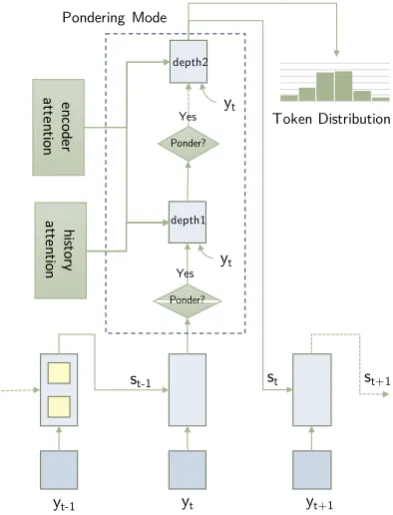
Figure 1: The illustration of our adaptive decoding. At-tention and pondering mode are only shown at time
t for brevity. Every decoder will go into pondering mode before the next timestep. The decoder cell is a stacked two-layer LSTM and initialized by the last for-ward states of the corresponeding encoder layer.
based on whether the model is acting in ponder-ing mode or not, which will be introduced later. We further apply a linear mapping and a softmax function to the concatenation ofst and attention
vectors to obtain the word predicting probabilities. We greedily decode the tokens at testing time.
Attention. We adopt two types of attention when decoding. One attends the decoder state upon encoder outputs and yield the input context vectorcet,
αet =Attn
st−1,
h
h(2)1 ,· · ·, h(2)m i
cet =Softmax(αdt) [s1,· · ·, st−1] (2)
where [·,·] means to vector stacking. The other similarly attends the hidden state to previous de-coder outputs, yielding the context vectorcdt over the decoding history. We use the bilinear function for encoder attention Attn(x, y) = xTWy +b, with trained parameters W and b, and use the dot production function for decoding history at-tentionsAttn(x, y) =xTy.
from (1), the model goes into the pondering mode. The output statestis further sent to a halting
mod-ule, which will generate a probabilityptpositively
correlated with the model uncertainty. We use an MLP with ReLU and sigmoid activations for the halting module. Then a choice is sampled from the Bernoulli distribution determined by pt. If it
chooses to continue, we again use (1) to update the state, meanwhile using the same embeddingytfor
the input.
s(tk)=fLSTM h
yt;cek;cdk;flag i
, s(tk−1) (3)
wheres0t =st,flag= 1, andcek, cdkare attention
vectors recomputed with s(tk−1) using (2). The model will keep pondering until it chooses to stop or reaches our limit ofk = 3. The final states(tk) will act as originalstin (1) for other modules.
2.2 Uncertainty Estimates
Since the halting module outputs a Bernoulli dis-tribution to guide the decoder, we have to pro-vides some uncertainty quantification for train-ing. Fortunately, Dropout (Srivastava et al.,2014) was proved a good uncertainty estimate (Gal and Ghahramani,2016). It’s simple and effective that neither the model nor the optimization algorithm would need to be changed. We left other estimates like those proposed inDong et al.(2018) in future work.
To estimate uncertainty with Dropout, we leave the model in training mode and thus the Dropout enabled. We run the forward pass of the equation (3) forFtimes with the same inputs. Output states are further sent to get token probabilities, q =
{p(ˆyt = yt+1 | st) | Θi}Fi=1, where Θi is the set
of all pertubated parameters affected by Dropout in the ith forward pass. We take the variance of q to reflect model uncertaintyU(st) = Var(q) as
suggested inGal and Ghahramani(2016). We dis-able the gradient propagation when computing the variance such that the gradient-based optimization is not influenced.
Note that the variance of a set of probabilities many not be quite large in practice, we thus rescale the variance to make it more numerically robust Un(st) = min(γ,Var(q))/γ, whereγ = 0.15 in
our case.
2.3 Learning
Our model consists of the Seq2Seq part (en-coder, de(en-coder, and attention) and the halting
mod-ule. For the former, we minimize the traditional cross entropy loss with gradient decent, Jent = E(x,y)logp(y|x).
We use the REINFORCE algorithm to opti-mize the halting module. The module acts as our policy network, by which the model consec-utively make decisions from the action spaceA=
{Ponder,Stop}. Each time the model make a choicea∈ A, the uncertainty of the seq2seq part is involved in the reward,
R(a|s(tk))
=
Un(s(tk)) if incorrect &a= 1
1−Un(s(tk)) if correct &a= 0
0 otherwise
(4)
wherea = 1means a Ponderchoice and a = 0 the other. We measure the correctness by examin-ing the greedily decoded token if arg maxyp(y | skt) = yt+1. The model will be rewarded for a
Stopaction if the prediction is correct, and for a Ponderaction if the prediction is incorrect. This is similar to the ponder cost of ACT that does not encourage excessive pondering steps.
3 Experiments
We compare our method with other models on two datasets. Our codes could be obtained via https://github.com/zxteloiv/AdaNSP.
3.1 Experimental Setup
Datasets. We use the preprocessed ATIS and Geo-Query datasets kindly provided byDong and La-pata (2018). All natural language sentences are converted to lower cases and stemmed with NLTK (Bird et al.,2009). Entity mentions like city codes, flight numbers are anonymized using numbered placeholders.
the ratio 0.2 during training. We runF = 5 for-ward passes before computing the variance. We use Adam (Kingma and Ba, 2015) for the opti-mizer, and use its default parameters from the pa-per.
Evaluation. We use the logical form accuracy as the evaluation metric, which is computed with parsed trees of the predictions and true labels. Two trees are considered identical as long as their struc-tures are the same, i.e., the order to sibling pred-icates doesn’t matter. We reuse the STree parser code fromDong and Lapata(2018).
3.2 Results and Analysis
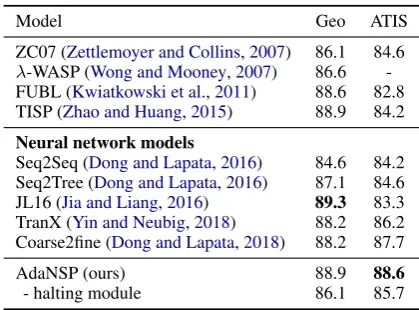
Our model outperforms the other comparative neural semantic parsers on this two set. We reuse the data fromDong and Lapata(2018) since the datasets are identical. Results are listed in Table 1. Our results are better than the SO-TAs (Dong and Lapata, 2018; Yin and Neubig,
2018) even without any intermediate representa-tions, whereas Coarse2fine defines a sketch and TranX uses ASDL for every type of target se-mantic sequences. We outperform Coarse2fine by 0.7% and 0.9% on GeoQuery and ATIS datasets respectively. AlthoughJia and Liang(2016) has a slightly better result on GeoQuery, they introduced a synchronous CFG to learn new and recombi-nated examples from the training data, which is a novel method of data augmentation and requires much human effort for preprocessing. For an abla-tion test, our degenerated model without the pon-dering part receives considerable performance de-creases by 2.8% and 2.9% on GeoQuery and ATIS datasets respectively.
Model Geo ATIS
ZC07 (Zettlemoyer and Collins,2007) 86.1 84.6
λ-WASP (Wong and Mooney,2007) 86.6 -FUBL (Kwiatkowski et al.,2011) 88.6 82.8 TISP (Zhao and Huang,2015) 88.9 84.2
Neural network models
Seq2Seq (Dong and Lapata,2016) 84.6 84.2 Seq2Tree (Dong and Lapata,2016) 87.1 84.6 JL16 (Jia and Liang,2016) 89.3 83.3 TranX (Yin and Neubig,2018) 88.2 86.2 Coarse2fine (Dong and Lapata,2018) 88.2 87.7
AdaNSP (ours) 88.9 88.6
[image:4.595.75.285.571.726.2]- halting module 86.1 85.7
Table 1: Results on GeoQuery and ATIS datasets
4 Related Work
Semantic Parsing. CCG or alignment-based Parsers (Zettlemoyer and Collins, 2005, 2007;
Kwiatkowski et al., 2010; Wong and Mooney,
2006,2007) try to model the correlation between semantic tokens and lexical meaning of natural language sentences. Methods based on depen-dency trees (Ge and Mooney, 2009;Liang et al.,
2011;Reddy et al., 2016) otherwise convert out-puts from an existing syntactic parser into seman-tic representations, which can be easily adopted in languages with much fewer resources than En-glish. Recently neural semantic parsers, especially under the encoder-decoder framework, also sprang up (Dong and Lapata,2016,2018;Jia and Liang,
2016;Xiao et al.,2016). To make the model aware of the underlying grammar of targets, people try to exert constraints on the decoder side by sketches, typing, grammars and runtime execution guides (Dong and Lapata, 2018; Krishnamurthy et al.,
2017;Groschwitz et al.,2018;Wang et al.,2018). Moreover, learning algorithms in SP like struc-tural learning and maximum marginal likelihood are combined with reinforcement algorithms (Guu et al.,2017;Iyyer et al.,2017;Misra et al.,2018).
Adaptive Computing. Adaptive Computation Times (ACT) was first proposed to adaptively learn the depth of RNN models from data (Graves,
2016). Skip-RNN (Campos et al., 2018) used a similar idea to equip a skipping mechanism with existing RNN cells, which adaptively skip some recurrent blocks along the computational graph and thus saved many computations. BlockDrop (Wu et al.,2018) also introduced the REINFORCE algorithm to jointly learn a dropping policy and discard some blocks of the ResNet by the policy network. Recently, Dehghani et al. (2019) pro-posed Universal Transformers (UT) as an alter-native form of the vanilla Transformer (Vaswani et al.,2017). It utilized ACT to control the recur-rence times of the basic layer blocks (same param-eters) in UT, instead of stacking different block layers in the vanilla Transformer. This helped UT mimic the inductive bias of RNNs and was shown Turing-completed, and has outperformed the vanilla Transformer in many tasks.
5 Conclusion
expert knowledge of intermediate structures of the target sequences, and achieves stronger results than the existing neural semantic parsers.
Acknowledgments
This work is supported by the Natural Sci-ence Foundation of China (No.61533018), the Natural Key R&D Program of China (No.2018YFC0830101), the Natural Science Foundation of China (No.61702512) and the independent research project of National Labo-ratory of Pattern Recognition. This work is also supported by Alibaba Group through Alibaba Innovative Research (AIR) Program, CCF-DiDi BigData Joint Lab and CCF-Tencent Open Research Fund.
References
Samy Bengio, Oriol Vinyals, Navdeep Jaitly, and Noam Shazeer. 2015. Scheduled Sampling for Se-quence Prediction with Recurrent Neural Networks, page 1171–1179. Curran Associates, Inc.
Steven Bird, Ewan Klein, and Edward Loper. 2009.
Natural language processing with Python: analyz-ing text with the natural language toolkit. ” O’Reilly Media, Inc.”.
V´ıctor Campos, Brendan Jou, Xavier Gir´o i Nieto, Jordi Torres, and Shih-Fu Chang. 2018. Skip RNN: Learning to skip state updates in recurrent neural networks. InInternational Conference on Learning Representations.
Bo Chen, Le Sun, and Xianpei Han. 2018. Sequence-to-action: End-to-end semantic graph generation for semantic parsing. Proceedings of the 56th Annual Meeting of the Association for Computational Lin-guistics (Volume 1: Long Papers), 1:766–777.
Mostafa Dehghani, Stephan Gouws, Oriol Vinyals, Jakob Uszkoreit, and Lukasz Kaiser. 2019. Uni-versal transformers. InInternational Conference on Learning Representations.
Li Dong and Mirella Lapata. 2016. Language to logi-cal form with neural attention. InProceedings of the 54th Annual Meeting of the Association for Compu-tational Linguistics (Volume 1: Long Papers), page 33–43. Association for Computational Linguistics.
Li Dong and Mirella Lapata. 2018. Coarse-to-fine de-coding for neural semantic parsing. Proceedings of the 56th Annual Meeting of the Association for Com-putational Linguistics (Volume 1: Long Papers), 1:731–742.
Li Dong, Chris Quirk, and Mirella Lapata. 2018. Con-fidence modeling for neural semantic parsing. Pro-ceedings of the 56th Annual Meeting of the Associa-tion for ComputaAssocia-tional Linguistics (Volume 1: Long Papers), 1:743–753.
Yarin Gal and Zoubin Ghahramani. 2016. Dropout as a bayesian approximation: Representing model uncer-tainty in deep learning. InInternational Conference on Machine Learning, page 1050–1059.
Ruifang Ge and Raymond J. Mooney. 2009. Learning a compositional semantic parser using an existing syntactic parser. InProceedings of the Joint Confer-ence of the 47th Annual Meeting of the ACL and the 4th International Joint Conference on Natural Lan-guage Processing of the AFNLP: Volume 2 - Volume 2, ACL ’09, page 611–619. Association for Compu-tational Linguistics.
Alex Graves. 2016. Adaptive computation time for recurrent neural networks. arXiv:1603.08983 [cs]. ArXiv: 1603.08983.
Jonas Groschwitz, Matthias Lindemann, Meaghan Fowlie, Mark Johnson, and Alexander Koller. 2018.
Amr dependency parsing with a typed semantic al-gebra. InProceedings of the 56th Annual Meeting of the Association for Computational Linguistics (Vol-ume 1: Long Papers), page 1831–1841. Association for Computational Linguistics.
Kelvin Guu, Panupong Pasupat, Evan Liu, and Percy Liang. 2017. From language to programs: Bridg-ing reinforcement learnBridg-ing and maximum marginal likelihood. InProceedings of the 55th Annual Meet-ing of the Association for Computational LMeet-inguistics (Volume 1: Long Papers), page 1051–1062. Associ-ation for ComputAssoci-ational Linguistics.
Mohit Iyyer, Wen-tau Yih, and Ming-Wei Chang. 2017.
Search-based neural structured learning for sequen-tial question answering.Proceedings of the 55th An-nual Meeting of the Association for Computational Linguistics (Volume 1: Long Papers), 1:1821–1831.
Robin Jia and Percy Liang. 2016. Data recombination for neural semantic parsing. InProceedings of the 54th Annual Meeting of the Association for Compu-tational Linguistics (Volume 1: Long Papers), page 12–22. Association for Computational Linguistics.
Diederik P. Kingma and Jimmy Ba. 2015. Adam: A method for stochastic optimization. ICLR 2015. ArXiv: 1412.6980.
Jayant Krishnamurthy, Pradeep Dasigi, and Matt Gard-ner. 2017. Neural semantic parsing with type con-straints for semi-structured tables. Proceedings of the 2017 Conference on Empirical Methods in Nat-ural Language Processing, page 1516–1526.
processing, page 1223–1233. Association for Com-putational Linguistics.
Tom Kwiatkowski, Luke Zettlemoyer, Sharon Goldwa-ter, and Mark Steedman. 2011. Lexical generaliza-tion in ccg grammar inducgeneraliza-tion for semantic pars-ing. InProceedings of the Conference on Empiri-cal Methods in Natural Language Processing, page 1512–1523. Association for Computational Linguis-tics.
Percy Liang, Michael I. Jordan, and Dan Klein. 2011.
Learning dependency-based compositional seman-tics. In Proceedings of the 49th Annual Meet-ing of the Association for Computational LMeet-inguis- Linguis-tics: Human Language Technologies-Volume 1, page 590–599. Association for Computational Lin-guistics.
Dipendra Misra, Ming-Wei Chang, Xiaodong He, and Wen-tau Yih. 2018. Policy shaping and general-ized update equations for semantic parsing from de-notations. In Proceedings of the 2018 Conference on Empirical Methods in Natural Language Pro-cessing, page 2442–2452. Association for Compu-tational Linguistics.
Siva Reddy, Oscar T¨ackstr¨om, Michael Collins, Tom Kwiatkowski, Dipanjan Das, Mark Steedman, and Mirella Lapata. 2016. Transforming dependency structures to logical forms for semantic parsing.
Transactions of the Association for Computational Linguistics, 4(0):127–140.
Nitish Srivastava, Geoffrey Hinton, Alex Krizhevsky, Ilya Sutskever, and Ruslan Salakhutdinov. 2014. Dropout: A simple way to prevent neural networks from overfitting. The Journal of Machine Learning Research, 15(1):1929–1958.
Ashish Vaswani, Noam Shazeer, Niki Parmar, Jakob Uszkoreit, Llion Jones, Aidan N. Gomez, Lukasz Kaiser, and Illia Polosukhin. 2017. Attention is all you need. arXiv:1706.03762 [cs]. ArXiv: 1706.03762.
Chenglong Wang, Kedar Tatwawadi, Marc Brockschmidt, Po-Sen Huang, Yi Mao, Olek-sandr Polozov, and Rishabh Singh. 2018. Robust text-to-sql generation with execution-guided decod-ing. arXiv:1807.03100 [cs]. ArXiv: 1807.03100.
Yuk Wah Wong and Raymond J. Mooney. 2006. Learn-ing for semantic parsLearn-ing with statistical machine translation. InProceedings of the main conference on Human Language Technology Conference of the North American Chapter of the Association of Com-putational Linguistics, page 439–446. Association for Computational Linguistics.
Yuk Wah Wong and Raymond J. Mooney. 2007.
Learning synchronous grammars for semantic pars-ing with lambda calculus. In Annual Meeting-Association for computational Linguistics, vol-ume 45, page 960.
Zuxuan Wu, Tushar Nagarajan, Abhishek Kumar, Steven Rennie, Larry S. Davis, Kristen Grauman, and Rogerio Feris. 2018. Blockdrop: Dynamic in-ference paths in residual networks. In The IEEE Conference on Computer Vision and Pattern Recog-nition (CVPR).
Chunyang Xiao, Marc Dymetman, and Claire Gardent. 2016. Sequence-based structured prediction for se-mantic parsing. Proceedings Association For Com-putational Linguistics, Berlin.
Pengcheng Yin and Graham Neubig. 2017. A syntac-tic neural model for general-purpose code genera-tion. InProceedings of the 55th Annual Meeting of the Association for Computational Linguistics (Vol-ume 1: Long Papers), pages 440–450. Association for Computational Linguistics.
Pengcheng Yin and Graham Neubig. 2018. Tranx: A transition-based neural abstract syntax parser for se-mantic parsing and code generation. In Proceed-ings of the 2018 Conference on Empirical Methods in Natural Language Processing: System Demon-strations, page 7–12. Association for Computational Linguistics.
Tao Yu, Zifan Li, Zilin Zhang, Rui Zhang, and Dragomir Radev. 2018a. Typesql: Knowledge-based type-aware neural text-to-sql generation. Pro-ceedings of the 2018 Conference of the North Amer-ican Chapter of the Association for Computational Linguistics: Human Language Technologies, Vol-ume 2 (Short Papers), 2:588–594.
Tao Yu, Michihiro Yasunaga, Kai Yang, Rui Zhang, Dongxu Wang, Zifan Li, and Dragomir Radev. 2018b. Syntaxsqlnet: Syntax tree networks for com-plex and cross-domain text-to-sql task. In Proceed-ings of the 2018 Conference on Empirical Methods in Natural Language Processing, page 1653–1663. Association for Computational Linguistics.
Luke S. Zettlemoyer and Michael Collins. 2005.
Learning to map sentences to logical form: Struc-tured classification with probabilistic categorial grammars. InProceedings of the Twenty-First Con-ference on Uncertainty in Artificial Intelligence, UAI’05, page 658–666. AUAI Press. Event-place: Edinburgh, Scotland.
Luke S. Zettlemoyer and Michael Collins. 2007. On-line learning of relaxed ccg grammars for parsing to logical form. InEMNLP-CoNLL, page 678–687.
Kai Zhao and Liang Huang. 2015. Type-driven in-cremental semantic parsing with polymorphism. In