
1668
The Risk of Racial Bias in Hate Speech Detection
Maarten Sap♦ Dallas Card♣ Saadia Gabriel♦ Yejin Choi♦♥ Noah A. Smith♦♥
♦Paul G. Allen School of Computer Science & Engineering, University of Washington, Seattle, USA
♣Machine Learning Department, Carnegie Mellon University, Pittsburgh, USA
♥Allen Institute for Artificial Intelligence, Seattle, USA
Abstract
We investigate how annotators’ insensitivity to differences in dialect can lead to racial bias in automatic hate speech detection mod-els, potentially amplifying harm against mi-nority populations. We first uncover unex-pected correlations between surface markers of African American English (AAE) and rat-ings of toxicity in several widely-used hate speech datasets. Then, we show that models trained on these corpora acquire and propagate these biases, such that AAE tweets and tweets by self-identified African Americans are up to two times more likely to be labelled as of-fensive compared to others. Finally, we pro-pose dialect and race priming as ways to re-duce the racial bias in annotation, showing that when annotators are made explicitly aware of an AAE tweet’s dialect they are significantly less likely to label the tweet as offensive.
1 Introduction
Toxic language (e.g., hate speech, abusive speech, or other offensive speech) primarily targets mem-bers of minority groups and can catalyze real-life violence towards them (O’Keeffe et al.,2011;
Cleland, 2014; Mozur, 2018). Social media
platforms are under increasing pressure to re-spond (Trindade, 2018), but automated removal of such content risks further suppressing already-marginalized voices (Yasin, 2018; Dixon et al., 2018). Thus, great care is needed when develop-ing automatic toxic language identification tools.
The task is especially challenging because what is considered toxic inherently depends on social context (e.g., speaker’s identity or dialect). In-deed, terms previously used to disparage com-munities (e.g., “n*gga”, “queer”) have been re-claimed by those communities while remaining offensive when used by outsiders (Rahman,2012). Figure 1 illustrates how phrases in the African American English dialect (AAE) are labelled by a publicly available toxicity detection tool as much
crowdsourcing
PerspectiveAPI Toxicity score
I saw him yesterday.
What's up, bro!
I saw his ass
yesterday. 95%
6% Wussup,
n*gga! 90%
7%
Wussup, n*gga!
classifier Non-toxic tweets
[image:1.595.310.525.205.349.2](per Spears, 1998)
Figure 1: Phrases in African American English (AAE), their non-AAE equivalents (from Spears,1998), and toxicity scores fromPerspectiveAPI.com. Per-spective is a tool from Jigsaw/Alphabet that uses a convolutional neural network to detect toxic language, trained on crowdsourced data where annotators were asked to label the toxicity of text without metadata.
more toxic than general American English equiv-alents, despite their being understood as non-toxic by AAE speakers (Spears,1998, see§2).
In this work, we first empirically characterize the racial bias present in several widely used Twit-ter corpora annotated for toxic content, and quan-tify the propagation of this bias through models trained on them (§3). We establish strong asso-ciations between AAE markers (e.g., “n*ggas”, “ass”) and toxicity annotations, and show that models acquire and replicate this bias: in other corpora, tweets inferred to be in AAE and tweets from self-identifying African American users are more likely to be classified as offensive.
Our findings show that existing approaches to toxic language detection have racial biases, and that text alone does not determine offensiveness. Therefore, we encourage paying greater atten-tion to the confounding effects of dialect and a speaker’s social identity (e.g., race) so as to avoid unintended negative impacts.
2 Race and Dialect on Social Media
Since previous research has exposed the potential for other identity-based biases in offensive lan-guage detection (e.g., gender bias; Park et al., 2018), here we investigate racial bias against speech by African Americans, focusing on Twit-ter as it is a particularly important space for Black activism (Williams and Domoszlai,2013;Freelon et al.,2016;Anderson et al.,2018). Race is a com-plex, multi-faceted social construct (Sen and Wa-sow, 2016) that has correlations with geography, status, dialect, and more. As Twitter accounts typ-ically do not have self-reported race information, researchers rely on various correlates of race as proxies. We use the African American English di-alect(AAE) as a proxy for race. AAE is a widely used dialect of English that is common among, but not unique to, those who identify as African Amer-ican,1 and is often used in written form on social media to signal a cultural identity (Green, 2002; Edwards,2004;Florini,2014).
Dialect estimation In this work, we infer
di-alect using a lexical detector of words associated with AAE or white-aligned English. We use the topic model from Blodgett et al. (2016), which was trained on 60M geolocated tweets and relies on US census race/ethnicity data as topics. The model yields probabilities of a tweet being AAE (pAAE) or White-aligned English (pwhite).2
3 Biases in Toxic Language Datasets
To understand the racial and dialectic bias in toxic language detection, we focus our analyses on two corpora of tweets (Davidson et al., 2017;Founta
et al., 2018) that are widely used in hate speech
detection (Park et al.,2018;van Aken et al.,2018;
Kapoor et al., 2018; Alorainy et al., 2018; Lee
1Of course, many African Americans might not use AAE
in every context, or at all. For further discussion of AAE, please refer toBlodgett et al.(2016).
2The model yields AAE, Hispanic, Asian/Other and
White-aligned dialect probabilities, but for the purpose of our study we only focus on AAE and White-aligned dialects.
category count AAE corr.
D
W
M
W
1
7 hate speech 1,430 −0.057
offensive 19,190 0.420
none 4,163 −0.414
total 24,783
F
D
C
L
1
8
hateful 4,965 0.141
abusive 27,150 0.355
spam 14,030 −0.102
none 53,851 −0.307
[image:2.595.325.507.62.219.2]total 99,996
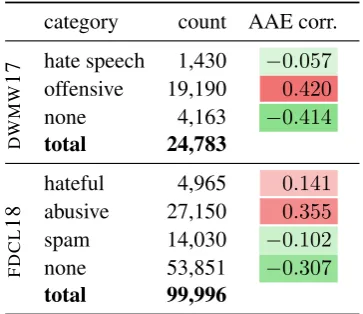
Table 1: Number of tweets in each category, and cor-relation with AAE (Pearsonr,p0.001). We assign tweets to categories based on the label forFDCL18, and majority class forDWMW17. Correlations are colored for interpretability.
et al.,2018;Waseem et al.,2018).3 Different pro-tocols were used to collect the tweets in these cor-pora, but both were annotated by Figure-Eight4 crowdworkers for various types of toxic language, shown in Table1.
DWMW17 (Davidson et al.,2017) includes an-notations of 25K tweets ashate speech,offensive (but not hate speech), or none. The authors col-lected data from Twitter, starting with 1,000 terms from HateBase (an online database of hate speech terms) as seeds, and crowdsourced at least three annotations per tweet.
FDCL18 (Founta et al., 2018) collects 100K tweets annotated with four labels: hateful, abu-sive,spamornone. Authors used a bootstrapping approach to sampling tweets, which were then la-belled by five crowdsource workers.
3.1 Data Bias
To quantify the racial bias that can arise during the annotation process, we investigate the correlation between toxicity annotations and dialect probabil-ities given byBlodgett et al.(2016).
Table 1 shows the Pearson r correlation be-tweenpAAE and each toxicity category. For both
datasets, we uncover strong associations between
3Our findings also hold for the widely used data from
Waseem and Hovy(2016). However, because of severe limi-tations of that dataset (seeSchmidt and Wiegand,2017; Klu-bika and Fernandez,2018), we relegate those analyses to sup-plementary (§A.3).
Within dataset proportions Proportions on DEMOGRAPHIC16 Proportions on USERLEVELRACE18
D
W
M
W
1
7 % false identification
Group Acc. None Offensive Hate
AAE 94.3 1.1 46.3 0.8
White 87.5 7.9 9.0 3.8
Overall 91.4 2.9 17.9 2.3
% false identification
Group Acc. None Abusive Hateful
AAE 81.4 4.2 26.0 1.7
White 82.7 30.5 4.5 0.8
Overall 81.4 20.9 6.6 0.8
0 25 50 75 100 AAE
White Overall
Dialect
58.1 38.7
79.3 18.5
74.0 23.3
None Offensive Hate
0 25 50 75 100 AA
White Overall
Self-reported race
77.1 20.0
84.2 13.5
83.0 14.5
None Offensive Hate
F
D
C
L
1
8
0 25 50 75 100 AAE
White Overall
Dialect
56.8 24.6
77.9 11.4
72.1 14.4
Spam None Abusive Hateful
0 25 50 75 100 AA
White Overall
Self-reported race
70.6 10.8
75.5 7.4
74.6 7.9
[image:3.595.72.525.61.215.2]Spam None Abusive Hateful
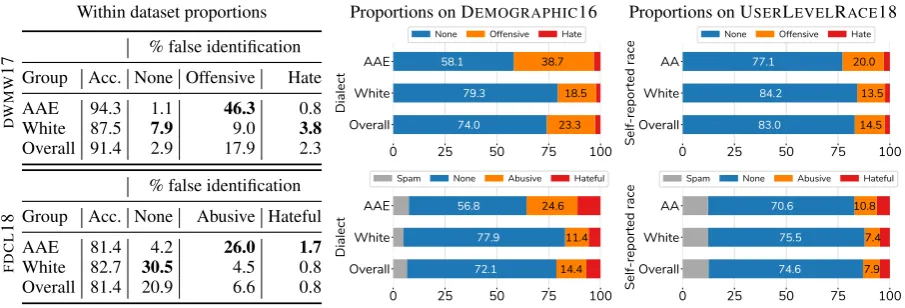
Figure 2:Left: classification accuracy and per-class rates of false positives (FP) on test data for models trained on DWMW17 andFDCL18, where the group with highest rate of FP is bolded. Middle and right: average probabil-ity mass of toxicprobabil-ity classes in DEMOGRAPHIC16 and USERLEVELRACE18, respectively, as given by classifiers trained on DWMW17 (top) and FDCL18 (bottom). Proportions are shown for AAE, White-aligned English, and overall (all tweets) for DEMOGRAPHIC16, and for self-identified White authors, African American authors (AA), and overall for USERLEVELRACE18.
inferred AAE dialect and various hate speech cat-egories, specifically the “offensive” label from DWMW17 (r = 0.42) and the “abusive” label fromFDCL18 (r = 0.35), providing evidence that dialect-based bias is present in these corpora. As additional analyses, we examine the interaction between unigrams indicative of dialect and hate speech categories, shown in§A.1.
3.2 Bias Propagation through Models
To further quantify the impact of racial biases in hate speech detection, we investigate how these bi-ases are acquired by predictive models. First, we report differences in rates of false positives (FP) between AAE and White-aligned dialect groups
for models trained on DWMW17 or FDCL18.
Then, we apply these models to two reference Twitter corpora, described below, and compute av-erage rates of reported toxicity, showing how these biases generalize to other data.5
DEMOGRAPHIC16 (Blodgett et al.,2016)
con-tains 56M tweets (2.8M users) with dialect es-timated using a demographic-aware topic model that leverages census race/ethnicity data and geo-coordinates of the user profile. As recommended, we assign dialect labels to tweets with dialect probabilities greater than 80%.
5We assume
a priorithat the average tweet is not inher-ently more toxic in a particular dialect. Assessing the veracity of this assumption requires a deep understanding of socio-cultural norms of profane and toxic speech.
USERLEVELRACE18 (Preot¸iuc-Pietro and Un-gar,2018) is a corpus of 5.4M tweets, collected from 4,132 survey participants (3,184 White, 374 AA) who reported their race/ethnicity and Twitter user handle. For this dataset, we compare differ-ences in toxicity predictions byself-reported race, instead of inferring message-level dialect.6
For each of the two toxic language corpora, we train a classifier to predict the toxicity label of a tweet. Using a basic neural attention architecture (Wang et al.,2016;Yang et al.,2016), we train a classifier initialized with GloVe vectors ( Penning-ton et al.,2014) to minimize the cross-entropy of the annotated class conditional on text,x:
p(class|x)∝exp(Woh+bo), (1)
withh=f(x), wheref is a BiLSTM with atten-tion, followed by a projection layer to encode the tweets into an H-dimensional vector.7 We refer the reader to the appendix for experimental details and hyperparameters (§A.2).
Results Figure 2 (left) shows that while both
models achieve high accuracy, the false positive rates (FPR) differ across groups for several toxic-ity labels. TheDWMW17 classifier predicts almost 50% of non-offensive AAE tweets as being offen-sive, andFDCL18 classifier shows higher FPR for
6Note that lexical dialect inferences of AAE (p
AAE) sig-nificantly correlate with both the AAE group from DEMO
-GRAPHIC16 (Pearsonr=0.61,p0.001) and self-reported AA race from USERLEVELRACE18 (Pearsonr=0.21,p
0.001).
7In preliminary experiments, our findings held regardless
the “Abusive” and “Hateful” categories for AAE tweets. Additionally, both classifiers show strong tendencies to label White tweets as “none”. These discrepancies in FPR across groups violate the equality of opportunity criterion, indicating dis-criminatory impact (Hardt et al.,2016).
We further quantify this potential discrimina-tion in our two reference Twitter corpora. Figure2 (middle and right) shows that the proportions of tweets classified as toxic also differ by group in these corpora. Specifically, in DEMOGRAPHIC16, AAE tweets are more than twice as likely to be labelled as “offensive” or “abusive” (by classifiers trained on DWMW17 and FDCL18, respectively). We show similar effects on USERLEVELRACE18, where tweets by African American authors are 1.5 times more likely to be labelled “offensive”. Our findings corroborate the existence of racial bias in the toxic language datasets and confirm that mod-els propagate this bias when trained on them.8
4 Effect of Dialect
To study the effect of dialect information on rat-ings of offensiveness, we run a small controlled experiment on Amazon Mechanical Turk where we prime annotators to consider the dialect and race of Twitter users. We ask workers to deter-mine whether a tweet (a) is offensiveto them, and (b) could be seen as offensive to anyone. In the dialect priming condition, we explicitly include the tweet’s dialect as measured byBlodgett et al. (2016), as well as extra instructions priming work-ers to think of tweet dialect as a proxy for the au-thor’s race. In therace primingcondition, we en-courage workers to consider the likely racial back-ground of a tweet’s author, based on its inferred dialect (e.g., an AAE tweet is likely authored by an African American Twitter user; see§A.5for the task instructions). For all tasks, we ask annotators to optionally report gender, age, race, and political leaning.9
With a distinct set of workers for each condi-tion, we gather five annotations apiece for a sam-ple of 1,351 tweets stratified by dialect, toxicity category, and dataset (DWMW17 and FDCL18).10
8
As noted byChung(2019), the PerspectiveAPI displays similar racial biases shown in the appendix (§A.4).
9This study was approved by the Institutional Review
Board (IRB) at the University of Washington.
10Annotations in the control setting agreed moderately
with toxicity labels inDWMW17 andFDCL18 (Pearsonr= 0.592 andr= 0.331, respectively;p0.001).
67.0 64.0 60.6 41.4
44.1 32.3
15.0 12.8 12.5 28.4 22.7 25.1
18.0 23.2 26.9 30.1 33.1 42.5
0 20 40 60 80 100
race dialect control race dialect control
offensive to you offensive to anyone
[image:4.595.314.518.69.209.2]no maybe yes
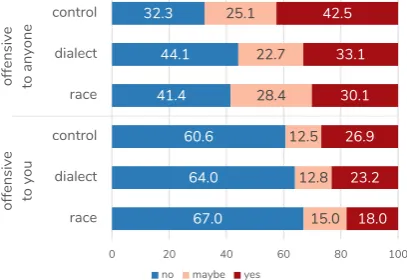
Figure 3: Proportion (in %) of offensiveness annota-tions of AAE tweets in control, dialect, and race ing conditions. Results show that dialect and race prim-ing significantly reduces an AAE tweet’s likelihood of being labelled offensive (p0.001).
Despite the inherent subjectivity of these ques-tions, workers frequently agreed about a tweet be-ing offensive to anyone (76% pairwise agreement,
κ=0.48) or to themselves (74% p.a.,κ=0.30).
Results Figure3shows that priming workers to
think about dialect and race makes them signifi-cantly less likely to label an AAE tweet as (po-tentially) offensive to anyone. Additionally, race priming makes workers less likely to find AAE tweets offensive to them.
To confirm these effects, we compare the means of the control condition and treatment condi-tions,11 and test significance with a ttest. When rating offensiveness to anyone, the mean for con-trol condition (Mc = 0.55) differs from dialect
(Md = 0.44) and race (Mr = 0.44) conditions significantly (p 0.001). For ratings of offen-siveness to workers, only the difference in means for control (Mc=0.33) and race (Md=0.25) con-ditions is significant (p0.001).
Additionally, we find that overall, annotators are substantially more likely to rate a tweet as be-ing offensive tosomeone, than to rate it as offen-sive to themselves, suggesting that people recog-nize the subjectivity of offensive language.
Our experiment provide insight into racial bias in annotations and shows the potential for re-ducing it, but several limitations apply, includ-ing the skewed demographics of our worker pool (75% self-reported White). Additionally, research suggests that motivations to not seem prejudiced
11We convert the offensiveness labels to real numbers (0:
could buffer stereotype use, which could in turn influence annotator responses (Plant and Devine,
1998;Moskowitz and Li,2011).
5 Related Work
A robust body of work has emerged trying to ad-dress the problem of hate speech and abusive lan-guage on social media (Schmidt and Wiegand, 2017). Many datasets have been created, but most are either small-scale pilots (∼100 instances;
Kwok and Wang, 2013; Burnap and Williams,
2015; Zhang et al., 2018), or focus on other
domains (e.g., Wikipedia edits; Wulczyn et al.,
2017). In addition to DWMW17 and FDCL18,
published Twitter corpora include Golbeck et al. (2017), which uses a somewhat restrictive defini-tion of abuse, andRibeiro et al. (2018), which is focused on network features, rather than text.
Past work on bias in hate speech datasets has exclusively focused on finding and removing bias against explicit identity mentions (e.g., woman, atheist, queer;Park and Fung,2017;Dixon et al., 2018). In contrast, our work shows how insensitiv-ity to dialect can lead to discrimination against mi-norities, even without explicit identity mentions.
6 Conclusion
We analyze racial bias in widely-used corpora of annotated toxic language, establishing corre-lations between annotations of offensiveness and the African American English (AAE) dialect. We show that models trained on these corpora prop-agate these biases, as AAE tweets are twice as likely to be labelled offensive compared to others. Finally, we introduce dialect and race priming, two ways to reduce annotator bias by highlighting the dialect of a tweet in the data annotation, and show that it significantly decreases the likelihood of AAE tweets being labelled as offensive. We find strong evidence that extra attention should be paid to the confounding effects of dialect so as to avoid unintended racial biases in hate speech de-tection.
Acknowledgments
The authors thank Dan Jurafsky, Emily Bender, Emily Gade, Tal August, Wesley McClean, Victor Zhong, and Laura Vianna, as well as anonymous reviewers, for helpful feedback. This work was in part supported by NSF grant IIS-1714566.
References
Betty van Aken, Julian Risch, Ralf Krestel, and Alexander L¨oser. 2018. Challenges for toxic com-ment classification: An in-depth error analysis.
CoRR, abs/1809.07572.
Wafa Alorainy, Pete Burnap, Han Liu, and Matthew Williams. 2018. Cyber hate classification: ’other-ing’ language and paragraph embedding. CoRR, abs/1801.07495.
Monica Anderson, Skye Toor, Lee Rainie, and Aaron Smith. 2018. Activism in the social media
ages. http://www.pewinternet.org/
2018/07/11/activism-in-the-social-media-age/. Accessed: 2019-03-01.
Su Lin Blodgett, Lisa Green, and Brendan O’Connor. 2016. Demographic dialectal variation in social me-dia: A case study of African-American english. In
EMNLP.
Pete Burnap and Matthew L. Williams. 2015. Cyber hate speech on Twitter: An application of machine classification and statistical modeling for policy and decision making. Policy & Internet, 7:223–242.
Anna Chung. 2019. How automated tools dis-criminate against black language. https:// onezero.medium.com/how-automated- tools-discriminate-against-black-language-2ac8eab8d6db. Accessed: 2019-03-02.
Jamie Cleland. 2014. Racism, football fans, and online message boards: How social media has added a new dimension to racist discourse in English football. J. Sport Soc. Issues, 38(5):415–431.
Thomas Davidson, Dana Warmsley, Michael W. Macy, and Ingmar Weber. 2017. Automated hate speech detection and the problem of offensive language. In
ICWSM.
Lucas Dixon, John Li, Jeffrey Sorensen, Nithum Thain, and Lucy Vasserman. 2018. Measuring and mitigat-ing unintended bias in text classification. In Pro-ceedings of Conference on AI, Ethics, and Society.
Walter F. Edwards. 2004. African American Vernacu-lar English: phonology. InA Handbook of Varieties of English: Morphology and Syntax.
Sarah Florini. 2014. Tweets, tweeps, and signifyin’: Communication and cultural performance on “Black Twitter”. Television & New Media, 15(3):223–237.
Deen Freelon, Charlton D. McIlwain, and Meredith D. Clark. 2016. Beyond the
hash-tags.
http://cmsimpact.org/wp-content/uploads/2016/03/beyond_ the_hashtags_2016.pdf. Accessed: 2019-03-01.
Jennifer Golbeck, Zahra Ashktorab, Rashad O. Banjo, Alexandra Berlinger, Siddharth Bhagwan, Cody Buntain, Paul Cheakalos, Alicia A. Geller, Quint Gergory, Rajesh Kumar Gnanasekaran, Raja Ra-jan Gunasekaran, Kelly M. Hoffman, Jenny Hot-tle, Vichita Jienjitlert, Shivika Khare, Ryan Lau, Marianna J. Martindale, Shalmali Naik, Heather L. Nixon, Piyush Ramachandran, Kristine M. Rogers, Lisa Rogers, Meghna Sardana Sarin, Gaurav Sha-hane, Jayanee Thanki, Priyanka Vengataraman, Zi-jian Wan, and Derek Michael Wu. 2017. A large labeled corpus for online harassment research. In
WebSci, pages 229–233. ACM.
Lisa Green. 2002. African American English: A Lin-guistic Introduction, 8.3.2002 edition edition. Cam-bridge University Press.
Moritz Hardt, Eric Price, and Nati Srebro. 2016. Equality of opportunity in supervised learning. In
NeurIPS.
Raghav Kapoor, Yaman Kumar, Kshitij Rajput, Ra-jiv Ratn Shah, Ponnurangam Kumaraguru, and Roger Zimmermann. 2018. Mind your language: Abuse and offense detection for code-switched lan-guages. CoRR, abs/1809.08652.
Filip Klubika and Raquel Fernandez. 2018. Examining a hate speech corpus for hate speech detection and popularity prediction. InLREC.
Irene Kwok and Yuzhou Wang. 2013. Locate the hate: Detecting tweets against blacks. InAAAI.
Younghun Lee, Seunghyun Yoon, and Kyomin Jung. 2018. Comparative studies of detecting abusive lan-guage on twitter. CoRR, abs/1808.10245.
Gordon B. Moskowitz and Peizhong Li. 2011. Egali-tarian goals trigger stereotype inhibition: A proac-tive form of stereotype control. J. Exp. Soc. Psy-chol., 47(1):103–116.
Paul Mozur. 2018. A genocide incited on Face-book, with posts from Myanmar’s military. https://www.nytimes.com/2018/10/ 15/technology/myanmar-facebook-genocide.html. Accessed: 2018-12-6.
Gwenn Schurgin O’Keeffe, Kathleen Clarke-Pearson, and Council on Communications and Media. 2011. The impact of social media on children, adolescents, and families. Pediatrics, 127(4):800–804.
Ji Ho Park and Pascale Fung. 2017.One-step and two-step classification for abusive language detection on Twitter. InProceedings of the Workshop on Abusive Language Online.
Ji Ho Park, Jamin Shin, and Pascale Fung. 2018. Re-ducing gender bias in abusive language detection. In
EMNLP.
Jeffrey Pennington, Richard Socher, and Christo-pher D. Manning. 2014. GloVe: Global vectors for word representation. InEMNLP.
E. Ashby Plant and Patricia G. Devine. 1998. Inter-nal and exterInter-nal motivation to respond without prej-udice. J. Pers. Soc. Psychol., 75(3):811–832.
Daniel Preot¸iuc-Pietro and Lyle Ungar. 2018. User-level race and ethnicity predictors from Twitter text. InCOLING.
Jacquelyn Rahman. 2012. The N word: Its history and use in the African American community. Journal of English Linguistics, 40(2):137–171.
Manoel Horta Ribeiro, Pedro H. Calais, Yuri A. San-tos, Virg´ılio A. F. Almeida, and Wagner Meira Jr. 2018. Characterizing and detecting hateful users on Twitter. InICWSM.
Anna Schmidt and Michael Wiegand. 2017. A survey on hate speech detection using natural language pro-cessing. InProceedings of the Workshop on NLP for Social Media.
Maya Sen and Omar Wasow. 2016. Race as a bundle of sticks: Designs that estimate effects of seemingly immutable characteristics. Annual Review of Politi-cal Science, 19.
Arthur K Spears. 1998. African-American language use: Ideology and so-called obscenity. In Salikoko S Mufwene, John R Rickford, Guy Bailey, and John Baugh, editors, African-American English: Struc-ture, History and Use, pages 226–250. Routledge New York.
Luiz Val´erio P Trindade. 2018. On the frontline: The rise of hate speech and racism on social media. https://discoversociety.org/ 2018/09/04/on-the-frontline-the- rise-of-hate-speech-and-racism-on-social-media/. Accessed: 2018-12-6.
Yequan Wang, Minlie Huang, xiaoyan zhu, and Li Zhao. 2016. Attention-based LSTM for aspect-level sentiment classification. InEMNLP.
Zeerak Waseem and Dirk Hovy. 2016. Hateful sym-bols or hateful people? Predictive features for hate speech detection on Twitter. InNAACL Student Re-search Workshop.
Zeerak Waseem, James Thorne, and Joachim Bingel. 2018. Bridging the gaps: Multi task learning for domain transfer of hate speech detection. In Jennifer Golbeck, editor, Online Harassment, pages 29–55. Springer International Publishing, Cham.
Ellery Wulczyn, Nithum Thain, and Lucas Dixon. 2017. Ex machina: Personal attacks seen at scale. InWWW.
Zichao Yang, Diyi Yang, Chris Dyer, Xiaodong He, Alexander J. Smola, and Eduard H. Hovy. 2016. Hi-erarchical attention networks for document classifi-cation. InNAACL.
Danyaal Yasin. 2018. Black and banned:
Who is free speech for? https:
//www.indexoncensorship.org/2018/ 09/black-and-banned-who-is-free-speech-for/. Accessed: 2018-12-6.
Ziqi Zhang, David Robinson, and Jonathan A. Tep-per. 2018. Detecting hate speech on Twitter using a convolution-GRU based deep neural network. In
(FDCL18 –abusive) (FDCL18 –hateful)
[image:8.595.93.504.61.398.2](DWMW17 –offensive) (DWMW17 –hate speech)
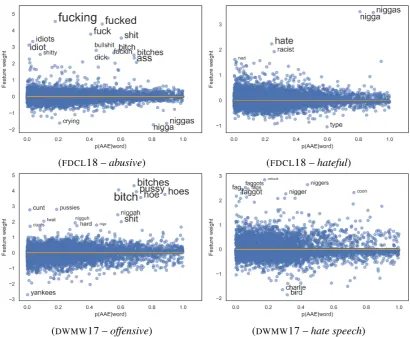
Figure 4: Feature weights learned byl2-regularized multiclass logistic regression models with unigram features,
plotted againstpAAEfor each term, based onBlodgett et al.(2016). Top: weights for predictingabusive(left) and
hateful(right) from a model trained onFDCL18. Bottom: weights for predictingoffensive(left) andhate speech
(right) from a model trained onDWMW17. Labels are shown for the most heavily-weighted terms, with label size proportional to the log count of the term in validation data. Note: “c*nt”, “n*gger,” “f*ggot,” and their variations are considered sexist, racist, and homophobic slurs, respectively, and are predictive of hate speechDWMW17.
A Appendix
We present further evidence of racial bias in hate speech detection in this appendix.
Disclaimer:due to the nature of this research, fig-ures and tables contain potentially offensive or up-setting terms (e.g. racist, sexist, or homophobic slurs). We do not censor these terms, as they are illustrative of important features in the datasets.
A.1 Lexical Exploration of Data Bias
To better understand the correlations between in-ferred dialect and the annotated hate speech cat-egories (abusive, offensive, etc.) we use simple linear models to look for influential terms. Specifi-cally, we trainl2-regularized multiclass logistic re-gression classifiers operating on unigram features for each ofDWMW17 andFDCL18 (tuning the reg-ularization strength on validation data). We then use theBlodgett et al.(2016) model to inferpAAE
for each individual vocabulary term in isolation. While this does not completely explain the corre-lations observed in section §3.1, it does allow us to identify individual words that are both strongly associated with AAE, and highly predictive of par-ticular categories.
Figure 4 shows the feature weights and pAAE
for each word in the models for FDCL18 (top) and DWMW17 (bottom), with the most highly weighted terms identified on the plots. The size of words indicates how common they are (propor-tional to the log of the number of times they appear in the corpus).
on DEMOGRAPHIC16 on USERLEVELRACE18
WH16 % false identification
Group Acc. Racism Sexism None
AAE 83.8 0.9 2.8 32.5
White 83.5 3.2 2.7 34.6
Overall 84.1 2.7 3.0 35.9 0 25 50 75 100
AAE White Overall
Dialect
81.1 17.5
90.5 8.2
88.8 9.9
None Sexism Racism
0 25 50 75 100 AA
White Overall
Self-reported race
88.9 10.0
90.5 8.4
90.3 8.6
[image:9.595.80.520.65.147.2]None Sexism Racism
Figure 5:Left: classification accuracy and per-class rates of false positives (FP) on test data for the model trained onWH16.Middle and right: average probability mass of toxicity classes in DEMOGRAPHIC16 and USERLEVEL -RACE18, respectively, as given by theWH16 classifier. As in Figure2, proportions are shown for AAE, White-aligned English, and overall (all tweets) for DEMOGRAPHIC16, and for self-identified White authors, African American authors (AA), and overall for USERLEVELRACE18.
strongly associated with AAE (and their offen-siveness depends on speaker and context;Spears, 1998). Because these terms are both frequent and highly weighted, any simple model trained on this data would indiscriminately label large numbers of tweets containing either of these terms as “hate-ful”.
By contrast, the terms that are highly predictive of “hate speech” in DWMW17 (i.e., slurs) partly reflect the HateBase lexicon used in constructing this dataset, and the resulting emphasis is differ-ent. (We also see artefacts of the dataset construc-tion in the negative weights placed on “charlie”, “bird”, and “yankees” — terms which occur in HateBase, but have harmless primary meanings.)
To verify that no single term is responsible for the correlations reported in section§3.1, we con-sider each word in the vocabulary in turn, and compute correlations excluding tweets containing that term. The results of this analysis (not shown) find that almost all of the correlations we observe are robust. For example, the correlation between
pAAEand “abusive” inFDCL18 increases the most
if we drop tweets containing “fucking” (highly positively weighted, but non-AAE aligned), and decreases slightly if we drop terms like “ass” or “bitch”. The one exception is the correlation be-tween “hateful” and pAAE in FDCL18: if we ex-clude tweets which contain “n*gga” or “n*ggas”, the correlation drops to r=0.047. However, this also causes the correlation between pAAE and “abusive” to increase tor=0.376.
A.2 Experimental Details for Classification
For each dataset, we randomly split the data into train/dev./test sets (73/12/15%), and perform early stopping when classification accuracy on dev. data stops increasing. ForDWMW17, which has
multi-category count AAE corr.
racism 1,976 −0.117
sexism 3,430 0.168
none 11,501 −0.064
total 16,907
Table 2: Data statistics inWH16, as well as the Pearson rcorrelations with the labels and inferred AAE dialect. All correlations arep0.001.
ple annotations per instance, we use the majority class as the label, dropping instances that are tied. For both datasets, we preprocess the text using an adapted version of the script for Twitter GloVe vectors.12 In our experiments, we setH= 64, and use a vocabulary size of|V|= 19k and|V|= 74k for DWMW17 and FDCL18, respectively, and ini-tialize the embedding layer with 300-dimensional GloVe vectors trained on 840 billion tokens. We experimented with using ELMo embeddings, but found that they did not boost performance for this task. We optimize these models using Adam with a learning rate of0.001, and a batch size of 64.
A.3 Bias inWaseem and Hovy(2016)
We replicate our analyses in§3on the widely used dataset by Waseem and Hovy (2016, henceforth, WH16), which categorizes tweets in three hate speech categories: racist, sexist, or none, shown in Table2, along with their correlations with AAE. This dataset suffers from severe sampling bias that limit the conclusions to be drawn from this data: 70% of sexist tweets were written by two users, and 99% of racist tweets were written by a single user (Schmidt and Wiegand, 2017; Klubika and Fernandez,2018).
12https://nlp.stanford.edu/projects/
[image:9.595.355.477.240.321.2]Full Instructions (Expand/Collapse)
You will read a tweet, and describe whether it could be considered toxic/disrespectful, to you or to anyone. Note: we will assume that MTurk workers only have good intentions when annotating these posts.
A note on race/ethnicity of the tweet author
We also provide an estimate of the tweet dialect, as determined by an AI system. Previous research has showed that dialects of English are strongly associated to a speaker's racial or ethnic identity. Additionally, certain words are usually less toxic when used by a minority (e.g., the word "n*gga" or the suffix "-ass" are considered harmless in African American English), therefore it's useful to know the dialect a tweet is in before labelling it for toxic content. Our AI system detects the following dialects:
General American English (gen Eng): associated with generic newscaster English.
African-American English (Afr-Am Eng): dialect spoken usually by African-American or Black folks.
Latino American English (Lat Eng): dialect spoken usually by Latino/a folks both in New York and California, Texas, Chicago, etc. (dialect priming)
Instructions
Read a potentially toxic post from the internet and tell us why it's toxic (this should take approx. 5 minutes). Note: You can complete as many HIT's in this batch as you want! But if your responses tend to be very different from what we're looking for, we might put a quota on the number of HIT's you can do in future batches. Also note: this is a pilot task, more HITs will be available in the future.
Participation restriction: providers/turkers for this task cannot currently be employed by or a student at the University of
Washington.
Full Instructions (Expand/Collapse)
You will read a tweet, and describe whether it could be considered toxic/disrespectful, to you or to anyone. Note: we will assume that MTurk workers only have good intentions when annotating these posts.
A note on race/ethnicity of the tweet author
We also provide an estimate of the Twitter user's race or ethnicity, as inferred by our AI system. Note that certain words are usually less toxic when used by a minority (e.g., the word "n*gga" or the suffix "-ass" are considered harmless when spoken by Black folks), therefore it's useful to know the identity of a Tweeter before labelling it for toxic content.
Annotation instructions 1.a) Tell us whether this tweet seems
toxic/hateful/disrespectful to you.
Our purpose is to understand how disrespect/offense can show up in language, we are not making statements about the actual content of the posts.
1.b) Considering a wide set of perspectives, tell us whether this
could be considered toxic/hateful/disrespectful to others. Try to answer this questions while considering a broad set of people from different backgrounds, not just your own.
1.c) Tell us whether the tweet was intentionally offensive or
not.
It can be hard to infer the intent behind a statement, but sometimes posts are clearly offensive jokes, insults, snobism, condescension, profanity, back-handed compliments, name calling, bullying, intimidation, or aggression.
2) If the post contains sexual content (explicitly or innuendo),
explain which part.
Sexual content can be used in disrespectful language, either overtly or hidden. Use the first text box to describe which parts of the post contain euphemism, double entendre or explicit sexual content. Then, use the second text box to explain why you answered this; try to explain what the phrase means, what it refers to, what the double-entendre is about, etc.
3) Indicate your gender, age, race, political leaning, and
whether you identify as a minority (this will remain confidential).
Your own personal background and experiences influence what you think of as disrespectful or offensive. We collect this information to account for all types of backgrounds that MTurkers come from in our research. If you answered this question once, you can skip it in subsequent HITs.
Background on our research project
At the University of Washington, we're passionate about understanding how potentially toxic or disrespectful language or stereotypes can be used against certain demographics/groups of people (e.g. racism, sexism, etc.). Although there is no direct benefit to you for participating, we very much appreciate your help in identifying and explaining such language/stereotypes, since this is something computational models have no clue about. We do not agree with any of the content/stereotypes presented to you, but it's important that we gather these annotations for research purposes.
Data collection & sharing
We will not ask you for your name, and the data collected in this study will be made unidentifiable to the best of our extent. We will securely store the data on our servers and only share with qualified researchers (e.g. who want to further the study of hate speech detection). If you later decide that you do not want your responses included in this study, please email so we can exclude your work.
If you have questions about your rights as a research participant, or wish to obtain information, ask questions or discuss any concerns about this study with someone other than the researcher(s), please contact the University of Washington Human Subjects Division at 206-543-0098 (for international calls include the US Calling Code: +1-206-543-0098).
Content Warning: posts were found on the (uncensored) internet; while it's crucial for us to annotate them, we do not endorse any of the stereotypes or offensive/immoral/rude material. You may find some of the content upsetting. If you have concerns, questions, or strong negative reactions to some of the content, please either email us (Maarten Sap at [email protected], or Professor Yejin Choi at [email protected]) or reach out if in crisis.
Examples [-] less examples
Sentence Race/Ethnicity Toxic Intentional Sex
You only got the job because you're a woman. White Yes Yes No
The movie with the all-muslim cast was a box office bomb.
White Yes Probably No
I got my black ass handed to me during this
basketball game. Black No No No
A white woman called police on black people barbecuing.
White No No (statement) No
This nigga tried to call me three times during
my shift smh Black No No No
You are a MORON. White Yes Yes No
Cause of dem stupid traffic lights I almost miss the beginning of my shift lololol
Latino/Latina Yes Yes No
Wh t d t ll t i d f i i t Whit Y Y N
[image:10.595.74.284.616.736.2](race priming)
Figure 6: Additional instructions shown to workers in thedialectandracepriming. In the dialect condition, we provide links to the dialect Wikipedia pages.
In Figure5(left), we show how models trained on this dataset have slightly higher false positive rates of sexism on AAE tweets, and of the “none” label for White tweets compared to AAE tweets. When predicting on our reference corpora (Fig-ure5, middle and right), we see AAE tweets (or tweets by African Americans) are labelled as sex-ist more than White-aligned tweets or tweets by White users. Again, due to the sampling issues, these results should be interpreted cautiously.
A.4 Toxicity and AAE in the PerspectiveAPI
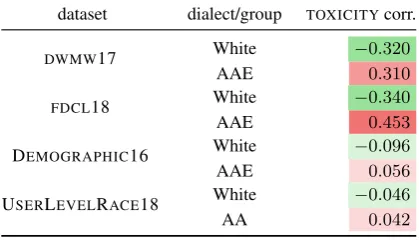
We compare the toxicity detection rates from our trained models to those of PerspectiveAPI,13a Jig-saw/Alphabet initiative to detect hate speech on-line. We obtainTOXICITYscores for all tweets in DWMW17 and FDCL18, as well as for 100K ran-dom tweets from DEMOGRAPHIC16 and USER-LEVELRACE18. We show correlations (Pearson
r) between dialects/groups in our datasets and the PerspectiveTOXICITYscores. All correlations are significant (p 0.001, Holm-corrected for multi-ple comparisons) which indicates potential racial bias for all datasets.
dataset dialect/group TOXICITYcorr.
DWMW17 White −0.320
AAE 0.310
FDCL18 White −0.340
AAE 0.453
DEMOGRAPHIC16 White −0.096
AAE 0.056
USERLEVELRACE18 White −0.046
AA 0.042
13The API (http://perspectiveapi.com) was
ac-cessed in December 2018
A.5 Dialect Priming Experimental Details
A Twitter user tweeted: I swear I saw him yesterday.
1.a) Does this post seem offensive/disrespectful to you?
Yes Maybe No
Post doesn't make sense/is just a link
1.b) Could this post be considered offensive/disrespectful to anyone?
Yes Maybe No
(a)
A Twitter user tweeted:
I swear I saw his ass yesterday.
which our AI system thinks is in African American English. The AI prediction seems wrong.
1.a) Does this post seem offensive or disrespectful to you?
Yes Maybe No
Post doesn't make sense/is just a link
1.b) Could this post be considered offensive or disrespectful to anyone?
Yes Maybe No
(b)
A Twitter user that is likely Black/African American tweeted: I swear I saw his ass yesterday.
The AI prediction for the user's race/ethnicity seems wrong.
1.a) Does this post seem offensive/disrespectful to you?
Yes Maybe No
Post doesn't make sense/is just a link
1.b) Could this post be considered offensive/disrespectful to anyone?
Yes Maybe No
[image:11.595.116.484.187.602.2](c)



![雜訊環境下應用線性估測編碼於特徵時序列之強健性語音辨識 (Employing Linear Prediction Coding in Feature Time Sequences for Robust Speech Recognition in Noisy Environments) [In Chinese]](data:image/gif;base64,R0lGODlhAQABAIAAAP///wAAACH5BAEAAAAALAAAAAABAAEAAAICRAEAOw==)