Segment-Level Sequence Modeling using Gated Recursive
Semi-Markov Conditional Random Fields
Jingwei Zhuo1,2∗, Yong Cao2, Jun Zhu1†, Bo Zhang1, Zaiqing Nie2 1Dept. of Comp. Sci. & Tech., State Key Lab of Intell. Tech. & Sys., TNList Lab,
Tsinghua University, Beijing, 100084, China
2Microsoft Research, Beijing, 100084, China
{zjw15@mails, dcszj@mail, dcszb@mail}.tsinghua.edu.cn; {yongc, znie}@microsoft.com
Abstract
Most of the sequence tagging tasks in nat-ural language processing require to recog-nize segments with certain syntactic role or semantic meaning in a sentence. They are usually tackled with Conditional Ran-dom Fields (CRFs), which do indirect word-level modeling over word-level fea-tures and thus cannot make full use of segment-level information. Semi-Markov Conditional Random Fields (Semi-CRFs) model segments directly but extracting segment-level features for Semi-CRFs is still a very challenging problem. This pa-per presents Gated Recursive Semi-CRFs (grSemi-CRFs), which model segments directly and automatically learn segment-level features through a gated recursive convolutional neural network. Our exper-iments on text chunking and named en-tity recognition (NER) demonstrate that grSemi-CRFs generally outperform other neural models.
1 Introduction
Most of the sequence tagging tasks in natural lan-guage processing (NLP) are segment-level tasks, such as text chunking and named entity recog-nition (NER), which require to recognize seg-ments (i.e., a set of continuous words) with cer-tain syntactic role or semantic meaning in a sen-tence. These tasks are usually tackled with Con-ditional Random Fields (CRFs) (Lafferty et al., 2001), which do word-level modeling as putting each word a tag, by using some predefined tag-ging schemes, e.g., the “IOB” scheme (Ramshaw ∗This work was done when J.W.Z was on an internship
with Microsoft Research.
†J.Z is the corresponding author.
and Marcus, 1995). Such tagging schemes are lossy transformations of original segment tags: They do indicate the boundary of adjacent seg-ments but lose the length information of segseg-ments to some extent. Besides, CRFs can only employ word-level features, which are either hand-crafted or extracted with deep neural networks, such as window-based neural networks (Collobert et al., 2011) and bidirectional Long Short-Term Mem-ory networks (BI-LSTMs) (Huang et al., 2015). Therefore, CRFs cannot make full use of segment-level information, such as inner properties of seg-ments, which cannot be fully encoded in word-level features.
Semi-Markov Conditional Random Fields (Semi-CRFs) (Sarawagi and Cohen, 2004) are proposed to model segments directly and thus readily utilize segment-level features that encode useful segment information. Existing work has shown that Semi-CRFs outperform CRFs on segment-level tagging tasks such as sequence segmentation (Andrew, 2006), NER (Sarawagi and Cohen, 2004; Okanohara et al., 2006), web data extraction (Zhu et al., 2007) and opinion extraction (Yang and Cardie, 2012). However, Semi-CRFs need many more features compared to CRFs as they need to model segments with different lengths. As manually designing the features is tedious and often incomplete, how to automatically extract good features becomes a very important problem for Semi-CRFs. A naive solution that builds multiple feature extractors, each of which extracts features for segments with a specific length, is apparently time-consuming. Moreover, some of these separate extractors may underfit as the segments with specific length may be very rare in the training data. By far, Semi-CRFs are lacking of an automatic segment-level feature extractor.
In this paper, we fill the research void by
proposing Gated Recursive Semi-Markov Condi-tional Random Fields (grSemi-CRFs), which can automatically learn features for segment-level se-quence tagging tasks. Unlike previous approaches which usually use a neural-based feature extrac-tor with a CRF layer, a grSemi-CRF consists of a gated recursive convolutional neural network (gr-Conv) (Cho et al., 2014) with a Semi-CRF layer. The grConv is a variant of recursive neural net-works. It builds a pyramid-like structure to ex-tract segment-level features in a hierarchical way. This feature hierarchy well matches the intuition that long segments are combinations of their short sub-segments. This idea was first explored in Cho et al. (2014) to build an encoder in neural machine translation and then extended to solve other prob-lems, such as sentence-level classification (Zhao et al., 2015) and Chinese word segmentation (Chen et al., 2015).
The advantages of grSemi-CRFs are two folds. First, thanks to the pyramid architecture of gr-Convs, grSemi-CRFs can extract all the segment-level features using one single feature extractor, and there is no underfitting problem as all param-eters of the feature extractor are shared globally. Besides, unlike recurrent neural network (RNN) models, the training and inference of grSemi-CRFs are very fast as there is no time dependency and all the computations can be done in parallel. Second, thanks to the semi-Markov structure of Semi-CRFs, grSemi-CRFs can model segments in sentences directly without the need to introduce extra tagging schemes, which solves the problem that segment length information cannot be fully encoded in tags. Besides, grSemi-CRFs can also utilize segment-level features which can flexibly encode segment-level information such as inner properties of segments, compared to word-level features as used in CRFs. By combining grConvs with Semi-CRFs, we propose a new way to auto-matically extract segment-level features for Semi-CRFs.
Our major contributions can be summarized as: (1) We propose grSemi-CRFs, which solve both the automatic feature extraction problem for Semi-CRFs and the indirect word-level mod-eling problem in CRFs. As a result, grSemi-CRFs can do segment-level modeling directly and make full use of segment-level features; (2) We evaluate grSemi-CRFs on two
segment-level sequence tagging tasks, text chunking
and NER. Experimental results show the ef-fectiveness of our model.
2 Preliminary
In sequence tagging tasks, given a word sequence, the goal is to assign each word (e.g., in POS Tag-ging) or each segment (e.g., in text chunking and NER) a tag. By leveraging a tagging scheme like “IOB”, all the tasks can be regarded as word-level tagging. More formally, let X denote the set of words and Y denote the set of tags. A word sentence with length T can be denoted by
x= (x1, ..., xT)and its corresponding tags can be
denoted asy = (y1, ..., yT). A CRF (Lafferty et
al., 2001) defines a conditional distribution
p(y|x) = 1Z(x)exp XT
t=1
F(yt,x) +A(yt−1, yt)
!
, (1)
where F(yt,x) is the tag score (or potential) for
tag yt at position t, A(yt−1, yt) is the
transi-tion score between yt−1 and yt to measure the
tag dependencies of adjacent words andZ(x) = P
y0expPTt=1F(y0t,x) +A(yt−1, yt0)
is the normalization factor. For the common log-linear models,F(yt,x)can be computed by
F(yt,x) =vyTtf(yt,x) +byt, (2)
where V = (v1, ...,v|Y|)T ∈ R|Y|×D, bV =
(b1, ..., b|Y|)T ∈ R|Y|, f(yt,x) ∈ RD are the
word-level features forytover the sentencexand
D is the number of features. f(yt,x) can be
manually designed or automatically extracted us-ing neural networks, such as window-based neural networks (Collobert et al., 2011).
If we consider segment-level tagging directly1,
we get a segmentation of the previous tag sen-tence. With a little abuse of notation, we denote a segmentation bys= (s1, ..., s|s|)in which thejth
segmentsj =hhj, dj, yjiconsists of a start
posi-tionhj, a lengthdj < LwhereLis a predefined
upperbound and a tagyj. Conceptually,sj means
a tag yj is given to words(xhj, ..., xhj+dj−1). A
Semi-CRF (Sarawagi and Cohen, 2004) defines a conditional distribution
p(s|x) = 1Z(x)exp
|s|
X
j=1
F(sj,x) +A(yj−1, yj)
, (3)
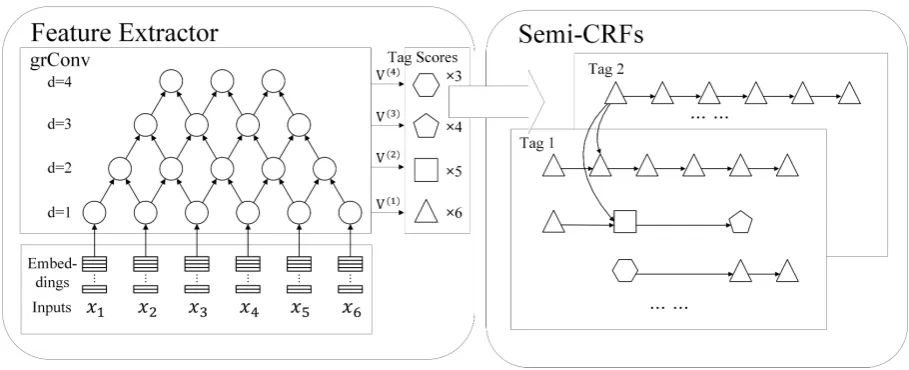
Figure 1: An overview of grSemi-CRFs. For simplicity, we set the segment length upperboundL = 4, and the sentence length T = 6. The left side is the feature extractor, in which each node denotes a vector of segment-level features (e.g.,z(d)k for thekth node in thedth layer). Embeddings of word-level input features are used as length-1 segment-level features, and the length-dfeature is extracted from two adjacent length-(d−1) features. The right side is the Semi-CRF. Tag score vectors are computed as linear transformations of segment-level features and the number of them equals the number of nodes in the same layer. For clarity, we use triangle, square, pentagon and hexagon to denote the tag score vectors for length-1,2,3,4segments and directed links to denote the tag transformations of adjacent segments.
whereF(sj,x)is the potential or tag score for
seg-mentsj,A(yj−1, yj)is the transition score to
mea-sure tag dependencies of adjacent segments and
Z(x) =Ps0expP|s 0|
j=1F(s0j,x) +Ay0
j−1,yj0
is the normalization factor. For the common log-linear models,F(sj,x)can be computed by
F(sj,x) =vTyjf(sj,x) +byj, (4) where V = (v1, ...,v|Y|)T ∈ R|Y|×D, bV =
(b1, ..., b|Y|)T ∈ R|Y| andf(sj,x) ∈ RD are the
segment-level features forsjover the sentencex.
As Eq. (1) and Eq. (3) show, CRFs can be re-garded as a special case of Semi-CRFs whenL= 1. CRFs need features for only length-1segments (i.e., words), while Semi-CRFs need features for length-` segments (1 ≤ ` ≤ L). Therefore, to model the same sentence, Semi-CRFs generally need many more features than CRFs, especially when Lis large. Besides, unlike word-level fea-tures used in CRFs, the sources of segment-level features are often quite limited. In existing work, the sources of f(sj,x) can be roughly divided
into two parts: (1) Concatenations of word-level features (Sarawagi and Cohen, 2004; Okanohara et al., 2006); and (2) Hand-crafted segment-level features, including task-insensitive features, like the length of segments, and task-specific features,
like the verb phrase patterns in opinion extraction (Yang and Cardie, 2012). As manually design-ing features is time-consumdesign-ing and often hard to capture rich statistics underlying the data, how to automatically extract features for Semi-CRFs re-mains a challenge.
3 Gated Recursive Semi-Markov CRFs
In this section, we present Gated Recursive Semi-CRFs (grSemi-Semi-CRFs), which inherit the advan-tages of Semi-CRFs in segment-level modeling, and also solve the feature extraction problem of Semi-CRFs by introducing a gated recursive con-volutional neural network (grConv) as the fea-ture extractor. Instead of building multiple feafea-ture extractors at different scales of segment lengths, grSemi-CRFs can extract features with any length by using a single grConv, and learn the parameters effectively via sharing statistics.
3.1 Architecture
The architecture of grSemi-CRFs is illustrated in Figure 1. A grSemi-CRF can be divided into two parts, a feature extractor (i.e., grConv) and a Semi-CRF. Below, we explain each part in turn.
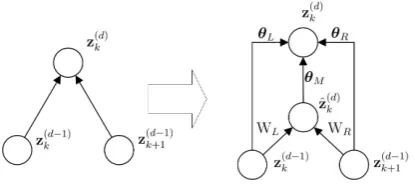
Figure 2: The the building block of the feature extractor (i.e., grConv), in which parameters are shared among the pyramid structure. We omit the dependency ofθL,θR,θM onGL,GR.
are stacked layer by layer and information is prop-agated from adjacent nodes in the same layer to their co-descendants in the higher layer through directed links. Recall that L denotes the upper-bound of segment length (i.e., the height of the grConv), we regard the bottom level as the 1st level and the top level as the Lth level. Then, for a length-T sentence, the dth level will have
T−d+ 1nodes, which correspond to features for
T−d+ 1length-dsegments. Thekth node in the
dth layer corresponds to the segment-level latent featuresz(d)k ∈ RD, which denote the meaning of
the segment, e.g., the syntactic role (i.e., for text chunking) or semantic meaning (i.e., for NER).
Like CRFs, grSemi-CRFs allow word-level cat-egorical inputs (i.e., xk) which are transformed
into continuous vectors (i.e., embeddings) accord-ing to look-up tables and then used as length-1
segment-level features (i.e., z(1)k ). To be clear, we call these inputs as input features and those extracted segment-level features (i.e., z(d)k ) as segment-level latent features. Besides, grSemi-CRFs also allow segment-level input features (e.g., gazetteers) directly as shown in Eq. (12). We will discuss more details in section 4.3.
The building block of the feature extractor is shown in Figure 2, where an intermediate node
ˆ
z(d) ∈ RD is introduced to represent the
inter-actions of two length-(d−1)segments. To cap-ture such complex interactions, ˆz(d)k is computed through a non-linear transformation, i.e.,
ˆ z(d)
k =g(α(d)k ) =g(WLzk(d−1)+ WRz(dk+1−1)+bW), (5)
where WL,WR ∈ RD×D and bW ∈ RD are
shared globally, andg(·)is a non-linear activation function2.
2We use a modified version of the sigmoid function, i.e.,
g(x) = 4 1 1+e−x−12
.
Then, the length-dsegment-level latent features
z(d)k can be computed as
z(d)
k =θLz(dk−1)+θRzk+1(d−1)+θMˆz(d)k , (6)
whereθL, θM andθR ∈ Rare the gating
coeffi-cients which satisfy the conditionθL, θR, θM ≥0
and θL +θR +θM = 1. Here, we make a
lit-tle modification of grConvs by making the gating coefficients as vectors instead of scalars, i.e.,
z(d)k =θL◦z(dk−1)+θR◦z(dk+1−1)+θM◦ˆz(d)k , (7)
where ◦ denotes the element-wise product and
θL, θR and θM ∈ RD are vectorial
gat-ing coefficients3 which satisfy the condition that θL,i, θR,i, θM,i≥0andθL,i+θR,i+θM,i= 1for
1≤i≤D. There are two reasons for this modifi-cation: (1) Theoretically, the element-wise combi-nation makes a detailed modeling as each feature inz(d)k may have its own combining; and (2) Ex-perimentally, this setting makes our grSemi-CRF4
more flexible, which increases its generalizability and leads to better performance in experiments as shown in Table 4.
We can regard Eq. (7) as a soft gate function to control the propagation flows. Besides, all the parameters (i.e., WL,WR,bW,GL,GR,bG) are
shared globally and recursively applied to the in-put sentence in a bottom-up manner. All of these account for the name gated recursive convolu-tional neural networks(grConvs).
Eq. (5) and Eq. (7) build the information prop-agation criteria in a grConv. The basic assumption behind Eq. (5) and Eq. (7) is that the meaning of one segment can be represented as a linear com-bination of three parts: (1) the meaning of its pre-fix segment, (2) the meaning of its sufpre-fix segment and (3) the joint meaning of both (i.e., the com-plex interaction). This process matches our intu-ition about the hierarchical structure in the com-position of a sentence. For example, the meaning ofthe United Statesdepends on the suffix segment
United States, whose meaning is not only from its prefix Unitedor suffix States, but the interaction of both.
The vectorial gating coefficientsθL,θRandθM
3We omit the dependency ofθ
L,θRandθM ondandk for notation simplicity.
are computed adaptively, i.e., θL θR θM =
1/Z 1/Z 1/Z
◦exp
GLz(dk−1)+ GRz(dk+1−1)+bG
,
(8)
where GL,GR ∈ R3D×D and bG ∈ R3D are
shared globally. Z ∈ Rd is normalization
coef-ficients and theith element ofZis computed via
Zi= 3
X
j=1
h
expGLz(dk−1)+ GRz(dk+1−1)+bG
i
D×(j−1)+i. (9)
After the forward propagation of the feature ex-tractor is over, the tag scores (i.e., the potential functions for Semi-CRFs) are computed through a linear transformation. For segment sj = hhj, dj, yji, its latent feature isf(sj,x) = z(dj)hj
and corresponding potential/tag score is
F(sj;x) =f(hhj, dj, yji;x) =
h V(dj)
0 z(dhjj)+b
(dj)
V
i
yj,
(10)
whereV(dj)0 ∈ R|Y|×D andb(dj) ∈ R|Y| are
pa-rameters for length-dj segments. To encode
con-textual information, we can assume that the tag of a segment depends not only on itself but also its neighbouring segments with the same length, i.e.,
F(sj;x) =
" H X
i=−H
V(dj)
i z(dhjj+i) +b
(dj)
V
#
yj
, (11)
whereV(dj)−H, ...,V(dj)0 , ...,VH(dj) ∈ R|Y|×D andH
is the window width for neighbouring segments. Apart from the automatically extracted segment-level latent featuresz(d)k , grSemi-CRFs also allow segment-level input features (e.g., gazetteers), i.e.,
F(sj;x) =
" H X
i=−H
V(dj)
i z(dhjj+i) +b
(dj)
V + U(dj)c(dhjj)
#
yj
,
(12)
whereU(dj) ∈R|Y|×D0
andc(dj)hj ∈RD0
is a vec-tor of segment-level input features.
Then, we can use Eq. (3) for inference by using a Semi-CRF version of Viterbi algorithms (Sarawagi and Cohen, 2004).
3.2 Learning of Parameters
To learn grSemi-CRFs, we maximize the log like-lihood L = logp(s|x) over all the parameters. Here, for notation simplity, we consider the sim-pliest case, i.e., using Eq. (10) to compute tag scores. More details can be found in the supple-mentary note.
Gradients of Semi-CRF-based parameters (i.e.,
A and V0) and tag scores F(sj,x) can be
com-puted based on the marginal probability of neigh-bouring segments via a Semi-CRF version of forward-backward algorithms (Sarawagi and Co-hen, 2004). As for the grConv-based parameters, we can compute their gradients by back propaga-tion. For example, gradients forWLandGLare5
∂L
∂WL= L
X
d=1 T−d+1
X
k=1
∂L
∂z(d)k
∂z(d) k
∂WL, ∂
L
∂GL= L
X
d=1 T−d+1
X
k=1
∂L
∂z(d)k
∂z(d) k
∂GL, (13)
where∂z(d)k ∂WL and∂z
(d) k
∂GL can be derived from Eq. (5),
Eq. (7) and Eq. (8). For ∂L
∂z(d)k , thanks to the recur-sive structure, it can be computed as
∂L
∂z(d)k =
∂z(d+1) k
∂z(d)k
∂L
∂z(d+1)k +
∂z(d+1) k−1
∂z(d)k
∂L
∂z(d+1)k−1
+ V(d)0 T ∂L
∂F(s(d) k ,x)
,
(14)
where s(d)k = hk, d,Yi is a length-|Y| vector which denotes segments with all possible tags for
z(d)k , ∂L
∂F(s(d)k ,x) is the gradient forF(s (d)
k ,x)and
∂z(d+1) k
∂z(d)k = diag(θL) + diag(θM◦g
0(α(d+1)
k ))WL, (15)
where diag(θL) denotes the diagonal matrix
spanned by vector θL, and ∂z(d+1)k−1
∂z(d)k has a simi-lar form. As Eq. (14) shows, for each node in the feature extractor of grSemi-CRFs, its gradi-ent consists of two parts: (1) the gradigradi-ents back propagated from high layer nodes (i.e., longer seg-ments); and (2) the supervising signals from Semi-CRFs. In other words, the supervision in the ob-jective function is added to each node in grSemi-CRFs. This is a nice property compared to other neural-based feature extractors used in CRFs, in which only the nodes of several layers on the top receive supervision. Besides, the term diag(θL)
in Eq. (15) prevents ∂z(d+1)k
∂z(d)k from being too small when g0(α(d)
k ) and WL are small, which acts as
the linear unit recurrent connection in the mem-ory block of LSTM (Hochreiter and Schmidhu-ber, 1997; Zhao et al., 2015). All of these help in avoiding gradient vanishing problems in train-ing grSemi-CRFs.
5Gradients for W
4 Experiments
We evaluate grSemi-CRFs on two segment-level sequence tagging NLP tasks: text chunking and named entity recognition (NER).
4.1 Datasets
For text chunking, we use the CONLL 2000 text chunking shared dataset6 (Tjong Kim Sang and
Buchholz, 2000), in which the objective is to di-vide the whole sentence into different segments according to their syntactic roles, such as noun
phrases (“NP”), verb phrases (“VP”) and adjec-tive phrases(“ADJP”). We call it a “segment-rich” tasks as the number of phrases are much higher than that of non-phrases which is tagged with oth-ers (“O”). We evaluate performance over all the chunks instead of only noun pharse (NP) chunks.
For NER, we use the CONLL 2003 named en-tity recognition shared dataset7(Tjong Kim Sang
and De Meulder, 2003), in which segments are tagged with one of four entity types: per-son (“PER”), location (“LOC”), organization
(“ORG”) and miscellaneous(“MISC”), or others
(“O”) which is used to denote non-entities. We call it a “segment-sparse” task as entities are rare while non-entities are common.
4.2 Input Features
For each word, we use multiple input features, including the word itself, its length-3 prefix and length-4 suffix, its capitalization pattern, its POS tag, the length-4,8,12,20 prefixs of its Brown clus-ters (Brown et al., 1992) and gazetteers8. All of
them are used as word-level input features except gazetteers, which are used as segment-level fea-tures directly. All the embeddings for word-level inputs are randomly initialized except word em-beddings, which can be initialized randomly or by pretraining over unlabeled data, which is exter-nal information compared to the dataset. Besides word embeddings, Brown clusters and gazetteers are also based on external information, as summa-rized below:
• Word embeddings. We use Senna embed-dings9(Collobert et al., 2011), which are
50-dimensional and have been commonly used
6Available at: http://www.cnts.ua.ac.be/conll2000/chunking/ 7Available at: http://www.cnts.ua.ac.be/conll2003/ner/ 8Among them, POS tags are provided in the dataset. 9Available at http://ronan.collobert.com/senna/
in sequence tagging tasks (Collobert et al., 2011; Turian et al., 2010; Huang et al., 2015);
• Brown clusters. We train two types of Brown clusters using the implementation from Liang (2005): (1) We follow the se-tups of Ratinov and Roth (2009), Turian et al. (2010) and Collobert et al. (2011) to gen-erate 1000 Brown clusters on Reuters RCV1 dataset (Lewis et al., 2004); (2) We gener-ate 1000 Brown clusters on New York Times (NYT) corpus (Sandhaus, 2008);
• Gazetteers. We build our gazetteers based on the gazetteers used in Senna (Collobert et al., 2011) and Wikipedia entries, mainly the locations and organizations. We also denoise our gazetteers by removing overlapped enti-ties and using BBN Pronoun Coreference and Entity Type Corpus (Weischedel and Brun-stein, 2005) as filters10.
4.3 Implementation Details
To learn grSemi-CRFs, we employ Adagrad (Duchi et al., 2011), an adaptive stochastic gra-dient descent method which has been proved suc-cessful in similar tasks (Chen et al., 2015; Zhao et al., 2015). To avoid overfitting, we use the dropout strategy (Srivastava et al., 2014) and apply it on the first layer (i.e.,z(0)k ). We also use the strategy of ensemble classifiers, which is proved an effective way to improve generalization performance (Col-lobert et al., 2011). All results are obtained by de-coding over an average Semi-CRF after 10 train-ing runs with randomly initialized parameters.
For the CONLL 2003 dataset, we use the F1
scores on the development set to help choose the best-performed model in each run. For the CONLL 2000 dataset, as there is no development set provided, we use cross validation as Turian et al. (2010) to choose hyperparameters. After that, we retrain model according to the hyperparame-ters and choose the final model in each run.
Our hyperparameter settings for these two tasks are shown in Table 1. The segment length is set ac-cording to the maximum segment length in train-ing set. We set the minibatch size to 10, which means that we process 10 sentences in a batch. The window width defines the parameterHin Eq. (12) when producing tag score vectors.
Hyperparameters CONLL 2000 CONLL 2003
Segment length 15 10
Dropout 0.3 0.3
Learning rate 0.3 0.3
Epochs 15 20
Minibatches 10 10
[image:7.595.76.285.61.135.2]Window width 2 2
Table 1: Hyperparameter settings for our model.
4.4 Results and Analysis
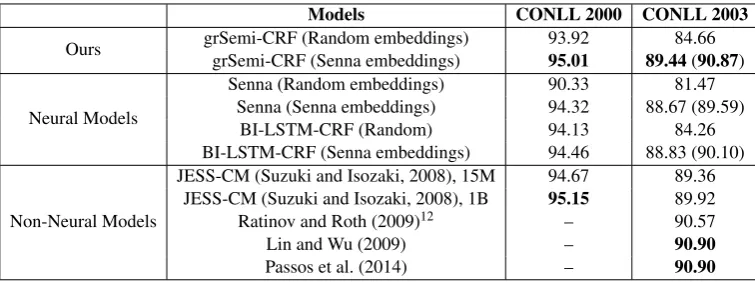
Table 2 shows the results of our grSemi-CRFs and other models11. We divide other models into
two categories, i.e., neural models and non-neural models, according to whether neural networks are used as automatic feature extractors. For neural models, Senna (Collobert et al., 2011) consists of a window-based neural network for feature extrac-tion and a CRF for word-level modeling while BI-LSTM-CRF (Huang et al., 2015) uses a bidirec-tional Long Short-Term Memory network for fea-ture extraction and a CRF for word-level model-ing.
For non-neural models, JESS-CM (Suzuki and Isozaki, 2008) is a semi-supervised model which combines Hidden Markov Models (HMMs) with CRFs and uses 1 billion unlabelled words in train-ing. Lin and Wu (2009) cluster 20 million phrases over corpus with around 700 billion tokens, and use the resulting clusters as features in CRFs. Pas-sos et al. (2014) propose a novel word embed-ding method which incorporates gazetteers as su-pervising signals in pretraining and builds a log-linear CRF over them. Ratinov and Roth (2009) use CRFs based on many non-local features and 30 gazetteers extracted from Wikipedia and other websites with more than 1.5 million entities.
As Table 2 shows, grSemi-CRFs outperform other neural models, in both text chunking and named entity recognition (NER) tasks. BI-LSTM-CRFs use many more input features than ours, which accounts for the phenomenon that the per-formance of our grSemi-CRFs is rather mediocre (i.e., 93.92% versus 94.13% and 84.66% versus 84.26%) without external information. However, once using Senna embeddings, our grSemi-CRFs perform much better than BI-LSTM-CRFs.
For non-neural models, one similarity of them is that they use a lot of hand-crafted features, and many of them are even task-specific. Unlike them,
11Because of the space limit, we only compare our model with other models which follow similar settings and achieve high performance.
Input Features CONLL 2000 CONLL 2003
None 93.92 84.66
Brown(NYT) 94.18 86.57
Brown(RCV1) 94.05 88.22
Emb 94.73 88.12
Gaz – 87.94
Emb + Brown(NYT) 95.01 88.86 Emb + Brown(RCV1) 94.87 89.44
Emb + Gaz – 89.88
Brown(NYT) + Gaz – 88.69
Brown(RCV1) + Gaz – 89.82
All(NYT) – 90.00
All(RCV1) – 90.87
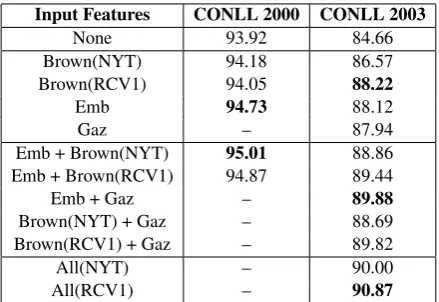
Table 3: Results of grSemi-CRF with external information, measured in F1 score. None = no
external information, Emb = Senna embeddings, Brown = Brown clusters, Gaz = gazetteers and All = Emb + Brown + Gaz. NYT and RCV1 in the parenthesis denote the corpus used to generate Brown clusters. “–” means no results. Notice that gazetteers are only applied to NER.
grSemi-CRFs use much fewer input features and most of them are task-insensitive13. However,
grSemi-CRFs achieve almost the same perfor-mance, sometimes even better. For text chunking, grSemi-CRF outperforms all reported supervised models, except JESS-CM (Suzuki and Isozaki, 2008), a semi-supervised model using giga-word scale unlabeled data in training14. However, the
performance of our grSemi-CRF (95.01%) is very close to that of JESS-CM (95.15%). For NER, the performance of grSemi-CRFs are also very closed to state-of-the-art results (90.87% versus 90.90%).
4.4.1 Impact of External Information
As Table 3 shows, external information improve the performance of grSemi-CRFs for both tasks. Compared to text chunking, we can find out that external information plays an extremely important role in NER, which coincides with the general idea that NER is a knowledge-intensive task (Ratinov and Roth, 2009). Another interesting thing is that, Brown clusters generated from NYT corpus per-forms better on the CONLL 2000 task while those generated from Reuters RCV1 dataset performs better on the CONLL 2003 task. The reason is
13E.g.: for NER, JESS-CM uses 79 different features; Lin and Wu (2009) use 48 baseline and phrase cluster features; while we only use 11. Besides, grSemi-CRFs use almost the same features for chunking and NER (except gazetteers).
[image:7.595.309.529.62.213.2]Models CONLL 2000 CONLL 2003
Ours grSemi-CRF (Random embeddings)grSemi-CRF (Senna embeddings) 93.9295.01 89.4484.66(90.87)
Neural Models
Senna (Random embeddings) 90.33 81.47 Senna (Senna embeddings) 94.32 88.67 (89.59)
BI-LSTM-CRF (Random) 94.13 84.26
BI-LSTM-CRF (Senna embeddings) 94.46 88.83 (90.10)
Non-Neural Models
JESS-CM (Suzuki and Isozaki, 2008), 15M 94.67 89.36 JESS-CM (Suzuki and Isozaki, 2008), 1B 95.15 89.92
Ratinov and Roth (2009)12 – 90.57
Lin and Wu (2009) – 90.90
Passos et al. (2014) – 90.90
Table 2: Experimental results over the CONLL-2000 and CONLL-2003 shared datasets, measured inF1
score. Numbers in parentheses are theF1 score when using gazetteers. JESS-CM (Suzuki and Isozaki,
2008) is a semi-supervised model, in which 15M or 1B denotes the number of unlabeled words it uses for training.
Gating Coefficients CONLL 2000 CONLL 2003
[image:8.595.109.487.61.202.2]Scalars 94.47 89.27(90.54) Vectors 95.01 89.44(90.87)
Table 4: F1 scores of grSemi-CRF with scalar or
vectorial gating coefficients. Numbers in paren-theses are theF1score when using gazetteers.
that the CONLL 2000 dataset is the subset of Wall Street Journal (WSJ) part of the Penn Treebank II Corpus (Marcus et al., 1993) while the CONLL 2003 dataset is a subset of Reuters RCV1 dataset. Maybe the writing styles between NYT and WSJ are more similar than those between RCV1 and WSJ.
4.4.2 Impact of Vectorial Gating Coefficients
As Table 4 shows, a grSemi-CRF using vectorial gating coefficients (i.e., Eq. (7)) performs bet-ter than that using scalar gating coefficients (i.e., Eq. (6)), which provides evidences for the the-oretical intuition that vectorial gating coefficients can make a detailed modeling of the combinations of segment-level latent features and thus performs better than scalar gating coefficients.
4.4.3 Visualization of Learnt Segment-Level Features
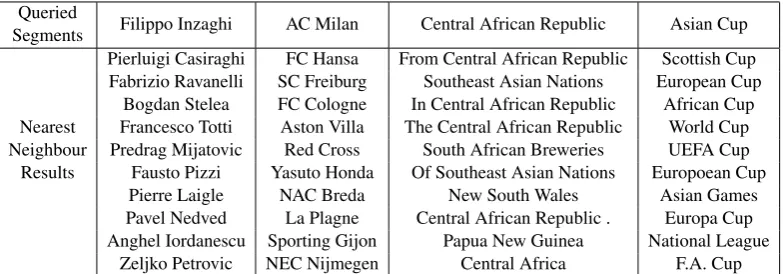
To demonstrate the quality of learnt segment-level features, we use an indirect way as widely adopted in previous work, e.g., Collobert et al. (2011). More specifically, we show 10 nearest neighbours for some selected queried segments according to Euclidean metric of corresponding
features15. To fully demonstrate the power of
grSemi-CRF in learning segment-level features, we use the Emb+Brown(RCV1) model in Table 3, which uses no gazetteers. We train the model on the CONLL 2003 training set and find nearest neighbours in the CONLL 2003 test set. We make no restrictions on segments, i.e., all possible seg-ments with different lengths in the CONLL 2003 test set are candidates.
As Table 5 shown, most of the nearest segments are meaningful and semantically related. For ex-ample, the nearest segments for “Filippo Inzaghi” are not only tagged withperson, but also names of famous football players as “Filippo Inzaghi”.
There also exist some imperfect results. E.g., for “Central African Republic”, nearest segments, which contain the same queried segment, are se-mantically related but not syntactically similar. The major reason may be that the CONLL 2003 dataset is a small corpus (if compared to the vast unlabelled data used to train Senna embed-dings), which restricts the range for candidate seg-ments and the quality of learnt segment-level fea-tures. Another reason is that labels in the CONLL 2003 dataset mainly encodes semantic information (e.g., named entities) instead of syntactic informa-tion (e.g., chunks).
Besides, as we make no restriction on the for-mulation of candidate segments, sometimes only a part of the whole phrase will be retrieved, e.g., “FC Hansa”, which is the prefix of “FC Hansa Rostock”. Exploring better way of utilizing
Queried Filippo Inzaghi AC Milan Central African Republic Asian Cup Segments
Pierluigi Casiraghi FC Hansa From Central African Republic Scottish Cup Fabrizio Ravanelli SC Freiburg Southeast Asian Nations European Cup
Bogdan Stelea FC Cologne In Central African Republic African Cup Nearest Francesco Totti Aston Villa The Central African Republic World Cup Neighbour Predrag Mijatovic Red Cross South African Breweries UEFA Cup
Results Fausto Pizzi Yasuto Honda Of Southeast Asian Nations Europoean Cup Pierre Laigle NAC Breda New South Wales Asian Games Pavel Nedved La Plagne Central African Republic . Europa Cup Anghel Iordanescu Sporting Gijon Papua New Guinea National League
[image:9.595.104.496.62.199.2]Zeljko Petrovic NEC Nijmegen Central Africa F.A. Cup
Table 5: Visualization of segment-level features learnt on the CONLL 2003 dataset. For each column the queried segment is followed by its 10 nearest neighbors (measured by the cosine similarity of their feature vectors). Corresponding tags for these four queried segments are (from left to right): person,
organization,locationandmiscellaneous.
belled data to improve learning segment-level fea-tures is part of the future work.
5 Discussions and Related Work
Cho et al. (2014) first propose grConvs to learn fix-length representations of the whole source sen-tence in neural machine translation. Zhao et al. (2015) use grConvs to learn hierarchical represen-tations (i.e., multiple fix-length represenrepresen-tations) of the whole sentence for sentence-level classifica-tion problem. Both of them focus on sentence-level classification problems while grSemi-CRFs are solving segment-level classification (sequence tagging) problems, which is fine-grained. Chen et al. (2015) propose Gated Recursive Neural Net-works (GRNNs), a variant of grConvs, to solve Chinese word segmentation problem. GRNNs still do word-level modeling by using CRFs while grSemi-CRFs do segment-level modeling directly by using semi-CRFs and makes full use of the re-cursive structure of grConvs.
We believe that, the recursive neural network (e.g., grConv) is a natural feature extractor for Semi-CRFs, as it extracts features for every possi-ble segments by one propagation over one trained model, which is fast-computing and efficient. In this sense, grSemi-CRFs provide a promising di-rection to explore.
6 Conclusions
In this paper, we propose Gated Recursive Semi-Markov Conditional Random Fields (grSemi-CRFs) for segment-level sequence tagging tasks. Unlike word-level models such as CRFs, grSemi-CRFs model segments directly without the need
of using extra tagging schemes and also readily utilize segment-level features, both hand-crafted and automatically extracted by a grConv. Exper-imental evaluations demonstrate the effectiveness of grSemi-CRFs on both text chunking and NER tasks.
In future work, we are interested in exploring better ways of utilizing vast unlabelled data to im-prove grSemi-CRFs, e.g., to learn phrase embed-dings from unlabelled data or designing a semi-supervised version of grSemi-CRFs.
Acknowledgments
J.W.Z, J.Z and B.Z are supported by the National Basic Research Program (973 Program) of China (No. 2013CB329403), National NSF of China (Nos. 61322308, 61332007), the Youngth Top-notch Talent Support Program, Tsinghua TNList Lab Big Data Initiative, and Tsinghua Initiative Scientific Research Program (No. 20141080934).
References
Galen Andrew. 2006. A hybrid markov/semi-markov conditional random field for sequence segmentation. In Proceedings of the 2006 Conference on Empiri-cal Methods in Natural Language Processing, pages 465–472.
Peter F Brown, Peter V Desouza, Robert L Mercer, Vincent J Della Pietra, and Jenifer C Lai. 1992. Class-based n-gram models of natural language. Computational linguistics, 18(4):467–479.
Kyunghyun Cho, Bart van Merri¨enboer, Dzmitry Bah-danau, and Yoshua Bengio. 2014. On the properties of neural machine translation: Encoder–decoder ap-proaches. Eighth Workshop on Syntax, Semantics and Structure in Statistical Translation, page 103.
Ronan Collobert, Jason Weston, L´eon Bottou, Michael Karlen, Koray Kavukcuoglu, and Pavel Kuksa. 2011. Natural language processing (almost) from scratch. The Journal of Machine Learning Re-search, 12:2493–2537.
John Duchi, Elad Hazan, and Yoram Singer. 2011. Adaptive subgradient methods for online learning and stochastic optimization. The Journal of Ma-chine Learning Research, 12:2121–2159.
Sepp Hochreiter and J¨urgen Schmidhuber. 1997. Long short-term memory. Neural computation, 9(8):1735–1780.
Zhiheng Huang, Wei Xu, and Kai Yu. 2015. Bidi-rectional LSTM-CRF models for sequence tagging. arXiv preprint arXiv:1508.01991.
John D. Lafferty, Andrew McCallum, and Fernando C. N. Pereira. 2001. Conditional random fields: Probabilistic models for segmenting and labeling se-quence data. InProceedings of the Eighteenth In-ternational Conference on Machine Learning, pages 282–289.
David D Lewis, Yiming Yang, Tony G Rose, and Fan Li. 2004. Rcv1: A new benchmark collection for text categorization research. The Journal of Ma-chine Learning Research, 5:361–397.
Percy Liang. 2005.Semi-Supervised Learning for Nat-ural Language. Ph.D. thesis, Massachusetts Insti-tute of Technology.
Dekang Lin and Xiaoyun Wu. 2009. Phrase clustering for discriminative learning. In Proceedings of An-nual Meeting of the Association for Computational Linguistics, pages 1030–1038.
Mitchell P Marcus, Mary Ann Marcinkiewicz, and Beatrice Santorini. 1993. Building a large anno-tated corpus of english: The penn treebank. Compu-tational linguistics, 19(2):313–330.
Daisuke Okanohara, Yusuke Miyao, Yoshimasa Tsu-ruoka, and Jun’ichi Tsujii. 2006. Improving the scalability of semi-markov conditional random fields for named entity recognition. InProceedings of Annual Meeting of the Association for Computa-tional Linguistics, pages 465–472.
Alexandre Passos, Vineet Kumar, and Andrew McCal-lum. 2014. Lexicon infused phrase embeddings for named entity resolution. Proceedings of the Eigh-teenth Conference on Computational Natural Lan-guage Learning, pages 78–86.
Lance A. Ramshaw and Mitchell P. Marcus. 1995. Text chunking using transformation-based learning. InProceedings of the Third Workshop on Very Large Corpora.
Lev Ratinov and Dan Roth. 2009. Design challenges and misconceptions in named entity recognition. In Proceedings of the Thirteenth Conference on Com-putational Natural Language Learning, pages 147– 155.
Evan Sandhaus. 2008. The new york times annotated corpus. Linguistic Data Consortium, Philadelphia, 6.
Sunita Sarawagi and William W Cohen. 2004. Semi-markov conditional random fields for information extraction. InAdvances in Neural Information Pro-cessing Systems, pages 1185–1192.
Nitish Srivastava, Geoffrey Hinton, Alex Krizhevsky, Ilya Sutskever, and Ruslan Salakhutdinov. 2014. Dropout: A simple way to prevent neural networks from overfitting. The Journal of Machine Learning Research, 15(1):1929–1958.
Jun Suzuki and Hideki Isozaki. 2008. Semi-supervised sequential labeling and segmentation using giga-word scale unlabeled data. In Proceedings of An-nual Meeting of the Association for Computational Linguistics, pages 665–673.
Erik F. Tjong Kim Sang and Sabine Buchholz. 2000. Introduction to the conll-2000 shared task: Chunk-ing. In Proceedings of the Forth Conference on Computational Natural Language Learning, pages 127–132.
Erik F. Tjong Kim Sang and Fien De Meulder. 2003. Introduction to the conll-2003 shared task: Language-independent named entity recognition. In Proceedings of the Seventh Conference on Computa-tional Natural Language Learning, pages 142–147. Joseph Turian, Lev Ratinov, and Yoshua Bengio. 2010.
Word representations: a simple and general method for semi-supervised learning. InProceedings of An-nual Meeting of the Association for Computational Linguistics, pages 384–394.
Ralph Weischedel and Ada Brunstein. 2005. Bbn pro-noun coreference and entity type corpus. Linguistic Data Consortium, Philadelphia, 112.
Bishan Yang and Claire Cardie. 2012. Extracting opin-ion expressopin-ions with semi-markov conditopin-ional ran-dom fields. InProceedings of the 2012 Joint Con-ference on Empirical Methods in Natural Language Processing and Computational Natural Language Learning, pages 1335–1345. Association for Com-putational Linguistics.