Knowledge Base Completion via Coupled Path Ranking
Quan Wang†, Jing Liu‡, Yuanfei Luo†, Bin Wang†, Chin-Yew Lin‡
†Institute of Information Engineering, Chinese Academy of Sciences, Beijing 100093, China
{wangquan,luoyuanfei,wangbin}@iie.ac.cn
‡Microsoft Research, Beijing 100080, China
{liudani,cyl}@microsoft.com
Abstract
Knowledge bases (KBs) are often greatly incomplete, necessitating a demand for K-B completion. The path ranking algorith-m (PRA) is one of the algorith-most proalgorith-mising ap-proaches to this task. Previous work on PRA usually follows a single-task learn-ing paradigm, buildlearn-ing a prediction mod-el for each rmod-elation independently with its own training data. It ignores meaningful associations among certain relations, and might not get enough training data for less frequent relations. This paper proposes a novel multi-task learning framework for PRA, referred to as coupled PRA (CPRA). It first devises an agglomerative clustering strategy to automatically discover relation-s that are highly correlated to each other, and then employs a multi-task learning s-trategy to effectively couple the prediction of such relations. As such, CPRA takes in-to account relation association and enables implicit data sharing among them. We empirically evaluate CPRA on benchmark data created from Freebase. Experimen-tal results show that CPRA can effective-ly identify coherent clusters in which rela-tions are highly correlated. By further cou-pling such relations, CPRA significantly outperforms PRA, in terms of both predic-tive accuracy and model interpretability.
1 Introduction
Knowledge bases (KBs) like Freebase (Bollack-er et al., 2008), DBpedia (Lehmann et al., 2014), and NELL (Carlson et al., 2010) are extremely useful resources for many NLP tasks (Cucerzan, 2007; Schuhmacher and Ponzetto, 2014). They provide large collections of facts about entities and
their relations, typically stored as (head entity, re-lation,tail entity) triples,e.g., (Paris,capitalOf, France). Although such KBs can be impressively large, they are still quite incomplete and missing crucial facts, which may reduce their usefulness in downstream tasks (West et al., 2014; Choi et al., 2015). KB completion, i.e., automatically infer-ring missing facts by examining existing ones, has thus attracted increasing attention. Approaches to this task roughly fall into three categories: (i) path ranking algorithms (PRA) (Lao et al., 2011); (ii) embedding techniques (Bordes et al., 2013; Guo et al., 2015); and (iii) graphical models such as Markov logic networks (MLN) (Richardson and Domingos, 2006). This paper focuses on PRA, which is easily interpretable (as opposed to em-bedding techniques) and requires no external logic rules (as opposed to MLN).
The key idea of PRA is to explicitly use paths connecting two entities to predict potential rela-tions between them. In PRA, a KB is encoded as a graph which consists of a set of heterogeneous edges. Each edge is labeled with a relation type that exists between two entities. Given a specific relation, random walks are first employed to find paths between two entities that have the given rela-tion. Here a path is a sequence of relations linking two entities, e.g., h −−−−−→bornIn e −−−−−−−−→capitalOf t. These paths are then used as features in a bina-ry classifier to predict if new instances (i.e., entity pairs) have the given relation.
While KBs are naturally composed of multiple relations, PRA models these relations separately during the inference phase, by learning an individ-ual classifier for each relation. We argue, however, that it will be beneficial for PRA to model certain relations in a collective way, particularly when the relations are closely related to each other. For ex-ample, given two relationsbornIn and livedIn,
there must be a lot of paths (features) that are pre-dictive for both relations,e.g.,h−−−−−−−−−−→nationality e
hasCapital
−−−−−−−−−→ t. These features make the cor-responding relation classification tasks highly re-lated. Numerous studies have shown that learn-ing multiple related tasks simultaneously (a.k.a. multi-task learning) usually leads to better predic-tive performance, profiting from the relevant infor-mation available in different tasks (Carlson et al., 2010; Chapelle et al., 2010).
This paper proposes a novel multi-task learning framework that couples the path ranking of multi-ple relations, referred to as coumulti-pled PRA (CPRA). The new model needs to answer two critical ques-tions: (i)which relations should be coupled, and (ii)in what manner they should be coupled.
As to the first question, it is obvious that not all relations are suitable to be learned together. For instance, modelingbornIntogether withhasWife might not bring any real benefits, since there are few common paths between these two relations. CPRA introduces a common-path based similarity measure, and accordingly devises an agglomera-tive clustering strategy to group relations. Only re-lations that are grouped into the same cluster will be coupled afterwards.
As to the second question, CPRA follows the common practice of multi-task learning (Evgeniou and Pontil, 2004), and couples relations by using classifiers with partially shared parameters. Given a cluster of relations, CPRA builds the classifier-s upon (i) relation-classifier-specific parameterclassifier-s to addreclassifier-sclassifier-s the specifics of individual relations, and (ii) shared parameters to model the commonalities among d-ifferent relations. These two types of parameters are balanced by a coupling coefficient, and learned jointly for all relations. In this way CPRA couples the classification tasks of multiple relations, and enables implicit data sharing and regularization.
The major contributions of this paper are as fol-lows. (i) We design a novel framework for multi-task learning with PRA,i.e., CPRA. To the best of our knowledge, this is the first study on multi-task PRA. (ii) We empirically verify the effectiveness of CPRA on a real-world, large-scale KB. Specifi-cally, we evaluate CPRA on benchmark data creat-ed from Freebase. Experimental results show that CPRA can effectively identify coherent clusters in which relations are highly correlated. By fur-ther coupling such relations, CPRA substantially outperforms PRA, in terms of not only predictive
accuracy but also model interpretability. (iii) We compare CPRA and PRA to the embedding-based TransE model (Bordes et al., 2013), and demon-strate their superiority over TransE. As far as we know, this is the first work that formally compares PRA-style approaches to embedding-based ones, on publicly available Freebase data.
In the remainder of this paper, we first review related work in Section 2, and formally introduce PRA in Section 3. We then detail the proposed CPRA framework in Section 4. Experiments and results are reported in Section 5, followed by the conclusion and future work in Section 6.
2 Related Work
We first review three lines of related work: (i) KB completion, (ii) PRA and its extensions, and (iii) multi-task learning, and then discuss the connec-tion between CPRA and previous approaches.
KB completion. This task is to automatically infer missing facts from existing ones. Prior work roughly falls into three categories: (i) path ranking algorithms (PRA) which use paths that connect t-wo entities to predict potential relations between them (Lao et al., 2011; Lao and Cohen, 2010); (i-i) embedding-based models which embed entities and relations into a latent vector space and make inferences in that space (Nickel et al., 2011; Bor-des et al., 2013); (iii) probabilistic graphical mod-els such as the Markov logic network (MLN) and its variants (Pujara et al., 2013; Jiang et al., 2012). This paper focuses on PRA, since it is easily inter-pretable (as opposed to embedding-based models) and requires no external logic rules (as opposed to MLN and its variants).
PRA and its extensions.PRA is a random walk inference technique designed for predicting new relation instances in KBs, first proposed by Lao and Cohen (2010). Recently various extension-s have been explored, ranging from incorporating a text corpus as additional evidence during infer-ence (Gardner et al., 2013; Gardner et al., 2014), to introducing better schemes to generate more predictive paths (Gardner and Mitchell, 2015; Shi and Weninger, 2015), or using PRA in a broader context such as Google’s Knowledge Vault (Dong et al., 2014). All these approaches are based on some single-task version of PRA, while our work explores multi-task learning for it.
simulta-neously can provide significant benefits relative to learning them independently (Caruana, 1997). A key ingredient of multi-task learning is to model the notion of task relatedness, through either pa-rameter sharing (Evgeniou and Pontil, 2004; An-do and Zhang, 2005) or feature sharing (Argyri-ou et al., 2007; He et al., 2014). In recent years, there has been increasing work showing the ben-efits of multi-task learning in NLP-related tasks, such as relation extraction (Jiang, 2009; Carlson et al., 2010) and machine translation (Sennrich et al., 2013; Cui et al., 2013; Dong et al., 2015). This pa-per investigates the possibility of multi-task learn-ing with PRA, in a parameter sharlearn-ing manner.
Connection with previous methods. Actually, modeling multiple relations collectively is a com-mon practice in embedding-based approaches. In such a method, embeddings are learned jointly for all relations, over a set of shared latent features (entity embeddings), and hence can capture mean-ingful associations among different relations. As shown by (Toutanova and Chen, 2015), observed features such as PRA paths usually perform bet-ter than latent features for KB completion. In this context, CPRA is designed in a way that gets the multi-relational benefit of embedding techniques while keeping PRA-style path features. Nickel et al. (2014) and Neelakantan et al. (2015) have tried similar ideas. However, their work focuses on im-proving embedding techniques with observed fea-tures, while our approach aims at improving PRA with multi-task learning.
3 Path Ranking Algorithm
PRA was first proposed by Lao and Cohen (2010), and later slightly modified in various ways (Gard-ner et al., 2014; Gard(Gard-ner and Mitchell, 2015). The key idea of PRA is to explicitly use paths that con-nect two entities as features to predict potential re-lations between them. Here a path is a sequence of relations⟨r1, r2,· · ·, rℓ⟩ that link two entities.
For example,⟨bornIn,capitalOf⟩is a path link-ing SophieMarceauto France, through an inter-mediate node Paris. Such paths are then used as features to predict the presence of specific re-lations,e.g.,nationality. A typical PRA model consists of three steps: feature extraction, feature computation, and relation-specific classification.
Feature extraction. The first step is to generate and select path features that are potentially useful for predicting new relation instances. To this end,
PRA first encodes a KB as a multi-relation graph. Given a pair of entities(h, t), PRA then finds the paths by performing random walks over the graph, recording those starting from h and ending at t with bounded lengths. More exhaustive strategies like breadth-first (Gardner and Mitchell, 2015) or depth-first (Shi and Weninger, 2015) search could also be used to enumerate the paths. After that a set of paths are selected as features, according to some precision-recall measure (Lao et al., 2011), or simply frequency (Gardner et al., 2014).
Feature computation. Once path features are selected, the next step is to compute their values. Given an entity pair(h, t)and a pathπ, PRA com-putes the feature value as a random walk proba-bilityp(t|h, π),i.e., the probability of arriving att given a random walk starting fromhand following exactly all relations in π. Computing these ran-dom walk probabilities could be at great expense. Gardner and Mitchell (2015) recently showed that such probabilities offer no discernible benefits. So they just used a binary value to indicate the pres-ence or abspres-ence of each path. Similarly, Shi and Weninger (2015) used the frequency of a path as it-s feature value. Beit-sideit-s pathit-s, other featureit-s it-such as path bigrams and vector space similarities could also be incorporated (Gardner et al., 2014).
Relation-specific classification. The last step of PRA is to train an individual classifier for each relation, so as to judge whether two entities should be linked by that relation. Given a relation and a set of training instances (i.e., pairs of entities that are linked by the relation or not, with features s-elected and computed as above), one can use any kind of classifier to train a model. Most previous work simply chooses logistic regression.
4 Coupled Path Ranking Algorithm
strat-egy, CPRA takes into account relation association and enables implicit data sharing among them. 4.1 Problem Formulation
Suppose we are given a KB containing a collection of triplesO={(h, r, t)}. Each triple is composed of two entitiesh, t ∈ Eand their relation r ∈ R, where E is the entity set and R the relation set. The KB is then encoded as a graphG, with entities represented as nodes, and triple(h, r, t)a directed edge from nodeh to nodet. We formally define KB completion as a binary classification problem. That is, given a particular relationr, for any entity pair (h, t)such that(h, r, t) ∈ O, we would like/ to judge whetherhandtshould be linked byr, by exploiting the graph structure of G. Let R ⊆ R denote a set of relations to be predicted.
Each relation r ∈ Ris associated with a set of training instances. Here a training instance is an entity pair(h, t), with a positive label if(h, r, t)∈ Oor a negative label otherwise.1 For each of the
entity pairs, path features could be extracted and computed using techniques described in Section 3. We denote byΠrthe set of path features extracted
for relation r, and define its training set asTr =
{(xir, yir)}. Herexir is the feature vector for an
entity pair, with each dimension corresponding to a pathπ ∈ Πr, andyir = ±1is the label. Note
that our primary goal is to verify the possibility of multi-task learning with PRA. It is beyond the scope of this paper to further explore better feature extraction or computation.
Given the relations and their training instances, CPRA performs KB completion using a multi-task learning strategy. It consists of two components: relation clustering and relation coupling. The for-mer automatically discovers highly correlated re-lations, and the latter further couples the learning of these relations, described in detail as follows. 4.2 Relation Clustering
It is obvious that not all relations are suitable to be coupled. We propose an agglomerative cluster-ing algorithm to automatically discover relations that are highly correlated and should be learned to-gether. Our intuition is that relations sharing more common paths (features) are probably more simi-lar in classification, and hence should be coupled. Specifically, we start with|R|clusters and each cluster contains a single relationr ∈ R. Here|·|is
1We will introduce the details of generating negative train-ing instances in Section 5.1.
the cardinality of a set. Then we iteratively merge the most similar clusters, say Cm and Cn, into a
new clusterC. The similarity between two clusters is defined as:
Sim(Ci,Cj) = min(|Π|CΠi∩ΠCj|
Ci|,|ΠCj|)
, (1)
whereΠCi is the feature set associated with
clus-terCi(ifCicontains a single relation,ΠCi the
fea-ture set associated with that relation). It essential-ly measures the overlap between two feature sets. The larger the overlap is, the higher the similari-ty will be. Once two clusters are merged, we up-date the feature set associated with the new cluster:
ΠC=ΠCm∪ΠCn. The algorithm stops when the
highest cluster similarity is below some predefined thresholdδ. This paper empirically setsδ = 0.5. As such, relations sharing a substantial number of common paths are grouped into the same cluster. 4.3 Relation Coupling
After clustering, the next step of CPRA is to cou-ple the path ranking of different relations within each cluster, i.e., to learn the classification tasks for these relations simultaneously. We employ a multi-task classification algorithm similar to (Ev-geniou and Pontil, 2004), and learn the classifiers jointly in a parameter sharing manner.
Consider a cluster containingK relationsC =
{r1, r2,· · ·, rK}. Recall that during the clustering
phase a shared feature set has been generated for that cluster,i.e.,ΠC =Πr1 ∪ · · · ∪ΠrK. We first reform the training instances for the K relation-s urelation-sing thirelation-s relation-shared feature relation-set, relation-so that all training data is represented in the same space.2 We denote
byTk ={(xik, yik)}Nki=1the reformed training
da-ta associated with thek-th relation. Then our goal is to jointly learnKclassifiersf1, f2,· · · , fKsuch
thatfk(xik)≈yik.
We first assume that the classifier for each rela-tion has a linear formfk(x) =wk·x+bk, where
wk ∈Rdis the weight vector andbkthe bias. To
model associations among different relations, we further assume that allwk andbk can be written,
for everyk∈ {1,· · ·, K}, as:
wk=w0+vk and bk=b0. (2)
Here the sharedw0is used to model the
common-alities among different relations, and the relation-specific vk to address the specifics of individual
2Note that Π
relations. If the relations are closely related (vk ≈
0), they will have similar weights (wt ≈ w0) on
the common paths. We use the same biasb0for all
the relations.3
We estimatevk,w0, andb0simultaneously in a
joint optimization problem, defined as follows. Problem 1 CPRA amounts to solving the general optimization problem:
min {vk},w0,b0
K ∑
k=1
Nk
∑
i=1
ℓ(xik, yik) +λK1 K ∑
k=1
∥vk∥2
2+λ2∥w0∥22,
whereℓ(xik, yik)is the loss on a training instance. It can be instantiated into a logistic regression (L-R) or support vector machine (SVM) version, by respectively defining the lossℓ(xik, yik)as:
ℓ(xik, yik) = log (1 + exp (−yikfk(xik))),
ℓ(xik, yik) = [1−yikfk(xik)]+,
wherefk(xik) = (w0+vk)·xik+b0. We call them
CPRA-LR and CPRA-SVM respectively.
In this problem,λ1 andλ2 are regularization
pa-rameters. By adjusting their values, we control the degree of parameter sharing among different rela-tions. The larger the ratio λ1
λ2 is, the more we be-lieve that all wt should conform to the common
model w0, and the smaller the relation-specific
weightvtwill be.
The multi-task learning problem can be directly linked to a standard single-task learning one, built on all training data from different relations. Proposition 1 Suppose the training data associ-ated with thek-th relation, for everyk=1,· · · , K, is transformed into:
e
xik= [√xρKik ,0| {z },· · ·,0 k−1
,xik,0| {z },· · ·,0 K−k
],
where0∈Rdis a vector whose coordinates are all zero, andρ=λ2
λ1 a coupling coefficient. Consider a linear classifier for the transformed datafe(x) =e
e
w·ex+eb, withwe andebconstructed as:
e
w= [√ρKw0,v1,· · ·,vK] and eb=b0.
Then the objective function of Problem 1 is equiv-alent to:
L= K ∑
k=1
Nk
∑
i=1
e
ℓ(xeik, yik) +eλ∥we∥22,
3It implicitly assumes that all the relations have the same proportion of positive instances. This assumption actually holds since given any relation we can always generate the same number of negative instances for each positive one. We set this number to 4 in our experiments.
whereeℓ= log(1 + exp(−yikfe(exik)))is a logistic loss for CPRA-LR, andℓe= [1−yikfe(xeik)]+ a hinge loss for CPRA-SVM; andλe= λ1
K.
That means, after transforming data from differ-ent relations into a unified represdiffer-entation, Prob-lem 1 is equivalent to a standard single-task learn-ing problem, built on the transformed data from all the relations. So it can easily be solved by existing tools such as LR or SVM.
5 Experiments
In this section we present empirical evaluation of CPRA in the KB completion task.
5.1 Experimental Setups
We create our data on the basis of FB15K (Bor-des et al., 2011)4, a relatively dense subgraph of
Freebase containing 1,345 relations and the corre-sponding triples.
KB graph construction.We notice that in most cases FB15K encodes a relation and its reverse re-lation at the same time. That is, once a new fact is observed, FB15K creates two triples for it,e.g., (x, film/edited-by,y) and (y,editor/film,x). Re-verse relations provide no additional knowledge. They may even hurt the performance of PRA-style methods. Actually, to enhance graph connectivity, PRA-style methods usually automatically add an inverse version for each relation in a KB (Lao and Cohen, 2010; Lao et al., 2011). That is, for each observed triple (h, r, t), another triple (t, r−1, h)
is constructed and added to the KB. Consider the prediction of a relation, sayfilm/edited-by. In the training phase, we could probably find that ev-ery two entities connected by this relation are also connected by the patheditor/film−1, and hence assign an extremely high weight to it.5 However,
in the testing phase, for any entity pair (x,y) such that (y,editor/film,x) has not been encoded, we might not even find that path and hence could al-ways make a negative prediction.6
For this reason, we remove reverse relations in FB15K. Specifically, we regardr2 to be a reverse
relation ofr1 if the triple(t, r2, h)holds
whenev-er(h, r1, t)is observed, and we randomly discard 4https://everest.hds.utc.fr/doku.php?id=en:smemlj12 5For every observed triple (x, film/edited-by,y), FB15K also encodes (y,editor/film,x), for which (x,
editor/film−1,y) is further constructed.
6Note that such test cases are generally more meaningful: if we already know (y, editor/film, x), predicting (x,
one of the two relations.7 As such, we keep 774
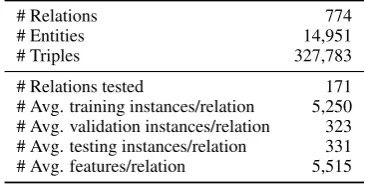
out of 1,345 relations in FB15K, covering 14,951 entities and 327,783 triples. Then we build a graph based on this data and use it as input to CPRA (and our baseline methods).
Labeled instance generation. We select 171 relations to test our methods. To do so, we pick 10 popular domains, including award, education, film, government, location, music, olympics, or-ganization, people, and tv. Relations in these do-mains with at least 50 triples observed for them are selected. For each of the 171 relations, we split the associated triples into roughly 80% training, 10% validation, and 10% testing. Since the triple num-ber varies significantly among the relations, we al-low at most 200 validation/testing triples for each relation, so as to make the test cases as balanced as possible. Note that validation and testing triples are not used for constructing the graph.
We generate positive instances for each relation directly from these triples. Given a relationrand a triple(h, r, t)observed for it (training, validation, or testing), we take the pair of entities(h, t)as a positive instance for that relation. Then we follow (Shi and Weninger, 2015; Krompaß et al., 2015) to generate negative instances. Given each positive instance(h, t)we generate four negative ones, two by randomly corrupting the headh, and the other two the tailt. To make the negative instances as d-ifficult as possible, we corrupt a position using on-ly entities that have appeared in that position. That means, given the relationcapitalOfand the pos-itive instance (Paris,France), we could generate a negative instance (Paris,UK) but never (Paris, NBA), since NBA never appears as a tail entity of the relation. We further ensure that the negative instances do not overlap with the positive ones.
Feature extraction and computation. Given the labeled instances, we extract path features for them using the code provided by Shi and Weninger (2015)8. It is a depth-first search strategy that
enu-merates all paths between two entities. We set the maximum path length to beℓ= 3. There are about 8.2% of the labeled instances for which no path could be extracted. We remove such cases, giving on average about 5,250 training, 323 validation, and 331 testing instances per relation. Then we re-move paths that appear only once in each relation, getting 5,515 features on average per relation. We
7We still add an inverse version for the relation kept dur-ing path extraction.
8https://github.com/nddsg/KGMiner
# Relations 774
# Entities 14,951
# Triples 327,783
# Relations tested 171
[image:6.595.324.509.63.155.2]# Avg. training instances/relation 5,250 # Avg. validation instances/relation 323 # Avg. testing instances/relation 331 # Avg. features/relation 5,515
Table 1: Statistics of the data.
simply compute the value of each feature as its fre-quency in an instance. Table 1 lists the statistics of the data used in our experiments.
Evaluation metrics. As evaluation metrics, we use mean average precision (MAP) and mean re-ciprocal rank (MRR), following recent work eval-uating KB completion performance (West et al., 2014; Gardner and Mitchell, 2015). Both metrics evaluate some ranking process: if a method ranks the positive instances before the negative ones for each relation, it will get a high MAP or MRR.
Baseline methods. We compare CPRA to tra-ditional single-task PRA. CPRA first groups the 171 relations into clusters, and then learns classi-fiers jointly for relations within the same cluster. We implement two versions of it: CPRA-LR and CPRA-SVM. As we have shown in Proposition 1, both of them could be solved by standard classi-fication tools. PRA learns an individual classifier for each of the relations, using LR or SVM classi-fication techniques, denoted by LR or PRA-SVM. We use LIBLINEAR (Fan et al., 2008)9 to
solve the LR and SVM classification problems. For all these methods, we tune the cost c in the range of {2−5,2−4,· · · ,24,25}. And we set the
coupling coefficientρ= λ2
λ1 in CPRA in the range of{0.1,0.2,0.5,1,2,5,10}.
We further compare CPRA to TransE, a widely adopted embedding-based method (Bordes et al., 2013). TransE learns vector representations for entities and relations (i.e., embeddings), and uses the learned embeddings to determine the plausibil-ity of missing facts. Such plausibilplausibil-ity can then be used to rank the labeled instances. We implement TransE using the code provided by Bordes et al. (2013)10. To learn embeddings, we take as input
the triples used to construct the graph (from which CPRA and PRA extract their paths). We tune the embedding dimension in {20,50,100}, the mar-gin in{0.1,0.2,0.5,1,2,5}, and the learning rate
film/casting-director gov-jurisdiction/dist-represent film/cinematography location/contain
film/costume-design-by location/adjoin film/art-direction-by us-county/county-seat film/crewmember county-place/county film/set-decoration-by location/partially-contain film/production-design-by region/place-export film/edited-by
film/written-by film/story-by
org/place-founded country/divisions org/headquarter-city country/capital
org/headquarter-state country/fst-level-divisions org/geographic-scope country/snd-level-divisions org/headquarter-country admin-division/capital org/service-location
[image:7.595.71.292.63.292.2]tv/tv-producer music-group-member/instrument tv/recurring-writer music-artist/recording-role tv/program-creator music-artist/track-role tv/regular-appear-person music-group-member/role tv/tv-actor
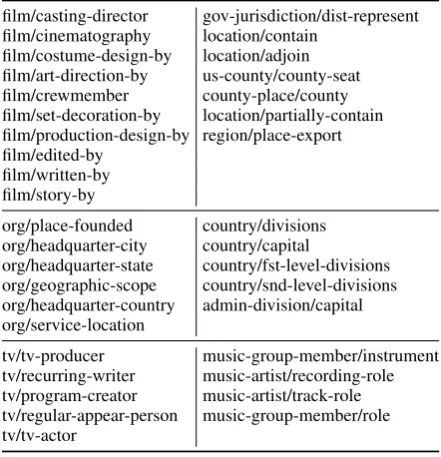
Table 2: Six largest clusters of relations (with the stopping criterionδ= 0.5).
in{10−4,10−3,10−2,10−1,1}. For details please
refer to (Bordes et al., 2013). For each of these methods, we select the optimal configuration that leads to the highest MAP on the validation set and report its performance on the test set.
5.2 Relation Clustering Results
We first test the effectiveness of our agglomerative strategy (Section 4.2) in relation clustering. With the stopping criterionδ = 0.5, 96 out of the 171 relations are grouped into clusters which contain at least two relations. Each of these 96 relations will later be learned jointly with some other relations. The other 75 relations cannot be merged, and will still be learned individually. Table 2 shows the six largest clusters discovered by our algorithm. Rela-tions in each cluster are arranged in the order they were merged. The results indicate that our algo-rithm can effectively identify coherent clusters in which relations are highly correlated to each other. For example, the top left cluster describes relations between a film and its crew members, and the mid-dle left between an organization and a location.
During clustering we might obtain clusters that contain too many relations and hence too many training instances for our CPRA model to learn ef-ficiently. We split such clusters into sub-clusters, either according to the domain (e.g., the film clus-ter and tv clusclus-ter) or randomly (e.g., the two loca-tion clusters on the top right).
5.3 KB Completion Results
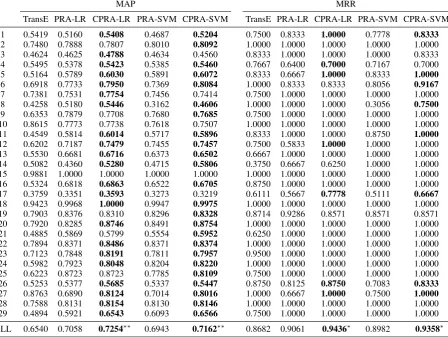
We further test the effectiveness of our multi-task learning strategy (Section 4.3) in KB completion. Table 3 gives the results on the 96 relations that are actually involved in multi-tasking learning (i.e., grouped into clusters with size larger than one).11
The 96 relations are grouped into 29 clusters, and relations within the same cluster are learned joint-ly. Table 3 reports (i) MAP and MRR within each cluster and (ii) overall MAP and MRR on the 96 relations. Numbers marked in bold type indicate that CPRA-LR/SVM outperforms PRA-LR/SVM, within a cluster (with its ID listed in the first col-umn) or on all the 96 relations (ALL). We judge s-tatistical significance of the overall improvements achieved by CPRA-LR/SVM over PRA-LR/SVM and TransE, using a paired t-test. The average pre-cision (or reciprocal rank) on each relation is used as paired data. The symbol “∗∗” indicates a signif-icance level ofp <0.0001, and “∗” a significance level ofp <0.05.
From the results, we can see that (i) CPRA outperforms PRA (using either LR or SVM) and TransE on the 96 relations (ALL) in both metrics. All the improvements are statistically significant, with a significance level ofp < 0.0001for MAP and a significance level ofp <0.05for MRR. (i-i) CPRA-LR/SVM outperforms PRA-LR/SVM in 22/24 out of the 29 clusters in terms of MAP. Most of the improvements are quite substantial. (iii) Im-proving PRA-LR and PRA-SVM in terms of MRR could be hard, since they already get the best per-formance (MRR = 1) in 19 out of the 29 clusters. But even so, CPRA-LR/SVM still improves 7/8 out of the remaining 10 clusters. (iv) The PRA-style methods perform substantially better than the embedding-based TransE model in most of the 29 clusters and on all the 96 relations. This observa-tion demonstrates the superiority of observed fea-tures (i.e., PRA paths) over latent features.
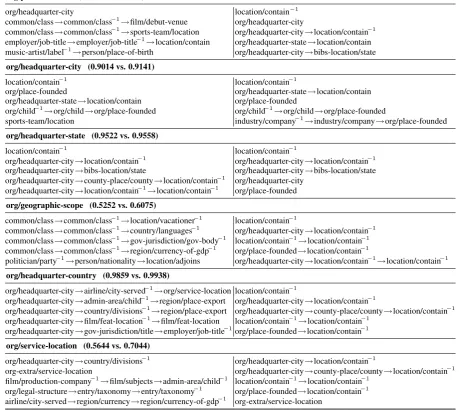
Table 4 further shows the top 5 most discrimina-tive paths (i.e., features with the highest weights) discovered by PRA-SVM (left) and CPRA-SVM (right) for each relation in the 6th cluster.12 The
average precision on each relation is also
provid-11The other 75 relations are still learned individually. So CPRA and PRA perform the same on these relations. The MAP values on these 75 relations are 0.6360, 0.6558, 0.6543 for TransE, PRA-LR, and PRA-SVM respectively, and the MRR values are 0.9049, 0.9033, and 0.9013 respectively.
MAP MRR
TransE PRA-LR CPRA-LR PRA-SVM CPRA-SVM TransE PRA-LR CPRA-LR PRA-SVM CPRA-SVM 1 0.5419 0.5160 0.5408 0.4687 0.5204 0.7500 0.8333 1.0000 0.7778 0.8333
2 0.7480 0.7888 0.7807 0.8010 0.8092 1.0000 1.0000 1.0000 1.0000 1.0000 3 0.4624 0.4625 0.4788 0.4634 0.4560 0.8333 1.0000 1.0000 1.0000 0.8333 4 0.5495 0.5378 0.5423 0.5385 0.5460 0.7667 0.6400 0.7000 0.7167 0.7000 5 0.5164 0.5789 0.6030 0.5891 0.6072 0.8333 0.6667 1.0000 0.8333 1.0000
6 0.6918 0.7733 0.7950 0.7369 0.8084 1.0000 0.8333 0.8333 0.8056 0.9167
7 0.7381 0.7531 0.7754 0.7456 0.7414 0.7500 1.0000 1.0000 1.0000 1.0000 8 0.4258 0.5180 0.5446 0.3162 0.4606 1.0000 1.0000 1.0000 0.3056 0.7500
9 0.6353 0.7879 0.7708 0.7680 0.7685 0.7500 1.0000 1.0000 1.0000 1.0000 10 0.8615 0.7773 0.7738 0.7618 0.7507 1.0000 1.0000 1.0000 1.0000 1.0000 11 0.4549 0.5814 0.6014 0.5717 0.5896 0.8333 1.0000 1.0000 0.8750 1.0000
12 0.6202 0.7187 0.7479 0.7455 0.7457 0.7500 0.5833 1.0000 1.0000 1.0000 13 0.5530 0.6681 0.6716 0.6373 0.6502 0.6667 1.0000 1.0000 1.0000 1.0000 14 0.5082 0.4360 0.5280 0.4715 0.5806 0.3750 0.6667 0.6250 1.0000 1.0000 15 0.9881 1.0000 1.0000 1.0000 1.0000 1.0000 1.0000 1.0000 1.0000 1.0000 16 0.5324 0.6818 0.6863 0.6522 0.6705 0.8750 1.0000 1.0000 1.0000 1.0000 17 0.3759 0.3351 0.3593 0.3273 0.3219 0.6111 0.5667 0.7778 0.5111 0.6667
18 0.9423 0.9968 1.0000 0.9947 0.9975 1.0000 1.0000 1.0000 1.0000 1.0000 19 0.7903 0.8376 0.8310 0.8296 0.8328 0.8714 0.9286 0.8571 0.8571 0.8571 20 0.7920 0.8285 0.8746 0.8491 0.8754 1.0000 1.0000 1.0000 1.0000 1.0000 21 0.4885 0.5869 0.5799 0.5554 0.5952 0.6250 1.0000 1.0000 1.0000 1.0000 22 0.7894 0.8371 0.8486 0.8371 0.8374 1.0000 1.0000 1.0000 1.0000 1.0000 23 0.7123 0.7848 0.8191 0.7811 0.7957 0.9500 1.0000 1.0000 1.0000 1.0000 24 0.5982 0.7923 0.8048 0.8204 0.8220 1.0000 1.0000 1.0000 1.0000 1.0000 25 0.6223 0.8723 0.8723 0.7785 0.8109 0.7500 1.0000 1.0000 1.0000 1.0000 26 0.5253 0.5377 0.5685 0.5337 0.5447 0.8750 0.8125 0.8750 0.7083 0.8333
27 0.8763 0.6890 0.8124 0.7014 0.8016 1.0000 0.6667 1.0000 0.7500 1.0000
[image:8.595.78.527.67.404.2]28 0.7588 0.8131 0.8154 0.8130 0.8146 1.0000 1.0000 1.0000 1.0000 1.0000 29 0.4894 0.5921 0.6543 0.6093 0.6566 0.7500 1.0000 1.0000 1.0000 1.0000 ALL 0.6540 0.7058 0.7254∗∗ 0.6943 0.7162∗∗ 0.8682 0.9061 0.9436∗ 0.8982 0.9358∗
Table 3: KB completion results on the 96 relations that have been grouped into clusters with size larger than one (with the stopping criterionδ= 0.5), and hence involved in multi-tasking learning.
ed. We can observe that (i) CPRA generally dis-covers more predictive paths than PRA. Almost all the top paths discovered by CPRA are easily inter-pretable and provide sensible reasons for the final prediction, while some of the top paths discovered by PRA are hard to interpret and less predictive. Takeorg/place-foundedas an example. All the 5 CPRA paths are useful to predict the place where an organization was founded,e.g., the 3rd one tells that “the organization headquarter in a city which is located in that place”. However, the PRA path “common/class→common/class−1→
film/debut-venue” is hard to interpret and less predictive. (ii) For the 1st/4th/6th relation on which PRA gets a low average precision, CPRA learns almost com-pletely different top paths and gets a substantially higher average precision. While for the other re-lations (2nd/3rd/5th) on which PRA already per-forms well enough, CPRA learns similar top paths and gets a comparable average precision. We have conducted the same analyses with CPRA-LR and PRA-LR, and observed similar phenomena. All
these observations demonstrate the superiority of CPRA, in terms of not only predictive accuracy but also model interpretability.
6 Conclusion
org/place-founded (0.4920 vs. 0.6750)
org/headquarter-city location/contain−1 common/class→common/class−1→film/debut-venue org/headquarter-city
common/class→common/class−1→sports-team/location org/headquarter-city→location/contain−1 employer/job-title→employer/job-title−1→location/contain org/headquarter-state→location/contain music-artist/label−1→person/place-of-birth org/headquarter-city→bibs-location/state
org/headquarter-city (0.9014 vs. 0.9141)
location/contain−1 location/contain−1
org/place-founded org/headquarter-state→location/contain org/headquarter-state→location/contain org/place-founded
org/child−1→org/child→org/place-founded org/child−1→org/child→org/place-founded
sports-team/location industry/company−1→industry/company→org/place-founded
org/headquarter-state (0.9522 vs. 0.9558)
location/contain−1 location/contain−1
org/headquarter-city→location/contain−1 org/headquarter-city→location/contain−1 org/headquarter-city→bibs-location/state org/headquarter-city→bibs-location/state org/headquarter-city→county-place/county→location/contain−1 org/headquarter-city
org/headquarter-city→location/contain−1→location/contain−1 org/place-founded
org/geographic-scope (0.5252 vs. 0.6075)
common/class→common/class−1→location/vacationer−1 location/contain−1
common/class→common/class−1→country/languages−1 org/headquarter-city→location/contain−1 common/class→common/class−1→gov-jurisdiction/gov-body−1 location/contain−1→location/contain−1 common/class→common/class−1→region/currency-of-gdp−1 org/place-founded→location/contain−1
politician/party−1→person/nationality→location/adjoins org/headquarter-city→location/contain−1→location/contain−1
org/headquarter-country (0.9859 vs. 0.9938)
org/headquarter-city→airline/city-served−1→org/service-location location/contain−1
org/headquarter-city→admin-area/child−1→region/place-export org/headquarter-city→location/contain−1
org/headquarter-city→country/divisions−1→region/place-export org/headquarter-city→county-place/county→location/contain−1 org/headquarter-city→film/feat-location−1→film/feat-location location/contain−1→location/contain−1
org/headquarter-city→gov-jurisdiction/title→employer/job-title−1org/place-founded→location/contain−1
org/service-location (0.5644 vs. 0.7044)
org/headquarter-city→country/divisions−1 org/headquarter-city→location/contain−1
org-extra/service-location org/headquarter-city→county-place/county→location/contain−1 film/production-company−1→film/subjects→admin-area/child−1 location/contain−1→location/contain−1
[image:9.595.69.529.74.484.2]org/legal-structure→entry/taxonomy→entry/taxonomy−1 org/place-founded→location/contain−1 airline/city-served→region/currency→region/currency-of-gdp−1 org-extra/service-location
Table 4: Top paths given by PRA-SVM (left) and CPRA-SVM (right) for each relation in the 6th cluster.
accuracy and model interpretability.
This is the first work that investigates the pos-sibility of multi-task learning with PRA, and we just provide a very simple solution. There are still many interesting topics to study. For instance, the agglomerative clustering strategy can only identi-fy highly correlated relations, i.e., those sharing a lot of common paths. Relations that are only loosely correlated,e.g., those sharing no common paths but a lot of sub-paths, will not be identified. We would like to design new mechanisms to dis-cover loosely correlated relations, and investigate whether coupling such relations still provides ben-efits. Another example is that the current method is a two-step approach, performing relation clus-tering first and then relation coupling. It will be in-teresting to study whether one can merge the
clus-tering step and the coupling step so as to have a richer inter-task dependent structure. We will in-vestigate such topics in our future work.
Acknowledgments
References
Rie Kubota Ando and Tong Zhang. 2005. A frame-work for learning predictive structures from multi-ple tasks and unlabeled data. Journal of Machine Learning Reseach, 6:1817–1853.
Andreas Argyriou, Theodoros Evgeniou, and Massim-iliano Pontil. 2007. Multi-task feature learning. In
Advances in Neural Information Processing System-s, pages 41–48.
Kurt Bollacker, Colin Evans, Praveen Paritosh, Tim S-turge, and Jamie Taylor. 2008. Freebase: A collab-oratively created graph database for structuring hu-man knowledge. In Proceedings of the 2008 ACM SIGMOD International Conference on Management of Data, pages 1247–1250.
Antoine Bordes, Jason Weston, Ronan Collobert, and Yoshua Bengio. 2011. Learning structured em-beddings of knowledge bases. In Proceedings of the 25th AAAI Conference on Artificial Intelligence, pages 301–306.
Antoine Bordes, Nicolas Usunier, Alberto Garcia-Dur´an, Jason Weston, and Oksana Yakhnenko. 2013. Translating embeddings for modeling multi-relational data. InAdvances in Neural Information Processing Systems, pages 2787–2795.
Andrew Carlson, Justin Betteridge, Bryan Kisiel, Bur-r Settles, Estevam R. HBur-ruschka JBur-r, and Tom M. Mitchell. 2010. Toward an architecture for never-ending language learning. In Proceedings of the 24th AAAI Conference on Artificial Intelligence, pages 1306–1313.
Rich Caruana. 1997. Multitask learning. Machine Learning, 28(1):41–75.
Olivier Chapelle, Pannagadatta Shivaswamy, Srinivas Vadrevu, Kilian Weinberger, Ya Zhang, and Belle Tseng. 2010. Multi-task learning for boosting with application to web search ranking. InProceedings of the 16th ACM SIGKDD International Conference on Knowledge Discovery and Data Mining, pages 1189–1198.
Eunsol Choi, Tom Kwiatkowski, and Luke Zettlemoy-er. 2015. Scalable semantic parsing with partial on-tologies. In Proceedings of the 53rd Annual Meet-ing of the Association for Computational LMeet-inguistics and the 7th International Joint Conference on Natu-ral Language Processing, pages 1311–1320.
Silviu Cucerzan. 2007. Large-scale named entity disambiguation based on Wikipedia data. In Pro-ceedings of the 2007 Joint Conference on Empirical Methods in Natural Language Processing and Com-putational Natural Language Learning, pages 708– 716.
Lei Cui, Xilun Chen, Dongdong Zhang, Shujie Liu, Mu Li, and Ming Zhou. 2013. Multi-domain adap-tation for SMT using multi-task learning. In Pro-ceedings of the 2013 Conference on Empirical Meth-ods in Natural Language Processing, pages 1055– 1065.
Xin Dong, Evgeniy Gabrilovich, Geremy Heitz, Wilko Horn, Ni Lao, Kevin Murphy, Thomas Strohman-n, Shaohua SuStrohman-n, and Wei Zhang. 2014. Knowl-edge vault: A web-scale approach to probabilistic knowledge fusion. InProceedings of the 20th ACM SIGKDD International Conference on Knowledge Discovery and Data Mining, pages 601–610. Daxiang Dong, Hua Wu, Wei He, Dianhai Yu, and
Haifeng Wang. 2015. Multi-task learning for mul-tiple language translation. In Proceedings of the 53rd Annual Meeting of the Association for Compu-tational Linguistics and the 7th International Joint Conference on Natural Language Processing, pages 1723–1732.
Theodoros Evgeniou and Massimiliano Pontil. 2004. Regularized multi-task learning. InProceedings of the 10th ACM SIGKDD International Conference on Knowledge Discovery and Data Mining, pages 109– 117.
Rong-En Fan, Kai-Wei Chang, Cho-Jui Hsieh, Xiang-Rui Wang, and Chih-Jen Lin. 2008. Liblinear: A library for large linear classification. Journal of Ma-chine Learning Research, 9:1871–1874.
Matt Gardner and Tom Mitchell. 2015. Efficient and expressive knowledge base completion using sub-graph feature extraction. InProceedings of the 2015 Conference on Empirical Methods in Natural Lan-guage Processing, pages 1488–1498.
Matt Gardner, Partha Pratim Talukdar, Bryan Kisiel, and Tom Mitchell. 2013. Improving learning and inference in a large knowledge-base using laten-t synlaten-taclaten-tic cues. InProceedings of the 2013 Con-ference on Empirical Methods in Natural Language Processing, pages 833–838.
Matt Gardner, Partha Talukdar, Jayant Krishnamurthy, and Tom Mitchell. 2014. Incorporating vector space similarity in random walk inference over knowledge bases. In Proceedings of the 2014 Conference on Empirical Methods in Natural Language Process-ing, pages 397–406.
Shangpu Jiang, Daniel Lowd, and Dejing Dou. 2012. Learning to refine an automatically extracted knowl-edge base using markov logic. InProceedings of the 2012 IEEE International Conference on Data Min-ing, pages 912–917.
Jing Jiang. 2009. Multi-task transfer learning for weakly-supervised relation extraction. In Proceed-ings of the Joint Conference of the 47th Annual Meeting of the ACL and the 4th International Joint Conference on Natural Language Processing of the AFNLP, pages 1012–1020.
Denis Krompaß, Stephan Baier, and Volker Tresp. 2015. Type-constrained representation learning in knowledge graphs. InProceedings of the 13th Inter-national Semantic Web Conference, pages 640–655.
Ni Lao and William W. Cohen. 2010. Relational re-trieval using a combination of path-constrained ran-dom walks.Machine Learning, 81(1):53–67.
Ni Lao, Tom Mitchell, and William W. Cohen. 2011. Random walk inference and learning in a large scale knowledge base. In Proceedings of the 2011 Con-ference on Empirical Methods in Natural Language Processing, pages 529–539.
Jens Lehmann, Robert Isele, Max Jakob, Anja Jentzsch, Dimitris Kontokostas, Pablo N. Mendes, Sebastian Hellmann, Mohamed Morsey, Patrick van Kleef, S¨oren Auer, et al. 2014. Dbpedia: A large-scale, multilingual knowledge base extracted from wikipedia.Semantic Web Journal.
Arvind Neelakantan, Benjamin Roth, and Andrew M-cCallum. 2015. Compositional vector space mod-els for knowledge base completion. InProceedings of the 53rd Annual Meeting of the Association for Computational Linguistics and the 7th International Joint Conference on Natural Language Processing, pages 156–166.
Maximilian Nickel, Volker Tresp, and Hans-Peter Kriegel. 2011. A three-way model for collective learning on multi-relational data. In Proceedings of the 28th International Conference on Machine Learning, pages 809–816.
Maximilian Nickel, Xueyan Jiang, and Volker Tresp. 2014. Reducing the rank in relational factorization models by including observable patterns. In Ad-vances in Neural Information Processing Systems, pages 1179–1187.
Jay Pujara, Hui Miao, Lise Getoor, and William Cohen. 2013. Knowledge graph identification. In Proceed-ings of the 11th International Semantic Web Confer-ence, pages 542–557.
Matthew Richardson and Pedro Domingos. 2006. Markov logic networks. Machine Learning, 62(1-2):107–136.
Michael Schuhmacher and Simone Paolo Ponzetto. 2014. Knowledge-based graph document modeling. In Proceedings of the 7th ACM International Con-ference on Web Search and Data Mining, pages 543– 552.
Rico Sennrich, Holger Schwenk, and Walid Aransa. 2013. A multi-domain translation model framework for statistical machine translation. InProceedings of the 51st Annual Meeting of the Association for Com-putational Linguistics, pages 832–840.
Baoxu Shi and Tim Weninger. 2015. Fact checking in large knowledge graphs: A discriminative predict path mining approach. InarXiv:1510.05911. Kristina Toutanova and Danqi Chen. 2015. Observed
versus latent features for knowledge base and tex-t inference. InProceedings of the 3rd Workshop on Continuous Vector Space Models and Their Compo-sitionality.