ISSN Online: 2329-3292 ISSN Print: 2329-3284
DOI: 10.4236/ojbm.2017.54056 Oct. 23, 2017 671 Open Journal of Business and Management
Review of Human Resource Management
Function of Front Line Managers
Yingying Liu
School of Business Administration, South China University of Technology, Guangzhou, China
Abstract
Front Line Managers (FLMs) are the managers of staff at the grass-roots level at the forefront of performing management activities, who play an important role in the achievement of enterprise’s whole objective and the implementa-tion of enterprise plan to the individual staff and first-line staff. With the de-velopment of management practice, FLMs are beginning to shoulder part of the human resources management responsibilities. The paper summarizes the research status of human resource management function of FLMs from the perspective of human resources management, and outlooks the future re-search direction.
Keywords
FLMs, Human Resources Management, Human Resources Management Effectiveness
1. Introduction
With the development of management practices of modern enterprise, the prac-tice of human resource management in enterprises is becoming more and more diversified, and the human resource management activities are no longer limited to the responsibility of the Human Resources Department. In order to realize the effective management of human resources, the Human Resources Department must cooperate with the managers of other departments to accomplish the management activities together. For non-human resources departments, De-partment Managers, Line Managers, especially FLMs, shall shoulder the super-visory responsibility of transmission and implementation.
Many scholars believe that the implementation of human resources manage-ment activities by FLMs is the first step for enterprises to achieve the human How to cite this paper: Liu, Y.Y. (2017)
Review of Human Resource Management Function of Front Line Managers. Open Journal of Business and Management, 5, 671-679.
https://doi.org/10.4236/ojbm.2017.54056
Received: September 13, 2017 Accepted: October 20, 2017 Published: October 23, 2017
Copyright © 2017 by author and Scientific Research Publishing Inc. This work is licensed under the Creative Commons Attribution International License (CC BY 4.0).
http://creativecommons.org/licenses/by/4.0/
DOI: 10.4236/ojbm.2017.54056 672 Open Journal of Business and Management resource management effectiveness (Lowe, 1992; den Hartog, Boselie & Paauwe, 2004) [1] [2]. Compared with the Human Resource Department, the cognition, understanding and implementation of human resource management by FLMs have greater influence on staff. Advanced human resources management con-cepts, policies, systems and activities, if the FLMS can not effectively transfer and operate, are also equivalent to a paper empty talk. So from this point of view, the FLM HRM implementation is directly related to the effectively landing of enter-prise human resources management. Therefore, this paper will review the hu-man resource hu-management function of the FLM from the perspective of huhu-man resource management, and give some directions for the future research of the field.
2. Front Line Managers (FLMS)
Front Line Managers (First line manager, FLMs), refer to those who contribute directly to the achievement of organizational objective generally in product field (production, operation and manufacturing) (Heraty & Morley, 1995) [3]. Storey (1988) divided Line Managers into two broad categories according to manage-ment authority: Junior/Middle Line Managers and Senior Line Managers, of which Junior/Middle Line Managers are the FLMs [4]. McGovern, Gratton and Hope Hailey et al. (1997) believe that the FLMs are the people who are not hu-man resource hu-manager with the responsibility of hu-managing staff regardless of the level of the job [5].
With the deepening of the study, scholars further define and explain the FLMs. Hales (2005) believes that FLMs are typical role of frontline management, which undertakes the communication with first-line staff (i.e., those who do not possess management functions) and is responsible for receiving the staff’s work report [6]. Nehles et al. introduced the human resources management effective-ness in 2006, and believe that FLMs are junior managers who are responsible for managing daily operation of basic team and certain human resources [7]. FLMs are direct managers of product and service from the perspective of product and service; and they play a center role in the management of organizing operation and are responsible for the product and service as well as performance of their team.
The product development and production of enterprises show a fine trend of development, and the structure of enterprises is becoming more and more flat due to the market competition. As the role of FLMs is more and more impor-tant, the role and responsibilities of FLMs played and undertaken in the enter-prise is more and more irreplaceable.
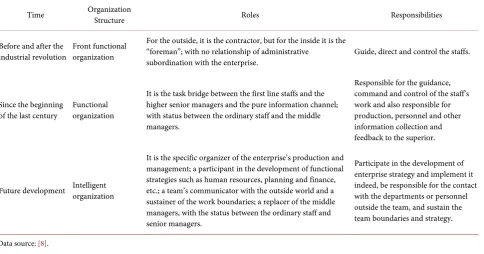
DOI: 10.4236/ojbm.2017.54056 673 Open Journal of Business and Management undertaken by the First Line Manager at different times are also different. Li Weidong, Liu Hong and Wang Yufeng (2010) have summarized the roles and responsibilities [8] undertaken by the First Line Manager at different times, as shown in Table 1.
It is easy to know that since the beginning of the last century, the FLMs have been playing the role of a task bridge between the first line staffs and higher se-nior managers, in charge of conveying the information and managing the em-ployees. Storey found that the work of the First Line Manager actually includes nine human resources functions including reward, cultivation & training, moti-vation of teams, evaluation of subordinates, vocational training, expense cutting down, improvement of quality, customer service, continuous improvement and optimization of the labor force allocation as early as 1992, and Storey suggests that the First Line Manager shall be given more tasks for human resource man-agement [4].
After interviewing 667 managers in 2006, Kulik and Bainbridge put forward the detailed division of labor between the First Line Manager and HR in the hu-man resource hu-management process: the development of promotion decision, performance management, guidance and standardization of staff’s behavior, work design, career planning, recruitment and selection of staff as well as the development of successor program are the human resources management un-dertaken by First Line Manager; while the management of salary and welfare, the planning of human resources, the development of leadership, the creation of or-ganizational culture and the training of staff are the key work of HR [9].
[image:3.595.59.544.477.731.2]The Human Resources Department is responsible for developing the effective human resource practices for enterprises. However, how these practices are
Table 1. Roles and Responsibilities of the First Line Manager.
Time Organization Structure Roles Responsibilities
Before and after the
industrial revolution Front functional organization
For the outside, it is the contractor, but for the inside it is the “foreman”; with no relationship of administrative
subordination with the enterprise. Guide, direct and control the staffs.
Since the beginning
of the last century Functional organization
It is the task bridge between the first line staffs and the higher senior managers and the pure information channel; with status between the ordinary staff and the middle managers.
Responsible for the guidance, command and control of the staff’s work and also responsible for production, personnel and other information collection and feedback to the superior.
Future development Intelligent organization
It is the specific organizer of the enterprise’s production and management; a participant in the development of functional strategies such as human resources, planning and finance, etc.; a team’s communicator with the outside world and a sustainer of the work boundaries; a replacer of the middle managers, with the status between the ordinary staff and senior managers.
Participate in the development of enterprise strategy and implement it indeed, be responsible for the contact with the departments or personnel outside the team, and sustain the team boundaries and strategy.
DOI: 10.4236/ojbm.2017.54056 674 Open Journal of Business and Management achieved ultimately falls on the company’s First Line Manager. Through the em-pirical research on the First Line Manager, Perry and Kulik (2008) have put for-ward that while retaining the original traditional Human Resources Department, more and more enterprises will gradually transfer the function of human re-sources management to the First Line Manager in each department, who truly implements the human resources decisions, truly contacts, deploys and manages the HR. It is found in the research by two scholars, Perry and Kulik that the ef-fect of devolution is significant and is positively regulated by the first line sup-port [10]. Zhang Chuanqing and Tian Xu’s empirical study in 2012 shows that the participation of the First Line Manager in activities for human resource management has played a regulatory role in the behavior of staffs and the beha-vior of organizational citizenship. The scholars, Alfes, Truss and Soane et al. (2013) have constructed the behavior of the FLMs, human resources manage-ment practices and model of individual performance perceived by the staff from the view perceived by staffs and in accordance with the social exchange theory, and have analyzed 1796 interviewees through structural equation model, the re-sult of which shows that the First Line Manager has an important significance in human resources management effectiveness: the scholars, Alfes et al. (2013) think that the focus of human resources management shall be on selection of the First Line Manager, resource allocation and performance management, followed by the support for the First Line Manager to ensure the fair and consistent hu-man resource hu-management practices [11].
4. Restrictions on FLMs in Human Resource Practices
As FLMs show better performance than HR Department in some HR work, such as recruitment training, performance management and promotion design, etc., part of the HR work are transferred to the FLMs to manage and execute, which is also one of the options for enterprises to reduce cost, expand influences, im-prove effects and efficiency (Brewster & Holt Larsen, 2000; Kulik & Bainbridge, 2006) [9] [12]. However, such HR devolution is not always welcomed and rec-ognized by FLMs, because they are in a complex working environment, and the devolution of HR work has increased the work diversity of the FLMs, which is not necessarily expected by them. (Sims & Szilagyi, 1976) [13].
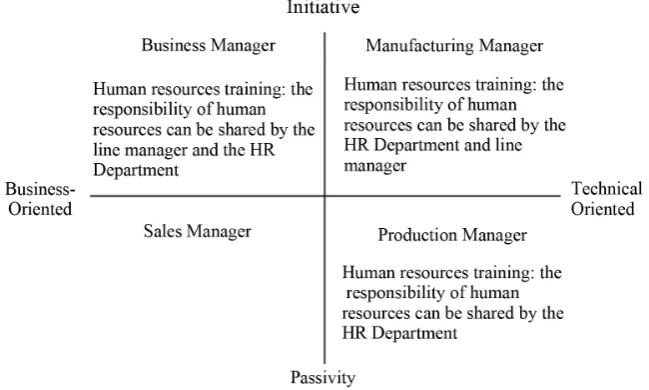
In the 1992 study, Storey ever proposed two core dimensions-initiative/passivity, business orientation/technology orientation, which can be used to distinguish different types of FLMs, and presented the Storey model as shown in Figure 1. In this model, Storey thought that: Personnel Department is not the key to im-prove the work of FLMs, because there are more passive FLMs than the initiative FLMs in most enterprises [14].
DOI: 10.4236/ojbm.2017.54056 675 Open Journal of Business and Management
Figure 1. Storey model line manager type division. Data source: Storey, J.,
Develop-ments in the Management of Human Resources, Blackwell, Oxford, 1992.
bureaucracy and institutionalization formed in the process of human resource management (Gratton L, et al., 1999) [15]; while the HR Department thinks that FLMs do not perform well in carrying out performance assessment on staff (Redman, 2001) [16]. In addition, in reality, many FLMs of enterprises especially the team leaders, are promoted from the non-management staff (first line staff), and they will still lack the necessary awareness of the specific activities arranged by the HR Department when they face the specific practical work at micro level of enterprise every day.
DOI: 10.4236/ojbm.2017.54056 676 Open Journal of Business and Management found that the discretion of FLMs in the execution of human resources man-agement activities is centered on the job demand, and through the staff’s re-sponse to job involvement and innovative behaviors, the exchange process is in-fluenced [21]. Huang Zhaoyou (2015) argue that the FLMs are not the profes-sional management personnel in HR Management Department, for which they will be restricted in the development of human resource management efficiency, and the restriction factors include the lack of FLMs’ abilities, lack of impetus and limited participation chance.
To sum up, after several years’ development, the study of FLMs from the hu-man resources hu-management aspect involves different fields and forms multiple theoretical systems. And in the existing studies of the correlation between FLMs and human resource management, scholars still have various opinions and do not form a unified point of view yet. And between the FLMs and HR Depart-ment, there are still many restriction factors.
5. Improvement of Human Resources Management
Effectiveness of FLMs
With the increasing awareness of the relationship between FLMs and human resource effectiveness, scholars begin to discuss how to promote the improve-ment of human resource effectiveness of FLMs. Surveying present research con-ditions, the exploration is carried out in two ways.
DOI: 10.4236/ojbm.2017.54056 677 Open Journal of Business and Management for purpose of exploring the relationship between communication, trust, depen-dency and cooperation and human resources management effectiveness in the process of collaboration, and found by research that if there is smooth commu-nication, higher degree of trust, higher dependency and close cooperation among them, the human resources management effectiveness of FLMs is more higher [24].
6. Directions for Future Research
The researches show that there is hardly any research on FLMs in human re-sources management based on quantity of literatures and research point. Espe-cially in the field of empirical research, the previous literature in this field is not discussed comprehensively and thoroughly. Given this, we believe that the re-search of FLMs in human resources management can be discussed in theory and empirical study from the following aspects:
1) With the HRM role positioning more and more strategic orientation, the FLMs’ perception of the importance &effectiveness on HRM will change. For example, more and more enterprises are beginning to reconstruct the HRM sys-tem, transforming it from the original traditional HR department to HR-COE (Human Resource Expert Center), HR-SSC (Human Resource Sharing Service Center) and HRBP. Future research can focus on FLMs’ perception of HRM from a dynamic perspective and the impact of this perception on their attitudes, behavior, and HRM performance.
1) In the current study, this trend of the HR devolution has been widely no-ticed. But the impact of the FLMS’ HRM responsibility on HRM performance (positive or negative) has not yet been answered. Through the summary of past studies, we believe that there may be a “double-edged sword” effect. On the one hand, FLM can make rapid adjustments in the implementation process which improves the implementation of HRM effect.. On the other hand, taking on ad-ditional roles may also take up the line manager’s more resources, which will not only prevent the line manager from effectively implementing the HRM activity, but will even have a negative impact on his or her job and performance. Future research can do more in-depth exploration on the impact of HR devolution.
3) The boundary conditions related to the effect of HR devolution are not adequately addressed. The nature and extent of the impact of this trend may also be different in different organizational contexts. It is important to clarify this is-sue for theory and practice, and that future research should continue to excavate its boundary conditions.
7. Conclusion
DOI: 10.4236/ojbm.2017.54056 678 Open Journal of Business and Management factors in the implementation of human resource management practices. Rea-lized it, scholars did some research about how to promote the improvement of human resource effectiveness of FLMs. Although Scholars have done a lot of re-search in this field, there are still some uncertain factors, so we sum up some of the future research directions and hope to help later research.
References
[1] Lowe, J. (1992) Locating the Line: The Front-Line Supervisor and Human Resource Management. Reassessing Human Resource Management, 20, 148-168.
[2] Den Hartog, D.N., Boselie, P. and Paauwe, J. (2004) Performance Management: A Model and Research Agenda. Applied Psychology, 53, 556-569.
https://doi.org/10.1111/j.1464-0597.2004.00188.x
[3] Heraty, N. and Morley, M. (1995) Line Managers and Human Resource Develop-ment. Journal of European Industrial Training, 19, 31-37.
https://doi.org/10.1108/03090599510095861
[4] Storey, J. (1988) Developments in the Management of Human Resources. Manage-ment Research News, 11, 27. https://doi.org/10.1108/eb027943
[5] McGovern, P., Gratton, L, Hope-Hailey, V., Stiles, P. and Truss, C. (1997) Human Resource Management on the Line? Human Resource Management Journal, 7, 12-29. https://doi.org/10.1111/j.1748-8583.1997.tb00286.x
[6] Hales, C. (2005) Rooted in Supervision, Branching into Management: Continuity and Change in the Role of First-Line Manager. Journal of Management Studies, 42, 471-506. https://doi.org/10.1111/j.1467-6486.2005.00506.x
[7] Nehles, A.C., van Riemsdijk, M., Kok, I. and Looise, J.K. (2006) Implementing Hu-man Resource Management Successfully: A First-Line Management Challenge.
Management Revue, 34, 256-273.
[8] Li, W.D., Liu, H. and Wang, Y.F. (2010) Role Responsibility and Leadership of FLMs. Human Resources Development of China, 12, 16-18.
[9] Kulik, C.T and Bainbridge, H.T. (2006) HR and the Line: The Distribution of HR Activities in Australian Organisations. Asia Pacific Journal of Human Resources, 44, 240-256.https://doi.org/10.1177/1038411106066399
[10] Perry, E.L. and Kulik, C.T. (2008) The Devolution of HR to the Line: Implications for Perceptions of People Management Effectiveness. The International Journal of Human Resource Management, 19, 262-273.
https://doi.org/10.1080/09585190701799838
[11] Alfes, K., Truss, C., Soane, E.C., Rees, C. and Gatenby, M. (2013) The Relationship between Line Manager Behavior, Perceived HRM Practices, and Individual Perfor-mance: Examining the Mediating Role of Engagement. Human Resource Manage-ment,52, 839-859.https://doi.org/10.1002/hrm.21512
[12] Brewster, C. and Larsen, H.H. (2000) Human Resource Management in Northern Europe: Trends, Dilemmas and Strategy. Blackwell Publishing Ltd.
[13] Sims, H.P and Szilagyi, A.D. (1976) Job Characteristic Relationships: Individual and Structural Moderators. Organizational Behavior and Human Performance, 17, 211-230.
DOI: 10.4236/ojbm.2017.54056 679 Open Journal of Business and Management
[15] Gratton, L., Hope-Hailey, V., Truss, K., et al. (1999) Strategic Human Resource Management. Oxford University Press, New York.
https://doi.org/10.1093/acprof:oso/9780198782049.001.0001
[16] Redman, T., Redman, T. and Wilkinson, A. (2001) Contemporary Human Resource Management. Pearson Education, Harlow, 57-95.
[17] Bond, S. and Wise, S. (2003) Family Leave Policies and Devolution to the Line. Per-sonnel Review, 32, 58-72.https://doi.org/10.1108/00483480310454727
[18] Maxwell, G.A. and Watson, S. (2006) Perspectives on Line Managers in Human Resource Management: Hilton International’s UK Hotels. The International Journal of Human Resource Management, 17, 1152-1170.
https://doi.org/10.1080/09585190600697638
[19] Nehles, A.C., Terhalle, A.M., van Riemsdijk, M.J., et al. (2010) Line Managers as Implementers of HRM: Are They Effective? Manuscript under Review.
[20] Den Hartog, D.N., Boon, C., Verburg, R.M. and Croon, M.A. (2013) HRM, Com-munication, Satisfaction, and Perceived Performance: A Cross-Level Test. Journal of Management, 39, 1637-1665.https://doi.org/10.1177/0149206312440118
[21] Southall, A. (2014) The Discretionary Role of the Line Manager in Inspiring Work Engagement and Innovative Behaviour: A Study of Social Exchange and Job Re-sources in the Public Sector. Doctoral Dissertation, Aston University.
[22] Kuvaas, B., Dysvik, A. and Buch, R. (2014) Antecedents and Employee Outcomes of Line Managers’ Perceptions of Enabling HR Practices. Journal of Management Stu-dies, 51, 845-868.https://doi.org/10.1111/joms.12085
[23] Liu, X., Li, X., Xian, Z. and Chen, C. (2015) How to Improve Human Resource Management Effectiveness—Through the Cooperation of Line Managers and Hu-man Resource Department. Human Resources Development of China, 21, 46-54. [24] Chen, C. (2016) A Study on the Work Process of Human Resource Management.