Proceedings of the 56th Annual Meeting of the Association for Computational Linguistics (Short Papers), pages 81–88 81
A Walk-based Model on Entity Graphs for Relation Extraction
Fenia Christopoulou1,3, Makoto Miwa2,3, Sophia Ananiadou1,3
1National Centre for Text Mining
1School of Computer Science, The University of Manchester, United Kingdom 2Toyota Technological Institute, Nagoya, 468-8511, Japan
3Artificial Intelligence Research Center (AIRC),
National Institute of Advanced Industrial Science and Technology (AIST), Japan
{efstathia.christopoulou, sophia.ananiadou}@manchester.ac.uk
Abstract
We present a novel graph-based neural network model for relation extraction. Our model treats multiple pairs in a sentence simultaneously and considers interactions among them. All the entities in a sentence are placed as nodes in a fully-connected graph structure. The edges are represented with position-aware contexts around the entity pairs. In order to consider differ-ent relation paths between two differ-entities, we construct up tol-length walks between each pair. The resulting walks are merged and iteratively used to update the edge rep-resentations into longer walks representa-tions. We show that the model achieves performance comparable to the state-of-the-art systems on the ACE 2005 dataset without using any external tools.
1 Introduction
Relation extraction (RE) is a task of identifying typed relations between known entity mentions in a sentence. Most existing RE models treat each relation in a sentence individually (Miwa and Bansal, 2016;Nguyen and Grishman,2015). However, a sentence typically contains multiple relations between entity mentions. RE models need to consider these pairs simultaneously to model the dependencies among them. The relation between a pair of interest (namely “target” pair) can be influenced by other pairs in the same sen-tence. The example illustrated in Figure1explains this phenomenon. The relation between the pair of interestToefting andcapital, can be extracted di-rectly from the target entities or indidi-rectly by in-corporating information from other related pairs in the sentence. The person entity (PER) Toeft-ingis directly related withteammatesthrough the
Toefting was convicted of assaulting a pair of workers during
PER
a night out with national squad teammates in the capital ...
PER GPE
PER-SOC PHYS
PHYS
Figure 1: Relation examples from ACE (Auto-matic Content Extraction) 2005 dataset ( Dodding-ton et al.,2004).
prepositionwith. Similarly,teammatesis directly related with the geopolitical entity (GPE)capital
through the preposition in. Toefting and capital
can be directly related throughinor indirectly re-lated throughteammates. Substantially, the path from Toefting to teammates to capital can addi-tionally support the relation betweenToeftingand
capital.
Multiple relations in a sentence between entity mentions can be represented as a graph. Neural graph-based models have shown significant im-provement in modelling graphs over traditional feature-based approaches in several tasks. They are most commonly applied on knowledge graphs (KG) for knowledge graph completion (Jiang et al.,2017) and the creation of knowledge graph embeddings (Wang et al.,2017;Shi and Weninger,
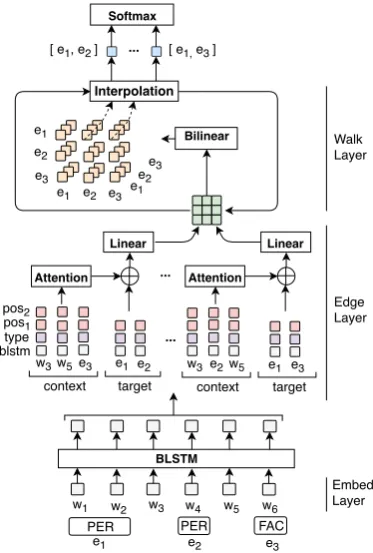
In this study, we propose a neural relation ex-traction model based on an entity graph, where entity mentions constitute the nodes and directed edges correspond to ordered pairs of entity men-tions. The overview of the model is shown in Figure 2. We initialize the representation of an edge (an ordered pair of entity mentions) from the representations of the entity mentions and their context. The context representation is achieved by employing an attention mechanism on context words. We then use an iterative process to aggre-gate up-tol-length walk representations between two entities into a single representation, which corresponds to the final representation of the edge. The contributions of our model can be summa-rized as follows:
• We propose a graph walk based neural model that considers multiple entity pairs in relation extraction from a sentence.
• We propose an iterative algorithm to form a single representation for up-tol-length walks between the entities of a pair.
• We show that our model performs compara-bly to the state-of-the-art without the use of external syntactic tools.
2 Proposed Walk-based Model
The goal of the RE task is given a sentence, en-tity mentions and their semantic types, to extract and classify all related entity pairs (target pairs) in the sentence. The proposed model consists of five stacked layers: embedding layer, BLSTM Layer, edge representation layer, walk aggregation layer and finally a classification layer.
As shown in Figure2, the model receives word representations and produces simultaneously a representation for each pair in the sentence. These representations combine the target pair, its context words, their relative positions to the pair entities and walks between them. During classification they are used to predict the relation type of each pair.
2.1 Embedding Layer
The embedding layer involves the creation ofnw, nt,np-dimensional vectors which are assigned to words, semantic entity types and relative positions to the target pairs. We map all words and seman-tic types into real-valued vectorswandt respec-tively. Relative positions to target entities are cre-ated based on the position of words in the
sen-Attention
...
e2
w3w5e3 e1
context target
Attention Linear
BLSTM
w6
w2 w3 w4 w5
w1
FAC PER
Linear
e3
e1 e2 e3 e1
e3 e2
Embed Layer Edge Layer
PER
e3
e2
e1
... Interpolation
...
e1
e2
blstm pos1
pos2
type
Softmax
[ e1, e2 ]
Walk Layer
e3
w3e2w5 e1
context target [ e1, e3 ]
[image:2.595.320.507.61.338.2]Bilinear
Figure 2: Overview of the walk-based model.
tence. In the example of Figure1, the relative po-sition ofteammatestocapitalis−3and the rela-tive position ofteammatestoToeftingis+16. We embed real-valued vectorspto these positions.
2.2 Bidirectional LSTM Layer
The word representations of each sentence are fed into a Bidirectional Long-short Term Memory (BLSTM) layer, which encodes the context rep-resentation for every word. The BLSTM outputs new word-level representationsh(Hochreiter and Schmidhuber,1997) that consider the sequence of words.
We avoid encoding target pair-dependent infor-mation in this BLSTM layer. This has two advan-tages: (i) the computational cost is reduced as this computation is repeated based on the number of sentences instead of the number of pairs, (ii) we can share the sequence layer among the pairs of a sentence. The second advantage is particularly im-portant as it enables the model to indirectly learn hidden dependencies between the related pairs in the same sentence.
For each word t in the sentence, we con-catenate the two representations from left-to-right and right-to-left pass of the LSTM into a ne -dimensional vector,et= [
− →
ht; ←−
2.3 Edge Representation Layer
The output word representations of the BLSTM are further divided into two parts: (i) target pair representations and (ii) target pair-specific context representations. The context of a target pair can be expressed as all words in the sentence that are not part of the entity mentions. We represent a related pair as described below.
A target pair contains two entities ei and ej. If an entity consists of N words, we cre-ate its BLSTM representation as the average of the BLSTM representations of the corresponding words,e= |1I|P
i∈Iei, whereI is a set with the word indices inside entitye.
We first create a representation for each pair en-tity and then we construct the representation for the context of the pair. The representation of an entityeiis the concatenation of its BLSTM repre-sentation ei, the representation of its entity type
ti and the representation of its relative position to entity ej, pij. Similarly, for entity ej we use its relative position to entityei, pji. Finally, the representations of the pair entities are as follows:
vi = [ei;ti;pij]andvj = [ej;tj;pji].
The next step involves the construction of the representation of the context for this pair. For each context word wz of the target pair ei, ej, we concatenate its BLSTM representationez, its semantic type representation tz and two relative position representations: to target entity ei, pzi and to target entity ej, pzj. The final represen-tation for a context word wz of a target pair is,
vijz = [ez;tz;pzi;pzj]. For a sentence, the con-text representations for all entity pairs can be ex-pressed as a three-dimensional matrix C, where rows and columns correspond to entities and the depth corresponds to the context words.
The context words representations of each tar-get pair are then compiled into a single represen-tation with an attention mechanism. Following the method proposed inZhou et al.(2016), we calcu-late weights for the context words of the target-pair and compute their weighted average,
u=q> tanh(Cij), α= softmax(u),
cij =Cij α>,
(1)
where q ∈ Rnd, n
d = ne + nt + 2np de-notes a trainable attention vector,αis the attended weights vector andcij ∈ Rnd is the context
rep-resentation of the pair as resulted by the weighted
average. This attention mechanism is independent of the relation type. We leave relation-dependent attention as future work.
Finally, we concatenate the representations of the target entities and their context (∈ Rnm). We
use a fully connected linear layer,Ws ∈Rnm×ns
withns < nm to reduce the dimensionality of the resulting vector. This corresponds to the represen-tation of an edge or a one-length walk between nodesiandj:v(1)ij =Ws [vi;vj;cij]∈Rns.
2.4 Walk Aggregation Layer
Our main aim is to support the relation between an entity pair by using chains of intermediate re-lations between the pair entities. Thus, the goal of this layer is to generate a single representation for a finite number of different lengths walks between two target entities. To achieve this, we represent a sentence as a directed graph, where the entities constitute the graph nodes and edges correspond to the representation of the relation between the two nodes. The representation of one-length walk be-tween a target pairvij(1), serves as a building block in order to create and aggregate representations for one-to-l-length walks between the pair. The walk-based algorithm can be seen as a two-step process: walk construction and walk aggregation. During the first step, two consecutive edges in the graph are combined using a modified bilinear transfor-mation,
f(v(λ)ik ,v(λ)kj ) =σ
vik(λ) (Wbvkj(λ))
, (2)
where v(λ)ij ∈ Rnb corresponds to walks repre-sentation of lengths one-to-λ between entities ei andej,represents element-wise multiplication, σ is the sigmoid non-linear function and Wb ∈
Rnb×nb is a trainable weight matrix. This
equa-tion results in walks of lengths two-to-2λ.
In the walk aggregation step, we linearly com-bine the initial walks (length one-to-λ) and the ex-tended walks (length two-to-2λ),
v(2λ)ij =βv(λ)ij + (1−β) X
k6=i,j
f(vik(λ),v(λ)kj ), (3)
equation withλ = 2. We repeat this process un-til the desired maximum walk length is reached, which is equivalent to2λ=l.
2.5 Classification Layer
For the final layer of the network, we pass the re-sulted pair representation into a fully connected layer with a softmax function,
y= softmax(Wrv(l)ij +br), (4)
whereWr ∈ Rnb×nr is the weight matrix, n r is the total number of relation types andbris the bias vector.
We use in total2r+1classes in order to consider both directions for every pair, i.e., left-to-right and right-to-left. The first argument appears first in a sentence in a left-to-right relation while the second argument appears first in a right-to-left relation. The additional class corresponds to non-related pairs, namely “no relation” class. We choose the most confident prediction for each direction and choose the positive and most confident prediction when the predictions contradict each other.
3 Experiments
3.1 Dataset
We evaluate the performance of our model on ACE 20051 for the task of relation extraction. ACE 2005 includes 7 entity types and6 relation types between named entities. We follow the pre-processing described inMiwa and Bansal(2016).
3.2 Experimental Settings
We implemented our model using the Chainer li-brary (Tokui et al.,2015).2 The model was trained
with Adam optimizer (Kingma and Ba, 2015). We initialized the word representations with ex-isting pre-trained embeddings with dimensionality of200.3 Our model did not use any external tools except these embeddings.
The forget bias of the LSTM layer was initial-ized with a value equal to one following the work ofJozefowicz et al.(2015). We use a batchsize of
10sentences and fix the pair representation dimen-sionality to100. We use gradient clipping, dropout on the embedding and output layers and L2 regu-larization without regularizing the biases, to avoid
1https://catalog.ldc.upenn.edu/
ldc2006t06
2
https://chainer.org/
3https://github.com/tticoin/LSTM-ER
Model P R F1 (%)
SPTree 70.1 61.2 65.3 Baseline 72.5 53.3 61.4∗ No walksl= 1 71.9 55.6 62.7
[image:4.595.323.512.60.170.2]+ Walksl= 2 69.9 58.4 63.6 + Walksl= 4 69.7 59.5 64.2 + Walksl= 8 71.5 55.3 62.4
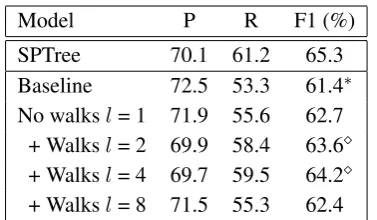
Table 1: Relation extraction performance on ACE 2005 test dataset. * denotes significance at p < 0.05 compared to SPTree, denotes significance at p<0.05 compared to the Baseline.
overfitting. We also incorporate early stopping with patience equal to five, to chose the number of training epochs and parameter averaging. We tune the model hyper-parameters on the respective development set using the RoBO Toolkit (Klein et al., 2017). Please refer to the supplementary material for the values.
We extract all possible pairs in a sentence based on the number of entities it contains. If a pair is not found in the corpus, it is assigned the “no re-lation” class. We report the micro precision, recall and F1 score following Miwa and Bansal (2016) andNguyen and Grishman(2015).
4 Results
Table 1 illustrates the performance of our pro-posed model in comparison with SPTree sys-temMiwa and Bansal(2016) on ACE 2005. We use the same data split with SPTree to compare with their model. We retrained their model with gold entities in order to compare the performances on the relation extraction task. TheBaseline corre-sponds to a model that classifies relations by using only the representations of entities in a target pair. As it can be observed from the table, the Base-linemodel achieves the lowest F1 score between the proposed models. By incorporating attention we can further improve the performance by 1.3 percent point (pp). The addition of2-length walks further improves performance (0.9 pp). The best results among the proposed models are achieved for maximum 4-length walks. By using up-to
8-length walks the performance drops almost by 2 pp. We also compared our performance with
Nguyen and Grishman (2015) (CNN) using their data split.4 For the comparison, we applied our
# Entities l= 1 l= 2 l= 4 l= 8
2 71.2 69.8 72.9 71.0
3 70.1 67.5 67.8 63.5∗
[4,6) 56.5 59.7 59.3 59.9
[6,12) 59.2 64.2∗ 62.2 60.4
[image:5.595.86.277.62.156.2][12,23) 54.7 59.3 62.3∗ 55.0
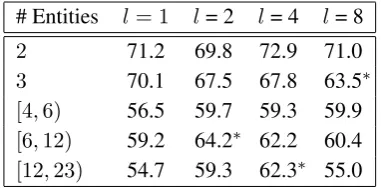
Table 2: Relation extraction performance (F1 %) on ACE 2005 development set for different num-ber of entities. * denotes significance at p<0.05 compared tol= 1.
best performing model (l= 4).5 The obtained per-formance is 65.8 / 58.4 / 61.9 in terms of P / R / F1 (%) respectively. In comparison with the per-formance of the CNN model, 71.5 / 53.9 / 61.3, we observe a large improvement in recall which results in 0.6 pp F1 increase.
We performed the Approximate Randomization test (Noreen,1989) on the results. The best walks model has no statistically significant difference with the state-of-the-art SPTree model as in Ta-ble1. This indicates that the proposed model can achieve comparable performance without any ex-ternal syntactic tools.
Finally, we show the performance of the pro-posed model as a function of the number of enti-ties in a sentence. Results in Table 2 reveal that for multi-pair sentences the model performs sig-nificantly better compared to the no-walks mod-els, proving the effectiveness of the method. Ad-ditionally, it is observed that for more entity pairs, longer walks seem to be required. However, very long walks result to reduced performance (l= 8).
5 Related Work
Traditionally, relation extraction approaches have incorporated a large variety of hand-crafted fea-tures to represent related entity pairs (Hermann and Blunsom, 2013; Miwa and Sasaki, 2014;
Nguyen and Grishman, 2014; Gormley et al.,
2015). Recent models instead employ neural net-work architectures and achieve state-of-the-art re-sults without heavy feature engineering. Neu-ral network techniques can be categorized into recurrent neural networks (RNNs) and convolu-tional neural networks (CNNs). The former is
5We kept the same parameters when we apply our model
to the this data split. We did not remove any negative exam-ples unlike theCNNmodel.
able to encode linguistic and syntactic properties of long word sequences, making them preferable for sequence-related tasks, e.g. natural language generation (Goyal et al., 2016), machine transla-tion (Sutskever et al.,2014).
State-of-the-art systems have proved to achieve good performance on relation extraction using RNNs (Cai et al., 2016;Miwa and Bansal,2016;
Xu et al., 2016;Liu et al., 2015). Nevertheless, most approaches do not take into consideration the dependencies between relations in a single sen-tence (dos Santos et al.,2015;Nguyen and Grish-man, 2015) and treat each pair separately. Cur-rent graph-based models are applied on knowl-edge graphs for distantly supervised relation ex-traction (Zeng et al., 2017). Graphs are defined on semantic types in their method, whereas we built entity-based graphs in sentences. Other ap-proaches also treat multiple relations in a sen-tence (Gupta et al.,2016;Miwa and Sasaki,2014;
Li and Ji,2014), but they fail to model long walks between entity mentions.
6 Conclusions
We proposed a novel neural network model for simultaneous sentence-level extraction of related pairs. Our model exploits target and context pair-specific representations and creates pair rep-resentations that encode up-to l-length walks be-tween the entities of the pair. We compared our model with the state-of-the-art models and ob-served comparable performance on the ACE2005 dataset without any external syntactic tools. The characteristics of the proposed approach are sum-marized in three factors: the encoding of depen-dencies between relations, the ability to represent multiple walks in the form of vectors and the in-dependence from external tools. Future work will aim at the construction of an end-to-end relation extraction system as well as application to differ-ent types of datasets.
Acknowledgments
References
Rui Cai, Xiaodong Zhang, and Houfeng Wang. 2016. Bidirectional recurrent convolutional neural network for relation classification. In Proceedings of the 54th Annual Meeting of the Association for Compu-tational Linguistics (Volume 1: Long Papers), vol-ume 1, pages 756–765.
George R Doddington, Alexis Mitchell, Mark A Przy-bocki, Lance A Ramshaw, Stephanie Strassel, and Ralph M Weischedel. 2004. The automatic con-tent extraction (ace) program-tasks, data, and eval-uation. In Proceedings of the Fourth International Conference on Language Resources and Evaluation (LREC), volume 2, page 1.
Matthew R. Gormley, Mo Yu, and Mark Dredze. 2015. Improved relation extraction with feature-rich com-positional embedding models. InProceedings of the Conference on Empirical Methods in Natural Lan-guage Processing (EMNLP), pages 1774–1784. As-sociation for Computational Linguistics.
Raghav Goyal, Marc Dymetman, and Eric Gaussier. 2016. Natural language generation through character-based rnns with finite-state prior knowl-edge. In Proceedings of COLING, the 26th Inter-national Conference on Computational Linguistics: Technical Papers, pages 1083–1092.
Pankaj Gupta, Hinrich Sch¨utze, and Bernt Andrassy. 2016. Table filling multi-task recurrent neural net-work for joint entity and relation extraction. In Pro-ceedings of COLING, the 26th International Confer-ence on Computational Linguistics: Technical Pa-pers, pages 2537–2547.
Karl Moritz Hermann and Phil Blunsom. 2013. The role of syntax in vector space models of composi-tional semantics. InProceedings of the 51st Annual Meeting of the Association for Computational Lin-guistics (Volume 1: Long Papers), volume 1, pages 894–904.
Sepp Hochreiter and J¨urgen Schmidhuber. 1997. Long short-term memory. Neural computation, 9(8):1735–1780.
Xiaotian Jiang, Quan Wang, Baoyuan Qi, Yongqin Qiu, Peng Li, and Bin Wang. 2017. Attentive path com-bination for knowledge graph completion. InAsian Conference on Machine Learning, pages 590–605.
Rafal Jozefowicz, Wojciech Zaremba, and Ilya Sutskever. 2015. An empirical exploration of recur-rent network architectures. InInternational Confer-ence on Machine Learning, pages 2342–2350.
Diederik P Kingma and Jimmy Ba. 2015. Adam: A method for stochastic optimization.
A. Klein, S. Falkner, N. Mansur, and F. Hutter. 2017. Robo: A flexible and robust bayesian optimization framework in python. InProceedings of Workshop on Bayesian Optimization in the Conference on Neu-ral Information Processing Systems (NIPS).
Qi Li and Heng Ji. 2014. Incremental joint extrac-tion of entity menextrac-tions and relaextrac-tions. In Proceed-ings of the 52nd Annual Meeting of the Associa-tion for ComputaAssocia-tional Linguistics (Volume 1: Long Papers), pages 402–412. Association for Computa-tional Linguistics.
Yang Liu, Furu Wei, Sujian Li, Heng Ji, Ming Zhou, and Houfeng WANG. 2015. A dependency-based neural network for relation classification. In Pro-ceedings of the 53rd Annual Meeting of the Associ-ation for ComputAssoci-ational Linguistics and the 7th In-ternational Joint Conference on Natural Language Processing (Volume 2: Short Papers), pages 285– 290. Association for Computational Linguistics.
Makoto Miwa and Mohit Bansal. 2016. End-to-end re-lation extraction using lstms on sequences and tree structures. InProceedings of the 54th Annual Meet-ing of the Association for Computational LMeet-inguistics (Volume 1: Long Papers), pages 1105–1116. Asso-ciation for Computational Linguistics.
Makoto Miwa and Yutaka Sasaki. 2014. Modeling joint entity and relation extraction with table rep-resentation. In Proceedings of the Conference on Empirical Methods in Natural Language Processing (EMNLP), pages 1858–1869. Association for Com-putational Linguistics.
Thien Huu Nguyen and Ralph Grishman. 2014. Em-ploying word representations and regularization for domain adaptation of relation extraction. In Pro-ceedings of the 52nd Annual Meeting of the Associa-tion for ComputaAssocia-tional Linguistics (Volume 2: Short Papers), volume 2, pages 68–74.
Thien Huu Nguyen and Ralph Grishman. 2015. Rela-tion extracRela-tion: Perspective from convoluRela-tional neu-ral networks. In Proceedings of the 1st Workshop on Vector Space Modeling for Natural Language Processing, pages 39–48. Association for Compu-tational Linguistics.
Eric W Noreen. 1989. Computer-intensive methods for testing hypotheses. Wiley New York.
Cicero dos Santos, Bing Xiang, and Bowen Zhou. 2015. Classifying relations by ranking with con-volutional neural networks. InProceedings of the 53rd Annual Meeting of the Association for Compu-tational Linguistics and the 7th International Joint Conference on Natural Language Processing (Vol-ume 1: Long Papers), pages 626–634. Association for Computational Linguistics.
Baoxu Shi and Tim Weninger. 2017. Proje: Embed-ding projection for knowledge graph completion. In
Proceedings of AAAI Conference on Artificial Intel-ligence, volume 17, pages 1236–1242.
Seiya Tokui, Kenta Oono, Shohei Hido, and Justin Clayton. 2015. Chainer: a next-generation open source framework for deep learning. InProceedings of Workshop on Machine Learning Systems (Learn-ingSys) in the twenty-ninth Annual Conference on Neural Information Processing Systems (NIPS), vol-ume 5.
Quan Wang, Zhendong Mao, Bin Wang, and Li Guo. 2017. Knowledge graph embedding: A survey of approaches and applications. IEEE Transactions on Knowledge and Data Engineering, 29(12):2724– 2743.
Kun Xu, Yansong Feng, Songfang Huang, and Dongyan Zhao. 2015. Semantic relation classifi-cation via convolutional neural networks with sim-ple negative sampling. InProceedings of the Con-ference on Empirical Methods in Natural Language Processing (EMNLP), pages 536–540. Association for Computational Linguistics.
Yan Xu, Ran Jia, Lili Mou, Ge Li, Yunchuan Chen, Yangyang Lu, and Zhi Jin. 2016. Improved rela-tion classificarela-tion by deep recurrent neural networks with data augmentation. In Proceedings of COL-ING, the 26th International Conference on Compu-tational Linguistics: Technical Papers, pages 1461– 1470.
Wenyuan Zeng, Yankai Lin, Zhiyuan Liu, and Maosong Sun. 2017. Incorporating relation paths in neural relation extraction. InProceedings of the Conference on Empirical Methods in Natural Lan-guage Processing (EMNLP), pages 1768–1777. As-sociation for Computational Linguistics.
Peng Zhou, Wei Shi, Jun Tian, Zhenyu Qi, Bingchen Li, Hongwei Hao, and Bo Xu. 2016. Attention-based bidirectional long short-term memory net-works for relation classification. InProceedings of the 54th Annual Meeting of the Association for Com-putational Linguistics (Volume 2: Short Papers), volume 2, pages 207–212.
A Hyper-parameter Settings
We tuned our proposed model using the RoBO toolkit (https://github.com/automl/ RoBO). Table 3provides the selected options we used for tuning the model.
Optimization Options
Optimization method Bohamiann
Maximizer scipy
Acquisition function log ei Number of iterations 50
[image:7.595.321.495.111.774.2]Initial points 3
Table 3: Hyper-parameters optimization options.
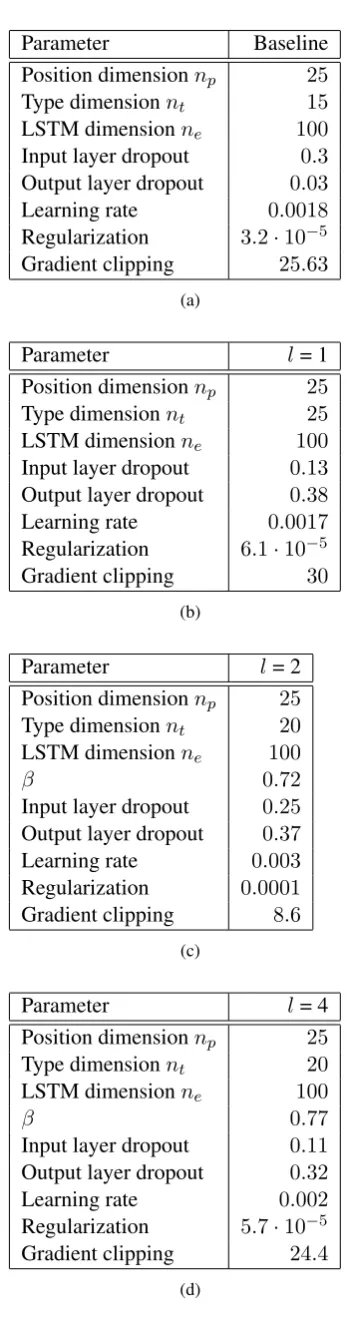
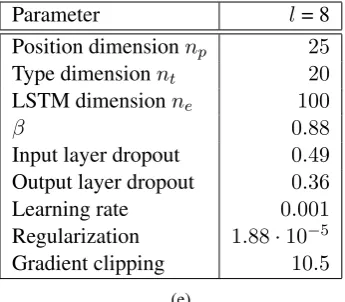
The parameters that gave the best performance for the different models can be found in Tables4a
-4e.
Parameter Baseline Position dimensionnp 25 Type dimensionnt 15
LSTM dimensionne 100 Input layer dropout 0.3
Output layer dropout 0.03
Learning rate 0.0018
Regularization 3.2·10−5 Gradient clipping 25.63
(a)
Parameter l= 1
Position dimensionnp 25
Type dimensionnt 25 LSTM dimensionne 100 Input layer dropout 0.13
Output layer dropout 0.38
Learning rate 0.0017
Regularization 6.1·10−5
Gradient clipping 30
(b)
Parameter l= 2
Position dimensionnp 25 Type dimensionnt 20
LSTM dimensionne 100
β 0.72
Input layer dropout 0.25
Output layer dropout 0.37
Learning rate 0.003
Regularization 0.0001
Gradient clipping 8.6
(c)
Parameter l= 4
Position dimensionnp 25
Type dimensionnt 20 LSTM dimensionne 100
β 0.77
Input layer dropout 0.11
Output layer dropout 0.32
Learning rate 0.002
Regularization 5.7·10−5
Gradient clipping 24.4
Parameter l= 8 Position dimensionnp 25
Type dimensionnt 20
LSTM dimensionne 100
β 0.88
Input layer dropout 0.49
Output layer dropout 0.36
Learning rate 0.001
Regularization 1.88·10−5
Gradient clipping 10.5
[image:8.595.72.245.62.213.2](e)