Improving Distributed Representation of Word Sense
via WordNet Gloss Composition and Context Clustering
Tao Chen1Ruifeng Xu1∗Yulan He2 Xuan Wang1
1Shenzhen Engineering Laboratory of Performance Robots at Digital Stage, Harbin Institute of Technology Shenzhen Graduate School, Shenzhen, China
2School of Engineering and Applied Science, Aston University, UK
[email protected] {xuruifeng,wangxuan}@hitsz.edu.cn
Abstract
In recent years, there has been an increas-ing interest in learnincreas-ing a distributed rep-resentation of word sense. Traditional context clustering based models usually require careful tuning of model parame-ters, and typically perform worse on infre-quent word senses. This paper presents a novel approach which addresses these lim-itations by first initializing the word sense embeddings through learning sentence-level embeddings from WordNet glosses using a convolutional neural networks. The initialized word sense embeddings are used by a context clustering based model to generate the distributed representations of word senses. Our learned represen-tations outperform the publicly available embeddings on 2 out of 4 metrics in the word similarity task, and 6 out of 13 sub tasks in the analogical reasoning task.
1 Introduction
With the rapid development of deep neural net-works and parallel computing, distributed repre-sentation of knowledge attracts much research in-terest. Models for learning distributed representa-tions of knowledge have been proposed at differ-ent granularity level, including word sense level (Huang et al., 2012; Chen et al., 2014; Neelakan-tan et al., 2014; Tian et al., 2014; Guo et al., 2014), word level (Rummelhart, 1986; Bengio et al., 2003; Collobert and Weston, 2008; Mnih and Hinton, 2009; Mikolov et al., 2010; Mikolov et al., 2013), phrase level (Socher et al., 2010; Zhang et al., 2014; Cho et al., 2014), sentence level (Mikolov et al., 2010; Socher et al., 2013; Kalch-brenner et al., 2014; Kim, 2014; Le and Mikolov, 2014), discourse level (Ji and Eisenstein, 2014) and document level (Le and Mikolov, 2014).
In distributed representations of word senses, each word sense is usually represented by a dense and real-valued vector in a low-dimensional space which captures the contextual semantic informa-tion. Most existing approaches adopted a cluster-based paradigm, which produces different sense vectors for each polysemy or homonymy through clustering the context of a target word. However, this paradigm usually has two limitations: (1) The performance of these approaches is sensitive to the clustering algorithm which requires the setting of the sense number for each word. For exam-ple, Neelakantan et al. (2014) proposed two clus-tering based model: the Multi-Sense Skip-Gram (MSSG) model and Non-Parametric Multi-Sense Skip-Gram (NP-MSSG) model. MSSG assumes each word has the same k-sense (e.g. k = 3), i.e., the same number of possible senses. How-ever, the number of senses in WordNet (Miller, 1995) varies from 1 such as “ben” to 75 such as “break”. As such, fixing the number of senses for all words would result in poor representations. NP-MSSG can learn the number of senses for each word directly from data. But it requires a tuning of a hyperparameterλwhich controls the creation of cluster centroids during training. Different λ
needs to be tuned for different datasets. (2) The initial value of sense representation is critical for most statistical clustering based approaches. How-ever, previous approaches usually adopted ran-dom initialization (Neelakantan et al., 2014) or the mean average of candidate words in a gloss (Chen et al., 2014). As a result, they may not produce optimal clustering results for word senses.
Focusing on the aforementioned two problems, this paper proposes to learn distributed representa-tions of word senses through WordNet gloss com-position and context clustering. The basic idea is that a word sense is represented as a synonym set (synset) in WordNet. In this way, instead of as-signing a fixed sense number to each word as in the
previous methods, different word will be assigned with different number of senses based on their corresponding entries in WordNet. Moreover, we notice that each synset has a textual definition (named as gloss). Naturally, we use a convolu-tional neural network (CNN) to learn distributed representations of these glosses (a.k.a. sense vec-tors) through sentence composition. Then, we modify MSSG for context clustering by initial-izing the sense vectors with the representations learned by our CNN-based sentence composition model. We expect that word sense vectors ini-tialized in this way would potentially lead to bet-ter representations of word senses generated from context clustering.
The obtained word sense representations are evaluated on two tasks. One is word similarity task, the other is analogical reasoning task pro-vided by WordRep (Gao et al., 2014). The results show that our approach attains comparable perfor-mance on learning distributed representations of word senses. In specific, our learned represen-tation outperforms publicly available embeddings on the globalSim and localSim metrics in word similarity task, and 6 in 13 subtasks in the ana-logical reasoning task.
2 Our Approach
Our proposed approach first train a Continuous Bag-Of-Words (CBOW) model (Mikolov et al., 2013) from a large collection of raw text to gen-erate word embeddings. These word embeddings are then used by a Sentence Composition Model, which takes glosses in WordNet as positive train-ing data and randomly replaces part of the sen-tences as negative training data to construct the corresponding word sense vectors based on a one-dimensional CNN. For example, a WordNet gloss of word star is “an actor who plays a principal role”. This is taken as a positive training example when learning the word sense vector for “star”. We concatenate the word embedding generated by the CBOW model for each of the words in the gloss, take the concatenated word embeddings as an input to CNN, and get the output vector as one sense vector of wordstar.
The learned sense vectors are fed into a vari-ant of the previously proposed Multi-Sense Skip-Gram Model(MSSG) to generates distributed rep-resentations of word senses from a text corpus. We name our approach as CNN-VMSSG.
2.1 Training Sense Vectors From WordNet Glosses Using CNN
In this step, we learn the distributed representation of each gloss sentence as the representation of the corresponding synset. The training objective is to minimize the ranking loss below:
Gs= ∑
s∈P
max{0,1−f(s) +f(s′)} (1)
Given a gloss sentencesas a positive training sam-ple, we randomly replace some words (controlled by a parameterλ) insto construct a negative train-ing sample s′. We compute the scores f(s) and f(s′)wheref(·)is the scoring function
represent-ing the whole CNN architecture without the soft-max layer. We expectf(s) andf(s′)to be close
to 1 and 0 respectively, andf(s)to be larger than
f(s′)by a margin of 1 for all the sentence in
posi-tive training setP.
The CNN architecture used in this component follows the architecture proposed by (Kim, 2014)1
which is a slight variant of the architecture pro-posed by (Collobert and Weston, 2008)2. It takes
a gloss matrixsas input where each column corre-sponds to the distributed representationvwi ∈Rd
of a wordwiin the sentence.
The idea behind the one-dimensional convolu-tion is to take the dot product of the vector w
with each n-gram in the sentence to obtain an-other sequence c, where n is the width of filter in the convolutional layer. In order to makec to cover different words in the negative sample cor-responding a positive sample, in this work, we ran-domly replace half of the words in a positive train-ing sample to construct a negative traintrain-ing sample (λ = 0.5). For example, take the WordNet gloss “an actor who plays a principal role” as a positive sample, a negative training sample constructed by this method may be “x1actor whox2x3principal
x4”, where x1 tox4 are randomly selected words
in a vocabulary collected from a large corpus. In the pooling layer, a max-overtime pooling operation (Collobert et al., 2011), which forces the network to capture the most useful local features produced by the convolutional layers, is applied. The model uses multiple filters (with varying win-dow sizes) to obtain multiple features. These fea-tures form the penultimate layer and are passed to a fully connected softmax layer whose output is
the probability distribution over labels. The train-ing error propagates back to fine-tune the parame-ters of the CNN and the input word vectors. The vector generated in the penultimate layer of the CNN architecture is regarded as the sense vector which captures the semantic content of the input gloss to a certain degree.
2.2 Context Clustering and VMSSG Model
Neelakantan et al. (2014) proposed the MSSG model which extends the skip-gram model to learn multi-prototype word embeddings by clustering the word embeddings of context words around each word. In this model, for each word w, the corresponding word embeddingvw ∈Rd,k-sense
vectorvsk ∈ Rd(k = 1,2, . . . , K) andk-context
cluster with centerµk∈Rd(k= 1,2, . . . , K) are
initialized randomly. The sense numberKof each word is a fixed parameter in the training algorithm. We improve the MSSG model by using the learned CBOW word embedding to initialize vw
and the sense vector trained by the sentence com-position model to initialize vsk. We also use the
sense number of each word in WordNetKwto
re-placeK. We named this model as a variant of the MSSG (VMSSG) model.
Algorithm 1Algorithm of VMSSG model
1: Input:D,d,K1, ..., Kw, ..., K|V|,M.
2: Initialize: ∀w ∈ V, k ∈ {1, . . . , Kw},
initial-izevw to a pre-trained word vector, vsw
k to a
pre-trained sense vector for wordwwith sense
k, and µw
k to a vector of random real value
∈(−1,1)d.
3: for eachwinDdo
4: r ←random number∈[1, M]
5: C ← {wi−r, ..., wi−1, wi+1, ..., wi+r} 6: vc← 2×1r∑w∈Cvw
7: kˆ= arg maxk{sim(µwk, vc)}
8: AssignCto context clusterkˆ. 9: Updateµˆk.
10: C′ =NoisySamples(C) 11: Gradient update onvsw
k,vwinC, C′.
12: end for 13: Output:vsw
k,vw,∀w∈V, k∈ {1, . . . , Kw}
The training algorithm of the VMSSG model is shown as Algorithm 1, where Dis a text corpus,
V is the vocabulary of D, |V|is the vocabulary size, M is the size of context window, vw is the
word embedding forw,sw
k is akth context cluster
of wordw,µw
k is the centroid of clusterkfor word
w. The function NoisySamples(C) randomly re-places context words with noisy words fromV.
3 Evaluation and Discussion 3.1 Experimental Setup
In all experiments, we train word vectors and sense vectors on a snapshot of Wikipedia in April 20103(Shaoul, 2010), previously used in (Huang
et al., 2012; Neelakantan et al., 2014). WordNet 3.1 is used for training the sentence composition model. A publicly available word vectors trained by CBOW from Google News4 are used as
pre-trained word vectors for CNN.
For training CNN, we use: rectified linear units, filter windows of 3, 4, 5 with 100 feature maps each, AdaDelta decay parameter of 0.95, the dropout rate of 0.5. For training VMSSG, we use
MSSG-KMeans as the clustering algorithm, and CBOW for learning sense vectors. We set the size of word vectors to 300, using boot vectors and sense vectors. For other parameter, we use default parameter settings for MSSG.
3.2 Word Similarity Task
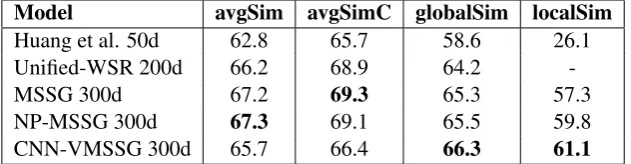
We evaluate our embeddings on the Contextual Word Similarities (SCWS) dataset (Huang et al., 2012). It contains 2,003 pairs of words and their sentential contexts. Each pair is associated with 10 to 16 human judgments of similarity on a scale from 0 to 10. We use the same metrics in (Neelakantan et al., 2014) to measure the simi-larity between two words given their respective context. The avgSim metric computes the aver-age similarity of all pairs of prototype vectors for each word, ignoring context. TheavgSimC met-ric weights each similarity term in avgSim by the likelihood of the word context appearing in its re-spective cluster. TheglobalSim metric computes each word vector ignoring senses. The localSim
metric chooses the most similar sense in context to estimate the similarity of a words pair.
We report the Spearman’s correlation ρ×100
between a model’s similarity scores and the human judgments in Table 1.5
3http://www.psych.ualberta.ca/ ˜westburylab/downloads/
westburylab.wikicorp.download.html
4https://drive.google.com/file/d/0B7XkCwpI5KDYNl
NUTTlSS21pQmM/edit?usp=sharing
5The localSim metric ofUnified-WSRis not reported in
Model avgSim avgSimC globalSim localSim
[image:4.595.142.458.63.145.2]Huang et al. 50d 62.8 65.7 58.6 26.1 Unified-WSR 200d 66.2 68.9 64.2 -MSSG 300d 67.2 69.3 65.3 57.3 NP-MSSG 300d 67.3 69.1 65.5 59.8 CNN-VMSSG 300d 65.7 66.4 66.3 61.1
Table 1: Experimental results in the SCWS task.
Subtask Word Pairs C&W CBOW MSSG NP-MSSG CNN-VMSSG
Antonym 973 0.28 4.57 0.25 0.10 1.01
Attribute 184 0.22 1.18 0.03 0.15 1.63
Causes 26 0.00 1.08 0.31 0.31 1.23
DerivedFrom 6,119 0.05 0.63 0.09 0.05 0.17
Entails 114 0.05 0.38 0.49 0.34 1.29
HasContext 1,149 0.12 0.35 1.73 1.56 1.41 InstanceOf 1,314 0.08 0.58 2.52 2.34 2.46
IsA 10,615 0.07 0.67 0.15 0.08 0.86
MadeOf 63 0.03 0.72 0.80 0.48 1.28
MemberOf 406 0.08 1.06 0.14 0.86 0.90
PartOf 1,029 0.31 1.27 1.50 0.73 0.48
RelatedTo 102 0.00 0.05 0.12 0.11 1.28
[image:4.595.76.524.177.370.2]SimilarTo 3,489 0.02 0.29 0.03 0.01 0.12
Table 2: Experimental results in the analogical reasoning task.
It is observed that our model achieves the best performance on the globalSimandlocalSim met-rics. It indicates that the use of pre-trained word vectors and initializing sense vectors with the em-beddings learned from WordNet glosses are in-deed helpful in improving the quality of both global word vectors and sense-level word vec-tors. Our approach performs worse onavgSimand
avgSimC. One possible reason is that we set the number of context clusters for each word to be the same as the number of its corresponding senses in WordNet. However, not all senses appear in the our experimented corpus which could lead to frag-mented context clustering results. One possible way to alleviate this problem is to perform post-processing to merge clusters which have smaller inter-cluster differences or to remove sense clus-ters which are under-represented in our data. We will leave it as our future work.
3.3 Analogical Reasoning Task
The analogical reasoning task introduced by (Mikolov et al., 2013) consists of questions of the form “ais tobis ascis to ”, where (a,b) and (c, ) are two word pairs. The goal is to find a word
d∗in vocabularyV whose representation vector is
the closest tovb−va+vc.
WordRep is a benchmark collection for the re-search on learning distributed word representa-tions, which expands the Mikolov et al.’s analog-ical reasoning questions. In our experiments, we use one evaluation set in WordRep, the WordNet collection which consists of 13 sub tasks.
We use the precisionp×100as metric for each sub task. Table 2 shows the results on the 13 sub tasks. The Word Pair column is the num-ber of word pairs of each sub task. The results of C&W were obtained using the 50-dimensional word embeddings that were made publicly avail-able by Turian et al. (2010).6 The CBOW results
were previously reported in (Gao et al., 2014). It can be observed that among 13 subtasks, our model outperforms the others by a good mar-gin in 6 subtasks,Attribute,Causes, Entails,IsA,
MadeOf andRelatedTo.
3.4 Discussion
Although our evaluation results on the word simi-larity task and the analogical reasoning task show that our proposed approach outperforms a number of existing word representation methods in some
of the subtasks, it is worth noting that both tasks do not consider the full spectrum of senses. In spe-cific, the analogical reasoning task was originally designed for evaluating single-prototype word rep-resentations which ignore that a word could have multiple meanings. Compared to single-prototype word vectors, evaluating sense vectors requires a significantly larger search space since each word could be represented by multiple sense vectors de-pending on the context. One may also argue that the analogical reasoning task may not be the most appropriate one in evaluating multiple-prototype word vectors since the context information is not available. In the future, we plan to evaluate our learned multiple-prototype word vectors in more relevant NLP tasks such as word sense disam-biguation and question answering.
Our proposed approach initializes sense vec-tors using the learned sentence embeddings from WordNet glosses. In other low resourced lan-guages, it is still possible to intialize sense vectors based on, for example, the word meanings found in language-specific dictionaries.
4 Conclusion and Future Work
This paper presents a method of incorporating WordNet glosses composition and context cluster-ing based model for learncluster-ing distributed represen-tations of word senses. By initializing sense vec-tors using the embeddings learned by a sentence composition from WordNet glosses, the context clustering method is able to generate better dis-tributed representations of word senses. The ob-tained word sense representations achieve state-of-the-art results on the globalSim and localSim met-rics in the word similarity task and in 6 sub tasks of the analogical reasoning task. It shows the ef-fectiveness of our proposed learning algorithm for generating word sense distributed representations. Considering the coverage of word senses in our training data, in future work we plan to filter out those sense vectors which are under-represented in the training corpus. We will also further investi-gate the feasibility of applying the multi-prototype word embeddings in a wide range of NLP tasks.
Acknowledgments
This work is supported by the National Natural Science Foundation of China (No. 61370165, 61203378), National 863 Program of China 2015AA015405, the Natural Science Foundation
of Guangdong Province (No. S2013010014475), Shenzhen Development and Reform Commission Grant No.[2014]1507, Shenzhen Peacock Plan Research Grant KQCX20140521144507925 and Baidu Collaborate Research Funding.
References
Yoshua Bengio, Rejean Ducharme, and Pascal Vincent. 2003. A neural probabilistic language model. Jour-nal of Machine Learning Research, 3:1137–1155. Xinxiong Chen, Zhiyuan Liu, and Maosong Sun. 2014.
A unified model for word sense representation and disambiguation. InProceedings of the 2014 Con-ference on Empirical Methods in Natural Language Processing (EMNLP), pages 1025–1035.
Kyunghyun Cho, Bart van Merrienboer, Caglar Gul-cehre, Fethi Bougares, Holger Schwenk, and Yoshua Bengio. 2014. Learning phrase representations using RNN encoder-decoder for statistical machine translation. Proceedings of the 2014 Conference on Empirical Methods in Natural Language Processing (EMNLP), pages 1724–1734.
Ronan Collobert and Jason Weston. 2008. A unified architecture for natural language processing: Deep neural networks with multitask learning. In Pro-ceedings of the 25th International Conference on Machine Learning (ICML), pages 160–167. ACM. Ronan Collobert, Jason Weston, L´eon Bottou, Michael
Karlen, Koray Kavukcuoglu, and Pavel Kuksa. 2011. Natural language processing (almost) from scratch. The Journal of Machine Learning Re-search, 12:2493–2537.
Bin Gao, Jiang Bian, and Tie-Yan Liu. 2014. Wordrep: A benchmark for research on learning word representations. In ICML 2014 Workshop on Knowledge-Powered Deep Learning for Text Mining (KPDLTM2014).
Jiang Guo, Wanxiang Che, Haifeng Wang, and Ting Liu. 2014. Learning sense-specific word embed-dings by exploiting bilingual resources. In Proceed-ings of the 25th International Conference on Com-putational Linguistics (COLING), pages 497–507. Eric H Huang, Richard Socher, Christopher D
Man-ning, and Andrew Y Ng. 2012. Improving word representations via global context and multiple word prototypes. InProceedings of the 50th Annual Meet-ing of the Association for Computational LMeet-inguis- Linguis-tics (ACL), pages 873–882. Association for Compu-tational Linguistics.
Nal Kalchbrenner, Edward Grefenstette, and Phil Blun-som. 2014. A convolutional neural network for modelling sentences. In Proceedings of the 52nd Annual Meeting of the Association for Computa-tional Linguistics (ACL), pages 655–665, Baltimore, Maryland, June. Association for Computational Lin-guistics.
Yoon Kim. 2014. Convolutional neural networks for sentence classification. InProceedings of the 2014 Conference on Empirical Methods in Natural Lan-guage Processing (EMNLP), pages 1746–1751, Oc-tober.
Quoc V Le and Tomas Mikolov. 2014. Distributed representations of sentences and documents. In Pro-ceedings of the 31th International Conference on Machine Learning (ICML), pages 1188–1196. Tomas Mikolov, Martin Karafi´at, Lukas Burget, Jan
Cernock`y, and Sanjeev Khudanpur. 2010. Recur-rent neural network based language model. In Pro-ceedings of INTERSPEECH, pages 1045–1048. Tomas Mikolov, Kai Chen, Greg Corrado, and Jeffrey
Dean. 2013. Efficient estimation of word represen-tations in vector space. InProceedings of Workshop at the International Conference on Learning Repre-sentations (ICLR).
George A Miller. 1995. Wordnet: a lexical database for english. Communications of the ACM, 38(11):39–41.
Andriy Mnih and Geoffrey E Hinton. 2009. A scal-able hierarchical distributed language model. In
Advances in neural information processing systems, pages 1081–1088.
Arvind Neelakantan, Jeevan Shankar, Alexandre Pas-sos, and Andrew McCallum. 2014. Efficient non-parametric estimation of multiple embeddings per word in vector space. InProceedings of the 2014 Conference on Empirical Methods in Natural Lan-guage Processing (EMNLP), pages 1059–1069. DE Rummelhart. 1986. Learning representations by
back-propagating errors. Nature, 323(9):533–536. Cyrus Shaoul. 2010. The westbury lab wikipedia
cor-pus. Edmonton, AB: University of Alberta.
Richard Socher, Christopher D Manning, and An-drew Y Ng. 2010. Learning continuous phrase representations and syntactic parsing with recursive neural networks. InProceedings of the NIPS-2010 Deep Learning and Unsupervised Feature Learning Workshop, pages 1–9.
Richard Socher, Alex Perelygin, Jean Y Wu, Jason Chuang, Christopher D Manning, Andrew Y Ng, and Christopher Potts. 2013. Recursive deep mod-els for semantic compositionality over a sentiment treebank. InProceedings of the Conference on Em-pirical Methods in Natural Language Processing (EMNLP), pages 1631–1642. Citeseer.
Fei Tian, Hanjun Dai, Jiang Bian, Bin Gao, Rui Zhang, Enhong Chen, and Tie-Yan Liu. 2014. A probabilis-tic model for learning multi-prototype word embed-dings. InProceedings of the 25th International Con-ference on Computational Linguistics (COLING), pages 151–160.
Joseph Turian, Lev Ratinov, and Yoshua Bengio. 2010. Word representations: a simple and general method for semi-supervised learning. InProceedings of the 48th annual meeting of the association for computa-tional linguistics (ACL), pages 384–394.