ATTITUDE AND BARRIERS TOWARDS PARTICIPATION IN CONTINUING PROFESSIONAL
DEVELOPMENT PROGRAMME AMONG NURSES
Mridula Das, *Barkha Devi, Snigdha Roy,
Bashal, Passang D. Bhutia, Anamika Chettri, Pangki Lepcha, Rita Chettri and Rinchen Lepcha
Sikkim Manipal College of Nursing, Sikkim Manipal University, Gangtok, Sikkim, India
ARTICLE INFO ABSTRACT
Introduction and Background:
popular term among professionals in recent years. Pro professional development programme
study was planned to assess and compare the profess
Sikkim.
nursing staff working in the hospital setup and directly or indirectly eng qualification of degree /diploma/certificate were recruited through
technique from different wards, outpatient departments and laboratories of government and private hospitals of Sikkim. Structured a
questionnaire on identified barrier were used to collect data on nurses attitude and barrier towards participation in
was established. of the questionnaire.
and private hospital displayed a favorable attitude towards continuing professional development programme.
(79%) than the mean attitude score of nurses in government hospital (77%) with the mean difference of 1.24 which was not found statistically significant (t=1.037,p>0.05). Nurses working in Government hospital had scored high barriers (62%) toward
programme than the private nurses (38%)
presence of personal and organizational barriers, nurses expressed favorable attitude towards continui
Copyright©2019, Mridula Das et al. This is an open access distribution, and reproduction in any medium, provided
INTRODUCTION
Nursing has progressed from ancient era to the dawn of modern nursing with the coming of Florence Nightingale and now to 21st century. Today's nurse is expected to make independent decisions in the day-to-day health care activities (Fitzpatrick, 2003). Clinical nursing mirrors the ever
field of the science and art of medicine, which demands proficiency of increasingly complex and technical skill scope of practice for nurses has expanded dramatically in recent years, and the extent of required nursing knowledge and resulting responsibility has increased. Newly evolved roles have been created for nurses in response to changes in the health care industry. Physicians, employers, patients, and the legal system expect more from nurses than ever before 2001). CPD is a concept which has evolved from the need to find a better platform for professionals to face the challenges to keep themselves up-to-date with new knowledge, discoveries and skills in order to perform better in their professions.
ISSN: 0975-833X
Article History: Received 15th May, 2019 Received in revised form 24th June, 2019
Accepted 20th July, 2019 Published online 31st August, 2019
Citation: Mridula Das, Barkha Devi, Snigdha Roy, Yourika Tamang development programme among nurses”, International Journal of Current Key Words:
Continuing Professional Development Programmes (CPDP), Continuing Nursing Education (CNE) Attitude,
Barrier, and Perceived Barrier.
*Corresponding author: Barkha Devi
RESEARCH ARTICLE
ATTITUDE AND BARRIERS TOWARDS PARTICIPATION IN CONTINUING PROFESSIONAL
DEVELOPMENT PROGRAMME AMONG NURSES
, Snigdha Roy, Yourika Tamang, Dikshya Rai, Puna Yami, Asha Chetry, Shama
Bhutia, Anamika Chettri, Pangki Lepcha, Rita Chettri and Rinchen Lepcha
Sikkim Manipal College of Nursing, Sikkim Manipal University, Gangtok, Sikkim, India
ABSTRACT
Introduction and Background: Continuing professional development programme
popular term among professionals in recent years. Professional organizations are exploring continuing professional development programme to monitor accountability and clinical competence. The present study was planned to assess and compare the attitude and barriers towards participation in continuing professional development programme among nurses working in Government and Private Hospitals, Sikkim. Methodology: Investigators adopted the descriptive comparative research design .The 100 nursing staff working in the hospital setup and directly or indirectly eng
qualification of degree /diploma/certificate were recruited through
technique from different wards, outpatient departments and laboratories of government and private hospitals of Sikkim. Structured attitude scale, barrier assessment scale and semi structured questionnaire on identified barrier were used to collect data on nurses attitude and barrier towards participation in continuing professional development programme
was established. Written informed consent was taken from the respondent prior to the administration of the questionnaire. Result: The analysis of the data indicated that the 7o% of nurses in Government and private hospital displayed a favorable attitude towards continuing professional development programme. The mean positive attitude score was slightly higher among nurses of private
(79%) than the mean attitude score of nurses in government hospital (77%) with the mean difference of 1.24 which was not found statistically significant (t=1.037,p>0.05). Nurses working in Government hospital had scored high barriers (62%) towards participation in continuing professional development programme than the private nurses (38%). Conclusion: It was indeed encouraging to see that even in presence of personal and organizational barriers, nurses expressed favorable attitude towards continuing professional development.
access article distributed under the Creative Commons Attribution the original work is properly cited.
Nursing has progressed from ancient era to the dawn of modern nursing with the coming of Florence Nightingale and expected to make day health care activities Clinical nursing mirrors the ever-changing field of the science and art of medicine, which demands proficiency of increasingly complex and technical skills. The scope of practice for nurses has expanded dramatically in recent years, and the extent of required nursing knowledge and resulting responsibility has increased. Newly evolved roles have been created for nurses in response to changes in the re industry. Physicians, employers, patients, and the legal system expect more from nurses than ever before (Eales, CPD is a concept which has evolved from the need to find a better platform for professionals to face the challenges to date with new knowledge, discoveries and skills in order to perform better in their professions.
(Bellfield, 2010) Nurses, by virtue of their licensure status,
have a fiduciary duty to continually improve their professional knowledge and skill. Maintaining and improving levels of competency and patient safety require nurses in clinical settings to constantly acquire new professional and interpersonal skills, keep abreast of evolving evidence practices, and become experts using new technology
2011). Various studies reveal that nurses take part in continuing professional development
including promotion of professional knowledge and clinical skills, providing better care services for patients, up their information, fulfilling organizational commitments, and obtaining educational certificates
nurses continue to seek knowledge by obtaining higher degrees, participating in professional organizations, attending conferences, or reading nursing journals. Others depend on their employer or accredited online entities to provide continuing nursing education programs. Regardless of the means, continued learning is imperative to the practice of
International Journal of Current Research Vol. 11, Issue, 08, pp.5907-5913, August, 2019
DOI: https://doi.org/10.24941/ijcr.35907.08.2019
Mridula Das, Barkha Devi, Snigdha Roy, Yourika Tamang et al, 2019. “Attitude and barriers towards participation in continuing professional International Journal of Current Research, 11, (08), 5907-5913.
Available online at http://www.journalcra.com
ATTITUDE AND BARRIERS TOWARDS PARTICIPATION IN CONTINUING PROFESSIONAL
DEVELOPMENT PROGRAMME AMONG NURSES
Yourika Tamang, Dikshya Rai, Puna Yami, Asha Chetry, Shama
Bhutia, Anamika Chettri, Pangki Lepcha, Rita Chettri and Rinchen Lepcha
Sikkim Manipal College of Nursing, Sikkim Manipal University, Gangtok, Sikkim, India
professional development programme has become a fessional organizations are exploring continuing to monitor accountability and clinical competence. The present attitude and barriers towards participation in continuing ional development programme among nurses working in Government and Private Hospitals, Investigators adopted the descriptive comparative research design .The 100 nursing staff working in the hospital setup and directly or indirectly engaged in patient care with the qualification of degree /diploma/certificate were recruited through stratified random sampling technique from different wards, outpatient departments and laboratories of government and private ttitude scale, barrier assessment scale and semi structured questionnaire on identified barrier were used to collect data on nurses attitude and barrier towards continuing professional development programme for which validity and reliability Written informed consent was taken from the respondent prior to the administration The analysis of the data indicated that the 7o% of nurses in Government and private hospital displayed a favorable attitude towards continuing professional development The mean positive attitude score was slightly higher among nurses of private hospital (79%) than the mean attitude score of nurses in government hospital (77%) with the mean difference of 1.24 which was not found statistically significant (t=1.037,p>0.05). Nurses working in Government s participation in continuing professional development It was indeed encouraging to see that even in presence of personal and organizational barriers, nurses expressed favorable attitude towards
License, which permits unrestricted use,
Nurses, by virtue of their licensure status, have a fiduciary duty to continually improve their professional aintaining and improving levels of competency and patient safety require nurses in clinical settings to constantly acquire new professional and interpersonal skills, keep abreast of evolving evidence-based practices, and become experts using new technology (Beatty, Various studies reveal that nurses take part in continuing professional development for many reasons including promotion of professional knowledge and clinical skills, providing better care services for patients, up-dating n, fulfilling organizational commitments, and
obtaining educational certificates (Taylor et al., 1999).Many
nurses continue to seek knowledge by obtaining higher degrees, participating in professional organizations, attending conferences, or reading nursing journals. Others depend on their employer or accredited online entities to provide education programs. Regardless of the means, continued learning is imperative to the practice of
INTERNATIONAL JOURNAL OF CURRENT RESEARCH
nursing. Research has shown that offering professional development opportunities in the work setting improves nurse retention and job satisfaction, and that employee satisfaction improves patient satisfaction and overall productivity (Lahiff,
1984). Homzehgardeshi and Shahhosseini has conducted a
study on facilitators and barriers of Iranian nurse’s participation in continuing education stated that continuing professional development is one of the modern strategies to maintain and elevate knowledge and professional skills of nurses. It was found that the barriers for not participating was
mainly due to the organizational barrier. Penz et al. has
conducted a study on barrier to participate in continuing education activities among rural and remote nurses and they found that continuing nursing education was very important for a nurse to keep update her knowledge regarding advance medical care for rendering patient care and the barriers found are lack of funding for continuing professional development,
work life balance, lack of support from family. Pelletier et al.
identified a small number of students who reported reduction in self-esteem. They suggested that these students may have been older or may not have studied for a number of years or may have held senior positions. They further suggested that senior nurses may have felt that they lose ‘seniority status’ when they are studying with junior staff. Barriers to nurses' participation in continuing professional development include lack of nursing manager’s and co-workers’ support, time constraint, unpleasant experiences of previous programs, and cost of course etc. Currently participation in continuing professional development programme on the job is compulsory
for nurses of many countries.Educators and administrators can
inspire future nurses as well as support the motivated nurses, by clearly identifying and eliminating specific reasons preventing nurses to acquire professional educational
advancement (Pelletier et al., 1998). Nurses will be better
assisted to overcome such barriers in the future. The
investigators while doing the review of literature didn’t find any significant study which measures the nurses’ attitude towards continuing professional development and barriers towards participation in continuing professional development within Indian context. Little empirical based research examined nurses’ perceptions towards their continuing professional education needs and the perceived outcomes in terms of knowledge, attitude, skills, job satisfaction, staff retention, and career development (Altmann, 2012).
Objectives
1. To assess the attitude and barrier towards participation
in continuing professional development programme among nurses in Government and Private hospital.
2. To compare the difference in barrier towards
participation in continuing professional development programme among nurses in Government and Private hospital.
3. To identify relationship between nurses attitude and
barrier towards participation in continuing professional development programme in Government and Private hospital.
Operational Definition
Nurses: It refers to the nursing staff working in the
hospital setup and directly or indirectly engaged in patient care with the qualification of ANM / GNM/ B.Sc. Nursing / PB B.Sc. Nursing.
Attitude: It refers to the opinion of the nurses towards
continuing professional development as measured by Structured Attitude Scale
Barrier: It refers to those personal, interpersonal,
physical, attitudinal, work environment and structural aspects which prevent the nurse from engaging or completing continuing education programme as assessed by Structured Barrier Assessment Scale.
Continuing Professional Development programme: It
refers to both formal and informal teaching and learning activities both within and outside the organisation taking place after registration of first qualification including ANM, GNM, Post B. Sc nursing degree and B. Sc nursing degree. In our study continuing professional development has been divided into two categories:
MATERIALS AND METHODS
Non experimental survey approach with Descriptive Comparative research design was used to quantify the attitude and barrier towards participation in continuing professional development programme among nurses working in selected hospitals of Sikkim. The study was conducted in Gangtok, East Sikkim in one government hospital and one private hospital. Simple random sampling was used to select sample in each strata. Nurses currently working in hospital setting of
Government and Private hospitals, posted in all shifts and
available during data collection whereas nurses who were on
maternity leave, study leave, unpaid leave, on long medical
leave, participated in pilot study , working as voluntary nurses,
administration of the questionnaire. The finding was presented for both descriptive and inferential statistics.
FINDINGS
Findings related to demographic data of nurses in
government and private hospitals: Majority of the nurses in
both the hospital belong to the age group of 21 to 40 years. 68% of nurses in government hospital were married and 74% nurses in private hospital were unmarried. In both the hospital, majority of the nurses were from nuclear family. Maximum numbers of nurses (44%) in government hospital were ANM by qualification where as in private hospital majority were GNM (48%), BSC Nursing /PBBSc. Nursing (48%).
[image:3.595.108.495.240.398.2]Majority of the nurses (68%) were qualified as a nurse for then 10 years with total length of experience more than 16 years (32%) in government hospital. In private hospital majority were qualified as a nurses (96%) for less than 10 years with total length of experience within 5 years (84%).In both the hospital highest degree of education by the nurse’s family were graduate/post graduate. Majority of the nurses (60%) in government hospital and (58%) in private hospital were staying within 3km from their working area in both the hospital. Majority of nurses in government hospital attended skill training programme in past 12 months whereas in private hospital the nurses commonly attended hospital in-service programme.
Figure 1. Distribution of nurses in terms of their monthly income in government and private hospitals
Section II: Findings related to nurses work profile in government and private hospitals
Table 1. Frequency and Percentage distribution of nurses in terms of their work profile
N= 100
Sl. No Educational profile Government nurses
n=50
Private nurses n=50
f % f %
1 After obtaining basic qualification have you studied and obtained an additional nursing or any other professional qualification
1.1 Yes 1.2 No
11 39
22 78
21 29
42 58
2 Opportunity to attend a course and further studies 2.1 Yes
2.2 No
33 17
66 34
50 -
100 -
3 Member of a professional nursing association/society 3.1 Yes
3.2 No
3 47
6 94
6 44
12 88
4 Do you attend the meetings or workshops offered by professional association 4.1 Yes
4.2 No
18 32
36 64
28 22
56 44
5 How do you think you would be benefited if you decide to advance your professional education 5.1 Promotion and increment
5.2 Earn more money
5.3 Gain respect in the work place 5.4Increase self pride
5.5 Better work placement 5.6 Gain respect with friends/ family 5.7 If others, specify
8 7 12 6 14 3
16 14 24 12 28 6
17 8 8 8 5 4
34 16 16 16 10 8
6 Do you have any fears or concerns about advancing your professional education 6.1 Yes
6.2 No
5 45
10 90
4 46
8 92
7 Have you explored options about advancing your professional education in the past 7.1 Yes
7.2 No
10 40
20 80
10 40
20 80
8 Is your attendance at the continuing professional development programme recorded 8.1 Yes
8.2 No
20 30
40 60
46 4
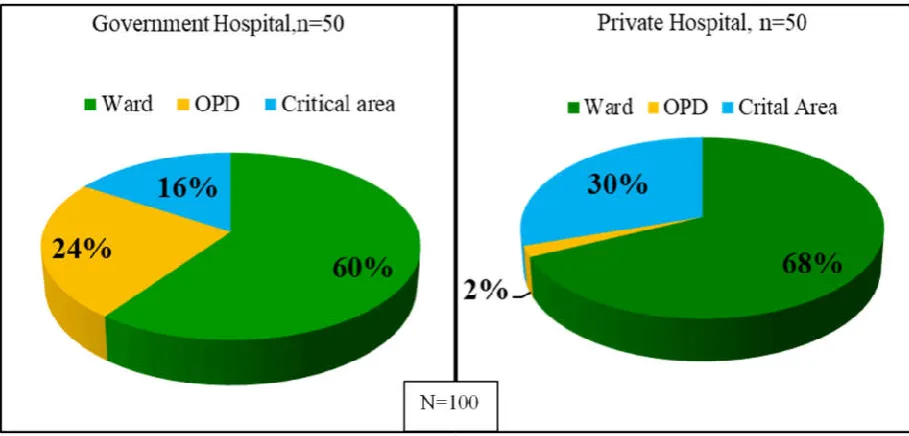
[image:3.595.43.561.481.800.2]Figure 2. Distribution of nurses in terms of their Current area of posting
Section III: Findings related to difference in nurses attitude towards continuing professional development programme in government and private hospitals
Table 2. Difference in nurses attitude towards Continuing Professional Development programme in government and private hospital N=100
Hospital Attitude score Mean Mean Difference SD ‘t’ value
Government Private
3870 3932
77.4 78.64 1.24
5.792
6.1569 1.037 ‘t’ (98), = 1.98 , P >0.05
[image:4.595.137.454.482.579.2]The nurse’s attitude score towards continuing professional development programme was higher among nurses of private hospital (3932) as compared to government hospital nurses (3870) but not found statistically significant (P>0.05).
Table 3. Level of nurse’s attitude towards continuing professional development programme in government and private hospital
N=100
Level of nurses attitude Nurses
‘t’ test
Government Private
n=50 n = 50
Mean ±SD % Mean ±SD %
Favorable attitude n=35
80.2 ± 4.364
70 % n=35 81.94 ± 3.80
70 % 1.779
Unfavorable attitude n=15
70.86 ± 2.416
30 % n= 15 70.93 ± 2.576
30% 0.076
‘t’ (68), = 2.00(P >0.05), ‘t’ (28), = 2.05(P >0.05)
[image:4.595.55.538.650.777.2]There was a no significant difference found in level of nurse’s attitude score towards continuing professional development programme in government and private hospitals (P>0.05).
Table 4. Area wise mean nurses attitude score with different dimensions of continuing professional development programme in government and private hospital
N=100
Area of CPD programme
Nurses attitude score
‘t’ test
Government Private
Mean ± SD Mean % Mean ±SD Mean %
Purpose of CPD programme 220.5 ± 14.5 88.2% 229± 5 91.6% 4.41*P<0.001 Influence of CPD programmes on skills and knowledge 216 ± 5.715 86.4% 228± 2.9 91.2% 13.24*P<0.001 Application CPD programmes in clinical setting 208 ± 2.16 83.2% 210± 6.4 84% 2.09*P<0.05 CPD improves patient care 208± 3.68 83.4% 213± 4.8 85.2% 5.146*P<0.001 CPD programmes and time of session 120± 13 48% 149 ± 5.09 59.6% 14.68*,P<0.001 Types of CPD programmes 169.3 ± 39 67.7% 178.6± 7.9 71.4% 16.43*P<0.001 Support of organization and employee 196± 1 78.4% 188.5± 1 75.4% 37.5*,P<0.001
Work environment 195.5± 1.5 78.2% 183.5± 3 73.4% 15.3*,P<0.001
Section IV: Findings related to difference in barrier towards participation in continuing professional development programme among nurses in government and private hospitals.
Table 5. Difference in Barrier towards participation in continuing professional development programme among nurses in government and private hospital
N=100
Hospital Barrier score Mean Mean Difference SD ‘t’ value
Government Private
2755 2815
55.1
56.3 1.2
8.466 14.47 0.506 ‘t’ (98), = 1.98, P > 0.05
[image:5.595.158.435.246.325.2]The overall nurse’s barrier score towards participation in continuing professional development programme was higher among nurses of private hospital (2815) as compared to government hospital nurses (2755) but not found statistically significant (P>0.05).
Table 6. Level of barrier towards participation in continuing professional development programme among nurses in government and private hospital
N=100, n=50
Level of barrier Nurses ‘t’ test
Government, n=50 Private, n = 50
Mean ±SD % Mean ±SD %
High barrier n=31
59.96 ± 6.57
62% n=19
70.84 ± 13.63
38% 14.977*
Low barrier n=19
47.15 ± 3.97
38% n=31
47.38 ± 3.852
62% 1.026
‘t’*
(48), = 2.02, (P <0.05, 0.001), ‘t’ (48), = 2.02, (P >0.05)
[image:5.595.88.503.407.475.2]There was a significant difference found in terms of level of barrier score where the number of government nurses faced high barrier (62%) as compare to private nurses (38%) towards participation in continuing professional development programme (P<0.001).
Table 7. Area wise mean barrier score towards participation in continuing professional development programme among nurses in government and private hospital
N=100, n=50
Area of barrier in CPD programme
Nurses barrier score
‘t’ test
Government, n=5 Private, n=5
Mean ± SD Mean % Mean ±SD Mean %
Personal Barriers 94.7± 7.11 63.13% 96 ± 6.1 64% 0.984 (P>0.05)
Interpersonal Barrier 88.1± 5.586 58.73% 89± 6.7 59.3% 07317 (P>0.05)
Organizational Barriers 90.9 ± 6.367 60.6% 94.6± 22.2 63.06% 1.132(P>0.005)
‘t’(98), = 1.98, P >0.05
There was no significant difference found (P>0.05) in nurse’s barrier score at different areas of barrier in continuing professional development programme. Although the scores were much higher among the nurses of private hospital at all the areas but not found statistically significant
Section V: Findings related to relationship between nurses attitude and barrier towards participation in continuing professional development programme in government and private hospitals.
Table 8. Relationship between nurse’s attitude and barrier towards participation in continuing professional development programme in Government hospital
n=50
Variable Mean r ‘t’ value
Attitude Barrier
77.4 55.1
0.086 0.651
t’ (48) =2.02, P > 0.05
There was a no relationship found between the nurses attitude towards continuing professional development programme and barrier in participation towards continuing professional development programme in Government hospital.
Table 9. Relationship between nurse’s attitude and barrier towards participation in continuing professional development programme in Private hospital
n=50
Variable Mean r ‘t’ value
Attitude Barrier
78.64 56.3
0.5 3.833*
‘t’ (48) =2.02 P <0.05
Conclusion
Though there were quite a few similarities between two groups, we found striking differences in the demographic profile especially in the age group and marital status (younger and single in private hospital), their educational qualification (higher in private hospital) and duration of their experience (more in government hospital). Majority of nurses in both hospitals couldn’t obtain any additional qualification after joining the job, nevertheless they agreed to utilise if there was an opportunity. Most of them had not joined any professional body in both hospitals. Major driving force behind advanced education for them was better placement in government hospital and better salary package. This is an important inference as it may act as an indirect indicator of work satisfaction in government hospital. The study also didn’t find any significant difference in nurses’ attitude towards continuing professional development except in few parameters. Same was true for the barrier towards continuing professional development. Their attitude and presence of barriers were independent factors and their relationship was different in both the groups. On one hand there was no relationship between the two factors in government hospital, the two factors were positively related to each other in private hospitals emphasizing the fact that nurses had a favorable attitude towards continuing professional development even in presence of barriers. The finding of present study is consistent with the finding of the study of Altmann and Tanya, (2012) who identified the nurses' attitudes towards continuing formal education among actively licensed RNs working in private hospitals and found that all subjects' attitudes' rank barely above neutral level with high overall attitude scores among
Associate Degree nurses. This result was similar with a
descriptive study conducted by Aris Yfantis on 23 clinical nurses of tertiary education in a district hospital of Greece where 82.6% of the participants answered that CPD helped them to plan their nursing care, whereas 17.4% that CPD helped them to think about what to do in clinical practice.
The finding was found consistent with the findings of the
cross-sectional study conducted by Zeinab Hamzehgardeshion
361 Iranian nurses where the mean score of personal and structural barriers was significantly higher than the mean score of interpersonal ones (F=2122.66, p<0.001). This result was
similar with a descriptive study conducted by Aris YF to
identify the nurses’ attitudes regarding Continuing Professional Development among 23 clinical nurses of tertiary education in a district hospital of Greece where 78% of the participants reported the existence of barriers to CPD and 17% reported that were unable to attend it because of heavy workload in the clinic. The finding of the present study was inconsistent with
the findings of the study of Altmann and Tanya (2012), who
identified the nurses' attitudes towards continuing formal education among actively licensed RNs working in private hospitals and found that attitudes do not appear to change over time based on years of experience nor differ by geographical location. There was a strong desire for attendance at continuing professional development programmes which to be recognized, acknowledged and awarded. Study also emphasizing the fact that in private sector, the hard work put by nurses is not well paid off as compared to government sector. On the other hand, the government sector needs to improve their work culture as the existing environment is unable to provide them work satisfaction in spite of good financial security. This result is
similar with a descriptive study conducted by Jennifer et al. to
identify the barriers to participation in Continuing education of Australian nurses, grouped into experienced nurses, recently qualified nurses and nurses in rural or remote areas where the major barriers identified were time, accessibility and relevance
of content. Continuing professional education and
development programmes are the backbone of the individual and organization benefitting both in a mutual way. Specialty specific programmes including the practical workshops to impart recent updates and time bound study leaves for higher education and later on their academic achievements linked to promotion and financial gains will ultimately translate into good and trusted patient care.
The study has revealed that continuing professional development programme is acknowledged and the nurses do have a favorable attitude towards engaging and participating in continuing professional development programme. In light of the findings from this study, there are few recommendations presented.
Continuing professional development programme
should be mandatory for continued nursing practice.
Mandated continuing professional development
programme will bring nursing practices in line with national and international practice. It will keep the nurses’ skills and knowledge up to date with new developments in nursing, specifically in the field of advancing Technology.
Continuing professional development programme must
be adequately resourced. Employers and management together must ensure adequate support to nurses to enhance participation in continuing professional development programme.
Opportunity to use and share knowledge and skills.
Once staff has attended continuing professional development programme, strategies should be put in place to apply new knowledge and skills gained in the work environment. Procedures should be put in place to encourage the application of learnt knowledge and skills to the clinical environment.
On completion of an appropriate continuing
professional development programme, awards and recognition may be offered. This is an incentive to participate in continuing professional development programme and an example is promotional status with remuneration on completion of a post-graduate course.
Acknowledgment: The researcher thanks all the participants
of the study for their kind cooperation.
Source of Funding: No funding sources
Conflict of interest: None declared
Ethical clearance: The study was approved by the
Institutional Ethics Committee
REFERENCES
Altmann, T.K. 2012. Nurses attitudes towards continuing formal education: a comparison by level of education and
geography. Nursing education perspective, Vol.33, No.2,
Aziz, Jet, N.C, and Rahman Abdul, S.S. 2012. Continuing Professional Development: Views and barriers towards
participation among Malaysian pharmacists. The European
Journal of Social and Behavioural Sciences, pp.2301-2218.
Beatty, R.M. 2001. Continuing professional education, organization support, and professional competence:
Dilemmas of rural nurses. The Journal of Continuing
Education in Nursing, Vol.33, No.5, pp.203-220. Retrieved
from www.google.com on 27/8/15.
Bellfield, S. 2010. Factors Influencing the Advancement of Professional Education of Nurses at a Magnet Hospital. Online published thesis for the degree of Master of Science in nursing education and work at the University of Georgetown University, Washington, D.C, Retrieved from www.google.com on 28/8/15.
Brace, N. Sheely, B. Conner, A D. and Martin, A C. Barriers to attendance at continuing nursing education presentation. Nursing research e-Journal for integrated delivery systems. Retrieved from www.google.com on 27/8/15.
Eales, C. 2001. Lifelong learning. SA Journal of
Physiotherapy, 57(3):2.
Fitzpatrick MA. Certified practice: we owe it to our patients and ourselves. Nurs Manage 2003 Mar;34(3):6.
Hamzehgardeshi, Z.andShahhosseini, Z. 2014. A study of facilitators and barriers of Iranian nurses participation in
continuing educational programmes. Journal of Global
health sciences, Vol.6, No.2, pp.183-88. Retrieved from
www.google.com on 24/8/15.
Indian Nursing Council, Retrieved from www.inc.org.on 28/8/15.
Lahiff, M. 1984. Attitudes to continuing education. Nursing Times, January: 27-30.
Pelletier, D. et al. 1998. Nurses'perceptions of their
professional growth on completion of two years of
postgraduate education. Australian Journal of Advanced
Nursing, Vol.16, No. 2, pp. 26-35. PMid: 10196874.
Penz, K. et al. 2007. Barriers to participation in continuing
education activities among rural and remote nurses.
Journal of continuing education in nursing, Vol. 38, No.2,
pp.58-66. Retrieved from www.google.com on 28/8/15.
Taylor, C. et al. 1999. Taking on the student role: How can we
improve the experience of registered nurses returning to
study? Australian Critical Care, Vol.12, No.3, pp. 98-102.
http://dx.doi.org/10.1016/S1036-7314(99)70581-3.
Ugwu, C.A. Erondu, F.O. and Onwuazombe, T.C. 2012. Attitudes and barriers to post graduate education among
radiographers in South Eastern Nigera. International
Journal Of Tropical Disease and Health, Vol.2,
pp.112-122.