ISSN Print: 2327-5952
DOI: 10.4236/jss.2019.75018 May 27, 2019 215 Open Journal of Social Sciences
Correlates of High Technology Exports
Performance in the Philippines
Eden J. Garces, Cerenio G. Adriatico
College of Business and Management, Southern Leyte State University, San Juan, Philippines
Abstract
This study presents empirical evidence among the predictor variables of for-eign direct investment (FDI), energy investment, official development assis-tance, and gross domestic product (GDP) which have a bearing on the growth of high technology exports in the Philippines. Data sets of indicators used in the study had been downloaded from the World Development Indicators website covering the period 1991-2016. The data were processed and analyzed utilizing the symbolic regression analysis through machine learning, the Nu-tonian Eureqa Desktop. The results of the study revealed that foreign direct investment and official development assistance have significant contributions to the development and manufacture of export-driven commodities classified by the Organization of Economic Cooperation and Development as high technology exports. On the other hand, the gross domestic product has a negative impact while energy investment has no contribution to exports de-velopment at all. Further, the results likewise demonstrated that strong causal relationships between high technology exports and the variables evidenced by a very high R2 goodness of fit of 0.82 signifying 82% of variations in high technology exports could be explained by the predictor variables included in the transfer. The study concluded that two relevant information was ob-tained. First, the indicator of official development assistance is only suitable in the short run period. Second, the gross domestic product will continue to decline if continuous trade deficit pervades in the long run period.
Keywords
Foreign Direct Investment, Symbolic Regression, Causal Relationships, A Trade Deficit
1. Introduction
High technology exports comprise of products with top research and
develop-How to cite this paper: Garces, E.J. and Adriatico, C.G. (2019) Correlates of High Technology Exports Performance in the Philippines. Open Journal of Social Sciences, 7, 215-226.
https://doi.org/10.4236/jss.2019.75018
Received: April 6, 2019 Accepted: May 24, 2019 Published: May 27, 2019
Copyright © 2019 by author(s) and Scientific Research Publishing Inc. This work is licensed under the Creative Commons Attribution International License (CC BY 4.0).
DOI: 10.4236/jss.2019.75018 216 Open Journal of Social Sciences ment intensity, such as in aerospace, computers, pharmaceuticals, scientific in-struments, and electrical machinery classified both by the World Bank and the Organization for Economic Cooperation and Development. In this age of infor-mation technology and globalization, high technology exports are fast becoming one of the key players in the rapid growth of the economy of a particular nation. Seyoum (2015) [1] claimed that in the future high technology products would become the primary attribute in the creation of wealth, accelerated growth in top exports, higher standards of living, economic growth and development. The main purpose of undertaking this study was to examine the determinants of high technology exports in the Philippines. It is on the assumption that the sets of in-dicators comprising of foreign direct investment, gross domestic product, energy investment, official development assistance, and foreign direct investment played significant roles in transitioning the country toward economic growth and emergence. Anderson and Ejermo (2008) [2] and Kato (2015) [3] ascer-tained that both knowledge and technology are the critical, essential components in the production of high-quality technology-intensive products geared for dis-tribution in domestic and international markets. The exports of manufactured goods are also observed sensitive to exchange rates in countries and territories like Japan, Hong Kong (China), Korea, China and Taiwan Province (Kato, 2015) [3]. Competitiveness coupled with research and development expenditures should be sufficient and viable enough to establish the level of the technology infrastructure (Porter, 1990) [4] of a particular country desiring to embark in the manufacture of export-oriented goods (Ege, A., and Ege, A.Y., 2017) [5] in order to acquire strong competitiveness (Alemu, 2013) [6] and to become a significant player in the global trade (Zeng, M., 2000, Liu, X.J., 2007, Han, Y.C., 2010) [7] [8][9]. Porter (1990) [4] also observed that government plays a significant role in the pursuit of excellence in the technology infrastructure by way of deregu-lating industries, continuously encourage sustained investment in human capi-tal, innovation, and physical assets. The government likewise should support in-tense local rivalries of competing industries as a stimulus to the creation of competitive advantage. A country having a competitive advantage in the pro-duction of a particular good will have an edge in the global market.
fa-DOI: 10.4236/jss.2019.75018 217 Open Journal of Social Sciences cilities. Investments in government assets are the resources the project company spends on acquiring government assets such as state-owned enterprises, rights to provide services in a specific area, or the use of specific radio spectrums.
contribu-DOI: 10.4236/jss.2019.75018 218 Open Journal of Social Sciences tion of the inward foreign direct investments included technology spillovers (Marin, et al., 2006) [15], developed financial system (Branstetter, 2006, Hermes,
et al., 2003) [16][17], capital accumulation and output productivity (De Mello,
1999) [18], and transfer of technology (Borensztein, et al., 1998) [19]. Many of the results suggested FDI is an essential vehicle for the removal of technology, relatively contributed more to growth than domestic investment. However, the higher productivity and economic growth fostered by FDI can only be realized when the host country has a minimum threshold stock of human capital and availability of sufficient absorptive capability of the advanced technologies of the recipient economy.
Meanwhile, the manufacture of high technology goods coupled with the utili-zation of alternative energy resources such as solar, water and wind energy gen-erally reduce consumption of energy. Additionally, firms engaged in the manu-facture of export-driven products are now adopting the use of alternative ener-gies to reduce carbon emissions. In reality, however, the contribution of the ag-gregate amount of high technology exports comprises only a minimal share of the gross domestic product.
However, many of the related researches undertaken focused merely on the overall export performance relative to economic growth (Epaphara, 2016, Olson,
et al., 2014, Liu, et al., 1998) [13][20][21]. Literature regarding high technology
exports was conducted either for developed countries or selected developing countries (Seyum, 2005, Kato, 2015, Bhatt, 2013) [1][3][22] including the Phil-ippines were relatively recent. Bhatt (2013) [22] found out foreign direct invest-ment is a significant variable of export indicating a 1% increase in the inflow of foreign direct investment will lead to at least 0.25% increase in exports within a one-year time gap with expected gains of both indicators in the long run. Argua-bly, the country experiences a recurring negative trade balance for many years, and this is the very reason this paper attempted to examine the relevant ma-croeconomic indicators in determining the growth of high technology exports of the country for the period 1991 until 2016. This will be assessed utilizing the symbolic regression. As recommended by Moreno-Sanchez et al. (2015) [23], symbolic regression (SR) is arguably a new methodology in building a statistical model having its roots in the so-called Genetic Programming. It includes sum-marizing an algorithm for an automated generation of mathematical expressions in the form of Y = f(x) to fit a set of data investigated. Accordingly, the symbolic regression offers some advantages over the standard regression methods like multiple linear regression where Eureqa Nutonian Desktop software can manage in running a search process of potential models while simultaneously evaluating each of them in various criteria finding a model with satisfactory predictive ac-curacy.
2. Theoretical and Conceptual Framework
DOI: 10.4236/jss.2019.75018 219 Open Journal of Social Sciences technology exports consistently sustain balanced economic growth. Based on the related searches there were two determinants contributing to high technology exports namely gross domestic product and foreign direct investment (Bhatt, 2013) [22].
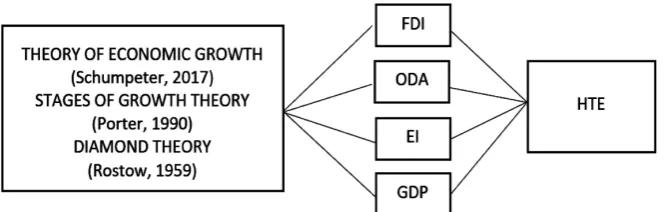
Porter’s (1990) [4] diamond theory examined the competitive advantage of nations using a set of variables: gross domestic product, investment in energy, official development assistance and inward foreign direct investment which sig-nificantly influence the development of high technology exports in a particular country. Accordingly, the nation’s competitiveness largely depends on the ca-pacity of industry to create, redefine, innovate, and upgrade the production of high-quality products ready for distribution at the domestic and international markets. Porter postulated the sample of nations and industries included in the study offered a rich empirical basis for developing and testing the new theory of how countries gain competitive advantage. To achieve this goal, countries, therefore, must move beyond the traditional neo-classical concept of compara-tive advantage to a competicompara-tive edge globally.
Schumpeter’s (2017) [24] theory of economic growth argued that business cycles are inevitable in a developing economy due to the uncertainties of eco-nomic booms and recessions. It is becoming a recurring phenomenon that can-not be easily removed nor corrected unless the government intervenes. This theory emphasized the creation of new wealth or resources through innovation. Recessions are becoming cyclical in the long run; hence, the need to produce new products that are highly in demand and competitive in the market. The theory also cautions recessions are the price a nation pays for long term eco-nomic growth leading to the so-called unnecessary setbacks and damages to the economy.
Rostow’s (1959) [25] stages of growth theory postulated economic growth oc-curs in five primary linear stages of varying length and time starting from a tra-ditional society, setting the preconditions for takeoff into self-sustaining growth, moving into the drive to maturity and the final stage which is the age of mass consumption. Todaro (2015) [26] however thought this as a highly partial theory about modern history. It was argued that while the developed countries had all passed the takeoff into self-sustaining growth, developing countries on the other end were still lagging either in the traditional society or the preconditions for takeoff and had to follow a specific set of rules of development to takeoff trans-forming them into self-sustaining growth. Foreign direct investment, official development assistance, gross domestic product, energy investment are few of the economic indicators precursor to this 3rd stage of economic growth.
DOI: 10.4236/jss.2019.75018 220 Open Journal of Social Sciences Figure 1. The theoretical and conceptual framework of the study.
3. Data and Methodology
The high technology export model utilized in this study is given by: HTE = f(FDI, ODA, EI, GDP) where:
FDI = foreign direct investment ODA = official development assistance EI = energy investment
GDP = gross domestic product
This model assumes the dynamics of growth of high technology exports are a function of the nation’s inward foreign domestic investment, official develop-ment assistance received from different bilateral and multilateral agreedevelop-ments, investment in various sources of energy development and the gross domestic product.
This study utilized the available dataset obtained from the World Develop-ment Indicators site of the World Bank covering the years 1991 until 2016. It employed an exploratory data analysis using a symbolic regression exploring new information, significant relationship, expand or substantiate existing know-ledge, and undertake prediction. The data gathered were processed with the aid of a machine learning, the Nutonian Eureqa Desktop version 1.24.0.9367 under academic license.
The following model definition is being proposed:
(
) (
) (
) (
)
(
1 , 2 , 3 , 4)
yhte f x fdi x gdp x ei x oda=
where, high technology export is calculated as a function of (x1) foreign direct investment, (x2) gross domestic product, (x3) energy investment, and (x4) offi-cial development assistance.
Further, to arrive at consistent results, the variables were standardized with the use of statistical software. Using the Nutonian Eureqa, Desktop the target expression set in the symbolic regression and the first options containing several formula building blocks already selected by default. Besides, the new formula of sine, cosine, and natural logarithm was checked to conform to linear statistical models. The default error metric was set to absolute error.
4. Results and Discussion
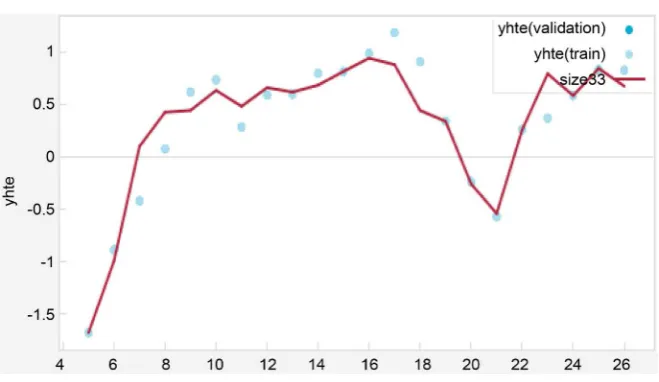
DOI: 10.4236/jss.2019.75018 221 Open Journal of Social Sciences Figure 2. Time series plot of the response variable (Source: Eureqa Nutonian Desktop).
1991-2016. The blue dots represent the actual values of the variable during the past 26 years. The red line, on the other hand, describes the predicted value of high technology exports over time. The graph meanwhile manifested both the dots and the continuous line will reach to convergence at a certain point in the future. It also demonstrates stronger causal relationships among high technology exports and the related macro-economic variables of the country in the long run. If the country continues to manufacture high-quality goods both for domestic consumption and exports all other things are held constant, more foreign direct investments will flow into the country which will create additional jobs to quali-fied job seekers—highly skilled and semi-skilled bringing unemployment rate at its acceptable level. As determined in previous studies lower unemployment also intensifies the consistent growth of the country’s economy (Fuchs, 1980, Islam, 2004, Sodipe and Ogunrinola, 2011, Misztal, 2010 and Wu, 2011) [27][28][29] [30][31]. The massive drop in the high technology exports in 2011 presented in the graph was aggravated by bad weather, weak global demands of electronics, and delays in government spending. As reported by the Center for Research on the Epidemiology of Disasters, 33 natural disasters struck the country in this particular year alone. Typhoon Sendong and other natural disasters that ravaged the different parts of the country caused over 26 billion economic losses and af-fected livelihood and income of 3.5 million families. Lower demand for elec-tronic exports was also affected by the massive earthquakes and tsunami in Ja-pan, and the very severe flooding in Thailand, a primary source of automotive parts and units. Since Philippine exports were very concentrated in just a single sector, this was severely hit by the global slowdown (the National Economic De-velopment Authority 2012); thus, a considerable drop in exports was accounted in this particular year.
Table 1 which presents the best mathematical model suggested by the
DOI: 10.4236/jss.2019.75018 222 Open Journal of Social Sciences Table 1. Selected solution generated from the Pareto Front.
MODEL R2 Mean Squared
Error (MSE) Coefficients Number of Complexity Error hte = a + b*oda + c*fdi*oda +
d*oda3 − e*gdp2 − f*oda2 0.82 0.17151889 6 Low Low
direct investment, energy investment, official development assistance, and gross domestic product, the variables of gross domestic product and energy invest-ment were observed as not directly significant contributors to the growth of high technology exports. This finding contradicted to the earlier results of Olson et al. (2010) [13], Istaiteyeh and Ismail (2015) [32] suggesting a positive correlation existed between gross domestic product and exports. Although common know-ledge dictates that growth in exports contributes positively toward economic growth (Bilas et al., 2015, Xu, 1996) [33][34] ascertained there is little evidence supporting a causal link between exports and outputs. Accordingly, previous studies also claimed an increase in exports led to a significant increase in gross domestic product.
Model Developed
3 2 2
3.49 0.712 0.578 0.332 0.167 1.75
hte= + oda+ fdi oda+ oda − gdp − oda
In this particular model, it can be understood that high technology exports are primarily a function of foreign direct investment (FDI) and official development assistance (ODA) especially during the initial stage of developing high-end products and goods precisely on short-run. It has to be noted that in the long run and the country has already taken off the production of export-driven con-sumer products and commodities based on research and development thereby reducing the need to avail for any additional official development assistance in the form of grants and soft loans. The gross domestic product (GDP) on the other hand has a negative bearing due to the trade deficit experienced by the country for several years. While official development assistance provides loans with cheaper interest, the ODA availed by the state from various development partners such as Japan, World Bank, and OECD member countries is for infra-structure, social reform, and community development, respectively. Interesting-ly, the production of high technology exports no longer require a large amount of energy perhaps due to the advancement in technology as far as manufacturing processes are concerned. On the other hand, traditional production processes such as the manufacture of steel, cement, oil and the like will continue to con-sume a large number of energy requirements.
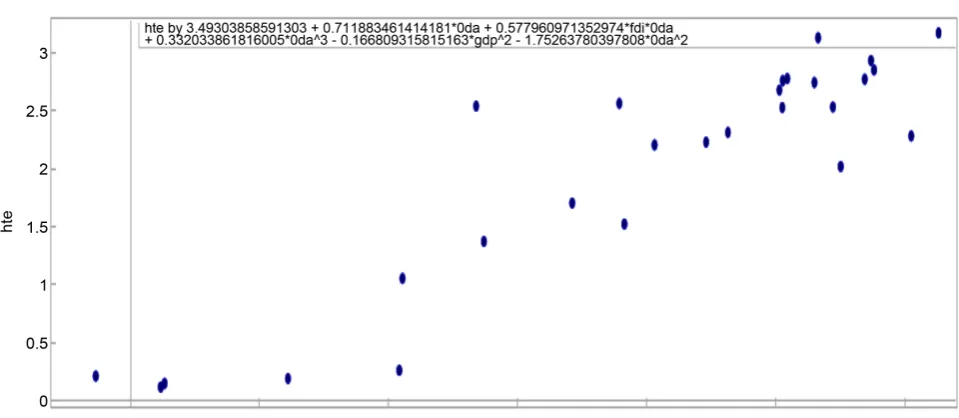
DOI: 10.4236/jss.2019.75018 223 Open Journal of Social Sciences Figure 3. Scatterplot of high technology exports and variables (Source: Eureqa Nutonian desktop).
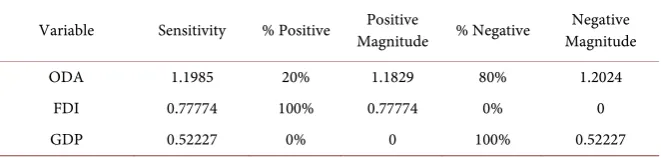
and energy investment contribute to the production of goods for shipping abroad, a perfect positive correlation would have been attained. This result is further validated by the sensitivity analysis presented in Table 2.
The sensitivity report indicates a 100% positive indicating increasing this va-riable will directly increase the target vava-riable. As discussed earlier, the official development assistance accounts for only 20% positive for the simple reason in the long run, availing of such aid will reduce gradually. The gross domestic product incurred a 100% negative impact as a result of the trade deficit. As ex-pected, when exports are higher than imports, a trade surplus will be achieved that would significantly contribute to an increase in the nation’s outputs.
DOI: 10.4236/jss.2019.75018 224 Open Journal of Social Sciences Table 2. Sensitivity analysis results of the target variables.
Variable Sensitivity % Positive Magnitude Positive % Negative Magnitude Negative
ODA 1.1985 20% 1.1829 80% 1.2024
FDI 0.77774 100% 0.77774 0% 0
GDP 0.52227 0% 0 100% 0.52227
Source: Eureqa Nutonian desktop.
policy instruments with a focus on research and development that will bring the country towards continued sustained growth and prosperity.
5. Conclusion
There are two relevant facts obtained in this particular study. First, official de-velopment assistance is suitable only in the short-term not on the long term ba-sis. Hence, inflows of this indicator should be channeled into the creation of in-novative programs and activities rather than focusing on the development projects. Second, the gross domestic product continues to decrease if consumers spend more on buying and consuming foreign goods rather than patronizing goods sold by local producers. As such, there is a continuing need to educate consumers on the impact of the trade deficit. Foreign direct investment and offi-cial development assistance are two important macroeconomic indicators ne-cessary for the full development of goods classified as high technology efforts. It is pervasive that over the years, the country suffered a significant setback in global trade due to continued trade deficits detrimental to the nation’s economy as this likewise increases in foreign debt. Economists, however, agree that trade deficits are sustainable as long as it does not exceed 3% of the nation’s gross do-mestic product (GDP) in the long run. The world is now increasingly migrating into industry 4.0 and to be able to keep at pace with the recent development po-licymakers who have to put more teeth in the creation of wealth through inno-vation. Initially, it requires a comprehensive development planning participated by the academe, the industry and relevant sectors. Finally, the use of symbolic regression (SR) will offer unbiased statistical results in future research.
Conflicts of Interest
The authors declare no conflicts of interest regarding the publication of this pa-per.
References
[1] Seyoum, B. (2005) Determinants of Levels of High Technology Exports an Empiri-cal Investigation. Advances in Competitiveness Research, 13, 64-79.
https://search.proquest.com/docview/211368444?accountid=173015
DOI: 10.4236/jss.2019.75018 225 Open Journal of Social Sciences https://doi.org/10.1080/10438590701279714
[3] Kato, A. (2015) Effects of Exchange Rate Changes on East Asian Technology-Intensive Exports. The Journal of International Trade & Economic Development, 24, 809-821. https://doi.org/10.1080/09638199.2014.974659
https://search.proquest.com/docview/1689380723?accountid=173015
[4] Porter, M.E. (1990) The Competitive Advantage of Nations. Competitive Intelli-gence Review, 1, 14.https://doi.org/10.1002/cir.3880010112
[5] Ege, A. and Ege, A.Y. (2017) The Turkish Economy and the Challenge of Technol-ogy: A Trade Perspective. New Perspectives on Turkey, 57, 31-60.
https://search.proquest.com/docview/1960941600?accountid=173015 https://doi.org/10.1017/npt.2017.28
[6] Alemu, A.M. (2013) The Nexus between Technological Infrastructure and Export Competitiveness of High-Tech Products in East Asian Economies. Journal of Eco-nomic Development, Management, IT, Finance, and Marketing, 5, 14-26.
https://search.proquest.com/docview/1509736725?accountid=173015 [7] Zeng, M. (2000) High Technology to Boost Exports. China Daily.
https://search.proquest.com/docview/257609515?accountid=173015
[8] Liu, X.J. (2007) The Analysis of Technology Importation Effect on Comparative Advantage of High-Tech Products Export (Order No. H211077). ProQuest Disser-tations & Theses Global.
https://search.proquest.com/docview/1026529488?accountid=173015
[9] Han, Y.C. (2010) An Evaluative Research on High-Tech Products Export Competi-tiveness in China (Order No. 10386123). ProQuest Dissertations & Theses Global. https://search.proquest.com/docview/1868345565?accountid=173015
[10] Leamer, E.E. (2009) Gross Domestic Product. In: Leamer, E.E., Ed., Macroeconomic Patterns and Stories, Springer, Berlin, 19-38.
[11] Anderson, L. (1993) Gross Domestic Product. The Concise Encyclopedia of Eco-nomics. Library of Economics and Liberty.
[12] Callen, T. (2008) What Is Gross Domestic Product? Finance & Development, 45. [13] Olson, M., Pilcher, S. and Whitman, N. (2014) Empirical Analysis of the
Relation-ship between Exports and GDP.
[14] Khan, M., Ferdous, T. and Kundu, N. (2012) Future Contribution of Export and Import to GDP in Bangladesh: A Box-Jenkins Approach.
[15] Marin, A. and Bell, M. (2006) Technology Spillovers from Foreign Direct Invest-ment (FDI): The Active Role of MNC Subsidiaries in Argentina in the 1990s. The Journal of Development Studies, 42, 678-697.
https://doi.org/10.1080/00220380600682298
[16] Branstetter, L. (2006) Is Foreign Direct Investment a Channel of Knowledge Spil-lovers? Evidence from Japan’s FDI in the United States. Journal of International Economics, 68, 325-344.https://doi.org/10.1016/j.jinteco.2005.06.006
[17] Hermes, N. and Lensink, R. (2003) Foreign Direct Investment, Financial Develop-ment, and Economic Growth. The Journal of Development Studies, 40, 142-163. https://doi.org/10.1080/00220380412331293707
[18] De Mello, L.R. (1999) Foreign Direct Investment-Led Growth: Evidence from Time Series and Panel Data. Oxford Economic Papers, 51, 133-151.
https://doi.org/10.1093/oep/51.1.133
DOI: 10.4236/jss.2019.75018 226 Open Journal of Social Sciences https://doi.org/10.1016/S0022-1996(97)00033-0
[20] Epaphra, M. (2016) Determinants of Export Performance in Tanzania. Journal of Economics Library, 3, 470-487.
[21] Liu, L.G. and Graham, E.M. (1998) The Relationship between Trade and Foreign Investment: Empirical Results for Taiwan and South Korea (No. WP98-7).
[22] Bhatt, P.R. (2013) Causal Relationship between Exports, FDI and Income: The Case of Vietnam. Applied Econometrics and International Development, 13, 161-172. [23] Moreno-Sanchez, D. and Tijerina-Aguilera, J. (2015) Use of Symbolic Regression
for Lean Six Sigma Projects.
[24] Schumpeter, J.A. (2017) Theory of Economic Development. Routledge, Abing-don-on-Thames.https://doi.org/10.4324/9781315135564
[25] Rostow, W.W. (1959) The Stages of Economic Growth. The Economic History Re-view, 12, 1-16.https://doi.org/10.1111/j.1468-0289.1959.tb01829.x
[26] Todaro, M.P. and Smith, S.C. (2011) Economic Development. 11th Edition, Pren-tice Hall, Harlow.
[27] Fuchs, V.R. (1980) Economic Growth and the Rise of Service Employment. https://doi.org/10.3386/w0486
[28] Islam, R. (2004) The Nexus of Economic Growth, Employment and Poverty Reduc-tion: An Empirical Analysis.
[29] Sodipe, O.A. and Ogunrinola, I.O. (2011) Employment and Economic Growth Nexus in Nigeria. International Journal of Business and Social Science, 2, 12-17. [30] Misztal, P. (2010) Foreign Direct Investments, as a Factor for Economic Growth in
Romania. Journal of Advanced Studies in Finance, 1, 72-82. https://search.proquest.com/docview/862561889?accountid=173015
[31] Wu, Y. (2011) Empirical Analysis on the Relationship between Employment and Economic Growth of Guangdong Province (Order No. 10576829). ProQuest Dis-sertations & Theses Global.
https://search.proquest.com/docview/1873860868?accountid=173015
[32] Istaiteyeh, R.M.S. and Ismail, M.T. (2015) A Causal Relationship between Foreign Direct Investment, Economic Growth and Export: Empirical Case for Jordan. Ad-vances in Management and Applied Economics, 5, 19-30.
https://search.proquest.com/docview/1704498162?accountid=173015 https://doi.org/10.15520/jbme.2016.vol4.iss5.186.pp01-06
[33] Bilas, V., Bosnjak, M. and Franc, S. (2015) Examining the Export-Led Growth Hy-pothesis: The Case of Croatia. Nase Gospodarstvo, 61, 22-31.
https://search.proquest.com/docview/1699250795?accountid=173015 https://doi.org/10.1515/ngoe-2015-0010
[34] Xu, Z. (1996) On the Causality between Export Growth and GDP Growth: An Em-pirical Reinvestigation. Review of International Economics, 4, 172-184.