Accepted Manuscript
A primary care web-based intervention modelling experiment replicated behaviour changes seen in earlier paper-based experiment
Shaun Treweek, Jill J. Francis, Debbie Bonetti, Karen Barnett, Martin P. Eccles, Jemma Hudson, Claire Jones, Nigel B. Pitts, Ian W. Ricketts, Frank Sullivan, Mark Weal, Graeme MacLennan
PII: S0895-4356(16)30233-5
DOI: 10.1016/j.jclinepi.2016.07.008 Reference: JCE 9213
To appear in: Journal of Clinical Epidemiology
Received Date: 1 February 2016 Revised Date: 21 June 2016 Accepted Date: 18 July 2016
Please cite this article as: Treweek S, Francis JJ, Bonetti D, Barnett K, Eccles MP, Hudson J, Jones C, Pitts NB, Ricketts IW, Sullivan F, Weal M, MacLennan G, A primary care web-based intervention modelling experiment replicated behaviour changes seen in earlier paper-based experiment, Journal of Clinical Epidemiology (2016), doi: 10.1016/j.jclinepi.2016.07.008.
M
AN
US
CR
IP
T
AC
CE
PT
ED
ACCEPTED MANUSCRIPT
A primary care web-based intervention modelling experiment
replicated behaviour changes seen in earlier paper-based
experiment
Authors
Shaun Treweek1, Jill J Francis2, Debbie Bonetti3, Karen Barnett4, Martin P Eccles5, Jemma Hudson1, Claire Jones6, Nigel B Pitts7, Ian W Ricketts8, Frank Sullivan9, Mark Weal10, Graeme MacLennan1
Addresses
1. Health Services Research Unit, University of Aberdeen, Health Sciences Building, Foresterhill, Aberdeen AB25 2ZD, UK.
2. School of Health Sciences, City University London, Northampton Square, London EC1V 0HB, UK.
3. School of Dentistry, University of Dundee, Frankland Building, Dundee DD1
4HN, UK.
4. Centre for Population Health Sciences, University of Edinburgh, Medical Quad,
Teviot Place, Edinburgh, EH8 9AG, UK.
5. Retired but at Institute of Health and Society, Newcastle University, Baddiley Clark Building, Richardson Road, Newcastle upon Tyne NE2 4AX, UK when the work was done.
6. Health Informatics Centre, University of Dundee, Ninewells Hospital & Medical School, Dundee DD1 9SY, UK.
7. Centre for Dental Innovation & Translation, Kings College London, Guy’s Hospital, London SE1 9RT, UK.
8. Retired but contactable via Computing, University of Dundee, Queen Mother Building, Dundee DD1 4HN, UK.
9. University of Toronto, Department of Community and Family Medicine, North York General Hospital, 4001 Leslie St. Toronto, ON M2K 1E1, Canada.
M
AN
US
CR
IP
T
AC
CE
PT
ED
ACCEPTED MANUSCRIPT
Corresponding author:
Shaun Treweek
Health Services Research Unit University of Aberdeen
3rd Floor, Health Sciences Building Foresterhill
Aberdeen AB25 2ZD UK
M
AN
US
CR
IP
T
AC
CE
PT
ED
ACCEPTED MANUSCRIPT
Abstract
Objectives: Intervention Modelling Experiment (IMEs) are a way of developing
and testing behaviour change interventions prior to a trial. We aimed to test this
methodology in a web-based IME that replicated the trial component of an earlier,
paper-based IME.
Study design and setting: Three-arm, web-based randomised evaluation of two
interventions (persuasive communication and action plan) and a ‘no intervention’
comparator. The interventions were designed to reduce the number of antibiotic
prescriptions in the management of uncomplicated upper respiratory tract
infection. General practitioners (GPs) were invited to complete an online
questionnaire and eight clinical scenarios where an antibiotic might be considered.
Results: 129 GPs completed the questionnaire. GPs receiving the persuasive
communication did not prescribe an antibiotic in 0.70 more scenarios (95%
confidence interval = 0.17 to 1.24) than those in the control arm. For the action
plan, GPs did not prescribe an antibiotic in 0.63 (95% CI = 0.11 to 1.15) more
scenarios than those in the control arm. Unlike the earlier IME, behavioural
intention was unaffected by the interventions; this may be due to a smaller sample
size than intended.
Conclusions: A web-based IME largely replicated the findings of an earlier
M
AN
US
CR
IP
T
AC
CE
PT
ED
ACCEPTED MANUSCRIPT
Keywords: intervention modelling experiments, behaviour change, randomised
controlled trials, prescribing, primary care
M
AN
US
CR
IP
T
AC
CE
PT
ED
ACCEPTED MANUSCRIPT
What’s new?
Key findings
• A web-based Intervention Modelling Experiment (IME) replicated the findings
of an earlier paper-based IME on general practitioners’ simulated antibiotic
prescribing behavior. The web-based IME did not replicate findings linked to
behavioural intention.
• Intervention effects were consistent across different modes of intervention
delivery.
What this adds to what is known
• Replication studies are relatively rare. Using different modes of delivery,
general practitioners from a different part of the UK and done seven years
after the original study, this replication experiment demonstrated that the IME
methodology can produce consistent results.
What is the implication?
• The IME methodology may potentially be considered as a way of developing
theory-based behaviour change interventions prior to evaluation in a full-scale
M
AN
US
CR
IP
T
AC
CE
PT
ED
ACCEPTED MANUSCRIPT
Background
Without help, the uptake of research results into clinical practice happens slowly, if
it happens at all [1]. The field of implementation science (or knowledge translation
as it is generally called in North America) has been established to, among other
things, develop and evaluate interventions to support professional behaviour
change that translates research evidence into practice. Examples include audit
and feedback [2] and educational outreach [3]. However, the literature provides
less information to guide the choice, or to optimise the components, of these
interventions for use in different contexts [4, 5]. Interventions can be effective (e.g.
reminder systems, audit) but the evidence is conflicting and the reason for this is
largely unknown [2]. The UK Medical Research Council (MRC) framework for
developing and evaluating complex interventions proposes more and better
theoretical and exploratory work prior to a full-scale trial as a means of improving
intervention development [6].
Intervention modelling experiments (IMEs) are one way of doing this exploratory
work [7] with some of the present study’s authors (DB, MPE, JJF and NBP)
involved in their development. In an IME key elements of the intervention are
delivered, using a randomised design, in a manner that approximates the real
world but where the measured outcome is generally an interim outcome, a proxy
for the behaviour of interest. Although we thought the methodology promising,
there had been no replication study, which we considered essential if other
investigators were to have confidence in the methodology; a single success is
M
AN
US
CR
IP
T
AC
CE
PT
ED
ACCEPTED MANUSCRIPT
The work described here is part of a study to evaluate the IME methodology itself
by replicating an earlier, paper-based IME [9-11]. Our key research interests
were:
1. Does the delivery mode of the IME (paper or web) affect predictors of GP
behaviour?
2. Do interventions developed using these predictors change behavioural
intention and simulated behaviour in similar ways for the paper and
web-based IMEs?
This is important information because, for the IME methodology to be useful, it
needs to be a robust and reliable method to support trialists with their intervention
modelling work. The first aim was addressed in an earlier publication [12], which
showed that the web-based IME identified 8/10 of the predictors of prescribing
behaviour identified in the paper-based IME. This paper describes work linked to
the second of our aims.
A detailed description of the form and content of the two theory-based
interventions has been published elsewhere [12]. This paper describes a
randomised evaluation of two behaviour change interventions (a persuasive
communication and an action plan) with a ‘no intervention’ comparator, all of which
were delivered within a web-based IME.
Methods
The trial was a three-arm, web-based trial of two behaviour change interventions
M
AN
US
CR
IP
T
AC
CE
PT
ED
ACCEPTED MANUSCRIPT
Scottish Health Boards identified by the Scottish Primary Care Research Network
(SPCRN; www.sspc.ac.uk/) using a combination of publicly available information
provided by Information Services Division (ISD) Scotland
(http://www.isdscotland.org/isd/3793.html) and restricted information held on the
NHS.net database, the latter to provide e-mail addresses. SPCRN staff sent email
invitations to GPs on our behalf because supporting recruitment to research
studies in this way is part of their role and GPs were familiar with receiving emails
from SPCRN (but not the research team). SPCRN staff also sent reminders but
had no other role in the study. The decision to use email to invite GPs was taken
after a randomised evaluation of postal versus email invitations, which found
emails to be as effective as postal invitations but quicker and cheaper to send [13].
Recruitment
Recruitment was done in two stages, reflecting the stages of an IME [8]. The first
stage recruited GPs to complete an online questionnaire comprising 20 questions
about antibiotic prescribing behaviour, eight clinical scenarios that required
antibiotic prescribing decisions and four general questions about the GP’s
background. GPs were also offered a £20 voucher for this stage. These data
were used to identify predictors of antibiotic-prescribing behaviour, which
replicated work from the earlier paper-based IME [10], as well as to design a new
intervention [12]. The clinical content of all eight scenarios, provided by one of the
authors (MPE), was such that there were no clear cases for prescribing an
M
AN
US
CR
IP
T
AC
CE
PT
ED
ACCEPTED MANUSCRIPT
The second stage recruited from among the GPs responding to stage 1 but
excluded those in the first quartile of responses to the questionnaire’s ‘intention to
not prescribe antibiotics’ questions. GPs already following best evidence for
prescribing antibiotics were not candidates for our interventions. The remaining
75% of GPs were invited to complete a second online questionnaire, which this
time included one of the two interventions or the ‘no intervention’ comparator.
GPs were offered a £30 voucher for this stage (meaning a GP entering both
stages was offered a total of £50 in vouchers). The eight scenarios in the second
questionnaire were different to those in the first but again, they were created (by
MPE) so that there was no compelling case in any of them for prescribing an
antibiotic. The other 24 questions were the same as in the first questionnaire.
The full questionnaire is shown in Additional File 1.
GPs were randomly allocated to one of the interventions or the comparator by the
LifeGuide software (https://www.lifeguideonline.org), which we used to deliver the
web-based IME. Non-responders received two reminders spaced two weeks
apart. All research staff were blinded to GP recruitment allocation until the study
database was locked.
Sample size
Using the dependent variable of behavioural intention, we sought to detect an
effect size of 0.66, which was the mean effect size for change in intention in a
meta-analysis of trials that measured change in intention and behaviour [14]. We
needed 50 participants per group to have 90% power of detecting this effect size
M
AN
US
CR
IP
T
AC
CE
PT
ED
ACCEPTED MANUSCRIPT
was set at 250 GPs to achieve the sample size of 150 participants. This increase
was to allow for drop-out between questionnaires and excluding the first quartile of
responses to the ’intention not to prescribe antibiotics’ questions (see above).
Interventions
Two behaviour change interventions were evaluated: a persuasive communication
and an action plan. The persuasive communication addressed beliefs about the
consequences (e.g. including ‘attitude’ from the Theory of Planned Behaviour [15]
and ‘outcome expectancies’ from Social Cognitive Theory [16, 17]) of managing
patients with uncomplicated URTI without prescribing antibiotics. It was effective in
reducing the number of antibiotic prescriptions in the paper-based IME’s
prescribing scenarios [11]. The format of this intervention can be translated
entirely for web delivery, therefore repeating it in the current study would address
questions about both intervention effectiveness and the relative effectiveness of
paper versus web-based delivery of intervention materials. (See Additional File 2).
The action plan was a new intervention developed using data from the first online
questionnaire [12]. Based on the stage 1 questionnaire responses, predictors of
antibiotic-prescribing behaviour were identified and classified into ‘theoretical
domains’ of behaviour change. Three domains predicted prescribing rates and
were thus identified as targets in the new intervention. These domains were beliefs
about consequences, beliefs about capabilities and behavioural regulation.
Replicable behaviour change techniques (intervention components) have been
identified to target each of the domains [18]. A behaviour change technique known
M
AN
US
CR
IP
T
AC
CE
PT
ED
ACCEPTED MANUSCRIPT
is an explicit statement of where, when, and how a behaviour will be performed.
Action plans are proposed to work by setting up environmental cues to remind an
individual to perform the behaviour [19]. Furthermore, repeated performance of a
behaviour in response to the cue increases the likelihood that a behaviour may
become a habit. (See Additional File 3).
Finally, a ‘no intervention’ comparator was used, in other words the web-based
IME presented nothing to the GP and moved straight to the questionnaire and
scenarios.
Outcome measures
There were two outcomes for the trial:
1. Behavioural intention (primary outcome) - strength of motivation, or intention
to perform the target behaviour (i.e. not prescribing an antibiotic).
2. Behavioural simulation (secondary outcome) - clinical decisions in the
context of simulated clinical situations presented in the eight clinical
scenarios.
Behavioural intention was measured using three questions from the questionnaire:
Q16, Q17 and Q18. (See Additional Files 1 and 4). The intention score was
computed by computing the mean of the responses (range of 1 to 7, with a higher
score meaning a greater intention to not prescribe an antibiotic) on these three
M
AN
US
CR
IP
T
AC
CE
PT
ED
ACCEPTED MANUSCRIPT
Behavioural simulation was the total number of clinical scenarios out of eight
where an antibiotic was not prescribed. KB, GM and ST each categorised all GPs’
responses to each clinical scenario with regard to prescribing into a Yes (an
antibiotic was prescribed) or a No (an antibiotic was not prescribed) and discussed
any differences in categorisation to reach consensus. All decisions were made
blinded to allocation and before the final analysis was started.
Statistical analysis
Categorical data were described using numbers and percentages, continuous data
using mean and standard deviation. The two outcomes were analysed using
linear regression comparing action plan and persuasive communication with the
‘no-intervention’ comparator. The models were adjusted for baseline and the effect
sizes presented along with 95% confidence intervals and p-values and analysed
by intention to treat. Analysis was carried out using Stata 13 (StataCorp. 2013.
Stata Statistical Software: Release 13. College Station, TX: StataCorp LP).
Results
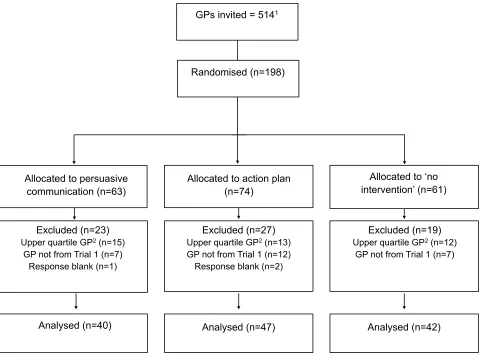
Recruitment ran between February 2012 and August 2012 and a total of 198 GPs
were randomised (Figure 1). Of these, 129 were from the lower three quartiles of
the ‘intention to not prescribe antibiotics’ responses in the first stage, i.e. our target
group, and all 129 sets of these data were analysed.
M
AN
US
CR
IP
T
AC
CE
PT
ED
ACCEPTED MANUSCRIPT
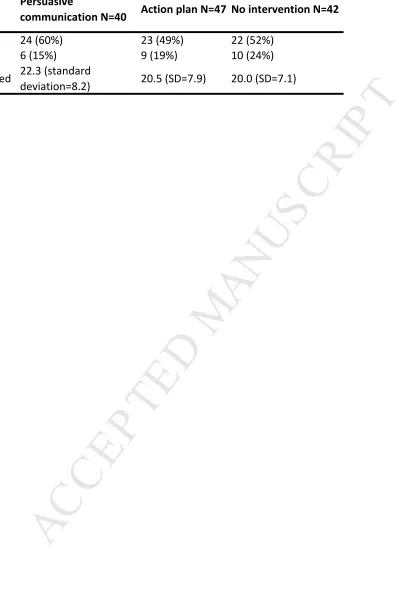
The demographic characteristics of the participants across the three trial arms
were similar (Table 1).
Behavioural intention and behavioural simulation
The mean number of scenarios without a prescription was 5.0 (out of 8) for the
persuasive communication, 4.9 for the action plan and 4.2 for the ‘no intervention’
comparator (Table 2). Figure 2 shows the distribution of scenarios without an
antibiotic prescription for the interventions and comparator.
The results of the regression analysis for behavioural simulation are also
summarised in Table 2. Adjusted for baseline score, GPs receiving the persuasive
communication did not prescribe an antibiotic in 0.70 (95% confidence interval =
0.17 to 1.24) more scenarios than those in the control arm. For the action plan
intervention, GPs did not prescribe an antibiotic in 0.63 (95% CI = 0.11 to 1.15)
more scenarios than those in the control arm.
Behavioural intention was unaffected by both interventions (Table 2). Correlation
between intention and behavioural simulation was 0.13, indicating a weak
relationship between the two.
Discussion
The work described here is part of a study to evaluate the IME methodology itself
by replicating an earlier, paper-based IME [10, 11] and describes a randomised
paper-M
AN
US
CR
IP
T
AC
CE
PT
ED
ACCEPTED MANUSCRIPT
based IME and an action plan developed from the predictors described in our
earlier publication [12] - against a ‘no intervention’ comparator. To be reassured,
we would have expected the persuasive communication intervention to reduce
intention to prescribe an antibiotic and to reduce antibiotic prescribing in simulated
clinical scenarios. For the persuasive communication, we would also expect the
size of effect seen in the current work to be similar to that seen in the earlier,
paper-based IME.
Both interventions increased the number of scenarios without an antibiotic
prescription, as in the earlier study. The results seen in the current study for the
persuasive communication are in broad agreement with those obtained for the
same intervention in the paper-based IME (paper-based IME: increase of 0.47
(95% CI=0.19 to 0.74) scenarios without a prescription; web-based IME: increase
of 0.70 (0.17 to 1.24) without a prescription. However, neither intervention reduced
the intention to prescribe, although both sets of confidence intervals shown in
Table 2 for behavioural intention do not rule out a reduction. However, we would
not necessarily expect the action planning intervention to influence behavioural
intention, as the proposed mechanism by which action plans change behaviour is
similar to the mechanism involved in habit formation; that is, the behaviour is
triggered directly by the context, with minimal reasoning or ‘cognitive processing’
[20]. Hence, following action planning, behaviour could change without the
involvement of behavioural intention (which is a cognitive process). Although the
study was powered on behavioural intention as the primary outcome (because
intention features in both theories on which the intervention was based), the data
M
AN
US
CR
IP
T
AC
CE
PT
ED
ACCEPTED MANUSCRIPT
intention data showed likely ceiling effects at baseline (mean of around 6 on a
scale of 1 to 7). Hence a further increase in intention scores as a result of the
intervention was unlikely. Responses to the clinical scenarios displayed a more
symmetrical distribution at baseline (mean of around 5 on a scale of 0 to 8),
despite the fact that the clinical content of all scenarios presented no clear cases
for prescribing an antibiotic. Hence, the difference in findings for intention and
simulation were likely a function of the difference in distributions. It is plausible that
participants would respond differently to these different measures: intention
questions ask GPs to report what they would do in general, and are therefore
subject to unintentional bias, whereas clinical scenarios present individual cases,
each of which have specific factors that may influence the prescribing decision.
The study had three strengths: it replicates previous work, it used a randomised
design and it had a theoretical rationale for selecting intervention components.
The work described here, together with that in a sister paper [12] (where we found
that the web-based IME identified 8/10 of the predictors of prescribing behaviour
identified in the paper-based IME), have largely reproduced results obtained in an
earlier, paper-based IME [10, 11], which reassures us that the IME methodology is
robust. The randomised design is the best way of running an experiment to test
the effectiveness of proposed interventions.
There are three limitations. The first is inherent in the IME methodology and is
that clinical scenarios were used to provide behavioural simulation scores. This
M
AN
US
CR
IP
T
AC
CE
PT
ED
ACCEPTED MANUSCRIPT
evidence of the external validity of clinical scenarios is limited, studies that have
explored this have been favourable towards their use [21].
The second limitation is that only 129, not 150 of GPs from the first stage took part
in the second stage. Hrisos and colleagues [11] managed to get 340 of 397 (86%)
GPs to return a completed questionnaire in their paper-based IME. That we could
only persuade 129 of the 254 invited (51%) to respond to the second
questionnaire is unfortunate and may explain our wide confidence intervals and
failure to replicate the reduction in intention to prescribe as seen in Hrisos et al’s
earlier work [11]. Both studies had three participants who effectively withdrew by
entering the study but who did not go on to provide a response. It perhaps also
highlights the ease with which people can ignore electronic invitations, surveys
and questionnaires. The final limitation is less about the methodology and more to
do with the interventions: both led to a modest mean of around 0.7 fewer
scenarios without an antibiotic prescription. We might expect this to get smaller
still if the interventions were used in the real world rather than the simulated world
of the IME. There are clearly limits to the type of intervention that can be tested in
an IME and it may be that while these interventions may have potentially useful
M
AN
US
CR
IP
T
AC
CE
PT
ED
ACCEPTED MANUSCRIPT
Conclusion
We have replicated, in a web-based system, an IME delivered initially on paper
and we found changes in behavioural simulation that are consistent with those
found in the paper-based IME. We did not replicate the changes in behavioral
intention seen in the paper-based work. We have also evaluated a new behaviour
change intervention in a randomised trial and found that it changed behavioural
simulation as expected based on its theory-based design. Replication studies are
an important part of increasing value and reducing waste in research [8] and this
replication study gives us greater confidence in the IME methodology than a single
study.
Acknowledgements and funding
We would like to thank the GPs who took part in this study. We would also like to
thank Marie Pitkethly and Gail Morrison for their help and support in recruiting GPs
to the study. WIME was funded by the Chief Scientist Office, grant number
CZH/4/610. The Health Services Research Unit, University of Aberdeen, is core
funded by the Chief Scientist Office of the Scottish Government Health
Directorates.
Ethical approval
WIME was approved by the Tayside Committee on Medical Research Ethics A,
M
AN
US
CR
IP
T
AC
CE
PT
ED
ACCEPTED MANUSCRIPT
& Development approval from the 12 National Health Service (NHS) Health
Boards involved.
The trial of which this study is part is registered: ClinicalTrials.gov number
NCT01206738.
Authors’ contributions
All authors except JH contributed to the design of the study. KB did most of the
day-to-day running of the study, with support from CJ and ST. GM and JH
analysed the data and KB, GM, DB, JJF, JH and ST discussed the results. All
authors contributed to the interpretation of the results. ST was chief investigator of
the study and wrote the first draft of the paper. All authors contributed to the final
M
AN
US
CR
IP
T
AC
CE
PT
ED
ACCEPTED MANUSCRIPT
References
1. Grimshaw JM, Eccles MP, Lavis JN, Hill SJ, Squires JE. Knowledge translation of research
findings. Implementation science 2012; 7:1.
2. Ivers N, Jamtvedt G, Flottorp S, Young JM, Odgaard-Jensen J, French SD, O’Brien MA,
Johansen M, Grimshaw J, Oxman AD. Audit and feedback: effects on professional practice and
healthcare outcomes. Cochrane Database of Systematic Reviews 2012, Issue 6. Art. No.:
CD000259. DOI: 10.1002/14651858.CD000259.pub3.
3. O'Brien MA, Rogers S, Jamtvedt G, Oxman AD, Odgaard-Jensen J, Kristoffersen DT,
Forsetlund L, Bainbridge D, Freemantle N, Davis D, Haynes RB, Harvey E. Educational
outreach visits: effects on professional practice and health care outcomes. Cochrane Database
of Systematic Reviews 2007, Issue 4. Art. No.: CD000409. DOI:
10.1002/14651858.CD000409.pub2.
4. Walker AE, Grimshaw J, Johnston M, Pitts N, Steen N, Eccles M: PRIME – PRocess modelling
in ImpleMEntation research: selecting a theoretical basis for interventions to change clinical
practice. BMC Health Services Research 2003, 3:22.
5. Foy R, Eccles M, Jamtvedt G, Young J, Grimshaw J, Baker R: What do we know about how to
do audit and feedback? BMC Health Services Research 2005, 5:50.
6. Craig P, Dieppe P, Macintyre S, Michie S, Nazareth I, Petticrew M. Developing and evaluating
complex interventions: the new Medical Research Council guidance. BMJ 2008;337:a1655.
7. Bonetti D, Eccles M, Johnston M, Steen N, Grimshaw J, Baker R, Walker A, Pitts N: Guiding
the design and selection of interventions to influence the implementation of evidence-based
practice: an experimental simulation of a complex intervention trial. Social Science and
Medicine 2005; 60: 2135-2147.
8. Ioannidis JPA, Greenland S, Hlatky MA, Khoury MJ, Macleod MR, Moher D, Schulz KF,
Tibshirani R. Increasing value and reducing waste in research design, conduct, and analysis.
Lancet 2014; 11; 166–75.
9. Treweek S, Ricketts IW, Francis J, Eccles M, Bonetti D, Pitts NB, MacLennan G, Sullivan F,
Jones C, Weal M, Barnett K. Developing and evaluating interventions to reduce inappropriate
M
AN
US
CR
IP
T
AC
CE
PT
ED
ACCEPTED MANUSCRIPT
randomised controlled trial to compare paper-based and web-based modelling experiments.
Implementation Science 2011, 6:16.
10. Hrisos S, Eccles M, Johnston M, Francis J, Kaner EF, Steen N, et al. Developing the content of
two behavioural interventions: Using theory-based interventions to promote GP management of
upper respiratory tract infection without prescribing antibiotics #1. BMC Health Serv Res. 2008;
8:11.
11. Hrisos S, Eccles M, Johnston M, Francis J, Kaner EF, Steen N, Grimshaw J: An intervention
modelling experiment to change GPs' intentions to implement evidence-based practice: using
theory-based interventions to promote GP management of upper respiratory tract infection
without prescribing antibiotics #2. BMC Health Services Research 2008, 8:10.
12. Treweek S, Bonetti D, Maclennan G, Barnett K, Eccles MP, Jones C, Pitts NB, Ricketts IW,
Sullivan F, Weal M, Francis JJ. Paper-based and web-based intervention modeling
experiments identified the same predictors of general practitioners’ antibiotic-prescribing
behavior. Journal of Clinical Epidemiology 2014; 67: 296–304.
13. Treweek S, Barnett K, MacLennan G, Bonetti D, Eccles M, Francis JJ, Jones C, Pitts NB,
Ricketts IW, Weal M, Sullivan F. E-mail invitations to general practitioners were as effective as
postal invitations and were more efficient. Journal of Clinical Epidemiology 2012; 657: 793–7.
14. Webb TL, Sheeran P. Does changing behavioural intention engender behaviour change? A
meta-analysis of the experimental evidence. Psychological Bulletin 2006; 132(2): 249-268.
15. Ajzen I. The theory of planned behaviour. Organ Behav Hum Decis Process 1991;50:179e211.
16. Bandura A. Self-efficacy: the exercise of control. New York, NY: Freeman; 1997.
17. Bandura A. Health promotion from the perspective of social cognitive theory. In: Norman P,
Abraham C, Conner M, editors. Un- derstanding and changing health behaviour: from health
beliefs to self-regulation. Amsterdam: Harwood Academic Publishers; 2000: 299e339.
18. Michie S, Johnston M, Francis JJ, Hardeman W, Eccles MP. From theory to intervention:
mapping theoretically derived behavioural determinants to behaviour change techniques.
Applied Psychology: An International Review 2008, 57, 660-680.
19. Sniehotta FF. Towards a theory of intentional behaviour change: Plans, planning, and
self-regulation. British Journal of Health Psychology 2009; 14(2): 261–273.
M
AN
US
CR
IP
T
AC
CE
PT
ED
ACCEPTED MANUSCRIPT
21. Peabody JW, Luck J, Glassman P, Jain S, Hansen J, Spell M, Lee M. Measuring the quality of
physician practice by using clinical vignettes: a prospective validation study. Annals of Internal
Medicine 2004; 141: 771–80.
Table and figure legends
Table 1 Baseline characteristics.
Table 2 Behavioural intention and behavioural simulation. For behavioural
intention, the data presented are for the sum of four questionnaire items linked to intention (see main text for details). Higher scores reflect a stronger intention to not prescribe an antibiotic. For behavioural simulation, the data presented are for number of scenarios where GPs did not prescribe an antibiotic.
Figure 1 Participant flow. Note: 1This breaks down as 254 GPs from the first stage of the IME and 260 GPs who were not involved in the first stage. 2Forty GPs were from the upper quartile group of the first stage responders and were unfortunately invited to participate in stage 2 due to an administrative error. The remaining 26 (of the 198) were GPs who were not in the first stage but who were invited because we were unsure that 150 target GPs would respond, which turned out to be correct. The analysis presented in this paper focuses on the 129 GPs from our target group and for whom we have baseline ‘intention to not prescribe antibiotics’ data.
Figure 2 The distribution of the number of scenarios (out of 8) for which 129 GPs
M
AN
US
CR
IP
T
AC
CE
PT
ED
[image:23.595.99.498.100.704.2]ACCEPTED MANUSCRIPT
Table 1 Baseline characteristics.
Persuasive
communication N=40 Action plan N=47 No intervention N=42
Male 24 (60%) 23 (49%) 22 (52%)
GP Trainer 6 (15%) 9 (19%) 10 (24%)
Years qualified 22.3 (standard
M
AN
US
CR
IP
T
AC
CE
PT
ED
ACCEPTED MANUSCRIPT Persuasive communication group N=391Action plan group N=47
No intervention group N=42
Persuasive communication Vs No intervention2
Action plan Vs No intervention1
Behavioural intention
Stage 1 (baseline: pre-intervention) 6.0 (0.9) 6.0 (0.8) 5.9 (0.7)
Stage 2 (post-intervention/comparator) 6.1 (0.6) 6.1 (0.8) 6.1 (0.7)
-0.06 (95% CI=-0.32 to 0.19) N.S.
-0.04 (95% CI=-0.29 to 0.20) N.S.
Persuasive communication group N=40
Action plan group N=47
No intervention group N=42
Behavioural simulation
Stage 1 of IME 5.2 (0.7) 5.2 (0.8) 5.1 (0.8)
Stage 2 of IME 5.0 (1.4) 4.9 (1.5) 4.2 (1.1) 0.70 (95% CI=0.17 to 1.24)*
0.63 (95% CI=0.11 to 1.15)*
*P<0.05; N.S. = not significant.
2
Adjusted for baseline scores.
Mean score (standard deviation)
Mean no. scenarios without antibiotic (standard deviation)
Table 2 Behavioural simulation and behavioural intention and behavioural simulation. For behavioural intention, the data
presented are for the sum of four questionnaire items linked to intention (see main text for details). Higher scores reflect a stronger intention to not prescribe an antibiotic. For behavioural simulation, the data presented are for number of scenarios where GPs did not prescribe an antibiotic.
1
M
AN
US
CR
IP
T
AC
CE
PT
ED
ACCEPTED MANUSCRIPT
Allocated to persuasive communication (n=63)
Allocated to ‘no intervention’ (n=61) Randomised (n=198)
GPs invited = 5141
Allocated to action plan (n=74)
Analysed (n=40) Analysed (n=47) Analysed (n=42)
Excluded (n=23)
Upper quartile GP2 (n=15) GP not from Trial 1 (n=7)
Response blank (n=1)
Excluded (n=27)
Upper quartile GP2 (n=13) GP not from Trial 1 (n=12) Response blank (n=2)
Excluded (n=19)
[image:25.842.59.540.55.413.2]Upper quartile GP2 (n=12) GP not from Trial 1 (n=7)
Figure 1 Participant flow. Note: 1This breaks down as 254 GPs from the first stage of the IME and 260 GPs who were not involved in the first stage. 2Forty GPs
M
AN
US
CR
IP
T
AC
CE
PT
ED
[image:26.842.62.601.61.445.2]ACCEPTED MANUSCRIPT
Figure 2 The distribution of the number of scenarios (out of 8) for which 129 GPs did not prescribe an antibiotic for the Persuasive communication, Action plan and