PAPER • OPEN ACCESS
Controlling the gain contribution of background
emitters in few-quantum-dot microlasers
To cite this article: F Gericke et al 2018 New J. Phys. 20 023036
View the article online for updates and enhancements.
Related content
Supplementary data
-Topical Review
S Reitzenstein and A Forchel
-Phonon-mediated off-resonant coupling effects in semiconductor quantum-dot lasers
Matthias Florian, Paul Gartner, Christopher Gies et al.
PAPER
Controlling the gain contribution of background emitters in
few-quantum-dot microlasers
F Gericke1
, M Segnon2
, M von Helversen1
, C Hopfmann1
, T Heindel1
, C Schneider3
, S Höfling3,4
, M Kamp3
, A Musiał1,5
, X Porte1
, C Gies2
and S Reitzenstein1
1 Institut für Festkörperphysik, Technische Universität Berlin, D-10623, Berlin, Germany 2 Institute for Theoretical Physics, University of Bremen, D-28334, Bremen, Germany 3 Lehrstuhl für Technische Physik, Universität Würzburg, D-97074, Würzburg, Germany
4 School of Physics and Astronomy, University of St Andrews, St Andrews, KY16 9SS, United Kingdom
5 Present address: Laboratory for Optical Spectroscopy of Nanostructures, Department of Experimental Physics, Faculty of Fundamental
Problems of Technology, Wrocław University of Science and Technology, Wrocław, Poland.
E-mail:[email protected]
Keywords:nanolasers, cavity QED, high-βlasing, quantum dot–micropillar cavities, single quantum dot laser, semiconductor laser
Abstract
We provide experimental and theoretical insight into single-emitter lasing effects in a quantum dot
(
QD
)
-microlaser under controlled variation of background gain provided by off-resonant discrete
gain centers. For that purpose, we apply an advanced two-color excitation concept where the
background gain contribution of off-resonant QDs can be continuously tuned by precisely balancing
the relative excitation power of two lasers emitting at different wavelengths. In this way, by selectively
exciting a single resonant QD and off-resonant QDs, we identify distinct single-QD signatures in the
lasing characteristics and distinguish between gain contributions of a single resonant emitter and a
countable number of off-resonant background emitters to the optical output of the microlaser. Our
work addresses the important question whether single-QD lasing is feasible in experimentally
accessible systems and shows that, for the investigated microlaser, the single-QD gain needs to be
supported by the background gain contribution of off-resonant QDs to reach the transition to lasing.
Interestingly, while a single QD cannot drive the investigated micropillar into lasing, its relative
contribution to the emission can be as high as 70% and it dominates the statistics of emitted photons
in the intermediate excitation regime below threshold.
1. Introduction
On the way towards the ultimate thresholdless semiconductor nanolaser[1], with only a single quantum dot
(QD)as gain medium, the three main challenges are(i)developing the required technology to realize such devices,(ii)identifying lasing threshold, and(iii)proving experimentally that a single QD is solely responsible for reaching it. Recent advances in material quality and the fabrication of semiconductor micro- and nano-lasers have already allowed researchers to approach the regime where a single QD can substantially modulate the optical gain[2–7]. So far, self-assembled QDs in semiconductor microcavities feature the highest optical quality in terms of oscillator strength, quantum efficiency and coherence properties[8], giving a chance to eventually approach the single-emitter lasing regime. However, in the presently available QD-cavity systems non-negligible gain contribution by non-resonant transitions is still necessary to overcome the laser threshold[5,9,10]. To better control the coupling behavior and the gain contribution of a single resonant emitter, integrating a single self-assembled QD into a high-quality microcavity will be interesting in further optimizations. However, this integration is a complicated task that requires sophisticated techniques, such as site-controlled growth[11–15] orin situlithography[16–18]. Deterministically-positioned QDs have been successfully applied in the past to realize high-quality single-photon sources[19,20], but up until now have not been demonstrated to provide sufficient optical gain to reach the lasing threshold in a single-QD device.
OPEN ACCESS
RECEIVED 13 September 2017
REVISED 11 December 2017
ACCEPTED FOR PUBLICATION 29 December 2017
PUBLISHED 15 February 2018
Original content from this work may be used under the terms of theCreative Commons Attribution 3.0 licence.
Any further distribution of this work must maintain attribution to the author(s)and the title of the work, journal citation and DOI.
In contrast, state-of-the-art QD-based microlasers have solely been based on self-assembled QDs placed randomly on the active area of the microlaser[2,3,5]. Most of these QDs can contribute to the output of the microlaser in an uncontrolled way, and only a small fraction of them have suitable spectral positions so they can be tuned through the cavity mode by, e.g., temperature tuning. Eventually, scenarios with only a single QD in spectral resonance(but not necessarily spatially matched)with the cavity mode are possible. Nevertheless, the requirements for such a single QD device to lase are very demanding. Even for a spontaneous emission factor
(β-factor)close to unity, in which case spontaneous emission of the resonant emitter is almost solely directed into the laser mode, the light–matter coupling rate has to overcome the cavity loss rate at least by a factor of two
[21]. In practice, it requires to combine cavities with a high quality factor(Q)and strong light–matter
interaction, leading towards the coherent strong coupling regime[10,22]. In this case the required highQ-factor microresonators with small mode volumes foster the illumination of the cavity mode by off-resonant QDs
[23,24]which in turn has significant impact on the transition to lasing. Here, even spectrally far off-resonant emitters can couple to the cavity mode by a combination of different mechanisms, i.e., due to the interaction of QD excitations with acoustic phonons[25], Auger-like scattering processes[26,27,34]and Coulomb
interaction with multi-exciton states[28]. By these mechanisms, off-resonant QDs can feed the cavity mode within a wide energy range of tens of meV and contribute to lasing. In the regime of increased excitation that is typical for laser applications, the dominant mechanism is the formation of multi-exciton states, the transitions of which can be in close spectral vicinity to the cavity mode even if the associated exciton resonance is strongly detuned. Small remaining energy differences on the meV scale are efficiently bridged predominantly by Auger-assisted scattering of carriers in the QD states with carriers in WL states that are occupied at sufficiently strong excitation at which QD emission saturates. This combination has been demonstrated to form an emission background that is resonant with the mode[26,28,43]. In this context, a better understanding of the influence of individual in- and off-resonant QDs on the lasing behavior is needed and will be crucial for the design and operation of future micro- and nano-lasers. This information is also an important contribution to the ongoing very active discussion in the semiconductor community about the possibility for a single QD to provide enough gain to initiate and sustain lasing[10,29–33]. Interestingly, and in spite of their central role, the influence of off-resonantly coupled QDs on the lasing behavior has not been described in a controlled and comprehensive way so far. We address this open issue by using a versatile two-color excitation scheme with support from a microscopic laser theory. Our research gives important insight on the impact of background gain provided by off-resonant QDs in a regime where the emission is dominated by a single resonant QD.
The structure under study is a high-quality low-mode volume GaAs-based QD-micropillar cavity containing a single layer of self-assembled QDs with an inhomogeneously broadened energy distribution of
≈50 meV. Our goal is to control the gain contribution of off-resonantly coupled QDs in our microlaser and to distinguish their influence on the lasing behavior from that of the desired resonant QD. This allows us to identify fingerprints of different gain contributions to the laser output and, as a result, distinguish between devices with only one QD and with a few QDs constituting the gain of the microlaser, simply by varying the relative intensity of two excitation lasers. We do so by using a two-color excitation scheme: the target QD gain is selectively addressed by resonant excitation of its spectrally narrow p-shell resonance, while the gain of the off-resonantly coupled QDs is controlled simultaneously by above-band excitation. Thereby, the ratio between the two different excitation powers is used to control the relative contribution of the off-resonant emitters to the device output. A similar excitation approach has been used previously to control the gain in optical amplifiers from additional quantum-dashes in addition to a quantum-well gain, enabling a novel mechanism for lasing based on a two-photon excitation process[55]. In general, nanolasers operating in the high-βregime do not show a pronounced and typical laser characteristics in the input–output curve[32]. Therefore, the identification of the lasing threshold for a nanolaser is a challenging task that usually requires to take into account different emission characteristics including the photon statistics of emission[7,35–41]. In this context, we apply a microscopic semiconductor laser model to precisely determine the threshold of the investigated microlaser in the different experimental scenarios. Following this approach, we obtain a comprehensive understanding of the laser’s threshold and itsβ-factor, which in our experiment is a function of the background gain contribution due to the different coupling coefficients of the resonant QD and background(BG)emitters.
2. Materials and methods
2.1. Sample properties
The gain medium consists of a single layer of self-assembled InGaAs QDs, with an Indium content of about 40% and an areal density of10 cm10 -2in the center of a GaAsλ-cavity. These QDs feature a large oscillator strength,
which in combination with the low mode-volume micropillar ensures pronounced light–matter interaction that facilitates reaching the strong coupling regime[24]with pronounced single QD lasing effects[10]. On top
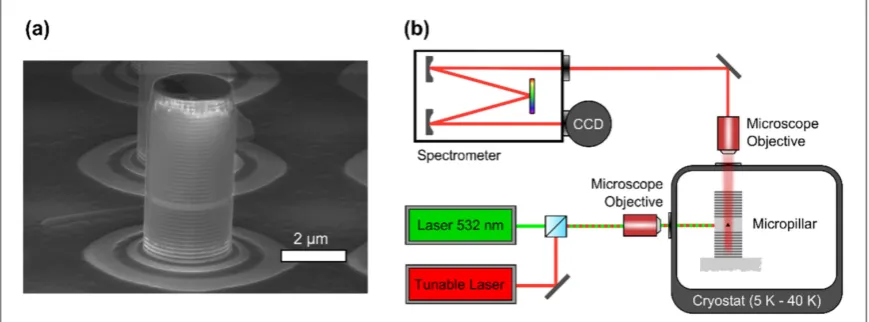
(bottom)of the central GaAs cavity 26(30)pairs of AlAs/GaAs layers acting as high reflective distributed Bragg reflectors(DBR)were grown. The micropillar was realized by high-resolution electron-beam lithography and plasma etching. A scanning electron micrograph of a processed free standing micropillar is shown infigure1(a). Theλ-cavity is visible in this picture as the thicker central horizontal section. The sample was cleaved to gain optical access to the micropillar cavity from the side(in the direction perpendicular to the micropillar axis). This enables direct and wavelength-independent excitation of the QDs[44]. For further details on the sample layout and processing we refer to[45].
To gain insight into the lasing characteristics of the QD-micropillar structure, its optical output was studied as a function of excitation power using the micro-photoluminescence(μPL)setup schematically shown in figure1(b). This setup has a perpendicular configuration of the excitation and the detection paths. The main advantage of side-excitation here is that the laser light is not(partially)blocked by the stop-band of the top DBR
[46]. Therefore, an efficient and homogeneous, i.e. wavelength-independent, excitation of the QDs can be realized. Furthermore, the perpendicular excitation and detection paths provide a natural rejection of a large fraction of the pump lasers’light in detection—an advantage that is particularly important for pumping wavelengths close to the micropillar’s resonance frequency. To selectively excite a single QD resonant with the cavity mode, we apply a quasi-resonant p-shell excitation scheme using a tunable semiconductor infrared(IR) laser with linewidth below 100 kHz(0.41 neV). The optical above-band excitation of the sample is carried out by a frequency doubled Nd:YAG laser emitting at a wavelength of 532 nm(further referred to as green excitation). The output power of each laser can be independently attenuated via a set of variable densityfilters before they are combined on a beam-splitter and focused on the sample by a lateral objective featuring high numerical aperture of 0.4 and long working distance of 20 mm. The sample is mounted in a variable temperature He-flow cryostat and kept at constant temperature of 25 K for most of the experiments. The far-field emission of the fundamental cavity mode is in perpendicular direction to the excitation path.
Based on the areal QD density of the wafer, we estimate an amount of@250dots within the active layer of a micropillar with 1.8μm diameter. Due to the self-assembled character of QD growth, there is a high variability in the QD emission energy and the spatial position. Nevertheless, about 5 QD lines are in the spectral proximity of the lasing mode and can be studied byfine-tuning with respect to the cavity mode. In the present case, the chosen QD excitonic transition couples strongly to the cavity mode at a resonance temperature of 25 K. At the same time, the spectral density of spectator QDs is high enough to provide enough background gain to overcome the lasing threshold.
[image:4.595.119.554.63.224.2]Above-band excitation is used to excite the BG emitters. Carriers are generated in the barrier material, from where they are captured equally into all QDs irrespective of their transition energies. In contrast, to address a target QD selectively either a resonant(s-shell)or a quasi resonant(p-shell)excitation scheme has to be employed. We choose p-shell excitation for most of the experiments because, in comparison with s-shell excitation, laser stray-light suppression is less demanding and to rule out a possible transfer of coherence from the exciting laser to the microlaser. To determine the energy of the p-shell for QDs in the micropillar of interest, we perform an excitation wavelength-dependent measurement, i.e. micro-photoluminescence excitation
(μPLE), at low excitation powers(not shown here). Whenever the laser energy is resonant with a p-shell(or another higher energy resonance)of a QD, we see a sharp maximum in the emission intensity at the energy of this QD and the cavity mode due to efficient pumping of the corresponding QD followed by the excitation transfer into the cavity mode due to off-resonant QD-cavity coupling. The response of the mode gets stronger the less detuned a QD is with respect to the cavity due to more efficient non-resonant cavity feeding. We selected the QD with the strongest p-shell resonance to coherently interact with the cavity mode. It can be tuned into resonance with the laser mode and exhibits a splitting between the s-shell and the p-shell of≈13 meV. This splitting is small in comparison to typical values of∼25–30 meV for standard In(Ga)As QDs[47–49], which is in agreement with an enhanced in-plane spatial extension of investigated QDs with enhanced oscillator strengh of about 25.
2.2. Optical characterization
First, we evaluate the influence of the BG emitters on the microlaser characteristics by examining the power-dependent emission spectra in two limiting cases: selective p-shell excitation of a target QD in resonance with the cavity mode(figure2(a))and non-selective above-band excitation with a green laser of all QDs in the gain medium(figure2(b)).
[image:5.595.120.553.63.257.2]The qualitative differences between the two cases are visible in the two panels offigure2. Using above-band excitation(figure2(a)), the QD emission lines(indicated by green arrows)exhibit larger linewidths at low excitation and broaden strongly with increasing excitation power. At high excitation 5μW, the spectrum is dominated by the cavity mode and strong broadband background so that single QD emission lines cannot be resolved anymore. These observations can be attributed to the fact that a large number of high-energy carriers are created in the whole structure that undergo multi-stage relaxation processes into the lowest energy states in the QDs. At higher excitation powers, when the confined states in the QDs are saturated, the recombination takes place from higher-energy states in the structure(wetting layer, WL or GaAs barrier material). This constitutes an additional background that contributes to the output of the micropillar, and it eventually gets stronger than the emission from single QDs experiencing saturation. In contrast,figure2(b)depicts the spectral dependence when only the p-shell of the selected QD is pumped. Due to a lower amount of carriers and less decoherence in the system, QD lines are narrower and do not broaden significantly with increasing excitation power, so that they can be individually resolved in the whole covered excitation range. Interestingly, even though we are using quasi-resonant excitation of a target QD, off-resonant QDs are still visible in the spectrum. This observation can be explained by the strong light–matter coupling in the structure leading to cavity mediated coupling between the QDs as discussed above. In this process, a target QD emits a photon that is stored in the cavity and afterwards transferred via one of the off-resonant coupling mechanisms, i.e. interaction with acoustic phonons, Auger-like scattering or Coulomb interaction with multi-excitonic states, to an off-resonant QD. An analog effect was previously observed in resonancefluorescence(RF)experiments on the same sample[50]. Another possibility is that due to relatively shallow confining potential of the investigated QDs, the p-shell
overlaps energetically with the tail of the density of states in the WL. This would result in non-zero probability of scattering carriers created in the p-shell state out of the QD towards the WL[51](instead of relaxing to the s-shell of the target QD). Since carriers in the WL can be captured into any of the QDs in the active region, this effect would be a detrimental factor to the selectiveness of our quasi-resonant excitation scheme.
To further quantify the difference in the response of the system under the two applied excitation schemes, we evaluate the single QD and the BG emitters’contribution to the spectra in terms of integrated intensities. For this purpose, we calculate the ratio between the QD in resonance with the cavity mode(selected range is marked as dotted lines infigures2(a)and(b))and the integrated intensity of the rest of the presented spectrum(outside the dotted lines). Figure2(c)depicts the system response under non-resonant excitation. The ratio shows a strong nonlinear increase in favor of the cavity mode contribution starting fromP≈1μW showing that most of the emission is funneled into the cavity mode and contributes to the microlaser output. This can be attributed to reaching the onset of stimulated emission and resembles a typical input–output laser characteristics. With increasing excitation power, the cavity is more effectively fed by the off-resonant emitters, which is reflected in a decreasing contribution of their intensity to the total intensity—a behavior that we consider asfingerprint of lasing action. Figure2(d)shows the described ratio for the quasi-resonant IR pumping scenario. Noteworthy, at low excitation powers, under p-shell excitation the cavity is fed more efficiently than when the above-band pump is applied, as it is indicated by the≈7% higher value of the ratio at low pump powers. This behavior can be attributed to strong coupling of the single QD in resonance to the cavity mode. The steeper initial increase in the ratio of the intensities is afingerprint of the single-QD nonlinearity proving that indeed in this excitation range the contribution of the BG emitters is negligible. The subsequent power-dependent evolution differs strongly from the above-band excitation scenario depicted infigure2(c). For the p-shell excitation of the target QD, the ratio stays almost constant within≈5%–10% variation and does not scale proportionally to the excitation power. This supports the interpretation that excitation of the system comes almost exclusively from a single emitter(at low excitation powers), which undergoes saturation for intermediate to high excitation powers.
2.3. Microscopic laser model for resonant QD and BG emitters
To gain further insight in the presented input–output curves and their interrelation with single-QD lasing, we employ a theoretical laser model that accounts for the semiconductor gain medium. As discussed in the introduction, a combination of non-resonant coupling mechanisms causes detuned transitions to emit resonantlyinto the cavity mode. For this reason, we use an effective picture, where the resonant contributions of NBGBG emitters are accounted for along the lines of Re. 43, and their Jaynes–Cummings coupling with the
cavity mode is considered in addition to the gain of the main single, resonant QD. In the following, we label quantities referring to the single QD withξ=QD and those referring to transitions of the BG emitters with
ξ=BG. Our microscopic model is based on the approach introduced in[52]and consists of a set of coupled dynamical equations derived from the Hamiltonian for the electronic states of the QD emitters, photons of the quantized electromagneticfield, and the interaction between QD excitations and photons in the laser mode. A set of coupled dynamical equations is derived for the intracavity mean photon number(áb b† ñ),and carrier
populations in the resonant QD(fse h,QD, )and the off-resonant QD transitions(fse h,BG, ):
+ k á ñ = á ñ + á ñ
⎜ ⎟
⎛ ⎝
⎞
⎠ † ∣ ∣ † † ∣ ∣ † † ( )
t b b g b v c N g b v c
d
d 2 2 QD 2 1
2
QD BG BG2 BG
= - ∣ ∣ á † †ñ + (b )+ ( ) ( )
tf g b v c R R P P
d
d s 2 , , 2
e h
p s e h ,QD
,
QD2 QD nl QD , g IR
= - ∣ ∣ á † †ñ + (b )+ ( ) ( )
tf g b v c R R P P
d
d s 2 , , 3
e h
pe hs ,BG
,
BG2 BG nl BG , g IR
Hereκis the cavity loss rate,gxdenotes the coupling constant of the QD in resonance or that of the off-resonant emitters, and the operatorsc†,v†annihilate(create)a carrier in the s-shell conduction- or valence-band state of
each emitter. Operatorsb†address photons in the laser mode. The rate
Rpe h, sdescribes the creation of excited
carriers in the laser levels via scattering that follows excitation from the two pump sources, green and IR, with respective pump powersPgandPIR.These excited carriers are created into the energetically higher p-states via a
relaxation-time approximation. The spontaneous recombination of carriers into nonlasing modes is given by the rateRnlthat depend on theβ-factors of the resonant QD(bQD)and the BG emitters(bBG).The dynamics of
equations(1)–(3)is determined by a balance of these interaction processes with the environment and the light– matter interaction of the single resonant andNBGbackground QDs via photon-assisted polarizations
+k+ G áx ñ =x x x + - x - x á ñ
⎜ ⎟
⎛ ⎝
⎞
⎠ † † ( ) † ( )
t b v c f f f f b b
d
d s 1 4
e s h s e s h , , , ,
with the dephasingGxassociated with the QD transitions resonant with the laser mode. This equation contains
the intra-cavity mean photon number that also appears in rate–equation theories. While the rate equations could be obtained by adiabatically eliminating the photon-assisted polarizations, we calculate the full dynamics and the dynamics of higher-order carrier-photon correlationsdáb bc c† †ñ,dáb bv v† † ñ,dáb b bv c† † †ñ,anddáb b bb† † ñ
as described in the appendixB. These equations allow us to calculate the second-order photon-correlation function at zero time delayg( )2(t=0), which contains information on the statistical properties of the emission
differentiating between single-photon character(g( )2(t=0)<1 ,) thermal(g( )2(t=0)=2 ,) and coherent
t= =
(g( )2( 0) 1)emission.
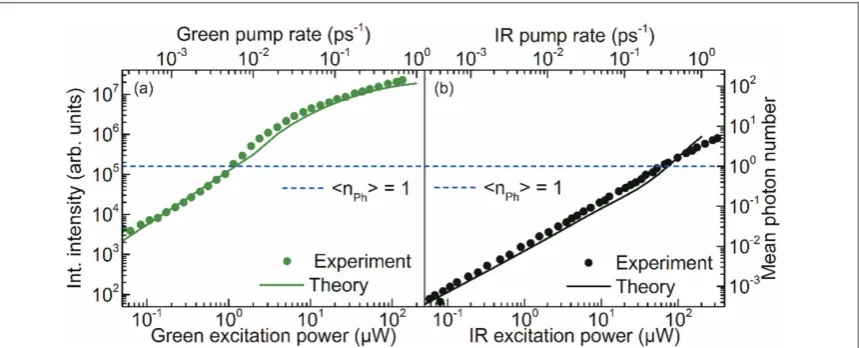
We determine the light–matter coupling-strengthgxand theβ-factor individually for the resonant and off-resonant case on the basis of experimental data obtained under purely green or IR excitation as shown infigure3, see appendixBfor further details. These parameters are used in all the following calculations and only the pump rates are varied to obtain the two-color excitation plots.
To further understand the nature of excitation in our system, it is important to note that the two
components of the gain in our laser model(resonant QD and BG emitters)are coupled via the common light field of the cavity. This leads to the effect that the resonant QD can in fact be indirectly excited by background excitation by reabsorbing cavity photons that were emitted from the detuned BG emitters, and vice-versa. It is therefore not possible to separate the system into resonant and background parts other than by switching off the corresponding light–matter coupling completely, a possibility that is reserved to theory alone and that has been used to obtainfigure6(c).
Our evaluation of the experimental data using non-resonant excitation confirms that emitters that are spectrally and spatially detuned from the cavity mode exhibit a weaker light–matter coupling strength and, thus, a lowerβ-factor than the single QD in resonance with the cavity mode. Consequently, theβ-factor of the coupled system consisting of resonant and BG emitters depends sensitively on the contribution of each of them. It is possible to quantify an effectiveβ-factor from equations(2)to(4)by considering only the spontaneous-emission contributions and solving equation(4)adiabatically. In this case, an effectiveβ-factor can be expressed as(see appendixB)
b b b l b
b =
+ láá ññ + + lá ñ =
á ñ
( )
† † † †
† † † †
g
g
1 1
, . 5
N b v c
b v c N
b v c b v c
eff QD BG BG
QD QD
BG 2
BG
QD
QD
BG
In the limit of vanishing contributions from BG emitters,befftakes on the highbQDvalue of the resonant
emitter, whereas a significantly lowerbeff=bBGis observed in the case of a dominating background. Viaλ, not
only the number of BG emitters enters, but also the respective coupling strength, taking into account the weaker coupling of detuned emitters.
The value of this effectiveβ-factorβeffimplicitly depends on the excitation rates of resonant and BG emitters and can, thereby, be tuned as we discuss in the following section. Note that more intricate many-body effects can already lead to deviations from a constantβ-factor of the resonant and BG QDs(bBGandbQD), a more detailed
[image:7.595.123.553.61.235.2]study of which is beyond the scope of the present work[42,43].
3. Results and discussion
3.1. Background controlled lasing in a QD-micropillar system
The experimental input–output curves for the two limiting cases, using only above-band excitation and only quasi-resonant p-shell excitation of the target QD are shown infigures3(a)and(b)together with the theoretical results. The latter ones are plotted versus the respective pump rates, which we consider to depend linearly with the excitation powers. The AppendixAprovides details on how the input-parameters for the theory are determined from the results presented infigure3. In the case of above-band excitation, in which all QDs are excited and can contribute to the gain, the input–output dependence shows the pronounced s-shape that is characteristic for the onset of stimulated emission in microlasers. In contrast, the p-shell excitation scenario results in nearly linear behavior over the whole measured range. Noteworthy, saturation at some point on the input–output curve would be expected for this latter scenario, but is not observed. Further experiments(see
appendix)in a resonant pumping scenario demonstrate that the QD in resonance is indeed saturating under strong p-shell excitation. However, the fact that we do not observe saturation in the input–output curve(see figure3(b))shows that the off-resonant emitters are also(unintentionally)excited and can even dominate the output of the QD-micropillar at high pump rates.
The clearly different behavior between both panels infigure3demonstrates that our two-color excitation scheme can be used to both understand and tailor the output characteristics of a few-QD semiconductor microlaser, including theβ-factor, by selective manipulation of the resonant and background gain contribution.
Up to now, the two limiting cases of either exciting dominantly the single target QD or all QDs in the micropillar have been presented. Now, we analyze the transition between them by gradually unbalancing between the two different pumps and continuous measurement of the QD-micropillar output characteristics. The results of full two-color excitation measurements are shown as excitation maps infigure4as obtained from experiment(panel(a))and from the theoretical model(panel(b)).
The horizontal axis represents the strength of the above-band excitation. Increasing the corresponding pump-rate corresponds mainly to increased excitation of the off-resonant emitters in the micropillar. In the vertical direction, p-shell excitation of the target single QD is increased. The blue dashed line in the left panel corresponds to the usual definition of threshold power(ánPhñ =1 ,) determined from the numerical
calculations by matching the calculated input–output characteristics to the experimentally measured one. Noteworthy, the qualitative agreement between the experimental and the theory maps is very high. The presented maps prove that the difference between input–output curves for the limiting cases is not related to different scaling factors for the excitation power but indeed to the fact that achieving lasing conditions with a single QD gain is rather challenging.
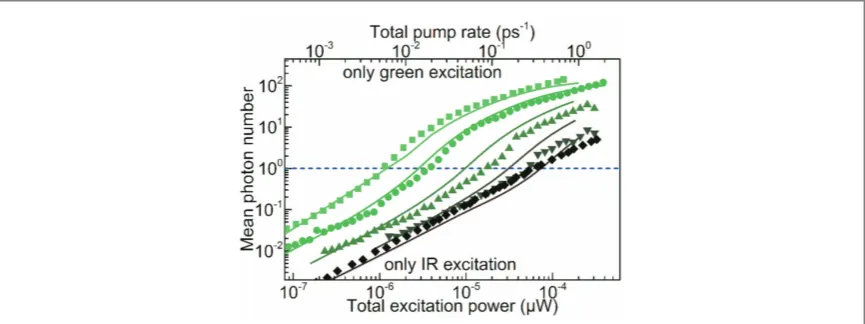
[image:8.595.120.553.63.252.2]To visualize the change in the shape of the input–output curve, diagonal cross-sections through the 2D map are presented infigure5at positions indicated by the colored solid lines infigure4(a). The upper- and lower-most input–output curves correspond to the two limiting cases shown infigures3(a)and(b). The diagonal cross-sections correspond to the input–output characteristics atfixed ratiosr=1, 7, 50 between both excitation
Figure 4.Experimental(left)and modeled(right)dependence of the emission intensity on the excitation conditions in the two-color excitation scheme. The blue dashed line in both panels represents the lasing threshold according to the usual definitionánPhñ =1for
powers, i.e., constant contribution-percentage of the off-resonant emitters. The input–output curves infigure5
are plotted against the sum of both excitation powers. The complementary theory curves are also shown in the same panel together with a horizontal(blue dashed)line associated with a mean photon numberánPhñ =1,
indicative for the lasing threshold. It can be clearly seen that the increase of the off-resonant
emitter-contribution causes the s-shape in the transition regime to become more pronounced and the threshold position shifts towards lower total excitation powers. Interestingly, the higher fraction of light coupled into the cavity mode from the BG emitters with less ideal light–matter coupling strength simultaneously degrades the effective
β-factor of the emission. We quantify this effect on the basis of equation(5), which is evaluated numerically. The result is shown infigure6(a): the maximal achievable effectiveβ-factor of 0.37 in case of dominant p-resonant excitation is still more than two times smaller than theβ-factor for the target resonant QD, which we extract to be 0.9 from matching the result shown infigure3for selective IR excitation of the single QD only(without any background emission). This indicates that even weak above-band excitation with a pump rate as low as
10−4ps−1introduces significant BG-emitter related occupation of the cavity mode. Noteworthy, for only above-band excitation of the system and in the strong excitation regime, the effectiveβ-factor drops to values close to bBG=0.25, evidencing the dominant role of the BG emitters in this range. Only in the regime of intermediate IR pump rates, the single QD gains a meaningful contribution so that itsfingerprint becomes visible in the microlaser characteristics. In this low excitation regime, these characteristics distinguish between a microlaser with only single-QD gain and a multi-QD laser.
Similar regions can be identified in the photon statistics. The calculatedg( )2(t=0)map is presented in figure6(b). Also in this case the behavior is non-monotonic withPIR: generally, in the low excitation regime,
t= =
( )
( )
g2 0 2reflects the thermal character of the emission from the QD ensemble. This atfirst sight
unexpected behavior is explained by the fact that a small fraction ofPIRalso drives the background. In a realistic
case of exciting 100 BG emitters by 1%, their spontaneous emission becomes comparable to the contribution of the single resonant QD. Then light is thermal, because the single-QD becomes‘part of the ensemble’. With increasing carrier population, i.e. highPIRspontaneous emission becomes faster, as it is proportional to the
populations(fe×fh), and once inversion is reached, stimulated emission sets in for the single-QD but not for
the BG emitters. Therefore, the single-QD contribution dominates the statistical properties of the emission only at higher excitation, revealing non-classical behavior and antibunching. Interestingly, even if there was no fraction ofPIRdriving the background, we would observe a similar effect, because photons emitted into the
cavity by the single-QD were re-absorbed by the background QDs, so that even then, the emission would be thermal at very lowPIR. At high incoherent excitation(usingPG)coherent emission is reached at pump rates of
about 0.1 ps−1. Since a small fraction of the p-shell excitation also drives the BG emitters, coherent emission can also be approached whenPIRis further increased, even though the single-QD alone does not provide sufficient
gain to cross the laser threshold. Noteworthy, fromg( )2(t =0)>1(seefigure6(b))we can conclude that the
laser emission is not reached for the maximumPIRvalues used in our experiment(despite ofánPhñ1).
Both the effectiveβ-factor andg( )2(t=0)dependences on the excitation power can be traced back to the
[image:9.595.120.553.62.224.2]relative contribution of the single-QD and BG emitters to the output of the microlaser presented infigure6(c). This intensity map presents the relative contribution of a single QD to the emission evaluated as a relative difference between the total emission(BG emitters and the single-QD)and the BG emitters’emission only(in
which case the single-QD is removed in the modeling). This cannot be realized in our experiments, as the presence of the single-QD is noticeable even if is not directly excited. Thus, the theoretical analysis gives important insight beyond the experimentally accessible regime and is very informative as it separates the two contributions to the microlaser output(for details seeappendix). Noteworthy, this analysis that goes well beyond the description of conventional semiconductor lasers in which the gain contribution of a single emitter is insignificant. It reveals contributions of up to 70% of the emission intensity due to a single resonant QD and unveils regions where the emission of a single-QD shows saturation(at high IR excitation pump rates exceeding 0.1 ps−1). In their sum, the isolated contribution of the single-QD and the effectiveβ-factor provide important insight into the interplay of resonant and background contributions in a nanolaser that can operate close to the ideal regime of single-emitter lasing. This insight could not be obtained fromg( )2(t=0)alone, which is a more
intricate quantity as it reflects the properties of the photons in the cavity, rather than their origin. At the same time, the autocorrelation function obtained from our microscopic model demonstrates that a single device can be operated in any regime of non-classical, coherent, or thermal emission by choosing the resonant(IR)and background(green)excitation to realize any point in the two-color maps. Due to the high relevance of the photon statistics to understand the nature of the micropillar emission, it will be interesting to address the autocorrelation function under two-color excitation in future experimental studies in order to confirm the predictions offigure6(b).
4. Conclusions
We have presented a comprehensive experimental and theoretical analysis of the relative gain contribution of a single resonant emitter and background emitters that are off-resonant in the single-QD lasing regime.
[image:10.595.117.553.60.426.2]Experimentally, this study is enabled by a two-color excitation scheme in a lateral excitation/axial detection
Figure 6.With the two-color pump rates on both axes, numerical results are shown for(a)the effectiveβ-factor,(b)g( )2(t=0 ,)and
experimental configuration in which QDs can be excited directly at any wavelength. The contribution of the off-resonant QDs is controlled optically by above-band excitation, meanwhile the single-QD in resonance is excited selectively via its p-shell. This advanced excitation scheme allowed us to demonstrate and control a transition between a device with characteristics similar to those of a macroscopic laser with QD-ensemble gain, and a microlaser fed by a very limited and discrete gain which requires a quantum-optical description of the interaction between the QD emitters and photons in the cavity. Our study provides important insight into the operation of high-quality microlasers close to the limiting case of the thresholdless single-emitter laser. In particular, it allows us to distinguish between a single- and a multiple-QD laser, a task which cannot be done solely based on the input–output characteristics.
We reveal that a dominant single-QD gain contribution leads to a higher effectiveβ-factor. This is a key aspect of our work, which shows that, in contrast the usual understanding, theβ-factor is not constant for a given microcavity system, but depends on and can be controlled by the specific excitation conditions
determining the effective gain. The dominant single-QD role is further evidenced in the photon statistics. Both, the lasing threshold and the effectiveβ-factor, strongly depend on non-resonant gain contribution.
Nevertheless, even if the efficiency of the spontaneous-emission coupling to the lasing mode is degraded by off-resonant emitters, lasing conditions can be reached in our system due to additional emitters.
The developed experimental approach is a very powerful technique enabling continuous change of the output characteristics of a single microlaser device using selective excitation of its gain. It constitutes an alternative to more complicated schemes, where precise or even deterministic control of the position, number, and optical
characteristics of QDs in the active material during growth or processing is utilized. Our analysis demonstrates that the off-resonant QDs lower the threshold power and result in restoring a pronounced s-shape in the input–output curve, but simultaneously cause a drop in the effectiveβ-factor of our QD-based micropillar laser. Therefore, the contribution of the non-resonant QDs can be used to control and tailor those two correlated laser parameters. As such our work provides important insight into the relative contribution of a resonant emitter and non-resonant BG emitters on the emission properties of a microlaser, which will be of high relevance for the further development of micro- and nanolasers towards the ultimate thresholdless single-quantum-dot laser.
Acknowledgments
The research leading to these results has received funding from the European Research Council under the European Union’s Seventh Framework ERC Grant Agreement No. 615613 as well as from the German Research Foundation via Grant-No.: Re2974/10-1, Gi1121/1-1, and Ka 2318/7-1. We gratefully thank M Sommer for technical assistance.
Appendix A
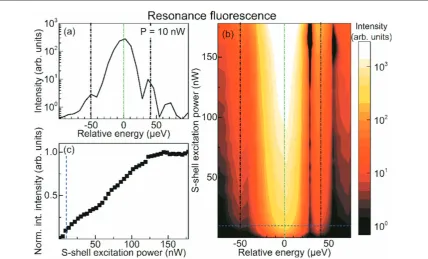
In the main textfigure3(b), one would expect saturation behavior of the input–output curve under p-shell excitation of the target QD. However, saturation is not observed and that can be attributed to different reasons, e.g., due to insufficient excitation power or due to contribution of off-resonant emitters. Here, we describe experimentalfindings that clarify the reason why the expected saturation is not observed. For that, we study the limiting case of truly selective excitation of a target QD, i.e., strictly resonant s-shell excitation has been employed. In that case none of the BG(off-resonant)emitters is excited directly as the laser energy is tuned to match the QD X transition of the target QD strongly-coupled and in resonance with the cavity mode.
Interestingly, a residual excitation redistribution via the cavity mode due to cavity-mediated coupling between the dots is still visible in the broad range spectrum(not-shown here). So that even under resonant s-shell excitation of the target QD the BG emitters light up, although their contribution to the emission is negligible in comparison to the target QD in resonance with the cavity mode. For this proof-of-principle experiment, a QD-micropillar(with vacuum Rabi splitting as large as 127μeV)in the same investigated sample was chosen to enable extraction of the signal of the target QD coupled to the cavity mode even in the case of non-ideal laser suppression. The same tunable IR laser is also used for strictly resonant s-shell excitation, but in this case, additional measures have to be taken to suppress stray light excitation, i.e., polarization rejection of the resonant laser and spatialfiltering of the detected signal using confocal configuration[53].
X transition shows saturation at an excitation power of around 150 nW, which is 2 orders of magnitude lower than typically for off-resonant excitation of the QDs. This clearly illustrates higher excitation efficiency of resonant driving. This proves that only a single QD is feeding the cavity as intended. However, this single QD does not provide enough gain to drive the system into lasing as shown also previously for similar system[10]. This has important consequences for the interpretation offigure3(b)in the main text. Taking into account the different excitation efficiencies of various excitation schemes, the saturation of the single QD would still be expected in the range of excitation powers available for p-shell excitation. The fact that we do not observe its signatures in the input–output curve(seefigure3(b)in the main text)shows that indeed the off-resonant emitters are directly excited and can even dominate the output of the QD-micropillar at high excitation.
Appendix B
The present work draws on lasers with two distinct excitation wavelengths to address a selected resonant QD and the BG emitters and to investigate the influence of the latter on the former. The theoretical investigation is based on a modified version of the semiconductor laser model established in[52], while considering the two-color excitation scheme as realized in the experiment.
B.1. Laser equations
We start from a microscopic Hamiltonian for the QD electronic states, the quantized electromagneticfield, and the interaction of the QD excitonic transitions with photons in the cavity mode to obtain the coupled
semiconductor laser equations for the carrier dynamicsfne h, ,photons dynamicsáb b† ñ,and the dynamics of the
photon assisted polarizationáb v c† †n nñ,as well as higher-order correlation functions between electronic and
photonic operators. For details, we refer to[52], where the laser equations are derived up to the level of the second-order photon autocorrelation functiong( )2( )0 .
[image:12.595.122.551.62.321.2]The experiment realizes the particular situation, where a single QD emitter is tuned into perfect resonance with the cavity mode, while a numberNof additional emitters acts as a background that is detuned from the mode. In the laser equations, we distinguish these two components by an indexξdenoting the resonant dot
(QD)and the BG emitters. With this, the mean photon number is determined by
á ñ = - ká ñ + á ñ +
å
á ñx= x x x
∣ ∣ ∣ ∣ ( )
† † † † † †
t b b b b g b v c g b v c
d
d 2 QD B.1
2
QD QD
BG 2
and contains contributions from the photon-assisted polarization of both the resonant and detuned emitters
(the second summation is over all BG emitters). Cavity losses are included as the rate2 .k
The photon-assisted polarization is the central quantity of the laser model, as it contains the physical processes of spontaneous and stimulated emission caused by the light–matter interaction. As the parameters differ for the two different subsystems, it also depends onx:
á † † ñ = -x (k+ G áx) † † ñ +x x x +( - x - x)á † ñ xÎ{ } ( )
t b v c b v c f f f f b b
d
d s 1 , QD, BG . B.2
e s h s e s h , , , ,
In this equation,Γis a phenomenological broadening of the QD transition, the term proportional to the QD s-shell electron and hole population results in the spontaneous emission contribution, while stimulated emission or absorption is proportional to the mean intra-cavity photon number and the inversion of each emitter.
The QD carrier population of the lowest energy s-states is determined by the interplay of recombination into the laser mode via the photon-assisted polarization, radiative losses into non-lasing modesRnl=(1-b)f fn ne h tsp,
and in-scattering of carriers from the energetically higher QD p-states at ratesRpe h, n:
= - ∣ ∣ á † †ñ + (b )+ ( ) ( )
tf g b v c R R P
d
d s 2 , B.3
e h
p s e h ,QD
,
QD2 QD nl QD
, IR
= - ∣ ∣ á † †ñ + (b )+ ( ) ( )
tf g b v c R R P P
d
d s 2 , . B.4
e h
pe hs ,BG
,
BG2 BG nl BG , IR BG
Non-resonant carrier excitation is modeled by carrier generation into the higher QD p-states, either via direct excitation in case of IR excitation at ratePIR,or via in-scattering of carriers that are excited into the energetically
higher-lying states of the barrier material by green laser excitation at ratePG:
=( +h )( - - )- ( ) ( )
tf P P f f R P
d
d p 1 , B.5
e h p e p h p s e h ,BG ,
G IR ,BG ,BG , IR
= ( - - )- ( ) ( )
tf P f f R P P
d
d p 1 , . B.6
e h p e p h p s e h ,QD ,
IR ,QD ,QD , IR BG
The dependence of the rateRpe h, non bothPIRandPGis motivated by the experimental fact that a small fraction
of the the IR laser is also captured by the BG emitters. To access the second-order correlation function given by
d
= + á ñ
á ñ
( ) ( )
( )
† †
†
g b b bb
b b
0 2 , B.7
2
2
we consider for each subsystem expectation values containing up to four photon operators in the arising hierarchy, while higher-order correlation functions are truncated[52]. However, as above, the higher-order correlation function must be modified with respect to the equation given in[52]to account for the two-excitation-scheme:
dá ñ = - kdá ñ +
å
á ñ +å
á ñx= x x x x= x x x
∣ ∣ ∣ ∣ ( )
† † † † † † † † † †
t b b bb b b bb g b b bv c g b b bv c
d
d 4 4 QD 4 . B.8
2
BG 2
B.2. Choice of parameters
As described in the context offigure3in the main text, the parameters of the two subsystems(BG emitters and single resonant QD)are based on a comparison between theory and experiment using green and IR excitation separately. This comparison is done by matching the calculated input–output characteristics to the measured one. Theβfactors of the resonant QD(bQD = 0.9)and the background(bBG = 0.25)are determined by the
matching the height of the jump between experimental and theoretical results.
An estimate for the light–matter coupling constant ofgQD = 50 eVm for the resonant QD is known from experimental measurements and provides an upper bound for the coupling constant of the BG emitters, for which we usegBG = 20 eV.m A Q-factor of 15 000 has been determined experimentally for the laser mode. Typical values are used for the relaxation rates(1 ps and 2 ps for electrons and holes, respectively)and the dephasing rates
(GQD = 1.36 eVm andGBG = 80 eVm ). We have checked that small variations of the dephasing rates result in
qualitatively the same behavior.N=160 BG emitters have been used. These parameters have been used for all calculations throughout the manuscript.
and in order to avoid microscopic calculations of phonon- or Auger-assisted feeding rates[27,34,54], we consider their contribution as an ensemble average. An effective light–matter coupling andβfactor is determined that apply equally for all BG emitters in the model.
B.3. Derivation of the effective spontaneous emission factor
In the main text we provide an analytical formula for the effective spontaneous emission factor of the joint system of resonant dot and the BG emitters that couples to the same photonic mode. Per definition, the spontaneous emission factor is the fraction of the total spontaneous emission that is funneled into the cavity mode, i.e.
b g
g g
=
+ , (B.9)
1
1 nl
whereglandgnlare the rate of spontaneous emission into the lasing and nonlasing modes, respectively. From the semiconductor laser model with the two-color excitation scheme, we define an effectiveβfactor as
b g g
g g g g
g
g g g g
g
g g g g
= +
+ + +
=
+ + + + + + + . (B.10)
eff l QD l BG l QD nl QD l BG nl BG l QD l QD nl QD l BG nl BG l BG l QD nl QD l BG nl BG
In the steady state, the spontaneous emission rate from each subsystem is given by
gxl = 2N g b v cx x2á † †ñx (B.11)
and depends on the photon-assisted polarization, the value of which can be obtained by solving its corresponding equation of motion in the steady state
k
= -( x+ G áx) b v c† † ñ +x f fx x ( )
0 e h. B.12
Note that we have omitted the stimulated emission channel, as only photons stemming from spontaneous emission enter the definition and computation of theβfactor. The loss into the nonlasing modes can be read from the population dynamics in the s-shell and is given by
g b
t
=
-x
x( x) x xx ( )
N 1 f f . B.13
e h
nl
sp
By combining the above equations and using the definition of the light–matter coupling in terms of the spontaneous emission time[52]
b k t
= + G
x
x x x x
( )
( )
g
2 , B.14
2
sp
we obtain the expression used in the main text for the effectiveβ-factor
b b b l b
b =
+ láᆠ†† †ññ + + láá ññ = ( )
† † † †
g
g
1 1
, . B.15
N b v c
b v c N
b v c b v c
eff QD BG BG
QD QD BG 2 BG QD QD BG
References
[1]Noda S 2006 Seeking the ultimate nanolaserScience314260–1
[2]Xie Z, Götzinger S, Fang W, Cao H and Solomon G 2007 Influence of a single quantum dot state on the characteristics of a microdisk laserPhys. Rev. Lett.98117401
[3]Reitzenstein Set al2008 Single quantum dot controlled lasing effects in high-Q micropillar cavitiesOpt. Express164848–57
[4]Nomura M, Kumagai N, Iwamoto S, Ota Y and Arakawa Y 2009 Photonic crystal nanocavity laser with a single quantum dot gainOpt. Express1715975
[5]Nomura M, Kumagai N, Iwamoto S, Ota Y and Arakawa Y 2010 Laser oscillation in a strongly coupled single-quantum-dot-nanocavity systemNat. Phys.6279–83
[6]Arakawa Y, Iwamoto S, Nomura M, Tandaechanurat A and Ota Y 2012 Cavity quantum electrodynamics and lasing oscillation in single quantum dot-photonic crystal nanocavity coupled systemsIEEE J. Sel. Top. Quantum Electron.131818–29
[7]Strauf S and Jahnke F 2011 Single quantum dot nanolaserLaser Photonics Rev.5607–33
[8]Birkedal D, Leosson K and Hvam J M 2001 Long lived coherence in self-assembled quantum dotsPhys. Rev. Lett.87227401
[9]Liu J, Ates S, Lorke M, Mørk J, Lodahl P and Stobbe S 2013 A comparison between experiment and theory on few-quantum-dot nanolasing in a photonic-crystal cavityOpt. Express2128507
[10]Gies Cet al2017 Strong light–matter coupling in the presence of lasingPhys. Rev.A96023806
[12]Surrente A, Gallo P, Felici M, Dwir B, Rudra A and Kapon E 2009 Dense arrays of ordered pyramidal quantum dots with narrow linewidth photoluminescence spectraNanotechnology20415205
[13]Pfau T J, Gushterov A, Reithmaier J P, Cestier I, Eisenstein G, Linder E and Gershoni D 2013 Phonon-mediated off-resonant coupling effects in semiconductor quantum-dot lasersNew J. Phys.15035019
[14]Schneider Cet al2012 Single site-controlled In(Ga)As/GaAs quantum dots: growth, properties and device integrationNanotechnology
20434012
[15]Strittmatter Aet al2012 Lateral positioning of InGaAs quantum dots using a buried stressorAppl. Phys. Lett.100093111
[16]Lee K Het al2006 Registration of single quantum dots using cryogenic laser photolithographyAppl. Phys. Lett.88193106
[17]Dousse Aet al2008 Controlled light–matter coupling for a single quantum dot embedded in a pillar microcavity using far-field optical lithographyPhys. Rev. Lett.101267404
[18]Gschrey Met al2013In situelectron-beam lithography of deterministic single-quantum-dot mesa-structures using low-temperature cathodoluminescence spectroscopyAppl. Phys. Lett.102251113
[19]He Y Met al2017 Deterministic implementation of a bright, on-demand single photon source with near-unity indistinguishability via quantum dot imagingOptica4802–8
[20]Sapienza L, Davanço M, Badolato A and Srinivasan K 2015 Nanoscale optical positioning of single quantum dots for bright and pure single-photon emissionNat. Commun.67833
[21]Gies C, Florian M, Gartner P and Jahnke F 2011 The single quantum dot-laser: lasing and strong coupling in the high-excitation regime Opt. Express1914370
[22]Reithmaier J P, Sęk G, Löffler A, Hofmann C and Kuhn S 2004 Strong coupling in a single quantum dot-semiconductor microcavity systemNature432197–200
[23]Hennessy Ket al2007 Quantum nature of a strongly coupled single quantum dot–cavity systemNature445896–9
[24]Press Det al2007 Photon antibunching from a single quantum-dot-microcavity system in the strong coupling regimePhys. Rev. Lett.
98117402
[25]Roy C and Hughes S 2011 Influence of electron-acoustic-phonon scattering on intensity power broadening in a coherently driven quantum-dot–cavity systemPhys. Rev.X1021009
[26]Winger Met al2009 Explanation of photon correlations in the far-off-resonance optical emission from a quantum-dot-cavity system Phys. Rev. Lett.103207403
[27]Florian M, Gartner P, Steinhoff A, Gies C and Jahnke F 2014 Coulomb-assisted cavity feeding in nonresonant optical emission from a quantum dotPhys. Rev.B89161302
[28]Laucht A, Kaniber M, Mohtashami A, Hauke N, Bichler M and Finley J J 2010 Temporal monitoring of nonresonant feeding of semiconductor nanocavity modes by quantum dot multiexciton transitionsPhys. Rev.B81241302
[29]Blood P 2013 The laser diode: 50 years onIEEE J. Sel. Top. Quantum Electron.191503201
[30]Coldren L 2013 What is a diode laser oscillator?IEEE J. Sel. Top. Quantum Electron.191503503
[31]Ning C Z 2013 What is laser threshold?IEEE J. Sel. Top. Quantum Electron.191503604
[32]Chow W W, Jahnke F and Gies C 2014 Emission properties of nanolasers during the transition to lasingLight: Sci. Appl.3e201
[33]Kreinberg Set al2017 Emission from quantum-dot high-βmicrocavities: transition from spontaneous emission to lasing and the effects of superradiant emitter couplingLight: Sci. Appl.6e17030
[34]Settnes M, Kaer P, Moelbjerg A and Mørk J 2013 Auger processes mediating the nonresonant optical emission from a semiconductor quantum dot embedded inside an optical cavityPhys. Rev. Lett.111067403
[35]Choi Y Set al2007 Evolution of the onset of coherence in a family of photonic crystal nanolasersAppl. Phys. Lett.91031108
[36]Yokoyama H 1992 Physics and device applications of optical microcavitiesScience25666–70
[37]Assmann M, Veit F, Bayer M, van der Poel M and Hvam J M 2009 Higher-order photon bunching in a semiconductor microcavity Science325297–300
[38]Nomura M, Iwamoto S, Kumagai N and Arakawa Y 2007 Temporal coherence of a photonic crystal nanocavity laser with high spontaneous emission coupling factorPhys. Rev.B75195313
[39]Hostein Ret al2010 Demonstration of coherent emission from high-βphotonic crystal nanolasers at room temperatureOpt. Lett.351154
[40]Hachair Xet al2011 Identification of the stimulated-emission threshold in high-βnanoscale lasers through phase-space reconstruction Phys. Rev.A83053836
[41]Lu Y Jet al2012 Plasmonic nanolaser using epitaxially grown silverfilmScience337450–3
[42]Gregersen N, Suhr T, Lorke M and Mørk J 2012 Quantum-dot nano-cavity lasers with Purcell-enhanced stimulated emissionAppl. Phys. Lett.100131107
[43]Lichtmannecker Set al2017 A few-emitter solid-state multi-exciton laserSci. Rep.77420
[44]Ates S, Ulrich S M, Reitzenstein S, Löffler A, Forchel A and Michler P 2009 Post-selected indistinguishable photons from the resonance fluorescence of a single quantum dot in a microcavityPhys. Rev. Lett.103167402
[45]Reitzenstein Set al2007 AlAs/GaAs micropillar cavities with quality factors exceeding 150.000Appl. Phys. Lett.90251109
[46]MusiałAet al2015 Correlations between axial and lateral emission of coupled quantum dot-micropillar cavitiesPhys. Rev.B91205310
[47]Cusack M A, Briddon P R and Jaros M 1996 Electronic structure of InAs/GaAs self-assembled quantum dotsPhys. Rev.B54R2300–3
[48]Brounkov P N, Polimeni A, Stoddart S T, Henini M and Eaves L 1998 Electronic structure of self-assembled InAs quantum dots in GaAs matrixAppl. Phys. Lett.731092–4
[49]Narvaez A, Bester G and Zunger A 2005 Dependence of the electronic structure of self-assembled(In,Ga)As/GaAs quantum dots on height and compositionJ. Appl. Phys.98043708
[50]Hopfmann Cet al2016 Effcient stray-light suppression for resonancefluorescence in quantum dot micropillars using self-aligned metal aperturesSemicond. Sci. Technol.31095007
[51]MusiałAet al2014 Toward weak confinement regime in epitaxial nanostructures: Interdependence of spatial character of quantum confinement and wave function extension in large and elongated quantum dotsPhys. Rev.B90045430
[52]Gies C, Wiersig J, Lorke M and Jahnke F 2007 Semiconductor model for quantum-dot based microcavity lasersPhys. Rev.A75013803
[53]Hopfmann Cet al2017 Transition from Jaynes–Cummings to Autler-Townes ladder in a quantum dot-microcavity systemPhys. Rev.B
95035302
[54]Florian M, Gartner P, Gies C and Jahnke F 2013 Phonon-mediated off-resonant coupling effects in semiconductor quantum-dot lasers New J. Phys.15035019