Development, validity and reliability
testing of the
E
ast
M
idlands
E
valuation
T
ool (EMET) for
measuring impacts on trainees
’
confidence and competence
following end of life care training
N1N2
N3 B Whittaker,
1
R Parry,2L Bird,3S Watson,4C Faull,5 on behalf of the EMET project team
▸Additional material is published online only. To view please visit the journal online (http://dx.doi.org/10.1136/ bmjspcare-2016-001100).
1
School of Health Sciences, The University of Nottingham, Nottingham, UK
2Sue Ryder Care Centre for the Study of Supportive, Palliative and End of Life Care, School of Health Sciences, University of Nottingham, Nottingham, UK 3
Division of Primary Care, School of Medicine, University of Nottingham, Nottingham, UK 4University of Derby, Derby, UK 5
LOROS Hospice, Leicester, UK
Correspondence to
Dr B Whittaker, School of Health Sciences, The University of Nottingham, Room B58, Medical School, Queens Medical Centre, Derby Road, Nottingham NG7 2HA, UK; becky.whittaker@ nottingham.ac.uk
Received 6 January 2016 Revised 14 October 2016 Accepted 13 January 2017
To cite:Whittaker B, Parry R, Bird L,et al.BMJ Supportive & Palliative CarePublished Online First: [please include Day Month Year]
doi:10.1136/bmjspcare-2016-001100
ABSTRACT
Objectives To develop, test and validate a versatile questionnaire, the East Midlands Evaluation Tool (EMET), for measuring effects of end of life care training events on trainees’ self-reported confidence and competence.
Methods A paper-based questionnaire was designed on the basis of the English Department of Health’s core competencies for end of life care, with sections for completion pretraining, immediately post-training and also for longer term follow-up. Preliminary versions were field tested at 55 training events delivered by 13 organisations to 1793 trainees working in diverse health and social care backgrounds. Iterative rounds of development aimed to maximise relevance to events and trainees. Internal consistency was assessed by calculating interitem correlations on questionnaire responses during field testing. Content validity was assessed via qualitative content analysis of (1) responses to questionnaires completed by field tester trainers and (2) field notes from a workshop with a separate cohort of experienced trainers. Test–retest reliability was assessed via repeat administration to a cohort of student nurses.
Results The EMET comprises 27 items with Likert-scaled responses supplemented with questions seeking free-text responses. It measures changes in self-assessed confidence and competence on 5 subscales: communication skills; assessment and care planning; symptom management; advance care planning; overarching values and knowledge. Test–retest reliability was found to be good, as was internal consistency: the questions successfully assess
different aspects of the same underlying concept.
Conclusions The EMET provides a time-efficient, reliable and flexible means of evaluating effects of training on self-reported confidence and competence in the key elements of end of life
care. Q1
INTRODUCTION
Policies in the UK,1 2 and internation-ally,3 4 strongly endorse staff training as a means to increase both specialist and non-specialist health and social care workers’ competence in end of life care delivery. In England in recent years, there has been a proliferation of training events that vary widely in length, modality, trainees and content.5 These training events range from halfa dayto multiple days, and trai-nees span a broad spectrum of
occupa-tional and professional backgrounds,
grades, settings and patient groups. Many events are multiprofessional.
The gold standard means of assessing the impact of training is to perform before and after workplace observations of staff and patients interacting.6 7 However, this can be highly time-consuming, while evalu-ation via self-report is far more feasible and economical. Therefore, even though it is known that self-reported confidence and
competence do not straightforwardly
reflect actual workplace behaviour
change,8 9 self-report often represents the best available option when resources do not stretch to workplace observations.
1 2 3 4 5 6 7 8 9 10 11 12 13 14 15 16 17 18 19 20 21 22 23 24 25 26 27 28 29 30 31 32 33 34 35 36 37 38 39 40 41 42 43 44 45 46 47 48 49 50 51 52 53 54 55 56 57 58
A systematic review examined existing self-report tools relevant to assessing end of life care training,10 and found that most are poorly validated and narrow in scope, and that they largely focus on physical aspects of symptom management. Some tools are also narrowly focused on single professional groupings.11This means that current tools have limited usefulness in the current environment where, as we noted, end of life care train-ing events are very diverse. Furthermore, evaluations of effects of end of life care education and training inter-ventions published over the past decade all report designing and using individual, project-specific evalu-ation questionnaires.12–15This adds to the evidence that we lack, and need, established, validated and broadly relevant tools.
Our questionnaire, referred to as a‘tool’,is designed to offer a rapid and feasible means to evaluate end of life care training events by measuring changes in trai-nees’self-reported confidence and competence. By con-fidence, we mean the self-awareness of having the competence to complete a task or reach a goal.16 By competence, we mean having the appropriate skills and
behaviours to undertake specific activities.17
Fortunately, a clear and government-endorsed articula-tion of core competencies for end of life care exists18 19 (seetable 1).
These competencies were developed with the aim of providing a sound framework for the commission-ing and design of traincommission-ing programmes recommended in English end of life care policy.5They also provide a useful basis for evaluating events.
METHODS Tool development
The East Midlands Evaluation Tool (known hereafter as EMET) was initially designed by authors BW and
CF and project team member Debra Broadhurst on
the basis of the English core competences for end of life care19(seetable 1). It was then refined and
devel-oped by the EMET project team (see
Acknowledgements) over a4-year period throughfive
iterative rounds of development.Whilein practice, all sections of the tool are designed to be used in non-anonymised form;during testing, all completed
ques-tionnaires were anonymised by ensuring that each
trainee only wrote their unique identifying code on the questionnaire.
The initial design of the tool entailed:
▸ A literature search and review which found that there were no validated tools available for evaluating the impact of end of life care learning events across a range of roles and care settings.10 11
▸ Discussions within a project team that included clinical and educational experts in end of life care.20–22
▸ Translation of the overarching statements of competen-cies in the Department of Health’s framework18 19into
questionnaire items grouped into the same subdomains. This entailed translating broad characteristics into more specific skills, practices or activities. For example, the statement of communication competence: ‘Develop and maintain communication with people about difficult and complex matters or situations related to end of life care’ was reformulated to: ‘I feel confident to talk with a dying person about issues surrounding their death’. The resulting tool comprised a total of 27 state-ments to which trainees were asked to respond via Likert-scaled responses. This was supplemented by (1) narrative questions seeking free-text responses to gain trainee views on whether, and how, the training had changed their confidence and competence in the delivery of end of life care.
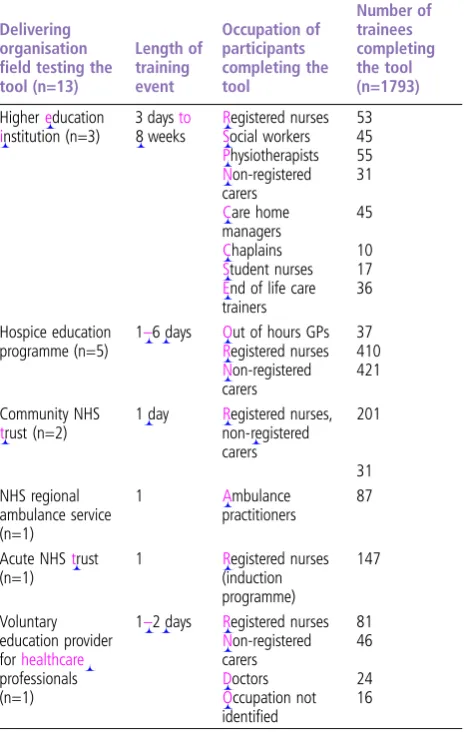
The next stage of development involved field testing the tool by administering it across a wide range of training events delivered by a total of 13 different organisations. We used the East Midlands Strategic Health Authority and personal networks of the project team to recruit trainers willing to use the tool to evaluate their training events. Thirteen organisa-tions used the tool in 55 different training events involving 1793 trainees. Almost three-quarters (71%) of the training events involved mixed cohorts of regis-tered and non-regisregis-tered employees from various occupational backgrounds and care settings. Events and trainees are described intable 2.
Trainers returned the questionnaires completed by each trainee to the EMET project team. Additionally, all trainers administering the tool during field testing were asked to complete a brief ‘feedback question-naire’ which sought both Likert-scaled and free-text responses on the ease of use of the tool, whether it reflected the aims of their own event(s), and whether they thought any items needed adding, altering or removing. This questionnaire is provided in online supplementaryfile 1.
At this stage,the tool was modified in the light of:
▸ Trainers’ feedback, both informally and via a question-naire survey.
▸ A review of trainee responses to the closed statements and narrative questions.
Table 1 The English Department of Health’s corecompetences forend oflifecare19
Commoncorecompetency
1 Communication skills: engaging effectively with family and patient/ resident in discussions about dying and death
2 Assessment and care planning: holistically assess, develop, implement and review a plan of care involving the family and patient/resident as appropriate
3 Symptommanagement: provide quality symptom management including maintaining comfort andwell-being
4 ACP: engage in discussions with family and patient/resident and show awareness of legal and ethical issues around the ACP process 5 Overarching values and knowledge: awareness of own values,
knowledge and ongoing professional development in supporting self and others in end of life care
ACP, advance care planning. 117
118 119 120 121 122 123 124 125 126 127 128 129 130 131 132 133 134 135 136 137 138 139 140 141 142 143 144 145 146 147 148 149 150 151 152 153 154 155 156 157 158 159 160 161 162 163 164 165 166 167 168 169 170 171 172 173 174
▸ The needs and requests of trainers and organisations delivering the courses.
▸ New policy initiatives—in particular the UK’s National Institute on Health and Care Excellence (NICE) guidance focused on recognising dying, avoiding inappropriate hospital admissions and initiating conver-sations about end of life.23
The modifications entailed rewording some ques-tionnaire statements and narrative questions so as to improve their applicability across a wide range of trai-nees and events. For instance, the initial version of the
EMET referred to the care of patients; this was
changed so as to replace reference to ‘patients’ with reference to ‘people in my care’. Other modifications made questionnaire items better reflect the competen-cies being measured by the Likert-scaled items and reported in the narrative questions. For example, some trainees noted the importance of listening to patients, and as a result the initial wording of one item: ‘I feel confident to talk with a dying patient about issues surrounding their death’was modified to: ‘I feel confident to listen to and talk with a dying person about issues surrounding their death’.
Reliability
Two domains were tested: test–retest reliability and internal consistency.
Test–retest reliability
Reliable tools produce the same score or measurement each time they are used if there has been no change to the features being measured.24 25Thus, if the trainee’s self-assessed confidence and competence remain con-stant, there should be no change in their score on the EMET. Conversely, any change in their score should be due to a change in self-assessed confidence and competence. We examined the degree to which the tool yielded the same results from one administration to the next under the same conditions using a con-venience sample of student nurses from a single year group in the Division of Nursing at the University of Nottingham. The students completed the EMET’s 27 Likert-scaled items on two occasions 1week apart. During that week, they received no end of life care specific teaching and were not exposed to clinical situations in which end of life care would have been observed. The correlation between the two scores was tested using a power calculation of 15% deviation. Scores were tested using a Pearson r test.26
Internal consistency
A reliable multi-item tool will give consistent results when different aspects of the same underlying
concept are measured by more than one item.27
During field testing, we examined the internal consist-ency of results across different multi-item sets of ques-tions. Interitem correlations were calculated for each
of the five core competence subscales using
Cronbach’sαvalues.26
Validity
Validity refers to whether a tool is measuring what it is designed and claimed to measure. We examined
content validity: whether the domains examined by
[image:3.595.57.290.60.427.2]the tool were appropriate, important and sufficient to its purposes.25 Content validity is examined through consultation with interested parties rather than via statistical methods. Accordingly, we conducted two separate structured consultations. One of these entailed completion and analysis of trainer feedback questionnaires during field testing as described above (seeonline supplementaryfile 1 and table 2). We col-lated frequencies for the responses to the Likert-scaled statements and analysed responses to the narrative questions via inductive qualitative content analysis.28 Second, we designed and ran a three-part structured workshop during the 2012 conference of the UK National Association of Palliative Care Educators (NAPCE). The workshop began with experienced end of life care trainers testing the tool by completing its pretraining section. Next, they participated in facili-tated small group discussions designed to consider positive and negative aspects of the tool. Finally, a Table 2 Training events and trainees using the tool
Delivering organisation field testing the tool (n=13)
Length of training event
Occupation of participants completing the tool
Number of trainees completing the tool (n=1793)
Highereducation
institution (n=3)
3 daysto
8 weeks
Registered nurses 53
Social workers 45
Physiotherapists 55
Non-registered carers
31
Care home managers
45
Chaplains 10
Student nurses 17
End of life care trainers
36
Hospice education programme (n=5)
1–6 days Out of hours GPs 37
Registered nurses 410
Non-registered carers
421
Community NHS
trust (n=2)
1 day Registered nurses, non-registered carers
201
31 NHS regional
ambulance service (n=1)
1 Ambulance
practitioners
87
Acute NHStrust (n=1)
1 Registered nurses (induction programme)
147
Voluntary education provider forhealthcare
professionals (n=1)
1–2 days Registered nurses 81
Non-registered carers
46
Doctors 24
Occupation not identified
16
GP, general practitioner; NHS, National Health Service.
233 234 235 236 237 238 239 240 241 242 243 244 245 246 247 248 249 250 251 252 253 254 255 256 257 258 259 260 261 262 263 264 265 266 267 268 269 270 271 272 273 274 275 276 277 278 279 280 281 282 283 284 285 286 287 288 289 290
large group discussion brought together the views of the small groups. Contemporaneous field notes were made by authors BW and SW. These were collated and analysed via inductive qualitative content analysis.28 The process of tool development over a4-year period is illustrated infigure 1.
RESULTS Tooldevelopment
The resulting questionnaire‘tool’is available asonline supplementaryfile 2. It comprises three sections:
Pretraining section‘tool A’
This is completed immediately before the training begins—usually at the event venue itself, but it can be sent to each trainee before the event. It gathers brief background information on the trainee’s work setting, professional qualifications (if any) and the date and type of the training event. It then asks the trainee to rate their confidence and competence across the five domains of the end of life care competences via the 27 Likert-scaled responses. Additionally, two narrative questions seek free-text responses from the trainee on their reasons for attendance and expectations of the event.
End of training section‘tool B’
Administered at the end of the training event, usually at the event venue itself, the trainee rerates their confi-dence and competence via the same 27 statements. They do so without sight of their pretraining
responses. Additionally, narrative questions ask
whether the training has met their expectations, and ask the trainee to articulate specific actions they plan to undertake as a consequence of the training. This question reflects emerging evidence on the value of action planning (or goal setting) within educational and behaviour change interventions.29 30
Optionalfollow-upsection‘tool C’
Designed for postal administration weeks or months after training, this section repeats the 27 Likert state-ments and then poses three new narrative questions which ask the trainee to report any impacts of training in relation to: (1) recognising dying; (2) avoiding inappropriate hospital admissions and (3) initiating conversations about end of life. These questions were framed in relation to English national end of life care targets5and quality standards.23
Reliability
Test–retest reliability
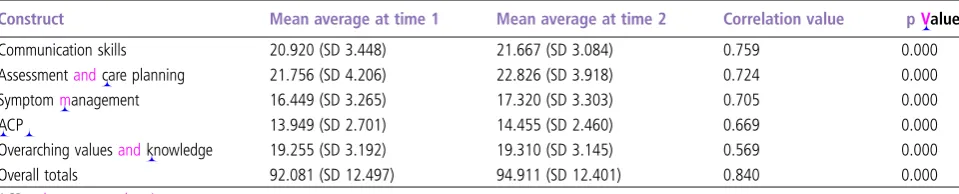
The convenience sample of 112 student nurses com-pleted the Likert section of the questionnaire on two separate occasions 1week apart. The overall total score at each time point correlated best, with a Pearson r correlation of 0.84. A score of 1 indicates a perfect correlation but scores of 0.7 or above are gen-erally considered to be highly correlated.31 Four of
the five subscales also correlated highly. The score that correlated least well was ‘overarching values and knowledge’ (Pearson’s r of 0.56), indicative of a moderate-to-good correlation. These results in table 3
suggest that the tool has good test–retest reliability and that changes in score over time can be attributed to changes in self-assessed confidence and competence as opposed to the effect of repeat administration.
Table 4 provides the pretraning and post-training scores for 1793 trainees who completed the assess-ment tool. In contrast to the test–retest scores which Q2 showed minimal change, these scores showed that trai-nees’ overall self-perceived confidence and
compe-tence had increased on average by ∼13 points
( possible scores range from).
Internal consistency
The internal consistency of responses was calculated for a total of 1793 questionnaires; all components had acceptable (>0.7) Cronbach’s α values.27 Taking into account that the subscales comprised a relatively low number of items, this indicates good reliability. These results indicate that within the five key compo-nents the questions successfully assess different aspects
of the same underlying concept (see table 5).
Furthermore, the absence of extremely high correla-tions indicates that there were no redundant ques-tions, that is, items that were so similar that they simply asked the same question in marginally different ways.
Validity
The first structured consultation was via a trainer feedback questionnaire completed during fieldwork. This feedback yielded 23 completed responses from 16 trainers representing 10 organisations relating to 23 different training events (separate questionnaires were completed for each event). Trainer responses to the Likert-scaled statements are shown in table 6. Their narrative responses indicated that overall trai-ners liked the format of EMET, that trainees were able to complete it, and that it fitted their training’s content and learning outcomes.
The trainers’ narrative comments provided insights on the EMET’s positive and limiting features. Four trainers commented that it was time-consuming for students to complete, and one reported that some trai-nees rushed through the post-training section, particu-larly at the end of the day. One trainer thought the tool did not match the specific clinical content of their training event. One commented that trainees could not remember their precourse expectations and thus could not accurately report on whether expecta-tions were met. On the other hand, three trainers commented that the specific focus on end of life care was particularly useful, and that trainees’ completion of the tool provided them with particularly valuable feedback for future training events.
349 350 351 352 353 354 355 356 357 358 359 360 361 362 363 364 365 366 367 368 369 370 371 372 373 374 375 376 377 378 379 380 381 382 383 384 385 386 387 388 389 390 391 392 393 394 395 396 397 398 399 400 401 402 403 404 405 406
The second structured consultation took the form of a three-part workshop at the UK NAPCE confer-ence. In total,22 experienced end of life care trainers participated in the workshop. Group feedback and discussions were collated and the findings are sum-marised inbox 1.
Overall, a large majority of the 38 trainers con-sulted during field testing and at the conference work-shop considered that the EMET measures what it sets out to measure and is relevant to a range of training events and trainees. Most also remarked that it was practical, flexible to different training events across a range of professional groups and easily administered.
A large majority of trainers reporting on their experiences of using the EMET in 23 training events indicated that they liked the format, that trainees were able to easily complete it, and that it was appropriate for the content of their training. A separate cohort of 22 experienced end of life care trainers consulted via a workshop appreciated its comprehensiveness, its congruence with a nationally defined competence framework, and its capacity to collect both brief responses on a wide range of end of life care compe-tencies and longer free-text responses which could be used to modify and develop future training.
DISCUSSION
We developed the EMET to evaluate diverse end of life care training events in England after establishing that there were no existing validated tools that were suitable for the wide range of events and trainees who participate in them. The validated tool provides a comprehensive approach for evaluating training in terms of changes in self-reported confidence and com-petence across five core areas, reflecting the domains of the English core competencies for end of life care.19 The tool is suitable for use with a wide range of trainees across a spectrum of end of life care training events. Our small-scale evaluation of its tes-t–retest reliability and a larger scale evaluation of its internal consistency, usability and validity yielded positive results.
The experienced trainers who participated in validity testing also commented on some drawbacks and limitations of the tool. Their responses suggest that the EMET may be too lengthy for administration in training events lasting half a day or less. They raised concerns about possible ceiling effects, that is, that it will not measure changes in trainees who report high levels of confidence and competence pre-training. We acknowledge that anecdotally we know
[image:5.595.58.538.633.730.2]Figure 1 Process of tool development.
Table 3 Reliability test results: test–retest (n=112)
Construct Mean average at time 1 Mean average at time 2 Correlation value pValue
Communication skills 20.920 (SD 3.448) 21.667 (SD 3.084) 0.759 0.000
Assessmentandcare planning 21.756 (SD 4.206) 22.826 (SD 3.918) 0.724 0.000
Symptommanagement 16.449 (SD 3.265) 17.320 (SD 3.303) 0.705 0.000
ACP 13.949 (SD 2.701) 14.455 (SD 2.460) 0.669 0.000
Overarching valuesandknowledge 19.255 (SD 3.192) 19.310 (SD 3.145) 0.569 0.000
Overall totals 92.081 (SD 12.497) 94.911 (SD 12.401) 0.840 0.000
ACP, advance care planning. 465
466 467 468 469 470 471 472 473 474 475 476 477 478 479 480 481 482 483 484 485 486 487 488 489 490 491 492 493 494 495 496 497 498 499 500 501 502 503 504 505 506 507 508 509 510 511 512 513 514 515 516 517 518 519 520 521 522
that trainers varied in how effectively they were able to ensure how delegates completed the tool. Trainers also raised concerns about the validity of the trainees’ responses. This latter concern is congruent with numerous empirical studies that have shown that self-report does not straightforwardly reflect actual skill. We know that in general, self-reports yield larger change scores than evaluation of actual perform-ance.8 9 Indeed, it has long been recognised that knowledge about clinical matters is much more easy to assess than actual application of that knowledge to workplace performance.32Therefore, where resources allow, multiple assessments including actual workplace performance and patient outcomes should be used. These will potentially yield a more accurate under-standing of training’s impacts than can be gleaned from self-reports.7 32 However, in situations where resources are limited, assessment of the impacts of training courses ontrainees via their self-report, such as provided by the EMET, offers a feasible and eco-nomical means of measuring a limited aspect of
train-ing’s impacts. Trainers, trainees, managers and
commissioners should nevertheless be aware that self-reports provide very limited insights into actual work-place behaviour change. The validated tool provides a baseline in recognising changes in confidence and competence as a starting point to be able to identify impacts of training on clinical practice. Overall, the validated tool fills a recognised gap currently evident in evaluating end of life care training events.
Final V.6 was produced on the basis of reliability and validity testing. This version of EMET is freely
available and can be downloaded from the
Nottingham Centre for the Advancement of
Supportive, Palliative and End of Life Care, University of Nottingham (NCARE) http://nottingham.ac.uk/ research/groups/srcc/postgrad-course.aspx. It is cur-rently in use in a range of events internationally in the context of a continued drive to improve end of life care delivery. Our work in developing and validating EMET adds to the understanding of how training can impact on workforce ability to meet patient outcomes in end of life care.
Strengths andlimitations
We designed an acceptable and useable tool,
[image:6.595.57.540.57.150.2]conducting preliminary testing of the EMET’s validity and reliability. Limitations of the test–retest reliability include the comparatively small and homogeneous sample and the brief time period between administra-tions.While this reduced the likelihood of confound-ing factors influencconfound-ing the second test, it remains conceivable that there was insufficient time for any effects of completing the first test to have dissipated. We acknowledge the comparatively low reliability score for overarching values and knowledge and suggest that this dimension might be particularly sen-sitive to repeat administration. Further exploration of the factors affecting the overarching values and knowledge score would be valuable. Strengths of this study include the comparatively large data set that was used to test internal consistency and the breadth and range of individuals who contributed to the assess-ments of validity over a period of time.
Table 4 Average pretrainingand post-training scores for respondents who had completed end of life care training (n=1793)
Construct Pretraining mean average Post-training mean average Meanchange in score pValue*
Communication skills 21.448 (SD 4.161) 25.059 (SD 4.343) 3.602 (SD 3.930) 0.000 Assessmentandcare planning 14.816 (SD 5.114) 17.410 (SD 5.414) 2.612 (SD 3.224) 0.000 Symptommanagement 16.192 (SD 4.199) 19.237 (SD 4.440) 3.077 (SD 3.395) 0.000
ACP 14.935 (SD 3.017) 17.111 (SD 3.161) 2.160 (SD 2.754) 0.000
Overarching valuesandknowledge 19.751 (SD 3.611) 21.483 (SD 3.952) 1.749 (SD 2.996) 0.000
Overall totals 91.695 (SD 20.894) 104.915 (SD 24.781) 13.220 (17.547) 0.000
*Wilcoxon signed-rank test.
[image:6.595.296.534.603.741.2]ACP, advance care planning.
Table 5 Reliability test results: internal consistency via Cronbach’sαvalues using Pearson’sr
Component Cronbach’sα
Numberof Likert scale items
Communications skills 0.845 6 Assessment and care planning 0.863 7
Symptom management 0.863 5
Advance care planning 0.823 4 Values and knowledge 0.819 5 27 items
Table 6 Field testing trainers’questionnaire responses (n=23)
Strongly agree/
agree Neutral
Strongly disagree/ disagree
The guidance for use of the tool was easy to follow.
21 2
I liked the overall format of the tool.
22 1
Trainees were able to complete the pretrainingand post-training sections.
21 1 1
I feel the tool adequately measured the aims of this learning event.
19 1 3
581 582 583 584 585 586 587 588 589 590 591 592 593 594 595 596 597 598 599 600 601 602 603 604 605 606 607 608 609 610 611 612 613 614 615 616 617 618 619 620 621 622 623 624 625 626 627 628 629 630 631 632 633 634 635 636 637 638
[image:6.595.66.537.603.742.2]The EMET was designed in the context of policy and practice in England, and whileits comprehensive coverage relates to end of life care delivery nationally, we suggest that it could be usefully applied in other countries. Such application should ideally be accom-panied by testing of reliability and validity across dif-ferent national and cultural contexts.
CONCLUSION
We advocate use of this freely available validated evaluation tool of self-reported confidence and com-petence (see online supplementary file 2), to assess impacts of end of life care training and to gather feed-back on training events. Where feasible, additional observational assessment of performance will provide more direct evaluation of training’s impact on practice and quality of service provision within the context of end of life.
Ethics
None required. All trainees and facilitators were informed that data would be used as part of the tool development and testing.
Acknowledgements The EMET project was initially funded by the East Midlands Strategic Health Authority and the National End of Life Care Programme, UK up to 2013. The EMET project team comprised: Debra Broadhurst, LOROS Hospice Leicester, early questionnaire design; Professor Jane Seymour, Sue Ryder Care Centre for the Study of Supportive, Palliative and End of Life Care, project support; Gavin Narayanasamy, Melanie Narayanasamy and Sarah Todd, data input and analysis; Dr Anthony Arthur, early advice on statistics methods. Contributors BW, SW and CF were responsible for project planning. BW and SW were responsible for conduct of the study. BW, SW, LB, CF and RP contributed to the reporting and discussion. BW has overall responsibility for the content. Competing interests None declared.
Provenance and peer review Not commissioned; externally peer reviewed.
REFERENCES
1 Leadership Alliance for Care of Dying People.One chance to get it right: improving people’s experience of care in the last few days and hours of life. London: NHS England, 2014.
2 The Scottish Government.Strategic framework for action on palliative and end of life care 2016-2021. Glasgow: NHS Scotland, 2015.
3 National Consensus Project for Quality Palliative Care.Clinical practice guidelines for quality palliative care. 3rd edn. 2013. http://www.nationalconsensusproject.org (accessed 12.10.2015).
4 Gamondi C, Larkin P, Payne S. Core competencies in palliative care: an EAPC White Paper on palliative care education—part 1.Eur J Palliat Care2013;20:86–139.
5 Department of Health.End of life care strategy: promoting high quality care for all adults at the end of life. Third annual report. London: Department of Health, 2011.
6 Hullsman R, Ros W, Winnubust JA,et al. Teaching clinically experienced physicians communication skills. A review of evaluation studies.BMC Med Educ1999;33:655–68. 7 Parry R. Are interventions to enhance communication
performance in allied health professionals effective, and how should they be delivered? Direct and indirect evidence.Patient Educ Couns2008;73:186–95.
8 Dunning D, Heath C, Suls JM. Flawed self-assessment: implications for health, education and the workplace.Psychol Sci Public Interest2004;5:69–106.
9 Davis DA, Mazmanian PE, Fordis M,et al. Accuracy of physician self-assessment compared with observed measures of competence: a systematic review.JAMA2006;296:1094–102.
Box 1 Comments about the tool from experienced end of life care trainers’workshop
▸ The experienced trainers’views on the tool’s positive
features
▸ Comprehensively covers multiple end of life care topics;
▸ Fidelity to nationally recognised competences; ▸ Inclusion of aspects of attitudes and beliefs;
▸ Incorporating both confidence and competence is useful because for some more capable trainees, train-ing may not change actual competences, but may impact on their recognition of and confidence in applying their competences;
▸ The mixture of short Likert-scaled and longer free-text response elements allows for efficient coverage of multiple relevant domains,whilealso enabling collec-tion of more detailed feedback;
▸ Collects data on elements of training events that trai-ners see as important, and this contrasts with some standard feedback forms that ask about peripheral matters such as car parking and refreshments; ▸ Capacity to collect both brief responses on a wide
range of end of life care competencies and longer free-text responses which could be used to modify and develop future training.
▸ The experienced trainers’views on possible limitations
▸ Will trainees’responses be valid? They might be moti-vated to rate themselves lower prior to training in order to allow‘room for improvement’.
▸ Might there be ceiling effects? If a trainee scores themselves highly pre-training, it is not possible to capture any change using the tool.
▸ Post-training score could be lower than the pretrain-ing one if the trainpretrain-ing helps a trainee to recognise what they do not know (ie,if it helps them recognise
the need for greater confidence and competence).
While a trainer might regard this as a positive outcome, a manager or commissioner may not. ▸ Some terms used may be difficult for people with
little experience in end of life care to understand. ▸ Some questionsmay betoo long.
▸ The neutral ‘neither agree nor disagree’ response option may be unhelpful.
▸ Some courses may have a narrower topical focus than the East Midlands Evaluation Tool (EMET), so some questions may not be relevant.
697 698 699 700 701 702 703 704 705 706 707 708 709 710 711 712 713 714 715 716 717 718 719 720 721 722 723 724 725 726 727 728 729 730 731 732 733 734 735 736 737 738 739 740 741 742 743 744 745 746 747 748 749 750 751 752 753 754
10 Frey R, Gott M, Banfield R,et al. What questionnaires exist to measure the perceived competence of generalists in palliative care provision? A critical literature review.BMJ Support Palliat Care2011;1:19–32.
11 Slåtten K, Hatlevik O, Fagerström L. Validation of a new instrument for self-assessment of nurses’core competencies in palliative care.Nurs Res Pract2014;2014:615498.
12 Shih CY, Hu WY, Lee LT,et al. Effect of a compassion-focused training program in palliative care education for medical students.Am J Hosp Palliat Care2013;30:114–20.
13 Harris D, Hillier LM, Keat N. Sustainable practice improvements: impact of the Comprehensive Advanced Palliative Care Education (CAPCE) program.J Palliat Care2007;23:262–72.
14 McClement SE, Care D, Dean R. Evaluation of education in palliative care: determining the effects on nurses’knowledge and attitudes.J Palliat Care2005;21:44–8.
15 Otis-Green S, Ferrell B, Spolum M,et al. An overview of the ACE Project-advocating for clinical excellence: transdisciplinary palliative care education.J Cancer Educ2009;24:120–6. 16 Bandura A. Self-efficacy: toward an unifying theory of
behavioral change.Psychol Rev1977;84:191–215.
17 Gamondi C, Larkin P, Payne S. Core competencies in palliative care: an EAPC White paper on palliative care education—part 2.Eur J Palliat Care2013;20:140–5.
18 Skills for Health.Common core principles and competences for social care and health workers working with adults at the end of life. Leeds: Skills for Care, 2014.
19 National End of Life Care Programme, Skills for Health, Skills for Care.Core competences for end of life care: training for health and social care staff. London: Department of Health, 2009. 20 Faull C, Nicholson A, Black F.Handbook of palliative care. 3rd
edn. Hoboken, NJ: Wiley Blackwell, 2012.
21 Feathers L, DeCaestecker S, Norrie P,et al. Developing skills in communication in end of life care: evaluation of a 3 day pilot
course for core medical training.BMJ Support Palliat Care 2014;4(Suppl 1):A38.
22 Howard P, Whittaker B.(nee Chady) placement learning in cancer and palliative care nursing: a guide for students in practice. Edinburgh: Baillière Tindall/Elsevier, 2012. 23 National Institute for Health and Care Excellence. End of life
care for adults: NICE quality standard 13 2011. https://www. nice.org.uk/guidance/qs13 (accessed 12.10.2015).
24 Wade D.Reasons for assessing: measurement in neurological rahabilitation. Oxford: Oxford Medical, 1992.
25 Bausewein C, Daveson B, Benalia H,et al.Outcome measurement in palliative care: the essentials. PRISMA, 2011. http://www.eapcnet.eu/LinkClick.aspx?
fileticket=-T62WTgTHtU%3D&tabid=1577 (accessed 12.10.2015).
26 Field A, Hole GJ.How to design and report experiments. London: Sage, 2003.
27 De Vaus D.Surveys in social research. 6th edn. New York: Routledge, 2013.
28 Elo S, Kyngäs H. The qualitative content analysis process. J Adv Nurs2008;62:107–15.
29 Cowan CA, Goldman EF, Hook M. Flexible and inexpensive: Improving learning transfer and program evaluation through participant action plans.Perf Improv 2010;49:18–25.
30 Battersby M, Von Korff M, Schaefer J,et al. Twelve evidence-based principles for implementing self-management support in primary care.Jt Comm J Qual Patient Saf
2010;36:561–70.
31 Hinkle DE, Wiersma W, Jurs SG.Applied statistics for the behavioural sciences. 5th edn. Boston: Houghton Mifflin, 2003.
32 Wass V, Van der Vleuten C, Shatzer J,et al. Assessment of clinical competence.Lancet2001;357:945–9.
813 814 815 816 817 818 819 820 821 822 823 824 825 826 827 828 829 830 831 832 833 834 835 836 837 838 839 840 841 842 843 844 845 846 847 848 849 850 851 852 853 854 855 856 857 858 859 860 861 862 863 864 865 866 867 868 869 870