warwick.ac.uk/lib-publications
Original citation:Dedner, Andreas, Ortner, Christoph and Wu, H. (2017) Analysis of patch-test consistent atomistic-to-continuum coupling with higher-order finite elements. ESAIM: Mathematical Modelling and Numerical Analysis, 51 (6). pp. 2263-2288. doi:10.1016/j.epidem.2017.04.001
Permanent WRAP URL:
http://wrap.warwick.ac.uk/87419
Copyright and reuse:
The Warwick Research Archive Portal (WRAP) makes this work by researchers of the University of Warwick available open access under the following conditions. Copyright © and all moral rights to the version of the paper presented here belong to the individual author(s) and/or other copyright owners. To the extent reasonable and practicable the material made available in WRAP has been checked for eligibility before being made available.
Copies of full items can be used for personal research or study, educational, or not-for-profit purposes without prior permission or charge. Provided that the authors, title and full
bibliographic details are credited, a hyperlink and/or URL is given for the original metadata page and the content is not changed in any way.
Publisher’s statement:
“Reproduced with permission from © EDP ”.
A note on versions:
The version presented here may differ from the published version or, version of record, if you wish to cite this item you are advised to consult the publisher’s version. Please see the ‘permanent WRAP URL’ above for details on accessing the published version and note that access may require a subscription.
ATOMISTIC-TO-CONTINUUM COUPLING WITH HIGHER-ORDER FINITE ELEMENTS
A. S. DEDNER, C. ORTNER, AND H. WU
Abstract. We formulate a patch test consistent atomistic-to-continuum coupling
(a/c) scheme that employs a second-order (potentially higher-order) finite element method in the material bulk. We prove a sharp error estimate in the energy-norm, which demonstrates that this scheme is (quasi-)optimal amongst energy-based sharp-interface a/c schemes that employ the Cauchy–Born continuum model. Our analysis also shows that employing a higher-order continuum discretisation does not yield qualitative improvements to the rate of convergence.
1. Introduction
Atomistic-to-continuum (a/c) coupling is a class of coarse-graining methods for efficient atomistic simulations of systems that couple localised atomistic effects de-scribed by molecular mechanics with long-range elastic effects dede-scribed by contin-uum models using the finite-element method. We refer to [6], and references therein for an extensive introduction and references.
The presented work explores the feasibility and effectiveness of introducing higher-order finite element methods in the a/c framework, specifically for quasi-nonlocal (QNL) type methods.
The QNL-type coupling, first introduced in [15], is an a/c method that uses a “geometric consistency condition” [3] to construct the coupling between the atom-istic and continuum model. The first explicit construction of such a scheme for two-dimensional domains with corners is described in [12] for a neareast-neighbour many-body site potential. We call this construction ”G23” for future reference. This approach satisfies force and energy patch tests (often simply called consistency), which in particular imply absence of ghost forces.
We will supply the G23 scheme with finite element methods of different orders and investigate the rates of convergence for the resulting schemes. Our conclusion will be that second-order finite element schemes are theoretically superior to first-order schemes, while schemes of third and higher first-order do not improve the rate of convergence. This conclusion is independent of defect types, since the total error can only be as good as the Cauchy–Born modeling error in the continuum region, which is of second order, just as a P2-finite element method. We further find that the consistency error of the a/c scheme is in fact dominated by the coupling component of the modelling error. Because of all these limitations, we will explore, for a basic
Date: March 16, 2017.
Key words and phrases. atomistic models, coarse graining, atomistic-to-continuum coupling, quasicontinuum method, error analysis.
HW was supported by MASDOC doctoral training centre, EPSRC grant EP/H023364/1. CO was supported by ERC Starting Grant 335120.
model problem, how well second-order schemes fare in practise against first-order schemes.
1.1. Outline. The theory of high-order finite element methods (FEM) in partial differential equations, and applications in solid mechanics is well established; see [14] and references therein. However, most work on the rigorous error analysis of a/c coupling has been restricted to P1 finite element methods; the only exception we are aware of is [11], which focuses on blending-type methods.
In the present work we estimate the accuracy of a QNL method employing a P2 FEM in the continuum region against an exact solution obtain from a fully atomistic model. Since stability of QNL type couplings is a subtle issue [9] we will primarily analyse the consistency errors, taking into account the relative sizes of the fully re-solved atomistic region and of the entire computational domain (Sections 6.1-6.6). We will then optimize these relative sizes as well as the mesh grading in the con-tinuum region in order to minimize the total consistency error (Section 6.7). We will observe that, using P1-FEM in the continuum region, the error resulting from FEM approximations is the dominating contributor of the consistency estimates, which implies that increasing the order of the FEM can indeed improve the accu-racy of the simulation. We will show that, using Pk-FEM with k ≥ 2, the FEM approximation error is dominated by the interface error which comes purely from the G23 construction, and in particular demonstrate that the P2-FEM is sufficient to achieve the optimal convergence rate for the consistency error. Finally,assuming
the stability of the G23 coupling (see assumption(A2)in§3.2, and also [9] why this must be an assumption and cannot be proven), we prove a rigorous error estimate in§6.
Finally, we conduct numerical experiments on a 2D anti-plane model problem to test our analytical predictions. The numerical results display the predicted error convergence rates for the fully atomistic model, P1-FEM G23 model, and P2-FEM G23 model.
2. Preliminaries
Our setup and notation follows [12]. As our model geometry we consider an infinite 2D triangular lattice,
Λ :=AZ2, with A=
1 cos(π/3) 0 sin(π/3)
.
We define the six nearest-neighbour lattice directions by a1 := (1,0), and aj :=
Qj6−1a1, j ∈Z, where Q6 denotes the rotation through the angle π/3. We supply Λ
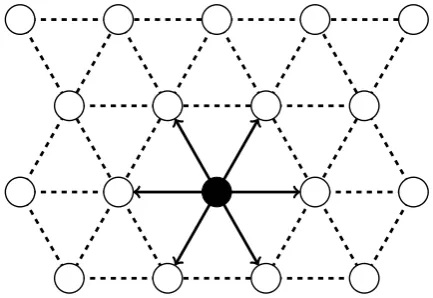
with an atomistic triangulation, as shown in Figure 1, which will be convenient in both analysis and numerical simulations. We denote this triangulation byT and its elements byT ∈ T. We also denote a:= (aj)6j=1, andFa:= (Faj)6j=1, forF∈Rm
×2
. We identify a discrete displacement mapu: Λ→Rm,m= 1,2,3, with its
continu-ous piecewise affine interpolant, with weak derivative∇u, which is also the pointwise derivative on each element T ∈ T. For m = 1,2,3, the spaces of displacements are defined as
U0 :=
u|Λ→Rm : supp(∇u) is compact , and
˙
U1,2 :=
Figure 1. The lattice and its canonical triangulation.
We equip ˙U1,2 with theH1-seminorm,kuk
U1,2 :=k∇ukL2(
R2). From [8] we know that
U0 is dense in ˙U1,2 in the sense that, if u∈U˙1,2, then there exist uj ∈ U0 such that ∇uj → ∇u strongly inL2.
A homogeneous displacement is a map uF : Λ → Rm, uF(x) := Fx, where F ∈
Rm×2.
For a map u: Λ→Rm, we define the finite difference operator
Dju(x) :=u(x+aj)−u(x), x∈Λ, j ∈ {1,2, ...,6}, and
Du(x) := (Dju(x))6j=1.
(2.1)
Note thatDuF(x) =Fa.
2.1. 2D many-body nearest neighbour interactions. We assume that the atom-istic interaction is described by a nearest-neighbour many-body site energy potential
V ∈ Cr(
Rm×6),r ≥5, with V(0) = 0. Furthermore, we assume that V satisfies the point symmetry
V((−gj+3)j6=1) = V(g) ∀g∈R
m×6 .
The energy of a displacementu∈ U0, given by
Ea(u) := X
`∈Λ
V(Du(`)),
is well-defined since the infinite sum becomes finite. To formulate a variational problem in the energy space ˙U1,2, we need the following lemma to extendEa to ˙U1,2.
Lemma 2.1. Ea : (U0,k∇ · kL2) → R is continuous and has a unique continuous extension to U˙1,2, which we still denote by Ea. Furthermore, the extended Ea :
( ˙U1,2,k∇ · k
L2)→R isr-times continuously Fr´echet differentiable.
Proof. See Lemma 2.1 in [4].
2.2. The variational problem. We add an external potential f ∈Cr( ˙U1,2) with ∂u(`)f(u) = 0 for all|`| ≥Rf, whereRf is some given radius, andf(u+c) =f(u) for
all constantsc. For example, we can think of f modelling a substitutional impurity. See also [5, 7] for similar approaches.
We then seek the solution to
ua ∈arg min Ea
(u)−f(u)|u∈U˙1,2
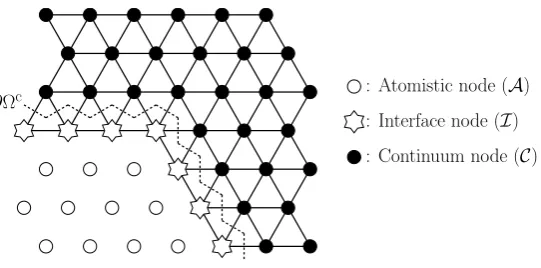
∂Ωc : Atomistic node (A) : Interface node (I)
[image:5.595.165.436.81.215.2]: Continuum node (C)
Figure 2. The domain decomposition with a layer of interface atoms.
For u, ϕ, ψ∈U˙1,2 we define the first and second variations of Ea by hδEa(u), ϕi:= lim
t→0t −1
(Ea(u+tϕ)− Ea(u)),
hδ2
Ea(u)ϕ, ψ
i:= lim
t→0t −1
(hδEa(u+tϕ), ψ
i − hδEa(u), ψ i).
We use analogous definitions for all energy functionals introduced in later sections.
2.3. The Cauchy–Born Approximation. The Cauchy–Born strain energy func-tion, corresponding to the interatomic potentialV is
W(F) := 1 Ω0
V(Fa), for F∈Rm×2,
where Ω0 := √
3/2 is the volume of a unit cell of the lattice Λ. Thus W(F) is the energy per volume of the homogeneous latticeFΛ.
2.4. The G23 coupling method. LetA ⊂ Λ denote the set of all lattice sites for which we want to maintain full atomistic accuracy. We denote the set of interface lattice sites by
I :=
`∈Λ\ A
`+aj ∈ A for some j ∈ {1, . . . ,6}
and we denote the remaining lattice sites byC := Λ\(A ∪ I). Let Ω` be the Voronoi
cell associated with site`. We define the atomistic, interface and continuum regions respectively by
Ωa := [
`∈A
Ω`, Ωi:=
[
`∈I
Ω`, and Ωc:=R2\
[
`∈A∪I
Ω`;
see Figure 2 for a visualisation.
A general form for the GRAC-type a/c coupling energy [3, 12] is
Eac(u) =X
`∈A
V(Du(`)) +X
`∈I
V (R`Dju(`))6j=1
+
Z
Ωc
W(∇u(x)) dx,
whereR`Dju(`) :=P6i=1C`,j,iDiu(`). The parametersC`,j,i are to be determined in
order for the coupling scheme to satisfy the “patch tests”:
Eac is locally energy consistent if, for all F∈
Rm×2,
V`i(Fa) =V(Fa) ∀`∈ I. (2.3)
Eac is force consistent if, for all F∈
Rm×2,
δEac(u
A
3
C
A
3
C
A C
[image:6.595.105.491.87.186.2]7
Figure 3. The first two configurations are allowed. The third configu-ration is not allowed as the interface atom at the corner has no nearest neighbour in the continuum region, and should instead be taken as an atomistic site.
2 3 2
3 2 3 2
3
2 3
2 3
2 3
1
1
1
1
1
1
1
1
1
1
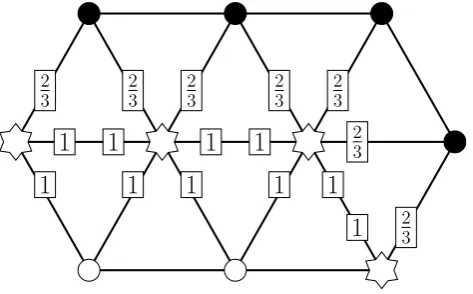
Figure 4. The geometry reconstruction coefficents λx,j at the interface sites.
Eac is patch test consistent if it satisfies both (2.3) and (2.4).
For the sake of brevity of notation we will often writeVi
`(Du(`)) :=V (R`Dju(`))6j=1
. Following [12] we make the following standing assumption (see Figure 3 for exam-ples).
(A0)Each vertex`∈ I has exactly two neighbours inI, and at least one neighbour in C.
Under this assumption, the geometry reconstruction operator R` is then defined
by
R`Djy(`) := (1−λ`,j)Dj−1y(`) +λ`,jDjy(`) + (1−λ`,j)Dj+1y(`),
λx,j :=
2/3, x+aj ∈ C
1, otherwise ;
see Figure 4. The resulting coupling method is called G23 and the corresponding energy functional Eg23. This choice of coefficients (and only this choice) leads to
patch test consistency (2.3) and (2.4).
For future reference we decompose the canonical triangulation T as follows:
TA : ={T ∈ T |T ∩(I ∪ C) =∅}, TC : ={T ∈ T |T ∩(I ∪ A) =∅} and TI : =T \(TC∪ TA).
[image:6.595.181.418.263.410.2]2.5. Notation for a P2 finite element scheme. In the atomistic and interface regions, the interactions are represented by discrete displacement maps, which are identified with their linear interpolant. Here, we identify the displacement map with its P1 interpolant. No approximation error is committed.
On the other hand, in the continuum region where the interactions are approxi-mated by the Cauchy–Born energy, we could increase the accuracy by using Pp-FEM with p > 1. In later sections we will review that the Cauchy–Born approximation yields a 2nd-order error, whereas employing the P1-FEM in the continuum region would reduce the accuracy to first order. In fact, we will show in that, with opti-mized mesh grading, P2-FEM is sufficient to obtain a convergence rate that cannot be improved by other choices of continuum discretisations. High-order Pp-FEM with
p > 2 will increase the computational costs but yield the same error convergence rate (see § 3.5).
Let K >0 denote the inner radius of the atomistic region,
K := sup
r >0| Br∩Λ⊂ A ,
where Br denotes the ball of radius r centred at 0. In order for the defect to be
contained in the atomistic region we assume throughout thatK ≥Rf.
Let Ωh denote the entire computational domain and N > 0 denote the inner
radius of Ωh, i.e.,
N := sup
r >0| Br ⊂Ωh .
LetTh be a finite element triangulation of Ωh which satisfies that, for T ∈ Th, T is
closed and
T ∩(A ∪ I)6=∅ ⇒ T ∈ T.
In other words,Th andT coincide in the atomistic and interface regions, whereas in
the continuum region the mesh size may increase towards the domain boundary. The optimal rate at which the mesh size increases will be determined in later sections.
We note that the concrete construction of Th will be based on the choice of the
domain parameters K and N; hence, when emphasizing this dependence, we will writeTh(K, N). We assume throughout that the family (Th(K, N))K,N is uniformly shape-regular, i.e., there exists c > 0 such that,
diam(T)2
≤c|T|, ∀T ∈ Th(K, N),∀K ≤N. (2.6)
This assumption eliminates the possibility of extreme angles on elements, which would deteriorate the constants in finite element interpolation error estimates. For the most part we will again drop the parameters from the notation by writing
Th ≡ Th(K, N) but implicitly will always keep the dependence.
Similar to (2.5), we define the atomistic, interface and continuum elements as
Ta
h,Thi and Thc, respectively. Note that Tha = TA and Thi = TI. We also let Nh
denote the number of degrees of freedom of Th.
We define the finite element space of admissible displacements as
Uh :=
u∈C(R2;Rm)| supp(u)⊂Ωh, u|T ∈P1(T) for T ⊂ Tha∪ Thi and
u|T ∈P2(T) forT ⊂ Thc .
(2.7)
In defining Uh we have made two approximations to the class of admissible
The computational scheme is to find
ug23h ∈arg min Eg23(u
h)−f(uh)|uh ∈ Uh . (2.8)
Remark 2.2. Uh is embedded in U0 via point evaluation. Through this
identifi-cation,f(uh) is well-defined for alluh ∈ Uh.
We will make this identificationonlywhen we evaluate f(uh). The reason for this
is a conflict when interpreting elements uh as lattice functions is that we identify
lattice functions with their continuous interpolants with respect to the canonical triangulationT, which would be different from the function uh itself. However, for
the evaluation off(uh) this issue does not arise.
3. Summary of results
3.1. Regularity of ua. The approximation error analysis in later sections requires
estimates on the decay of the elastic fields away from the defect core. These results follow from a natural stability assumption:
(A1) The atomistic solution is strongly stable, that is, there exists C0 >0,
hδ2
Ea(ua)ϕ, ϕ
i ≥C0k∇ϕk2
L2, ∀ϕ∈U˙1,2, (3.1)
whereua is a solution to (2.2).
Corollary 3.1. Suppose that (A1) is satisfied, then there exists a constant C > 0
such that, for 1≤j ≤r−2,
|Djua(`)| ≤C|`|−1−j.
Proof. See Theorem 2.3 in [4].
3.2. Stability. In [9] it is shown that there is a “universal” instability in 2D inter-faces for QNL-type a/c couplings: it is impossible to prove in full generality that
δ2Eg23(ua) is a positive definite operator, even if we assume (3.1). Indeed, this
po-tential instability is universal to a wide class of generalized geometric reconstruction methods. However, it is rarely observed in practice. To circumvent this difficulty, we make the following standing assumption:
(A2) The homogeneous lattice is strongly stable under the G23 approximation, that is, there existsC0g23 >0 which is independent ofK such that, forK sufficiently
large,
hδ2
Eg23(0)ϕ
h, ϕhi ≥C0g23k∇ϕhk 2
L2, ∀ϕh ∈ Uh. (3.2)
3.3. Main results. To state the main results it is convenient to employ a smooth interpolant to measure the regularity of lattice functions. In Lemma 6.1, we define such an interpolant ˜u ∈ C2,1(
R2) for u ∈ U0, for which there exists a universal
constant ˜C such that, for all q∈[1,∞], 0≤j ≤3,
|Dju(`)| ≤C˜k∇ju˜k L1(ω
`) and k∇ ju˜k
Lq(T) ≤C˜kDjuk`q(Λ∩T)
whereω` :=`+A(−1,1)2.
3.3.1. Consistency error estimate. In (5.6) we define a quasi-best approximation operator Πh : U0 → Uh, which truncates an atomistic displacement to enforce the
homogeneous Dirichlet boundary condition, and then interpolates it onto the finite element mesh.
Our main result is the following consistency error estimate.
Theorem 3.2. If ua is a solution to (2.2) then we have, for all ϕ
h ∈ Uh,
hδEg23(Π
hua), ϕhi.
k∇2u˜a
kL2(Ωi)+k∇3u˜akL2(Ωc)+k∇2u˜ak2L4(Ωc)
+kh2 ∇3u˜a
kL2(Ωc
h)+k∇u˜ a
kL2(
R2\BN/2)
+N−1kh2∇2
˜
uakL2(B
N\BN/2)
k∇ϕhkL2(
R2\Ωa),
(3.3)
where Ωc
h corresponds to the continuum region of Ωh, and h(x) := diam(T) with
x∈T ∈ Th.
3.3.2. Optimizing the approximation parameters. Before we estimate the errork∇ua− ∇uhkL2, we optimize the approximation parameters in the computational scheme.
This means that the radius K of the atomistic region, the radius N of the entire computational domain and the mesh sizehshould satisfy certain balancing relations. We only outline the result of this optimisation and refer to § 6.7 for the details.
Due to the decay estimates on ˜ua the dominating terms in (3.3) turn out to be k∇2u˜ak
L2(Ωi) and k∇u˜akL2(
R2\BN/2). (3.4)
(We will see momentarily that the mesh size plays a minor role.) These two terms result from the nature of the coupling scheme and the far-field truncation error. In particular, both of these cannot be improved by the choice of discreti-sation of the Cauchy–Born model, e.g., order of the FEM. We also note that, if we had employed a P1-FEM, the only different terms in the analog of (3.3) are
kh∇2u˜ak
L2(Ωc) rather than kh2∇3u˜akL2(Ωc), and N−1kh∇u˜akL2(B
N\BN/2) rather than N−1
kh2∇2u˜ak
L2(B
N\BN/2), hence the limiting factor would have beenkh∇ 2u˜ak
L2(Ωc).
We can balance the two terms in (3.4) by choosing N ≈K5/2. It then remains to
determine a mesh-size so that the finite element error contribution,
kh2∇3u˜ak
L2(Ωc
h) and N
−1
kh2∇2u˜k
L2(B
N\BN/2)
remains small in comparison. We show that the scaling h(x)≈|Kx|
β
is a suitable choice, with 1< β < 3/2, under which both terms become of order O(K−3).
β N Nh consistency error
P2-FEM 1,3 2
K5/2 K2 K−5/2
P1-FEM 1,3 2
K2 K2 K−2
Table 1. Quasi-optimal relations between approximation parameters
for P2-GR23 and, for comparision, for P1-GR23.
Corollary 3.3. Suppose that N, h satisfy the relations of Table 1, the consistency error estimate (3.3) in terms of the number of degrees of freedom Nh can be written as
kδEg23
(Πhua)kU−1,2 .Nh−5/4. (3.5)
3.3.3. Error estimate. To complete our summary of results, we now use the Inverse Function Theorem to obtain error estimates for the strains and the energy.
Theorem 3.4. Suppose that (A0), (A1) and (A2) are satisfied and that the quasi-optimal scaling of N, h from Table 1 is satisfied. Then, for sufficiently large atomistic region sizeK, a solution ug23h to (2.8) exists which satisfies the error estimates
k∇ua− ∇ug23
h kL2 .Nh−5/4, and (3.6)
[Ea(ua)−f(ua)]−[Eg23(u g23
h )−f(u
g23
)].N −7/4
h , (3.7)
where Nh is the number of degrees of freedom.
Remark 3.5. The analogous estimates of P1-GR23 to (3.6) and (3.7) are N−1
h
and Nh−2 respectively.
3.4. Setup of the numerical tests. For our numerical tests, we consider an anti-plane displacementu: Λ→R. We choose a hexagonal atomistic region Ωa with side
length K and one layer of atomistic sites outside Ωa as the interface. To construct
the finite element mesh, we add hexagonal layers of elements such that, for each layer
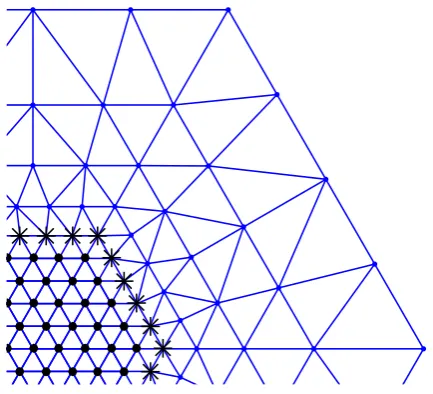
j, h(layer j) = (|x|/K)β, with β = 1.4; see Figure 5. The procedure is terminated
once the radius of the domain exceeds N = dK5/2e. This construction guarantees
the quasi-optimal approximation parameter balance to optimise the P2-FEM error. The derivation is given in Section 6.7.
In our tests we compare the P2-G23 method against
(1) a pure atomistic model with clamped boundary condition: the construction of the domain is as in the P2-G23 method, but without continuum region; (2) a P1-G23 method: the construction is again identical to that of the P2-G23
method, but the P2-FEM in the definition of Uh is replaced by a P1-FEM.
-15 -10 -5 0 5 10 15 -10
[image:11.595.188.405.83.280.2]-5 0 5 10
Figure 5. An example of the computatioanl mesh. The the vertices marked by ”•” are the atomistic sites; the vertices marked by ”∗” are the interface sites.
The site potential is given by a nearest-neighbour embedded atom toy model,
V(Du) :=G 6 X
i=1
ρ(|Diu(`)|)
!
withG(s) :=s+1 2s
2 and ρ(r) := sin2(rπ). This is a simplified anti-plane toy model
as used in [4], which absorbs the pair interaction into the embedding term.
The external potential is defined by hf, ui = 10(u(0,0)−u(1,0)), which can be thought of as an elastic dipole. A steepest descent method, preconditioned with a finite element Laplacian and fixed (manually tuned) step-size, is used to find a minimizer ug23h of Eg23(u)−f(u), using u
h = 0 as the starting guess.
In order to compare the errors, we use a comparison solution with atomistic region size 3K and other computational parameters scaled as above.
The numerical results, with brief discussions, are shown in Figures 6–9. The two most important observations are the following:
(1) the numerical tests confirm the analytical predictions for the energy-norm error, but the experimental rates for the energy error are better than the analytical rates. Similar observations were also made in [4].
(2) With our specific setup, the improvement of the P2-GR23 over P1-GR23 is clearly observed when plotting the error against #A ∝ Nh, but when
plotted against Nh the improvement is only seen in the asymptotic regime.
This indicates that further work is required, such as a posteriori adaption, to optimise the P2-GR23 in the pre-asymptotic regime as well.
3.5. Extension to high-order FEM. If we apply higher-order FEM in the contin-uum region, then to extend our error analysis we would need a smooth interpolant of u ∈ U0 with higher regularity than ˜u ∈ C2,1(R2). A suitable extension given in
[5] is, for arbitrary n, a Cn,1 piecewise polynomial of degree 2n + 1 with
proper-ties analogous to those stated in Lemma 6.1. The resulting higher-order decay rate
|∇ju˜a(x)|
100 101 102 10-5
10-4 10-3 10-2
10-1 Point Defect : Geometry Error
[image:12.595.130.454.91.353.2]ATM G23-P2 G23-P1
Figure 6. Error in energy norm plotted against #A. We clearly
observe the predicted rate of convergence.
Nh
101 102 103 104 105
k
D
7
uh
!
D
7
u
k`
2
10-5 10-4 10-3 10-2
10-1 Point Defect : Geometry Error
ATM G23-P2 G23-P1
9N!1
h
9Nh!5=4
9Nh!1=2
Figure 7. Error in energy norm plotted against the number of degrees
[image:12.595.131.459.411.690.2]100 101 102 10-8
10-7 10-6 10-5 10-4 10-3 10-2
10-1 Point Defect : Energy Error
[image:13.595.134.455.95.357.2]ATM G23-P2 G23-P1
Figure 8. The energy error plotted against #A. The observed rate of convergence is better than the rate predicted in Theorem 3.4.
Nh
101 102 103 104 105
j
E
h(
7uh
)
!
E
a(
7
u
a)j
10-8 10-7 10-6 10-5 10-4 10-3 10-2
10-1 Point Defect : Energy Error
ATM G23-P2 G23-P1
9N!1
h
9N!2
h
9N!52
h
[image:13.595.130.462.412.685.2]However, as we have pointed out in§3.3.2, if we employ the mesh gradingh(x) = (|x|/K)β with 1< β < 3/2 in the continuum region, the total approximation error
cannot be improved by using Pp-FEM withp > 2, since the dominating term is the interface error k∇2u˜ak
L2(Ωi) for p ≥ 2, which results from the construction of G23
coupling and is not affected by the choice of FEM.
If we consider a coarser mesh for high-order FEM in hopes of reducing the number of degrees of freedom, i.e., choosing β ≥ 3/2, then applying analogous calculations to those in§6.7 gives us the following result:
Employing Pp-FEM with p > 2, in order to match the convergence rate of the Cauchy–Born error termk∇3u˜ak
L2(Ωc) ∼K−3, the highest mesh coarsening rate is
β = 5 3 −
1 3p.
This means that the optimal mesh grading that Pp-FEM can achieve without compromising accuracy is no greater than 5
3. However, in that case, the number of
degrees of freedom is always O(K2).
4. Conclusion
We obtained a sharp energy-norm error estimate for the G23 coupling method with P2-FEM discretisation of the continuum model. Furthermore, we demonstrated that, with P1-FEM discretisation the FEM coarsening error is the dominating term in the consistency error estimate, whereas for P2-FEM discretisation the interface error becomes the dominating term. In particular, a P2-FEM discretisation yields a more rapid decay of the error. Crucially though, since for Pp-FEM with p ≥ 2 the interface contribution dominates the total error the P2-FEM is already optimal. That is, increasing to p > 2 will not improve the rate of convergence, but increase the computational cost and algorithmic complexity.
Numerically, we observe that the improvement of P2-GR23 over P1-GR23 is only modest at moderate Nh, hence a P2-GR23 scheme would be primarily of interest
if very high accuracy of the solution is required. Purely according to our a priori
error analysis, considering the additional algorithmic complexity, it is unclear how practically useful higher-order FEM in the context of A/C coupling are. However, before drawing such a universal conclusion, one should explore whether optimis-ing the pre-asymptotic regime, usoptimis-ing hp a posteriori mesh adaption, could lead to improved cost/error rates.
While our estimates for the error in energy-norm are sharp, our numerical results show the estimates for the energy errors are suboptimal. We hightlight the leading term in the error analysis which overestimate the error in Section 7.2. We are unable, at present, to obtain an optimal energy error estimate. This appears to be an open problem throughout the literature on hybrid atomistic multi-scale schemes; see e.g. [4].
5. Reduction to consistency
Assuming the existence of an atomistic solution ua, we seek to prove the existence
of ug23h ∈ Uh satisfying
hδEg23(ug23
h ), ϕhi=hδf(u
g23
h ), ϕhi, for all ϕh ∈ Uh, (5.1)
and to estimate the kua−ug23
h kin a suitable norm.
The error analysis consists of consistency and stability estimates. Once these are established we apply the following theorem to obtain the existence of a solutionug23h
and the error estimate. The proof of this theorem is standard and can be found in various references, e.g. [13, Lemma 2.2].
Theorem 5.1 (The inverse function theorem). Let Uh be a subspace of U, equipped withk∇ · kL2, and let Gh ∈C1(Uh,Uh∗)with Lipschitz-continuous derivative δGh:
kδGh(uh)−δGh(vh)kL≤Mk∇uh− ∇vhkL2 for all uh, vh ∈ Uh, where k · kL denotes the L(Uh,Uh∗)-operator norm.
Let u¯h ∈ Uh satisfy
kGh(¯uh)kU∗
h ≤η, (5.2)
hδGh(¯uh)vh, vhi ≥γk∇vhk2L2 for all vh ∈ Uh, (5.3) such that M, η, γ satisfy the relation
2M η γ2 <1.
Then there exists a (locally unique)uh ∈ Uh such that Gh(uh) = 0,
k∇uh− ∇u¯hkL2 ≤2η
γ, and
hδGh(uh)vh, vhi ≥
1− 2M η
γ2
γk∇vhk2L2 for all vh ∈ Uh.
To ensure Dirichlet boundary conditions, we adapt the quasi-best approximation map defined in [4]. Letµ∈C3(
R2) be a cut-off function such that
µ(x) =
1 0≤x≤ 1 2,
0 x≥1.
Foru: Λ→Rm, define
Lu(x) := µ
|x| N
(˜u(x)−au), where au :=
1
|BN \BN/2| Z
BN\BN/2
˜
u(y) dy. (5.4)
Let νT,i, i = 1,2,3 be the vertices of T and me be the mid-point of an edge e.
Then, the set of allactive P2 finite element nodes is given by
Nh :={νT,i|T ∈ Th, i= 1,2,3} ∪ {me|e=T1∩T2, T1, T2 ∈ Thc}.
Furthermore, let I2
h : C(R2;Rm) → Uh be the interpolation operator such that,
for g ∈ C(R2;Rm), Ih2(g)|T ∈ P1(T) for T ⊂ Tha∪ Thi, Ih2(g)|T ∈P2(T) forT ⊂ Thc,
and
Ih2(g)(x) =g(x) for all x∈ Nh.
Remark 5.2. We also introduce ghost nodes on the edges shared by interface and continuum elements:
Nhg :={me|e=T1∩T2, T1 ∈ Thi, T2 ∈ Thc}. (5.5)
Then, for x∈ Nhg, I2
h(g)(x) = (g(νx1) +g(νx2))/2, where νx1 andνx2 are the vertices of
the edge on whichx lies. Hence, the P1 and P2 interpolants coincide on Ng
h.
We can now define the projection map (quasi-best approximation operator) Πh : U0 → Uh as
Πh :=Ih2◦ L. (5.6)
5.1. Stability. To put Theorem 5.1 (Inverse Function Theorem) into our context, let
Gh(v) :=δEg23(v)−δf(v) and u¯h := Πhua.
To make (5.2) and (5.3) concrete we will show that there exist η, γ > 0 such that, for all ϕh ∈ Uh,
hδEg23(Π
hua), ϕhi − hδf(Πhua), ϕhi ≤ηk∇ϕhkL2, (consistency) hδ2
Eg23(Π
hua)ϕh, ϕhi − hδ2f(Πhua)ϕh, ϕhi ≥γk∇ϕhk2L2. (stability)
Ignoring some technical requirements, the inverse function theorem implies that, if
η/γ is sufficiently small, then there existsug23h ∈ Uh such that hδEg23(ug23
h ), ϕhi − hδf(ug23h ), ϕhi= 0, ∀ϕh ∈ Uh, and k∇ug23h − ∇ΠhuakL2 ≤2η
γ.
Finally adding the best approximation error k∇Πhua− ∇uakL2 gives the error
esti-mate
k∇ug23h − ∇ua
kL2 ≤ k∇Πhua− ∇uakL2 + 2η γ
The Lipschitz and consistency estimates require assumptions on the bounded-ness of partial derivatives of V. For g ∈ Rm×6, define the first and second partial derivatives, for i, j = 1, . . . ,6, by
∂jV(g) :=
∂V(g)
∂gj ∈R
m, and ∂
i,jV(g) :=
∂2V(g) ∂gi∂gj ∈R
m×m,
and similarly for the third derivatives ∂i,j,kV(g) ∈ Rm×m×m. We assume that the
second and third derivatives are bounded
M2 : =
6 X
i,j=1
sup
g∈Rm×6 sup
h1,h2∈R2,
|h1|=|h2|=1
∂i,jV(g)[h1, h2]<∞, and (5.7)
M3 : =
6 X
i,j,k=1
sup
g∈Rm×6
sup
h1,h2,h3∈R2,
|h1|=|h2|=|h3|=1
∂i,j,kV(g)[h1, h2, h3]<∞. (5.8)
6 X
i=1
|∂iV(g)−∂iV(h)| ≤M2 max
j=1,...,6|gj−hj|, 6
X
i,j=1
|∂i∂jV(g)−∂i∂jV(h)| ≤M3 max
k=1,...,6|gk−hk|, forg,h∈R
m×6
. (5.9)
From the bounds above we can obtain the following Lipschitz continuity and stability results.
Lemma 5.3. There exists M >0 such that
kδGh(uh)−δGh(vh)kL ≤Mk∇uh− ∇vhkL2 for all uh, vh ∈ Uh. (5.10)
Proof. The result follows directly from (5.9) and the fact thatf ∈Cr( ˙U1,2) and that δf is compactly supported hence δ2f is also Lipschitz. Namely, for allϕ
h ∈ Uh, h(δGh(uh)−δGh(vh))ϕh, ϕhi
=h(δ2Eg23
(uh)−δ2Eg23(vh))ϕh, ϕhi+h(δ2f(vh)−δ2f(uh))ϕh, ϕhi ≤Cg23M3k∇uh − ∇vhkL∞k∇ϕhk2L2 +Cfkuh−vhkL∞(BRf)kϕhk2L2 .k∇uh− ∇vhkL2k∇ϕhk2L2 +k∇uh− ∇vhkL2(B
Rf)kϕhk 2
L2,
where Cg23 is the constant resulting from the interface reconstruction and the lin-ear elasticity formulation of Cauchy–Born in the continuum region, and Cf is the
Lipschitz constant ofδ2f.
Lemma 5.4. Under the assumptions(A1)and(A2), ifGh(v) :=δEg23(v)−δf(v), then there exits γ >0 such that, when K is sufficiently large,
hδGh(Πhua)ϕh, ϕhi ≥γk∇ϕhk2L2 for all ϕh ∈ Uh. (5.11)
Proof. The proof of this result is a straightforward adaption of the proof of [5, Lemma 4.9], which is an analogous result for blending-type a/c coupling.
6. Consistency estimate with a P2-FEM
6.1. Outline of the consistency estimate. We begin by decomposing the con-sistency error into
hδEg23
(Πhua), ϕhi − hδf(Πhua), ϕhi=
hδEg23
(Πhua), ϕhi − hδEa(ua), ϕi
+{hδf(Πhua), ϕhi − hδf(ua), ϕi}
=:ηint+ηext, (6.1) whereϕh ∈ Uh is given and we can chooseϕ∈ U0 arbitrarily.
For ϕh ∈ Uh, ϕh|T ∈ P2(T) for T ∈ Thc. But the test function ϕ in hδEa(ua), ϕi
where I+ is an extra layer of atomistic sites outside I. With this assumption in
place, we can further decompose ηint into the following parts,
ηint =
Z
Ωc
∂FW(∇u˜a) : (∇ϕh− ∇ϕ)
+
Z
Ωc
(∂FW(∇Πhua)−∂FW(∇u˜a)) :∇ϕh
+
Z
Ωc
∂FW(∇u˜a)−∂FW(∇ua)
:∇ϕ
+hδEg23(ua)
−δEa(ua), ϕ i
=:δ1+δ2+δ3+δ4,
(6.2)
where ˜ua is the smooth interpolant of ua defined in Lemma 6.1 below. By ∇ϕ in δ1 we mean the gradient of the canonical linear interpolant of ϕ. To estimate δ2 we require an approximation error estimate for Πhu−u. To estimate δ3 we will exploit
the fact that the atomistic triangulationT is uniform to prove a super-convergence estimate. Finally, for the modelling error, δ4, we employ the techniques developed in [12].
To define the smooth interpolant ˜ua, we use the construction from [5], namely a C2,1-conforming multi-quintic interpolant. Although the interpolant defined in [5] is
for lattice functions onZ2, we can use the linear transformation fromZ2 to Λ = AZ2
to obtain a modified interpolant.
Lemma 6.1. (a) For each u : Λ → Rm, there exists a unique u˜ ∈ C2,1(
R2;Rm) such that, for all `∈Λ,
˜
u|`+A(0,1)2 is a polynomial of degree 5,
˜
u(`) =u(`), ∂aiu˜(`) =
1
2(u(`+ai)−u(`−ai)), ∂2
aiu˜(`) =u(`+ai)−2u(`) +u(`−ai), where i∈ {1,2} and ∂ai is the derivative in the direction of ai.
(b) Moreover, for q∈[1,∞], 0≤j ≤3, k∇ju˜k
Lq(`+A(1,0)2) .kDjuk`q(`+A{−1,0,1,2}2) and |Dju(`)|.k∇ju˜kL1(`+A(−1,1)2),
(6.3)
where D is the difference operator defined in (2.1). In particular, k∇u˜kLq .k∇ukLq .k∇u˜kLq,
where u is identified with its piecewise affine interpolant.
Proof. Let v :Z2 →Rm and v(ξ) :=u(Aξ) for all ξ∈ Z. Then [5, Lemma 1] shows
that there exists a unique ˜v ∈C2,1(
R2;Rm) such that, for ξ ∈Z2,
˜
v|ξ+(0,1)2 is a polynomial of degree 5,
˜
v(ξ) =v(ξ), ∂eiv˜(ξ) =
1
2(v(ξ+ei)−v(ξ−ei)), ∂2
eiv˜(ξ) =v(ξ+ei)−2v(ξ) +v(ξ−ei) i= 1,2,
For part (b), [5, Lemma 1] establishes also that there exists a constant C0
j such
that, forξ ∈Z2, 1≤j ≤3, q∈[1,∞],
k∇jv˜kLq(ξ+(1,0)2) ≤Cj0kDˆjvk`q(ξ+{−1,0,1,2}2),
where ˆD represents the 4-stencil difference operator in Z2: let R:={ρ ∈Z2| |ρ| =
1}, then ˆDv(`) := ( ˆDρv(`))ρ∈R with ˆDρv(`) := v(`+ρ)−v(`). After transformation,
we have, for ξ=A` ∈Λ,
ˆ
Dv(`) = (Diu(ξ))i=1,2,4,5.
By adding the additional stencil elementsD3, D6 we obtain
Cj00k∇ju˜k
Lq(ξ+A(1,0)2)≤ k∇jv˜kLq(`+(1,0)2) ≤C0
jkDˆjvk`q(`+{−1,0,1,2}2) ≤Cj000kDjuk`q(ξ+A{−1,0,1,2}2),
where C00
j and Cj000 only depend on j. Writing C := max1≤j≤3 C000
j C00
j
yields the first inequality of (6.3). Following a similar argument the second inequality also
holds.
6.2. Construction of ϕ and estimation of δ1. Recall that
δ1 :=
Z
Ωc
∂FW(∇u˜a) : (∇ϕh− ∇ϕ).
We adapt the modified quasi-interpolation operator introduced in [2] to approxi-mate a test function ϕh ∈ Uh. The advantage of this interpolation operator is that
by using the setting of a partition of unity the approximation error has a local aver-age zero. Consequently we can apply Poincar´e inequality on patches to obtain local estimates.
We think of the construction of ϕ as a Dirichlet boundary problem with the outer boundary ∂Ωh and the inner boundary ∂Ωc. Let φ` be the piecewise linear
hat-functions on the canonical triangulation T associated with` ∈Λ. Define
φPU
` :=
φ`
P
k∈C∩Ωhφk
, ∀`∈ C,
whereC is the continuum lattice sites as defined in§2.4. It is clear that{φPU
` }`∈C∩Ωh
is a partition of unity.
Now we refer to [2] for the contruction of a linear interpolant of ϕh ∈ Uh . We
shall define the interpolant as follows:
where
ϕ1(`) :=
ϕh(`), `∈ A ∪ I ∪ I+,
R
RR2φ`ϕh
R2φ`
, `∈ C \ I+,
ϕ1(x) :=X
`∈Λ
ϕ1(`)φ`(x), ∀x∈R2,
ϕ2(`) :=
R
R2(ϕh−ϕ1)φ
PU `
R
R2φ`
, `∈ C \ I+,
0, `∈ A ∪ I ∪ I+,
ϕ2(x) :=X
`∈Λ
ϕ2(`)φ`(x), ∀x∈R2.
Observe that ϕh and ϕboth are supported on a finite domain, hence we can use
Theorem 3.1 in [2] to conclude that
k∇ϕkL2(R2) .k∇ϕhkL2(R2), ∀ϕh ∈ Uh.
Let g :=−div [∂FW(∇u˜a)]. Then
δ1 =
Z
Ωc
g·(ϕh−ϕ) dx=
Z
Ωc
g·((ϕh−ϕ1)−ϕ2) dx
Sinceϕ2 is a piecewise-linear quasi-interpolant ofϕh−ϕ1 as defined in [2], a direct
consequence of Theorem 3.1 in [2] is that there exists C > 0 such that, recalling Ωa
h :=
S Ta
h,
δ1 ≤Ck∇(ϕh−ϕ1)kL2(
R2\Ωah)
X
`∈C∩Ωh d2`
Z
w`
φPU` |g− hgi`|2dx
!1/2 ,
where w` := supp(φ`), hgi` := 1/|w`|Rw
`g(x) dx and d` := diam(w`) = 1. With the
sharp Poincar´e constant derived by [1] , we have
Z
w`
φPU` |g− hgi`|2dx≤
Z
w`
|g− hgi`|2dx≤ 41d2`k∇gk2L2(w `).
On the other hand,ϕ1 is a standard quasi-interpolant of ϕh inSThc, which implies
that there existsC0 >0 such that k∇(ϕh−ϕ1)kL2(
R2\Ωah) ≤C 0
k∇ϕhkL2(
R2\Ωah). (6.5)
Due to the fact that d` = 1 and that each point in R2\Ωah is covered by at most
threew`, we have
δ1 ≤Cmax
` d
2
`k∇gkL2(
R2\Ωah)k∇ϕhkL2(R2\Ωah) ≤CM2k∇3u˜a
kL2(
R2\Ωah)+M3k∇ 2u˜a
k2
L4(
R2\Ωah)
k∇ϕhkL2(
R2\Ωah), (6.6)
where we used the following estimate, for some c >0,
k∇gkL2(Ω
h)=k∇div[∂FW(∇u˜ a)]
kL2(R2\Ωa h)
=k∇ ∂F2W(∇u˜
a
)∇2
˜
ua
kL2(R2\Ωa h)
= ∂
2
FW(∇u˜
a)
∇3u˜a+∂3
FW(∇u˜
a)
∇2u˜a2
L2(R2\Ωa h) ≤cM2k∇3u˜a
kL2(
R2\Ωah)+M3k∇ 2u˜a
k2
L4(
R2\Ωah)
employing the global bounds (5.7) and (5.8). This completes the estimate for δ1.
6.3. Estimation of δ2. Recall that
δ2 :=
Z
Ωc
(∂FW(∇Πhua)−∂FW(∇u˜a)) :∇ϕh.
We start with estimating the best approximation error.
Lemma 6.2. Let T ∈ Tc
h, u∈U˙1,2 and v ∈W3,2(R2). Then we have the following estimates.
(a) Denote hT := diam(T), then
k∇v− ∇I2
hvkL2(T) .h2Tk∇3vkL2(T).
(b) There exists a constant C >0 such that, for any domain S ⊃ BN,
k∇Lu− ∇u˜kL2(S) ≤Ck∇u˜k L2(S\B
N/2), where L is the cut-off function defined by (5.4).
(c) Furthermore, we have the best approximation error estimate
k∇Πhu− ∇u˜kL2(Ωc).kh2∇3u˜akL2(Ωc
h)+k∇u˜ a
kL2(
R2\BN/2)
+N−1kh2∇2u˜k
L2(B
N\BN/2),
(6.7)
where h(x) := diam(T) with x∈T.
Proof. Recall the uniform shape regularity assumption (2.6). Part (a) follows directly from the Bramble–Hilbert Lemma.
For Part (b), we use a variation of Theorem 2.1 in [10]. Applying Poincar´e’s inequality gives
k∇L(u)− ∇u˜kL2(S) =
N−1µ0(˜u−a) + (µ−1)∇u˜
L2(S)
≤N−1Cµku˜−akL2(S)+k(1−µ)∇u˜kL2(S\B N/2) ≤CpCµk∇u˜kL2(BN\B
N/2)+k(1−µ)∇u˜kL2(S\BN/2) ≤Ck∇u˜kL2(S\B
N/2).
For Part (c), we combine Part (a) and (b), that is
k∇Πhu− ∇u˜kL2(Ωc) ≤ k(Ih2◦ L)(u)− L(u)kL2(Ωc)+kL(u)−u˜kL2(Ωc) .kh2∇3L(u)k
L2(Ωc)+k∇u˜kL2(Ωc\B N/2)
=
h2 3 X
n=0
1
Nn∇ nµ
∇3−n(˜u−a)
L2(B N\Ωa)
+k∇u˜kL2(R2\B N/2)
.kh2∇3u˜k
L2(Ωc
h)+k∇u˜kL2(R2\BN/2)+
1
Nkh 2∇2u˜k
L2(B
N\BN/2).
The last line only contains the terms with n = 0,1. The term for n = 2 is
N−2
kh2∇u˜k
L2(B
N\BN/2), but since N
−2h2 .1 this is absorved into k∇u˜k
L2(
R2\BN/2).
The estimate forδ2 is now a consequence of the best approximation error estimate:
δ2 ≤ k∂FW(∇Πhua)−∂FW(∇u˜a)kL2(Ωc)k∇ϕhkL2(Ωc) ≤M2k∇Πhua− ∇u˜akL2(Ωc)k∇ϕhkL2(Ωc)
.kh2 ∇3u˜a
kL2(Ωc
h)+k∇u˜ a
kL2(R2\B
N/2) +N −1
kh2 ∇2u˜
kL2(B
N\BN/2)
k∇ϕhkL2(Ωc).
(6.8)
6.4. Estimation of δ3. Recall that
δ3 =
Z
Ωc
∂FW(∇u˜a)−∂FW(∇ua)
:∇ϕ,
where ϕ is a lattice function with compact support and ∇ϕ denotes the gradient of its piecwise linear interpolant. To estimate this term we observe that ua can be
interpreted as the P1 nodal interpolant of ˜ua. Although this indicates a first-order
estimate only, we can exploit mesh regularity to obtain a second-order superconver-gence estimate.
To that end, we rewrite the integral over the domain as a summation of elements. Let ˚E be the union of edges that are shared by two continuum elements, andωe be
the union of said elements, i.e., ˚
E : ={e=T1∩T2|T1, T2 ∈ TC}. ωe : =T1∪T2, whereT1∩T2 =e.
Recall thatW(F)≡ 1
Ω0V(F·a). Observe that for a pair of T1, T2 sharing a common
edge e which has the direction of aj, ∇ajϕ(T1) = ∇ajϕ(T2), which allows us to
re-group integration over elements as integration of patches ωe except for elements
near the interface. After simplifying the notation by writing ˜Vj :=∂jV(∇u˜·a) and
Vj :=∂jV(∇u·a), we can rewrite δ3 as follows:
δ3 = 1 Ω0
X
T∈TC∪TI 6 X
j=1 Z
T∩Ωc ˜
Vj−Vj
· ∇ajϕ(T)
= 1 Ω0 6 X j=1 X
e∈E˚j Z
ωe ˜
Vj−Vj
· ∇ajϕ
+ 1 Ω0
X
T∈TC∪TI 6 X
j=1 cT,j
Z
T∩Ωc ˜
Vj−Vj
· ∇ajϕ(T)
=:τ1+τ2,
where ˚Ej :={e∈E˚|e is in the direction of aj} and cT,j is defined as follows,
cT,j =
0, ∃e∈E˚j∩T,
1, otherwise.
Observe that for T ∈ TC, cT,j is only non-zero near the interface. So we have
τ2 ≤ 1
Ω0 Z
Ωi +
M2|∇u˜a− ∇ua| |∇ϕ|.k∇2
˜
uakL2(Ωi
ν
T1,iν
T1,i0T
1T
2m
eν
T2,i0ν
T2,i [image:23.595.87.511.360.583.2]a
iFigure 10.
where Ωi
+ := S
{T ∈ TC|dist(T,Ωi)≤1/2}. Note that the second-order error ∇2u˜a
results from the fact thatuais a piecewise linear nodal interpolant of ˜uaon a uniform
mesh.
To estimate τ1, we employ the following second-order mid-point estimate.
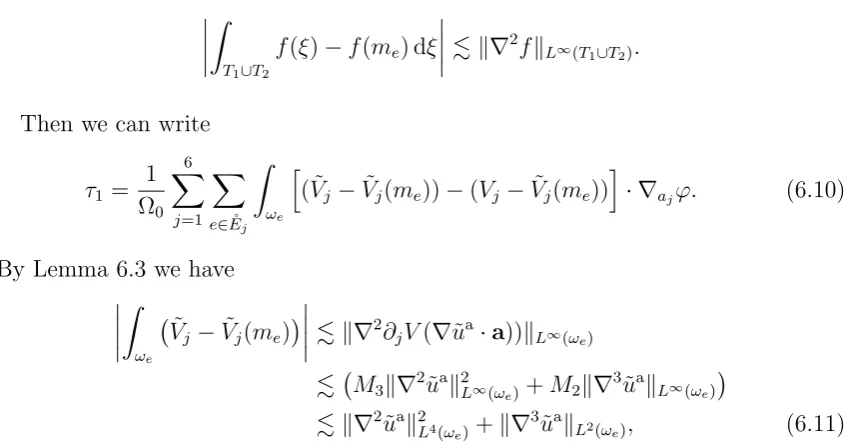
Lemma 6.3. Supposef ∈W2,∞(T1
∪T2;R) where T1, T2 ∈ T such that they share an edge e and let me be the mid-point of e, then
Z
T1∪T2
f(ξ)−f(me) dξ
.k∇
2f
kL∞(T1∪T2).
Then we can write
τ1 = 1 Ω0
6 X
j=1 X
e∈E˚j Z
ωe h
( ˜Vj −V˜j(me))−(Vj −V˜j(me))
i
· ∇ajϕ. (6.10)
By Lemma 6.3 we have
Z
ωe
˜
Vj−V˜j(me)
.k∇
2∂
jV(∇u˜a·a))kL∞(ωe)
. M3k∇2
˜
uak2
L∞(ωe)+M2k∇ 3
˜
uakL∞(ωe)
.k∇2u˜ak2
L4(ωe)+k∇3u˜akL2(ω
e), (6.11)
where the last line comes from the fact that ˜ua is a polynomial of degree 5 on each T, hence on each patch ωe the norms are equivalent.
On the other hand, for i= 1, ...6 we denoteνT,i and νT,i0 as the vertices ofT with
νT,i+ai =νT,i0. Then onT ⊃e, we have, using Taylor expansion,
∇ua
|T ·ai− ∇u˜a(me)·ai = ˜ua(νT,i0)−u˜a(νT,i)− ∇u˜a(me)·ai =τe,
where|τe| . k∇3u˜akL∞(ωe). Then for T1 and T2 with T1 ∩T2 = e = [νT,i, νT,i0], we
have
[∇ua(T1)·a
i− ∇u˜a(me)·ai] + [∇ua(T2)·ai− ∇u˜a(me)·ai] = 2τe.
Z
ωe
Vj−V˜j(me)
=
|T1|(Vj|T1 −V˜j(me)) +|T2|(Vj|T2 −V˜j(me))
=|T1|
6 X
i=1
∂j,iV(∇u˜a(me)·a)
h
∇ua|T1 ·ai− ∇u˜ a
(me)·ai
+∇ua|
T2 ·ai− ∇u˜ a(m
e)·ai
i
+O M3k∇2
˜
uak2
L∞(ωe)
.M2k∇3u˜ak
L∞(ωe)+M3k∇ 2u˜ak2
L∞(ωe).
Combining this estimate with (6.11), we have
τ1 .nk∇2u˜a k2
L4(Ωc)+k∇3u˜akL2(Ωc) o
k∇ϕkL2(Ωc).
Finally, combining the last estimate with (6.9) we obtain
δ3 .nk∇2
˜
uakL2(Ωi
+)+k∇ 2
˜
uak2
L4(Ωc)+k∇3u˜akL2(Ωc) o
k∇ϕkL2(Ωc). (6.12)
6.5. Estimation ofδ4. We observe thatδ4requires the estimation of pure modelling errors regardless of the choice of finite element approximation or domain truncation. This term was the main focus of [12], where the following result was proven.
Theorem 6.4 (Theorem 5.1 [12]). Let u : Λ → Rm and let ϕ : Λ → Rm with compact support, then
hδEg23(ua)
−δEa(ua), ϕ i
.
M2kD2uak`2(Iext)+M2kD3uak`2(C)+M3kD2uak2`4(C)
kDϕk`2(Λ\A),
where Iext :={`∈Λ|dist(`,I)≤1}.
By the construction of the smooth interpolant ˜u in Lemma 6.1 we therefore con-clude that
δ4 .(k∇2
˜
uakL2(Ωi)+k∇3u˜akL2(Ωc)+k∇2u˜ak2L4(Ωc))k∇ϕkL2(
R2\Ωa). (6.13)
6.6. Proof of Theorem 3.2. Recall from (6.1) the splitting of the consistency error intoηext and ηint. From the definition of ϕ in (6.4) it follows thatηext = 0.
In (6.2) the termηintis further split intoδ1, . . . , δ4which are respectively estimated in (6.6), (6.8), (6.12) and (6.13). Combining these four estimates, the stated result (3.3) follows.
We first estimate the decay rate of each term in the consistency estimate (3.3). Recall that Corollary 3.1 implies |∇ju˜a(x)| . |x|−1−j. Hence, we can estimate the
interface error by
k∇2u˜a
kL2(Ωi) . Z
Ωi| x|−6
12
.(K·K−6)12 .K−5/2. (6.14)
Similarly, we have
k∇3u˜a
kL2(Ωc) . Z
Ωc|
x|−8dx 12
. Z ∞
K
r·r−8dr 12
.K−3,
k∇2u˜ak2
L4(Ωc) . Z
Ωc| x|−12
dx 12
. Z ∞
K
r·r−12dr 12
.K−5,
k∇u˜ak
L2(
R\BN/2) . Z
R2\BN/2 |x|−4
dx !12
. Z ∞
N/2
r·r−4dr 12
.N−1. (6.15)
We observe that the interface term (6.14) dominates the consistency error. Balancing this with the far-field term (6.15) gives
N−1
≈K−5/2, i.e., N
≈K5/2.
To determine the mesh size h, we writeh(x) := |Kx|β. Then we have
kh2 ∇3u˜a
kL2(Ωc h) .
Z
Ωch |x|4β
K4β|x|
−8
dx !1/2
= 1
K2β
Z N
K
r·r4β−8dr 1/2
= 1
K2β
r4β−6r=N
r=K
1/2
≈K−3, provided that 4β−6<0.
The final remaining term is
N−1kh2∇2u˜ak
L2(B
N\BN/2) .N −1
Z
BN\BN/2 |x|4β
K4β|x|
−6
dx !1/2
.N2β−3
K−2β .K3β−152 .
Since we chose β <3/2, it follows that K−3 dominates K3β−152 .
Therefore, the error rate for the optimal finite element coarsening is K−3 and to
attain it we must choose
h(x)≈
|x| K
β
, where β < 3
2.
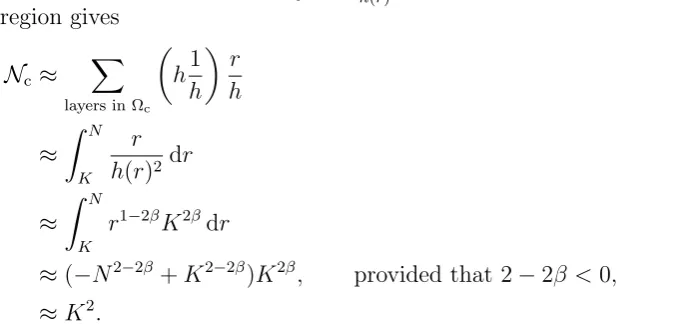
Finally, we estimate the relationship between the number of degrees of freedomNh
and the atomistic radiusK. It is easy to see that the number of degrees of freedom in the atomistic domain satisfies Na ≈ K2. Next, one can estimate the degrees of
mesh. On each layer with radius r, Nlayer ≈ h(rr). Summing over all layers in the
continuum region gives
Nc ≈ X
layers in Ωc
h1 h
r h
≈ Z N
K
r h(r)2 dr
≈ Z N
K
r1−2βK2βdr
≈(−N2−2β+K2−2β)K2β, provided that 2−2β <0, ≈K2.
Therefore, we deduce that the mesh grading should satisfy 1< β < 3
2 to obtain the
optimal cost/accuracy ratio for the error in the energy-norm, K−5/2 ≈ N−5/4
[image:26.595.143.490.98.263.2]h . The
table in§ 3.3.2 summarises the derivation of this section.
7. Proof of Theorem 3.4
7.1. Existence and error in energy norm. We refer to the inverse function theorem, Theorem 5.1. Let δGh := δEg23 −δf and ¯uh := Πhua. We have already
shown in Theorem 3.2 and Lemma 5.4 that
kGh(¯uh)kUh∗ ≤η,
hδGh(¯uh)vh, vhi ≥γk∇vhk2L2 for all vh ∈ Uh,
with η=ηint+ηext and
ηint .k∇2u˜a
kL2(Ωi)+k∇3u˜akL2(Ωc)+k∇2u˜ak2L4(Ωc)
+kh2∇3u˜ak
L2(Ωc
h)+k∇u˜ ak
L2(
R2\BN/2)+N −1
kh2∇2u˜ak
L2(B
N\BN/2) .Nh−5/4.
For ηext, recall that ∂u(`)f(u) = 0 for all|`| ≥Rf, and that K ≥Rf. We have, on
supp(∂u(`)f(u)), ∇Πhua =∇ua and ∇ϕh =∇ϕ. Thus ηext = 0 and
η=ηint .Nh−5/4.
Using also the Lipscthiz bound from Lemma 5.3 Theorem 5.1 implies, for K
sufficiently large, that there exists a strongly stable minimizerug23h ∈ Uh such that
hδEg23
(ug23h ), ϕhi − hδf(uhg23), ϕhi= 0, ∀ϕh ∈ Uh,
and
k∇ug23h − ∇ΠhuakL2 ≤2η γ .k∇2
˜
uakL2(Ωi)+k∇3u˜akL2(Ωc)+k∇2u˜ak2L4(Ωc)
+kh2 ∇3u˜a
kL2(Ωc)+k∇u˜akL2(
R2\BN/2)
Adding the best approximation error (6.7) gives
k∇ug23h − ∇uak
L2 ≤ k∇ug23h − ∇ΠhuakL2 +k∇Πhua− ∇uakL2 .Nh−5/4+kh2∇3u˜kL2(STc
h)+k∇u˜kL2(R2\BN/2) .Nh−5/4.
This completes the proof of Theorem 3.4.
7.2. The energy error. In this section we prove the energy error estimates stated in Theorem 3.4. For the sake of notational simplicity we define Ea
f := Ea−f and Efg23:=Eg23−f.
First, we observe that
|Efg23(u
g23
h )− E
a
f(u
a
)| ≤ |Efg23(u
g23
h )− E
g23
f (Πhua)|+|Efg23(Πhua)− Efa(u
a
)|
=:e1+e2.
The first term can be estimated by (3.6) and the fact that hδEfg23(u
g23
h ), ϕhi= 0 for
allϕh ∈ Uh:
e1 ≤ hδE
g23
f (u
g23
h ),Πhua−ug23h i
+ Z 1 0
(1−t)hδ2 Efg23(u
g23
h +t(Πhu
a
−ug23h ))(Πhua −ug23h ),(Πhua−ug23h )idt
.k∇Πhua− ∇uhg23k2L2 .K−5 .N −5/2
h . (7.1)
For the second term we use the fact thatEg23(0) =Ea(0), and henceEg23
f (0) =Efa(0),
to estimate
e2 ≤ |Efg23(0)− Efa(0)|+
Z 1 0
hδEfg23(tΠhua),Πhuaidt−
Z 1
0 hδEa
f(tua), uaidt
≤ Z 1 0
hδEg23
f (tΠhua),Πhuai − hδEfa(tua), vidt
+ Z 1 0 hδEa
f(tua), v−uai dt
=:e21+e22,
wherev : Λ→Rm is an arbitrary test function.
7.2.1. Estimate for e21. To exploit the consistency error estimate we choose v := Π∗
hΠhua defined in (6.4). In this case, similar to estimating ηint, we obtain
e21 . Z 1
0
˜
ηint(t) dtk∇ΠhuakL2(
R2\Ωah), where
˜
ηint(t) =k∇2tu˜ak
L2(Ωi)+k∇3tu˜akL2(Ωc)+k∇2tu˜ak2L4(Ωc)+kh2∇3tu˜akL2(Ωc h)
+k∇tu˜a
kL2(R2\B
N/2)+N −1
kh2 ∇2tu˜
kL2(B
N\BN/2) .tK−5/2.
From Corollary 3.1 and 6.2 it follows that|∇Πhva(x)|.|x|−2 hence we can deduce
that
e21.K−5/2K−1
=K−7/2
7.2.2. Estimate for e22. First we observe that by Trapezoidal rule, ifζ ∈C2(
R) and
ζ(0) =ζ(1) = 0, then we have for someθ ∈[0,1],
Z 1
0
ζ(t) dt=− 1
12ζ
00
(θ).
Letζ(t) := hδEa
f(tua), v −uai. Then ζ(1) = 0 since δEfa(ua) = 0 and ζ(0) = 0 since
δEa(0) = 0 and ∂
u(`)f(u) = 0 outside defect core while v =ua in the defect core.
Having e22=R1
0 ζ(t) dt we obtain e22.δ3
Ea(θua)[ua, ua, v −ua]
.M3 X
`∈Λ\A
|Dua(`)|2|Dv(`)−Dua(`)|
. Z
R2\Ωa|∇
˜
ua|2
|∇v− ∇ua|,
where we recall thatv := Π∗
hΠhua. Using the stability (6.5) we obtain
e22 .k∇u˜ak3
L3(R2\Ωa)+k∇u˜ak2L4(R2\Ωa)k∇ΠhuakL2(
R2\Ωa)
. Z ∞
K
rr−6 dr+
Z ∞
K
rr−8 dr
1/2 Z ∞
K
rr−4 dr 1/2
.K−4+K−3K−1 =K−4. (7.3)
Combining (7.1), (7.2) and (7.3) completes the proof of the energy error estimate (3.7) and therefore of our main result, Theorem 3.4.
References
[1] G. Acosta and R. G. Duran. An optimal poincar inequality in l1 for convex domains.Proc. AMS 132(1), 195-202, 2003.
[2] C. Carstensen. Quasi-interpolation and a posteriori error analysis in finite element methods.
M2AN Math. Model. Numer. Anal., 33:1187–1202, 1999.
[3] W. E, J. Lu, and J. Z. Yang. Uniform accuracy of the quasicontinuum method.Phys. Rev. B, 74(21):214115, 2006.
[4] V. Ehrlacher, C. Ortner, and A. V. Shapeev. Analysis of boundary conditions for crystal defect atomistic simulations, 2013.
[5] X. H. Li, C. Ortner, A. Shapeev, and B. Van Koten. Analysis of blended atomistic/continuum hybrid methods.ArXiv e-prints, 1404.4878, 2014.
[6] M. Luskin and C. Ortner. Atomstic-to-continuum coupling. Acta Numerica, 22:397 – 508, 2013.
[7] C. Ortner. The role of the patch test in 2D atomistic-to-continuum coupling methods.ESAIM Math. Model. Numer. Anal., 46, 2012.
[8] C. Ortner and A. Shapeev. Interpolation of lattice functions and applications to atom-istic/continuum multiscale methods. manuscript.
[9] C. Ortner, A. Shapeev, and L. Zhang. (in-)stability and stabilisation of qnl-type atomistic-to-continuum coupling methods, 2014.
[10] C. Ortner and E. S¨uli. A note on linear elliptic systems on Rd. ArXiv e-prints, 1202.3970, 2012.
[11] C. Ortner and L. Zhang. Atomistic/continuum blending with ghost force correction. ArXiv:1407.0053, to appear in SISC.
[13] Christoph Ortner. A priori and a posteriori analysis of the quasinonlocal quasicontinuum method in 1D.Math. Comp., 80(275):1265–1285, 2011.
[14] C. Schwab. p- and hp- finite element methods: theory and applications in solid and fluid mechanics. Oxford Universiy Press, Oxford, 1998.
[15] T. Shimokawa, J. J. Mortensen, J. Schiotz, and K. W. Jacobsen. Matching conditions in the quasicontinuum method: Removal of the error introduced at the interface between the coarse-grained and fully atomistic region.Phys. Rev. B, 69(21):214104, 2004.
A. Dedner, Mathematics Institute, Zeeman Building, University of Warwick, Coventry CV4 7AL, UK
E-mail address: [email protected]
C. Ortner, Mathematics Institute, Zeeman Building, University of Warwick, Coventry CV4 7AL, UK
E-mail address: [email protected]
H. Wu, Mathematics Institute, Zeeman Building, University of Warwick, Coven-try CV4 7AL, UK