warwick.ac.uk/lib-publications
Original citation:
Ashoor, Huda M., Lillie, Erin, Zarin, Wasifa, Pham, Ba’, Khan, Paul A., Nincic, Vera, Yazdi, Fatemeh, Ghassemi, Marco, Ivory, John, Cardoso, Roberta, Perkins, Gavin D., de Caen, Allan R. and Tricco, Andrea C.. (2017) Effectiveness of different compression-to-ventilation methods for cardiopulmonary resuscitation : a systematic review. Resuscitation
Permanent WRAP URL:
http://wrap.warwick.ac.uk/89631
Copyright and reuse:
The Warwick Research Archive Portal (WRAP) makes this work by researchers of the University of Warwick available open access under the following conditions. Copyright © and all moral rights to the version of the paper presented here belong to the individual author(s) and/or other copyright owners. To the extent reasonable and practicable the material made available in WRAP has been checked for eligibility before being made available.
Copies of full items can be used for personal research or study, educational, or not-for-profit purposes without prior permission or charge. Provided that the authors, title and full bibliographic details are credited, a hyperlink and/or URL is given for the original metadata page and the content is not changed in any way.
Publisher’s statement:
© 2017, Elsevier. Licensed under the Creative Commons Attribution-NonCommercial-NoDerivatives 4.0 International http://creativecommons.org/licenses/by-nc-nd/4.0/
A note on versions:
The version presented here may differ from the published version or, version of record, if you wish to cite this item you are advised to consult the publisher’s version. Please see the ‘permanent WRAP url’ above for details on accessing the published version and note that access may require a subscription.
1
Effectiveness of Different Compression-to-Ventilation Methods for
1
Cardiopulmonary Resuscitation: A Systematic Review
2
Huda M. Ashoora, BSc Email: [email protected]
3
Erin Lilliea, MSc Email: [email protected]
4
Wasifa Zarina, MPH Email: [email protected]
5
Ba’ Phama, b, MSc PhD Email: [email protected]
6
Paul A. Khana, MSc PhD Email: [email protected]
7
Vera Nincica, PhD Email: [email protected]
8
Fatemeh Yazdia, MSc Email: [email protected]
9
Marco Ghassemia, MSc Email: [email protected]
10
John Ivorya, MSc Email: [email protected]
11
Roberta Cardosoa, RN PhD Email: [email protected]
12
Gavin D. Perkinsc, MD Email: [email protected]
13
Allan R. de Caend, MD Email: [email protected]
14
Andrea C. Triccoa, e, *, MSc PhD Email: [email protected]
15
a Li Ka Shing Knowledge Institute, St. Michael’s Hospital, 209 Victoria Street, Toronto, Ontario,
16
2
b Toronto Health Economics and Technology Assessment Collaborative, Faculty of Pharmacy
18
and Institute of Health Policy Management Evaluation, University of Toronto, 144 College 19
Street, Toronto, Ontario, Canada, M5S 3M2 20
c University of Warwick, Warwick Medical School and Heart of England NHS Foundation Trust,
21
Coventry, CV4 7AL, United Kingdom 22
d Stollery Children's Hospital, University of Alberta, 8440 112 Street Northwest, Edmonton,
23
Alberta, Canada, T6G 2B7 24
e Epidemiology Division, Dalla Lana School of Public Health, University of Toronto, Health
25
Sciences Building, 155 College Street, 6th floor, Toronto, Ontario, Canada, M5T 3M7
26
*Corresponding Author
27
Dr. Andrea Tricco 28
Scientist, Knowledge Translation 29
Li Ka Shing Knowledge Institute, St. Michael’s Hospital, 30
209 Victoria Street, East Building, Toronto, Ontario, M5B 1W8, Canada 31
Phone: 416-864-6060, Fax: 416-864-5805, Email: [email protected]
32
Collaborators (ILCOR Basic Life Support Task Force):
33
AHA - American Heart Association; ANZCOR - Australian & New Zealand Committee on
34
Resuscitation; ERC - European Resuscitation Council; HSFC - Heart & Stroke Foundation of
35
Canada; IAHF - Inter-American Heart Foundation; RCA - Resuscitation Council of Asia; RCSA
36
- Resuscitation Council of Southern Africa
37
Alfredo Sierra (IAHF) 38
3 Christian Vaillancourt (HSFC)
40
David Stanton (RCSA) 41
Julie Considine (ANZCOR) 42
Kevin Nation (ANZCOR) 43
Maaret Castren (ERC) 44
Michael Sayre (AHA) 45
Raffo Escalante (IAHF) 46
Raul Gazmuri (AHA) 47
Robert Berg (AHA) 48
Ruud Koster (ERC) 49
Swee Han Lim (RCA) 50
Tetsuya Sakamoto (RCA) 51
Theresa Mariero Olasveengen (ERC) 52
Word Count: 309 (abstract [250 max]), 3,413 (main text [4,000 max]), 4 figures, 4 tables, 2 53
4
ABSTRACT
55
Aim: To compare the effectiveness of different compression-to-ventilation methods during
56
cardiopulmonary resuscitation (CPR) in patients with cardiac arrest. 57
Methods: We searched MEDLINE and Cochrane Central Register of Controlled Trials from 58
inception until January 2016. We included experimental, quasi-experimental, and observational 59
studies that compared different chest compression-to-ventilation ratios during CPR for all 60
patients and assessed at least one of the following outcomes: favourable neurological outcomes, 61
survival, return of spontaneous circulation (ROSC), and quality of life. Two reviewers 62
independently screened literature search results, abstracted data, and appraised the risk of bias. 63
Random-effects meta-analyses were conducted separately for randomised and non-randomised 64
studies, as well as study characteristics, such as CPR provider. 65
Results: After screening 5,703 titles and abstracts and 229 full-text articles, we included 41 66
studies, of which 13 were companion reports. For adults receiving bystander or dispatcher-67
instructed CPR, no significant differences were observed across all comparisons and outcomes. 68
Significantly less adults receiving bystander-initiated or plus dispatcher-instructed compression-69
only CPR experienced favourable neurological outcomes, survival, and ROSC compared to CPR 70
30:2 (compression-to-ventilation) in un-adjusted analyses in a large cohort study. Evidence from 71
emergency medical service (EMS) CPR providers showed significantly more adults receiving 72
CPR 30:2 experiencing improved favourable neurological outcomes and survival versus those 73
receiving CPR 15:2. Significantly more children receiving CPR 15:2 or 30:2 experienced 74
favourable neurological outcomes, survival, and greater ROSC compared to compression-only 75
CPR. However, for children <1 years of age, no significant differences were observed between 76
5
Conclusions: Our results demonstrated that for adults CPR 30:2 is associated with better 78
survival and favourable neurological outcomes when compared to CPR 15:2. For children, more 79
patients receiving CPR with either 15:2 or 30:2 compression-to ventilation ratio experienced 80
favourable neurological function, survival, and ROSC when compared to CO-CPR for children 81
6
INTRODUCTION
83
Out-of-hospital cardiac arrest (OHCA) is a leading cause of mortality worldwide with millions of 84
lives lost every year.1 Less than 10% of people with OHCA who receive treatment survive to
85
hospital discharge.2 Cardiopulmonary resuscitation (CPR) is important for patient survival of
86
sudden cardiac arrest; however, bystander CPR rates remain very low globally.3
87
CPR involves chest compressions and ventilations to maintain cardio-cerebral perfusion while 88
attempting to restart the heart.4 Although CPR is undoubtedly life-saving, it can be challenging
89
to learn and difficult to perform. A barrier to attempting CPR is the administration of rescue 90
breaths (i.e., mouth-to-mouth ventilation).5 In addition, evidence suggests that prolonged
91
interruptions in chest compressions to deliver ventilations may be harmful. Attempts to 92
overcome these problems have led to the development of compression-only resuscitation and 93
minimally-interrupted chest compression techniques. However, uncertainty exists about the 94
effectiveness of these newer techniques, and whether effects differ depending on the CPR 95
provider, setting, and characteristics of recipients. 96
We aimed to determine the effectiveness of different compression-to-ventilation methods during 97
CPR regarding favourable neurological outcomes, survival, return of spontaneous circulation 98
(ROSC), and quality of life among patients experiencing cardiac arrest, and whether this differed 99
7
METHODS
101
Protocol
102
The protocol was drafted using the Preferred Reporting Items for Systematic Reviews and Meta-103
analysis Protocols (PRISMA-P)6 in collaboration with clinical experts from the International
104
Liaison Committee on Resuscitation (ILCOR) (Appendix A) and registered with PROSPERO 105
(CRD42016047811). 106
Eligibility criteria
107
The eligibility criteria based on PICOST (Population, Intervention, Control, Outcomes, Study 108
design and Timeframe) were:7
109
Population: Patients of all ages (i.e., neonates, children, adults) with cardiac arrest from any 110
cause and across all settings (in-hospital and out-of-hospital). Studies that included animals were 111
not eligible. 112
Intervention: All manual CPR methods including Compression-only CPR (CO-CPR), 113
Continuous Compression CPR (CC-CPR), and CPR with different compression-to-ventilation 114
ratios. CO-CPR included compression with no ventilations, while CC-CPR included 115
compression with asynchronous ventilations or minimally-interrupted cardiac resuscitation 116
(MICR) (Appendix B). Studies that mentioned the use of a mechanical device during CPR were 117
only considered if the same device was used across all relevant intervention arms and would 118
therefore not confound the observed effect. 119
Comparators: Studies had to compare at least two different CPR methods from the eligible 120
8
Outcomes: The primary outcome was favourable neurological outcomes, measured by cerebral 122
performance or a modified Rankin Score. Secondary outcomes were survival, ROSC, and quality 123
of life. 124
Study designs: Randomised controlled trials (RCTs) and non-randomised studies (non-125
randomised controlled trials, interrupted time series, controlled before-and-after studies, cohort 126
studies) were eligible for inclusion. Study designs without a comparator group (e.g., case series, 127
cross-sectional studies), reviews, and pooled analyses were excluded. 128
Other: We excluded unpublished studies (e.g., conference abstracts, trial protocols), and non-129
English papers. 130
Information sources and literature search
131
MEDLINE and the Cochrane Central Register of Controlled Trials were searched from inception 132
until January 2016. An experienced librarian developed the original search strategy. 133
The final search strategy was conducted on January 15, 2016 (Appendix C). The unique results 134
from the literature search were uploaded to proprietary online screening software, Synthesi.SR.8
135
The literature search was supplemented by scanning the references of all studies included in the 136
previous ILCOR reviews, and additional studies identified by the ILCOR content experts. 137
Study selection
138
A training exercise was conducted prior to commencing study selection using the predefined 139
eligibility criteria (Appendix D) on a random sample of 25 titles and abstracts (i.e., level 1 140
screening). A similar training exercise was conducted for the screening of a random sample of 24 141
potentially relevant full-text articles (i.e., level 2 screening). The team established 75% 142
9
Subsequently, pairs of reviewers screened citations independently for inclusion at level 1 (EL, 144
FY, HMA, JI, MG, PAK, RC, TL, VN) and level 2 (FY, JI, MG, PAK, RC, VN) screening. All 145
discrepancies were resolved by discussion or the involvement of a third reviewer (HMA, ACT) 146
and/or clinical expert (GDP, ADC). 147
Data items and data abstraction
148
A standardized data abstraction form was developed and pilot-tested prior to beginning data 149
abstraction. Data items were study characteristics (e.g., study design, year of conduct), patient 150
characteristics (e.g., number of patients, mean age, and initial rhythm), CPR methods and 151
outcomes (e.g., compressions-to-ventilations ratios, scale used, time point, results). Outcomes 152
were abstracted according to the Utstein-style guidelines for resuscitation research.9
153
Companion reports (i.e., multiple publications reporting results from the same study participants) 154
were identified by discerning overlap in study period, geographic location, setting, and type of 155
CPR method. The publication with the longest follow-up period was considered the main 156
publication and companion reports were only used to supplement the data abstracted from the 157
main publication. 158
After approximately 75% agreement was achieved, pairs of reviewers (FY, JI, MG, PK, RC, VN) 159
independently abstracted all relevant information from each article. All discrepancies were 160
resolved by discussion or involvement of a third reviewer (EL, WZ). We contacted authors for 161
relevant missing information and to provide clarification; for example, to obtain a breakdown of 162
patient population by age. Clinical experts assisted in coding the appropriate CPR provider type, 163
intervention and aetiology categories across the studies. 164
Risk of bias
10
The Cochrane Risk-of-Bias Tool10 was used for appraising RCTs and quasi-RCTs; Cochrane
166
Effective Practice and Organization of Care (EPOC) Risk-of-Bias Tool11 was used for
cluster-167
crossover RCTs, non-randomised controlled trials, interrupted time series, and controlled before-168
and-after studies; and Newcastle-Ottawa Scale was used for cohort studies.12 Experienced pairs
169
of reviewers (FY, JI, MG, PAK, RC, VN) independently appraised the risk of bias of all included 170
studies with discrepancies resolved by a third reviewer (EL, WZ). 171
Synthesis of results
172
Intervention effects (e.g., CO-CPR versus CPR 30:2 compression-to-ventilation ratio) were 173
summarized using un-adjusted risk ratios (RR) and risk differences (RD) and pooled via random-174
effects meta-analysis. We assessed statistical heterogeneity using the I2 statistic,13 with an I2
175
value above 75% indicative of substantial heterogeneity.13 All statistical analyses were
176
conducted using the metafor package in R (version 3.2.3).14
177
For the main analysis, the intervention effect estimates were derived separately for RCTs and 178
non-randomised studies, as well as for adults and children. For survival, the main analysis was 179
conducted using the longest duration of follow-up, yet we also conducted a sensitivity analysis 180
using the survival data closest to the timing of CPR. As well, a series of subgroup analyses were 181
conducted exploring the impact of factors potentially affecting the intervention effect estimates, 182
including aetiology of cardiac arrest, emergency medical service (EMS) response times, initial 183
rhythm, and percentage of arrests that were witnessed. 184
Although not previously specified in the review protocol, we stratified overall results by CPR 185
11
instructed CPR (telephone CPR), 3) bystander delivered CPR, 4) CPR delivered by EMS staff, 187
and 5) CPR delivered by hospital staff. 188
GRADE appraisal
189
Using the Grading of Recommendation, Assessment, Development, and Evaluation (GRADE) 190
guidance,15 we assessed the quality (or certainty) of the available evidence. This was conducted
191
by three reviewers (HMA, EL, WZ) and verified by the study guarantor and content experts 192
(ACT, GDP, ADC). Studies looking at before-and-after guideline changes were considered 193
“indirect evidence” because multiple aspects of treatment were likely to have changed over time, 194
12
RESULTS
196
Literature search
197
After screening 5,703 titles and abstracts and 229 potentially relevant full-text articles, 28 198
studies2, 16-42 and 13 companion reports39, 40, 43-54 fulfilled our eligibility criteria and were
199
included (Figure 1). 200
Study characteristics
201
Included studies were published between 1993 and 2015 with a study period ranging from 1983 202
to 2015 (Table 1; Appendix F). We included one cluster-crossover RCT,16 three RCTs,20, 23, 24
203
and 24 cohort studies.2, 17-19, 21, 22, 25-42 Most studies were conducted in the USA and Japan (n=16),
204
involving OHCAs (n=27), while one31 was conducted in a hospital setting.
205
Nine studies17, 18, 20, 29, 33, 35, 37, 39, 41 included cardiac arrests with cardiac causes, 13 papers2, 19,
24-206
28, 30, 34, 36, 38, 40, 42 included both cardiac and non-cardiac causes, and one paper21 included
non-207
cardiac causes. CPR was provided by: EMS personnel,16-18, 25, 27, 29, 30, 32, 33, 36, 41 bystanders,19, 21,
208
22, 26, 34, 35, 37, 38 bystanders receiving dispatcher instructions,20, 23, 24 bystander alone or with
209
dispatcher instructions,2, 28 and emergency department staff.31 Most studies (n=16)2, 16, 17, 19, 20, 22,
210
23, 25, 30-33, 35, 36, 38, 40 did not restrict the study population by initial rhythm, six24, 26, 29, 34, 39, 41
211
included only patients with initial shockable rhythm, and one 27 included patients with initial
212
non-shockable rhythm. 213
Patient characteristics
214
Twenty studies16-21, 24-34, 36, 39, 40 included adults, two28, 38 included children, and six2, 23, 35, 37, 41, 42
215
included both adults and children (Table 1; Appendix G). The overall number of CPR recipients 216
13
The mean age reported for adult-only studies ranged from 56.9 years (SD 18.6) to 74.1 years (SD 218
14.9), and was 4.9 years (SD 6.1) for paediatric-only studies. 219
Risk of bias results
220
Three RCTs were appraised with the Cochrane risk-of-bias tool (Appendix H). One trial24 had an
221
unclear random sequence generation, while another20 had unclear allocation concealment, and
222
the third trial23 had a high risk of bias due to blinding of personnel, as well as incomplete
223
outcome data bias. One cluster-crossover RCT16 assessed using the EPOC risk-of-bias tool
224
(Appendix I) had an unclear risk of bias for random sequence generation, as well as for 225
allocation concealment; all other items were scored as low risk of bias. 226
For the 23 cohort studies, the main methodological shortcoming was related to the comparability 227
of cohorts on the basis of the design or analysis, as the majority did not adjust for potential 228
confounding variables (Appendix J). In addition, the majority of the cohort studies did not report 229
the duration of follow-up.17, 22, 25-28, 30-34, 36, 37, 40-42 230
Reporting results
231
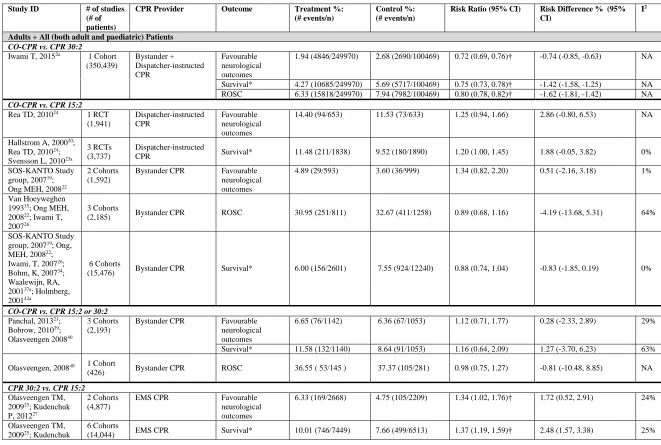
Results of the main analysis stratified by patient age, CPR comparisons, provider, and outcome 232
are presented below, as well as in Table 2. Only statistically significant findings are presented in 233
the text, but all results are presented in Table 1, where it can be observed that statistically 234
significant results were not found for the following comparisons: CO-CPR versus CPR 15:2 in 235
mostly adult patients and CO-CPR versus CPR 30:2 or CPR 15:2 in mostly adult patients. Unless 236
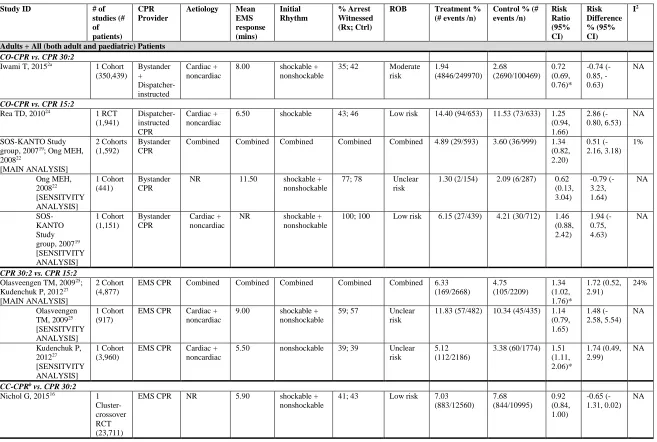
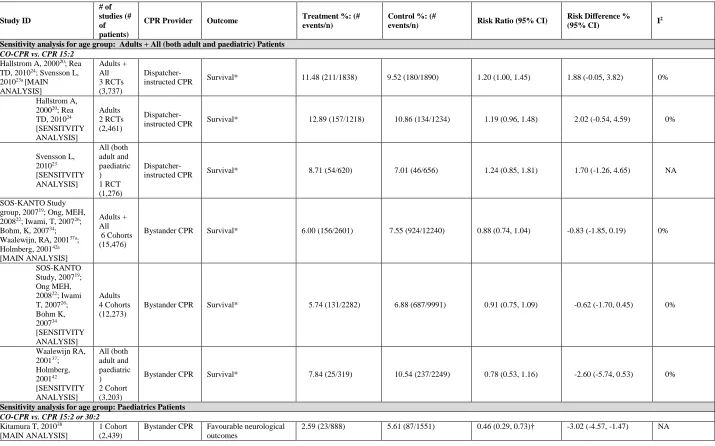
otherwise noted, sub-group analyses (Table 3) and sensitivity analyses (Table 4) demonstrated 237
consistent results with the main analyses. For all studies not included in the meta-analyses 238
14
CO-CPR vs. CPR 30:2 (adults)
240
For bystanders plus dispatcher-instructed CPR, one cohort study2 of 350,439 mostly adult
241
patients found that significantly less patients receiving CO-CPR experienced favourable 242
neurological outcomes (RD 0.74, 95% CI: 0.85, 0.63), survived (RD 1.42, 95% CI: 1.58, -243
1.25), and experienced ROSC (RD -1.62, 95% CI: -1.81, -1.42) compared to CPR 30:2. 244
CPR 30:2 vs CPR 15:2 (adults)
245
For EMS CPR, a meta-analysis of two cohort studies25, 27 with 4,877 adults found that
246
significantly more patients receiving CPR 30:2 experienced favourable neurological outcomes 247
(RD 1.72, 95% CI: 0.52, 2.91) compared to CPR 15:2. A meta-analysis of six cohort studies17, 25,
248
27, 30, 33, 36 with 13,962 adults revealed that significantly more patients receiving CPR 30:2
249
survived (RD 2.48, 95% CI: 1.57, 3.38) compared to CPR 15:2. The results for ROSC were not 250
statistically significant. 251
CPR 50:2 vs CPR 15:2 (adults)
252
For EMS CPR, one cohort study29 of 200 adults found that significantly more patients receiving
253
CPR 50:2 survived (RD 21.48, 95% CI: 6.90, 36.06) and experienced ROSC (RD 21.89, 95% CI: 254
6.88, 36.90) compared to CPR 15:2. 255
CC-CPR (with asynchronous ventilations at a rate of 10 per minute) vs. CPR 30:2 (adults)
256
For EMS CPR, one cluster-crossover RCT16 including 23,711 adults found significantly less
257
patients receiving CC-CPR experienced ROSC (RD -1.15, 95% CI: -2.25, -0.05) compared to 258
15
survival were not statistically significant. Results were also found not to be significant for ROSC 260
(RD −1.1, 95% CI:-2.4, 0.1) when adjusted for confounding variables. 261
CC-CPR (with minimally interrupted cardiac resuscitation) vs. CPR 15:2 (adults)
262
For EMS CPR, one cohort study18 of 181 adults found that significantly more patients receiving
263
CC-CPR experienced favourable neurological outcomes (RD 24.11, 95% CI: 11.58, 36.63) 264
compared to CPR 15:2. 265
CC-CPR (with minimally interrupted cardiac resuscitation) vs. CPR 15:2 or 30:2 (adults)
266
For EMS CPR, one cohort study41 with 2,460 mostly adult patients found that significantly more
267
patients receiving CC-CPR survived (RD 5.24, 95% CI: 2.88, 7.6) and experienced ROSC (RD 268
10.64, 95% CI: 6.80, 14.49) compared to CPR 15:2 or 30:2. The results for favourable 269
neurological outcomes were not statistically significant. 270
CC-CPR (with asynchronous positive-pressure ventilations delivered by a Thumper device) vs.
271
CPR 5:1(adults)
272
For in-hospital CPR, one cohort study31 of 515 adults found that significantly more patients
273
receiving CC-CPR survived (RD 5.86 95% CI: 1.19, 10.53), and experienced ROSC (RD 11.64, 274
95% CI: 3.61, 19.68) compared to CPR 5:1. The results for favourable neurological outcomes 275
were not statistically significant. 276
CO-CPR vs. CPR 30:2 (Paediatrics)
277
For bystander plus dispatcher-instructed CPR, one cohort study28 of 2,617 children (mean age:
278
16
outcomes (RD -3.30, 95% CI: -4.88, -1.71), and survived (RD -7.04, 95% CI: -9.58, -4.50) 280
compared to CPR 30:2. 281
CO-CPR vs. CPR 15:2 or 30:2 (Paediatrics)
282
For bystander CPR, one cohort study38 of 2,439 paediatric (mean age: 4.9yrs) patients found
283
significantly less patients receiving CO-CPR experienced favourable neurological outcomes (RD 284
-3.02, 95% CI: -4.57, -1.47) or survived (RD -2.98, 95% CI: -5.51, -0.45) compared to CPR 15:2 285
or 30:2. The results for ROSC were not statistically significant. 286
Quality of life
287
None of the included studies reported data on quality of life. 288
GRADE (Appendix L)
289
The only results of high certainty in this systematic review were those for favourable 290
neurological outcomes, survival, and ROSC, in one cluster-crossover RCT16 which compared
291
17
DISCUSSION
293
For adults, our results suggest no statistically significant differences across all outcomes and 294
comparisons for those receiving bystander-initiated CPR alone or dispatcher-instructed CPR with 295
or without ventilations. Significantly less adults receiving bystander plus dispatcher-instructed 296
CO-CPR experienced favourable neurological outcomes, survival, and ROSC compared to CPR 297
30:2. As well, significantly more patients receiving EMS CPR 30:2 experienced favourable 298
neurological outcomes and survival compared to CPR 15:2. 299
For children, the results varied by the patients’ age. CPR 15:2 or 30:2 compression-to-ventilation 300
ratios showed more children with favourable neurological outcomes, survival, and ROSC when 301
compared to CO-CPR for children of all ages. However, no statistically significant differences 302
were observed across these outcomes for children less than one year old. In addition, only two 303
studies with small sample sizes of children were identified for inclusion in our review. As such, 304
our results might be affected by a lack of power to show a true effect in this population. Two 305
additional studies have been published since our literature search was conducted and should be 306
considered to inform guidelines for paediatric population. The studies by Fukuda and Naim 307
examined CO-CPR compared to conventional CPR for paediatric population and both found 308
conventional CPR to be associated with improved outcomes for paediatrics, which was 309
consistent with our results.55, 56
310
The findings from this review and meta-analysis require interpretation in the context of the 311
settings where the interventions were applied. The 2015 consensus on science and treatment 312
recommendations for dispatcher instructions noted that CPR instructions are associated with 313
increased performance of CPR and better patient outcomes.57 The finding of no statistically
314
18
dispatcher-instructed CO-CPR58 supports ILCOR’s recommendation for dispatcher-instructed
316
CO-CPR. For bystander-initiated CPR, Iwami found that any CPR is better than no CPR,2 in
un-317
adjusted analyses CPR 30:2 compression-to-ventilation was associated with the best outcomes in 318
adults. Iwami adjusted for measured confounding variables for no CPR versus CO-CPR or 319
conventional CPR and found similar odds ratios across the two comparisons. Iwami eloquently 320
notes “the most important result from this nationwide registry of OHCA is not the comparison of 321
odds ratios (ORs) between CCCPR and conventional CPR but the increase in the total incidence 322
of survival with favourable neurological outcomes attributed to either type of bystander CPR”.2
323
This review supports ILCOR’s current recommendation that all victims of cardiac arrest should 324
receive chest compressions. For those trained and willing to give rescue-breaths, our findings 325
support that additional benefits can be achieved from CPR with a synchronous compression-to-326
ventilation ratio. 327
Of note, a meta-analysis by Hupfl59 compared CO-CPR to conventional CPR and found the same
328
three RCTs20, 23, 24 as our systematic review with the same findings for survival at discharge.
329
Also a recent Cochrane review60 which included four studies demonstrated the same findings as
330
our review. 331
There are some limitations of the included studies worth noting. All three RCTs had unclear risk 332
of bias for at least one important criterion, and one of the RCTs had a high risk of bias for two 333
components. In the discussion of one trial publication,23 authors observed that some dispatchers
334
seemed to have had aprejudice against CO-CPR and a preference for standard CPR, while some
335
callers indicated a preference for a CPR technique irrespective of the randomised intervention. 336
This issue may also have impacted the other studies. The included cohort studies were 337
19
Consequently, those results might not be reliable and should be interpreted with caution. 339
Additionally, a small number of studies where the focus was not to compare different 340
compression-to-ventilation ratios (though these data were featured in sub-group analyses) were 341
included, after having been identified by the content experts. It is possible that similar studies 342
could have been missed during our screening process. Also we identified several studies 343
examining minimally-interrupted cardiac resuscitation delivered by EMS from Arizona. In some 344
of these cases, the evaluation appeared to run concurrently with a community campaign of 345
bystander compression-only CPR.21, 39 It was difficult to precisely determine the overlap in
346
patient populations reported in these studies. For example, whilst it was clear that some studies 347
examined specific sub-groups who received MICR (e.g. age),61, 62 there appeared to be overlap in
348
the patient populations evaluated between reports.18, 41, 43 To minimize the risk of including
349
individual patients more than once in our meta-analysis, we limited our analysis to the Bobrow, 350
200841 paper as we judged this to be the most comprehensive study that was aligned with our
351
specific PICO question. Finally, the studies we evaluated included a variety of settings where 352
EMS systems and response times may vary and for some studies it was not possible to separate 353
paediatric from adult cases. 354
There are strengths that are worth noting in our review approach. Our team is multidisciplinary, 355
including content experts, systematic review methodologists, a statistician, and trained 356
systematic review staff. All levels of screening and data abstraction were conducted after a pilot-357
test and were done in duplicate, with discrepancies verified by a third reviewer. We also assessed 358
the quality of the totality of the evidence using GRADE. However, there are some limitations to 359
be noted, such as limiting to published studies only written in English. The majority of studies 360
20
and unmeasured confounding factors. In our analyses we only included un-adjusted estimates 362
because only four of the included papers16, 28, 31, 41 undertook analyses which adjusted for
363
potentially confounding variables (Appendix K). Also, since there were fewer than 10 studies in 364
the meta-analyses63, we were unable to statistically assess for publication bias.
365
In terms of areas identified for future research, we did not find any studies that measured quality 366
of life. This is an important patient-related outcome that needs to be considered in future studies. 367
In addition, none of the included studies provided data on neonates. Thus, for this population it 368
might be necessary to use indirect evidence from paediatric studies or animal models to 369
21
CONCLUSIONS
371
For adults, our results demonstrated that CPR 30:2 is associated with better survival and 372
favourable neurological outcomes when compared to CPR 15:2. For children, more patients 373
receiving CPR with either 15:2 or 30:2 compression-to ventilation ratio experienced favourable 374
neurological function, survival, and ROSC when compared to CO-CPR for children of all ages, 375
22
CONFLICTS OF INTEREST
377
Dr. Gavin Perkins and Dr. Allan deCaen are both affiliated with ILCOR, the commissioning 378
committee of this review. All other authors have no known conflicts of interest to declare. 379
FUNDING
380
The source of funding for this work was the International Liaison Committee on Resuscitation 381
(ILCOR). GDP is supported as a National Institute for Health Research (NIHR) Senior 382
Investigator and Director of Research for the Intensive Care Foundation. ACT is funded by a 383
Tier 2 Canada Research Chair in Knowledge Synthesis. The funders had no role in study design, 384
data collection and analysis, decision to publish, or preparation of the manuscript. 385
ACKNOWLEDGEMENTS
386
We thank Dr. Jessie McGowan for revising and executing the literature searches, Alissa Epworth 387
for obtaining the included studies, Susan Le for formatting the manuscript, and Dr. Sharon Straus 388
for providing critical feedback on the report. We also would like to thank the ILCOR BLS task 389
force for their contribution to the design and conduct of the systematic review and for their 390
interpretation of the findings. 391
LIST OF ABBREVIATIONS
392
CA – cardiac arrest; CC-CPR – continuous compression CPR; CI – confidence interval; CO-393
CPR – compression-only CPR; CPR – cardiopulmonary resuscitation; EMS – emergency 394
medical service; EPOC – Effective Practice and Organization of Care; GRADE – Grading of 395
Recommendation, Assessment, Development, and Evaluation; ILCOR BLS – International 396
Liaison Committee on Resuscitation Basic Life Support; MICR – minimally-interrupted cardiac 397
23
Intervention, Control, Outcomes, Study design and Timeframe; PRESS – Peer Review of 399
Electronic Search Strategies; PRISMA-P – Preferred Reporting Items for Systematic Reviews 400
and Meta-analysis Protocols; RCTs – randomised controlled trials; RD – risk differences; ROSC 401
– return of spontaneous circulation; RR – risk ratio; SD – standard deviation 402
LEGENDS TO FIGURES
403
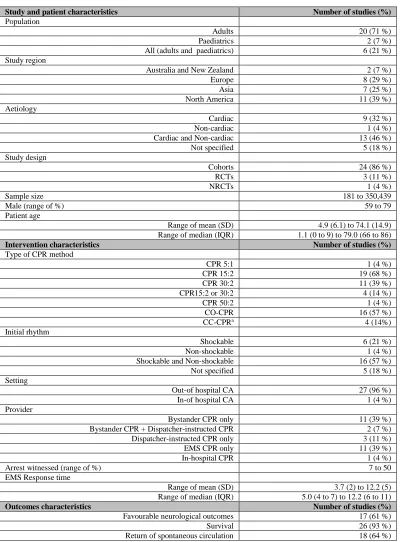
Table 1: Summary characteristics 404
Table 2: Main analysis stratified by patient age, CPR comparisons, provider, and outcome 405
Table 3. Subgroup Analysis - Favourable Neurological Outcomes 406
Table 4. Sensitivity Analysis 407
Figure 1. Flow chart 408
Figure 2. Forest plots of risk ratio for favourable neurological outcomes, ROSC and survival 409
with CO-CPR vs. CPR 15:2. Treatment effect is measured using risk ratio estimate (95% 410
confidence interval), with values ≥1 indicating that treatment is more effective than control. 411
Figure 3. Forest plots of risk ratio for favourable neurological outcomes and survival with CO-412
CPR vs. CPR 15:2 or 30:2 Treatment effect is measured using risk ratio estimate (95% 413
confidence interval), with values ≥1 indicating that treatment is more effective than control.) 414
Figure 4. Forest plots of risk ratio for favourable neurological outcomes, ROSC and survival 415
with CPR 30:2 vs. CPR 15:2. Treatment effect is measured using risk ratio estimate (95% 416
confidence interval), with values ≥1 indicating that treatment is more effective than control. 417
SUPPLEMENTARY FILES
418
Supplementary File 1: Appendix (A-L) 419
24
Table 1. Summary Characteristics
421
Study and patient characteristics Number of studies (%)
Population
Adults 20 (71 %)
Paediatrics 2 (7 %)
All (adults and paediatrics) 6 (21 %) Study region
Australia and New Zealand 2 (7 %)
Europe 8 (29 %)
Asia 7 (25 %)
North America 11 (39 %)
Aetiology
Cardiac 9 (32 %)
Non-cardiac 1 (4 %)
Cardiac and Non-cardiac 13 (46 %)
Not specified 5 (18 %)
Study design
Cohorts 24 (86 %)
RCTs 3 (11 %)
NRCTs 1 (4 %)
Sample size 181 to 350,439
Male (range of %) 59 to 79
Patient age
Range of mean (SD) 4.9 (6.1) to 74.1 (14.9) Range of median (IQR) 1.1 (0 to 9) to 79.0 (66 to 86)
Intervention characteristics Number of studies (%)
Type of CPR method
CPR 5:1 1 (4 %)
CPR 15:2 19 (68 %)
CPR 30:2 11 (39 %)
CPR15:2 or 30:2 4 (14 %)
CPR 50:2 1 (4 %)
CO-CPR 16 (57 %)
CC-CPRa 4 (14%)
Initial rhythm
Shockable 6 (21 %)
Non-shockable 1 (4 %)
Shockable and Non-shockable 16 (57 %)
Not specified 5 (18 %)
Setting
Out-of hospital CA 27 (96 %)
In-of hospital CA 1 (4 %)
Provider
Bystander CPR only 11 (39 %) Bystander CPR + Dispatcher-instructed CPR 2 (7 %) Dispatcher-instructed CPR only 3 (11 %)
EMS CPR only 11 (39 %)
In-hospital CPR 1 (4 %)
Arrest witnessed (range of %) 7 to 50
EMS Response time
Range of mean (SD) 3.7 (2) to 12.2 (5) Range of median (IQR) 5.0 (4 to 7) to 12.2 (6 to 11)
Outcomes characteristics Number of studies (%)
Favourable neurological outcomes 17 (61 %)
Survival 26 (93 %)
Return of spontaneous circulation 18 (64 %)
Abbreviations: CA – cardiac arrest; CC-CPR - continuous compression CPR; CO-CPR – compression-only CPR; 422
CPR – cardiopulmonary resuscitation; EMS – emergency medical service; IQR – interquartile range; NRCT – non-423
randomised controlled trials; RCT – randomised controlled trial; SD – standard deviation 424
425
aIncludes cardiocerebral resuscitation and minimally interrupted cardiac resuscitation
25
Table 2. Main analysis stratified by patient age, CPR comparisons, provider, and outcome
428
Study ID # of studies
(# of patients)
CPR Provider Outcome Treatment %:
(# events/n)
Control %: (# events/n)
Risk Ratio (95% CI) Risk Difference % (95%
CI)
I2
Adults + All (both adult and paediatric) Patients
CO-CPR vs. CPR 30:2
Iwami T, 20152a 1 Cohort
(350,439) Bystander + Dispatcher-instructed CPR Favourable neurological outcomes
1.94 (4846/249970) 2.68 (2690/100469) 0.72 (0.69, 0.76)† -0.74 (-0.85, -0.63) NA
Survival* 4.27 (10685/249970) 5.69 (5717/100469) 0.75 (0.73, 0.78)† -1.42 (-1.58, -1.25) NA ROSC 6.33 (15818/249970) 7.94 (7982/100469) 0.80 (0.78, 0.82)† -1.62 (-1.81, -1.42) NA
CO-CPR vs. CPR 15:2
Rea TD, 201024 1 RCT
(1,941) Dispatcher-instructed CPR Favourable neurological outcomes
14.40 (94/653) 11.53 (73/633) 1.25 (0.94, 1.66) 2.86 (-0.80, 6.53) NA
Hallstrom A, 200020;
Rea TD, 201024;
Svensson L, 201023a
3 RCTs (3,737)
Dispatcher-instructed
CPR Survival* 11.48 (211/1838) 9.52 (180/1890) 1.20 (1.00, 1.45) 1.88 (-0.05, 3.82) 0%
SOS-KANTO Study group, 200719;
Ong MEH, 200822
2 Cohorts (1,592)
Bystander CPR Favourable neurological outcomes
4.89 (29/593) 3.60 (36/999) 1.34 (0.82, 2.20) 0.51 (-2.16, 3.18) 1%
Van Hoeyweghen 199335; Ong MEH,
200822; Iwami T,
200726
3 Cohorts
(2,185) Bystander CPR ROSC 30.95 (251/811) 32.67 (411/1258) 0.89 (0.68, 1.16) -4.19 (-13.68, 5.31) 64%
SOS-KANTO Study group, 200719; Ong,
MEH, 200822;
Iwami, T, 200726;
Bohm, K, 200734;
Waalewijn, RA, 200137a; Holmberg,
200142a
6 Cohorts
(15,476) Bystander CPR Survival* 6.00 (156/2601) 7.55 (924/12240) 0.88 (0.74, 1.04) -0.83 (-1.85, 0.19) 0%
CO-CPR vs. CPR 15:2 or 30:2
Panchal, 201321;
Bobrow, 201039;
Olasveengen 200840
3 Cohorts (2,193)
Bystander CPR Favourable neurological outcomes
6.65 (76/1142) 6.36 (67/1053) 1.12 (0.71, 1.77) 0.28 (-2.33, 2.89) 29%
Survival* 11.58 (132/1140) 8.64 (91/1053) 1.16 (0.64, 2.09) 1.27 (-3.70, 6.23) 63%
Olasveengen, 200840 1 Cohort
(426) Bystander CPR ROSC 36.55 ( 53/145 ) 37.37 (105/281) 0.98 (0.75, 1.27) -0.81 (-10.48, 8.85) NA
CPR 30:2 vs. CPR 15:2
Olasveengen TM, 200925; Kudenchuk
P, 201227
2 Cohorts (4,877)
EMS CPR Favourable neurological outcomes
6.33 (169/2668) 4.75 (105/2209) 1.34 (1.02, 1.76)† 1.72 (0.52, 2.91) 24%
Olasveengen TM, 200925; Kudenchuk
6 Cohorts
26
P, 201227; Steinmetz
J, 200830; Robinson
S, 201033; Sayre M,
200936; Deasy C,
201117
Olasveengen TM, 200925; Kudenchuk
P, 201227; Steinmetz
J, 200830; Sayre M,
200936; Robinson S,
201033; Deasy C,
201117; Hostler D,
200732
7 Cohorts
(15,287) EMS CPR ROSC 34.99 (2404/6870) 32.40 (2151/6639) 1.11 (1.00, 1.23) 3.45 (0.10, 6.80) 64%
CPR 50:2 vs. CPR 15:2
Garza A, 200929 1 Cohort
(200) EMS CPR
Survival* 43.86 (25/57) 22.38 (32/143) 1.96 (1.28, 2.99)† 21.48 (6.90, 36.06) NA ROSC 59.65 (34/57) 37.76 (54/143) 1.58 (1.17, 2.13)† 21.89 (6.88, 36.90) NA
CC-CPRb vs. CPR 30:2
Nichol G, 201516 1
Cluster-crossover RCT (23,711)
EMS CPR Favourable neurological outcomes
7.03 (883/12560) 7.68 (844/10995) 0.92 (0.84, 1.00) -0.65 (-1.31, 0.02) NA
Survival* 8.95 (1129/12613) 9.71 (1072/11035) 0.92 (0.85, 1.00) -0.76 (-1.51, -0.02) NA ROSC 24.18 (3058/12646) 25.33 (2799 /11051) 0.955 (0.913, 0.998)† -1.15 (-2.25, -0.05) NA
CC-CPRc vs. CPR 15:2
Kellum MJ, 200818
1 Cohort (181)
EMS CPR Favourable neurological outcomes
39.33 (35/89) 15.22 (14/92) 2.58 (1.50, 4.47)† 24.11 (11.58, 36.63) NA
CC-CPRc vs. CPR 15:2 or 30:2
Bobrow, 200841a 1 Cohort
(2,460)
EMS CPR Favourable neurological outcomes
46.67 (28/60)‡ 57.97 (40/69)‡ 0.81 (0.57, 1.13) -11.30 (-28.48, 5.87) NA
Survival* 9.08 (60/661) 3.84 (69/1799) 2.37 (1.69, 3.31)† 5.24 (2.88, 7.60) NA ROSC 27.99 (185/661) 17.34 (312/1799) 1.61 (1.38, 1.89)† 10.64 (6.80, 14.49) NA
CC-CPR d vs. CPR 5:1
Lee IH, 201331 a 1 Cohort
(515)
In-hospital CPR Favourable neurological outcomes
1.92 (4/208) 1.63 (5/307) 1.18 (0.32, 4.35) 0.29 (-2.05, 2.64) NA
Survival* 10.10 (21/208) 4.23 (13/307) 2.38 (1.22, 4.65)† 5.86 (1.19, 10.53) NA ROSC 35.10 (73/208) 23.45 (72/307) 1.50 (1.14, 1.97)† 11.64 (3.61, 19.68) NA
Paediatric Patients
CO-CPR vs. CPR 30 :2
Goto Y, 201428 1 Cohort
(2,617)
Bystander + Dispatcher-instructed CPR
Favourable neurological outcomes
2.71 (38/1402) 6.01 (73/1215) 0.45 (0.31, 0.66)† -3.30 (-4.88, -1.71) NA
Survival* 8.84 (124/1402) 15.88 (193/1215) 0.56 (0.45, 0.69)† -7.04 (-9.58, -4.50) NA
CO-CPR vs. CPR 15:2 or 30:2
Kitamura T, 201038 1 Cohort
(2,439)
Bystander CPR Favourable neurological outcomes
27
Survival* 9.46 (84/888) 12.44 (193/1551) 0.76 (0.60, 0.97)† -2.98 (-5.51, -0.45) NA ROSC 5.52 (49/888) 7.48 (116/1551) 0.74 (0.53, 1.02) -1.96 (-3.95, 0.03) NA
Kitamura T, 201038e
1 Cohort (1,444)
Bystander CPR Favourable neurological outcomes
3.72 (20/538) 8.06 (73/906) 0.46 (0.28, 0.75)† -4.34 (-6.73, -1.95)
NA
Survival* 11.15 (60/538) 15.89 (144/906) 0.70 (0.53, 0.93)† -4.74 (-8.31, -1.17) NA ROSC 7.06 (38/538) 10.60 (96/906) 0.67 (0.47, 0.96)† -3.53 (-6.48, -0.58) NA
Kitamura T, 201038f
1 Cohort (995)
Bystander CPR Favourable neurological outcomes
0.86 (3/350) 2.17 (14/645) 0.39 (0.11, 1.36) -1.31 (-2.80, 0.17)
NA
Survival* 6.86 (24/350) 7.60 (49/645) 0.90 (0.56, 1.45) -0.74 (-4.09, 2.61) NA ROSC 3.14 (11/350) 3.10 (20/645) 1.01 (0.49, 2.09) 0.04 (-2.22, 2.31) NA Abbreviations: CC-CPR - continuous compression CPR; CI - confidence interval; CO-CPR - compression-only CPR; CPR - cardiopulmonary resuscitation; 429
EMS – emergency medical service; NA – not applicable; RCT – randomized controlled trial; ROSC – Return of spontaneous circulation 430
431
* Survival data reported at the longest follow-up time. For example, if a study reported survival data at admission, at discharge or at 30 days, the survival data at 432
30 days was used. 433
† Results were found to be statistically significant 434
‡ Number of patients reported for favourable neurological outcomes and not the number of patients enrolled.a Combined population (includes both adults and
435
paediatrics) 436
b All patients received positive-pressure ventilation
437
c Minimally interrupted cardiac resuscitation
438
d Mechanical Thumper device (model 1008) continuous CPR versus Thumper device (model 1007)
439
e Age 1 to 17years
440
f Age < 1 year
28
Table 3. Subgroup Analysis - Favourable Neurological Outcomes
442
Study ID # of
studies (# of patients)
CPR Provider
Aetiology Mean
EMS response (mins) Initial Rhythm % Arrest Witnessed (Rx; Ctrl)
ROB Treatment %
(# events /n)
Control % (# events /n) Risk Ratio (95% CI) Risk Difference % (95% CI) I2
Adults + All (both adult and paediatric) Patients
CO-CPR vs. CPR 30:2
Iwami T, 20152a 1 Cohort
(350,439) Bystander + Dispatcher-instructed Cardiac + noncardiac
8.00 shockable + nonshockable
35; 42 Moderate risk 1.94 (4846/249970) 2.68 (2690/100469) 0.72 (0.69, 0.76)* -0.74 (0.85, -0.63) NA
CO-CPR vs. CPR 15:2
Rea TD, 201024 1 RCT
(1,941) Dispatcher-instructed CPR Cardiac + noncardiac
6.50 shockable 43; 46 Low risk 14.40 (94/653) 11.53 (73/633) 1.25 (0.94, 1.66) 2.86 (-0.80, 6.53) NA SOS-KANTO Study group, 200719; Ong MEH,
200822 [MAIN ANALYSIS] 2 Cohorts (1,592) Bystander CPR
Combined Combined Combined Combined Combined 4.89 (29/593) 3.60 (36/999) 1.34 (0.82, 2.20) 0.51 (-2.16, 3.18) 1% Ong MEH, 200822 [SENSITVITY ANALYSIS] 1 Cohort (441) Bystander CPR
NR 11.50 shockable + nonshockable
77; 78 Unclear risk
1.30 (2/154) 2.09 (6/287) 0.62 (0.13, 3.04) -0.79 (-3.23, 1.64) NA SOS- KANTO Study group, 200719
[SENSITVITY ANALYSIS] 1 Cohort (1,151) Bystander CPR Cardiac + noncardiac
NR shockable + nonshockable
100; 100 Low risk 6.15 (27/439) 4.21 (30/712) 1.46 (0.88, 2.42) 1.94 (-0.75, 4.63) NA
CPR 30:2 vs. CPR 15:2
Olasveengen TM, 200925;
Kudenchuk P, 201227
[MAIN ANALYSIS]
2 Cohort (4,877)
EMS CPR Combined Combined Combined Combined Combined 6.33 (169/2668) 4.75 (105/2209) 1.34 (1.02, 1.76)* 1.72 (0.52, 2.91) 24% Olasveengen TM, 200925
[SENSITVITY ANALYSIS]
1 Cohort (917)
EMS CPR Cardiac + noncardiac
9.00 shockable + nonshockable
59; 57 Unclear risk
11.83 (57/482) 10.34 (45/435) 1.14 (0.79, 1.65) 1.48 (-2.58, 5.54) NA Kudenchuk P, 201227 [SENSITVITY ANALYSIS] 1 Cohort (3,960)
EMS CPR Cardiac + noncardiac
5.50 nonshockable 39; 39 Unclear risk
5.12 (112/2186)
3.38 (60/1774) 1.51 (1.11, 2.06)*
1.74 (0.49, 2.99)
NA
CC-CPRb vs. CPR 30:2
Nichol G, 201516 1
Cluster-crossover RCT (23,711)
EMS CPR NR 5.90 shockable + nonshockable
29
CC-CPRc vs. CPR 15 :2
Kellum MJ, 200818 1 Cohort
(181)
EMS CPR Cardiac 8.60 shockable 100; 100 High risk 39.33 (35/89) 15.22 (14/92) 2.58 (1.50, 4.47)* 24.11 (11.58, 36.63) NA
CC-CPR vs. CPR 5:1
Lee IH, 201331 1 Cohort
(515)
In-hospital CPR
NR 4.50 shockable + nonshockable
14; 15 Unclear risk
1.92 (4/208) 1.63 (5/307) 1.18 (0.32, 4.35) 0.29 (-2.05, 2.64) NA Paediatrics Patients
CO-CPR vs. CPR 30 :2
Goto Y, 201428 1 Cohort
(2,617) Bystander + Dispatcher-instructed CPR Cardiac + noncardiac
NR NR NA Moderate
risk
2.71 (38/1402) 6.01 (73/1215) 0.45 (0.31, 0.66)* -3.30 (4.88, -1.71) NA
CO-CPR vs. CPR 15:2 or 30:2
Kitamura T, 201038 1 Cohort
(2,439)
Bystander CPR
Cardiac + noncardiac
8.50 shockable + nonshockable
25; 24 Moderate risk
2.59 (23/888) 5.61 (87/1551) 0.46 (0.29, 0.73)* -3.02 (4.57, -1.47) NA Kitamura T, 201038d 1 Cohort (1,444) Bystander CPR Cardiac + noncardiac
8.50 shockable + nonshockable
25; 24 Moderate risk
3.72 (20/538) 8.06 (73/906) 0.46 (0.28, 0.75)* -4.34 (6.73, -1.95) NA Kitamura T, 201038e 1 Cohort (995) Bystander CPR Cardiac + noncardiac
8.50 shockable + nonshockable
25; 24 Moderate risk
0.86 (3/350) 2.17 (14/645) 0.39 (0.11, 1.36) -1.31 (-2.80, 0.17) NA
Abbreviations: CC-CPR - continuous compression CPR; CI – confidence interval; CO-CPR – compression-only CPR; CPR – cardiopulmonary resuscitation; 443
EMS – emergency medical service; NA – not applicable; RCT – randomised controlled trial; ROB – risk of bias 444
445
* Results were found to be statistically significant 446
a Combined population (includes both adults and paediatrics)
447
b All patients received positive-pressure ventilation.
448
c Mechanical Thumper device (model 1008) continuous CPR versus Thumper device (model 1007)
449
d Age 1 to 17years
450
e Age < 1 year
30
Table 4. Sensitivity Analysis
452 Study ID # of studies (# of patients)
CPR Provider Outcome Treatment %: (#
events/n)
Control %: (#
events/n) Risk Ratio (95% CI)
Risk Difference %
(95% CI) I
2
Sensitivity analysis for age group: Adults + All (both adult and paediatric) Patients
CO-CPR vs. CPR 15:2
Hallstrom A, 200020; Rea
TD, 201024; Svensson L,
201023a [MAIN
ANALYSIS] Adults + All 3 RCTs (3,737)
Dispatcher-instructed CPR Survival* 11.48 (211/1838) 9.52 (180/1890) 1.20 (1.00, 1.45) 1.88 (-0.05, 3.82) 0%
Hallstrom A, 200020; Rea
TD, 201024
[SENSITVITY ANALYSIS] Adults 2 RCTs (2,461)
Dispatcher-instructed CPR Survival* 12.89 (157/1218) 10.86 (134/1234) 1.19 (0.96, 1.48) 2.02 (-0.54, 4.59) 0%
Svensson L, 201023 [SENSITVITY ANALYSIS] All (both adult and paediatric ) 1 RCT (1,276)
Dispatcher-instructed CPR Survival* 8.71 (54/620) 7.01 (46/656) 1.24 (0.85, 1.81) 1.70 (-1.26, 4.65) NA
SOS-KANTO Study group, 200719; Ong, MEH,
200822; Iwami, T, 200726;
Bohm, K, 200734;
Waalewijn, RA, 200137a;
Holmberg, 200142a
[MAIN ANALYSIS]
Adults + All 6 Cohorts (15,476)
Bystander CPR Survival* 6.00 (156/2601) 7.55 (924/12240) 0.88 (0.74, 1.04) -0.83 (-1.85, 0.19) 0%
SOS-KANTO Study, 200719;
Ong MEH, 200822; Iwami
T, 200726;
Bohm K, 200734 [SENSITVITY ANALYSIS] Adults 4 Cohorts (12,273)
Bystander CPR Survival* 5.74 (131/2282) 6.88 (687/9991) 0.91 (0.75, 1.09) -0.62 (-1.70, 0.45) 0%
Waalewijn RA, 200137;
Holmberg, 200142 [SENSITVITY ANALYSIS] All (both adult and paediatric ) 2 Cohort (3,203)
Bystander CPR Survival* 7.84 (25/319) 10.54 (237/2249) 0.78 (0.53, 1.16) -2.60 (-5.74, 0.53) 0%
Sensitivity analysis for age group: Paediatrics Patients
CO-CPR vs. CPR 15:2 or 30:2
Kitamura T, 201038
[MAIN ANALYSIS]
1 Cohort (2,439)
Bystander CPR Favourable neurological outcomes
31
Survival* 9.46 (84/888) 12.44 (193/1551) 0.76 (0.6, 0.97)† -2.98 (-5.51, -0.45) NA ROSC 5.52 (49/888) 7.48 (116/1551) 0.74 (0.53, 1.02) -1.96 (-3.95, 0.03) NA Kitamura T, 201038 [SENSITVITY ANALYSIS] Age 1-17 years 1 Cohort (1,444) Bystander CPR Favourable neurological
outcomes 3.72 (20/538) 8.06 (73/906) 0.46 (0.28, 0.75)† -4.34 (-6.73, -1.95) NA Survival* 11.15 (60/538) 15.89 (144/906) 0.70 (0.53, 0.93)† -4.74 (-8.31, -1.17) NA ROSC 7.06 (38/538) 10.60 (96/906) 0.67 (0.47, 0.96)† -3.53 (-6.48, -0.58) NA Kitamura T,
201038
[SENSITVITY ANALYSIS]
Age < 1 year 1 Cohort (995)
Bystander CPR
Favourable neurological
outcomes 0.86 (3/350) 2.17 (14/645) 0.39 (0.11, 1.36) -1.31 (-2.80, 0.17) NA Survival* 6.86 (24/350) 7.60 (49/645) 0.90 (0.56, 1.45) -0.74 (-4.09, 2.61) NA ROSC 3.14 (11/350) 3.10 (20/645) 1.01 (0.49, 2.09) 0.04 (-2.22, 2.31) NA
Sensitivity analysis for survival data closest to CPR
CO-CPR vs. CPR 15:2
SOS-KANTO Study group, 200719; Ong, MEH,
200822; Iwami, T, 200726;
Bohm, K, 200734;
Waalewijn, RA, 200137a;
Holmberg, 200142a
[MAIN ANALYSIS] Longest follow-up time 6 Cohorts (15,476)
Bystander CPR Survival 6.00 (156/2601) 7.55 (924/12240) 0.88 (0.74, 1.04) -0.83 (-1.85, 0.19) 0%
SOS-KANTO Study group, 200719; Ong,
MEH, 200822;
Iwami, T, 200726; Bohm,
K, 200734;
Waalewijn, RA, 200137;
Holmberg, 200142 [SENSITVITY ANALYSIS] Closest follow-up time 6 Cohorts (15,476)
Bystander CPR Survival 12.42 (323/2601) 16.72 (2047/12240) 0.93 (0.80, 1.08) -0.97 (-2.22, 0.28) 16%
Hallstrom A, 200020; Rea
TD, 201024; Svensson L,
201023a [MAIN ANALYSIS] Longest follow-up time 3 RCTs (3,737)
Dispatcher-instructed CPR Survival 11.48 (211/1838) 9.52 (180/1890) 1.20 (1.00, 1.45) 1.88 (-0.05, 3.82) 0%
Hallstrom A, 200020; Rea
TD, 201024;
Svensson L, 201023 [SENSITVITY ANALYSIS] Closest follow-up time 3 RCTs (3,737)
Dispatcher-instructed CPR Survival 14.07 (211/1500) 11.63 (178/1531) 1.22 (1.01, 1.46)† 2.37 (0.00, 4.73) 0%
CO-CPR vs. CPR 15:2 or 30:2
Panchal, 201321; Bobrow,
201039; Olasveengen
200840 [MAIN ANALYSIS] Longest follow-up time 3 Cohorts
32
(2,193) Panchal,
201321;
Bobrow, 201039;
Olasveengen, 200840
[SENSITVITY ANALYSIS]
Closest follow-up time 3 Cohorts (2,193)
Bystander CPR Survival 15.26 (174/1140) 15.95 (168/1053) 1.21 (0.76, 1.95) 2.00 (-2.95, 6.94) 74%
CPR 30:2 vs. CPR 15:2
Olasveengen TM, 200925;
Kudenchuk P, 201227;
Steinmetz J, 200830;
Robinson S, 201033; Sayre
M, 200936; Deasy C,
201117
[MAIN ANALYSIS]
Longest follow-up time 6 Cohorts (14,044)
EMS CPR Survival 10.01 (746/7449) 7.66 (499/6513) 1.37 (1.19, 1.59)† 2.48 (1.57, 3.38) 25%
Olasveengen TM, 200925;
Kudenchuk P, 201227;
Steinmetz J, 200830;
Robinson S, 201033; Sayre
M, 200936;
Deasy C, 201117
[SENSITVITY ANALYSIS]
Closest follow-up time 6 Cohorts (14,044)
EMS CPR Survival 24.42 (1819/7449) 19.53 (1272/6513) 1.38 (1.21, 1.56)† 5.81 (2.99, 8.62) 50%
CC-CPRa vs. CPR 15:2 or 30:2
Bobrow, 200841
[MAIN ANALYSIS]
Longest follow-up time 1 Cohort (2,460)
EMS CPR Survival 9.08 (60/661) 3.84 (69/1799) 2.37 (1.69, 3.31)† 5.24 (2.88, 7.60) NA
Bobrow, 200841
[SENSITVITY ANALYSIS]
Closest follow-up time 1 Cohort (2,460)
EMS CPR Survival 21.94 (145/661) 15.06 (271/1799) 1.46 (1.22, 1.74)† 6.87 (3.31, 10.43) NA
CC-CPRb vs. CPR 5:1
Lee IH, 201331
[MAIN ANALYSIS]
Longest follow-up time 1 Cohort (515)
In-hospital CPR
Survival 10.10 (21/208) 4.23 (13/307) 2.38 (1.22, 4.65)† 5.86 (1.19, 10.53) NA
Lee IH, 201331
[SENSITVITY
Closest
33
ANALYSIS] time 1 Cohort (515)
Abbreviations: CC-CPR – continuous compression CPR; CI – confidence interval; CO-CPR – compression-only CPR; CPR – cardiopulmonary resuscitation; 453
EMS – emergency medical service; NA – not applicable; RCT – randomised controlled trial; ROSC – return of spontaneous circulation 454
455
* Survival data reported closest to CPR. For example, if a study reported survival data at admission, at discharge or at 30 days, the survival data at admission was 456
used. 457
† Results were found to be statistically significant 458
a Minimally interrupted cardiac resuscitation
459
b Mechanical Thumper device (model 1008) continuous CPR versus Thumper device (model 1007)
34
REFERENCES
461
1. Cabrini L, Biondi-Zoccai G, Landoni G, et al. Bystander-initiated chest compression-only CPR is
462
better than standard CPR in out-of-hospital cardiac arrest. HSR proceedings in intensive care &
463
cardiovascular anesthesia. 2010;2(4):279-85.
464
2. Iwami T, Kitamura T, Kiyohara K, Kawamura T. Dissemination of Chest Compression-Only
465
Cardiopulmonary Resuscitation and Survival After Out-of-Hospital Cardiac Arrest. Circulation.
466
2015;132(5):415-22.
467
3. de Caen A, Tijssen JA. Is It Time to Stop Teaching Bystanders Ventilation as Part of Pediatric
468
Cardiopulmonary Resuscitation? Circulation. 2016;134(25):2071-3.
469
4. Kouwenhoven WB, Jude JR, Knickerbocker GG. Closed-chest cardiac massage. JAMA.
470
1960;173:1064-7.
471
5. Becker LB, Berg RA, Pepe PE, et al. A reappraisal of mouth-to-mouth ventilation during
472
bystander-initiated cardiopulmonary resuscitation. A statement for healthcare professionals from the
473
Ventilation Working Group of the Basic Life Support and Pediatric Life Support Subcommittees,
474
American Heart Association. Circulation. 1997;96(6):2102-12.
475
6. Shamseer L, Moher D, Clarke M, et al. Preferred reporting items for systematic review and
meta-476
analysis protocols (PRISMA-P) 2015: elaboration and explanation. BMJ. 2015;349:g7647.
477
7. Stone PW. Popping the (PICO) question in research and evidence-based practice. Appl Nurs Res.
478
2002;15(3):197-8.
479
8. Synthesi.SR. Toronto: Knowledge Translation Program, St. Michael's Hospital; 2014.
480
9. Perkins GD, Jacobs IG, Nadkarni VM, et al. Cardiac Arrest and Cardiopulmonary Resuscitation
481
Outcome Reports: Update of the Utstein Resuscitation Registry Templates for Out-of-Hospital Cardiac
482
Arrest: A Statement for Healthcare Professionals From a Task Force of the International Liaison
483
Committee on Resuscitation (American Heart Association, European Resuscitation Council, Australian
484
and New Zealand Council on Resuscitation, Heart and Stroke Foundation of Canada, InterAmerican
485
Heart Foundation, Resuscitation Council of Southern Africa, Resuscitation Council of Asia); and the
486
American Heart Association Emergency Cardiovascular Care Committee and the Council on
487
Cardiopulmonary, Critical Care, Perioperative and Resuscitation. Resuscitation. 2015;96:328-40.
488
10. Higgins JP, Altman DG, Gotzsche PC, et al. The Cochrane Collaboration's tool for assessing risk of
489
bias in randomised trials. BMJ. 2011;343:d5928.
490
11. Effective Practice and Organisation of Care (EPOC). EPOC Resources for review authors. Oslo:
491
Norwegian Knowledge Centre for the Health Services; 2015. Available from:
492
http://epoc.cochrane.org/epoc-specific-resources-review-authors.
493
12. Wells G, Shea B, Peterson J, Welch V, Losos M, Tugwell P. The Newcastle-Ottawa Scale (NOS) for
494
assessing the quality of nonrandomised studies in meta-analyses. Ontario, Canada: Ottawa Hospital
495
Research Institute; 2011. Available from:
496
http://www.ohri.ca/programs/clinical_epidemiology/oxford.asp.
497
13. Higgins JP, Thompson SG. Quantifying heterogeneity in a meta-analysis. Stat Med.
498
2002;21(11):1539-58.
499
14. Viechtbauer W. Conducting Meta-Analyses in R with the metafor Package. Journal of Statistical
500
Software. 2010;36(3):48.
501
15. Brozek JL, Akl EA, Alonso-Coello P, et al. Grading quality of evidence and strength of
502
recommendations in clinical practice guidelines. Part 1 of 3. An overview of the GRADE approach and
503
grading quality of evidence about interventions. Allergy. 2009;64(5):669-77.
504
16. Nichol G, Leroux B, Wang H, et al. Trial of Continuous or Interrupted Chest Compressions during
505
CPR. N Engl J Med. 2015;373(23):2203-14.
35
17. Deasy C, Bray JE, Smith K, et al. Cardiac arrest outcomes before and after the 2005 resuscitation
507
guidelines implementation: evidence of improvement? Resuscitation. 2011;82(8):984-8.
508
18. Kellum MJ, Kennedy KW, Barney R, et al. Cardiocerebral resuscitation improves neurologically
509
intact survival of patients with out-of-hospital cardiac arrest. Ann Emerg Med. 2008;52(3):244-52.
510
19. SOS-KANTO study group. Cardiopulmonary resuscitation by bystanders with chest compression
511
only (SOS-KANTO): an observational study. Lancet. 2007;369(9565):920-6.
512
20. Hallstrom A, Cobb L, Johnson E, Copass M. Cardiopulmonary resuscitation by chest compression
513
alone or with mouth-to-mouth ventilation. N Engl J Med. 2000;342(21):1546-53.
514
21. Panchal AR, Bobrow BJ, Spaite DW, et al. Chest compression-only cardiopulmonary resuscitation
515
performed by lay rescuers for adult out-of-hospital cardiac arrest due to non-cardiac aetiologies.
516
Resuscitation. 2013;84(4):435-9.
517
22. Ong ME, Ng FS, Anushia P, et al. Comparison of chest compression only and standard
518
cardiopulmonary resuscitation for out-of-hospital cardiac arrest in Singapore. Resuscitation.
519
2008;78(2):119-26.
520
23. Svensson L, Bohm K, Castren M, et al. Compression-only CPR or standard CPR in out-of-hospital
521
cardiac arrest. N Engl J Med. 2010;363(5):434-42.
522
24. Rea TD, Fahrenbruch C, Culley L, et al. CPR with chest compression alone or with rescue
523
breathing. N Engl J Med. 2010;363(5):423-33.
524
25. Olasveengen TM, Vik E, Kuzovlev A, Sunde K. Effect of implementation of new resuscitation
525
guidelines on quality of cardiopulmonary resuscitation and survival. Resuscitation. 2009;80(4):407-11.
526
26. Iwami T, Kawamura T, Hiraide A, et al. Effectiveness of bystander-initiated cardiac-only
527
resuscitation for patients with out-of-hospital cardiac arrest. Circulation. 2007;116(25):2900-7.
528
27. Kudenchuk PJ, Redshaw JD, Stubbs BA, et al. Impact of changes in resuscitation practice on
529
survival and neurological outcome after out-of-hospital cardiac arrest resulting from nonshockable
530
arrhythmias. Circulation. 2012;125(14):1787-94.
531
28. Goto Y, Maeda T, Goto Y. Impact of dispatcher-assisted bystander cardiopulmonary
532
resuscitation on neurological outcomes in children with out-of-hospital cardiac arrests: a prospective,
533
nationwide, population-based cohort study. J Am Heart Assoc. 2014;3(3):e000499.
534
29. Garza AG, Gratton MC, Salomone JA, Lindholm D, McElroy J, Archer R. Improved patient survival
535
using a modified resuscitation protocol for out-of-hospital cardiac arrest. Circulation.
536
2009;119(19):2597-605.
537
30. Steinmetz J, Barnung S, Nielsen SL, Risom M, Rasmussen LS. Improved survival after an
out-of-538
hospital cardiac arrest using new guidelines. Acta Anaesthesiol Scand. 2008;52(7):908-13.
539
31. Lee IH, How CK, Lu WH, et al. Improved survival outcome with continuous chest compressions
540
with ventilation compared to 5:1 compressions-to-ventilations mechanical cardiopulmonary
541
resuscitation in out-of-hospital cardiac arrest. J Chin Med Assoc. 2013;76(3):158-63.
542
32. Hostler D, Rittenberger JC, Roth R, Callaway CW. Increased chest compression to ventilation
543
ratio improves delivery of CPR. Resuscitation. 2007;74(3):446-52.
544
33. Robinson S, Swain AH, Hoyle SR, Larsen PD. Survival from out-of-hospital cardiac arrest in New
545
Zealand following the 2005 resuscitation guideline changes. Resuscitation. 2010;81(12):1648-51.
546
34. Bohm K, Rosenqvist M, Herlitz J, Hollenberg J, Svensson L. Survival is similar after standard
547
treatment and chest compression only in out-of-hospital bystander cardiopulmonary resuscitation.
548
Circulation. 2007;116(25):2908-12.
549
35. Van Hoeyweghen RJ, Bossaert LL, Mullie A, et al. Quality and efficiency of bystander CPR.
550
Belgian Cerebral Resuscitation Study Group. Resuscitation. 1993;26(1):47-52.
551
36. Sayre MR, Cantrell SA, White LJ, Hiestand BC, Keseg DP, Koser S. Impact of the 2005 American
552
Heart Association cardiopulmonary resuscitation and emergency cardiovascular care guidelines on
out-553
of-hospital cardiac arrest survival. Prehosp Emerg Care. 2009;13(4):469-77.