© 2019, IRJET | Impact Factor value: 7.211 | ISO 9001:2008 Certified Journal | Page 5015
Biometric Attendance Management System using Raspberry Pi
Varun Panditpautra
1, Adrija Goswami
2, Aishwarya Khavare
3, Prof. Sarita
Ambadekar
4Department of Computer Engineering, K.J. Somaiya Institute of Engineering & I.T, Sion, Mumbai, Maharashtra, India
---Abstract- In every organization or company, attendance is an aspect that is of major importance and is recorded on a daily basis. Currently, in many institutions, attendance is recorded by using a sheet of paper on which students sign in front of their name. The major drawback of this system is that a student may forge his/her friends’ signature even though they are absent. Keeping a track of the number and names of students present in the class is a time-consuming job and costs a lot of working hours of the faculty. This time can be saved if the current method of recording attendance is replaced by some method that consumes less time. After recording the attendance, the next tedious task is of generating reports based on the recorded data. This task can easily be automated. In this paper, we describe ways to curb the existing problem through our biometric attendance management system with customized report generation. Raspberry Pi is used to transmit data and our hardware modules are connected to it. The system provides two ways-Fingerprint Module and Facial Recognition Module in order to record attendance uniquely by checking pre-registered data. In case the main method (fingerprint module) fails to work, students can use the facial recognition module. We have used LBPH face recognizer and Haar Cascade method to implement face detection and recognition. The system, after recording attendance, sends data to Real-time database using Firebase and this data can be retrieved on the Web Application. The system is also able to generate customized report of attendance. Our system stands out from other existing biometric attendance management systems as, our system provides a fully- functional backup method to record attendance in case our primary method fails or takes inappropriately long time. Once after all the students have recorded attendance, the data gets sent to the Firebase.
Keywords- Biometric, Facial Recognition, Fingerprint Module, Raspberry Pi, LBPH Face Recognizer, Haar Cascade, Firebase, Customized report
I. INTRODUCTION
Till today, lecturers in, most universities are still found using the conventional methods of taking students’ attendance either by calling out the student names or by passing around an attendance sheet for students to sign confirming their presence. In addition to the time-consuming issue, such a method is also at higher risk of having students cheating about their attendance, especially in a large classroom. This method can be replaced by a new method of recording attendance by using Biometrics and Facial Recognition. These two technologies can be implemented on a computer. But, using these on a computer will not allow the lecturer to record attendance of students. It can be recorded but it has many
drawbacks, mainly, it is time consuming .To avoid this disadvantage, Biometrics (Fingerprint & Facial
Recognition) can be used in Raspberry Pi, A credit card sized computer, to which various modules performing facial recognition and biometric can be attached.
This will allow the system to be portable and secure at the same time. Thus, our system is compact as all the main functional unit get equipped within a portable handheld box.
Attendance Management is a very crucial part of an Institute as it ensures discipline and required performance measures
by students. Thus, an accurate and efficient Attendance Management system is highly required and
popular.
II. LITERATURE REVIEW
We have reviewed several IEEE papers relevant to our system which are as follows:
Initially Jennifer C. Dela Cruz, Arnold C. Paglinawan, Miguel Isiah R. Bonifacio, Allan Jake D.
© 2019, IRJET | Impact Factor value: 7.211 | ISO 9001:2008 Certified Journal | Page 5016
[2], in which the proposed Access Control System presents a scalable solution for identification and authentication purposes. The system is capable of replacing the existing RFID card-based Systems. The generic nature of the ACS makes it possible to extend the system to multiple locations and employ the technology in various situations. We did not use ACS in our project as our requirement includes student attending the lecture till it completes and not just access to lecture hall. Hence, we will circulate the hardware device to every bench. Next paper reviewed was End-to-end Encryption based Biometric SaaS [3] by Dr. Vinayak A. Bharadi, V. J. Kaul, Sameer Amrutia in the year 2015. In this paper a low-cost computer Raspberry Pi is used as a remote enrolment and authentication node. The enrolment part is done, and the captured data is sent to the cloud. The Fingerprint & face capturing sensors along with Wi-Fi adapter is interfaced to Raspberry Pi. We will make use of the fact that only specific characteristics, which are unique to every fingerprint, are filtered and saved as an encrypted biometric key or mathematical representation. No image of a fingerprint is ever saved, only a series of numbers (a binary code), is used for verification. The algorithm cannot be reconverted to an image, so no one can duplicate your fingerprints. The next paper was on Attendance Management System [4] by Shailendra, Manjot Singh, Md. Alam Khan, Vikram Singh, Avinash Patil, Sushma Wadar in the year 2015. This paper presents a design and framework for taking attendance and thereby makingtroublesome process of taking and compiling of attendance simple and efficient. This website uses MySQL database which is open source relational database management system (RDBMS). We have used Real-time Firebase database because here, clients from various platforms share one Realtime Database instance and automatically receive updates with the newest data. We also reviewed paper on Just IoT Internet of Things based on the Firebase Real-time Database [5] by Wu- Jeng Li, Chiaming Yen, You-Sheng Lin, Shu-Chu Tung, and ShihMiao Huang in the year 2018. This paper designs an Internet of Things system called JustIoT. It can be used for educational purposes and help students to design IoT applications. Firebase Cloud had recently introduced the Cloud Functions feature which allows users to write programs in JavaScript language and put them on the Firebase cloud platform. We have used Real-time database for our project as Cloud Firestore is still in its beta testing stage and real-time database stores data as one large JSON tree which makes it very easy to store data. Lastly, we have reviewed and used the method described in A Real-time Face Recognition System Based on the Improved LBPH Algorithm[6] by XueMei Zhao, ChengBing Wei in year 2017 where they describe why LBPH face recognition algorithm is better than Eigenfaces and Fisherfaces face recognition algorithms as it can not only recognize the front face, but also recognize the side face, and can recognize faces under any lightwhich is more flexible. Most of our facial recognition module is similar to what is proposed in this paper.
[image:2.596.192.377.482.730.2]III. METHODOLOGY
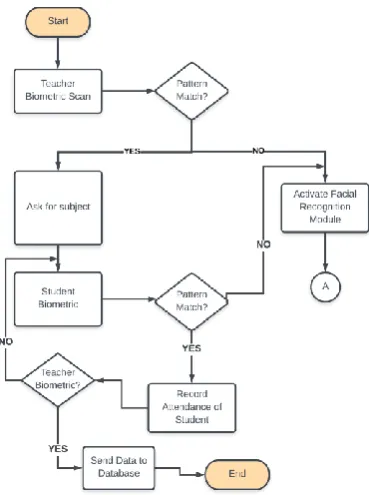
Fig 1 shows the main flow of the system in order to record attendance and send it to database.
© 2019, IRJET | Impact Factor value: 7.211 | ISO 9001:2008 Certified Journal | Page 5017
A. Hardware and Software ModulesThe most common set of requirements defined by any operating system or software application is the physical computer resources, also known as hardware. We have used Raspberry Pi 3 B+ to transmit data. This is the main hardware component of our system through which data will be transferred to online database. It has inbuilt Wi-Fi which helps to transmit data wirelessly, Optical Fingerprint Reader 307, as shown in Fig 2, to scan fingerprint and PiCamera module, as shown in Fig 3, to mark attendance by recording and validating the facial features of the user. We have used
python as our programming language to interact with firebase. The attendance can we retrieved on a
Web Application directly from Firebase. Fingerprint detection and Facial Recognition algorithms are executed to register as well as validate the respective biometric data.
B. Fingerprint Module
In our fingerprint module, the sensor is able to enroll new finger as well as detect already existing finger. Fingerprint data gets stored in the Optical Fingerprint Reader R307 Module itself. R307 can store up to 1000 fingerprints. R307 module is capable of independent fingerprint collection, fingerprint registration, fingerprint comparison (1:1) and fingerprint search (1: N) function. R307 can be accessed by using PyFingerprint Library.
Fig 2. Optical Fingerprint Reader R307
In our system, R307 module performs Fingerprint Collection, Fingerprint Comparison and Fingerprint Search. These features are performed at different stages of the project. Fingerprint Collection: A data set is created of new fingerprint samples, to be used further for recognition.
Fingerprint Comparison: The user needs to enter finger twice to validate the new finger. Once user enters finger second time, it gets stored at a new position. It gives an error saying “Fingers Don’t Match” upon comparison, in case user enters different finger second time during validation.
Fingerprint Search: Now, when an already enrolled finger is entered, the module checks whether it is already there in the data set by comparing and displays its position number.
C. Facial Recognition
© 2019, IRJET | Impact Factor value: 7.211 | ISO 9001:2008 Certified Journal | Page 5018
Fig 3. PiCamera
There are 3 steps to train the classifier for facial recognition which are as follows: Data Gathering: Gather face data (face images in this case) of the people we want to identify. Train the Recognizer: Feed that face data and respective names of each face to the recognizer so that it can learn. Recognition: Feed new faces of that people and see if the face recognizer we just trained recognizes them. The idea with LBPH is not to look at the image as a whole, but instead, try to find its local structure by comparing each pixel to the neighbouring pixels. The names of those face
recognizers and their OpenCV calls are: EigenFaces – cv2.face.createEigenFaceRecognizer() FisherFaces –
cv2.face.createFisherFaceRecognizer() Local Binary Patterns Histograms (LBPH) –
cv2.face.createLBPHFaceRecogniz Eigenfaces and Fisherfaces are both affected by light and, in real life, we cannot guarantee perfect light conditions. LBPH face recognizer is an improvement to overcome this drawback.
The LBPH Face Recognizer Process: In this method we take a 3×3 window and move it across one image. At each move (each local part of the picture), compare the pixel at the centre, with its surrounding pixels. Denote the neighbours with intensity value less than or equal to the centre pixel by 1 and the rest by 0.
Fig 4. LBPH decimal value generation[7]
[image:4.596.189.423.431.491.2]© 2019, IRJET | Impact Factor value: 7.211 | ISO 9001:2008 Certified Journal | Page 5019
Fig 5. Sample Histogram[7]
At the end of this process we will have one histogram for each face in the training data set which will be stored for later recognition. The algorithm also keeps track of which histogram belongs to which person.
Later during recognition, the process is as follows: Feed a new image to the recognizer for face recognition. The recognizer generates a histogram for that new picture. It then compares that histogram with the histograms it already has. Finally, it finds the best match and returns the person label associated with that best match.
D. Firebase Module
Firebase is a mobile and web application development platform developed by Firebase, Inc. Firebase provides a real- time database and backend as a service. The service provides application developers an API that allows application data to be synchronized across clients and stored on Firebase's cloud. The company provides client libraries that enable integration with Android, iOS, JavaScript, Java, Objective-C, Swift and Node.js applications.
We have successfully created a database and stored data sent through raspberry pi in it. We have used Python to interact with Firebase. Fig 6 shows sample data displayed on Real-time Database on Firebase as received from Raspberry Pi.
[image:5.596.210.417.494.675.2]© 2019, IRJET | Impact Factor value: 7.211 | ISO 9001:2008 Certified Journal | Page 5020
IV. INPUT AND OUTPUT
For the proposed system having two modules – Biometric Recognition and Facial Recognition, we have provided different inputs to the system.
A. Biometric Recognition
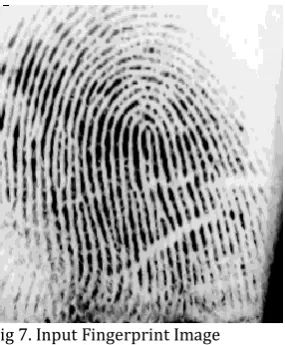
[image:6.596.255.398.249.422.2]For the biometric recognition module, we provide fingerprint as the input. The input is a finger to the R307 Biometric Module which is then converted into a greyscale image as shown in Fig 7.
Fig 7. Input Fingerprint Image
Biometric Recognition is required in 2 parts of the system. First, while registering the fingerprint for the first time. This process takes places as shown in Fig. 8.
Fig 8. Biometric Registration Process
[image:6.596.200.415.468.654.2]© 2019, IRJET | Impact Factor value: 7.211 | ISO 9001:2008 Certified Journal | Page 5021
Fig 9. Process of Marking Attendance using Biometric
After the data is uploaded to Firebase it looks as shown in Fig 6. This data is then fetched by the Web Application which is used to generate reports.
B. Facial Recognition
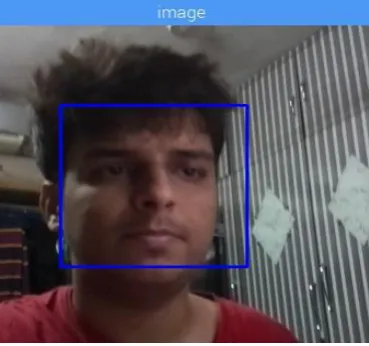
[image:7.596.219.404.347.520.2]While using the facial recognition module. The input given to the system is recorded initially by recording a dataset of each user. This dataset may contain images of the user’s face ranging from 30-150 in number. More number of images ensures better accuracy. Recording the dataset shows the window as shown in Fig 10.
Fig 10. Recording Dataset
Once recorded, these images are then converted into greyscale for better results. Conversion of these images is done while storing the image in a folder. Image after converting to greyscale looks as shown in Fig 11.
[image:7.596.202.409.573.713.2]© 2019, IRJET | Impact Factor value: 7.211 | ISO 9001:2008 Certified Journal | Page 5022
After training the system using the dataset generated. Facial Recognition is performed. While performing Facial Recognition, the output is as shown in Fig 12.Fig 12. Output of Facial Recognition
V. CONCLUSION
In the present generation systems, there is a lot of time, data, space when it comes to keeping track of attendance. We have studied the overall flow of the system i.e. how the system would work, what would be the phases of the system. We have also studied the various algorithms through which the data can be transferred to the firebase module and retrieved on the web application. The code for the respective web application has been written in html language with the help of java-script for the purpose of connecting it to the real-time database on the firebase console. The web page will retrieve the data from the database and display the required data on the click of a button on the web page developed. The report generation is done on the basis of data retrieved from Web Application and can be custom according to the user. The outputs for all the trial runs were recorded. On observation, the designed system gives satisfactory results. Our system stands out from other existing biometric attendance management systems as, our system provides a fully- functional backup method to record attendance in case our primary method fails or takes inappropriately long time. Once after all the students have recorded attendance, the data gets sent to the Firebase.
VI. REFERENCES
[1] Jennifer C. Dela Cruz, Arnold C. Paglinawan, Miguel Isiah R. Bonifacio, Allan Jake
D. Flores, Earl Vic B. Hurna, "Biometrics Based Attendance Checking using Principal Component Analysis", School of EECE, Mapúa Institute of Technology Intramuros, Manila, Philippines,
[2] 2015Yash Mittal, Aishwary V arshney, Prachi Aggarwal, KapilMatani and V. K.
Mittal, "Fingerprint Biometric based Access Control and Classroom Attendance
Management System", Indian Institute of Information Technology Chittoor, Sri City, 2015
[3] Dr. Vinayak A. Bharadi, V. J. Kaul, SameerAmrutia, “End-to-end Encryption based Biometric SaaS”, Thakur College of Engineering and Technology Mumbai, India,
© 2019, IRJET | Impact Factor value: 7.211 | ISO 9001:2008 Certified Journal | Page 5023
[4] Shailendra, Manjot Singh, Md. Alam Khan, Vikram Singh, AvinashPatil, SushmaWadar, “Attendance
Management System”, Army Institute of Technology, Pune, India,
[5] 2010Wu-Jeng Li, Chiaming Yen, You-Sheng Lin, Shu-Chu Tung, and ShihMiao Huang, “JustIoT
Internet of Things based on the Firebase Real- time Database”, 2018
[6] XueMei Zhao, ChengBing Wei, “A Real-time Face Recognition System Based on the Improved LBPH Algorithm”, School of Electronic InformationQingdao UniversityQingdao, China, 2017
![Fig 4. LBPH decimal value generation[7]](https://thumb-us.123doks.com/thumbv2/123dok_us/9406494.441881/4.596.225.413.107.260/fig-lbph-decimal-value-generation.webp)
![Fig 5. Sample Histogram[7]](https://thumb-us.123doks.com/thumbv2/123dok_us/9406494.441881/5.596.210.417.494.675/fig-sample-histogram.webp)