© 2019, IRJET | Impact Factor value: 7.211 | ISO 9001:2008 Certified Journal | Page 3318
Electrical Simulation Model of IEC 61400-27-1 Doubly-Fed Induction
Generator (Type 3A) Based Wind Turbine
N.Bhavadharini
1, B.R.Pavithra
2, M.C.Lavanya
3, Lavanya Dhanesh
41,2
UG Scholars, Department of Electrical and Electronics Engineering, Panimalar Institute of Technology, Chennai
3
Deputy Director, Research and Development (R&D) and Resource Data Analytic & Forecasting (RDAF), National
Institute of Wind Energy, Chennai
4
Associate Professor, Department of Electrical and Electronics Engineering, Panimalar Institute of Technology,
Chennai
---***---Abstract –
The main objective of this project is to implement the Electrical Simulation Model of IEC 61400-27-1 standard TYPE 3 – DOUBLY-FED INDUCTION GENERATOR (DFIG) based wind turbine. The dynamic models of a wind turbine are designed by the manufacturers. These manufacturers provide the behavior of their machines with a high level of detail. Before carrying out In-situ testing of Wind Energy Conversion System(WECS), wind turbine certification institution can perform generic evaluation of the system with standard parameters by using electrical simulation models which will be effortless for the manufacturers to scrutinize the performance. Standards make sure that the products work together safely and reliably as intended. So different parameters given in the model can be able to emulate the response for a wide range of machines. By using standard tool MATLAB/SIMULINK electrical simulation of IEC 61400-27-1 DOUBLY-FED INDUCTION GENERATOR based wind turbine is designed and implemented.Key Words: IEC 61400-27-1, DFIG, WECS,
MATLAB/SIMULINK
1.INTRODUCTION
Wind energy utilization in power system has increased greatly to meet the demand of the power system. Stability of the system is concerned by the power system operators. So the dynamic models of a wind turbine are designed by the manufacturers. Manufacturers of wind turbines commonly have all-inclusive data of wind turbine models. But there are several drawbacks for the use of such models by grid operators. The grid operator does not have a full knowledge of the model. So generic models have been required is developed. Then a manufacturer only needs to provide a parameterization for the model. This generic model development finds the right balance between desired accuracy and model complexity.
1.1 SCOPE
IEC 61400-27 specifies standard electrical simulation models for wind turbines which provides procedures for examining the specified electrical simulation models. IEC 61400-27-1 defines the universal terms and parameters with the purpose of specifying the electrical characteristics of a wind turbine. The models are described in a standard way which can be applied for future wind turbine concepts. So the dynamic simulation models are designed for wind turbine terminals. The validation procedure specified in IEC 61400-27-1 focuses on the IEC 61400-21 tests for response to voltage sag and transients condition.
1.2
GENERAL SPECIFICATIONThe models are modular in nature. Maintain power system stability for positive sequence dynamics like short circuit disturbance, frequency disturbance and change in reference values. Model should be valid for power system frequency deviation of ±6%.Must handle the phase change control. Steady state voltage deviation should between 0.85p.u – 1.15p.u.The typical dynamic simulation time frame of interest is from 10 seconds to 30 seconds. It should withstand over voltage /under voltage and over frequency/under frequency. During power swing, turbine-generator inertia and first drive train torsional mode are taken into account. Protection and control systems design.
2. TYPE 3: WT WITH DOUBLY-FED ASYNCHRONOUS
GENERATORS
© 2019, IRJET | Impact Factor value: 7.211 | ISO 9001:2008 Certified Journal | Page 3319 produces maximum efficiency even at low wind speed of 3-
5m/s. Problems such as over voltage /under voltage ride through or over current/under current ride through gets compensated. This model is best suited model of wind turbine and used in all the wind farms.
2.1
MODULES OF DFIG BASED WIND TURBIBNE1. Aerodynamic Module - One dimensional model 2. Mechanical Module - Two mass model. 3. Generator set Module
2.1.1 . AERODYNAMIC MODULE - ONE
DIMENSIONAL MODEL
The main purpose of wind turbines is to generate energy using the wind. Hence, the aerodynamics is a very important part of wind turbines. The wind turbine aerodynamic and drive train block contains both the entire mechanical representation of the wind turbine including the pitch drive and the aerodynamic model that describes the conversion of wind speed to mechanical power.
Figure 1 - Block diagram for one-dimensional aerodynamic model is implemented in MATLAB
[image:2.595.76.276.368.492.2]The aerodynamic models presented have in common that A large number of parameters is required. These parameters may to some extent be confidential and not available for users of the model. The model is highly nonlinear, the calculation of initial values for the simulation is therefore possible only through iteration. A reduction of the number of parameters required. The use of parameters that show clear physical relations. A direct calculation of the initial values. Reduction of the simulation effort.
Table 1: Parameter list for one-dimensional aerodynamic model
2.1.2 .
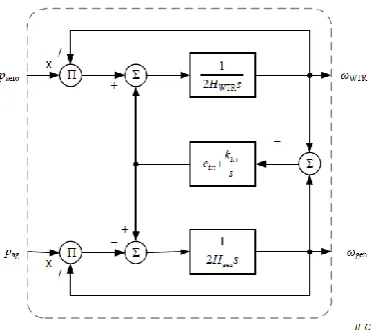
MECHANICAL MODULE - TWO MASS MODEL.A two-mass model is used, several simulations using a variation of the stiffness of the drive train. The impact of using an active drive train damper in the model is compared to a passive implementation in the model. By increasing the damping coefficient of a two-mass drive train model, the response of an active drive train damper can be emulated. . A two-mass representation is accurate enough for representing all relevant effects for stability studies for DFG wind turbines. Higher order turbine representations usually add only limited additional information at the expense of far more detailed models compared to a two-mass drive train.
Figure 2 - Block diagram for two mass model mechanical model implemented in MATLAB
2.1.3 TYPE 3A GENERATOR SET MODEL
The output of the generator model is a current, injected through a current source with parallel impedance Xs. However, in some power system simulation software, ‘control’-parts and ‘grid’-parts of a model are treated differently. To improve the convergence behavior of the simulation in such cases, it is recommended to move the parallel impedance Xs .
Symbols Base
Unit Description Category
Θw0 deg Initial pitch angle Case
ka Pn /
deg2
[image:2.595.350.536.408.573.2]© 2019, IRJET | Impact Factor value: 7.211 | ISO 9001:2008 Certified Journal | Page 3320
Table 2 - Parameter list for type 3A generator set model
Figure 3 – Block diagram for type 3A generator set model
2.1.4 REFERENCE FRAME ROTATION
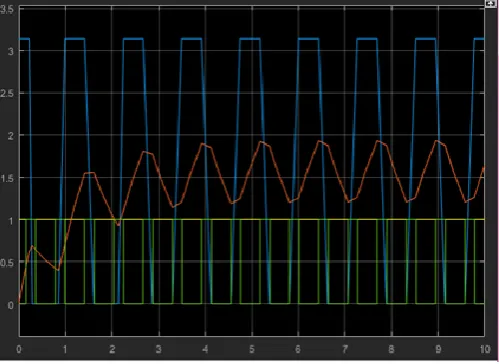
This PLL block of reference frame of rotation model is fed with sine wave input . This block compares the sine block’s voltage magnitude with the PLL1 magnitude voltage. This PLL block is fed with sine wave input . This block compares the sine block’s angle with the PLL2 magnitude voltage. The simulation model compares the voltage and angle output of the wind turbine terminal voltage with the PLL model. PLL1 block compares the voltage magnitude .PLL2 block compares the angle of the input voltage wind turbine. Angle is filtered and/or frozen to avoid instabilities due to lack of voltage reference.
Figure 4 – Block diagram for type 3A reference frame model
The value of uPLL2 should be coordinated with the value of uPLL1. Usually, uPLL2 ≤ uPLL1. uPLL2 is employed to avoid numerical problems when voltage is close to zero and then angle is not numerically valid. If the voltage of the PLL1 is greater than that of PLL 2 then PLL 1 get locked gives output 1 but the PLL 2 gives the output 0.
2.1.5 GRID REFERENCE FRAME
[image:3.595.39.285.86.501.2]The output of the generator model is a current, injected through a current source with parallel impedance Xs. However, in some power system simulation software, ‘control’-parts and ‘grid’- parts of a model are treated differently. The losses in the generator system are neglected setting the generator air gap power pag equal to the WT terminal power. The air gap power and wind turbine current is observed which helps to avoid malfunctioning of the wind turbine when subjected to transients.
[image:3.595.313.524.549.641.2]© 2019, IRJET | Impact Factor value: 7.211 | ISO 9001:2008 Certified Journal | Page 3321
2.2 SIMULATION RESULTS
[image:4.595.308.560.136.302.2]Figure 6 - Output of one dimensional aero dynamic Simulink Model for nominal speed of the wind
[image:4.595.39.286.374.545.2]Figure 7 – Output of simulink Speed of a wind turbine rotor (ωWTR) OF TWO MASS model
Figure 8 – Output of Simulink Speed of a wind turbine rotor ωgen of TWO MASS model
[image:4.595.309.559.376.558.2]© 2019, IRJET | Impact Factor value: 7.211 | ISO 9001:2008 Certified Journal | Page 3322
3. CONCLUSIONS
This work mainly focused on the development of electrical simulation models of IEC 61400-27-1 standard DOUBLY-FED INDUCTION GENERATOR (TYPE 3A) BASED wind turbine using MATLAB-SIMULINK. The simulation models are mainly used by the wind turbine manufacturers who provide parameterization for different implementations. An electric model is designed and implemented using standard tools which will available globally for research works and testing purpose. These electrical models are used for measurement and assessment of wind turbine with the minimum number of parameters necessary to represent all relevant effects like voltage sag, over voltage ride through, under voltage ride through, etc. The aerodynamic model, mechanical model, generator set model of type 3A wind turbine is been implemented using constant values and this model works efficiently. It provides reactive power control and ensures the voltage stability during the transient condition of the system. Further optimization of the models using complex values will be implemented in the future work.
REFERENCES
1. Jens Fortmann, “Modeling of Wind Turbines with Doubly Fed Generator System”, Springer Vieweg, 2014.
2. M. Berhanu, Y. Mekonnen, R. Leidhold, M. Mamo, Z. Muluneh and A. Sarwat, “Analysis of a Doubly Fed Induction Generator Through Modelling and Simulation”, IEEE PES/IAS PowerAfrica. (2018) 3. Milkias Berhanu Tuka, Roberto Leidhold, Mengesha
Mamo, “Modelling and Control of a Doubly Fed Induction Generator Using a Back-to-Back Converters in Grid Tied Wind Power System”, IEEE PES-IAS PowerAfrica (2017)
4. B.Chitti Babu , K.B.Mohanty “Doubly-Fed Induction Generator for Variable Speed Wind Energy Conversion Systems- Modelling & Simulation”, International Journal of Computer and Electrical Engineering, Vol. 2, No. 1, 1793-8163, 2010. 5. E. Bounadjaa,, A. Djahbarb, Z. Boudjemac, “Variable
structure control of a doubly fed induction generator for wind energy conversion systems”, The International Conference on Technologies and Materials for Renewable Energy, Environment and Sustainability, TMREES14, ScienceDirect, 2014. 6. Ghulam Sarwar Kaloi, Jie Wang, Mazhar Hussain
Baloch, “Active and reactive power control of the doubly fed induction generator based on wind energy conversion system”, 2016.
7. J.G. Slootweg, H. Polinder, W.L. Kling, “Dynamic Modelling of a Wind Turbine with Doubly Fed Induction Generator”, IEEE Xplore, 2001.
8. Margaris, Ioannis, Hansen, Anca Daniela, Bech, John, Andresen, Björn Sørensen, Poul Ejnar, “Implementation of IEC Standard Models for Power System Stability Studies”, Proceedings of 11th International Workshop on Large-Scale Integration of Wind Power into Power Systems 2012.
9. LIU You-wei, CHEN Zhi-hui, SHEN Juan, “Application of PLL in the Generator-side Converters for Doubly-Fed Wind Power Generation Systems”, International Conference on Future Energy, Environment, and Materials, 2012.