© 2019, IRJET | Impact Factor value: 7.211 | ISO 9001:2008 Certified Journal
| Page 350
The Study of various Tools and Techniques of Inventory Management
and Experiment with use of ABC Analysis
Rajesh Hukum
1, Vivek A Shrouty
21
Deputy Manager-Inventory Management,
[email protected]
Uttam Value Steels Limited, Wardha, India
2
Dy. General Manager- QA, [email protected]
Uttam Value Steels Limited, Wardha, India
---***---Abstract -
An inventory management is technique which is generally used to manage the organization effectively. The organization wants to control their inventory cost, material cost, labour cost etc. There are several inventory techniques used in organization such as ABC, XYZ, HML, VED, SDE, SOS, FSN, and EOQ. This study mainly focuses on ABC analysis. In ABC analysis the items are classified into A, B and C classes based on unit consumption value. We analyze the various factors and functions, which affect the raw materials inventory management and perform the value analysis of the Inventory. Analyze the present system, based on this analysis suggested for improvement by introducing proper cost effective material procurement and storage so as to minimize waste and material holdup and successfully meet the supply and demand of raw materials. Data collection is mainly of 3 months through the general store manager and other staff involved in inventory control operation.Key Words:
ABC analysis, inventory management,
inventory control,HML Analysis, VED Analysis, SDE Analysis, SOS Analysis, FSN Analysis, EOQ
1. INTRODUCTION
The term ‘inventory’ originates from the French word ‘Inventaire’ and Latin word ‘Inventariom”, which implies a list of things found. The term ‘inventory’ can be defined as, “The term inventory includes materials like – raw, in process, finished packaging, spares and others; stocked in order to meet an unexpected demand or distribution in the future.”
1.1 Inventory includes the following categories of
items:
a.
Production Inventories
:
Raw materials, parts and components which enter the firm’s product in the production process. These may consist of two types –special items manufactured to company specifications and standard industrial items purchased ‘off the shell’.b.
MRO Inventories
:
Maintenance, Repair, and Operating supplies which are consumed in the production process but which do not become the part of the product. (e.g. lubricating oil, soap, machine repair parts)c. In-process Inventories: Semi-finished products found at various stages in the production operation.
d. Finished goods Inventories: Completed products ready for shipment.
2. PROCESS OF INVENTORY MANAGEMENT AND
CONTROL
Inventory management and control refers to the planning for optimum quantities of materials at all stages in the production cycle and evolving techniques which would ensure the availability of planned inventories. Following four steps are involved in the process:
2.1
Determination of optimum inventory levels and
procedures of their review and adjustment
:
© 2019, IRJET | Impact Factor value: 7.211 | ISO 9001:2008 Certified Journal
| Page 351
Excess inventories, however, guarantee uninterrupted supply of materials and components, to meet production schedules and finished goods to meet customers demand. Too less of inventory releases working capital for alternative uses and reduces carrying costs and increases ordering costs. But there is the risk of stock out costs.
2.2
Determination of the degree of control that is
required for the best results
:
The second aspect of inventory management is to decide just how much control is needed to realize the objectives of inventory management. The difficulty is best overcome by categorization of inventory on the basis of value. Popularly called the ABC categorization, this approach is useful in deciding the degree of control. ‘A’ class items are ‘high’ in value but ‘low’ in quantity, ‘C’ class inventories are the opposite of ‘A’ group i.e. ‘high’ in quantity and ‘low’ in value. In between are the ‘B’ group stocks which are more or less equal in quantity and value proportion to the total inventory. Tight control is exercised on ‘A’ category items through accurate records of receipts and issues and by co-ordination of incoming shipments with production managements.
2.3
Planning and design of the Inventory control
system
:
An inventory system provides the organizational structure and the operating policies for maintaining and controlling goods to be inventoried. The system is responsible for ordering and receipt of goods, timing the order placement, and keeping track of what has been ordered, how much, and from whom.2.4
Planning of the Inventory control organization
:
It is yet another important aspect of inventory management because choosing the panel to control is very difficult.
3. SCOPE OF INVENTORY CONTROL
3.1 Formulation of Policy
:
First of all, the policies of investment procurement, storage, handling, shortage and stock-outs, deterioration obsolescence etc. are to be formulated under the scientific system of inventory control. What, when and how much of purchasing and fixation of minimum and maximum levels is also to be determined for a given period of time.3.2 Organization structure
:
After determining inventory policy, the next step is to decide the location, layout and types of storehouse. It will facilitate the movement of materials and thus minimize he storage and handling cost of stores.3.3
Determination of Economic Order Quantity
: Economic order quantity or economic lot size (if it related to production) refers to that quantity ordered in a single purchase or number of units should be manufactured in a single run, so that the total costs-ordering or set up costs and inventory carrying costs are at the minimum. So, the determination of E.O.Q. is also within the scope of inventory control.3.4
Determination of Safety Stock
:
Safety Stock is defined as the difference between the amount stocked to satisfy demand during a certain time interval and the mean expected demand for that period. It is for the purpose of providing protection against depletion. If demand remained constant and lead time, usage value, variability of lead time demand, carrying charges and he importance of its stock out cost. Again, determination of buffer stock reserve stock is included in the management of inventory.3.5
Determination of Lead Time
:
By lead time is meant the time that lapse between the raising of an indent by the stores as well as users and the receipt of materials by them. Lead time is of fundamental importance in determining inventory levels.3.6
Minimum Material Handling and Storage Cost
:
Stores Organization activities are arranged in such a manner that the cost of bringing in the storehouse and issuing from the storehouse of the various stores will minimize the storage and material handling cost of stores.
3.7
Effectiveness towards running store
:
The determination of policies of the location, layout and material storage handling equipment will certainly help in the effective working of storage organization.4.
INVENTORY CONTROL TECHNIQUES
© 2019, IRJET | Impact Factor value: 7.211 | ISO 9001:2008 Certified Journal
| Page 352
4.1
ABC Analysis (13)
ABC analysis is a business term used to define an inventory categorization technique often used in materials management. It is also known as ‘Selective Inventory Control.’ ABC analysis provides a mechanism for identifying items which will have a significant impact on overall inventory cost whilst also providing a mechanism for identifying different categories of stock that will require different management and controls. When carrying out an ABC analysis, inventory items are valued (item cost multiplied by quantity issued/consumed in period) with the results then ranked. The results are then grouped typically into three bands. These bands are called ABC codes;
"A class" Inventory will typically contain items that account for 80-85% of total value, or 05-10% of total items.
"B class" Inventory will have around 15% of total value, or 10-20% of total items.
"C class" Inventory will account for the remaining 05-10%, or 80-85% of total items.
ABC Analysis is similar to the Pareto principle in that the "A class" group will typically account for a large proportion of the overall value but a small percentage of the overall volume of inventory.
A-Class B-Class C-Class
Very Strict Control Moderate
Control Loose control
Handled by Senior Executives
Low safety
stock High safety stock Maximum efforts to
reduce lead time
Order once in 3-months
Bulk Ordering can be made
Accurate forecast Quarterly
review Rough estimate
No safety stock Moderate
efforts Annually review
4.2 XYZ Analysis (7), (8), (10)
The XYZ analysis is a way to classify inventory items according to variability of their demand.
X – Very little variation: X items are characterized by steady turnover over time. Future demand can be reliably forecast.
Y – Some variation: Although demand for Y items is not steady, variability in demand can be predicted to an extent. This is usually because demand fluctuations are caused by known factors, such as seasonality, product lifecycles, competitor action or economic factors. It's more difficult to forecast demand accurately.
Z – The most variation: Demand for Z items can fluctuate strongly or occur sporadically. There is no trend or predictable causal factors, making reliable demand forecasting impossible.
4.2.1 What benefits does the approach provide?
Improves accuracy of forecasting. Reduces stock-outs, which:
– Improves production stability and efficiency. – Improves customer satisfaction.
Increases stock churn. Reduces stock obsolescence.
Clarifies service levels for items with volatile demand.
4.2.2 Implementing XYZ inventory management? Questions to consider
Is there reliable and accessible cost and demand information by item?
Will your inventory management systems and processes facilitate efficient and effective implementation and operation of the XYZ approach?
Have the costs and benefits of implementing and operating XYZ been quantified and is the business case compelling?
Has the impact of the change to XYZ on capability been assessed and planned for?
4.3 HML Analysis (8)
H-M-L analysis is similar to ABC analysis except the difference that instead of “Annual Inventory Turnover”, cost per unit criterion is used. The items under this analysis are classified based on their unit prices. They are categorized in three groups , which are as follows
H-High Price Items M-Medium Price Items L-Low Price Items
4.3.1 Objectives of HML analysis
© 2019, IRJET | Impact Factor value: 7.211 | ISO 9001:2008 Certified Journal
| Page 353
To keep control over the consumption at the department level
To evolve buying policy, to control purchase To delegate the authority to different buyer Determine the frequency of stock verification
To keep control over the consumption at the department level
To evolve buying policy, to control purchase To delegate the authority to different buyer 4.4 VED Analysis (3), (4), (5) (9)
VED stands for vital, essential and desirable. This analysis relates to the classification of maintenance spare parts and denotes the essentiality of stocking spares.
The spares are split into three categories in order of importance. From the view-points of functional utility, the effects of non-availability at the time of requirement or the operation, process, production, plant or equipment and the urgency of replacement in case of breakdown.
Some spares are so important that their non-availability renders the equipment or a number of equipment in a process line completely inoperative, or even causes extreme damage to plant, equipment or human life.
On the other hand some spares are non-functional, serving relatively unimportant purposes and their replacement can be postponed or alternative methods of repair found. All these factors will have direct effects on the stocks of spares to be maintained.
V: Vital items which render the equipment or the whole line operation in a process totally and immediately inoperative or unsafe; and if these items go out of stock or are not readily available, there is loss of production for the whole period. E: Essential items which reduce the equipment’s performance but do not render it inoperative or unsafe; non-availability of these items may result in temporary loss of production or dislocation of production work; replacement can be delayed without affecting the equipment’s performance seriously; temporary repairs are sometimes possible.
D: Desirable items which are mostly non-functional and do not affect the performance of the equipment.
As the common saying goes “Vital Few — trivial many”, the number of vital spares in a plant or a particular equipment will only be a few while most of the spares will fall in ‘the desirable and essential’ category.
However, the decision regarding the stock of spares to be maintained will depend not only on how critical the spares
are from the functional point of view (VED analysis) but also on the annual consumption (user) cost of spares (ABC — analysis) and, therefore, for control of spare parts both VED and ABC analyses are to be combined
4.5 SDE Analysis (4), (9)
The criterion for this analysis is the availability of the materials in the market. In industrial situations where certain materials are scarce (specially in a developing country like India) this analysis is very useful and gives proper guideline for deciding the inventory policies.
4.5.1 The characteristics of the three categories – SD and E – are:
S: Refers to scarce items, items which are in short supply. Usually these are raw materials, spare parts and imported items.
D: Stands for difficult items, items which are not readily available in local markets and have to be procured from faraway places, or items for which there are a limited number of suppliers; or items for which quality suppliers are difficult to get.
E: Refer to items which are easily available in the local markets.
4.6 SOS Analysis (10)
Raw materials, especially agricultural inputs are generally classified by the seasonal, off-seasonal systems since the prices during the season would generally be lower.
The seasonal items which are available only for a limited period should be procured and stocked for meeting the needs of the full year. The prices of the seasonal items which are available throughout the year are generally less during the harvest season.
The quantity required of such items should, therefore, be determined after comparing the cost savings on account of lower prices, if purchased during season, with the higher cost of carrying inventories if purchased throughout the year.
© 2019, IRJET | Impact Factor value: 7.211 | ISO 9001:2008 Certified Journal
| Page 354
4.7 FSN Analysis (5), (9), (11)
The FSN Analysis is based on the rate of issue or rate of usage of spare parts and the alphabets F S and N stands for Fast Moving, Slow Moving and Non Moving items. The FSN classification system categorizes the items based on how frequently the parts are issued and how frequently they are used.
Usual classification of Items at Inventory can be classified based on the following criteria
Fast Moving – Items which are frequently issued from inventory which are more than once for a specific time period
Slow Moving – Items which are less frequently issued which might be once in a specific time period
Non-Moving – Items which are not issued from the inventory at all in a specific time period
The FSN classification system is extremely helpful in distributing spare parts which are kept near the dispensing are having items which belong to the fast-moving category. The items which fall into the non-moving category can be discontinued if the further scope of use is not expected. As companies in production for a longer period have a specific percentage of non-moving spare parts which are usually disposed at regular intervals. Selling the spare parts or reusing the same can be again in the capital which can be used for other uses.
4.8 Economic Order Quantity (EOQ): (5), (6), (12)
Economic order quantity (EOQ) is that size of the order which gives maximum economy in purchasing any material and ultimately contributes towards maintaining the materials at the optimum level and at the minimum cost.
In other words, the economic order quantity (EOQ) is the amount of inventory to be ordered at one time for purposes of minimizing annual inventory cost.
The quantity to order at a given time must be determined by balancing two factors: (1) the cost of possessing or carrying materials and (2) the cost of acquiring or ordering materials. Purchasing larger quantities may decrease the unit cost of acquisition, but this saving may not be more than offset by the cost of carrying materials in stock for a longer period of time.
4.8.1 The carrying cost of inventory may include:
Interest on investment of working capital Property tax and insurance
Storage cost, handling cost
Deterioration and shrinkage of stocks Obsolescence of stocks.
4.8.2 Formula of Economic Order Quantity (EOQ):
The different formulas have been developed for the calculation of economic order quantity (EOQ). The following formula is usually used for the calculation of
A = Demand for the year
Cp = Cost to place a single order
Ch = Cost to hold one unit inventory for a year * = ×
4.8.3 Underlying Assumptions of Economic Order Quantity:
1. The ordering cost is constant. 2. The rate of demand is constant 3. The lead time is fixed
4. The purchase price of the item is constant i.e. no discount is available
5. The replenishment is made instantaneously; the whole batch is delivered at once.
5.
METHODOLOGY (13)
There are various types of inventory control techniques such as ABC, XYZ, HML, VED, S-OS, and EOQ etc. Here we focus on the ABC analysis techniques.
5.1 Procedure
1) To conduct ABC analysis, following steps are necessary: 2) Prepare the list of items and calculate their unit price, annual consumption,
© 2019, IRJET | Impact Factor value: 7.211 | ISO 9001:2008 Certified Journal
| Page 355
5.2 Model for ABC analysis study
[image:6.595.300.567.55.388.2]6
.EXPERIMENT
: The collected data of two departments has been analyzing the physical stock in numbers & metric tons and also compare by involving cost of available materials.Table-1- -ABC Analysis
ABC Classification
No.of Items
Value (In Crs)
ABC %
Item basis (Actual)
ABC % Value Basis (Actual)
% Criteria
A 259 22.91 5 85 5-10%
B 619 2.61 13 10 10-20%
C 4012 1.45 82 5 70-80%
4890 26.97 100
A 218 15.52 7 83 5-10%
B 355 2.15 11 12 10-20%
C 2580 1.07 82 6 70-80%
TOTAL 3153 18.68 100
8043 45.65
Table & Graph-4.1. Comparative of No.of Items for SMS & HRM (A)
Category
No.of Items
SMS HRM
A 821 888
B 1860 1742
C 11842 6887
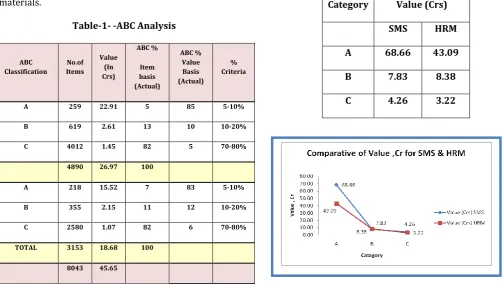
Table & Graph-4.2. Comparative of Value, Cr for SMS & HRM
Category Value (Crs)
SMS HRM
A 68.66 43.09
B 7.83 8.38
C 4.26 3.22
In above cumulative summary of September, October & November data, Item wise ABC classification shows that SMS having 14523 item in inventory. Out of 1423 items, 821
Visit to Inventory Storage Locations
Data Collection
Data
Analysis
ABC
Analysis
Tables & Graph
Analysis
[image:6.595.37.541.440.724.2] [image:6.595.31.302.481.727.2]© 2019, IRJET | Impact Factor value: 7.211 | ISO 9001:2008 Certified Journal
| Page 356
items in A-class, 1860 items in B-class & 11842 items in C-class category. Similarly, HRM dept having 9517 items in inventory & out of 9517 items, 888 items in A-class, 1742 items in B-class & 6887 items in C-class category.
Value wise ABC classification shows that SMS having 80.75Crs in inventory. Out of 80.75Crs, 68.66Crs in A-class, 7.83Crs in B-class & 4.26Crs in C-class category. Similarly, HRM dept having 54.69Crs in inventory & out of 54.69Crs, 43.09Crs in A-class, 8.38Crs in B-class & 3.22Crs in C-class category.
7. CONCLUSIONS:
From the study it is found that each and every analysis is very important and useful.
From the experiment of ABC analysis, in which two departments are involved ,it is found that both the department have strict control on A-category items and shall be handled by senior executive and focus to be given on to reduce the lead time.
8. REFERENCES
(1). https://www.cleverism.com/complete-guide-abc-analysis-customer-segmentation-inventory/
(2). https://www.purchasing-procurement-center.com/abc-analysis.html
(3).https://specialties.bayt.com/en/specialties/q/266887 /what-is-ved-analysis-and-how-does-it-help-to-control-the-inventory/
(4). http://www.yourarticlelibrary.com/business- management/marketing-management-business- management/ved-analysis-sde-analysis-and-fsn-analysis/69363
(5). https://efinancemanagement.com/costing-terms/inventory-management-techniques
(6). https://www.myaccountingcourse.com/accounting-dictionary/economic-order-quantity
(7). https://www.cgma.org/resources/tools/cost-transformation-model/xyz-inventory-management.html (8).http://www.managementparadise.com/forums/eleme nts-logistics-logs/200330-hml-analysis-xyz-analysis.html (9). http://www.yourarticlelibrary.com/business-
management/marketing-management-business- management/ved-analysis-sde-analysis-and-fsn-analysis/69363
(10).https://inventorymanagementimportancecom.blogsp ot.com/2016/07/fsn-sos-xyz-golf-classification.html (11). https://mywestford.com/blog/fsn-analysis-in-inventory-management/
(12).http://www.accountingexplanation.com/economic_o rder_quantity_eoq.htm
(13). http://www.iaetsdjaras.org/gallery/14-may-741.pdf (14). http://www.yourarticlelibrary.com/inventory- control/abc-analysis-meaning-objectives-and-limitations-inventory-control/74251
(15). https://www.citeman.com/7537-advantages-and-purpose-of-abc-analysis.html
(16). https://www.google.com/search?client=firefox-b&q=abc+analysis+graph&sa=X&ved=2ahUKEwjfy7_yzNb fAhUKpY8KHehzCwYQ1QIoA3oECAQQBA&biw=1280&bih =889
9. BIOGRAPHIES
Mr. Rajesh Hukum, M.Com B.Ed , having 24+ years of experience in inventory control. He is well versatile with Quality Management system like ISO 9001 and others standards. At present he is working as Deputy Manager at UVSL, Wardha. He has command over 5S and Kaizen quality concepts and also safety in plant
.
Mr. Vivek Shrouty, BE
(Mechanical) ,MBA(TQM & EXIM), ADFM,
LA(ISO9001:2015),NDT(Level-II) and LSSGB . He has been working since 1996, for 8 years with SGS India (Société Générale de Surveillance). At present he is working as Deputy General Manager (QA) at UVSL, Wardha form last 14 years. Blog: