Munich Personal RePEc Archive
Reluctant Regulation
Bortolotti, Bernardo and Cambini, Carlo and Rondi, Laura
“Paolo Baffi” Centre on Central Banking and Financial Regulation
April 2012
Online at
https://mpra.ub.uni-muenchen.de/48073/
“Paolo Baffi” Centre on Central Banking and Financial Regulation
“Paolo Baffi” Centre Research Paper Series No. 2012-113
Reluctant Regulation
by
Bernardo Bortolotti, Carlo Cambini,
and Laura Rondi
This Paper can be downloaded without charge from The Social Science Research Network Electronic Paper Collection:
1
Reluctant Regulation
∗Bernardo Bortolotti*
Università di Torino and Paolo Baffi Center, Università Bocconi
Carlo Cambini†
Politecnico di Torino and EUI
Laura Rondi‡
Politecnico di Torino and CERIS-CNR
April 23th, 2012
Abstract
We study the effect of state ownership on the market-to-book ratios of publicly traded European utilities observed from 1994 to 2005. We find that when the company is subject to independent regulation, state ownership is positively associated with firm value. This effect is strong and significant in countries where weak checks and balances and political fragmentation do not constrain the power of the executive. We conclude that where political institutions are weak, politicians imperfectly delegate powers to regulatory agencies in order to benefit state-owned firms.
JEL Classification: K23, L33, L51, L90, G32
Keywords: Privatization; Regulatory Independence; Political Institutions; Firm Value
∗
An earlier version of this paper was circulated under the title “Regulatory Independence, Ownership and Firm Value: The Role of Political Institutions”. We thank Daniel Albalate, Luigi Benfratello, Eshien Chong, Giovanni Mastrobuoni, Antonio Nicita, Martin Peitz, Alessandro Petretto, Carlo Scarpa, Carine Staropoli, Yossi Spiegel, Pablo T. Spiller, and seminars participants at the 2009 EEA Annual Meeting in Barcelona, the 2011 CDP Private Equity for Infrastructure Workshop in Rome, the European University Institute (EUI) - Florence, the Annual Meeting of the Law and Economics Association, the Centre d’Economie de la Sorbonne (CES) – University of Paris I, the 4th NERI Workshop in Turin, for comments on earlier versions of this paper. Bernardo Bortolotti gratefully acknowledges the financial support of the European Commission (Contract No. CIT5-CT-2005-028647) and of the Sovereign Investment Lab, Paolo Baffi Centre on Central Banking and Financial Regulation at Università Bocconi. Carlo Cambini and Laura Rondi gratefully acknowledge financial support from the Italian Ministry of Education (No. 20089PYFHY_004).
*
Corresponding Author: Dipartimento di Scienze Economiche e Finanziare “G. Prato”, Università di Torino, Corso
Unione Sovietica 218bis, 10134, Torino, Università di Torino - Tel: 39011-6706064+30-0116706164, Email:
[email protected], http://web.econ.unito.it/bortolotti/
†
Politecnico di Torino, DISPEA, Corso Duca degli Abruzzi, 24, 10129 Torino, Italy. Tel: + 39-0115647292, e-mail:
‡
Politecnico di Torino, DISPEA, Corso Duca degli Abruzzi, 24, 10129 Torino, Italy. Tel: +39-0115647232, Email:
2
“How can the state regulate the firms it also runs?”
The Economist (2012, p. 17)
1. Introduction
Three decades after the start of the largest transfer of ownership in the history of the
corporation privatization is fading away. Since the turn of the century, state assets divestiture has
been slowing down in most developed economies and advancing somehow in emerging countries
due to the initial floatation of large State-owned Enterprises (SOEs). However, around the world the
most common outcome of this process is government control of (partly) privatized firms, a
qualifying feature of the so-called “rise of state capitalism”.1 Interestingly, and contrary to
conventional wisdom, residual control rights by the government do not affect negatively the value
of the firm. Recent evidence has shown that partial privatization improves financial and operating
performance (Gupta, 2005) and that firms under government control tend to be more valuable than
fully privatized firms (Beltratti et al., 2007; Bortolotti and Faccio, 2009).
Public utilities, i.e. firms operating in network industries, such as energy,
telecommunication, transports, and water, had a great bearing in past privatization processes. In
most developed countries, sales advanced in parallel with deep structural reforms promoting
liberalization and regulation of former state monopolies to boost efficiency and private investment.2
In the European Union, for example, the Commission urged the member states to establish
Independent Regulatory Authorities (IRAs), i.e. autonomous public organizations to which
governments delegate the regulatory policy. Yet, government control of privatized/regulated firms
is commonly observed also in public utilities.3 Interestingly, we observe a similar effect of residual
state ownership on firm value: higher state ownership is associated to higher firm value, but this
happens only when the firm becomes subject to an IRA. Figure 1 illustrates the evolution of
market-to-book ratios of European telecom and energy utilities before and after the official establishment of
respective IRAs. We notice that, in the three-year period after the event, state-controlled firms
outperform privately controlled firms by 15 percent on average.
Aim of this paper is twofold: first, we evaluate empirically the effect of government
ownership on the market value of public utilities, controlling for other possible determinants.
Second, should this relation exist, we try to establish the channel linking government ownership to
1
According to a recent report on state capitalism, the combined market value of global SOEs is more than $2 trillion and total employment around 6 million (The Economist, January 21st, 2012).
2
Utilities accounted for two thirds of the privatization revenues raised in European countries from 1977 to date (Privatization Barometer, 2010).
the valuation of companies subject to independent regulation. To this purpose, we use an original
panel dataset of 88 publicly traded network utilities from 14 EU countries observed from 1994 to
2005, which includes 10 of the top 30 companies in terms of market capitalization within the
European Industrial Sector (Mediobanca Investment Bank, 2009). Estimates rely on both
cross-country and within-cross-country variation in the data around regulatory reforms and political institutions.
Why should governments own firms? Conventional wisdom and a bulk of theoretical
literature suggest that politicians are “bad owners” of corporations as they typically impose
objectives that destroy shareholders’ value (Shapiro and Willig, 1990; Shleifer and Vishny, 1994;
Bennedsen, 2000).4 At the same time, politicians are also viewed as “bad regulators” as their
interference may lead to time-inconsistent regulatory decisions and to the expropriation of utilities’
sunk investments (Stigler, 1971). These arguments provide the rationale for the privatization of
SOEs, insofar as the transfer of ownership rights to the private sector improves incentives and
boosts operating performance (Megginson and Netter, 2001), and for the setting up of IRAs, in
order to foster the credibility of regulatory commitments (Levy and Spiller, 1994; Baldwin and
Cave, 1999).
However, the existence of a legally (de jure) independent regulator is not sufficient to
ensure real (de facto) independent decisions, because genuine independence hinges, among other
things, upon the real powers that the political system delegates to the agency, in other words upon
the residual rights to intervene in regulatory decisions retained by incumbent politicians.5 We label
reluctant regulation the institutional setting when regulatory powers are delegated to a formally
independent regulator, but subject de facto to political interference.
Reluctant regulation matters when the government retains significant ownership rights in
regulated firms. In this case, politicians may wield their powers to obtain favourable regulatory
decisions that boost the utilities’ profitability, and this in turn allows the government, for example,
to raise additional fiscal revenues via extra-dividends and to avoid tax increases, spending cuts or
other politically costly decisions or to promote “national champions”. The expectation that the
government gives a “helping hand” indirectly via regulation boosts the market value of utilities
under mixed (private-public) ownership, with private shareholders sharing the financial rent
provided for by the public shareholder.
4
In this perspective, privatization can be seen as a safeguard against the opportunistic behavior of politicians (Sappington and Stiglitz, 1987). See also the recent survey by Martimort (2006).
5
444-To establish the link between residual state ownership and regulated firms’ market value, we
focus on reluctant regulation as possible channel by exploiting the heterogeneity in the ownership
patterns and in the regulatory settings. The seminal study by Levy and Spiller (1994) shows that
political interference in regulatory decisions is more likely when the institutional constraints on
executive discretion are weak. In this case, regulatory commitment is less credible since political
powers can more easily overturn administrative decisions. Formal institutional arrangements that
constrain executive discretion typically include the explicit separation of powers, an effective
“checks and balance” system between the different branches of the government, and an electoral
system that enhances party proliferation and political fragmentation. We thus expect reluctant
regulation to surface where institutional constraints are weak providing governments’ incentives to
retain higher stakes in regulated firms. Where instead one country’s institutional endowment fosters
genuine independent regulation, residual public ownership should be completely neutral with
respect to firm value.
Our empirical results are consistent with our predictions. We find that residual state
ownership positively affects the market value of regulated firms and that this effect is significant
only where political institutions do not effectively restrain governments’ power. Importantly, in a
model where we take fully into account the endogeneity of residual state ownership and
independent regulation, we show that political institutions affect firm value only indirectly, and that
residual stakes by the government are the only channel through which institutions affect the
valuation of regulated firms. Results survive when we account for sectors characteristics, country
specificity, thresholds of ownership and control rights, and for the extent of market liberalization,
supporting the view that reluctant regulation is a fundamental driver of the performance of public
utilities.
Several papers have addressed related issues. For example, some empirical studies have
shown that political institutions are significant determinants of structural reforms such as regulatory
decisions (Duso, 2005; Guerriero, 2011), market liberalization (Pitlik, 2007; Potrafke, 2010; Duso
and Seldeslachts, 2010) and privatisation (Li and Xu, 2002; Bortolotti and Faccio, 2009; Dinc and
Gupta, 2011).6 In a similar vein, Edwards and Waverman (2006) have addressed the link between
government ownership and regulatory independence. Using a sample of 15 EU incumbent
telecommunications operators tracked from 1997 to 2003, the authors show that public ownership
of the incumbent positively affects wholesale rates, suggesting that governments influence
regulatory outcomes in favour of incumbents where they have substantially invested in. However,
6
this effect is mitigated in presence of institutional features enhancing regulatory independence from
the government.
To the best of our knowledge, our paper is the first systematic analysis on the impact of state
ownership on regulated firms’ market value in the EU introducing political institution and the novel
concept of reluctant regulation as explanatory factor of this empirical relation.
The rest of the paper is organized as follows. In Section 2 we describe the institutional
context. In Section 3 we present our research design and the estimation strategy. In Section 4, we
describe our data, specifically the sample, the firm level data and the regulatory, ownership and
political variables. In Section 5 we present the empirical results from estimating the market value
regression, while in Section 6 we account for the effect of different political institutions. In Section
7 we present some robustness checks. Section 8 concludes.
2. The Institutional Reforms in the Utility Sectors in the European Union
Following a big wave of nationalization after the Second World War, vertically integrated,
stated-owned, monopolies largely dominated European network industries. Under this regime,
utilities were an operational branch of the government and instructed to provide universal services
at low prices, absorb unemployment, and invest in infrastructure. The government in turn played the
dual role of owner and “regulator,” and set tariffs, quality standards, and investment levels. This
arrangement however created ill-performing and highly inefficient public monopolies (Megginson
and Netter, 2001).
Starting from the mid 1980’s in the UK, and early 1990’s in the rest of Europe, the
European Commission promoted a gradual liberalization and regulatory process intended to
improve the efficiency and service quality of EU public utilities and increase their investments. In
particular, the European Commission enacted a number of directives aimed at setting up a common
regulatory framework for EU member states, which were in turn required to transpose these
directives into national legislation.
One of the most important of these EU-driven reforms is perhaps the institution of IRAs,
charged with the duty to regulate the activity of network industries and to discipline the potential
conflict of interest between the government and state-controlled utilities. Typically, delegated
regulatory tasks involve price-setting decisions both at retail and wholesale level - whenever access
to essential facility is needed to develop market competition -, the definition of entry conditions, the
imposition of quality standards and all the technical rules to use or access to existing infrastructures.
The IRAs ought to operate with their own specialized staff and detailed mandate,
urged member states’ governments to establish national independent regulators at least in
economy-wide sectors like energy and telecommunications, sometimes under the threat of infringement
procedures before the European Court of Justice.7 Nevertheless, the European Commission left the
decision about the definition and the scope of the delegated powers entirely in the hands of national
governments. This process of delegation led to the creation of formally independent (de jure)
agencies. However, de facto independence clearly hinged upon how this delegation process was
implemented in each member state. Indeed, agencies usually are not fully independent because
political executives often retain ultimate responsibility for their activities (Verhoest et al., 2012).
As for privatization, the European Commission left the decision about the ownership of
regulated energy utilities entirely in the hands of national governments (see Bortolotti et al., 2003).
As a result, after more than a decade, many large EU utilities are still controlled by central and local
governments, especially as far as France, Germany, and Italy, and the energy sector, are concerned.
The implementation of these institutional reforms (modern regulation, privatization, market
liberalization) varies considerably across EU countries and sectors. Table 1 reports the year in
which an IRA was established, the timing of transposition of sectoral directives in each Member
State, and the allocation of proceeds from privatization over time. The data refer only to energy and
telecoms because in water supply and transport infrastructure a common regulatory framework is
still under construction, IRAs still do not exist (so regulation is carried out by government
committees or within ministries) and privatization process are lagging behind. As shown in Table 1,
in most member states, privatizations in energy and telecoms followed the implementation of EC
directives on the adoption of regulatory framework and the inception of IRAs.
Reforms are most advanced in the telecom industry, where liberalization started in 1987
with the publication of the Green Paper for the Development of the Common Market for
telecommunication services and equipment. The Green Paper was followed by a sequence of
directives, starting from Directive 90/388 on “Competition in the markets for telecommunications
services,” which established the institution of national IRAs in each Member State. Table 1 shows
that independent regulatory agencies now operate in virtually all member states: in the U.K. the
IRA was established in 1984, while in the other EU countries IRAs were set up in mid nineties. As
for firm ownership, at the onset of the liberalization process, the European Commission raised
concerns about residual state ownership in telecoms companies.8 As of 2005, most telecom
7
Recently, the European Commission launched an infringement procedure against Luxemburg, Romania and Slovakia regarding the telecoms authority’s independence and its internal organization. See European Commission (2010; p. 44).
8
“In some Member States, concerns are reported that the structures in place do not ensure that regulatory decisions are
not influenced by State ownership considerations. In these cases, the necessary separation of the control of the
companies were (at least partially) privatized and governments held majority of control only in the
German and Swedish incumbents.
Market liberalization reforms are well ahead also in the energy sector, where the majority of
electric and gas utilities are subject to regulation by an IRAs. The milestone legislation is Directive
96/92 for the electricity, followed by Directive 98/30 for the gas market; these directives aimed at
gradually introducing competition in generation and retail segments, as well as at unbundling the
various segments of the energy value chain. Importantly, these directives established independent
national regulatory agencies: the U.K. was again the first country in Europe to establish an IRA in
1989, the other countries followed from 1995 to 2000, while Germany was the last one to set up an
IRA for energy utilities in 2006. As regards firm ownership, the only fully privatized energy
utilities are British. At the opposite side stands the French government, which, with its larger than
80% stake in both Gaz de France and Electricitè de France (and the 32% stake in Telecom France),
appears as the most reluctant to release control in regulated utilities.
Finally, in water supply and in transportation infrastructure (docks and ports, airports and
freight motorways) structural reforms still lag behind. With the exception of the U.K., most water
and transportation utilities are still controlled by central and local governments and subject to
regulation by ministries or other branches of the government rather than by independent regulatory
agencies.
3. Research Design
3.1 Theoretical Framework
Our initial question is: how does ownership affect firm value when an IRA is in place?
When there is not an IRA in place, self-interested politicians may exploit state-controlled
utilities to extract rents from social investment and employment programs that result in low
profitability and inefficiency (see for example Megginson and Netter, 2001). In this case, private
investors will typically shun regulated firms.
The establishment of IRAs – such as the process promoted by the European Commission
during the 90s- functionally separates the (dual) role of the state as typical large shareholder of
utilities and as regulator of the industry. The delegation act, formally shifting the regulatory powers
from the political sphere to an independent bureaucratic entity, curbs ex ante political interference
and opportunistic behavior by self-interested politicians (Levy and Spiller, 1984; Armstrong and
investment, allowing the opening up of capital to external investors and - should commitments be
sustained over time - full privatization (Perotti, 1995).
In theory, if regulators were de facto independent, IRAs should be able to thwart any attempt
to “capture” by politicians, regardless of the private or public status of the firm (Laffont and Tirole,
1986, Sappington and Stiglitz, 1987). However, if regulators are de iure but not de facto
independent, politicians wield regulatory powers and have incentives to retain a stake in the firm
(Laffont and Tirole, 1991; Laffont, 1996). Indeed, by keeping regulators on their toes, politicians
may obtain a favorable regulatory treatment of the state-owned utility, such as a soft regulatory
stance (higher tariffs, higher entry barriers, etc.) in order to increase the firm’s profits that will
accrue, via dividends, to the public budget. Private investors of the regulated firm will share the
benefits with the government and thus be willing to value positively its presence as shareholder in
firms. This “corporatist” equilibrium is likely to exist when regulatory powers are imperfectly
delegated to the formally, and not genuinely IRAs, i.e. in the regime that we refer to as reluctant
regulation.9
Following this argument, the relevant research question becomes: under what conditions
does state ownership have a positive impact on firm value? Our working hypothesis is that this will
occur where reluctant regulation is more likely, i.e. where the institutional constraints on
administrative discretion are weaker. To test this hypothesis, we exploit features of the political
system that proxy the extent to which the executive’s powers are constrained by formal institutional
arrangements, and we predict that in those countries where such constraints are in place, regulators
will be less subject to political interference and state ownership will not matter for valuation.10
The recent political economy literature has developed a vast array of variables capturing
formal institutional arrangements that curb executive discretion or make policy reversal less likely
(see, among others, Acemoglu, 2005; Persson and Tabellini; 1999; Persson, 2002). As highlighted
by Levy and Spiller (1994), the credibility of regulation and the risk of political interference depend
on the structure and organization of political institutions, such as an effective “checks and balances”
system. Another important institutional feature is an electoral system, which leads to party
proliferation and political fragmentation: proportional electoral systems make policy changes less
9
Under imperfect delegation of powers to the IRA, the politician may also extract the rent from the regulated firm through bribes. In this case, the politician would not have incentives to retain stakes in the firm. We would thus expect to see full privatization cum reluctant regulation where corruption is more widespread (Shleifer and Vishny, 1994). However, this alternative equilibrium is less likely to occur in developed economies such as the European countries for which this theoretical framework is designed.
10
likely, thus enhancing the credibility of regulatory commitments; in contrast, majoritarian systems,
characterized by the turnover of strong governments of different stripes, expose regulation to the
risk of unexpected policy changes.
3.2 Empirical Modeling
The central empirical relationship we are interested in is of the following form:
Yt = f (Government UCRt-1, IRAt-1, Xt-1),
where Yt is firm value (the firm market-to-book ratio) at time t, GovernmentUCRt-1 is firm
ownership (the residual ultimate control rights held by the government) at time t-1, IRAt-1 is a
dummy denoting the presence of an independent regulatory agency (as opposed to executive-branch
regulators or ministries) at time t-1and X t-1 is a vector of control variables.
When exploring this relationship empirically, we face a number of issues. First,
government’s residual ownership is likely to be endogenous because pay-out expectations and
investment opportunities affect the privatization decision. Second, endogeneity problems affect also
the IRA dummy, since the government may have an incentive to set up the IRA in sectors where
profitability is expected to be higher. Moreover, the IRA dummy is an imperfect measure of
regulatory independence because it just denotes the presence of a regulatory authority. Third, as
long as reluctant regulation matters only when the government retains significant ownership rights
in regulated firms, we must consider the interaction between the ownership variable and the IRA
dummy, treating the resulting term also as potentially endogenous. Identification is thus a serious
issue that we will be discussed below.
Our empirical strategy is the following: to estimate the impact of residual state ownership on
regulated firms’ market value we first run OLS regressions where we enter the ownership variable
both linearly and interactively with the IRA dummy. Second, we investigate whether the estimated
coefficients of our variable of interest – the interaction between state ownership and IRA - differ in
sub-samples characterized by institutional arrangements with lower or higher ability to constrain
executive discretion. Third, we try to establish the channel linking regulated firms’ value to residual
3.3 Identification and Instrumental Variables
Under a regime of reluctant regulation, government’s power to interfere with regulatory
policy will produce economic rents that will boost the market value of partially privatized firms.
The credibility of regulatory commitment hinges therefore upon the ability of the political system to
constrain administrative discretion.
Our identification strategy rests on the assumption that political institutions affect the
latitude of government’s residual regulatory powers and the size of the stake retained in public
utilities. This qualifies political institutions as potentially valid instruments and, because a set of
different variables is available, we estimate an over-identified model. By testing that our
instruments do not have a direct impact on firm value beyond the effect they exert on the
endogenous variables (see, for example, Persson, Roland and Tabellini, 2007; and Tabellini 2010),
we can isolate the channel through which political institutions affect market value.
To find suitable instruments, we rely on political economy variables identified by the
literature on the credibility of regulatory commitments. For example, the number of decision
makers whose agreement is necessary before policies can be changed is a key feature of any
political system. Therefore, our first political economy variable, and instrument, is Checks &
Balances, a time-varying measure of the number of veto players in a political system, adjusting for
whether these veto players are independent of each other. The index also records whether the same
or different parties control the executive branch and the legislature in presidential systems, or
whether there is a minority government or a coalition of one, or more parties controlling the
government, in proportional systems (Beck et al. 2001, pp. 169-170). It ranges from 0 to 7 to
measure low vs. high degree and quality of the checks and balances and is sourced from the World
Bank DPI-Database on Political Institutions.11
The second political variable, complementary to checks and balances, accounts for the type
of electoral system, whether it leads to party proliferation or aggregation within the Parliamentary
system. We use theElectoral Disproportionality index, developed by Gallagher (1991) and updated
by Bortolotti and Pinotti (2008) according to the following formula:
where vi is the share of votes obtained by party in general elections, si is the seat share of the party i,
and N is the total number of parties in the legislature. The index is continuous and time varying; it
11 This measure has been widely used in the literature (see, for example, Keefer and Knack, 2007).
(
)
∑
=
−
=
N
i
i
s
i
v
G
1
2
2
equals zero when there is perfect proportionality between seats and votes and it increases, on
average, as the electoral rule moves towards the majoritarian system. By locating country-years in a
political spectrum ranging from the majoritarian and the so-called “consensus” model of
democracy, the index is a measure of political fragmentation. A lower electoral disproportionality is
usually associated with a higher effective number of parties in legislature and government and more
stable executives (Lijphart, 1999).
The instrument set then includes country-specific variables that help explaining the pace of
privatization and liberalization reforms. The Political Orientation Index measures government’s
political preferences in the right-left political spectrum. As shown by Bortolotti and Faccio (2009),
Potrafke (2010) and Duso and Seldeslachts (2010), the political orientation of the executive in
charge is a significant determinant of structural reforms such as market liberalization and firm
privatization. The index we use ranges from 0 (extreme left wing) to 10 (extreme right wing) and is
the weighted average of the right-left political orientation scores of the parties forming the
executive branch of government, where the weights are equal to the number of parliamentary seats
held by each party divided by the total number of parliamentary seats held by the ruling coalition as
a whole (see Huber and Inglehart, 1995, updated by Bortolotti and Pinotti, 2008). The Debt to GDP
ratio is the ratio of total government debt (domestic and foreign) to GDP in a given year (our source
here is the OECD Structural Analysis Database). Bortolotti and Faccio (2009) include this ratio to
control for one country’s fiscal conditions, as large debt to GDP ratios spurred the privatization
wave in many EU member states struggling to comply with the requirements of the Maastricht
Treaty. Finally, to account for changes in the market structure within public utility sectors, we use
the OECD Index of Liberalization,sourced from the OECD International Regulation database by
Conway and Nicoletti (2006). The index is an average of several indicators varying from 0 to 6
(larger numbers indicate a lower degree of openness) and accounts for entry barriers, vertical
integration and other features of the industry structure. Because the original index also includes a
sub-indicator for state ownership of the relevant firms, we excluded this component and recomputed
the average over the remaining OECD sub-indicators.
4. The Sample and the Data
For the empirical analysis we use an unbalanced panel of 88 publicly traded utilities and
transportation infrastructure operators from EU 15 member states, tracked from 1994 to 2005. All
firms operate in regulated sectors, i.e. where entry and prices are subject to regulatory oversight
formally Independent Regulatory Agency (IRA), and many, though publicly traded on a stock
exchange, are partially owned by the government. The regulated sectors include electric and natural
gas utilities (in both distribution and transmission), water supply companies, fixed telecoms, freight
roads concessionaires, and transport infrastructure operators such as ports, airports authorities, and
rail infrastructure.
The data comprise a diversified set of firms operating in a wide array of industries that either
were always under an IRA (such as UK energy, telecom and water companies), or never were
subject to an IRA (freight roads concessionaries, ports and docks, airports and water companies in
all Europe except UK), or that become regulated by an IRA within the sample period. Although in
the empirical analysis we control for this heterogeneity by including firm fixed effects, one might
worry that the different institutional and regulatory environment faced by the firms (Independent
Authority, national ministries, local governments or some executive branch commission) might
somehow bias our results. To address this concern, we conduct the econometric analysis both on the
larger, more heterogeneous sample and on the sub-sample of energy (electricity and gas) utilities
and telecom companies EU telecoms and energy (electricity and gas) utilities eventually subject to
IRA and to similar EU-prompted market reforms. This sub-sample comprises 57 firms - 15 fixed
telecom operators and 42 energy companies.
To measure regulatory independence, we use a dummy that is equal to 1 in all years in
which the firm was subject to an IRA and equals 0 otherwise (i.e. when it is regulated by an
executive-branch commission). The IRA dummy was constructed using data and information on
IRAs’ inception dates taken from Gilardi (2005) for energy and telecommunications. As shown in
Table 1, the U.K. introduced an IRA in 1984 in the telecom industry and in 1989 in the energy
sector, while most countries established an IRA only in mid nineties, most of them in the time span
between 1995 and 2000. We complemented this data by drawing information about the presence of
IRAs in the other sectors from additional sources and found that only the water industry in the UK
has an independent regulatory agency. Overall, 60 firms (the 57 energy and telecom operators plus
three UK water supply companies) are (or become) subject to an IRA while 28 are regulated by a
governmental committee or a ministry.
For all firms, we identify and track overtime the state’s ultimate control rights (Government
UCR) following to the weakest link approach. According to this approach, the UCR of the state is
simply equal to the minimum ownership stake along a chain (i.e., the weakest link). In the case of
multiple chains, the UCR’s are summed up across all chains.12 Among the 88 firms, 42 firms are
12
privately-controlled throughout our sample period, 26 are state-controlled throughout our sample
period, and 20 were “privatized” during our sample period (i.e. when the state’s ultimate control
rights fall below 30% during our sample period). As Figure 2 shows, privatized utilities often
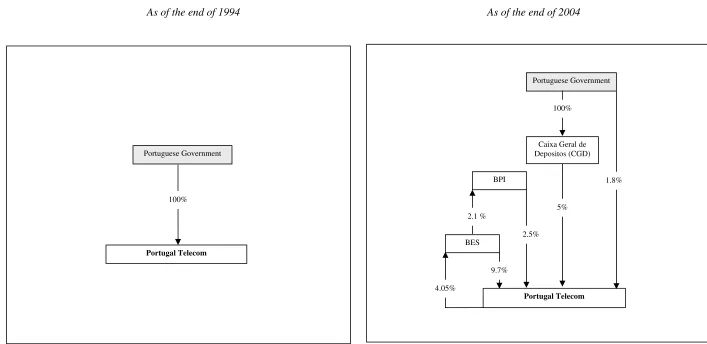
display complex ownership structures, with pyramiding often used to separate share ownership and
control. A first examination of our data reveals that the State has a stake in sixty-two companies and
that thirty-seven of the partially State-controlled utilities are subject to an IRA. In Table 2, we
report, for the ten largest utilities in the telecom and energy sectors, the year since when they
operate under an IRA, the date of the IPO, the total market capitalization and the Government UCR
at the end of the sample period (2005). Compared to telecommunications, energy IRAs were
introduced later, mostly around 2000. The privatization process also differs across countries: it lags
behind in France and Germany, but is more advanced in Spain and in the U.K. where most sample
firms are under private control during the sample period. More in detail, we note that 4 out of 14
fixed telecom operators were fully privatized by 2005 whereas two, in Germany and Sweden, were
still controlled by the State with a stake larger than 50%. Among energy operators, the UK
companies are fully privatized, E.ON (Germany) and Iberdola (Spain) have government UCR
below 5%, while the two France operators are still owned by the state with a share larger than 80%
(as of 2005).
Accounting and financial firm-level data have been collected from Worldscope. As a
measure of firm value, we use the market-to-book ratio (MTB). MTB is calculated as total assets
minus the book value of equity plus the market value of equity divided by the total assets. The
market value of equity is computed by multiplying the number of outstanding shares at the end of
the relevant year by the share price at that date converted into U.S. dollars. Other key variables for
the analysis of market-to-book ratios are the log of real total assets to control for size, the ratio of
EBIT (earnings before interests and taxes) to total assets, which is a proxy for profitability and
“efficiency”, and firm financial leverage, defined as total financial debt divided by the sum of book
equity and total financial debt.
We also control for key features of the financial and macroeconomic environment of the
different EU countries. We use the Investor Protection index, i.e. the “anti-director rights” index
developed by La Porta, Lopez-de-Silanes, Shleifer and Vishny (1999) and updated by Pagano and
Volpin (2005) to proxy for the extent of protection and enforcement of investor rights. The index is
time varying and goes from 0 to 7 as shareholders’ rights become more protected. We expect that
higher values of this index are associated with lower cost of equity and hence higher market value
(see, for example, La Porta, Lopez-de-Silanes, Shleifer and Vishny, 2002). Finally, we include GDP
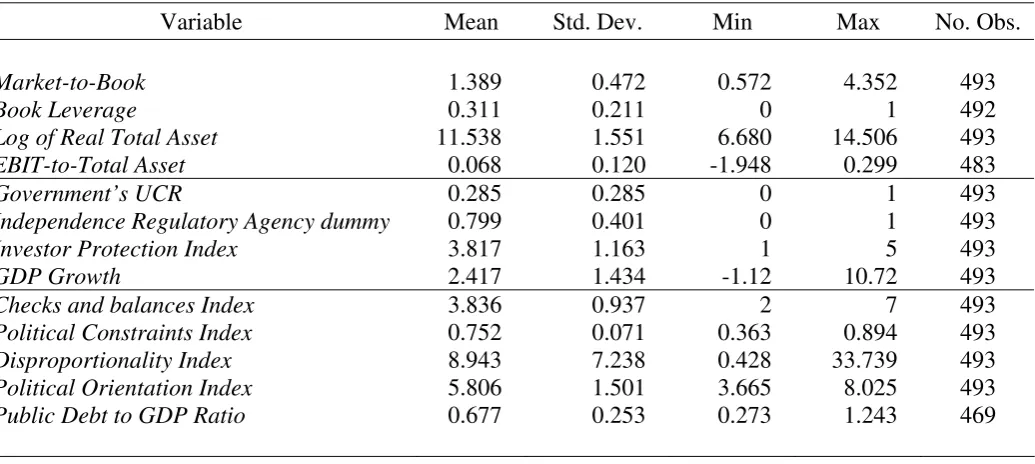
summarizes the descriptive statistics for the main firm and country level variables used in the
analysis both for the full sample (Panel A) and for the sub-sample of energy and telecom companies
(Panel B).
Figure 1 shows the average market-to-book ratios for private and state controlled firms from
3 years before the IRA set up to 3 years after the IRA establishment, using the 57 energy and
telecom firms. If we define as state-controlled those companies where Government UCR are equal
to or greater than 30%, we notice that the average market to book ratio of state controlled firms is
lower before the switch (year 0), but thereafter starts growing and, in the second and third year after
the IRA setup, is definitively larger: +20% and + 15%, respectively. In contrast, the average MTB
of private companies decreased from 1.33, at the regime switch, to 1.22 three years later.
5. The Effect of State Ownership on the Market Value of Regulated Firms
We estimate the following regression:
, * , 5 1 , 4 1 , 1 , 3 1 , 2 1 , 1 0 it t t t i i i t i t i t i t i t i t i it Year Firm IRA UCR Government IRA UCR Government MTB ε λ μ α α α α α α + + + + + + + + =
∑
∑
− − − − − YX (1)
where MTBit is the Market-to-Book ratio of firm i in year t, GovernmentUCRi,t-1 and IRAi,t-1 are the
lagged values of the continuous government ultimate control rights variable and of the IRA dummy,
GovernmentUCRi,t-1 *IRAi,t-1 is the interaction term that allows us to test for the effect of residual
State ownership when the IRA is in place,13Xit-1 is a vector of firm-specific variables, Yit is a vector
of country-specific variables, μiand λt are firm and year fixed effects while εit is an error term. The
vector of firm controls in this regression includes the Log of Real Total Assets to control for size,
the EBIT-to-Total Assets ratio to control for profitability/efficiency and the financial Leverage,
defined as total financial debt divided by the sum of book equity and total financial debt.14 The
vector of country-specific controls includes GDP growth and the Investor Protection index. To
13
A similar approach was used by Kwoka (2002 and 2006) to assess the differences across private and public ownership in the prices charged by U.S. electric utilities and in their cost efficiency.
14
partly address potential reverse causality, we lag all firm variables one year and moreover we add
firm-specific fixed effects to filter out unobserved firm heterogeneity that is constant over time.
In Table 4, we present the O.L.S. fixed effect coefficients for the EU regulated utilities
(columns (1) and (2)) and for the sub-sample of 57 regulated energy and telecom firms that,
following the EC directives, at some point in time - mostly from 1996 to 2000 - implemented the
new regulatory regime. In Columns (3) and (4), we thus focus on the changes in the market value of
private vs. public firms after they became subject to an IRA.
The results show that the market to book ratio is negatively related to firm size and that
market value is larger in countries where investor rights are better protected by the law and GDP
growth is faster. In Column (1), we find that neither state ownership nor the IRA dummy has,
separately, a significant effect. Column (2) adds the interaction between Government UCR and IRA.
We find that the coefficient on Government UCR turns significantly negative, while its interaction
with IRA is positive and highly significant. The positive coefficient on the interacted terms suggests
that when the IRA is in place, the larger the share held by the State, the higher the firm market
value. In Columns (3) and (4), the results for the control variables are less precisely estimated,
probably due to the exclusion of firms that either had the IRA from the start or never became
subject to an IRA, which sort of reduced the heterogeneity in the data. Notwithstanding this, in
Column (3) we find that the coefficient on GovernmentUCR is positive and significant and, in
Column (4), when we consider the effect of public ownership under the IRA, the standalone
GovernmentUCR variable is no longer significant while the interaction term is positive and
significant. This latter result is consistent with the graphical evidence in Figure 1.
In the next section, we interpret this finding, analyzing its political economy implications.
For this analysis, we focus on the sub-sample of firms operating in the energy and telecom sectors
where IRAs have been established. We report the results for the full sample in the Appendix.
6. Firm Value and State Ownership: the Role of Political Institutions
Our next step is to examine the driving forces that may explain the positive impact of
residual state ownership on firm value when the IRA exists. In Section 3, we argued that the quality
of a country’s political institutions disciplines the discretionary power of the government and its
latitude to interfere with the regulatory policy. To implement an empirical test we first investigate
whether the response of firm value to different regulatory and ownership regimes differs across
“weak” vs. “strong” political institutions as measured by two country-specific indices: Checks and
of Government UCR, IRA and of their interaction by incorporating the role of political institutions
straight into a specific identifying assumption, i.e. that Checks and Balances and Disproportionality
are valid instruments in a regression of partially privatized regulated firms’ market-to-book ratio
(Section 6.2).
6.1 Weak vs. Strong Political Institutions: Evidence from Sub-samples
We estimate market value regressions where we split our sample energy and telecom firms
based on Checks and Balances (C&B) in Table 5, and Electoral Disproportionality in Table 6. The
indexes allow for institutional changes over time as well as firms shifting across the “high”-“low”
categories. To classify country-years observations with the strongest countervailing powers, we
refer to values of the C&B index at the top quartile of its distribution – more specifically, when
C&B is greater than 4 (and symmetrically, for observations with C&B less than or equal to 4).
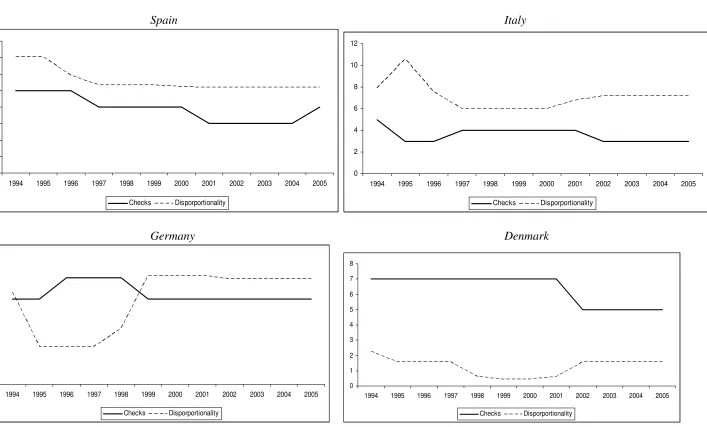
Based on country averages, Denmark, Holland, Belgium and Germany exhibit the highest scoresand
Greece, Portugal, Spain and Italy the lowest. Figure 3 reports the trends of the political institutions
indexes for two selected countries at the top and at the bottom ends of the distributions, i.e.
Denmark and Germany, Spain and Italy, respectively.
The empirical results in Table 5 are consistent with our predictions. In countries where
institutional checks and balances are weaker, larger government’s ownership stakes lead to higher
MTB ratios for the regulated firms. The evidence is weaker in Column (1) where we do not account
for the presence of the IRA, but is very strong where we do, in Column (2). The results strikingly
differ when we turn to Columns (3) and (4), where the countervailing powers are supposed to
restrain interference from the executive more efficiently. In both specifications, the IRA dummy is
positive and significant which suggests that where IRAs are expected to act independently (as
envisioned by the EC directives), capital markets assign a premium to the reduced regulatory
uncertainty that follows regulatory commitment (see Cambini and Rondi, 2011, for evidence on
fixed investment). Moreover, in Column (4), the interaction between GovernmentUCR and the IRA
dummy is negatively correlated with firm value, and this is consistent with the typical negative
outlook assigned to state-controlled regulated utilities.
To classify country-years observations where policy reversals are supposed to be less likely
owing to the electoral system, we refer to low values of the Electoral Disproportionality index.
governments, which according to Levy and Spiller (1994)15, favor regulatory commitment while,
incontrast, more cohesive governments typical of majoritarian systems have more room to interfere
in regulatory decisions. Indeed, we notice that, on average, Electoral Disproportionality is
negatively correlated with C&Bs, suggesting that checks and balances tend to be less effective in
majoritarian systems. Again using country averages, we find that Denmark, Holland, Germany and
Sweden score lower Disproportionality Indexes, while, at the opposite end of the distribution,
France (the most majoritarian system), the UK, Greece and Italy score the higher indexes. In Figure
3, we plot the evolution of both Checks and Balances and Disproportionality for a subset of
countries.
In Table 6, we report the results of the MTB equation when the sample is split according to
the electoral rule. To allow straightforward comparability with the results in Table 5, we inverted
the Disproportionality index to generate an Electoral Proportionality (EP) index so that high
proportionality has, by construction, an effect similar to high checks and balances. To separate the
sample, we thus use a threshold value of Electoral Proportionality of 28.5 to split the sample (i.e.
the 75th percentile value of the distribution of the inverted Disproportionality index). The results in
Table 6 show that, as the electoral rule becomes less proportional (hence in countries with more
majoritarian parliamentary systems), the larger the stake held by the state, the higher the firm
market value, particularly if the IRA is in place as shown by the positive and statistically significant
coefficient on the GovernmentUCR*IRA interaction in Column (2). In contrast, when we focus on
the sub-sample with more fragmented parliamentary systems, residual state ownership of regulated
firms is irrelevant (see Columns (3) and (4)).
Our results in Tables 5 and 6 suggest that the exploitation of political leverage to obtain
higher value (through political interference in regulatory decisions) does not occur whenever
regulation is granted independence by countervailing powers constraining the power of the
executive. In this case, regulatory policy is enforced independently of government residual stakes in
firms.16
15
Spiller and Urbiztondo (1994) also show that the probability of observing more independent agencies is higher in systems characterized by divided governments.
16
6.2 Instrumental variable results
The results reported in the previous section support the idea of reluctant regulation as a
possible factor explaining why state ownership benefits public utilities. We now try to find more
systematic evidence from instrumental variable estimation. In Section 3 we argued that state
ownership could affect its market value only when weak political institutions allow government’s
interference through reluctant regulation. To test this prediction, we now estimate the effect of
political institutions by two-stage least squares (2SLS), using Checks and Balances, or Electoral
Proportionality, and other country-specific variables (political orientation, the debt to GDP ratio,
and market openness) as instruments for Government UCR, IRA and their interaction (Government
UCR*IRA). Because we have more instruments than endogenous variables, our statistical model is
over-identified. We thus test the over-identifying restrictions and identify the impact of both state
ownership and IRA on firm value by testing the exclusion restriction that Checks and Balances and
Electoral Proportionality do not appear in the second stage estimation of firm market value, MTB
(we perform a similar test also for the other instruments).
In Table 7.1, we present the first-stage regressions for Government UCR, IRA and their
interaction when we use Checks and Balances (Columns (1), (3) and (5)) and Electoral
Proportionality (Columns (2), (4) and (6)) in the instrument sets. In Columns (1) and (2), the
negative coefficients on Political Orientation indicate that state ownership tends to be lower when
the executive is more ”right-wing”, while the positive coefficients on the OECD index suggest that
larger government stakes tend to be associated with less open and less liberalized markets. Columns
(3) and (4) suggest that IRAs were primarily set up when the Debt-to-GDP ratio is highest, probably
because EU member states tend to be more eager to comply with institutional requirements when
they are under fiscal distress. In addition, the inception of an IRA is positively associated with
right-wing governments, market openness, and electoral proportionality, and negatively related to checks
and balances (but recall that the IRAs were setup following EU Directives, so these results may
reflect the timing of the implementation of the norm). More importantly for our point of view,
Columns (5) and (6) show that, when the IRA is in place, residual state ownership tend to be larger
where the institutional checks and balances are weaker and electoral proportionality is lower. This
evidence is consistent with the idea that strong, less accountable executives do not wish to
relinquish control over politically sensitive public utilities from which they can extract economic
rents. Overall the first-stage results deliver an important message: of all the instruments we used,
only Checks and Balances and Electoral Proportionality are significant determinants of all the
endogenous variables. More to the point, they are the only significant explanatory variables of the
In Table 7.2, we present the 2SLS results where we test the over-identifying restrictions by
calculating the Sargan-Hansen and the Difference in Sargan statistics as well as by including C&B
and EP directly in the second-stage regressions.
Columns (1) and (3) report the 2SLS estimates when we use, respectively, C&B and EP in
the instrument set, along with political orientation, debt to GDP ratio and the OECD market
liberalization index. The results show that the interaction Government UCR*IRA is positive and
significant in all columns, which supports our hypothesis that the presence of the government as a
(residual) shareholder boosts the regulated firm’s value providing a sort of indirect governmental
protection that is apparently recognized and rewarded by the capital markets.
Comfortingly, the J statistics shows that the sets of instruments we use in both specifications
are valid and the Difference in Sargan tests on the political institution variables confirm that they
are valid instruments. However, we further test the exclusion restrictions by entering C&B and EP
in the second stage, in Columns (2) and (4) respectively. The results confirm the validity of our
identification strategy, as both instruments, once included in the MTB regression, are statistically
insignificant.17 This analysis shows that (weak) political institutions affect firms’ market value, but
only through the effect of residual government stakes in regulated firms. We set forth reluctant
regulation as an important channel to explain the valuation effect of government’s shareholdings in
public utilities.
7. Robustness Tests
As noted in Section 2, from a country level perspective, the UK is the EU member state
where the institutional reforms started earlier. More precisely, independent regulators in
telecommunications, energy and water supply were set up in the Eighties and most firms were fully
privatized even before. The peculiarity and relevance of the UK suggest us to check the robustness
of our results on a sample that excludes UK firms. In Table 8 we re-estimate the model with the
interaction between Government UCR and IRA for the full sample of non-UK firms as well as for
the sub-samples with low C&B and Electoral Proportionality. Comfortingly, the results support
our predictions and are very similar to those reported in Tables 5-7 and even sharper. In columns (1)
and (2), both the OLS and the 2SLS estimated coefficients on the Government UCR*IRA interacted
variable are positive and highly significant. Moreover, the positive coefficients are significant and
larger in the market value regressions for the firm-year observations subject to weaker checks and
balances and less proportional party systems. This analysis confirms that our results were not
17
sensitive to the presence (or the absence) of a country, such as the UK where privatization and
liberalization reforms date back to the Eighties.
In the second robustness check, we replace the continuous ownership variable with a
dummy to control whether the results hold for regulated firms where the state maintains a stake
large enough to reasonably ensure relative power and discretionality in managerial decisions. So we
use a plausible threshold of state ownership, i.e. a dummy that equals 1 when the Government UCR
are equal to and greater than 30%, to account for the fact that the state as a shareholder is likely to
exercise control even when it holds less than the majority interest. Table 9 reports the results from
estimating the specification with the interaction between the IRA dummy and the ownership
dummy UCR_30%. We find that the presence of the state as a shareholder with (at least) a 30%
stake positively and significantly affects the market value, but only when we control for the
endogeneity ownership variable and its interaction with the IRA dummy (Column (2)). The positive
effect, however, becomes strongly significant when we turn to the sub-sample of observations in
countries with low checks and balances (in Column (3)) and less proportional electoral rules hence
more majoritarian government systems (in Column (4)). Consistently with our theoretical
framework, in such political environments governments maintain the latitude to interfere with
regulatory decisions, and politicians may find it convenient to slow down privatizations.
Finally, it may be argued that our state controlled companies operate in sectors where
competition is still limited and, therefore, that our results capture part of this market power.
According to an OECD report by Conway and Nicoletti (2006, p.6), the presence of public
ownership hinders competition in some sectors: "with public enterprises often enjoying soft budget
constraints and state guarantees, the playing field is not level in markets where they operate". We
thus use the OECD index of product market regulation to test the impact of the intensity of
competition on firm market value, following the same strategy employed for political institutions.
We thus first split the sample using a threshold value of OECD Index of Liberalizationto estimate the
effect of government control in industries with high (index below 0.8, i.e. the 25th percentile value
of the distribution of the index) and low (index above 0.8) competition. The results show that
Government UCR*IRA is never significant, whether markets are more or less liberalized, both for
the full sample and for the telecom and energy sub-sample. Second, we check the direct impact of
competition by introducing the index as a regressor in the IV second-stage regression. We find that
and highly significant. In sum, the positive effect of government ownership on regulated firms’
market value is not driven by the intensity of market openness and liberalization.18
8. Conclusions
Over the last 20 years and around the world, regulatory competencies in network industries
have been delegated to independent agencies in order to improve market efficiency and to discipline
the conflict of interest stemming from the dual role of the state as owner and regulator. However,
despite significant efforts and structural reforms, most utilities, in Europe and elsewhere, are still
owned and often controlled by the state. Consequently, regulatory independence and residual state
ownership are intertwined institutional features that affect firm real and financial decisions, and
ultimately market value.
In this paper, we study empirically the relationship between state ownership and firms’
value when companies are subject to independent regulation. Using a large sample of European
utilities, we show state ownership is positively associated with firm value and that this effect is
strong and significant in countries where weak checks and balances and lower political
fragmentation do not constrain the power of the executive. Hence, where political institutions are
weak, politicians imperfectly delegate powers to regulatory agencies in order to benefit state-owned
firms. We label the creation of formally but not de facto independent agencies reluctant regulation,
a new concept which allows us to explain why governments stakes are associated with higher
valuations, and why privatization is so often partial and incomplete in network industries.
Our results point out a possible regulatory failure in industrial organizations dominated by
state controlled incumbents and characterized by reluctant regulation. Under these circumstances,
the state apparently enjoys and shares with private shareholders an undue economic rent at the
expense of consumers. Given the prevalence of state controlled utilities and the strong power
wielded by national governments, this conclusion raises concerns about the effectiveness of
privatization and regulatory policies in network industries in Europe. To address the problem and
therefore to make the recent structural reforms on network industries more credible, national
governments may push forward privatization to eliminate the potential conflict of interest, or
improve regulatory institutions in the direction of an enhanced independence and public
accountability.
References
Acemoglu D. (2005), “Constitutions, Politics and Economics: A Review Essay on Persson and Tabellini’s
The Economic Effects of Constitutions”, Journal of Economic Literature, 43(4), 1025-1048.
Albalate D., G. Bel and E. Ferran (2012), “Institutional Determinants of Military Spending”, Journal of
Comparative Economics, forthcoming.
Alesina A. and G. Tabellini (2008), “Bureaucrats or Politicians? Part II: Multiple Policy Tasks”, Journal of
Public Economics, 92, 426-447.
Armstrong, M. and D. Sappington (2007) “Recent Developments in the Theory of Regulation,” in M.
Armstrong and R. Porter (eds.), Handbook of Industrial Organization (Vol. III), Elsevier Science
Publishers: Amsterdam.
Baldwin R. and M. Cave (1999), Understanding Regulation. Theory, Strategy, and Practice. Oxford
University Press, Oxford (UK).
Beck T., G. Clarke, A. Groff, P. Keefer and P. Walsh (2001), “New Tools in Comparative Political
Economy: The Database of Political Institutions”, World Bank Economic Review, 15(1), 165-176.
Beltratti A., B. Bortolotti and V. Milella (2007), “State Ownership, Political Risk, and Asset Prices”, mimeo.
Bennedsen M. (2000), “Political Ownership”, Journal of Public Economics, 76, 559-581.
Bortolotti B. and M. Faccio (2009), “Government Control of Privatized Firms,” Review of Financial Studies,
22(8), 2907-2939.
Bortolotti, B., Fantini, M., and Siniscalco, D. (2003). “Privatisation around the World: Evidence From Panel
Data”, Journal of Public Economics, 88(1–2), 305–332.
Bortolotti, B., and P. Pinotti (2008), “Delayed Privatization”, Public Choice, 3, 331-351.
Cambini C. and L. Rondi (2011), “Regulatory Independence, Investment and Political Interference: Evidence
from the European Union”, EUI Working Papers - RSCAS 2011/42, Florence.
Claessens S., S. Djankov, and L. Lang, (2000), “The Separation of Ownership and Control in East Asian
Corporations,” Journal of Financial Economics, 58, 81-112.
Conway P. and G. Nicoletti (2006), Product Market Regulation in the Non Manufacturing Sectors of OECD
Countries: Measurement and Highlights, OECD Economics Department Working Paper n. 530,
OECD, Paris.
Dinc I.S. and N. Gupta (2011), “The Decision to Privatize: Finance and Politics”, The Journal of Finance,
66(1), 241-269.
Duso T. (2005)” Lobbying and Regulation in a Political Economy: Evidence from the U.S. Cellular
Industry”, Public Choice, 122, 251-276.
Duso T. and J. Seldeslachts (2010), “The Political Economy of Mobile Telecommunications Liberalization:
Evidence from OECD Countries”, Journal of Comparative Economics, 38(2), 199-216.
Edwards, G. and L. Waverman (2006), “The Effects of Public Ownership and Regulatory Independence on
European Commission (1999), Fourth Report on the Implementation of theTelecommunications Regulatory
Package, Bruxelles.
European Commission (2010), Progress Report on the Single European Electronic Communications Market
(15th Report), Part 1. COM(2010) 253, August, Bruxelles.
Faccio, M., and L. H. P. Lang (2002), “The Ultimate Ownership of Western European Corporations,”
Journal of Financial Economics, 65, 365-395
Gallagher, M., (1991), “Proportionality, Disproportionality and Electoral Systems,” Electoral Studies, 10,
33-51.
Gilardi F. (2005), “The Institutional Foundations of Regulatory Capitalism: The Diffusion of Independent
Regulatory Agencies in Western Europe”, The Annals of the American Academy of Political and
Social Science, 598, 84-101.
Guerriero C. (2011), “Accountability in Government and Regulatory Policies: Theory and Evidence.”,
Journal of Comparative Economics, 39, 453-469.
Gupta N. (2005), “Partial Privatization and Firm Performance”, The Journal of Finance, 60(2), 987-1015.
Guthrie, G. (2006), “Regulating Infrastructure: The Impact on Risk and Investment”, Journal of Economic
Literature, 44(4), 925-972.
Huber, J., and R. Inglehart (1995), “Expert Interpretations of Party Space and Party Locations in 42
Societies,” Party Politics, 1, 73-111.
Keefer, P. and S. Knack (2007), “Boondoggles, Rent-Seeking, and Political Checks and Balances: Public
Investment under Unaccountable Governments”, Review of Economics and Statistics, 89(3), 3566–
572.
Kwoka J.E. (2002), “Governance Alternatives and Pricing in the U.S. Electric Power Industry”, Journal of
Law Economics and Organization, 18(1), 278-294.
Kwoka J.E. (2006), “The Role of Competition in Natural Monopoly: Cost, Public Ownership, and
Regulation”, Review of Industrial Organization, 29, 127-147.
La Porta R., F. Lopez-de-Silanes, and A. Shleifer (1999), “Corporate Ownership Around the World,”
Journal of Finance, 54, 471-518.
La Porta R., F. Lopez-de-Silanes, and A. Shleifer (2002), “Investor protection and Corporate Valuation,”
Journal of Finance, 57, 1147-1170.
Laffont J.-J. (1996), “Industrial Policy and Politics”, International Journal of Industrial Organization, 14,
1-27.
Laffont J.-J. (2005), Regulation and Development, Oxford University Press.
Laffont J.-J. and J. Tirole (1986), “Using Cost Observation to Regulate Firms”, Journal of Political
Economy, 94(3): 614-641.
Laffont J.-J. and J. Tirole (1991), "Privatization and Incentives", Journal of Law, Economics and
Lang, L. H. P., E. Ofek and R. M. Stulz (1996), "Leverage, Investment, and Firm Growth," Journal of
Financial Economics, 40: 3-29.
Levy B. and P.T. Spiller (1994), "The Institutional Foundations of Regulatory Commitment: A Comparative
Analysis of Telecommunications Regulation," Journal of Law, Economics, and Organization, 10(2),
201-246.
Li W. and L. C. Xu (2002), “The Political Economy of Privatisation and Competition: Cross-Country
Evidence from the Telecommunications Sector,” Journal of Comparative Economics, 30, 439–462.
Lijphart, A. (1999). Patterns of Democracy. New Haven: Yale University Press.
Martimort D. (2006), "An Agency Perspective on the Costs and Benefits of Privatization," Journal of
Regulatory Economics, 30(1), 5-44.
McConnell, J. J., and H. Servaes (1990), "Additional Evidence on Equity Ownership and Corporate Value,"
Journal of Financial Economics, 27, 595-612.
Mediobanca Investment Bank (2009), Indici e dati, Milan, Italy.
Megginson W., and J. Netter (2001) “From State to Market: A Survey of Empirical Studies on
Privatization,” Journal of Economic Literature, 39(2), 321–89.
Morck, R., A. Shleifer and R. W. Vishny (1988), "Management Ownership and Market Valuation. An
Empirical Analysis," Journal of Financial Economics, 20, 293-315.
Pagano M. and P. Volpin (2005) “The Political Economy of Corporate Governance,” American Economic
Review, 95(4), 1005-1030.
Perotti E. (1995), “Credible Privatization”, American Economic Review, 85(4), 847-859.
Persson, T. (2002), “Do Political Institutions Shape Economic Policy?,” Econometrica, 70(3), 883-905.
Persson, T. and G. Tabellini (1999) “The Size and Scope of Government: Comparative Politics with Rational
Politicians.” European Economic Review, 43, 699-735.
Persson T., G. Roland and G. Tabellini (2007), “Electoral Rules and Government Spending in Parliamentary
Democracies”, Quarterly Journal of Political Science, 1-34.
Pitlik H. (2007), “A Race to liberalization? Diffusion of Economic Policy Reform among
OECD-Economies”, Public Choice, 132, 159-178.
Potrafke N. (2010), “Does Government Ideology Influence Deregulation of Product Markets? Empirical
Evidence from OECD Countries”, Public Choice, 143(1-2), 135-155.
Privatization Barometer (2010), Here Comes another Privatization Wave. PB Annual Report, Milan.
Downloadable at: http://www.feem.it/userfiles/attach/20116291544444PB_Annual_Report_2010.pdf
Roland G. (2008), Privatization: Successes and Failures. Columbia University Press, New York.
Sappington, D.E.M. and J. Stiglitz (1987), “Privatization, Information and Incentives”, Journal of Policy
Analysis and Management, 6, 567-582.
Shapiro C. and R. Willig (1990) “Economic Rationales for the Scope of Privatization”. J.M. Ohlin Program
Shleifer A. and R. Vishny (1994), “Politicians and Firms”, Quarterly Journal of Economics, 109(4),
995-1025.
Spiller, P.T. and S. Urbiztondo (1994), “Political Appointees vs. Career Civil Servants: A
Multiple-Principals Theory of Political Institutions”, European Journal of Political Economy, 10(3), 465-497.
Stigler, G. (1971), “The Economic Theory of Regulation”, Bell Journal of Economics, 2, 3-21.
Verhoest K., Van Thiel S., G. Bouckaert and P. Laegreid (2012), Government Agencies. Practices and