Knowledge Management in a Dynamic
Manufacturing Context: Case Study
Sérgio Dinis SOUSAa,1, Eusébio Pinto NUNESa and Ronildo Souza SILVAba
ALGORITMI Research Centre, University of Minho, Portugal
b
AOC-Envision Monitor Industria Eletronica, Brazil
Abstract. Continuous improvement or just improvement is a necessity for companies in a dynamic environment. To be more competitive companies must adapt to the changing internal and external environment. To adapt implies making decisions and taking actions in an informed way. Assuming that Knowledge is widespread over the company, companies may develop knowledge management systems (KMS) to capture and disseminate knowledge, but there is not a universal set of requirements to do it. This paper shows, through a case study, a methodology to manage knowledge developed by a renowned manufacturer of electronic products. In this company, it is studied the impact of process improvement on management practices and collaborators behavior. The development of a KMS, in a dynamic context, is discussed and assessed through a survey. The features of this system allow us to consider it as a KMS. The KMS leverages the use of collaborative tools and supports the verified performance improvements.
Keywords. Continuous improvement, Dynamic Context, Quality improvement, Knowledge Management, Knowledge Management System.
Introduction
Industries are continually challenged to provide the best return on investment for their shareholders and are facing changes due to the dynamic environment. Their activities can be influenced by internal or external factors [1], such as new laws, new competitors, new products/services, new technical requirements, new materials, new employees or new customer requirements. These factors put pressure on companies that can be described as a complex system, with multiple objectives related to production quantity, production quality, deadlines, and process efficiency. Thus, in competitive sectors, companies must adapt to find better ways of fulfilling multiple objectives and provide the best return on investment for their shareholders. Good solutions, in terms of layout, production plan, quality control, management directives, work instructions may become ineffective and/or inefficient as changes occur in this system.
To deal with change, to improve the quality of the product or service, and stay competitive, companies may introduce quality improvement programs such as quality circles, statistical process control (SPC), total quality management (TQM), six sigma, to name a few, developed in the manufacturing industry [2]. These allow putting in place methods to identify problems, potential problems or inefficiencies and devise
1 Corresponding Author, Mail: [email protected]
A
© 2018 The authors and IOS Press. This article is published online with Open Access by IOS Press and distributed under the terms of the Creative Commons Attribution Non-Commercial License 4.0 (CC BY-NC 4.0). doi:10.3233/978-1-61499-898-3-1082
solutions to solve these problems. For example, in quality management, there is a set of quality control and quality improvement activities that should be planned and implemented [3]. The key elements in these plans are the people who make decisions and take actions. For example, in quality improvement projects such as Six Sigma, black belts are key to provide technical knowledge and experience from previous improvement projects, while in quality control circles the team solves problems, gathers information and knowledge about the processes, its problems and adopted solutions. When defining corrective or preventive actions using the PDCA, team members should learn from success and from failure [3]. Other improvement methods such as benchmarking adapt the best solution to a new context. In all these examples, knowledge is at the center of these change processes and is intangible, context-specific, and dynamic but, according to [4], knowledge is difficult to grasp, transfer, imitate and transact. From these examples, a research question that can be posed is: how can change be managed, in the context of process improvement, to use existing and newly created knowledge, so that future improvements are more efficient?
To answer this research question, a literature review is presented on knowledge management, followed by a case study that shows how a large multinational company, that applies continuous improvement on a daily basis, developed a method to manage knowledge. The paper ends with a discussion of results and its impact on companies and for theory development of knowledge management.
This paper is organized as follows: in section 1 it is presented a literature review on the dynamic industrial environment and knowledge management. Section 2 presents the research methodology. In section 3 one case study presents the company dynamic context and the knowledge repository developed. In section 4 the knowledge management is assessed through a survey based on a questionnaire. The paper ends with conclusions and limitations of this work.
1.Knowledge management in manufacturing dynamic environments 1.1.Manufacturing dynamic environment
Companies need to adapt to changing market needs to stay competitive in the global market. This ability is becoming of increasing importance as product complexity increases; customer demand for product variety increases; product lifecycles shorten; legislation concerning areas such as materials, emissions and Safety tighten; and supply chains and customers become global [5].
The efficiency of processes can be addressed by waste identification and removal in both in the business design and manufacturing processes, leading to improved quality and profit margins [6]. Focus on quality leads directly to an increase in productivity and to other benefits, due to the ability of the company to produce standardized products, reduce variation, and increase the efficiency of its processes [7]. Currently, the attention of managers is focused on process improvement, as a consequence of dynamic changes taking place in the environment [1].
Companies may deploy quality improvement teams, particularly in manufacturing operations, quality improvement programs such as Six Sigma under its quality management function. These teams can be part of a continuous improvement program. Continuous improvement is defined as a “culture of sustained improvement targeting the elimination of waste in all systems and processes of the organization [8].
To understand causality between elements of a system, for example, a manufacturing system, a fishbone diagram or a cause-effect matrix, to relate cause and effect is typically used, but generally, the understanding is poor of the dynamic behavior of the improvement process [2, 9].
To improve the understanding and efficiency of these improvement processes, in quality control and improvement activities, people should collect data, analyze it for valid information, disseminate it, generate knowledge about possible solutions, transfer that knowledge to other employees, and make it available for reuse. As the steps follow and the application of an improvement method is repeated, individual knowledge is expanded and can reach the organizational level. For example, Plan-Do-Check-Act (PDCA) can structure such activities [3]. Process improvement should be supported by the concept of knowledge management (KM), which enables the interaction between members of the organization [1].
Firms emphasizing learning invest in transferring knowledge from experienced employees to less experienced employees through activities like mentoring, apprenticeships and job rotation [10]. Systematically collecting and utilizing best practices and lessons learned are other means of supporting learning within the organization [11]. However, few companies have achieved this ideal, because managers do not know the precise steps for building a learning organization, nor to develop knowledge resources to support process improvement [1].
1.2.Knowledge management
Organizations need to properly manage knowledge to be able to meet the global competition, survive on the market and be successful [1, 11]. Thus, it can be concluded that methods of acquiring, collecting and transferring knowledge, information as well as exchanging experience become more important [1].
Many organizations use information and communication technologies to implement knowledge management systems (KMS). Such systems are specifically designed to support processes of knowledge creation, storage, retrieval, transfer and application [12]. However, there are no exact requirements to develop KMS [13] and its implementation is difficult since these systems are unstructured [14].
According to [14], KMS have three relevant features:
Knowledge repositories – are the most common type of KMS and emphasize the codification and storage of knowledge, through databases that document best practices, experiences and other codified knowledge of experts, to facilitate knowledge reuse. Knowledge repositories preserve organizational memory and provide functions for capturing, generating, organizing, searching, retrieving and using knowledge and information.
Knowledge Maps – are searchable indexes of expertise held by individual employees.
Collaborative tools – tools, such as groupware, email, chat, electronic forums and conferencing, provide communication and collaboration services. The collaborative tools enable knowledge exchange among knowledge seekers and knowledge providers.
Assuming that knowledge-sharing activities and management methods can differ in different contexts [11] and may be affected by the managers’ institutional and cultural contexts [11], this research will focus on knowledge management constructs associated with the context, the team members that use the KMS and collaborative tools.
2.Research methodology
The main objective of this work is to present how can continuous improvement be successfully applied so that its associated knowledge is captured and disseminated. To that end, a case study describes how a KMS was developed, in an LCD and LED TV production industry, in Brazil.
The specific objectives are to describe the internal dynamic context associated with continuous improvement and to analyze the development of a KMS.
The case study uses multiple sources of evidence that are enriched by the perception of the people involved in the lesson-learned procedure, particularly on softs aspects of knowledge repositories such as the management of the improvement teams (knowledge providers/seekers); team initiative and behavior; and the organizational context where change happens.
A research instrument was used in the form of a questionnaire was answered by 26 members, participants (managers, engineers, analysts, and technicians) in the improvement groups that contributed to the developed lessons-learned procedure.
Each of the questions contains a 10-point Likert scale for marking, by the respondent, their degree of agreement. If an overall agreement among respondents is high, it can be concluded that lesson-learned procedure contributes to knowledge management, particularly with the three sub-constructs related with group management (5 questions); group behavior (2 questions); and the organizational context (8 questions), as proposed by [15]. The 16 survey questions are presented in the appendix.
Data obtained from the application of the questionnaire were organized, coded and analyzed using an Excel® spreadsheet. First, descriptive statistics of the variables were calculated: the arithmetic mean as a measure of central tendency since it represents the data well and has the advantage of being a measure that takes into account all values. To measure the variability of data, the standard deviation was calculated. The number of valid observations was also recorded and null and unanswered questions were left blank.
3.Case study
3.1.Dynamic environment characterization
This section presents the company and, in particular, the new products introduction process and mass production, addressing, in particular, TVs and Monitors manufacturing and assembly.
The company Envision Ind. Eletronica, where the study was carried out, is classified as a large company (annual turnover = 2.5 Billion R$ and approximately 1200 employees) in the electro-electronic segment and belongs to a multinational group with its origins and headquarters in China. Its production is characterized as an intermittent process since its volume is determined by variable customer demand.
The company receives from other companies new products to be mass-produced. The Research and Development (R&D) Department, with the support of other departments develops the necessary activities to plan for its mass production. This process involves many activities. The existence of a New Product Introduction (NPI) plan is the basis for the successful launch of a product. The NPI receives products specifications and develops the necessary activities to mass-produce it. This involves
defining production plans, test equipment, and deploying a continuous improvement team to put in practice corrective and preventive actions to improve product and process efficiency.
For a given new product, the peaks of problems occur at the beginning of mass-production. After those initial problems are identified and overcome, the process may present some defects. This is mainly due to possible changes in the workforce, material quality, machine breakdown, engineering changes, and operational failures, among others. When this occurs, the company needs to act cooperatively, to find solutions.
In the last 6 years (2011-2016), the number of new products introduced to mass-production per year, ranged from 37 to 50, with an average of 43.3 new products introduced per year. During this period a continuous improvement team using basic quality tools had the responsibility to identify and reduce problems. Overall, the percentage of defective items was 2.19% in the first 3 years and less than 0.98% in the last 3 years. Details of these improvements are presented in [16]. The organization has never ceased to have problems, but gradually learned to reduce them in a systematic way.
The continuous improvement team, involving 26 employees, consists of representatives from several departments: Production, Quality, and Engineering, which would solve the problems of product quality. The definition of the team and the responsibility for each member was based on knowledge, motivation, and experience.
The improvement activities developed in the company generated significant changes in the NPI process and mass-production. The team identified an evolution in problem-solving, such as the involvement of departments, which began to act more quickly. During this period performance indicators were displayed to all employees, through an updated, real-time electronic scoreboard, posted at the beginning of each production line. Work instructions and procedures were also improved, as well as the implementation of a smarter quality policy, based on the practical knowledge of the employees and adapted to the demands of the main customers, such as Sony, Panasonic, Lenovo, and Dell.
To explain how the company achieved, maintained and improved this quality performance, the next section will describe the developed knowledge management system.
3.2.Knowledge management system
The company developed and implemented the Lessons-Learned Procedure, with the objective that Quality, Production and Electrical and Mechanical Engineering departments register and share among them experiences obtained in complex problem-solving situations in the organizational environment. This procedure in centered in people and starts as the last stage of any improvement process. It can also start when a new solution (recognized as a success) is developed to prevent some potential problem, particularly before mass-production.
The process improvement team identified criteria for each operational area to initiate a lesson-learned procedure. The criteria were related to the existence of Customer Complaints; Field Rework; Larger defects that generate rework; Line stoppage; or Safety.
The procedure (see Figure 1) requires the record of these problems in a standardized way to facilitate future interpretation. A form was developed to
standardize information gathering, which is stored in a relational database. The form has the following fields:
x ID: sequential number of lessons-learned record;
x Date: day, month, year of occurrence;
x Project or Model: project or model reference;
x Phase: PP (Pilot Production) or MP (Mass Production);
x Area /Department: where the problem/success was evidenced;
x Task: Workstation, event, activity, etc.;
x Problem/Success: Experience/fact that originated the lesson learned;
x Impact: effects (line stoppage, rework, percentage of defect, losses, etc.);
x Recommendation: suggestions for improvement, action to be taken, etc.;
x Image / attachment: photo or PowerPoint® presentation.
Problem/success
Satisfy criteria to create Lesson-Learned?
Lesson-Learned
Form Complete
Lesson-Learned Report Start End No Send report to RD department for consolidation Yes
Each new lesson-learned is assessed by the R&D department, which consolidates lessons learned and forwards them to other group companies and/or to the Original Equipment Manufacturer customer. This information is also available at the pilot line meeting (conducted prior to the introduction of a new product to be mass-produced) and closing meeting.
4.Discussion of results
The case study evidenced the factors identified in the literature review as the cause of increasing competitiveness, such as the increasing of product complexity/variety and the shortening of product lifecycles [5]. It also provides support to characterize the company context as dynamic, not only by the number of new products introduced per year that has been increasing but also because new employees were hired in the manufacturing company. This confirms the factors associated with a dynamic environment proposed by [1]: new laws, new competitors, new products/services, new technical requirements, new materials, new employees and new customer requirements. To deal with the dynamic environment the company defined a continuous improvement team organized as a set of groups to carry on improvement projects. The main goal of this team is to improve yield, mainly by reducing defective units. During six years the percentage of defective units reduced steadily. Simultaneously the company designed and implemented a lesson-learned procedure, which can be classified as a KMS which supported this performance improvement as suggested by [17].
The improvement team developed a lesson-learned procedure, which includes a database to record and disseminate relevant knowledge. The company defined criteria to open a lesson-learned and the fields of the database. This database exhibits the features of a knowledge repository as proposed by [14].
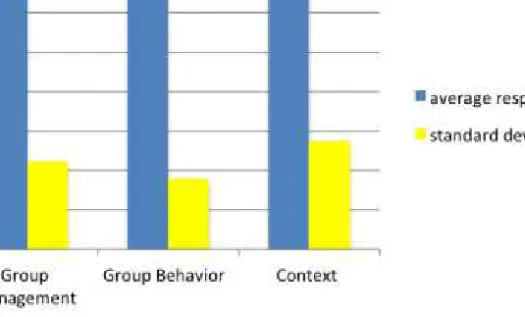
The questionnaire answers assess the perception of the people involved in the improvement team regarding group management, group behavior, and organizational context. The results grouped by each sub-construct are presented in Figure 2. In general, results show a high level of agreement, suggesting that the lesson-learned procedure contributes to Knowledge Management. Answers related to context scored high values also suggesting that the company has in place adequate collaborative tools, other relevant feature of a KMS, according to [14].
5.Conclusions
Continuous improvement is a necessity for manufacturing companies in dynamic environments. This case study evidenced the dynamic context resulting from the introduction of new products to be mass-produced and quality improvement over the years was measured by the percentage of defective items.
To be competitive this process improvement must be effective and efficient. The developed system proved to be effective in managing knowledge, despite knowledge being intangible [4] difficult to grasp and transfer. To that end a lesson-learned procedure was developed and implemented by the Quality department as a tool to facilitate process improvement, corresponding to features of a knowledge repository.
Figure 2. Questionnaire responses by sub-construct (n=26).
The assumption, by [14], that by using knowledge repositories employees can be more efficient at work, despite possible problems in decision making caused by data quality issues [18], is supported by this case study, since over the six years the number of new products introduced per year increased and the quality performance indexes improved.
The team members were both knowledge providers/holders and knowledge users, considering the classification proposed by [19]. In this classification, there are also a knowledge organizer and a knowledge manager. The knowledge producers and the knowledge users must accept the KMS and use it. The applied questionnaire evidenced agreement with sub-constructs related with good practices of group management and group behavior. Additionally, the questionnaire also suggests that the context enables the use of collaborative tools, which is another feature of a KMS [14].
This work presented evidence on managing best practices and lessons learned supporting learning within the organization, as suggested by [11]. It can also contribute to defining a set of requirements to develop KMS, fulfilling a gap identified by [13].
The main limitation of this work is that conclusions are based on a single case study, however, in inductive research, the reliability issue depends more on multiple sources of data [20]. Additionally, the case study was centered on the improvement team and did not assess the perception of KMS users from other group companies or the team that develop new products. This latter aspect could be a valuable future work to refute or consolidate these work conclusions.
Acknowledgement
This work has been supported by COMPETE: POCI-01-0145-FEDER-007043 and FCT – Fundação para a Ciência e Tecnologia within the Project Scope: UID/CEC/00319/2013.
References
[1] R. Brajer-Marczak, Elements of knowledge management in the improvement of business processes,
Management (1429-9321), Vol. 20:2, 2016, pp. 242–260, doi:10.1515/manment-2015-0063.
[2] D. van Dyk and L. Pretorius, A system dynamics approach to quality improvement programs in a heavy engineering manufacturing environment: A case study. In Technology Management for Emerging Technologies (PICMET), 2012 Proceedings of PICMET'12, 2012, July, pp. 3287–3296.
[3] J. Juran and J. De Feo, Juran’s Quality Handbook, McGraw-Hill, 2010, 6th Edition.
[4] I. Nonaka, R. Toyama and A. Nagata, A firm as a knowledge-creating entity: A new perspective on the theory of the firm. Industrial and Corporate Change, vol. 9:1, 2000, pp. 1–20
https://doi.org/10.1093/icc/9.1.1.
[5] B. J. Hicks and J. Matthews, The barriers to realising sustainable process improvement: A root cause analysis of paradigms for manufacturing systems improvement, International Journal of Computer Integrated Manufacturing, Vol. 23:7, 2010, pp. 585–602, DOI: 10.1080/0951192X.2010.485754. [6] D. van Dyk, and L. Pretorius, A systems thinking approach to the sustainability of quality improvement
programmes, South African Journal of Industrial Engineering, Vol. 25:1, 2014, pp. 71–84. [7] J.S. Oakland, Total Quality Management, text with cases, Butterworth-Heinemann, Oxford, 2003. [8] N. Bhuiyan and A. Baghel, An overview of continuous improvement: from the past to the present,
Management Decision, Vol. 43, 2005, pp. 761–771.
[9] S. Sousa, N. Rodrigues and E. Nunes, Evolution of process capability in a manufacturing process, Journal of Management Analytics (JMA), 2018, in press,
https://doi.org/10.1080/23270012.2018.1436988.
[10] S. Bryant, The impact of peer mentoring on organizational knowledge creation and sharing, Group & Organization Management, Vol. 30: 3, 2005, pp. 319–338.
[11] H. Hussinki, A. Kianto, M. Vanhala and P. Ritala, Assessing the universality of knowledge management practices, Journal of Knowledge Management, Vol. 21: 6, 2017, pp. 1596–1621,
https://doi.org/10.1108/JKM-09-2016-0394.
[12] M. Alavi and D. E. Leidner, Knowledge management and knowledge management systems: Conceptual foundations and research issues, MIS Quarterly, Vol. 25:1, 2001, pp. 107–136.
[13] H. F. Lin, Examining the factors influencing knowledge management system adoption and continuance intention, Knowledge Management Research & Practice, Vol. 11:4, 2013, pp. 389–404.
[14] Yu-Min Wang and Yao-Ching Wang, Determinants of firms' knowledge management system implementation: An empirical study, Computers in Human Behavior, Vol. 64, 2016, pp. 829–842,
https://doi.org/10.1016/j.chb.2016.07.055.
[15] C. Y. Oribe, Who solves problems learn? The contribution of systematic problem solving for organizational learning (in Portuguese), MSc thesis, Master in Management, Pontifical Catholic University of Minas Gerais, Brazil, 2008.
[16] R. S. Silva, Application of QC story in the Electronic Product Industry, MSc thesis, Master in Industrial Engineering, University of Minho, Portugal, 2016.
[17] Xiaojun Zhang, Knowledge Management System Use and Job Performance: A Multilevel Contingency Model. MIS Quarterly, Vol. 41:3, 2017, pp. 811–840.
[18] S. Sousa; E. Nunes and I. Lopes, Uncertainty Components in Performance Measures, IAENG Transactions on Engineering Technologies - Special Issue of the World Congress on Engineering 2012, Yang, Gi-Chul et al. (eds), 2013, Springer, Singapore, pp. 753–765, DOI: 10.1007/978-94-007-6190-2-57
[19] T. Housel and A. H. Bell, Measuring and managing knowledge, Macmillan/McGraw-Hill, New York, 2001.
[20] R. McAdam and B. Lafferty, A multilevel case study critique of six sigma: statistical control or strategic change? International Journal of Operations & Production Management, Vol. 24:5, 2004, pp. 530–549.
Appendix – Questions used in the survey Group management
1. When new members are invited to be part of improvement projects, the group passes them everything they have learned.
2. Members are influenced by the vision of a charismatic person who motivates them to practice continuous improvement.
3. The experience of the senior staff is used to enhance the effective potential of the lessons learned.
4. The company uses consultants, professional meetings, benchmarks, conventions or another type of exchange process to increase the added value of improvement projects.
5. There is a department or function in the organization responsible for managing the data and information generated by the improvement/lessons-learned groups.
Group Behavior
6. When group members need to discover or research something relevant to the work, the team transposes technical or departmental boundaries in order to achieve its objective.
7. The group gathers information from different backgrounds and disciplines for problem analysis and resolution.
Context
8. The members of the improvement groups have a wide variety of media of choice (telephone, cell phones, e-mail, internet, murals, video/audio conferencing, etc.).
9. There is an encouragement in the company to use rigorous quality tools to chart the right course of the project.
10. The knowledge generated by improvement groups is lost due to staff turnover. 11. Improvement teams learn about the problems also from the practices and strategies of their competitors.
12. Since considered satisfactory, the team studies and adopts the solutions that have been given by suppliers and partner companies with similar problems.
13. Group members use computer systems to disseminate what they have learned during the improvement project.
14. The media used by groups to disseminate their knowledge work quickly and efficiently.
15. The knowledge generated by the improvement groups about the problems and their own performance in the use of the lessons learned are easy to access and retrieve.
16. The computer systems where the information and data of the improvement groups are stored are easy to use.