PLEASE SCROLL DOWN FOR ARTICLE
Access details: Access Details: [subscription number 931317285]Publisher Routledge
Informa Ltd Registered in England and Wales Registered Number: 1072954 Registered office: Mortimer House, 37-41 Mortimer Street, London W1T 3JH, UK
Justice Quarterly
Publication details, including instructions for authors and subscription information: http://www.informaworld.com/smpp/title~content=t713722354
A Hero's Welcome? Exploring the Prevalence and Problems of Military
Veterans in the Arrestee Population
Michael D. White; Philip Mulvey; Andrew M. Fox; David Choate First published on: 28 March 2011
To cite this Article White, Michael D. , Mulvey, Philip , Fox, Andrew M. and Choate, David(2011) 'A Hero's Welcome? Exploring the Prevalence and Problems of Military Veterans in the Arrestee Population', Justice Quarterly,, First published on: 28 March 2011 (iFirst)
To link to this Article: DOI: 10.1080/07418825.2011.560890
URL: http://dx.doi.org/10.1080/07418825.2011.560890
Full terms and conditions of use: http://www.informaworld.com/terms-and-conditions-of-access.pdf
This article may be used for research, teaching and private study purposes. Any substantial or systematic reproduction, re-distribution, re-selling, loan or sub-licensing, systematic supply or distribution in any form to anyone is expressly forbidden.
The publisher does not give any warranty express or implied or make any representation that the contents will be complete or accurate or up to date. The accuracy of any instructions, formulae and drug doses should be independently verified with primary sources. The publisher shall not be liable for any loss, actions, claims, proceedings, demand or costs or damages whatsoever or howsoever caused arising directly or indirectly in connection with or arising out of the use of this material.
ISSN 0741-8825 print/1745-9109 online/11/000001-29 © 2011 Academy of Criminal Justice Sciences DOI: 10.1080/07418825.2011.560890
A Hero’s Welcome? Exploring the
Prevalence and Problems of
Military Veterans in the Arrestee
Population
Michael D. White, Philip Mulvey, Andrew M. Fox
and David Choate
Taylor and Francis RJQY_A_560890.sgm 10.1080/07418825.2011.560890 Justice Quarterly 0741-8825 (print)/1745-9109 (online) Article 2011 Taylor & Francis 00 0 0000002011 Dr MichaelWhite [email protected]
The potential for veterans to end up in the criminal justice system as a result of physical and psychological problems that may be combat-related has generated much interest, illustrated most recently by the development of specialized veterans’ courts. However, little is known about how often veterans are arrested and incarcerated, the nature of their problems, or the extent to which their military service has contributed to their criminality. Using interview data from 2,102 arrestees booked in Maricopa County (AZ) during 2009, this paper examines the problems and prior experiences of arrested military veterans and compares veteran and non-veteran arrestees along a range of measures. Results indicate that veterans comprise 6.3% of the arrestee population, and that more than 50% of veterans report suffering from at least one combat-related problem including physical injury, post-traumatic stress disorder (PTSD), other mental health problems, and substance abuse. Multivariate analysis indicates that
Michael D. White is an associate professor in the School of Criminology and Criminal Justice at Arizona State University. Dr. White’s primary research interests involve the police, including use of force, training, and misconduct. Dr. White’s recent work has been published in Criminology and Public Policy, Journal of Research in Crime and Delinquency, Criminal Justice and Behavior, and
Crime and Delinquency. Philip Mulvey is a graduate research associate for the Center for Applied Behavioral Health Policy and a doctoral student in the School of Criminology and Criminal Justice at Arizona State University. His research interests include the interface between mental health and deviance, specialty courts, and juvenile delinquency. Andrew M. Fox is a graduate research assistant for the Center for Violence Prevention and Community Safety and a doctoral student in the School of Criminology and Criminal Justice at Arizona State University. His research interests include social network analysis, gangs, drug markets, and communities. He has coauthored articles that appear or are forthcoming in Justice Quarterly, Crime and Delinquency, and the Pan American Journal of Public Health. David E. Choate is the associate director of Operations for the Center for Violence Prevention and Community Safety at Arizona State University. He has worked with dozens of local, county, state, and federal law enforcement agencies; numerous not-for-profit social service organi-zations, city, county, and state agencies, community groups and treatment providers throughout Arizona conducting evaluation, research, and strategic planning initiatives. Correspondence to: Michael D. White, School of Criminology and Criminal Justice, Arizona State University, 411 N Central Ave, Phoenix 85004, USA. E-mail: [email protected]
veteran arrestees differ from non-veterans on a number of key measures, most notably more frequent arrests for violent offenses and greater use of crack cocaine and opiates. The paper concludes with a discussion of implications for the potential link between military service and criminality as well as for crimi-nal justice policy and practice.
Keywords veterans and crime; military and crime; combat-related problems and crime
Introduction
Gary Pettengill wanted to make a career out of the military, but the Army made him take a medical discharge in 2006 after he injured his back in Iraq. At the time, Pettengill was 23 and married, with a third child on the way. To cope with what he says were empty days and nightmares caused by post-traumatic stress disorder, Pettengill says he started smoking marijuana. Then he began selling it to pay his bills. In February, he was arrested during a drug sweep and accused of being in possession of two pounds of marijuana. (Lewis, 2008, p. 1)
Carlos Lopez, 26, returned to Orange [County] in 2004 after a four-year stint in the Marines and struggled to readjust to civilian life. Haunted by memories of friends who died in Iraq, he was prescribed antidepressants, fell in with a bad crowd and started using cocaine. He was convicted of a possession charge in 2005. In 2007, Lopez was arrested for drunk driving, a violation of his probation. (Riccardi, 2009, p. 2)
These and many other stories in the news media illustrate the struggles faced by many military veterans1 after they return from combat operations abroad. Recent research suggests that these problems are often tied directly to their combat service. For example, the US army’s first study of the mental health of troops who fought in Iraq found that about one in eight soldiers reported symp-toms of post-traumatic stress disorder (PTSD). The survey also showed that less than half of those with problems sought help (Associated Press, June 30, 2004). The number of troops suffering from head injuries caused by combat is equally alarming (e.g., traumatic brain injury, TBI). A recent study found that 20% of all frontline infantry troops suffered from concussions during combat (“Troops risk”, 2006). Hoge et al. (2008) surveyed 2,525 army infantry troops three to four months after returning from deployment and found that approximately 15% reported experiencing TBI, defined as loss of consciousness or altered mental status. Other common signs and symptoms of these war-related conditions include decreased attention span, lack of motivation, irritability, depression
1. We use the term “veteran” throughout the paper to describe any individual who served in the US military for at least one day, regardless of whether they saw combat (i.e., served during a time of war) or their type of discharge (honorable, general, or other). This is a purposely broad definition employed because of the exploratory objectives of the study, and the non-discriminating nature of mental illness and other problems (i.e., type of discharge means little to those who served in the military and suffer from PTSD, TBI, or substance abuse).
and anxiety, increased fatigue, headaches, memory loss or disturbance, disrupted sleep, and behavioral issues (Hoge et al., 2008).
The symptoms associated with some of these combat-related injuries can also lead to anti-social behavior that draws the attention of the police (e.g., drug use, increased aggression), and may result in arrest and incarceration (Freeman & Roca, 2001; Lasko, Gurvits, Kuhne, Orr, & Pitman, 1999; Sherman, Sautter, Jackson, Lyons, & Han, 2006). In recognition of this problem, several jurisdictions across the USA have created specialized veteran courts, which employ a drug court-adapted therapeutic approach to funnel justice system-involved veterans to counseling and support services.2 Moreover, the American Recovery and Reinvestment Act of 2009 included nearly $1.5 billion in funding for the Department of Veteran Affairs to expand their facilities and services (http://www.va.gov). Despite these developments, little is known regarding the prevalence of military veterans in the criminal justice system, the nature of their cases and prior experiences, as well how combat-related conditions, such as PTSD or TBI, may have contributed to their involvement in the system.
This knowledge gap is troubling for two reasons. First, veterans who have served and were injured during wartime have made an extraordinary commit-ment to the country—a commitcommit-ment that many would argue deserves special treatment after their service ends (see, e.g., the Services, Education, and Rehabilitation for Veterans (SERV) Act introduced by Senators John Kerry and Lisa Murkowski in July 2008). Second, the end of combat operations and substantial troop withdrawal in Iraq are scheduled to occur in 2011 (along with the start of troop withdrawal in Afghanistan), which will result in a substantial increase in the number of veterans returning home over the next few years. Importantly, the lack of information on returning veterans and their service-related problems severely inhibits our understanding of both how those prob-lems may increase their risk of arrest and incarceration as well as how local offi-cials should properly respond to those problems.
This paper seeks to address the knowledge gap in this area through an exami-nation of 2,102 recently booked arrestees in Maricopa County, Arizona. Using interview data from the Arizona Arrestee Reporting Information Network (AARIN), the authors employ descriptive and multivariate analyses to character-ize the problems and prior experiences of military veterans and to compare veteran and non-veteran arrestees along a range of demographic, background, and criminal behavior measures. The overall objectives of the paper are to determine the prevalence of military veterans in the Maricopa County arrestee population and to assess the extent to which the arrested veterans differ from the larger arrestee population. Additionally, the paper seeks to explore the potential link between military service and criminality (e.g., the Violent Veteran Model; see Willbach, 1948). The paper concludes with a discussion of research implications for criminal justice policy and practice, as well as for the
2. In fact, the two stories at the beginning of this paper are both taken from articles describing veterans courts.
ongoing debate regarding the potential link between military service, combat-related injuries, and criminality.
Prior Research Early Research on Returning Military Veterans
Scholars have long inquired about the potential health impacts that military service has on veterans. Generations before PTSD was diagnosed, doctors used terms such as “nervous disease” in the medical pension files of veterans (Pizarro, Silver, & Prause, 2006). Historical evidence suggests that anxiety disorders, such as PTSD, were common to soldiers as far back as the Civil War. For example, a recent study of archival records examining the health outcomes of Civil War veterans found that direct exposure to death in one’s military unit was strongly correlated with later co-morbid nervous and psychological prob-lems (Pizarro et al., 2006). Hendin and Haas (1984) highlighted several exam-ples of veterans from wars pre-dating Vietnam who experienced significant stress reactions and noteworthy antisocial and violent behaviors as a result of prolonged exposure to combat.
The Vietnam conflict largely changed the way returning veterans were perceived and received. As thousands of troops came home with significant debilitating and severe post-traumatic stress reactions, greater attention was focused on the health consequences of combat. Some research has placed prev-alence rates of PTSD for Vietnam veterans at nearly one in three during the first year after returning from combat (Kulka et al., 1990). Schlenger et al. (1992) found that prevalence rates remained high (approximately 15%) years later. Researchers have suggested that PTSD was more common among those serving in Vietnam than veterans of previous wars because of their younger age (Vietnam veterans were, on average, seven years younger than WWII veterans), as well as unique aspects of the War—including specific fighting tactics of the enemy (e.g., guerilla warfare), increased exposure to death, the complexity of the US military command, and the lack of public support in the USA for the war (Green, Grace, Lindy, & Gleser, 1990; Higgins,1991; Speed, Engdahl, Schwartz, & Everly, 1989).
It is important to note that PTSD among Vietnam veterans has been linked to other social, psychological, and physical problems. Studies have shown that Vietnam veterans suffering from PTSD also have had significant problems with alcohol and drug addiction (Bremner, Southwick, Darnell, & Charney, 1996; Jordan et al., 1991; Kulka et al., 1990; McFall, Mackay, & Donovan, 1991; McGuire, Rosenheck, & Kasprow, 2003; True, Goldberg & Eisen, 1988). Research has also documented elevated rates of interpersonal violence with romantic partners (Beckham, Feldman & Kirby, 1998; Byrne & Riggs, 1996; Jordan et al., 1992) as well as co-morbid psychological illnesses, such as depression and anxi-ety disorders (Helzer, Robins, & McEvoy, 1987; Kessler, Sonnega, Bromet,
Hughes, & Nelson. 1995; Kulka et al., 1990; True et al., 1988). Finally, and perhaps as a result of these co-occurring problems, Vietnam veterans have also experienced high rates of homelessness. Some research has concluded that homelessness is twice as common among veterans as in the general population (Cunningham, Henry, & Lyons, 2007).
The impact of the Vietnam War on the mental, physical, and emotional health of veterans who served during that conflict was devastating. Although these behavioral health consequences are now widely acknowledged, this recog-nition has not translated into a comprehensive research agenda for the new generation of service personnel returning from deployment in the post 9/11 wars in Iraq (Operation Iraqi Freedom, OIF) and Afghanistan (Operation Enduring Freedom, OEF). The limited research on the problems of veterans serving in OEF/OIF is described in the following sections.
Veterans from Post 9/11 Wars
According to the National Council on Disability (2009), more than 1.6 million American military personnel have been deployed to Iraq and Afghanistan as part of OIF and OEF, and more than 565,000 have been deployed more than once. At any one time, the number of military personnel in Iraq and Afghanistan has ranged from 120,000 to 171,000 (O’Hanlon & Campbell, 2008). Troops deployed in OIF/OEF are a diverse group: three-quarters of those deployed are army, 15% are marines, and 10% are navy and air force; 72% are active duty members, and 28% are national guard or reserve troops; 88% are male; 60% are white, 22% are African American, and 11% are Latino; the average age ranges from 27 (for active duty) to 33 (for guard or reserve); 60% are married, and more than 50% have children (O’Bryant & Waterhouse, 2007, 2008).
While the number of soldiers wounded and killed during OIF/OEF is dwarfed by the loss of life in the Vietnam War (where more than 58,000 US soldiers were killed), the casualty rates are substantial. As of December 2010, more than 5,800 soldiers have been killed during OIF and OEF, and nearly 42,000 soldiers have been wounded (http://www.defense.gov/news/casualty.pdf).3 In addi-tion, the National Defense Council (2009, p. 1) notes that “an estimated 25-40 percent [of returning veterans] have less visible wounds – psychological and neurological injuries associated with post traumatic stress disorder (PTSD) or TBI, which have been dubbed ‘signature injuries’ of the Iraq War.” The Defense and Veteran’s Brain Injury Center reports that nearly one-quarter of all OIF/OEF combat wounds are brain injuries (TBI), more than twice the rate of TBI experi-enced by Vietnam veterans (http://www.dvbic.org). Additional research suggests that 20% of returning army veterans experienced concussions during
3. These figures are updated weekly. The total deaths include those killed in action and non-hostile deaths. A small number of deaths involve civilian Department of Defense employees and deaths that occurred in countries other than Iraq/Afghanistan, such as Guantanamo Bay (Cuba), Ethiopia, Jordan, Sudan, Turkey, and Yemen, but were part of OIF/OEF operations.
their tour of duty (Associated Press, 2004; see also Hoge et al., 2008). Though the increased rate of head injuries and TBI may be attributed, at least in part, to better detection methods, there is some evidence to support actual increases in these types of injuries. For example, Okie (2005) argued that the wide spread use of Kevlar body armor (including helmets) has improved survival rates for injured soldiers, leading to greater rates of survivable head injuries. Okie (2005) also highlighted the greater exposure of OIF/OEF veterans to improvised explo-sive devices (IEDs) and road side bombs than veterans in previous wars, which may also increase head injuries (see also http://www.dvbic.org).4
In another study, approximately 17% of those returning from Iraq were diag-nosed with a serious mental disorder—a twofold increase over pre-deployment levels (Hoge et al., 2004). A related study found that many soldiers who showed no signs of mental health problems immediately after their return from combat were diagnosed with a mental disorder when rescreened several months later (Milliken, Auchterlonie, & Hoge, 2007). Recent estimates have indicated that anywhere from 20% to 40% of returning soldiers are in need of treatment for mental health problems (Department of Defense Task Force on Mental Health, 2007), and that many suffer co-occurring disorders (Seal, Bertenthal, Miner, Sen, & Marmar, 2007). Greenburg and Roy (2007, p. 889) concluded that:
Iraq has become an incubator for post traumatic stress disorder (PTSD) in the American service members. The combat zone in Iraq has no frontline, no safe zone, and the embattled soldier has little with which to differentiate friend from foe, no warning of when or where the next improvised explosive device will be detonated. It is hardly surprising that we are seeing high rates of depres-sion, PTSD, and other anxiety disorders in service members who have been deployed to Iraq.
The Link between Military Service, Combat-Related Problems and Criminality
Historically, researchers and policy-makers have been interested in determining whether military service and combat-related illnesses, such as PTSD, are also associated with an increased risk of criminality. During the 1940s, public concern over civilian safety inspired research examining the criminality of veterans. Willbach (1948), for example, reported that the New York City arrest rate rose 89% in a three-year span during the mid-1940s, leaving some to suggest that service personnel returning from the WWII front lines were largely responsible for this increase. Willbach (1948, p. 501) provided an interesting rationale for a connection between military combat and criminality:
Having engaged in mass movements to vanquish an enemy, [the soldier] returns home with a new code and a new set of morals plus a knowledge of the use of
4. The degree to which increased rates of head injuries and TBI are explained by actual prevalence vs. better detection methods remains unknown.
weapons and a desire to continue adventure and to make a living or amass a fortune by expropriating the property of others.
Archer and Gartner (1976) examined postwar homicide rates and posited the
Violent Veteran Model, which hypothesized that soldiers are socialized to be violent to adapt to wartime conditions. In effect, they are taught that being skilled in violence is a primary tool for survival, but they are never “untaught” these lessons after their military service has ended. Archer and Gartner (1976) noted that variations of the Violent Veteran Model have existed anecdotally since the American Revolution, and this idea was discussed in the literature as early as World War I (Darrow, 1922; Kardiner, 1941).
Over the years, empirical support for the Violent Veteran Model has been mixed. For example, although Willbach (1948) explored the relationship between increased crime rates in New York City and returning veterans from WWII, he concluded that veterans were not responsible for the crime increase. Bennett (1954) noted that veterans entered prison at substantially lower rates than non-veterans, and he argued that military service actually had a negative influence on criminality. Notably, Bennett (1954) also concluded that veterans who were incarcerated adjusted better to prison than non-veteran offenders, were more easily rehabilitated during their prison term, and upon release, were less likely to re-offend—especially for violent offenses.
Though the perceived link between military service, combat-related prob-lems, and criminality has continued to be the subject of debate, contemporary research has not resolved the nature of the relationship. Some recent research has suggested that trauma and combat exposure, PTSD symptoms, substance abuse, and post deployment adjustment problems may be positive predictors of incarceration for veterans (e.g., supportive of the Violent Veteran Model; McGuire et al., 2003; Saxon et al., 2001; Yager, Laufer, & Gallops, 1984). More generally, Abramson (1972) and others have argued that the “criminalization” of mental illness has resulted in jails and prisons becoming the primary housing facilities for the mentally ill (see also Teplin, 1983, 1984, 1985), which would include veterans suffering from such problems. Studies have consistently placed rates of mental illness among jail inmates at from 6% to 16% (Ditton, 1999; Lamb & Weinberger, 1998; Steadman & Veysey, 1997; Teplin, 1994). Other research has questioned the link between combat-related problems and criminal justice involvement. For example, Shaw, Churchill, Noyes, & Loeffel-holz (1987) found that PTSD did not increase the likelihood of incarceration among veterans, and that combat stress was largely unrelated to criminal behavior.5 Erickson, Rosenheck, Trestman, Ford, & Desai. (2008) reported that mental illness was not a predictor of incarceration for veterans after control-ling for other factors such as substance use. Using data from the National Vietnam Veterans Readjustment Study, Fontana and Rosenheck (2005)
5. Shaw et al. (1987) did identify a direct relationship between levels of combat stress and PTSD, as well frequent substance use among veterans with PTSD.
concluded that veterans who exhibited antisocial behavior after deployment tended to have long histories of conduct problems before entering the military (e.g., pre-existing conditions).
Consequently, the relationship between military service, combat-related mental health problems—particularly PTSD—and criminal justice involvement remains unclear, as it appears that other risky behavior, such as substance abuse, likely plays an important contributing role. That is, while PTSD may or may not, by itself, lead to an increased risk of incarceration among veterans, it is tied to greater levels of substance abuse and other forms of anti-social behavior which increase the risk of criminal justice system involvement. More-over, the extent to which these behaviors were prevalent before entering the military (i.e., “pre-existing” conditions) also raises questions about assertions of causality.
Recent Research on Veterans in the Criminal Justice System
The recent attention on mental health problems of returning veterans—and the link between those problems and anti-social behavior—has generated interest in the prevalence of veterans in the criminal justice system as well as how those veteran arrestees may differ from non-veterans. The Bureau of Justice Statistics (BJS) has published two reports examining the prevalence of military veterans in local jails and prisons. Mumola (2000) reported that the rates of incarcerated veterans rose by 46% from 1985 to 1998, but this increase is much lower than the increase in non-veteran incarceration rates (which rose 172% in the same time period). A more recent report of veterans in 2004, focusing on state and federal prisons, found that the proportion of incarcerated veterans has been steadily declining over the past two decades, though that decline may be tied to long-term decreases in the size of the veteran population (a decrease of more than 3.5 million veterans during that time; Noonan & Mumola, 2007). Specifically, in 2001, 10% of state prisoners reported prior mili-tary service, compared with 12% in 1997 and 20% in 1986 (Noonan & Mumola, 2007). The BJS reports also indicate that criminal justice-involved veterans are distinctive from the larger criminal justice population in a number of ways. For example, incarcerated veterans were more likely to be white, and they tended to have more education, were older, and were more likely to be serving time for violent offenses (Noonan & Mumola, 2007). The authors note, however, that just 5% of the veterans in their sample served in post 9/11 Iraq and Afghanistan.
As awareness of veterans in the criminal justice system has increased recently, several jurisdictions have initiated special court-based efforts called veteran courts. Modeled after drug courts, the Veterans Court seeks to divert clients into counseling and support services that are closely supervised by the judge. In Buffalo’s Veterans Court (the first in the nation), for example, clients participate for approximately one year, and if all requirements are met, their
criminal charges are dismissed.6 In addition, a number of recent initiatives have been established at the federal level to facilitate alternative approaches to veterans who have been arrested and incarcerated. For example, the US Department of Health and Human Services (through the Substance Abuse and Mental Health Services Administration) began offering grant money in 2008 to community programs that divert people with trauma-related disorders— especially veterans—from the criminal justice system. Also, the SERV Act was introduced in July of 2008 to support the continued development of veteran courts. And more recently, a number of states have introduced legislation pertaining to veterans in the criminal justice system. In June of 2009, Texas became the first state to pass legislation calling for the establishment of county veteran courts (http://www.nadcp.org/JusticeForVets-Legislation). Notably, by December 2010 specialized veteran courts were operating in 49 jurisdictions across the USA (http://www.nadcp.org/learn/veterans-treatment-court-clear-inghouse).
Methodology
Despite recent media and legislative attention, there is little definitive research to assess the prevalence of veterans in jails and prisons, or the extent to which their combat-related problems have led to their incarceration. This study seeks to address these gaps by examining veteran status, combat-related problems and criminality among 2,102 recently booked arrestees in Maricopa County, Arizona. Data for the current study come from the AARIN. The AARIN project in Maricopa County was originally established in 1987 under the auspices of the Drug Use Forecasting (DUF) program, and later the Arrestee Drug Abuse Program (ADAM); both sponsored by the National Institute of Justice (NIJ) to monitor drug use trends, treatment needs, and at-risk behavior among recently booked arrestees. The program involved collecting survey data and urine specimens from recently booked arrestees in 35 sites across the USA. In January 2004, ADAM operations were suspended by NIJ due to federal spending constraints. A few jurisdictions sought to continue to fund the program through the use of local funds. Maricopa County was one of those sites, and with funding provided by the Maricopa County Managers Office, the AARIN program was re-established in 2007.
In order to ensure representative results for the entire population of arrest-ees in Maricopa County, the AARIN project employs the same rigorous methodol-ogy as its predecessor (ADAM), which centers on a systematic sampling protocol with data collection from countywide jail facilities, with target quotas at each facility. Data are collected quarterly at all facilities; interviews are conducted (and urine specimens are collected) during a two-week period at the Fourth
6. The Buffalo Veterans Court has garnered significant media attention, including coverage in USA Today and National Public Radio.
Avenue County Jail and during a one-week period at each of the Glendale and Mesa Police Departments.7 During data collection periods, for eight hours each day, interviews are conducted with arrestees who are randomly selected based on booking time. Consistent with the ADAM sampling strategy, a stock (i.e., arrested during non-data collection hours) and flow (i.e., arrested during data collection hours) selection process is employed to ensure a representative sample of arrestees. Arrestees who had been in custody longer than 48 hours were ineligible for participation in AARIN because of time limitations associated with urinalysis testing. Over the study period for this paper (2009), just more than 90% of approached adult arrestees agreed to participate in the study, and 89.6% of those who were interviewed also provided a urine specimen (for a study sample size of 2,102 arrestees).
The data used in the current analysis include the core survey instrument from the AARIN project as well as a detailed Veterans addendum. The core instru-ment, based on its predecessors from DUF and ADAM, gathers a range of self-report data on background and demographics, prior criminal history, current charge information, drug use patterns (lifetime, within last 12 months, 30 days, three days), substance abuse dependence and treatment, firearms possession/ ownership, gang involvement, victimization, and mental health.8 The Veterans Addendum was designed as a threshold instrument, screening all AARIN partici-pants for service in the US military, including the Coast Guard and National Guard.9 For those respondents who identified themselves as veterans, inter-viewers asked a series of follow-up questions about their service including whether they served in Iraq or Afghanistan, the branch of service, length of service and discharge, and the nature of their discharge. Additional questions were asked about service-related problems including whether they suffered a physical injury during their service, and if so, the type of injury, as well as mental health issues, substance abuse and related problems (post-discharge). At the end of the interview, each respondent was asked to provide a urine sample, which was analyzed for four different drugs: marijuana, cocaine, opiates, and methamphetamine.10 The urinalysis is calibrated to detect drugs ingested within 72 hours of the interview and to keep false positives to no more than 2 per 100 (Visher, 1991).
The variables used to assess mental health on the AARIN interview instrument warrant some discussion. These questions, which were derived from the Dual Diagnosis addendum developed and used for ADAM (Alemagno, Shaffer-King, Tonkin, & Hammel, 2004), focus on whether the respondent has received professional help for an emotional, psychiatric, or mental health problem, if they have been told they have a problem, or have been treated, prescribed
7. Interviews are also conducted at juvenile detention facilities but those data are not used in this paper.
8. See White (2010) for a more complete discussion of the AARIN methodology and data. 9. The Veterans Addendum was implemented in the first quarter of 2009.
10. As a reliability check, all specimens that test positive with EMIT methods are retested using gas chromatography with mass spectrum detection (GC/MS).
medication, or hospitalized for a mental health condition.11 Importantly, prior research has shown that brief, self-reported screening for mental health is a valid proxy for clinical assessments (Berwick et al., 1991; Spitzer, Kroenke, & Williams, 1999). For example, Berwick et al. (1991) compared a brief set of five questions to three longer, substantiated assessment tools and found significant reliability with the brief screening. Similarly, Spitzer et al. (1999) tested a self-report version of a clinical assessment tool and found that the self-self-reported version had comparable diagnostic validity.
Analytic Strategy
The authors employed a two-stage analysis to address the research questions. The first stage involves a basic descriptive analysis that illustrates the preva-lence of veterans in the Maricopa County arrestee population, as well as their background, socioeconomic characteristics, and problems. Veteran arrestees are also compared to the larger arrestee population along these dimensions. The second stage of the analysis builds upon the veteran/non-veteran compari-son and uses logistic regression to identify predictors of several measures of criminality, including confirmed drug use (by drug type, from urinalysis results), self-reported drug use (for the past 12 months, 30 days, and three days, also by drug type), and arrest for a violent offense. In each of the crime outcome models, veteran status (no, yes) is entered as a predictor along with a range of other relevant covariates.12
Limitations
The current study suffers from a number of limitations that warrant consider-ation. First, data were collected from one county in Arizona. Given the study location’s size and geography, the generalizability of the findings to jurisdic-tions in other parts of the country remains unknown. Second, with the exception of the offense and urinalysis data, all information collected from arrestees was self-reported, including information about veteran status and military service. The limits of self-report surveys are well-known (honesty, memory problems, etc.), though some research suggests that arrestees are generally truthful in their responses in such settings (see, e.g., Berwick et al., 1991; Katz, Webb,
11. These same criteria have been used in the Survey of Inmates in State and Federal Correctional Facilities, the Survey of Inmates in Local Jails, and the Survey of Adults on Probation, as reported by the BJS special report on mental health (Ditton, 1999).
12. The violent charge outcome reflects the current arrest that resulted in their participation in the study. Ideally, these models would predict a post-release measure of criminality (e.g., new offenses). However, these data were not available. As a result, we rely on these proxy measures of criminal behavior.
Gartin, & Marshall, 1997).13 Third, given the exploratory nature of this study, we were not able to collect detailed information on the nature of mental health and related problems among veterans (and non-veteran arrestees). Specifically, interviewers were not trained to conduct psychiatric assessments or tests, and the scope and parameters of the AARIN project prohibited the collection of such data. Moreover, while this paper explores the relationships between substance abuse, mental health problems, and criminality, we are unable to control for the presence of these problems before individuals entered the military. For example, we do not know whether those who enter the military are more likely to have these problems in their past, and if so, the extent to which these “pre-existing” conditions explain post-discharge differences from non-veteran arrest-ees. Our inability to collect pre-military service measures of these problems seriously limits the conclusions we can draw about the potential military/ criminality link, and we explore these issues further in the Discussion section of the paper. Last, this study examines a sample of incarcerated veterans only. The extent to which the findings here can be generalized to non-criminal justice-involved veterans remains unknown.
Results
Table 1 displays the characteristics of the arrestee sample (n = 2,102) and compares veteran and non-veteran arrestees. Of the 2,102 respondents inter-viewed in 2009, 132 or 6.3% reported that they had served in the US military. Veterans were predominantly male (92.4% compared to 75.5% of non-veterans) and white (61.4% compared to 45.5% for non-veterans). On average, veterans were significantly older (41.7 years) than non-veterans (31.5 years). Veterans were also significantly more likely to have achieved post high school education (59.1% compared to 27.9% of non-veterans) and were more likely to have been working full time when they were arrested (43.2% compared to 31.5% of non-veterans).
Veterans were no more likely than non-veteran arrestees to be homeless; however, they were more likely to live with their spouse (21.5% compared to 14.1% of non-veterans). Veterans were more likely to be arrested for a violent offense (30.3% compared to 19.6% for non-veterans). There were no statisti-cally significant differences between veterans and non-veterans in their self-reported rates of prior arrests and victimization in the past 12 months. Veteran arrestees, however, were significantly more likely than their non-veteran counterparts to report having a mental health problem (40.9% compared to 30.7%).
13. Moreover, consistency in self-reported drug use patterns and urinalysis results reported in this study and elsewhere (Katz et al., 1997; White, 2009, 2010) also suggests candidness in arrestee responses.
Table 2 shows the characteristics of veteran arrestees’ military service. Almost half of the veterans served in the army (49.6%), and most indicated that they served for three or more years (though nearly 40% served fewer than three years). Notably, two-thirds (66.9%) of the soldiers had been discharged more than 10 years ago. In fact, only 16% of veteran arrestees reported that they had served in post-9/11 Iraq or Afghanistan. Nearly one-third of veteran arrestees (30.2%) indicated that they had been injured during their service (approxi-mately one-third of wounded veterans suffered a head injury). Moreover, 17.1% reported that they had been diagnosed or treated for PTSD, and 16.3% had been diagnosed or treated for another mental health problem (post-discharge). About one-quarter had been diagnosed or treated for a substance abuse prob-lem since their discharge. Taken together, 68 of the 132 veterans in this study—or just over half (52%)—reported having at least one of these problems.14
Table 3 compares drug use patterns among veteran and non-veteran arrest-ees, by drug type. The most common drug of choice among arrestarrest-ees,
regard-14. Since these questions are part of the Veterans Addendum, we do not have this information for non-veteran arrestees.
Table 1 Characteristics of the arrestee population by veteran status
No Yes Total
% % %
Have you ever served in the US military? 93.7 6.3 100.0
N 1970 132 2102
Non-Veteran Veteran Total
% % %
Male* 75.5 92.4 76.5
Age1* 31.5(10.4) 41.7(12.4) 32.2(10.8)
White* 45.5 61.4 46.4
Post high school* 27.9 59.1 29.9
High school graduate 32.8 31.8 32.8
Full time employment* 31.5 43.2 32.2
Homeless 6.4 8.3 6.6
Lives with spouse* 14.1 21.5 14.6
Violent offense* 19.6 30.3 20.3
Arrests (past 12 months) 41.9 40.2 41.8
Victimized (past 12 months) 37.7 42.4 38.0
Mental health problem* 30.7 40.9 31.4
1Mean (SD). *p < .05.
less of veteran status, was marijuana. Overall, 44–50% of arrestees reported marijuana use in the past year. One-quarter of arrestees reported metham-phetamine use in the past year. Cocaine (both powder and crack) and opiate use were less frequent (6–17%). Interestingly, there were a few significant differences in drug use patterns among veteran and non-veteran arrestees. For example, recent marijuana use was much more common among non-veterans (40.3% of non-veterans tested positive, compared to 24.6% for veterans). This difference is also evident in self-reported use in the last 30 days. In addition, self-reported crack cocaine and opiate use were twice as common among
Table 2 Characteristics of veterans’ service
% n
In which branch of service?
Army 49.6 64 Navy 20.2 26 Air force 8.5 11 Marines 12.4 16 Coast guard 1.6 2 National guard 7.8 10
How long did you serve?
Less than 1 Year 9.3 12
1–2 Years 29.5 38
3–4 Years 37.2 48
5–10 Years 17.8 23
More than 10 years 6.2 8
How long ago were you discharged?
Less than 1 Year 3.9 5
1–2 Years 4.7 6
3–4 Years 11.8 15
5–10 Years 12.6 16
More than 10 years 66.9 85
Describe the nature of your discharge?
Honorable 70.2 87
General 19.4 24
Other than honorable 8.9 11
Bad conduct 0.8 1
Dishonorable 0.8 1
Did you serve in Iraq or Afghanistan after September 11, 2001? 16.4 21
Were you physically injured during military service? 30.2 39
Have you been diagnosed or treated for PTSD since your military service?
17.1 22
Have you been diagnosed or treated for mental health problem other than PTSD since your military service?
16.3 21
Have you been diagnosed or treated for substance abuse? 21.7 28
veteran arrestees. Nearly 14% of veteran arrestees reported crack cocaine use in the past month, compared to just 5% of non-veteran arrestees. And 12.1% of veteran arrestees reported using opiates in the last year, compared to only 6.4% of non-veteran arrestees.
Multivariate Analysis
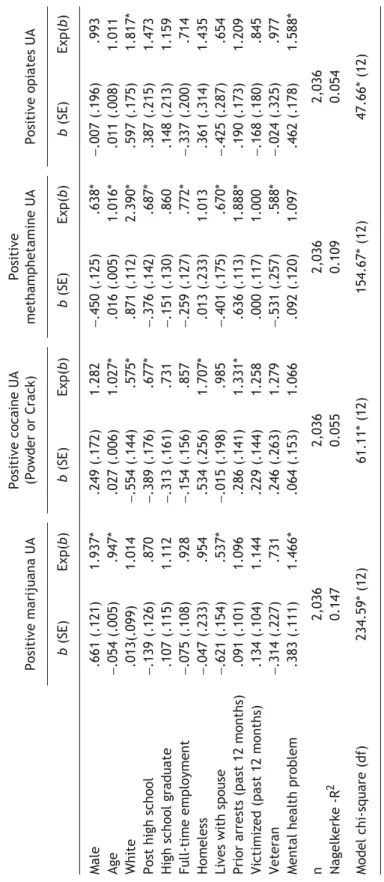
Table 4 shows the regression models for confirmed drug use (positive urinaly-sis for marijuana, cocaine, methamphetamine, and opiates) among arrest-ees. In the first model, a number of variables were associated with marijuana use, specifically, males and younger arrestees were significantly more likely to test positive, while arrestees who lived with their spouse were less likely to test positive for marijuana. Additionally, arrestees who self-reported a mental health problem were significantly more likely to test posi-tive for marijuana. Veteran status was not a significant predictor of
Table 3 Drug use by veteran status
Non-Veteran Veteran Total
% n % n % n Marijuana Past 12 months 50.3 990 43.9 58 49.9 1048 Past 30 days* 43.3 853 34.1 45 42.7 898 Urinalysis* 40.3 785 24.6 32 39.3 817 Powder cocaine Past 12 months 13.0 257 12.1 16 13.0 273 Past 30 days 7.8 154 8.3 11 7.8 165 Urinalysis 13.0 254 16.9 22 13.3 276 Crack cocaine Past 12 months* 8.3 163 16.7 22 8.8 185 Past 30 days* 5.3 105 13.6 18 5.9 123 Urinalysis 13.0 254 16.9 22 13.3 276 Methamphetamine Past 12 months 24.0 472 25.0 33 24.0 505 Past 30 days 19.4 382 15.9 21 19.2 403 Urinalysis 24.5 477 16.9 22 24.0 499 Opiates Past 12 months* 6.4 127 12.1 16 6.8 143 Past 30 days 4.9 97 6.8 9 5.0 106 Urinalysis 7.9 155 10.0 13 8.1 168 *p < .05.
Table 4
P
redicting confirmed drug use
Positive marijuana UA
Positive cocaine UA (Powder or Crack)
Positive methamphetamine UA Positive opiates UA b (SE) Exp( b ) b (SE) Exp( b ) b (SE) Exp( b ) b (SE) Exp( b ) Male .661 (.121) 1.937* .249 (.172) 1.282 − .450 (.125) .638* − .007 (.196) .993 Age − .054 (.005) .947* .027 (.006) 1.027* .016 (.005) 1.016* .011 (.008) 1.011 White .013(.099) 1.014 − .554 (.144) .575* .871 (.112) 2.390* .597 (.175) 1.817*
Post high school
− .139 (.126) .870 − .389 (.176) .677* − .376 (.142) .687* .387 (.215) 1.473
High school graduate
.107 (.115) 1.112 − .313 (.161) .731 − .151 (.130) .860 .148 (.213) 1.159 Full-time employment − .075 (.108) .928 − .154 (.156) .857 − .259 (.127) .772* − .337 (.200) .714 Homeless − .047 (.233) .954 .534 (.256) 1.707* .013 (.233) 1.013 .361 (.314) 1.435
Lives with spouse
− .621 (.154) .537* − .015 (.198) .985 − .401 (.175) .670* − .425 (.287) .654
Prior arrests (past 12 months)
.091 (.101) 1.096 .286 (.141) 1.331* .636 (.113) 1.888* .190 (.173) 1.209
Victimized (past 12 months)
.134 (.104) 1.144 .229 (.144) 1.258 .000 (.117) 1.000 − .168 (.180) .845 Veteran − .314 (.227) .731 .246 (.263) 1.279 − .531 (.257) .588* − .024 (.325) .977
Mental health problem
.383 (.111) 1.466* .064 (.153) 1.066 .092 (.120) 1.097 .462 (.178) 1.588* n 2,036 2,036 2,036 2,036 Nagelkerke -R 2 0.147 0.055 0.109 0.054 Model chi-square (df) 234.59* (12) 61.11* (12) 154.67* (12) 47.66* (12) * p < .05.
confirmed marijuana use.15 The second model predicts confirmed cocaine use, either powder or crack. Arrestees who were older, homeless, and had prior arrests were more likely to test positive for cocaine, while those who were white and who had a post high school education were significantly less likely to test positive for cocaine. Veteran status was unrelated to confirmed cocaine use. For methamphetamine use, arrestees who were older and white were more likely to test positive, as were those who had prior arrests. Arrestees who were male, had post-high school education, worked full time, and lived with their spouse were significantly less likely to test positive for methamphet-amines. Importantly, veterans were significantly less likely than non-veterans to test positive for methamphetamines (Exp(b) = 0.59; p < .05). This was the only significant difference for veteran status among the confirmed drug use models. For the last model, arrestees who were white and who reported a mental health problem were more likely to test positive for opiates.
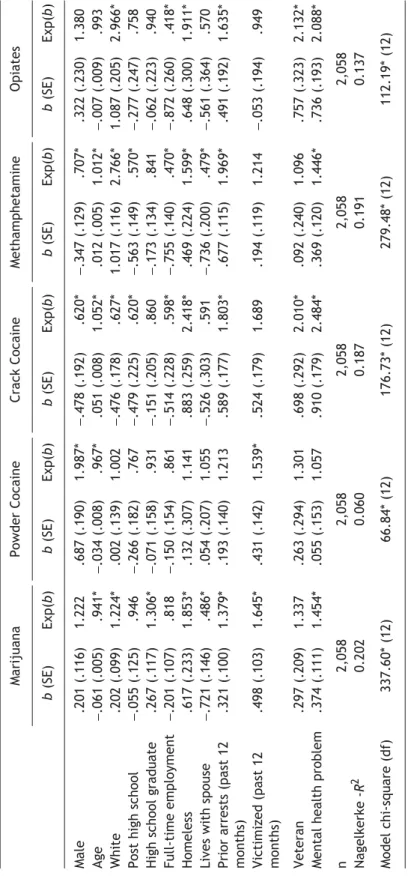
Table 5 shows the models for self-reported drug use in the past 12 months. A number of variables were significant predictors of use across drug type including older age (less marijuana and powder cocaine but more frequent crack cocaine and methamphetamine), white (more frequent marijuana, opiates and metham-phetamine but less crack cocaine), male (more frequent powder cocaine but less crack and methamphetamine), full-time employment (less frequent crack cocaine, opiates and methamphetamine), as well as homeless, prior arrests, and mental health problems (all more frequent marijuana, crack, methamphet-amine and opiates). Veteran status emerged as significant for two measures of self-reported drug use. Veteran arrestees were significantly more likely than non-veteran arrestees to report use of crack cocaine (Exp(b) = 2.01; p < .05) and opiates (Exp(b) = 2.13; p < .05).16
Table 6 shows the model predicting arrest for a violent charge. Arrestees who were white and who had prior arrests were significantly less likely to be arrested for a violent offense. Those who reported living with their spouse or being victimized in the past 12 months were more likely to be arrested for
15. One reviewer noted that the differences between veterans and non-veterans in our crime measures (drug use and violent charge) could be a result of a priori or pre-military service differ-ences in criminal involvement. We have raised this issue in Limitations section, and we come back to it later in the paper. In addition, while lifetime criminal history was unavailable in the data, we can examine age at first use of different illicit drugs as a proxy for early criminal involvement. We compared veterans to non-veterans on their age at first use measures. The mean age of first use of methamphetamine and both crack and powder cocaine was significantly higher for our veteran sample, compared to non-veterans, and there were no significant differences for marijuana, heroin, or alcohol. These findings indicate that at a minimum, veteran arrestees in this study were no more likely than other arrestees to begin using illicit drugs at an early age. Though this does not specifi-cally measure pre-military drug use, it does offer a rough approximation of onset and highlights the similarities among veteran and non-veteran arrestees.
16. In addition to self-reported use in the past 12 months, we ran the same models for past 30-day use and past three-day use (both self-reported). Veteran arrestees were more likely to report crack cocaine use during both time frames. Veteran status was not significant in any of the other 30-day and three-day models.
Table 5
P
redicting past 12-month self-reported drug use
Marijuana Powder Cocaine Crack Cocaine Methamphetamine Opiates b (SE) Exp( b ) b (SE) Exp( b ) b (SE) Exp( b ) b (SE) Exp( b ) b (SE) Exp( b ) Male .201 (.116) 1.222 .687 (.190) 1.987* − .478 (.192) .620* − .347 (.129) .707* .322 (.230) 1.380 Age − .061 (.005) .941* − .034 (.008) .967* .051 (.008) 1.052* .012 (.005) 1.012* − .007 (.009) .993 White .202 (.099) 1.224* .002 (.139) 1.002 − .476 (.178) .627* 1.017 (.116) 2.766* 1.087 (.205) 2.966*
Post high school
− .055 (.125) .946 − .266 (.182) .767 − .479 (.225) .620* − .563 (.149) .570* − .277 (.247) .758
High school graduate
.267 (.117) 1.306* − .071 (.158) .931 − .151 (.205) .860 − .173 (.134) .841 − .062 (.223) .940 Full-time employment − .201 (.107) .818 − .150 (.154) .861 − .514 (.228) .598* − .755 (.140) .470* − .872 (.260) .418* Homeless .617 (.233) 1.853* .132 (.307) 1.141 .883 (.259) 2.418* .469 (.224) 1.599* .648 (.300) 1.911*
Lives with spouse
− .721 (.146) .486* .054 (.207) 1.055 − .526 (.303) .591 − .736 (.200) .479* − .561 (.364) .570
Prior arrests (past 12 months)
.321 (.100) 1.379* .193 (.140) 1.213 .589 (.177) 1.803* .677 (.115) 1.969* .491 (.192) 1.635*
Victimized (past 12 months)
.498 (.103) 1.645* .431 (.142) 1.539* .524 (.179) 1.689 .194 (.119) 1.214 − .053 (.194) .949 Veteran .297 (.209) 1.337 .263 (.294) 1.301 .698 (.292) 2.010* .092 (.240) 1.096 .757 (.323) 2.132*
Mental health problem
.374 (.111) 1.454* .055 (.153) 1.057 .910 (.179) 2.484* .369 (.120) 1.446* .736 (.193) 2.088* n 2,058 2,058 2,058 2,058 2,058 Nagelkerke -R 2 0.202 0.060 0.187 0.191 0.137 Model chi-square (df) 337.60* (12) 66.84* (12) 176.73* (12) 279.48* (12) 112.19* (12) * p < .05.
violence. Importantly, veterans were significantly more likely than non-veterans to be arrested for a violent charge (Exp(b) = 1.61; p < .05).
Discussion
Literature dating back to the Civil War has documented the physical and psycho-logical problems suffered by veterans as a result of combat. The potential for veterans to end up in the criminal justice system, perhaps as a result of these problems, has garnered significant attention recently—illustrated by both the increased funding for the Department of Veterans Affairs and the development of specialized veteran courts. Despite these developments, little research has assessed the prevalence of veterans in jails and prisons, the nature of their problems, or the extent to which there is a direct link between military service and involvement in the criminal justice system. The current study sought to begin to fill this knowledge gap with data from over 2,100 arrestees in Maricopa County, Arizona.
The Prevalence of Veterans in the Maricopa County Jail
Findings indicate that 6.3% of Maricopa County arrestees in 2009 were military veterans. This is consistent with BJS data suggesting that there has been a
Table 6 Predicting violent charge
Any violent offense
b (SE) Exp(b)
Male .246 (.141) 1.279
Age .001 (.006) 1.001
White −.354 (.117) .702*
Post high school .137 (.140) 1.147
High school graduate −.257 (.139) .774
Full-time employment .232 (.121) 1.261
Homeless −.123 (.285) .884
Lives with spouse .378 (.149) 1.459*
Prior arrests (past 12 months) −.335 (.120) .715*
Victimized (past 12 months) .348 (.120) 1.416*
Veteran .475 (.214) 1.608*
Mental health problem −.025 (.130) .975
n 2,058
Nagelkerke-R2 0.045
Model chi-square (df) 59.66* (12)
*p < .05.
steady decline in the prevalence of incarcerated veterans over time (Noonan & Mumola, 2007). This trend does not diminish the sheer number of veterans in local jails and prisons, however. For example, though this study included 2,102 arrestees and only 132 were veterans, the methodology employed allows for extrapolation of the sample characteristics to the larger population of arrest-ees. Recent data suggest that the Maricopa County jail books more than 130,000 individuals into its detention centers each year (Maricopa County, 2010). Thus, the 2,102 arrestees interviewed in 2009 represent approximately 1.6% of all persons booked that year. Arguably then, the 132 veterans interviewed also represent 1.6% of the larger veteran arrestee population—suggesting that as many as 8,000 military veterans may have been booked in the Maricopa County jail in 2009.17
The extent to which the prevalence findings here offer insights to other juris-dictions across the US remains unclear, especially given the lack of other local-level studies and the absence of geographic breakdowns in the national local-level data (Mumola, 2000). Nevertheless, the current study represents the first effort at documenting the prevalence of incarcerated veterans in a large county jail (fifth largest in the country), and perhaps more importantly, offers a process for capturing such information that has proven success (modeled after DUF and ADAM) and can be replicated elsewhere. Moreover, these findings should be considered in the context of developments in OIF and OEF over the remainder of 2011. In February 2009 President Obama announced that combat operations in Iraq would cease by 31 August 2010—with just 50,000 US troops remaining to “train, equip and advise Iraqi Security Forces … [and to] conduct counterterror-ism operations” (http://www.defense.gov/news/newsarticle.aspx?id=53554)— and all US troops will leave Iraq by the end of 2011. At the same time, however, the number of US troops in Afghanistan had reached 68,000 by the end of 2009, with 30,000 more troops deployed to OEF by summer 2010. While at the time of this writing there is no stated deadline to end the war in Afghanistan, President Obama has announced that troop withdrawals will begin in July 2011.18 Notably, in June 2010 the war in Afghanistan surpassed Vietnam as the longest US war on record (at eight and half years), and public support has continued to wane. In September 2009, for example, a Pew survey indicated that 43% of respondents
17. This is an estimate affected to some degree by sampling error and candidness of responses (e.g., falsely reporting veteran status). Regardless, the number of incarcerated veterans in a given year is likely to be substantial (i.e., measured in the thousands).
18. This is a goal that was challenged during Congressional hearings in June 2010, and military lead-ers acknowledged in their testimony that there is no deadline for a complete troop withdrawal. For example, General David Petraeus testified on June 29, 2010 before the Senate Armed Services Committee and suggested that the July 2011 deadline may be flexible. The General said: “There will be assessment at the end of this year after which undoubtedly we’ll make certain tweaks, refine-ments, perhaps some significant changes” (Gearan and Flaherty, 2010). That assessment, released on 16 December, 2010, highlighted threats to the proposed timeline, but offered no definitive state-ments on planned troop withdrawal or the end of combat operations (http://www.nytimes.com/ 2010/12/17/world/asia/17afghan.html?pagewanted=2&_r=1&hpw).
favored removing US troops as soon as possible (see http://pewresearch.org/ pubs/1349/support-falls-afghanistan-war-troop-removal).
By all accounts then, there will be a substantial influx of returning veterans of OIF/OEF in 2011–2012. Available evidence indicates that veterans of OIF and OEF are experiencing the same physical and psychological problems that have plagued veterans dating back to the Civil War (Pizarro et al., 2006), and in fact, there is some evidence to suggest that they may be experiencing them at greater rates than in the past (see Okie, 2005; though better detection methods may also explain the increased rates). Recall that one-quarter of soldiers injured in OIF/OEF suffered brain injuries (Defense and Veteran’s Brain Injury Center, http://www.dvbic.org; see also Hoge et al., 2008). The stories of Gary Pettengill and Carlos Lopez at the beginning of this paper put these statistics in human terms and demonstrate quite clearly the risks and challenges facing returning veterans.
Characteristics of Incarcerated Veterans in Maricopa County
This study describes two important sets of findings with regard to the attributes of incarcerated veterans in Maricopa County. The first set of findings involves a comparison of veteran and non-veteran arrestees and suggests that veterans are distinctive across a number of background and demographic characteristics. Consistent with the earlier BJS report (Noonan & Mumola, 2007), veteran arrest-ees were a group that tended to be older, male, and less racially diverse than the larger arrestee population. Veterans were also more educated with more frequent full-time employment. Veterans were also more likely to report having mental health problems. Alternatively, the multivariate analyses indicated that veteran arrestees were more likely than non-veterans to be arrested for a violent offense, and they self-reported substantially higher rates of “hard” drug use including opiates and crack cocaine (non-veterans, on the other hand, indi-cated higher levels of methamphetamine use). Unfortunately, drug use data from jail-based veteran samples in other jurisdictions are not available for comparison, though the rates reported here are much higher than those reported in studies of non-incarcerated veterans. For example, the National Survey on Drug Use and Health (2005) reported that just 3.5% of veterans indi-cated using marijuana in the previous month.19 Clearly, there are several distin-guishing characteristics of incarcerated veterans in Maricopa County—such as their higher arrest rates for violent offenses and their higher prevalence rates of opiates and crack cocaine use—that may present challenges for justice and treatment officials.
19. Mumola (2000) reports drug use data for veterans incarcerated in local jails from 1996, indicat-ing that rates among veterans and non-veterans are similar. For example, 44% of veterans reported using any drug within a month of their arrest, compared to 49% of non-veteran arrestees. Marijuana use was slightly more common among non-veteran arrestees (33% compared to 26% for veterans), but rates of cocaine and opiate use were similar (18–20% and 6%, respectively).
The second set of findings relates to characteristics of their military service. Much like the previous BJS studies, the incarcerated veterans in Maricopa County are older, with most being discharged more than a decade ago. Just 16% indicated that they served in post-9/11 Iraq and Afghanistan (OEF/OIF). Still, more than one-half reported at least one problem that is potentially combat-related, including physical injury (30%, including one-third with head injuries), PTSD (17%), another mental health problem (16%), and substance abuse (22%). Recall that the interview questions specifically asked veterans to report on problems they have experienced after their discharge from the military. As a result, these findings suggest that a large number of incarcerated veterans have physical and psychological illnesses that require treatment, and if left untreated, will likely continue to cause them problems and may lead to further involvement in the criminal justice system.
Exploring the Link between Military Service and Criminality
Returning to an earlier question, unfortunately this study offers little direct evidence to test the link between veteran status and criminal involvement. Our inability to definitively distinguish between pre- and post-military service measures of criminality constrained efforts to explore this question. Clearly, future research should attempt to collect measures of criminality and problem behavior over the long-term. This will allow researchers the opportunity to assess the extent to which both (1) criminality precedes military service and (2) military service precedes criminality. Nevertheless, two findings reported here are consistent with the Violent Veteran Model (Willbach, 1948). Specifically, the results in Tables 5 and 6 indicate that veterans were significantly more likely than non-veterans to report crack cocaine and opiate use and to be arrested for a violent offense. Admittedly, we cannot rule out the potential for pre-military service differences in criminal involvement to explain these find-ings, but there are a few points to consider that may, to some degree, mitigate these concerns. First, and as mentioned previously, the interview questions specifically asked veteran arrestees to report on problems they have experi-enced post-discharge from the military. Second, and more importantly, there are specific screening processes in place to prevent individuals with serious physical, psychological, and emotional problems from entering the military. For example, though there has likely been some variation over time, prior felony convictions have served as a longstanding exclusionary criterion for admittance to the military. As a result, individuals with prior violent histories that have resulted in criminal convictions are typically screened out during the applica-tion process. More recent federal prohibiapplica-tions on firearms possession following convictions for domestic violence also come into play. To a lesser extent, the same can be said about screening processes for applicants with serious mental health and substance abuse problems (see, e.g., http://www.military.com/
Recruiting/Content/0,13898,rec_step07_DQ_law,,00.html).20 While by no means fool-proof, these exclusionary criteria and screening processes are in place to reduce the likelihood that individuals with serious problems in their past enter the military service. The extent to which these processes mitigate concerns over the “criminality precedes military service” hypothesis remains unknown, but it does serve as important context for consideration of the mili-tary/criminality question.
Though the conclusions that can be drawn are bound by the aforementioned limitations, the findings here do highlight the need for additional investigation of these questions. For example, with regard to the violence finding, one poten-tial explanation is that some veterans do, indeed, have trouble “unlearning” the adoption of violence as a survival tool after their discharge—which may then lead to more frequent arrests for violent offenses. Alternatively, it is also possi-ble that the relationship between military service and potential for violence is mediated by their combat-related injuries, as PTSD, other forms of mental illness, and TBI all may increase the likelihood of veterans engaging in violent behavior (and drug use). These findings clearly suggest that the relationship between crime and military service is complex and requires further intensive examination, with an emphasis on capturing measures of anti-social behavior (and other problems) both before and after military service.
Implications for Criminal Justice Agencies
Setting aside the military/criminality question, we return back to the other research findings involving prevalence and problems of veterans in the criminal justice system. Our review of the literature and available data suggests that little is known regarding the prevalence and problems of criminal justice-involved veterans. Given the findings from Maricopa County, it may be likely that many jurisdictions (especially large ones) have sizeable numbers of military veterans in their local jails, and in the absence of widespread data collection mechanisms described above, it is probably safe to assume that many of those same jurisdictions are largely unaware of this population. It is also safe to assume that the number of those jurisdictions—as well as the size of their incar-cerated veteran populations—will likely increase considerably over the next two years. In addition, the findings here indicate that, at least in Maricopa County,
20. “Persons entering the Armed Forces should be of good moral character. The underlying purpose of moral character enlistment standards is to minimize entrance of persons who are likely to become disciplinary cases or security risks or who disrupt good order, morale, and discipline. Moral standards of acceptability for service are designed to disqualify the following kinds of persons: Indi-viduals under any form of judicial restraint (bond, probation, imprisonment, or parole); Those with significant criminal records … Persons convicted of felonies may request a waiver to permit their enlistment. The waiver procedure is not automatic, and approval is based on each individual case. Those who have exhibited antisocial behavior or other traits of character that would render them unfit to associate with military personnel.” (http://www.military.com/Recruiting/Content/ 0,13898,rec_step07_DQ_law,,00.html)
veteran arrestees differ from non-veteran arrestees in important ways that may have implications for case processing, service needs, and case disposition (e.g., if a jurisdiction already has or is considering a specialized Veterans Court). Taken together, it seems reasonable to conclude that some jurisdictions may wish to explore the prevalence and problems of incarcerated veterans and assess whether the issue warrants special attention (or not). If a jurisdiction does deem that special attention for incarcerated veterans is warranted, the findings here offer some “food for thought” on how those efforts might be structured.
First, Maricopa County (AZ) had an existing data collection infrastructure in place through its AARIN project. When local officials became interested in the problem of incarcerated veterans, they simply tapped into the AARIN project to investigate the issue. If other jurisdictions are interested in exploring this prob-lem in their jails, officials will need to develop and institutionalize screening and identification mechanisms. One option would be to model their approach after the DUF/ADAM-based strategy that at one point was operational in 35 cities across the USA. Also, though often overlooked, police can play an impor-tant role in identifying troubled veterans who may or may not be formally involved in the criminal justice system. Police officers routinely interact with the mentally ill and the homeless, and have often been referred to as “street-corner psychiatrists” (Teplin & Pruett, 1992) or “psychiatrists in blue” (Menzies, 2006). In effect, police (many of whom are also veterans) can serve a catchment and diversion function to funnel-troubled veterans into appropriate specialized services. The Crisis Intervention Team (CIT), which seeks to divert the mentally ill in crisis away from jails and into acute care settings, offers a viable model for police interventions with veterans in distress (Daly, 2006; Dupont & Cochran, 2000; Teller, Munetz, Gil, & Ritter, 2006).21
Second, given increased funding and the political sensitivity of the issue, it is likely that specialized veteran courts will continue to emerge across the USA.22 If a jurisdiction determines a need and pursues the specialized court option, there are several resources to draw on to assist with program development and implementation. The National Association of Drug Court Professionals (NADCP) offers a wealth of information through its web-based national clearinghouse for Veterans Treatment Courts, including US Department of Justice reports on the key elements of both drug courts and mental health courts (http:// www.nadcp.org/learn/veterans-treatment-court-clearinghouse). In addition, NADCP has recently developed a Veterans Court mentor program where estab-lished courts assist new courts in training, technical assistance, and research. Also, there is a body of research demonstrating that drugs courts (and problem solving courts in general) are effective in both helping participants with their substance abuse and other problems, and in reducing recidivism (Belenko, 2001;
21. The CIT program was developed by the Memphis (TN) Police Department and has been adopted by dozens of police departments across the country.
22. For example, from June to December 2010 the number of veteran courts increased from 30 to 49.
Goldkamp, White, & Robinson, 2001; Wilson, Mitchell, & MacKenzie, 2006). These resources can serve as an important starting point for jurisdictions considering the specialized court approach.
Last, jurisdictions interested in investigating the problem of incarcerated veterans would benefit from drawing on local offices of the Department of Veter-ans Affairs. The local VA offices have experience and expertise in dealing with combat-related problems, and those offices can access national-level resources for treatment, services and funding. The Veterans Health Administration of the Department of Veterans Affairs is divided geographically into more than 20 health system networks, called Veterans Integrated Service Networks (VISNs), and each “VA medical center has designated a Veterans Justice Outreach Specialist (VJO) who is responsible for coordinating outreach, assessment and case management for justice involved offenders http://www.nadcp.org/learn/veterans-treat-ment-court-clearinghouse).” The VA also operates a National Center for PTSD, which offers information and resources on a wide variety of issues related to PTSD, including reintegration guides for veteran and their families (http:// www.ptsd.va.gov).23 The VA also works closely with the Defense and Veterans Brain Injury Center (DVBIC). The DVBIC was created by Congress in 1992, and it serves “active duty military, their beneficiaries, and veterans with traumatic brain injuries (TBI) through state-of-the-art clinical care, innovative clinical research initiatives, and educational programs (http://www.dvbic.org).” In short, the Department of Veterans Affairs offers important resources for local systems seeking to assist justice-involved veterans.
Final Thoughts
In the end, serious questions remain regarding the nature and extent to which military service, combat-related injuries, such as PTSD and TBI, and criminality are interrelated. Clearly, more work needs to done here. In terms of policy, questions also persist regarding whether or not the appropriate federal, state, and local agencies are prepared for the impending influx of returning veterans over the next two years, including thousands with combat-related injuries and problems. Recent increases in the funding support for the Department of Veter-ans Affairs ($1.5 billion in 2009) indicate some degree of preparation at the federal level. But at the local level, serious questions remain. This is particu-larly true with regard to criminal justice agencies where the lack of available data strongly suggests that most jurisdictions are largely oblivious to the number of veterans—and their problems—in their courts and jails. Based on this lack of awareness, it seems reasonable to conclude that many local justice systems will be ill-prepared to handle (or even document) any sort of increase in the number of incarcerated veterans, or to effectively respond to their
23. These guides are titled: Returning from the war zone: A guide for military personnel and
Returning from the war zone: A guide for families of military personnel (http://www.ptsd.va.gov).