Dynamic Test Generation To Find Integer Bugs in x86 Binary Linux
Programs
David Molnar
UC Berkeley
Xue Cong Li
UC Berkeley
David A. Wagner
UC Berkeley
Abstract
Recently, integer bugs, including integer overflow, width conversion, and signed/unsigned conversion errors, have risen to become a common root cause for serious security vulnerabilities. We introduce new methods for discover-ing integer bugs usdiscover-ing dynamic test generation on x86 binaries, and we describe key design choices in efficient symbolic execution of such programs. We implemented our methods in a prototype tool SmartFuzz, which we use to analyze Linux x86 binary executables. We also created a reporting service, metafuzz.com, to aid in triaging and reporting bugs found by SmartFuzz and the black-box fuzz testing toolzzuf. We report on experi-ments applying these tools to a range of software appli-cations, including themplayermedia player, theexiv2 image metadata library, and ImageMagickconvert. We also report on our experience using SmartFuzz, zzuf, andmetafuzz.comto perform testing at scale with the Amazon Elastic Compute Cloud (EC2). To date, the metafuzz.comsite has recorded more than 2,614 test runs, comprising2,361,595test cases. Our experiments found approximately77total distinct bugs in 864 com-pute hours, costing us an average of$2.24per bug at cur-rent EC2 rates. We quantify the overlap in bugs found by the two tools, and we show that SmartFuzz finds bugs missed by zzuf, including one program where Smart-Fuzz finds bugs butzzufdoes not.
1 Introduction
Integer overflow bugs recently became the second most common bug type in security advisories from OS ven-dors [10]. Unfortunately, traditional static and dynamic analysis techniques are poorly suited to detecting integer-related bugs. In this paper, we argue thatdynamic test generationis better suited to finding such bugs, and we develop new methods for finding a broad class of inte-ger bugs with this approach. We have implemented these methods in a new tool, SmartFuzz, that analyzes traces from commodity Linux x86 programs.
Integer bugsresult from a mismatch between machine arithmetic and mathematical arithmetic. For example, machine arithmetic has bounded precision; if an expres-sion has a value greater than the maximum integer that can be represented, the value wraps around to fit in ma-chine precision. This can cause the value stored to be smaller than expected by the programmer. If, for exam-ple, a wrapped value is used as an argument tomalloc, the result is an object that is smaller than expected, which can lead to a buffer overflow later if the programmer is not careful. This kind of bug is often known as an integer overflow bug. In Section 2 we describe two other classes of integer bugs: width conversions, in which converting from one type of machine integer to another causes un-expected changes in value, andsigned/unsigned conver-sions, in which a value is treated as both a signed and an unsigned integer. These kinds of bugs are pervasive and can, in many cases, cause serious security vulnerabili-ties. Therefore, eliminating such bugs is important for improving software security.
While new code can partially or totally avoid integer bugs if it is constructed appropriately [19], it is also im-portant to find and fix bugs in legacy code. Previous approaches to finding integer bugs in legacy code have focused on static analysis or runtime checks. Unfortu-nately, existing static analysis algorithms for finding in-teger bugs tend to generate many false positives, because it is difficult to statically reason about integer values with sufficient precision. Alternatively, one can insert runtime checks into the application to check for overflow or non-value-preserving width conversions, and raise an excep-tion if they occur. One problem with this approach is that many overflows are benign and harmless. Throwing an exception in such cases prevents the application from functioning and thus causes false positives. Furthermore, occasionally the code intentionally relies upon overflow semantics; e.g., cryptographic code or fast hash func-tions. Such code is often falsely flagged by static analysis or runtime checks. In summary, both static analysis and
runtime checking tend to suffer from either many false positives or many missed bugs.
In contrast,dynamic test generationis a promising ap-proach for avoiding these shortcomings. Dynamic test generation, a technique introduced by Godefroid et al. and Engler et al. [13, 7], usessymbolic executionto gen-erate new test cases that expose specifically targeted be-haviors of the program. Symbolic execution works by collecting a set of constraints, called thepath condition, that model the values computed by the program along a single path through the code. To determine whether there is any input that could cause the program to follow that path of execution and also violate a particular assertion, we can add to the path condition a constraint represent-ing that the assertion is violated and feed the resultrepresent-ing set of constraints to a solver. If the solver finds any solution to the resulting constraints, we can synthesize a new test case that will trigger an assertion violation. In this way, symbolic execution can be used to discover test cases that cause the program to behave in a specific way.
Our main approach is to use symbolic execution to construct test cases that trigger arithmetic overflows, non-value-preserving width conversions, or dangerous signed/unsigned conversions. Then, we run the program on these test cases and use standard tools that check for buggy behavior to recognize bugs. We only report test cases that are verified to trigger incorrect behavior by the program. As a result, we have confidence that all test cases we report are real bugs and not false positives.
Others have previously reported on using dynamic test generation to find some kinds of security bugs [8, 15]. The contribution of this paper is to show how to extend those techniques to find integer-related bugs. We show that this approach is effective at finding many bugs, with-out the false positives endemic to prior work on static analysis and runtime checking.
The ability to eliminate false positives is important, because false positives are time-consuming to deal with. In slogan form: false positives in static analysis waste the programmer’s time; false positives in runtime check-ing waste the end user’s time; while false positives in dynamic test generation waste the tool’s time. Because an hour of CPU time is much cheaper than an hour of a human’s time, dynamic test generation is an attractive way to find and fix integer bugs.
We have implemented our approach to finding inte-ger bugs inSmartFuzz, a tool for performing symbolic execution and dynamic test generation on Linux x86 ap-plications. SmartFuzz works with binary executables di-rectly, and does not require or use access to source code. Working with binaries has several advantages, most no-tably that we can generate tests directly from shipping binaries. In particular, we do not need to modify the build process for a program under test, which has been
a pain point for static analysis tools [9]. Also, this allows us to perform whole-program analysis: we can find bugs that arise due to interactions between the application and libraries it uses, even if we don’t have source code for those libraries. Of course, working with binary traces in-troduces special challenges, most notably the sheer size of the traces and the lack of type information that would be present in the source code. We discuss the challenges and design choices in Section 4.
In Section 5 we describe the techniques we use to gen-erate test cases for integer bugs in dynamic test gener-ation. We discovered that these techniques find many bugs, too many to track manually. To help us prioritize and manage these bug reports and streamline the pro-cess of reporting them to developers, we builtMetafuzz, a web service for tracking test cases and bugs (Section 6). Metafuzz helps minimize the amount of human time re-quired to find high-quality bugs and report them to de-velopers, which is important because human time is the most expensive resource in a testing framework. Finally, Section 7 presents an empirical evaluation of our tech-niques and discusses our experience with these tools.
The contributions of this paper are the following:
• We design novel algorithms for finding signed/unsigned conversion vulnerabilities us-ing symbolic execution. In particular, we develop a novel type inference approach that allows us to detect which values in an x86 binary trace are used as signed integers, unsigned integers, or both. We discuss challenges in scaling such an analysis to commodity Linux media playing software and our approach to these challenges.
• We extend the range of integer bugs that can be found with symbolic execution, including integer overflows, integer underflows, width conversions, and signed/unsigned conversions. No prior sym-bolic execution tool has included the ability to de-tect all of these kinds of integer vulnerabilities.
• We implement these methods inSmartFuzz, a tool for symbolic execution and dynamic test generation of x86 binaries on Linux. We describe key chal-lenges in symbolic execution of commodity Linux software, and we explain design choices in Smart-Fuzz motivated by these challenges.
• We report on the bug finding performance of Smart-Fuzz and compare SmartSmart-Fuzz to the zzuf black box fuzz testing tool. The zzuf tool is a simple, yet effective,fuzz testingprogram which randomly mutates a given seed file to find new test inputs, without any knowledge or feedback from the tar-get program. We have tested a broad range of com-modity Linux software, including the media players
mplayerandffmpeg, the ImageMagickconvert tool, and theexiv2TIFF metadata parsing library. This software comprises over one million lines of source code, and our test cases result in symbolic execution of traces that are millions of x86 instruc-tions in length.
• We identify challenges with reporting bugs at scale, and introduce several techniques for addressing these challenges. For example, we present evidence that a simple stack hash is not sufficient for group-ing test cases to avoid duplicate bug reports, and then we develop afuzzy stack hash to solve these problems. Our experiments find approximately77 total distinct bugs in864compute hours, giving us an average cost of$2.24per bug at current Amazon EC2 rates. We quantify the overlap in bugs found by the two tools, and we show that SmartFuzz finds bugs missed byzzuf, including one program where SmartFuzz finds bugs butzzufdoes not.
Between June 2008 and November 2008, Metafuzz has processed over 2,614 test runs from both SmartFuzz and thezzufblack box fuzz testing tool [16], comprising 2,361,595 test cases. To our knowledge, this is the largest number of test runs and test cases yet reported for dy-namic test generation techniques. We have released our code under the GPL version 2 and BSD licenses1. Our vision is a service that makes it easy and inexpensive for software projects to find integer bugs and other serious security relevant code defects using dynamic test gener-ation techniques. Our work shows that such a service is possible for a large class of commodity Linux programs.
2 Integer Bugs
We now describe the three main classes of integer bugs we want to find: integer overflow/underflow, width con-versions, and signed/unsigned conversion errors [2]. All three classes of bugs occur due to the mismatch between machine arithmetic and arithmetic over unbounded inte-gers.
Overflow/Underflow. Integer overflow (and underflow) bugs occur when an arithmetic expression results in a value that is larger (or smaller) than can be represented by the machine type. The usual behavior in this case is to silently “wrap around,” e.g. for a 32-bit type, reduce the value modulo232. Consider the functionbadalloc
in Figure 1. If the multiplicationsz * noverflows, the allocated buffer may be smaller than expected, which can lead to a buffer overflow later.
Width Conversions. Converting a value of one integral type to a wider (or narrower) integral type which has a
1http://www.sf.net/projects/catchconv
char *badalloc(int sz, int n) { return (char *) malloc(sz * n); }
void badcpy(Int16 n, char *p, char *q) { UInt32 m = n;
memcpy(p, q, m); }
void badcpy2(int n, char *p, char *q) { if (n > 800)
return; memcpy(p, q, n); }
Figure 1: Examples of three types of integer bugs. different range of values can introducewidth conversion
bugs. For instance, considerbadcpyin Figure 1. If the first parameter is negative, the conversion fromInt16to UInt32will trigger sign-extension, causingmto be very large and likely leading to a buffer overflow. Because memcpy’s third argument is declared to have typesize t (which is an unsigned integer type), even if we passed ndirectly tomemcpythe implicit conversion would still make this buggy. Width conversion bugs can also arise when converting a wider type to a narrower type.
Signed/Unsigned Conversion. Lastly, converting a signed integer type to an unsigned integer type of the same width (or vice versa) can introduce bugs, because this conversion can change a negative number to a large positive number (or vice versa). For example, consider badcpy2in Figure 1. If the first parameternis a negative integer, it will pass the bounds check, then be promoted to a large unsigned integer when passed to memcpy. memcpy will copy a large number of bytes, likely lead-ing to a buffer overflow.
3 Related Work
An earlier version of SmartFuzz and the Metafuzz web site infrastructure described in this paper were used for previous work that compares dynamic test generation with black-box fuzz testing by different authors [1]. That previous work does not describe the SmartFuzz tool, its design choices, or the Metafuzz infrastructure in detail. Furthermore, this paper works from new data on the ef-fectiveness of SmartFuzz, except for an anecdote in our “preliminary experiences” section. We are not aware of other work that directly compares dynamic test gener-ation with black-box fuzz testing on a scale similar to ours.
The most closely related work on integer bugs is Godefroid et al. [15], who describe dynamic test genera-tion with bug-seeking queries for integer overflow, un-derflow, and some narrowing conversion errors in the context of the SAGE tool. Our work looks at a wider
range of narrowing conversion errors, and we consider signed/unsigned conversion while their work does not. The EXE and KLEE tools also use integer overflow to prioritize different test cases in dynamic test generation, but they do not break out results on the number of bugs found due to this heuristic [8, 6]. The KLEE system also focuses on scaling dynamic test generation, but in a dif-ferent way. While we focus on a few “large” programs in our results, KLEE focuses on high code coverage for over450smaller programs, as measured by trace size and source lines of code. These previous works also do not address the problem of type inference for integer types in binary traces.
IntScope is a static binary analysis tool for finding in-teger overflow bugs [28]. IntScope translates binaries to an intermediate representation, then it checks lazily for potentially harmful integer overflows by using symbolic execution for data that flows into “taint sinks” defined by the tool, such as memory allocation functions. Smart-Fuzz, in contrast, eagerlyattempts to generate new test cases that cause an integer bug at the point in the pro-gram where such behavior could occur. This difference is due in part to the fact that IntScope reports errors to a programmer directly, while SmartFuzz filters test cases using a tool such as memcheck. As we argued in the Introduction, such a filter allows us to employ aggres-sive heuristics that may generate many test cases. Fur-thermore, while IntScope renders signed and unsigned comparisons in their intermediate representation by us-ing hints from the x86 instruction set, they do not explic-itly discuss how to use this information to perform type inference for signed and unsigned types, nor do they ad-dress the issue of scaling such inference to traces with millions of instructions. Finally, IntScope focuses only on integer overflow errors, while SmartFuzz covers un-derflow, narrowing conversion, and signed/unsigned con-version bugs in addition.
The dynamic test generation approach we use was in-troduced by Godefroid et al. [13] and independently by Cadar and Engler [7]. The SAGE system by Godefroid et al. works, as we do, on x86 binary programs and uses a generational search, but SAGE makes several dif-ferent design choices we explain in Section 4. Lanzi et al. propose a design for dynamic test generation of x86 binaries that uses static analysis of loops to assist the solver, but their implementation is preliminary [17]. KLEE, in contrast, works with the intermediate repre-sentation generated by the Low-Level Virtual Machine target forgcc[6]. Larson and Austin applied symbolic range analysis to traces of programs to look for potential buffer overflow attacks, although they did not attempt to synthesize crashing inputs [18]. The BitBlaze [5] infras-tructure of Song et al. also performs symbolic execution of x86 binaries, but their focus is on malware and
signa-ture generation, not on test generation.
Other approaches to integer bugs include static anal-ysis and runtime detection. The Microsoft Prefast tool uses static analysis to warn about intraprocedural integer overflows [21]. Both Microsoft Visual C++ andgcccan add runtime checks to catch integer overflows in argu-ments tomallocand terminate a program. Brumley et al. provide rules for such runtime checks and show they can be implemented with low overhead on the x86 ar-chitecture by using jumps conditioned on the overflow bit in EFLAGS [4]. Both of these approaches fail to catch signed/unsigned conversion errors. Furthermore, both static analysis and runtime checking for overflow will flag code that is correct but relies on overflow se-mantics, while our approach only reports test cases in case of a crash or a Valgrind error report.
Blexim gives an introduction to integer bugs [3]. Fuzz testing has received a great deal of attention since its original introduction by Miller et al [22]. Notable pub-lic demonstrations of fuzzing’s ability to find bugs in-clude the Month of Browser Bugs and Month of Kernel Bugs [23, 20]. DeMott surveys recent work on fuzz test-ing, including the autodafe fuzzer, which uses libgdb to instrument functions of interest and adjust fuzz testing based on those functions’ arguments [11, 27].
Our Metafuzz infrastructure also addresses issues not treated in previous work on test generation. First, we make bug bucketinga first-class problem and we intro-duce afuzzy stack hashin response to developer feedback on bugs reported by Metafuzz. The SAGE paper reports bugs by stack hash, and KLEE reports on using the line of code as a bug bucketing heuristic, but we are not aware of other work that uses a fuzzy stack hash. Second, we report techniques for reducing the amount of human time required to process test cases generated by fuzzing and improve the quality of our error reports to developers; we are not aware of previous work on this topic. Such techniques are vitally important because human time is the most expensive part of a test infrastructure. Finally, Metafuzz uses on-demand computing with the Amazon Elastic Compute Cloud, and we explicitly quantify the cost of each bug found, which was not done in previous work.
4 Dynamic Test Generation
We describe the architecture ofSmartFuzz, a tool for dy-namic test generation of x86 binary programs on Linux. Dynamic test generation on x86 binaries—without ac-cess to source code—raises special challenges. We dis-cuss these challenges and motivate our fundamental de-sign choices.
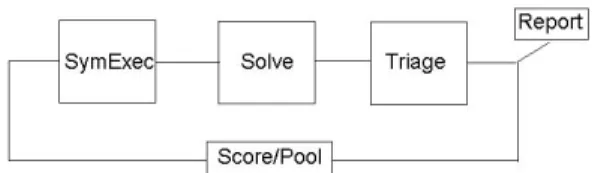
Figure 2: Dynamic test generation includes four stages: symbolic execution, solving to obtain new test cases, then triage to determine whether to report a bug or score the test case for addition to the pool of unexplored test cases.
4.1 Architecture
The SmartFuzz architecture is as follows: First, we add one or more test cases to a pool. Each test case in the pool receives a score given by the number of new basic blocks seen when running the target program on the test case. By “new” we mean that the basic block has not been observed while scoring any previous test case; we identify basic blocks by the instruction pointer of their entry point.
In each iteration of test generation, we choose a high-scoring test case, execute the program on that input, and use symbolic execution to generate a set of constraints that record how each intermediate value computed by the program relates to the inputs in the test case. SmartFuzz implements the symbolic execution and scoring compo-nents using the Valgrind binary analysis framework, and we use STP [12] to solve constraints.
For each symbolic branch, SmartFuzz adds a con-straint that tries to force the program down a differ-ent path. We then query the constraint solver to see whether there exists any solution to the resulting set of constraints; if there is, the solution describes a new test case. We refer to these ascoverage queriesto the con-straint solver.
SmartFuzz also injects constraints that are satisfied if a condition causing an error or potential error is satis-fied (e.g., to force an arithmetic calculation to overflow). We then query the constraint solver; a solution describes a test case likely to cause an error. We refer to these as bug-seeking queries to the constraint solver. Bug-seeking queries come in differenttypes, depending on the specific error they seek to exhibit in the program.
Both coverage and bug-seeking queries are explored in agenerational searchsimilar to the SAGE tool [14]. Each query from a symbolic trace is solved in turn, and new test cases created from successfully solved queries. A single symbolic execution therefore leads to many cov-erage and bug-seeking queries to the constraint solver, which may result in many new test cases.
Wetriageeach new test case as it is generated, i.e. we
determine if it exhibits a bug. If so, we report the bug; otherwise, we add the test case to the pool for scoring and possible symbolic execution. For triage, we use Valgrind memcheck on the target program with each test case, which is a tool that observes concrete execution looking for common programming errors [26]. We record any test case that causes the program to crash or triggers a memcheckwarning.
We chose memcheck because it checks a variety of properties, including reads and writes to invalid mem-ory locations, memmem-ory leaks, and use of uninitialized values. Re-implementing these analyses as part of the SmartFuzz symbolic execution tool would be wasteful and error-prone, as thememchecktool has had the bene-fit of multiple years of use in large-scale projects such as Firefox and OpenOffice. Thememchecktool is known as a tool with a low false positive rate, as well, making it more likely that developers will pay attention to bugs reported bymemcheck. Given amemcheckerror report, developers do not even need to know that associated test case was created by SmartFuzz.
We do not attempt to classify the bugs we find as ex-ploitable or not exex-ploitable, because doing so by hand for the volume of test cases we generate is impracti-cal. Many of the bugs found by memcheck are mem-ory safety errors, which often lead to security vulnerabil-ities. Writes to invalid memory locations, in particular, are a red flag. Finally, to report bugs we use the Metafuzz framework described in Section 6.
4.2 Design Choices
Intermediate Representation. The sheer size and com-plexity of the x86 instruction set poses a challenge for analyzing x86 binaries. We decided to translate the un-derlying x86 code on-the-fly to an intermediate repre-sentation, then map the intermediate representation to symbolic formulas. Specifically, we used the Valgrind binary instrumentation tool to translate x86 instructions into VEX, the Valgrind intermediate representation [24]. The BitBlaze system works similarly, but with a different intermediate representation [5]. Details are available in an extended version of this paper2.
Using an intermediate representation offers several ad-vantages. First, it allows for a degree of platform inde-pendence: though we support only x86 in our current tool, the VEX library also supports the AMD64 and Pow-erPC instruction sets, with ARM support under active de-velopment. Adding support for these additional architec-tures requires only adding support for a small number of additional VEX instructions, not an entirely new instruc-tion set from scratch. Second, the VEX library generates IR that satisfies the single static assignment property and
2http://www.cs.berkeley.edu/~dmolnar/
performs other optimizations, which makes the transla-tion from IR to formulas more straightforward. Third, and most importantly, this choice allowed us to outsource the pain of dealing with the minutae of the x86 instruc-tion set to the VEX library, which has had years of pro-duction use as part of the Valgrind memory checking tool. For instance, we don’t need to explicitly model the EFLAGS register, as the VEX library translates it to boolean operations. The main shortcoming with the VEX IR is that a single x86 instruction may expand to five or more IR instructions, which results in long traces and correspondingly longer symbolic formulas.
Online Constraint Generation. SmartFuzz usesonline
constraint generation, in which constraints are generated while the program is running. In contrast, SAGE (an-other tool for dynamic test generation) usesoffline con-straint generation, where the program is first traced and then the trace is replayed to generate constraints [14]. Offline constraint generation has several advantages: it is not sensitive to concurrency or nondeterminism in sys-tem calls; tracing has lower runtime overhead than con-straint generation, so can be applied to running systems in a realistic environment; and, this separation of con-cerns makes the system easier to develop and debug, not least because trace replay and constraint generation is reproducible and deterministic. In short, offline con-straint generation has important software engineering ad-vantages.
SmartFuzz uses online constraint generation primarily because, when the SmartFuzz project began, we were not aware of an available offline trace-and-replay framework with an intermediate representation comparable to VEX. Today, O’Callahan’schronicle-recordercould pro-vide a starting point for a VEX-based offline constraint generation tool [25].
Memory Model. Other symbolic execution tools such as EXE and KLEE model memory as a set of symbolic arrays, with one array for each allocated memory object. We do not. Instead, for each load or store instruction, we first concretize the memory address before access-ing the symbolic heap. In particular, we keep a mapM
from concrete memory addresses to symbolic values. If the program reads from concrete addressa, we retrieve a symbolic value fromM(a). Even if we have recorded a symbolic expressionaassociated with this address, the symbolic address is ignored. Note that the value ofais known at constraint generation time and hence becomes (as far as the solver is concerned) a constant. Store in-structions are handled similarly.
While this approach sacrifices precision, it scales bet-ter to large traces. We note that the SAGE tool adopts a similar memory model. In particular, concretizing ad-dresses generates symbolic formulas that the constraint solver can solve much more efficiently, because the
solver does not need to reason about aliasing of point-ers.
Only Tainted Data is Symbolic. We track the taint sta-tus of every byte in memory. As an optimization, we do not store symbolic information for untainted memory locations, because by definition untainted data is not de-pendent upon the untrusted inputs that we are trying to vary. We have found that only a tiny fraction of the data processed along a single execution path is tainted. Con-sequently, this optimization greatly reduces the size of our constraint systems and reduces the memory overhead of symbolic execution.
Focus on Fuzzing Files. We decided to focus on single-threaded programs, such as media players, that read a file containing untrusted data. Thus, a test case is simply the contents of this file, and SmartFuzz can focus on gen-erating candidate files. This simplifies the symbolic ex-ecution and test case generation infrastructure, because there are a limited number of system calls that read from this file, and we do not need to account for concurrent interactions between threads in the same program. We know of no fundamental barriers, however, to extending our approach to multi-threaded and network-facing pro-grams.
Our implementation associates a symbolic input vari-able with each byte of the input file. As a result, Smart-Fuzz cannot generate test cases with more bytes than are present in the initial seed file.
Multiple Cooperating Analyses. Our tool is imple-mented as a series of independent cooperating analyses in the Valgrind instrumentation framework. Each analy-sis adds its own instrumentation to a basic block during translation and exports an interface to the other analyses. For example, the instrumentation for tracking taint flow, which determines the IR instructions to treat as symbolic, exports an interface that allows querying whether a spe-cific memory location or temporary variable is symbolic. A second analysis then uses this interface to determine whether or not to output STP constraints for a given IR instruction.
The main advantage of this approach is that it makes it easy to add new features by adding a new analysis, then modifying our core constraint generation instrumen-tation. Also, this decomposition enabled us to extract our taint-tracking code and use it in a different project with minimal modifications, and we were able to implement the binary type inference analysis described in Section 5, replacing a different earlier version, without changing our other analyses.
Optimize in Postprocessing. Another design choice was to output constraints that are as “close” as possible to the intermediate representation, performing only limited optimizations on the fly. For example, we implement the “related constraint elimination,” as introduced by tools
such as EXE and SAGE [8, 14], as a post-processing step on constraints created by our tool. We then leave it up to the solver to perform common subexpression elim-ination, constant propagation, and other optimizations. The main benefit of this choice is that it simplifies our constraint generation. One drawback of this choice is that current solvers, including STP, are not yet capable of “remembering” optimizations from one query to the next, leading to redundant work on the part of the solver. The main drawback of this choice, however, is that while after optimization each individual query is small, the to-tal symbolic trace containing all queries for a program can be several gigabytes. When running our tool on a 32-bit host machine, this can cause problems with maxi-mum file size for a single file or maximaxi-mum memory size in a single process.
5 Techniques for Finding Integer Bugs
We now describe the techniques we use for finding inte-ger bugs.Overflow/Underflow. For each arithmetic expression that could potentially overflow or underflow, we emit a constraint that is satisfied if the overflow or underflow occurs. If our solver can satisfy these constraints, the resulting input values will likely cause an underflow or overflow, potentially leading to unexpected behavior.
Width Conversions. For each conversion between inte-ger types, we check whether it is possible for the source value to be outside the range of the target value by adding a constraint that’s satisfied when this is the case and then applying the constraint solver. For conversions that may sign-extend, we use the constraint solver to search for a test case where the high bit of the source value is non-zero.
Signed/Unsigned Conversions. Our basic approach is to try to reconstruct, from the x86 instructions executed, signed/unsigned type information about all integral val-ues. This information is present in the source code but not in the binary, so we describe an algorithm to infer this information automatically.
Consider four types for integer values: “Top,” “Signed,” “Unsigned,” or “Bottom.” Here, “Top” means the value has not been observed in the context of a signed or unsigned integer; “Signed” means that the value has been used as a signed integer; “Unsigned” means the value has been used as an unsigned integer; and “Bot-tom” means that the value has been used inconsistently as both a signed and unsigned integer. These types form a four-point lattice. Our goal is to find symbolic program values that have type “Bottom.” These values are can-didates for signed/unsigned conversion errors. We then attempt to synthesize an input that forces these values to be negative.
We associate every instance of every temporary
vari-int main(vari-int argc, char** argv) { char * p = malloc(800); char * q = malloc(800); int n; n = atol(argv[1]); if (n > 800) return; memcpy(p, q, n); return 0; }
Figure 3: A simple test case for dynamic type infer-ence and query generation. The signed comparisonn > 800and unsignedsize targument tomemcpyassign the type “Bottom” to the value associated withn. When we solve for an input that makesnnegative, we obtain a test case that reveals the error.
able in the Valgrind intermediate representation with a type. Every variable in the program starts with type Top. During execution we addtype constraintsto the type of each value. For x86 binaries, the sources of type con-straints are signed and unsigned comparison operators: e.g., a signed comparison between two values causes both values to receive the “Signed” type constraint. We also add unsigned type constraints to values used as the length argument ofmemcpyfunction, which we can de-tect because we know the calling convention for x86 and we have debugging symbols for glibc. While the x86 in-struction set has additional operations, such asIMULthat reveal type information about their operands, we do not consider these; this means only that we may incorrectly under-constrain the types of some values.
Any value that has received both a signed and un-signed type constraint receives the type Bottom. After adding a type constraint, we check to see if the type of a value has moved to Bottom. If so, we attempt to solve for an input which makes the value negative. We do this because negative values behave differently in signed and unsigned comparisons, and so they are likely to exhibit an error if one exists. All of this information is present in the trace without requiring access to the original program source code.
We discovered, however, that gcc 4.1.2 inlines some calls to memcpy by transforming them to rep movsbinstructions, even when the-Oflag is not present. Furthermore, the Valgrind IR generated for the rep movsb instruction compares a decrementing counter variable to zero, instead of counting up and executing an unsigned comparison to the loop bound. As a result, on gcc 4.1.2 a call tomemcpydoes not cause its length argu-ment to be marked as unsigned. To deal with this prob-lem, we implemented a simple heuristic to detect the IR generated forrep movsband emit the appropriate
con-straint. We verified that this heuristic works on a small test case similar to Figure3, generating a test input that caused a segmentation fault.
A key problem is storing all of the information re-quired to carry out type inference without exhausting available memory. Because a trace may have several mil-lion instructions, memory usage is key to scaling type inference to long traces. Furthermore, our algorithm re-quires us to keep track of the types of all values in the program, unlike constraint generation, which need con-cern itself only with tainted values. An earlier version of our analysis created a special “type variable” for each value, then maintained a map from IR locations to type variables. Each type variable then mapped to a type. We found that in addition to being hard to maintain, this analysis often led to a number of live type variables that scaled linearly with the number of executed IR instruc-tions. The result was that our analysis ran out of memory when attempting to play media files in themplayer me-dia player.
To solve this problem, we developed a garbage-collected data structure for tracking type information. To reduce memory consumption, we use a union-find data structure to partition integer values into equivalence classes where all values in an equivalence class are re-quired to have the same type. We maintain one type for each union-find equivalence class; in our implementation type information is associated with the representative node for that equivalence class. Assignments force the source and target values to have the same types, which is implemented by merging their equivalence classes. Up-dating the type for a value can be done by upUp-dating its representative node’s type, with no need to explicitly up-date the types of all other variables in the equivalence class.
It turns out that this data structure is acyclic, due to the fact that VEX IR is in SSA form. Therefore, we use ref-erence counting to garbage collect these nodes. In addi-tion, we benefit from an additional property of the VEX IR: all values are either stored in memory, in registers, or in a temporary variable, and the lifetime of each tempo-rary variable is implicitly limited to that of a single basic block. Therefore, we maintain a list of temporaries that are live in the current basic block; when we leave the basic block, the type information associated with all of those live temporaries can be deallocated. Consequently, the amount of memory needed for type inference at any point is proportional to the number of tainted (symbolic) variables that are live at that point—which is a significant improvement over the naive approach to type inference. The full version of this paper contains a more detailed specification of these algorithms3.
3http://www.cs.berkeley.edu/~dmolnar/
usenix09-full.pdf
6 Triage and Reporting at Scale
Both SmartFuzz andzzufcan produce hundreds to thou-sands of test cases for a single test run. We designed and built a web service,Metafuzz, to manage the volume of tests. We describe some problems we found while building Metafuzz and techniques to overcoming these problems. Finally, we describe the user experience with Metafuzz and bug reporting.
6.1 Problems and Techniques
The Metafuzz architecture is as follows: first, a Test Ma-chine generates new test cases for a program and runs them locally. The Test Machine then determines which test cases exhibit bugs and sends these test cases to Meta-fuzz. The Metafuzz web site displays these test cases to the User, along with information about what kind of bug was found in which target program. The User can pick test cases of interest and download them for further in-vestigation. We now describe some of the problems we faced when designing Metafuzz, and our techniques for handling them. Section 7 reports our experiences with using Metafuzz to manage test cases and report bugs.
Problem: Each test run generated many test cases, too many to examine by hand.
Technique: We used Valgrind’smemcheckto automate the process of checking whether a particular test case causes the program to misbehave. Memchecklooks for memory leaks, use of uninitialized values, and memory safety errors such as writes to memory that was not allo-cated [26]. Ifmemcheckreports an error, we save the test case. In addition, we looked for core dumps and non-zero program exit codes.
Problem: Even after filtering out the test cases that caused no errors, there were still many test cases that do cause errors.
Technique: Themetafuzz.comfront page is a HTML page listing all of the potential bug reports. showing all potential bug reports. Each test machine uploads infor-mation about test cases that trigger bugs to Metafuzz.
Problem: The machines used for testing had no long-term storage. Some of the test cases were too big to at-tach in e-mail or Bugzilla, making it difficult to share them with developers.
Technique: Test cases are uploaded directly to Meta-fuzz, providing each one with a stable URL. Each test case also includes the Valgrind output showing the Val-grind error, as well as the output of the program to stdoutandstderr.
Problem: Some target projects change quickly. For ex-ample, we saw as many as four updates per day to the mplayersource code repository. Developers reject bug reports against “out of date” versions of the software.
Technique:We use the Amazon Elastic Compute Cloud (EC2) to automatically attempt to reproduce the bug
against the latest version of the target software. A button on the Metafuzz site spawns an Amazon EC2 instance that checks out the most recent version of the target soft-ware, builds it, and then attempts to reproduce the bug.
Problem: Software projects have specific reporting re-quirements that are tedious to implement by hand. For example,mplayerdevelopers ask for a stack backtrace, disassembly, and register dump at the point of a crash.
Technique: Metafuzz automatically generates bug re-ports in the proper format from the failing test case. We added a button to the Metafuzz web site so that we can review the resulting bug report and then send it to the tar-get software’s bug tracker with a single click.
Problem: The same bug often manifests itself as many failing test cases. Reporting the same bug to developers many times wastes developer time.
Technique: We use the call stack to identify multiple instances of the same bug. Valgrind memcheck reports the call stack at each error site, as a sequence of instruc-tion pointers. If debugging informainstruc-tion is present, it also reports the associated filename and line number informa-tion in the source code.
Initially, we computed astack hashas a hash of the se-quence of instruction pointers in the backtrace. This has the benefit of not requiring debug information or sym-bols. Unfortunately, we found that a naive stack hash has several problems. First, it is sensitive to address space layout randomization (ASLR), because different runs of the same program may load the stack or dynamically linked libraries at different addresses, leading to differ-ent hash values for call stacks that are semantically the same. Second, even without ASLR, we found several cases where a single bug might be triggered at multiple call stacks that were similar but not identical. For exam-ple, a buggy function can be called in several different places in the code. Each call site then yields a different stack hash. Third, any slight change to the target soft-ware can change instruction pointers and thus cause the same bug to receive a different stack hash. While we do use the stack hash on the client to avoid uploading test cases for bugs that have been previously found, we found that we could not use stack hashes alone to determine if a bug report is novel or not.
To address these shortcomings, we developed afuzzy stack hashthat is forgiving of slight changes to the call stack. We use debug symbol information to identify the name of the function called, the line number in source code (excluding the last digit of the line number, to allow for slight changes in the code), and the name of the object file for each frame in the call stack. We then hash all of this information for the three functions at the top of the call stack.
The choice of the number of functions to hash deter-mines the “fuzzyness” of the hash. At one extreme, we
could hash all extant functions on the call stack. This would be similar to the classic stack hash and report many semantically same bugs in different buckets. On the other extreme, we could hash only the most recently called function. This fails in cases where two seman-tically different bugs both exhibit as a result of calling memcpy or some other utility function with bogus ar-guments. In this case, both call stacks would end with memcpyeven though the bug is in the way the arguments are computed. We chose three functions as a trade-off between these extremes; we found this sufficient to stop further reports from the mplayer developers of dupli-cates in our initial experiences. Finding the best fuzzy stack hash is interesting future work; we note that the choice of bug bucketing technique may depend on the program under test.
While any fuzzy stack hash, including ours, may acci-dentally lump together two distinct bugs, we believe this is less serious than reporting duplicate bugs to develop-ers. We added a post-processing step on the server that computes the fuzzy stack hash for test cases that have been uploaded to Metafuzz and uses it to coalesce dupli-cates into a single bug bucket.
Problem: Because Valgrindmemcheckdoes not termi-nate the program after seeing an error, a single test case may give rise to dozens of Valgrind error reports. Two different test cases may share some Valgrind errors but not others.
Technique: First, we put a link on the Metafuzz site to a single test case for each bug bucket. Therefore, if two test cases share some Valgrind errors, we only use one test case for each of the errors in common. Second, when reporting bugs to developers, we highlight in the title the specific bugs on which to focus.
7 Results
7.1 Preliminary Experience
We used an earlier version of SmartFuzz and Metafuzz in a project carried out by a group of undergraduate students over the course of eight weeks in Summer 2008. When beginning the project, none of the students had any train-ing in security or bug reporttrain-ing. We provided a one-week course in software security. We introduced SmartFuzz, zzuf, and Metafuzz, then asked the students to gener-ate test cases and report bugs to software developers. By the end of the eight weeks, the students generated over 1.2million test cases, from which they reported over90 bugs to software developers, principally to themplayer project, of which14were fixed. For further details, we refer to their presentation [1].
7.2 Experiment Setup
Test Programs. Our target programs were mplayer version SVN-r28403-4.1.2, ffmpeg version
mplayer ffmpeg exiv2 gzip bzip2 convert Coverage 2599 14535 1629 5906 12606 388 ConversionNot32 0 3787 0 0 0 0 Conversion32to8 1 26 740 2 10 116 Conversion32to16 0 16004 0 0 0 0 Conversion16Sto32 0 121 0 0 0 0 SignedOverflow 1544 37803 5941 24825 9109 49 SignedUnderflow 3 4003 48 1647 2840 0 UnsignedOverflow 1544 36945 4957 24825 9104 35 UnsignedUnderflow 0 0 0 0 0 0 MallocArg 0 24 0 0 0 0 SignedUnsigned 2568 21064 799 7883 17065 49
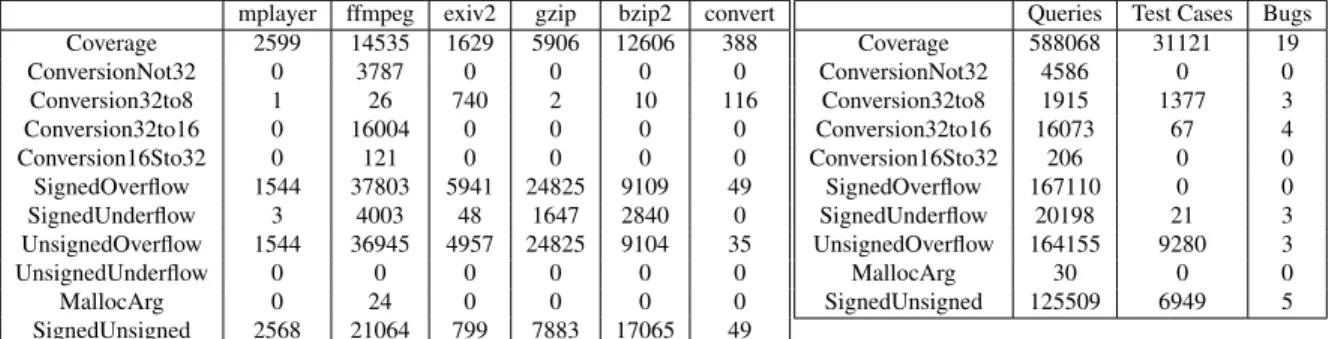
Figure 5: The number of each type of query for each test program after a single24-hour run.
SVN-r16903, exiv2 version SVN-r1735, gzip version1.3.12,bzip2version1.0.5, and ImageMagick convert version 6.4.8 − 10, which are all widely used media and compression programs. Table 4 shows information on the size of each test program. Our test programs are large, both in terms of source lines of code and trace lengths. The percentage of the trace that is symbolic, however, is small.
Test Platform. Our experiments were run on the Ama-zon Elastic Compute Cloud (EC2), employing a “small” and a “large” instance image with SmartFuzz,zzuf, and all our test programs pre-installed. At this writing, an EC2 small instance has 1.7 GB of RAM and a single-core virtual CPU with performance roughly equivalent to a1GHz 2007 Intel Xeon. An EC2 large instance has 7 GB of RAM and a dual-core virtual CPU, with each core having performance roughly equivalent to a1GHz Xeon.
We ran all mplayer runs and ffmpeg runs on EC2 large instances, and we ran all other test runs with EC2 small instances. We spot-checked each run to ensure that instances successfully held all working data in mem-ory during symbolic execution and triage without swap-ping to disk, which would incur a significant perfor-mance penalty. For each target program we ran Smart-Fuzz and zzuf with three seed files, for 24hours per program per seed file. Our experiments took288 large machine-hours and576 small machine-hours, which at current EC2 prices of$0.10per hour for small instances and$0.40per hour for large instances cost$172.80.
Query Types.SmartFuzz queries our solver with the fol-lowing types of queries:Coverage,ConversionNot32, Conversion32to8, Conversion32to16,
SignedOverflow, UnsignedOverflow,
SignedUnderflow, UnsignedUnderflow, MallocArg, andSignedUnsigned. Coveragequeries refer to queries created as part of the generational search by flipping path conditions. The others arebug-seeking queries that attempt to synthesize inputs leading to specific kinds of bugs. Here MallocArg refers to a
Queries Test Cases Bugs Coverage 588068 31121 19 ConversionNot32 4586 0 0 Conversion32to8 1915 1377 3 Conversion32to16 16073 67 4 Conversion16Sto32 206 0 0 SignedOverflow 167110 0 0 SignedUnderflow 20198 21 3 UnsignedOverflow 164155 9280 3 MallocArg 30 0 0 SignedUnsigned 125509 6949 5
Figure 6: The number of bugs found, by query type, over all test runs. The fourth column shows the number of distinct bugs found from test cases produced by the given type of query, as classified using our fuzzy stack hash. set of bug-seeking queries that attempt to force inputs to known memory allocation functions to be negative, yielding an implicit conversion to a large unsigned integer, or force the input to be small.
Experience Reporting to Developers. Our original strategy was to report all distinct bugs to developers and let them judge which ones to fix. Themplayer devel-opers gave us feedback on this strategy. They wanted to focus on fixing the most serious bugs, so they preferred seeing reports only for out-of-bounds writes and double free errors. In contrast, they were not as interested in out-of-bound reads, even if the resulting read caused a segmentation fault. This helped us prioritize bugs for re-porting.
7.3 Bug Statistics
Integer Bug-Seeking Queries Yield Bugs. Figure 6 re-ports the number of each type of query to the constraint solver over all test runs. For each type of query, we re-port the number of test files generated and the number of distinct bugs, as measured by our fuzzy stack hash. Some bugs may be revealed by multiple different kinds of queries, so there may be overlap between the bug counts in two different rows of Figure 6.
The table shows that our dynamic test generation methods for integer bugs succeed in finding bugs in our test programs. Furthermore, the queries for signed/unsigned bugs found the most distinct bugs out of all bug-seeking queries. This shows that our novel method for detecting signed/unsigned bugs (Section 5) is effective at finding bugs.
SmartFuzz Finds More Bugs Than zzuf, on mplayer.
For mplayer, SmartFuzz generated 10,661 test cases over all test runs, whilezzufgenerated 11,297 test cases; SmartFuzz found22bugs whilezzuffound13. There-fore, in terms of number of bugs, SmartFuzz outper-formed zzuf for testing mplayer. Another surprising result here is that SmartFuzz generated nearly as many test cases as zzuf, despite the additional overhead for
SLOC seedfile type and size Branches x86 instrs IRStmts asserts queries
mplayer 723468 MP3 (159000 bytes) 20647045 159500373 810829992 1960 36
ffmpeg 304990 AVI (980002 bytes) 4147710 19539096 115036155 4778690 462346
exiv2 57080 JPG (22844 bytes) 809806 6185985 32460806 81450 1006
gzip 140036 TAR.GZ (14763 bytes) 24782 161118 880386 95960 13309
bzip 26095 TAR.BZ2 (618620 bytes) 107396936 746219573 4185066021 1787053 314914
ImageMagick 300896 PNG (25385 bytes) 98993374 478474232 2802603384 583 81
Figure 4: The size of our test programs. We report the source lines of code for each test program and the size of one of our seed files, as measured by David A. Wheeler’ssloccount. Then we run the test program on that seed file and report the total number of branches, x86 instructions, Valgrind IR statements, STP assert statements, and STP query statements for that run. We ran symbolic execution for a maximum of12hours, which was sufficient for all programs exceptmplayer, which terminated during symbolic execution.
symbolic execution and constraint solving. This shows the effect of the generational search and the choice of memory model; we leverage a single expensive symbolic execution and fast solver queries to generate many test cases. At the same time, we note thatzzuffound a seri-ous InvalidWrite bug, while SmartFuzz did not.
A previous version of our infrastructure had prob-lems with test cases that caused the target program to run forever, causing the search to stall. Therefore, we introduced a timeout, so that after 300 CPU seconds, the target program is killed. We manually examined the output ofmemcheckfrom all killed programs to de-termine whether such test cases represent errors. For gzipwe discovered that SmartFuzz created six such test cases, which account for the two out-of-bounds read (In-validRead) errors we report;zzufdid not find any hang-ing test cases forgzip. We found no other hanging test cases in our other test runs.
Different Bugs Found by SmartFuzz andzzuf. We ran the same target programs with the same seed files usingzzuf. Figure 7 shows bugs found by each type of fuzzer. With respect to each tool, SmartFuzz found 37 total distinct bugs andzzuffound59distinct bugs. We found some overlap between bugs as well:19bugs were found by both fuzz testing tools, for a total of77distinct bugs. This shows that while there is overlap between the two tools, SmartFuzz finds bugs thatzzufdoes not and vice versa. Therefore, it makes sense to try both tools when testing software.
Note that we did not find any bugs forbzip2with ei-ther fuzzer, so neiei-ther tool was effective on this program. This shows that fuzzing is not always effective at find-ing bugs, especially with a program that has already seen attention for security vulnerabilities. We also note that SmartFuzz found InvalidRead errors ingzipwhilezzuf found no bugs in this program. Thereforegzipis a case where SmartFuzz’s directed testing is able to trigger a bug, but purely random testing is not.
Block Coverage. We measured the number of basic blocks in the program visited by the execution of the
seed file, then measured how many new basic blocks were visited during the test run. We discovered zzuf added a higher percentage of new blocks than Smart-Fuzz in 13 of the test runs, while SmartFuzz added a higher percentage of new blocks in 4 of the test runs (the SmartFuzzconvert-2test run terminated prema-turely.) Table 8 shows the initial basic blocks, the num-ber of blocks added, and the percentage added for each fuzzer. We see that the effectiveness of SmartFuzz varies by program; forconvertit is particularly effective, find-ing many more new basic blocks thanzzuf.
Contrasting SmartFuzz and zzuf Performance. De-spite the limitations of random testing, the blackbox fuzz testing toolzzuffound bugs in four out of our six test programs. In three of our test programs, zzuf found more bugs than SmartFuzz. Furthermore, zzuf found the most serious InvalidWrite errors, while SmartFuzz did not. These results seem surprising, because Smart-Fuzz exercises directed testing based on program behav-ior whilezzufis a purely blackbox tool. We would ex-pect that SmartFuzz should find all the bugs found by zzuf, given an unbounded amount of time to run both test generation methods.
In practice, however, the time which we run the meth-ods is limited, and so the question is which bugs are dis-covered first by each method. We have identified possi-ble reasons for this behavior, based on examining the test cases and Valgrind errors generated by both tools4. We now list and briefly explain these reasons.
Header parsing errors.The errors we observed are often in code that parses the header of a file format. For exam-ple, we noticed bugs in functions ofmplayerthat parse MP3 headers. These errors can be triggered by simply placing “wrong” values in data fields of header files. As a result, these errors do not require complicated and un-likely predicates to be true before reaching buggy code, and so the errors can be reached without needing the full power of dynamic test generation. Similarly, code cov-4We have placed representative test cases from each method at
mplayer ffmpeg exiv2 gzip convert SyscallParam 4 3 2 3 0 0 0 0 0 0 UninitCondition 13 1 1 8 0 0 0 0 3 8 UninitValue 0 3 0 3 0 0 0 0 0 2 Overlap 0 0 0 1 0 0 0 0 0 0 Leak DefinitelyLost 2 2 2 4 0 0 0 0 0 0 Leak PossiblyLost 2 1 0 2 0 1 0 0 0 0 InvalidRead 1 2 0 4 4 6 2 0 1 1 InvalidWrite 0 1 0 3 0 0 0 0 0 0 Total 22 13 5 28 4 7 2 0 4 11
Cost per bug $1.30 $2.16 $5.76 $1.03 $1.80 $1.03 $3.60 NA $1.20 $0.65
Figure 7: The number of bugs, after fuzzy stack hashing, found by SmartFuzz (the number on the left in each column) andzzuf(the number on the right). We also report the cost per bug, assuming$0.10per small compute-hour,$0.40 per large compute-hour, and3runs of24hours each per target for each tool.
erage may be affected by the style of program used for testing.
Difference in number of bytes changed. The two differ-ent methods change a vastly differdiffer-ent number of bytes from the original seed file to create each new test case. SmartFuzz changes exactly those bytes that must change to force program execution down a single new path or to violate a single property. Below we show that in our programs there are only a small number of constraints on the input to solve, so a SmartFuzz test case differs from its seed file by only a small number of bytes. In contrast, zzufchanges a fixed fraction of the input bytes to ran-dom other bytes; in our experiments, we left this at the default value of0.004.
The large number of changes in a single fuzzed test case means that for header parsing or other code that looks at small chunks of the file independently, a sin-gle zzuf test case will exercise many different code paths with fuzzed chunks of the input file. Each path which originates from parsing a fuzzed chunk of the in-put file is a potential bug. Furthermore, because Val-grindmemcheckdoes not necessarily terminate the pro-gram’s execution when a memory safety error occurs, one such file may yield multiple bugs and correspond-ing bug buckets.
In contrast, the SmartFuzz test cases usually change only one chunk and so explore only one “fuzzed” path through such code. Our code coverage metric, unfortu-nately, is not precise enough to capture this difference be-cause we measured block coverage instead of path cov-erage. This means once a set of code blocks has been covered, a testing method receives no further credit for additional paths through those same code blocks.
Small number of generations reached by SmartFuzz.Our 24hour experiments with SmartFuzz tended to reach a small number of generations. While previous work on whitebox fuzz testing shows that most bugs are found in the early generations [14], this feeds into the pre-vious issue because the number of differences between the fuzzed file and the original file is proportional to the
generation number of the file. We are exploring longer-running SmartFuzz experiments of a week or more to ad-dress this issue.
Loop behavior in SmartFuzz. Finally, SmartFuzz deals with loops by looking at the unrolled loop in the dynamic program trace, then attempting to generate test cases for each symbolic ifstatement in the unrolled loop. This strategy is not likely to create new test cases that cause the loop to execute for vastly more iterations than seen in the trace. By contrast, thezzufcase may get lucky by assigning a random and large value to a byte sequence in the file that controls the loop behavior. On the other hand, when we looked at thegzipbug found by Smart-Fuzz and not byzzuf, we discovered that it appears to be due to an infinite loop in theinflate dynamicroutine ofgzip.
7.4 SmartFuzz Statistics
Integer Bug Queries Vary By Program.Table 5 shows the number of solver queries of each type for one of our 24-hour test runs. We see that the type of queries varies from one program to another. We also see that forbzip2 and mplayer, queries generated by type inference for signed/unsigned errors account for a large fraction of all queries to the constraint solver. This results from our choice to eagerly generate new test cases early in the pro-gram; because there are many potential integer bugs in these two programs, our symbolic traces have many inte-ger bug-seeking queries. Our design choice of using an independent tool such asmemcheckto filter the resulting test cases means we can tolerate such a large number of queries because they require little human oversight.
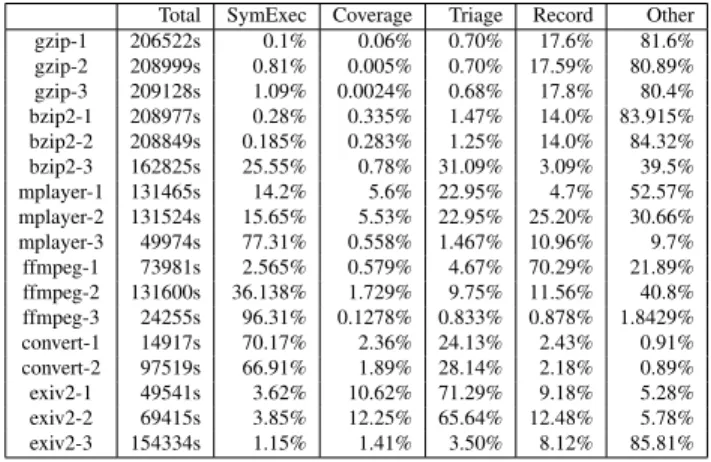
Time Spent In Each Task Varies By Program. Fig-ure 9 shows the percentage of time spent in symbolic execution, coverage, triage, and recording for each run of our experiment. We also report an “Other” category, which includes the time spent in the constraint solver. This shows us where we can obtain gains through fur-ther optimization. The amount of time spent in each task depends greatly on the seed file, as well as on the
Initial basic blocks Blocks added by tests Ratio of prior two columns Test run SmartFuzz zzuf SmartFuzz zzuf SmartFuzz zzuf
mplayer-1 7819 7823 5509 326 70% 4% mplayer-2 11375 11376 908 1395 7% 12% mplayer-3 11093 11096 102 2472 0.9% 22% ffmpeg-1 6470 6470 592 20036 9.14% 310% ffmpeg-2 6427 6427 677 2210 10.53% 34.3% ffmpeg-3 6112 611 97 538 1.58% 8.8% convert-1 8028 8246 2187 20 27% 0.24% convert-2 8040 8258 2392 6 29% 0.073% convert-3 NA 10715 NA 1846 NA 17.2% exiv2-1 9819 9816 2934 3560 29.9% 36.3% exiv2-2 9811 9807 2783 3345 28.3% 34.1% exiv2-3 9814 9810 2816 3561 28.7% 36.3% gzip-1 2088 2088 252 334 12% 16% gzip-2 2169 2169 259 275 11.9% 12.7% gzip-3 2124 2124 266 316 12% 15% bzip2-1 2779 2778 123 209 4.4% 7.5% bzip2-2 2777 2778 125 237 4.5% 8.5% bzip2-3 2823 2822 115 114 4.1% 4.0%
Figure 8: Coverage metrics: the initial number of basic blocks, before testing; the number of blocks added during testing; and the percentage of blocks added.
Total SymExec Coverage Triage Record Other gzip-1 206522s 0.1% 0.06% 0.70% 17.6% 81.6% gzip-2 208999s 0.81% 0.005% 0.70% 17.59% 80.89% gzip-3 209128s 1.09% 0.0024% 0.68% 17.8% 80.4% bzip2-1 208977s 0.28% 0.335% 1.47% 14.0% 83.915% bzip2-2 208849s 0.185% 0.283% 1.25% 14.0% 84.32% bzip2-3 162825s 25.55% 0.78% 31.09% 3.09% 39.5% mplayer-1 131465s 14.2% 5.6% 22.95% 4.7% 52.57% mplayer-2 131524s 15.65% 5.53% 22.95% 25.20% 30.66% mplayer-3 49974s 77.31% 0.558% 1.467% 10.96% 9.7% ffmpeg-1 73981s 2.565% 0.579% 4.67% 70.29% 21.89% ffmpeg-2 131600s 36.138% 1.729% 9.75% 11.56% 40.8% ffmpeg-3 24255s 96.31% 0.1278% 0.833% 0.878% 1.8429% convert-1 14917s 70.17% 2.36% 24.13% 2.43% 0.91% convert-2 97519s 66.91% 1.89% 28.14% 2.18% 0.89% exiv2-1 49541s 3.62% 10.62% 71.29% 9.18% 5.28% exiv2-2 69415s 3.85% 12.25% 65.64% 12.48% 5.78% exiv2-3 154334s 1.15% 1.41% 3.50% 8.12% 85.81% Figure 9: The percentage of time spent in each of the phases of SmartFuzz. The second column reports the to-tal wall-clock time, in seconds, for the run; the remaining columns are a percentage of this total. The “other” col-umn includes the time spent solving STP queries.
target program. For example, the first run ofmplayer, which used a mp3 seedfile, spent 98.57% of total time in symbolic execution, and only 0.33% in coverage, and 0.72% in triage. In contrast, the second run ofmplayer, which used a mp4 seedfile, spent only 14.77% of time in symbolic execution, but 10.23% of time in coverage, and 40.82% in triage. We see that the speed of symbolic ex-ecution and of triage is the major bottleneck for several of our test runs, however. This shows that future work should focus on improving these two areas.
7.5 Solver Statistics
Related Constraint Optimization Varies By Program.
We measured the size of all queries to the constraint solver, both before and after applying the related con-straint optimization described in Section 4. Figure 10 shows the average size for queries from each test pro-gram, taken over all queries in all test runs with that program. We see that while the optimization is effective in all cases, its average effectiveness varies greatly from one test program to another. This shows that different programs vary greatly in how many input bytes influence each query.
The Majority of Queries Are Fast.Figure 10 shows the empirical cumulative distribution function of STP solver times over all our test runs. For about 70% of the test cases, the solver takes at most one second. The maxi-mum solver time was about 10.89 seconds. These results reflect our choice of memory model and the effectiveness of the related constraint optimization. Because of these, the queries to the solver consist only of operations over bitvectors (with no array constraints), and most of the sets of constraints sent to the solver are small, yielding fast solver performance.
8 Conclusion
We described new methods for finding integer bugs in dynamic test generation, and we implemented these methods in SmartFuzz, a new dynamic test generation tool. We then reported on our experiences building the web sitemetafuzz.comand using it to manage test case generation at scale. In particular, we found that Smart-Fuzz finds bugs not found byzzufand vice versa, show-ing that a comprehensive testshow-ing strategy should use both
average before average after ratio (before/after) mplayer 292524 33092 8.84 ffmpeg 350846 83086 4.22 exiv2 81807 10696 7.65 gzip 348027 199336 1.75 bzip2 278980 162159 1.72 convert 2119 1057 2.00
Figure 10: On the left, average query size before and af-ter related constraint optimization for each test program. On the right, an empirical CDF of solver times.
white-box and black-box test generation tools.
Furthermore, we showed that our methods can find in-teger bugs without the false positives inherent to static analysis or runtime checking approaches, and we showed that our methods scale to commodity Linux media play-ing software. The Metafuzz web site is live, and we have released our code to allow others to use our work.
9 Acknowledgments
We thank Cristian Cadar, Daniel Dunbar, Dawson En-gler, Patrice Godefoid, Michael Levin, and Paul Twohey for discussions about their respective systems and dy-namic test generation. We thank Paul Twohey for helpful tips on the engineering of test machines. We thank Chris Karlof for reading a draft of our paper on short notice. We thank the SUPERB TRUST 2008 team for their work with Metafuzz and SmartFuzz during Summer 2008. We thank Li-Wen Hsu and Alex Fabrikant for their help with the metafuzz.com web site, and Sushant Shankar, Shiuan-Tzuo Shen, and Mark Winterrowd for their com-ments. We thank Erinn Clark, Charlie Miller, Prateek Saxena, Dawn Song, the Berkeley BitBlaze group, and the anonymous Oakland referees for feedback on ear-lier drafts of this work. This work was generously sup-ported by funding from DARPA and by NSF grants CCF-0430585 and CCF-0424422.
References
[1] ASLANI, M., CHUNG, N., DOHERTY, J., STOCKMAN, N.,ANDQUACH, W. Comparison of
blackbox and whitebox fuzzers in finding software bugs, November 2008. TRUST Retreat Presenta-tion.
[2] BLEXIM. Basic integer overflows. Phrack 0x0b
(2002).
[3] BLEXIM. Basic integer overflows. Phrack 0x0b, 0x3c (2002). http://www.phrack.org/ archives/60/p60-0x0a.txt.
[4] BRUMLEY, D., CHIEH, T., JOHNSON, R., LIN,
H.,ANDSONG, D. RICH : Automatically
protect-ing against integer-based vulnerabilities. InNDSS (Symp. on Network and Distributed System Secu-rity)(2007).
[5] BRUMLEY, D., NEWSOME, J., SONG, D., WANG, H.,ANDJHA, S. Towards automatic generation of
vulnerability-based signatures. InProceedings of the 2006 IEEE Symposium on Security and Privacy
(2006).
[6] CADAR, C., DUNBAR, D., AND ENGLER, D. Klee: Unassisted and automatic generation of high-coverage tests for complex systems programs. In
Proceedings of OSDI 2008(2008).
[7] CADAR, C., AND ENGLER, D. EGT: Execution
generated testing. InSPIN(2005).
[8] CADAR, C., GANESH, V., PAWLOWSKI, P. M., DILL, D. L., AND ENGLER, D. R. EXE: Auto-matically Generating Inputs of Death. InACM CCS
(2006).
[9] CHEN, K.,ANDWAGNER, D. Large-scale
analy-sis of format string vulnerabilities in debian linux. In PLAS - Programming Languages and Analysis for Security(2007). http://www.cs.berkeley. edu/~daw/papers/fmtstr-plas07.pdf. [10] CORPORATION, M. Vulnerability Type
Distribu-tions in CVE, May 2007. http://cve.mitre. org/docs/vuln-trends/index.html.
[11] DEMOTT, J. The evolving art of fuzzing. InDEF CON 14(2006).http://www.appliedsec.com/ files/The_Evolving_Art_of_Fuzzing.odp. [12] GANESH, V., AND DILL, D. STP: A
deci-sion procedure for bitvectors and arrays. CAV 2007, 2007. http://theory.stanford.edu/ ~vganesh/stp.html.
[13] GODEFROID, P., KLARLUND, N., AND SEN, K. DART: Directed Automated Random Testing. In
Proceedings of PLDI’2005 (ACM SIGPLAN 2005 Conference on Programming Language Design and Implementation) (Chicago, June 2005), pp. 213– 223.
[14] GODEFROID, P., LEVIN, M., AND MOLNAR,
D. Automated Whitebox Fuzz Testing. In
Proceedings of NDSS’2008 (Network and Dis-tributed Systems Security) (San Diego, Febru-ary 2008). http://research.microsoft.com/ users/pg/public_psfiles/ndss2008.pdf. [15] GODEFROID, P., LEVIN, M. Y., AND MOLNAR,
D. Active Property Checking. Tech. rep., Mi-crosoft, 2007. MSR-TR-2007-91.
[16] HOCEVAR, S. zzuf, 2007. http://caca.zoy. org/wiki/zzuf.
[17] LANZI, A., MARTIGNONI, L., MONGA, M., AND PALEARI, R. A smart fuzzer for x86 executables. In Software Engineering for Se-cure Systems, 2007. SESS ’07: ICSE Workshops 2007 (2007). http://idea.sec.dico.unimi. it/~roberto/pubs/sess07.pdf.
[18] LARSON, E., AND AUSTIN, T. High Coverage
Detection of Input-Related Security Faults. In
Proceedings of 12th USENIX Security Symposium
(Washington D.C., August 2003).
[19] LEBLANC, D. Safeint 3.0.11, 2008.http://www.
codeplex.com/SafeInt.
[20] LMH. Month of kernel bugs, November 2006. http://projects.info-pull.com/mokb/. [21] MICROSOFTCORPORATION. Prefast, 2008.
[22] MILLER, B. P., FREDRIKSEN, L.,ANDSO, B. An
empirical study of the reliability of UNIX utilities.
Communications of the Association for Computing Machinery 33, 12 (1990), 32–44.
[23] MOORE, H. Month of browser bugs, July 2006. http://browserfun.blogspot.com/.
[24] NETHERCOTE, N.,ANDSEWARD, J. Valgrind: A
framework for heavyweight dynamic binary instru-mentation. InPLDI - Programming Language De-sign and Implementation(2007).
[25] O’CALLAHAN, R. Chronicle-recorder,
2008. http://code.google.com/p/ chronicle-recorder/.
[26] SEWARD, J., AND NETHERCOTE, N. Using val-grind to detect undefined memory errors with bit precision. In Proceedings of the USENIX An-nual Technical Conference(2005). http://www. valgrind.org/docs/memcheck2005.pdf.
[27] VUAGNOUX, M. Autodafe: An act of
soft-ware torture. In 22nd Chaos Communications Congress, Berlin, Germany (2005). autodafe. sourceforge.net.
[28] WANG, T., WEI, T., LIN, Z., AND ZOU, W. Intscope: Automatically detecting integer overflow vulnerability in x86 binary using symbolic execu-tion. InNetwork Distributed Security Symposium (NDSS)(2009).