University of Central Florida University of Central Florida
STARS
STARS
Electronic Theses and Dissertations, 2004-2019
2018
Bridging the Gap between Application and Solid-State-Drives
Bridging the Gap between Application and Solid-State-Drives
Jian ZhouUniversity of Central Florida
Part of the Computer Engineering Commons
Find similar works at: https://stars.library.ucf.edu/etd
University of Central Florida Libraries http://library.ucf.edu
This Doctoral Dissertation (Open Access) is brought to you for free and open access by STARS. It has been accepted for inclusion in Electronic Theses and Dissertations, 2004-2019 by an authorized administrator of STARS. For more
information, please contact [email protected].
STARS Citation STARS Citation
Zhou, Jian, "Bridging the Gap between Application and Solid-State-Drives" (2018). Electronic Theses and Dissertations, 2004-2019. 5958.
BRIDGING THE GAP BETWEEN APPLICATION AND SOLID-STATE-DRIVES
by
JIAN ZHOU
B.S. Wuhan University of Science and Technology, 2008 Ph.D. Huazhong University of Science and Technology, 2016
A dissertation submitted in partial fulfilment of the requirements for the degree of Doctor of Philosophy
in the Department of Electrical and Computer Engineering in the College of Engineering and Computer Science
at the University of Central Florida Orlando, Florida
Summer Term 2018
ABSTRACT
Data storage is one of the important and often critical parts of the computing system in terms of performance, cost, reliability, and energy. Numerous new memory technologies, such as NAND flash, phase change memory (PCM), magnetic RAM (STT-RAM) and Memristor, have emerged recently. Many of them have already entered the production system. Traditional storage optimiza-tion and caching algorithms are far from optimal because storage I/Os do not show simple locality. To provide optimal storage we need accurate predictions of I/O behavior. However, the workloads are increasingly dynamic and diverse, making the long and short time I/O prediction challenge. Because of the evolution of the storage technologies and the increasing diversity of workloads, the storage software is becoming more and more complex. For example, Flash Translation Layer (FTL) is added for NAND-flash based Solid State Disks (NAND-SSDs). However, it introduces overhead such as address translation delay and garbage collection costs. There are many recent studies aim to address the overhead. Unfortunately, there is no one-size-fits-all solution due to the variety of workloads. Despite rapidly evolving in storage technologies, the increasing heterogene-ity and diversheterogene-ity in machines and workloads coupled with the continued data explosion exacerbate the gap between computing and storage speeds.
In this dissertation, we improve the data storage performance from both top-down and bottom-up approach. [top-down] First, we will investigate exposing the storage level parallelism so that applications can avoid I/O contentions and workloads skew when scheduling the jobs. Second, we will study how architecture aware task scheduling can improve the performance of the application when PCM based NVRAM are equipped. [bottom-up]Third, we will develop an I/O correlation aware flash translation layer for NAND-flash based Solid State Disks. Fourth, we will build a DRAM-based correlation aware FTL emulator and study the performance in various filesystems.
This dissertation is dedicated to my wife Yaping Wang and my child Abby Zhou.
ACKNOWLEDGMENTS
I would like to express the deepest appreciation to my adviser Dr. Jun Wang, for his continued guidance, strong support, and valuable advising throughout my Ph.D. journey. Without his guid-ance and persistent help this dissertation would not have been possible.
I would like to thank my committee members, Dr. Mingjie Lin, Dr. Deliang, Dr. Fan Rickard Fredrik Ewetz, and Dr. GuoJun Qi, for serving on my dissertation committee and providing valu-able guidance and suggestions.
This project is supported in part by the US National Science Foundation Grant CCF-1337244, 1527249 and 1717388, and US Army/DURIP program W911NF-17-1-0208.
TABLE OF CONTENTS
LIST OF FIGURES . . . xii
LIST OF TABLES . . . xvi
CHAPTER 1: APPROXSSD: DATA LAYOUT AWARE SAMPLING ON AN ARRAY OF SSDS . . . 1
Introduction . . . 2
Motivation and Analysis . . . 5
Workloads Balance in Data Sampling . . . 5
Contention Analysis . . . 7
Approxssd Design and Optimizations . . . 8
Architecture Design . . . 8
Data Structure and Programming Interface . . . 9
Task Scheduling and Execution . . . 11
The Optimizations for Approxssd . . . 12
Use Data Layout Aware Sampling to Balance the Workloads . . . 12
Drop the Straggler Disks . . . 14 Error-bar Estimation . . . 14 Experiments . . . 16 Experimental Setup . . . 16 Performance Comparison . . . 17 Error-bar Estimation . . . 19
Impact of Design Components . . . 21
Workload Balance . . . 22
Contention & I/O Performance . . . 22
Performance Breakdown . . . 25
Discussion & Related Work . . . 26
Approximative Computing . . . 26
Scaled-up SSD Servers . . . 27
Local Storage System . . . 28
Storage Virtualization . . . 29
Heterogeneous System & Data Skew . . . 29
CHAPTER 2: ARCHSAMPLER: ARCHITECTURE-AWARE MEMORY SAMPLING
LI-BRARY FOR IN-MEMORY APPLICATIONS . . . 31
Introduction . . . 32
Motivation and Analysis . . . 34
Design and Optimizations . . . 38
Load-balanced Sampling . . . 39
Contention-free Threading . . . 40
Bootstrap Error Estimation . . . 41
Implementation: Putting It All Together . . . 41
Evaluation . . . 42
Methodology . . . 43
Analysis and Discussion . . . 47
Approximate Accuracy . . . 47
Performance of Approximate Query . . . 49
Load-balance Issues . . . 51
CHAPTER 3: A CORRELATION-AWARE PAGE-LEVEL FTL TO EXPLOIT SEMAN-TIC LINKS IN WORKLOADS . . . 53
Background & Motivation . . . 57
Performance of SSDs . . . 57
Latency Analysis . . . 58
Additional Page Read Overhead in Address Translation . . . 58
Garbage Collection Overhead in Translation Blocks . . . 60
Addressing Performance Issue in FTL . . . 62
Improving Data Locality by Introducing Correlated Translation Blocks . . 62
Improving Cache Utilization by Exploiting Read and Write Disparity . . . 63
Reducing GC Overhead by Leveraging Write Skewness . . . 63
The Design of CPFTL . . . 65
Overview of CPFTL . . . 65
Correlated Translation Page . . . 67
Clustering Aware Correlation Mining . . . 67
Correlation Prediction . . . 69
Adaptive Prefetching . . . 70
Dirty Entry Index for Cache Management . . . 71
Evaluation Setup . . . 72
Workload Traces . . . 73
Evaluation Methodology . . . 74
Experiment Results . . . 75
Cache Hit Ratio . . . 75
Numbers of Translation Page Reads . . . 77
Numbers of Translation Page Writes . . . 77
Numbers of Translation Block Erase . . . 78
Average Response Time . . . 78
Impact of Correlation Mining . . . 79
Impact of Cache Size . . . 79
Impact of Design Components . . . 80
CPFTL Overhead . . . 82
Emulation of CPFTL . . . 84
Design of Emulator . . . 84
Kernel Level Block Device Driver . . . 86
Putting It All Together . . . 87
Validation . . . 88
Filesystem Evaluation . . . 89
Discussion & Related Work . . . 91
CHAPTER 4: CONCLUSIONS . . . 93
LIST OF FIGURES
1.1 Workload balance issue in performing data sampling on SSD arrays. The total amount of sampled data remains the same between current random se-lection and our proposed scheme. Orange indicates the sampled data. . . 3
1.2 I/O contention issue on SSD array. The data partitions are sampled as Fig-ure 1.1. The ApproxMap and ApproxReduce tasks are variantions of MapRe-duce tasks with the added ability to performing sampling and task dropping operations. . . 4
1.3 Workload imbalance issue. The higher values are optimal, with 100% in-dicating the load is fully balanced. Using 1% sampling ratio. (WC: Word Count; PR: Page Rank; RR: Request Rate; PP: Project Popularity) . . . 6
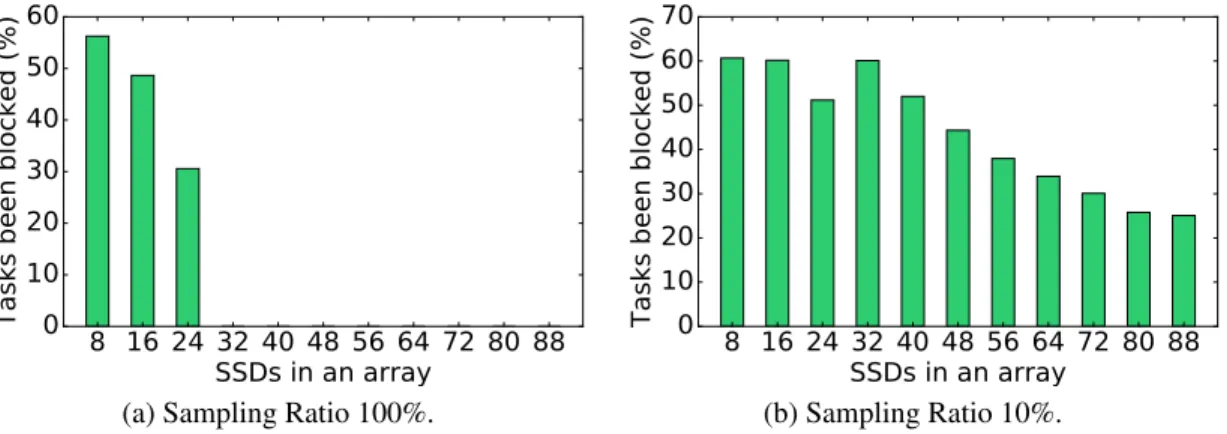
1.4 Computational analysis on the percentage of blocked tasks due to I/O con-tentions under different sampling ratios. 32 I/O threads are used. . . 8
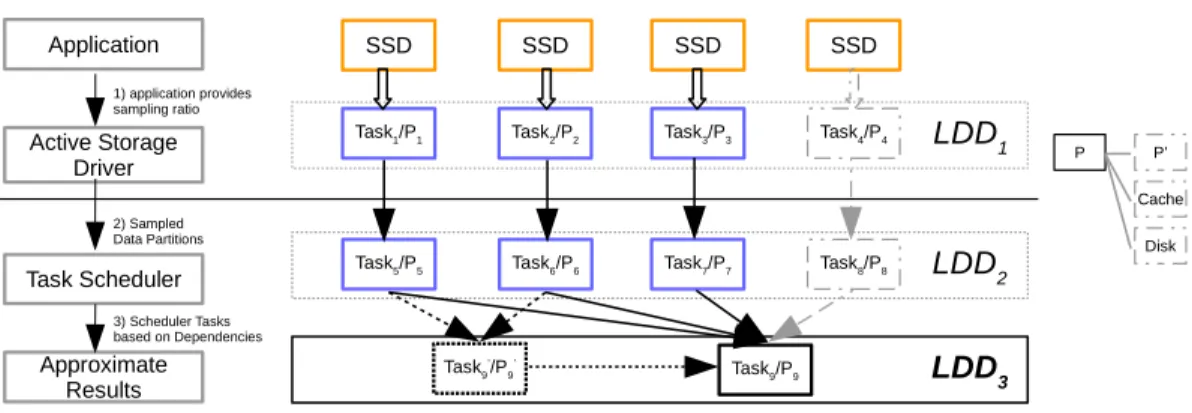
1.5 ApproxSSD Architecture: Partition and Task Dependency Tree (Pi is a
par-tition). . . 9
1.6 Execution time comparison under different sampling ratios. . . 18
1.7 Error rate under different sampling ratios. The data point shows the average error rate for the top 1000 items. . . 20
1.8 Workload balance analysis. The ratio of average load to maximum load, when using 1% sampling ratio. . . 22
1.9 Percentage of CPU I/O Wait time when using different sampling ratios. . . . 23
1.10 I/O per second (IOPS) and latency under different scheduling strategy. . . 23
1.11 Stability of I/O latency. . . 24
1.12 Impact of partition size. . . 24
1.13 Performance Breakdown . . . 25
2.1 Data sampling on systems with NVM-based main memories. . . 33
2.2 Conventional Random Sampling. . . 35
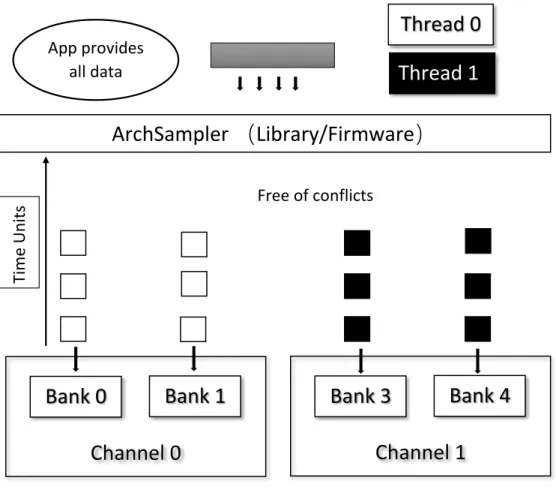
2.3 Conceptual example showing benefits of Bank-aware Sampling. . . 36
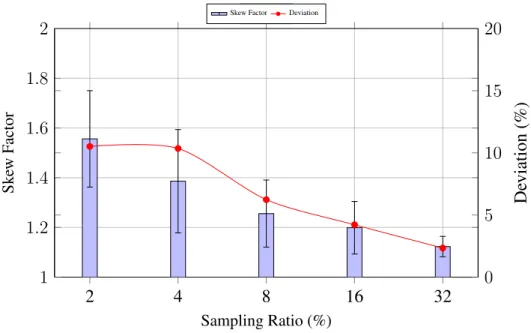
2.4 Workload imbalance issue (Skew factor = max/avg NVM rows requested from banks). . . 37
2.5 Percentage of tasks been blocked due to bank-level I/O contentions. . . 38
2.6 Overview of ArchSampler framework. . . 42
2.7 Results of WordCount under different sampling ratio. (L. S.: Load-balanced sampling with estimated error bound, R. S.: random sampling with estimated error bound, L. S. Error: error rate of load-balanced sampling, R. S. Error: error rate of random sampling.) . . . 47
2.9 Normalized Runtime performance of WordCount. Note the performance is normalized to the synthetic worst case. bn[n = 4, 8, 16, 32] represent n
number of banks. sm[m= 2, 4, 8, 16, 32] representmhsampling ratio. . . 49
2.10 Latency of WordCount. Note the Latency is in logarithmic scale. bn[n = 4, 8, 16, 32] represent n number of banks. sm[m= 2, 4, 8, 16, 32] representmh sampling ratio. . . 49
2.11 Normalized Runtime performance of Avg. Rating. Note the performance is normalized to the synthetic worst case. bn[n = 4, 8, 16, 32] represent n number of banks. sm[m= 2, 4, 8, 16, 32] representmhsampling ratio. . . 51
2.12 Latency of Avg. Rating. Note the Latency is in logarithmic scale. bn[n = 4, 8, 16, 32] represent n number of banks. sm[m= 2, 4, 8, 16, 32] representmh sampling ratio. . . 51
2.13 Runtime performance for Synthetic Workloads. Note the Y label is in loga-rithmic scale. A. stands for ArchSampler. R. stands for Random. . . 52
2.14 Load balance in Synthetic Workloads. . . 52
3.1 Mapping Management in SSD: Correlated Mapping Table is stored sepa-rately, causing additional read request to locate the correlated data. . . 58
3.2 Performance Analysis under different FTL schemes. . . 59
3.3 Correlation Distribution for Financial 2 workload. . . 60
3.5 Architecture of CPFTL.DLP N: Logical Data Page Number,DP P N: Physical
Data Page Number,CBF P: Correlation Bloom Filter Predictor,CP P N:
Phys-ical Correlated Translation Page Number, MV P N: Virtual Translation Page
Number,MP P N: Physical Translation Page Number. . . 66
3.6 Dirty Entry Index. . . 71
3.7 Performance of CPFTL . . . 76
3.8 Impact of Cache Size. . . 80
3.9 Impact of Design Components. . . 81
3.10 Architecture of SSD emulator . . . 85
3.11 Validation of Emulator . . . 90
LIST OF TABLES
1.1 List of evaluated applications. . . 16
2.1 Simulated system configuration. . . 44
2.2 List of evaluated applications. . . 45
3.1 Enterprise-Scale Workload Characteristics. . . 73
3.2 Preprocessed Workload Characteristics. . . 73
3.3 SSD parameters in our simulation . . . 75
3.4 Overhead of CPFTL: Peak Memory Usage and Percentage of Correlation Updates . . . 83
3.5 Evaluation Platform . . . 88
CHAPTER 1: APPROXSSD: DATA LAYOUT AWARE SAMPLING ON
AN ARRAY OF SSDS
Execution of analytic frameworks on sample data sets is the current trend in response to increas-ing data size and demand for real-time analysis. Additionally, high-performance, energy-efficient Solid-State Drives (SSD) arrays are the primary storage subsystem for parallel data analysis sys-tems. To exploit the benefits of SSD arrays when executing sample data set analytics, several key areas must be considered. First, due to logical to physical address translation, random data choice in data sampling jobs can cause unbalanced workloads among SSDs in the array. Second, after the data choice, existing task schedulers in data analysis frameworks can introduce non-negligible resource contentions resulting from the suboptimal Input/Output (I/O). The performance of SSDs is unpredictable because of their varying maintenance costs at runtime, which renders them hard to be managed by the scheduler. With the trend towards sample set data analytics and the use of SSDs, it is increasingly important to ensure balanced workloads and minimize resource con-tentions. Without addressing these areas, sample-set data analytics on SSDs will continue to suffer from performance inefficiencies.
In this paper, we propose ApproxSSD to perform on-disk layout-aware data sampling on SSD ar-rays. This proposed framework leverages data selection and task scheduling to improve the perfor-mance of many applications. ApproxSSD decouples I/O from the computation in task execution. This avoids potential I/O contentions and suboptimal workload balances. We have developed an open-source prototype system of ApproxSSD in Scala at Github. Our evaluation shows that Ap-proxSSD can achieve up to2.7times speed up at 10% sampling ratio under WordCount workloads when compared to Spark, while simultaneously maintaining high output accuracy.
Introduction
As the number of CPU cores continues to increase [1, 2], applications have started to embrace many-core by spawning multiple concurrent jobs. Meanwhile, even when ideal task-level paral-lelism is achieved, storage systems become the major stumbling block to the scalability of many I/O-intensive applications [3]. Many recent works [4, 5, 6] propose to perform big data analytics and machine learning algorithms on powerful servers equipped with arrays of NAND Flash-based Solid State Drives (SSDs) [7]. SSDs in these scaled-up servers play a key role in reducing the I/O overhead. This is because today’s big data programs, especially iterative algorithms can easily exhaust server’s memory space. The memory capacity demands are typically handled by using disk space, i.e., swap regions. This results in frequent data partitions migration between disk and memory. Popular in-memory systems, such as Spark [8], are hindered by this approach. Also, data sampling techniques are widely used to shrink the data size and enable in-memory processing. For most sampling applications, uniform data selection [9, 10, 11] is used. In some other cases, such as sparse input datasets [12, 13, 14, 15], conditional sampling is required for higher accuracy. Most research focuses on enhancing the output accuracy or the estimation of the error bar. However, there is another important research area that has not be thoroughly covered, which is motivating the focus of this chapter. It is the sub-optimal use of SSD arrays due to inefficient data sampling techniques that are not aware of the low-level data layout.
The first problem in approximate data analytics on SSD arrays is the workload balance issue. In uniform sampling, the assumption is that the amount of data sampled from each disk is equal [9, 10, 11]. Counter-intuitively, this ideal case rarely happens [16, 17]. Suppose we randomly sample eight data partitions from eight disks, the theoretical probability of having each disk serves one data partition is as low as one in twenty-two. Such pattern persists even if the number of sampled data partitions increases. Figure 1.1a shows an example that disk b contains the most selected
dataset. A key design challenge to optimize task execution time is to balance the data sampling across all SSDs to avoid throttling delays from an SSD with a large amount of input data. To avoid this type of bottleneck, as illustrated in Figure 1.1b, we expose the data layout information to the data sampling engine and then perform a balanced sampling strategy on among the SSDs.
(a) Application selects a subset randomly out of the entire data set. The sampled data are con-centrated on few disks.
(b) Given multiple choices of a subset, balanced data sampling selects the one which accesses the same amount of data from each SSD to enforce load balance.
Figure 1.1: Workload balance issue in performing data sampling on SSD arrays. The total amount of sampled data remains the same between current random selection and our proposed scheme. Orange indicates the sampled data.
Secondly, the random access of input data and the blind task scheduler results in severe I/O con-tention between SSDs. As reported, the performance of random read accesses on SSDs is worse than that of other access patterns and operations, including random write accesses [18]. While sequential accesses can be easily striped over multiple storage media in a round-robin fashion to exploit their parallelism, random read requests cause severe resource conflicts [19]. Figure 1.2a shows the input task orders when we submit the sampled dataset to mapping threads in a round robin way. The ApproxMap and ApproxReduce tasks are variantions of the MapReduce tasks with the added ability to perform data sampling and task dropping operations. In this illustration I/O contention is occurring first on diskaand then on diskbif the map tasks are executed in the default order. This is occurring even though the sampled data set is balanced among SSDs (Figure 1.2b).
(a) The sampled segments are submitted to ApproxMap tasks in a round-robin way so that each task processes the same number of segments.
(b) Contentions happen while multiple tasks request segments on the same disk (contentions hap-pen first on diskathen diskb).
(c) Reordering
seg-ments read based on the data layout to remove contention.
Figure 1.2: I/O contention issue on SSD array. The data partitions are sampled as Figure 1.1. The ApproxMap and ApproxReduce tasks are variantions of MapReduce tasks with the added ability to performing sampling and task dropping operations.
Our idea is to develop an on-disk data layout aware scheduler to avoid the I/O contentions so that we can get results as in Figure 1.2c. The way to tackle I/O contention in storage layer is to reorder I/O requests [20, 19], or use decoupled I/O threads to improve the prformance [21]. However, the performance of SSDs at runtime varies significantly and is impossible to forecast by the task scheduler, also the data to disk mapping is hidden by the storage layer. As a result, the proper task execution order cannot be determined. Additionally, reordering tasks will not produce an acceptable solution if tasks are skewed to a few disks. To solve this, we propose to exclusively use I/O threads to load data from each disk, where two threads will not compete for one disk, and one slow disk will not affect others.
Emerging storage systems and devices, such as Ceph[22], copy-on-write filesystems [23] and Open-channel SSDs[24], try to avoid the usage of a fixed RAID controller, but instead, expose the storage-level parallelism to the application layer. However, existing big data frameworks do not take advantage of storage level parallelism in the task planning and scheduling. To improve the
I/O efficiency, we developed ApproxSSD: a novel parallel data processing framework with an in-tegratedactive storage driver. Upon the job submission, ApproxSSD constructs a dependency tree of computing and I/O tasks. The corresponding I/O tasks are then dispatched to the storage driver for processing. The data sampling job is launched and computed by the storage driver where data layout information is available. Therefore, data partitions can be sampled in a balanced manner while meeting the sampling ratio requirement. The I/O scheduler then pro-actively determines the data loading sequence to fully exploit the bandwidth of each disk. Finally, we process fetched data in parallel. Benefiting from multiple decoupled components, our design is expected to unleash the full potential of SSD arrays and the power of multi-core CPUs. In doing this, we have made the following contributions:
• We proposed an active data storage engine which leverages the flexibility of partition pro-cessing order to fully unleash the parallelism in SSD arrays.
• We proposed a data-layout aware sampling scheme to balance the workloads among multiple SSDs by using non-uniform segment sampling.
• We have prototyped ApproxSSD in Scala, which is open sourced at
https://github.com/janzhou/approxssd. The results indicate up to 2.7 times speedups com-pared to the state-of-the-art data analysis engine.
Motivation and Analysis
Workloads Balance in Data Sampling
The sampling-based approximate query has been widely used in modern data-intensive analytic applications. Sampling obtains a much smaller data set with the similar data structure and features.
As a sampled dataset can typically fit into the main memory, the technique reduces the latency and resource usage. The basic technique that is used to perform data sampling is choosing the data randomly from the entire dataset. Unfortunately, random data access results in imbalanced workloads across SSDs in an array. The overall execution time of data sampling is determined by the SSD with the maximum load.
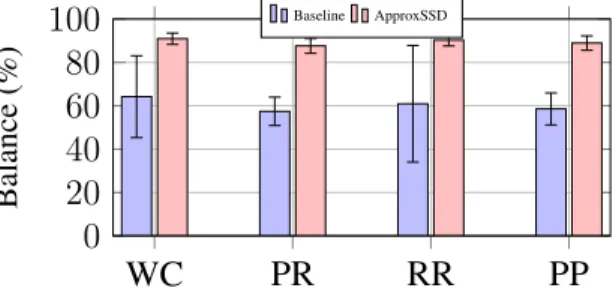
Figure 2.4 shows the workload imbalance issue in 4 real world applications. The details of the applications are described in the evaluation section. The measurements were obtained using the standard Linux iostat command to capture the amount of data read from the SSD during application execution. The balance percentage is calculated by dividing the calculated average amount of data served by the array of SSDs by the maximum amount of data served by a single SSD. For each workload, we get the average value and deviation from 20 executions. In four real-world applications, the work load balance is on average 60%, with deviations as high as 20%, as shown in Figure 3. This is due to the fact that data sampling is performed by the approximate applications or computing frameworks [10, 25], while the physical data layout is masked by the storage software such as filesystems and RAID controller. Motivated by this, we propose to expose the internal parallelism inside the storage architecture to the data sampling framework. The data layout aware sampling can effectively balance the maximum workload of each SSD in a storage array.
WC PR RR PP 0 20 40 60 80 100 Balance (%) Deviation 0 10 20 30 De viation (%) Balance Deviation
Figure 1.3: Workload imbalance issue. The higher values are optimal, with 100% indicating the load is fully balanced. Using 1% sampling ratio. (WC: Word Count; PR: Page Rank; RR: Request Rate; PP: Project Popularity)
Contention Analysis
To get a better understanding about the I/O contention, we mimic data sampling job performance with an ideal “what-if” simulator. Our simulator is unconstrained and (i) randomly selects data from all the SSDs in the input phase and (ii) submit data analysis tasks such that the workload is distributed evenly across all the threads. We quantitatively measure the contention by counting the number of tasks that have been blocked due to I/O contention. If two tasks contend for one physical disk, we count one of the tasks as blocked. We ignore the internal parallelism of SSDs, such as the channel-level parallelism, in the computational analysis. However, this simplification does not affect the conclusion that random data sampling can potentially increase the I/O contention. Figure 1.4 shows the percentage of tasks that have been blocked compared to the total number of disks in the array. The sampling ratio is the percentage of data been selected from the origional data. We can find that the maximum percentage of tasks been blocked due to I/O contention is around60%. It also shows that as the number of disks increases the chances of having a contention decreases. However, the percentage of contention I/O tends to increase as we decrease the sampling ratio. This is because when we use a higher sampling ratio, more data will be selected, thus making it easier to parallelize the I/O requests. For example, when processing the whole data (100% sampling ratio), we can perform sequential I/Os which can be easily striped to disks. This is why the result shows no contention when using 100% sampling ratio, 32 I/O threads and 32 disks. When we reduce the sampling ratio, it will result in more random I/O and thus more contentions.
8 16 24 32 40 48 56 64 72 80 88
SSDs in an array
0
10
20
30
40
50
60
Tasks been blocked (%)
(a) Sampling Ratio 100%.
8 16 24 32 40 48 56 64 72 80 88
SSDs in an array
0
10
20
30
40
50
60
70
Tasks been blocked (%)
(b) Sampling Ratio 10%.
Figure 1.4: Computational analysis on the percentage of blocked tasks due to I/O contentions under different sampling ratios. 32 I/O threads are used.
Approxssd Design and Optimizations
Architecture Design
Data analysis frameworks and their corresponding file systems [8, 26] emphasize on high through-put and scalable performance by splitting data into large chunks on servers. However, these servers may includes an array of disks and the task scheduler is unaware of the data distribution among them and assumes I/Os can be easily stripped to disks. Unfortunately, the on-disk data distribution is becoming important when we introduce sampling to reduce the input data size and provide fast approximate results. To guarantee an acceptable approximate error, data sampling is done using random and small-sized data access on disks. Because of this, contemporary analysis frameworks cannot unleash the full potential of SSD array performance. Without the data layout information, applications will sample uneven amounts of data from disks. Currently, the task schedulers have no coordination with the I/O systems to avoid disk contentions. Even though that the analytical frameworks and the underlining storage system work in a parallel manner, the random data access, and the blind task scheduler will cause severe load imbalance and contention issues between SSDs.
We propose ApproxSSD, a decoupled data storage and processing engine designed for big data sampling. As shown in Figure 1.5, ApproxSSDmainly consists of an active storage driver and a task scheduler. The active storage driver is a software module that runs on the host system to govern the storage system. We expose the detailed information of the storage system, such as the number of SSDs and the placement of data partitions, to the storage driver. To achieve this, we manage the partition to disk mappings in the active storage driver directly, instead of using a fixed RAID controller or a black-boxed file system. The user then provides the required sampling ratio to the active storage driver. The storage driver then pro-actively loads the data according to the sampling ratio and data layout to maximize the bandwidth of each disk. Finally, the task scheduler launches computing tasks based on the dependencies.
SSD SSD SSD SSD
Task1/P1 Task2/P2 Task3/P3 Task4/P4
Task9/P9
Task5/P5 Task7/P7 Task8/P8
LDD1 LDD2 LDD3 Active Storage Driver Task Scheduler Application 1) application provides sampling ratio 2) Sampled Data Partitions Approximate Results 3) Scheduler Tasks based on Dependencies P’ Cache Disk P Task6/P6 Task9’/P 9’
Figure 1.5: ApproxSSD Architecture: Partition and Task Dependency Tree (Piis a partition).
Data Structure and Programming Interface
ApproxSSD provides a Log-structured Distributed Dataset (LDD) interface to manipulate the dataset. An LDD is constructed by several data partitions. A data partition is the minimum disk I/O unit and is stored in a continuous space on one disk. As shown in Listing 1, LDD supports standard MapReduce data manipulation functions such as map, reduce and join. In addition, we also providesampleoperation to perform layout aware data sampling.
abstract class LDD[T : ClassTag] extends Serializable {
def partitions : Array[Partition[T]]
def map[V : ClassTag](v : T => V) : MapPartitionsLDD[V,T]
def sample(ratio : Double) : MapPartitionsLDD[T,T]
def samplePartitions(ratio : Double) : LDD[T]
def filter(v : (T => Boolean)) : MapPartitionsLDD[T,T] }
abstract class MapLDD[T : ClassTag, U : ClassTag] extends LDD[(T, U)] {
def reduceByKeyPartitions( f : (U, U) => U) : MapLDD[T,U]
def reduceByKey(f : (U, U) => U) : ReduceByKeyLDD[T, U] }
Listing 1: Selected Interface Design for ApproxSSD
Characteristics of Partition data structure: The data of an LDD partition can be loaded or computed from multiple sources: the disk, the in-memory cache or the dependent partition. And the data source of a partition is marked by a flag variable. When data is stored on disks, thedisk identity (ID)anddata offsetare stored within the partition data structure, so there is no additional query when fetching data from disks. The benefit gained by using this type of partitioned data structure is that we can hide the locations of data from the applications and do not need to implicitly load the data before performing data manipulation operations. The procedure of loading the data partition from disk to in-memory cache is defined as I/O task. The procedure of executing a program with data from a partition is defined ascomputing task.
Data flow:A data manipulation function transforms one LDD to another. The partition dependent tree is constructed while doing the LDD transformation (e.g. map, reduce and join operations). Upon a job submission, we submit all the partitions whose data are stored on disk in the active storage driver as well as a data sampling ratio. The data loading is automatically done by the active storage driver, and the data source then points to an in-memory cache.
Persistent LDD and Transitional LDD:Intermediate data is defined as transitional LDD and it can be dropped after use. On the other hand, a persistent LDD is the resultant data which needs to
be stored in the disks when the computation is done. When writing persistent LDD data to disks, partitions provide data, but the disk IDs and the offsets of the written data are determined by the storage driver.
Data Sampling: For the data sampling, LDD provides two levels of sampling functions. One is inter-partition sampling. The other is intra-partition sampling. In contrast to the existing approx-imation techniques in parallel data analysis engines which rely on applications to sample data, ApproxSSD provides high level abstract for the sampling functions so that balanced data selection and contention free task scheduling are enabled.
Task Scheduling and Execution
In this subsection, we discuss the computing and I/O task scheduling. First, we use anI/O sched-uler in our active storage driver to schedule I/O tasks and a dedicatedtask schedulerto schedule computing tasks. For example, in Figure 1.5, the tasks for partition P1 toP4 are simply loading
data from disks. The I/O scheduler can utilize the on-disk data layout information to facilitate the scheduling of data loading tasks. The rest of the tasks are scheduled by the task scheduler, where we mainly focus on the dependencies. Second, when a task is executed, a signal is sent to all tasks depending on it. The task scheduler then launches its dependencies accordingly. If one partition depends on multiple children, all its child partitions need to be executed before it can be launched. If a partition is dropped, e.g. P4, a drop signal is sent to tasks depending on it and its dependency
is removed. Third, to improve CPU efficiency, we overlap the execution of tasks on different lev-els. For example, if TaskT5 andT6 are finished and the Task T7 is still waiting for the I/O Task T3, we dynamically construct a new taskT
0
9, which depends on T5 andT6, and submit to the task
scheduler. Overlapping the task execution in different levels can reduce the CPU time spend on waiting the I/Os.
There are three major execution steps for a sampling-based approximation job:
• Job submission. While submitting an approximate job, the user specifies the sampling ratio for the input data.
• Input data sampling. The active storage driver selects the data partitions based on the sampling ratio and loads the data accordingly.
• Task execution planning.As the partitions are loaded, the computing tasks are then initiated by the scheduler according to the task dependencies.
The Optimizations for Approxssd
ApproxSSD can perform several on-disk data layout aware optimizations.
Use Data Layout Aware Sampling to Balance the Workloads
In existing data analysis frameworks, the workload imbalance problem cannot be efficiently avoided because 1) there is no easy way to get the on-disk data layout information in existing systems, e.g. HDFS and 2) as discussed in the above section, the chance of having the sampled data evenly distributed is low. However, in ApproxSSD, the data to disk mapping is directly managed by our prototyped active storage driver.
To balance workloads among SSDs, we first group input partitions based on their disk IDs. Then, one sampling process is initiated within each group and an equal number of partitions are sampled. Although this method is simple and straightforward, it can be inefficient when the number of partitions is large, and the sampling ratio is low. When the sampling ratio is low, we choose partitions one by one until the required amount of partitions is satisfied. If the number of partitions
on a certain disk exceeds others by a threshold, then some partitions on that disk are dropped. Thus, the same amount of data is selected from each disk (distinguished by the color orange in Figure 1.1). As a result, the potential hot spots on disks can be avoided. Furthermore, instead of sampling the same amount of data on each disk, the number of sampled partitions can also be weighted by the performance of disks in a heterogeneous system.
Use Decoupled Task Threads to Avoid the Contention
Loading the same amount of data from each SSD does not equal to unleashing the full potential of SSD array performance. There is a chance that multiple independent tasks request data from one disk simultaneously. In order to avoid the array level I/O contention, we developed two thread pools. One is for the computing tasks and the other is for the I/O tasks. The execution of computing tasks requires the I/O tasks finish first. We bind each SSD with a set of exclusive I/O threads. The I/O scheduler will dispatch I/O tasks to SSD’s corresponding threads set. Thus, none of the array level contentions happen. After the data loading tasks have been finished, the computing tasks depending on them are submitted to the execution queue.
Writing: The data of the write requests is stored to disks in a Log-structured manner. Because of this, data on disks is immutable and it is safe to spawn any number of read threads for each disk. However, for write threads, a shard write queue and log head is created for each disk to avoid data racing. Contrary to the traditional storage system, target disk and the offsets of the written data are not indicated by the write operations but are determined by the driver. The write requests are dispatched by the write router. Write router collects the write queue information from each disk, then dispatch writing tasks to the SSD with shortest write queue. When the request is finished, the disk ID and the offset of the written data are returned and maintained in thepartition
To reduce memory overhead, we give write requests higher priority compared to read requests because we can release the memory space occupied the output data only after it has been written to the SSD array. The write requests in each disk’s write queue are scheduled by a first in first out (FIFO) scheduler.
Reading: The I/O scheduler does not schedule read requests based on their arrival order. Instead, it creates multiple independent read queues for each disk. Thus, we use multiple decoupled I/O threads to process the read requests in each disk’s queue. Because of this, I/O threads from dif-ferent disks will not compete with each other. All the on-disk data and the location of the data is immutable. As a result, there is no cost in updating the mapping and it is safe to perform multi-threaded data loading without concerning the data racing problems.
Drop the Straggler Disks
Due to the unpredictable performance of SSDs, runtime straggler cannot be avoided even if the even amount of data is sampled from each disk. In order to prevent a straggling SSD, which will slow down the entire application, we always select 10%more data compared to the required samples size from the underlying data and do not wait for the last10%tasks to finish. For example, if the sampling ratio is 1%, we select a total of 1.1%data from the input data. With fine-grained control over the sampling ratio on multiple disks, the reduction of straggling SSDs during data loading phase leads to further improvements in approximation runtime.
Error-bar Estimation
We adopt the standard multi-stage sampling theory [27, 25] to compute error bounds for approxi-mate applications. The set of supported aggregation functions includes SUM, COUNT, AVG, and
PROPORTION. In particular, we describe the approximation of SUM as an example. Approxi-mation for other aggregation functions shares the similar process. Depending on the dataset and computation, it may be necessary to use bootstrap methods [28, 27, 9] to generate a lower error bar (i.e., more accurate) by introducing additional re-sampling overhead. Assuming we divide the entire datasets into multiple data partitions, we have a total ofT items which are divided into N
partitions, and each partition hasMiitems so thatT =PNi=1Mi. Each unit in partitionihas an
as-sociated valuevij, and the sum of these values can be obtained byτ =PNi=1
PMi
j=1vij. To estimate
the sum τ, we sample a list of n partitions which are randomly selected based on their inclusion probabilityπi. The estimated sum is expressed in equation 3.1:
ˆ τ = N n n X i=1 (Mi mi mi X j=1 vij)± (1.1)
where,τˆis the estimatedτ and the error boundis defined equation 3.2:
=tn−1,1−α/2
q b
V(ˆτ) (1.2)
where,Vb(ˆτ)is defined in equation 1.3:
b V(ˆτ) = N(N −n)s 2 u n + N n X i=1 nMi(M−i−mi) s2i mi (1.3)
Table 1.1: List of evaluated applications.
Application Algorithm Datasets
Word Frequency Word count Wikimedia Dumps Page Rank Graph processing Wikimedia Dumps Request Rate Average Wikimedia Pageviews Popular Pages Sum Wikimedia Pageviews Popular Project Sum Wikimedia Pageviews
Experiments
To evaluate ApproxSSD, we used multiple common real world data-analytics applications and algorithms (see Table 1.1 for details). We executed Word Count (WC) and Page Rank (PR) al-gorithms on 49GB Wikimedia Data Dumps [29]. Popular page (PP) and request rates (RR) are executed on 219GB page access log for Wikimedia Page Views [30].
Experimental Setup
ApproxSSD is built as a standalone prototype system using Scala programming language. It has a direct access to the SSDs. Each SSD is bound to an independent storage driver. The storage driver has one log-structured write head which serves the write request in a first-come, first-served (FCFS) manner. At its initialization, ApproxSSD has its data stored on an external storage server. As a result, the experimental data needs to be moved to the prototyped storage system before execution. During the movement, the write request is submitted to the write router first, then dispatched to the storage driver with the least outstanding requests. Data stored on the disk is immutable to guarantee thread safety so that there is no limit on the number of concurrent read requests. The executor is configured with 8 map threads and 8 reduce threads in total. To conduct our experiments, we used an 8-core Xeon server with 64GB memory and 8 OCZ 120GB SATA SSDs. We employ the RAID
controller and ext4 file system in our experiments to set up a working Spark baseline system for comparison. In ApproxSSD, we bypass the RAID controller to gain direct access to the physical disks. We use a typical 8KB partition size by default in both the baseline and ApproxSSD settings.
We start with studying the impact of ApproxSSD on the performance and the accuracy of the applications. Later, we study and analyze the impact of ApproxSSD on key metrics, such as I/O throughput and I/O contention. For job execution time, the experiment is repeated 20 times. Then we report the average execution time and its deviation. To keep the results consistent, we clear the system buffer before the beginning of each experiment. For accuracy, we calculate estimated error bars and the difference between precise value and approximate value. To measure the I/O contention and its impact, I/O latency, I/O throughput as well as the percentage of the CPU I/O wait time are reported.
Performance Comparison
For our performance evaluation study, we use two publicly accessible datasets, Wikipedia data dump and Wikipedia access log. Specifically, we study 4 applications in this section. First, in the Word Count analysis for the Wikipedia data dump, a key-value pair < word,1 >is generated in the map phase, and in the reduce phase the count for each word is summed. Second, in the page rank analysis, we extract the < p,1 > pair from the Wikipedia data dump, wherep represents the page that is linked; in the reduce phase, we count the number of links pointing to page p. Third, in the Wikipedia request rate analysis, we calculate the average number of requests from the Wikipedia access log. Similarly,< time,1 >pair is generated in the map phase. We then group and sum the < time, value > pair based on per hour time unit. Finally, in the page popularity analysis for Wikipedia access log,< page,1>pair is produced by the number of page accesses in the map phase and then the total accesses in the reduce phase is obtained by a simple summation.
In the baseline, we use a random boolean generator to randomly select a number of data partitions to be used for analysis jobs. While in ApproxSSD, the same amount of data is sampled from each disk drive. The total amount of sampled data is10%more than the requested in order to avoid the bottleneck caused by the straggler disks. Then multiple independent data fetchers are launched for each disk drive, and fetched data is submitted to the task scheduler. When the amount of fetched data reaches the requested volume, the fetch process is stopped for the final estimation of results.
10−2 10−1 100 101 102 0 500 1,000 Sampling ratio (%) Ex ecution time (seconds) Precise Baseline ApproxSSD
(a) Word Count
10−2 10−1 100 101 102 0 500 1,000 Sampling ratio (%) Ex ecution time (seconds) Precise Baseline ApproxSSD (b) Page Rank 10−2 10−1 100 101 102 0 2,000 4,000 6,000 8,000 Sampling ratio (%) Ex ecution time (seconds) Precise Baseline ApproxSSD (c) Request Rate 10−2 10−1 100 101 102 0 2,000 4,000 6,000 8,000 Sampling ratio (%) Ex ecution time (seconds) Precise Baseline ApproxSSD (d) Page Popularity
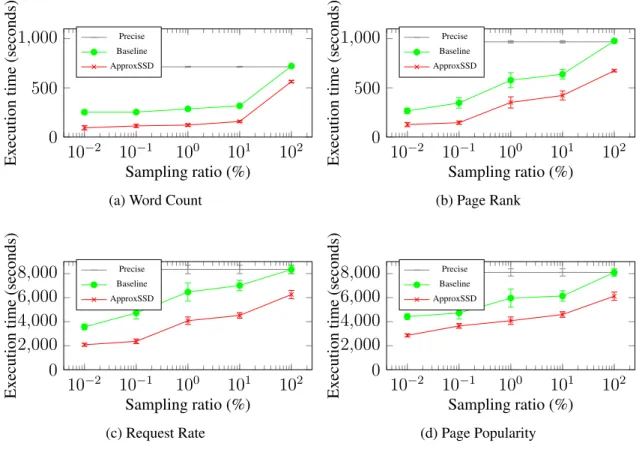
Figure 1.6: Execution time comparison under different sampling ratios.
Figure 1.6 shows the total execution time under different approximation strategies. X-axis is the percentage of the data being sampled and is in log scale. Y-axis is the total execution time in seconds. Each data point in the figure represents the average value over 20 executions as well as the minimum and maximum values. The gray line represents the time spent on precise
execu-tion in baseline system. The green line represents the approximaexecu-tion performance of the baseline system. While the red line represents the approximation performance of ApproxSSD with all the optimization strategies enabled.
Figure 1.6a and Figure 1.6b show the total execution time of Word Count (WC) and Page Rank (PR) respectively when different sampling ratios are applied to the Wikipedia data dump dataset. The execution time of both algorithms decreases with sampling ratio. ApproxSSD is 2.7 and
2.09times faster than the baseline Spark solution when the sampling ratio is 0.01% (Divide the execution time of the baseline by that of the ApproxSSD). As we reduce the sampling ratio from
100%to0.01%, the total execution time of PR decreases more significantly than that of WC after
10%sampling ratio. This is because when the input data size is reduced, PR algorithm can achieve better data locality and thus lower memory usage overhead. The extra performance gain when doing approximate query is due to the balanced data choices among the SSDs and the runtime straggler dropping. Even when the sampling ratio is 100% which means the entire dataset is processed without sampling, ApproxSSD is1.28and1.45times faster than the baseline solution. This is because the reduced I/O stack and parallel data read threads can shorten the data load time.
Similarly, the total Request Rate and Page Popularity analysis time for Wikipedia access log dataset with different sampling ratios are shown in Figure 1.6c and Figure 1.6d respectively. ApproxSSD is1.70and1.55times faster than the baseline when the sampling ratio is set to0.01%. ApproxSSD can also outperform the baseline by1.33and1.55in terms of execution time when analyzing the entire dataset.
Error-bar Estimation
In this section, we study the estimation error bar in ApproxSSD. ApproxSSD balances the work-loads by performing segmented sampling in each disk. Some researchers, such as BlinkDB [31]
split the data based on the data dimensions and then perform segmented sampling in each dimen-sion to improve the approximate accuracy. There may exists bias in the sampled data when the content of the file is not equally likely to be selected. However, both the random sampling and the data-layout aware sampling developed in current ApproxSSD does not consider the data dimen-sions or how the content is distributed in the files. As any partition still has equal chance of being selected in our segmented sampling, ApproxSSD does not introduce bias and should have the same level of sampling accuracy as the random sampling. Future versions of ApproxSSD may focus on improving the sampling accuracy.
10−2 10−1 100 101 102 0 10 20 30 40 Sampling ratio (%) Error rate (%) ApproxSSDBaseline
(a) Word Count
10−2 10−1 100 101 102 0 10 20 30 40 Sampling ratio (%) Error rate (%) ApproxSSDBaseline (b) Page Rank 10−2 10−1 100 101 102 0 10 20 30 40 Sampling ratio (%) Error rate (%) ApproxSSDBaseline (c) Request Rate 10−2 10−1 100 101 102 0 10 20 30 40 Sampling ratio (%) Error rate (%) ApproxSSDBaseline (d) Project Popularity
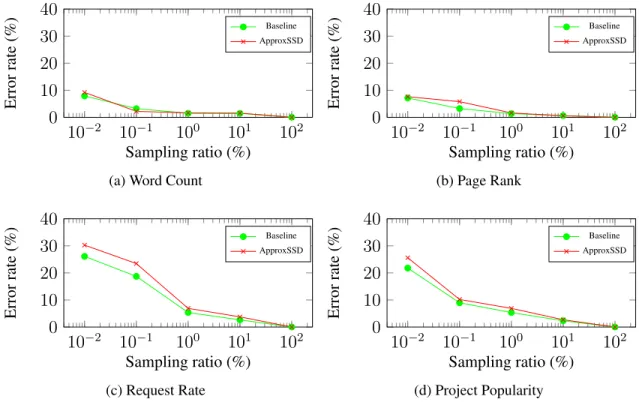
Figure 1.7: Error rate under different sampling ratios. The data point shows the average error rate for the top 1000 items.
Particularly, Figure 1.7 shows the error bar analysis for different applications. In the Word Count analysis, we select the top 1000 most frequently used words and use equation to calculate the
error-bar. We use the error ratio to indicate the differences. The error ratio is calculated by divide the error-bar by the actual experimental value. The graphs show the average error rate. In the page rank analysis, the top 1000 most linked pages are selected. The error rate of the total link times for the selected pages is shown in the graph. In the Wikipedia Request Rate analysis, the approximate number of requests in a time unit (an hour) is compared with the precise one. Then the average error rate is plotted in a time unit (a week). Finally, we conduct the similar comparison in the Popular Page analysis for the top 1000 most accessed Wikipedia pages.
The error rate of ApproxSSD, as shown in the figures, is very close to that of the baseline in every application. It is observed that Word Count and Page Rank analysis generally have lower error rate compared to Request Rate and Page Popularity analysis. This is because the content-based popularity analysis is more stable than the access pattern based popularity analysis.
As shown in Figure 1.7a and Figure 1.7b, the error rate of Word Count and Page Rank are barely affected by the sampling ratio. As shown in Figure 1.7c and Figure 1.7d, the Request Rate and Popular Page analysis have larger error rates which increase significantly when the sampling ratio is reduced to0.01%. We can see that ApproxSSD has little impact on the overall sampling accuracy. And ApproxSSD can also adopt the technology used in BlinkDB to further improve the accuracy by considering data dimensions when save to disks.
Impact of Design Components
In this subsection, we study the overhead of ApproxSSD in terms of 1) workload balance; 2) I/O contention 3) and task drop. To study the performance of I/O system, we collect the I/O latency and I/O per second (IOPS) in our active storage driver. We also developed a round-robin I/O scheduler for comparison.
Workload Balance WC PR RR PP 0 20 40 60 80 100 Balance (%) Baseline ApproxSSD
Figure 1.8: Workload balance analysis. The ratio of average load to maximum load, when using 1% sampling ratio.
To study the workload balance issue of ApproxSSD, we capture the maximum amount of data served by a single SSD. We use the standard iostat command in Linux to capture the amount of data read been from SSDs during the execution. Then the average value is calculated from 20 executions, and the max, average, and min values are plotted for each data point. We measure the workload load balance among disks using the ratio of the average amount data been served by disks and the maximum amount of data being served by a single disk, as shown in Figure 1.8. We can observe that the maximum load of the baseline is around 1.48times larger than that of ApproxSSD, with a very high deviation. On the contrary, the SSD workloads under ApproxSSD are well balanced and very stable with a deviation less than10%.
Contention & I/O Performance
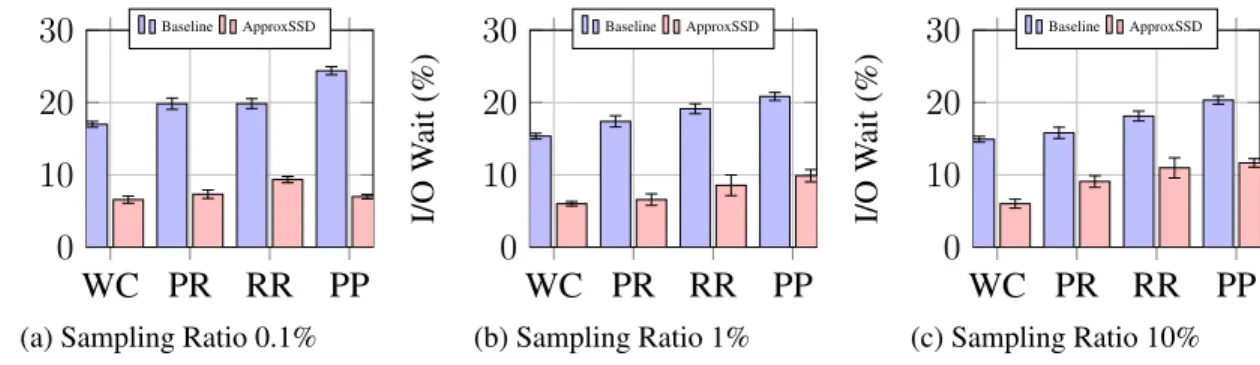
Loading the same amount of data from each SSD does not necessarily mean that we have exploited the I/O bandwidth. If tasks on the same disk are scheduled concurrently, the corresponding SSD will lead to an I/O contention, which results in a waste of CPU cycles. As shown in Figure 1.9, the percentage of I/O wait time is used to indicate the CPU and disk bandwidth utilization ratio. The
results come from the average of 20 executions. We can observe that the baseline wastes3times more CPU circles on the I/O wait compared to ApproxSSD.
WC PR RR PP 0 10 20 30 I/O W ait (%) Baseline ApproxSSD
(a) Sampling Ratio 0.1%
WC PR RR PP 0 10 20 30 I/O W ait (%) Baseline ApproxSSD (b) Sampling Ratio 1% WC PR RR PP 0 10 20 30 I/O W ait (%) Baseline ApproxSSD (c) Sampling Ratio 10%
Figure 1.9: Percentage of CPU I/O Wait time when using different sampling ratios.
20 40 60 80 0 50 100 Balance (%) Latenc y (ms) 0 2,000 4,000 IOPS Latency IOPS
(a) Round-robin Scheduling (Baseline)
20 40 60 80 0 50 100 Balance (%) Latenc y (ms) 0 2,000 4,000 IOPS Latency IOPS (b) ApproxSSD Decoupled
Figure 1.10: I/O per second (IOPS) and latency under different scheduling strategy.
Figure 1.10 shows the IOPS and latency when using different I/O scheduling strategies. We spawn the same amount of the I/O threads in the baseline and ApproxSSD designs. The I/O threads are equipped with an unbounded I/O queue, and we submit all the I/O requests of the sampled data to these threads while submitting the jobs. In the baseline approach, the I/O scheduler sends requests to I/O threads in a round-robin way regardless of their data location. In ApproxSSD, we bind the I/O threads to disks, each thread only handles requests to the corresponding disk. The results come from the average of 20 executions, We can see clearly that there is a correlation between load
balance and contention. As the load balance increases, the IOPS increases under both designs. While the I/O latency of the baseline design reduces and the latency of ApproxSSD consistently stays very low. Figure 1.11 shows a sample of latency over time, which indicates that ApproxSSD has more stable latency compared to the baseline design.
0 20 40 60 0 20 40 60 80 100 I/O Sequence Latenc y (ms) Round-robin Scheduling ApproxSSD Decoupled
Figure 1.11: Stability of I/O latency.
2K 4K 8K 16K 32K 64K 0 20 40 60 80 100 Ex ecution time (s) Baseline ApproxSSD
(a) Execution time under different partition size.
2K 4K 8K 16K 32K 64K 0 5 10 15 Error Rate (%) Baseline ApproxSSD
(b) Error rate under different partition size.
Figure 1.12: Impact of partition size.
As we discussed, the size of sampling unit is one of the causes of I/O inefficiency. Figure 1.12 compares the total execution time and the approximate error rate under different partition size. The results come from the average of 20 executions. Results show that there are no significant differences in the execution time when using partition size larger than 64KB. As the partition size decrease to 2KB, ApproxSSD turned out to be 2x times faster than the baseline solution while
providing comparable approximate accuracy. It is worth noticing that as the partitions size goes beyond 64KB, the disk I/O will then become more sequential thus result in higher I/O throughput. However, the approximate error rate will be larger, and make the result useless for applications.
Performance Breakdown BaselineBS CS D-10 D-25 D-50 0 100 200 300 Ex ecution time (seconds)
Figure 1.13: Performance Breakdown
In this experiment, we show the performance breakdown of each design components. We develop flag to enable/disable balanced sampling (BS), contention free scheduling (CS) and different task dropping ratios including 10% (D-10) 20% (D-20) and 50% (D-50). In the baseline experiments, we use random sampling. In the balanced sampling we only balance the workloads among SSDs. In the contention free scheduling we balance the workloads as well as use decoupled I/O threads for each disk. In task dropping experiments we further add different task dropping ratio to reduce the impact of unstable SSD performance. We use a fixed 10% sampling ratio and WordCount workload in each experiment. We run each experiment 20 times to get the average. Figure 1.13 shows the total execution time when different flags is enabled. All the percentage of the execution time reduction used below are compared to that of the baseline. The balanced sampling along can reduce the 37.5% execution time on average. The contention free threads can further reduce 14.2% execution time on average. In the case of using50%dropping ratio, we sample15%of the original
data, then drop50%of the sampled data during the execution, so that we still process10%of the original data. As the results show, the execution time can drop by9.8% when using the dropping ratio of10%. Then it drops another5.2% if further increase the dropping ratio to50%. However, as the task dropping ratio increases, the data been processed could be more skewed to the SSDs with better performance.
Discussion & Related Work
In this section, we discuss the related work and the requirements, challenges and solutions for effectively deploying ApproxSSD in real systems.
Approximative Computing
Data-intensive computing frameworks usually handle large amounts of data and require fast data retrieval to support applications, such as intelligent machine learning [32], graph processing [33, 34, 35, 36]. To cope with the explosive growth in data size and facilitate near-real-time analysis, many works have been proposed to reduce the input data volume, e.g., data transformation and sampling. The data transformation technique utilizes a compressed format to represent the original data, for example, the random projection is used to reduce the dimensionality of a matrix [37], and multi-probe locality sensitive hashing [38] is used in similarity search [39]. Data sampling, on the other hand, selects only a portion of the input data for processing and typically has low overhead [11, 13, 12, 15]. Due to its simplicity, data sampling has promoted the deployment of approximation in big data applications.
Scaled-up SSD Servers
Many recent works [4, 5, 6] propose efficient frameworks that can run big data analytics and machine learning algorithms on a single powerful server equipped with an array of SSDs. The direct benefit of running analytics or machine learning jobs on a single server is the removal of the heavy communication cost in distributed frameworks. Indeed, it has been shown in [40] that the majority of real-world analytic jobs process less than 100 GB of input. However, to process the entire dataset, applications have to repeatedly switch the data between memory and external disk array [41].
Without any moving parts, SSDs are expected to provide fast random read accesses and low I/O latency [42]. However, counter-intuitively, contemporary SSDs deliver unstable performance due to their distinct electrical characteristics and complex firmware design [7, 43]. 0.6% of the time, an SSD is more than 2x slower than its peer drives in the same array [44, 45]. Note that the worst-case latency of fully-utilized SSDs is much worse than that of HDDs due to garbage collection invocations in SSDs [18]. It is also reported that the random read performance can be even worse than random write performance [18]. Even when the workload is sequential read, the SSD perfor-mance can degrade with NAND flash cell aging and the increasing number of I/O requests [18]. Moreover, the concurrent read and write will degrade the performance further [20]. Additionally, SSD garbage collection can increase latency by a factor of 100 [46]. “Fast” and “slow” pages exist within an SSD [47], thereby causing uneven read/write latencies. ECC correction, read disturb, and read retry are also factors of performance instability [48]. In the task dropping design, additional data is sampled from SSDs which results in extra read requests to the SSDs. The read requests have little impact on the SSD lifespan compared to the other operations on the SSD [49]. Thus, it does not noticeably increase the cost of using the SSD array.
Local Storage System
It is not uncommon for storage systems to expose the data layout information in the pursuit of better performance in data analysis jobs [50, 51, 52, 53, 54]. There is also some recent work to expose the internal parallelism of SSDs in filesystem or block I/O [55, 24, 21]. Our work further exploit the storage level parallelism in the application layer. However, contemporary storage systems introduce many advanced techniques such as data compression and data deduplication. Thus, capturing the data layout information at the application level becomes even more complex and may change at runtime. Fortunately, the implementation of ApproxSSD only requires information that relates to the internal parallelism of the SSD arrays, such as data-to-device mappings. Accordingly, it is sufficient to support ApproxSSD through adding a mapping query function in existing storage systems.
To optimize the mapping query performance, the metadata in ApproxSSD is cached in memory. When partitioning 1TB data with the partition size of 8KB, we approximately need 1GB of mem-ory for the metadata. If we implement data sampling, the size of the metadata to be cached will be further reduced. To the best of our knowledge, it is not common for a single node to store hundreds of Terabytes. Therefore, we can manage storing metadata in memory to both reduce the write traf-fic and improve the read performance. However, if we do need to process hundreds of Terabytes in a single node, we can first split the data to several Terabytes then process the files separately. The metadata is generated in the write threads in background. Only the initial portion of metadata is loaded from disk not the entire metadata set. Thus, the metadata in ApproxSSD does not introduce significant overhead.
Storage Virtualization
Virtualization is another widely adopted technology to consolidate servers. It brings many other potential optimizations, e.g. system wide data compression and deduplication, dynamic resource and performance allocation according to the workload. However, the sharing of storage system among the co-located virtualization environments incurs performance interference between each other [56, 57]. Without exposing the storage level parallelism to ApproxSSD, there is not enough opportunity for performance optimizations. In fact, this is not limited to ApproxSSD; state-of-the-art I/O protocols, e.g., NVM Express (NVMe), provide multiple submission queues that are visible to the SSD controller, thus without assuring such parallelism is exposed directly to the guest VM, it is challenging for the guest VM to optimize for SSD performance. To enable the performance gains from ApproxSSD in the presence of storage virtualization, we need to deploy a set of techniques. First, allowing the VM to query the host/hypervisor to directly interact with the block device, to obtain the actual device mappings (only those related to it). Second, any changes in the actual mappings are frequently propagated to the VM through an interrupt or special device driver (similar to Memory Ballooning driver). Third, using independent I/O threads to consolidate the requests from the hypervisor. Finally, providing a LDD-based storage virtualization interface for applications. Accordingly, ApproxSSD that runs on the hypervisor can get the data layout and leverage it effectively to achieve data-layout aware task scheduling.
Heterogeneous System & Data Skew
The write scheme of ApproxSSD is depending on the SSD status (e.g. if it is performing garbage collection). In a homogeneous system, we expect that the data will be eventually evenly placed among SSDs. On the other side, in a heterogeneous system, where SSDs from multiple vendors are equipped, a long-term execution of ApproxSSD may result in a skewed data placement. However,
the unbalanced data writing will not hurt the overall execution performance as ApproxSSD tends to write more data to more powerful SSDs. In the meanwhile, by introducing skewed data sampling, which takes different SSD performance into consideration, ApproxSSD would further improve the sampling performance.
Distributed Data Processing
Shared-nothing software architecture, such as Hadoop [26] and Spark [8], are becoming the de-facto standard for big data processing. ApproxSSD is a good compliment to the Hadoop ecosystem. As the Hadoop Distributed File System (HDFS) is mainly optimized for large sequential I/O, load-ing even 8KB data from a chunk would need to read and parse the whole chunk which is typically 64MB. In the meantime, reducing the chunk size would increases the size of the metadata and result in too much overhead in the NameNode. As a result, one of the most feasible ways to im-prove performance is to combine the function of ApproxSSD in the DataNode to support random sampling and leverage the I/O parallelism in SSD Array. We could then redesign the task executor to avoid I/O contentions.
Meanwhile, with the current implementation, the following options are available. First, Approx-SSD can potentially be incorporated into existing architecture as a local executor. Second, we can develop a data layout task grouping strategy that combines multiple co-located tasks into one. Third, we can launch a remote data loading task through ApproxSSD, and perform asynchronous data transfer between nodes, if remote data accessing is unavoidable.
CHAPTER 2: ARCHSAMPLER: ARCHITECTURE-AWARE MEMORY
SAMPLING LIBRARY FOR IN-MEMORY APPLICATIONS
With the explosive rate of data growth, the limited scalability of the DRAM technology defies the performance potentials for in-memory applications. Fortunately, emerging non-volatile memory (NVM) technologies, such as Phase-Change Memory (PCM) and Memristor, are promising candi-dates for replacing DRAM. Emerging NVMs are very dense, hence promise large capacities. Ad-ditionally, NVMs are non-volatile, thus enable persistent applications and byte-addressable files. Both, density and persistency, are key enablers for in-memory applications. On the other side, emerging NVMs are slower than DRAM, thus optimizing for locality and avoiding contentions are key aspects to unlock the NVM performance.
In this paper, we study the impact of memory contentions and architecture-oblivious implemen-tations on the performance of sampling based in-memory approximation. Sampling has become an imperative technique used to accelerate big data processing, especially in today’s emerging in-memory computing. However, we observe multiple of times slow-down for naive and de-fault implementations of in-memory data sampling. Accordingly, we propose ArchSampler, an architecture-aware sampling library. The main idea is to exploits free choice of data samples to dynamically select which bank as a host to serve memory requests. Hence, ArchSampler enables efficient and high performing sampling through employing its knowledge of the NVM architec-tural details to maximize data locality and avoiding inter-thread contentions. Our evaluation shows that ArchSampler can achieve up to1.62 speed up (1.20on average) for different in-memory ap-plications.
Introduction
Emerging Non-Volatile Memory (NVM) technologies, such as Phase-Change Memory (PCM)[58, 59] and Memristor[60], are promising candidates for building future memory systems[58, 61]. Compared to DRAM, emerging NVMs promise high densities, near-zero idle power and persistent applications [62, 63, 58, 59]. While orders of magnitude faster, similar to flash-based Solid-State Drives (SSDs), emerging NVMs enable persistent data storage, hence allow hosting filesystems and persistent data applications. Accordingly, applications that process a large amount of persistent files, such as in-memory database systems and big data applications, are expected to benefit heavily from the deployment of emerging NVMs. Given the high density of emerging NVMs, it is possible to completely host the filesystem, hence all the files, instead of having them frequently swapped in and out between the memory and a much slower storage device, e.g., SSDs.
In many cases, instead of completely processing all data, it is sufficient to do sampling to infer key characteristics about the data. Sampling has been proven to be an efficient yet accurate way to solve real world problems[27, 9, 64]. For instance, in a recent work [64], the authors find that sampling only 10% of the original data set can be done with less than 5% accuracy loss for major data analytics applications. We expect sampling applications to become more common with emerging NVMs, given the huge amount of data NVMs can host. With SSDs, sampling is typically done through obtaining samples from a huge file, copy them to main memory (e.g., DRAM), and finally process them.The sampling process involves accessing slow SSD drives and copying the data to DRAM. A process that can waste tens of microseconds for each sample.
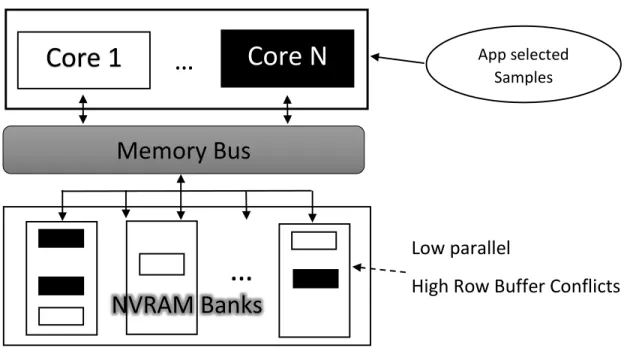
Future systems with NVM-based main memories can directly host huge files, hence enable in-place sampling and processing of files’ data. Recent Linux implementations of filesystems started to support Direct-Access for Files (DAX) to facilitate direct accesses to NVM-hosted filesystems [65]. Figure 2.1 depicts sampling and processing data in future NVM-based main memory systems.
As mentioned earlier, given the huge amount of data NVMs can store, processing all the data of the files can be replaced with fast NVM sampling. On the other side, since emerging NVMs have small latencies, the contention of accesses on the memory can incur significant overheads. The contentions could result from unbalanced accesses to the NVM memory banks and row buffer conflicts. Compared to DRAM, this overhead is much more significant; the actual NVM access latency incurred due to row buffer conflicts is multiple of times higher than DRAM, however, row buffer hits are as fast as DRAM. Moreover, the data sampling on NVM will generate more random memory request which in turn reduces row buffer hits. Our evaluation shows that the performance overhead of internal NVM contentions can reach up to 39%. Fortunately, we observe that sampling applications can exploit theirinherent data choice libertyto more efficiently utilize the internal architecture of emerging NVM technologies.
App selected Samples
…
Core 1
…
Core N
Memory Bus
NVRAM Banks
Low parallel
High Row Buffer Conflicts
Figure 2.1: Data sampling on systems with NVM-based main memories.
In this chapter, we develop ArchSampler, a software framework library that enables architecture-aware data sampling. We discuss the design, challenges and potentials for this type of abstractions.
ArchSampler primarily achieves two main objectives. First, reducing the unbalanced load on dif-ferent NVM banks. Second, maximizing the row buffer locality on each bank by reducing bank conflicts. Unfortunately, there is a lack of work that aims for architecture-awareness in data sam-pling applications. To the best of our knowledge, this is the first work to propose architecture-aware sampling framework for emerging NVM technologies. We strongly believe that this work serves as a first step towards hardware-awareness in big data applications.
To evaluate ArchSampler, we use the Structural Simulation Toolkit (SST)[66], a widely-used de-tailed architectural simulator. We run several data sampling algorithms derived from real world applications. Our results show that ArchSampler can improve the performance of the default im-plementations by up to1.62(1.20on average).
Motivation and Analysis
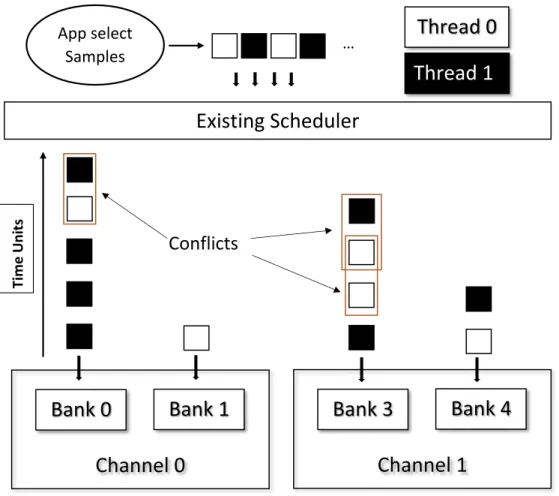
In this section, we motivate our bank-aware data approximation approach by showing how applica-tions sampling on NVMs will cause more interference than other applicaapplica-tions, and how leveraging the ”inherent data choices” of data sampling in bank selection can ameliorate this problem.
To enable scale-out data analysis, the data analysis frameworks usually slice the data into multiple splits and use shared-nothing threads to process that data in parallel [67].Complex data analytics jobs or queries are then translated into multiple iterations of the map, reduce and join operations. In addition, data sampling techniques are nowadays widely adopted to shrink the input data and gen-erate fast and approximate results. Because of this, improved processing performance of sampling plays a key role in responsive analytics jobs.
NVM-Based memories are logically organized as groups of banks within a single or multiple ranks. NVM banks can service memory requests in parallel. Bank-level Parallelism (BLP) is used