Adv. Hort. Sci., 2018 32(4): 459-470 DOI: 10.13128/ahs-22479
Combining ability and gene action of
some tomato genotypes under low
light condition
S. Emami 1, S.H. Nemati1 (*), M. Azizi 1, M. Mobli 21 Department of Horticultural Science and Landscape, Faculty of Agriculture, Ferdowsi University of Mashhad, Mashhad, Iran.
2 Department of Horticultural Science, Faculty of Agriculture, Isfahan University of Technology, Isfahan, Iran.
Key words: combining ability, diallel, heritability, light intensity, reciprocal effects,
Solanum lycopersicum.
Abstract: Limitations in access to electricity in rural areas and substantial cost of supplemental lightning necessitate breeding as response to low light condi-tions. Seven inbred lines of tomato (Solanum lycopersicum L.) and their F1 hybrids, including reciprocals, developed through a 7×7 full diallel cross were evaluated under two different levels of light. Mean square for light (L) effect was significant for total yield, average fruit weight and days to first flower. Variation attributable to Genotypes and genotype × light (G×L) interaction had significant effect on all studied traits except days to ripening for which G×L interaction was not significant. Diallel analysis across two environments indi-cated that general (GCA), specific (SCA) and reciprocal combining ability (REC) were significant for all characters implying importance of additive and non-additive gene action along with cytoplasmic effects on genetic expression of yield, yield components and earliness. Ratio of SCA variance to SCA variance and estimates of narrow sense heritability (h2
n.s) demonstrated higher weight
of additive effects in inheritance of yield, fruit number and days to ripening, while indicating predominance of non-additive effects for fruit weight and early flowering. Interactions GCA×L and SCA×L were significant for almost all studied features. A particular genotype could not be recommended for all traits, but variation among genotypes in response to ambient light was promising for fea-sibility of plant breeding for non-optimal light intensity and duration.
1. Introduction
Tomato (Solanum lycopersicum L.), a member of solanaceae family, is a wide cultivated vegetable used for fresh and processing market. This day neutral plant is grown in various regions of the world with different climates (Mizoguchi et al., 2007; Gerszberg et al., 2015). Iran is among the top 10 countries producing tomato (FAOSTAT, 2014), but it performs very poorly in terms of tomato seed production and a large portion of the seeds, particularly hybrid cultivars, is imported to the country. The major obstacle to seed production in Iran is the absence of breeding programs
(*)Corresponding author:
Citation:
EMAMI S., NEMATI S.H., AZIZI M., MOBLI M.,
2018 - Combining ability and gene action of some
tomato genotypes under low light condition. -Adv. Hort. Sci., 32(4): 459-470
Copyright:
© 2018 Emami S., Nemati S.H., Azizi M., Mobli M. This is an open access, peer reviewed article published by Firenze University Press (http://www.fupress.net/index.php/ahs/) and distributed under the terms of the Creative Commons Attribution License, which permits unrestricted use, distribution, and reproduction in any medium, provided the original author and source are credited.
Data Availability Statement:
All relevant data are within the paper and its Supporting Information files.
Competing Interests:
The authors declare no competing interests.
Received for publication 10 January 2018 Accepted for publication 16 May 2018
AHS
Advances in Horticultural Sciencefor most of the vegetables including tomato; there-fore, more attention to vegetables breeding in order to produce high quality seeds is required.
Hybrid breeding technique is one of the most important methods used for crop improvement. The information needed to develop proper F1hybrid
cul-tivars via hybrid breeding could be achieved through different methods including diallel analysis, a method to analyze crosses made among (n) lines in all possi-ble combinations (Griffing, 1956 a, b). The analysis is mainly adopted when dealing with limited number of parental lines and determines genetic parameters such as heterosis, general combining ability (GCA), specific combining ability (SCA), heritability, and nature of gene action. Heterosis demonstrates the superiority of F1 progenies compared to the average of their parents. General combining ability (GCA) shows the average performance of a parental line while specific combining ability (SCA) refers to the best combination of crosses. General combining abili-ty (GCA) and specific combining abiliabili-ty (SCA) are the indicators of additive and non-additive gene effects, respectively. These parameters help plant breeders in the selection of suitable parental lines and appro-priate breeding method (Sprague and Tatum, 1942).
It should be noted that despite of the advantages of hybrid cultivars over open pollinated ones, the high price of hybrid seeds developed via hybridiza-tion programs makes the use of them more economi-cal for intensive and indoor cultivation (Zengin et al., 2015). One of the major problems affecting plants growth in greenhouses is the decreased level of light received by plants due to significant loss of solar radi-ation caused by reflection and absorption by green-house covering material (Baeza and López, 2012) and high plant density, typically executed in greenhouse cultivations (Laurent et al., 2017). Since light is one of the most crucial factors influencing growth rate, pro-duction quality and quantity of plant, supplying plants with adequate light intensity with suitable
quality is of importance in greenhouses particularly during autumn and winter seasons (Hangarter, 1997). In developing countries such as Iran, most of the greenhouses do not benefit from high technology and suffer from lack of accessibility to electricity, hence; supplemental lightning is not applied. Moreover, substantial price of energy resources and tendency toward lower energy consumption (Oz and Atilgan, 2015) necessitate hybrid breeding for low light conditions. To our knowledge breeding for low light condition has not been conducted in tomato, therefore, this study aimed to investigate if there existed any differences among various tomato geno-types in response to two different light conditions while considering the introduction of suitable parental lines and hybrids for each condition as well as determination of stable genotypes over two envi-ronments. Genetic parameters including combining ability, gene action and heritability were estimated to help breeders in choosing the best approach for the improvement of tomatoes regarding increased yield and earliness.
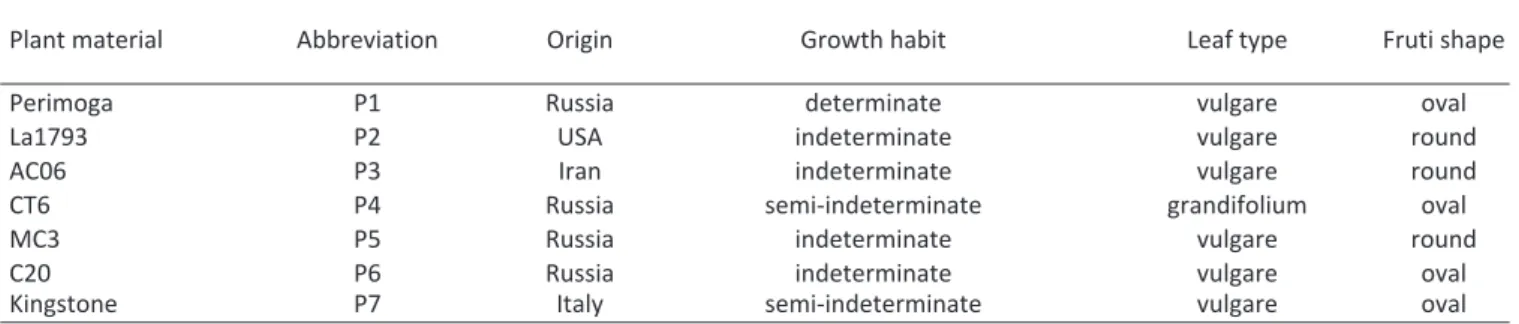
2. Materials and Methods Plant material
Seven inbred lines of tomato consisted of ‘Perimoga’, ‘La1793’, ‘AC06’, ‘CT6’, ‘MC3’, ‘C20’ and ‘Kingstone’ (Table 1) were cultivated in a research greenhouse of Ferdowsi University of Mashhad, Mashhad, Iran under optimum conditions. The lines were crossed in all possible two-way combinations (full diallel cross system) to develop F1 hybrids with their reciprocals.
Experimental design
The experiment was performed in research green-house of Ferdowsi University of Mashhad with com-puterized temperature control system. A year round was divided into two growing seasons: the first
grow-Table 1 - Description of parental inbred lines crossed in 7×7 full diallel cross system
Plant material Abbreviation Origin Growth habit Leaf type Fruti shape
Perimoga P1 Russia determinate vulgare oval
La1793 P2 USA indeterminate vulgare round
AC06 P3 Iran indeterminate vulgare round
CT6 P4 Russia semi-indeterminate grandifolium oval
MC3 P5 Russia indeterminate vulgare round
C20 P6 Russia indeterminate vulgare oval
ing season was from March to August including warm seasons with high light intensity and long pho-toperiod (more sunny hours a day) and the second season covering cold seasons with low light intensity and short photoperiod (less sunny hours per day) started in September and ended up in January. To investigate the performance of tomato plants under two different light conditions, 21 F1 progenies together with reciprocals (42 F1 hybrid progenies) developed via a 7×7 full diallel cross system were cul-tivated during each of the two aforementioned growing seasons. Daily average of light intensity of experimental greenhouse during each month is rep-resented in Table 2. The experiment was conducted in a completely randomized design with three repli-cations per genotype in two different time span men-tioned above (split plot).
Measurement of characters
The observations concerning the following char-acteristics were recorded as described below.
Total yield per plant (Kg)
It was calculated by summing up the weight of fruits obtained from all pickings during 8 weeks from each plant.
Average fruit weight (g)
The average fruit weight was an index of fruit size. All fruits collected from each harvest were weighted and the total weight of the fruits was divided into the number of the weighted fruits.
Number of fruits per plant
Harvested fruits of each plant in a period of 8 weeks were counted.
Days to first flower
The number of days from seeding until the forma-tion of first flower on the plants was recorded.
Days to ripening
The number of days from flower anthesis to fruit ripening stage was determined through the date tag-ging of five flowers per plant at the time of anthesis. Fruit ripening was considered the time when geneti-cally red fruits turned pink and yellow ones turned yellow (Garg et al., 2008).
Statistical analysis
Obtained data in each environment were ana-lyzed using Excel software (Microsoft office 2010) using Griffing’s (1956, a, b) Method 3, Model 1 (fixed effects) formula. Combined analysis of data over two seasons was performed based on modified Method 3, Model 1 for several environments proposed by Singh (1973) as described below:
Where Yijk = observation of trait value of parents i
and j in year k; µ = population mean; gi / gj = GCA effect of parent i / j; sji/sji= SCA effect of the hybrid
developed from parent i × parent j/ parent i × parent
j; rij=REC effect of the hybrid produced by parent i ×
parent j; lk=effect of environment k; (gl)ik/ (gl)jk =
interaction between GCA effect of parent i / j with environment k; (sl)ijk = interaction between SCA
effect of cross ij with environment k; and eijk = error
of observation ijk.
Broad-sense heritability (H2
b.s) and narrow-sense
heritability (h2
b.s) over environments were estimated
using following formula (Sharifi et al., 2010):
Where L indicated light condition; σ2g, σ2s and σ2r
stand for variance components of GCA, SCA and REC, respectively; σ2gl, σ2sl and σ2rl represent variance
components of GCA×L, SCA×L and REC×L, respectively.
Where F1 and Yij are the mean performances of
hybrids and parents, respectively.
The average of light intensity per day was calculated based on 24 hours a day including night hours (n= 24, one measurements every hour). Table 2 - Average of daily light intensity for each months (foot candle intensity/24h)
Average light intensity
First growing season with high light intensity and duration Second growing season with low light intensity and duration
Mar. Apr. May June July Aug. Sept. Oct. Nov. Dec. Jan. Feb.
3. Results ANOVA analysis
The variance analysis of genotypes for each sea-son separately showed that genotypes were highly significant (Table 3); therefore, the compound analy-sis of variance over two environments was conduct-ed (Table 4). Light condition was considerconduct-ed as main plot; therefore, error A refers to whole plot error. Some genotypes, namely 42 F1 hybrids grown under each light treatment along with the interaction between genotypes and environments, were the sub plot of the experiment and error B represent whole plot error. Compound ANOVA analysis for two sea-sons represented in Table 4 showed that light (L)
effect was highly significant for total yield per plant, average fruit weight and days number to first flower but not significant for fruit number per plant and days number for fruit ripening. Genotypes and the interaction of genotypes with light (G×L) were highly significant for all studied traits except for days to ripening in which genotypes did not show any inter-action with environment.
Estimation of genetic parameters
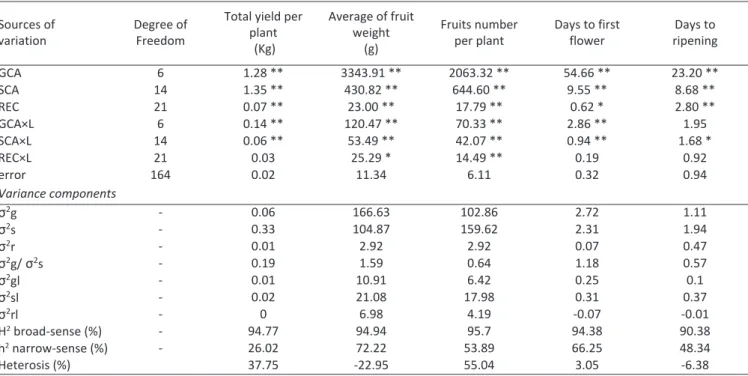
Compound analysis of variance for general com-bining ability (GCA), specific comcom-bining ability (SCA) and reciprocal combining ability (REC) over two sea-sons for yield, yield components and earliness varied (Table 4). The results indicated that variances due to
Table 3 - Mean squares of ANOVA analysis over two light conditions for yield, yield components and earliness of F1 hybrids with their reciprocals developed via a 7×7 full diallel cross
** Significant at P<0.01 level.
Sources of variation Degree of Freedom Total yield per plant (Kg) Average of fruit weight (g) Fruit number per plant Days to first flower Days to ripening Light (L) 1 16.69 ** 14654.49 ** 913.52 359.53 ** 5.43 error A 4 0.74 261.6 140.91 0.61 8.8 Genotypes (G) 41 2.05 ** 1944.73 ** 1593.50 ** 34.74 ** 23.38 ** G×L 41 0.17 ** 146.54 ** 96.24 ** 2.50 ** 3.99 error B 164 0.07 34.01 18.33 0.97 2.81
Table 4 - Compound analysis of variance for combining ability over two environments for yield, yield components and earliness of F1 hybrids with their reciprocals developed via a 7×7 full diallel cross and estimates of heritability in broad and narrow senses as well as heterosis
* Significant at P<0.05 level, ** Significant at P<0.01 level. Sources of
variation
Degree of Freedom
Total yield per plant (Kg) Average of fruit weight (g) Fruits number per plant Days to first flower Days to ripening GCA 6 1.28 ** 3343.91 ** 2063.32 ** 54.66 ** 23.20 ** SCA 14 1.35 ** 430.82 ** 644.60 ** 9.55 ** 8.68 ** REC 21 0.07 ** 23.00 ** 17.79 ** 0.62 * 2.80 ** GCA×L 6 0.14 ** 120.47 ** 70.33 ** 2.86 ** 1.95 SCA×L 14 0.06 ** 53.49 ** 42.07 ** 0.94 ** 1.68 * REC×L 21 0.03 25.29 * 14.49 ** 0.19 0.92 error 164 0.02 11.34 6.11 0.32 0.94 Variance components σ2g - 0.06 166.63 102.86 2.72 1.11 σ2s - 0.33 104.87 159.62 2.31 1.94 σ2r - 0.01 2.92 2.92 0.07 0.47 σ2g/σ2s - 0.19 1.59 0.64 1.18 0.57 σ2gl - 0.01 10.91 6.42 0.25 0.1 σ2sl - 0.02 21.08 17.98 0.31 0.37 σ2rl - 0 6.98 4.19 -0.07 -0.01 H2broad-sense (%) - 94.77 94.94 95.7 94.38 90.38 h2narrow-sense (%) - 26.02 72.22 53.89 66.25 48.34 Heterosis (%) 37.75 -22.95 55.04 3.05 -6.38
GCA, SCA and REC were highly significant for all stud-ied characters. The significance of both GCA and SCA variances implies that all studied characters are con-trolled by either of additive or non-additive gene action. The effect of interaction GCA×L and SCA×L on all evaluated features were significant but fruit ripen-ing period, which showed non-significant variance of GCA×L. The interaction of REC×L showed remarkable effect only on average fruit weight and fruits number per plant. For total yield, fruits number and days to ripening, the GCA (σ2g) was less than variance
com-ponent of SCA (σ2s) in a way that σ2g/σ2s was less
than unity, demonstrating the predominance of non-additive gene action in controlling mentioned traits (Baker, 1978). The ratio of σ2g/σ2s for fruit weight
and days to first flower was higher than unity, illus-trating the more important role of additive gene action for inheritance of these attributes.
Estimates of broad-sense heritability percentage (H2 %) over environments was high for all studied
traits ranged from 90 to 95% (Table 4). Narrow-sense heritability percentage (h2%) was low for total yield,
fruits number and days to ripening while relatively high for fruit weight and days to flowering. Total het-erosis percentage was high for yield and fruit number while negative for fruit weight. Unlike yield and yield components, in earliness characters negative values show superiority but heterosis for early flowering was positive. Negative but low heterosis was record-ed for early maturity.
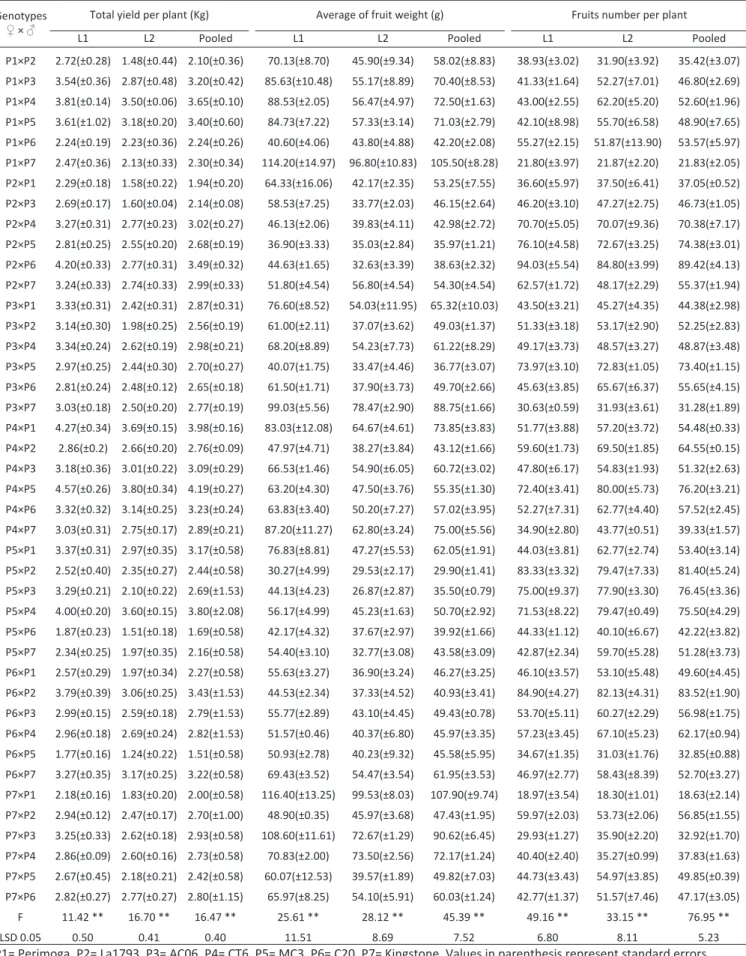
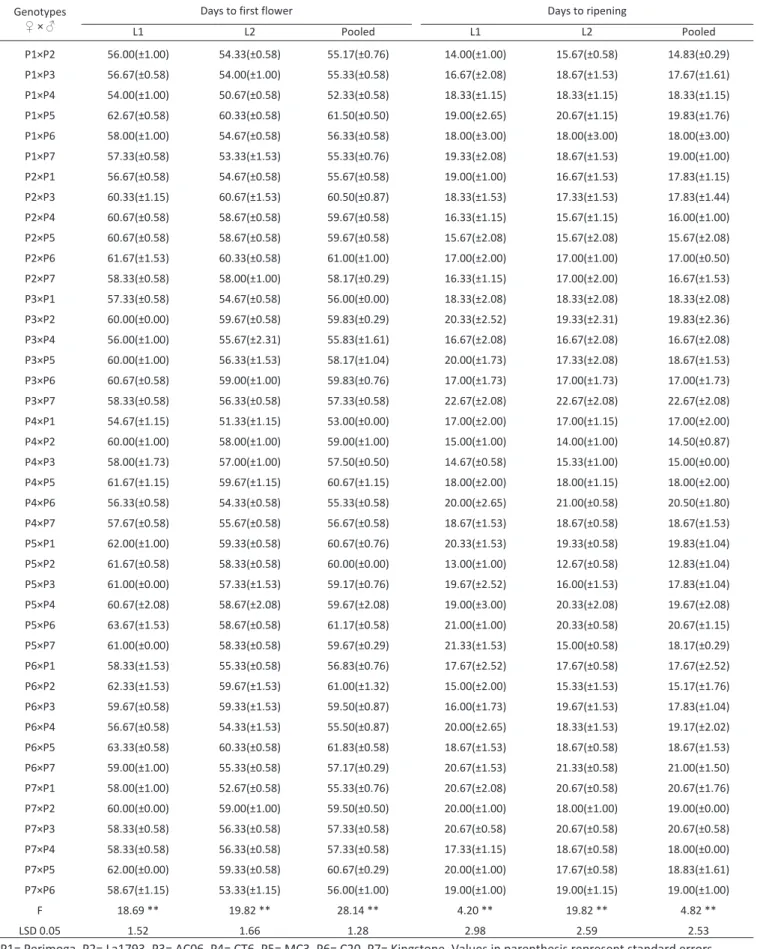
Estimation of mean values
Mean values of F1 hybrids for plant yield showed that hybrid ‘CT6×MC3’ (P4×P5) had the highest rate under both light conditions, while lowest amount was for hybrid ‘C20×MC3’ (P6×P5) (Table 5). ‘Perimoga×Kingstone’ (P1×P7) cross and its reciprocal produced heaviest fruits over two environments. Lightest fruits produced under normal light were for ‘MC3×La1793’ (P5×P2), but under low light, the fruits of hybrid ‘MC3×AC06’ (P5×P3) had the least weight. The Highest number of fruits per plant was produced by hybrid ‘La1793×C20’ (P2×P6) and the lowest was for ‘Kingstone×Perimoga’ (P7×P1). Hybrid ‘Perimoga×CT6’ (P1×P4) commenced flowering earli-er than othearli-er progenies. Latest flowearli-ering undearli-er ade-quate light intensity was for ‘MC3×C20’ (P5×P6), while under low light, it was for hybrid ‘La1793×AC06’ (P2×P3). Overall, according to pooled data over two seasons, hybrid ‘C20×MC3’ (P6×P5) took more days to flower compared with other prog-enies. Longest fruit ripening duration was for hybrid
‘MC3×LA1793’ (P5×P2) and shortest period for ripen-ing was observed in the cross of ‘ACO6×Kripen-ingstone’ (P3×P7).
Estimation of GCA,SCA and REC effect
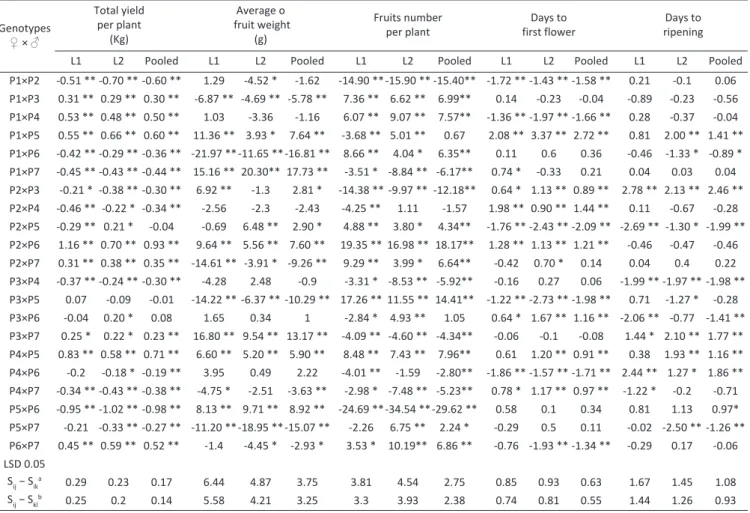
For yield and yield components, positive values of GCA, SCA and REC indicate the superiority of geno-types while for earliness characters negative values are desired (Table 6). Most of the parental lines were not stable during two growing seasons and superior parents for each character differed with environmen-tal changes. Parenenvironmen-tal line of ‘CT6’ (P4) was the best combiner for achieving higher yield in both seasons, and the lowest GCA in low light and high light condi-tion was for ‘Kingstone’ (P7) and ‘La1793’ (P2), respectively. In total ‘Kingstone’ (P7) was the weakest genitor for yield across two environments. For fruit weight, although ‘Perimoga’ (P1) had the highest GCA in warm season, parental line ‘Kingstone’ (P7) acted as the best combiner in both seasons. The best donors for increased fruits number during sunny and cloudy seasons were ‘La1793’ (P2) and ‘MC3’ (P5), respectively and ‘La1793’ (P2) had the best GCA over both seasons. For days to first flower, parental geno-type ‘Perimoga’ (P1) possessed the highest negative GCA and ‘MC3’ (P5) had the highest positive and sig-nificant GCA under each ambient light and over both of them. The best combiner concerning days to ripen-ing in both tested environments was ‘La1793’ (P2) and the weakest performance was for ‘Kingstone’ (P7).
In yield and related trait, a positive value of SCA is repetitive of a successful cross between parental lines of that hybrid, while a negative value demon-strates that parental lines did not make up a good couple. For earliness, negative values of SCA are indicative of prosperity .Estimation of SCA for each evironment and over two environments indicated that the best combination for total yield was ‘La1793×C20’ (P2×P6) and the worst was for ‘MC3×C20’ (P5×P6) (Table 7). For fruit weight, Hybrid ‘AC06×Kingstone’ (P3×P7) had the highest SCA during sunny seasons, and the hybrid developed from ‘Perimoga×Kingstone’ (P1×P7) had the highest magni-tude during cloudy seasons and over two seasons. The highest and lowest SCA estimations for fruits number were similar to total yield. The cross between ‘MC3×C20’ (P4×P6) was the most successful cross for decreased days to flowering during sunny months. ‘La1793×MC3’ (P2×P5) not only had the highest negative SCA during cold months, but also possessed the best SCA in total. For this trait,
Table 5 - Means values and standard deviation for yield components and earliness of F1 hybrids developed via 7×7 diallel cross over two light conditions (part A)
P1= Perimoga, P2= La1793, P3= AC06, P4= CT6, P5= MC3, P6= C20, P7= Kingstone. Values in parenthesis represent standard errors. ** Significant at P<0.01.
Genotypes ♀× ♂
Total yield per plant (Kg) Average of fruit weight (g) Fruits number per plant
L1 L2 Pooled L1 L2 Pooled L1 L2 Pooled
P1×P2 2.72(±0.28) 1.48(±0.44) 2.10(±0.36) 70.13(±8.70) 45.90(±9.34) 58.02(±8.83) 38.93(±3.02) 31.90(±3.92) 35.42(±3.07) P1×P3 3.54(±0.36) 2.87(±0.48) 3.20(±0.42) 85.63(±10.48) 55.17(±8.89) 70.40(±8.53) 41.33(±1.64) 52.27(±7.01) 46.80(±2.69) P1×P4 3.81(±0.14) 3.50(±0.06) 3.65(±0.10) 88.53(±2.05) 56.47(±4.97) 72.50(±1.63) 43.00(±2.55) 62.20(±5.20) 52.60(±1.96) P1×P5 3.61(±1.02) 3.18(±0.20) 3.40(±0.60) 84.73(±7.22) 57.33(±3.14) 71.03(±2.79) 42.10(±8.98) 55.70(±6.58) 48.90(±7.65) P1×P6 2.24(±0.19) 2.23(±0.36) 2.24(±0.26) 40.60(±4.06) 43.80(±4.88) 42.20(±2.08) 55.27(±2.15) 51.87(±13.90) 53.57(±5.97) P1×P7 2.47(±0.36) 2.13(±0.33) 2.30(±0.34) 114.20(±14.97) 96.80(±10.83) 105.50(±8.28) 21.80(±3.97) 21.87(±2.20) 21.83(±2.05) P2×P1 2.29(±0.18) 1.58(±0.22) 1.94(±0.20) 64.33(±16.06) 42.17(±2.35) 53.25(±7.55) 36.60(±5.97) 37.50(±6.41) 37.05(±0.52) P2×P3 2.69(±0.17) 1.60(±0.04) 2.14(±0.08) 58.53(±7.25) 33.77(±2.03) 46.15(±2.64) 46.20(±3.10) 47.27(±2.75) 46.73(±1.05) P2×P4 3.27(±0.31) 2.77(±0.23) 3.02(±0.27) 46.13(±2.06) 39.83(±4.11) 42.98(±2.72) 70.70(±5.05) 70.07(±9.36) 70.38(±7.17) P2×P5 2.81(±0.25) 2.55(±0.20) 2.68(±0.19) 36.90(±3.33) 35.03(±2.84) 35.97(±1.21) 76.10(±4.58) 72.67(±3.25) 74.38(±3.01) P2×P6 4.20(±0.33) 2.77(±0.31) 3.49(±0.32) 44.63(±1.65) 32.63(±3.39) 38.63(±2.32) 94.03(±5.54) 84.80(±3.99) 89.42(±4.13) P2×P7 3.24(±0.33) 2.74(±0.33) 2.99(±0.33) 51.80(±4.54) 56.80(±4.54) 54.30(±4.54) 62.57(±1.72) 48.17(±2.29) 55.37(±1.94) P3×P1 3.33(±0.31) 2.42(±0.31) 2.87(±0.31) 76.60(±8.52) 54.03(±11.95) 65.32(±10.03) 43.50(±3.21) 45.27(±4.35) 44.38(±2.98) P3×P2 3.14(±0.30) 1.98(±0.25) 2.56(±0.19) 61.00(±2.11) 37.07(±3.62) 49.03(±1.37) 51.33(±3.18) 53.17(±2.90) 52.25(±2.83) P3×P4 3.34(±0.24) 2.62(±0.19) 2.98(±0.21) 68.20(±8.89) 54.23(±7.73) 61.22(±8.29) 49.17(±3.73) 48.57(±3.27) 48.87(±3.48) P3×P5 2.97(±0.25) 2.44(±0.30) 2.70(±0.27) 40.07(±1.75) 33.47(±4.46) 36.77(±3.07) 73.97(±3.10) 72.83(±1.05) 73.40(±1.15) P3×P6 2.81(±0.24) 2.48(±0.12) 2.65(±0.18) 61.50(±1.71) 37.90(±3.73) 49.70(±2.66) 45.63(±3.85) 65.67(±6.37) 55.65(±4.15) P3×P7 3.03(±0.18) 2.50(±0.20) 2.77(±0.19) 99.03(±5.56) 78.47(±2.90) 88.75(±1.66) 30.63(±0.59) 31.93(±3.61) 31.28(±1.89) P4×P1 4.27(±0.34) 3.69(±0.15) 3.98(±0.16) 83.03(±12.08) 64.67(±4.61) 73.85(±3.83) 51.77(±3.88) 57.20(±3.72) 54.48(±0.33) P4×P2 2.86(±0.2) 2.66(±0.20) 2.76(±0.09) 47.97(±4.71) 38.27(±3.84) 43.12(±1.66) 59.60(±1.73) 69.50(±1.85) 64.55(±0.15) P4×P3 3.18(±0.36) 3.01(±0.22) 3.09(±0.29) 66.53(±1.46) 54.90(±6.05) 60.72(±3.02) 47.80(±6.17) 54.83(±1.93) 51.32(±2.63) P4×P5 4.57(±0.26) 3.80(±0.34) 4.19(±0.27) 63.20(±4.30) 47.50(±3.76) 55.35(±1.30) 72.40(±3.41) 80.00(±5.73) 76.20(±3.21) P4×P6 3.32(±0.32) 3.14(±0.25) 3.23(±0.24) 63.83(±3.40) 50.20(±7.27) 57.02(±3.95) 52.27(±7.31) 62.77(±4.40) 57.52(±2.45) P4×P7 3.03(±0.31) 2.75(±0.17) 2.89(±0.21) 87.20(±11.27) 62.80(±3.24) 75.00(±5.56) 34.90(±2.80) 43.77(±0.51) 39.33(±1.57) P5×P1 3.37(±0.31) 2.97(±0.35) 3.17(±0.58) 76.83(±8.81) 47.27(±5.53) 62.05(±1.91) 44.03(±3.81) 62.77(±2.74) 53.40(±3.14) P5×P2 2.52(±0.40) 2.35(±0.27) 2.44(±0.58) 30.27(±4.99) 29.53(±2.17) 29.90(±1.41) 83.33(±3.32) 79.47(±7.33) 81.40(±5.24) P5×P3 3.29(±0.21) 2.10(±0.22) 2.69(±1.53) 44.13(±4.23) 26.87(±2.87) 35.50(±0.79) 75.00(±9.37) 77.90(±3.30) 76.45(±3.36) P5×P4 4.00(±0.20) 3.60(±0.15) 3.80(±2.08) 56.17(±4.99) 45.23(±1.63) 50.70(±2.92) 71.53(±8.22) 79.47(±0.49) 75.50(±4.29) P5×P6 1.87(±0.23) 1.51(±0.18) 1.69(±0.58) 42.17(±4.32) 37.67(±2.97) 39.92(±1.66) 44.33(±1.12) 40.10(±6.67) 42.22(±3.82) P5×P7 2.34(±0.25) 1.97(±0.35) 2.16(±0.58) 54.40(±3.10) 32.77(±3.08) 43.58(±3.09) 42.87(±2.34) 59.70(±5.28) 51.28(±3.73) P6×P1 2.57(±0.29) 1.97(±0.34) 2.27(±0.58) 55.63(±3.27) 36.90(±3.24) 46.27(±3.25) 46.10(±3.57) 53.10(±5.48) 49.60(±4.45) P6×P2 3.79(±0.39) 3.06(±0.25) 3.43(±1.53) 44.53(±2.34) 37.33(±4.52) 40.93(±3.41) 84.90(±4.27) 82.13(±4.31) 83.52(±1.90) P6×P3 2.99(±0.15) 2.59(±0.18) 2.79(±1.53) 55.77(±2.89) 43.10(±4.45) 49.43(±0.78) 53.70(±5.11) 60.27(±2.29) 56.98(±1.75) P6×P4 2.96(±0.18) 2.69(±0.24) 2.82(±1.53) 51.57(±0.46) 40.37(±6.80) 45.97(±3.35) 57.23(±3.45) 67.10(±5.23) 62.17(±0.94) P6×P5 1.77(±0.16) 1.24(±0.22) 1.51(±0.58) 50.93(±2.78) 40.23(±9.32) 45.58(±5.95) 34.67(±1.35) 31.03(±1.76) 32.85(±0.88) P6×P7 3.27(±0.35) 3.17(±0.25) 3.22(±0.58) 69.43(±3.52) 54.47(±3.54) 61.95(±3.53) 46.97(±2.77) 58.43(±8.39) 52.70(±3.27) P7×P1 2.18(±0.16) 1.83(±0.20) 2.00(±0.58) 116.40(±13.25) 99.53(±8.03) 107.90(±9.74) 18.97(±3.54) 18.30(±1.01) 18.63(±2.14) P7×P2 2.94(±0.12) 2.47(±0.17) 2.70(±1.00) 48.90(±0.35) 45.97(±3.68) 47.43(±1.95) 59.97(±2.03) 53.73(±2.06) 56.85(±1.55) P7×P3 3.25(±0.33) 2.62(±0.18) 2.93(±0.58) 108.60(±11.61) 72.67(±1.29) 90.62(±6.45) 29.93(±1.27) 35.90(±2.20) 32.92(±1.70) P7×P4 2.86(±0.09) 2.60(±0.16) 2.73(±0.58) 70.83(±2.00) 73.50(±2.56) 72.17(±1.24) 40.40(±2.40) 35.27(±0.99) 37.83(±1.63) P7×P5 2.67(±0.45) 2.18(±0.21) 2.42(±0.58) 60.07(±12.53) 39.57(±1.89) 49.82(±7.03) 44.73(±3.43) 54.97(±3.85) 49.85(±0.39) P7×P6 2.82(±0.27) 2.77(±0.27) 2.80(±1.15) 65.97(±8.25) 54.10(±5.91) 60.03(±1.24) 42.77(±1.37) 51.57(±7.46) 47.17(±3.05) F 11.42 ** 16.70 ** 16.47 ** 25.61 ** 28.12 ** 45.39 ** 49.16 ** 33.15 ** 76.95 ** LSD 0.05 0.50 0.41 0.40 11.51 8.69 7.52 6.80 8.11 5.23 To be continued
Table 5 - Means values and standard deviation for yield components and earliness of F1 hybrids developed via 7×7 diallel cross over two light conditions
P1= Perimoga, P2= La1793, P3= AC06, P4= CT6, P5= MC3, P6= C20, P7= Kingstone. Values in parenthesis represent standard errors. ** Significant at P<0.01.
Genotypes ♀ × ♂
Days to first flower Days to ripening
L1 L2 Pooled L1 L2 Pooled P1×P2 56.00(±1.00) 54.33(±0.58) 55.17(±0.76) 14.00(±1.00) 15.67(±0.58) 14.83(±0.29) P1×P3 56.67(±0.58) 54.00(±1.00) 55.33(±0.58) 16.67(±2.08) 18.67(±1.53) 17.67(±1.61) P1×P4 54.00(±1.00) 50.67(±0.58) 52.33(±0.58) 18.33(±1.15) 18.33(±1.15) 18.33(±1.15) P1×P5 62.67(±0.58) 60.33(±0.58) 61.50(±0.50) 19.00(±2.65) 20.67(±1.15) 19.83(±1.76) P1×P6 58.00(±1.00) 54.67(±0.58) 56.33(±0.58) 18.00(±3.00) 18.00(±3.00) 18.00(±3.00) P1×P7 57.33(±0.58) 53.33(±1.53) 55.33(±0.76) 19.33(±2.08) 18.67(±1.53) 19.00(±1.00) P2×P1 56.67(±0.58) 54.67(±0.58) 55.67(±0.58) 19.00(±1.00) 16.67(±1.53) 17.83(±1.15) P2×P3 60.33(±1.15) 60.67(±1.53) 60.50(±0.87) 18.33(±1.53) 17.33(±1.53) 17.83(±1.44) P2×P4 60.67(±0.58) 58.67(±0.58) 59.67(±0.58) 16.33(±1.15) 15.67(±1.15) 16.00(±1.00) P2×P5 60.67(±0.58) 58.67(±0.58) 59.67(±0.58) 15.67(±2.08) 15.67(±2.08) 15.67(±2.08) P2×P6 61.67(±1.53) 60.33(±0.58) 61.00(±1.00) 17.00(±2.00) 17.00(±1.00) 17.00(±0.50) P2×P7 58.33(±0.58) 58.00(±1.00) 58.17(±0.29) 16.33(±1.15) 17.00(±2.00) 16.67(±1.53) P3×P1 57.33(±0.58) 54.67(±0.58) 56.00(±0.00) 18.33(±2.08) 18.33(±2.08) 18.33(±2.08) P3×P2 60.00(±0.00) 59.67(±0.58) 59.83(±0.29) 20.33(±2.52) 19.33(±2.31) 19.83(±2.36) P3×P4 56.00(±1.00) 55.67(±2.31) 55.83(±1.61) 16.67(±2.08) 16.67(±2.08) 16.67(±2.08) P3×P5 60.00(±1.00) 56.33(±1.53) 58.17(±1.04) 20.00(±1.73) 17.33(±2.08) 18.67(±1.53) P3×P6 60.67(±0.58) 59.00(±1.00) 59.83(±0.76) 17.00(±1.73) 17.00(±1.73) 17.00(±1.73) P3×P7 58.33(±0.58) 56.33(±0.58) 57.33(±0.58) 22.67(±2.08) 22.67(±2.08) 22.67(±2.08) P4×P1 54.67(±1.15) 51.33(±1.15) 53.00(±0.00) 17.00(±2.00) 17.00(±1.15) 17.00(±2.00) P4×P2 60.00(±1.00) 58.00(±1.00) 59.00(±1.00) 15.00(±1.00) 14.00(±1.00) 14.50(±0.87) P4×P3 58.00(±1.73) 57.00(±1.00) 57.50(±0.50) 14.67(±0.58) 15.33(±1.00) 15.00(±0.00) P4×P5 61.67(±1.15) 59.67(±1.15) 60.67(±1.15) 18.00(±2.00) 18.00(±1.15) 18.00(±2.00) P4×P6 56.33(±0.58) 54.33(±0.58) 55.33(±0.58) 20.00(±2.65) 21.00(±0.58) 20.50(±1.80) P4×P7 57.67(±0.58) 55.67(±0.58) 56.67(±0.58) 18.67(±1.53) 18.67(±0.58) 18.67(±1.53) P5×P1 62.00(±1.00) 59.33(±0.58) 60.67(±0.76) 20.33(±1.53) 19.33(±0.58) 19.83(±1.04) P5×P2 61.67(±0.58) 58.33(±0.58) 60.00(±0.00) 13.00(±1.00) 12.67(±0.58) 12.83(±1.04) P5×P3 61.00(±0.00) 57.33(±1.53) 59.17(±0.76) 19.67(±2.52) 16.00(±1.53) 17.83(±1.04) P5×P4 60.67(±2.08) 58.67(±2.08) 59.67(±2.08) 19.00(±3.00) 20.33(±2.08) 19.67(±2.08) P5×P6 63.67(±1.53) 58.67(±0.58) 61.17(±0.58) 21.00(±1.00) 20.33(±0.58) 20.67(±1.15) P5×P7 61.00(±0.00) 58.33(±0.58) 59.67(±0.29) 21.33(±1.53) 15.00(±0.58) 18.17(±0.29) P6×P1 58.33(±1.53) 55.33(±0.58) 56.83(±0.76) 17.67(±2.52) 17.67(±0.58) 17.67(±2.52) P6×P2 62.33(±1.53) 59.67(±1.53) 61.00(±1.32) 15.00(±2.00) 15.33(±1.53) 15.17(±1.76) P6×P3 59.67(±0.58) 59.33(±1.53) 59.50(±0.87) 16.00(±1.73) 19.67(±1.53) 17.83(±1.04) P6×P4 56.67(±0.58) 54.33(±1.53) 55.50(±0.87) 20.00(±2.65) 18.33(±1.53) 19.17(±2.02) P6×P5 63.33(±0.58) 60.33(±0.58) 61.83(±0.58) 18.67(±1.53) 18.67(±0.58) 18.67(±1.53) P6×P7 59.00(±1.00) 55.33(±0.58) 57.17(±0.29) 20.67(±1.53) 21.33(±0.58) 21.00(±1.50) P7×P1 58.00(±1.00) 52.67(±0.58) 55.33(±0.76) 20.67(±2.08) 20.67(±0.58) 20.67(±1.76) P7×P2 60.00(±0.00) 59.00(±1.00) 59.50(±0.50) 20.00(±1.00) 18.00(±1.00) 19.00(±0.00) P7×P3 58.33(±0.58) 56.33(±0.58) 57.33(±0.58) 20.67(±0.58) 20.67(±0.58) 20.67(±0.58) P7×P4 58.33(±0.58) 56.33(±0.58) 57.33(±0.58) 17.33(±1.15) 18.67(±0.58) 18.00(±0.00) P7×P5 62.00(±0.00) 59.33(±0.58) 60.67(±0.29) 20.00(±1.00) 17.67(±0.58) 18.83(±1.61) P7×P6 58.67(±1.15) 53.33(±1.15) 56.00(±1.00) 19.00(±1.00) 19.00(±1.15) 19.00(±1.00) F 18.69 ** 19.82 ** 28.14 ** 4.20 ** 19.82 ** 4.82 ** LSD 0.05 1.52 1.66 1.28 2.98 2.59 2.53 Continued
Table 6 - General combining ability (GCA) effects of parental lines for yield, yield components and earliness in a 7×7 diallel cross over two light conditions
P1= Perimoga, P2= La1793, P3= AC06, P4= CT6, P5= MC3, P6= C20, P7= Kingstone. * Significant at P<0.05 level, ** Significant at P<0.01 level.
adifference between GCA of two parental lines at P<0.05 level. Parental
lines
Total yield per plant (Kg)
Average of fruit weight (g)
Fruits number per
plant Days to first flower Days to ripening
L1 L2 Pooled L1 L2 Pooled L1 L2 Pooled L1 L2 Pooled L1 L2 Pooled
P1 -0.02 -0.06 -0.04 18.32 ** 10.97 ** 14.64 ** -13.46 **-11.38 **-12.42 ** -1.93 ** -2.70 ** -2.31 ** -0.06 0.42 0.18 P2 -0.02 -0.24 ** -0.13 ** -16.82 ** -11.61 ** -14.22 ** 14.63 ** 6.67 ** 10.65 ** 0.74 ** 1.77 ** 1.25 ** -1.90 ** -2.11 ** -2.00 ** P3 0.09 -0.12 ** -0.02 5.22 ** -0.87 2.17 ** -2.98 ** -1.78 * -2.38 ** -0.46 ** 0.40 * -0.03 0.2 0.36 0.28 P4 0.48 ** 0.64 ** 0.56 ** 1.98 3.76 ** 2.87 ** 3.28 ** 6.70 ** 4.99 ** -1.63 ** -1.20 ** -1.41 ** -0.80 * -0.34 -0.57 ** P5 -0.08 -0.06 -0.07 ** -13.35 ** -11.79 ** -12.57 ** 8.71 ** 10.29 ** 9.50 ** 2.94 ** 2.30 ** 2.62 ** 0.67 * -0.38 0.15 P6 -0.20 ** -0.08 -0.14 ** -12.68 ** -8.17 ** -10.42 ** 3.99 ** 4.51 ** 4.25 ** 0.74 ** 0.24 0.49 ** 0.1 0.79 ** 0.45 * P7 -0.25 ** -0.07 -0.16 ** 17.34 ** 17.71 ** 17.52 ** -14.15 **-15.01 **-14.58 ** -0.40 * -0.83 ** -0.61 ** 1.77 ** 1.26 ** 1.51 ** LSD 0.05 gi- gja 0.16 0.13 0.09 3.56 2.68 2.07 2.1 2.51 1.52 0.47 0.51 0.35 0.92 0.8 0.6
Table 7 - Specific combining ability (SCA) effects of F1 hybrids for yield, yield components and earliness in a 7×7 diallel cross over two light conditions
P1= Perimoga, P2= La1793, P3= AC06, P4= CT6, P5= MC3, P6= C20, P7= Kingstone. *Significant at P < 0.05 level. ** Significant at P<0.01 level.
aDifference between two SCA of two hybrids, with a common parent. bDifference between two SCA of two hybrids, with non-common parent.
Genotypes ♀ × ♂ Total yield per plant (Kg) Average o fruit weight (g) Fruits number per plant Days to first flower Days to ripening
L1 L2 Pooled L1 L2 Pooled L1 L2 Pooled L1 L2 Pooled L1 L2 Pooled
P1×P2 -0.51 ** -0.70 ** -0.60 ** 1.29 -4.52 * -1.62 -14.90 **-15.90 ** -15.40** -1.72 ** -1.43 ** -1.58 ** 0.21 -0.1 0.06 P1×P3 0.31 ** 0.29 ** 0.30 ** -6.87 ** -4.69 ** -5.78 ** 7.36 ** 6.62 ** 6.99** 0.14 -0.23 -0.04 -0.89 -0.23 -0.56 P1×P4 0.53 ** 0.48 ** 0.50 ** 1.03 -3.36 -1.16 6.07 ** 9.07 ** 7.57** -1.36 ** -1.97 ** -1.66 ** 0.28 -0.37 -0.04 P1×P5 0.55 ** 0.66 ** 0.60 ** 11.36 ** 3.93 * 7.64 ** -3.68 ** 5.01 ** 0.67 2.08 ** 3.37 ** 2.72 ** 0.81 2.00 ** 1.41 ** P1×P6 -0.42 ** -0.29 ** -0.36 ** -21.97 **-11.65 **-16.81 ** 8.66 ** 4.04 * 6.35** 0.11 0.6 0.36 -0.46 -1.33 * -0.89 * P1×P7 -0.45 ** -0.43 ** -0.44 ** 15.16 ** 20.30** 17.73 ** -3.51 * -8.84 ** -6.17** 0.74 * -0.33 0.21 0.04 0.03 0.04 P2×P3 -0.21 * -0.38 ** -0.30 ** 6.92 ** -1.3 2.81 * -14.38 ** -9.97 ** -12.18** 0.64 * 1.13 ** 0.89 ** 2.78 ** 2.13 ** 2.46 ** P2×P4 -0.46 ** -0.22 * -0.34 ** -2.56 -2.3 -2.43 -4.25 ** 1.11 -1.57 1.98 ** 0.90 ** 1.44 ** 0.11 -0.67 -0.28 P2×P5 -0.29 ** 0.21 * -0.04 -0.69 6.48 ** 2.90 * 4.88 ** 3.80 * 4.34** -1.76 ** -2.43 ** -2.09 ** -2.69 ** -1.30 * -1.99 ** P2×P6 1.16 ** 0.70 ** 0.93 ** 9.64 ** 5.56 ** 7.60 ** 19.35 ** 16.98 ** 18.17** 1.28 ** 1.13 ** 1.21 ** -0.46 -0.47 -0.46 P2×P7 0.31 ** 0.38 ** 0.35 ** -14.61 ** -3.91 * -9.26 ** 9.29 ** 3.99 * 6.64** -0.42 0.70 * 0.14 0.04 0.4 0.22 P3×P4 -0.37 ** -0.24 ** -0.30 ** -4.28 2.48 -0.9 -3.31 * -8.53 ** -5.92** -0.16 0.27 0.06 -1.99 ** -1.97 ** -1.98 ** P3×P5 0.07 -0.09 -0.01 -14.22 ** -6.37 ** -10.29 ** 17.26 ** 11.55 ** 14.41** -1.22 ** -2.73 ** -1.98 ** 0.71 -1.27 * -0.28 P3×P6 -0.04 0.20 * 0.08 1.65 0.34 1 -2.84 * 4.93 ** 1.05 0.64 * 1.67 ** 1.16 ** -2.06 ** -0.77 -1.41 ** P3×P7 0.25 * 0.22 * 0.23 ** 16.80 ** 9.54 ** 13.17 ** -4.09 ** -4.60 ** -4.34** -0.06 -0.1 -0.08 1.44 * 2.10 ** 1.77 ** P4×P5 0.83 ** 0.58 ** 0.71 ** 6.60 ** 5.20 ** 5.90 ** 8.48 ** 7.43 ** 7.96** 0.61 1.20 ** 0.91 ** 0.38 1.93 ** 1.16 ** P4×P6 -0.2 -0.18 * -0.19 ** 3.95 0.49 2.22 -4.01 ** -1.59 -2.80** -1.86 ** -1.57 ** -1.71 ** 2.44 ** 1.27 * 1.86 ** P4×P7 -0.34 ** -0.43 ** -0.38 ** -4.75 * -2.51 -3.63 ** -2.98 * -7.48 ** -5.23** 0.78 * 1.17 ** 0.97 ** -1.22 * -0.2 -0.71 P5×P6 -0.95 ** -1.02 ** -0.98 ** 8.13 ** 9.71 ** 8.92 ** -24.69 **-34.54 **-29.62 ** 0.58 0.1 0.34 0.81 1.13 0.97* P5×P7 -0.21 -0.33 ** -0.27 ** -11.20 **-18.95 **-15.07 ** -2.26 6.75 ** 2.24 * -0.29 0.5 0.11 -0.02 -2.50 ** -1.26 ** P6×P7 0.45 ** 0.59 ** 0.52 ** -1.4 -4.45 * -2.93 * 3.53 * 10.19** 6.86 ** -0.76 -1.93 ** -1.34 ** -0.29 0.17 -0.06 LSD 0.05 Sij− Sika 0.29 0.23 0.17 6.44 4.87 3.75 3.81 4.54 2.75 0.85 0.93 0.63 1.67 1.45 1.08 Sij− Skl b 0.25 0.2 0.14 5.58 4.21 3.25 3.3 3.93 2.38 0.74 0.81 0.55 1.44 1.26 0.93
‘Perimoga×MC3’ (P1×P5) was the weakest combina-tion across both environments. The most negative value of SCA for ripening period under low light belonged to ‘La1793×MC3’ (P2×P5) and under high light was for ‘Kingstone×MC3’ (P7×P5). Pooled value of SCA in this character showed that generally ‘La1793×MC3’ (P2×P5) and ‘AC06×La1793’ (P3×P2) had the highest and the lowest negative values, respectively.
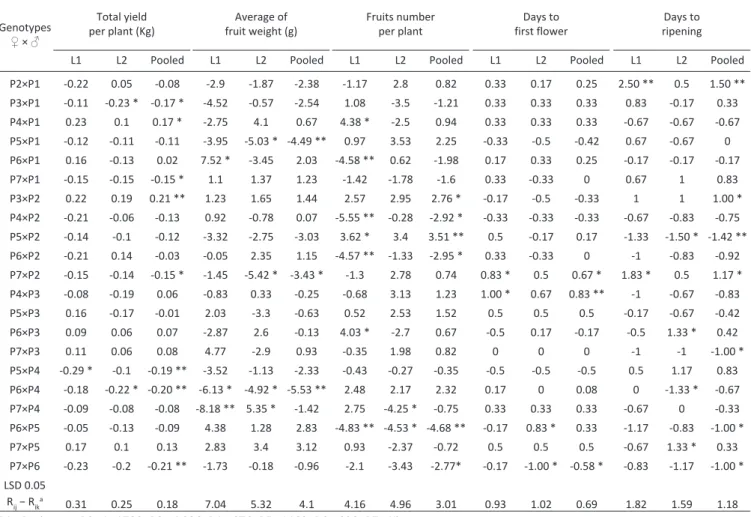
The results of REC indicated that the best recipro-cal combinations over two environments for total yield, average of fruit weight, fruits number, days to flowering and days to ripening was for ‘AC06×La1793’ (P3×P2), ‘Kingstone×MC3’ (P7×P5), ‘MC3×La1793’ (P5×P2), ‘Kingstone×C20’ (P7×P6) and ‘MC3×La1793’ (P5×P2), respectively (Table 8). The Lowest pooled REC in foregoing characters was for ‘Kingstone×C20’ (P7×P6), ‘C20×CT6’ (P6×P4), ‘C20×MC3’ (P6×P5), ‘MC3×AC06’ (P4×P3) and ‘La1793×Perimoga’ (P2×P1), respectively
4. Discussion and Conclusions
The results indicated that total yield, average fruit weight and flowering time were influenced by the amount of received light, while fruit number and fruit ripening period were not affected. Genotype effect was highly significant for all studied traits implying the feasibility of breeding. Despite of simultaneous influence of light and genotype on yield, fruit weight and days to flower, a comparison between magni-tude of environment and genotype effects revealed that the genotype variation played more important in the expression of studied traits.
The significance of interaction genotype × light condition (G×L) for almost all characters except days to ripening revealed that there is a genotype varia-tion in response to light intensity as regards yield, yield components and early flowering. Previous stud-ies reported genotype variation regarding reaction to environmental light in different species (Stratton,
Table 8 - Reciprocal effect (REC) for yield, yield components and earliness in a 7×7 diallel cross over two light conditions
P1= Perimoga, P2= La1793, P3= AC06, P4= CT6, P5= MC3, P6= C20, P7= Kingstone. * Significant at P<0.05 level, ** Significant at P<0.01 level.
aDifference between two RCA of two hybrids.
Genotypes ♀× ♂ Total yield per plant (Kg) Average of fruit weight (g) Fruits number per plant Days to first flower Days to ripening
L1 L2 Pooled L1 L2 Pooled L1 L2 Pooled L1 L2 Pooled L1 L2 Pooled
P2×P1 -0.22 0.05 -0.08 -2.9 -1.87 -2.38 -1.17 2.8 0.82 0.33 0.17 0.25 2.50 ** 0.5 1.50 ** P3×P1 -0.11 -0.23 * -0.17 * -4.52 -0.57 -2.54 1.08 -3.5 -1.21 0.33 0.33 0.33 0.83 -0.17 0.33 P4×P1 0.23 0.1 0.17 * -2.75 4.1 0.67 4.38 * -2.5 0.94 0.33 0.33 0.33 -0.67 -0.67 -0.67 P5×P1 -0.12 -0.11 -0.11 -3.95 -5.03 * -4.49 ** 0.97 3.53 2.25 -0.33 -0.5 -0.42 0.67 -0.67 0 P6×P1 0.16 -0.13 0.02 7.52 * -3.45 2.03 -4.58 ** 0.62 -1.98 0.17 0.33 0.25 -0.17 -0.17 -0.17 P7×P1 -0.15 -0.15 -0.15 * 1.1 1.37 1.23 -1.42 -1.78 -1.6 0.33 -0.33 0 0.67 1 0.83 P3×P2 0.22 0.19 0.21 ** 1.23 1.65 1.44 2.57 2.95 2.76 * -0.17 -0.5 -0.33 1 1 1.00 * P4×P2 -0.21 -0.06 -0.13 0.92 -0.78 0.07 -5.55 ** -0.28 -2.92 * -0.33 -0.33 -0.33 -0.67 -0.83 -0.75 P5×P2 -0.14 -0.1 -0.12 -3.32 -2.75 -3.03 3.62 * 3.4 3.51 ** 0.5 -0.17 0.17 -1.33 -1.50 * -1.42 ** P6×P2 -0.21 0.14 -0.03 -0.05 2.35 1.15 -4.57 ** -1.33 -2.95 * 0.33 -0.33 0 -1 -0.83 -0.92 P7×P2 -0.15 -0.14 -0.15 * -1.45 -5.42 * -3.43 * -1.3 2.78 0.74 0.83 * 0.5 0.67 * 1.83 * 0.5 1.17 * P4×P3 -0.08 -0.19 0.06 -0.83 0.33 -0.25 -0.68 3.13 1.23 1.00 * 0.67 0.83 ** -1 -0.67 -0.83 P5×P3 0.16 -0.17 -0.01 2.03 -3.3 -0.63 0.52 2.53 1.52 0.5 0.5 0.5 -0.17 -0.67 -0.42 P6×P3 0.09 0.06 0.07 -2.87 2.6 -0.13 4.03 * -2.7 0.67 -0.5 0.17 -0.17 -0.5 1.33 * 0.42 P7×P3 0.11 0.06 0.08 4.77 -2.9 0.93 -0.35 1.98 0.82 0 0 0 -1 -1 -1.00 * P5×P4 -0.29 * -0.1 -0.19 ** -3.52 -1.13 -2.33 -0.43 -0.27 -0.35 -0.5 -0.5 -0.5 0.5 1.17 0.83 P6×P4 -0.18 -0.22 * -0.20 ** -6.13 * -4.92 * -5.53 ** 2.48 2.17 2.32 0.17 0 0.08 0 -1.33 * -0.67 P7×P4 -0.09 -0.08 -0.08 -8.18 ** 5.35 * -1.42 2.75 -4.25 * -0.75 0.33 0.33 0.33 -0.67 0 -0.33 P6×P5 -0.05 -0.13 -0.09 4.38 1.28 2.83 -4.83 ** -4.53 * -4.68 ** -0.17 0.83 * 0.33 -1.17 -0.83 -1.00 * P7×P5 0.17 0.1 0.13 2.83 3.4 3.12 0.93 -2.37 -0.72 0.5 0.5 0.5 -0.67 1.33 * 0.33 P7×P6 -0.23 -0.2 -0.21 ** -1.73 -0.18 -0.96 -2.1 -3.43 -2.77* -0.17 -1.00 * -0.58 * -0.83 -1.17 -1.00 * LSD 0.05 Rij− Rika 0.31 0.25 0.18 7.04 5.32 4.1 4.16 4.96 3.01 0.93 1.02 0.69 1.82 1.59 1.18
D.A., 1998; Martínez-Ferri et al., 2001) promising for plant improvement regarding maintenance of high yield and earliness under lower level of light intensi-ty. The remarkable effect of interaction G×L on stud-ied traits except ripening period demonstrated that genotypes were not stable across two environments and should be evaluated in a range of environments. Importance of genotype selection across different environments for tomato improvement concerning yield and earliness attributing traits was reported by Chadha and Kumar (2001), and Biswas et al.(2011).
According to mean performances of hybrids, superior genotypes for various characteristics dif-fered and none of them could be considered as the best for all of the attributes. In this regard, in order to commercialize F1 hybrids, breeding programs should be conducted to collect suitable features in one plant (Breseghello and Coelho, 2013).
Either of general combing ability (GCA) or specific combining ability (SCA) was highly significant for all of evaluated features illustrating both additive and non-additive gene action were involved in controlling yield, yield components and earliness. Our findings supports additive-dominance model reported by Chishti et al.(2008) and Biswas et al.(2011) for pro-duction and earliness traits. Significant contribution of REC to total sum squire is indicative of inter-allelic interactions in the expression of studied traits. Similarly, REC effect on fruit weight and number was reported by Hannan et al., (2007 b).
Higher magnitude of SCA variance (σ2s) in
compar-ison with GCA variance (σ2g) for total yield, fruit
num-ber and days to ripening indicated that these traits are mainly under the control of dominant effects. Similar findings were reported by Solieman (2009) and El-Gabry et al.(2014) for fruit yield and number. The predominance of non-additive gene action over additive effects for days to ripening was in agree-ment with Hannan et al. (2007a) but inconsistent with Garg et al. (2008) who found additive gene action to be more effective on days to ripening over two environments.
The ratio of σ2g/σ2s over two light conditions was
greater than unity for fruit weight and days to flow-ering indicative of more weight of additive effects in inheritance of these features. Garg et al. (2008), Rai and Asati (2011) and Nadeem et al.(2013) also con-tributed the expression of fruit weight and early flowering to both additive and dominance gene actions with preponderance of additive effects. Biswas et al.(2011) who examined tomato genotypes across two environments, different in terms of
tem-perature and light intensity, reported more impor-tant role of additive gene action in control of fruit weight.
The interaction GCA×L was significant for all char-acters except for days to ripening indicating the sen-sibility of additive effects to light condition. The sig-nificant interaction SCA×L was indicative of instability of dominance effects under different environmental light. REC×L varied for fruit weight and number demonstrating the susceptibility of cytoplasmic effects to environment in some traits and necessity of reciprocal crosses for choosing the most suitable genotypes for target environment.
Estimates of broad-sense heritability percentage (H2
b.s%) across two different light conditions was
high, demonstrating the low effect of environment and high response of studied traits to breeding pro-grams. Relatively high narrow sense heritability per-centage (h2
n.s%) for fruit weight and early flowering
indicated that these traits are largely controlled by additive effects; while, low h2
n.s% of yield, fruit
num-ber and early maturity demonstrated higher weight of non-additive effects in inheritance of these traits. These findings agree with earlier work of Biswas et al. (2011) and Dutta et al. (2013) who reported low narrow sense heritability for yield and fruit number over two environments.
Importance of both additive and non-additive gene action with predominance of additive effects in expression of fruit weight and days to flowering revealed that selection breeding programs could be an effective strategy for genetic improvement of tomato for these characters, while exploitation of hybrid vigor should not be neglected (Grilli et al., 2003). Yield, fruit number and early ripening were controlled by additive-dominance effects with higher weight of dominance effects implying hybrid breed-ing could be adopted for improvement of these char-acters (Gul et al., 2010). Abd El-Maksoud et al.(2013) proposed recurrent selection program for improve-ment of traits controlled by both additive and non-additive effects. For such traits, hybridization in seg-regating generations followed by selection for out-performing genotypes has been recommended (Dutta et al., 2013; Bhattarai et al., 2016).
Limitation in access to clean energy resources in rural areas and global interest toward lower energy consumption necessitate breeding for low energy input. In the current study, genetic variation among tomato genotypes under different light conditions was observed and some genotypes showed more sta-bility than others. None of parental lines or F1
hybrids exhibited high performance for all studied features, therefore, a particular genotype cannot be recommended. However, genetic knowledge obtained from this research could be used in plan-ning tomato breeding programs. More important role of additive gene action in inheritance of fruit weight and early flowering indicate the effectiveness of selection breeding, while predominance of non-additive effects in genetic expression of plant yield, fruit number and early maturity suggest adoption of bi-parental mating for improvement of mentioned traits.
References
ABD EL-MAKSOUD M.M., FARIED S.M., SADEK M.M., 2013
- Gene action and heritability for some characteristics
of tomato fruit (Lycopersicon esculentum Mill). - J.
Agric. Chem. Biotechnol. Mansoura Univ., 4(5): 197-204.
BAEZA E., LÓPEZ J.C., 2012 - Light transmission through
greenhouse covers. - Acta Horticulturae, 956: 425-440.
BAKER C.M., 1978 - Issues in diallel analysis. - Crop Sci., 18: 533-536.
BHATTARAI U., SHARMA A., DAS R., TALUKDAR P., 2016
-Genetic analysis of yield and yield-attributing traits for
high temperature resistance in tomato. - Int. J. Veg.
Sci., 22(6): 585-597.
BISWAS V.R., BHATT R.P., KUMAR N., 2011 - Gene action in
tomato (Lycopersicon esculentum Mill.) under open
and protected environments. - Veg. Sci., 38(2): 206-208.
BRESEGHELLO F., COELHO A.S.G., 2013. - Traditional and modern plant breeding methods with examples in rice (Oryza sativaL.). - J. Agric. Food Chem., 61(35): 8277-8286.
CHADHA S., KUMAR J., 2001 - Combining ability over
envi-ronments in tomato. - Indian J. Agric. Res., 35(3):
171-175.
CHISHTI S.A.S., KHAN A.A., SADIA B., KHAN I.A., 2008
-Analysis of combining ability for yield, yield
compo-nents and quality characters in tomato (Lycopersicon
esculentumMill.). - J. Agric. Res., 46(4): 325-332. DUTTA A.K., AKHTAR S., KARAK C., HAZRA P., 2013 - Gene
actions for fruit yield and quality characters of tomato
through generation mean analysis. -Indian J. Hort.,
70(2): 230-237.
ELGABRY M.A.H., SOLIEMAN T.I.H., ABIDO A.I.A., 2014
-Combining ability and heritability of some tomato (Solanum lycopersicumL.) cultivars. - Sci. Hortic., 167: 153-157.
FAO, 2014 - FAOSTAT- http://www.fao.org/faostat. GARG N., CHEEMA D.S., DHATT A.S., 2008 - Genetics of
yield, quality and shelf life characteristics in tomato
under normal and late planting conditions. - Euphytica,
159(1-2): 275-288.
GERSZBERG A., HNATUSZKO-KONKA K., KOWALCZYK T., KONONOWICZ A.K., 2015 - Tomato (Solanum lycoper-sicumL.) in the service of biotechnology. - Plant Cell. Tiss. Organ. Cult., 120: 881-902.
GRIFFING B., 1956 a - A generalized treatment of the use of
diallel crosses in quantitative inheritance. - Heredity,
10: 31-50.
GRIFFING B., 1956 b - Concepts of general and specific
combining ability in relation to diallel crossing system.
-Aust. J. Biol. Sci., 9: 436-493.
GRILLI G.V.G, BRAZ L.T., PERECIN D., OLIVEIRA J.A., CANTLIFFE D.J., STOFFELLA P.J., NASCIMENTO W.M., 2003 - Genetic control of fruit-setting percentage of
tomatoes tolerant to high temperatures. - Acta
Horticulturae, 607: 179-184.
GUL R., RAHMAN H., KHALIL I.H., SHAH S.M.A., GHAFOOR A., 2010 - Heterosis for flower and fruit traits in tomato (Lycopersicon esculentumMill.). - Afr. J. Biotechnol., 9(27): 4144-4151.
HANGARTER R.P., 1997 - Gravity, light and plant form. -Plant Cell Environ., 20: 796-800.
HANNAN M.M., AHMED M.B., ROY U.K., RAZVY M.A., HAY-DAR A., RAHMAN M.A., ISLAM R., 2007 a - Heterosis, combining ability and genetics for brix, days to first
fruit ripening and yield in tomato (Lycopersicon
escu-lentumMill.). - Middle-East J. Sci. Res., 2(3-4): 128-131. HANNAN M.M., BISWAS M.K., AHMED M.B., HOSSAIN M., ISLAM R. 2007 b - Combining ability analysis of yield
and yield components in tomato (Lycopersicum
escu-lentumMill.). - Turk. J. Bot., 31(6): 559-563.
LAURENT L., MÅRELL A., KORBOULEWSKY N., SAÏD S., BALANDIER P., 2017 - How does disturbance affect the intensity and importance of plant competition along
resource gradients?- For. Ecol. Manag., 391: 239-245.
MARTÍNEZ-FERRI E., VALLADARES F., PÉREZ-CORONA M.E., BAQUEDANO F.J., CASTILLO F.J., MANRIQUE E., 2001
-Population divergence in the plasticity of the response of Quercus cocciferato the light environment. - Funct. Ecol., 15(1): 124-135.
MIZOGUCHI T., NIINUMA K., YOSHIDA R., 2007 - Day-neu-tral response of photoperiodic flowering in tomatoes: possible implications based on recent molecular
genet-ics of Arabidopsis and rice. - Plant Biotechnol., 24(1):
83-86.
NADEEM K., MUNAWAR M., CHISHTI S.A.S., 2013 - Genetic architecture and association of fruit yield and quality
traits in tomato (Solanum lycopersicumL.). - Universal
J. Agr. Res., 1(4): 155-159.
OZ H., ATILGAN A., 2015 - Determination of effects of out-door relative humidity of fan pad cooling effects in
greenhouses. - Infrastruktura i Ekologia Terenów
Wiejskich, (III/2): 759-767.
RAI N., ASATI B.S., 2011 - Combining ability and gene action studies for fruit yield contributing traits in
brin-jal. - Indian J. Hortic., 68(2): 212-215.
SHARIFI P., DEHGHANI H., MOUMENI A., MOGHADDAM M., 2010 - Genetic main effect and genotype× environ-ment interaction for cooking quality traits in a diallel
set of Indica rice (Oryza sativa L.) varieties. - Crop
Pasture Sci., 61(6): 475-482.
SINGH D., 1973 - Diallel analysis for combining ability over
several environments-II. - Indian. J. Genet. Plant Breed.
33(3): 469-481.
SOLIEMAN T.H.I., 2009 - Diallel analysis of five tomato cul-tivars and estimation of some genetic parameters for
growth and yield characters. - J. Alex. Sci. Exch., 30(2):
274-288.
SPRAGUE G.F., TATUM L.A., 1942 - General versus specific
combining ability in single crosses of corn. - J. Am. Soc.
Agron., 34: 923-932.
STRATTON D.A., 1998 - Reaction norm functions and QTL–environment interactions for flowering time in
Arabidopsis thaliana. - Heredity, 81(2): 144-155. ZENGIN S., KABAŞ A., OĞUZ A., EREN A., POLAT E., 2015
-Determining of general combining ability for yield,
quality and some other traits of tomato (Solanum
lycopersicumL.) inbred lines. - Akdeniz Univ. Ziraat Fak. Derg., 28(1): 1-4.