
arch - 1 Copyright © 2002 Scott Bradner
Internet Architectural Philosophy
Internet Architectural Philosophy
and the New Business Reality
and the New Business Reality
Scott
Scott
Bradner
Bradner
Harvard University
Harvard University
Topics
Topics
◆◆
architecture (as design philosophy)
architecture (as design philosophy)
◆
◆
key decisions
key decisions
◆
◆
architecture (as reality)
architecture (as reality)
◆
arch - 3 Copyright © 2002 Scott Bradner
Background
Background
◆◆
multiple unrelated efforts (early to mid 1960
multiple unrelated efforts (early to mid 1960
’
’
s)
s)
packet switching theory: (
packet switching theory: (KleinrockKleinrock) 1961) 1961 day dreaming: (
day dreaming: (LickliderLicklider’’s s Galactic Network) 1962Galactic Network) 1962
make use of remote expensive computers: (Roberts) 1964
make use of remote expensive computers: (Roberts) 1964
survivable infrastructure for voice and data: (Baron) 1964
survivable infrastructure for voice and data: (Baron) 1964
◆
◆
ARPANET (late 1960
ARPANET (late 1960
’
’
s)
s)
Roberts ARPANET paper 1967
Roberts ARPANET paper 1967
RFP for
RFP for ““Interface Message ProcessorInterface Message Processor”” won by BBN 1968 won by BBN 1968 four ARPANET hosts by 1969
four ARPANET hosts by 1969
public demo and email in 1972
public demo and email in 1972
Fundamental Goal of Internet Protocols
Fundamental Goal of Internet Protocols
◆◆
multiplexed utilization of
multiplexed utilization of
existing
existing
networks
networks
different administrative boundaries
different administrative boundaries
multiplexing via packets
multiplexing via packets
networks interconnected with packet switches
networks interconnected with packet switches
called gateways (now called routers)
called gateways (now called routers)
note: international in scope
note: international in scope
◆
◆
did not want to build a new global network
did not want to build a new global network
too expensive
too expensive
too limiting
arch - 5 Copyright © 2002 Scott Bradner
Internet Protocols Design Philosophy
Internet Protocols Design Philosophy
◆◆
ordered set of 2nd-level goals
ordered set of 2nd-level goals
1/
1/ survivabilitysurvivability in the face of failure in the face of failure 2/ support
2/ support multiple typesmultiple types of communications service of communications service 3/ accommodate a
3/ accommodate a varietyvariety of network types of network types 4/ permit
4/ permit distributed managementdistributed management of resources of resources 5/
5/ cost effectivecost effective
6/
6/ low effortlow effort to attach a host to attach a host 7/
7/ accountaccount for use of resources for use of resources
◆
◆
note: no performance (
note: no performance (
QoS
QoS
) or security goals
) or security goals
◆
◆
not all goals have been met
not all goals have been met
management & accounting functions are limited
management & accounting functions are limited
Packets!
Packets!
◆◆
basic decision: use packets not circuits
basic decision: use packets not circuits
Kleinrock
Kleinrock’’s s work showed packet switching to be a morework showed packet switching to be a more efficient switching method
efficient switching method
◆
◆
packet (a.k.a. datagram)
packet (a.k.a. datagram)
self contained
self contained
handled independently of preceding or following packets
handled independently of preceding or following packets
contains destination and source
contains destination and source internetworkinternetworkaddressaddress
may
may contain processing hints (e.g. contain processing hints (e.g. QoS QoS tag)tag)
no delivery guarantees
no delivery guarantees
net may drop, duplicate, or deliver out of order
net may drop, duplicate, or deliver out of order
reliability (where needed) is done at higher levels
reliability (where needed) is done at higher levels Dest Addr Src Addr payload
arch - 7 Copyright © 2002 Scott Bradner
Routing
Routing
◆◆
sub parts of the network are connected together by
sub parts of the network are connected together by
computers that forward packets toward destination
computers that forward packets toward destination
these computers are called
these computers are called ““routersrouters””
◆
◆
routers use destination address in packet to make
routers use destination address in packet to make
forwarding decision
forwarding decision
◆
◆
routers exchange
routers exchange
reachability
reachability
information with
information with
other routers to build tables of
other routers to build tables of
“
“
next hops
next hops
”
”
toward
toward
specific local networks
specific local networks
exchange of
exchange of reachability reachability information done with information done with ““routingrouting protocol
protocol””
Unreliability can be Important
Unreliability can be Important
◆◆
basic decision:
basic decision:
offer
offer
an unreliable service
an unreliable service
◆
◆
1st idea was to only have TCP (a reliable service)
1st idea was to only have TCP (a reliable service)
◆
◆
problems
problems
not good for voice & video
not good for voice & video
data has to be delivered in time - retransmission for
data has to be delivered in time - retransmission for
reliability causes too great a delay
reliability causes too great a delay
not good for all applications
not good for all applications
e.g. a debugger has to work in
e.g. a debugger has to work in lossy lossy environmentenvironment
retransmission algorithm may vary with application
retransmission algorithm may vary with application
◆
◆
thus:
thus:
split
split
IP & TCP and add UDP
IP & TCP and add UDP
IETF just added SCTP
arch - 9 Copyright © 2002 Scott Bradner
A Quote
A Quote
“
“
the lesson of the Internet is that
the lesson of the Internet is that
efficiency is not
efficiency is not
the primary consideration
the primary consideration
. Ability to grow and
. Ability to grow and
adapt to changing requirements is the primary
adapt to changing requirements is the primary
consideration. This makes simplicity and
consideration. This makes simplicity and
uniformity very precious indeed.
uniformity very precious indeed.
”
”
Bob Braden
Bob Braden
Networks as Generic
Networks as Generic
◆◆
design requirement of working over:
design requirement of working over:
existing networks & a wide variety of networks
existing networks & a wide variety of networks
◆
◆
minimum set of assumptions about network
minimum set of assumptions about network
reasonable size packets, reasonable but not perfect
reasonable size packets, reasonable but not perfect
delivery reliability, network-wide addressing, way to
delivery reliability, network-wide addressing, way to
get error messages back to source, no assumption of
get error messages back to source, no assumption of
in-order packet delivery
order packet delivery
◆
◆
“
“
smart wires
smart wires
”
”
are not much of a help
are not much of a help
e.g. X.25 (reliable delivery)e.g. X.25 (reliable delivery)
e.g. ATM (
e.g. ATM (QoS QoS functions)functions)
◆
◆
thus it is easy to use new types of networks
thus it is easy to use new types of networks
assuming they are not too helpful (feature rich)
arch - 11 Copyright © 2002 Scott Bradner
End-to-End Argument
End-to-End Argument
◆
◆
1981 paper by
1981 paper by
Saltzer
Saltzer
, Reed & Clark
, Reed & Clark
◆
◆
“
“
smart networks
smart networks
”
”
do not help
do not help
adding functions into network can be redundant since
adding functions into network can be redundant since
actual function is end-to-end
actual function is end-to-end
e.g. encryption, data reliability
e.g. encryption, data reliability
also harder to change with new technology
also harder to change with new technology
also see Lampson
also see Lampson Hints for Computer System DesignHints for Computer System Design
◆
◆
e2e argument projected to mean
e2e argument projected to mean
no per-session knowledge or state in the network
no per-session knowledge or state in the network
but some
but some ““soft-statesoft-state”” (auto refreshed) may be OK (auto refreshed) may be OK
network should be transparent to end-to-end applications
network should be transparent to end-to-end applications
Ease of Experimentation With e2e
Ease of Experimentation With e2e
◆◆
easier to experiment in an e2e environment
easier to experiment in an e2e environment
if the network is transparent then only nodes involved are
if the network is transparent then only nodes involved are
the end nodes
the end nodes
note that an end node could be a 3rd party server
note that an end node could be a 3rd party server
no need to get permission to experiment
no need to get permission to experiment
◆
◆
cheaper to experiment
cheaper to experiment
can do much smaller scale experiments - down to 2 nodes
can do much smaller scale experiments - down to 2 nodes
than core-based services
than core-based services
◆
arch - 13 Copyright © 2002 Scott Bradner
Economic Driver?
Economic Driver?
◆◆
Mark
Mark
Gaynor
Gaynor
Harvard PHD thesis
Harvard PHD thesis
◆
◆
define market uncertainty as
define market uncertainty as
MU
MU
how well do you know what the customer wants
how well do you know what the customer wants
◆
◆
low MU means customer wants are known
low MU means customer wants are known
e.g.
e.g. ““voice servicevoice service”” no opportunity to be
no opportunity to be ““betterbetter”” than competitor than competitor
◆
◆
high MU means customer wants are not known
high MU means customer wants are not known
e.g. future IP-enabled voice service
e.g. future IP-enabled voice service
opportunity to better match customer wants than
opportunity to better match customer wants than
competitor does
competitor does
Economic Driver,
Economic Driver,
contd
contd
.
.
◆
◆
low MU
low MU
commodity service
commodity service
provide most efficient way - frequently centralized
provide most efficient way - frequently centralized
◆
◆
high MU
high MU
need to experiment to try to match customer want
need to experiment to try to match customer want
note: if only one company figures it out they dominate the
note: if only one company figures it out they dominate the
market
market
easier to experiment on edges
easier to experiment on edges
i.e. e2e is a innovation friendly model
i.e. e2e is a innovation friendly model
even if its more expensive to provide service to ends
arch - 15 Copyright © 2002 Scott Bradner
Smart vs. Stupid Networks
Smart vs. Stupid Networks
◆◆
phone network technology: self-named
phone network technology: self-named
“
“
Intelligent
Intelligent
Network
Network
”
”
(IN)
(IN)
many network-based services
many network-based services
admission control, number translation, accounting, ...
admission control, number translation, accounting, ...
◆
◆
Isenberg
Isenberg
’
’
s
s
Rise of the Stupid Network
Rise of the Stupid Network
compared
compared
phone network
phone network
’
’
s
s
“
“
Intelligent Network
Intelligent Network
”
”
to Internet
to Internet
Isenberg
Isenberg’’s basic messages:s basic messages:
network (i.e. carrier) -based services slow to change
network (i.e. carrier) -based services slow to change
voice is not all there is
voice is not all there is
carrier gets in the way
carrier gets in the way
just
just ““deliver the bitsdeliver the bits”” works works
But!!
But!!
◆◆
a
a
“
“
stupid network
stupid network
”
”
is a commodity service
is a commodity service
the price of a commodity service is driven by the stupidest
the price of a commodity service is driven by the stupidest
vendor
vendor
◆
◆
hard to make money delivering commodity services
hard to make money delivering commodity services
◆
◆
new network infrastructure is very expensive
new network infrastructure is very expensive
fiber optic cables (with installation) & hardware
fiber optic cables (with installation) & hardware
◆
◆
access rights can also be very expensive
access rights can also be very expensive
e.g. wireless spectrum licenses
e.g. wireless spectrum licenses
◆
◆
carriers need something else to make money
carriers need something else to make money
common dream is that services or content will save the day
common dream is that services or content will save the day
may be a false dream
may be a false dream
arch - 17 Copyright © 2002 Scott Bradner
But!! (2)
But!! (2)
◆◆
packets w/o circuits cause problems
packets w/o circuits cause problems
can not do guaranteed
can not do guaranteed QoSQoS
can not control path packets take
can not control path packets take
can not reserve capacity for application
can not reserve capacity for application
security control harder
security control harder
do not have logical
do not have logical ““wirewire”” back to source back to source management harder
management harder
can not see data patterns on the network
can not see data patterns on the network
finding non-catastrophic failures harder
finding non-catastrophic failures harder
service provider interconnections harder
service provider interconnections harder
no clean interface
no clean interface
◆
◆
lack of useful formal tools to describe performance
lack of useful formal tools to describe performance
!QoS
Conceptualization Problem
Conceptualization Problem
◆◆
fundamental disconnect between
fundamental disconnect between
“
“
Internet
Internet
”
”
and
and
“
“
phone
phone
”
”
people
people
“
“
bell-heads vs. net-heads
bell-heads vs. net-heads
”
”
◆◆
by their definition the Internet can not work
by their definition the Internet can not work
and must be fixed - they will rescue us
and must be fixed - they will rescue us
“
“You can not build corporate network out of TCP/IP.You can not build corporate network out of TCP/IP.””
arch - 19 Copyright © 2002 Scott Bradner
Traditional Phone Network
Traditional Phone Network
◆◆
circuits &
circuits &
“
“
smart network
smart network
”
”
◆
◆
connection-oriented
connection-oriented
◆
◆
hard state in network devices
hard state in network devices
◆
◆
fragile
fragile
◆
◆
central resource control
central resource control
◆
◆
socialist? "for the good of all"
socialist? "for the good of all"
◆
◆
applications in network
applications in network
e.g., phone switch
e.g., phone switch
end-to-end touch-tone signaling was a
end-to-end touch-tone signaling was a mistakemistake
◆
◆
predictable development path
predictable development path
extended development cycle
extended development cycle
Internet
Internet
◆◆
packets & e2e
packets & e2e
◆
◆
soft state in network devices
soft state in network devices
◆
◆
resilient
resilient
◆
◆
competitive resource control
competitive resource control
◆
◆
capitalist? "individual initiative
capitalist? "individual initiative
”
”
but too much selfishness hurts allbut too much selfishness hurts all
must play by the same rules - but no enforcement
must play by the same rules - but no enforcement
the tragedy of the commons
the tragedy of the commons
◆
◆
applications in hosts at edges (end-to-end)
applications in hosts at edges (end-to-end)
and in 3rd party servers anywhere on the net
and in 3rd party servers anywhere on the net
◆
◆
hard to predict developments
hard to predict developments
chaos at the rate of
arch - 21 Copyright © 2002 Scott Bradner
More Conceptualization Problems
More Conceptualization Problems
◆◆
service provided by 3rd parties - not only by
service provided by 3rd parties - not only by
carriers
carriers
different from phone world
different from phone world
◆
◆
a quote from an IETF telephony mailing list
a quote from an IETF telephony mailing list
Hi Roy, Hi Roy,
I still don
I still don’’t understand why it is a "users"t understand why it is a "users" choice where the "services" are executed choice where the "services" are executed -I would have thought that this would be I would have thought that this would be networks choice
networks choice
Disjoint Control and Data Paths
Disjoint Control and Data Paths
◆◆
signaling and data paths in Internet may not
signaling and data paths in Internet may not
coincide
coincide
and paths vary
and paths vary
over time
over time telephonyserver signal data
arch - 23 Copyright © 2002 Scott Bradner
Circuits in the Internet
Circuits in the Internet
◆◆
do not seem to go away (MPLS)
do not seem to go away (MPLS)
◆
◆
used for traffic engineering
used for traffic engineering
city-pair pipes
city-pair pipes
maybe class of service city-pair pipes
maybe class of service city-pair pipes
◆
◆
and customer connections
and customer connections
◆
◆
finer grain (instance of application) use still pushed
finer grain (instance of application) use still pushed
◆
◆
remember the fate of ATM
remember the fate of ATM
circuit - used for trunks not flows
circuit - used for trunks not flows
QoS
QoS - ignored (ATM not end-to-end)- ignored (ATM not end-to-end) link sharing - may make sense
link sharing - may make sense
as the bearer service - did not make it
as the bearer service - did not make it
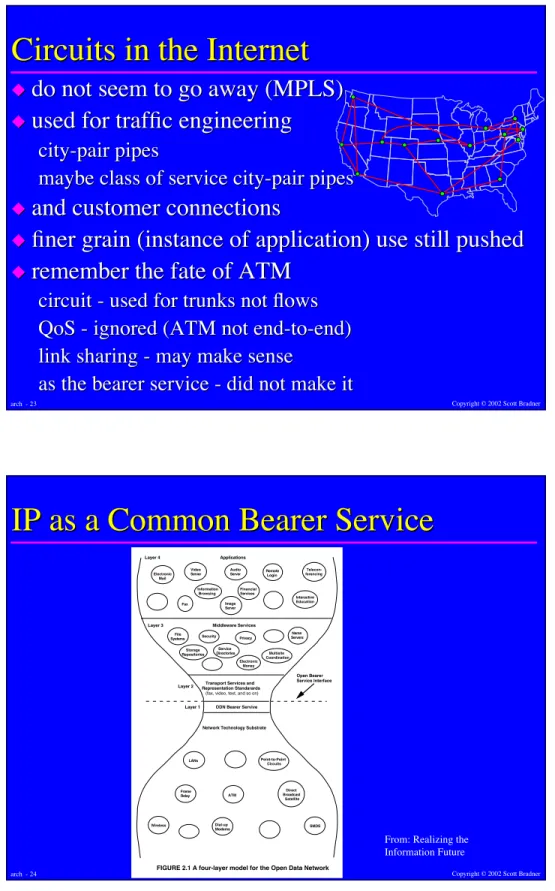
IP as a Common Bearer Service
IP as a Common Bearer Service
Network Technology Substrate ODN Bearer Servive
Open Bearer Service Interface Transport Services and
Representation Standarards
(fax, video, text, and so on)
Layer 1 Layer 2
Layer 3 Middleware Services Layer 4 Applications
FIGURE 2.1 A four-layer model for the Open Data Network Remote Login Telecon-ferencing Audio Server Financial Services Image Server Video Server Electronic Mail Information Browsing Fax Interactive Education Name Servers Multisite Coordination Electronic Money Privacy Service Directories Security Storage Repositories File Systems LANs Point-to-Point Circuits Frame Relay Dial-up Modems ATM Wireless SMDS Direct Broadcast Satellite
From: Realizing the Information Future
arch - 25 Copyright © 2002 Scott Bradner
Net is No Longer Transparent
Net is No Longer Transparent
◆◆
end-to-end argument says the net should be
end-to-end argument says the net should be
transparent
transparent
i.e. packet not modified in transit (other than TTL)
i.e. packet not modified in transit (other than TTL)
global-scope
global-scope internetwork internetwork addressaddress
i.e., packet goes to address in destination address field
i.e., packet goes to address in destination address field
◆
◆
transparency now gone in some cases
transparency now gone in some cases
NATs
NATs, firewalls, proxies, content caches, TCP , firewalls, proxies, content caches, TCP reshapersreshapers replace addresses, intercept traffic, insert traffic
replace addresses, intercept traffic, insert traffic
◆
◆
other issues
other issues
wiretapping, taxation, content filtering
wiretapping, taxation, content filtering
NAT/Firewall/Cache Issues
NAT/Firewall/Cache Issues
◆◆
can not trust IP address as end-to-end
can not trust IP address as end-to-end
breaks
breaks IPSecIPSec, not sure who you are talking to, not sure who you are talking to
◆
◆
applications with addresses in data
applications with addresses in data
have to have application-specific support (ALG) in devices
have to have application-specific support (ALG) in devices
deploying new application requires approval of net manager
deploying new application requires approval of net manager
◆
◆
dynamic port usage
dynamic port usage
ALG must snoop on application traffic
ALG must snoop on application traffic
ALG must understand application logic
ALG must understand application logic
◆
◆
new IETF effort to develop generic signaling
new IETF effort to develop generic signaling
may help some
may help some
but will not make these devices transparent
arch - 27 Copyright © 2002 Scott Bradner
Trust-Free Environment
Trust-Free Environment
◆◆
original Internet architecture assumed a
original Internet architecture assumed a
trustworthy environment
trustworthy environment
◆
◆
no longer the case
no longer the case
mistrust net itself (eavesdropping, reliability etc)
mistrust net itself (eavesdropping, reliability etc)
mistrust that you are talking to the right end point
mistrust that you are talking to the right end point
e.g., proxy, redirect, spoofing (MAC & IP address)
e.g., proxy, redirect, spoofing (MAC & IP address)
unsolicited correspondence (spam)
unsolicited correspondence (spam)
anonymity hard to get
anonymity hard to get
mistrust own hardware and software
mistrust own hardware and software
3rd parties insist on being in the middle
3rd parties insist on being in the middle
filters, wiretapping,
filters, wiretapping, ……
Summary of Architectural Points
Summary of Architectural Points
◆◆
datagram-based network
datagram-based network
not circuit switched
not circuit switched
◆
◆
network of networks
network of networks
different parts under different management
different parts under different management
◆
◆
minimize per-session state in network
minimize per-session state in network
some auto-refreshed state is OK
some auto-refreshed state is OK
◆
◆
end-to-end model maximizes flexibility
end-to-end model maximizes flexibility
network does not need to know what you are doing
network does not need to know what you are doing
◆
◆
“
“
smart wires
smart wires
”
”
can get in the way
can get in the way
e.g., nested control loopse.g., nested control loops
◆
◆
reliable delivery is an option
reliable delivery is an option
not a requirement
arch - 29 Copyright © 2002 Scott Bradner
Key Decisions
Key Decisions
◆◆
a few key decisions brought us here
a few key decisions brought us here
to the Internet of today
to the Internet of today
◆
◆
but there was no way to predict where we are now
but there was no way to predict where we are now
◆
◆
unplanned parenthood
unplanned parenthood
10 Decisions That Made a Difference
10 Decisions That Made a Difference
◆◆
support existing network
support existing network
s
s
◆
◆
datagram
datagram
-based
-based
◆
◆
creating the
creating the
router
router
function
function
◆
◆
split TCP
split TCP
and
and
IP
IP
◆
◆
DARPA fund Berkeley to add TCP/IP to
DARPA fund Berkeley to add TCP/IP to
UNIX
UNIX
◆
◆
CSNET and
CSNET and
CSNET/ARPANET
CSNET/ARPANET
deal
deal
◆
◆
NSF
NSF
require TCP/IP
require TCP/IP
on
on
NSFnet
NSFnet
◆
◆
ISO
ISO
turn down
turn down
TCP
TCP
/
/
IP
IP
◆
◆
NSF Acceptable Use Policy (
NSF Acceptable Use Policy (
AUP
AUP
)
)
◆
arch - 31 Copyright © 2002 Scott Bradner
Internet Architecture
Internet Architecture
◆◆
#1 goal of original Internet protocols was to deal
#1 goal of original Internet protocols was to deal
with a
with a
network of networks
network of networks
not a single type of network
not a single type of network
not under one management
not under one management
◆
◆
networks interconnected at datagram level
networks interconnected at datagram level
no session-aware logic at interconnections
no session-aware logic at interconnections
◆
◆
bi-lateral interconnection agreements
bi-lateral interconnection agreements
“
“customercustomer”” - buy transit service to - buy transit service to ““the Internetthe Internet”” “
“peerpeer”” - cost sharing connection to a network and its - cost sharing connection to a network and its customers
customers
Customer Interconnection
Customer Interconnection
◆◆
one network pays another for access to
one network pays another for access to
“
“
the
the
Internet
Internet
”
”
paying network can be Internet service provider (ISP) or
paying network can be Internet service provider (ISP) or
enterprise
enterprise
only as useful as resulting coverage
only as useful as resulting coverage
“
“MetcafeMetcafe’’s s LawLaw””: value of network increases by square: value of network increases by square of the number of reachable nodes
of the number of reachable nodes
◆
◆
customer can move business to another network if
customer can move business to another network if
they do not like the service
they do not like the service
may have to renumber to preserve addressing topology
arch - 33 Copyright © 2002 Scott Bradner
Peering
Peering
◆◆
business decision
business decision
no current regulationsno current regulations
◆
◆
it can be cost effective for two networks to
it can be cost effective for two networks to
interconnect sharing the costs of the links
interconnect sharing the costs of the links
interconnection can be at
interconnection can be at ““public peering pointspublic peering points”” or using or using dedicated links between networks
dedicated links between networks
◆
◆
but only
but only
“
“
see
see
”
”
other network and their customers
other network and their customers
not the other networknot the other network’’s other peerss other peers
◆
◆
must peer with all large networks to get
must peer with all large networks to get
“
“
the Internet
the Internet
”
”
or be a customer to another network (or networks)or be a customer to another network (or networks)
Multi-Homing
Multi-Homing
◆◆
one network (ISP or enterprise) can connect to
one network (ISP or enterprise) can connect to
more than one other network
more than one other network
for redundancy and reliability
for redundancy and reliability
called
called ““multi-homedmulti-homed””
◆
arch - 35 Copyright © 2002 Scott Bradner
Public Peering Points
Public Peering Points
◆◆
3 originally designated by National Science
3 originally designated by National Science
Foundation (NSF) as part of the breakup of the
Foundation (NSF) as part of the breakup of the
NSFnet
NSFnet
◆
◆
now many local peering points around the world
now many local peering points around the world
but
but telcom telcom costs can discourage use in some countriescosts can discourage use in some countries
cheaper to get lines to US than within country
cheaper to get lines to US than within country
◆
◆
level-2 interconnect
level-2 interconnect
like an local area network (e.g. an Ethernet)
like an local area network (e.g. an Ethernet)
i.e. not involved in IP-level routing
i.e. not involved in IP-level routing
Private Peering
Private Peering
◆◆
two ISPs can agree to interconnect sharing costs
two ISPs can agree to interconnect sharing costs
“
“you buy and run one line, Iyou buy and run one line, I’’ll buy and run anotherll buy and run another”” peering list normally private
peering list normally private
◆
◆
ISPs have minimum criteria before peering will be
ISPs have minimum criteria before peering will be
considered
considered
some publish the criteria
some publish the criteria
◆
◆
criteria normally include
criteria normally include
minimum level of interconnect traffic, traffic balance,
minimum level of interconnect traffic, traffic balance,
backbone size, geographic scope,
backbone size, geographic scope,
competent network operations center
arch - 37 Copyright © 2002 Scott Bradner
Tier 1 ISPs
Tier 1 ISPs
◆◆
some big ISPs are referred to as
some big ISPs are referred to as
“
“
Tier 1 ISPs
Tier 1 ISPs
”
”
◆
◆
no real externally verifiable definition
no real externally verifiable definition
◆
◆
general concept:
general concept:
“
“an ISP that gets most of not all of its connectivity froman ISP that gets most of not all of its connectivity from
peering, not by being a transit customer
peering, not by being a transit customer””
i.e. a Tier 1 ISP is one that is connected to the other Tier
i.e. a Tier 1 ISP is one that is connected to the other Tier
1 ISPs
1 ISPs
Interconnection Pattern
Interconnection Pattern
◆◆
no explicit network hierarchy assumed
no explicit network hierarchy assumed
◆
◆
no specific pattern to ISP interconnections
no specific pattern to ISP interconnections
other than that peering tends to be between networks of
other than that peering tends to be between networks of
the same basic size
the same basic size
but not always - can have business reasons for mismatch
but not always - can have business reasons for mismatch
◆
◆
peering and transit connections can appear random
peering and transit connections can appear random
◆
◆
notes:
notes:
most traffic does not flow through Tier 1 ISPs
most traffic does not flow through Tier 1 ISPs
many
many ““lower-levellower-level”” interconnections interconnections
hard (impossible) to know relative sizes of ISPs
arch - 39 Copyright © 2002 Scott Bradner
Current Internet Architecture
Current Internet Architecture
you are here
Money
Money
◆◆
“
“
but who is going to make money at that?
but who is going to make money at that?
”
”
John John McQuillanMcQuillan
◆
◆
how is the carrier supported?
how is the carrier supported?
“
“we do not know how to route moneywe do not know how to route money””
Dave ClarkDave Clark
◆
◆
carrier wants a piece of the action
carrier wants a piece of the action
e.g., WAP, AT&T proposal
e.g., WAP, AT&T proposal
◆
◆
is content king?
is content king?
factoid: total US movie revenue ~= 2 weeks of US phone
factoid: total US movie revenue ~= 2 weeks of US phone
charges
arch - 41 Copyright © 2002 Scott Bradner
iMode
iMode
: A Model?
: A Model?
◆
◆
DoCoMo
DoCoMo
’
’
s iMode
s iMode
service
service
more than 30 million subscribers
more than 30 million subscribers
9.6Kb data service
9.6Kb data service
50,000 iMode compatible sites
50,000 iMode compatible sites
DoCoMo
DoCoMo works with less than 10% of themworks with less than 10% of them does billing, runs servers etc
does billing, runs servers etc
rest are on their own
rest are on their own
◆
◆
key decision: open access ( NOT WAP!)
key decision: open access ( NOT WAP!)
makes service more attractive
makes service more attractive
DoCoMo
DoCoMo charges monthly fee and charges monthly fee and for for data transferreddata transferred
More on Money
More on Money
◆◆
QoS
QoS
does not seem to be a useful charging base
does not seem to be a useful charging base
◆
◆
differentiated by application is an intelligence test
differentiated by application is an intelligence test
railroads in US used to do this (Rhode Island Line
railroads in US used to do this (Rhode Island Line ))
not enough will fail the test
not enough will fail the test
◆
◆
and then there is all that fiber
and then there is all that fiber
◆
arch - 43 Copyright © 2002 Scott Bradner
A Bit More on Money
A Bit More on Money
◆◆
what happened to that $ trillion anyway?
what happened to that $ trillion anyway?
few infrastructures pay for themselves
few infrastructures pay for themselves
the Internet is not an exception
the Internet is not an exception
◆
◆
is there a difference now that the fiber is
is there a difference now that the fiber is
“
“
free
free
”
”
?
?
Last Word
Last Word
◆◆
Internet
Internet
“
“
too important to fail
too important to fail
”
”
(?)
(?)
what about ISPs (can you saywhat about ISPs (can you say ““KPNQuestKPNQuest””?)?)
◆
◆
will there be anyone left standing other than the
will there be anyone left standing other than the
telcos
telcos
?
?
what can they see from their point of view?
what can they see from their point of view?
◆
◆
will you be able to say
will you be able to say
“
“
Internet
Internet
”
”
and
and
“
“
business
business
model
model
”
”
in the same sentence?
in the same sentence?
without a
arch - 45 Copyright © 2002 Scott Bradner
What
![[P800.Ebook] Download PDF Pocket Pc Network Programming By Steve Makofsky.pdf](data:image/gif;base64,R0lGODlhAQABAIAAAP///wAAACH5BAEAAAAALAAAAAABAAEAAAICRAEAOw==)