
Color Confinement, Hadron Dynamics, and Hadron
Spectroscopy from Light-Front Holography and
Superconformal Algebra
Stanley J. Brodsky∗†
SLAC National Accelerator Laboratory, Stanford University, Stanford, California
E-mail:[email protected]
Guy F. de Téramond
Universidad de Costa Rica, San José, Costa Rica E-mail:[email protected]
Alexandre Deur
Thomas Jefferson National Accelerator Facility, Newport News, Virginia E-mail:[email protected]
Hans Günter Dosch
Institut für Theoretische Physik der Universität, Heidelberg, Germany E-mail:[email protected]
Marina Nielsen
Instituto de Física, Universidade de São Paulo, São Paulo, Brazil E-mail:[email protected]
PoS(Confinement2018)040
quantum mechanical Schrödinger equation for atoms in QED. A key feature is theimplemen-tation of the de Alfaro, Fubini and Furlan (dAFF) procedure for breaking conformal invariance which allows a mass parameter to appear in the Hamiltonian and the equations of motion while retaining the conformal symmetry of the action. When one applies the dAFF procedure to chiral QCD, a mass scaleκ appears which determines hadron masses and universal Regge slopes. It also implies a unique form of the soft-wall dilaton which modifies the action of AdS5. The re-sult is a remarkably simple analytic description of quark confinement, as well as nonperturbative hadronic structure and dynamics. The same mass parameterκ controls the Gaussian fall-off of the nonperturbative QCD running coupling: αs(Q2)∝exp −Q2/4κ2
, in agreement with the effective charge determined from measurements of the Bjorken sum rule. The mass scaleκ un-derlying hadron masses can be connected to the parameterΛMSin the QCD running coupling by matching the magnitude and slope of the nonperturbative coupling to perturbative QCD at large
Q2. The result is an effective couplingαs(Q2)defined at all momenta and a transition scaleQ0 which separates perturbative and nonperturbative dynamics. QCD is not supersymmetrical in the traditional sense – the QCD Lagrangian is based on quark and gluonic fields, not squarks nor gluinos. However, when one applies superconformal algebra, one obtains a unified spectroscopy of meson, baryon, and tetraquarks as equal-mass members of the same 4-plet representation. The LF resulting Schrödinger equations match the bound state equation obtained from LF holography. The predicted Regge trajectories have a universal slope in both the principal quantum numbern
and orbital angular momentum. The meson and baryon Regge trajectories are identical when one compares mesons with baryons with orbital angular momentumLM=LB+1. The matching of
bosonic meson and fermionic baryon masses is a manifestation of a hidden supersymmetry in hadron physics. The pion eigenstate is massless for massless quarks, despite its dynamical struc-ture as aqq¯bound state. The superconformal relations also can be extended to heavy-light quark mesons and baryons. One also obtains empirically viable predictions for spacelike and timelike hadronic form factors, structure functions, distribution amplitudes, and transverse momentum distributions.
XIII Quark Confinement and the Hadron Spectrum - Confinement2018 31 July - 6 August 2018
Maynooth University, Ireland
∗Speaker.
PoS(Confinement2018)040
1. Profound Questions for Hadron Physics
Although the foundations of quantum chromodynamics (QCD) were developed 45 years ago [1], there are fundamental and profound questions which are not fully understood. For example, what is the dynamical mechanism for color confinement which prevents quarks and gluons from appearing as asymptotic states? What is the origin of the QCD mass scale which gives the proton its mass, and what is the color confining dynamics which can produce a massless pionqq¯bound state when the quarks are massless? Why are Regge slopesM2∝L,nidentical for both mesons and baryons, in both angular momentumLand the principal quantum numbern? What is the analytic form of the QCD running couplingαs(Q)at all scales,both hard and soft? What is the full spectroscopy of
hadrons in QCD, including tetraquarks, pentaquarks, gluonia, and other exotic states? What are the fundamental frame-independent nonperturbative wavefunctions of the hadronic eigenstates which underly dynamical observables such as structure functions and form factors? How do the off-shell quarks and gluons produced in collisions remain confined and hadronize at the amplitude level to produce the final-state hadrons? What is the nature of the QCD vacuum – can vacuum condensates exist without causing huge contributions to the cosmological constant?
In this report, I will review recent insights to the fundamental features of QCD that can be obtained using a novel theoretical approach based onlight-front holography [2] and supercon-formal algebra[3, 4]. A key feature is the implementation of the de Alfaro, Fubini and Furlan (dAFF) procedure for breaking conformal invariance which allows a mass parameter to appear in the Hamiltonian and the equations of motion, while retaining the conformal symmetry of the action [5]. A key consequence for chiral QCD is a Lorentz-invariant single-variablelight-front Schrödinger bound-state equationforqq¯mesons: [2,6]
h − d dζ2+ (4L2−1) 4ζ2 +U(ζ 2)i ψ(ζ) =M2ψ(ζ). (1) The potential has the unique form [6]
U(ζ2) =κ4ζ2+2κ2(L+S−1), (2) whereζ2=b2⊥x(1−x)is the radial coordinate of light-front (LF) theory,x=k
+
p+ =
k0+kz
P0+Pz and 1−x
are the quark and antiquark LF momentum fractions,S=Szis the ˆzprojection of theqq¯spin and
L=Lzis the relative orbital angular momentum of theqand ¯q. Quark masses add a term∑i
m2i
xi to
the LF Hamiltonian. See Fig. 1. The color-confining harmonic oscillator contributionκ4ζ2to the LF potential for light quarks becomes the usualσrconfining potential for heavy quarkonium in the nonrelativistic limit. [7]
Classical gravity theory based on five-dimensional Anti-de Sitter spacetime AdS5 provides
a geometrical representation of conformal symmetry [8]. It is also holographically dual [2] to field theory in physical 3+1 spacetime quantized using LF timeτ=t+z/c. [9] Eq. (1) with the potential (2) can then be derived using AdS5 space and the dilatoneκ
2z˜2
“soft-wall” modification of its action, where the fifth coordinate of AdS space ˜zis identified with the light-front coordinate ζ using light-front holography. This specific dilaton is mandated by the dAFF procedure.
The κ4ζ2 harmonic oscillator contribution to the potentialU(ζ2) confines the colored con-stituent quarks. The eigenvalues of this equation
PoS(Confinement2018)040
provide a surprisingly accurate representation of meson spectroscopy forκ=0.53GeV. The Regge slopes in n and L are predicted to be identical, consistent with observed hadron spectroscopy. The pion with n=L=S=0 is massless for massless quarks, despite its dynamical structure as a qq¯ bound state. The eigensolutions of Eq. (1) ψn,L(x,k⊥2) provide the LF wave functions
underlying hadron structure and dynamics in the nonperturbative domain, as well as hadronization, the conversion of the off-shell constituent quarks to the mesonsqq¯→H at the amplitude level. Since the units of mass GeV are irrelevant to QCD, only ratios of masses can be predicted by QCD; thus the value of κ is not a fixed parameter – the only parameters entering the light-front holographic predictions are the quark masses predicted by the Higgs mechanism in the Standard Model.
Remarkably, a similar LF Schrodinger equation is predicted for baryons by superconformal algebra where the baryons|q[qq]iare represented as a 3C quark and a ¯3C composite diquark [10,
11] with relative orbital angular momentum LB. A crucial difference with the meson equation
is that LB−1 replaces L=LM. The meson and baryon Regge trajectories in n and L are then
identical when one compares the mesons and baryons spectra with orbital angular momentum
LM =LB + 1. This equality of bosonic meson and fermionic baryon masses is a manifestation
of a hidden supersymmetry in hadron physics. Superconformal algebra also predicts that each baryon wave function has two components with LB andLB+1 with equal weight so that there
is equal probability for the quark to have spin parallel and antiparallel to the total baryon spin
Jz [3]. Thus the total angular momentum of the quark-scalar diquark proton is carried by the quark’s orbital angular momentum. This is a novel realization of the chiral symmetry of the QCD Lagrangian. The|qq¯imesons and the|q[qq]ibaryons are also degenerate in mass with|[qq][q¯q¯]i
tetraquarks. Thus another remarkable consequence is the organization of the hadron spectrum into “4-plet” supersymmetric representations. Solving for relativistic hadron spectroscopy and dynamics using this LF formalism is analogous to solving for atomic hadron spectroscopy and dynamics in nonrelativistic Schrödinger theory.
The running coupling of QCD is predicted to have the formαs(Q2) =αs(0)e−Q
2/4
κ2 in the
nonperturbative domain. This is derived using LF holography by identifying the AdS5 coupling
defined by the conformally breaking dilatoneκ2z˜2
with the QCD coupling [12,13,14,15,16,17]. The matching of the magnitude and derivative of this nonperturbative prediction at its inflection pointQ0 with the pQCD coupling then determines αs(Q2) at all scales for any choice of
renor-malization scheme. We have also used effective nonperturbative LF holographic wave functions, together with BFKL, ERBL and DGLAP evolution equations, to predict structure functions, dis-tribution amplitudes and hard exclusive amplitudes beyond the transition scaleQ0 [18, 19, 20].
Superconformal algebra predicts that the resulting generalized parton distributions of mesons and baryons have a universal structure [20]. One can also predict the distributions of higher Fock states such as|uudQQ¯iwith intrinsic heavy quarks with theirQQ¯ asymmetries [21].
Quark counting rules for hadron form factors and other hard exclusive amplitudes are also a property of these nonperturbative solutions. One can thus use counting rules to identify the field content of mesons, baryons, tetraquarks, and gluonium. For example, the asymptotic power-law falloff of the exclusive annihilation cross sections forσ(e+e−→Ha+Hb)∝(1/s)1+nH a+nHb,where
nHis the number of valence constituent fields (the leading twist ) of a meson (n=2), baryon (n=3 ),
PoS(Confinement2018)040
Light-front perturbation theory has many important simplifications for computing scattering amplitudes perturbatively, including explicit unitarity, recursion relations, overallJzconservation, and limits on the change inLzat each vertex [24].
In Dirac’s front form, the vacuum state is the state of lowest invariant massHLF|0i=0.
Dis-connected vacuum diagrams do not appear, soh0|Tµ ν|0i
LF=0 [25]. Thus in the front form, QCD
effects associated with the vacuum are contained in the hadron wavefunctions [26], and one predicts zero contribution to the cosmological constant [27].
Light-Front Holography AdS/QCD Soft-Wall Model Conformal Symmetry of the action U(⇣) =4⇣2+ 22(L+S 1)
Exploring QCD, Cambridge, August 20-24, 2007 Page 9
Light-Front Schrödinger Equation Unique Confinement Potential!
•de Alfaro, Fubini, Furlan: Scale can appear in Hamiltonian and EQM without affecting conformal invariance of action!
•Fubini, Rabinovici: e'(z)=e+2z2 Single variable ζ ⇥ d2 d⇣2 1 4L 2 4⇣2 +U(⇣) ⇤ (⇣) =M2 (⇣) d2 d2 +V( ) ⇥ =M2⇥( ) d2 d2+V( ) ⇥ =M2⇥( ) 2=x(1 x)b2 ⇥. Jz=Szp=⇤ni=1Siz+ ⇤n 1 i=1⌥zi=12 each Fock State
Jz
p=Szq+Sgz+Lzq+Lzg=12
Figure 1: The convergence of
theoret-ical methods for generating a model of hadron spectroscopy and dynamics with color confinement and meson-baryon su-persymmetric relations.
In the following sections I will discuss these points in detail.
2. Conformal Invariance of QCD and the Principle of Maximum Conformality
Conformal symmetry is an underlying symmetry of QCD. If one sets the quark masses to zero in the QCD Lagrangian, the theory has no evident mass scale, and it is manifestly scale invariant. In effect, the classical chiral QCD theory is conformal.
A key tool is the remarkable observation of dAFF [5] which shows how a mass scale can appear in the Hamiltonian and the equations of motion of a theory while retaining the conformal symmetry of the action. When one applies the dAFF procedure to chiral light-front QCD, a mass scaleκappears which determines universal Regge slopes and hadron masses in the absence of the Higgs coupling.
Conformal symmetry also leads to a rigorous way to eliminate the renormalization scale am-biguity [28,29,30,31]. A primary problem for perturbative QCD analyses is how to set the renor-malization scale of the QCD running coupling in order to achieve precise fixed-order predictions for physical observables. The Principle of Maximal Conformality (PMC) provides a systematic way to set the renormalization scales order-by-order for any perturbative QCD process, eliminat-ing the ambiguities associated with the conventional renormalization scale-setteliminat-ing procedure. The resulting predictions are independent of the choice of renormalization scheme, a requirement of renormalization group invariance. The scales of the QCD couplings and the effective number of quark flavors are set order-by-order by absorbing the nonconformalβterms in the pQCD series into the running coupling. The resulting pQCD series then matches theβ =0 conformal series. The PMC generalizes the BLM procedure to all orders [32] and it reduces to the Gell Mann-Low scale
PoS(Confinement2018)040
setting procedure for Abelian QED in theNC→0 limit. The divergent renormalon series does not
appear. The PMC satisfies renormalization group invariance and all of the other self-consistency conditions derived from the renormalization group. It thus systematically eliminates a major theo-retical uncertainty for pQCD predictions and increases the sensitivity of experiment to new physics beyond the Standard Model.
The Crewther relation [33], which was originally derived for conformal theory, provides a remarkable connection between two observables when the β function vanishes. Specifically, it connects the non-singlet Adler function to the Bjorken sum rule coefficient for polarized deep-inelastic electron scattering at leading twist. The “Generalized Crewther Relation" [33, 34, 35] relates these observables for physical QCD with nonzero β function. The resulting relation is independent of the choice of the renormalization scheme at any finite order, and the dependence on the choice of the initial scale is negligible. Similar scale-fixed “commensurate scale relations” also connect other physical observables at their physical momentum scales, thus providing new convention-independent precision tests of QCD.
3. The Origin of the QCD Mass Scale and de Alfaro, Fubini and Furlan Procedure
A fundamental question for QCD is the origin of the mass of the proton and other hadrons when the quark masses are zero. It is often stated that the mass scaleΛMS of the renormalized perturbative theory generates the nonperturbative QCD mass scale; however, this “dimensional transmutation” solution is problematic since the perturbative scale is renormalization-scheme de-pendent, whereas hadron masses cannot depend on a theoretical convention. It is conventional to measure hadron masses in MeV units; however, QCD has no knowledge of units such as electron-volts. Thus QCD atmq=0 can at best only predict ratios of masses such as mρ/mp and other
dimensionless quantities. It is often argued that the QCD mass scale reflects the presence of quark and gluon condensates in the QCD vacuum state. However, such condensates lead to a cosmolog-ical constant a factor of 1042 larger than measured. Nontrivial vacuum structure does not appear in QCD if one defines the vacuum state as the eigenstate of lowest invariant mass of the QCD LF Hamiltonian. In fact, in Dirac’s boost invariant “front form” [9], where the time variable is the timex+=t+z/calong the light-front, the light-front vacuum|0iLF is both causal and
frame-independent; one thus hash0|Tµ ν|0i
LF =0 [25] and zero cosmological constant [27,26]. In the
case of the Higgs theory, the traditional Higgs vacuum expectation value (VEV) is replaced by a “zero mode” in the LF theory, analogous to a classical Stark or Zeeman field [36]. The Higgs LF zero mode [36] has no energy-momentum density, so it also gives zero contribution to the cosmo-logical constant.
The remarkable work of de Alfaro, Fubini, and Furlan [5] provides a novel solution for the origin of the hadron mass scale in QCD. dAFF have shown that one can introduce a nonzero mass scaleκ into the Hamiltonian of a conformal theory without affecting the conformal invariance of the action. The essential step is to add to the Hamiltonian H a term proportional to the dilation operatorDand the special conformal operatorKto fulfill the algebra of the of the generators of the conformal group. In the case of one-dimensional quantum mechanics, the resulting Hamiltonian acquires a confining harmonic oscillator potential; however, after a redefinition of the time variable, the action remains conformal.
PoS(Confinement2018)040
The application of dAFF then leads in fact to a color-confining LF harmonic oscillator poten-tial, where again the action remains conformal. In fact, de Téramond, Dosch, and Brodsky [6] have shown that a mass gap and a fundamental color confinement scale also appear when one extends the dAFF procedure to LF Hamiltonian theory in physical 3+1 spacetime. The LF equation forqq¯ bound states formq=0 can be systematically reduced to Eq. (1), a differential equation in a single
LF radial variableζ; whereζ2=b2⊥x(1−x)is the radial variable of the front form andL=max|Lz| is the LF orbital angular momentum [2]. This is in analogy to the non-relativistic radial Schrödinger equation for bound states such as positronium in QCD. Thus in the case of QCD(3+1) – using the causal, frame-independent light-front Hamiltonian formalism – the confining LF potential has the unique formκ4ζ2. The same procedure can be applied to relativistic quantum field theory using LF quantization [37].
4. Light-Front Holography
As noted by Maldacena [8], anti-deSitter space in five space-time dimensions (AdS5) provides
a geometrical representation of the conformal group. Thus AdS5 can be used as a starting point
for a conformal theory such as chiral QCD. In fact AdS5 is holographically dual to gauge theory
quantized using light-front time, Dirac’s front form. Exclusive hadron amplitudes, such as elastic and transition form factors are given in terms of convolutions of light-front wavefunctions [38]. The light-front Drell-Yan-West formulae for electromagnetic and gravitational form factors is identical to the Polchinski-Strassler [39] formula for form factors in AdS5. This identification “light-front
holography” also provides a nonperturbative derivation of scaling laws [40,41] for form factors at large momentum transfer. Additional references and reviews of LF Holography may be found in refs. [42,43,44,45,46].
Remarkably, the identical LF potential and the same LF equation of motion are obtained from AdS5 when one identifies the fifth coordinate ˜z with the LF radial coordinate ζ and
in-troduces a specific modification of the AdS5 metric – the “dilaton”eφ(z˜)=e+κ
2z˜2
. This dilaton also leads to a Gaussian functional form of the nonperturbative QCD running coupling:αs(Q2) =
αs(0)exp −Q2/4κ2
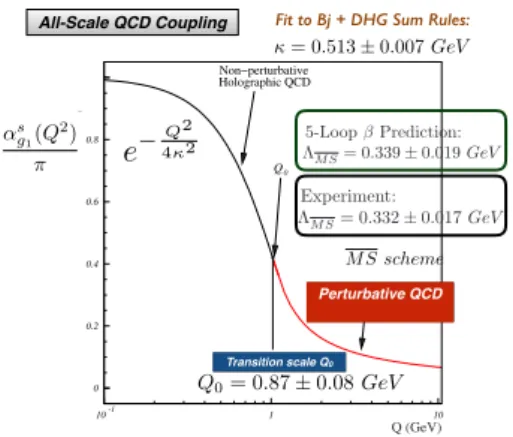
, in agreement with the effective charge determined from measurements [47, 48,49] of the Bjorken sum rule. See Fig.2. Deur, de Téramond, and Brodsky [12,13,14,15] have also shown how the parameterκ, which determines the mass scale of hadrons and Regge slopes in the zero quark mass limit, can be connected to the mass scaleΛs controlling the evolution of the
perturbative QCD coupling. The high momentum transfer dependence of the couplingαg1(Q
2)is
predicted by pQCD. The matching of the high and low momentum transfer regimes ofαg1(Q
2)–
both its value and its slope – then determines a scaleQ0=0.87±0.08 GeV which sets the interface between perturbative and nonperturbative hadron dynamics [17]. This connection can be done for any choice of renormalization scheme, such as theMSscheme, The mass scaleκunderlying hadron masses can thus be connected to the parameterΛMS in the QCD running coupling by matching its
predicted nonperturbative form to the perturbative QCD regime. The result is an effective coupling αs(Q2)defined at all momenta. See Fig.3.
The identification of AdS5with the light-front Hamiltonian theory automatically introduces an
extra spin-dependent constant term 2κ2(L+S−1)in the LF Hamiltonian, whereL=maxLz,S=
PoS(Confinement2018)040
AdS s (Q)/⇥=e Q 2/42 s(Q) ⇥ Deur, de Teramond, sjb = 0.54GeVAnalytic, defined at all scales, IR Fixed Point
Q (GeV) s (Q)/ g1/ (pQCD) g1/ world data / OPAL AdS Modified AdS Lattice QCD (2004) (2007) g1/ Hall A/CLAS g1/ JLab CLAS F3/ GDH limit 0 0.2 0.4 0.6 0.8 1 10-1 1 10
Sublimated gluons below 1 GeV
AdS/QCD dilaton captures the higher twist corrections to effective charges for Q < 1 GeV
e'=e+2z2
Figure 2: Comparison of the nonperturbative
run-ning couplingαs/π =exp −Q2/4κ2
predicted by light front holography with measurements [47, 48,49] of the effective chargeαg1(Q2)from theQ2
dependence of the Bjorken sum rule.
Perturbative QCD Holographic QCD (asymptotic freedom) Q0 Non−perturbative 0 0.2 0.4 0.6 0.8 1 10-1 1 10 Q (GeV) αg1 (Q)/ π Transition scale Q0 Perturbative QCD ↵s g1(Q2) ⇡ All-Scale QCD Coupling e Q 2 42 = 0.513±0.007GeV
Fit to Bj + DHG Sum Rules:
Q0= 0.87±0.08GeV M S scheme Experiment: ⇤M S= 0.332±0.017GeV 5-Loop Prediction: ⇤M S= 0.339±0.019GeV
Figure 3: Connecting the nonperturbative
run-ning couplingαs/π=exp −Q2/4κ2with the 5-loop QCD prediction for the effective charge of the Bjorken sum ruleαg1(Q2).See Refs. [12,13,14,
16]
“LF Schrödinger equation” inζ, whereU(ζ2) =κ4ζ2+2κ2(L+S−1). The synthesis of holo-graphic QCD and conformal quantum mechanics is illustrated in Fig. 1. The eigenvalues for the meson spectrum areM2(L,n) =4κ2(n+L+S/2).The mesonic spectrum ofqq¯bound states is thus described as Regge trajectories in both the principal quantum numbern(the number of nodes in the radial wavefunction) and the orbital angular momentumLwith the same slope 4κ2. Color confine-ment is a consequence of the light-front potentialU(ζ2). Remarkably, the pion(n=0,J=L=0)is massless:mπ=0 formq=0. The LF potential contains a term 2κ2(J−1)which is analogous to the
hyperfine spin-spin splitting interaction in atoms. This term vanishes for theρsinceJ=L+S=1. However, in the case of the pion withJ=0, it gives a negative contribution−2κ2to the pion mass squared which exactly cancels the positive contributions from the LF kinetic energy and confining potential. Thus light-front holography explains another fundamental question in hadron physics – how a zero massqq¯pseudoscalar pion bound state can emerge, despite its composite structure.
The eigensolutions of the LF Schrödinger equation generate both the mass spectrum and the light front wave functionsψM(x,k⊥,λ)for allqq¯meson bound states. Nonzero quark masses
ap-pear in the “LF kinetic energy” (LFKE)∑i[
k2⊥+m2
x ]icontribution to the LF Hamiltonian – the square
of the invariant mass of the constituents:M2= (∑ip
µ
i )2. One can identify the
m2
x contribution to
the LFKE as arising in the Higgs theory from the coupling mx ×mof each quark to the background zero-mode Higgs field [36] which replaces the usual VEV of the standard time “instant form”. The resulting nonperturbative hadronic LF wavefunctions are Gaussian functions of the parton invariant mass squaredM2; they do not factor as functions ofk⊥2. The pion distribution amplitude has the formφπ(x)∝
p
x(1−x)in the nonperturbative domain, which then evolves by ERBL evolution to
x(1−x)at infiniteQ2[18]. In the heavy quark limit, one recovers the usualσrconfining potential for heavy quarkonium [7].
PoS(Confinement2018)040
5. Superconformal Algebra and Supersymmetric Hadron Spectroscopy
Another advance in LF hadron physics is the application ofsuperconformal algebra, a feature of the underlying conformal symmetry of chiral QCD, originally discovered by Haag, Lopuszanski, and Sohnius [50]. The superconformal group in one dimension has an elegant 2×2 Pauli matrix representation. The conformal Hamiltonian operator and the special conformal operator can be represented as anticommutators of fermionic generatorsH=1/2{Q,Q†}andK=1/2{S,S†}. As shown by Fubini and Rabinovici, [51], a nonconformal Hamiltonian with a mass scale can then be obtained by shiftingQ→Q+√ωK, the supersymmetric analog of the dAFF procedure. When ex-tended to hadron physics in the light front this procedure leads to universal confinement for mesons and baryons and a zero mass pion in the chiral limit [3,4]. In effect, one has obtained extended representations of the superconformal algebra [51,52]. This ansatz extends the predictions for the hadron spectrum to a “4-plet” – consisting of a mass-degenerate antiquark meson, a quark-diquark baryon, and a quark-diquark-antiquark-diquark tetraquark, as shown in Fig.4. The 4-plet contains two entriesΨ±for each baryon, corresponding to internal orbital angular momentumLandL+1. This
property of the baryon LFWFs is the analog of the eigensolution of the Dirac-Coulomb equation which has both an upper componentΨ+and a lower componentΨ−=m+~σE·~p−VΨ+.
Bound-state LF Schrödinger equations for both baryons and mesons can be derived from su-perconformal algebra [3, 4]. Remarkably, the predicted meson equation is identical to the LF Schrödinger equation with the same confinement potential and spin term that was derived from LF holography from AdS5 with the soft-wall dilatone+κ
2z2
, with the same confinement potential and spin term. See Eqs. (1) and (2). The baryonic eigensolutions correspond to bound states of 3C quarks to a ¯3C spin-0 or spin-1qq diquark cluster; they each have two amplitudesLB,LB+1
with have equal Fock state probability – a feature of “quark chirality invariance”. For example, the proton’s Fock state componentsψ+(with parallel quark and baryon spins) andψ−(with anti-parallel quark and baryon spins) have equal Fock state probability; thus the proton’s spin is carried by quark orbital angular momentum in the nonperturbative domain. Predictions for the static prop-erties of the nucleons are discussed in Ref. [53]. The predicted spectrum,M2(n,L) =4κ2(n+L)
for mesons and M2(n,L) =4κ2(n+L+1) for nucleons, is remarkably consistent with observed hadronic spectroscopy: The Regge-slopes innandLare identical. The extension of the supercon-formal structure to include the spin-spin interaction is described [54]. The predicted meson, baryon and tetraquark masses coincide if one identifies a meson with internal orbital angular momentum
LMwith its superpartner baryon or tetraquark withLB=LM−1. Superconformal algebra thus
pre-dicts that mesons withLM=LB+1 have the same mass as the baryons in the supermultiplet. An
example of the mass degeneracy of theρ/ω meson Regge trajectory with theJ=3/2∆-baryon
trajectory is shown in Fig.5. The value ofκ is not a fixed parameter, since only ratios of masses are predicted by QCD.
The combination of superconformal algebra and light-front dynamics thus leads to the novel prediction that hadron physics has supersymmetric properties in both spectroscopy and dynamics. The excitation spectra of relativistic light-quark meson, baryon and tetraquark bound states all lie on linear Regge trajectories with identical slopes in the radial and orbital quantum numbers. Detailed predictions for the tetraquark spectroscopy and comparisons with the observed hadron spectrum are presented in Ref. [55].
PoS(Confinement2018)040
6. Supersymmetric Hadron Spectroscopy for Heavy Quarks
The predictions from light-front holography and superconformal algebra have been extended to mesons, baryons, and tetraquarks with strange, charm and bottom quarks in Refs. [10, 11]. Although conformal symmetry is strongly broken by the heavy quark mass, the basic underlying supersymmetric mechanism, which transforms mesons to baryons (and baryons to tetraquarks) into each other, still holds and gives remarkable connections and mass degeneracy across the entire spectrum of light, heavy-light and double-heavy hadrons. The excitation spectra of the heavy quark meson, baryon and tetraquark bound states continue to lie on universal linear Regge trajectories with identical slopes in the radial and orbital quantum numbers, but with an increased value for the slope. For example, the mass of the lightest double-charm baryon|c[cq]i, where the composite
[cq]is a scalar diquark, is predicted to be identical to the mass of theL=1 orbital excitation of the |cc¯i ( the 1++ h0c(L=1) ) and also the mass of the |[cq][c¯q¯]i double-charm tetraquark. In fact, the mass of thehc(3525)matches the mass of the double-charm baryonΞ+ccd(3520)identified
by SELEX and a tetraquark candidate theΞcc(3415). For more details, see Refs. [55,56]. The
effective supersymmetric properties of QCD can be used to identify the structure of the heavy quark mesons, baryons and tetraquark states [55].
Superconformal Algebra 2X2 Hadronic Multiplets &% '$ u e &% '$ e e e M, LB+ 1 B+, LB -R† &% '$ e e e B , LB+ 1 &% '$ e e u u T, LB -R†
Figure 1: The supersymmetric quadruplet{ M, B+, B , T}. Open circles represent
quarks, full circles antiquarks. The tetraquark has the same mass as its baryon partner in the multiplet. Notice that the LF angular momentum of the negative-chirality component wave function of a baryon B is one unit higher than that of the positive-chirality (leading-twist)
component B+.
spinor wavefunction B+and B , plus two bosonic wave functions, namely the meson Band the tetraquark T. These states can be arranged as a 2⇥2 matrix:
M(LM=LB+ 1) B (LB+ 1) B+(LB) T(LT=LB)
!
, (21)
on which the symmetry generators (1) and the Hamiltonian (17) operate9. According to this analysis, the lowest-lying light-quark tetraquark is a partner of theb1(1235) and the nucleon; it has quantum numbersI, JP= 0,0+. The partners of
thea2(1320) and the (1233) have the quantum numbersI= 0, JP= 1+. Candidates
for these states are thef0(980) anda1(1260), respectively.
2.4 Inclusion of quark masses and comparison with experiment
We have argued in [11] that the natural way to include light quark masses in the hadron mass spectrum is to leave the LF potential unchanged as a first approximation and add the additional term of the invariant mass m2=Pn
i=1 m2
i
xi to the LF kinetic
energy. The resulting LF wave function is then modified by the factore 1 2 m2, thus
providing a relativistically invariant form for the hadronic wave functions. The e↵ect of the nonzero quark masses for the squared hadron masses is then given by the expectation value of m2
evaluated using the modified wave functions. This prescription leads to
9It is interesting to note that in Ref. [20] mesons, baryons and tetraquarks are also hadronic states within the same multiplet.
Meson Baryon
Tetraquark Baryon
Bosons, Fermions with Equal Mass!
Proton: |u[ud]> Quark + Scalar Diquark Equal Weight: L=0, L=1 R†q![¯q¯q] 3C!3C R†q¯![qq] ¯ 3C!¯3C
Figure 4: The 4-plet representation of
mass-degenerate hadronic states predicted by superconfor-mal algebra [6]. Mesons areqq¯bound states, baryons are quark – antidiquark bound states and tetraquarks are diquark-antidiquark bound states. The supersym-metric ladder operator R†
λ connects quarks and anti-diquark clusters of the same color representation.
! ! ! ! ! ! ! ! !!!!! " " " " # # # # M2!GeV2" LM!LB!1 Ρ,Ω a2,f2 Ρ3,Ω3 a4,f4 $ 3 2 ! $12 % ,$32 % $12 ! ,$32 ! ,$52 ! ,$72 ! $ 11 2 ! 0 1 2 3 4 5 0 1 2 3 4 5 6 ⇢ superpartner trajectories Dosch, de Teramond, sjb
Figure 5: Comparison of the ρ/ω
me-son Regge trajectory with theJ=3/2 ∆
baryon trajectory. Superconformal alge-bra predicts the degeneracy of the meson and baryon trajectories if one identifies a meson with internal orbital angular mo-mentumLM with its superpartner baryon
withLM=LB+1.See Refs. [3,4].
Thus one predicts supersymmetric hadron spectroscopy – bosons and fermions with the same mass and twist. The members of the 4-plet not only have identical masses for the bosonic and fermionic hadron eigenvalues, but also supersymmetric relations between their eigenfunctions – their light-front wavefunctions. The baryonic eigensolutions correspond to bound states of 3C
quarks to a ¯3C spin-0 or spin-1qqdiquark cluster; the tetraquarks in the 4-plet are bound states of
diquarks and anti-diquarks. In the case of a nucleon, the overlap of theL=0 andL=1 LF wave-functions in the Drell-Yan-West formula is required to have a non-zero Pauli form factorF2(Q2)and
anomalous magnetic moment [38]. The existence of both components is also necessary to generate the pseudo-T-odd Sivers single-spin asymmetry in deep inelastic lepton-nucleon scattering [57].
PoS(Confinement2018)040
7. Summary
The combination of conformal symmetry, light-front dynamics, the dAFF procedure (confor-mal quantum mechanics) and its holographic embedding in AdS5space, has provided new insights,
not only into the physics underlying color confinement, but also into the form of the nonperturbative QCD coupling and the QCD mass scale. A comprehensive review is given in Ref. [45].
The QCD Lagrangian is not supersymmetrical; it is based on quark and gluonic fields, not squarks nor gluinos. However, when one applies superconformal algebra [50] using the extended dAFF procedure of Fubini and Rabinovici [51], one obtains a unified spectroscopy of meson, baryon, and tetraquarks as equal-mass members of the same 4-plet representation, reflecting the underlying conformal symmetry of semi-classical QCD for massless quarks as well as the color dynamics underlying the supersymmetric connection of mesons, baryons and tetraquarks from the fundamentalSU(3)Crepresentation¯3∼3×3. The set of “Light-front Schrödinger equations”
pre-dicted from superconformal algebra [3,4], match the bound-state equation obtained from AdS5and
LF holography. They incorporate color confinement and other essential spectroscopic and dynam-ical features of hadron physics, including a massless pion for zero quark mass and linear Regge trajectories with thesame slopein the radial quantum number nand internal orbital angular mo-mentumLfor mesons, baryons, and tetraquarks. In fact, the meson and baryon Regge trajectories and spectra are identical when one compares mesons with baryons with orbital angular momen-tum LM=LB+1. Their LF wavefunctions, the eigensolutions of the LF Schrödinger equations,
have the same underlying universal form. A new method for solving nonperturbative QCD “Basis Light-Front Quantization” (BLFQ) [58], uses the eigensolutions of a color-confining approxima-tion to QCD (such as LF holography) as the basis funcapproxima-tions, rather than the plane-wave basis used in DLCQ, thus incorporating the full dynamics of QCD.
The light-front holographic approach, with the constraints imposed by the superconformal al-gebraic structure, predicts novel supersymmetric relations between mesons, baryons, and tetraquarks of the same parity as members of the same 4-plet representation of superconformal algebra. Em-pirically viable predictions for spacelike and timelike hadronic form factors, structure functions, distribution amplitudes, and transverse momentum distributions have also been obtained [20,59]. One can also observe features of superconformal symmetry in the spectroscopy and dynamics of heavy-light as well as double-heavy mesons and baryons [11,55]. The combination of light-front field theory with superconformal algebra thus leads to the novel prediction that hadron physics has supersymmetric properties in both spectroscopy and dynamics. One can test the similarities of their wavefunctions and form factors in exclusive reactions such ase+e− →πT whereT is a tetraquark [23]. Quark counting rules for hadron form factors and other hard exclusive amplitudes are also a property of these nonperturbative solutions [22,23]. One can thus use counting rules to identify the field content of mesons, baryons, tetraquarks, and gluonium. Light-front holography thus gives a remarkably simple analytic description of quark confinement, as well as nonperturba-tive hadronic structure and dynamics.
PoS(Confinement2018)040
8. Acknowledgments
We thank our collaborators for discussions, including Cedric Lorcé, R. S. Sufian, Tianbo Liu, Alex Trawinski, Stan Glazek, Felipe Llanes Estrada, Xing-Gang Wu, Peter Lowdon, Kelly Chiu, Robert Shrock, Craig Roberts, Philip Mannheim, and Matin Mojaza. This research was supported by the Department of Energy, contract DE–AC02–76SF00515. SLAC-PUB-17345.
References
[1] H. Fritzsch, M. Gell-Mann and H. Leutwyler, Phys. Lett.47B, 365 (1973).
[2] G. F. de Téramond and S. J. Brodsky, Phys. Rev. Lett.102, 081601 (2009) [arXiv:0809.4899 [hep-ph]]. [3] G. F. de Téramond, H. G. Dosch and S. J. Brodsky, Phys. Rev. D91, 045040 (2015) [arXiv:1411.5243
[hep-ph]].
[4] H. G. Dosch, G. F. de Téramond and S. J. Brodsky, Phys. Rev. D91, 085016 (2015) [arXiv:1501.00959 [hep-th]].
[5] V. de Alfaro, S. Fubini, and G. Furlan (1976)Nuovo Cim. A34, 569.
[6] S. J. Brodsky, G. F. de Téramond and H. G. Dosch, Phys. Lett. B729, 3 (2014) [arXiv:1302.4105 [hep-th]].
[7] A. P. Trawinski, S. D. Glazek, S. J. Brodsky, G. F. de Téramond and H. G. Dosch, Phys. Rev. D90, 074017 (2014) [arXiv:1403.5651 [hep-ph]].
[8] J. M. Maldacena, TASI 2003 lectures on AdS / CFT, hep-th/0309246. [9] P. A. M. Dirac, Rev. Mod. Phys.21, 392 (1949).
[10] H. G. Dosch, G. F. de Téramond and S. J. Brodsky, Phys. Rev. D92, 074010 (2015); Phys. Rev. D95, 034016 (2017) [arXiv:1612.02370 [hep-ph]].
[11] M. Nielsen, S. J. Brodsky, G. F. de Téramond, H. G. Dosch, F. S. Navarra and L. Zou, Phys. Rev. D
98, 034002 (2018) [arXiv:1805.11567 [hep-ph]].
[12] S. J. Brodsky, G. F. de Téramond and A. Deur, Phys. Rev. D81, 096010 (2010) [arXiv:1002.3948 [hep-ph]].
[13] A. Deur, S. J. Brodsky and G. F. de Téramond, Phys. Lett. B750, 528 (2015) [arXiv:1409.5488 [hep-ph]].
[14] S. J. Brodsky, G. F. de Téramond, A. Deur and H. G. Dosch, Few Body Syst.56, no. 6-9, 621 (2015) [arXiv:1410.0425 [hep-ph]].
[15] A. Deur, S. J. Brodsky and G. F. de Téramond, Prog. Part. Nucl. Phys.90, 1 (2016) [arXiv:1604.08082 [hep-ph]].
[16] A. Deur, S. J. Brodsky and G. F. de Téramond, J. Phys. G44, no. 10, 105005 (2017) [arXiv:1608.04933 [hep-ph]].
[17] A. Deur, S. J. Brodsky and G. F. de Téramond, Phys. Lett. B757, 275 (2016) [arXiv:1601.06568 [hep-ph]].
[18] S. J. Brodsky, F. G. Cao and G. F. de Téramond, Phys. Rev. D84, 033001 (2011) [arXiv:1104.3364 [hep-ph]].
PoS(Confinement2018)040
[19] S. J. Brodsky, F. G. Cao and G. F. de Téramond, Phys. Rev. D84, 075012 (2011) [arXiv:1105.3999[hep-ph]].
[20] G. F. de Téramondet al.[HLFHS Collaboration], Phys. Rev. Lett.120, 182001 (2018) [arXiv:1801.09154 [hep-ph]].
[21] R. S. Sufian, T. Liu, G. F. de Téramond, H. G. Dosch, S. J. Brodsky, A. Deur, M. T. Islam and B. Q. Ma, arXiv:1809.04975 [hep-ph].
[22] S. J. Brodsky and F. J. Llanes-Estrada, arXiv:1810.08772 [hep-ph].
[23] S. J. Brodsky and R. F. Lebed, Phys. Rev. D91, 114025 (2015) [arXiv:1505.00803 [hep-ph]]. [24] K. Y. J. Chiu and S. J. Brodsky, Phys. Rev. D95, 065035 (2017) [arXiv:1702.01127 [hep-th]]. [25] P. Lowdon, K. Y. J. Chiu and S. J. Brodsky, Phys. Lett. B774, 1 (2017) [arXiv:1707.06313 [hep-th]]. [26] S. J. Brodsky, C. D. Roberts, R. Shrock and P. C. Tandy, Phys. Rev. C85, 065202 (2012)
[arXiv:1202.2376 [nucl-th]].
[27] S. J. Brodsky and R. Shrock, Proc. Nat. Acad. Sci.108, 45 (2011) [arXiv:0905.1151 [hep-th]]. [28] M. Mojaza, S. J. Brodsky and X. G. Wu, Phys. Rev. Lett.110, 192001 (2013) [arXiv:1212.0049
[hep-ph]].
[29] X. G. Wu, S. J. Brodsky and M. Mojaza, Prog. Part. Nucl. Phys.72, 44 (2013) [arXiv:1302.0599 [hep-ph]].
[30] B. L. Du, X. G. Wu, J. M. Shen and S. J. Brodsky, arXiv:1807.11144 [hep-ph]. [31] S. Q. Wang, X. G. Wu, S. J. Brodsky and M. Mojaza, Phys. Rev. D94, 053003 (2016)
[arXiv:1605.02572 [hep-ph]].
[32] S. J. Brodsky, G. P. Lepage and P. B. Mackenzie, Phys. Rev. D28, 228 (1983). [33] H. J. Lu and S. J. Brodsky, Phys. Rev. D48, 3310 (1993) [hep-ph/9211254].
[34] J. M. Shen, X. G. Wu, Y. Ma and S. J. Brodsky, Phys. Lett. B770, 494 (2017) [arXiv:1611.07249 [hep-ph]].
[35] S. J. Brodsky, G. T. Gabadadze, A. L. Kataev and H. J. Lu, Phys. Lett. B372, 133 (1996) [hep-ph/9512367].
[36] P. P. Srivastava and S. J. Brodsky, Phys. Rev. D66, 045019 (2002) [hep-ph/0202141]. [37] S. J. Brodsky, H. C. Pauli and S. S. Pinsky, Phys. Rept.301, 299 (1998) [hep-ph/9705477]. [38] S. J. Brodsky and S. D. Drell, Phys. Rev. D22, 2236 (1980).
[39] J. Polchinski and M. J. Strassler, Phys. Rev. Lett.88, 031601 (2002) [hep-th/0109174]. [40] S. J. Brodsky and G. R. Farrar, Phys. Rev. Lett.31, 1153 (1973).
[41] G. P. Lepage and S. J. Brodsky, Phys. Rev. D22, 2157 (1980).
[42] G. F. de Téramond and S. J. Brodsky, Nucl. Phys. Proc. Suppl.199, 89 (2010) [arXiv:0909.3900 [hep-ph]].
[43] S. J. Brodsky and F. Guy de Téramond, Chin. Phys. C34, no. 9, 1229 (2010) [arXiv:1001.1978 [hep-ph]].
[44] G. F. de Téramond, S. J. Brodsky and H. G. Dosch, EPJ Web Conf.73, 01014 (2014) [arXiv:1401.5531 [hep-ph]].
PoS(Confinement2018)040
[45] S. J. Brodsky, G. F. de Téramond, H. G. Dosch and J. Erlich, Phys. Rept.584, 1 (2015)[arXiv:1407.8131 [hep-ph]].
[46] S. J. Brodsky, A. Deur, G. F. de TÃl’ramond and H. G. Dosch, Int. J. Mod. Phys. Conf. Ser.39, 1560081 (2015) [arXiv:1510.01011 [hep-ph]].
[47] A. Deuret al., Phys. Rev. Lett.93, 212001 (2004) [hep-ex/0407007].
[48] A. Deur, V. Burkert, J. P. Chen and W. Korsch, Phys. Lett. B650, 244 (2007) [hep-ph/0509113]. [49] A. Deur, V. Burkert, J. P. Chen and W. Korsch, Phys. Lett. B665, 349 (2008) [arXiv:0803.4119
[hep-ph]].
[50] R. Haag, J. T. Lopuszanski and M. Sohnius, Nucl. Phys. B88, 257 (1975). [51] S. Fubini and E. Rabinovici, Nucl. Phys. B245, 17 (1984).
[52] V. P. Akulov and A. I. Pashnev, Theor. Math. Phys.56, 862 (1983) [Teor. Mat. Fiz.56, 344 (1983)]. [53] T. Liu and B. Q. Ma, Phys. Rev. D92, no. 9, 096003 (2015) [arXiv:1510.07783 [hep-ph]].
[54] S. J. Brodsky, G. F. de TÃl’ramond, H. G. Dosch and C. LorcÃl’, Phys. Lett. B759, 171 (2016) [arXiv:1604.06746 [hep-ph]].
[55] M. Nielsen and S. J. Brodsky, Phys. Rev. D97, 114001 (2018) [arXiv:1802.09652 [hep-ph]]. [56] S. J. Brodsky, S. Groote and S. Koshkarev, Eur. Phys. J. C78, 483 (2018) [arXiv:1709.09903
[hep-ph]].
[57] S. J. Brodsky, D. S. Hwang and I. Schmidt, Phys. Lett. B530, 99 (2002) [hep-ph/0201296]. [58] J. P. Vary, X. Zhao, A. Ilderton, H. Honkanen, P. Maris and S. J. Brodsky, Nucl. Phys. Proc. Suppl.
251-252, 10 (2014) [arXiv:1406.1838 [nucl-th]].
[59] R. S. Sufian, G. F. de Téramond, S. J. Brodsky, A. Deur and H. G. Dosch, Phys. Rev. D95, 014011 (2017) [arXiv:1609.06688 [hep-ph]].
![Figure 4: The 4-plet representation of mass- mass-degenerate hadronic states predicted by superconfor-mal algebra [6]](https://thumb-us.123doks.com/thumbv2/123dok_us/1138589.2652086/10.892.152.358.537.722/figure-representation-degenerate-hadronic-states-predicted-superconfor-algebra.webp)
