Journal of Counseling Sexology & Sexual
Journal of Counseling Sexology & Sexual
Wellness: Research, Practice, and Education
Wellness: Research, Practice, and Education
Volume 1 Issue 2
Article 7
2019
Full Issue
Full Issue
Journal of Counseling Sexology & Sexual Wellness: Research Education, and Practice JCSSW
Follow this and additional works at: https://digitalcommons.unf.edu/jcssw
Recommended Citation
Recommended Citation
JCSSW, J. (2019). Full Issue. Journal of Counseling Sexology & Sexual Wellness: Research, Practice, and Education, 1 (2). Retrieved from https://digitalcommons.unf.edu/jcssw/vol1/iss2/7
This Full Issue is brought to you for free and open access by the Brooks College of Health at UNF Digital Commons. It has been accepted for inclusion in Journal of
Counseling Sexology & Sexual Wellness: Research, Practice, and Education by an authorized administrator of UNF Digital Commons. For more information, please contact Digital Projects.
Journal of Counseling Sexology
&
Sexual Wellness
Research, Practice, and Education
Robert J. Zeglin
Editor
Jason “Jayce” Patton
Associate Editor
ISSN: 2577-1299
Table of Contents
Journal of Counseling Sexology
&
Sexual Wellness: Research, Practice, and Education
Fall 2019, Vol. 1 No. 2, 69-113Sexual Values and Behaviors Discrepancy Model Zachary D. Bloom, Ashley J. Blount, Dalena L. Dillman Taylor,
&Galina Lipkin
69-79. Founded in theory and empirical research, we de-veloped the Sexual Values and Behaviors Discrepancy Model (SVBDM) as reflective model for counselors to follow in or-der to assist their clients in safely reducing discrepancies be-tween their ideal and practiced sexual beliefs, values, and behaviors. The SVBDM is a wellness-informed and sex-positive approach to working with clients and is comprised of three steps: Identification and Operationalization of Potential Sexual Issues, Counselor’s Self-Assessment, and Reducing Discrepancies and Maintaining Safety. We note practical im-plications and potential limitations of this model as well as recommendations for future research.
The Use of Technology in Sexual Exploration Among a Rape Culture Youth
Kelley R. Holladay&W. Bryce Hagedorn
80-89. The present investigation sought to address the gap of research surrounding rape myth acceptance attitudes and cyber-sexual assault (CBSA). Researchers examined data collected from a college sample of 94 undergraduate psychology students. The purpose of this investigation was to explore whether this sample of college students reported any potential stereotypes pertaining to cyber-sexual assault victims and whether the college students utilized technology for sexual exploration (e.g., creation, distribution, and receiv-ing of sexually explicit material). In addition to identifyreceiv-ing cyber-sexual victims, this study explored the correlation of gender with those responses. Results are reported, and sug-gestions for counselors are offered. The researchers hypoth-esize that rape culture acceptance attitudes have shifted to victims of online abuse, though more research is warranted to draw specific conclusions.
Clinical Implications in Vaginal Orgasm Response Lindsey M. Brown McCormick, Sherry Todd, Laura
Schmuldt, Kathryn Russ,&Cristen Wathen
90-95. Previous research has shown that counselors feel uncomfortable addressing clients’ sexual concerns due to a lack of education on topics related to human sexuality. Var-ious studies have attempted to identify the characteristics of vaginal orgasm, including whether women and other peo-ple with vaginas (PWV) can achieve different kinds of
or-gasms. The current study examines responses to participants surveyed across the United States on their orgasm response and compares responses of participants who achieved or-gasm through masturbation and those who achieved oror-gasm through sex with a partner to determine whether PWV ex-perience one kind of orgasm during masturbation and expe-rience a different kind of orgasm during sex with a partner. Results from the current study suggest that there are two dis-tinct orgasm experiences achieved by PWV which differ in physiological and psychological response. Counselors and counselor educators can use results from this study to help expand their knowledge on sexual response to feel more con-fident in their practice.
Sexual Wellness and Rare Disease Considerations: A Behavioral Case Conceptualization and Approach to
Counseling Treatment
Jessica Z. Taylor, Chrystal L. Lewis,&Leslie E. Davis 96-104. Sexual wellness is infrequently addressed with individuals with a rare disease. Counselors must be com-petent in working with sexual wellness issues, especially those related to medical conditions, since clients may not share those concerns with healthcare providers. This arti-cle presents a case scenario involving a client living with a rare disease called Hereditary Angioedema, the symptoms of which present challenges to her intimate and sexual re-lationship with her partner due to unpredictable and painful swelling. A behavioral theoretical lens is used to conceptual-ize the case scenario and inform treatment. Implications for counselor competency, interdisciplinary collaboration, and client empowerment toward advocacy are discussed.
Using Surrogate Partner Therapy in Counseling: Treatment Considerations
Kelly Emelianchik-Key&Kimberleigh Stickney 105-113. When working with clients on issues of sexu-ality, clinicians often avoid the treatment approach of surro-gate partner therapy due to lack of information and under-standing. Surrogate partner therapy is a grey area within legal and ethical boundaries of various mental health pro-fessional associations. This article offers an intensive ex-ploration of surrogate partner therapy, including its history, ethical considerations, benefits, and challenges. Best prac-tices and treatment considerations when working with a sur-rogate partner therapist are discussed. Although there is a
Journal of Counseling Sexology&Sexual Wellness: Research Education, and Practice Table of Contents lack of research and evidence-based practice information, the
available literature demonstrates that surrogate partner ther-apy is an effective intervention that can enhance treatment for clients struggling with sexuality and intimacy issues.
Submissions
If you are interested in submitting your work toJCSSW for consideration for publication, you can locate our
submission requirements at
https://digitalcommons.unf.edu/jcssw/styleguide.html. TheJCSSWeditorial team is committed to ensuring an efficient review process and aims to communicate all initial decisions within 90 days of submission. Please also
feel free to contactRobert J. Zeglin(Editor) or "Jayce" Patton(Associate Editor) with any questions.
The Sexual Values and Behaviors Discrepancy Model
Zachary D. Bloom
Northeastern Illinois University
Ashley J. Blount
University of Nebraska at OmahaDalena L. Dillman Taylor
University of Central Florida
Galina Lipkin
Northeastern Illinois UniversityFounded in theory and empirical research, we developed the Sexual Values and Behaviors Dis-crepancy Model (SVBDM) as reflective model for counselors to follow in order to assist their clients in safely reducing discrepancies between their ideal and practiced sexual beliefs, values, and behaviors. The SVBDM is a wellness-informed and sex-positive approach to working with clients and is comprised of three steps: Identification and Operationalization of Potential Sex-ual Issues, Counselor’s Self-Assessment, and Reducing Discrepancies and Maintaining Safety. We note practical implications and potential limitations of this model as well as recommenda-tions for future research.
Keywords:sexuality, wellness, theory, supervision, relationships
Introduction
Sexuality is an integrated component of healthy develop-ment across the lifespan (Mosher,2017; Wong,2015). As such, counselors are charged with promoting healthy devel-opment and holistic wellness in their work with clients, in-cluding the domain of sexuality (Council for Accreditation of Counseling and Related Educational Programs [CACREP], Standard 5.F.2.e, Council for Accreditation of Counseling and Related Educational Programs,2016). Indeed, the coun-seling profession calls for the promotion of sex positivity (Burnes, Singh, & Witherspoon,2017) and sexual wellness (Iantaffi,2016) to meet the needs of clients who are present-ing to counselpresent-ing for issues related to their sexuality (Ayres & Haddock, 2009; Reissing & Giulio, 2010; Sanabria & Murray,2018). Yet, some counselors report feeling under-trained and/or uncomfortable working with clients with sex-ual concerns (Harris & Hays,2008;Bloom, Gutierrez, Lam-bie, & Ali,2016).
Scholars noted the evolution of clients’ counseling needs as society moves further from the early and mid 20th cen-tury when the majority of traditional counseling models orig-inated (e.g.,Bloom & Taylor,2015). A primary concern is that clients are presenting to counseling with contemporary issues related to intimacy and sexuality (Hertlein & Steven-son,2010) that are made more prevalent by the accessibility, affordability, and availability of the Internet (Cooper,1998). Within the last decade, researchers have identified clinical is-sues related to adverse experiences with online dating (Ali & Bloom,2018), online sexual solicitation (Rice et al.,2014), addiction to cybersex (Goldberg, Peterson, Rosen, & Sara, 2008), complications associated with client pornography use (Ayres & Haddock,2009;Bloom & Hagedorn,2014), and an
array of other clinical issues (Reissing & Giulio,2010). Con-sequently, there is a call for counselors to address their per-sonal and professional limitations when working with clients regarding sexual issues and for counselor education pro-grams to “increase opportunities for counselors-in-training to receive formal sex education” (Bloom et al.,2016, p. 340).
When working with clients with issues related to their sex-uality, it is important for counselors to remember to work within their boundaries of competence (American Counsel-ing Association [ACA],2014), as sexual issues can contain nuances that require additional training or referral to coun-selors who specialize in working with clients with sexual concerns (Yarber, 2013). Regardless of the specific clin-ical issue, theory remains an essential component (Corey, 2016) of ethical practice (ACA, 2014). However, in light of the gradations of more contemporary sexual issues and the continued evolution of society, a critical review of the literature failed to find a succinct, user-friendly model that is both grounded in theory and best practices . Therefore, founded on the effectiveness of the therapeutic relationship in creating positive client outcomes (Norcross & Lambert,
Corresponding Author Zachary D. Bloom Northeastern Illinois University
5500 North St. Louis Avenue Chicago, IL 60625-4699
E: [email protected] P: (773)442-5553
Journal of Counseling Sexology&Sexual Wellness: Research, Practice, and Education Bloom et al., 2019 2011), the strengths-based approach of wellness-informed
counseling (Myers & Sweeny,2005), and the essential role of differentiation in working with clients with issues related to sexuality (Heiden-Rootes, Brimhall, Jankowski, & Red-dick,2017;Schnarch,1991), we propose the Sexual Values and Behaviors Discrepancy Model (SVBDM) to guide coun-selors in their work with clients who present with sexual is-sues that is founded in theory and best practices.
Sexuality and the Counseling Field
Whereas today’s counselors work from a strengths-based stance with clients (Burnes et al.,2017), psychiatrists in the United States in the 1930s viewed sexual issues (i.e., values and practices) from a lens of pathology (Chiang,2010). As such, individuals performing less mainstream sexual prac-tices were commonly pathologized. For example, homo-sexuality was once considered to be a result of childhood trauma that could be cured with treatment (Chiang, 2010; Drescher,2008) and was only removed from the Diagnostic and Statistical Manual of Mental Disorders ([DSM]; Amer-ican Psychiatric Association [APA]) in its sixth printing of its second edition in 1973 (Drescher,2015). Even more re-cently, conversion therapy – the harmful application of coun-seling practice to change an individual’s sexual orientation – has been universally condemned and considered unethical by the counseling profession (e.g.,Human Rights Campaign, n.d.). The counseling profession’s evolved stance regarding the practice of conversion therapy reflects the profession’s greater understanding of the fluidity and variability of sexu-ality (Fairyington,2008), as well as the importance of mini-mizing harm, stigma, and the expression of microaggressions when working with clients pertaining to issues of sexuality (Drescher,2015; Hermann & Herlihy,2006; Hozid,2013; Moleiro & Pinto,2015).
Sexual practices and beliefs about sexuality are dynamic in nature (Yarber,2013), and a variety of counseling issues (e.g., shame, emotional suppression, reduced sexual desire) might be related to individuals’ adherence to strict gender roles and/or conservative beliefs about sex and sexual prac-tices (Petersen & Hyde, 2011). Further, it is necessary to note that labels of mental illness (i.e., disorders identified in the DSM) can improperly be used to reinforce negative social beliefs (Hozid,2013), including stereotyping and microag-gressions . Clients are seeking counseling services for sexual issues (Ayres & Haddock,2009;Goldberg et al.,2008; Har-ris & Hays,2008;Bloom et al.,2016), but counselors might be holding conservative and/or progressive beliefs about sex-uality (Authors , 2016) that inhibit their unbiased treatment of those problems, thus impairing their ability to fulfill their role as an ethical counselor working within their boundaries of skills and competence (ACA,2014).
A review of the literature indicates that counselors’ com-fort with sexuality might be a mitigating factor in the
treat-ment of sexual issues (Kazukauskas & Lam,2009;Harris & Hays,2008;Bloom et al.,2016). Goldberg and colleagues (2008) explored marriage and family therapists’ (N =134) treatment of client issues related to cybersex and identified that 20% of their sample did not feel prepared to diagnose problems related to cybersex. Similarly, Ayres and Haddock (2009) examined marriage and family therapists’ (N =99) treatment of client issues related to pornography use and re-ported that 47.4% of their sample did not receive training as graduate students about pornography use, and 79% of their sample felt “minimally” or “not at all” trained to work with clients related to those issues (p. 63). Harris and Hays (2008) also explored marriage and family therapists’ (N=175) com-fort with sexuality and identified that therapists who received more training and/or attained supervision were more com-fortable discussing issues of sexuality with clients, support-ing the call for increased discussion and availability of re-sources to increase counselors’ comfort with sexuality.
Bloom et al. (2016) explored counselors’ (n=575) com-fort with sexuality and attitudes towards pornography and identified that both variables were predictive of counselors’ assessment and treatment of clinical issues related to client pornography use. Authors speculated on their data in con-junction with exploratory questions from their investigation and noted, “We believe that confidence to treat issues related to sexuality might predict counselors’ comfort with working with clients, and we believe that counselors’ quality of train-ing influences their confidence to treat issues of sexuality” (p. 339). Furthermore, they identified a subsample of counselors from their study (n=79) who viewed pornography “to learn about sexuality” (p. 334) , further highlighting the need for counselors’ formal education on sexual practices.
In light of Bloom et al.’s (2016) study in addition to the ex-istent literature on counselors’ comfort with sexuality, coun-selors could benefit from a model guiding their treatment of client sexual issues, which might enhance their confi-dence and competence in working with clients with those presenting issues. With the understanding that sexual val-ues and practices vary per individual and per sexual rela-tionship (Yarber,2013), it is to remember the importance for counselors to do no harm (ACA,2014) by not pathologizing their clients (Hozid,2013). Therefore, we call for counselors to infuse a wellness-informed approach in their work with clients regarding issues of sexuality. Thus, in alignment with the counseling professions’ strengths-based stance towards sexuality (Burnes et al.,2017), we offer the SVBDM as an atheoretical approach that can be integrated into any coun-selor’s clinical work as a way to assist clients in reducing discrepancies between their beliefs and values about sexual-ity and their sexual behaviors.
Bloom et al., 2019 Journal of Counseling Sexology&Sexual Wellness: Research, Practice, and Education Theoretical Foundations
To meet the needs of diverse clients presenting to coun-seling with nuanced issues related to their sexuality, and in order to provide a general strategy that can be integrated into most counselors’ orientations, we based the SVBDM on relationship- oriented principles (Rogers, 1957). As such , we also recognize the importance of a building and main-taining a counselor’s level of differentiation (Bowen,1993) in order to facilitate a client’s growth. Finally, we encour-age a holistic and strength -based conceptualization of clients and their presenting issues. The following sections delineate these concepts.
Therapeutic Relationships and Differentiation
Across theoretical approaches (Corey,2016), most coun-selors infuse three therapist-led core conditions into their clinical work, as originally outlined by Rogers (1957,1980): unconditional positive regard, empathy, and congruence. Re-searchers have established the essential role that therapeutic relationships play in the creation of positive client outcomes (Lambert & Bergin,2001;Norcross,2011;Norcross & Lam-bert,2011). Indeed, the therapeutic relationship is predictive of positive client outcomes (Connors, Carroll, DiClemente, Longabaugh, & Donovan,1997; Krupnick et al.,2006), ac-counting for about 30% of the variance (Lambert & Barley, 2001). Consequently, it is necessary for counselors to facili-tate a strong working relationship with their clients.
In addition to the establishment of a therapeutic relation-ship, counselors also need to maintain the therapeutic re-lationship by avoiding therapeutic ruptures, and tending to ruptures in the relationship when they happen (Norcross & Lambert, 2011). Generally, a rupture might occur in the therapeutic relationship if a counselor is no longer congruent with themselves, when positive regard becomes conditional, or if the counselor is unable to remain in psychological con-tact with the client due to a potential reaction to the content or process occurring in session (Norcross & Lambert,2011; Rogers,1957).
Murray Bowen (1993) recognized negative reactivity and anxiety as potential factors interfering with the ability to maintain one’s sense of self (i.e., to be congruent), or to be differentiated, thus impacting the therapeutic relationship. In this way, Bowen’s concept of differentiation speaks to an in-dividual’s ability to regulate one’s self in the presence of an-other person’s emotional space, belief, and/or value system. While differentiation was conceptualized regarding individ-uals (i.e., clients) in a relational context, Bowen and other scholars also recognized the essentially that counselors also need to possess high levels of differentiation (Heiden-Rootes et al., 2017; Schnarch, 1991; Siegel, 2010). Thus, an es-sential component of the SVBDM is a counselor’s reflection in order to better understand their points of reactivity and/or
limitations when working with clients regarding sensitive or emotionally provocative subjects (e.g., sexuality). Overall, in order for a counselor to address a client’s experience of sexual wellness, a counselor must be able to promote and maintain a strong therapeutic relationship and work within their boundaries of competence. In doing so, counselors may be more likely to successfully provide a general platform for clients to discuss discrepancies between their sexual wants, values, and practices, in conjunction with any other present-ing clinical concerns.
Wellness-Informed Counseling&Wellness Discrepancies In addition to the importance of integrating the core con-ditions and differentiation into a counselor’s repertoire, the concept of wellness is an essential platform when conceptu-alizing client concerns. Alfred Adler was the first theorist to emphasize the importance of an individual’s experience of wellness and proposed the term “Gemeinschaftsgefühl,” which translates to community. Since his formative work, wellness has been tied to this concept of community or social interest (Adler, 1954). Scholars transitioned from Adler’s traditional conceptualization of social interest towards a def-inition of social wellness in terms of an individual’s relation-ship to the environment and others (Hettler,1980). Defini-tions of social wellness continued to evolve, promoting per-sonal relationships while deemphasizing external (environ-mental) components (Adams, Bezner, & Steinhardt,1997). Though different definitions of social wellness exist, many wellness authors (e.g., Adler, 1954; Hettler, 1980; Myers, Luecht, & Sweeney, 2004; Myers & Sweeny, 2005; Wit-mer & Sweeney, 1992) agree on the importance of social relationships. For this reason, we infuse wellness within the SVBDM model so that client concerns are viewed within a strengths-based paradigm; supporting the idea that sexuality can be both personal and social in nature (Roach & Young, 2007). The infusion of a holistic, strength-based approach aids in mitigating against potential harm done by inadver-tently pathologizing clients through a medical model lens (Barden, Conley, & Young,2015) and aligns with the coun-seling profession’s background and current values.
Despite its varied conceptualizations, wellness is defined as an individual’s overall experience of physical, mental, and emotional health across the lifespan (Diamond & Huebner, 2012; Mosher, 2017; World Health Organization, 2010). This holistic conceptualization of a client aligns with the counseling profession’s promotion of well-being and optimal functioning across a plethora of bio-psycho-social paradigms (Burnes et al.,2017). Though holistic wellness is paramount, as people are constantly striving towards optimal function-ing, the understanding and use of wellness discrepancies within the counseling process is equally essential in the work of counselors. In relation to sexuality specifically, previous wellness models included sexual intimacy or sexuality
Journal of Counseling Sexology&Sexual Wellness: Research, Practice, and Education Bloom et al., 2019 tors (Witmer & Sweeney, 1992); however, none explicitly
focused on the importance of clients’ sexual values or exam-ined the discrepancy between their perceived sexuality and ideal sexuality within the conceptualization and treatment process. Any discrepancies can be informative to the coun-selor as to where the presenting issue may lie, as opposed to relying singularly on DSM diagnoses. The latter may perpet-uate biases and/or misunderstandings of gender and sexual-ity identsexual-ity. Therefore, counselors can utilize clients’ well-ness discrepancies, particularly sexual wellwell-ness, to promote insight for the client on their perceived self and ideal self, promoting congruence of self.
Consistent with Carl Rogers’ (1957) emphasis of promot-ing a client’s experience of congruence, some wellness re-searchers (Blount & Lambie, 2017) promote a strengths-based conceptualization of clients’ presenting concerns in light of discrepancies between ideals and practices. Thus, if an individual’s perceived sexuality (i.e., sexual practices, val-ues) is different from their aspirational/ideal sexuality (i.e., desired sexual practices, values), a discrepancy exists which could cause a rift in the client’s well-being (Blount & Lam-bie,2017). Similarly, if a client strives toward congruence between their sexual values (i.e., what the client perceives they want in relation to their sexuality) and their sexual be-haviors (i.e., the actions the client is taking in regard to their sexuality), then they are more likely to feel content in that area of wellness. In total, for the creation of the SVBDM, we considered individuals’ dynamic identity and expression of sexuality (Yarber,2013), potential areas for counselors’ ex-perience of countertransference (Heiden-Rootes et al.,2017), the call for counselors’ assessment and treatment of sexual issues (e.g.,Goldberg et al.,2008;Bloom et al.,2016), and sound integration of theoretically supported principles that can be adopted into any counselor’s general practice.
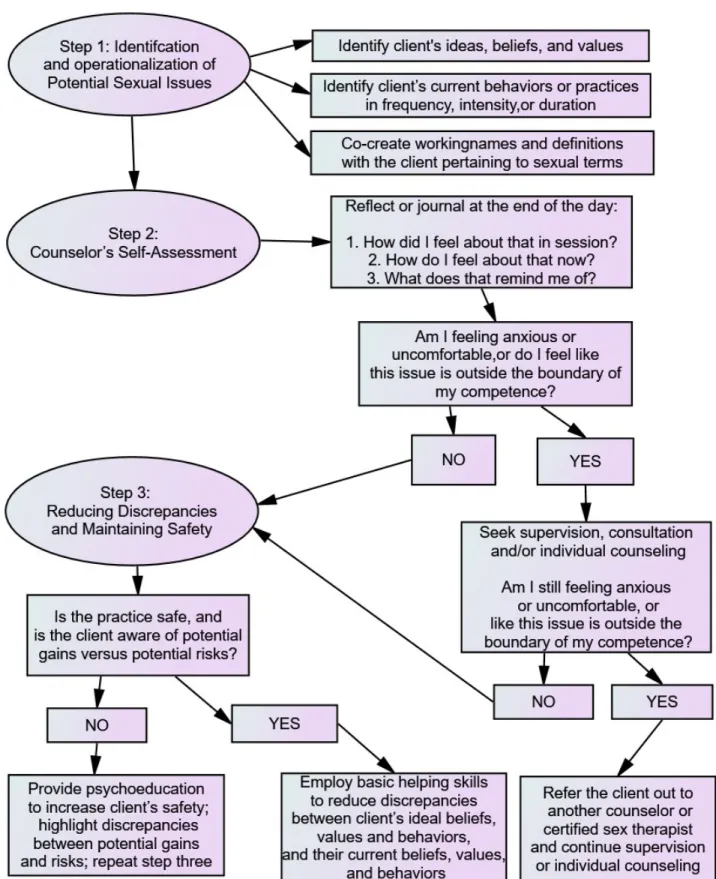
The Sexual Values and Behaviors Discrepancy Model We created the SVBDM to provide counselors with a con-crete order of operations to follow when working with clients to address their issues related to sexuality. The purpose of the model is to potentially increase counselors’ sense of comfort and/or confidence to assess and treat clients for those issues while simultaneously providing a series of steps (see Figure 1) to assist counselors in recognizing the boundaries and lim-itations of their professional competence.
In step one, the counselor works with their client to co-create working definitions of the client’s ideal and actual sex-ual values and practices. Simultaneously, in step two, the counselor reflects on their reactions to their client, the con-tent of the session, and pocon-tential areas for their own growth through consultation, supervision, and/or additional training. Lastly, in step three, the counselor works with the client to reduce discrepancies between the client’s ideal and practiced values and behaviors while also assessing for any potential
safety issues (e.g., high risk sexual behaviors; consent) that might affect the client. The following sections further delin-eate the components for each step of the SVBDM.
Step 1: Identification and Operationalization of Potential Sexual Issues
Researchers call for increased opportunities to assess for issues related to sexuality (Burnes et al.,2017;Hook,2007; Watkins,2008). Therefore, we follow Bloom et al.’s (2016) suggestion to create space in an intake session for clients to discuss their sexuality. Specifically, a counselor might leave a space on an intake questionnaire for the client to circle “yes” or “no” in response to a question that asks, “Have you or a friend or a loved one been concerned about your sex-ual activity?” Further, we encourage counselors to rely on their basic counseling skills (e.g., open-ended questioning, reflection of content, reflection of feeling, summarizing) to continue to explore any identified issue. If the counselor is unfamiliar with the term or issue identified by the client, we suggest the counselor ask non-invasive follow-up questions to clarify what the client’s issue is, even going as far as to co-create a definition of the presenting issue. For example, a client might report that they feel guilty for “cheating” on their partner by pursuing relationships online, even if they have not met any of those individuals in person. Thus, a counselor might ask the client, “What constitutes cheating, and what doesn’t?” As such, the client and counselor might co-create, lead by the client, a working definition of “cheat-ing” to mean pursuit of emotional relationships that feel non-platonic, even if they do not include physical contact. It is our hope that by creating an opportunity to ask about sex or sex-uality and having conversations regarding sexsex-uality, clients might feel more encouraged to be open about any presenting concerns that might be related to their sexuality.
It is necessary for the counselor to consider four do-mains of assessment in this step, including assessment of the client’s (1) current and (2) ideal beliefs or values as well as assessment of their own (3) ideal and (4) practiced behaviors. Regarding the client’s ideal and current beliefs or values, we recommend counselors reflect discrepancies between what the client currently believes or values and what they would ultimately like to believe or value. For example, a client might report that they believe that sex is a meaningless act (i.e., current belief), but the client wishes that they could ex-perience a meaningful sexual connection with a partner (i.e., ideal value).
Alternatively, a client might come to therapy with a pre-senting behavior that they currently practice that they wish to change. Regarding the assessment of a client’s ideal and practiced behaviors, it is necessary to note what the client is currently doing. For example, a client might report that they want to reduce the amount they masturbate on a daily basis. We recommend that counselors work in this step to
Bloom et al., 2019 Journal of Counseling Sexology&Sexual Wellness: Research, Practice, and Education
Figure 1. Sexual Values and Behaviors Discrepancy Model
Journal of Counseling Sexology&Sexual Wellness: Research, Practice, and Education Bloom et al., 2019 tify the client’s ideal beliefs or values and ideal behaviors
as well as their current beliefs or values and practices. We suggest counselors explore client behaviors in measures of frequency and duration. Considering the previous example, a client might report that they masturbate an average of three times per day and they want to reduce that frequency to one time per day on average (i.e., frequency). Alternatively, the client might report that they masturbate for two hours per day on average and would like to reduce that amount of time to a half hour per day on average (i.e., duration). Consequently, step one might require counselors and clients to continually revise a co-created definition of the problem as more infor-mation is gathered.
While beliefs and values can be more difficult to quantify, we suggest using scaling questions to evaluate the client’s intensity of their belief or value. Considering the previous example of a client who wants to experience partnered sex-ual activity as more meaningful, a counselor might use scal-ing questions to assist the client in identifyscal-ing that sexual activity currently feels like a “3” on a 10-point scale, where 10 represents high levels of meaning, and the client wants to experience partnered sexual activity as a “7” or higher. With this strategy, a counselor can assist the client in setting more objective goals and measure progress or stagnation towards meeting those goals.
While step one regards information gathering, it is neces-sary to note that behaviors are influenced by clients’ beliefs and values, and exploring their beliefs and values that influ-ence practiced or ideal behaviors is an integral part of the SVBDM that will be discussed in step three. Overall, the purpose of step one is to ensure that a counselor and client can speak the same language to understand what the client is currently experiencing in beliefs or values and behaviors and what they would like to experience instead. Consistent with Blount & Lambie (2017), we believe that sexual well-ness is likely to be achieved by low discrepancies between current and ideal practices/values; and areas for growth in-volve high discrepancies between current and ideal prac-tices/values. Therefore, the counselor can utilize informa-tion gained in step one to reduce discrepancies between the client’s ideal and current
Step 2: Counselor’s Self-Assessment
The SVBDM is a reflective model, and we believe it is es-pecially important for counselors to provide a safe and sup-portive environment in the counseling process due to the sen-sitive nature of sexuality. Therefore, we call for counselors to consider strategies to evaluate their own limitations in re-gard to their work with clients presenting to counseling with sexual issues and to make appropriate referrals to other pro-fessionals as necessary. While it is imperative for counselors to work within their boundaries of competence, we note that referrals to other professionals can be harmful for clients –
especially after a client has made a potentially sensitive dis-closure or has previous experiences of rejection – and refer-rals should only be considered as necessary when all other professional interventions have failed (e.g., supervision, ad-ditional training/education).
The second step of the SVBDM is for counselors to take a personal inventory of their beliefs, values, and experiences that might generate countertransference issues, negative re-activity, or anxiety regarding the client’s presenting content (i.e., low differentiation). For example, a client who reports that they are engaging in extramarital relationships might trigger a counselor to feel angry with the client if the content relates to the counselor’s previous experiences of infidelity in their relationship history. Or, perhaps the subject of infi-delity might make it difficult for the counselor to maintain unconditional positive regard if it goes against personal val-ues of fidelity. Regardless of whether the counselor’s reac-tivity is due to countertransference or possessing values dif-ferent from the client’s values, it is necessary for the coun-selor to take ownership of their reactivity and to take steps to reduce it (i.e., increase differentiation).
Ideally, we would recommend that counselors assess their reactivity simultaneously while working in session with the client. However, we recognize that discussion of sexual is-sues might be overwhelming to some counselors as docu-mented in previous research (e.g.,Bloom et al.,2016). Thus, counselors might be better able to serve their clients by set-ting aside some time at the end of their session or workday to think about the content reported in session and to ask them-selves, (1) “How did I feel about that in session?” (2) “How do I feel about that now?” and (3) “What does that remind me of?” Further, it is important for a counselor to evaluate, “How do I feel about people who want or do the things de-scribed in session?” If possible, we encourage counselors to write a journal response to these questions and then evaluate their own responses to determine if they are experiencing any anxiety or countertransference regarding the client, the pro-cess of working with the client, or the content of what was reported in session.
We suggest that if counselors are experiencing discomfort or anxiety, that they seek supervision and consultation to de-termine whether their work with the client is in the client’s best interest (ACA2014). For example, through supervision or consultation, a counselor with the support of a supervisor might recognize that it would be beneficial to seek individual counseling for their discomfort with discussing the client’s presenting issue. While exploring countertransference issues with another therapist, the counselor can make a more in-formed decision as to whether or not they can appropriately and ethically continue to work with the client, again under-standing that referring a client to another therapist is not an ideal outcome.
Furthermore, we suggest that counselors also explore how
Bloom et al., 2019 Journal of Counseling Sexology&Sexual Wellness: Research, Practice, and Education knowledgeable they feel about the presenting issue. If the
counselor feels comfortable working with the client regard-ing the presentregard-ing concern, but uncomfortable with their knowledge on the subject, the counselor could pursue super-vision and/or consultation to determine how they can learn more about the issue (e.g., additional training or continuing education opportunities). For example, it might benefit the counselor to meet with an educator through the American Association of Sexuality Educators, Counselors and Thera-pists (AASECT) to further assist the counselor in develop-ing their knowledge and skills. We believe that counselors can address sexuality-related issues as they do for more com-mon presenting issues (e.g., anxiety, depression) by relying on their basic skills paired with their theoretical orientation; it is important that counselors do not shy away from this work and confuse feelings of discomfort with a lack of skill. We are hopeful that through supervision or consultation, the counselor could continuously gauge whether or not they are able to work with the client within their boundaries of com-petence, or if it might be more beneficial for the counselor to refer the client to a specialist (e.g., a certified sex therapist). For example, if a counselor is working with a couple where one partner is experiencing pain during sex (e.g., Genito-Pelvic Pain Disorder), and the counselor is unfamiliar with the nuances of the diagnosis or corresponding treatment pro-tocol, the counselor is encouraged to refer the couple to a sex therapist. We hope that counselors who take an opportunity to assess their own discomfort will be empowered to make more informed decisions for themselves to best serve their clients. In summary, step two is labeled “Self-Assessment,” and it is intended as an opportunity for counselors to re-view their beliefs and values surrounding sex and sexuality to identify potential countertransference issues with clarity.
Step 3: Reducing Discrepancies and Maintaining Safety After the counselor has worked with the client using shared language to identify a sexual belief or value or be-havior that the client would like to address in therapy (Step 1), and the counselor has determined that they are working within their boundaries of competence to address the present-ing issue without countertransference or value interference (Step 2), we recommend that counselors assist their clients in identifying discrepancies between their current beliefs or val-ues and practices and their ideal beliefs or valval-ues and prac-tices. It is necessary to note that beliefs and values – like behaviors – are influenced by additional factors. In this way, we hope the counselor works with the client to explore fac-tors that might influence the client’s beliefs or values, such as social messaging, religious ideals, modeled behavior, previ-ous trauma, or intergenerational family patterns. We hope the open nature of the model allows counselors to pursue factors that are especially important or relevant to the counselor’s theoretical orientation.
As part of this process, it might also be helpful to recog-nize potential interactions between a client’s beliefs or val-ues and their behaviors. Clients who present with a behav-ioral goal might be unaware of how their behavior could be a manifestation of a belief or value. Therefore, exploring the beliefs or values compelling a client’s practiced or ideal be-havior could help the client to better identify their goals for counseling. As an example, if a client presents to counseling and reports that they want to stop masturbating, it might be helpful to explore the client’s motivation for their goal to bet-ter understand their pursuit of it. In this example, if the client wants masturbation to not interfere with their sexual activ-ity with their romantic partner, the counselor and the client can work together to deconstruct the influence of the client’s values on their behavioral goal. A solution-focused thera-pist might assist the client in identifying exceptions to the problem, and the issue might be resolved by the client’s in-creased awareness that their masturbation practices have not yet interfered in their sexual relationship with their romantic partner, and they do not need to abstain from masturbation.
Following the SVBDM, if a client presents for counsel-ing services and reports that they feel guilty for cheatcounsel-ing on their partner through online relationships, the counselor can work with the client to identify specific, measureable, and objective behaviors that the client is practicing (e.g., chatting online with non-platonic partners for two hours per day) and specific ideals and values the client possesses (e.g., “I should only flirt with my partner,” or “I should only find my partner attractive”). Then, the counselor can work with the client to identify the ideal behavior and value they would like to possess. For example, the same client might report “I wish I wouldn’t chat with anyone at all!” or identify “I wish I be-lieved that I could flirt with other people as long as I only engage in physical intimacy with my partner.” In accordance with step two, we hope the counselor examines their reac-tions to the client, the content of the session, and any po-tential areas for countertransference both in the session and reflectively after the session. Assuming the counselor does not find any issues to address in consultation or supervision and that the counselor believes they do not need to seek fur-ther educational opportunities or training on the subject of the client’s presenting issue, the counselor can begin to work to reduce the client’s perceived discrepancies.
Just as in the assessment process of step one, we recom-mend counselors rely on their basic counseling skills (e.g., reflection of content, reflection of feeling) and other tech-niques from their preferred theoretical orientation in the pro-cess of reducing discrepancies. For example, a psychody-namic counselor might explore a client’s relationships with members of their family of origin to identify parallels and patterns that are present in their romantic relationship. Simi-larly, an Adlerian therapist might use an open-ended question (e.g., “how was fidelity modeled for you by your parents’
Journal of Counseling Sexology&Sexual Wellness: Research, Practice, and Education Bloom et al., 2019 lationship?”) to explore a client’s early recollections and their
influence on the client’s private logic. Or, an existential ther-apist might use Socratic questioning (e.g., explore complex ideas, uncover assumptions, analyze concepts) to deconstruct the client’s value system.
While the SVBDM serves as a guiding tool for coun-selors to facilitate client change between ideal and practiced beliefs or values and behaviors, counselors must also con-sider whether the client’s goal(s) for therapy might be best achieved by altering the current beliefs or values or practices or by changing the ideal beliefs or values or practices. While it might make sense to imagine that counselors should work to help clients move towards their ideal beliefs or values and practices, some clients may present to counseling with unre-alistic ideals. As an example, if a client presents to counsel-ing with a stated goal of stoppcounsel-ing sexual activities with same-sex partners and a stated interest in pursuing exclusively het-erosexual relationships, counselors must recognize that the client might be struggling with their sexual identity and that conforming to heterosexual ideals might not be in the client’s best interest. Thus, a counselor following the SVBDM must consider that an appropriate counseling goal might be for a client to deconstruct their ideal beliefs or values and practices in order to better find acceptance of one’s current beliefs or values or practices. At the same time, it is also important for a counselor to recognize that a client might make behavioral choices (e.g., abstinence from sexual activity with same sex partners) in order to adhere to their belief system, even if it is inconsistent with what appears to be the client’s sexual orien-tation. For example, a male Muslim client who is attracted to other men might choose to not engage in same sex relation-ships in order to be consistent with their religious beliefs. In that way, it is important for the counselor to explore the in-teraction between the client’s beliefs, values, and behaviors, to establish realistic, attainable, and therapeutic goals for the client. As it relates to this example, we call for counselors to accept clients’ choices that are determined by the client as best for them at that time, so long as their choices are safe.
In the spirit of promoting wellness while preventing harm (American Counseling Association, 2014; Council for Ac-creditation of Counseling and Related Educational Programs, 2016), we recommend that counselors also assess for safety while gathering information pertaining to the client’s current and ideal practices and values. For example, if a client re-ports that they engage in unprotected sex with anonymous partners and the client appears to be unaware of risks that are associated with that behavior, the counselor could pro-vide psychoeducation to the client as a way to reduce po-tential harm as a result of sexual violence, unintended preg-nancy, or sexually transmitted infections. More specifically, the counselor is encouraged to address the client’s percep-tion of what might be gained or lost by continuing those behaviors, again aiming to reduce the discrepancy between
what the client wants (e.g., empowered sexual expression) and what the client is doing (e.g., increasing risk and oppor-tunity for potential harm). The counselor is encouraged to discuss the ideal practice and co-create a safer practice for the client.
Because no catalogue exists that delineates safe and un-safe behaviors for a client to practice, we recommend that discussions around safety are ongoing between the counselor and the client, as they work collaboratively in the client’s best interest. This process might be unique to each client, especially as it relates to their individual sexual practices and community membership. Discussions regarding safety might extend to discussions around consent, “coming-out,” or referrals to medical doctors to diagnose a client’s reported physical symptoms. Overall, assessment of safety and edu-cation – for both the client and the counselor – are on=going components of the model and are especially relevant in the assessment of current and future sexual ideals and practice.
We believe that one of the greatest strengths of the SVBDM for counselors is its adaptability to various theo-retical orientations and practices. Therefore, we encourage counselors to rely again on their basic counseling skills (e.g., paraphrasing, confrontation) and use of Socratic questioning to highlight discrepancies between the client’s current and ideal practices and values. However, we encourage coun-selors to operate from the theoretical orientation that res-onates for them in their clinical practice. Further, we be-lieve the model can be utilized with diverse clients and can be tailored for work across cultures/belief systems because the SVBDM calls for counselors to explore and honor a client’s worldview. As such, we encourage culture and background to be considered when evaluating the clients presenting is-sue in counseling, and suggest counselors continue to assess current and future practices as safe, while taking steps to mit-igate against unsafe practices (e.g., psychoeducation).
Conclusion
To our knowledge, the Sexual Values and Behaviors Dis-crepancy Model (SVBDM) is the first model intended for use by counselors to comprehensively address individuals’ dynamic identity and expression of sexuality (Yarber,2013), potential areas for counselors’ experience of countertransfer-ence (Heiden-Rootes et al., 2017), the call for counselors’ assessment and treatment of sexual issues (e.g., Goldberg et al.,2008; Bloom et al., 2016), and sound integration of theoretically supported principles that can be adopted into a counselor’s general practice. Counselors are encouraged in their implementation of this model to self-reflect frequently while working with clients who present with sex or sexuality concerns, to approach clients consistently with the core con-ditions to create and maintain safety within the therapeutic relationship, and to pursue specialized training for areas of specific interest. We recommend counselors utilize steps one
Bloom et al., 2019 Journal of Counseling Sexology&Sexual Wellness: Research, Practice, and Education and two simultaneously (e.g., information gathering and
self-reflection) throughout their work with clients. By means of consistent self-reflection, counselors may become aware of biases, concerns, or limitations of knowledge prior to work-ing with a client rather than durwork-ing the initial intake. We are hopeful that during this process, counselors are aware of their blind spots and limitations prior to accepting clients that are beyond the scope of their expertise. We believe one of the strengths of this model is in its orientation and focus on client safety in sexual practices and behaviors, which can be clouded by a counselor’s judgments or beliefs about a client’s perceived and ideal practices.
Through the review of current literature, we addressed the counselors’ need for increased skill, knowledge, and com-fort with discussing issues related to client sexuality by of-fering a general model for counselors to incorporate into their practice. We also encourage CACREP (2016) to con-sider the addition of new standards that would require coun-selor education programs to offer a course in human sexu-ality, as sex and sexuality concerns are common in client presenting issues (Ayres & Haddock,2009;Harris & Hays, 2008;Kazukauskas & Lam,2009;Sanabria & Murray,2018; Bloom et al., 2016). This model might be a useful tool to be included in a human sexuality course as a way to assist students early in their clinical training to understand the im-portance of assessment and self-reflection in their work with clients. Therefore, we hope counselor educators can use this model as a step by step process to follow in clinical case stud-ies and in role play situations with counselors-in-training.
Although this model is grounded in empirical research, it has yet to be tested. We call for future researchers to test counselor efficacy using this model in regard to the assess-ment and treatassess-ment of client issues related to sexuality. Fur-ther, this model is focused on clients’ report of how they are feeling or behaving and how they desire to be feeling or be-having. Although we recommend that counselors use their clinical judgment in step 3 to consider the appropriateness of ideal values or beliefs, this current model does not specifi-cally assess how adaptive or positive the clients’ beliefs, val-ues, or behaviors are. Future editions of this model might in-clude a sexual health assessment in order to manage healthy versus risky behaviors as well as assess the client’s sexual functioning (mitigating the self-report nature of the model). In addition, researchers can explore comfort and confidence of counselors who implement this model on sexuality/sexual issues versus those counselors who do not use a model as a point of reference. To enhance use of this model, we en-courage future researchers to develop an assessment of coun-selor comfort and knowledge of common sexual and sexual-ity concerns for counselors to use within their self-reflection (i.e., step two).
In conclusion, clients present to counseling with sexual issues regardless of counselors’ expertise. Researchers have
noted consistently that counselors’ feelings of discomfort or lack of preparation regarding sexual and/or sexuality con-cerns might be mitigating factors in the assessment and treat-ment clients’ sexual issues (Bloom et al.,2016). Therefore, we developed the SVBDM as a reflective model for coun-selors to follow to assist their clients in safely reducing dis-crepancies between their ideal and practiced sexual values and behaviors.
References
Adams, T., Bezner, J., & Steinhardt, M. (1997). The conceptualization and measurement of perceived well-ness: Integrating balance across and within dimen-sions. American Journal of Health Promotion,11(3), 208–218. doi:10.4278/0890-1171-11.3.208
Adler, A. (1954). Understanding human nature. Fawcett Premier.
Ali, S., & Bloom, Z. D. (2018). Creative approaches to address online dating in counseling. Jour-nal of Creativity in Mental Health, 14(1), 81–93. doi:10.1080/15401383.2018.1535922
American Counseling Association. (2014). Code of ethics. Author.
Ayres, M. M., & Haddock, S. A. (2009). Thera-pists’ approaches in working with heterosexual cou-ples struggling with male partners’ online sexual be-havior. Sexual Addiction&Compulsivity,16(1), 55– 78. doi:10.1080/10720160802711952
Barden, S., Conley, A., & Young, M. (2015). Integrat-ing health and wellness in mental health counselIntegrat-ing: Clinical, educational, and policy implications. Jour-nal of Mental Health Counseling, 37(2), 152–163. doi:10.17744/mehc.37.2.1868134772854247
Bloom, Z. D., Gutierrez, D., Lambie, G. W., & Ali, S. (2016). Counselors’ comfort with sexuality, attitudes towards pornography, and propensity to assess and treat client issues related to pornography use. Jour-nal of Mental Health Counseling, 38(4), 327–345. doi:10.17744/mehc.38.4.04
Bloom, Z. D., & Hagedorn, W. B. (2014). Male adolescents and contemporary pornography. The Family Journal, 23(1), 82–89. doi:10.1177/1066480714555672 Bloom, Z. D., & Taylor, D. D. (2015). New problems in
today’s technological era: An adlerian case example. The Journal of Individual Psychology,71(2), 163–173. doi:10.1353/jip.2015.0020
Blount, A. J., & Lambie, G. W. (2017). Development and factor structure of the helping professional well-ness discrepancy scale. Measurement and Evalua-tion in Counseling and Development,51(2), 92–110. doi:10.1080/07481756.2017.1358060
Bowen, M. (1993).Family therapy in clinical practice. Jason Aronson.
Journal of Counseling Sexology&Sexual Wellness: Research, Practice, and Education Bloom et al., 2019 Burnes, T. R., Singh, A. A., & Witherspoon, R. G.
(2017). Sex positivity and counseling psychol-ogy: An introduction to the major contribu-tion. The Counseling Psychologist, 45(4), 470–486. doi:10.1177/0011000017710216
Chiang, H. H. (2010). Liberating sex, knowing desire: scien-tia sexualis and epistemic turning points in the history of sexuality. History of the Human Sciences, 23(5), 42–69. doi:10.1177/0952695110378947
Connors, G. J., Carroll, K. M., DiClemente, C. C., Longabaugh, R., & Donovan, D. M. (1997). The therapeutic alliance and its relationship to alcoholism treatment participation and outcome. Journal of Consulting and Clinical Psychology,65(4), 588–598. doi:10.1037/0022-006x.65.4.588
Cooper, A. (1998). Sexuality and the internet: Surfing into the new millennium. CyberPsychology &Behavior, 1(2), 187–193. doi:10.1089/cpb.1998.1.187
Corey, G. (2016). Theory and practice of counseling and psychotherapy. Cengage Learning.
Council for Accreditation of Counseling and Related Educational Programs. (2016). 2016 standards for accreditation. Author. Retrieved from http:// www.cacrep.org/wp-content/uploads/2017/ 08/2016-Standards-with-citations.pdf Diamond, L. M., & Huebner, D. M. (2012). Is good sex
good for you? rethinking sexuality and health. So-cial and Personality Psychology Compass,6(1), 54– 69. doi:10.1111/j.1751-9004.2011.00408.x
Drescher, J. (2008). A history of homosexuality and orga-nized psychoanalysis. The Journal of the American Academy of Psychoanalysis and Dynamic Psychiatry, 36(3), 443–460. doi:10.1521/jaap.2008.36.3.443 Drescher, J. (2015). Out of DSM: Depathologizing
ho-mosexuality. Behavioral Sciences, 5(4), 565–575. doi:10.3390/bs5040565
Fairyington, S. (2008). Kinsey, bisexuality, and the case against dualism. Journal of Bisexuality,8(3-4), 265– 270. doi:10.1080/15299710802501876
Goldberg, P. D., Peterson, B. D., Rosen, K. H., & Sara, M. L. (2008). Cybersex: The impact of a contemporary problem on the practices of marriage and family ther-apists. Journal of Marital and Family Therapy,34(4), 469–480. doi:10.1111/j.1752-0606.2008.00089.x Harris, S. M., & Hays, K. W. (2008). Family therapist
com-fort with and willingness to discuss client sexuality. Journal of Marital and Family Therapy, 34(2), 239– 250. doi:10.1111/j.1752-0606.2008.00066.x
Heiden-Rootes, K. M., Brimhall, A. S., Jankowski, P. J., & Reddick, G. T. (2017). Differentiation of self and clin-icians’ perceptions of client sexual behavior as "prob-lematic". Contemporary Family Therapy,39(3), 207– 219. doi:10.1007/s10591-017-9412-3
Hermann, M. A., & Herlihy, B. R. (2006). Legal and eth-ical implications of refusing to counsel homosexual clients.Journal of Counseling&Development,84(4), 414–418. doi:10.1002/j.1556-6678.2006.tb00425.x Hertlein, K. M., & Stevenson, A. (2010). The seven “as”
contributing to internet-related intimacy problems: A literature review. Cyberpsychology: Journal of Psy-chosocial Research on Cyberspace,4(1).
Hettler, B. (1980). Wellness promotion on a university cam-pus. The Journal of Health Promotion and Mainte-nance,3(1), 77-95.
Hook, D. (2007). Foucault, psychology and the analytics of power (critical theory and practice in psychology and the human sciences). Palgrave Macmillan.
Hozid, Z. (2013). Gender identity "disorder"? a cri-tique of the binary approach to gender. Ethical Hu-man Psychology and Psychiatry, 15(2), 135.1–138. doi:10.1891/1559-4343.15.2.135
Human Rights Campaign. (n.d.). Policy and position statements on conversion therapy. Retrieved
from https://www.hrc.org/resources/
policy-and-position-statements-on -conversion-therapy
Iantaffi, A. (2016). Seeking sexual wellness in an unwell culture.Sexual and Relationship Therapy,31(2), 121– 122. doi:10.1080/14681994.2016.1168251
Kazukauskas, K. A., & Lam, C. S. (2009). Importance of ad-dressing sexuality in certified rehabilitation counselor practice. Rehabilitation Education, 23(2), 127–139. doi:10.1891/088970109805059137
Krupnick, J. L., Sotsky, S. M., Elkin, I., Simmens, S., Moyer, J., Watkins, J., & Pilkonis, P. A. (2006). The role of the therapeutic alliance in psychotherapy and phar-macotherapy outcome: Findings in the national insti-tute of mental health treatment of depression collab-orative research program. FOCUS, 4(2), 269–277. doi:10.1176/foc.4.2.269
Lambert, M. J., & Barley, D. E. (2001). Research summary on the therapeutic relationship and psychotherapy out-come. Psychotherapy: Theory, Research, Prac-tice, Training, 38(4), 357–361. doi:10.1037/ 0033-3204.38.4.357
Lambert, M. J., & Bergin, A. E. (2001). Therapist character-istics and their contribution to psychotherapy outcome. In A. E. Bergin & S. L. Garfield (Eds.),Handbook of psychotherapy and behavior change(4th ed.). John Wiley & Sons, Inc.
Moleiro, C., & Pinto, N. (2015). Sexual orientation and gender identity: review of concepts, contro-versies and their relation to psychopathology clas-sification systems. Frontiers in Psychology, 6. doi:10.3389/fpsyg.2015.01511
Mosher, C. M. (2017). Historical perspectives of sex
Bloom et al., 2019 Journal of Counseling Sexology&Sexual Wellness: Research, Practice, and Education ity: Contributing to a new paradigm within counseling
psychology.The Counseling Psychologist,45(4), 487– 503. doi:10.1177/0011000017713755
Myers, J. E., Luecht, R. M., & Sweeney, T. J. (2004). The factor structure of wellness: Reex-amining theoretical and empirical models underly-ing the wellness evaluation of lifestyle (WEL) and the five-factor wei. Measurement and Evaluation in Counseling and Development, 36(4), 194–208. doi:10.1080/07481756.2004.11909742
Myers, J. E., & Sweeny, T. J. (2005). Counseling for well-ness: Theory, research, and practice. American Coun-seling Association.
Norcross, J. C. (2011). Psychotherapy relationships that work: Evidence-based responsiveness(2nd ed.). Ox-ford University Press.
Norcross, J. C., & Lambert, M. J. (2011). Psychotherapy relationships that work II. Psychotherapy,48(1), 4–8. doi:10.1037/a0022180
Petersen, J. L., & Hyde, J. S. (2011). Gen-der differences in sexual attitudes and behav-iors: A review of meta-analytic results and large datasets. Journal of Sex Research,48(2-3), 149–165. doi:10.1080/00224499.2011.551851
Reissing, E. D., & Giulio, G. D. (2010). Practicing clini-cal psychologists’ provision of sexual health care ser-vices. Professional Psychology: Research and Prac-tice,41(1), 57–63. doi:10.1037/a0017023
Rice, E., Winetrobe, H., Holloway, I. W., Montoya, J., Plant, A., & Kordic, T. (2014). Cell phone internet access, online sexual solicitation, partner seeking, and sexual risk behavior among adolescents. Archives of Sexual Behavior,44(3), 755–763. doi:10.1007/ s10508-014-0366-3
Roach, L. F., & Young, M. E. (2007). Do counselor ed-ucation programs promote wellness in their students? Counselor Education and Supervision,47(1), 29–45. doi:10.1002/j.1556-6978.2007.tb00036.x
Rogers, C. R. (1957). The necessary and suffi -cient conditions of therapeutic personality change. Journal of Consulting Psychology, 21(2), 95–103. doi:10.1037/h0045357
Rogers, C. R. (1980).A way of being. Norton.
Sanabria, S., & Murray, T. L. (2018). In-fusing human sexuality content and counseling in counselor education curriculum. American Journal of Sexuality Education, 13(2), 190–204. doi:10.1080/15546128.2018.1457461
Schnarch, D. (1991). Constructing the sexual crucible : an integration of sexual and marital therapy. Norton. Siegel, D. (2010). Mindsight : the new science of personal
transformation. Bantam Books.
Watkins, M. (2008). Toward psychologies of liberation:
Critical theory in the practice of psychology and the human sciences. Palgrave Macmillan.
Witmer, J. M., & Sweeney, T. J. (1992). A holistic model for wellness and prevention over the life span. Jour-nal of Counseling& Development, 71(2), 140–148. doi:10.1002/j.1556-6676.1992.tb02189.x
Wong, D. (2015). Counseling individuals through the lifes-pan. SAGE.
World Health Organization. (2010). Developing sex-ual health programmes: A framework for ac-tion. Retrieved from https://apps.who.int/ iris/bitstream/handle/10665/70501/
WHO_RHR_HRP_10.22_eng.pdf;jsessionid= 9FDA2D7B230FD157F0A91666AF6C42DC ?sequence=1
Yarber, W. (2013). Human sexuality : diversity in contem-porary america(8th ed.). McGraw-Hill.
The Use of Technology in Sexual Exploration
Among a Rape Culture Youth
Kelley R. Holladay
University of New Mexico
W. Bryce Hagedorn
University of Central Florida
The present investigation sought to address the gap of research surrounding rape myth accep-tance attitudes and cyber-sexual assault (CBSA). Researchers examined data collected from a college sample of 94 undergraduate psychology students. The purpose of this investigation was to explore whether this sample of college students reported any potential stereotypes per-taining to cyber-sexual assault victims and whether the college students utilized technology for sexual exploration (e.g., creation, distribution, and receiving of sexually explicit material). In addition to identifying cyber-sexual victims, this study explored the correlation of gender with those responses. Results are reported, and suggestions for counselors are offered. The researchers hypothesize that rape culture acceptance attitudes have shifted to victims of online abuse, though more research is warranted to draw specific conclusions.
Keywords:cyber-sexual assault, revenge-porn, sexual violence, rape culture, college students
Introduction
The United States is the lead consumer of technology, and recent advancements have shifted the way we communicate (Marganski & Fauth,2013). This evolution of technology-facilitated conversations has transformed how individuals en-gage, which currently occurs most often through the avenues of cell phones, text messaging, and social media. Today, almost 85% of Americans own cell phones (Marganski & Fauth,2013), and nearly two thirds to three-quarters of cell phone users regularly send and receive text messages (Kohut et al.,2011;Smith,2011). As anticipated, text messaging is now the preferred means of communication among young adults (Marganski & Fauth, 2013; Smith, 2011). More-over, social media is a widely used platform among young adults, where some youth have reported being online "con-stantly" (Anderson & Jiang,2018). In fact, students spend nearly an hour on Facebook daily, as nearly 50% of stu-dents had logged onto their social media accounts multiple times throughout the day (Anderson & Jiang,2018; Spon-cil & Gitimu, 2013). With the rise and expansion of tech-nology, cell phones (e.g., text messaging), internet use, and social media sites have become the socially favored route of communication among peer groups. In light of this surge in technology usage among youth, communication researchers (Armstrong & Mahone,2017) pointed out that such avenues have extended how material is distributed, which includes sexually explicit material.
Cyber-sexual assault (CBSA), also known as "noncon-sensual pornography" or "revenge porn," is the nonconsen-sual sharing of sexually explicit images online, through so-cial media avenues like Facebook and Instagram (Holladay,
2016). Specifically, CBSA refers to the dissemination of sex-ually explicit images where one of the pictured individuals did not consent to the distribution of the material (Bartow,
2012; Bloom, 2016)). For example, the material can be posted by an ex-lover upon the ending of a relationship in ef-forts to taunt or humiliate the victim (Laird & Toups,2013). The definition of CBSA can also encompass other noncon-sensual distribution of intimate photographs, whether by a classmate or roommate, in efforts to bully or harass the vic-tim (Bartow,2012). Victims of CBSA can be shamed into silence when these private photos are made accessible for viewing by family members, friends, employers, schools, so-cial media networks, and more. Further, the sexually explicit images can be posted on hundreds of websites, almost stantly, resulting in one Google search of the pictured in-dividual’s name being overrun with the images (Citron & Franks,2014;Bloom,2016).
The mental health consequences associated with cyber-sexual assault are largely unknown. Recent quantitative (Holladay, 2016) and qualitative (Bates, 2016) literature
Corresponding Author Kelley R. Holladay University of New Mexico
Simpson Hall, 103 Albuquerque, NM 87131
E: [email protected] P: (505)277-1774
Holladay & Hagedorn, 2019 Journal of Counseling Sexology&Sexual Wellness: Research, Practice, and Education
identified constructs (e.g., depression, suicidal thoughts, emotional dysregulation, post-traumatic stress) common among sexual assault survivors for two smaller samples of CBSA survivors. Despite this, as of now, CBSA is not clas-sified as a form of sexual assault due to the lack of research, leaving victims with limited options for mental health care, while also leaving clinicians with no efficacious treatment approaches. Furthermore, prevalence rates have been diffi -cult to measure, because a victim’s speaking out can exac-erbate the assault (Citron & Franks, 2014). An invaluable research contribution, however, has recently identified that one in 25 Americans have been harassed with their sexually intimate photos or become victims of CBSA (Data & So-ciety Research Institute & the Center for Innovative Public Health Research, 2016). Meanwhile, researchers (Drouin, Vogel, Surbey, & Stills,2013) reported that 55% - 78% on individuals have engaged in sexting, or the sharing of sex-ually intimate material through technology. With such high prevalence rates for engaging in the creation and distribution of personal, sexually intimate material, we wondered what the prevalence rates were for those that blame victims who are harassed with their sexually explicit material. In a recent study that examined biases towards blaming rape victims (Felson & Palmore,2018), the researchers found that college students were more likely to engage in indirect blame; how-ever, the researchers’ also noted that college students were willing to use the word blame if they perceived a person’s own recklessness as having led to their misfortune (e.g., as-sault). Because cyber-sexual assault survivors participated in the creation of their material (in some cases), we wondered if survivors of cyber-sexual assault would experience increased levels of blame surrounding their assault?
This investigation was specifically tested for behaviors of college students’ in the creation, dissemination, and recep-tion of sexually explicit images. Addirecep-tionally, we explored the participants’ responses concerning those individuals who become victimized with their private, sexually explicit im-ages. Lastly, we explored the relationship of gender based on the participants’ responses. Overall, this study served to initiate the conversation surrounding current rape culture at-titudes, and how these may manifest through the prolifera-tion of CBSA. With this in mind, we first present current research on the use of technology with sexual exploration among young adults (e.g., creation and sharing of sexual ma-terial). This section includes literature on deviant behaviors and the nonconsensual sharing of another person’s private, sexual material. We conclude with how CBSA perpetuates rape culture acceptance attitudes.
Young Adults and Technology: When Sharing Intimate Images Digitally Goes Awry
An online cultural revolution has changed the way we in-teract both socially, and sexually. Sexting refers to the
self-creation (e.g., selfie) and the digital sending of a sexually explicit image, which is next transmitted through email, so-cial media, or cellphone (e.g., text message). Typically, the individual shares their private image digitally, with a roman-tic interest or partner (Humbach, 2014; Henry & Powell,
2014b). Due to the nearly immediate transmission of infor-mation online, images can be disseminated via technology quickly and broadly. Researchers (Henry & Powell,2014a,
2015) have noted that the taking of sexual photos may be a sexually healthy form of sexual exploration in the new age of technology. One of the unintended consequences, how-ever, can be a rapid and nonconsensual distribution of sex-ual photos; in these cases, the consequences for victims may be highly traumatic. Bloom (2016) noted that victims could spend their lives scrubbing their images from the web, across hundreds of websites, and due to the nature of the internet, those images may never be erased. The scope and frequency of CBSA, as highlighted above, encourages a social norm that sexual assault endured through technology is normal and the victims are to blame (i.e., rape myth acceptance; Holla-day,2016).
In a recent meta-analysis that reviewed 39 studies on sex-ting behaviors among youth (Madigan, Ly, Rash, Ouytsel, & Temple,2018), some of the literature pointed to a rise of sexting behaviors for this population (60%). The researchers also pointed out that multiple youth (8.4% - 12.0%) had ei-ther forwarded or received a sexual image without the pic-tured individual’s consent. This behavior could be due to rape myth acceptance attitudes (e.g., "they took the photo so they should expect it to be shared"). Conversely, it may stem from the anonymity of technology, which enables indi-viduals to continue to forward nonconsensual intimate mate-rial, while emotionally separating themselves from the crime. Either way, the sharing of sexually explicit material with a partner (Bloom,2016), and as a form of sexual exploration (Henry & Powell,2015), is no longer atypical. Consequently, approximately 10% of individuals have been threatened with their sexually intimate photos, where among these threats 60% of individuals reported that their intimate material was eventually shared without their consent (McAfee, 2013). In fact, one in 25 Americans have been threatened with or have become victims of CBSA (Data & Society Research Institute & the Center for Innovative Public Health Research,2016). This equates to nearly 10 million Americans, or 4%. De-spite prevalence numbers indicating CBSA was on the rise, ninety-four percent of Americans believe that their intimate photographs are safe in the hands of their current partners (Bloom,2016). In a national study (The National Campaign to Prevent Teen & Unplanned Pregnancy, 2008) exploring the sexting behaviors of teens and young adults, males and females reported the sharing of sexually intimate photos at nearly equal rates (young adult women, 36%; young adult men, 31%). However, this same study highlighted that the