Increased Fall Detection Accuracy in an Accelerometer-Based Algorithm
Considering Residual Movement
Panagiotis Kostopoulos
1, Tiago Nunes
1, Kevin Salvi
1, Michel Deriaz
1and Julien Torrent
21Institute of Services Science, University of Geneva, Switzerland 2Fondation Suisse pour les T´el´eth`eses, Neuchˆatel, Switzerland
{panagiotis.kostopoulos, tiago.nunes, kevin.salvi, michel.deriaz}@unige.ch, [email protected]
Keywords: Fall Detection, Smartwatch, Sensors, Residual Movement, Accelerometer, Alarm.
Abstract: Every year over 11 million falls are registered. Falls play a critical role in the deterioration of the health of the elderly and the subsequent need of care. This paper presents a fall detection system running on a smartwatch (F2D). Data from the accelerometer is collected, passing through an adaptive threshold-based algorithm which detects patterns corresponding to a fall. A decision module takes into account the residual movement of the user, matching a detected fall pattern to an actual fall. Unlike traditional systems which require a base station and an alarm central, F2D works completely independently. To the best of our knowledge, this is the first fall detection system which works on a smartwatch, being less stigmatizing for the end user. The fall detection algorithm has been tested by Fondation Suisse pour les T´el´eth`eses (FST), the project partner for the commercialization of our system. Taking advantage of their experience with the end users, we are confident that F2D meets the demands of a reliable and easily extensible system. This paper highlights the innovative algorithm which takes into account residual movement to increase the fall detection accuracy and summarizes the architecture and the implementation of the fall detection system.
1
INTRODUCTION
Unintentional falls are frequent and quite dangerous for elderly people. Yearly, more than 11 million falls are registered (Brown, 2005), leading to a wide spec-trum of injuries for this age group. Aside from caus-ing physical injuries, falls can also have dramatic psy-chological consequences that reduce elderly people’s independence (Ryynanen et al., 1992). It has been found that after falling, 48% of older people report a fear of falling and 25% report curtailing activities. Moreover, falls can also lead to disability and creased mobility which often results in increased de-pendency on others and, hence, an increased need of being admitted to an institution. Finally, one other se-rious consequence of falling is the ”long-lie” condi-tion where a falling person remains on the ground or floor for more than an hour after a fall. The ”long-lie” is a sign of weakness, illness and social isolation and is associated with high mortality rates among the el-derly. Time spent on the floor can be associated with a fear of falling, muscle damage, pneumonia, pres-sure sores, dehydration and hypothermia (Lord et al., 2001; Nevit et al., 1989).
In an attempt to minimize these serious
conse-quences of falling, various fall detection systems were developed over the last decade. These systems are mainly based on video-cameras (Nait-Charif and McKenna, 2004; Lee and Lee, 2009; Huang et al., 2008), acoustic (Alwan et al., 2006; Litvak et al., 2008) or inertial sensors (Hwang et al., 2004) and mobile phone technology (Sposaro and Tyson, 2009; Dai et al., 2010; Dumitrache and Pasca, 2013; Aguiar et al., 2014).
Common fall detection systems are based on a sensor detecting a strong vertical acceleration, launching an alarm when a fall event is recognized. More recent systems usually take into account other sensors able to detect the device’s orientation in or-der to determine whether the user is lying or standing. In (Dai et al., 2010) the authors present PerFallD, a system which combines the detection and the com-munication components using mobile phones. They compare it with existing academic and commercial solutions and conclude that their system is quite ac-curate despite the fact that they are using only low-cost sensors (the ones from an Android G1 phone). In (Sposaro and Tyson, 2009) the authors present iFall, another Android application tested on a G1 phone, which is focused on the communication between the
fall detection system and the alarm notification mod-ule, instead of the sensors only.
Most of the current fall detection systems require a base central. In this paper we propose a fall de-tection system (F2D) which works on a smartwatch, therefore completely independent from a base station. Using such a device is less stigmatizing for the user. In addition, it can be offered for less than half of the cost of existing systems on the market. Our system meets the requirements of reliability, ease of installa-tion and restricinstalla-tion of false positives (Doughty et al., 2000) which are essential for a properly built fall de-tection system.
F2D works on a smartwatch and therefore fixed on the wrist of the person. We have avoided the dis-advantages of (He et al., 2012) where the solution of the waist-mounted smartphone the authors provide is not feasible for two reasons: 1) Normally people do not wear their phones on the waist but in their pockets. 2) The system will be working only when the smart-phone is mounted on the waist and not at other times. Other problems such as the usage of intrusive devices exist in (Hou et al., 2012) and (Li et al., 2012), where the accelerometer and Bluetooth unit are bounded as a wearable unit and placed on the subject’s waist or chest.
Nowadays, simple smartwatches are very power-ful and have a set of sensors that can be used and diverted from their original intent. More computing power and storage on these devices offer greater op-portunities. Using a single smartwatch as a device for running the F2D application satisfies the condition of ease of installation of the fall detection system.
In general the fall detection algorithms wait for a response of the user after a possible fall in order to make a decision if the situation is critical or not. But this is not always applicable and convenient for the end user, especially for elderly people who are the target group of our research. In F2D we propose an accelerometer-based algorithm considering the resid-ual movement after the fall. This analysis is per-formed in the decision module of the F2D application which is responsible for the classification of a possi-ble fall pattern being a real fall event or not.
The rest of this paper is organized as follows. In Section 2 our designed fall detection system is scribed in detail emphasizing the innovative fall de-tection algorithm. Experimental results are reported and discussed in Section 3. Future improvements of our work to make F2D more robust are presented in Section 4. Finally, a brief conclusion is given in Sec-tion 5.
2
SYSTEM DESIGN
Our fall detection system is an Android application running on an AW-420.RX smartwatch of Simvalley Mobile. We have chosen the Android based solution because it is an open source framework designed for mobile devices. The Android SDK provides the API libraries and developer tools necessary to build, test and debug applications for Android. We implemented the prototype in Java using the Android SDK API 19. The fall detection algorithm, which is explained be-low, is implemented as a background service. When a fall is detected the service informs the main applica-tion, which notifies the caretakers (family or friends). There are several notification channels the user can choose from: call, SMS or email.
2.1
System Overview
We collect data from the accelerometer sensor of the smartwatch. Then we apply filters to detect patterns corresponding to a fall. We use a threshold based algorithm for the fall detection which takes into ac-count the residual movement of the user after the fall. The thresholds were selected based on experiments with different profiles of users (age, weight, height are factors that were taken into account). The deci-sion module combines different data coming from the filters as depicted in Figure 1, in order to make a deci-sion whether a possible fall corresponds to a real fall. If it is the case, the information is transmitted to the alarm module. When a potentially critical situation is detected, the smartwatch uses different communica-tion means (call, SMS, email) to inform the caretak-ers. Another important difference with the traditional systems is that the smartwatch communicates directly with the caretakers with no involvement of a base sta-tion and a centralized alarm.
Figure 1: System architecture.
2.2
Fall Detection Algorithm
The fall detection algorithm is implemented in a back-ground service and is running continuously. The user can operate his smartwatch as usual. F2D does not cause any interference with the normal usage of in-stalled applications. The algorithm is threshold based like (Dumitrache and Pasca, 2013), relying on the captured data of the accelerometer of the smartwatch.
We decided to use a threshold based algorithm and not a machine learning approach like (Aguiar et al., 2014) as it is less complex and therefore requires the lowest computational power (Habib et al., 2014). In the typical scenario, the user will use the application on his smartwatch normally during the day without the requirement of charging it much more than usu-ally. Since the fall detection system will run continu-ously, we should optimize the battery consumption of the device. Therefore, only the tri-axial accelerometer signal is used since it is the most informative sensor regarding the fall detection.
The algorithm distinguishes daily activities from falls. Activities of Daily Living (ADL) are normal activities such as walking, standing or running. The pattern of a fall must be different from the patterns of these activities. Acceleration data is sampled at 40 Hz from the 3-axis accelerometer sensor embedded in the Android smartwatch. Specifically, the sensor which provides acceleration information without the gravity component (linear acceleration) is used. We calculate the norm of the acceleration for each mo-ment as described in Equation 1.
acceleration=√x2+y2+z2 (1)
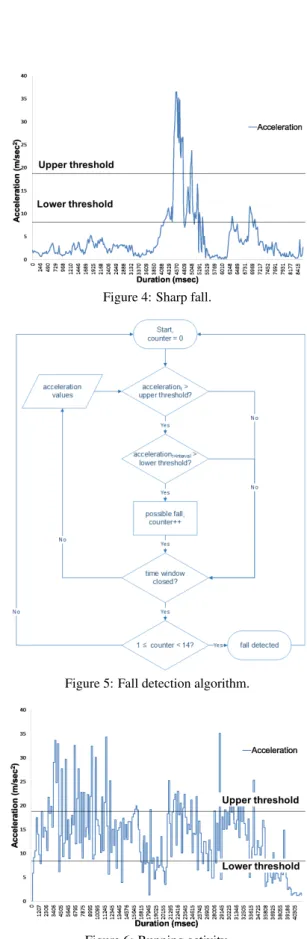
We have analyzed a set of data with 150 different simulated falls from different people involved in the experiments, as reported in Table 2, from our project partner FST. This company has a long experience in creating and using innovative products adapted to people with disabilities. Thanks to this data we have improved the detection of possible falls. We observed that all falls follow one of the three patterns which we have called smooth, strong and sharp. They are given in Figures 2, 3 and 4 respectively. The main differ-ence between them is the time interval of the residual movement after the fall Table 1. More specifically, when a fall takes place, the peak that exceeds the up-per threshold of the acceleration corresponds to the hit. After this, the pattern of the fall has a second peak, lower than the first one and exceeding the lower threshold. Finally, the acceleration returns to normal values. This behaviour of the acceleration after the first peak represents the residual movement that we take into account in the decision module for the char-acterization of a possible fall event as a real fall. 2.2.1 Time Window
The time window is an essential part of the fall de-tection algorithm. We have defined a time window in which we are able to recognize a fall pattern. This window is set to 6 seconds, a value which has been selected after conducting experiments, using the set
of data from simulated falls mentioned above. The main goal of the algorithm is the detection of all falls and at the same time the elimination of false positives. Building and testing our system we concluded that less than 6 seconds is not enough for the detection of all different types of falls. However, setting the win-dow to higher values creates a bigger occurrence of false positives.
2.2.2 Fall Pattern
The next step of the algorithm is the detection of a possible fall. In order to consider an activity as a pos-sible fall the two following conditions must be satis-fied: 1) If the acceleration exceeds an upper thresh-old which is set to 18 m/sec2. 2) If after a given time interval the acceleration exceeds a lower thresh-old which is set to 7m/sec2. The two thresholds have been selected based on the basic traoff between de-tecting all falls and avoiding false positives. This time difference between the two peaks represents the resid-ual movement of the user after a fall. The intensity of this movement depends on the profile of the individ-ual user. The three possible values of the time interval are given in Table 1.
If the two conditions are satisfied during the time window of 6 seconds then a possible fall is suspected. We can see in Figures 2 - 4 that this time window is sufficient for the satisfaction of the two conditions that should happen in order to detect a fall pattern. 2.2.3 Decision Module
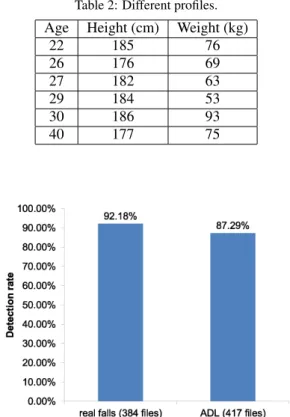
The final step of the fall detection algorithm is the classification of the fall pattern as real. In this deci-sion module a counter increases every time that both conditions of exceeding the thresholds are satisfied. The critical range of the values of the fall counter is (1≤counter<14). If (counter≥14), then it is due to another activity being performed (e.g., run-ning) which gives the difference in the acceleration values as we can see in Figure 6. On the other hand if (counter<1) it means the user at most did a sudden movement with his wrist and so the threshold condi-tions were not satisfied (e.g., when a user was going down the stairs in Figure 8). The graphical explana-tion and the structure of the fall detecexplana-tion algorithm is given in Figure 5.
2.3
Emergency Actions
If the algorithm decides that a fall has happened then the background service notifies the main application, which in turn sends a message to the caretakers.
The smartwatch communicates directly with the caretakers. In case of an alarm the loudspeaker of the watch is automatically turned on at a high volume and calls from caretakers are automatically answered. This allows the user to communicate even in uncom-fortable positions that could result after a fall.
Table 1: The three possible time intervals.
Smooth Strong Sharp 100 ms 300 ms 500 ms
Figure 2: Smooth fall.
Figure 3: Strong fall.
3
EVALUATION
For the evaluation of the reliability of the fall detec-tion mechanism in F2D we performed a series of ex-periments. We collected different types of falls’ data (i.e., forwards, backwards, sideways). We also col-lected activities of daily living data (e.g., walking, go-ing down the stairs, gogo-ing up the stairs) as we can see in Figures 7 - 9. Since it is very difficult to test
Figure 4: Sharp fall.
Figure 5: Fall detection algorithm.
Figure 6: Running activity.
a fall detection mechanism with elderly people, as it can more easily cause injuries, we performed the
ex-Figure 7: Walking activity.
Figure 8: Going down the stairs.
Figure 9: Going up the stairs.
periments with healthy adults. The test subjects were wearing smartwatches while falling on a mattress.
For testing the ADL the test subjects wore the smartwatches for 24 hours. Testers were doing all their daily life activities. As we can see in the Fig-ures 7 - 9 the acceleration values do not exceed the upper threshold. Hence, a suspected fall is not classi-fied as a real fall because the counter must exceed 0 in order to detect a real fall.
Moreover, we evaluated our fall detection
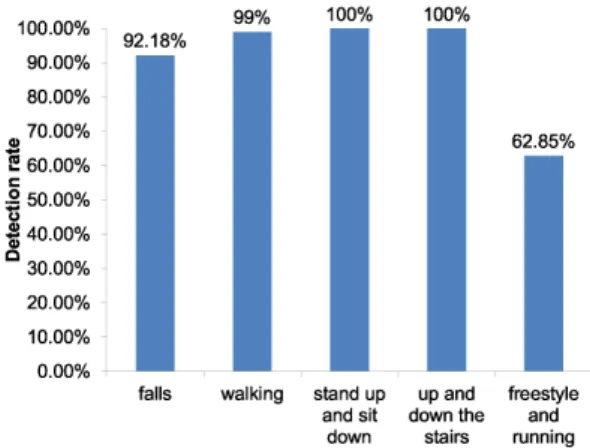
algo-rithm using a set of simulated falls and another set with ADL data, that we received from our project partner FST. This set consists of a subset of 384 sim-ulated falls and 417 ADL. The set of data that we are using is much larger comparing with other sys-tems (Dumitrache and Pasca, 2013) where only 34 simulated falls and 200 daily activities simulated by a single young person were used. Our data has been collected from 6 people with different profiles as re-ported in Table 2. The simulated falls took place in a room falling on a mattress in order to avoid injuries. Also the ADL were the following: walking, going up the stairs, going down the stairs, stand up from a chair, sit down on a chair, running. Based on these facts, it can be noted that the accuracy of our algorithm is quite high. We achieved a true positive rate (sensi-tivity) of 92.18% for the set of simulated falls and a true negative rate (specificity) of 87.29% for detecting the ADL data. The average of sensitivity and speci-ficity represents the accuracy of the system which is equal to 89.74%. The analytical results are presented in Figures 10 and 11.
Table 2: Different profiles.
Age Height (cm) Weight (kg)
22 185 76 26 176 69 27 182 63 29 184 53 30 186 93 40 177 75
Figure 10: Accuracy using real data from partner.
We conclude that the F2D system works reliably. Some false alarms were detected when the testers per-formed sudden movements with residual activity try-ing to simulate the same pattern of a fall event.
Figure 11: Decomposition of ADL and respective detection rate.
4
FUTURE WORK
The first step for further improvement of the robust-ness of our fall detection system is the reduction of false positives. We are planning to achieve this goal in three steps. The first step is the elimination of mis-leading direction of the movement of the smartwatch. We cannot expect to detect a fall when the direction of smartwatch is going up. Thanks to this recognition of the movement direction we will avoid some false positives coming from sudden movements which have similar patterns with a fall but in which the direction of the movement is going up.
The second step for reducing false positives is the use of adaptive thresholds. With the selected thresh-olds we cover most of the cases of a fall based on the experiments carried out in our lab and the data that we received from the end users of our project partner. With the adaptivity of the upper and lower thresholds we will make our fall detection system more generic and therefore allow a tailored response for each spe-cific end user. We expect further improvements to the fall detection as well as a reduction of the false posi-tives.
The third and last step in decreasing false positives is taking into account the users’ context. Common fall detection systems are based on a sensor detect-ing a strong vertical acceleration. But smoother falls (e.g., a person grabbing a chair, a table, or any other object) are not detected while some particular situa-tions (a user that sits abruptly on his sofa) lead to false alarms. To distinguish only the critical situations, we will take into account contextual data. For example, what happened before the fall, after the fall, at which place in the room, at what time of the day, or next to what object in a room. A user’s profile, continuously updated with his habits or particular behaviour, will
bring additional data to the user’s context. The cur-rent context (e.g., position, time) will be used in two different manners. The first is to define the variables of the filters in order to better differentiate the pos-sible (expected) patterns. For example, we can take into account the users’ height and weight as parame-ters for the algorithm. The second manner is to help the decision module. Once a possible fall is detected by the algorithm, we will check if it is likely that it is a real fall according to the current context.
Finally, thanks to the experience of our project partner with elderly end users, we will be able to test our fall detection system with real-world fall data in the future. Testing our algorithm in real-life condi-tions will give us the opportunity to create a more ro-bust automated alarm system with higher acceptance.
5
CONCLUSION
Fall detection is a research field that has a big impact on the improvement of the daily life of elderly people. In this paper we propose the first fall detection system designed to run on an independent smartwatch (F2D). There is no base station (which limits the range), no central alarm station (which is more difficult to man-age) and it works on a standard smartwatch. It implies that it is less stigmatizing for the end user, quite cheap comparing to existing systems and it is easily extend-able. F2D uses an innovative fall detection algorithm which takes into account the residual movement of the user in order to match a fall pattern to a real fall.
We have conducted a range of experiments in our lab and used real data from our project partner FST who has relevant experience in the domain involving real end users. These experiments demonstrated that the fall detection system is robust.
Based on the reliability of the fall detection and the restriction of false positives, which are guaran-teed by the fall detection algorithm, we have built a system which meets the requirements for deployment and use.
ACKNOWLEDGEMENTS
This work was supported by the Swiss Commission for Technology and Innovation (CTI grant 15876.2 PFES-ES). The authors would like to thank Anastasija Collen who helped to improve the quality of this pa-per.
REFERENCES
Aguiar, B., Rocha, T., Silva, J., and Sousa, I. (2014). Accelerometer-based fall detection for smart-phones. InMedical Measurements and Applications (MeMeA), 2014 IEEE International Symposium on. Alwan, M., Rajendran, P., Kell, S., Mack, D., and Dalal, S.
(2006). A smart and passive floor-vibration based fall detector for elderly. InProc. ICTTA’ 06.
Brown, G. (2005). An accelerometer based fall detec-tor: Development, experimentation, and analysis. In EECS/SUPERB.
Dai, J., Bai, X., Yang, Z., Shen, Z., and Xuan, D. (2010). Perfalld: A pervasive fall detection system using mo-bile phones. InPervasive Computing and Communi-cations Workshops (PERCOM Workshops), 2010 8th IEEE International Conference on.
Doughty, K., Lewis, R., and McIntosh, A. (2000). The desigh of a practical and reliable fall detector for community and institutional telecare. InJournal of Telemedicine and Telecare.
Dumitrache, M. and Pasca, S. (2013). Fall detection al-gorithm based on triaxial accelerometer data. In E-Health and Bioengineering Conference (EHB), 2013. Habib, M. A., Mohktar, M. S., Kamaruzzaman, S. B.,
Lim, K. S., Pin, T. M., and Ibrahim, F. (2014). Smartphone-based solutions for fall detection and prevention: challenges and open issues. In http://www.mdpi.com/journal/sensors.
He, Y., Li, Y., and Bao, S.-D. (2012). Fall detection by built-in tri-accelerometer of smartphone. In Biomedi-cal and Health Informatics (BHI), 2012 IEEE-EMBS International Conference on.
Hou, Y., Li, N., and Huang, Z. (2012). Triaxial accelerometer-based real time fall event detection. In Information Society (i-Society), 2012 International Conference on.
Huang, B., Tian, G., and Li, X. (2008). A method for fast fall detection. InProc 7th World Congr Intell Contr Autom.
Hwang, J., Kang, J., Jang, Y., and Kim, H. (2004). Devel-opment of novel algorithm and real-time monitoring ambulatory system using bluetooth module for fall de-tection in the elderly. InProc 26th IEEE EMBS Ann Int Conf.
Lee, Y. and Lee, H. (2009). Multiple object tracking for fall detection in real-time surveillance system. InProc 11th Int Conf Adv Commn Tec.
Li, Y., Chen, G., Shen, Y., Zhu, Y., and Cheng, Z. (2012). Accelerometer-based fall detection sensor system for the elderly. InCloud Computing and Intelligent Sys-tems (CCIS), 2012 IEEE 2nd International Confer-ence on.
Litvak, D., Zigel, Y., and Gannot, I. (2008). Fall detection of elderly through floor vibrations and sound. InProc 30th IEEE EMBS Ann Int Conf.
Lord, R., Sherrington, C., and Menz, H. (2001). Falls in older people: risk factors and strategies for prevention. InCambridge University Press. Cambridge.
Nait-Charif, H. and McKenna, S. (2004). Activity summari-sation and fall detection in a supportive home environ-ment. InProc 17th Inte Conf Patt Recog. Cambridge UK.
Nevit, M., Cummings, S., Kidd, S., and Black, D. (1989). Risk factors for recurrent nonsyncopal fall. a prospec-tive study. InJ Am Med Ass.
Ryynanen, O. P., Kivela, S. L., Honkanen, R., and Laippala, P. (1992). Falls and lying helpless in the elderly. InZ Gerontol.
Sposaro, F. and Tyson, G. (2009). ifall: An android applica-tion for fall monitoring and response. InEngineering in Medicine and Biology Society, 2009. EMBC 2009. Annual International Conference of the IEEE.