Succeed. Transform. Compute. Perform.
WHITE PAPER
Using the Profitability Factor and
Big Data to Combat Customer Churn
The Alacer Group July 2013 page 1 Highlights
To combat customer churn within the mobile telecommunications industry, the Alacer Group used big data combined with an understanding of profitability to help a Tier 1 carrier better target its marketing efforts.
Using the Profitability Factor and
Big Data to Combat Customer Churn
EXECUTIVE SUMMARY
In the increasingly competitive mobile telecommunications industry, retaining customers is a challenge that Tier 1 carriers are aggressively rising to meet. While many marketing efforts to combat churn are still reactive, the Alacer Group recently developed a model for an American telecommunications company that outlined proactive approaches for contacting customers before they decide to change service providers. Looking at more than 70 different data points on over 70,000 customers, we created a binary logistic regression that could predict with 60% accuracy whether or not a customer will churn. We then considered the Probability Factor, and calculated each customer’s value to the carrier to create individual Profit-Churn scores. The results determined where each customer fit into a four-quadrant matrix, which gave the service provider a road map for determining the best actions for each audience.
A PERVASIVE PROBLEM: CUSTOMER CHURN
The American mobile telecommunications industry has matured from its early days of explosive growth to a saturated and fiercely competitive market where carriers are battling to simply retain existing customers. The current buzzword within the industry is customer churn, a term used to describe customers who voluntarily unsubscribe to join a competitive carrier. It’s become so pervasive that the industry now has one of the highest customer churn rates in business; as an example, in August 2012, T-Mobile’s churn rate was 2.10 percent, which may seem miniscule until you factor in its millions of subscribers. As a result, many companies are redirecting vast sums of their marketing dollars from developing customer acquisition programs to devising churn management strategies. In fact, the analysts at Gartner Research recently reported that the marketing budget allocated to retaining customers and increasing loyalty through customer service will more than double by 2015.
Most often, service providers are reactionary in their efforts to address voluntary churn. But what if unstructured data could be used to develop a model that could identify the most lucrative customers and help develop a proactive program for ensuring their loyalty? Big data offers just this opportunity.
With this in mind, the Alacer Group recently worked with a Tier 1 service provider to leverage its customer data, which could then be used to create a proactive churn management program. Using 75 relevant data
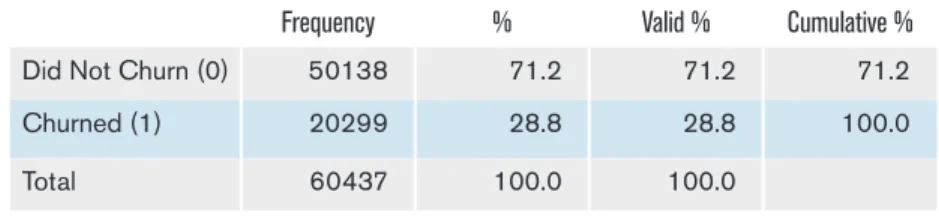
The Alacer Group July 2013 page 2 points for each of approximately 70,000 customers, 28.8% of which had churned (see Figure 1), we could design a useful churn prediction model for restructuring marketing operations.
DEVELOPING A CHURN SCORING MODEL
In order to predict the likelihood of a customer churning, it is important to understand what variables may cause a customer to leave in the first place. To do this, we created a Churn Scoring Model using binary logistic regression. We began by dividing our data set into estimation and validation samples; the first was to be used to create a predictive model, with the validation sample as a test of the model’s performance. Next, a logistic regression was created using almost all of the independent variables as inputs and the binary churn variable as the output. If done manually, it would take a long time to test and eliminate the many independent variables that are either not statistically significant or that have high correlations with other independent variables used in the model. Fortunately, IBM’s SPSS statistical software has a feature that automates much of the variable selection process. With most of the 75 independent variables inputted into a logistic regression, we ran an analysis using the Backward: Conditional method. This analyzes all variables and then eliminates them one-by-one until a desired model is achieved. With this regression model, we identified 36 of the independent variables that are statistically significant for predicting customer churn (see Exhibit 1); however, at this point the model is not yet complete. In its current format, it only gives us a t score, as shown:
The t score is not very helpful in itself, but it can be converted into a Bernoulli Probability by applying this formula giving us our scoring model:
With the scoring model complete, we can apply it to our validation sample and evaluate its predictive performance. We exported the t score model using the Propensity to Purchase option in the Direct Marketing module in SPSS, and applied this to our validation sample using SPSS’s Apply Scores from Model feature.
Fig 1—Customer Churn Status, 31-60 days after obs_date
Frequency % Valid % Cumulative %
Did Not Churn (0) 50138 71.2 71.2 71.2
Churned (1) 20299 28.8 28.8 100.0
Total 60437 100.0 100.0
1
𝑡𝑡 = 𝛽𝛽!+ 𝛽𝛽!𝑥𝑥!+ 𝛽𝛽!𝑥𝑥!+ ⋯
𝑝𝑝 𝑦𝑦= 1|𝑡𝑡 =1 +𝑒𝑒𝑡𝑡𝑒𝑒𝑡𝑡
Figure 3 – Binary Logistic Regression Model Quality Score
Figure 4 – Expected Profit vs. Average Profit Comparison
1
𝑡𝑡 = 𝛽𝛽!+ 𝛽𝛽!𝑥𝑥!+ 𝛽𝛽!𝑥𝑥!+ ⋯
𝑝𝑝 𝑦𝑦= 1|𝑡𝑡 =1 +𝑒𝑒𝑡𝑡𝑒𝑒𝑡𝑡
Figure 3 – Binary Logistic Regression Model Quality Score
Figure 4 – Expected Profit vs. Average Profit Comparison
The Alacer Group July 2013 page 3 As a result, each customer received a Predicted Value and a Selected Probability (that y=1). We then grouped the Selected Probability values into seven different bins (Figure 2).
We noted that more than 1,000 customers were not given a churn score. Initially, we used the age of the head of household as a variable factor; however, more than 20,000 customers were shown to either not have a listed age (hence no score), or an age of 0 (impossible), so age was not a useful variable.
After removing age as a variable factor, we ran the Backwards: Conditional binary logistic regression again (see Figure 3). We also computed a new “accuracy test” variable, which was the sum of the value of the actual churn result (0 or 1) and two times the churn value predicted by our model (0 or 2).
Values of 0 = the model correctly predicted someone would not churn (42.7%) Values of 1 = the model incorrectly predicted someone would not churn (12.4%) Values of 2 = the model incorrectly predicted someone would churn (28.4%) Values of 3 = the model correctly predicted that someone would churn (16.4%)
Fig 2—Distribution Of Churn Probability Valid probability
of churn Frequency % Valid % Cumulative %
<40% 12698 18.0 18.0 18.0 40-50% 26151 37.1 37.1 55.2 50-60% 22616 32.1 32.1 87.3 60-70% 7361 10.5 10.5 97.7 70-80% 1420 2.0 2.0 99.7 80-90% 173 .2 .2 99.7 90-100% 18 0 0 100.0 Total 70437 100.0 100.0
Fig 3—Binary Logistic Regression Model Quality Score
A good model has a value above 0.5. A value below 0.5
indicates the model is not better than random prediction.
The Alacer Group July 2013 page 4 Overall, the model was accurate 59.1% of the time in predicting whether or not a customer would churn (42.7 + 16.4 = 59.1). We then decided that the profitability of each customer was important to consider as well.
THE PROFITABILITY FACTOR
Sprint CEO Dan Hesse recently confirmed the importance of the Profitability Factor. In his April 2013 conference call with shareholders, he explained that mobile operators can’t rely on adding new high-value contract subscribers to boost their bottom lines. Instead, companies will need to focus on retaining the customers they have, while encouraging individual subscribers to spend more.
That said, the goal for any voluntary churn reduction program is revenue stabilization and augmentation. Looking at a subscriber’s profitability is arguably a better model for developing a targeted marketing program than utilizing overall subscription numbers as a benchmark. Not all subscribers are equal in value; in fact, based on cost vs. profitability, there are some customers that it might be wiser for a service provider to proactively lose from a revenue standpoint.
By considering the profitability of each of customer in addition to his or her likeliness to churn, we can determine if some churn is desirable, identify high value customers who should be proactively targeted to remain loyal, and develop an overall action plan.
In order to analyze the data in a way that provides insight into customer profitability, we used the customer lifetime value (CLV) approach to perform an annual profit & loss analysis for each subscriber. Because the data is missing actual costs, we made the following assumptions:
• Monthly COGs = 40% of monthly revenue • Monthly Directas Cost/Call = $0.50
Director assisted call representative wage = $10/hr Director assisted call representative productivity = 20 calls/hr • Monthly Custcare Cost/Call = $1
Customer care service representative wage = $10/hr Customer care service representative productivity = 10 calls/hr • Monthly Retcalls Cost = $2.50 * (# of Calls / # of Months in Service)
Retention team call representative wage = $15/hr Retention team call representative productivity = 6 calls/hr • Monthly Phone Cost = $12.50 * # of Phones
Average phone cost to company = $300 Average phone life = 24 months
“mobile operators
can’t rely on adding
new high-value
contract subscribers
to boost their bottom
lines.”
The Alacer Group July 2013 page 5 We then took the profitability for each customer and discounted it using a hurdle rate of 10% (we assumed an annual cost of capital of 10%). Using the calculated annual value for each customer and each customer’s credit rating, we calculated each customer’s ongoing monthly expected profit by using the formula: Monthly Expected Profit = (Monthly Revenue – Monthly Cost) – (Monthly Cost * Default Rate)
For default rates, we used the national average credit default ratings (left).
With each customer’s Monthly Expected Profit calculation, we could now compare an individual’s profitability. We were astounded to learn that while 35.37% of the company’s customers are more profitable than the average customer, these customers generate more than half (61.52%) of the cumulative Monthly Expected Profit (Figure 4).
To better visualize the distribution of profitability, we grouped customers into seven bins according to each customer’s expected profit. We ob-served that 10% of customers are significantly more profitable than the average customer (>1 standard deviation, bins 5-7) and 737 customers appear to be unprofitable (bin 0).
RECOMMENDATIONS
By melding the Churn Model with the Profitability Factor, the service provider gets a useful framework for making more informed marketing decisions, and can concentrate retention efforts on those highly profitable customers who are most likely to churn. These are the customers the carrier cannot afford to lose. Unprofitable subscribers who are likely to churn can either be let go as customers or can be enticed to move to a profitable status.
Credit
Score 300 - 549 550 - 599 600 - 649 650 - 699 700 - 749 750 - 799 800 - 850 Default
Rate 71% 51% 31% 15% 5% 2% 1%
The Alacer Group July 2013 page 6 Using the seven bins from the Churn and Profitability scores, each
customer’s combined score is used to assign him or her to a quadrant. For example, a customer with a Profitability score of 7 and a Churn score of 5 gets a combined score of 75. Each two-digit score can be read as a set of X,Y coordinates.
The quadrant boundaries were created from the company data set at break points driven by business needs. The Churn axis breaks between 2 and 3 where there is a 50% or more probability of churn. The
Profitability axis breaks between 3 and 4 where the mean profitability was calculated. Figure 7 illustrates the breakdown of the quadrants and the customer distribution.
Within each quadrant, marketing efforts would be prioritized based on Expected Churn Loss:
Expected Churn Loss = Monthly Expected Profit * Probability of Churn
Fig 6—Profitability/Churn Action Matrix
“Unprofitable
subscribers who are
likely to churn can
either be let go…
or enticed to move
to a more profitable
status.”
Fig 5—Customer Profitability Distribution
Valid Frequency % Valid % Cumulative %
Negative 737 1.0 1.0 1.0 > -1 Std Dev 2801 4.0 4.0 5.0 < -1 Std Dev 41986 59.6 59.6 64.6 < +1 Std Dev 17810 25.3 25.3 89.9 > +1 Std Dev 4348 6.2 6.2 96.1 > +2 Std Dev 1548 2.2 2.2 98.3 > +3 Std Dev 1207 1.7 1.7 100.0 Total 70437 100.0 100.0
As an example, this calculation could help determine if a Profit7-Churn6 individual should be addressed before a Profit6-Churn7 customer. The actionable predictors of churn can now be used to develop specific
marketing actions appropriate to each customer. Here are a couple of ways churn predictors could help determine how the company could retain a valued customer:
• Subscriber has called customer service. The customer service team would know (via integrated CRM) that this customer is a priority; likewise, during workload management for callbacks, profitable customers who are likely to churn would be at the top of the work queues.
• Higher unique subscribers: This would indicate that the customer does a lot of business and will regularly shop for volume discounts. The service provider could discount additional lines and offer to
consolidate any lines the subscriber has with competitive carriers. • Children in household: The carrier could offer discounted family plans to encourage children to join the plan instead of choosing a competing offer.
• High credit rating: Customers with high credit ratings can easily leave and are not locked into a plan. The service provider can offer early discounts to extend a 24-month commitment, a few months prior to plan expiration.
In conclusion, while Churn and Profitability/CLV models are not new, this unique quantitative approach of combining churn with the Profitability Factor is a new twist. Through a simple scoring model similar to RFM, service provider marketers can now prioritize their retention actions for the best customers.
The Alacer Group July 2013 page 7
“…churn predictors
could help determine
how the company
could retain a valued
customer…”
The Alacer Group July 2013 page 8 Seattle :: Dallas :: New York www.alacergroup.com +1 800 414-5170 -2 Log likelihood Cox & Snell R Square Nagelkerke R Square
1 53178.922a .042 .056
34 53201.048a .041 .055
Model Summary
Step
B S.E. Wald df Sig. Exp(B)
revenue .00173783 .001 5.082 1 .024 1.002 mou -.00025644 .000 38.659 1 .000 1.000 recchrge -.00289557 .001 11.215 1 .001 .997 overage .00085752 .000 10.107 1 .001 1.001 roam .00688599 .002 11.818 1 .001 1.007 changem -.00049513 .000 88.434 1 .000 1.000 changer .00217132 .000 35.969 1 .000 1.002 dropvce .00795962 .002 24.849 1 .000 1.008 blckvce .00311351 .001 8.315 1 .004 1.003 unansvce .00083462 .000 4.113 1 .043 1.001 custcare -.00602921 .003 5.765 1 .016 .994 threeway -.03294184 .011 8.483 1 .004 .968 outcalls .00102671 .001 3.492 1 .062 1.001 incalls -.00293776 .001 8.980 1 .003 .997 peakvce -.00059728 .000 8.739 1 .003 .999 months -.01953363 .002 97.397 1 .000 .981 uniqsubs .19068780 .020 91.896 1 .000 1.210 actvsubs -.21070478 .027 58.730 1 .000 .810 phones .05159926 .013 16.382 1 .000 1.053 eqpdays .00145299 .000 404.793 1 .000 1.001 children .10761678 .027 16.322 1 .000 1.114 creditaa .06878241 .030 5.154 1 .023 1.071 creditb .08967838 .034 6.871 1 .009 1.094 creditc -.11003307 .041 7.277 1 .007 .896 creditde -.30767517 .040 58.441 1 .000 .735 prizmub -.05371995 .022 5.749 1 .016 .948 refurb .23448797 .031 55.427 1 .000 1.264 webcap -.15690567 .037 17.705 1 .000 .855 marryun .09235302 .027 11.780 1 .001 1.097 mailres -.15549665 .025 37.408 1 .000 .856 newcelly -.06607626 .026 6.305 1 .012 .936 income -.01062298 .004 6.156 1 .013 .989 creditad -.06110406 .032 3.570 1 .059 .941 setprcm -.10878176 .040 7.383 1 .007 .897 setprc .00062148 .000 4.925 1 .026 1.001 retcall .72729224 .057 160.784 1 .000 2.069 Constant -.00796744 .081 .010 1 .921 .992
Variables in the Equation
Step 34a