O C C A S I O N A L PA P E R S E R I E S
N O. 2 5 / M A R C H 2 0 0 5
GOVERNMENT DEBT
MANAGEMENT IN THE
EURO AREA
RECENT THEORETICAL
DEVELOPMENTS
AND CHANGES IN
PRACTICES
by Guido Wolswijk
and Jakob de Haan
In 2005 all ECB publications will feature a motif taken from the €50 banknote.
O C C A S I O N A L PA P E R S E R I E S
N O. 2 5 / M A R C H 2 0 0 5
GOVERNMENT DEBT
MANAGEMENT IN THE
EURO AREA
RECENT THEORETICAL
DEVELOPMENTS
AND CHANGES IN
PRACTICES
1by Guido Wolswijk
2and Jakob de Haan
3This paper can be downloaded from the ECB’s website (http://www.ecb.int).
©European Central Bank, 2005 Address Kaiserstrasse 29 60311 Frankfurt am Main Germany Postal address Postfach 16 03 19 60066 Frankfurt am Main Germany Telephone + 4 9 6 9 1 3 4 4 0 Website http://www.ecb.int Fax + 4 9 69 1 3 4 4 6 0 0 0 Telex 4 1 1 1 4 4 e c b d
All rights reserved. Reproduction for educational and non-commercial purposes is permitted provided that the source is acknowledged.
The views expressed in this paper do not necessarily reflect those of the European Central Bank.
ISSN 1607-1484 (print) ISSN 1725-6534 (online)
C O N T E N T S
EXECUTIVE SUMMARY 4
1 INTRODUCTION 6
2 GOVERNMENT DEBT MANAGEMENT
OBJECTIVES 6
3 ORGANISATION OF DEBT MANAGEMENT 8 4 GOVERNMENT DEBT MATURITY 9 5 INFLATION-INDEXED GOVERNMENT DEBT 13 6 CURRENCY DENOMINATION OF DEBT 15
7 DEBT OWNERSHIP 17
8 ISSUING AND TRADING PRACTICES 18 Issuance policies 18 Distribution channels 18 Electronic trading systems 19 9 CONCLUSIONS AND OUTLOOK 19
ANNEX 21
E X E C U T I V E S U M M A R Y
Government debt management in the euro area is evolving rapidly. The introduction of the euro in 1999 had a major impact on the operations of debt managers as the disappearance of exchange rate risks within the euro area created the conditions for a pan-European capital market. As a result, debt managers have become direct competitors in the European capital market. The decrease in government deficit and debt ratios in the run-up to Economic and Monetary Union (EMU), resulting in a reduction in supply of government debt instruments, and the rapid expansion of electronic trading systems are other developments which have affected the environment in which debt managers operate. This paper reviews recent developments in the management of government debt in the euro area, covering both theoretical and practical aspects. In particular, it focuses on key aspects of debt management, i.e. the objectives of debt management, its organisation, the maturity of debt, inflation-indexed debt, the currency denomination of debt, the ownership of debt, and debt issuing and trading practices.
The objectives of debt management agencies in the euro area have remained more or less the same: the financing of public debt at low costs with acceptable risks. This focus on budgetary costs differs from recent academic literature on debt management, in which deficit stabilisation is often regarded as an objective. The aim there is to avoid increases in deficits above 3% of GDP using a variety of debt instruments.
The autonomy of debt management agencies was already increasing before the start of EMU. However, it received an additional boost from the introduction of a more competitive environment, as reflected in greater autonomy for the larger debt management offices in recent years, either as part of the national ministry of finance or as a separate unit outside the government sector. Increased independence has gone hand-in-hand with
more detailed strategic goals and practical guidelines for the agencies, often setting targets or limits for key elements such as maturity and refinancing risk.
The residual maturity of debt in the euro area is converging, with the average maturity now close to six years. Some high-debt countries have seized the opportunity to expand longer-term financing on more favourable longer-terms while a few others have increased the issuance of short-term government bills, partly with a view to establishing benchmarks in that segment of the capital market. Another development in this area, following the establishment of a euro swap market, is the steering of the duration of debt by use of interest rate swaps. This allows debt managers to issue debt instruments in the most liquid, longer-term capital market segment (usually 10-year maturity) and at the same time take advantage of lower short-term interest rates.
Within the range of debt instruments issued, inflation-indexed debt is increasingly popular among debt managers, although starting from a low level. Whereas, in the past, cost savings and establishing credibility were the main reasons for issuing this type of debt, establishing one’s name in a market that is potentially fast-growing now seems to be the prime motivation. For investors, portfolio diversification can be an important reason for investing in this type of bond, despite low inflation expectations. For pension funds in particular, matching inflation-linked liabilities is another reason.
After the changeover to the euro, government debt managers put less emphasis on issuing debt denominated in non-domestic currencies. This mainly reflects the large pool of resources now available in euro, reduced fears of crowding-out and the opportunity to attract foreign investors when issuing in the domestic currency (euro). Less than 2% of government debt in the euro area is now denominated in currencies other than euro.
S U M M A R Y Foreign ownership of euro area government
debt has increased markedly, as the introduction of the euro has made it much easier to invest in the euro area, reducing the national bias. Large increases in foreign ownership were seen in particular in some smaller euro area countries, where the share of non-domestic ownership doubled in the space of a few years.
Increased emphasis on the liquidity of issuances, with a view to securing the lowest possible funding costs, is reflected in issuance and trading practices. Most bonds offered today are standard, “plain vanilla” securities, which are easy to trade. Nearly all euro area debt managers distribute newly issued bonds via primary dealers. Increasingly, government bonds are traded on electronic trading platforms.
Thus, overall, there is a tendency towards convergence on key aspects of debt management. Rather than representing a break with the past, the introduction of the euro has supported and strengthened trends already under way. However, convergence has not been equal in all aspects and is taking place at different speeds. More recently, some divergence in debt management operations seems to be re-emerging, mainly reflecting the desire of debt managers to be leading players in niche areas.
1 INTRODUCTION
Government debt management practices in the euro area are evolving rapidly. The working environment of government debt managers in the euro area has been transformed considerably during the last few years. This has changed debt management in many ways, often with the effect of reinforcing existing trends. The introduction of the euro in 1999 was a major change, creating the conditions for a pan-European capital market. Exchange rate risks within the euro area no longer exist, market conventions have been harmonised and efficient linkages between European settlement systems have been established. Debt managers have become small to medium-sized players in a larger European capital market, instead of being the dominant player in the national market. Consequently, competition among debt managers has increased, stimulating a more efficient primary market and a deeper, more liquid secondary market. Lower government deficits and debts have also affected the work environment of debt managers. From around 5% of GDP in 1995 the average deficit in the euro area declined until 2000, when a position very close to balance was reported.1 After peaking at above 75% of GDP
in 1997 the average gross government debt ratio in the euro area declined until 2002, when it stood at 69% of GDP. Reduced gross borrowing needs prompted discussions on which instruments to use to finance debt, how to preserve liquidity in the market, and what role there is for interest rate swaps.2 This
debate has partly abated with the return of significant deficits (averaging 2¾% of GDP in the euro area in 2003) and a new rise in the average debt ratio in the euro area (to more than 70% of GDP in 2003).
An additional factor that has had an important impact on debt management is the introduction and expansion of electronic trading systems, which has changed the organisation of securities trading.
1 Part of the favourable budgetary development resulted from sales of UMTS licenses, resulting in one-off receipts of about 1% of GDP.
2 Gross borrowing includes borrowing to finance the def icit (net borrowing) and borrowing to f inance redemptions. 3 See Favero et al. (1999) and Missale (1999) for comprehensive
studies on government debt management before EMU.
These developments have also influenced theoretical thinking on government debt management. In particular, the fiscal constraints introduced in the Maastricht Treaty have influenced work on deficit stabilisation theory. The independence of the European Central Bank (ECB) and the changed policy constellation, with one monetary policy actor and twelve national fiscal authorities that have already adopted the euro, are also reflected in the academic literature.
This paper reviews recent developments in debt management in the euro area, focusing on a few key aspects. Relevant theoretical developments as well as practical innovations in debt management since the start of EMU in Europe are presented.3 The key aspects focused
on are the objectives of debt management (Section 2), the organisation of debt management (Section 3), the maturity of debt (Section 4), inflation-indexed debt (Section 5), the currency denomination of debt (Section 6), the ownership of debt (Section 7), and issuing and trading practices (Section 8). The final section contains our conclusions and looks at some upcoming challenges for debt management in the euro area.
2 GOVERNMENT DEBT MANAGEMENT OBJECTIVES
Theories on optimal government debt management have emphasised a variety of goals over time. They include macroeconomic stabilisation, developing national financial markets, supporting monetary policy, and minimising costs and risks. The inclusion of macroeconomic goals for government debt management clearly distinguishes it from debt management in the private sector where cost considerations dominate. In addition, assets
DEBT MANAGEMENT OBJECTIVES and liabilities in private businesses are usually
directly linked (e.g. issuing a bond or equity to finance an expansion or a corporate takeover), while in government such direct links are usually absent.
The starting point for any discussion on debt management objectives is the seminal paper by Tobin (1963). Tobin regarded government debt management primarily as a tool for macroeconomic stabilisation, with minimisation of interest costs coming secondary, and risk minimising not playing any role at all. Thus, in an economic upturn, the issuance of new debt should be concentrated on long maturities, driving up long-term interest rates, thus contributing to a cooling off of the economy.
Tax smoothing is the key government objective in Barro’s work on debt management (1999). Under his approach debt levels are permitted to vary over time to allow smooth tax rates, which is welfare-improving as tax rate changes create economic distortions. Issuing debt with interest payments contingent on certain developments would be optimal. For example, GDP-indexed debt could be issued with returns being dependent on the growth rate of GDP. In a high growth environment investors could enjoy a higher return on these bonds without the government having to increase tax ratios as high growth improves the budget balance via built-in stabilisers. In the absence of GDP-indexed bonds, attention focuses on combinations of conventional instruments (nominal bonds, indexed bonds and foreign currency bonds) that may produce similar results (see e.g. Missale, 1999). Which combination of instruments is optimal then depends on the types of shock that hit the economy. Inflation-indexed debt, for instance, is preferable in the event of demand shocks. In the case of a positive demand shock, rising GDP decreases the budget deficit via automatic stabilisers, which is countered by rising nominal interest spending due to higher inflation. The choice of debt maturity can also
play a role in smoothing tax rates (Angeletos, 2002).
Reflecting the new fiscal framework in EMU, Missale (2000) suggests deficit stabilisation as the main objective of debt management. He argues that fluctuations in the deficit-to-GDP ratio can be minimised via an appropriate selection of debt instruments on the basis of inflation and real GDP-sensitivity of interest payments. The optimal structure depends on the sign and strength of the correlations between inflation, real GDP growth and interest rates. Missale models the changes in optimal debt management under EMU following the introduction of a single monetary policy in the euro area, which affects the aforementioned correlations. Assuming the ECB gives high priority to price stability, his model shows that a combination of long-term conventional debt and inflation-indexed debt would be optimal for the purpose of deficit stabilisation. The cost of using debt instruments to reduce the likelihood that budget balances will breach the 3% of GDP deficit limit need to be weighed against the cost of the deficit exceeding this limit.
Turning to practice, the primary objective of debt management agencies in the euro area is to ensure financing of the annual borrowing at the lowest possible (medium-term) cost with acceptable risks, although precise wordings and emphasis differ from country to country. The operational targets or guidelines for debt management units differ more substantially. Often, these are based on asset-liability studies or cost-at-risk models, weighing interest costs against budgetary risks. Targets can take the form of a target (range) for the average maturity or the (modified) duration,4 subject to certain
restrictions such as quantitative limits on the use of interest rate swaps. For example, the French debt agency had a 2004 target of an average maturity (after interest rate swaps) of 5.3 years, implying a reduction of nearly half a
4 The modif ied duration measures the change in the current value of the debt portfolio when the yield of the portfolio changes by 1 basis point.
year compared to 2003. The Belgian debt agency has to operate within limits on the shares of different maturities in total debt, such as a 25% cap for total euro-denominated debt on which the interest rate needs to be reset within a year. In the Netherlands, after focusing on duration, the target is now the total annual refinancing amount (including swaps), which is set at a level of 9% of GDP.
These goals of European debt managers bear little resemblance to the objectives identified in the academic literature. Active support for macroeconomic policies has lost ground. This reflects reduced confidence in the effectiveness of active demand management and more integrated capital markets that limit the scope for national debt policies. Tax smoothing has also been ignored as a debt management goal. Instead of focusing on the budget with the aim of avoiding large changes in taxes, debt managers focus more narrowly on reducing government interest payments and avoiding (the risk of) large fluctuations in these payments. While, all other things being equal, low interest rate costs contribute to lower taxes, debt managers do not take interactions with other budget elements into account. This possibly results in sub-optimal debt management from the tax-smoothing point of view.
The lack of practical follow-up also applies to the deficit stabilisation goal. Whereas the optimal composition of debt depends on types of shock and on co-variances between macroeconomic variables, these are difficult to predict and may be subject to change. Thus, the benefits of adapting debt management practices for deficit stabilisation seem limited. Although the objectives identified in academic literature do not coincide with the goals of the debt managers, Missale (2001) finds that actual government debt structures closely resemble the optimal debt composition from a deficit-stabilisation point of view, with the shares of inflation-indexed debt being somewhat below optimal levels. He concludes that
current debt structures provide a sufficiently good insurance against macroeconomic shocks, and help to reduce the risk that deficits will go above 3% of GDP.
Nevertheless, the gap between the theory and the practice of debt management is striking. As mentioned by Leong (1999), possible causes for this discrepancy include the nature of the theoretical models used (with taxpayers and bondholders basically coinciding). Differences in accounting conventions may also explain the different focuses. Whereas changes in the market value of the debt portfolio are of central importance in most theoretical models, debt managers and policy makers in general focus on annual budgets.
3 ORGANISATION OF DEBT MANAGEMENT The organisational structure of debt management is linked to prevailing views on the goals that debt management should aim at. Putting the emphasis on macroeconomic stability naturally leads to the debt management task being entrusted to the Ministry of Finance. Fear of interference with monetary policy, on the other hand, may lead to operational responsibilities being assigned to the national central bank.
In line with a reduced role for macroeconomic considerations in determining debt management objectives, debt management units were generally given more independence in the 1990s. A stronger focus on “narrow” debt management goals allowed for delegation to separate units. In addition, higher product complexity and competition among debt managers require a higher degree of operational independence and professionalism, which is easier to accomplish in a non-government unit. Cost considerations sometimes also played a role in the decision to delegate tasks to more independent units.5
5 In Germany, debt management was centralised in 2001, expected to deliver interest payments savings of up to €0.75 billion per year.
DEBT MATURITY While the process started in the 1990s, the
progress in capital market integration and the subsequent increase in competition between debt managers around the start of EMU gave additional impetus to granting more independence to debt managers. Thus, for example, the debt management agencies of the two main economies of the euro area, Germany and France, were given increased independence in their operations in 2001. The precise organisation of debt management differs from country to country (Currie et al. 2003). In some countries, there is an emphasis on the role of portfolio management in debt management, and operational responsibilities are delegated to separate units outside the Ministry of Finance, although the Ministry ultimately remains responsible. Ireland is a good example. Some other countries, such as Belgium, France and the Netherlands, have not gone that far, and maintain the debt management unit as part of their Ministry of Finance, but with more independence than before. These countries emphasise the role that debt management can play in public policy (e.g. in maintaining well-developed financial markets). Annex 1 presents an overview of the organisation of debt management in the euro area countries.
4 GOVERNMENT DEBT MATURITY
Government debt maturity is a key parameter in debt management, as is reflected both in academic literature and in practice. In theory, issuing short-term debt is cheaper than issuing long-term debt if the normal term structure prevails. Taking just a short-run cost perspective, the optimal policy would probably be to borrow (a large amount) short-term and to invest in the equity market (Campbell and Shiller, 1996). Against this, the refinancing risk is higher for short-term debt. Frequent refinancing implies a higher risk of having to refinance debt at higher interest rates. Financing at short-term rates adds to the
volatility of budget balances and of household disposable incomes.
Explaining differences in debt maturities between countries and over time, Missale and Blanchard (1994) point to the role of the size of the debt ratio. Looking from a time-consistency point of view, they predict a negative relation between debt and maturity when the debt ratio exceeds 100% of GDP. Such high debt levels would increase government incentives to inflate the debt burden away. Consequently, investors would much prefer short-term debt. De Haan et al. (1995) argue that a positive relation between size of debt and maturity can sometimes be expected if a higher debt ratio forces the debt manager to lengthen maturity to avoid a crisis of confidence. In the model of Drudi and Giordano (2000), negative relations between the size and the maturity of debt prevail at low and extremely high debt levels. In the first case, it reflects fears of inflating away debt if debt becomes larger, while at extremely high debt levels the default risk premia become too large for governments to issue long-term debt. In the intermediate range, the relation becomes positive, as governments try to reduce refinancing risks of larger debt by lengthening maturity.
Miller (1997b) considers the effects of political instability on debt maturity. Political instability causes inflation uncertainty, reflected in higher long-term interest rates. This increases incentives for governments to issue a larger portion of debt with short-term maturity.
The link between central bank independence and debt maturity is also explored in academic literature. A very high level of central bank independence is a bulwark against inflationary pressure from a government. Falcetti and Missale (2002) argue that central bank independence is more efficient in overcoming time-inconsistency problems and in reducing inflationary expectations than issuing inflation-indexed or foreign currency
6 The lower limit for government securities to be eligible for trading on EuroMTS, the European electronic platform for government securities, is €5 billion.
7 The exchange rate risk premium was particularly high in Italy (1.5 percentage point), but also signif icant in Spain (1.0 percentage point) and in Finland and Ireland (0.4 percentage point) according to Blanco (2001) in a study in which Greece was not included.
8 The relative contributions of liquidity and credit risk as the main differentiating features of government bonds is subject to debate (see e.g. Codogno et al. (2003) and Santillán et al. (2000)).
Chart 1 Euro area government debt according to original maturity
(% of total debt)
Source: ECB Monthly Bulletin. 0 20 40 60 80 100 0 20 40 60 80 100 2003 2002 2001 2000 1999 1998 1997 1996 1995 1994 1993 1992 up to 1 year
over 1 year with variable rate over 1 year with fixed rate
denominated bonds. They attribute longer maturities in the late 1980s to increased central bank independence, reflecting increased investor confidence in longer-run price stability. With a larger volume of nominal bonds outstanding, the effectiveness of monetary policy may increase. Changes in interest rates affect bond prices and thereby wealth, which has some impact on private consumption and output.
Based on the above considerations, the start of EMU would suggest a lengthening of maturities. Time-consistency concerns have decreased with the independence of the ECB because direct monetary financing has been ruled out and price stability is set as the primary objective of the ECB. Furthermore, debt levels have come down in accordance with the rules on budgetary discipline enshrined in the Maastricht Treaty and the Stability and Growth Pact.
Apart from such macroeconomic considerations, the maturity choice of euro area debt managers since EMU has been partly motivated by liquidity concerns, with low liquidity premia contributing to low costs. The development of EMU, with decreased cross-border obstacles to trade, has led to an increased focus on issuing standardised, “plain vanilla” government bonds, especially with 10-year maturities. The size of these bond issues is generally quite large compared to the pre-EMU years due to the aim of achieving a high degree of liquidity in the markets. While issues of about €2 billion were standard in smaller countries before the start of EMU, the minimum is now €5 billion, with large countries in the euro area having bond issuances of over €20 billion.6
Substantially lower long-term interest rates in the run-up to EMU and thereafter also created incentives for a shift in focus to the long-term segment of the capital market. This is reflected in a rise in the share of euro area government debt with original maturity of over 1 year and fixed interest rates around the start of EMU and
a lower share of debt instruments linked to short-term interest rates (short-term debt and long-term debt with variable interest rates) (see Chart 1). This increase took place in particular in countries with previously less-disciplined fiscal policies. The adoption of the common currency caused the exchange rate risk premium in interest rates to vanish.7 In
addition, credit risk premia may also have decreased because of improved public finances and limits on government deficits and debts included in the Maastricht Treaty.8 Thus, from
a debt management perspective, joining EMU has been a major contribution to achieving the objective of cost minimisation.
With government deficits generally lower than a few years ago, the possibility of issuing one or more large 10-year benchmark bonds has decreased, especially for countries with smaller government debts. Governments
DEBT MATURITY
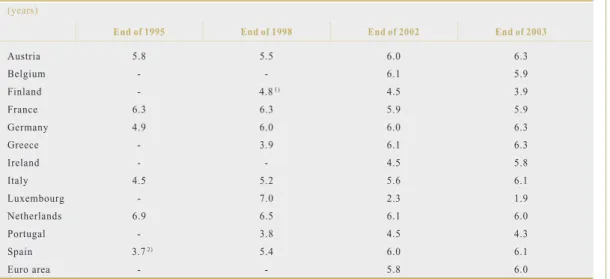
End of 1995 End of 1998 End of 2002 End of 2003
Austria 5.8 5.5 6.0 6.3 Belgium - - 6.1 5.9 Finland - 1)4.81) 4.5 3.9 France 6.3 6.3 5.9 5.9 Germany 4.9 6.0 6.0 6.3 Greece - 3.9 6.1 6.3 Ireland - - 4.5 5.8 Italy 4.5 5.2 5.6 6.1 Luxembourg - 7.0 2.3 1.9 Netherlands 6.9 6.5 6.1 6.0 Portugal - 3.8 4.5 4.3 Spain 2)3.72) 5.4 6.0 6.1 Euro area - - 5.8 6.0
Source: Annual reports of euro area debt managers and OECD (2003). 1) End of 1999.
2) End of 1996.
Table 1 Term to maturity of government debt in the euro area
(years)
9 Easier access by individuals to the primary and secondary markets for government bonds via financial intermediaries and the internet has also played a role in decreasing the volume of retail debt.
10 Low short-term interest rates led Ireland to f inance its entire gross borrowing requirement (€4 billion) short-term in 2001.
have used various strategies to increase the possibilities of borrowing at benchmark maturities. Buy-back operations and bond switching operations have been introduced or extended, while non-tradable debt instruments, such as retail debt, have decreased in size.9
Some additional room for issuing longer-term benchmark bonds came from a decrease in short-term financing. The share of short-term debt fell, particularly in Belgium, Greece and Italy, which all have very high debt ratios. For example, in Italy the share of short-term debt in total central government debt over a period of 10 years decreased from over 60% (1993) to around 25% (2003).
At the start of EMU government issuances were heavily concentrated on 10-year bonds, with all euro area debt managers active in that market. The 3-, 5- and 30-year segments also remained attractive, with about half of the debt managers issuing at least one security in those segments (Economic and Financial Committee, 2000a). More recently, debt managers have selected a somewhat wider spectrum of maturities, including some reversion to issuing short-term securities as reflected in the slight increase in debt with original maturities of less than one
year as shown in Chart 1. Factors underlying the renewed interest in issuing short-term securities include the aim of establishing benchmarks at the short end of the yield curve. Furthermore, disappointing deficit developments after 2000 resulted in unplanned borrowing requirements, which are easier to finance by issuing short-term debt. Short-term debt can also help debt managers to even out the redemption pattern over time. This is often a secondary objective of debt managers, to avoid the concentration of very large borrowing requirements in one single year and ensure frequent contacts with capital markets. Finally, historically low short-term interest rates favoured issuances in the short-term segment.10
The outcome of these developments has been a strong convergence of the residual maturity of government debt to an average of around 6 years in 2003 (see Table 1). This process had
already started before the launch of the euro (Favero et al., 1999). Broadly speaking, the average residual maturity in the large majority of countries is now within a 5.5 to 6.5 year band, with exceptions in a few smaller countries. Dispersion was larger before, although limited data availability and caveats in definitions and data collection call for caution in interpretation, especially when making cross-country comparisons.
The convergence in maturities can be seen as contributing to a more homogeneous
transmission mechanism of monetary policy in the euro area. However, it has to be taken into account that government debt only plays a minor role in the entire transmission process. Of course, government debt levels also continue to differ substantially between the countries of the euro area, contributing to differences in the strength of the transmission. Furthermore, the residual maturity of government debt can be a misleading indicator for the transmission channel. Many debt managers now use interest rate swaps (see Box 1), making the concept of residual
1 Swaps can also be (and apparently have been) used to provide governments with high current revenues to artif icially improve the budget at the expense of future revenues (Piga 2001).
2 Higher def icits in recent years have increased the number of issuances of 10-year bonds. To avoid overshooting the targets for maturity/duration, some debt managers have used reverse swaps.
3 As governments are big players, their behaviour may affect the functioning of the swap market. Remolona and Wooldridge (2003) noted a ceiling on euro swap spreads, as governments enter the market to take advantage of short-term interest rates when differences between government long-term interest rates and swap rates become large.
4 France has used swaps since 2002 and has estimated the gain at €200 million. The Dutch public debt manager has calculated that it saved €111 million through the use of interest rate swaps in the period 1999-2001.
Box 1
INTEREST RATE SWAPS INCREASINGLY POPULAR
Interest rate swaps conducted by euro area government debt managers normally imply that the debt manager receives the long-term interest rate from a counterparty and pays the short-term interest rate. This shift to short-term interest rates allows governments to benefit from the generally lower short-term interest rates without running the refinancing risk of this type of debt (Ladekarl and Svennesen, 1999).1
The increasing popularity of interest-rate swaps is related to reduced government financing needs. Combined with the policy of issuing high volumes of benchmark bonds to obtain liquidity in these markets and government guidelines on the maturity of debt, this leaves debt managers little choice for managing the short-term risk profile of government debt.2 Swaps
introduce more flexibility in debt management by separating liquidity from the risk profile.3
While issuing long-term benchmark bonds for which there is a liquid market, swaps allow the cost advantages of short-term interest rates to be realised.4
Interest rate swaps are not without risks (Piga, 2001), such as counterparty risk: i.e. the risk that the counterparty may no longer be able to fulfil its obligations. Authorisation for debt managers to conduct swaps is therefore accompanied by several restrictions regarding the minimum rating of counterparties, maximum risks per counterparty and/or overall maximum risks. Only a limited number of government debt managers provide (non-standardised) information on swap operations undertaken and the risks involved. The risks involved were recognised by the French Minister of Finance, who temporarily suspended swap operations in September 2002 in view of the high volatility of the financial markets.
INDEXED GOVERNMENT DEBT
11 A case in point is the issuance of indexed bonds in the UK in 1981, when the government had lower inflation expectations than investors on account of its strong belief in its own anti-inflation policy.
12 Liquidity is less of an issue if investors, institutional ones in particular, want to hold this debt until maturity.
13 Governments dominate the market for indexed bonds, but some private companies have also entered the market recently (see European Commission, 2003).
14 Changes in the inflation-risk premium, the liquidity premium or the tax treatment of indexed bonds may decrease the reliability of such inferences (see ECB, 2003).
15 In this context, Margaret Thatcher referred to inflation-indexed bonds as “sleeping policemen”.
maturities a less reliable indicator of the short-term interest rate sensitivity of government interest payments.
5 INFLATION-INDEXED GOVERNMENT DEBT The benefits and drawbacks of inflation-indexed bonds are much debated in academic debt management literature. A discussion of the pros and cons of inflation-indexed bonds can be structured around the objectives of the parties involved (Shen, 1995).
Treasuries may benefit from issuing inflation-indexed bonds as investors do not need to be compensated for inflation uncertainty, and thus require a lower interest rate. Benefits may be particularly large if the government’s inflation expectations deviate from market expectations.11 In addition, under some
circumstances, inflation-indexed bonds may contribute to stabilising real expenditure and thus result in some tax smoothing. Indexed debt may be particularly useful for this purpose if the macroeconomic shocks are predominantly demand shocks, and inflation and growth are positively correlated (Missale, 1999). In the case of a positive demand shock, higher income generates higher tax revenues, while higher inflation will increase nominal interest payments for indexed debt. For governments the potential disadvantages of issuing inflation-indexed bonds include reduced predictability of nominal interest payments, resulting in larger sensitivity of budgets to inflation, and greater volatility, unless revenues are also inflation-sensitive. Issuing this type of debt also risks segmenting the market, with investors demanding a liquidity premium for indexed bonds, as the size of the market and trade in this type of bonds is usually limited.12 It has also been
argued that the default risk premium of the government may increase, as the option of reducing the real value of debt via inflation is no longer available. Price (1997) has documented the main rationales for governments to issue inflation-indexed debt in a number of countries.
Investing in indexed bonds offers investors protection against inflation. This may be particularly attractive for institutional investors like pension funds, giving them the opportunity to match their long-term, inflation-sensitive pension liabilities. “Demonstration effects” may help create a larger market for inflation-indexed products if governments issue this type of bond.13 This would provide
increased opportunities for inflation-risk-averse investors to hedge against inflation. Campbell and Shiller (1996) argue on these grounds that the setting up of such a market may be classified as a public good, thus justifying government involvement. The creation of a market for derivatives of inflation-indexed products may help to further develop the market and foster liquidity (European Commission, 2003).
For monetary policy authorities, indexed bonds allow the inflation expectations of market participants to be deduced by comparing yields on index-linked bonds with yields on nominal bonds of the same maturity.14 Inferences on this
basis may be more reliable than those based on other sources, such as interviews, as they reflect actual decisions rather than mere opinions. Furthermore, issuing indexed bonds may reduce the incentives for governments to put pressure on central banks to tolerate higher inflation with a view to reducing the real value of government debt,15 although a high degree of
central bank independence is a better safeguard against this. Another consequence of issuing indexed bonds could be a reduction in the inflation aversion of investors, as they would
16 Guidotti (1992) described the circumstances under which the likelihood increases that indexation will spread.
17 Governments committed to reducing inflation from high levels have sometimes started issuing inflation-indexed bonds to reinforce the credibility of their goal, e.g. Israel (1955) and the United Kingdom (1981).
be protected against the direct adverse effects of inflation (Uhlig, 1997). Moreover, inflation-indexation could spread to other parts of the economy, notably wage-setting, increasing real wage rigidities.16 Support for monetary
policy aimed at price stability may decrease (Pecchi and Piga, 1997) along with monetary policy effectiveness if large parts of the economy are insulated from the direct adverse effects of inflation.
It can be argued that the introduction of the euro should have reduced interest in inflation-indexed bond following the lines of reasoning above. A large number of safeguards against high inflation have been introduced, such as the ECB’s primary objective of price stability, the independence of the ECB, the prohibition of monetary financing and the no-bail-out clause. The fact that the twelve national governments of the euro area no longer have national institutions as monetary counterparties but the ECB, which focuses on euro area-wide developments, also reduces the scope for governments to influence monetary developments. As a result, fear among investors of the erosion of the real value of nominal debt should have been reduced. Nevertheless, the market for indexed bonds is growing rapidly. This can be explained by a shift in incentives for issuers and investors following the start of EMU. So far, cost savings and establishing credibility17 had been the
major motivations for issuing this type of bond, while the primary reason for investing in it was protection against inflation risks. Now, with low inflation expectations, portfolio diversification has emerged as the main reason to invest in indexed bonds (European Commission, 2003). Indexed bonds are of particular interest to pension funds, whose future obligations are linked to nominal developments because of the price or wage indexation of pension benefits. Investing in inflation-indexed bonds offers them the opportunity to match liabilities with nominal claims, thus reducing mismatches in the growth of assets and liabilities due to inflation. For governments, issuing indexed bonds may have
the advantage of establishing a reputation in a market that potentially can grow rapidly in light of the mounting importance of funded pension systems, and of developing the market for this product with possible private follow-ups. Within the euro area, the number of countries issuing inflation-indexed bonds (France, Greece and Italy) is small but growing. France has been issuing this type of bond since 1998, linked to a domestic price index. Since 2001 bonds indexed to the euro area harmonised index of consumer prices (euro area HICP, excluding tobacco) have been offered with a view to broadening the investor base. Issuance statistics confirm that ownership of inflation-indexed bonds is widely spread – some 75% of the first French bond linked to the euro area HICP was sold to non-residents, of which more than half were investors from outside the euro area. To ensure that sufficient liquidity prevails in this market segment, the issuance programme will be accelerated – eventually some 10% of net bonds issued will be indexed. Italy and Greece issued inflation-indexed bonds with 5-year and 20-year maturities respectively in 2003, while Germany and the Netherlands are considering this option. Although growing rapidly, the share of inflation-indexed bonds in total debt is still relatively small. In France, it represented around 4% of total tradable central government debt in 2003, while in Italy and Greece its share of total government debt is below 1%.
A somewhat related type of debt, GDP-indexed debt, has not yet seen the light of day. The main advantage of this kind of debt would be to limit the variation of the debt-to-GDP ratio, and thus limit the risk of a debt crisis. In a recession, when tax revenues are relatively low, GDP-indexed bonds would only pay a low interest rate, and thus keep government interest
DENOMINATION OF DEBT payments low.18 Obstfeld and Peri (1998)
discussed GDP-indexed bonds in the context of limited adjustment mechanisms in Europe to deal with asymmetric shocks. They suggested issuing perpetual debt linked to nominal GDP, and investing the proceeds internationally in a diversified portfolio. In that way, a country would be less vulnerable to economic shocks. Potential disadvantages of GDP-indexed bonds include fears of deliberate misreporting of GDP and moral hazard, as the benefit to governments of growing faster are reduced. Furthermore, large government intervention may be needed to create a market for GDP-indexed bonds because of development costs and the need to set standards.
6 CURRENCY DENOMINATION OF DEBT The currency denomination of debt instruments is less debated in the literature than the choice between nominal and indexed bonds, although there are similarities between indexed bonds and foreign currency bonds (Gilson and Gerard, 2002). Both types of security can be seen as commitment devices, protecting bondholders against domestic inflation and thus weakening incentives for governments to push for high inflation. Like indexed debt, foreign exchange debt can be instrumental in avoiding large variations in tax rates. Issuing foreign currency debt is sometimes seen as more advantageous if there is a strong positive correlation between the domestic and foreign economies. In such cases, the domestic economy can appear to enjoy a free ride: higher inflation in the foreign economy (e.g. to alleviate the debt burden in that country) will reduce the real burden of foreign currency denominated debt in the domestic country without incurring the negative reputational consequences (Miller, 1997a).
The decision to issue debt in foreign currency seems to be motivated by practical considerations. These can include avoiding an overburdening of the domestic capital market, supplementing official foreign exchange
18 See Borensztein and Mauro (2002) for a discussion of the pros and cons of this debt instrument.
reserves, increasing international ownership of bonds, and taking advantage of better financing conditions abroad. Claessens et al. (2003) found that smaller economies, with narrower domestic investor bases, take more recourse to foreign currency debt. In the empirical work of De Fontenay et al. (1995) lower interest rates abroad compared to domestic rates were found to have a positive effect on the foreign currency debt share. Pecchi and Di Meana (1998), testing various theories on the denomination of debt, concluded that (expected) cost is a key consideration in deciding whether to issue foreign currency debt.
On the other hand, issuing non-domestic debt is sometimes avoided for reasons of prestige, as recourse to foreign currency debt may be regarded as a sign of financial weakness. Furthermore, cost advantages are not always obvious in view of interest and exchange rate fluctuations and liquidity premia to be paid when a small issuer enters a relatively large market. Swaps, however, can be used to reduce excessive volatility in budgets resulting from exchange rate or interest rate changes.
The relevance of many of these motives has diminished in recent years in the euro area. Integrated European capital markets and, until recently, improved public finances have relaxed fears of a crowding out of private capital demand. With the advent of the euro, countries also no longer need to issue securities in another, non-domestic currency to attract international investors. The credible price stability objective of the independent central bank has also reduced the need for foreign currency debt as a commitment device, as modelled by Gilson and Gerard (2002). The attitudes of individual countries towards borrowing in non-euro currencies still vary. In some countries, reducing foreign currency denominated debt is a stated part of the debt management strategy (Belgium, Greece,
Ireland and Italy). A few other debt managers, in search of favourable financing conditions, either continue to use this option (Austria),19
or do not exclude it if conditions turn favourable (Germany, Spain). Italy still issues US dollar denominated securities with a view to maintaining its benchmark status among non-US sovereign issuers. A few countries, such as the Netherlands, so far explicitly exclude the financing of part of government debt in foreign currencies. France lifted the prohibition on borrowing in foreign currencies in 2003, and Germany now also no longer excludes this option. Countries issuing non-euro denominated debt mostly use foreign exchange swaps to reduce the exchange rate risk.
The share of debt denominated in non-euro currencies, which stood at 2% in the euro area at the end of 2002, continues to show a slightly declining tendency. With the introduction of the euro on 1 January 1999, debt previously denominated in legacy currencies, representing more than 3% of GDP, was automatically re-denominated as domestic currency debt. The main currencies in which foreign currency debt is now denominated are US dollar, pound
sterling, Japanese yen and Swiss franc (see Table 2). The share of foreign currency denominated debt in 2002 exceeded 10% of total central government debt only in Austria (12%) and Finland (13%). Previously these levels were much higher. In 1995, for instance, the share of non-domestic currencies in total central government debt exceeded 25% in Belgium, Finland and Ireland.
Finally, it should be noted that the introduction of the euro also had a major effect on debt managers outside the euro area. Denmark and Sweden (and the ten countries that joined the European Union in May 2004) issue a substantial part of their debt in euro or issue debt in their domestic currency and then swap it for euro. Box 2 briefly describes the role of the euro in debt management in Denmark and Sweden.
As % of total USD JPY GBP CHF
central government
debt (% of foreign currency denominated debt)
Austria 12.7 45 55 Belgium 2.1 5 21 74 Finland 13.2 36 29 28 7 France 0.0 Germany 0.0 Greece1) 2.8 61 15 6 18 Ireland 2.0 100 Italy 3.5 80 14 6 Luxembourg 5.0 100 Netherlands 0.0 Portugal 1.7 100 Spain 3.3 49 47 4 Euro area 2.0 52 19 10 19
Source: Annual reports of euro area debt managers. 1) After using foreign exchange swaps.
Table 2 Foreign currency denominated debt in euro area countries, 2002
19 According to the Austrian debt management off ice, the long-term saving from using foreign currency markets ranges between 1½ and 2% of GDP (Hauth and Kocher, 2001).
OWNERSHIP
Box 2
DEBT MANAGEMENT STRATEGIES IN DENMARK AND SWEDEN
In Denmark, around 12% of total central government debt was denominated in foreign currency at the end of 2003. Foreign exchange denominated debt nowadays only relates to euros, whereas before the coming of the euro, borrowing also took place in US dollars, Swiss francs, Japanese Yen and national currencies of euro area countries. Part of the foreign currency debt is issued directly in euro; another part is issued in Danish Krone and then swapped to euro. The aim of issuing in euros is to maintain adequate foreign exchange reserves. Denmark participates in the European Exchange Rate Mechanism (ERM), with a fixed exchange rate policy vis-à-vis the euro, maintaining a narrow band of ±2.25% around its central rate. Stabilisation of the amount of foreign exchange debt is part of Denmark’s debt policy. In Sweden, some 27% of central government debt is expressed in foreign currencies. Euro-denominated debt accounts for around 65% of this, but debt also continues to be issued in US dollars, Swiss francs, UK pounds, and Japanese Yen. The goal, however, is to reduce the share of foreign-currency-denominated debt in total debt. Currently, Sweden does not participate in the ERM. Most foreign currency debt is first issued in Swedish Krona, and then swapped into foreign currencies.
20 In some cases, legal restrictions on pension funds were effectively relaxed as the obligation to invest only in the national currency automatically broadened with the advent of the euro to include all euro area countries.
7 DEBT OWNERSHIP
Debt ownership is another topic in debt management that has received relatively little attention in the literature. Practical considerations seem to dominate the decisions of debt managers whether or not to actively seek to attract non-domestic investors.
Attracting foreign investors now relies much less on the currency in which debt is denominated and more on the features of the bond and the distribution channels. While attracting foreign investors has not been a major problem for the larger euro area countries, for the smaller ones it presented a relatively new situation.
Now that the euro is the domestic currency of twelve countries and exchange rate risks and costs have disappeared, the degree of national bias in investor preferences has decreased.20
Exchange rate risks used to play a major role, but non-standardised market conventions and a lack of efficient pan-European settlement systems also hampered international trade in
government bonds. Today government debt managers are less certain about national demand for their debt securities, forcing them to enter into competition with other debt managers. Portfolio managers are also diversifying into a wider range of corporate bonds because of tight spreads for government bonds. Thus, government debt managers face increased competition, requiring them to cater for the desires of investors. Smaller countries in particular have taken action to increase interest in their products by, for example, using road shows or by issuing only a few, large bonds on a limited number of days.
Results indicate that ownership of government debt is indeed much more widely spread than before (see Chart 2). On average in the euro area domestic ownership of total government debt decreased from 75% in 1997 to 54% in 2003. A broadening of bond ownership has occurred in most countries, but in the smaller
ones in particular. Over the period 1997-2002 foreign ownership of long-term government debt in the Netherlands doubled to 56%, in Spain it increased from 18% to 41%, and in France non-residents’ share of marketable debt rose to 36% from 15%.
8 ISSUING AND TRADING PRACTICES The many changes in the environment in which European debt managers work also have implications for the more practical aspects of debt management. This section briefly describes some of the main changes in the issuing and trading of government debt.21
Competition among debt managers has increased because of progress made towards a single capital market as a result of the euro. Being able to finance government deficits on favourable terms in this environment required some changes in practices, aimed mainly at increasing the liquidity of bonds issued. Apart from creditworthiness, liquidity is the main factor explaining cross-country differences in the interest rates to be paid by governments.
Chart 2 Ownership of government debt in the euro area
(% of GDP)
Source: ECB Monthly Bulletin.
Note: MFI = monetary f inancial institution, OFI = other f inancial institution. 0 10 20 30 40 50 60 70 80 0 10 20 30 40 50 60 70 80 1992 1993 1994 1995 1996 1997 1998 1999 2000 2001 2002 2003 foreign domestic other OFI MFI ISSUANCE POLICIES
Increasing standardisation of market conventions (e.g. day count basis, settlement dates) leading up to EMU greatly improved the comparability of government issues. Increased focus on fully standardised, “plain vanilla” securities, often with 5 or 10 year maturities, also contributed to this. To increase transparency, debt managers now usually announce their issuance calendar well in advance, often including the type of debt instrument to be offered on specific dates. Given these pre-commitments, the scope for opportunistic issues, trying to take advantage of temporary favourable market conditions, has greatly decreased. Less progress has been made regarding day-to-day issuance coordination. Issuance calendars to some extent overlap, especially in the early months of the year when debt managers frontload their financing. Smaller euro area countries in particular may suffer disadvantages because of the incomplete harmonisation of debt management practices.
DISTRIBUTION CHANNELS
Increased competition in the primary and secondary government bond markets has led to changes in distribution channels. Primary dealers and bank syndicates are now popular means to reach more non-domestic investors. Primary dealers mediate between the debt agency and buyers in both the primary and secondary markets. All euro area countries except Germany now use primary dealers to distribute government bonds. Tasks for primary dealers usually include the obligation to bid at auctions or to buy a certain amount of newly issued bonds, promotion of government debt and market making.22 In all countries
concerned, many foreign financial institutions
21 A more detailed presentation of recent changes in the European bond markets is given in ECB (2004).
22 See Economic and Financial Committee (2000b) for more information on the tasks and privileges of primary dealers in Europe.
AND OUTLOOK are included as primary dealers, reflecting the
wish to spread ownership of government securities widely.
Bank syndicates have also become increasingly popular as a way to distribute new government debt, particularly when approaching new market segments. Syndicate participants may select specific investors to whom the government security to be issued may be especially interesting. For smaller countries, a particular advantage is that a significant amount can be placed at once, thus immediately creating liquidity.
ELECTRONIC TRADING SYSTEMS
Liquidity in the secondary market has been fostered by electronic trading systems. Since its introduction in Italy in 1988, trade in government securities via electronic trading systems has spread to most countries. In addition to these local systems, EuroMTS was introduced in 1999, enabling quotation and trading of some European benchmark bonds. Obligations to provide quotes for some traders have improved liquidity while maximum bid-ask spreads have reduced transaction costs. A requirement for trading on EuroMTS is a bond size of at least €5 billion. To foster liquidity in the markets, and to qualify for participation in EuroMTS, the average size of a bond issued by a central government has increased substantially since the advent of EMU. More recently, electronic systems have been used not only for trading government bonds but also as a platform to issue bonds. Finally, government bonds and bills play a major role in the European repo market, where repurchase agreements are traded. Central government debt constitutes about 87% of the collateral underlying repo transactions in Europe (ISMA, 2004). At the same time, large repo markets support the liquidity of the government securities market as they enable traders to take positions in these markets. The benchmark status of the German Bund in the main 10-year bond segment amongst others
reflects the well-developed repo market for these German bonds. Increasingly, repo trading takes place on electronic trading platforms.
9 CONCLUSIONS AND OUTLOOK
Debt management strategies have changed considerably in recent years, following the introduction of the euro and declining government debt ratios. The ultimate objectives of debt management have remained more or less the same, but financing debt at low cost against acceptable risks in this new environment required an adaptation of strategies. Very practical considerations regarding cost and risks continue to dominate the objectives adopted, rather than tax or deficit stabilisation as suggested in the academic literature.
Although the histories and the institutional positions of debt managers in the euro area countries vary, a strong tendency towards convergence can be observed in recent years. In most cases, recent developments strengthened trends that were already in place. Key aspects of debt management that have changed in recent years include the autonomy of debt management agencies. Increased competition in capital markets has speeded up this process, although to different degrees. In line with this, debt management agencies are being given more precise strategic goals and guidelines, often in the form of targets for or limits on maturity or the refinancing risk. The average maturities of outstanding debt in the euro area are converging, with the average residual maturity now close to six years. As debt managers increasingly manage the duration of debt through interest rate swaps, the average maturity is less useful as an indication of the interest sensitivity of public debt. Information on the size of and the risk exposure to interest swaps is often still lacking.
As to the types of government debt instruments, index-linked debt is growing in importance with more countries issuing this
type of debt than before and others considering it. Portfolio diversification rather than cost saving appears to be the prime reason for issuing this type of debt, with pension funds being major investors. Less emphasis is given to issuing non-euro denominated debt given the large pool of resources available in euro. Foreign ownership of euro area government debt has increased markedly, especially in smaller euro area countries where in many cases non-domestic ownership has more than doubled in the space of five years. The increased emphasis on liquidity aspects with a view to securing the lowest possible funding costs is reflected in issuance and trading practices (plain vanilla bonds, primary dealers, electronic trading).
While debt management practices in the euro area are converging in many aspects, some differences remain, reflecting different operational objectives and sizes of deficits and debts. Furthermore, the emphasis on convergence has decreased somewhat lately, reflecting a return to higher government deficits and an increasing desire to innovate to attract investors in niche areas.
Looking forward, euro area debt managers will face some additional challenges in future. With low deficits and competitive auction data setting at the beginning of EMU, the issue of coordination of debt management practices in the euro area has arisen (Giovannini Group, 2000), including ideas about European sovereigns issuing common bonds. Current high government deficits have increased opportunities for regular issuances of benchmark bonds, relegating discussions on this type of coordination to the background, but it may revive once public finances have been put on a sounder footing.
Population ageing will have a noticeable effect on government debt management. Higher pension and health care spending will increase deficits if no compensatory action is taken. Indeed, countries have agreed on additional
efforts to reduce debt burdens to free up resources that would otherwise be spent on interest payments. At the same time, demand for government debt, and for (very) long-term index-linked debt in particular, is bound to rise because of the building up of pension funds, which will be keen to invest part of the entrusted money in safe government assets.
ANNEXES
A N N E X
G O V E R N M E N T D E B T M A N A G E R S I N
T H E E U R O A R E A
Debt manager
Manager Institutional position classification Website
Austria Österreichische Part of the Ministry SMO www.oebfa.co.at
Bundesfinanzierungsagentur of Finance
Belgium Service de la dette Part of the Federal DMO www.treasury.fgov.be/
publique/Federale Dienst Public Service Finance interdette
van de Staatsschuld
Finland Valtiokonttori The State Treasury is DMO www.valtiokonttori.fi/
(State Treasury) supervised by the rahpa/bulletin/bulletin.htm
Ministry of Finance
France Agence France Trésor Part of the Ministry DMO www.aft.gouv.fr
of Economic Affairs, Finance and Industry
Germany Bundesrepublik Deutschland Limited company with SMO
www.deutsche-– Finanzagentur GmbH the German State, finanzagentur.de/eng/
represented by the Federal Ministry of Finance, as sole shareholder.
Greece General Accounting Office Part of the Ministry of DMO www.mof-glk.gr/
Economy and Finance en/home.htm
Ireland National Treasury The Chief Executive is SMO www.ntma.ie
Management Agency appointed by the
Minister for Finance and is directly responsible
to him
Italy Dipartimento del Tesoro Part of the Ministry DMO www.tesoro.it/publicdebt
of Economy and Finance
Luxembourg Trésorerie de l’Etat Part of the Ministry of Finance DMO www.etat.lu/TS/
Netherlands Agentschap van het Part of the Ministry DMO www.dutchstate.nl
ministerie van Financiën of Finance, but with much autonomy
Portugal Instituto de Gestão do Part of the Ministry of Finance SMO www.igcp.pt
Crédito Público
Spain Tesoro Público Part of the Ministry DMO www.mineco.es/tesoro/
of Economy and Finance htm/deuda/index_en.htm
Source: Currie et al. (2003) and own classif ications.
Note: SMO = “special debt management off ice”, a separate unit outside the Ministry of Finance to which operational responsibilities are delegated. DMO = “debt management off ice”, a unit with no such delegation.
Angeletos, G. (2002), “Fiscal Policy with Non-Contingent Debt and the Optimal Maturity Structure”, The Quarterly Journal of Economics, 117 (3), pp. 1105-1131.
Barro, R. (1999), “Notes on Optimal Debt Management”, Journal of Applied Economics, 2, pp. 281-289.
Blanco, R. (2001), “The Euro-Area Government Securities Markets. Recent Developments and Implications for Market Functioning”, Banco de España Working Paper, No. 120.
Borensztein, E. and P. Mauro (2002), “Reviving the Case for GDP-Indexed Bonds”, IMF Policy Discussion Paper, No. 10.
Calvo, G. C. and P. E. Guidotti (1990), “Indexation and Maturity of Government Bonds: An Explanatory Model”, in R. Dornbusch and M. Draghi, Public Management: Theory and History, Cambridge University Press, Cambridge, pp. 52-82.
Campbell, J. and R. Shiller (1996), “A Scorecard for Indexed Government Debt”, Cowles Foundation Discussion Paper, No. 1125.
Claessens, S., D. Klingebiel and S. Schmukler (2003), “Government Bonds in Domestic and Foreign Currency: The Role of Macroeconomic and Institutional Factors”, CEPR Discussion Paper, No. 3789.
Codogno, L., C. Favero and A. Missale (2003), “Yield Spreads on EMU Government Bonds”,
Economic Policy, No. 18, pp. 503-532.
Currie, E., J-J. Dethier and E. Togo (2003), “Institutional Arrangements for Public Debt Management”, World Bank Policy Research Working Paper, No. 3021.
De Fontenay, P., G. Milesi-Ferretti and H. Pill (1995), “The Role of Foreign Currency Debt in Public Debt Management”, IMF Working Paper, No. 95/21.
Drudi, F. and R. Giordano (2000), “Default Risk and Optimal Debt Management”, Journal of Banking and Finance, 24, pp. 861-891.
Economic and Financial Committee (2000a), Progress Report on EU Government Bond Instruments, Brussels.
Economic and Financial Committee (2000b), Progress Report on Primary Dealership in EU Public Debt Management, Brussels.
European Central Bank, Monthly Bulletin, several issues.
European Central Bank (2003), “Recent Developments in the Market for Index-Linked Bonds in the Euro Area”, Monthly Bulletin, December.
European Central Bank (2004), The Euro Bond Market Study.
European Commission (2003), “Special Feature: Index-linked Bonds”, Quarterly Note on the Euro-Denominated Bond Markets, January-March 2003, Brussels.
European Commission (2004), Autumn 2004 Economic Forecasts, Brussels.
Falcetti, E. and A. Missale (2002), “Public Debt Indexation and Denomination with an Independent Central Bank”, European Economic Review, 46(10), pp. 1825-50.
Favero, C., A. Missale and G. Piga (1999), “EMU and Public Debt Management: One Money, One Debt?”, CEPR Policy Paper, No. 3.
Gilson, N. and M. Gerard (2002), “Currency Composition and Public Debt in EMU”, IFO Studien, 48 (2), pp. 301-321.
Giovannini Group (2000). Co-ordinated Public Debt Issuance in the Euro Area – Report of the Giovannini Group, http://europa.eu.int/comm/economy_finance/ publications/giovannini/ giovannini081100en.pdf.
Guidotti, P. (1992), “Wage and Public Debt Indexation”, IMF Working Paper, No. 92/7. Haan, J. de, B. Sikken and A. Hilder (1995), “On the Relationship between the Debt Ratio and
Debt Maturity”, Applied Economics Letters, 2, pp. 484-486.
Hauth, E. and P. A. Kocher (2001), “Austria’s Sovereign Debt-Management Against the Background of Euro Area Financial Markets”, Focus on Austria, ONB, 2, pp. 159-176. ISMA (2004), European Repo Market Survey, No. 7, October.
Ladekarl, J. and A. Svennesen (1999), “Interest Rate Swaps and Domestic Government Debt Management in Denmark”, OECD Financial Market Trends, June, pp. 155-174.
Leong, D. (1999), “Debt Management – Theory and Practice”, UK Treasury Occasional Paper, No. 18.
Lumpkin, S. (2000), “Recent Innovations in Government Debt Management Techniques and Practices and Government Securities Markets”, OECD Financial Market Trends, No. 75, pp. 63-76.
Miller, V. (1997a), “Why a Government Might Want to Consider Foreign Currency Denominated Debt?”, Economic Letters, 55, pp. 247-250.
Miller, V. (1997b), “Political Instability and Debt Maturity”, Economic Inquiry, 35 (1), pp. 121-127.
Missale, A. and O. Blanchard (1994), “The Debt Burden and Debt Maturity”, American Economic Review, 84(1), pp. 309-19.
Missale, A. (2000), “Optimal Debt Management with a Stability and Growth Pact”, Public Finance and Management, 1 (1), pp. 58-91.
Missale, A. (2001), “Public Debt Management and the Stability and Growth Pact”, in A. Brunila, M. Buti and D. Franco (eds.), The Stability and Growth Pact – The Architecture of Fiscal Policy in EMU, Palgrave, New York, pp. 44-68.
Obstfeld, M. and G. Peri (1998), “Regional Non-Adjustment and Fiscal Policy”, in “EMU: Prospects and Challenges for the Euro”, Economic Policy, No. 26, pp. 206-247.
OECD (2003), Central Government Debt, Statistical Yearbook, 1992-2001.
Pecchi, L. and G. Piga (1997), “Who’s Afraid of Index-Linked Bonds”, in M. D. Cecco, L. Pecchi and G. Piga (eds.), Managing Public Debt: Index-Linked Bonds in Theory and Practice, Edward Elgar Publishing Ltd, Cheltenham.
Pecchi, L., and A. di Meana (1998), “Public Foreign Currency Debt: A Cross-Country Evaluation of Competing Theories”, Giornale degli Economisti e Annali di Economia, No. 2, September.
Piga, G. (1999), “Public Debt Management in the European Monetary Union”, LUISS, OCSM working paper, paper prepared for the European Commission.
Piga, G. (2001), Derivatives and Public Debt Management, ISMA, Zurich.
Price, R. (1997), “The Rationale and Design of Inflation-Indexed Bonds”, IMF Working Paper, No. 97/12.
Remolona, E. M. and P. D. Wooldridge (2003), “The Euro Interest Rate Swap Market”, BIS Quarterly Review, March, pp. 47-57.
Santillán, J., M. Bayle and C. Thygesen (2000), “The Impact of the Euro on Money and Bond Markets”, ECB Occasional Paper, No. 1.
Shen, P. (1995), “Benefits and Limitations of Inflation Indexed Treasury Bonds”, Federal Reserve Bank of Kansas City Economic Review, Third Quarter, pp. 41-56.
Tobin, J. (1963), “An Essay on Principles of Debt Management”, Fiscal and Debt Management Policies, Englewood Cliffs, pp. 143-218.
Uhlig, H. (1997), “Long-Term Debt and the Political Support for a Monetary Union”, CEPR Discussion Paper Series, No. 1603.
OCC ASIONAL PAPER SERIES
1 “The impact of the euro on money and bond markets” by J. Santillán, M. Bayle and C. Thygesen, July 2000.
2 “The effective exchange rates of the euro” by L. Buldorini, S. Makrydakis and C. Thimann, February 2002.
3 “Estimating the trend of M3 income velocity underlying the reference value for monetary growth” by C. Brand, D. Gerdesmeier and B. Roffia, May 2002.
4 “Labour force developments in the euro area since the 1980s” by V. Genre and R. Gómez-Salvador, July 2002.
5 “The evolution of clearing and central counterparty services for exchange-traded derivatives in the United States and Europe: a comparison” by D. Russo, T. L. Hart and A. Schönenberger, September 2002.
6 “Banking integration in the euro area” by I. Cabral, F. Dierick and J. Vesala, December 2002.
7 “Economic relations with regions neighbouring the euro area in the ‘Euro Time Zone’” by F. Mazzaferro, A. Mehl, M. Sturm, C. Thimann and A. Winkler, December 2002.
8 “An introduction to the ECB’s survey of professional forecasters” by J. A. Garcia, September 2003.
9 “Fiscal adjustment in 1991-2002: stylised facts and policy implications” by M. G. Briotti, February 2004.
10 “The acceding countries’ strategies towards ERM II and the adoption of the euro: an analytical review” by a staff team led by P. Backé and C. Thimann and including O. Arratibel, O. Calvo-Gonzalez, A. Mehl and C. Nerlich, February 2004.
11 “Official dollarisation/euroisation: motives, features and policy implications of current cases” by A. Winkler, F. Mazzaferro, C. Nerlich and C. Thimann, February 2004.
12 “Understanding the impact of the external dimension on the euro area: trade, capital flows and other international macroeconomic linkages“ by R. Anderton, F. di Mauro and F. Moneta, March 2004.
13 “Fair value accounting and financial stability” by a staff team led by A. Enria and including L. Cappiello, F. Dierick, S. Grittini, A. Maddaloni, P. Molitor, F. Pires and P. Poloni, April 2004.
14 “Measuring Financial Integration in the Euro Area” by L. Baele, A. Ferrando, P. Hördahl, E. Krylova, C. Monnet, April 2004.
15 “Quality adjustment of European price statistics and the role for hedonics” by H. Ahnert and G. Kenny, May 2004.
16 “Market dynamics associated with credit ratings: a literature review” by F. Gonzalez, F. Haas, R. Johannes, M. Persson, L. Toledo, R. Violi, M. Wieland and C. Zins, June 2004.
17 “Corporate ‘Excesses’ and financial market dynamics” by A. Maddaloni and D. Pain, July 2004. 18 “The international role of the euro: evidence from bonds issued by non-euro area residents” by
A. Geis, A. Mehl and S. Wredenborg, July 2004.
19 “Sectoral specialisation in the EU a macroeconomic perspective” by MPC task force of the ESCB, July 2004.
20 “The supervision of mixed financial services groups in Europe” by F. Dierick, August 2004. 21 “Governance of securities clearing and settlement systems” by D. Russo, T. Hart,
M. C. Malaguti and C. Papathanassiou, October 2004.
22 “Assessing potential output growth in the euro area: a growth accounting perspective” by A. Musso and T. Westermann, January 2005.
23 “The bank lending survey for the euro area” by J. Berg, A. van Rixtel, A. Ferrando, G. de Bondt and S. Scopel, February 2005.
24 “Wage diversity in the euro area: an overview of labour cost differentials across industries” by V. Genre, D. Momferatou and G. Mourre, February 2005.
25 “Government debt management in the euro area: recent theoretical developments and changes in practices”by G. Wolswijk and J. de Haan, March 2005.