AN OPTIMIZED HIDDEN NODE HANDLING
APPROACH FOR IMPROVING THE COVERAGE AND
NETWORK EFFICIENCY IN WIRELESS
MULTIMEDIA SENSOR NETWORKS
Adwan Alanazi
Under the Supervision of Dr. Khaled Elleithy
DISSERTATION
SUBMITTED IN PARTIAL FULFILMENT OF THE REQUIREMENTS FOR THE DEGREE OF DOCTOR OF PHILOSOPHY IN COMPUTER SCIENCE
AND ENGINEERING THE SCHOOL OF ENGINEERING
UNIVERSITY OF BRIDGEPORT CONNECTICUT
AN OPTIMIZED HIDDEN NODE HANDLING
APPROACH FOR IMPROVING THE COVERAGE
AND NETWORK EFFICIENCY IN WIRELESS
MULTIMEDIA SENSOR NETWORKS
© Copyright by Adwan Alanazi 2017
AN OPTIMIZED HIDDEN NODE HANDLING
APPROACH FOR IMPROVING THE COVERAGE AND
NETWORK EFFICIENCY IN WIRELESS
MULTIMEDIA SENSOR NETWORKS
ABSTRACT
Wireless Multimedia Sensor Networks (WMSNs) are comprised of sensor nodes that form the momentary network and do not rely on the support of any orthodox centralized infrastructure or administration. Such a given situation mandates that every sensor node gets the support of the other sensor nodes in order to advance the packets to the desired destination node, and specifically to the sink node. Successful transmission of online multimedia streams in wireless multimedia sensor networks (WMSNs) is a challenge due to their limited bandwidth and power resources. The existing WMSN protocols are not completely appropriate for multimedia communication. The effectiveness of WMSNs vary as it depends on the correct location of the sensor nodes in the field. Thus, maximizing the multimedia coverage is the most important issue in the delivery of multimedia contents. The nodes in WMSNs are either static or mobile. Thus, the node connections change continuously due to the mobility in wireless multimedia
communication that causes an additional energy consumption and synchronization loss between neighboring nodes. The focus is on hidden node problems in WMSNs and how they can affect the network performance. Hidden nodes occur in the networks when nodes that are invisible to each other communicate with another node that is visible to these nodes at a particular period. Eventually, a collision may occur and the node will be unable to receive any packets. In addition, this study looks at the effectiveness of the optimal orientation for the sensor nodes in the environment. This work introduces an Optimized Hidden Node Handling (OHND) approach. The OHND consists of three phases: hidden node handling, message exchange, and location and view handling. These three phases aim to maximize the multimedia node coverage and improve energy efficiency, hidden node handling capacity, and packet delivery ratio. OHND helps multimedia sensor nodes to compute the directional coverage. Furthermore, an OHND is used to maintain a continuous node– continuous neighbor discovery process to handle the mobility of the nodes. To evaluate the performance of the proposed algorithms, the results are compared with other known approaches. The results demonstrate that nodes are capable of maintaining direct coverage and detecting hidden nodes in order to maximize coverage, achieve power efficiency, reduce the end-to-end delay, and improve the throughput. Finally, this study provides an efficient solution for handling the hidden node problem in case mobility.
ACKNOWLEDGEMENTS
My thanks are wholly devoted to God who has helped me all the way to complete this work successfully. I would like to thank my parents, my wife, and my beautiful children Fahad and Julia for their support, understanding, and encouragement. Also, I would like to thank my sisters and brothers for their support at all times.
I am extremely grateful to my advisor Dr. Khaled Elleithy, for his encouragement and excellent guidance and advice. I am honored that my work has been supervised by him. My grateful thanks are also extended to my dissertation committee, Dr. Navarun Gupta, Dr. Xingguo Xiong, Dr. Miad Faezipour and Dr. Eman Abdelfattah, for their valuable suggestions and feedback that improved my work.
Last but not least, to the faculty and staff at the University of Bridgeport, thank you for helping me to accomplish this mission. It was a wonderful and exciting experience to be a member of this community.
TABLE OF CONTENTS
ABSTRACT ... iii
ACKNOWLEDGEMENTS ... v
TABLE OF CONTENTS ... vi
LIST OF TABLES ... viii
LIST OF FIGURES ... ix
Chapter 1: Introduction ... 1
1.1 Research Motivation ... 3
1.2 Potential Contributions ... 3
Chapter 2: Literature review ... 5
2.1 Introduction ... 5
2.2 Categorization and Classification of Quality of Service Routing Protocols ... 8
2.2.1 Probabilistic Routing Protocols (Hard Real Time) ... 9
2.2.2 Probabilistic Routing Protocols (Soft Real Time) ... 14
2.2.3 Deterministic Routing Protons (Hard Real Time) ... 17
2.2.4 Deterministic Routing Protons (Soft Real Time) ... 21
2.3 Simulation Setup and Performance Evaluation... 24
2.4 Challenges and Open Research Issues ... 30
2.5 Conclusion ... 35
Chapter 3: Buffer-Overflow and Noise-Handling Model: Guaranteeing Quality of Service Routing for Wireless Multimedia Sensor Networks ... 36
3.1. Introduction ... 36
3.3 Simulation Setup and Performance Analysis ... 44
3.4 Conclusion ... 50
Chapter 4: An Optimized Hidden Node handling APPROACH FOR improving Coverage and network efficiency in wireless multimedia sensor networks ... 52
4.1 Introduction ... 52
4.2 Related Work ... 56
4.3 Overview in Mobility Impact ... 62
4.4 Optimized Hidden Node Handling Approach (OHND) ... 63
4.4.1 Hidden Node Handling ... 64
4.4.2 Message Exchange Phase ... 70
4.5 Mobile and Energy Efficient Routing Protocol for Handling Hidden Nodes (MEQRO) .... 74
Chapter 5: Simulation setup and performance analysis ... 76
5.1. An Optimized Hidden Node Handling Approach for Improving Coverage and Network Efficiency in WMSNs Experimental Results ... 76
5.1.1. Multimedia Throughput Efficiency ... 78
5.1.2 Successful Packet Delivery Ratio ... 80
5.1.3 Network Accuracy ... 81
5.1.4 Energy Consumption with Hidden Node ... 82
5.1.5 End to End Delay ... 84
5.2 Mobile and Energy Efficient Routing Protocol for Handling Hidden Nodes (MEQRO) Analysis: ... 85 5.2.1 Energy Consumption ... 86 5.2.2 Throughput ... 86 5.2.3 End-To-End Delay ... 87 CHAPTER 6: CONCLUSIONS ... 89 REFERENCES ... 91
LIST OF TABLES
Table 2.1 Simulation parameters and its corresponding values 25 Table 2.2 Evaluation and comparison of QoS routing protocols
over WMSNs
34
Table 3.1 Simulation parameters and its corresponding values 45 Table 4.1 The characteristics and limitations of the existing
approaches.
61
Table 4.2 Notations used and their description 69 Table 4.3 Notations used and their description 73 Table 5.1 Simulation parameters and its corresponding values. 77 Table 5.2 Simulation parameters and its corresponding values 85
LIST OF FIGURES
Figure 2.1 Classification of quality of service (QoS) routing protocols 9 Figure 2.2 The Strategic Location Selection in MRG 10 Figure 2.3 Queuing Model in the Cluster-Based Wireless Sensor
Networks
14
Figure 2.4 Three Level Cluster Hierarchy 19 Figure 2.5 Queuing Theory for Proposed Algorithm 21 Figure 2.6 Average delivery ratios vs different node failure probability 27 Figure 2.7 Average energy consumption VS node failure probability 28 Figure 2.8 End-to-end delay of routing protocols at the different time
intervals
29
Figure 2.9 Network lifetime using different routing protocols and network size
30
Figure 3.1 Throughput with stationary nodes 46 Figure 3.2 (a) Throughput with 10% mobile nodes 47 Figure 3.2 (b) Throughput with 20% mobile nodes 47 Figure 3.2 (c) Throughput with 30% mobile nodes 48 Figure 3.3 Alive remaining node VS sensing routs with static nodes 48
Figure3.4 (a) Alive remaining node VS sensing routes with 10% mobile sensor nodes
49
Figure3.4 (b) Alive remaining node VS sensing routs with 20% mobile sensor nodes
50
Figure 3.4 (c) Alive remaining node VS sensing routs with 30% mobile sensor nodes
50
Figure 4.1 Proposed subdivision methodology 64 Figure 4.2 Coordination node synchronization process 65 Figure 4.3 Obstacles within the node boundary and viewpoint 73 Figure 5.1 (a) multimedia coverage in existence of 22 obstacles 79 Figure 5.1 (b) multimedia coverage in existence of 14 obstacles 79 Figure 5.1 (c) multimedia coverage in case of no obstacles 80 Figure 5.2 Successful packet delivery VS number of monitoring events 81 Figure 5.3 The network accuracy in presence of hidden nodes of
OHND and other competing approaches
82
Figure 5.4 Energy consumption vs number of hidden nodes 83 Figure 5.5 End to end delay performance 84 Figure 5.6 Energy consumption statistics 86
Figure5.7 Throughput performance analysis 87 figure 5.8 Delay performance analysis 88
CHAPTER 1: INTRODUCTION
Wireless Multimedia Sensor Networks (WMSNs) are capable of capturing audio-video information by using low-cost cameras embedded with sensor nodes. Multimedia sensors provide substantial information related to a particular area of interest. However, multimedia applications experience problems due to online media transmission challenges. Several sources of energy waste include idle listening, overhearing, packet loss due to collisions, and packet overhead in the multimedia sense. One of the major sources of energy waste is the packet collisions that happen when two nodes try to transmit packets simultaneously. As a result, this causes a partial or complete packet loss at the recipient node. The lost packets need to be discarded or retransmitted, which could be the source of the excess energy consumption waste and Quality of Service (QoS) degradation. To enable the on-demand multimedia services, it is important to focus on multimedia-supported algorithms in WMSNs to determine the hidden node problems and compute the directional coverage. WMSNs consist of promising technology that can resolve several solutions, and cover health applications, commercial, and civilian applications. WMSNs involve a large number of low cost and small sensors that are equipped with wireless communication as well as computation capabilities. However, despite their benefits, WMSNs are problematic because of energy limitations brought about by the sensor nodes. The energy expenditure of these WMSNs depends on factors
such as data processing, wireless communication, and environmental sensing. Therefore, most of the routing protocols aim particularly at accomplishing energy preservation. Most of the routing protocols that are designed for WMSNs follow the attainment of energy efficiency but are practically incompatible for provision of QoS in the WMSNs. Moreover, network density, severe bandwidth limitations, limited node power, and topology dynamicity have led to many limitations related to the management of WMSNs. A hidden node problem happens when the two nodes that are invisible to each other communicate with another node that is visible node to each other. Eventually, there is degradation of three performance metrics as discussed below:
Throughput: Denotes the sum of traffic that is proficiently received by a given recipient node and it will be decreased because of the collisions.
Energy-efficiency: Reduces because every collision leads to another retransmission.
Transfer Delay is the period from the initiating of a message until it reaches the recipient node that enlarges because of several retransmissions of a particular collided message.
A recent research by[1] has demonstrated that around 40% of packets are lost because of hidden node collision. Such a percent rises as the number of hidden nodes increase. Therefore, the execution by these wireless sensor networks is enhanced when the nodes that are hidden are eliminated after being detected in the networks. Mobility support in WMSNs is not a simple matter, irrespective of the working level, as it involves
and affects the network components. Among the current proposals, none of them demonstrated an effective solution for handling the node problem in case of mobility.
1.1 Research Motivation
Successful transmission of online multimedia streams in WMSNs is a big challenge (limited bandwidth and power resources).
The existing Wireless Sensor Network (WSN) protocols are not completely appropriate for multimedia communication.
The hidden-node problem has been shown to be a major source of performance degradation (QoS) in WSN but it is even more severe in WMSNs.
The effectiveness of WMSNs varies, and it depends on the correct view of its sensor nodes in the field that should maximize multimedia coverage.
Once a better location coverage and hidden node solution for multimedia sensors are discovered, the results will help to improve the capabilities of WMSN applications.
1.2 Potential Contributions
This study proposes an optimized hidden node handling approach for Improving the coverage and network efficiency in (WMSNs). Our approach consists of three phases:
protocol provides an efficient solution for handling the hidden nodes problem in WMSNs that leads to the improvements in the network throughput and reduces the delays and the power consumption. This protocol improves the view of the multimedia sensors and minimizes the effects of obstacles. It takes advantages of the overlapping areas to improve the sensed information that can be beneficial for some applications such as the tracking applications. It results in maximizing the coverage of the sensed environment. Handling the hidden nodes problem in case of mobility has been addressed in this work because it helps improve the QoS support and extends the network lifetime. In addition, this study introduces mobile and energy efficient quality of service protocol for WMSNs, and the focus will be to study hidden node problems in WMSNs in case of mobility. When nodes that are invisible to each other communicate with another node that is visible to these nodes at a certain period, collision occurs in the networks. Eventually, a collision may occur and the node will be unable to receive any packets.
CHAPTER 2: LITERATURE REVIEW
2.1 Introduction
Many routing protocols have been proposed for wireless sensor networks. These routing protocols are generally based on energy efficiency. However, the recent advances in complementary metal-oxide semiconductor (CMOS) cameras and small microphones have led to the development of WMSNs as a class of wireless sensor networks that pose additional challenges. The transmission of imaging and video data needs routing protocols with both energy efficiency and QoS characteristics in order to guarantee the efficient use of the sensor nodes and effective access to the collected data. In addition, with integration of real time applications in the WSNs, the use of QoS routing protocols is not only becoming a significant topic but is also gaining the attention of researches. In designing an efficient QoS routing protocol, the reliability and guarantee of end-to-end delay are critical events while conserving energy. Thus, considerable research has been proposed for designing energy efficient and robust QoS routing protocols. This work presents a state of the art research work based on QoS routing protocols for WMSNs that have already been proposed. This work categorizes the QoS routing protocols into probabilistic and deterministic protocols. In addition, both categories are classified into soft and hard real time protocols by highlighting the QoS issues including limitations and
features of each protocol. Furthermore, this study compares the performance of known routing protocols using network simulator-2 (NS2). This work also focuses on the design challenges and future research directions and it highlights the characteristics of each QoS routing protocol.
The network routing protocols in WSNs perform similar objectives to distribute network reachability information. They may share the complete routing table or exchange certain information. Most existing routing approaches use dynamic information, but in some cases, static information is more suitable [2]. However, the major objectives of introducing routing protocols for WMSNs are for prolonging the sensor network battery life time, ensuring the connectivity under several scenarios, enhancing the network survivability, handling energy consumption efficiently, reducing complexity and latency, and improving WMSN performance [3]. The routing protocols differ due to their scalability and performance features. From another perspective, WMSNs face several restrictions due to limited power supply, computing capability, high traffic volume, and limited bandwidth [4]. Several performance factors affect and influence the WMSN routing protocol design, such as data aggregation, network deployment, data delivery model, and network dynamic. These design factors consume excess energy as well as affect the scalability and QoS.
The performance of a routing protocol is associated with an architectural design that can be dynamic or static [5]. In network dynamic, the role of sensor nodes and sink is important. On the other hand, mobility of the sinks and cluster-heads is also essential. Node deployment affects the routing performance. The deployment may be self-organized or deterministic [6]. In self-organizing, the sensor nodes are randomly
scattered and generate an infrastructure in an ad hoc fashion. In deterministic positions, the sensors are manually placed and data are forwarded through pre-defined routes. The routing protocols are based on data delivery mechanism with respect to the reduction of energy consumption and route permanence [7] . Data aggregation is an issue at the routing level because sensor nodes may generate same packets from multiple nodes that can cause the network to be flooded and waste more energy [8]. This problem can be handled by using functions such as min, max, suppression, and average. These functions can be applied partially or fully for each sensor node that causes substantial energy savings. This technique can obtain traffic optimization and energy efficiency using well-organized quality of service routing protocols [9].
Several efficient routing protocols in different categories have currently been introduced for the WMSNs [10]. However, there is still a need for more research to be conducted by introducing not only energy efficient routing protocol but also that focuses on other areas [11]. Factors to be considered when developing a routing protocol include an energy balanced network, nodes mobility, and integration of fixed with mobile networks, and QoS [12].
QoS is important when designing routing protocols, particularly in critical applications such as healthcare and the military [13]. Many of the introduced algorithms have been analyzed by using simulation tools, e.g., NS2 or OPNET. Some of these algorithms might be implemented in real deployments such as the Topology Dissemination Based on Reverse-Path Forwarding Protocol (TBRPF) [14], Implicit Geographic Forwarding (IGF) [15] in military networks, Energy-aware Temporarily Ordered Routing Algorithm (E-TORA)[16] in health departments, algorithms Two-Tier
Data Dissemination (TTDD) [17], Column-Row Location, and Routing On-demand Acyclic Multipath (ROAM)[18]. Not all these are completely functional in mobile environments, which can be improved to control mobility and excess energy consumption. This survey focuses on QoS routing protocols with classification, strength and weakness, deployment of QoS protocols in specific applications, and research direction for improving the QoS routing protocols.
2.2 Categorization and Classification of Quality of Service
Routing Protocols
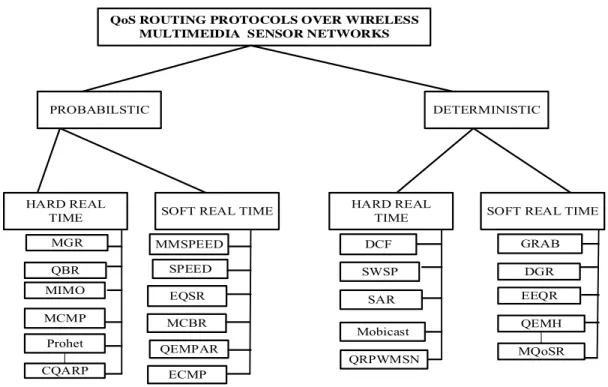
Based on the research issue, QoS routing protocols have been classified into two categories, which are probabilistic and deterministic, and these include soft real time and hard real time QoS routing protocols. This will help researchers to choose the best QoS routing protocol according to the requirements of the application to reduce energy consumption and obtain better throughput given in Figure 2.1.
In probabilistic routing protocols, the routing between sources to destination depends on the probability of the last lower rebroadcasted rate. In the probabilistic approach, the sensor node transmits the message with a known probability [19]. The transmission probability involves different factors such as hop-distance from source to destination, the number of hops where packet is already traveled, time in which sensor node already forwarded the packets, and the number of neighbor nodes. The probability-based protocols perform directed and controlled flooding. Thus, multiple packets are copied. In addition, probabilistic protocol uses the knowledge of history. Unlike probabilistic protocols, the deterministic protocols keep the complete information of node
trajectories, encounter probability of nodes, and the period in which a decision is forwarded [20]. Both probabilistic and deterministic routing protocols are also classified into soft and hard real time. Soft real time protocol can miss a few data points that do not affect the performance. If some bits are missed, performance is eventually degraded. On the other hand, hard real-time absolutely hits every deadline, such as nuclear systems, medical applications, military applications, and avionics.
PROBABILSTIC
SOFT REAL TIME
DETERMINISTIC
HARD REAL TIME
QoS ROUTING PROTOCOLS OVER WIRELESS MULTIMEIDIA SENSOR NETWORKS
SOFT REAL TIME HARD REAL TIME SAR MGR GRAB SPEED MMSPEED DGR DCF MIMO SWSP QEMPAR Prohet CQARP QRPWMSN Mobicast QBR MCMP EQSR MCBR ECMP EEQR QEMH MQoSR
Figure 2.1. classification of quality of service (QoS) routing protocols
2.2.1 Probabilistic Routing Protocols (Hard Real Time)
Multimedia Geographic Routing (MGR) introduces the new architecture called mobile multimedia sensor network (MMSN) in [21] that is based on the Mobile Multimedia Geographic Routing (MGR) scheme. In this scheme, the mobile multimedia sensor node (MMN) is used to improve sensor network ability for event description. The
average end-to-end delay of specific applications in MMSNs. The main goal of this protocol is to handle the delay to guarantee the priority for QoS provisioning. The protocol continuously attempts to reduce the energy consumption in order to prolong the sensor lifetime.
This helps to exploit the energy delay adjustments for design of this protocol. However, the key operation of this protocol is to choose the suitable location of current node for next hop. To complete this, MGR estimates the distance of the desired hop for the next hop selection that can be obtained by dividing the distance between current to the sink node. MGR ensures the QoS delay and reduces about 30% of energy consumption and prolongs the network lifetime as compared to classical geographic routing. MGR is more scalable than other protocols because it has the capability to control the mobility depicted in Figure 2.2.
Figure 2.2. The Strategic Location Selection in MRG [21]
QoS based routing (QBR) protocol [22] is a real-hard probabilistic-based routing protocol introduced for supporting the event and periodic-based data reporting. QBR is composed of the features of geographic routing with QoS provisioning. The data packets
are forwarded in the network based on the type of the packet. QBR sets different priorities levels for each type of data packet. Thus, multiple transmission queues are introduced for handling the priorities of data packets. In addition, the node is picked based on residual energy, high link quality, and the path with minimum load. The selection process of nodes consists of one-hop neighbor node that helps reduce additional energy consumption. In handling the congestion within the network, the ring or barrier mechanism that aggregates and captures the data packets is introduced. The barrier operation involves the barrier formation, shrink, repair, enlarge and termination. Despite these significant features, QBR is unable to meet the required QoS parameters. The main concern with this protocol is the use of extra control messages, which affect the throughput and consume additional energy.
Multiple Inputs and Multiple output (MIMO) is proposed in [23]. In MIMO, the data is collected in Multi-Hop Virtual MIMO through multiple source nodes and transmitted to a distant sink using multiple hops. The clusters are used to organize the sensors given in Figure 2.3. The cluster head transmits the data to cluster nodes that are related to a specific cluster. An Additive White Gaussian Noise (WGN) is used in such a transmission with squared power path loss because of short intra cluster transmission range.
Further, the cluster nodes translate and transmit data to a cluster head to the next hop due to orthogonal Space-Time Block Code (STBC). Multi-hop Virtual MIMO shows that an average reduction of the channel between each cluster head and cluster node is estimated during construction of the clusters so that it employs an equal Signal-to-Noise
Ratio (SNR) policy to distribute the transmitted energy due to its spectral performance efficiency and simplicity.
The Multi-Constrained QoS Multi-Path routing (MCMP) protocol is proposed in [24] to handle the QoS requirements. The MCMP uses braided paths to forward the packets to the sink station, which help maintain the QoS parameters such as end-to-end delay and reliability. The protocol structure is based on the linear integer programming, which formulates the end-to-end delay as an optimized problem. The MCMP routing algorithm builds the detailed link information for memory, sustainable computation, and overhead for the resource restricted sensor nodes. MCMP uses the local link metrics and distance to estimate the path metric. Local link metrics can help to obtain the network scalability. The goal of MCMP is to employ multiple paths to improve the network performance using moderate energy consumption. However, the protocol always prefers to choose the path that consists of the minimum number of hops to fulfill the essential QoS parameters. As a result, the protocol leads to the additional energy consumption.
The Probabilistic routing protocol for Heterogeneous sensor networks (ProHet) is introduced in [25] as a probabilistic hard real-time approach that can handle the asymmetry links in a dispersed fashion using local information. It uses low overhead with a guaranteed delivery rate. The working process of ProHet consists of two phases: the preparation phase that identifies the neighbor relationships and determines the reverse path for the asymmetric links and the routing phase that selects the nodes in order to forward the message and send the acknowledgement. ProHet uses bidirectional routing abstraction to determine the reverse path for each asymmetric link. It then applies a probabilistic policy to select forwarding nodes based on chronological data using local
information. The advantage of this protocol is to reduce energy consumption and to guarantee the delivery rate in wireless hybrid sensor networks [26]. As with the previous QoS protocols, ProHet focuses only on hot spot and energy consumption as discussed in [27]. Also, ProHet lacks mobility support and decreases the throughput.
Cluster-based QoS Aware Routing Protocol (CQARP) is a probabilistic hard real-time QoS routing protocol introduced for cluster-based wireless sensor networks in [28]. This protocol employs a queuing model to tackle the non-real-time and real-time traffic. The protocol focuses on least end-to-end delay, improving the throughput and prolonging the network lifetime. The protocol involves the cost function with each link and applies the K-least cost path algorithm to determine the set of the efficient routing paths. Each path is verified against the end-to-end delay limitations. Once a path satisfies the limitations, it is selected as the path for sending the data to sink node. All the nodes are assigned a similar bandwidth ratio, which can create problems because some of the nodes require higher bandwidth. The strength of this protocol is to improve the throughput and prolong the network lifetime. Also, the issue of bandwidth assignment was resolved by using a different bandwidth ratio for each node. However, transmission delay was not considered and the protocol lacks mobility support. The working process of the protocol is depicted in Figure 2.3.
Figure 2.3. Queuing Model in the Cluster-Based Wireless Sensor Networks [28]
2.2.2 Probabilistic Routing Protocols (Soft Real Time)
Multi-Path and Multi-SPEED (MMSPEED) Protocol is introduced to guarantee the probabilistic QoS in [29]. The QoS provisioning is done into two domains: reliability and timeliness. The reliability domain supports many reliability requirements using probabilistic multipath forwarding, and the timeliness domain can be achieved by ensuring multiple packet delivery. These mechanisms are realized in a localized manner without using global network information. The local geographic packet forwarding is improved with a dynamic benefit that compensates for local conclusion imprecision as a packet travels to its destination. The key goal of MMSPEED is to guarantee end-to-end requirements with a localized manner that supports the adaptability and scalability for large scale dynamic WSNs. It also ensures QoS differentiation in both timeliness and reliability domains. MMSPEED greatly improves both timeliness and reliability. However, MMSPEED uses greedy forwarding and geographic routing, which may not improve the performance of the network. In addition, it is not a good option for long life
applications because in such applications, the data transmission exceeds the required energy.
Stateless Protocol for real-time communication (SPEED) is introduced to maintain QoS for WSNs, based on soft real-time end-to-end guarantees. SPEED controls the congestion during heavy traffic load [30]. The Stateless Geographic Non-Deterministic Forwarding (SNFG) routing module is used in SPEED, which works with a combination of four other modules at the network layer. SNFG maintains traffic delivery speed across a WSN using a two-tier adaptation, including traffic delivery at the networking layer and packet regulation at the MAC layer. SPEED consists of several components including Neighborhood Feedback Loop (NFL), application Programming Interface, backpressure rerouting, delay-estimation scheme, last mile processing, Nondeterministic Geographic Forwarding (NGF) algorithm, and last mile processing. SPEED consumes slightly more energy than other QoS protocols because it delivers more packets under heavy congestion. The strength of SPEED reduces end-to-end delay.
The energy efficient and QoS aware multi-hop routing protocol (EQSR) maximize the network lifetime [31]. In EQSR, delay sensitive traffic is handled and forwarded effectively to the sink node using a service differentiation concept. The goal of EQSR is to improve throughput and to reduce the end-to-end delay by using multiple paths. The protocol uses residual energy, node buffer size, and signal-to-noise-ratio for determining the best next hop. In addition, EQSR uses a data aggregation model to handle the real-time and non-real-time traffic. EQSR uses a path discovery phase that consists of initialization phase, a primary path discovery phase, and an alternative paths discovery phase.
The path discovery phase is based on directed diffusion [32]. The sink node uses the multiple paths discovery to determine the set of neighboring nodes, which can send the data towards the sink from the source node. Furthermore, EQSR applies a procedure of path refreshment, path selection, traffic allocation, and data transmission for maintaining the QoS and handling the different types of traffic.
Message-initiated Constrained-Based Routing (MCBR) maintains the QoS requirements [33]. MCBR is composed of explicit specifications for route constraints, QoS provisioning, and constraint-based destinations for handling the messages and the set of QoS based meta-schemes. The routes are set up through network flooding from the source to the destination. The data message is transmitted from the source to the destination through the route that fulfills the QoS provision for a given data message. The general purpose of a meta-data routing scheme in MCBR is to improve the end-to-end delay and throughput. In addition, MCBR involves two kinds of meta-routing strategies: search-based and constrained-flooding. However, the additional use of control packets for both types of routing strategies causes a significant overhead. In order to reduce this overhead, the QoS-aware learning-based routing protocol is proposed in [34].
Another probabilistic soft real time multi path routing protocol named QoS and Energy Aware Multi-Path Routing Algorithm (QEMPAR) was introduced to support the real-time applications [35]. The goal of this protocol is to increase the network lifetime. The approach assumed that all the nodes were randomly distributed in the intended environment. Each node was assigned a unique ID. The node energy was considered equal at the beginning of the simulation. In addition, the nodes were aware of their location by using GPS and could handle the energy consumption. Based on this
assumption, the nodes could communicate with other nodes beyond of their radio range. In this protocol, the energy consumption model was used to determine the suitable link, path discovery, and paths assortment; in addition, the tiny packets were sent using different paths. The strength of this protocol is to prolong the network lifetime. However, throughput is affected due to increase of the latency. In addition, no mobility is considered in this protocol and using GPS makes it cost ineffective.
Energy constrained multi-path routing (ECMP) is the extension of MCMP [36]. ECMP is proposed to frame the QoS routing problem to reduce the energy consumption. The protocol focuses on the playback delay, reliability, and geo-spatial path selection limitations. The tradeoff between less energy consumption and the minimum number of paths is shown for improving the QoS requirements. The main purpose of driving the ECMP model is to utilize the resource constraints efficiently to replicate not only resourceful bandwidth utilization but also insignificant energy consumption in its stringent terms. The ECMP selects those paths in the network, which satisfy the QoS requirements. However, fulfilling the QoS provisioning, routing overhead is introduced in terms of additional energy consumption and computational complexity. The overhead can affect the performance of those applications that require a certain delay and a bandwidth.
2.2.3 Deterministic Routing Protons (Hard Real Time)
Directional Controlled Fusion (DCF) protocol is introduced for data fusion and load balancing while maintaining QoS [37]. The key parameter in a multipath fusion factor provides trade-offs between multipath-expanding and multipath converging. To
guarantee the QoS for several applications, one source node is chosen as reference source per round based on standards such as distance from the target region center, maximum remaining energy, and distance to the sink. The first stage for source node is to start a Reference-Source-Selection-Timer (RSS-Timer). Random value for each RSS-Timer is set on specific criteria. In this phase, a small value of RSS-Timer specifies that a source has advanced admissibility as a reference source. The next step is to monitor the RSS-Timer. The source whose value terminates first is chosen as a reference source. It also broadcasts an election notification message (ENM) within the targeted region. When nodes from another source get this message, they attempt to withdraw their RSS-Timers and determine the reference source location. The next phase in the reference source is to begin the building of the reference path and initiate the side sources attempt to transfer control packets.
Sleep/Wake Scheduling Protocol (SWSP) is introduced to preserve energy. It turns off the radio during idle time and wakes up just before the start of the transmission of the message [38] . It uses synchronization between the sender and the receiver. Thus, nodes wake up concurrently to communicate with each other. The existing synchronization mechanism gets accurate synchronization instantaneously after exchange of synchronization messages. However, there is a random synchronization fault due to non-deterministic elements in the system. A consequence of these faults is that the clock will not propagate with time and will fail to be analogous to real message transmission time. Thus, an ideal sleep/wake scheduling algorithm is introduced. It attains that a message capturing capability threshold by using less energy consumption. Additionally, multi-hop communication is performed.
The sleep/wake scheduling protocol is systematized into a cluster-based hierarchy, and each cluster is comprised of multiple cluster members and a single cluster head. The key issue of this protocol is to recognize one of the cluster members as a cluster head in one cluster. For example, "C" is cluster head of "E," yet at the same time, it is also a member of "A" as shown in Figure 2.4. The member nodes are synchronized during the synchronization period and the transmission period.
BS A C D E F B
Figure2.4. Three Level Cluster Hierarchy [38]
Sequential Assignment Routing (SAR) is the first routing protocol for WSNs that initiated the idea of QoS in the routing decisions [39]. SAR decides the routing process based on three factors: 1) QoS on each path, 2) energy resources, and 3) the precedence level of each packet. SAR uses multi-path and localized path restoration techniques to avoid single path failure. The goal of the SAR algorithm is to reduce an average weighted QoS metric during the WSN's lifetime.
Mobicast is the deterministic hard real-time mobile object tracking protocol introduced in [40]. The protocol uses a multi-cast routing and dynamically tracks the mobile object. In this technique, a mobile user is guided to locate the mobile object correctly without sending flooding requests to localize the mobile object. This protocol
helps to preserve the energy consumption to prolong the network lifetime. In this approach, source and target names are used for mobile users and mobile objects, respectively.
The WSN helps the source node identify the target node and keeps the tracked information of a targeted node. The approach is based on active and sleeping modes. The source node is not required to communicate to the current location of the targeted node when detecting the location. This protocol applies a face routing process explained in [41] that is based on the idea of Gabriel Graph discussed in [42] for chasing the target correctly. It also focuses on velocity of the targeted node and its moving direction. The protocol saves energy as compared with other object tracking WSN protocols. However, mobility scenarios are not completely explained and a latency issue still exists.
QoS-based routing protocol for wireless multimedia sensor network (QRPWMSN) is introduced in [43] to perform routing on each data packet according to existing QoS standards by considering the delay, energy efficiency, and reliability. This protocol is based on the geographical information model. The protocol uses a genetic algorithm and a queuing theory. QRPWMSN weighs each delay in order to consume less energy by maintaining the reliability for determining the best efficient path. All the nodes are fixed and possess individual identifiers as illustrated in Figure 2.5.
The advantage of this protocol is to improve the transmission with less congestion However, the protocol is complicated due to its use of the individual identifier that can increase the latency and reduce the throughput. In addition, it does not have mobility support and consumes a substantial amount of energy for any transmission.
TRANSPORT LAYER
PACKET
NEIGHBOR NODE MAANGER
USUAL PACKET HELLO
AUDIO PACKETS
VIDEO PACKETS
QUEUING MANAGER USUAL PACKET QUEUING
AUDIO PACKET QUEUING
VIDOE PACKET QUEUING
HIGHER PRIORITY
Figure 2.5. Queuing Theory for Proposed Algorithm [43] 2.2.4 Deterministic Routing Protons (Soft Real Time)
GRAdient Broadcast (GRAB) is specifically designed for robust data delivery in order to control unreliable nodes and imperfect wireless links [44]. GRAB constructs and maintains the cost field by broadcasting advertisement (ADV) packets. When a node gets an ADV packet comprised of the cost of sender, it computes its cost by accumulating the link cost between sender-to-sender cost advertisements. The node compares this cost with the previously verified one and then sets a new cost. When the node gets a smaller cost than the older one, it transmits an ADV packet containing the new cost. GRAB handles bandwidth by using an amount of credit taken in each data packet that lets the sender regulate the strength of data delivery. The benefit of GRAB is to reply upon the communal efforts of the multiple nodes to distribute data without any data dependency on any individual node. However, it increases overhead by using redundant data.
Directional Geographical Routing (DGR) Multipath routing protocol is introduced in [45]. DGR is suitable for real time video streaming over energy constrained nodes and a bandwidth from a small number of detached video sensor nodes (VNs) to a sink by
merging a forward error correction (FEC) coding technique. In DGR, an active node VN broadcasts the packets to its direct neighbors while concatenating FEC packets of a video frame and all the data. When nodes get concatenated packets broadcasted by the VN, they choose their own payload based on the sequence numbers and identify the corresponding packets of nodes. Subsequently, nodes unicast the allotted packets to the sink through corresponding individual paths. In DGR, multipath routers set three paths the between source and the sink. Furthermore, each path uses a different first direct neighbor. This architecture can be efficient to route the video traffic of the network. The simulation results prove that DGR gets low latency that is equal to 0.05msec. It also increases network lifetime and provides better-received video quality. The video peak signal to noise ratio could be improved up to 3dB.
Energy efficient and QoS aware routing (EEQR) is deterministic real-soft routing protocol introduced in [46]. Guaranteeing the QoS, the data prioritization is performed based on the message type. Two types of sink nodes were used: static and mobile. The static sink nodes handle the delay-sensitive messages while mobile sink nodes handle the delay tolerant messages. The objective of EEQR is to improve network lifetime and coverage efficiency. In addition, it focuses on the QoS parameters such as end-to-end delay, packet loss ratio, and throughput. EEQR is based on the multi-hop communication that reduces the end-to-end delay and bandwidth consumption. Packet prioritization mechanism handles the data gathering issue. Incoming traffic of the network is ranked according to the packet content significance. Proposed EEQR is divided into phases and sub-phases. The primary phases include setup and steady. The sub-phases comprise of eight sub-phases. The setup phase involves the initialization,
route update, and clustering three phases. The steady phase consists of six sub-phases: data prioritization, data forwarding to cluster head or super node, data forwarding to static sink, mobile sink movement decision, forwarding queue weight to mobile sink, and mobile sink data gathering.
QoS based and Energy aware Multi-path Hierarchical Routing (QEMH) protocol is introduced in [47] to fulfill the QoS requirements and energy consumption. QEMH is designed based on the hierarchical mechanism for consuming the minimum energy. The protocol consists of two phases. In the first phase, the QEMH selects the cluster head node based on two metrics: node distance from the sink station and residual energy of the node. In second phase, QEMH performs the routes discovery process by using multiple conditions such as buffer size, residual energy, distance to sink, and signal-to-noise ratio.
Once a node detects an event, it then sends the data to the cluster head node. The responsibility of the cluster head node is to further forward it to the sink station along the paths. QEMH uses the weighted traffic allocation approach to distribute the network traffic amongst the existing paths to increase the throughput and end-to-end delay. In this approach, the cluster head node distributes the traffic between the paths based on the end-to-end delay of each path. The QEMH measures the end-end-to-end delay during the paths discovery process. QEMH aims to prolong the network lifetime as load balancing that helps to balance the energy consumption uniformly throughout the network. Furthermore, QEMH deploys the queuing model to handle the real-time and the non-real-time traffic.
Multi-objective QoS Routing (MQoSR) protocol is introduced [48] and is based on geographic routing mechanism. The protocol uses a heuristic neighbor selection procedure that combines the geographic characteristics with the QoS requirements to
obtain QoS improvement for several applications. The QoS provision issue for routing is articulated as path and link-based parameters. The link-based parameters are divided into delay, reliability, distance to sink, and energy consumption. The path-based parameters are presented in form of reliable data transmission, end-to-end delay, and network lifetime. MQoSR applies a different selection policy for each QoS requirement. The node selects the next hop node based on the requested requirements and the link conditions for improving the QoS provisioning. MQoSR is purely based on the on-demand routing mechanism, which makes the multiple node-disjoint paths. The MQoSR decides the cost of each link based on link cost function, and total link cost function.
2.3 Simulation Setup and Performance Evaluation
This section shows the performance for some of the known routing protocols: SPEED, Mobicast, MMSPEED, SAR, MGR, and MIMO. The performance of the protocols is measured using network simulator-2 (NS2). We constituted the network size of 400 m x 400 m.
We assumed that the homogenous nodes are disseminated in the flat type network. Each node initially uses 5 joules energy. The nodes are responsible to forward the data to the base station. The base station is located at point (0, 500). The size of the packets is 128 bytes. The residual energy of each node after 6 cycles is calculated to prolong the network lifetime. The performance analysis of the routing protocols is made using the following assumptions.
A static sink node (base station) is set that is farther from the sensing field.
Each node has a variable sensing capability and sensing the field with the variable rates and is responsible to forward the data to sink node.
50% nodes are mobile.
Each sensor node has a same communication capacity and computing resources.
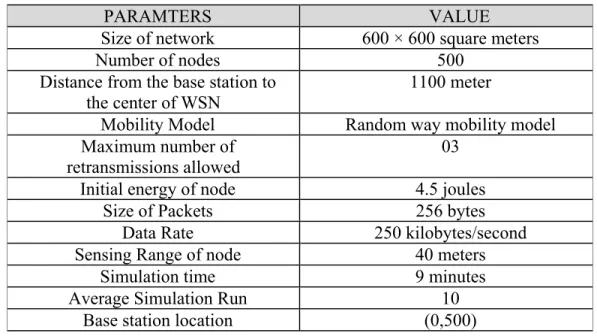
The location of sensor nodes is determined prior to starting the simulation. The rest of parameters are explained in Table 2.1.
Table 2.1 Simulation parameters and its corresponding values PARAMTERS VALUE Size of network 400 × 400 square
meters Number of
nodes
450
Queue-Capacity 30 Packets Mobility Model Random way
mobility model Maximum number of retransmissions allowed 03 Initial energy of node 5 joules Size of Packets 128 bytes
Data Rate 300 kilobytes/second Sensing Range
of node 35 meters Simulation time 5 minutes
Average Simulation Run 06 Base station location (0,500)
Average delivery rate
Average energy consumption
End-to-end delay
Lifetime
Average delivery rate
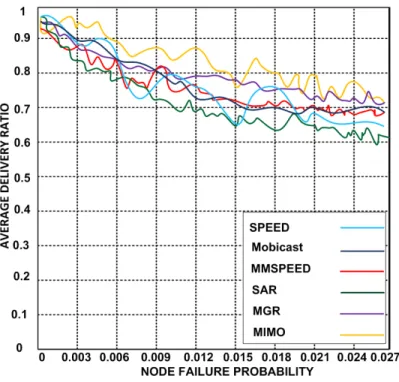
One of the significant metrics for evaluating the performance of the routing protocols is an average delivery rate. We compare the performance using the node failure probability and an average delivery ratio are shown in Figure 2.6. We observe that the performance of the routing protocols is comparatively similar, but MIMO has a slightly higher performance than other routing protocols. We notice that these routing protocols experience the problems due to node failure. As a result, the protocols reduce the performance. The reason of reducing the performance of the protocols is the lack of load-balancing algorithms.
Figure 2.6. Average delivery ratios vs different node failure probability
Average energy consumption
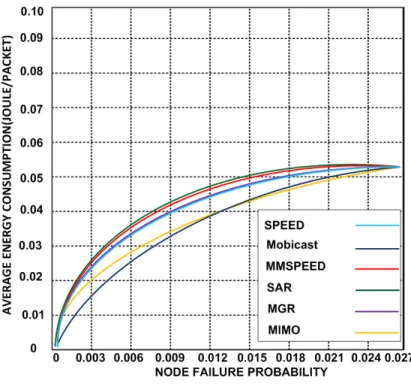
We measure the energy consumption of each protocol using node failure probability. We observed that the performance of each protocol is almost similar. However, MMSPEED, and SAR show slightly higher performance than other routing protocols, but at the 0.027 probability rate, the energy consumption of each routing protocol is the same. The energy consumption could affect the QoS provisioning. The result depicted in Figure 2.7 demonstrates that the routing protocols consume the additional energy resources due to node failure probability. The node failure probability could be improved using the optimized approaches.
Figure 2.7. Average energy consumption VS node failure probability
End-to-end delay
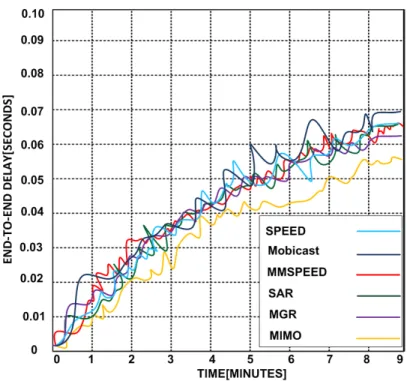
End-to-end delay is another significant parameter for analyzing the performance of QoS based routing protocols. We show end-to-end delay of each routing protocol in Figure 8. Based on the results, we observed that when the time interval increases, the end-to-end delay performance of each routing protocols is affected.
Figure 2.8. End-to-end delay of routing protocols at the different time intervals
In this experiment, variable packet sizes are used for the arrival rate at the sender side. One of the interesting measurements deals with both non-real time and real time data traffic. Based on the results, we observed that MIMO shows a slightly lower end-to-end delay when compared with the other routing protocols. However, end-to-end-to-end-to-end delay of MIMO can also be considered higher within the scope of the routing performance.
Lifetime
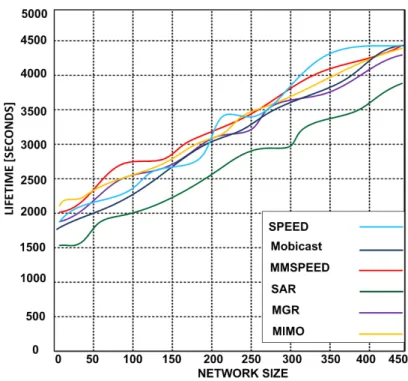
The primary goal of the WMSNs is to improve the network lifetime because the sensor node possesses limited power and other resources. In this experiment, we measured the performance of these routing protocols using a different network size as depicted in Figure 2.9.
Figure 2.9. Network lifetime using different routing protocols and network size
Based on the results, we observed that the performance of each competing routing protocol is similar except for the SAR routing protocol. The SAR routing protocol degrades the network lifetime. However, overall, the network lifetime using these routing protocols is not encouraging. Thus, there is a need for optimized routing protocols to prolong the network lifetime.
2.4 Challenges and Open Research Issues
Most of the existing QoS techniques support only QoS aware routing protocols. QoS aware routing is a crucial part for maintaining the QoS framework to improve the lifetime of wireless networks. The data delivery paths are analyzed using knowledge resource accessibility along with other requirements under QoS routing schemes.
Numerous issues need to be considered when designing the QoS routing protocols for WMSNs. We have determined important factors that can improve the design.
Parameter selection (The delay, bandwidth and path computation).
Timeliness and reliability.
QoS state maintenance and propagation.
Scalability and mobility.
Maintaining the network adaptability and balancing the efficiency for low latency.
Many routing protocols were introduced, but some of focus on maintaining QoS. In general, the main job of WSN is to sense the environment and to send the sensed data to the base station. Therefore, QoS provisioning in WMSN faces significant challenges:
Heterogeneity: This is one of the big challenges in WMSN for maintaining the QoS because used sensors for detecting the events are different from each other. There are applications that require heterogeneous sensors to monitor the events and to capture images and videos for moving objects such as handling the disaster situation, surveillance system and military battlefield environment. These applications generate the data from sensors at varying rates based on different QoS limitation and delivery models. Hence, these diversified WMSNs may impose significant challenges for the provision of the QoS.
Limitation of resources: The efficient energy utilization is one significant challenges for maintaining the QoS. When sensor nodes are communicating, they may drain the battery. This situation can be worse when sensor nodes are underground as they are not replaceable and rechargeable.
Bandwidth utilization: This is a challenge in WSNs generally because WSNs involves real time and non-real time traffic. Thus, the bandwidth allocation should be maintained to balance the traffic flow between real time and non-real time communication. However, introduction of multimedia will pose more challenges because there will be higher traffic and more bandwidth demands to process such type of data
Network adaptability: The link failure and node failure can be caused by mobility. As a result, the network topology changes, which is a concern. The network encompasses the densely deployed hundreds to thousands of nodes in a landscape of interest. In this situation, the number of sensor nodes may join or leave the network that affects the QoS.
Data Redundancy Sensor nodes are deployed in the area of interest for sensing the situation, but most of the generated data is redundant, and this redundancy affects the reliability and fault tolerance process. As a result, energy is wasted. Data fusion and data aggregation are solutions to handle the redundancy. For instance, the sensors generate the same image and point to same direction that aggregated. However, data fusion techniques and data aggregation could create problem for QoS design.
Unreliable Medium: The radio is the communication medium in WMSN that is less reliable inherited the features of Medium Access Control (MAC) protocols. Furthermore, the wireless links are also affected because several environmental factors including signal interference and noise.
Assorted Data Pattern: This is an important issue for designing the QoS routing protocol because data can arrive in the form of periodic and= non-periodic. The sensing data can periodically be created in applications at unpredictable times due to exposure to serious events. Similarly, sensory data can be generated at regular intervals such as the monitoring process of real time environmental applications. This diversified nature of data creates the significant challenges for QoS WMSN routing protocols.
Multiple Base Stations and Sinks: Most WMSN applications involve a single base station and sink, but some applications require multiple base stations and sinks, such as the military and disaster recovery applications. In this situation, WMSNs should be capable to handle the mixed QoS level with multiple base stations or sinks [49]. Several techniques are available in literature to handle different kinds of issues to improve the QoS. However, issues still exist that need to be resolved for QoS provisioning.
In addition to the challenges for QoS, we also consider important directions and research issues that need to be highlighted. Mobility is one of the major threads for
QoS provisioning because sensor network models are based on the assumption that consider sink as static, but this assumption cannot be accurate for all types of scenarios. For example, a battlefield scenario consists of mixed types of sensor nodes: static and mobile. Therefore, in this situation, sink and sensor nodes should be provided mobility support. Furthermore, network topology also keeps on fluctuating dynamically. It is more important to address the mobility and dynamicity of WMSNs, as they need to be considered before designing QoS routing protocols.
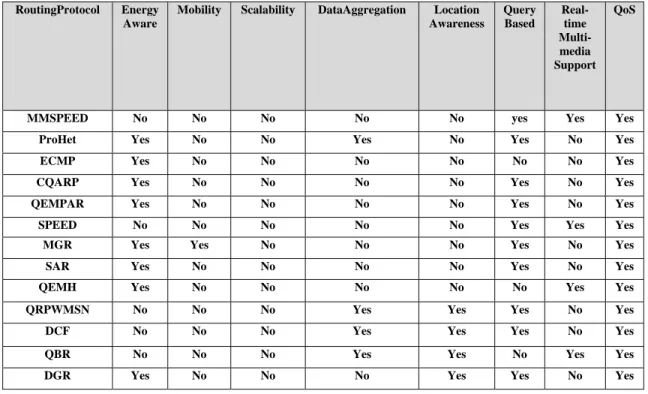
The placement of the heterogeneous multimedia sensor node is another research area for QoS provisioning [50]. Thus, secure data routing is a significant aspect that needs to be considered for WMSNs. In all these conditions, WMSN is a challenge in designing the QoS routing protocols. Based on a detailed survey, we have compared the characteristics of existing QoS routing protocols explained in Table 2.2.
Table 2.2. evaluation and comparison of QoS routing protocols over WMSNs.
RoutingProtocol Energy Aware
Mobility Scalability DataAggregation Location Awareness Query Based Real-time Multi-media Support QoS
MMSPEED No No No No No yes Yes Yes
ProHet Yes No No Yes No Yes No Yes
ECMP Yes No No No No No No Yes
CQARP Yes No No No No Yes No Yes
QEMPAR Yes No No No No Yes No Yes
SPEED No No No No No Yes Yes Yes
MGR Yes Yes No No No Yes No Yes
SAR Yes No No No No Yes No Yes
QEMH Yes No No No No No Yes Yes
QRPWMSN No No No Yes Yes Yes No Yes
DCF No No No Yes Yes Yes No Yes
QBR No No No Yes Yes No Yes Yes
2.5 Conclusion
This section conducted a comprehensive survey of QoS routing protocols in WMSN. The QoS routing protocols are classified into deterministic and probabilistic categories. Both categories are classified into soft and hard real time protocols. We highlighted critical challenges posed by the unique features of WMSNs. In addition, we reviewed QoS routing protocols with strength and weaknesses in WMSNs and discussed the challenges and open research issues that will help the research community to deal with them in the future. In addition, we have simulated known routing protocols using NS2 and compared their performance. Finally, we have evaluated the characteristics of each routing protocols using several parameters.
GRAB Yes No No No Yes Yes No Yes
SWSP No No No Yes No Yes No Yes
MQoSR No No No No Yes No No Yes
MIMO No No No Yes No Yes No Yes
Mobicast Yes Yes Ys No Yes Yes Yes Yes
EEQR Yes No No No Yes No No Yes
EQSR Yes No No Yes No No Yes Yes
MCBR Yes No No No No No Yes Yes
CHAPTER 3: BUFFER-OVERFLOW AND
NOISE-HANDLING MODEL: GUARANTEEING QUALITY OF
SERVICE ROUTING FOR WIRELESS MULTIMEDIA
SENSOR NETWORKS
3.1. Introduction
Wireless Sensor Networks (WSNs) are the collection of sensor nodes that form a momentary network without the support of any centralized administration or infrastructure. In such a situation, it is mandatory for each sensor node to obtain the support of other sensor nodes to advance the packet to its desired destination node, particularly to the sink node or base station. One significant challenge in designing the WMSN is introducing an energy efficient routing protocol that may transmit information despite limited resources. Another significant problem is determining the resources of the next hop node in advance. The routing protocols in existing literature mainly focus on prolonging the network lifetime.
This research introduces the buffer-overflow distance-aware and noise-handling (BODANH) model to guarantee the QoS for multipath routing over wireless multimedia sensor networks. BODANH involves three components: buffer allocation, distance
measurement, and signal-to-noise-ratio. This model prevents the loss of data and avoids the congestion caused by buffer-overflow and identifies the node distance prior to route discovery that helps determine the location and distance between nodes when the node is either movable or immobile.
The performance of this model is compared to other QoS routing protocols. Simulation results demonstrate that our model surpasses the other routing QoS routing protocols in terms of throughput and the remaining live nodes in static and mobility scenarios.
Due to the rapid advancement in emerging technologies particularly in micro electro-mechanical systems, small scale energy devices, low power integrated digital circuits, small scale energy supplies, microprocessors, and low power radios have provided the platform for low cast, low energy, and multifunctional wireless sensor nodes that can perceive and respond to deviations in physical phenomena [51]. Each sensor node is equipped with a tiny microprocessor, radio transceiver, small battery, and a set of transducers, which are used for obtaining information that redirect the vicissitudes in the surrounding environment. Wireless sensor networks involve a number of tiny sensor nodes that coordinate with each other to perform critical tasks (e.g., object tracking and environment monitoring) and deliver the collected data to the sink node or base station [52]. The areas of wireless sensor network applications include healthcare, battlefield, surveillance, environmental monitoring, or detection of fire [53]. However, network density, limited node power, severe bandwidth limitations, dynamicity of the topology, and large-scale deployments have caused challenges in the management of WSNs. In addition, buffer overflow and noise have also posed challenges including congestion, data
loss, performance dilapidation, and excess. Limited memory space causes buffer overflow and data packets start to drop [54]. As a result, retransmission is required for the lost data packets [55]. Thus, additional energy is consumed. The recent advances of low cost, miniature size cameras or microphones have led to the development of WMSNs as a class of wireless sensor networks. WMSN is a network of wirelessly interconnected sensor nodes that can capture images, video, and audio data from the surrounding environment and send that to the sink. WMSNs attracted attention because they enhance the exiting WSN applications and enable new applications such as multimedia surveillance sensor networks, traffic avoidance, enforcement and control systems, and advanced health care delivery. In order to guarantee the successful transmission of the multimedia content, the routing protocols need to be energy efficient and QoS support [56]. Buffer detection is largely an open issue in WMSNs due to limited computational capabilities and limited memory resources.
The sensor nodes handle low data volume in low data rate applications [57]. However, multimedia-driven applications are required to determine the status of a buffer prior to sending the data to the next hop because sensor nodes may be loaded due to such applications and the buffer may start to overflow. In addition, buffer overflow invites congestion that may cause a reduction in network efficiency [58-60]. To handle congestion, it is important to determine the sufficient free buffer space prior to delivering the data packets to next hop nodes. Several approaches are available in literature for conventional networks. However, these approaches are too complicated to be introduced in resource constrained WMSNs. Additionally, WMSNs vary in nature from wired network because nodes in WMSN hold a single queue that is connected with a single
transmitter. Furthermore, the noise and distance of nodes are also more important for the discovery of the path for guaranteeing the QoS provisioning [56].
Most approaches used to discover paths are based on the residual energy of the node. These approaches are not suitable in certain situations, such as when the sensor node is farther from the sink node and holds high residual energy; however, long distance and noise weaken the signal strength. As a result, the node does not receive all sent packets [61]. Trade-offs are an efficient use of the buffer and energy of sensor nodes, which are highly desirable when designing multi-path routing that guarantees the QoS provision for WMSNs [62]. This paper attempts to address the congestion and data overflow caused by buffer limitations. Furthermore, we consider noise and determine the distance including the location of the node that helps in the discovery of an optimized path. The contribution involves the BODANH mathematical model that improves the throughput and extends the network life.
The remainder of the chapter is organized as follows. The next section presents a proposed model called buffer-overflow, distance-aware and noise-handling model. This is followed by the simulation setup and performance study of the result. The last section provides a conclusion for this work.
3.2 Buffer-Overflow, Distance Aware, and Noise Handling Model
Guaranteeing the QoS routing in wireless multimedia sensor networks is a challenging problem due to limited properties of the sensor node. Our aim is to present the BODANH model in a manner that improves the throughput and prolongs the network lifetime. Thus, we focus on detecting the capacity of buffer prior to sending the data
packets as well as determining the node distance and handling the noise. The BODANH model includes the following features:
Buffer allocation
Distance measurement
Signal-to-noise ratio
A. Buffer Allocation
Each sensor node S=(S1 , S2 , S3 , Sn) measures all traffic flows 'F(m,n)' passing through each link L=(L1,L2, . . . , Ln) , ∀ L1, L2, . . . , Ln ∈L. Where Fnt(m,n) is the measurement of the new time interval, and Pk(Pk1, Pk2, Pk3, . . . , Pkn) is the number of packets. Let us assume number of packets Pk(Pk1, Pk2, Pk3, . . . , Pkn) received by S1 from sensor node S2 over the link L1 during the time interval 't∆'. Thus, the size of buffer measured in new interval can be obtained as:
Fnt(m,n)=Pk1∈ Pk1S1(Pk) (1) Where ’S1(Pk)': Already existing packets in the buffer of sensor node.
If sensor node 'S1' is congested either due to bottleneck (heavy traffic) or full buffer, then the buffer limit for each sensor node can be calculated as follows:
bρ(S)=F(Pk)ρ(s)+S1 ∈ SS1{F(Pk)} r(Pk) (2) Where ‘bρ’: Buffer limit, 'F(Pk)': The number of transmitted packets out of the buffer, ‘r(Pk)’: The rate of packets transmitted in per second, ‘ρ(s)’ : The source of the data , and’ S1{F(Pk)} : Buffer limit of ‘S1’ sensor node.
The sensor node forwards the packets that can be measured locally, if ρ(s) =1 then ‘s’ is the data source otherwise ρ(s)=0. The sensor node ’S1' advertises the buffer
limit ‘bρ’ to the sensor node ’S2' possibly by using piggybacking in the acknowledgement packet. In response, the sensor node ’S2' applies a rate limit (actual rate on path) ‘B∆path’ that is bounded by a rate limit. If the sensor node ’S1' itself is data source, it will assign the buffer to node ’S2' as follows:
bρ(S1)= 11+S1 ∈ SS1{F(Pk)} r(Pk) (3) If the neighbor node attempts to enforce a buffer rate limit, it may cause congestion; if the buffer capacity of the receiving node is full, then it administers rate limits. This process is applied to the data sources. Finally, all the exaggerated data sources are able to adjust the packets rates based on the allotted fair bandwidth. Note that only congested node administers the rate limit that is updated periodically.
When the congestion state proceeds to sensor node ‘S1’, the buffer rate limit is stopped. This situation can occur by raising the buffer rate limits of sensor node ’S1’. The sensor node ’S1' is capable of identifying the situation of the congestion by detecting the fullness of the buffer. When that situation happens, the sensor nodes fix the buffer rate limits to be bρ(S)) and bρ(S1), rather than over-setting them. As a result, a sensor node discontinues enforcing buffer rate limits once its congestion state is detached (buffer is deflated) and the data rates at which the node accepts packets from the neighboring nodes are less than the buffer rate limits.
B. Distance Measurement
Based on the transmission rate 'St∆' of each sensor node in the sensing area of the sensor network, the clustering process is initiated between clustering nodes and cluster head nodes for determining the optimal path. This process involves the messaging
multimedia sensor networks. In addition, all the sensor nodes detect their locations ‘₯’ from the sink.
The base station sends the message inside the network, the nodes that receive the signal that start calculating the distance from the base station (sink). The process of calculating the distance is performed using Euclidian distance formula given in equation (4):
r(S1)=₯( s)
-₯(S1)2 (4)
Where 'r(S1)': Distance of sensor node from sink node, ‘₯( s)’ : Location of sink node, ₯(S1): location of sensor node '(S1)' after detecting the distance.
Our goal is to determine an optimized disjoint (primary) path and braided paths for data communication. Thus, the sensor node that possesses the shortest distance ‘rα(S1)’ connects itself with the disjoint path. However, the sensor node that has extended distance 'rβ(S1)' from the sink joins the braided path. Our approach is applied with lower and higher levels clusters in hierarchy. Let ‘r(S1)’ be the distance between source node and sink node and '∆t' be the transmission rate and 'E(S1)’ be transmitted energy of sensor node that is proportional to the received signal strength. Thus, transmitted power ‘∆Tp’ of the node for each cycle can be obtained as
∆Tp= r(S1)μσ*∆t (5) where ‘μ’: constant value that is considered as the requirement of signal strength, and ‘σ’ : distance loss factor. In this contribution, we only assume ideal MAC and only interference is detected due to background that is set to be at the constant rate. Hence, the
received signal strength reduces the signal to noise ratio. Thus, the energy consumption for sending one unit of data over the medium with distance ‘r(S1)' can be obtained as
r(S1)μσ =E(S1)* 1∆t r(S1)μσ -E(S1)* 1∆t =0 r(S1)μσ - E(S1)∆t =0 r(S1)μσ= E(S1)∆t
E(S1)=r(S1)μσ*∆t (6) In the wireless network, a major source of signal loss is attenuation. Fundamentally, th
![Figure 2.2. The Strategic Location Selection in MRG [21]](https://thumb-us.123doks.com/thumbv2/123dok_us/216947.2520504/21.918.302.725.604.861/figure-strategic-location-selection-mrg.webp)
![Figure 2.3. Queuing Model in the Cluster-Based Wireless Sensor Networks [28]](https://thumb-us.123doks.com/thumbv2/123dok_us/216947.2520504/25.918.223.811.110.346/figure-queuing-model-cluster-based-wireless-sensor-networks.webp)
![Figure 2.5. Queuing Theory for Proposed Algorithm [43]](https://thumb-us.123doks.com/thumbv2/123dok_us/216947.2520504/32.918.219.808.116.328/figure-queuing-theory-proposed-algorithm.webp)