An Overview of Vertical Handoff Decision Algorithms in NGWNs and a
new Scheme for Providing Optimized Performance in Heterogeneous
Wireless Networks
Ionut BOSOANCA, Anca VARGATU
Department of Computer and Communications Engineering, Faculty of Automation, Computers and Electronics, University of Craiova
[email protected], [email protected]
Because the increasingly development and use of wireless networks and mobile technologies, was implemented the idea that users of mobile terminals must have access in different wire-less networks simultaneously. Therefore one of the main interest points of Next Generation Wireless Networks (NGWNs), refers to the ability to support wireless network access equip-ment to ensure a high rate of services between different wireless networks. To solve these problems it was necessary to have decision algorithms to decide for each user of mobile ter-minal, which is the best network at some point, for a service or a specific application that the user needs. Therefore to make these things, different algorithms use the vertical handoff tech-nique. Below are presented a series of algorithms based on vertical handoff technique with a classification of the different existing vertical handoff decision strategies, which tries to solve these issues of wireless network selection at a given time for a specific application of an user. Based on our synthesis on vertical handoff decision strategies given below, we build our strategy based on solutions presented below, taking the most interesting aspect of each one.
Keywords: Vertical Handoff, Genetic Algorithms, Fuzzy Logic, Neural Networks, AHP Introduction
In the near future it will be found the sit-uation in which users of wireless technolo-gies and mobile networks will no longer be bound by a subscription of one network, they will have the possibility to choose their own, one of the available networks depending on the mobile device used and the needs they could have at the moment. Evolution of wire-less networks together with the evolution of mobile technologies have resulted in NGWNs networks, which are expected to provide support for heterogeneous access technologies. This has led to the emergence of a multitude of different technologies wire-less, each with different characteristics; on the other hand mobile devices are currently built with different network interfaces. The terminals with “multi-homed” in this envi-ronment of heterogeneous radio networks, can connect to any combination of these net-works (GPRS, UMTS, WLAN, WiMAX, BLUETOOTH etc). These wireless networks are combined to offer to the mobile terminals equipped with multiple network interfaces an ubiquitous network environment, but for
have access to wireless networks, must take a vertical handoff decision. Handoff procedure can be characterized into different types, on the one hand, the handoff can be vertically or horizontally on the other side the handoff can be soft or hard. Vertical Handoff, takes place between points of attachment that support different network technologies such as be-tween an IEEE 802.11 access point and a base station of a cellular network. Conse-quently, Handoff is the process by which the MT (Mobile Terminal) maintains active con-nections while moving from one point to which is attached (base station or access rou-ter where is connected) to another. Horizon-tal Handoff, takes place between points of at-tachment that supports the same network technology, for example between two neigh-boring base stations of cellular networks. Soft Handoff, it can be said that the soft han-doff is when MT is connected to two points of attachment for a while and we talk about the connection before interruption the han-doff process. In this case, connecting to the new objective is set before the break old connections, therefore it is called
make-1
before-break. The GSM standard makes in opposition to the soft handoff a “hard han-doff”, meaning “Make Before Break” which means that the transition from one base sta-tion to another base stasta-tion is needed to break the old connection before making a new con-nection with the network that has the best strong signal. So we can say that the handoff is hard when MT is connected only to a point in time. Thus we talk about an interruption (break before make) before to complete the handoff process. To achieve the vertical han-doff process and for a good continuation of services, it is necessary to implement an al-gorithm, which based on conditions offered by the network where we are now connected, and based on parameters provided by de-tected network, it must take a vertical han-doff decision. This decision depends on dif-ferent parameters desired by the user such as bandwidth, cost of service, power require-ments, security, network condition, user pre-ference and quality of service. For a satisfy-ing user experience, mobile terminals must be able to transfer the connection without weights to the best access network of all networks candidate available, without any notable interruption to a continuing conversa-tion which may be an audio or video session. Such ability to ensure the transfer between heterogeneous networks characterizes the vertical handoff process. Handoff manage-ment factors include mobility scenarios,
me-trics and decision algorithms for different procedures. Handoff management is the key issue in developing solutions that support mobility scenarios. For a better understand-ing of what was said above, I will present several vertical handoff algorithms proposed in the literature, with a classification of the different existing vertical handoff decision strategies which will be the main of this presentation. This paper is divided as fol-lows: Section 2 The most important criteria in the vertical handoff decision; Section 3 Vertical Handoff Processes; Section 4 Func-tions and strategies for Vertical Handoff de-cision; Section 5 IEEE 802.21 Standard; Section 6 Conclusion; Section 7 The pro-posed algorithm; Section 8 Bibliography;
2 The most important criteria in the ver-tical handoff decision
The criteria involved in vertical handoff de-cision are very important in taking a correct and fair decisions for switching to a certain network from both, application requirements used in that time and mobile terminal capa-bilities and more important to the user's pre-ferences. Criteria involved in vertical handoff decision are also important aspect to achieve continuous, uninterrupted mobility scenarios. Figure 1 shows the most important criteria proposed in the literature to be used in algo-rithms VHD solutions in order to get more performance.
Fig. 1. Decision criteria In the following I will briefly present the
es-sential aspects of each criterion:
• Received signal strength (RSS): is the first criterion chosen to exemplify, and widely used criterion, because it does not involve too much complexity and is
easi-ly measured and also directeasi-ly linked to quality of service. Criteria RSS and the distance between mobile terminal to the point of attachment is in a tight connec-tion. Most existing algorithms horizontal handoff use RSS as primary decision
cri-terion. RSS is an important criterion for algorithms VHD but it is not enough for a complete decision;
• Available bandwidth: a criterion for
dis-covery of available resources of commu-nication expressed in bit. It is also a good criterion for identification of network traffic conditions and is especially impor-tant for delay-sensitive applications;
• Power Requirements: wireless devices
running on battery, so they have limited power consumption. If the battery level decreases, switching for a network to another network with low power con-sumption can provide a longer usage time. For example, if a device with the battery almost exhausted, switching from a WLAN to a WWAN network would be a smart decision. This is because, when they operate in a WWAN network, the device is inactive for an extended period of time. However, given the unpredicta-ble and chaotic nature of wireless trans-mission, the terminals are able to wait be-tween transport activities in the form of packages, because there is no predefined set of times of arrival and transmission of data and packets. The Power Require-ments becomes a critical issue especially if the hand held battery is low. In such situations, it is preferably transferred to an attachment point, and this will extend battery life [1];
• Service cost: The cost of various services
is a big problem, and it could be some-times a deciding factor in choosing a network. Broadband Wireless Internet Service Providers (WISPs) and cellular service providers may be variety plans of options that will influence the likely choice of network and thus handoff deci-sion. Each network will have a different policy by cost, so in some cases the cost of a service network should be taken into account in performing handoff decisions;
• The Security: Risks are inherent in any
wireless technology. Some of these risks are similar to those of wired networks, some are exacerbated by wireless connec-tivity, and some are new. Perhaps the
most significant source of risks in wire-less networks is that the technology un-derlying communications environment. For some applications, confidentiality or integrity of data transmission may be crit-ical. That's why a network with a high se-curity level may be preferred over anoth-er network with a lowanoth-er security level. Therefore, security has been chosen as one of the main factors in decision-making vertical handoff;
• User preferences: personal preference to
the user access to a network could carry to selecting a type of network over other networks candidate. RSS and the deci-sion-making criteria based on connection time to the network are widely used in the handoff decision as horizontal and vertical. Other schemes are recognized in VHD;
• Proactive handoff: Users are involved in
vertical handoff decision and final deci-sion on whether or not to initiate vertical handoff process, irrespective of condi-tions network. Allowing the user to choose the preferred network, the system is able to adapt to user requirements.
• Quality of service: The shift to a network
with better conditions and higher perfor-mance usually would provide improved service levels. Transmission rate, error rate and other characteristics can be measured to decide which network can provide greater assurance and continuous connectivity [19].
• Speed: In vertical handoff algorithms, the
speed factor has a large and important decisions binding effect than traditional handoff decision algorithms horizontal handoff. When the users travel at high speed within a network coverage area is discouraged the idea to initiate vertical handoff process because after a short pe-riod of time the user will have to go back to the initial network because it will get out from under cover network host. [2] It is obvious indication that the combina-tion of all these criteria and the dynamics of some of them will significantly increase the complexity of decision making for vertical
handoff. In general this complex problem it can be perceived as: the problem centered on user satisfaction, contextual information of the user, the mobile terminal and network. Based on these different perspectives of problem, in the next section, vertical handoff decision problem is defined, its security fea-tures and different strategies proposed in the literature to solve this problem and a classifi-cation of existing strategies.
3 Vertical Handoff Processes
Many works of literature [5] [7] [9] [10], de-scribe the handoff process in three phases;
• Handoff Information Gathering: This
phase is used to collect all information necessary to identify the need for handoff and which is the moment when the should be initiated;
• Handoff Decision: This phase is used to
determine when and where to make the handoff process by selecting the appro-priate access network;
• Handoff execution: This phase is used to
change channels according to the details required during the decision phase; [18] Vertical handoff process can be classified based on the handoff initiator and the process controller in: Mobile-Controlled Handoff, Network-Controlled Handoff and Mobile-Assisted Handoff. Without regard to the types of handoff, the handoff process control or handoff decision mechanism can be lo-cated in the network or even in the MT (Mo-bile Terminal). Handoff decision usually in-volves a type of measurements and informa-tion about when and where the handoff process to be used, where it must be obtained from one or another entity that is the network or mobile terminal. So in “Network-Controlled Handoff” (NCHO) network has primary control on handoff process. The “Mobile-Controlled Handoff” (MCHO), mo-bile terminal (MT) must make their own measurements and decide alone when and where to initiate the handoff process. When information and measurements of the MT is used by network to decide on the handoff process, then it we refer to the mobile ter-minal assisted handoff “Mobile-Assisted
Handoff” (MAHO). When the network col-lects information necessary we talk about the handoff process assisted by network Net-work-Assisted Handoff (NAHO). In the lite-rature several papers focus on solutions
Net-work-Controlled Handoff and
Mobile-Controlled Handoff. In the following we present two approaches in the literature for those two solutions discussed. I will begin by presenting the algorithm proposed by [3] which deals with Network-Controlled Han-doff solution. Tawil R., Guy Pujol and O. Sa-lazar [3] began their work starting from some approaches in literature, which focused on the idea that the calculation of handoff deci-sion is made by the mobile terminal. This sit-uation in their view was not exactly a good thing, because the calculations which must be made to select a suitable candidate network-ing, would require a significant amount of re-sources from mobile device and have a nega-tive impact on mobile terminal functionality, in terms of delay processing especially when using several metrics and are applied to a large number of candidate networks. Through their work proposed a vertical han-doff algorithm called Distributed Vertical Handoff Decision making (DVHD) that combines in a way distributed Multiple Attribute decision Making (MADM) function and Simple Additive weighting (SAW) [4], but delegates the calculation of handoff process to wireless networking device called candidate Visiting Network (VN). Function presented by them, considers evaluation me-trics in selecting a network “Visiting Net-work” (VN) available, the following: band-width, the VoIP call dropping probability and the cost. As benefits of the DVHD scheme, can be considered the following: delegate calculations of handoff decision metrics from the mobile device to the Vns, and implemen-tation metrics to calculate the probability of a network to crash, so no mobile device should be connected to a network that also has great probability to crash. The DVHD scheme con-sists of the following steps:
• After the mobile device detects available networks as a potential network Vns the handoff process, sends a message with
handoff request which contains handoff metrics required by the mobile terminal user together with their weights;
• Decision metrics calculation is made at every network Vns, applying MADM method;
• The mobile terminal selects the highest quality value of a candidate network, and recommends this wireless network with the highest metric as a potential VN; • HN, network with information received
from mobile terminal triggers the process Network selection decision process is formu-lated as a MADM problem which evaluates a set of alternative networks using multi-criteria Network Selection Function (NSF). NFS, in this case is the set of three parame-ters for assessing the network bandwidth, dropping probability, and cost. This function provides an estimate of how the candidate network will behave under specified condi-tions. In the end it is important to clarify the assumptions underlying the scenario DVHS. Those who realized this decision algorithm considered that the mobile terminal moves into an area covered by a different set of wireless networks and managed by the same operator. Cellular networks cover the whole area of mobility, while the wireless networks offer only limited coverage, as shown in fig-ure 1.The disadvantages of this algorithm would be: The “Home Network” can only be a cellular network, is not treated the case Home Networks is wireless networking(!?); Available Networks “Visiting Networks” are always wireless networks (!?); It is assumed that the terminal is always covered by at least
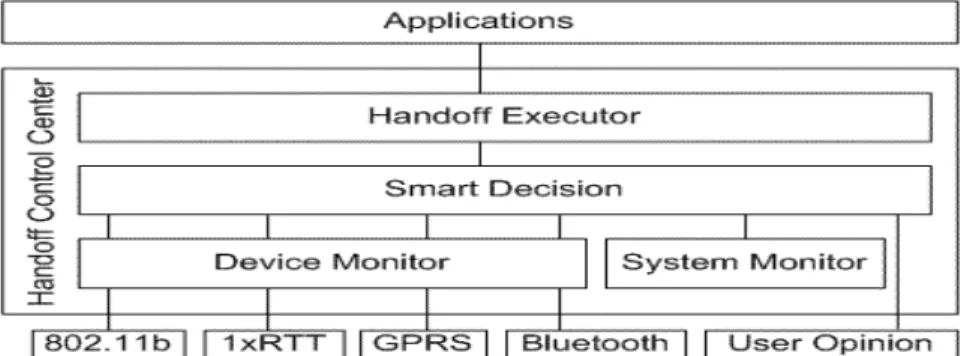
two networks (!?); They do not treat the case when the wireless signal is lost (!?); Consider to few parameters to calculate the decision metric only bandwidth, the VoIP call drop-ping probability, and skipped the cost and power requirements, security, network con-dition, etc.(!?); Do not treat the case when in the network HN occur major changes and us-er requirements are not satisfied(!?); Is not flexible and does too many assumptions (!?). Above we presented a solution of algorithm that addresses to Network-Controlled Han-doff highlighting some advantages and dis-advantages of this algorithm presented in [2]. In the following we present a literature ap-proach to solution “Mobile-Controlled Han-doff” namely the algorithm proposed in [5] “A Smart Decision Model”. This paper pro-poses an intelligent decision device that be-cause of its properties must support a flexible configuration of the vertical handoff process, and according to user preferences, system configurations / information, and characteris-tics of available network must find the best network available and the right time to make the handoff. To achieve this, it is used score function to make the best choice based on various factors like power consumption, cost of connection, link capacity and system in-formation such as battery remaining. The proposed model is designed for Universal Seamless handoff Architecture (Usha) and is able to provide vertical handoff “automatical-ly to the” most appropriate “Network Inter-face” at the most appropriate “time”. Figure 2 presents the proposed model.
Fig. 2. Decision Model
net-work interface and the highest level of appli-cation. This device handoff Control Center (HCC) is composed of four major compo-nents namely: Device Monitor (DM), System Monitor (SM) Smart decision (SD), and han-doff executor (HE).Device Monitor (DM) is responsible for analyzing and reporting the status, characteristics such as link capacity, strength and power consumption of each network separately for each available net-work. System Monitor (SM) deals with ana-lyzing and reporting information about sys-tem, information necessary which follows to be considered in the vertical handoff process such as battery remaining. Smart decision (SD) deals with the integration of user re-quirements on handoff process and of all in-formation offered by DM and it develop the score function for each network to find the best network available. Handoff executor checks if network characteristics currently used, get a better score or a lower score than one candidate network which currently has the highest score. Smart decision making (SD) is composed of two major phase, name-ly: priority phase and normal phase. Unlike the first algorithm studied in this work which delegates the calculation of handoff decision metrics to the networks candidates, in this al-gorithm entire process is realized on the mo-bile device [3].
4 Functions and strategies for Vertical Handoff decision
In this section is introduced a list of the most relevant and best decisional strategies for vertical handoff process proposed in the lite-rature. It is obvious to mention that the com-bination of all the criteria listed in section 2 and dynamic as some of them will signifi-cantly increase the complexity of vertical handoff decision making process. In general, this complex problem it can be perceived as a: the problem that is user centered meaning, user satisfaction, the problem that is centered on contextual information of the user, the problem that is centered on mobile terminal and network. Based on these different pers-pectives of handoff decision problem, in the next section, vertical handoff decision
prob-lem is defined, its features and different strategies proposed in the literature to solve this problem and the classification of existing strategies. We distinguish seven categories, namely: functions based on Genetic Algo-rithms, functions based on user satisfaction, functions based on RSS, functions based on Fuzzy Logic and Neural Networks, functions based on multiple criteria and context-aware strategies.
4.1 Functions based on Genetic Algo-rithms
Strategies based on Genetic Algorithms are the first strategy discussed in this section. The literature has proposed several solutions for vertical handoff which are based on Ge-netic Algorithms [4] [6] [7]. In the following example will bring the algorithm proposed by [6]. In this article the authors propose a solution to solve the access network selection (ANS) that combines Fuzzy Logic (FL) with Genetic Algorithms (GA). The proposed so-lution offers more Scalability, Flexibility, and simplicity. Genetic Algorithms are used in this paper to overcome some problems en-countered in Multiple Criteria Decision Mak-ing method (MCDM). The most important advantages that GA can provide in achieving the desired scheme would be:
• GA can handle a large number of
va-riables and may provide a complex search even for the ANS criteria, thus providing a classification according to their weights to provide an optimal solu-tion, a solution close to optimal or good solution;
• GA can successfully cope with various challenges, constraints and objective for weighting criteria of ANS;
• GA does not require derivative informa-tion in search of help in making a deci-sion;
• GA works with randomly generated nu-merical data, experimental data, analyti-cal functions that can provide more op-tions in the implementation of the ANS algorithm; Each individual in the GA population represents a possible solution to the problem;
• GA is heuristic, which means it estimates a solution because for most problems we don't have any formula for solving the problem because it is too complex, or if we have, it just takes too long to calculate the solution exactly. An example could be ANs criteria weights. The most feasi-ble approach then is to use a heuristic method.
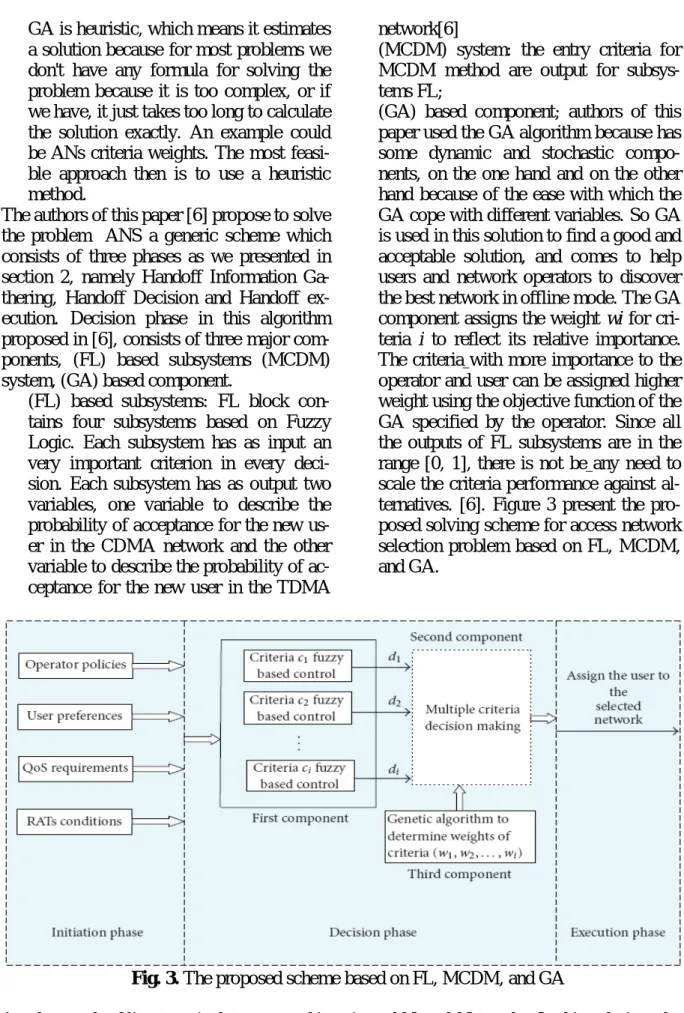
The authors of this paper [6] propose to solve the problem ANS a generic scheme which consists of three phases as we presented in section 2, namely Handoff Information Ga-thering, Handoff Decision and Handoff ex-ecution. Decision phase in this algorithm proposed in [6], consists of three major com-ponents, (FL) based subsystems (MCDM) system, (GA) based component.
• (FL) based subsystems: FL block con-tains four subsystems based on Fuzzy Logic. Each subsystem has as input an very important criterion in every deci-sion. Each subsystem has as output two variables, one variable to describe the probability of acceptance for the new us-er in the CDMA network and the othus-er variable to describe the probability of ac-ceptance for the new user in the TDMA
network[6]
• (MCDM) system: the entry criteria for MCDM method are output for subsys-tems FL;
• (GA) based component; authors of this paper used the GA algorithm because has some dynamic and stochastic compo-nents, on the one hand and on the other hand because of the ease with which the GA cope with different variables. So GA is used in this solution to find a good and acceptable solution, and comes to help users and network operators to discover the best network in offline mode. The GA component assigns the weight wi for cri-teria i to reflect its relative importance. The criteria with more importance to the operator and user can be assigned higher weight using the objective function of the GA specified by the operator. Since all the outputs of FL subsystems are in the range [0, 1], there is not be any need to scale the criteria performance against al-ternatives. [6]. Figure 3 present the pro-posed solving scheme for access network selection problem based on FL, MCDM, and GA.
Fig. 3. The proposed scheme based on FL, MCDM, and GA Another work of literature is that proposed in
[7] where GA are combined with Fuzzy
Log-ic and Neural Networks. In this solution, the authors used GA to combine the available
networks in order to select the best network at a given time. In this solution, a string must encode n × c real valued parameters; there by optimal combination coefficients for combin-ing Neural Networks can be obtained. Each coefficient is encoded by 8 bits and scaled between [0 ~ 1]. The GA then manipulates the most promising strings in its search for improved solutions.
4.2 Strategies based on decision functions. DF
This class of algorithms combines indicators such as cost, security, bandwidth and power consumption in a cost function, handoff deci-sion can be achieved by comparing these re-sults with those of the candidate networks. Various tasks were assigned to various indi-cators of input based on network conditions and user preferences. Vertical handoff deci-sions based on cost functions are based on measuring the benefit obtained by connecting to a given network. It is implemented for any network “n” that covers a user's functional area and is a sum of functions and weights of the parameters. An algorithm similar to those described above, which considered as first, the candidate network is a wireless network but the calculation of handoff decision takes place in the mobile terminal, is the algorithm proposed in [2]. This algorithm brings some-thing new to discuss, namely the speed with which a user moves within a network and the location where it is. The problem has been made as follows: if a user connected to a mo-bile network enters wireless network cover-age with a very strong signal and which meets all requirements, it would normally have to pass on that wireless network. But if the speed of the user inside the network is high and it will leave the network after a short period of time is useful to make vertical handoff to the wireless network (!?). In this article the authors propose an algorithm (VHDF) of vertical handoff based on differ-ent metrics, namely, is a composition of sev-eral metrics: cost of services (C), power re-quirements (W), safety (S), user preferences (U), network conditions (N), network per-formance (P) and velocity (V). All these
me-trics are combined in a function that should decide if a user goes to another network or not. Q = f (AC, BW, CS, DU, EN, FP, GV) Where a, b, c, d, e, f, g, h are numerical scores mean different weights in the calcula-tion of metrics. If the user speed is high, the handoff process is not needed, even if the signal strength is strong, because the user will leave the network after a short period of time. Location may indicate that person could leave, perhaps, immediately the area of network coverage. [2]
4.3 Strategies focused on signal strength (RSS)
The main handoff decision criterion used in this case is the RSS. Many strategies have been developed to directly compare RSS at-tachment point with the atat-tachment point candidate ([9], [16], [22], [24]). The strate-gies are based on RSS are numerous because that do not involve too much complexity and is easy to use. Such solution is proposed in the literature [9]. The decision to transfer the user from a network to another is mainly based on the strength of the signal (RSS: Re-ceived Signal Strength) at the edge of the two cells. The mobile triggers the transfer to-wards the base station (B) that offers a better signal in terms of power (i.e. choose Bnew, if RSSnew > RSSold).There are few variants of RSS [9] offered :
RSS: Handoff is triggered when re-ceived signal power of candidate antenna is superior to that of the current antenna (RSSnew > RSSold);
• RSS with a threshold : Handoff is
trig-gered when received signal power of candidate antenna is superior to that of the current antenna and the power of this later is less then a minimum threshold T (RSSnew > RSSold and RSSold <T);
• RSS with latency: Handoff is triggered
when received signal power of candidate antenna is superior to that of the current antenna with a predefined margin H (RSSnew > RSSold + H);
• Trigger timer: A timer can be added to
any of these algorithms that will start as soon as their conditions are satisfied.
Handoff will then start at a predefined moment once the specific conditions are set;
The major inconvenience of the RSS algo-rithm is the not required number of handoff generated by the weakening of the propaga-tion signal (Path Loss) and the fading of the signal caused by obstacles [9]. These strate-gies are based on RSS, although they are very common, they do not fully resolve the vertical handoff decision problems.
4.4 User-centered decisional strategies (UC)
Among the various criteria that a vertical handoff decision scheme takes into account, user preferences in terms of cost and QoS, is the most interesting parameter for user cen-tered strategies. To choose the best utility function, decision metrics are actually the us-er's risk attitude: neutral (user prefer to pay less and have fewer delays), for search (the user may prefer alternative delays as low in exchange for financial savings and safety ef-fects) and adverse (the user prefers to know that pay less). The proposed functions, user centered, propose the policy and decision cri-teria especially for user satisfaction rather than for applications. To choose the most suitable network that can respond to user demands and network, must be taken into ac-count several criteria based on the different available networks but also reconsidering several techniques. An algorithm is proposed in the literature [10] which starts from the idea that there is a growing demand for on-line service such as browsing, shopping, mu-sic downloads, file transfer, and database access. The approach proposed in this work is that when the decision to select the net-work is made, user terminal will study wire-less interface and will form a list of available networks. The mobile terminal will use an algorithm to predict the actual transfer rate for each network in the list. It will then apply the predicted rates and the user utility func-tion to determine which network is expected to meet the deadline time for a complete transfer and offer the lowest cost. The price that the network charges for the full transfer
depends of pricing schemes employed by the network. Pricing scheme used in this paper is a simple scheme with a fixed price per Kbyte transferred. This intelligent mobile user’s FTP application requires the transfer of a file of size 80 Kbytes in a Service Oriented Hete-rogeneous Wireless Network Environment (SOHWNE). This is a typical size for an MMS message. The data is to be sent uplink on TCP from the terminal through an access point (AP) to a server in the wired network. The user is faced with a scenario, where must choose the radio access network(RAN) which meets their data transfer terms best to use for transporting their application data. The user terminal must predict the rate for each of the available WLANs and use those estimated rates, together with the network prices and provided utility function for the current application, to select the WLAN that will give the greatest Consumer Surplus (CS) while meeting the transfer completion time deadline.[10]
4.5 Decision strategies with multiple attributes (Multiple Attribute Decision Making)
Handoff decision problem relates to choosing from a limited number of candidate net-works, from many providers and technolo-gies, that meet a certain criteria, a certain network. This is a typical problem MADM (Multiple Attribute Decision Making), which is found in many works of literature [12] [17]. This method is considered a process known and recognized, purely mathematical. Such a solution is presented using the MADM method by [23]. The authors of this paper start from the idea that a suitable access network has to be selected once the handoff initiation algorithm indicates the need to handoff from the current access net-work to a target netnet-work. To solve this prob-lem they formulate the network decision process as a MADM problem that deals with the evaluation of a set of alternative access networks using a multiple attribute wireless network selection function (WNSF) defined on a set of attributes. The WNSF is an objec-tive function that measures the efficiency in
using radio resources and the improvement in quality of service to mobile users gained by handing off to a particular network. It is de-fined for all alternative target access net-works that cover the service area of a user. The network that provides the highest WNSF value is selected as the best network to han-doff from the current access network accord-ing to the mobile terminal conditions, net-work conditions, service and application re-quirements, cost of service, and user prefe-rences. The WNSF is triggered when any of the following events occur: (a) a new service request is made; (b) a user changes his/her preferences; (c) the MT detects the availabili-ty of a new network; (d) there is severe signal degradation or complete signal loss of the current radio link. Parameters (attributes) used for the WNSF include the signal strength (S), network coverage area (A), data rate (D), service cost (C), reliability (R), se-curity (E), battery power (P), mobile terminal velocity (V), and network latency (L). Input data from both the user and the system are required for the network selection algorithm, whose main purpose is to determine and se-lect an optimum cellular/wireless access net-work for a particular high quality service that can satisfy the following objectives: Good signal strength, Good network coverage, Op-timum data rate, Low service cost, High re-liability, Strong security, Good mobile veloc-ity, Low battery power requirements, Low network latency.[23] However, such a clas-sical method remains insufficient to solve problems of decision, giving proof of a cer-tain vagueness in the criteria of decision. To obtain decisional strategies more efficient is necessary to use methods more advanced, or even combined with some classics such as combination between MADM method and Fuzzy Logic or Neural Network.
4.6 Strategies based on Neural Networks and Fuzzy Logic (FL / NN)
These VHD algorithms try to use a richer set of points of entry than others in making han-doff decisions. When using multiple entry points is extremely difficult if not impossible, to be able to develop analytical formulas for
vertical handoff decision process. Fuzzy log-ic systems allow coding in algorithms, qua-litative thinking of human experts in order to improve overall efficiency. The fuzzy integral is a nonlinear functional that is de-fined with respect to a fuzzy measure, espe-cially gλ-fuzzy measure introduced by Suge-no [12]. We can find application examples of this process in VHD in [13], [14], [15]. A neural network can be considered as a map-ping device between input and output sets. It represents a function f that maps I into O: f : I
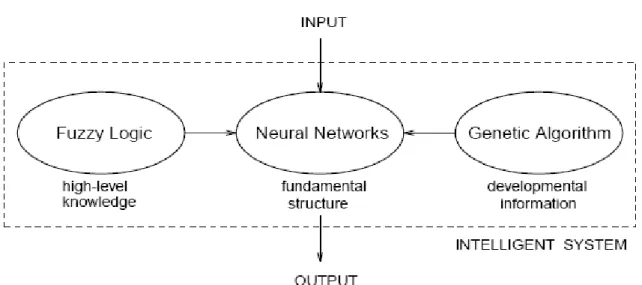
→ O, or y = f(x) where y Є O and x Є I. Since the classification problem is a mapping from the feature space to some set of output classes, we can formalize the neural network, especially two layered feed forward neural network trained with the generalized delta rule, as a classifier.[GA] It is also possible to create adaptive versions of these algorithms, by using real-time and continuous learning process, they can monitor system perfor-mance and can modify their own structure to create highly effective handoff decision algo-rithms.[19] Fuzzy Logic (FL) and Neural Networks (NN) are two concepts used in the implementation of the vertical handoff algo-rithms to choose when and on which network is selected from the available networks to ex-ecute the transfer. They are combined with different criteria or attributes, to develop ad-vanced decision algorithms for both real-time applications and for the opposite. A vertical handoff solution that uses these two concepts was proposed in [7] to produce a very power-ful system. The solution proposed by [7] used Neural Networks as a baseline system, because they are well recognized as a power-ful input–output mapper and human opera-tors cannot easily incorporated some know-ledge about the problem into the Neural Networks. Fuzzy logic gives a possibility to utilize top-down knowledge from designer. Human operators can enhance the Neural Networks by incorporating their knowledge with fuzzy membership functions, which are modified through learning process as fine tuning.[7]. In this paper proposed in the lite-rature [7], besides Neural Networks and Fuzzy Logic are used and the GA, which are
combined with Fuzzy Logic and Neural Networks. In this solution the authors used GA to combine the available networks in or-der to select the best network at a given time. In this solution, a string must encode n × c real-valued parameters; there by optimal combination coefficients for combining Neural Networks can be obtained. Each
coef-ficient is encoded by 8 bits and scaled be-tween [0 ~ 1]. The GA then manipulates the most promising strings in its search for im-proved solutions. Figure 4 present schematic diagram of the hybrid framework based on Neural Networks, Fuzzy Logic and Genetic Algorithms.
Fig. 4. Schematic diagram
It is to underline the fact that classic methods MADM cannot handle efficiently a decision-al problem with uncertain data as the deci-sional criteria contain. That’s why, the FL use does not confront only with uncertain in-formation but it also has to combine them and to value simultaneously multiple criteria. Since the FL concept assures a vigorous ma-thematical base, the vertical handoff decision may be formulate as Fuzzy MADM.
4.7 Context-aware strategies (CA)
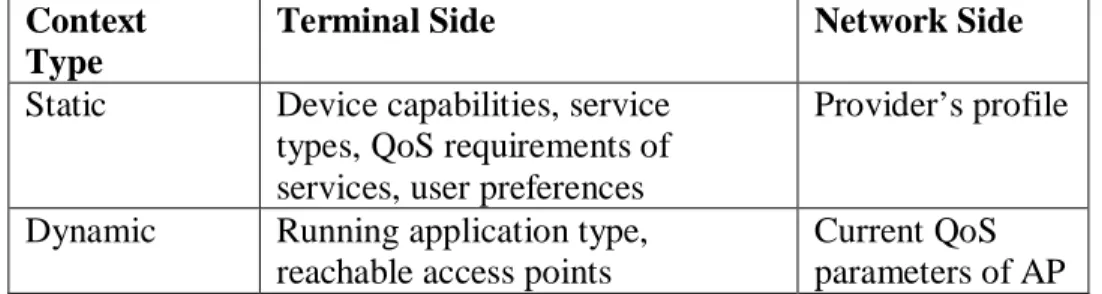
The concept of “Context-aware strategies” bases on the knowledge about the context of the mobile terminal and information net-works to make better decisions. However a strategy decision based on the concept of context known as “context aware” manages this information from the mobile terminal and network and values the context changes to make decisions on the necessity of handoff process and choosing the best target access network. Relevant background information for the handoff decision algorithm are men-tioned in 2 section as handoff decision crite-ria. These handoff decision algorithms have a
strong connection with mobile terminal (the capabilities of the terminal, location, etc.), user preferences, network (coverage, qos. etc), QoS needs, type of service (real or un-real time). Some decision solutions based on the concept of ”context aware” [4], [2] are based on the AHP(Analytic Hierarchy Process) method. Another algorithm treated in this presentation is the algorithm proposed by Tansir Ahmed, Kyandoghere Kyamakya, and Markus Ludwig [2]. This algorithm tries to select the most appropriate network for a given application based on multiple options that would satisfy the main requirements based on established parameters. The algo-rithm is based on the Analytic Hierarchy Process (AHP) presented in [11], this model is a process well known and proven mathe-matically to identify the most suitable net-work from a set of netnet-works with several al-ternatives based on predefined objectives by user. This algorithm takes into account how much can the properties of the mobile device and network properties at which wants to connect and lumped them as background in-formation. Simple construction of algorithm
makes it suitable for different mobile devices multimode (e.g. PDAs) that have few capa-bility and functionality constraints such as processor speed, memory size, power con-sumption, etc. Algorithm is more flexible as the algorithm described above and a very im-portant feature is that it can be configured by
the user. In the table below is presented the background model for this algorithm, namely the information and parameters that do not often change are classified as static context information and those that change are often framed as a dynamic context information.
Table 1. Background model for this algorithm
Context Type
Terminal Side Network Side
Static Device capabilities, service
types, QoS requirements of services, user preferences
Provider’s profile
Dynamic Running application type,
reachable access points
Current QoS parameters of AP Device capabilities include information about
the device resolution, display size, processor speed, available interfaces, battery life and memory. The services offered by mobile terminal are divided into three categories namely conversational services / Real-Time Services, Interactive Services, and streaming services and each of them has its QoS re-quirements. User preferences are divided into two categories: about interface preferences and service preferences and running applica-tion types contains the informaapplica-tion of current application. Reachable Access Points (APs) contains currently available networks and addresses of the APs. The Service Provider's network and Current QoS parameters are identified on the network. The algorithm is divided in five steps:
• The user gathers his preferences which must accomplish requirements of applica-tions and be according with device capa-bilities, resulting in the end three sets of preconfigured data for three types of ser-vices and these are stored in the applica-tion profiles.;
• Are identified the available network ca-pabilities.
• Identified capabilities of available net-works, including the current network are compared with user set preferences using a decision algorithm, and then are as-signed scores between 1 and 9 in des-cending order where the network that
meets the most user requirements has the score equal with 1. If a special network not shows its cost information this net-work obtains a score of 9 as an implicit value.
• It is realized the situation on levels of available networks based on priority scores and network scores calculated in previous step.
• In this step the applications used by the user in current network are switched to the available network selected, taking in-to account the priorities set by the user in step 1 and rank obtained in step 4.
Unlike the algorithm [3] presented above is obviously that this algorithm is more com-plex and deals with many difficult points which the previous algorithm has not taken into account. It has greater flexibility because the user has a greater influence on decision by defining the static and dynamic informa-tion.
5 IEEE 802.21 Standard
Handoff solutions must allow service provid-ers, applications providers and other entities to implement policies handoff based on va-riety business applications. IEEE 802.21 standard addresses this problem by providing a framework and associated services that can allow a process of continuous handoff, unin-terrupted between heterogeneous access technologies. IEEE 802.21 defines a
frame-work media-independent-handoff (MIH), which can significantly improve the process of handoff between heterogeneous network technologies. The proposed standard defines tools that are necessary to share information, events, and commands to facilitate initiation of the handoff process. IEEE 802.21 is not trying to standardize the actual handoff ex-ecution mechanism.
5.1 Benefits of Standardization
• The service Media Independent Event
Services(Mies): detects changes in the properties of the interface connection and report local and remote events;
A handoff manner to ensure interoperability technologies of across access multiple is to create environments specific extensions. For example: T1 access technology can be ex-tended to interoperation with T2, while another extension would be necessary to en-sure interoperability with T3. Similarly, T2 and T3 will require their own extensions. In this way, we will need N * (N-1) extensions to interconnect N different access technolo-gies. The complexity of this type of approach is very high if they are taken in to account several access technologies. A media-independent framework is a method more scalable and efficient addressing for handoff between technologies. With a common plat-form to address the handoff process, each technology of access requires only an exten-sion to ensure interoperability with all access technologies. This is the approach embraced by the IEEE 802.21 standard that defines a common set of MIH services that interact with the highest levels and protocols. Each access technology will require only an exten-sion average to be provided interoperability with other technologies. The purpose IEEE 802.21 is to improve the user experience by providing functionality that facilitates both MIH handoff process initiated by the hand-held, as well as those initiated by the network MIH Function (MIHF) includes three types of services:
• The service Media Independent
Com-mand Service: (MICS) provides a set of commands for MIH users to control the
connection state; [24]
• The service Media Independent
Informa-tion Service: (MIIS) provides informa-tion about neighboring networks includ-ing their location and properties;
IEEE 802.21 defines three services that faci-litate the handoff processes over heterogene-ous networks: MIES, MICS, and MIIS. These three primary services are configured and managed by a fourth service called man-agement services.
6
In this study, we presented several different aspects of vertical handoff solutions present in literature. Strategies proposed above show various aspects of vertical handoff decision problem relating to: network performances, user satisfaction, flexibility, efficiency and some solutions based on multiple criteria. IEEE 802.21 standard creates a base to sup-port the protocols that put in value vertical handoff processes [42]. Since 802.21 only provide the fundamental basis, looked in en-semble, algorithms which should be imple-mented are assigned to the designers. The de-tails of network selection and vertical han-doff policies that control the hanhan-doff process are not part of the research area of the stan-dard IEEE 802.21. Unfortunately, at the pro-posed VHD algorithms, either lack different network parameters, either studies who re-port this algorithms they lack sufficient detail for implementation. The domain vertical handoff decision algorithm in heterogeneous networks is an intensively researched area. The main difficulty is to define an algorithm that is intended to be really useful in a wide range of conditions and the preferences of the user. A possible solution could be due to dis-coveries in the field, implementation of sev-eral adaptive algorithms HDV and adopting methods to choose an intelligent algorithm based on conditions and user preferences. In this paper, we presented the vertical handoff decision making through a classification of various strategies of vertical handoff decision existing. It was proved that are necessary ad-vanced assessment functions and an opti-mized architecture for better execution of the
handoff decision in order to meet user prefe-rences and efficient use of network resources. Based on this knowledge accumulated we have developed our proposal presented in the next section to develop a new vertical han-doff algorithm to satisfy and resolve as much as possible, needs and problems identified at this time.
7 The
Considering the decisional handoff strategies discussed, we conclude that the solutions to the Multiple Criteria, Fuzzy Logic and AHP (Analytic Hierarchy Process) methods are very necessary. For this we consider a flexi-ble system FL, aflexi-ble to operate with imprecise data, and which can be used to model nonli-near functions with an arbitrary complexity. To cooperate with this, we need vertical han-doff policies that express rules that contribute and help to finalize entire vertical handoff decision process. It can provide more flex-ibility because the entire handoff process can be completely controlled by MCHO Mobile (Mobile-Controlled Handoff, MCHO). IEEE 802.21 supports scheme MCHO (Mobile-Controlled Handoff, MCHO) and Mobile IP functions as mobility management protocol. It reduces the complexity of the network, the received signal and the process of handoff la-tency better than a Mobile Assisted Handoff (MAHO). Most undertaken experiments and publications on vertical handoff process [19, 20, 18, 21], even policies promoting a deci-sional MCHO model, in which MT is re-sponsible for taking decisions, thus putting all their trust in intelligence MT. That's why a solution MCHO of vertical handoff deci-sion is reliable. [18] Thus, MT leads initia-tive and controls the handoff decision phase in the execution phase. Having all these is-sues clearly defined and differentiated, we propose an intelligent system for vertical handoff management process, controlled by the mobile terminal but assisted by the net-work. The available networks, after their de-tection by the mobile terminal, must send in-formation to the mobile terminal with its
availability in that time. Network must in-form the new user who wants to connect to it, if she could give her characteristics to normal parameters, that characterize her. Mobile terminal must have continuously, at any time a list of available networks. This system uses the method ABC (Always Best Connected) who responds “if the handoff is necessary or not”, and on which network to execute the handoff. This proposal will be a combination of different strategies outlined above and will try as much as it can, to include most of the main background information considered major in carrying end of the vertical handov-er process. Fuzzy logic and AHP method will be used to support decision, unlike most al-gorithms in the literature that using MADM method (Multiple Attribute Decision Mak-ing) and Multiple Objective Decision Making (MODM) to choose, depending on a particu-lar set of attributes, the best network. The advantage to use Fuzzy Logic is that besides to combine and evaluate multiple criteria si-multaneously, is occupy and imprecise in-formation, dynamic and uncertain, and offers a very strong mathematical support. AHP de-cision deals with identifying the problem as a multilevel structure. These are just some of the fuzzy variables. Before carrying out the network selection process must follow two steps: criteria score, the importance of each criterion is evaluated according to user prefe-rences, and network score in which the avail-able networks are evaluated and compared for each handoff decision criteria. Handoff execution establishes connectivity via the access network using Mobile IP functions. Our solution is focused on the aspect of en-suring flexibility and efficient to vertical handoff decision, thanks to advanced algo-rithms based on information from context and on FL and AHP methods, that expresses the policies that shape the entire decision-making rules. In this scenario the user is in-volved in choosing the network and he has the final decision. Figure 5 shows the pro-posed scheme based on Fuzzy Logic, AHP, MT architecture
Fig. 5. Proposed Scheme A final conclusion of what was said above
regarding the methods used and how their combination to achieve the proposed algo-rithm, would be:
• Algorithm will be based on the concepts of ABC, AHP, Fuzzy Logic and multiple criteria solution;
• ABC (Always Best Connected) will be
used to detect whether the handoff is ne-cessary or not. Information provided will be used to initiate the process of handoff. Are followed these steps: All available networks at that time are stored in a list; Deleting specified user network interfac-es as undinterfac-esirable; If the list remains emp-ty are reintroduced the network removed
in step 2; Move to the next phase;
• Once initiated handoff process, back-ground information will be collected ei-ther from the network (QoS parameters, bandwidth, packet delay, packet loss), from the mobile terminal and from the user (user preferences, capabilities, bat-tery, network interfaces, applications used in real time or not, terminal location, speed, etc.). Also in this step the informa-tion received will be divided into two categories: dynamic and static informa-tion. Imprecise information gained from this step will be used as input for the sys-tem for processing fuzzy math. The data received are converted into fuzzy sets in
which each criterion will be compared to a value. Representative values are ob-tained by mapping the parameters in a function. As for proper input Fuzzy Logic we could identify different input va-riables whose value is not clearly known. The first Fuzzy Logic input variable could be the signal that might have some fuzzy parameters based on values: low, normal, strong and very strong. A second option would be the bandwidth that would rely on some fuzzy parameters values: low, normal, high, and very good.
A third variable would be the network coverage that would have some fuzzy pa-rameters based on values: low, normal, high, and very good. These are just some of the variables assessed by fuzzy logic. These are just some of the variables as-sessed by fuzzy logic;
• AHP Method will be used to evaluate the data received from the fuzzy system and to the block who is deal with contextual information. Also during this step will be assigned scores for each network to be well differentiated.
References
[1] N. Nasser, A. Hasswa and H. Hassanein, “Handoffs in fourth generation hetero-geneous net- works”, IEEE Communi-cations Magazine, Vol. 44, No. 10, pp. 96-103, Oct. 2006.
[2] A. Hasswa, N. Nasser and H. Hassanein, “Generic Vertical Handoff Decision Function for Heterogeneous Wireless Networks,” Proceedings of the 2nd IEEE/IFIP International Conference on Wireless and Optical Communications Networks (WOCN 2005), pp. 239–243, March 2005
[3] R. Tawil, O. Salazar and G. Pujolle, “Vertical Hando® Decision Scheme Us-ing MADM for Wireless Networks”, in Proc. of IEEE WCNC'08, Las Vegas, NV, March/April 2008.
[4] A. Sgora and D. Vergados, “Handoff pri-oritization and decision schemes in wire-less cellular networks: a survey,” IEEE Communications Surveys and Tutorials, vol. 11, no. 4, pp. 57–77, 2009.
[5] L-J. Chen, T. Sun, B. Chen, V. Rajen-dran, and M. Gerla, „A Smart Decision Model for Vertical Handoff”. Proc. of
The 4th ANWIRE Int. Workshop on
Wireless Internet and Re configurability, 2004.
[6] M. Alkhawlani and A. Ayesh “Hindawi Publishing Corporation Advances in Ar-tificial Intelligence”, Volume 2008, Article ID 793058, 12 pages doi:10.1155/2008/793058
[7] S-B. Cho, “Fusion of Neural Networks with Fuzzy Logic and genetic algo-rithm”, Integrated Computer-Aided
En-gineering, vol. 9, (2002) pp. 363–372
363 IOS Press
[9] A. Benmimoune and M. Kadoch, “Ver-tical handoff between UMTS and WLAN”, Proceeding of the 4th interna-tional conference on Communications and information technology, ISBN: 978-960-474-207-3
[10] O. Ormond, G.Muntean and J. Murphy, IT&T 2005: Information Technology and Telecommunications, pp. 175-184, Cork, October 2005.
[11] T.L. Saaty, “How to make a decision: The Analytic Hierarchy Process”, Euro-pean Jour nal of Operational Research, 1990, Vol. 48, pp. 9-26.
[12] M. Sugeno, “Fuzzy measures and fuzzy integrals: A survey”, Fuzzy Automata Dec. Proc., Amsterdam, North Hol-land, 1977, pp. 89–102.
[13] R.R. Yager, “Element selection from a fuzzy subset using the fuzzy integral”, IEEE Trans. Syst. Man. Cyber., Vol. 23 (1993), 467– 477.
[14] K. Leszeynski, P. Penczek and W. Gro-chulskki, “Sugeno’s fuzzy measures and fuzzy clustering”, Fuzzy Sets Syst., Vol. 15 (1985), 147–158.
[15] H. Tahani and J.M. Keller, “Information fusion in computer vision using the
fuzzy integral”, IEEE Trans. Syst. Man. Cyber., Vol. 20, (1990), pp. 733–741. [16] G.P. Pollhi, “Trends in Handoff
De-sign”, IEEE. Communications Magazine, Vol. 34, 82-90.
[17] W. Zhang, “Handoff Decision Using Fuzzy MADM in heterogeneous net-works”, in Proc. IEEE WCNC’, New Or-leans, LA March 2005.
[18] M. Kassar, B. Kervella and G. Pujolle, “An overview of vertical handoff deci-sion strategies in heterogeneous wireless networks”, Computer Communications, Vol. 31, No. 10, 2008, pp. 2607–2620. [19] X. Yan, A. Sekercioglu and S.Y.
Na-rayanan, Computer Networks, Vol. 54, Issue 11, August 2010, pp. 1848-1863.
[20] C. Chi, X. Cai, R. Hao and F. Liu. “Modeling and analysis of handoff algo-rithms”, in: Proceedings of the 2007 IEEE Global Telecommunications Con-ference, Washington,DC, USA,
Novem-ber 2007, pp. 4473–4477.
[21] D. Lee, Y. Han and J. Hwang, “QoS-based vertical handoff decision algorithm in heterogeneous systems”, in: Proceedings of the IEEE 17th Interna-tional Symposium on Personal, Indoor and Mobile Radio Communications (PIMRC’06), Helsinki, Finland, Sep-tember 2006, pp. 1–5.
[22] J. Holis and P. Pechac, “Elevation De-pendent Shadowing Model for Mobile Communications via High Altitude Plat-forms in Built-Up Areas” – IEEE Trans-actions On Antennas And Propagation, Vol. 56, No. 4, April 2008.
[23] Y. Nkansah-Gyekye and J. I. Agbinya, "Vertical handoff between WWAN and WLAN", ICNICONSMCL'06, 2006 [24]Y-F. Huang and H-C. Chen,
“Perfor-mance of Adaptive Hysteresis Vertical Handoff Scheme for Heterogeneous Mobile Communication Networks”, Journal of Networks, Vol. 5, No. 8, 2010, pp. 977-983, Aug 2010
Ionut BOSOANCA has graduated the Faculty of Automation, Computers and Electronics, University of Craiova, Computer Science specialization in 2009. He received two external scholarships, one in Germany in 2009, where he achieved his license project at “Universität der Bundeswehr, München”, and another in 2008 at the “University T.E.I of Piraeus”, Greece. In October 2009 he started to study in the Computer and Communication Engineering Master at University of Craiova, Romania. His interests are Vertical Handoff algorithms and resources allocation in wireless network.
Anca VARGATU has graduated the Faculty of Automation and Computers, Politehnica University of Timisoara, Computer Science specialization in 2009. In October 2009 she started to study in the Computer and Communica-tion Engineering Master at University of Craiova, Romania. Her interests are Vertical Handoff algorithms and resources allocation in wireless network.