Department of Computer Science Faculty of Science
University of Copenhagen December 2007
Sensor Network Motes:
Portability & Performance
to correct a few typos June 5th 2008.
This document is typeset in LATEX 2ε.
It contains 106 pages, app. 47470 words and app. 308634 characters (excluding table of content, biblography, etc.). It is printed on 123 A4 sheets.
Abstract
This dissertation describes our efforts to improve sensor network perfor-mance evaluation and portability, within the context of the sensor network project Hogthrob. In Hogthrob, we faced the challenge of building a sensor network architecture for sow monitoring. This application has hard require-ments on price and performance, and shows great potential for using sensor networks. Throughout the project we let the application requirements guide our design choices, leading us to push the technologies further to meet the specific goal of the application.
In this dissertation, we attack two key areas related to the design of this so-lution. We found the current state of the art within performance evaluation to be inadequate and that the moving to the next generation platforms is being held back by practical issues in porting existing software. We have taken a pragmatic, experimental approach to investigate these challenges and apart from developing the methodologies, we also present the results of our experiments.
In particular, we present a new vector based methodology for performance evaluation of sensor network devices (motes) and applications, based on application specific benchmarking.
In addition, we present our results from porting the highly popular sensor network operating system TinyOS to a new and emerging system on a chip based platform. Moving the sensor network field towards the use of system-on-a-chip devices has large potential in terms of price and performance. We claim to have advanced the current state of the art of sensor networks within the two key areas: portability and performance.
Acknowledgments
I would like to thank professor David Culler for hosting me during my six months research visit to UC Berkeley. Arch Rock for providing me with facilities and equipment. I would like to thank the Hogthrob partners, in particular C´ecile Cornou and Klaus S. Madsen. And finally I would like to thank my supervisor Philippe Bonnet, Eric Jul and Marcus Chang from DIKU.
My research grant is made possible through the Danish Technical Research Council1
1Statens Teknisk-Videnskabelige Forskningsr˚ad (STVF) iv
Contents
1 Introduction 1
1.1 The Hogthrob Project . . . 1
1.1.1 Sow Monitoring . . . 2
1.1.2 Application Requirements . . . 2
1.1.3 Project Challenges . . . 3
1.2 Sensor Network Motes . . . 3
1.2.1 Exploring the Design Space . . . 3
1.3 Problem . . . 4 1.3.1 Performance Evaluation . . . 5 1.3.2 Portability . . . 6 1.3.3 Thesis Statement . . . 6 1.4 Approach . . . 6 1.4.1 Work Done . . . 7 1.5 Contributions . . . 8 1.5.1 Technical Contributions . . . 9 1.6 This Dissertation . . . 9 2 Background 11 2.1 Sensor Network Monitoring Applications . . . 12
2.1.1 Great Duck Island . . . 12
2.1.2 Zebranet . . . 13
2.1.3 Hogthrob Pilot Experiment . . . 14
2.1.4 Discussion . . . 17
2.2 Sensor Network Platforms . . . 17
2.2.1 Sensor Network Motes . . . 18
2.2.2 Generic Sensor Nodes . . . 18
2.2.3 System on a Chip . . . 21
2.2.4 Discussion . . . 24
2.3 Sensor Network Software . . . 26
2.3.1 Mote Operating Systems . . . 26
2.3.2 TinyOS . . . 27
2.4 Power Estimation in Sensor Networks . . . 28
2.4.1 Power Estimation Strategies . . . 29
2.4.2 Node and Network Level Simulation . . . 30
2.4.3 VLSI Design . . . 33
2.4.4 Power Model . . . 36
2.4.5 Discussion . . . 39 v
2.5.1 HogthrobV0 . . . 40
2.5.2 Design Process . . . 41
2.5.3 Finalizing and Testing HogthrobV0 . . . 42
2.6 Summary . . . 44
3 Characterizing Mote and Application Performance 47 3.1 Introduction . . . 47
3.2 Related Work . . . 49
3.2.1 Tracing Execution . . . 50
3.2.2 Application Specific Benchmarking . . . 50
3.3 Vector-Based Methodology . . . 51 3.3.1 Mote Vector . . . 52 3.3.2 Application Vector . . . 54 3.3.3 Application Trace . . . 55 3.3.4 Example . . . 57 3.4 Implementation in TinyOS 2.0 . . . 58
3.4.1 Applications and Mote Vectors . . . 59
3.4.2 Capturing the Trace . . . 60
3.4.3 TinyOS API Instrumentation . . . 61
3.5 Experimental Results . . . 63
3.5.1 CC2430 and Sensinode Micro . . . 63
3.5.2 TinyOS 2.0 on CC2430 and Micro . . . 64
3.5.3 Experimental Setup . . . 65 3.5.4 CC2430 and Micro . . . 66 3.5.5 Performance Prediction . . . 68 3.6 Limitations . . . 70 3.7 Conclusion . . . 71 3.7.1 Contributions . . . 72 3.7.2 Future Work . . . 73 4 TinyOS for 8051 75 4.1 Introduction . . . 75 4.2 Related . . . 76
4.3 Portability and Sensor Networks . . . 77
4.3.1 Portable Embedded Software . . . 78
4.4 The 8051 Architecture . . . 78
4.4.1 Memory Model . . . 80
4.4.2 8051 Compilers . . . 81
4.4.3 CC2430 . . . 81
4.5 TinyOS 2.0 on 8051 . . . 82
4.5.1 TinyOS Tool Chain . . . 83
4.5.2 Mangling the Code . . . 84
4.5.3 Modification Details . . . 84 4.5.4 8051 Platform Family . . . 86 4.5.5 TinyOS Components . . . 87 4.6 Experimental Results . . . 88 4.6.1 Platforms . . . 89 4.6.2 Code Size . . . 90 vi
4.6.3 Power Consumption and Run Time . . . 91
4.6.4 Observations . . . 92
4.7 Limitations . . . 92
4.8 Conclusion . . . 94
4.8.1 Contributions . . . 95
4.8.2 Lessons Learned and Future Work . . . 96
5 Conclusion 99 5.1 Performance Evaluation . . . 100 5.1.1 Contributions . . . 100 5.1.2 Future Work . . . 101 5.2 TinyOS on 8051 . . . 101 5.2.1 Contributions . . . 102 5.2.2 Future Work . . . 102
5.3 Perspectives of the Hogthrob Project . . . 103
5.4 Summary . . . 104
CHAPTER
1
Introduction
This dissertation describes our efforts to improve sensor network performance evaluation and portability, within the context of the sensor network project Hogthrob. In Hogthrob, we faced the challenge of building a sensor network architecture for sow monitoring. This application has hard requirements on price and performance, and shows great potential for using sensor networks. Throughout the project we let the application requirements guide our design choices, leading us to push the technologies further to meet the specific goal of the application.
In this dissertation, we attack two key areas related to the design of this solution. We found the current state of the art within performance evaluation to be inadequate and that the moving to the next generation platforms is being held back by practical issues in porting existing soft-ware. We have taken a pragmatic, experimental approach to investigate these challenges and apart from developing the methodologies, we also present the results of our experiments.
In particular, we present a new vector based methodology for performance evaluation of sensor network devices (motes) and applications. The methodology uses a benchmarking ap-proach to create an objective description of a mote, and further traces an application to extract an abstract workload description from a running application. Combining these two are able to speculative estimate the performance of an application across motes.
In addition, we present our results from porting the highly popular sensor network operat-ing system TinyOS to a new and emergoperat-ing system on a chip based platform. Movoperat-ing the sensor network field towards the use of system-on-a-chip devices has large potential in terms of price and performance.
We claim to have advanced the current state of the art of sensor networks within the two key areas: portability and performance. Before we further detail our motivation and define the problems covered in this dissertation, we introduce the Hogthrob project.
1.1
The Hogthrob Project
The work presented in this dissertation is part of Hogthrob research project. Named after the captain of the Muppet Shows “Pigs in Space”, the Hogthrob project is a four year research project (started in February 2004). The goal is to build a sensor network infrastructure for sow monitoring. The project is a collaboration between three research institutions, and two indus-trial partners.
The key idea in the project is the use of sensor network technology within the area of Sow Monitoring. What can be observed and how? DIKU has focused on the sensor network
tructure for this task. This dissertation is a continuation of my Masters Thesis and I will quote the introduction of the Hogthrob project[64]:
1.1.1
Sow Monitoring
Current sow monitoring equipment is based on RF-id ear tags and readers located at feeding stations. This equipment has some advantages (its main goal is to control how much food sows are eating) and a number of drawbacks:
• When looking for a given pig, the farmer has to place a hand-held reader close to an animal—for large groups this can be time consuming. Legislation is underway that will require farmers to let sows roam freely in large pens. This will expose this problem further. • Correctly establishing the onset ofestrus1(heat period) is a major issue for pig production. The sows exhibit clear physical signs when the event occurs. Finding the exact moment can be done purely by observation or augmented by using a detection system.
The available detection systems today rely on the fact that the sows are likely to approach a bore more often (if one is available) during the heat period. Placing a bore in an adjacent confinement and detecting the RF-id tags of the sows that approach it will provide a de-cent indication. However, sows are housed in groups with a strict hierarchy. A sow low in the hierarchy is unlikely to approach the bore. A purely RF-id based system will thus not detect the beginning of a heat period for all pigs.
Implementing a sensor network by placing a sensor node on each sow provides new insights and new solutions to the problems above.
1.1.2
Application Requirements
Monitoring sows in a large pen on a farm presents a concrete sensor network monitoring ap-plication with many interesting challenges. The apap-plication requirements are imposed by the farmers, not as a result of our imagination. The three major constraints areprice,life time, and
form factor:
1. The profit margin of sow production is low and the equipment for each sow must be very cheap in order to fit the budget (in the order of a fewe).
2. The usability of the system on the farm will be drastically reduced if the nodes have to be manually inspected too often. A lifetime of as much as “a few years” would be ad-vantageous, but in practice a lifetime of 6 months would be acceptable. The identification systems used today are not maintenance free as the sows tend to loose or eat the tags. 3. Ear-tags are a good trade-off for sow monitoring equipment. This form factor offers good
guarantees in terms of robustness (pigs fight a lot and large equipment is likely to be damaged or lost), it doesn’t hurt or annoy the animals and it is easy to install and remove (as opposed to injecting capsules in the body of a sow).
1Estrus is the period when a sow can be bred, and it lasts for a short time only. If a sow is not bred during its first estrus, it is considered unproductive from the commercial point of view since it will be another three weeks before estrus reoccurs. Meanwhile it needs to be fed and housed.
1.2 Sensor Network Motes 3
1.1.3
Project Challenges
Building a sensor network architecture that meets the requirements of the application is the objective of the project. The question is how? We choose to follow the following application driven approach:
• We choose a large design space that encompasses both hardware and software compo-nents and the interaction between them.
• We want to explore the design space and take design decisions based on how they con-tribute to meeting the application requirements.
Let us first discuss sensor network motes and then define the problems we undertake in this dissertation.
1.2
Sensor Network Motes
Sensor networks-based monitoring applications range from simple data gathering, to complex Internet-based information systems. Either way, the physical space is instrumented with sen-sors extended with storage, computation and communication capabilities, the so-called motes. Motes run the network embedded programs that mainly sleep, and occasionally acquire, com-municate, store and process data.
The overall goal of the Hogthrob project is to design a sensor network architecture that meets the requirements of the application (Section 1.1.2). The question is how? The approaches we have seen application builders take, can roughly be divided into two: build a mote or buy a mote. Buying a mote relies on having agenericmote available that, while being general enough for several applications, also performs well adequately. Alternatively acustommote could be build specifically for an application, ensuring that the performance is sufficient.
Regardless of the approach to acquiring a mote the, the key question is will it perform well enough? We refer to the process of answering these questions asexploring the design space.
1.2.1
Exploring the Design Space
By exploring the design space we denote the process of evaluation design options in relation to a set of criteria. Depending on the application at hand the depth of this process may vary, but it is our claim that all sensor network applications will require some form of exploration. The Hogthrob project was started with an exploratory phase, in part consisting of a pilot experiment. The purpose of the process was to understand the application at hand at a more fundamental level and to learn the possibilities and limitations of potential solutions. We believe this process is a common trait for all sensor network applications, and it is our claim that this process is essential to producing an efficient solution.
The design options available in the sensor network domain are very open. For many projects designing a new mote is out of reach, while most opt for an existing design. An existing design has many appealing qualities, in particular saving the time consuming task of designing and building a mote. Using an existing mote design will enable us to implement a solution much more rapidly than having to design a mote from the ground. Essentially generic motes may bring the advantages of a PC to the sensor network domain—cheap, flexible and easy to use. Within the research community a large number of projects has been focused on building generic
motes (one-size-fits-all), and a large number of operating systems, motes, network infrastruc-tures are available to us within this domain.
The alternative to a using an existing mote is to design a new mote for a given application. Building a mote specifically for a set of requirements allows a much higher integration with the characteristics of the application, and allowing the mote to take advantage of performance potentials. One of the most promising visions to facilitate a new level of performance is the use of hardware accelerators. A hardware accelerator is a piece of hardware that enhances perfor-mance by alleviating the system. To build such an accelerator requires intricate knowledge of the performance bottlenecks.
While promising gains in terms of price and performance, the use of application specific motes is uncommon. Both in the research community and commercially the norm at this time is to rely on generic motes.
Generic Motes
In order to increase reliability and reduce complexity, research prototypes [37, 83] as well as commercial systems2now implement a tiered approach where motes run simple, standard data acquisition programs while complex services are implemented on gateways. These data acqui-sition programs are either a black box (e.g. Arch Rock), or the straightforward compoacqui-sition of building blocks such as sample, compress, store, route (e.g. Tenet). This approach increases reliability because the generic programs are carefully engineered, and reused across deploy-ments. This approach reduces complexity because a system integrator does not need to write embedded programs to deploy a sensor network application.
Such programs need to be portable to accommodate different types of motes. First, a pro-gram might need to be ported to successive generations of motes. Indeed, hardware designers continuously strive to develop new motes that are cheaper, and more power efficient. Second, a program might need to be ported simultaneously to different types of motes, as system inte-grators need various form factors or performance characteristics.
1.3
Problem
The key question for Hogthrob is: does a given mote design meet the requirements of the ap-plication. For us this means that we must perform a set of exploratory experiments that gives us the insights required to design the final mote. The result of such a process could be that a generic mote is sufficient or that wee need to build a new mote with certain properties. Regard-less, the question remains how to evaluate the performance of the mote designs in relation to the requirements.
In our view this is a general problem in sensor network mote design—how do we compare performance across mote designs? The most prominent sensor network deployments rely on trial and error, and the benchmarking techniques that are available do not provide the insights into how a given application (or workload) will perform.
Whether using an existing mote or developing a new mote, having a portable software base will greatly reduce the complexity of implementing an application. As mentioned above, cur-rently the most common approach relies on the paradigm of implementing a sensor network using generic motes. Each mote runs the same program and is configured on the fly using some
1.3 Problem 5 infrastructure. Moving such an infrastructure to a new platform that better suits the application requires that the software base is portable.
In this dissertation we focus on performance evaluation and portability.
1.3.1
Performance Evaluation
For us performance evaluation means, answering the question: will this mote perform adequate within the parameters required by our application? We observe that the current evaluation methods are inadequate in a number of key parameters. To uncover the answer to this question we need a methodology to evaluate the relevant parameters, in particular it must overcome the following deficiencies:
Benchmarking A common approach to understanding the performance of an application on new hardware platform is to look at a benchmark. A benchmark is run on a number of possible candidates, and the winner is the machine that best fulfills the benchmark. The problem with this approach is that relating the workload of the benchmark to the workload of an actual application is difficult.
Earlier attempts at creating sensor benchmarks have taken a traditional approach[45]. At-tempting to createstress marksthat give insights to how two platforms relate to each other. The problem with this approach is, as with benchmarks in general, that relating the per-formance of the benchmark to the perper-formance of an actual workload is difficult if not impossible. In the case of sensor networks the problem is further apparent: the energy consumption is entirely dependent on the particular workload that is imposed by the ap-plication.
Prototyping approach Building a new mote often starts with a prototype. Such a prototype can serve many purposes, a starting point, a learning platform, etc. However, as a prototype the major purpose is to develop a final mote.
No current method allows a designer to reason systematically about the performance of the final mote using the prototype mote.
Measurement methods do not span platforms At the current stage in sensor networks all op-tions are open: hardware, operating system, applicaop-tions, etc. A general method must span all of the available design options.
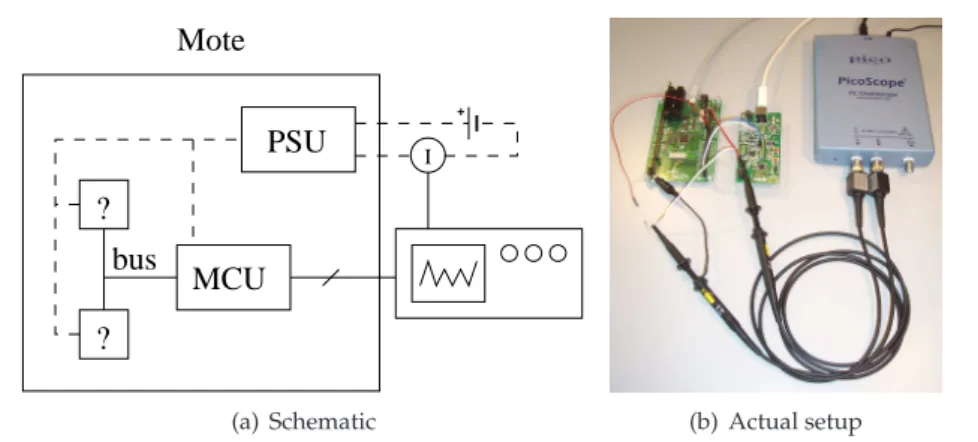
Subsystems are evaluated in isolation The process involved in determining the performance of a sensor network mote cannot be viewed in isolation. Consider for example the impact of a radio, such a component has a data sheet, which should determine the performance. Running a radio requires a power supply, it requires a CPU to perform certain computa-tions, etc. It is essential that these overheads are part of the performance equation. Simulation is insufficient to model the environment Performance evaluation is often based
on simulations, however with a sensor network interacts extensively with the ment. A simulation of a sensor network application must include a model of the environ-ment making the simulation result dependent on this model - an error in the environenviron-ment model will lead to an error in the simulation result.
The conclusion is that using simulation in an environment that is not well understood is difficult.
The time-frame is too short In our case we wish to expand the time frame to reason about the entire lifetime of our deployment, lasting days, months or years. Current methods only look at short time intervals we need to expand the time frame to cover the entire period.
1.3.2
Portability
As we have discussed the sensor network design process may greatly benefit from portability. While the issue of portability has been the focus of a large body of research in the sensor network community, the number of platforms still remains relatively low. We base our effort on the following observations:
TinyOS As one of the popular sensor network operating systems the platform support of TinyOS impacts the field as a whole. TinyOS is designed for high portability and the recent version 2 of TinyOS introduces a stringent layered approach. Still, the supported platforms are largely the same as previous versions of TinyOS and other sensor network operating systems.
Prototype Designing a new platform using an existing platform will greatly benefit from a portable software environment. In particular the vision of adoptinghardware accelerators
could be archived by the use of a prototyping approach.
Low platform adoption While interesting platforms are emerging promising superior perfor-mance, only a handful of platforms are widely adopted. We claim that the practical issues are holding the adoption of new and interesting platforms back. In particular the emer-gence of system-on-a-chip based devices, has not caught on despite the fact that large performance gains are within reach.
1.3.3
Thesis Statement
In this dissertation we focus on two key issues that are currently holding the continued evolu-tion of sensor networks back
Performance evaluationCurrent sensor mote evaluation methods are insufficient. It is essential to develop new methods that allows us to compare the performance of applica-tions across mote designs.
Portability Current sensor network support systems claim to be highly portable and well suited for a broad set of hardware platforms. In particular the recent TinyOS 2 has redesigned the underlying architecture to better facilitate portability. To a large extent, this claim is untested.
We wish to investigate this claim, by picking a fixed point in the design space (the 8051) and provide a proof of concept implementation.
1.4
Approach
The area of sensor networks has for some time been the subject of a large research effort. While envisioning a bright future for sensor networks, many projects fall short in tangible solutions.
1.4 Approach 7 Therefore our approach is pragmatic. We wish to transform the visions into concrete implemen-tations. We will implement proof of concept solutions and conduct the necessary field studies to support our claims.
The first task at hand is a practical approach to exploring the design space. One of the most promising paths in sensor network mote design is the use of system-on-a-chip design. This technology has been on the verge of a breakthrough in sensor networks for some time, but the barriers have never been broken. To get access to the this technology we pick a fixed point in design space: the Texas Instruments CC2430 featuring an 8051 based MCU and a 2.4 GHz radio. We want to explore the challenges and the potential of this system on a chip in the Hogthrob application. This platform will serve as aprototypeto the final platform.
The second task is the evaluation. As described previously we find the existing evaluation frameworks inadequate. We design and implement a evaluation method that allows us to find general characteristics of a mote and of an application.
1.4.1
Work Done
Within the Hogthrob project we concentrated on the process of providing a feasible sensor net-work design for sow monitoring. One key element in this was understanding the application. We took part in the team effort that resulted in the first pilot experiment collecting data from sows during their ovulation period. The experiment is described here [22, 44, 79].
• The field studies have been carried out as a collaboration between DIKU and LIFE. The implementations were provided by DIKU and I assisted in practical aspects, the overall design process and the following data scrubbing phase.
• In collaboration with two master students we designed a 30 day experiment to be setup in a stable. This setup contained two redundant servers collecting video and acceleration data transmitted from the sows using Bluetooth.
• The setup failed in a number of ways. Combining the collected data and video data from the two redundant servers turned out to be non trivial and time consuming.
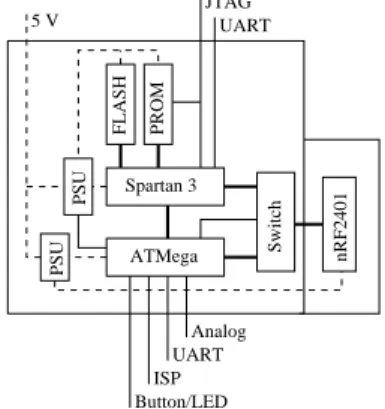
In relation to the sensor mote design we investigated two paths to gain access to a system-on-a-chip: build one and buy one. By buying a completed SoC, we benefit from a chip that, although not tailored to our approach, provides the characteristics intrinsic to SoC design. Pro-ducing a chip is beyond the capabilities of the Hogthrob project, but to be able to explore the possibilities available from a custom built SoC we created the HogthrobV0 prototype platform. While this platform does not provide the energy performance of a SoC it can be configured to be functionally equivalent to one.
• The next step in the use of system-on-a-chip design is the use of hardware accelerators. To explore this path the HogthrobV0 platform, we have used to mimic the functionality of CC2430 - by using the freely available Oregano 8051 core and the on-board radio. This setup allows us to carefully measure the impact of adding additional hardware to the architecture.
• The HogthrobV0 platform will enablein-situexperiments of hardware accelerators. In-stead of relying on feeding a hardware simulation with a model of the environment, this platforms allows hardware simulation with real input.
Using the HogthrobV0 platform as a prototype introduces two problems: i) it does not have the performance of the platform we are trying to simulate and ii) the software needs to be
portable to be translated from the prototype to the final mote. TinyOS has for some years been promising to deliver highly portable, cross platform, sensor network operating system. We test this hypothesis with a proof of concept implementation for 8051 based platforms.
• I spent a 6 month research visit at the University of California Berkeley, working with some of the driving forces behind TinyOS, this greatly sped up the process of implement-ing TinyOS for 8051 and in learnimplement-ing the motivation behind TinyOS 2.
To be able to speculatively predict the performance of a final mote, before it is available we adapted the vector based methodology, initially proposed by Setlzer et al.[100], to study mote performance in general and TinyOS-based motes in particular. We implemented this method on two commercially available sensor motes: Sensinode Nano and Sensinode Micro, and we experimentally verified the viability of the method.
• First, we test the hypothesis underlying our approach.
• Second, we compare the performance of the Micro and CC2430 motes using their hard-ware vectors.
• Finally, we predict the performance of generic data acquisition program from Micro to the CC2430.
To gain a broader perspective of the applications that may benefit from the use of sensor networks I have taken part in a number of events.
• I took part in TinyOS Technology Exchange 2005, 2006, conference participant IPSN’07, SenSys 2005, 2006, 2007. I was paper reviewer for SenSys 2005 and 2006.
I met with industrial partners through Danish Industries3, and the agricultural fare “Down to Earth” (Jordforbindelse)
As well as student project supervisor, internal censor, guest lecturer, etc.
1.5
Contributions
We claim to have advanced the field of sensor networks in the following areas: A new methodology for sensor mote performance benchmarking
We have proposed a methodology for comparing and benchmarking sensor net-work motes. This methodology will aid a sensor netnet-work designer answer key performance questions, when designing or selecting sensor network motes. An experimental verification of our performance methodology
We have implemented our method in TinyOS 2 for two commercial sensor net-work motes: Sensinode Nano and Sensinode Micro. We present the results of our experiments.
1.6 This Dissertation 9 A quantitative performance comparison of two sensor network motes
We present a quantitative comparison of Sensinode Nano and Sensinode Micro using our vector based benchmark.
A highly compatible port of TinyOS 2 for the 8051
We present an implementation of the operating system TinyOS for the 8051 plat-form. The 8051 architecture differ substantially from the architectures used to de-velop TinyOS. We have ported the sensor network operating system TinyOS 2 to the CC2430 and 8051 platforms.
We propose a method that allows a single source tree to be compiled using differ-ent compilers with differdiffer-ent C-dialect. We believe this is the first 8051 operating system to support multiple compilers using a single source base.
A comparison of the CC2430 and the Sensinode Micro.4
We further detail the comparison of the CPU benchmark used as part of the vec-tor based methodology, focusing on the architectural differences between the two. This comparison complements the results based on the vector based approach, de-tailing the impact caused by the architectural differences.
Lessons for portable sensor network operating systems
We present our lessons from porting TinyOS to the 8051 platform. These solutions are not limited to TinyOS or the 8051 and we consider the lessons to be generally applicable to other projects facing similar challenges.
The lessons consist in part of the work presented here and of our guide to building TinyOS 2 platforms published separately as a technical report[65].
1.5.1
Technical Contributions
A Platform Enabling Hardware/Software co-design
• HogthrobV0 prototype platform. We have implemented, tested and docu-mented the Hogthrob prototype platform - an compact, flexible FPGA based prototyping platform. This platform allows a much wider design space for future researchers attempting to verify assumptions by field experiments. A manual for this platform is published separately as a technical report[66]. • Oregano for HogthrobV0. We have adapted a freely available 8051 core for
the HogthrobV0.
1.6
This Dissertation
In this chapter we have detailed some of the motivation for this dissertation and the Hogthrob project. We have defined the two problems we address. In the following chapters we detail the work introduced here. Each chapter has been written to be self-contained in such a form that
they can be read independent of the other chapters. Chapter 3 forms the basis of a publication at the EWSN 2008 conference, and Chapter 4 has been written such that it could form the basis of a publication at a later date.
We will begin by building some of the background for the Hogthrob project in Chapter 2. Here we will cover some examples of sensor network applications, review some of current sensor mote hardware platforms and look at the power estimation techniques available to us. We will also look at the HogthrobV0 prototype platform, that we designed in the project.
Chapter 3 introduce performance evaluation in sensor networks and present our vector based methodology. Chapter 4 discuss portable operating systems and present our method-ology. We will conclude our findings and summarize the results in Chapter 5.
CHAPTER
2
Background
The following chapter builds some of the general background for the Hogthrob project. This chapter builds the knowledge required for the Hogthrob project, and serves to illustrate the context of the project, but is not strictly focused on the problems we describe in this dissertation. The context described here was important to us and the project, but some sections are less relevant to the points of this dissertation.
We direct readers that are not particularly interested in the review of mote design and power estimation techniques to skip to Section 2.5 covering the Hogthrob prototype platform.
In Section 2.1 we begin by describing two classic examples of sensor network deployments. The two examples uses a sensor network to monitor animals in two quite different scenarios. We compare this to the monitoring application of the Hogthrob pilot experiment. The intention is to build a context for the remainder of the discussions, in particular the kind of challenges that we are ultimately facing. The focus of the section is how the requirements of the application are met with the design of the architecture and the section serves to illustrate the types of applications that have taken advantage of a sensor network.
In Section 2.2 we survey past and current generations of sensor network motes. The review is based on the motes available at the beginning of the project and is not up to date with the most recent developments. We use this section to build the case for the need for a specialized design, that we choose as the goal of the project.
In Section 2.3 we describe some of the approaches chosen to program sensor networks in general. We describe some of the work related to TinyOS and outline the design principles behind TinyOS that differ substantially from other systems. This discussion is important to the context of TinyOS in relation to sensor networks.
In Section 2.4 we review some of the related work regarding power estimation. Some of the subjects covered are not directly related to our work, but it serves to build the intuition required for our power estimation technique in Chapter 3.
In Section 2.5 we present the HogthrobV0 prototype platform. This platform lays a foun-dation for further exploration of the hardware software boundary, but this work is far from complete. We include it here as a technical contribution. The potential of the platform include combining this platform with our vector based methodology (Chapter 3) and experimenting with the hardware software boundary by implementing hardware extensions to an 8051 CPU running on the embedded FPGA.
The motivation for the Hogthrob project has been explored previously, and major parts of this chapter has been published previously[64].
(a) Housing (b) Network Architecture
Figure 2.1 Great Duck Island. Mica mote in acrylic enclosure and schematic network architecture[92].
2.1
Sensor Network Monitoring Applications
Recent years has seen a number of scientific and commercial applications of sensor network monitoring. For scientific monitoring, sensor networks have provided a number of advantages over current methods. Some project have greatly benefited from on board computing, spacial allocation, in network processing, etc.
We will look at a couple of scientific examples and focus on how the requirements of the application are met.
2.1.1
Great Duck Island
During 2002 researchers from University of California Berkeley (UCB) and The College of the Atlantic deployed a sensor network with 32 nodes on a desolate island off the coast of Maine. The goal was to monitor the habitat of a small sea bird, the Leach’s Storm Petrel. The tar-get lifetime was to monitor the birds during their 7 months breeding period. The sensor net-work monitors how the birds use their burrows and it monitors the micro climate in them. The Leach’s Storm Petrel and other seabirds are sensitive to disturbance—sensor nodes provide a low invasive alternative to frequent visits[80].
Sensor Network
The deployed sensor nodes were slightly modified Mica motes (see Section 2.2.2) equipped with the Mica weather sensor board1. The weather board features temperature, photo-resistor, barometric pressure, humidity, and passive infrared (thermophile) sensors.
To withstand the harsh, outdoor environment, sensor nodes are covered with a thin parylene sealant which protects exposed electrical contacts from water. The on-board sensors remained exposed to preserve their sensitivity. The nodes were placed in a ventilated acrylic enclosure (see Figure 2.1(a)).
2.1 Sensor Network Monitoring Applications 13 The nodes were spread out over a 15 acre area and results were forwarded to a central database. The wide spread of the sensor nodes demands a sophisticated network infrastructure. The authors choose a two tiered architecture by grouping sensor nodes close together in asensor
patchwith a gateway that is part of atransit networkthat transmits the data to a remote data
storage unit (see Figure 2.1(b)).
As a simple health sign the nodes regularly included their battery voltage with their sensor reading. This measure assisted researchers in analysis of remote node failures and provide insights into deviating sensor readings.
The authors consider this application is representative of a class of sensor network applica-tions described ashabitat and environmental monitoring, with the following characteristics:
• Immobile nodes that are left unattended for long periods of time.
• On-line data gathering, measurements are forwarded through network infrastructure While the experiments were planned for as long as 7 months many of nodes failed much earlier than this. Interestingly only a few died because of depleted batteries, the majority failed to withstand the wear and tear from the outdoors. Based on this fact node failures are shown to be predictable based on their, faulty, sensor readings. An other surprise was the networking performance: the nodes send infrequently and at a low rate, suggesting few or no collisions. However, in the deployment it turns out that by different types of misfortune the nodes start dropping a large number of packets for example at certain period the transmission schedule is aligned and packets collide[106].
Lessons Learned
The Berkeley team have learned lessons from their experiments in a number of domains ranging from packaging to network protocols. From our point of view the most interesting lessons are:
• The differences in conducting lab and field experiments
• Their approach consist in using pre-designed hardware and package, so that it can fit in a burrow and survive outdoor conditions. They suggest that a more effective approach would be to account for environmental conditions and specific sensors when designing hardware and software.
2.1.2
Zebranet
In January of 2004 the Zebranet project monitored herds of Zebras roaming freely in the plains of Kenya[55]. The goal of the project is to conduct a live experiment attaching collars with sensor nodes on herds of Zebras and log their position using GPS during one year.
Some 35,000 Zebras roam freely in the 40,000km2Laikipia plateau of central Kenya in larger or smaller groups depending on their species. The speed and direction of movement of the individual animals in a group is closely correlated, thus tracking an entire herd can be accom-plished by collaring only a single or a few animals in a group, vastly reducing the number of collars required.
Sensor Network
Traditional tracking is based on collaring animals with VHF transmitter and locating the an-imals by driving through or flying over the expected locations listening for “pings” from the transmitters. The freely roaming Zebras give rise to a radically different scenario than the Great Duck Island scenario:
• The nodes are mobile
• The base station is mobile (moving along with the researchers camp) • The nodes are not in contact with a base station or network at all times
It is unattractive to deploy fixed infrastructure through out the park mainly because of the risk of vandalism and the large area. To solve these problems the authors observe that the herds of Zebras tend to meet regularly at water-holes scattered throughout the park. Using this observation, they choose a peer-to-peerdata disseminationstrategy (similar to Manatee[5]): measurements are replicated from node to node when they are within radio range an to the base-station when it is in range. By using the last time of contact with the base station as a data replacement heuristic, the measurements will statistically make their way towards the base station.
Prototype Nodes
The authors present multiple generations of prototype nodes, from the first proof of concept (version 0.1[55]) to a small integrated platforms powered by solar cells (versions 1,2, and 3[113]). The prototype platform experimented with a dual radio system for long / short range commu-nication, but this was not used in the field, as the authors believe that it was unlikely the dual range principle was of much use. In January 2004, a batch of the version 3 nodes were deployed in Kenya, a summary of the features is given in Table 2.1 on page 19.
The platform uses a GPS receiver to obtain the location at regular intervals and logs this in the on-board flash. They choose a long range, low data-rate radio (MaxStream 9xStream2). The GPS unit and the radio are high power devices (compared with the devices we will look at in Section 2.2) and to sustain its power budget the platform recharges a battery using solar cells embedded in the collar.
It is also noteworthy that, although the authors point to many inefficiencies and power op-timizations in the platform, it turned out to begood enough—12 zebras were collared with and the platform functioned autonomous on the plains of Kenya. A few preliminary results have been published, but detailed results from the deployment is not available at this time[113]. Lessons Learned
The authors gain insights into how to design a sensor network platform and how to conduct experiments in the field. The lessons we take from the Zebranet deployment are:
• The authors developedspecificnodes driven by the requirements of the application. In this case the requirements included long range radios, weight, size and GPS-logging. • The new platform was fixed first and then software was developed. There was no
evalu-ation of how the hardware could best support the software.
2.1.3
Hogthrob Pilot Experiment
The Hogthrob project involves building a sensor network for monitoring sows, and detecting heat in particular. The Hogthrob project begun with an exploratory phase, consisting in part of a pilot experiment in February 2005. The purpose of this experiment was to verify earlier findings regarding sow behavior using group housed sows, as opposed to individually housed
2.1 Sensor Network Monitoring Applications 15 sows, as well as gaining familiarity with setting up experiments in a stable. The data would further aid in building a model of the sow behavior.
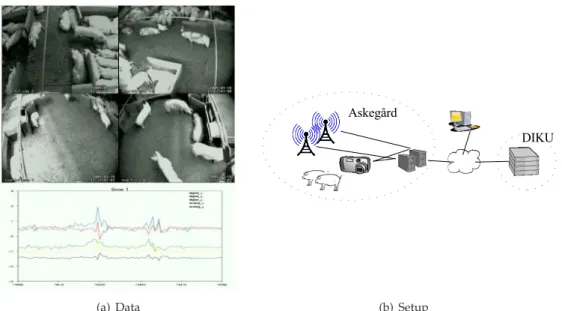
The experiment consisted in monitoring five sows before, during and after their heat period including the time of ovulation. During this time the sows are fitted with a sensor collecting ac-celeration data. In addition, a ground truth is collected using cameras and manual observation of physical traits indicating heat. An visualization of the cameras and acceleration is depicted in Figure 2.2(a).
The heat period of the sows lasts only for one or two days and occurs approximately once a month. The five sows are taken out of their regular production cycle and monitored for a 30 day period. This period should be long enough to collect data in a non-heat and a heat period and take into account the irregularity of the ovulation.
The experiment is characterized by: • Deployment for a short period.
• Collecting data and learning the nature of the application are equally important goals. • The environment is different than, what would traditionally be considered a sensor
net-work: while the sender is battery powered, the infrastructure is connected to the power grid.
Sensor Network
The sensor network is built using a Bluetooth enabled sensor motes sampling acceleration to a local buffer and offloading to a server once every hour (See Figure 2.2(b)). The mote contains two accelerometers a digital and an analog that are sampled at 4 Hz. The data is offloaded to one of two servers that receives and time stamps the data. The data is stored locally and forwarded via the Internet to a central storage.
The store and forward strategy is chosen to accommodate the long connect time, but high data transfer rate of Bluetooth. In this way, the energy pr. bit becomes relatively low. The video is recorded on two servers for redundancy if one server fails. We choose a get all strategy: collecting all data from the motes and doing all processing offline.
Lessons Learned
The experiment was a valuable lesson in building the final sensor network infrastructure. The collected data was not perfect, but provided enough value to get started on a model. In all the pilot was success and create a foundation for further experiments. In total 240 MiB of sensor data was collected, along with 30 days of video.
• Communication failures were much more frequent than expected. Quite possibly because the sows might lie down on a mote in such a way that it could not of load the data. This caused extended periods of missing data.
• One of the accelerometers was misprogrammed and returned faulty values.
• The video servers did in fact fail at random, however, joining the video turned out to be time consuming.
• The time synchronization for each server was misconfigured. Meaning that no continuous time exist for all data, because the motes are equally likely to check in on one or the other server.
(a) Data (b) Setup
Figure 2.2 Pilot experiment at Askelygaard. a) the 4 cameras and a plot of the data collected from one sow. Notice that one of the five sows we are monitoring is in upper right frame with markings on the back, b) a depiction of the setup two PC are connected to a Bluetooth receiver and all 4 cameras are connected to both PC. The PC offload their data to remote servers via the Internet and allows remote monitoring.
2.2 Sensor Network Platforms 17 Validating the assumptions prior to the experiment was not carried out - calibrating the accelerometers and that the connections were sufficient (even with sows lying on the motes). Prior to the experiment no planning was made for the aftermath - the data scrubbing after the experiment was much larger than anticipated.
Many of these faults could have been cured by more careful planning and higher focus on getting meaningful data from day one.
2.1.4
Discussion
We looked at three examples of sensor network applications using deployments early in the project phase. In all tree cases the problem was not well understood and the experiments lead to new insights into the application. The three examples used a low level of in network process-ing and off loaded as much data as the network could handle. We believe these three can be considered as prime examples of pilot projects, and serve as examples to the development pro-cess for other similar projects: starting out with a prototype design and a get-all data collection strategy.
Looking back, we can distinguish two types of requirements that lead to the design of these sensor networks:
Functionality sensing capabilities, modularity, data collection / dissemination
Performance lifetime, price, energy budget, form factor, environmental resistance (rain, fumes, etc.)
Based on these requirements choices were made to design a sensor network—as far as the design decisions are concerned, we make the following observations:
• The Great Duck Island designers chose to use pre-designed sensor nodes while the Ze-branet designers chose to define their own sensor nodes.
• In both cases, the application requirements were met through a trial-and-error approach that consist of a) a pre-deployment analysis (either back of the envelope calculations or micro-experiments in the lab), b) an on-line monitoring (battery level indication) and c) a
post mortemanalysis (that rely on data logged during the experiment).
More generally the examples show the challenges that are faced within the type of applica-tions that we denote as sensor networks. Constrained in size, energy and price and requiring some form of network communication possibly employing in-network aggregation.
In the context of Hogthrob, a first question is whether to use a generic, pre-designed sen-sor node or to design our own. As far as meeting the application requirements (described in Chapter 1), we aim at following a systematic approach for which this thesis is a foundation.
In the next section we will try to place the existing platforms in relation to the design pa-rameters above.
2.2
Sensor Network Platforms
In recent years there has been growing research in the field of building sensor network plat-forms, each of these platforms are a point in the design space. Most of the platforms are used to investigate a multitude of research topics ranging from network issues, remote reprogramming,
sensing capabilities to software design or scalability. Only a few platforms have been evaluated in large scale application deployments.
The major drawbacks to designing and building sensor nodes, disregarding the cost is: (a) the design process itself is a long and time-consuming and (b) scaling a network to hundreds or thousands of nodes is difficult. To overcome this initial hurdle and to study large scale sensor networks simulation is often employed. We will come back to the topic of simulation in Section 2.4 when discussing power estimation, but using simulation as a sensor network platform will not give us insights to the possibilities in hardware design that exists today.
The question we posed was: is there a platform available today that we can use in the Hogthrob project? In this section we look at the available sensor nodes. The nodes we describe in Section 2.2.2 have been built using commercially available or common off the shelf compo-nents (COTS), the next natural move for sensor network platforms is to embed all compocompo-nents on a chip (system on a chip). We look into two projects exploring this practice in Section 2.2.3.
2.2.1
Sensor Network Motes
The sensor networks we see today are characterized by instrumenting the physical world using motes. The motes in turn run the embedded programs that collect, store and transmit the mea-surements collected by the motes. Some networks are composed of homogeneous motes, while some adopt a tiered approach with heterogeneous motes at different levels.
2.2.2
Generic Sensor Nodes
By generic nodes we mean nodes that are built to fit a general picture of a sensor network node and not specialized to a particular purpose. We look into a broad range of the generic sensor nodes available today, and compare them in Table 2.1
UC Berkeley Motes
The vast majority of research in sensor networks has been centered around the generations of sensor nodes developed at UC Berkeley: Rene, Mica, Mica2 [1, 2] shown in Figure 2.3—these are the platforms that first coined the term “motes”.
Among the first motes to be developed at UC Berkeley were the “RF Mote” and the “weC” motes [50] featuring RF Monolithics TR1000 radio and the Atmel AT90LS8535 at 150 kHz and 4 MHz respectively. While the RF Mote has low power consumption, it is unable to operate the radio anywhere near its maximum capability. The AT90LS8535 is aHarvard architecture3without the ability to write in the program memory and therefore the motes contain a co-processor to handle reprogramming.
Building on the experiences of these nodes, the Rene and Rene2 were constructed in a mod-ular design as a “sandwich” board, allowing easy and compact connection of additional boards (sensor board, etc.). The Rene2 featured the ATMega163 MCU at 4 MHz increasing the memory from 0.5 KiB to 1 KiB and the program flash from 8 KiB to 16 KiB.
The successor to these nodes was the Mica[48] and Mica2[72] motes continuing the modular design but upgrading to a more powerful MCU: the Atmel ATMega 103 at 4 MHz and ATMega 128l at 7.37 MHz respectively. Among other things the ATMega128l eliminates the coprocessor for writing to program memory. Based on the experiences in the first Great Duck Island de-ployment, the Mica2 and derivatives (Mica2Dot, MicaZ) are designed without a battery voltage 3The termHarvard architecturedenotes the separation of program and data memory as opposed tostored programor
von Neumannarchitectures in which program and data resides in the same memory space [46] 4http://www.tinyos.net/media.html
2.2 Sensor Network Platforms 19
(a) RF Mote (1998) (b) weC (1999) (c) Mica2 (2002) (d) Telos (2004) Figure 2.3 Four generations of UC-Berkeley Motes4
MCU Clock FLASH RAM Wakeup Storage Radio (MHz) (KiB7) (KiB7) ( µs) (KiB7) RF Mote[50] AT9080515 0.15 8 0.5 32 TR1000 weC[91] AT90LS8535 4 8 0.5 1000 32 TR1000 Rene[91] ATMega163 4 16 1 1000 32 TR1000 Mica[91] ATMega103 4 128 4 180 512 TR1000 Mica2[91] ATMega128l 7 128 4 180 512 CC1000 MicaZ[91] ATMega128l 7 128 4 512 CC2420 BTNode2 ATMega128l 7.35 128 64 0 ROK101007 BTNode3 ATMega128l 7.35 128 184 0 ZV4002, CC1000
iMote ARM7 12 512 64 Zeevo Bluetooth Eyes MSP430 58 60 2 244 TR1000
Telos MSP430 8 60 2 6 512 CC2420 ZebraNet MSP430 8 60 2 3.8 9xStream MC13192 MC9S08GT60 408 60 4 0 MC13192
Table 2.1 Sensor node summary. FLASH is used for program memory, Clock is the MCU clock, Power is the power consumption of the MCU. Storage is extra nonvolatile storage.
up conversion (step-up or boost converter) and operate on unregulated battery voltage. As the battery is depleted, the voltage will drop affecting components such as the radio, sensors, etc. this influence has not been explored.
The Rene, Mica and Mica2 motes were (and are) commercialized by the spin-off company Crossbow5and are used by most sensor network research groups at the time of writing. A num-ber of variants have been manufactured such as the Dot and MicaDot, primarily with smaller footprint.
Telos
The Telos node from the latest UC Berkeley spin-off MoteIV6 combines the Texas Instruments TI MSP430 with the Chipcon CC2420, 802.15.4 radio. The node does not feature the modular design of the Mica nodes, but has an on-board USB port for easy programming, making them ideal for educational purposes and less sensible to wear and tear when connecting and discon-necting plugs to external components.
5http://www.xbow.com 6http://www.moteiv.com
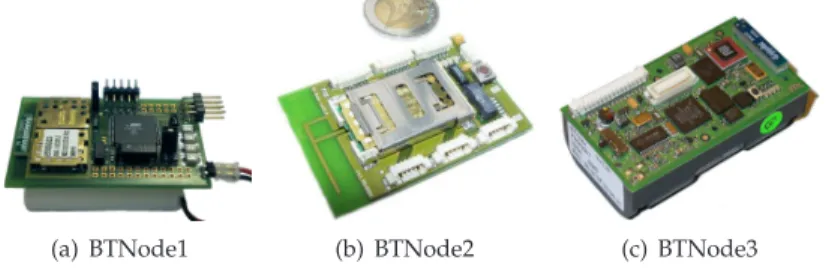
(a) BTNode1 (b) BTNode2 (c) BTNode3 Figure 2.4 BTNodes from ETH Z ¨urich9
MicaZ
The latest Mica variant from Crossbow. As it predecessors it is based on the ATMega128l and has an external serial flash and as the Telos node it features the CC2420, 802.15.4 radio. The form factor is the same as the Mica nodes and it remains compatible with the Mica sensor boards. BTNode
The BTNode generations of nodes have been developed at the ETH Z ¨urich in the Smart-ITs project10 (the three generations are shown in Figure 2.4). The Smart-ITs prototype[11] and BTNode2[8] were functionally equivalent, however the prototype was merely a proof of con-cept. They both feature an Atmel ATMega128l and an Ericsson ROK 101 007 Bluetooth module. Additionally a 60 KiB external RAM block and a battery charge indicator in the form of a simple voltage divider is provided on-board.
Recently the BTNode3[7] was released, this node is developed at ETH, but manufactured and sold commercially by Art of Technology, Z ¨urich11. It features the Atmel ATMega128l, 244 KiB external RAM and dual radios: Chipcon CC1000 and Zeevo ZV4002. In contrary to the BTNode2 design the BTNode3 has been designed in a sandwich fashion in order to allow easy connection of additional boards.
Eyes
The Eyes project12has yet to publish details on their prototype nodes, however a short overview has been publish with the T-Mac radio medium access protocol[109]. The prototype features the 16 bit Texas Instruments MSP430F14 with 2 KiB RAM and 60 KiB flash, variable clock up to 5 MHz. Additionally it has an RFM TR1000 radio, and 2 Mbit EEPROM. The potential of the variable clock is not explored.
Intel Mote
The Intel IMote[58] is based on an Zeevo Bluetooth module with integrated ARM7 core (part number not available) with very few other components. The nodes are designed in a stackable fashion for easy connection to sensor boards. The details are few, but link reliability is argued
7KiB, MiB, and GiB is defined as210
,220 ,230 bytes respectively[21]. 8Variable up to 9http://www.btnode.ethz.ch 10http://www.smart-its.org 11http://www.art-of-technology.ch 12http://eyes.eu.org
2.2 Sensor Network Platforms 21
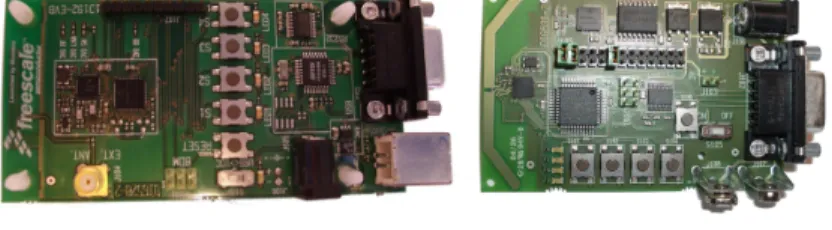
(a) MC13192-EVB (b) MC13192-SARD Figure 2.5 Freescale evaluation boards for the ZigBee-ready platform
as one of the advantages over more simple radios. An example deployment is described mon-itoring vibration in an factory scenario. The factory is a radio-hostile environment, with many obstacles and machinery generating noise. Even in this environment the Zeevo Bluetooth radio shows good connectivity and range.
Freescale Evaluation Boards
Recently DIKU acquired two different Freescale13 evaluation boards featuring the Motorola 802.15.4 ZigBee-ready platform: the MC13192 Evaluation Board (EVB)[51] and the MC13192 Sensor Applications Reference Design (SARD)[52] (shown in Figure 2.5). Both feature the Freescale 802.15.4 MC13192 radio and the MC9S08GT60 microprocessor (part of the HCS08 family). The MC9S08GT60 is an 8 bit MCU with 16-bit addressing space and a variable clock speed up to 40 MHz, featuring 4 KiB RAM, 60 KiB FLASH, 8 ADC channels
The MC13192-EVB has a few push-buttons, LEDs, pin headers for external sensors and a USB or RS-232 programming port. The MC13192-SARD features the Freescale MMA6261Q, MMA1260D 1.5 g accelerometers.
Conclusion
When designing a sensor network platform using commercially available components the num-ber of options is tremendous: MCU and radio manufacturers are plentiful. In this context it is surprising to see such a small diversity in choices. Even among the nodes designed by differ-ent research groups the choices are quite similar—no single node distinguishes itself from the others as remarkable.
Each of the nodes were the product of a certain design point, locking a design based on the available options. In each case when a hardware design was fixed the software was limited by the choices made in the beginning.
In general this approach allows flexible development, with add on sensors, easy component replacement, etc. The primary drawbacks to this approach is the constraints in terms of energy consumption and the form factor of the assembled printed circuitry boards (PCB).
2.2.3
System on a Chip
The sensor network deployments described in Section 2.1, and the available platforms described in the previous section are based on COTS nodes. Such nodes are easy to build or can be pur-chased commercially, but has a number of drawbacks. A solution to address these problems is
(a) SPEC sensor node ADC RAM Blocks Address Translation I/O Ports ALU Instruction Fetch & Decode Encryption Engine System Timers SPI Programming Module Radio Subsystem Register File Analog RF
Memory & I/O bus
RISC Core
(b) SPEC overview
Figure 2.6 Spec sensor node on a chip. Pictures from Jason Hill’s website15.
to consider a sensor node on a chip i.e. assembling all components of a senor node on a single chip.
In the following we will look into a few projects, that while being very interesting, are still in their early stages and only being tested in simulation or lab experiments.
Spec
The Spec node[49] is an ASIC14 followup to the success of the Mica motes (see Figure 2.6). It continues the design strategy and is based on a single MCU for baseband, MAC and applica-tions with a number ofhardware acceleratorsto offload the MCU for demanding operations. To remain compatible with the Mica motes the implemented MCU core is an AVR instruction set compatible, 8 bit, Harvard architecture, RISC core with 16-bit instructions. As the ATMega128l it features a two stage pipeline (instruction fetch/execute) and on chip A/D converter. Addi-tionally a 900 MHz radio transceiver is provided on the chip.
The on-chip radio is a simple device with no offloading features, resulting in high frequency of interrupts for the MCU. To support efficient interrupts two sets of registers are provided (register windows) and an interrupt merely slides the window lowering the overhead of an in-terrupt to no more than two instructions. Furthermore, a start symbol detection (correlator), simplified direct memory access (DMA) and encryption accelerators are implemented in hard-ware.
The chip is manufactured in a 0.25µm technology, measuring 2.5 mm on each side and thousandfold improvements in terms of energy consumption are shown on MCU-intensive op-erations, compared to the Mica platform.
Sensor-Network Asynchronous Processor (SNAP)
SNAP/LE[28] presents an implementation of the SNAP architecture[53], a novel approach to sensor network processors. SNAP distinguishes itself from a general purpose MCU in two ways: it is based on an asynchronous logic and is based on an “event driven” design. The argument for this is the following: recent advances in radio technology will shift the energy bottle-neck such that the energy consumption of the MCU during active instruction execution becomes significant. The event driven architecture will address this problem, while the asyn-chronous design will provide further energy savings.
2.2 Sensor Network Platforms 23 Event driven
The processor is based on processing events through an event queue instead of signaling in-terrupt that in turn executing the appropriate inin-terrupt handler. The processor executes the appropriate handlers by removing events from the queue. This eliminates the overhead of han-dling interrupts. Event handlers are executed non-preemptively, in-order and instructions are issued to the single in-order execution unit. In essence moving the event driven nature of many sensor network applications into the processor.
In addition to the execution unit a timer and message coprocessor is present. The timer unit places events on the queue and notifies the core to execute the proper handler. The message processor is in essence a 16-bit wide FIFO buffer for transmission and reception.
Asynchronous Logic
Clocked (or synchronous) logic uses the clock to determine when signals arestableorvalid— this has two drawbacks in relation to energy consumption: First, when starting the system, the clock-signal has to stabilize, leading to longer startup times and secondly, elaborate measures has to be employed to disable circuitry that is unused in a particular computation (such as dividing the chip into clock domains).
Asynchronous logic eliminates the need for a clock signal by using ahandshaketo express when a signal is valid. This reduces startup times and only transistors needed for a computation will be active, in a senseautomaticpower management.
Evaluation
The processor has been simulated extensively using a 0.18µmtechnology and a set of tentative power consumption figures are compared to that of the ATMega128l. The authors show an extremely low startup time (in the order of tens of nanoseconds depending on voltage) and a considerably lower energy consumption than the ATMega128l. The expected form factor is not explored.
The comparison does not take into account that the ATMega128l predates SNAP with a few years and is probably manufactured with a greater feature size than the 0.18 µm of the simulation (the actual feature size is not specified by Atmel). It is unclear what savings can be attributed to the event driven approach, the asynchronous design, or to savings of a lower feature size.
PicoRadio
The PicoRadio Test Bed (or PicoNode I) is the prototype environment of the PicoRadio project. The PicoRadio project is investigating small, low power system on a chip (SoC) devices for sen-sor networks (or PicoRadio networks). By applying system-level design decisions and metic-ulous concern for energy reduction they hope to arrive at a much more optimal design than optimizing parts of the system without taking the entire system into account[97].
PicaRadio advocates implementing specialized protocol processors to handle timing sen-sitive and computing intensive operations. As a first order approximation this can be imple-mented in a configurable logic block and later refined through a number of iterations to a single ASIC[23]. A substantial energy reduction is observed even with the first order refinement using an FPGA rather than a general purpose micro controller [97].
Pico Radio Test Bed
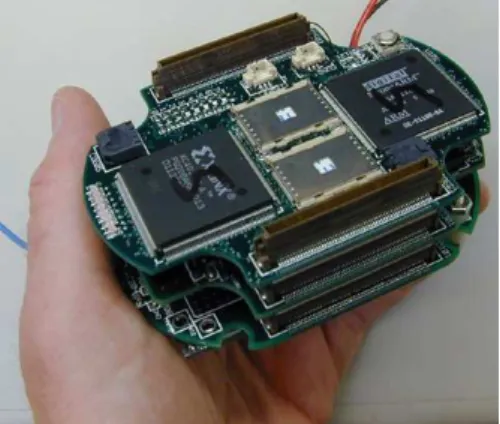
The Pico Radio Test Bed[16] is divided into a number of PCBs by the logical function: digital (computing), power supply, sensors, radio. They are designed is a stackable fashion for easy and robust assembly. The computing board features (Figure 2.7):
• a StrongARM SA-1100 with 4 MiB RAM and 3 MiB of flash with an adjustable clock from 60 MHz to 200 MHz
• a Xilinx 40 k system gates FPGA16(XC4020XLA) with external SRAM and FLASH. The ARM is running software which will be run on a general purpose microprocessor while the FPGA is emulating the functionality that will eventually be implemented in a dedicated protocol processor.
For the ARM a simple programming environment is provided that provides some operating system services. It is event-driven in the sense that user programs are activated via interrupts (external, timer, etc.) and features a single non-preemptive main routine. The main function is called periodically and it is up to the user to provide parallelism and to ensure that the thread is non blocking.
From the specification above it is clear that this platform is far more powerful than the sensor nodes described previously. While the scenarios and applications envisaged resembles those of most other sensor network projects the described platforms are far more computing intensive resorting to FPGA implementation to solve the computing needs[16].
While the methodology describes the need for system-level decisions and meticulous con-cern for power consumption, experimental results using application examples are scarce. Pub-lished works describes the completed PicoNode I (Test Bed)[16] and PicoNode II (TCI)[3], but the lack of experimental data is surprising. The axiom of a separate protocol-processor based implementation always out performing a microprocessor based implementation is not shown.
The second approximation of a SoC, the TCI (Two Chip Implementation), is presented con-suming 13 mW on average and more than 24 mW peak—and this does not include radio front-end and application processor [3].
Conclusion
Designing SoC platforms allows control over all of the involved components allowing them to be designed for optimal interaction, not being hindered by legacy design choices.
Furthermore, it allows software/hardware co-design—the SPEC node included an encryp-tion engine, the SNAP processor moved the event based execuencryp-tion into the processor. In this way the designers are able to build the exact features that are required in a given application, this would have been impossible using COTS components.
2.2.4
Discussion
In this section we described the strategies for building platforms seen previously in the sensor network community. We have looked at generic nodes built on a set of assumptions about com-mon general purpose sensor network application, using commercially available components. Finally we looked at the early stages of two SoC sensor nodes.
Most of the platforms we described have never been tested in long deployments or large numbers. It is our claim that the generic sensor nodes focus on thefunctionalaspects of a sensor
16Field Programmable Gate Array
2.2 Sensor Network Platforms 25
Figure 2.7 PicoRadio Test Bed17
network application while theperformanceis non-optimal. Based on the few deployments we have seen we are convinced that such platforms will not be able to achieve the performance required by Hogthrob. Therefore we do not use any of the exiting nodes. We need a sensor node specialized to our conditions. It must be cheap (a fewe), small (can be attached to the ear of a sow), have a lifetime of up to two years.
We will not go into the cost of producing electronics, but it is a given that for high volumes integrated circuits (chips) are much cheaper than mounting similar components on a PCB. As an example a singe Mica2 from Crossbow costs 150 USD18 and this does not include sensors while the ATMega128l integrated MCU with numerous peripherals costs about 10 USD. It is our claim that to be able to build a sensor node including sensors, microprocessor and radio withing the budget it must be built as a system on a chip.
The previous deployment examples showed us the importance of taking all layers into ac-count when designing a sensor node. Component boundaries impose a limitation on the type of functionality that can be implemented. The Great Duck Island did not nearly meet their life-time goals, Zebranet were constrained in the power-saving features the could utilize by poorly integrated components (a similar observation was made for TinyBT[68]).
To solve these problems we choose to follow aholisticview that takes all layers of design into account when constructing a sensor network. We do this by employing hardware and software co-design[59]. That is, we need to design and evaluate the ability of the hardware platform to support the application and we need to design and evaluate the ability of the software to exploit the power conserving features of the platform as well as supporting the needs of the application.
The question is now: how do we design and evaluate a SoC? Producing chips takes time and is expensive, consequently we wish to evaluate the ability of the SoC design to meet the application requirements as a part of the design process—before a SoC is available.
Lifetime being the most important parameter, how do we estimate the lifetime of such a sensor node? We will return to this topic in Chapter 3.
2.3
Sensor Network Software
The rise of sensor networks has challenged some of the conventional wisdom within software systems design. Sensor networks has resulted in new ideas in a number of areas, encompass-ing larger or smaller parts of the ecosystem relatencompass-ing to a sensor network deployment. In the following we will look at some of the main trends and discuss examples. The software sup-port systems are in charge of acquiring the data and reacting to the results. This could involve tasks such transporting, actuating, aggregating, etc. To accomplish this task sensor network designers structure their solution to fit the needs of their application.
Today most systems employ a tiered approach implementing some functionality at a level above the motes. Motes run embedded software that sample the physical environment off load-ing data, events, aggregates or similar to a second tier. This is a contrary to the initial belief in the sensor network community, that most processing would be pushed to the network[43].
Regardless of the tiered approach each mote still needs a program, and the most common approac
![Figure 2.1 Great Duck Island. Mica mote in acrylic enclosure and schematic network architecture[92].](https://thumb-us.123doks.com/thumbv2/123dok_us/489589.2557976/20.892.221.772.135.394/figure-great-island-acrylic-enclosure-schematic-network-architecture.webp)