209
INTRODUCTION
Presently, all major technical universities have intro-duced computers as an important and valuable vehicle for the improvement of the educational process. Many university teachers are now being seriously involved in the development of various types of interactive Computer-Based Training (CBT) programs for appli-cation in the university teaching/learning process.
Once academic teachers learn how to use well-designed and often sophisticated CBT programs effectively, they begin to create new ways of struc-turing their education and training activities in order to better accommodate the available educational programmes in order to satisfy educational objectives and students’ needs.
Intensive research and developmental activities in relation to the application of interactive CBT programs
The Development and Application of Computer-Based
Training Programs in Maritime Engineering Education*
Romuald Cwilewicz
Leonard Tomczak
Gdynia Maritime University, ul. Morska 83, 81-962 Gdynia, Poland
Zenon J. Pudlowski
Monash University, Wellington Road, Clayton, Melbourne, VIC 3800, Australia
Under the Seafarers’ Training, Certification and Watchkeeping (STCW) 78/95 Convention, it is highly recommended that Computer-Based Training (CBT) programs be applied to maritime engineering education. Therefore, many maritime academic institutions, as well as professional and vocational training centres, have decided to apply this type of tool to support their didactic processes. The Gdynia Maritime University, Gdynia, Poland, is in the forefront of the design, development and implementation of such tools, and has used these computer-assisted programs over the last five or so years. The objective of this paper is to describe and present some experiences related to the development and effective utilisation of computer-based simulators in the teaching-learning process. In this article, the considerations regarding this topic are based on an example of an engine room simulator with medium speed diesel engines and a controllable pitch propeller installation, which are important facilities onboard any ship. The basic simulator features, such as assessment, self-training and the faults scenario creation, taking into consideration the new and highly effective methods in marine engineer education and training, are presented and discussed in this article.
have been carried out at the Gdynia Maritime Univer-sity (GMU), Gdynia, Poland, over the last few years [1]. As a result, a wide range of CBT instruction pack-ages has been already developed and implemented, and new initiatives are currently underway.
In designing such programs, care is being taken to make them as interactive as possible with the applica-tion of recent achievements of modern computer technologies so that they can be easily implemented in laboratory experimental work [2].
THE USE OF CBT PROGRAMS IN
LABORATORY EXERCISES
Laboratory exercises constitute one of the key activities of the didactic process in engineering and technology education. Hence, the effective use of laboratory experimental procedures depends very much on the proper preparation of students. CBT inter-active programs may, therefore, play an important role in improving the quality of this preparatory process.
*A revised and expanded version of a paper presented at the 6th UICEE Annual Conference on Engineering
Education, held in Cairns, Australia, from 10 to 14 February 2003.
Because of the application of such programs, students not only become acquainted with the operational procedure but also with the selection and adjustment of certain parameters for various experimental quantities. Moreover, the use of such programs enables the simulation of faulty operation that cannot be realised under real laboratory conditions [3].
It is a well-known fact that during laboratory exercises, even when conducted in small groups, not every individual student is able to become acquainted with all the details and, in particular, with the method of adjustment and variation of experimental param-eters. However, CBT interactive programs offer the possibility of learning how to adjust the parameters of certain devices, such as timing unit, pressure, speed and temperature controls, etc. Therefore, CBT programs should be applied in the laboratory teaching process prior to the running of real-life laboratory experiments. This largely enriches the teaching/learn-ing process and improves the efficiency and safety of the laboratory experimental work.
INTERACTIVE CBT PROGRAMS
Considerable practical experience gained after devel-oping, implementing and using a wide range of CBT interactive programs in maritime engineering educa-tion indicates that generally their basic objectives, tasks and features should be to:
• Familiarise learners with individual auxiliary ship-board systems or equipment;
• Develop operational skills;
• Train and master emergency procedures (knowl-edge and skills on how to react in emergency situations);
• Combine simulations with multimedia techniques, such as animation, diagrams, pictures, sound, etc;
• Develop and improve the English language skills of ships’ personnel;
• Prepare for the pre-promotion assessment of competency;
• Intensify trainees’ activities during the education process;
• Make the learning process shorter with the simultaneous increase in quality;
• Make the assessment process of trainees much more comprehensive and objective.
Also, it is important that, apart from the features listed above, such programs should facilitate the effective performance of a wide range of education activities [4].
DESCRIPTION OF THE CBT
INTERACTIVE PROGRAMS
Considerable research and development activities have been carried out over the last five or so years in the field of Computer-Based Training (CBT) at the GMU. The work carried out has been enriched by the suc-cessful collaboration with the UNITEST, a company based in Gdansk, Poland, so that a significant number of CBT interactive programs are being presently used at the GMU in both undergraduate and postgraduate courses. The CBT programs are:
• Water pumps
• Hydrophore installation
• Fresh water generator
• Piston compressor
• Refrigerating plant
• Diesel engines
• Diesel engine generators
• Steering gear installation
• Oily water separator
• Biological sewage treatment plant
• Auxiliary steam boiler installation
• Marine diesel engine monitoring systems
• Fuel treatment plant
• Controllable pitch propeller
Generally, the aim of the marine training software packages is to help teach the basic principles of how to operate the equipment used on board of a ship, and especially in a marine power plant. The comprehen-sive programs used are intended to train undergradu-ate and postgraduundergradu-ate students to become competent maritime personnel, for example, engine room offic-ers. Moreover, the educational packages are based on the actual procedures and solutions presently used on ships [4].
The programs listed above are really and truly interactive. They facilitate and enable the realistic presentation of the marine power plant equipment func-tioning on ships and are equipped with control panels and system installation diagrams. For example, a typi-cal control panel contains switches, pressure gauges, as well as control and alarm lamps. The control panel and the main switchboard were intentionally designed in such a way so that they reflect on and resemble the real equipment used in engine rooms on ships.
Some of the programs include the possibility to realise the control and regulation of the system parameters. Graphic symbols used in the programs are described in the legend. All operations on the PC screen (valve opening, pump starting, etc) are easily controlled by the computer mouse. It should be added
that most of the programs include relevant sound effects.
An appropriate logical and mathematical model of a system, or a particular piece of equipment devel-oped, ensures that the program will react to a train-ee’s action exactly as it would have reacted in reality. Also, in a case of faulty operations, the program will react identically as it would have happened during the normal operation of real equipment. Information about the action performed by students is displayed in the form of digital or analogue data, colour changes of pipes, as well as sound effects [5].
CONTROLLABLE PITCH PROPELLER
INSTALLATION
A typical CBT interactive program, such as the Controllable Pitch Propeller installation program, is presented in Figures 1-6. The program is initiated through a main menu. Usually, the menu consists of the following options available for selection:
• Description
• Operating
• Test
• Simulator
An opening slide, showing the Controllable Pitch Propeller installation simulation program, is presented in Figure 1.
The individual parts of the program are described and illustrated in the following four sections.
Description
This part describes the operating principles, working conditions, application and main components of the
installation, together with different kinds of graphic presentations (pictures, photos, diagrams, etc). Figure 2 presents a cutaway view of the Controllable Pitch Propeller, where the functioning principles (three-dimensional presentation) can be easily illustrated in the mechanism shown.
The experience gained so far proves that it is extremely important to combine the schematic diagram with the real presentation of a determined part in the form of a photo. The hub mechanism is shown in Figure 3 as a real picture of the mechanism.
Operation
This part of the program includes a step-by-step de-tailed description of the preparation for the starting of the plant, then the exact starting of the plant, as well as the automatic and manual control of the function-ing and stoppfunction-ing of the plant procedures, together with
Figure 1: An opening slide of the Controllable Pitch Propeller.
Figure 2: A cutaway view of the Controllable Pitch Propeller.
Figure 3: A picture of the hub mechanism of the Controllable Pitch Propeller.
the application of the emergency procedures. This part also presents special diagrams illustrating the consecu-tive phases of the operation of the plant.
Test
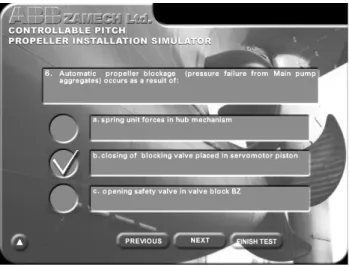
The function of the assessment test, which is an inte-gral part of the program, is intended to gauge the knowledge gained by trainees after completing the first two parts of the program. In this module, trainees should indicate the correct answers to ten randomly selected questions. An example question is presented in Figure 4.
The program enables trainees to access the test several times without having to answer the same ques-tions. At the end of the test, trainees are given a test mark, indicating the rate of correct answers (each correct answer gives trainees a chance to score ten points).
Simulator
An interactive software simulator forms the next section of the program. An ECR control panel and an installation diagram of the Controllable Pitch Propeller installation simulator are presented in Figures 5 and 6.
By clicking on the mouse, the trainee has to set the valves in the installation diagram in proper positions, and to start the pump by the operation of the switches and push-buttons included in the panel.
Obviously, the trainee has to follow the instructions given in the Operating Instructions. These enable the trainee to apply in practice the theoretical knowl-edge acquired in accordance with the Operating In-structions. The trainee is then confronted with real life reactions of the installation. The Controllable Pitch
Propeller installation program not only allows the operation in the normal exploitation conditions but also the operation in an emergency mode. Moreover, this simulator makes it possible for the trainee to exercise manual emergency operations of the Controllable Pitch Propeller.
CONDUCT OF THE SIMULATION
The increased use of marine simulators for education and training implies that instructors must ensure that training using such simulators is effective. In the application of this didactic tool, several factors have been identified as extremely important and essential [6]. These are:
• Practical skills are being taught and developed.
• Operational scenarios are created.
• The trainee’s assessment is conducted.
For example, the application of large full-mission engine room simulators, in its hardware version, Figure 4: An example text question.
Figure 5: An ECR control panel.
requires the realisation of trainees’ practical exercises in relatively small groups, which normally constitute four to eight trainees in the group. It is a well-known fact that, in reality, large engine room simulators do not actually allow for an individual approach to train-ing and assessment. For this reason, small desktop-type simulators are more often being applied. The basic advantage here is that their cost is low and that they grossly facilitate individual training.
Simulator Description
The effective use of the engine room simulator is ana-lysed here based on the example of a medium speed diesel engine room with a Controllable Pitch Propeller installation. Each of the simulator’s options described below play an important role in ensuring the effec-tiveness of the training process.
The engine room simulator presented here can be applied in the hardware (desktop-type), as well as in its software version. The control panel of this simula-tor is in its software version only. A view of the simu-lator’s console is shown in Figure 7.
The station software used by the instructor has a number of functions and allows for the creation of the following:
• The creation of the faults operational scenario by the system set-up (changing the liquid levels in the tanks and pressure setting).
• Freezing the operation of the simulator’s operation.
• Realising the manoeuvring commands.
The instructor’s station is connected by phone with the trainee station.
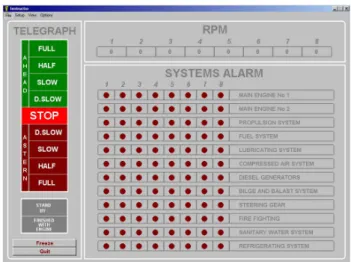
The software of the instructor’s station (in its multi-station version only), which is presented in Figure 8,
also enables the observation of the following indica-tions being displayed on the trainee’s station:
• The system’s alarm;
• The shaft revolution;
• The alarm log.
Engine Room Resources
The engine room resources option is available from the Main Menu/Options and Resources (see Figure 9).
This part of the simulator’s software is designated for the creation of the operational scenario.
The resources option allows for the adjustment of the levels of the liquid in the tanks, pressure settle-ment, aeration of pumps, as well as the simulation of the filters’ impurities contamination. An example of this resources option application is presented in Figure 10.
The Checklist
The main purpose of the checklist option of the soft-ware is to:
• Standardise the operation procedures and training.
• Ensure that potential faults, due to improper procedures, are avoided.
Figure 7: A view of the simulator’s console.
Figure 8: A view of the instructor’s station software.
The checklist can be applied especially for the proper teaching of the engine room operation in a standalone mode, without any instructor (self-training).
The checklist is based on the concept of a division of the whole engine room operation into various smaller and typical tasks. A specific checklist covers all these tasks. Each checklist is based on the follow-ing principles:
• Each checklist begins with a certain engine room set-up, typical for that checklist.
• A checklist properly completed should lead to another specific engine room set-up, which is the target of this particular procedure.
• Clear instruction, what to do, and how to do it, is provided for every single checklist step.
• The checklists are linked in such a way that the target set-up of one checklist is an entry set-up for the next checklist in almost every case. This means that the completion of all of the check-lists’ procedures results in the acquisition of the knowledge of the whole engine room operation at a basic level.
The Alarm Log
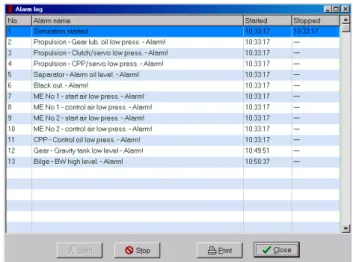
The alarm log window can be used to obtain an over-view of the user’s activities. This is of particular im-portance for the instructor in order to assess the trainee and for the purpose of discussing the trainee’s progress on the completion of the exercise. This window can be accessed by using the mouse to click on the View/ Alarm Log item from the main menu. An example of this application is shown in Figure 11.
The alarm log contains the following information:
• The full name of the alarm.
• The time of the alarm’s activation.
• The time of the alarm’s deactivation.
• Information about the loading set-up.
It should be pointed out at this point that it is also possible to print all of the alarm log records by using the push-button called Print.
Freezing the Simulator
In addition, the simulator allows the user to freeze the simulation. This option is extremely useful at the early stages of training, when the trainee needs more time to analyse the operational situation (see Figure 12).
The obvious advantage of this simulator is that it is designated for the instructor’s supervised and unsu-pervised mode of training. The unsuunsu-pervised mode is intended for the individual trainee’s activities (self-training without instructor’s participation) and permits access to all of the simulator’s options (set-up, check-list, freeze simulator and alarm log).
Figure 10: Example of settings in the resources option application.
Figure 11: The alarm log.
In the case of the selection of the supervised mode set-up, the checklist and freeze simulator options are not available. This is a special mode that is only available and applied during the trainees’ assessment (examinations).
DISCUSSION
The vast experience with the utilisation of CBT inter-active programs clearly demonstrates that these programs constitute a considerable development and improvement in the training process of maritime personnel and engine room officers in particular.
As it is presented in the paper, the CBT interactive programs introduce a new and active approach to train-ing that shortens the learntrain-ing process and that facili-tates a better perception and understanding of the operation of major maritime devices. It has been found that the use of CBT interactive programs grossly improves the quality of assessment of the trainee’s progress making it much more objective.
It should be mentioned at this point that CBT inter-active programs are very often being successfully used in the educational schemes, which include participants who may have returned to training after a few years of professional activity. They usually encounter serious problems in adapting to traditional methods of education and training.
Generally, CBT interactive programs may be suc-cessfully used in many educational activities, includ-ing the followinclud-ing:
• Lectures;
• Exercises and seminars;
• Laboratory experiments;
• Examinations;
• Continuing professional development;
• Vocational training;
• Individualised self-training;
• On-the-job training.
As mentioned before, the trainee not only acquires the knowledge and skills concerning the operation of the equipment in normal exploitation conditions, but more importantly he/she is also familiarised with emer-gency situations and procedures.
As a consequence, the trainee is better prepared to deal with practical situations during the operation while onboard the ship. The critical emergency situations may be simulated and repeated as many times as necessary in order for the trainee to master the situations and to achieve the proper level of preparedness.
In order to achieve the desired training results, the
CBT interactive programs have been constructed in such a way that they meet the following requirements:
• Exhibit the simplicity of utilisation.
• Are available as a single PC configuration.
• Developed for typical ship equipment and instal-lation, taking into account the latest technical solutions.
• Prepared in strict cooperation with equipment manufacturers so that the program could be a part of the Operator’s Guide.
• Possess an Operation’s Guide.
• Are inexpensive to design and build.
• Exhibit the realism of simulated systems or equip-ment (inclusive of process peripherals such as panels with push-buttons, switches, gauges, levers, signalling and alarm lamps, etc).
• Exhibit a high descriptiveness.
• Demonstrate the interactive learning due to human-computer dialogue.
The requirements listed above have been accom-plished satisfactorily as a result of many years of research, teaching experience and close observation of the trainee’s needs and capabilities.
CONCLUSIONS
The experience gained with the utilisation of interac-tive CBT programs at the GMU shows clearly that these programs constitute a considerable advancement in engineering education. As indicated above, the ap-plication of CBT programs in teaching has introduced all the benefits coming from an active approach to training.
It has been found that this approach shortens the learning time and facilitates the acquisition of new knowledge and understanding of the operational prin-ciples of different kinds of devices, in this case related to maritime engineering. Objective assessment of trainees’ progress is also one of the important features when using interactive CBT programs.
It is worthwhile mentioning that interactive CBT programs are often successfully used in the educa-tional schemes for professional engineers needing to be retrained after a period of professional practice. This gives them the opportunity to take part in con-tinuous professional development by updating their knowledge and skills. During that process, it is often possible to rectify certain professional deficiencies. The use of CBTs in continuing education and training is less threatening for mature trainees whilst taking part in the teaching/learning process, and is much more acceptable due to the individual nature of the
interac-tion between the student and the machine. The use of CBTs certainly eliminates several deficiencies and problems encountered in the traditional education and training process. Some specific observations are:
• The use of CBT interactive programs introduces a new and active approach to education and train-ing that shortens the learntrain-ing process.
• The application of CBT interactive programs facilitates the perception and understanding of the basic operations of maritime devices and equipment.
• The use of such programs allows for a more indi-vidual and objective assessment of the trainee’s progress, thereby largely improving the quality of the education and training process.
• The vast experience with the utilisation of CBT interactive programs clearly demonstrates that these programs constitute a considerable devel-opment and advancement of the maritime educa-tion and training process.
The specific experience gained during the use of the engine room simulators, indicates that this innova-tive and effecinnova-tive educational method has a consider-able impact on the quality of the engineering educa-tional process.
The application of the simulation leads to a better understanding of the principles of operation of both the equipment and the systems when compared with traditional education methods. Moreover, it reduces the cost of training and largely increases the effec-tiveness of engineering educational process. It has been found that the trainee acquires not only the knowl-edge concerning the operation of the equipment in normal exploitation conditions, but also becomes familiarised with emergency situations. As a conse-quence, the trainee is better prepared to deal with emergencies during real-life operations when onboard a ship.
However, the effective use of the engine room simulators is dependent upon the simulation’s techni-cal capacities (operational scenario creation, self training features, effective assessment, etc), as well as being dependent on the instructor’s preparation and his/her engagement in conducting the training process.
REFERENCES
1. Cwilewicz, R. and Tomczak, L., Safety and envi-ronmental aspects of Computers Based Training (CBT) interactive programs application for students and engine room officers. Proc. Conf.
on Maritime Educ. and Training, Rijeka, Croatia, 1 (1999).
2. Cwilewicz, R. and Tomczak, L., New develop-ments in Computers Based Training (CBT) – In-teractive program for students and engine room officers. Proc. 4th Inter. Conf. on Engine Room
Simulators, Vallejo, USA (1999).
3. Cwilewicz, R., Tomczak, L. and Pudlowski, Z.J., The application of interactive Computer Based Training (CBT) programs in engineering educa-tion. Proc. 3rd Baltic Region Seminar on Engng.
Educ., G
ö
teborg, Sweden, 113-116 (1999). 4. Cwilewicz, R., Tomczak, L. and Pudlowski, Z.J.,Computer Based Training (CBT): the application of interactive programs in marine education and training. Proc. 4th Baltic Region Seminar on
Engng. Educ., Lyngby, Denmark, 62-65 (2000). 5. Cwilewicz, R., Tomczak, L. and Pudlowski, Z.J., The application of simulators in marine engineer-ing education. Proc. 2nd Global Congress on
Engng. Educ., Wismar, Germany, 138-140 (2000).
6. Cwilewicz, R., Tomczak, L. and Pudlowski, Z.J., The effective application of engine room simula-tors in marine engineering education. Proc. 3rd
Global Congress on Engng. Educ., Glasgow, Scotland, UK, 316-318 (2002).
BIOGRAPHIES
Prof. Romuald Cwilewicz was born in 1939 in Gdynia, Poland. He graduated from the Technical University of Gdansk in 1962 with an MSc in mechanical engineering. In 1974, he gained a PhD, based on a dissertation con-cerning marine gas turbines, and a DSc in 1993 in the same specialisation.
He has been a professor of the Gdynia Maritime University (GMU) since 1993, and has held several managerial positions, including the position of Vice-Rector for Educational Affairs (1990-1996) and Dean of the Faculty of Maritime Mechanical Engineering (1999-2002). He is presently Head of the Department of Marine Power Plants and Vice-Rector for Educa-tional Affairs.
His professional interests are in the optimisation of power engineering processes and diagnostics of ships’ technical systems. He has published extensively, and is the author or co-author of many journal articles, conference papers and patents concerning his field of
specialisation, as well as engineering education. Also, he was a Visiting Professor of the Hochschule Bremerhaven and Shanghai Maritime University.
Prof. R. Cwilewicz is an active member of the UICEE, and is Director of the Centre for Maritime Engineering Education (CMEE), a satellite centre of the UICEE, based at the GMU. He was awarded the UICEE Silver Badge of Honour in 1997 at the 1st
Asia-Pacific Forum on Engineering & Technology Edu-cation.
Dr Leonard Tomczak was born in 1950 in Nowy Targ, Poland. He graduated from Gdynia Maritime University (GMU), Poland, with a BSc in 1974 and with an MSc in 1987, both in marine me-chanical engineering. He gained his PhD in 2001 from the Technical University of Gdansk, Poland, on comple-tion of a dissertacomple-tion concerning marine electronic die-sel indicators.
In 1977-1985, he was a United Nations Develop-ment Programmes expert in diesel engines in Angola. He has worked at Gdynia Maritime University since 1976, initially as a research assistant and later as a senior lecturer. He is presently an assistant professor at GMU and Managing Director of UNITEST, a Gdansk-based company. Since 2002, he has been a consultant within the International Maritime Organi-sation (IMO).
His professional interests are in the application of measuring equipment for marine diesel engines injec-tion and combusinjec-tion process analysis, as well as in the practical application of engine room simulators and interactive Computer-Based Training (CBT) programs for marine engineering education. He is the author or co-author of many refereed journal and conference articles.
Zenon Jan Pudlowski gradu-ated Master of Electrical Engineering from the Acad-emy of Mining and Metal-lurgy (Cracow, Poland), and Doctor of Philosophy from Jagiellonian University (Cra-cow), in 1968 and 1979 respectively.
From 1969 to 1976, he was a lecturer in the Insti-tute of Technology within the University of Pedagogy
(Cracow). Between 1976 and 1979, he was a researcher at the Institute of Vocational Education (Warsaw) and from 1979 to 1981 was an Adjunct Professor at the Institute of Pedogogy within Jagiellonian University. From 1981 to 1993 he was with the Department of Electrical Engineering at The University of Sydney where, in recent years, he was a Senior Lecturer.
He is presently Professor and Director of the UNESCO International Centre for Engineering Education (UICEE) in the Faculty of Engineering at Monash University, Clayton, Melbourne, Australia. He was Associate Dean (Engineering Education) of the Faculty of Engineering between 1994 and 1998.
In 1992, he was instrumental in establishing an International Faculty of Engineering at the Technical University of Lodz, Poland, of which he was the Foun-dation Dean and Professor (in absentia)(1992-99). He was also appointed Honorary Dean of the English Engineering Faculty at the Donetsk State Technical University (DonSTU) in the Ukraine in 1995.
His research interests include circuit analysis, elec-trical machines and apparatus, implementation of com-puter technology in electrical engineering, software engineering, methodology of engineering education and industrial training, educational psychology and meas-urement, as well as human aspects of communication in engineering. His achievements to date have been published in books and manuals and in over 300 scientific papers, in refereed journals and conference proceedings.
Prof. Pudlowski is a Fellow of the Institution of Engineers, Australia. He is a member of the editorial advisory boards of many international journals, including the International Journal of Engineering Education, the International Journal of Electrical Engineering Education and the European Journal of Engineer-ing Education. He is the founder of the Australasian Association for Engineering Education (AAEE) and the Australasian Journal of Engineering Education (AJEE), and was the 1st Vice-President and Execu-tive Director of the AAEE and the Editor-in-Chief of the AJEE since its inception in 1989 until 1997. Currently, he is the Editor-in-Chief of the Global Journal of Engineering Education. He is the Foun-dation Secretary of the International Liaison Group for Engineering Education (ILG-EE).
Prof. Pudlowski was a member of the UNESCO International Committee on Engineering Education (ICEE) (1992-2000). He has chaired and organised several international conferences and meetings. He was the Academic Convener of the 2nd World
Con-ference on Engineering Education, the General Chairman of the East-West Congresses on Engineering
Education. He was General Chairman of the UNESCO 1995 International Congress of Engineering Deans and Industry Leaders, and General Chairman of the Global Congress on Engineering Education.
He received the inaugural AAEE Medal for Distinguished Contributions to Engineering Education (Australasia) in 1991 and was awarded the Order of the Egyptian Syndicate of Engineers for Contributions to the Development of Engineering Education on both National and International Levels in 1994.
In June 1996, Professor Pudlowski received an
honorary doctorate from the Donetsk State Technical University in the Ukraine in recognition of his contri-butions to international engineering education, and in July 1998, he was awarded an honorary Doctorate of Technology from Glasgow Caledonian University, Glasgow, Scotland, United Kingdom. He was elected a member of the Ukrainian Academy of Engineering Sciences in 1997. In 2002, he was awarded the title of an Honorary Professor of the Tomsk Polytechnic Uni-versity, Tomsk, Russia, and was appointed an External Professor at Aalborg University, Aalborg, Denmark.