VTT RESEARCH NOTES 2407 Business Process Modeling and Execution. Tools and technologies report for SOAMeS project
ESPOO 2007
VTT RESEARCH NOTES 2407
VTT Tiedotteita – Research Notes
2385 Löfman, Jari, Keto, Vesa & Mészáros, Ferenc. FEFTRATM. Verification. 2007. 103 p. + app. 4 p.
2386 Loikkanen, Torsti, Hyytinen, Kirsi & Koivusalo, Salla. Yhteiskuntavastuu ja kilpailu-kyky suomalaisyrityksissä. Nykytila ja kehitysnäkymät. 2007. 118 s.
2387 Henttonen, Katja. Stylebase for Eclipse. An open source tool to support the modeling of quality-driven software architecture. 2007. 61 p. + app. 15 p.
2388 Lanne, Marinka & Kupi, Eija. Miten hahmottaa security-alaa? Teoreettinen malli Suomen security-liiketoiminta-alueista. 2007. 52 s. + liitt. 1 s.
2389 Leikas, Jaana & Lehtonen, Lauri. Ikääntyvien idealiike. Käyttäjälähtöisellä innovoinnilla elämänmakuisia mobiilipalveluja. 2007. 34 s.
2390 Tuominen, Anu, Ahlqvist, Toni, Rämä, Pirkko, Rosenberg, Marja & Räsänen, Jukka. Liikennejärjestelmän teknologiapalvelujen vaikutusarvioinnit tulevaisuudessa. 2007. 64 s. + liitt. 5 s.
2391 Mikkola, Markku & Pirttimäki, Antti. Tuotekehitys Kiinassa. Uhka, mahdollisuus vai yhdentekevää? 2007. 31 s.
2392 Kettunen, Jari, Rakshit, Krishanu & Uoti, Mikko. Electronic India. Market trends and industry practices in IT services, telecoms and online media. 2007. 98 p. + app. 2 p.
2394 Herrala, Maila. The value of transport information. 2007. 87 p. + app. 5 p.
2395 Aarnisalo, Kaarina, Heiskanen, Seppo, Jaakkola, Kaarle, Landor, Eva & Raaska, Laura. Traceability of foods and foodborne hazards. 2007. 46 p. + app. 2 p.
2396 Nylund, Nils-Olof, Erkkilä, Kimmo, Clark, Nigel & Rideout, Greg. Evaluation of duty cycles for heavy-duty urban vehicles. Final report of IEA AMF Annex XXIX. 2007. 81 p. + app. 10 p.
2397 Helynen, Satu, Flyktman, Martti, Asikainen, Antti & Laitila, Juha. Metsätalouteen ja metsäteollisuuteen perustuvan energialiiketoiminnan mahdollisuudet. 2007. 66 s. 2398 Jansson, Kim, Mikkola, Markku & Ryynänen, Tapani. Verkostoyhteistyöllä
Kiinaan? SeaChi-projektin loppuraportti. 2007. 46 s. + liitt. 6 s.
2399 Hänninen Hannu, Brederholm, Anssi, Saukkonen, Tapio, Gripenberg, Hans, Toivonen, Aki, Ehrnstén, Ulla & Aaltonen, Pertti. Hot cracking and environment-assisted cracking susceptibility of dissimilar metal welds. 2007. 182 p.
2400 Ailisto, Heikki, Matinmikko, Tapio, Häikiö, Juha, Ylisaukko-oja, Arto, Strömmer, Esko, Hillukkala, Mika, Wallin, Arto, Siira, Erkki, Pöyry, Aki, Törmänen, Vili, Huomo, Tua, Tuikka, Tuomo, Leskinen, Sonja & Salonen, Jarno. Physical browsing with NFC technology. 2007. 70 p.
2401 Häkkinen, Tarja, Vares, Sirje, Huovila, Pekka, Vesikari, Erkki, Porkka, Janne, Nilsson, Lars-Olof, Togerö, Åse, Jonsson, Carl, Suber, Katarina, Andersson, Ronny, Larsson, Robert & Nuorkivi, Isto. ICT for whole life optimisation of residential buildings. 2007. 207 p.
2403 Toivonen, Santtu. Web on the Move. Landscapes of Mobile Social Media. 2007. 56 p. + app. 3 p.
2404 Vares, Sirje & Lehtinen, Jarkko. Lasipakkausten keräysjärjestelmän tehostaminen ja lasin hyötykäytön ympäristövaikutukset. 2007. 122 s.
2407 Koskela, Mika & Haajanen, Jyrki. Business Process Modeling and Execution. Tools and technologies report for SOAMeS project. 2007. 63 p. + app. 2 p.
Mika Koskela
&
Jyrki Haajanen
Business Process Modeling and
Execution
Tools and technologies report
for SOAMeS project
VTT VTT VTT PL 1000 PB 1000 P.O. Box 1000 02044 VTT 02044 VTT FI-02044 VTT, Finland Puh. 020 722 4404 Tel. 020 722 4404 Phone internat. + 358 20 722 4404
VTT TIEDOTTEITA – RESEARCH NOTES 2407
Business Process Modeling
and Execution
Tools and technologies report
for SOAMeS project
ISBN 978-951-38-6958-8 (URL: http://www.vtt.fi/publications/index.jsp) ISSN 1455-0865 (URL: http://www.vtt.fi/publications/index.jsp)
Copyright © VTT 2007
JULKAISIJA – UTGIVARE – PUBLISHER VTT, Vuorimiehentie 3, PL 1000, 02044 VTT puh. vaihde 020 722 111, faksi 020 722 4374 VTT, Bergsmansvägen 3, PB 1000, 02044 VTT tel. växel 020 722 111, fax 020 722 4374
VTT Technical Research Centre of Finland, Vuorimiehentie 3, P.O. Box 1000, FI-02044 VTT, Finland phone internat. +358 20 722 111, fax +358 20 722 4374
VTT, Vuorimiehentie 3, PL 1000, 02044 VTT puh. vaihde 020 722 111, faksi 020 722 7024 VTT, Bergsmansvägen 3, PB 1000, 02044 VTT tel. växel 020 722 111, fax 020 722 7024
VTT Technical Research Centre of Finland, Vuorimiehentie 3, P.O. Box 1000, FI-02044 VTT, Finland phone internat. +358 20 722 111, fax +358 20 722 7024
Koskela, Mika & Haajanen, Jyrki. Business Process Modeling and Execution. Tools and technologies report for SOAMeS project. Espoo 2007. VTT Tiedotteita – Research Notes 2407. 63 p. + app. 2 p. Keywords business process modeling, business process execution, business process management,
service-oriented architecture
Abstract
This report presents the results of a survey on business process modeling and execution technologies. The first phase of the research consisted of a broad survey on the available language options. For business process execution, Business Process Execution Language (BPEL for short, officially WS-BPEL or BPEL4WS depending on the version) was considered as the only relevant option. Other executable languages were either obsolete or academic proposals not suitable for industry use. For business process modeling, Business Process Modeling Notation (BPMN) and UML Activity Diagram (AD) were considered suitable. Other available options did not provide enough support for transformations to executable languages.
The expressive power of the languages was evaluated by comparing how well the languages support different workflow patterns. It was found out that there is a significant gap between the expressive power of modeling and execution languages, which means that all models cannot be directly transformed to executable code. Between BPMN and UML AD, the differences in pattern support were minimal. However, it was noted that the specifications are partly ambiguous, which can lead to misinterpretations in the transformations.
The practical utility of the findings was demonstrated by testing two available tools that supported BPMN and BPEL and that were considered prominent based on their documented functionalities. The test results showed that the transformation functionalities were to a large extent dependent on the expressive power of the languages. It was concluded that the technologies have not yet fully matured, but first steps in their adoption can already be taken, because by taking the known shortcomings of the technologies into account in the modeling, automatic transformations from models to code, and even vice versa, can be realized.
Preface
This report describes the research conducted in SOAMeS (Service Oriented Architecture in Multichannel e-Services) in VTT Technical Research Centre of Finland in collaboration with University of Helsinki. The project started in mid 2006 and it will be finished during the year 2008. One objective of the project was to evaluate the feasibility of existing technology that is used in service oriented environment. These include, for example, business process modeling and execution languages. This report focuses on tools and technologies on this domain.
The target audience of this document includes enterprises that are adopting business process modeling and execution technologies and tools. Additionally, our research is relevant to developers who work with the focal technologies or build custom tools based on the discussed standards. This report should be valuable to people on many levels of the organization. The introduction, conclusion and summary sections are accessible to managers who need information to support their decision making on IT strategy. The conducted tests and evaluations as well as the more detailed descriptions of the technologies should be examined by the IT specialists of the enterprise. By reading the more detailed sections of this report, the specialists can evaluate what kind of value the discussed technologies can provide and what kind of requirements does their adoption pose.
Contents
Abstract...3 Preface ...4 List of symbols ...7 1. Introduction...8 1.1 Background ...81.2 Motivation and objectives ...9
2. Business process modeling and execution...11
2.1 Modeling languages...11
2.1.1 Available options ...11
2.1.2 Business Process Modeling Notation (BPMN)...12
2.1.2.1 BPMN basics...12
2.1.2.2 Semantics of the elements...13
2.2 Execution languages...17
2.2.1 Available options ...18
2.2.2 Business Process Execution Language (BPEL)...18
2.2.2.1 Principles of BPEL...19
2.2.2.2 Basic BPEL elements...20
2.2.2.3 Abstract BPEL ...21
2.2.2.4 BPEL extensions ...21
2.2.2.5 Conclusion on BPEL...22
3. Workflow patterns and business process languages ...23
3.1 Control flow patterns...24
3.2 Data patterns...26
4. Existing research on BPMN-BPEL transformations ...28
4.1 Links and event handlers ...28
4.2 Links and diagram restructuring...29
5. Tool-based experiments on transformations...30
5.1 Principles for tool selection...31
5.2 Selected tools...31
5.2.1 Intalio BPMS Community Edition...32
5.2.2 eClarus Business Process Modeler for SOA Architects ...36
5.2.3 Progress of the testing ...38
6. Test case results ...44
6.1 Transformations...44
6.2 Code quality ...46
7. Conclusions...50
7.1 Business process modeling and execution languages ...50
7.2 BPMN and BPEL tools – provided value and limitations...51
7.3 Guidelines for tool selection...54
7.4 An outlook to the future ...56
8. Summary ...59
Acknowledgements ...60
References ...61
List of symbols
AD Activity Diagram
BPD Business Process Diagram
BPDM Business Process Definition Metamodel BPEL Business Process Execution Language
BPEL4WS Business Process Execution Language for Web Services BPM Business Process Management
BPMI Business Process Management Initiative BPML Business Process Modeling Language BPMN Business Process Modeling Notation BPMS Business Process Management Suite BPSS Business Process Specification Schema EPC Event Driven Process Chain
ICT Information and Communication Technologies EPML Event-Driven Process Chain Markup Language IDEF3 Integrated DEFinition Method 3
MDA Model Driven Architecture OMG Object Management Group OWL-S OWL-Services
PIP Partner Interface Process PNML The Petri Net Markup Language
RAD Role Activity Diagram
SOA Service-Oriented Architecture UML Unified Modeling Language
WS-BPEL Web Services Business Process Execution Language WS-CDL Web Service Choreography Description Language WSCI Web Service Choreography Interface
WSCL Web Service Choreography Language WSDL Web Service Description Language WSFL Web Services Flow Language XMI XML Metadata Interchange
XML eXtensible Markup Language XPDL XML Process Definition Language
XSD XML Schema Document
1. Introduction
Modern enterprises are faced with global rivals and a tightening competitive environment. At the same time the changes in the business environment and daily routines are constant and occur at increasing pace. To survive in these conditions companies are focusing on their core competencies and outsource other functions to their business network partners for whom these functions are core competence. Hence, modern business life is becoming increasingly networked. This networking is driven and enabled by the recent rapid development in the Information and Communication Technologies (ICT). Especially the Internet based communications and business process and information system integration possibilities that became available since the mid 1990’s have contributed to this development.
The plain focus on core competencies is not enough in competitive business conditions. Companies need to keep fit and develop their processes and infrastructure constantly. This also means that their customers and business partners will require constant changes on their common business processes and information system interoperability. At the same time, information systems and business architectures of the companies are going through changes. The keywords for these changes are: loose-coupling, reusability, isolation of technology and business requirements, interoperability and automation. Once these changes have taken place, we will have totally different looking enterprises with less or no stove-pipe departmental information systems, monolithic applications, etc. At this point, the time is ripe for the introduction of next generation enterprise computing, based on model driven business process management, execution and integration.
1.1 Background
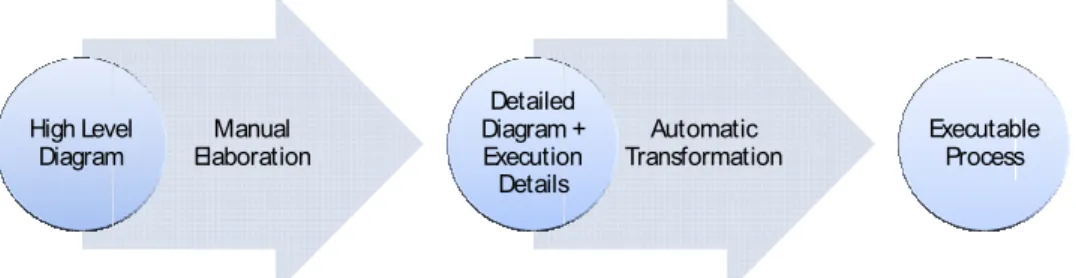
Business Process Management (BPM) is an interdisciplinary domain which deals with the continuous development of business processes with the help of IT. BPM has gained lots of popularity in recent years due to the rise of the Service-Oriented Architecture (SOA) paradigm and related technologies that can be applied to execute and manage IT-enabled business processes. To align the business requirements with the executable processes, the modeling should start from high level processes, which would be refined to more detailed and exact models and finally to executable code. This development is outlined in Figure 1. To improve productivity of the IT organization and maintainability of the models, the transformations between models and code should be automated as much as possible. This kind of approach can be related to the Model Driven Architecture (MDA) framework, although the MDA-related technologies are not necessarily used. In this report, it is evaluated how well the state-of-the-art BPM technologies fulfill the promise that executable code could be automatically generated from business process models.
Manual Elaboration High Level
Diagram TransformationAutomatic
Detailed Diagram + Execution Details Executable Process
Figure 1. Development from business process diagram to executable process.
1.2 Motivation and objectives
As a part of the SOAMeS project, the state-of-the-art in business process modeling and execution is examined. Recognizing and managing business processes in companies is not a new phenomenon, but business process automation and integration have gained momentum in recent years, much because the enabling SOA-related standards and technologies. Mastering BPM is not a straightforward task, however: according to Gartner, only a small proportion of companies adopting BPM will succeed in stages beyond intra-process automation and control in the near future (Melenovsky & Sinur 2006). Enabling and supporting IT solutions are one of the success factors in this maturity model, but for many companies this field can be confusing due to the wide variety of available options and contradicting promises and claims made by different instances. It is, therefore, important to find out what can be expected from these technologies today, and to give directions for future BPM-related IT investments.
The purpose of this research is to examine which technologies are currently most prominent for business process modeling and execution in industry use. In the survey, a special emphasis is put on the relationship between modeling and execution languages. In other words, it is examined how well business process models can be transformed to executable processes and, to some extent, vice versa. This kind of research is considered relevant, because the requirements and possible limitations are not clearly stated by tool vendors or the standardization organizations. A complementary goal is to outline the relationship between BPM as a management domain and the topical technologies. For example, this means assessing the role of the state-of-the-art modeling standards in companies modeling and managing business processes: in order to really provide value to the organization, the notations that align with the executable processes should be accessible by both IT and business users.
The specific phases and objectives of the research include:
− to clarify the current state of the languages in the Business Process Management domain
− to evaluate the most prominent standards in business process modeling and execution languages based on their expressive power, suitability and tool support; a special emphasis is put on how well they could enable transformations between modeling and execution languages
− to identify potential problems in transformations based on gaps in expressive power; this is done by discussing the existing research on the workflow pattern
support of the languages
− to demonstrate the transformations and their possible shortcomings using prominent tools
− to provide guidelines for companies adopting BPM tools now and in the near future.
It should be pointed out that the purpose of the expressive power analysis is not provide a complete evaluation of each language independently, but to point out the possible differences between the languages and to act as a background for the tool testing. An overview is still given, and a more detailed investigation can be carried out with little effort by business IT experts, using the introduced earlier research. Also, it should be noted that the purpose of the tool test is not to provide purchasing recommendations. The introduced tools are advanced and good candidates for experimenting with the technologies, but a valid tool comparison would have required more candidates and different criteria for tool selection and evaluation than was used in this research. The field is also constantly evolving, which means that in-depth tool benchmarking can only be considered valid for a relatively short period of time. However, based on our experiences, guidelines for tool selection are formulated. Additionally, the recognized shortcomings can be used as criteria for more specific and demarcated tool evaluation in companies.
2. Business process modeling and execution
2.1 Modeling languages
Visual business process modeling, i.e., drawing a business process diagram, is ideally the first step of the business process lifecycle. Numerous notations are available for this purpose and on the highest abstraction level, one can even visualize the core diagram elements using arbitrary shapes and lines. Also XML-based languages can sometimes be categorized as modeling languages. However, in this research we investigated visual business process modeling languages that are detailed enough to express executable processes so that code could be generated based on the diagrams. We use the term
modeling language instead of modeling notation in order to stress that the discussed standards aim at specifying the detailed behavior that the modeling elements indicate, not only the visual notation.
2.1.1 Available options
To narrow down the options for modeling languages, we investigated languages that were discussed in (List & Korherr 2006). For a table comparing these languages, see Table 5 in Appendix A. From their list, we omitted proprietary languages, academic proposals, languages with no specified visual notation and languages that were not intended for modeling executable processes. This left us with two prominent options: Business Process Modeling Notation (BPMN) (Object Management Group 2006) and UML Activity Diagram (AD) (Object Management Group 2005). These languages were compared based on their expressive power, status and support. Expressive power refers to the language’s ability to present different kinds of process constructs, patterns and situations that appear in business processes. It was evaluated based on existing workflow patterns research (Section 3). The later section provides more detailed discussion on the topic. At this point, we conclude that the differences in the expressive powers of BPMN and UML AD are not significant. In some situations, BPMN provides better expressive power than UML AD, however. It should also be noted that for both modeling languages, the specification is in some cases too vague and it is thus unclear whether certain patterns can be expressed. The deciding factor for this study was thus tool support: very few tools for generating executable business process code from UML Activity Diagrams were available. The original organization responsible of BPMN also stated that UML has a different viewpoint on business processes, i.e., it focuses more on software design (OMG.org 2004). Although this statement must be taken with caution because it was given by the developers of another standard, we do think that BPMN is more easily accessible for both business and IT users. This can be considered an important factor in business process modeling.
2.1.2 Business Process Modeling Notation (BPMN)
BPMN is one of the youngest business process modeling languages available but it has already gained a notable amount of popularity nevertheless. At the time of writing, there are 43 BPMN implementations, i.e., tools which the standardization organization, the Object Management Group (OMG), considers to support BPMN, and many of them support BPEL generation (OMG.org 2007). The first BPMN specification was released in May 2004 by BPMI.org. The current version is 1.0 Final Draft, driven by Object Management Group which merged with BPMI.org (Object Management Group 2006). From one perspective, the aim of BPMN is to provide a notation that both IT and business users understand. This means that the basic elements of the language should be easy to access. From a second perspective, BPMN is designed to act as a visual notation for executable languages. BPMN is able to present private processes, public processes
and collaboration processes. The idea is simply that one can freely choose the level of granularity to use when modeling processes with BPMN. Most BPMN elements can be mapped to execution but some are used purely for informative purposes. One of the shortcomings of BPMN is that it lacks formal semantics, and the specifications for certain elements can also be considered inadequate for execution purposes. Additionally, the specification does not include an XML interchange format for BPMN diagrams. For this purpose, OMG has subsequently introduced the Business Process Definition Metamodel (BPDM) specification but it is not yet supported by the available tools.
2.1.2.1 BPMN basics
In this report, we introduce the basics of BPMN so that readers, who are not familiar with it, capture the general idea of BPMN modeling and the research we have conducted. The detailed discussions in the following sections often require more in-depth understanding of BPMN and the underlying execution language. We do not cover all the necessary details here. Instead, we target those sections to people with basic knowledge of the technologies. However, it can be said that learning BPMN does not require tremendous efforts, especially if one is familiar with some business process modeling language. In addition to the specification (Object Management Group 2006), we recommend the introductory article (White 2004a) and the BPMN tutorial (White 2006). The author of the both articles has also contributed in the official specification and these documents are available on the official BPMN web site1.
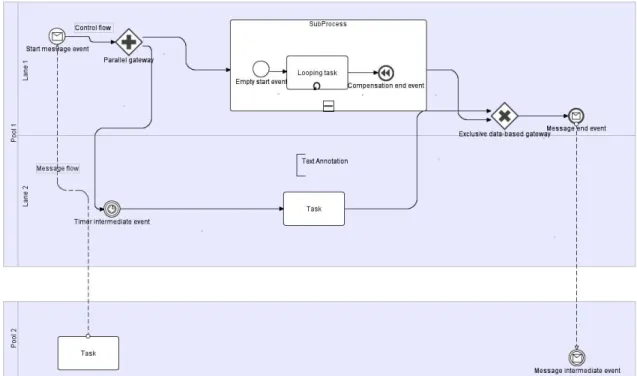
In BPMN, a Business Process Diagram (BPD) is a visual presentation of a business process. The term model is also often used to refer to the outcomes of BPMN modeling. The specification does not make a clear distinction between these concepts. However, the term model usually implies that also the necessary execution details (e.g., variable information) have been specified, whereas the concept of Business Process Diagram refers only to the graphical constructs. A BPD consists of elements whose visual appearance and semantics is defined in the BPMN specification. The elements consist of Activities, and the actors carrying out those activities. The actors are represented by
Pools which can be further divided into sub-actors by Lanes. These are used on purely informative purposes and they do not affect the execution of the process. Additionally, the progress of the process is determined by Events. Inside a pool, which often represents an independent IT system, the sequence of activities is represented by
Sequence Flow. Interaction with other pools is indicated by Message Flows. The progress of the Sequence Flow is often described using the concept of a token which passes through the flow objects. When discussing the control flow of the process, the term upstream is used to refer to the elements or tokens that appear or are generated before the discussed point in the process. Similarly, the term downstream refers to the parts that follow the discussed point. The control flow can diverge based on specified conditions. The conditions are directly attached to the flow or different kinds of
Gateways are used to indicate decision points. These basic elements are depicted in Figure 2.
2.1.2.2 Semantics of the elements
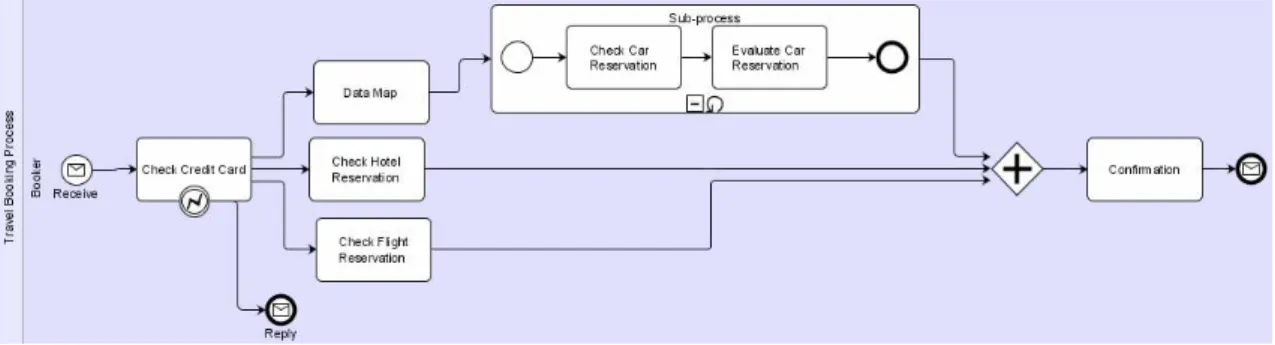
BPMN defines several special versions of these elements. For example, Activity can be a sub-process or a looping activity. In turn, an Event can be a start event, intermediate event or an end event and it can represent an incoming or an outgoing message or an error. Besides activities and their connectors, BPMN defines Artifacts such as Data objects which can be annotated to indicate the inputs and outputs of the activities. (Object Management Group 2006)
The End Event indicates when the process will end. BPMN includes different kinds of
End Events, which define different results for the process. A very typical end event is a
Message End Event, which implies that a message is sent as the outcome of the process. Other types include, e.g., Error (an error is thrown), Compensation (the process is rolled back), Terminate (all activities in the process immediately end) and Empty (the result is not specified). Terminate End Events are special because when they are triggered, all activities are ended. In the case of other type of End Events, all tokens for the process have to be consumed by an End Event before the process instance is considered completed.
In BPMN, Gateways are used to control the sequence flow and in, more complex situations, the use of them is compulsory. There are two basic types of gateways: Data-based which evaluate the chosen path based on, e.g., values of variables and Event-based which depend on, e.g., an arriving message. They can be splitting, forking merging or joining, i.e., they can split one sequence flow to several (alternative or parallel) paths or combine them together. Forking or merging without a gateway is referred as uncontrolled. The gateways can be inclusive (OR), exclusive (XOR),
complex or parallel (AND). In exclusive gateways, the sequence flow can take only one of the outgoing paths. In merging, they are often not required. Parallel processing creates multiple tokens which are combined back together at the merging phase. In inclusive gateways, all of the combinations of the independent paths can be taken. Parallel gateways define multiple paths that are executed concurrently. In forking, they can often be left out. In merging, they indicate that all of the inputs have to be available before the execution is continued. Complex gateways can be used to combine the behavior of several linked gateways. The forking or merging behavior of the complex gateway can be determined by an expression which can, e.g., evaluate process data to determine which flows to select. (Object Management Group 2006)
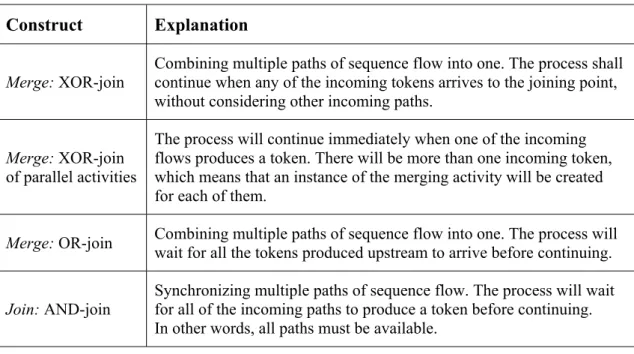
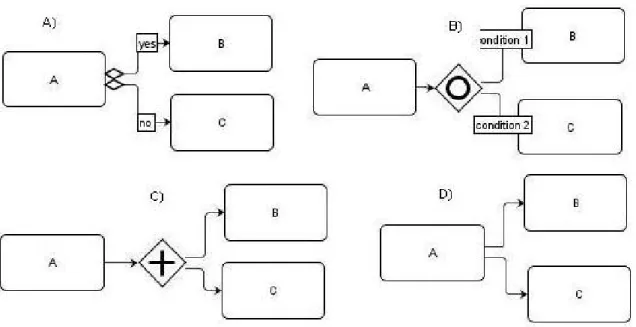
The behavior indicated by different kinds of forks and joins should be understood in order to understand the test case examples in Section 5. In Tables 1 and 2, the semantics of different splits and joins in BPMN are described informally. Example diagram constructs are presented in Figures 3 and 4. It should be pointed out that the join number one is only a special case of join number two, but it is presented separately in order to clarify the behavior indicated by unsynchronized merge in BPMN.
It should be noted that in many cases the exactly same behavior can be realized both by gateways and uncontrolled flow. An example of this is given in the context of AND-split Figure 3. In OR- XOR-AND-splitting, Conditional Sequence Flow (arrows with attached diamonds) must be used if gateways are omitted. The attached conditions tell whether or not the choice is exclusive (see for example the XOR-split in Figure 3 – it is implicit that either yes or no can be taken, but not both). It is often more clearer to use gateways, because, for example, the gateways explicitly indicate that the alternative paths are exclusive. If uncontrolled flow is used, this restriction must come up in the conditions attached to the control flow. One should also note that the exclusive (XOR) gateway can be modeled with or without the drawing in it – the indicated process behavior is exactly the same.
Table 1. Process behavior indicated by BPMN splits according to (Object Management Group 2006).
Construct Explanation
Split: XOR-split
(exclusive OR) The control flow splits into more than one branch. Only one of them can be chosen during runtime.
Split: OR-split (inclusive OR)
A branching point where all paths are independent: all combinations of the paths can be taken.
Fork: AND-split (parallel split)
A branching point where a single path of sequence flow is divided into two or more parallel paths. A token is immediately sent to each of the outgoing Sequence Flow.
Table 2. Process behavior indicated by BPMN splits according to (Object Management Group 2006).
Construct Explanation Merge: XOR-join
Combining multiple paths of sequence flow into one. The process shall continue when any of the incoming tokens arrives to the joining point, without considering other incoming paths.
Merge: XOR-join of parallel activities
The process will continue immediately when one of the incoming flows produces a token. There will be more than one incoming token, which means that an instance of the merging activity will be created for each of them.
Merge: OR-join Combining multiple paths of sequence flow into one. The process will wait for all the tokens produced upstream to arrive before continuing.
Join: AND-join
Synchronizing multiple paths of sequence flow. The process will wait for all of the incoming paths to produce a token before continuing. In other words, all paths must be available.
Based on these tables, it can be said that the splitting behavior of BPMN is very clear and easy to understand. The joining behavior, however, is not so straightforward and it is likely to create misunderstandings among people who are familiar with other modeling notations. For example, it is not very obvious that sequence flows that merge without gateways proceed independently of each other, thus creating multiple instances of their common activity if the flows are parallel. In UML AD, for instance, a merge node is used in these kinds of situations. Additionally, based on the specification document, it is not exactly clear how the number of possibly incoming tokens is
determined. The OR-join has been stated to be inadequately specified, e.g., by Ouyang et al. (2006). Because of this, it was also not used in the test case processes. However, based on these kinds of issues, it must be noted that the standard has not fully matured yet. Also, because formal semantics is not included in the specification, it is possible that tool vendors misinterpret the rules. This results in potentially incorrect enactment behavior, although executable code could be created based on the model.
It should also be pointed out that if the use of splits and joins is not carefully analyzed, erroneous models can be created. Based on these models, accurate executable code may even be generated, but the problems occur when the processes are being executed. Three typical classes of problems can be identified: deadlocks, livelocks and multiple instances. In a deadlock, the execution ceases because the process waits for tokens which will never be generated. This can happen, e.g., if OR- and AND-splits are wrongly paired. In a livelock the process constantly changes its state, but does not progress, e.g., loops infinitely. Multiple instances of the same activity can lead to unnecessary resource consumption, or even incorrect business results.
Figure 3. BPMN splits: A) XOR B) OR C) & D) AND (equivalent behaviour).
Figure 4. BPMN joins: A) XOR B) XOR (parallel activities) C) OR D) AND.
2.2 Execution languages
In the context of the SOAMeS research project, business process modeling focuses on processes that will be automated and executed in Service-Oriented environment. Therefore, the study on business process modeling tools also involves investigating executable business process languages.
2.2.1 Available options
The business process management domain includes several XML-based languages, but few of them can be actually used to execute automated business processes without translating them into another format. In this research, we first briefly inspected the languages listed in a relatively comprehensive survey by Mendling et al. (2004). From this list we omitted choreography languages, pure academic proposals, visual modeling languages and clearly superseded options. We then studied Business Process Execution Language (BPEL), Business Process Modeling Language (BPML), Business Process Definition Metamodel (BPDM) and XML Process Definition Language (XPDL). The only language that was considered suitable for automated execution was BPEL. Other three languages were obsolete (BPML) or focused more on process interchange than automated execution (BPDM and XPDL). XLANG and WSFL are also both options for execution languages, but they are directly included in BPEL versions that are currently in use. To limit the scope of the stidy, academic proposals such as Yet Another Workflow Language (YAWL) were excluded from this research. Therefore, BPEL was considered the only relevant execution language for this research. The categorization of the XML-based languages is summarized in Table 7 of Appendix A.
2.2.2 Business Process Execution Language (BPEL)
Business Process Execution Language (BPEL4WS 1.1 and WS-BPEL 2.0) (Andrews et al. 2003; OASIS 2007) was introduced in previous SOAMeS research notes (Kanniainen & Haajanen 2007). In short, BPEL is an XML-based language for specifying business processes in Web Service environment. It is used together with Web Service Description Language (WSDL) and other related technologies. This means that BPEL is used to define how the business process is built from Web Service invocations and what kind of interaction with external participants does the process involve.
BPEL can be seen as an XML-programming language for Web Service compositions. Like most programming languages, BPEL is complex and the specification is extensive. In-depth understanding of BPEL requires software development competence as well as knowledge of the Web Service technologies it is built on. Therefore, we only provide a brief introduction to BPEL here, in order to provide a basis for latter sections. For those who want to master BPEL, several books have been published. For an online introduction, see, e.g., (Miguel 2006).
The current BPEL standard is the result of combining different specifications developed by different organizations. The BPEL4WS language was originally proposed by Microsoft and IBM in July 2002. BPEL4WS combined properties from Microsoft’s
WSFL and IBM’s XLANG. The revised version of BPEL4WS (Andrews et al. 2003) has been widely adopted by tool vendors. In version 2.0, the language was renamed to WS-BPEL which was approved as an OASIS standard in 2007 (OASIS 2007). In this report, the acronym BPEL is generally used to refer to both versions because the older version cannot be considered obsolete. Clear distinction between the versions is made whenever necessary. The new version involves syntactic changes and improved alignment with other XML technologies such as XPath. Therefore, BPEL processes are not directly backward compatible.
2.2.2.1 Principles of BPEL
BPEL can be used to specify both executable and abstract processes. In the first case, the full implementation logic of the process is defined, whereas in the latter case only the message exchange between process participants is included. The core elements of a BPEL document include:
− Roles of the process participants
− Port types required from the participants
− Orchestration: the actual process flow
− Correlation information: definition of how messages can be routed to correct composition instances, i.e., how to map abstract specifications to running instances. In this report, we focus on executable aspects of BPEL, for three reasons. Firstly, mappings between the modeling languages and BPEL do not currently cover abstract processes. Secondly, it has been convincingly stated that BPEL does not suit well for defining abstract processes (van der Aalst et al. 2005). This is because BPEL processes are always presented from the point of view of one partner. Consequently, business partners do not need to agree on using BPEL. Finally, the focus of this report is on executable processes, not incomplete process descriptions which are closely related to choreographies. Hence, abstract BPEL is also discussed in the choreography language report, which is also published within the SOAMeS research project. However, we describe the principles of abstract BPEL and, additionally, demonstrate the use of executable processes in collaborative settings in one of our test cases.
When transformations between business process languages are carried out, the adopted representation paradigm is an especially important question. Two basic categories can be recognized: block-oriented languages and graph-oriented languages. The first ones define the control flow by nesting different kinds of control primitives. The second ones specify it using different kinds of nodes and arcs. Arcs connect nodes with one another,
presenting temporal or logical connections. Transformations between these fundamentally different languages are problematic, because graph-oriented languages can express process patterns that block-oriented cannot. BPEL is for the most part block-oriented. Graph-oriented structures can be partially expressed using links. Modeling languages, in contrast, are often graph-oriented. (Mendling et al. 2006)
2.2.2.2 Basic BPEL elements
BPEL activities can be either basic or structured activities. The basic activities correspond to actual components of the process. They are realized through Web Service interaction, i.e., through invocations of WSDL operations. These activities include for example the following operations:
− <invoke>: calls an operation
− <receive>: waits for an input message
− <reply>: sends an output message
− <assign>: updates variable values
− <wait>: blocks the execution for a certain period of time.
The structured activities resemble control structures of conventional programming language. They constitute the block-oriented part of BPEL, which originates from XLANG. Structural activities of BPEL include:
− <sequence>: set of activities to be executed in the listed order
− <switch>: condition-activity pairs from which the first activity with true
− condition is executed. In WS-BPEL 2.0, this activity is replaced by <if> construct (OASIS 2007, p. 263)
− <pick>: list of event-activity pairs. When the first event from list occurs, the corresponding activity is executed. Handling of race conditions is not specified.
− <while>: one activity and condition. The activity is executed while the condition is true
− <flow>: the activities inside this activity are executed in parallel. A flow is completed when all of the parallel activities are completed.
Additionally, BPEL specifies handlers for events and faults. For each handler, an event, a scope and a corresponding activity to handle the event is defined.
The order of execution inside a <flow> element can be controlled using <link> elements. This defines the graph-oriented nature of BPEL, which originates from
WSFL. Consequently, BPEL links have an important role when business process diagrams are transformed into executable processes. In using BPEL links, the following restrictions apply, however (OASIS 2007):
− links cannot cross the boundaries of repeatable constructs such as <while>, and in WS-BPEL 2.0 only outbound links can cross <catch>, <catchAll> and <terminationHandler> scopes
− a <link> declared in <flow> cannot create a control cycle.
2.2.2.3 Abstract BPEL
In business-to-business settings, one is often interested in capturing the interactions between participants and messaging sequences without revealing the internal processing details for each participant. Abstract BPEL captures these kinds of processes. Essentially, abstract BPEL processes differ from executable processes by allowing internal details to be omitted from the process description. Thus, the process cannot be directly executed, but one can build different kinds of executable processes that correspond to the defined abstract process. In abstract BPEL, process information can be left unspecified in two ways: omission or opacity. In short, omission is an implicit form of opacity. This means that, for example, the variable reference attributes for web service invocations can either be left out or explicitly defined as opaque.
WS-BPEL 2.0 (OASIS 2007) specifies the role of abstract processes in more detail than BPEL4WS 1.1 (Andrews et al. 2003). According to (OASIS 2007, p. 147), abstract processes have different kinds of use cases. Therefore, the specification defines a Common Base for abstract processes. It can be refined by defining profiles for specific use cases. In the Common Base, all activities, expressions, attributes and data sources can be opaque. The profiles can restrict these opacity rules to make the process descriptions accurate enough for the purposes of the use case. The WS-BPEL 2.0 specification defines two abstract process profiles: a profile for observable behavior and a profile for process templates. In short, the first profile is meant for controlling business process contracts and the second profile for a high-level process representation in an organization.
2.2.2.4 BPEL extensions
Several BPEL extensions have been introduced, for example BPEL4People for presenting human activities in BPEL processes and BPEL Subprocesses for reusable subprocesses. The status of these specifications varies and detailed study of them was
not included in this research. It should be pointed out, however, that relying on extensions decreases the portability of BPEL processes, meaning that a process created for one engine cannot necessarily be executed in another engine.
2.2.2.5 Conclusion on BPEL
In conclusion, we state that BPEL is a relatively powerful language with a strong position and it is currently the best possible option for executing business processes. This is mainly because it does not have any serious competitors in the industry, considering process execution. In comparison with conventional programming languages such as Java, BPEL provides powerful mechanisms for typical business process interactions such as long-term transactions, asynchronous messaging and parallel activities. This means that it would require much more effort and lines of code to express the process in a conventional programming language. The downside is the syntactic restrictiveness of BPEL which is one source of problems in the BPMN transformations.
Although BPEL is an important standard, it lacks some features and complementary languages are needed. For process execution in electronic business networks, better support for collaboration processes is required. Choreography languages such as WS-CDL should be used for this purpose and use BPEL to implement the internal processes. The term choreography refers to the collaborations between interacting parties, i.e., the global process that each participant needs to agree on (van der Aalst et al. 2005, p. 10). For example, based on the global definitions described in a WS-CDL document, each party can implement solutions that conform to their role in the global process (Kavantzas et al. 2004). Choreography languages are also investigated in SOAMeS project. The results are delivered in a separate report.
3. Workflow patterns and business
process languages
Workflow patterns are a popular and systematic method for evaluating workflow languages and tools. The terminology can be confusing, because in this report we have discussed the modeling and execution of business processes. In the academia, different views exist on the definitions of a workflow and a business process. The distinction is partly based on the different formalisms adopted in these two camps. For example, it has been stated that, in contrast to workflows, business processes can represent more dynamic situations in which processes and the relationships among its participants evolve as the process executes (Smith & Fingar 2003). On the other hand, Business Process Management can be merely seen as an extension of Workflow Management, covering also other lifecycle phases than modeling and execution, such as process monitoring. For the purposes of this research, however, it is enough to point out that workflow patterns are fully applicable to the tools and technologies under discussion. Informally, patterns describe workflow constructs that represent certain process setting, originating from business requirements. They resemble design patterns in software engineering. Originally, van der Aalst et al. (2003, p. 6) recognized four different perspectives for workflow patterns:
− control-flow perspective: activities and their execution order
− data perspective: process and business data on top of the control perspective
− resource perspective: human and device roles responsible for executing the activities
− operational perspective: elementary actions of activities.
Workflow patterns constitute an active area of research. Information on the patterns and their support is maintained by the Workflow Patterns Initiative2 on their website. The number of different patterns in each category has increased since their first introduction and also new perspectives have been introduced: exception handling perspective deals with causes and control of exceptions in workflows and service interaction patterns
describe the possible interactions between different processes or processes and resources. Comparing languages based on workflow patterns can be used to evaluate their suitability and expressive power (van der Aalst et al. 2003, p. 7). A language may be able to express a pattern, i.e., have expressive power, but the resulting expression might be, e.g., very hard to understand, i.e., unsuitable. Different workflow patterns represent different settings. Therefore, all patterns are not equally relevant to all purposes and domains.
According to van der Aalst et al. (2003, p. 6) the control flow and data perspectives include the most important patterns while the perspectives on resources and operations have a supplementary role. Based on its relatively short history, same can be stated about the exception handling perspective. Service interaction perspective can be considered relevant to SOA but its focus is more on choreography than on execution. Additionally, modeling issues have not been considered. Here we present control flow patterns because they constitute the dominant workflow perspective. Also the data pattern support of the languages is briefly discussed. These patterns act as a basis for the test cases in which both suitability and expressive power is evaluated in the context of language transformations.
The Workflow Patterns initiative has also evaluated the pattern support of certain workflow products, including, for example, WebSphere and SAP. Because none of these products is fully based on standard modeling and execution languages, the pattern evaluations are not further discussed here.
3.1 Control flow patterns
The original body of work (van der Aalst et al. 2003) defines 20 control flow divided in five categories. The work on control flow patterns continues and at the time of writing there are currently 43 pattern descriptions available on the Workflow Patterns initiative website. The new patterns are mostly based on the original ones so that an old pattern has been divided into several new patterns because of the different situations it may occur in. The original patterns have also been re-evaluated and revised to avoid ambiguities. The control flow patterns include: (Workflow Patterns Initiative 2007)
− 5 basic control flow patterns: elementary aspects of process control similar to the initial definitions of WfMC (e.g., sequence, parallel split)
− 12 advanced branching and synchronization patterns: more complex branching and merging (e.g., multi-merge)
− 5 structural patterns: behavioral design restrictions (cycles, termination)
− 7 multiple instance patterns: situations where multiple execution threads relating to same activity are active at the same time
− 7 state based patterns: situations dependent on the process state (defined by broad set of data)
− 5 cancellation patterns: variants of the activity cancellation concept
− 2 triggers to trigger activities by a signal from another part of the process or from the external environment.
The most important control flow patterns whose supports differ in the focal languages are summarized in Table 3. These act as a basis for recognizing possible shortcomings in the transformations between modeling and execution languages.
Table 3. Selected control flow patterns and their support according to (van der Aalst et al. 2003; Workflow Patterns initiative 2007).
Pattern name Description BPEL 1.1 BPMN 1.0 AD 2.0
Discriminator The convergence of two or more branches into a single subsequent branch. Only one token is
accepted, others will be blocked. no support partial; specification on join condition unclear (structured) partial; specification on join condition unclear (structured) Multi-merge The merging of multiple
parallel paths without synchronization.
no support support support
Arbitrary cycles Cycles with more than one
entry or exit point. no support support support
Multiple Instances with a Priori Design-Time Knowledge Creating a multiple instance activity when the required number of instances is known at design time. no support; no support for multiple activity instances support support Multiple Instances with a Priori Run-Time Knowledge Creating a multiple instance activity when the required number of instances may depend on runtime factors but is known beforehand. instance creation no support; no support for multiple activity instances support support
Explicit termination Process is terminated if it reaches a certain state.
no support support support
Acyclic Synchronizing Merge
Two or more branches converge into a single subsequent branch. Synchronization is made based on the information locally available to the merge construct.
support no support partial;
specification on join condition unclear Structured Synchronizing merge
Same as above, but in a structured context, i.e., so that there is a join of the same type for each split.
support support no support; the
specification on join condition to achieve this unclear
Based on the pattern comparison it can be concluded that graph-oriented visual modeling languages have better support of control flow patterns than the highly block- oriented execution language. Some contrary exceptions can be recognized, however. These include Acyclic Synchronizing Merge: in BPMN, for example, the OR-join is
used to realize synchronizing merge. However, it can only be used in Structured Synchronizing Merge, meaning that it assumes that each split in the model has a corresponding join of the same type. It should also be noted that in the most complex cases, the specifications are not detailed enough to guarantee full support for the pattern. In addition to recognizing the gaps between modeling and execution, the patterns were examined in order to analyze the expressive power of the languages. This was based on Workflow Patterns Initiative (2007). For detailed listings of the pattern support, the reader is advised to study this web site. It can be concluded that BPEL supports relatively well the different control flow patterns, although some shortcomings can be identified. The relevance of BPEL’s evaluation is hindered by the fact that it has no real competitors as an execution language standard in the industry. Clearly, BPEL’s pattern support is the union of XLANG’s and WSFL’s supports, because the constructs of both languages are included (van der Aalst et al. 2005). BPEL4WS 1.1 is challenged by the proprietary workflow languages and the extended versions of BPEL, some of which have also been evaluated in (Workflow Patterns Initiative 2007). The differences are relatively small, however. For example, standard BPEL and IBM WebSphere Integration Developer support the same control flow patterns. Oracle BPEL introduces a new construct for multiple parallel instances of the same activity, which enables it support some multiple instance patterns that the standard does not support. On the other hand, e.g., a pattern called Interleaved Parallel Routing (parallel tasks with partial ordering requirements) cannot be implemented in Oracle BPEL although it is supported through <scope> in standard BPEL.
The control flow supports of the focal modeling languages, BPMN and UML AD, are almost equal. Also in this case, the Synchronizing Merge patterns are the ones to point out differences in expressive power. BPMN supports the structured version, as described above, but UML AD does not.
3.2 Data patterns
Data patterns capture the ways of utilizing and representing data in workflows. Together with control flow patterns, they constitute a basis for pattern-based evaluation of workflow (and business process) standards and tools. Data patterns can be divided into four categories (Russel et al. 2005, p. 3):
− Data visibility: how data elements can be viewed by different workflow components – 8 patterns described in (Workflow Patterns Initiative 2007)
− Data interaction: how data is communicated between the active elements in the workflow – 6 internal and 11 external interaction patterns described in (Workflow Patterns Initiative 2007)
− Data transfer: how data elements are transferred between workflow components and what kind of mechanisms exist for passing data elements across the interfaces of workflow components – 7 patterns described in (Workflow Patterns Initiative 2007)
− Data-based routing: how data elements can influence other aspects in the workflow, particularly the control flow perspective – 7 patterns described in (Workflow Patterns Initiative 2007).
The Workflow Patterns Initiative (2007) often defines many variations of the same data pattern. For example, there are both Push-oriented and Pull-oriented versions of all data transfer patterns. In general, both execution and modeling languages lack support for some versions of the patterns. The relevance of some of the patterns can thus be questioned to some extent.
BPEL provides support for all of the common data patterns. Problems are posed by, e.g., complex data transfer patterns. The proprietary alternatives do not provide better support, however. Also both modeling languages support all basic patterns, but shortcomings can be recognized in many advanced variations. BPMN provides a slightly better support than UML AD. This is mainly because in BPMN, Pools can be used to represent external environments in data transfer patterns – UML AD does not have such constructs. In case of data patterns, it cannot be so clearly stated that either modeling or execution languages would result in better expressive power. Some differences can be pointed out, however. For instance, modeling languages can both express preconditions for activities, but they cannot indicate data transfer by reference, like BPEL.
4. Existing research on BPMN-BPEL
transformations
BPMN has had a close relationship with BPEL from the beginning and preliminary mappings to BPEL are provided already in the BPMN specification. Based on this, lots of research has been conducted considering the subject (White 2005; Recker & Mendling 2006; Ouyang et al. 2006; Emig et al. 2006) and several BPMN tools generate BPEL based on the diagrams. The basic mappings between BPMN and BPEL elements are also covered in the BPMN specification (Object Management Group 2006). We started our study on the subject by investigating the existing research. We found out that certain process patterns were constantly considered problematic in publications. These shortcomings in the transformations stem from the fundamental differences between graph-oriented and block-oriented languages. Strategies for overcoming these gaps exist, with their own limitations. Due to the vast amount of existing research and implementations, we did not try to develop a new algorithm for BPMN-BPEL transformation but to evaluate the limitations of the existing tools and to outline strategies for overcoming those. In this section we briefly introduce two of the most prominent transformation approaches found. The first one, (Ouyang et al. 2006), is a technical report by a group of well-known workflow scientists. Some of the advanced constructs of BPMN, such as exception handling mechanism, are not included in the algorithm, though. The second one, (Gao 2006), is an industry paper by the vendor of a prominent BPMN tool, eClarus.
4.1 Links and event handlers
Event handler is a BPEL construct which is familiar from many conventional programming languages. For each handler, an event, a scope and a corresponding activity to handle the event is defined. Any valid BPMN model can be translated to BPEL using event handlers. This means that for each BPMN task, event or gateway, a set of event handlers is defined. This way, any kind of parallel behavior can be managed despite the block-oriented nature of BPEL. The diagram still has to be free of, e.g., deadlocks and livelocks in order to produce a functional process. This approach, however, results in BPEL code which is not readable and hence difficult to modify by developers afterwards. However, two classes of BPMN models can be translated to BPEL models by using constrained control flow constructs of BPEL: structured and synchronizing process models. The models in the first category can be translated into the five structured control flow constructs of BPEL (sequence, flow, switch, pick and while). The models of the second type can be translated to BPEL using a control link structure. The BPEL code generated this way is much more readable than the one based on event handlers. In short, the translation method aims at maximizing the readability of the code by resorting to BPEL event handlers only if no other options exist. (Ouyang et al. 2006)
The authors of (Ouyang et al. 2006) point out that defining reverse transformations for BPMN diagrams involving the entire BPMN diagram would be a challenging task. Their method does not therefore enable round-tripping, even though BPEL-to-BPMN transformations can be considered much more straightforward than the opposite operation. In the software development process, BPEL code can be generated from business process models using the method described earlier. However, it is possible that the BPEL code is modified later on. At this point, methods for automatic BPMN modification would be feasible to keep the models consistent. Therefore, the challenge of reversibility is mentioned as a future research subject in the article. (Ouyang et al. 2006, p. 18)
The translation algorithm of Ouyang et al. (2006) has also been successfully implemented. The result is a piece of software named simply as BPMN2BPEL3. It is a command line tool, which takes an XML serialization of a BPMN model as an input and produces a BPEL document using the approach described in the article. The resulting BPEL descriptions have also been validated using Oracle BPEL Process Manager (Ouyang et al. 2006, p. 35).
4.2 Links and diagram restructuring
Gao (2006) states that the developers of eClarus have solved the problem of round-trip engineering between BPMN and BPEL. The details of this translation algorithm are not public but the principles of the method are described. It is also admitted in the paper that not all BPMN diagrams can be mapped to BPEL in an isomorphic way. According to Gao, however, it is possible to rewrite the diagram so that it is BPEL isomorphic, i.e., it can be precisely expressed using BPEL. This rewriting is said to be a difficult process of semantic analysis and the details of executing it automatically are not discussed. The transformation of BPEL isomorphic diagrams is based on the basic mappings and so-called static token flow analysis. In this approach, a flow token is assigned for each sequence flow and downstream tokens are inherited by upstream flows. Tokens are divided into sub-tokens and merged back according to the flow. By analyzing the signatures of the tokens, transformable patterns in the diagram can be recognized. For example, if a flow object has two incoming sequence flows, and the token of the first flow is a sub-token of the second flow’s token, a loop structure can be recognized. This method can also be used to find non-isomorphic graph structures which necessitate rewriting the diagram.
5. Tool-based experiments on transformations
It can be said that tools have a significant role in business process modeling and execution. BPEL is a complex language and writing the code manually is a time consuming and error prone task. Because of the specialized nature of BPEL, it can be assumed that even the majority of software developers are unfamiliar with its details. This learning curve can be made gentler by appropriate use of tools. In general, business process modeling and execution tools can be divided into four categories:
− Business process execution platforms: tools that guide the design of BPEL processes and execute the process in a BPEL engine, which is technically an application server with BPEL execution capability.
− Business process modeling tools: tools that can be used to model processes in a standard or proprietary notation. No support for generating BPEL from the diagrams is provided and the modeling is not restricted by the capabilities of the execution language.
− Business process modeling tools with transformation support: tools which are able to export diagrams to BPEL code or import BPEL files to generate BPMN models. If support for both functionalities exists, the tool is close to supporting
BPMN-BPEL round-trip engineering. These tools generate BPEL code but it has to be deployed and executed using a separate product.
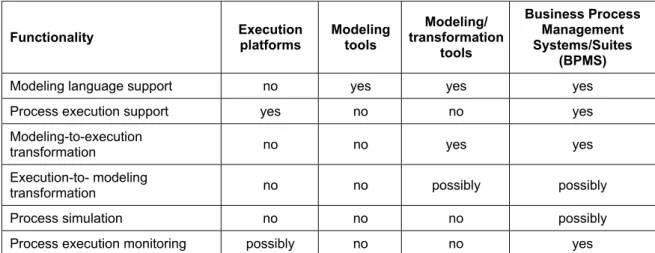
− Business Process Management Systems/Suites (BPMS): these tools support the whole process lifecycle from modeling to execution, with possible simulation capability. They generate BPEL code from BPMN models. The executable process can be deployed to an execution engine which is integrated with the modeling environment. The execution engine may provide the capability to monitor a process execution using the corresponding diagram as a basis for visualization. The first category of tools is introduced in (Kanniainen & Haajanen 2007). In this project, the focus is on automated business processes, which means that business process models need to have a clear relationship with executable processes. Therefore, the second category of tools is omitted here. From the selected tools, one (eClarus) falls into the third category and the other (Intalio BPMS) to the fourth category. The properties of the categories are summarized in Table 4. The table indicates whether the typical tools in these categories include certain functionalities. If a column is marked as
possibly, this means that tools in the category may have this kind of support, but this is not necessary.
Table 4. Modeling and execution tool categories.
Functionality Execution platforms Modelingtools transformation Modeling/ tools
Business Process Management Systems/Suites
(BPMS)
Modeling language support no yes yes yes
Process execution support yes no no yes
Modeling-to-execution
transformation no no yes yes
Execution-to- modeling
transformation no no possibly possibly
Process simulation no no no possibly
Process execution monitoring possibly no no yes
5.1 Principles for tool selection
The selection of investigated tools was to a large extent based on lists maintained by the Object Management Group. Also industry articles (e.g., Gao 2006) and free search on the web were exploited. The used tools were selected based on available documentation and, in certain cases, preliminary use experience. In the selection, the following properties of the tools were emphasized:
− Language support: the support for BPMN and BPEL was required. For BPEL, both BPEL4WS 1.1 and WS-BPEL 2.0 supports were considered suitable.
− Claimed transformation support: the products were evaluated based on the transformation support stated in the documentation. All selected tools support some level of code generation based on process diagrams.
− Availability: the research was restricted by the fact that the products needed to be available for research purposes at low costs. All included products were available freely, as a trial version or under academic license.
5.2 Selected tools
Based on the previously described criteria, several suitable tools could be found. We did not include a wide range of products in our test cases, because this could have affected the quality of the tests due to the limited time scope. Additionally, as the previous sections show, the transformation functionality of the tools is largely dependent on the expressive power of the languages, and the results can thus be generalized more than
with proprietary BPM tools. Finally, the field is under constant change and new products and improved versions of the old ones are being released at a rapid pace. Hence, the results of extensive comparisons would not have been feasible for very long. We did not choose the tools randomly, however. The first tool, Intalio BPMS, was selected because it was freely available and because it provided the whole BPMS functionality. We feel that freely available products have currently an important role, because the technologies and the domain in general are at a relatively young stage. Organizations may need to assess whether such technology would provide considerable value, before making significant investments in tools. This kind of analysis is also suggested by Gartner in their analysis on Intalio (Hill & Drakos 2006). Accordingly, Intalio is the first credible BPMS product, although commercial products include a wider set of features that are accessible also to business users.
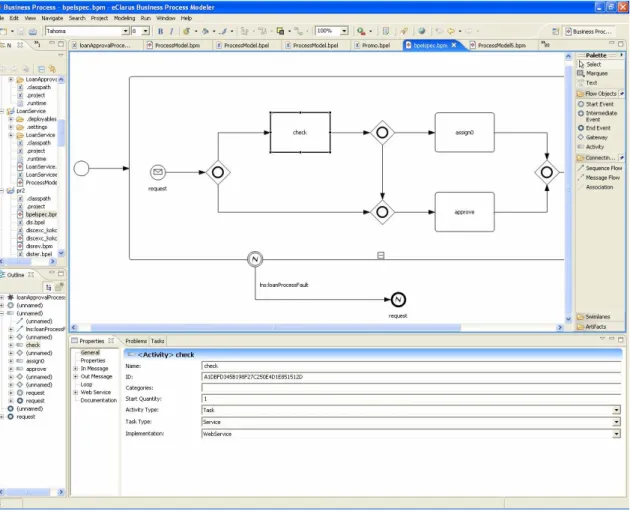
The second tool, eClarus Business Process Modeler for SOA Architects, was selected because it was one of the few tools that supported both BPEL export and import. The industrial paper covering the principles of its transformation method (Gao 2006) also increased our interest on this product. It is a commercial tool but the vendor provided us with a limited license for our research purposes.
5.2.1 Intalio BPMS Community Edition
Intalio BPMS Community Edition4 enables experimenting with a full-blown BPMS without costs and therefore, it was chosen for this study. The functionalities are divided into two separate products: Intalio Designer for modeling business processes and Intalio Business Process Management Server for executing and managing them. The Community Edition of Intalio can only be used with a MySQL relational database and Apache Geronimo application server. The Enterprise Edition5 does not have these restrictions. For the purpose of this research, i.e., mainly for examining the BPMN transformations, the Community Edition is considered completely adequate.
In this research, version 4.4 of both Intalio Designer and Intalio Business Process Management Server were used. In the early stage of the empirical study, version 5 of the Designer also reached alpha stage. Due to its immature stage, it could not be included in the research. According to the documentation on the web site, the tested version of the Designer requires Windows XP or Windows 2000. The Server will also work on Linux or Mac OS X. The toolset was only tested in Windows XP environment.
4 http://bpms.intalio.com. 5
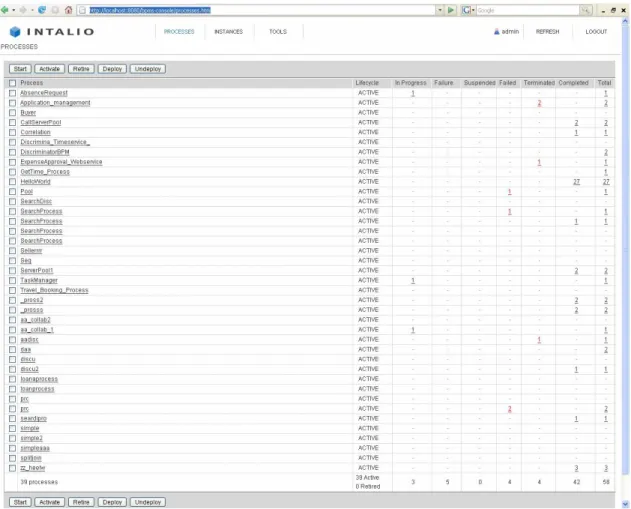
The basic modeling view of Designer is presented in Figure 5 and the listing of deployed processes in Server in Figure 6.
Figure 6. Intalio BPMS Server.
As BPMS products in general, Intalio BPMS Community edition is intended to cover all basic aspects of business process management including process modeling, deployment, execution and monitoring. The whole suite relies on BPMN as a visual notation and BPEL as an execution language. Intalio supports the WS-BPEL 2.0 specification which is claimed to be more portable than the earlier version. The WS-BPEL 2.0 descriptions which are generated based on BPMN can be deployed into the Server with one click in the Designer. The server also supports BPEL4WS 1.1 but for those files, a separate deployment package must be created. Other model formats were not supported by the used version. In the Designer, most of the BPMN 1.0 specification’s elements are implemented. The few missing elements include Data object elements, Cancel elements and Complex Gateways. Additionally, Intalio BPMS 4.4 does not support abstract messaging between pools or merging between exception and normal flow.
Intalio is clearly focused on executable business processes based on Web Service technologies. It is not intended to be a tool for pure business analysts: basic understanding of the underlying technologies is definitely needed. Intalio Designer includes most of the BPMN elements relevant to executable business process models. In the Intalio Designer, external activities and message flows are mapped to specific