V
viewpoints
V
IA A reMArkABle alignment oftechnologies, the future of software has been revolu-tionized in a way that also makes it easier to teach. Cloud computing and the shift in the software industrya toward Software as a Serviceb (SaaS) using Agile develop-ment has led to tools and techniques that are a much better match to the classroom than earlier software devel-opment methods. In addition, modern programming frameworks for Agile development like Ruby on Rails dem-onstrate that big ideas in program-ming languages can deliver productiv-ity through extensive software reuse. We can leverage such productivity to allow students to experience the whole software life cycle repeatedly within a single college course, which addresses many criticisms from industry about software education. By using free-trial online services, students can develop and deploy their SaaS apps in the cloud without using (overloaded) campus resources. Our enthusiasm for Agile, SaaS, and cloud computing is not based just on improving students’
employ-a Virtuemploy-ally every shrink-wremploy-ap progremploy-am is offered as a service, including PC standard-bearers like Office (see Office 365; http://www.micro-soft.com/en-ca/office365/online-software.aspx) and TurboTax (see TurboTax Online; http:// turbotax.intuit.com/personal-taxes/online/ compare.jsp).
b Instead of binaries that must be installed on a local computer, SaaS delivers software and associated data as a service over the Internet, often via a thin program on client devices such as a browser.
ability; rather, we are excited that they can learn and practice software engi-neering fundamentals, and that they use them even after graduation. Our 50,000 online students are a testimony to the popularity of the material and the scalability of our SaaS “courseware.”
the Complaints and the Defense While new college graduates are good at coding and debugging,1 employers complain about other missing skills that are equally important. A standard faculty reaction to such criticisms is that we are trying to teach principles that prepare students for their whole careers; we are not trade schools that teach the latest superficial fads.
To understand the complaints in more depth, we spoke to representa-tives from a half-dozen leading soft-ware companies. We were struck by the unanimity of the number-one request from each company: that students learn how to enhance sparsely docu-mented legacy code. In priority order, other requests were making testing a first-class citizen, working with non-technical customers, performing de-sign reviews, and working in teams. We agree that the social skills needed to work effectively with nontechni-cal customers, work well in teams, and perform effective design reviews are helpful for the students’ whole ca-reers—the question is how to fit them
Viewpoint
Crossing the Software
education Chasm
An Agile approach that exploits cloud computing.
DOI:10.1145/2160718.2160732 Armando Fox and David Patterson
turning software concepts into Rails development tools.
sWeBoK Concept Agile Version Rails tool
Software Requirements User Stories, Behavior-Driven Design (BDD)*
Cucumber (http://cukes.info) Project Management velocity, version
Control
Pivotal Tracker (http://www.pivotaltracker.com/), Github (https://github.com/)
Software verification and Testing
Test-driven development (TDD)
RSpec (unit/functional testing; http://rspec.info/), SimpleCov (coverage measurement;
http://rubygems.org/gems/simplecov) Software Maintenance Refactoring to control
complexity
metric-fu (captures metrics of code complexity e.g., cyclomatic and ABC; http://metric-fu. rubyforge.org/), pingdom (monitors 99%ile response times to deployed app from around the world; http://pingdom.com/). iDEs such as Aptana (http://aptana.com/) and RubyMine (http://www.jetbrains.com/ruby/) include refactoring support, method name autocompletion, visualizing dependencies among classes, and so on.
Software Lifecycle iterations See Figure 3
MAy 2012 | voL. 55 | no. 5 | CommuNiCAtioNs of the ACm 45
Calendar
of Events
May 15–17 Computing frontiers Conference, Caligari, Italy, Sponsored: SIGMICro, Contact: John feo, email: [email protected], Phone: 509-375-3768 May 15–16Workshop on Software and Compilers for embedded Systems,
Sankt Goar, Germany, Contact: Henk Corporaal, email: [email protected] May 16–21
The 9th Annual Conference on
Theory and Applications on Models and Computation, Beijing, China, Contact: li Angsheng, email: [email protected] May 21–24 6th International Conference on Pervasive Computing Technologies for Healthcare, San Diego, CA,
Contact: Dr. rosa I. Arriaga, email: [email protected] May 21–25
Shape Modeling International, College Station, TX,
Contact: ergun Akleman, email: ergun.akleman@gmail. com, Phone: 979-845-6599 May 21–25 The 2012 International Conference on Collaboration Technologies and Systems, Denver, Co,
Contact: Geoffrey fox,
email: [email protected] May 22–25
International Working Conference
on Advanced Visual Interfaces, Capri Islands (Naples), Italy, Contact: Tortora Genoveffa, email: [email protected] May 23–25
euro-American Conference on Telematics and Information Systems,
Valencia, Spain, Contact: Samper J. Javier, email: [email protected]
into a course. Similarly, no one ques-tions the value of emphasizing test-ing—the question is how to get stu-dents to take it seriously.
Instructors respond that even if we agreed with the recommendations, time constrains how much one class can cover. A typical undergraduate workload of four courses per term and a 50-hour workweek gives students about 12 hours per week per course, including lectures, labs, exams, and so forth. This works out to approximately 120 hours per quarter to 180 hours per semester, or just three to four weeks for a full-time developer!
A Classroom opportunity: Agile Development
The Agile Manifesto signaled a para-digm shift for many software applica-tions. This approach embraces change as a fact of life; small teams of devel-opers continuously refine a working but incomplete prototype until the customer is happy with the result, with the customer offering feedback with every iteration. Agile emphasizes Test-Driven Developmentc (TDD) to reduce mistakes, which addresses industry’s request to make testing a first-class cit-izen; user storiesd to reach agreement and validate customer requirements, which addresses working with non-technical customers; and velocitye to measure progress. The Agile software philosophy is to make new versions available every two weeks. The as-sumption is basically continuous code refactoring over its lifetime, which de-velops skills that can also work with legacy code. Clearly, small teams and multiple iterations of incomplete pro-totypes could match the classroom.
Note that we do not tell students that Agile is the only way to develop software; indeed, we explain Agile is inappropriate for safety-critical apps, for example. We believe that new pro-gramming methodologies develop and become popular in response
c In TDD you first write a failing test case that defines a new feature, and then write code to pass that test.
d A user story is a few nontechnical sentences that captures a feature the customer wants to include in the app.
e Velocity is calculated by estimating units of work per user story and then counting how many units are completed.
to new opportunities, so we tell stu-dents to expect to learn new method-ologies and frameworks in the future. Our experience is that once students learn the classic steps of software de-velopment and have a positive experi-ence in using them via Agile, they will use these key software engineering principles in other projects no mat-ter which methodology is used (see Figure 5).
A Classroom target for the Post-PC era: “i Do and i understand” To motivate students, it is helpful to use a platform that allows them to cre-ate compelling apps. In this emerging post-PC era, mobile applications for smartphones and tablets and Software as a Service (SaaS) for cloud computing are both compelling. (50,000 students are evidence that SaaS is indeed com-pelling.) As you can teach the princi-ples with either target, given the time constraints mentioned earlier, why not pick the platform that has the most productive tools? Our view is that the only hope for addressing all the con-cerns from industry within one course is to use a highly productive program-ming framework.
Our experience is that the Rails eco-system has by far the best tools to sup-port test-driven development, behav-ior-driven design, and Agile processes, many of which are made possible by intellectually deep Ruby language fea-tures such as closures, higher-order functions, functional idioms, and
the only hope for
addressing all the
concerns from
industry within
the course time
constraints is to use
a highly productive
programming
metaprogramming. The accompany-ing table shows critical topics from the SWEBOK (software engineering body of knowledge),5 the Agile technique for that topic, and the Rails tool that imple-ments that technique. Because these tools are lightweight, seamlessly inte-grated with Rails, and require virtually
no installation or configuration—some are delivered as SaaS—students quickly begin learning important techniques directly by doing them. We agree with Confucius: “I hear and I forget. I see and I remember. I do and I understand.” Students see and use tools that we can explain and check, rather than just hear
lectures about a methodology and then forget to use them in their projects.
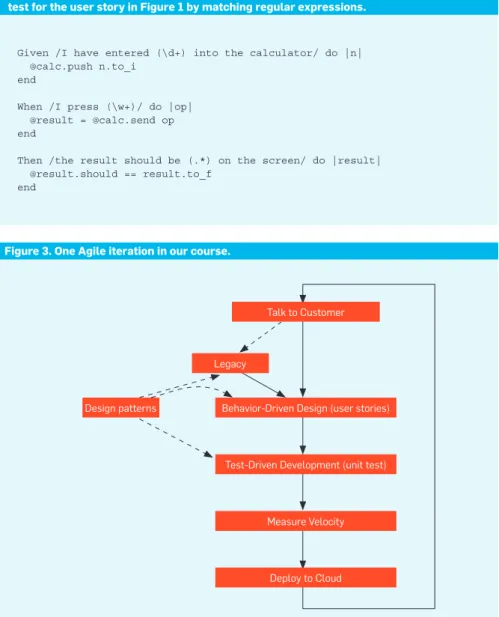
For example, the Cucumber tool automates turning customer-under-standable user stories into acceptance tests. Figure 1 is an example feature for a cash register application and one “happy path” user story (called a scenario in Cucumber) for that fea-ture (see http://en.wikipedia.org/ wiki/Cucumber_%28software%29). Note that this format is easy for the nontechnical customer to under-stand and help develop, which is a founding principle of Agile and ad-dresses a key criticism from industry. Cucumber uses regular expressions to match user stories to the testing harness. Figure 2 is the key section of the Cucumber and Ruby code that automates the acceptance test by matching regular expressions.
Such tools not only make it easy for students to do what they hear in lecture, but also simplify grading of student effort from a time-intensive subjective evaluation by reading code to a low-effort objective evaluation by measuring it. SimpleCov measures test coverage, saikuro measures cyc-lomatic complexity of the code, flog measures code assignment-branch-condition complexity, reek comments on code quality by highlighting “code smells,”f Cucumber shows the num-ber of user stories completed, and Piv-otal Tracker records weekly progress and can point out problems in balance of effort by members of teams. Indeed, these tools make it plausible for the online course to have automatically gradable assignments with some teeth in them.
Compared to Java and its frame-works, Rails programmers have found factors of three to five reductions in number of lines of code, which is one indication of productivity.6,8 Rails also helps with a criticism of Agile in that TDD and rapid iteration can lead to poor software architecture. We do teach design patterns (see Figure 3). Indeed, the Rails framework follows the Model View Controller (MVC)g design pattern
f Code smells highlight to sections of code that may be hard to read, maintain, or evolve. g MVC is a design pattern that separates input
logic, business logic, and user interface logic yet provides a loose coupling between them.
figure 1. An example feature for a cash register application and one “happy path” user story for that feature.
Feature: Division
In order to avoid silly mistakes
Cashiers must be able to calculate a fraction Scenario: Regular numbers
Given I have entered 3 into the calculator And I have entered 2 into the calculator When I press divide
Then the result should be 1.5 on the screen
figure 2. the key section of the Cucumber and Ruby code that automates the acceptance test for the user story in figure 1 by matching regular expressions.
Given /I have entered (\d+) into the calculator/ do |n| @calc.push n.to_i
end
When /I press (\w+)/ do |op| @result = @calc.send op end
Then /the result should be (.*) on the screen/ do |result| @result.should == result.to_f
end
figure 3. one Agile iteration in our course.
Talk to Customer
Behavior-Driven Design (user stories)
Test-Driven Development (unit test)
Measure velocity
Deploy to Cloud Legacy
MAy 2012 | voL. 55 | no. 5 | CommuNiCAtioNs of the ACm 47 A typical faculty reaction to the re-quest for students to deal with poorly documented legacy code is that it should not exist if students are taught good practices. However, despite de-cades of well-meaning instructors ex-pounding on the importance of prop-erly factored and highly documented code, our industry colleagues assure us the legacy code problem will continue to persist. Thus, on this point we quote Shimon Peres: “If a problem has no solu-tion, it may not be a problem, but a fact— not to be solved, but to be coped with over time.” Hence, if we can find principles that teach how to cope with legacy code, they would be appropriate for the class-room since it is a long-lasting challenge. To learn to deal with legacy apps, our students learn and enhance a large, popular, well-written (but poorly docu-mented) open source app written in Rails. We use Typo, a blogging frame-work containing 30,000 lines of Ruby and 15,000 lines of JavaScript, which suggests that it has the functionality of a Java program of 100,000 to 150,000 lines of code. We choose a Rails app rather than a Java app to maintain the programmer productivity we need to fit within our time budget. Feathers2 ar-gues that the first step is to write tests for legacy code to ensure understand-ing before modification, so enhancing to simplify development of the classic
three-tiered applications of cloud com-puting. In addition, because of cloud computing, deploying their projects in the same horizontally scalable environ-ment used by professional developers is instant, free for small projects, and requires neither software installation nor joining a developer program. In particular, it frees the course from in-structional computers, which are often antiquated, overloaded, or both.
One criticism of the choice of Ruby is its inefficiency compared to lan-guages like Java or C++. Since hard-ware has improved approximately 1,000X in cost-performance since Java was announced in 1995 and 1,000,000X since C++ was unveiled in 1979,7 the efficiency of low-level code matters in fewer places today than it used to. We think using the improved cost-performance to increase pro-grammer productivity makes sense in general, but especially so in the class-room. Note that for cloud comput-ing, horizontal scalability can trump single-node performance; deploying as SaaS on the cloud in this course lets us teach (and test) what makes an app scalable across many servers, which is not covered elsewhere in our curricu-lum. Once again, without using the cloud to teach the class, we could not
offer students the chance to experi-ment with scalability.
An example Course
We use this approach to teach a soft-ware course, which currently has more than 100 juniors and seniors, at UC Berkeley. We also are offering the first part as a massive open online course (MOOC) to 50,000 online students, most of whom work in the IT industry and graduated from college five to 10 years ago.3 (The MOOC tests the scal-ability of the tools and automatic grad-ing of programmgrad-ing assignments.) Students follow steps shown in Figure 3, which turns the concepts and tools listed in the table into a logical pro-cess. Additional tools facilitate tying together the steps of this process; for example, Autotest monitors the source code tree in the background, automati-cally rerunning tests and user stories via RSpec/Cucumber in response to even minor code changes, giving im-mediate feedback if something breaks. Following the Agile philosophy, they deploy on Amazon Web Services (AWS) (via Heroku) multiple times during the course. The teaching staff evaluates iterations by interacting with the de-ployed app on AWS and by using Pivot-al Tracker to check velocity and stories remaining to be implemented.
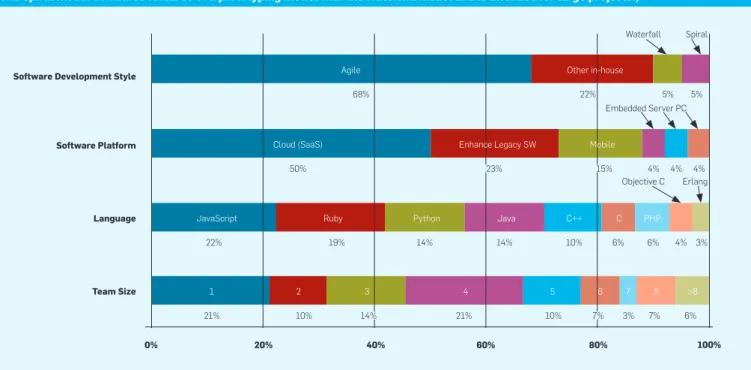
figure 4. survey results of software experience for former Berkeley students now in industry. (the waterfall software development process is characterized by much of the design being done in advance of coding, completing each phase before going on to the next one. the spiral model combines features of a prototyping model with the waterfall model and is intended for large projects.)
0% 21% 22% 50% 68% 22% 5% 5% 23% 15% 4% 4% 4% 19% 14% 14% 10% 6% 6% 4% 3% 1 JavaScript cloud (SaaS)
agile other in-house
enhance legacy SW Mobile
ruby Python Java c++ c PhP objective c Waterfall embedded Server Pc erlang Spiral 2 3 4 5 6 7 8 >8 10% 14% 21% 10% 7% 3% 7% 6% team size Language software Platform software Development style
“Donec et felis
vestibulum dui
ligula id scelerisque,
suscipit quis dolor
nulla facilisi curabitur
sit amet pede fusce.
legacy code fits surprisingly well with the test-driven development of Agile.
To learn to communicate with non-technical customers, for the Berke-ley course we asked for projects from nonprofit organizations. The projects are typically less than 3,000 lines of code, with typically two to three times more code for testing than for the app. Teams of four or five students meet with customers on each Agile iteration for feedback on the current prototype and to prioritize the next features to add. (Moreover, we encourage students to connect these applications to Face-book or Twitter, which gives students the chance to deal with users as well as nontechnical customers within a single course.) Teams members do design reviews for each other as part of a bi-weekly class laboratory section, as Agile favors frequent code check-ins and de-sign reviews. (Online students do not do projects.)
using the course content afterward
Figure 4 shows the survey results of Berkeley students from two earlier course offerings. Just 22 of the 47 re-spondents had graduated, and just 19 had done significant software projects.
The percentages indicate the results of their 26 software projects. We were surprised that Agile software develop-ment was so popular (68%) and that the cloud was such a popular platform (50%). Given that no language was used in more than 22% of the projects, our alumni must be using Agile in projects that use languages other than Ruby or Python. All the class teams had four or five students, which directly matches the average team size from the survey.
Once again, Agile development and Rails were not selected because we ex-pected them to dominate students’ professional careers upon graduation; we use them to take advantage of their productivity so we can fit several criti-cal ideas into a single college course in the hope they will use them later no matter what methodology, program-ming language, and framework.
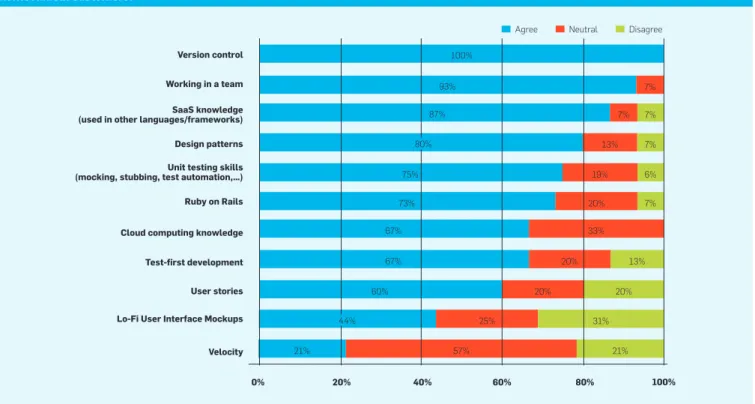
Figure 5 shows the students’ rank-ing of the topics the table and Figure 3 in terms of usefulness in their indus-trial projects. Most students agreed that the top nine topics in the course were useful in their jobs. Once again, we were pleased to see that these ideas were still being used, even in indus-trial projects that did not rely on Agile or on Rails. The two lower ranked
top-ics were Lo-Fi User Interface Mockups, which makes sense since few devel-opers work on the UI of a user-facing project, and Velocity, as progress can be measured in other ways in industry.
Although a small sample and not a conclusive user study, our survey of-fers at least anecdotal evidence that students of this course do continue to use successful software development techniques in later software projects of all kinds.
conclusion
Using Agile to develop SaaS apps via highly productive tools like Rails and deploying them using cloud comput-ing cultivates good software practices and pleases many stakeholders:
˲Students like it because they get the pride of accomplishment in ship-ping code that works and is used by people other than their instructors, plus they get experience that can help land internships or jobs.
˲Faculty like it because students actually use what they hear in lecture, even after graduation, and they expe-rience how big CS ideas genuinely im-prove productivity. Virtual machines re-duces hassles for faculty plus the cloud allows for more interesting program-figure 5. Ranked results from survey of former Berkeley students on whether course topics listed in the table and program-figure 3 were useful in their industrial projects. these earlier versions of the course did not offer enhancing legacy code, design reviews, and working with nontechnical customers. 21% 60% 67% 73% 75% 67% 20% 20% 20% 19% 13% 7% 7% 33% 20% 13% 7% 6% 7% 7% 57% 25% 31% 21% 87% 93% 100%
Agree Neutral Disagree
0% Velocity Lo-fi user interface mockups user stories test-first development cloud computing knowledge Ruby on Rails Design patterns Working in a team Version control
unit testing skills (mocking, stubbing, test automation,…)
saas knowledge (used in other languages/frameworks)
20% 40% 60% 80% 100%
80%
MAy 2012 | voL. 55 | no. 5 | CommuNiCAtioNs of the ACm 49
The ACM Career & Job Center is the perfect place to
begin searching for your next employment opportunity!
http://jobs.acm.org
ACM’s
Career & Job Center
Looking for your next IT job?
Need Career Advice?
Visit ACM’s Career & Job Center at:
http://jobs.acm.org
Off ering a host of career-enhancing benefi ts:
➜
A highly targeted focus on job opportunities in
the computing industry
➜
Access to hundreds of corporate job postings
➜Resume posting keeping you connected to the
employment market while letting you maintain
full control over your confi dential information
➜
An advanced Job Alert system notifi es you of
new opportunities matching your criteria
➜
Career coaching and guidance from trained
experts dedicated to your success
➜
A content library of the best career articles
compiled from hundreds of sources, and much
more!
CareerCenter_TwoThird_Ad.indd 1 4/3/12 1:38 PM
ming assignments—which the testing and code evaluation tools of Rails can help grade—thereby allowing us to of-fer a MOOC with 50,000 students.
˲Colleagues in industry like it be-cause it addresses several of their con-cerns. An example is this quote from a Googler: “I think what you’re doing in your class is amazing. I’d be far more likely to prefer graduates of this program than any other I’ve seen. As you know, we’re not a Ruby shop, but I feel this is a good choice for the class to be able to get real features done. Java or C++ would take forever.”4
We received similar comments from colleagues at Amazon, eBay, and Microsoft, none of which are “Ruby shops.” As we expected, leading soft-ware companies prefer students learn important ideas rather than steer us to teach specific languages and tools used inside those companies.
We believe Agile+Cloud+Rails can turn a perceived weakness of the CS curriculum into a potential strength. If you are a potentially interested in-structor, we would be happy to help you cross the long-standing chasm be-tween what industry recommends and what academia offers.
References
1. begel, a. and Simon, b. novice software developers, all over again. in ICER ‘08: Proceedings of the 4th
International Workshop on Computing Education Research (Sept. 2008).
2. feathers, M. Working Effectively with Legacy Code, Prentice hall, 2004.
3. fox, a. and Patterson, d. Software engineering for Software as a Service; http://www.saas-class.org, March 2012 and May 2012.
4. green, b. Private communication, 2011. 5. ieee. guide to the Software engineering body of
knowledge (SWebok), 2004.
6. Ji, f. and Sedano, t. comparing extreme programming and waterfall project results. Conference on Software Engineering Education and Training 2011 (2011). 7. Patterson, d.a. and hennessy, J.l. Computer
Organization and Design: The Hardware/Software Interface. revised 4th edition, Morgan kaufmann Publishers, 2012.
8. Stella, l.f.f., Jarzabek, S. and Wadhwa, b. a comparative study of maintainability of Web applications on J2ee, .net, and ruby on rails. WSE 2008. 10th International Sym-posium on Web Site Evolution (oct. 3–4, 2008), 93–99.
Armando Fox ([email protected]) is an adjunct
associate professor at Uc berkeley and a co-founder of the berkeley rad lab.
David Patterson ([email protected]) is the
e.h. and M.e. Pardee chair of computer Science at Uc berkeley and is a past president of acM.
We thank our colleagues at amazon Web Services, ebay, facebook, github, google, heroku, Microsoft, and Pivotal labs for their feedback and suggestions on this Viewpoint, for their support and feedback during the development of the course, and for their donations of services to support the online course.