FINANCIAL GLOBALIZATION: A REAPPRAISAL M. Ayhan Kose Eswar Prasad Kenneth Rogoff Shang-Jin Wei Working Paper 12484 http://www.nber.org/papers/w12484
NATIONAL BUREAU OF ECONOMIC RESEARCH 1050 Massachusetts Avenue
Cambridge, MA 02138 August 2006
We are grateful for helpful comments from Roger Gordon, referees, seminar participants at the BIS, ECB, HKMA, CEPR, Cornell University, and University of Houston, where earlier versions of this paper were presented. Lore Aguilar, Cigdem Akin, Dionysios Kaltis and Ashley Taylor provided excellent research assistance. The views expressed in this paper are solely those of the authors and do not necessarily reflect those of the IMF or IMF policy. The views expressed herein are those of the author(s) and do not necessarily reflect the views of the National Bureau of Economic Research.
©2006 by M. Ayhan Kose, Eswar Prasad, Kenneth Rogoff and Shang-Jin Wei. All rights reserved. Short sections of text, not to exceed two paragraphs, may be quoted without explicit permission provided that full credit, including © notice, is given to the source.
August 2006
JEL No. F02, F21, F36, F4
ABSTRACT
The literature on the benefits and costs of financial globalization for developing countries has exploded in recent years, but along many disparate channels with a variety of apparently conflicting results. We attempt to provide a unified conceptual framework for organizing this vast and growing literature. This framework allows us to provide a fresh synthetic perspective on the macroeconomic effects of financial globalization, both in terms of growth and volatility. Overall, our critical reading of the recent empirical literature is that it lends some qualified support to the view that developing countries can benefit from financial globalization, but with many nuances. On the other hand, there is little systematic evidence to support widely-cited claims that financial globalization by itself leads to deeper and more costly developing country growth crises.
M. Ayhan Kose
International Monetary Fund 700 19th Street, NW
Washington, DC 20431
Eswar Prasad
International Monetary Fund Research Department, Room 9-700 International Monetary Fund 700 19th Street, NW Washington, DC 20431 [email protected] Kenneth S. Rogoff Economics Department Harvard University Littauer Center 232 Cambridge, MA 02138-3001 and NBER [email protected] Shang-Jin Wei
International Monetary Fund Room 10-700
19th Street, NW
Washington, DC 20433 and NBER
I. Introduction
The recent wave of financial globalization got started in earnest in the mid-1980s, with rising cross-border financial flows among industrial economies and between industrial and
developing economies. This was spurred by liberalization of capital controls in many of these countries, in anticipation of the benefits that cross-border flows would bring in terms of better global allocation of capital and improved international risk-sharing possibilities. The strong presumption was that these benefits ought to be large, especially for developing countries that tend to be relatively capital-poor and have more volatile income growth. With the surge in financial flows, however, came a spate of currency and financial crises in the late 1980s and 1990s. There is a widely-held perception that developing countries that opened up to capital flows have been more vulnerable to these crises than industrial
economies, and have been much more adversely affected. These developments have sparked a fierce debate among both academics and practitioners on the costs and benefits of financial globalization. This debate has intensified and become more polarized over time, in contrast to the debate on trade liberalization that has more or less moved towards a consensus.1 Some academic economists view increasing capital account liberalization and unfettered capital flows as a serious impediment to global financial stability (e.g., Rodrik, 1998; Bhagwati, 1998; Stiglitz, 2002), leading to calls for capital controls and the imposition of frictions such as “Tobin taxes” on international asset trade. Others argue that increased openness to capital flows has, by and large, proven essential for countries aiming to upgrade from lower to middle income status, while significantly enhancing stability among
industrialized countries (e.g., Fischer, 1998; Summers, 2000). This is clearly a matter of considerable policy relevance, especially with major economies like China and India recently taking steps to open up their capital accounts. While consensus may be too much to hope for, some clarity on what theory and data do tell us—and what they do not tell us—is important for informing the ongoing debate.
A central conclusion of this paper is that while the rapidly-growing empirical literature is gradually tilting towards supporting a significant positive role for financial globalization, there are many unanswered questions about how a country should organize and pace its move. At the same time, we find there is very little meaningful empirical support to underpin the more polemic claims of those who argue that capital account liberalizations (as opposed to, say, inappropriately rigid exchange rate regimes) are the root problem behind most
developing country financial crises of the past fifteen years. We hope in this paper to provide a synthetic perspective on this literature so the reader may judge for herself. At the same
1 For empirical evidence showing that trade openness has a direct and positive effect on economic
growth, see, e.g., Frankel and Romer (1999) and Dollar and Kraay (2003). Rodriguez and Rodrik (2002) present a contrarian view but, as summarized in recent surveys by Berg and Krueger (2002), Baldwin (2004), and Winters (2004), the weight of the evidence supports the by-now conventional wisdom that trade is good for growth.
time, we try to develop a few organizing principles that will perhaps point the way to where future research is most needed.
The fundamental point we make in this paper is that the main benefits to successful financial globalization are probably catalytic and indirect, rather than simply enhanced access to financing for domestic investment. Of course, this perspective differs from the standard neoclassical framework, which views the key benefit of financial globalization as arising from long-term net flows of capital from industrial to developing economies. Since the former group of countries is capital rich while the latter is relatively capital poor, this would generate welfare gains for both groups of countries. Yet, a survey of the literature on capital account liberalization by Eichengreen (2001) concludes that there is no empirical
substantiation of the conventional theoretical tenets about the growth benefits of capital account liberalization.
A subsequent survey by us (Prasad, Rogoff, Wei and Kose, 2003) on the broader dimensions of financial globalization deepens the puzzle. Even after taking into account the fundamental distinction between de jure and de facto financial globalization (which we shall discuss below), we still conclude that, taken as a whole, the vast empirical literature provides little robust evidence of a causal relationship between financial integration and growth. Moreover, we find that, among developing countries, the volatility of consumption growth relative to income growth appears to be positively associated with financial integration, the opposite of what canonical theoretical models would predict. In theory, access to international markets should allow all countries to smooth consumption by insuring against country-specific income risk. What accounts for these discrepancies between the advertised benefits of financial globalization and the mixed empirical evidence?2
We argue here that far more important than the direct growth effects of access to more capital is how capital flows generate a number of what we label the “potential collateral benefits” of financial integration. There is now a rapidly growing literature showing that financial
openness can, in many but not all circumstances, promote development of the domestic financial sector, impose discipline on macroeconomic policies, generate efficiency gains among domestic firms by exposing them to competition from foreign entrants, and unleash forces that result in better government and corporate governance.
The notion that financial globalization mainly influences growth through indirect channels has important implications for empirical analysis of its benefits. For one thing, building institutions, enhancing market discipline and deepening the financial sector takes time, and so does the realization of growth benefits from such channels. This may explain why, over relatively short periods, it seems much easier to detect the costs but not the benefits of
2 We emphasize up front that our analysis focuses largely on private capital flows and does not
encompass the effects of official flows, including foreign aid, and other flows such as remittances (which should, strictly speaking, appear in the current account of the balance of payments).
financial globalization. More fundamentally, even at long horizons, it may be difficult to detect the productivity-enhancing benefits of financial globalization in empirical work if one includes structural, institutional and macroeconomic policy variables in cross-country
regressions that attempt to explain growth of GDP or productivity. For then, by construction, there can be little added explanatory power left for the financial openness measure. Indeed, this could explain why simple correlations tend to show that financially integrated economies have higher growth rates on average than less integrated economies, yet it has proven
difficult to find a causal effect of financial integration on growth once the other factors mentioned above are controlled for.
The approach we have outlined above helps to link together a number of other pieces of the literature. For instance, a majority of the papers looking at the effects of overall capital account liberalization have relied on de jure measures of capital account openness, which reflect legal restrictions on capital movements (or lack thereof). But the collateral benefits are likely to be realized at least as much through de facto integration, which, as we show, can be quite different. In practice, the distinction between de jure and de facto openness can be very important. Many countries have capital controls that are quite strict on paper but toothless in practice so their de facto level of integration—as measured by capital flows or stocks of foreign assets and liabilities--is quite high; this in itself could act as a disciplining device on the government and firms. In contrast, many other countries are quite open to global capital markets on a de jure basis, but in practice capital flows are minimal. In our survey, we consider results based on both kinds of measures and argue that the choice of measure has important consequences for empirical analysis.
Our approach could help understand why recent research that focuses on the growth effects of equity market liberalizations seems to find such strong positive effects despite the fact that portfolio equity inflows are typically small relative to other types of flows. For instance, one possibility is that equity market liberalizations typically take place in tandem with various other domestic reforms, and when national governments have confidence in their own ability to adequately supervise domestic financial markets. Besides, equity inflows are precisely the ones that, along with FDI, are most likely to confer the sort of collateral benefits discussed above. Our analysis may help explain why there is much stronger evidence based on microeconomic (firm- or industry-level) data on the distortionary effects of capital controls and the benefits of capital account liberalization.
The collateral benefits perspective also ties in to the literature on thresholds in the effects of financial globalization. It has become a mantra in academic and policy circles that financial globalization can in principle be good for any country—in terms of delivering the benefits and minimizing risks—but that the benefits to cost calculus is much more compelling for countries with robust institutions and good macroeconomic policies. The set of prescribed requirements tends to be vast—encompassing sound monetary and fiscal policies, depth and sophistication of financial markets, the quality of financial sector regulation and supervision, transparency and good governance, and the list goes on.
It is clearly the case that most developing countries do not measure up to all of these desiderata and, for many of them, the length of this list makes things look hopeless at the outset. Does this imply that developing countries would do best to shield themselves from external influences while trying to improve the quality of their domestic policies and institutions to some acceptable level? The academic literature we survey does not seem to offer a simple answer, in part because the links are bi-directional. In theory (and with some supporting evidence, as we shall see), financial opening may in fact play an important catalytic role in improving institutions, allowing for transfer of good governance practices, strengthening macroeconomic discipline and so on. But there remain a number of unresolved questions in the literature that make it difficult to draw firm policy conclusions. We list some of these questions that require further research in the final section of the paper.
II. A Brief Overview of Theory
We begin with a very brief review of the basic implications from theoretical models about how financial globalization should affect growth, volatility, and comovement of output and consumption.
Growth
As we have already noted, the simplest benchmark one-sector neoclassical framework suggests that financial globalization should lead to flows of capital from capital-rich economies to capital-poor economies since, in the latter, the returns to capital should be higher.3 These flows should complement limited domestic saving in capital-poor economies
and, by reducing the cost of capital, allow for increased investment. Certain types of financial flows could also generate technology spillovers and serve as a conduit for imbibing
managerial and other forms of organizational expertise from more advanced economies. There are also a number of indirect channels through which financial globalization could enhance growth. It could help promote specialization by allowing for sharing of income risk, which could in turn increase productivity and growth as well.4 Financial flows could foster development of the domestic financial sector and, by imposing discipline on macroeconomic policies, lead to more stable policies. We discuss the mechanisms and evidence for some of these channels later in the paper.
3 Indeed, the fact that the actual volumes of such flows don’t come anywhere near what might be
predicted by neoclassical growth models has been characterized as a puzzle by Lucas (1990), with many subsequent papers trying to resolve this puzzle.
4 Concerns about increases in volatility that may result from a specialized production structure could
discourage countries from taking up growth-enhancing specialization activities; higher volatility might also reduce investment rates. Financial globalization could facilitate international risk sharing and thereby reduce countries’ consumption volatility. Among developed countries and across regions within developed countries, better risk sharing appears to be associated with greater specialization (Acemoglu and Zilibotti, 1997; Obstfeld, 1994; and Kalemi-Ozcan, Sorensen, and Yosha, 2001).
Volatility
The effects of financial integration on output volatility are not obvious in theory. In principle, financial integration allows capital-poor countries to diversify away from their narrow
production bases that are often agricultural or natural resource-dependent. This should reduce macroeconomic volatility. At a more advanced stage of development, however, trade and financial integration could simultaneously allow for enhanced specialization based on comparative advantage considerations. This could make countries more vulnerable to industry-specific shocks.5
Theory does have a strong prediction, however, about the relationship between financial integration and consumption volatility. Since consumers and, by extension, economies are risk-averse, consumption theory tells us that they should desire to use financial markets to insure against income risk, thereby smoothing the effects of temporary idiosyncratic
fluctuations in income growth on consumption growth. In theory, the benefits of international risk-sharing could be quite large (Lewis, 1999; van Wincoop, 1999). But this issue is far from settled (see the discussion in Obstfeld and Rogoff, 2004, Chapter 5). Lucas’s (1987) claim that macroeconomic stabilization policies that reduce consumption volatility can have only minimal welfare benefits continues to be influential (see Barlevy, 2004). Some authors have shown that, even within Lucas’s framework, the higher volatility that developing countries experience implies that they can potentially reap large benefits from international risk-sharing arrangements (Pallage and Robe, 2003)
Comovement
Another prediction of theory, related to the consumption smoothing issue, concerns the cross-country comovement of major macroeconomic aggregates. In theory, the effect of increased financial integration on cross-country correlations of output growth is uncertain, since it depends on the nature of shocks and specialization patterns. In any case, financial integration should in theory help countries diversify away country-specific risk and should, therefore, result in stronger comovement of consumption growth across countries. Thus, in parallel to the discussion of volatility, economic theory has clear implications for how financial integration should affect cross-country consumption correlations but not for correlations of output or income.
5 See Kose, Prasad and Terrones (2004) for a more detailed exposition. Imbs and Wacziarg (2003)
show that the degree of diversification has an inverted U-shaped relationship with per capita income level. The relationship between financial openness and macroeconomic volatility could also be affected by certain features of developing countries that may make them more vulnerable to external shocks. First, the limited diversification of their exports and imports could make them susceptible to terms of trade and foreign demand shocks (Kose, 2002). Second, sharp changes in world interest rates might induce large fluctuations in highly indebted countries (Blankenau, Kose, and Yi, 2001;
Neumeyer and Perri, 2005). Third, country size is an important factor as external shocks have a larger impact on volatility in small open developing countries (Crucini, 1997).
In summary, there is a strong presumption in theory that financial integration is good for growth and, although its effects on output volatility are unclear, it should unambiguously lead to reductions in the relative volatility of consumption (and increase the cross-country comovement of fluctuations in consumption).
III. Measuring Financial Openness
The traditional approach to measuring financial openness is to use measures of legal restrictions on cross-border capital flows. Such capital controls come in many varieties (controls on inflows versus controls on outflows, quantity controls versus price controls, restrictions on foreign equity holdings, etc.). Indeed, the IMF’s widely-used Annual Report on Exchange Rate Arrangements and Exchange Restrictions (AREAER) measures over 60 different types of controls. Appendix I summarizes the different categories of restrictions in the AREAER and shows how wide-ranging these controls can be.
One issue in the literature is whether to use a 0/1 measure of capital account openness (as in, say, the well-known work of Rodrik, 1998) or a finer measure (as pioneered by Quinn, 1997). Another question is whether to stick with using one of these types of de jure measures (as most of the literature does) or look for alternatives. It is worth noting that the range of available de jure measures is not as broad as it may seem since most of them, in one way or another, essentially just summarize the information in the IMF’s AREAER reports.
An alternative approach (advocated, for example, in Prasad, Rogoff, Wei and Kose, 2003) is to use a de facto measure that tries to take into account how much a country is integrated into international capital markets in practice. We will argue in this section that there is important information in both the de jure and de facto measures, but that for many applications the de facto measure is more suitable. The availability of a de facto integration measure that is consistently defined across countries owes a great deal to the pioneering work of Lane and Milesi-Ferretti, which we discuss in greater detail below.
De jure measures based on IMF indicators
Measuring capital account openness has long been a challenge (see Edison et. al., 2004). Some researchers utilize the summary information provided by the AREAER to construct a “share” measure, reflecting the fraction of years in the sample in which a country’s capital account was open (see Grilli and Milesi-Ferretti, 1995; Rodrik, 1998; and Klein and Olivei, 2006).Quinn (1997, 2003) use the narrative descriptions in the AREAER to develop a quantitative measure of capital account openness. Raising the level of technical
sophistication a notch, Chinn and Ito (2005) develop an index of financial openness based on principal components extracted from disaggregated capital and current account restriction measures in the AREAER. Mody and Murshid (2005) also utilize the measures involving restrictions on capital and current account transactions and construct a different measure. Edwards (2005) combines the measures in Mody and Murshid (2005) and Chinn and Ito
(2005) with information from country-specific data sources and proposes a new index.6 After the expansion of the set of categories reflecting the existence of capital controls in the 1997 issue of the AREAER, there have been some refinements of the earlier measures (see Johnston and Tamirisa, 1998, and Miniane, 2004).
Shortcomings of de jure measures
All of these measures, despite their increasing sophistication and fineness, suffer from a variety of similar shortcomings. First, they do not accurately reflect the degree of openness of the capital account because they are partially based on various restrictions associated with foreign exchange transactions that may not necessarily impede capital flows. Second, they do not capture the degree of enforcement of capital controls (or the effectiveness of that
enforcement), which can change over time even if the legal restrictions themselves remain unchanged.7 Third, and most importantly, these measures do not always reflect the actual
degree of integration of an economy into international capital markets, as we have already noted. As another example, China, despite its extensive regime of capital controls, has not been able to stop inflows of speculative capital in recent years (see Prasad and Wei, 2007). A further complication is that, despite the extensive coverage of the IMF’s annual AREAER publication, there could be other regulations that effectively act as capital controls but are not counted as controls. For instance, prudential regulations that limit the foreign exchange exposure of domestic banks could, under certain circumstances, have the same effect as capital controls.
This discussion suggests that the distinction between de jure and de facto financial integration is a crucial one. After all, what matters in analyzing the effects of financial globalization, is not how integrated economies seem on paper but how integrated they are in practice.8 But how does one go about measuring de factointegration?
6 Edison and Warnock (2003) construct measures of capital account restrictions related to just equity
flows. Bekaert and Harvey (2000) and Henry (2000a) compile dates of equity market liberalizations for developing countries. We discuss some of these narrower measures in more detail later.
7 Edwards (2005) notes that binary measures suggest similar levels of capital account restrictiveness
in Chile, Mexico and Brazil during the period 1992-1994. In fact, Mexico had a rather open capital account, Brazil employed a complex set of controls on capital flows, and there were some controls on short-term flows in Chile.
8 Collins (2005) argues that de facto and de jure measures are both relevant in measuring the effects
of financial integration. She also notes that de facto indicators are likely to be endogenous in growth regressions, making it difficult to pin down causal effects. As we discuss below, de jure measures also have a strong element of endogeneity to them, in addition to their various other deficiencies.
Aizenman and Noy (2006) report that de jure measures of capital account liberalization have differential effects on de facto measures of trade and financial integration. They find that de jure
restrictions on current account transactions adversely affect the extent of de facto trade openness
while de jure restrictions on capital account transactions have no impact on de facto financial
De facto measures based on price differentials
One approach has been to look at price-based measures of asset market integration. The logic is that, irrespective of the volume and direction of flows, true integration of capital markets should be reflected in common prices of similar financial instruments across national borders.9 While the logic is sound, there are serious practical problems in using such measures for emerging markets and even more so for low-income developing economies. Returns on financial instruments in these economies may incorporate a multitude of risk and liquidity premia that are difficult to quantify. For example, stocks of firms in many emerging market economies trade at low price earnings ratios due to investor concerns about corporate governance and contract problems. Yet, it is not easy to separate this form of segmentation from differential pricing due to high project risk. In general, domestic financial markets may simply not be deep or liquid enough to allow for efficient arbitrage of price differentials. Other measures of capital market integration include saving-investment correlations and, related to the price-based approach discussed above, various interest parity conditions (see Frankel, 1992; and Edison, Klein, Ricci, and Slok, 2002). However, these measures are also difficult to interpret and to operationalize for an extended period of time and for a large group of countries.
De facto measures based on quantities
This leaves quantity-based measures of integration based on actual flows which, in our view, provide the best available measure of a country’s integration with international financial markets. One issue is whether to measure integration using net or gross capital flows. Gross flows provide a relatively less volatile and more sensible picture of integration. Indeed, this measure has the advantage of capturing two-way flows which one would expect to see if economies were in fact sharing risk efficiently in a world with multiple financial instruments and agents with different risk profiles. Using the sum of gross inflows and outflows as a ratio to national GDP also yields a nice symmetry with the widely-used measure of trade
openness, which is the sum of imports and exports as a ratio to GDP.
However, such annual flows tend to be quite volatile and are prone to measurement error. To mitigate these problems, it may be preferable to use a measure of the sum of gross stocks of foreign assets and liabilities as a ratio to GDP. These stocks are essentially just a refined cumulated version of the underlying flows corrected for valuation effects. This preserves the spirit of measuring de facto integration and obviates many of the problems associated with flow data. Moreover, for some purposes--particularly risk sharing--the stock measures are integration. Similarly, Magud and Reinhart (2006) survey a number of studies on the effectiveness of capital controls and conclude that controls on inflows do not reduce the volume of net flows.
9 This is of course a simplistic description of a sophisticated approach (see Karolyi and Stulz, 2003,
clearly more appropriate. For instance, if countries have large gross stocks of assets and liabilities, small exchange rate changes can have large valuation effects and serve as a mechanism for risk-sharing even if net asset positions are small.
The measures of financial integration that we use in the next section draw upon the work of Milesi-Ferretti and Lane (2006). These authors have carefully constructed an extensive dataset of stocks of gross liabilities and assets for 145 countries covering the period 1970-2004.10 Their dataset contains information about the composition of international financial positions, including foreign direct investment, portfolio equity investment, external debt, and official reserves. In addition, the dataset has the virtue of accounting for valuation effects and other problems that typically plague raw country-level data, and also corrects for cross-country differences in data definitions and variable construction.
IV. Patterns of Financial Globalization
Measures of de facto integration based on the Lane-Milesi-Ferretti data show a surge in financial globalization over the last two decades. Emerging markets have accounted for the lion’s share of inflows to developing economies. This is of course not a surprise since their level of integration into financial markets is the main ex-post criterion used to define emerging markets--the point to note here is that only a relatively small group of developing economies has actively participated in the process of financial globalization. FDI and portfolio equity flows have become the dominant form of new flows into developing economies, with the relative importance of debt flows declining over time (although, as we shall see, debt still accounts for more than half the stock of all external liabilities.)
Evolution of financial globalization across different country groups
Figure 1 shows the absolute level of integration of different country groups into global financial markets, calculated as the sum of gross international financial assets and
liabilities.11 While the level of integration into global capital markets is clearly highest for advanced economies, emerging market economies have accounted for the bulk of the integration experienced by developing economies in terms of the accumulation of foreign liabilities through capital inflows (Figure 2). Of the total stock of outstanding foreign liabilities at the end of 2004, industrial countries accounted for 91 percent and emerging
10 In this paper, Lane and Milesi-Ferretti substantially extend their widely-used External Wealth of
Nations database (Lane and Milesi-Ferretti, 2001) by employing a revised methodology and utilizing a larger set of sources. While their benchmark series are based on the official estimates from the International Investment Position, they compute the stock positions for earlier years using data on capital flows and account for capital gains and losses. In a series of papers, they analyze the various features of the data and document the implications of changes in external asset positions for exchange rates, financial integration, and global imbalances (see Lane and Milesi-Ferretti, 2002, 2003, 2005).
markets for 8 percent. Both figures show that the recent wave of financial globalization really got started in earnest only in the mid-1980s.12
Figure 3 compares the evolution of de jure integration based on the IMF’s binary capital account restrictiveness measure, averaged across all countries in each group, and
corresponding group averages of the de facto financial openness measure (stock of
international financial assets and liabilities expressed as a ratio to GDP). By both measures, advanced economies have become substantially integrated into global financial markets. For emerging market economies, average de jure openness has not changed much based on the IMF measure, but de facto integration has increased sharply over the last two decades. For other developing economies, de jure openness on average rose sharply over the last decade, to a level higher than that for emerging market economies, but the de factomeasure has stayed flat over this period. This figure highlights the different informational content in the two types of integration measures and the importance of taking these differences into account in analyses of the effects of financial globalization.
Composition of stocks and flows
Table 1 shows that the share of debt in gross stocks of foreign assets and liabilities has declined from 75 percent in 1980-84 to 59 percent in 2000-04. Among advanced economies, the biggest increase has been in the share of portfolio equity. For emerging markets, the share of FDI and portfolio equity has risen from a total of 13 percent in 1980-84 to 37 percent in 2000-04. In recent years, accumulation of official international reserves has accounted for a significant portion of the increase in gross foreign assets of emerging and other developing economies; consequently, the share of the “other” category has jumped over the last decade. Some of these patterns are even stronger when one looks at gross inflows (rather than total stocks of assets and liabilities). Table 2 shows that, while debt financing remains the most important source of inflows for advanced economies, FDI now accounts for almost half of total inflows into developing economies. Equity flows have become quite important for emerging markets, accounting for almost 12 percent of inflows, while this category still remains virtually non-existent for other developing economies, reflecting their
underdeveloped stock markets.
In short, there are important differences across country groups in the relative importance of different types of inflows, although there has been a broad shift away from debt financing towards FDI and equity flows in all groups.
12 A much earlier wave of financial globalization, which took place between 1880 and 1914, has been
analyzed by Bordo, Taylor and Williamson (2003), Obstfeld and Taylor (2004), and Mauro, Sussman and Yafeh (2006).
Volatility of inflows
Table 3 looks at the volatility of different types of inflows, calculated as the cross-country averages of the standard deviations of different types of inflows (measured as ratios to GDP) over the period 1985-2004. The top panel shows that, in all country groups, gross inflows of debt financing are substantially more volatile than FDI or equity inflows, or the sum of FDI and equity inflows.
However, the standard deviation is not a scale-free measure and could be affected by the magnitude of different types of flows. In the lower panel of Table 3, we examine a different measure of volatility—the coefficient of variation (the standard deviation divided by the mean). The results using this measure are less clear-cut. For emerging markets, FDI and the sum of FDI and equity are slightly less volatile than debt flows. Some of these results turn out to be sensitive to the choice of sample as a few countries have very small shares of certain types of flows, which distorts some of the results (by blowing up the coefficients of variation).
V. Macroeconomic Evidence on the Effects of Financial Globalization
In this section, we review macroeconomic evidence on the effects of financial globalization in the three dimensions discussed in the theoretical overview--growth, volatility and
comovement. The evidence based on cross-country regression frameworks has been inconclusive in some respects and, as we discuss below, has a number of conceptual limitations that can not easily be overcome just by using better cross-country datasets or more sophisticated econometric techniques. Nevertheless, this is a useful starting point as the aggregate evidence has been at the center of various debates on financial globalization.
V.1 Effects on Growth
Perceptions about the growth benefits of financial integration owe much to the fact that emerging market economies have, as a group, experienced far higher cumulative growth since 1970 than other developing countries or even industrial countries, despite the crises that some in the former group have experienced (Figure 4). Excluding China and India from the list of emerging markets makes the cumulative growth performance of this group over this period look less spectacular, although it is still much better than that of the group of other developing countries.
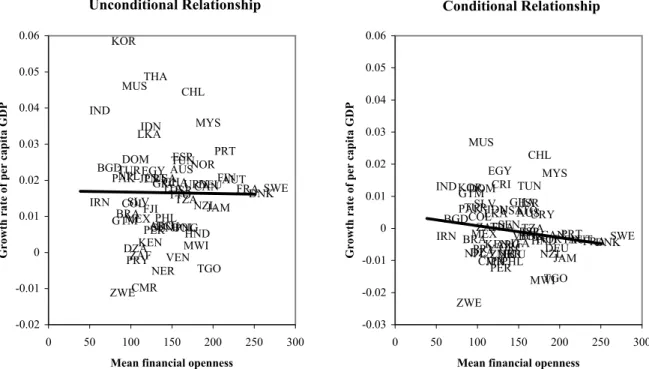
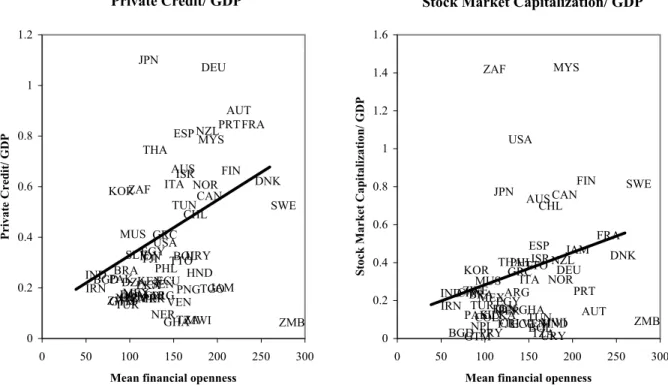
Figure 5A shows that there is no systematic relationship between the average level of de facto financial openness and growth during the period of globalization (defined here as 1985-2004).13 Controlling for standard growth determinants makes little difference (right panel).
13 We excluded from these plots a few countries that were outliers, mostly those with very high levels
of financial openness relative to GDP (see the Data Appendix). Including all of the countries in our sample strengthened (or left essentially unchanged) all of the results reported here. We do not
When one compares average GDP growth with the change in the financial openness measure from 1985 to 2004, however, there appears to be a weak positive association, consistent with the general wisdom that economies that integrated into global financial markets grew faster (Figure 5B). But once other growth determinants are controlled for, this relationship
vanishes. There is of course considerable endogeneity embedded in regressions of this sort, but they do clarify the point taken from the literature based on cross-country growth
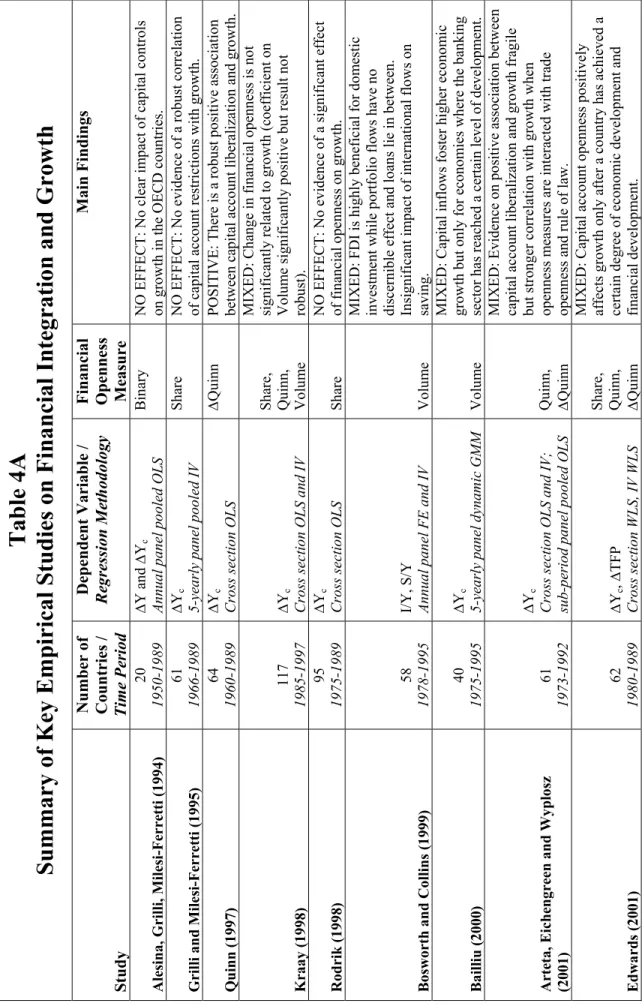
regressions that financial integration by itself may not be the key to high growth.14 In Table 4A, we provide an overview of the literature that aims to establish a causal
relationship between financial openness and growth. While some of these studies conclude that there are growth benefits associated with international financial integration, the majority of them tend to find no effect or a mixed effect (results that are not robust across alternative specifications) for developing countries. This confirms our earlier claim that, if financial integration has a positive effect on growth, it is apparently not robust, once the usual determinants of growth are controlled for.
Growth effects of coarse versus finer de jure measures
Why do different studies reach such diverse conclusions about the importance of financial integration in affecting long-run economic performance? A key issue that we noted earlier is related to the measurement of financial integration. Some widely used de jure measures are quite coarse and may not capture the true extent of international financial integration. As discussed by Edison, Klein, Ricci, and Slok (2004), empirical studies using finer (more informative) de jure measures of capital account openness appear to reach more positive results about the impact of financial integration on economic growth than those that employ binary measures. For example, Rodrik (1998) finds that capital account liberalization has no significant effect on economic growth, but his analysis is based on a binary measure of capital controls. Employing a finer, and presumably more informative, version of the same openness measure, Quinn (1997) documents a positive association between capital account liberalization and economic growth.
formally examine the effects of outliers as these plots are meant just to be descriptive and do not constitute formal empirical evidence.
14 An alternative approach is to look at specific country experiences. Prasad, Rogoff, Wei, and Kose
(2003) analyze the growth performance of the fastest and slowest growing (or fastest declining) economies during 1980–2000 and the status of their financial openness. They conclude that a high
level of financial integration is not a necessary condition for attaining high growth. China and India
achieved high growth rates despite limited and selective capital account liberalization. Mauritius and Botswana also had strong growth rates despite being relatively closed to financial flows. Financial
integration is apparently also not a sufficient condition for attaining high growth. For example, Jordan
and Peru became relatively open to foreign capital flows during this period; yet their economies contracted. Bakker and Chapple (2002) and Ariyoshi et al. (2000) review the experiences of several industrial and developing countries, respectively, with the process of capital account liberalization.
De facto versus de jure measures
Among the studies that use both de jure and de facto measures, specifications where capital account openness is measured using de facto measures tend to lend more support for the potential growth enhancing effects of financial integration than those employing de jure measures (see Kraay, 1998; O’ Donnell, 2001; and Edison, Levine, Ricci, and Slok, 2002). The fact that studies using finer de jure measures and de facto measures find more evidence of positive growth effects suggests that appropriate measurement of financial integration is crucial for uncovering growth effects. It also suggests that the nature of financial
integration—what types of inflows and outflows are permitted—may have an important bearing on the growth outcomes. We return to this later, but flag this as an area where more systematic research would be useful.
Country coverage
There are also materially important differences in the coverage of countries across studies. Some studies focus exclusively on advanced countries, a few consider developing and emerging market countries, and others use a combination of all three groups. While Quinn (1997) finds that capital account liberalization tends to have a positive impact in all
countries, Edwards (2001) and Edison, Klein, Ricci, and Slok (2004) argue that its effect is very limited in less developed countries. Arteta, Eichengreen and Wyplosz (2003), on the other hand, find no relationship between the level of development and the growth effects of capital account liberalization. We return to this issue in Section IX, when we discuss in more detail how the growth benefits of capital account liberalization may be influenced by specific country characteristics, many of which are of course related to the level of development. Time period
The time period covered by different empirical analyses is another source of variation in results. Some studies use data going back to the early 1950s (Alesina, Grilli, and Milesi-Ferretti, 1994), while others limit their examination to the post-1986 period (Klein and Olivei, 2006). Longer time spans are presumably more appropriate for studying the impact of international financial integration on economic growth. At the same time, one must keep in mind that capital flows to developing countries have really taken off only in the last two decades. The choice of sample period appears to make a big difference. For example, comparing the studies by Rodrik (1998) and Quinn (1997) which arrive at diametrically opposed conclusions, Eichengreen (2001) observes that Quinn’s sample coverage begins in 1960 and Rodrik’s in 1975. Even though both studies use a sample ending in 1989, the impact of the debt crises of the 1980s receives a higher weight in Rodrik’s study since the span of his dataset is much shorter.
Differences in methodologies
Differences in empirical methodologies could also account for some of the variations in results across papers, especially given the large number of potential pitfalls in reduced-form
cross-country regressions. While some studies point to the importance of capturing temporal effects associated with financial integration using dynamic regression models (McKenzie, 2001), others emphasize the need to account for nonlinear interactions between financial integration and various factors affecting economic growth (Klein, 2005). Edison, Levine, Ricci, and Sløk (2002) employ a variety of statistical methodologies that allow them to deal with several econometric problems, including possible reverse causality—i.e., the possibility that any observed association between financial integration and growth could result from the mechanism that faster growing economies are more likely to liberalize their capital
accounts.15 After a battery of statistical analyses, they conclude that there is no robustly significant effect of financial integration on economic growth, although de facto measures of integration do tend to generate some results showing positive growth effects.
Investment as an alternative dependent variable
Another important difference across empirical studies is related to the choice of dependent variable. The studies we have summarized so far look at the relationship between financial integration and GDP growth. Is there evidence that financial integration boosts investment growth, as predicted by the neoclassical model? Bosworth and Collins (1999) and
Borenzstein, De Gregorio, and Lee (1998) find that there is a strong positive association between certain types of financial integration and investment growth. In particular, their findings suggest that there exists an almost one-for-one relationship between FDI flows and domestic investment. The relationship between aggregate financial flows (as opposed to just FDI) and investment growth appears to be smaller and less robust. Mody and Murshid (2005) confirm the positive relationship reported in earlier results, but their results suggest that the impact of capital inflows on growth has been declining over time.
Summary of the evidence on growth benefits
Our reading of this large literature based on aggregate data is that it remains difficult to find robust evidence that financial integration systematically increases growth, once other
determinants of growth are controlled for. Nevertheless, the weight of the evidence seems to be gradually shifting towards finding positive marginal effects on growth, especially when financial integration is measured using de facto or finer de jure measures, when data over longer time periods are used, and when interaction terms accounting for supportive conditions (such as good policies and institutions) are properly included in cross-country regression frameworks. We will expand on these themes later in the paper.
We should note, however, that potential endogeneity between financial integration and growth remains a problematic issue even in studies that do find a positive association
15 They use a generalized method of moments estimation procedure in which, under certain
assumptions, lagged values of changes in the explanatory variables can be used as instruments to control for potential endogeneity of all of the explanatory variables.
between these variables. This problem may ultimately be intractable if one relies solely on macroeconomic data; looking at more disaggregated data may be one way out. Another possibility, as we will discuss later, is that it is very difficult, even at a conceptual level, to make strong causal statements about the consequences of financial globalization,
independent of whether macro or micro data are used. V.2 Effects on Volatility
Capital account liberalization is believed to have played an important role in fomenting financial crises and has been indicted by some observers as the proximate cause for the crises experienced by various emerging markets over the last decades. Interestingly, there is little empirical evidence to support the view that capital account liberalization by itself increases vulnerability to crises. While crisis episodes receive most of the attention, however, they are just particularly sharp manifestations of the more general phenomenon of macroeconomic volatility. Here the results are less favorable--there is no evidence that financial globalization has delivered on the promised benefit of improved international risk sharing and reduced volatility of consumption.
Crises
Some papers that have analyzed the effects of capital controls on susceptibility to financial crises have found that countries with capital controls are in fact more subject to crises. But this could simply be because of a “selection effect”—often it is countries with poor
macroeconomic fundamentals that put controls in place to try and insulate themselves from crises. Glick, Guo and Hutchison (2006) address this issue--they find that capital account openness reduces the probability of currency crises, even after controlling for selection bias in terms of how macroeconomic policies influence the existence of capital controls.16 The
relationship between capital controls and crises could also reflect the fact that some of the countries are actually more integrated in terms of de facto measures of integration (capital flight) and that capital controls therefore do not insulate them from crises.
Edwards (2005) examines this issue using a more sophisticated measure of de jure financial openness that attempts to incorporate some notion of the intensity of capital controls. He looks at two manifestations of external crises—sudden stops of capital inflows and current account reversals. He finds no systematic evidence that countries with higher capital mobility tend to have a higher incidence of crises, or tend to face a higher probability of having a crisis, than countries with lower mobility. In subsequent work, Edwards (2006) concludes that there is no evidence that the output costs of currency crises are smaller in countries that restrict capital mobility.
16 These authors use a binary capital account openness indicator based on the IMF’s AREAER.
Whether this relationship holds up with de facto measures, which we have argued are more appropriate measures of integration, remains to be seen.
While currency crises have been emphasized in the literature on the risks of capital account liberalization, it is worth noting that banking crises account for about one-third of financial crises over the last three decades and that their frequency increased in the 1980s and 1990s (Kaminsky and Reinhart, 1999). Banking crises tend to be more disruptive--Hutchison and Noy (2005), for instance, find that banking crises generally have larger adverse effects on output growth than currency crises. Glick and Hutchison (2001) explore the relationships between these two types of crises—one of their conclusions is that banking crises are a good indicator of future currency crises, while the reverse is not necessarily true. Furthermore, there appears to be little evidence that capital account liberalization by itself affects vulnerability to banking crises; moreover, the adverse effects of banking crises seem to be weaker for countries with open capital accounts (Bonfiglioli and Mendicino, 2004).
In sum, there is little formal empirical evidence to support the oft-cited claims that financial globalization in and of itself is responsible for the spate of financial crises that the world has seen over the last three decades. Of course, as we will discuss in more detail below, the interaction between capital account liberalization and other policy choices (e.g., fixed exchange rate regimes that are not well supported by other macroeconomic policies) could, under certain circumstances, spell trouble for a developing economy.
Volatility
Turning to volatility more broadly, there has been a well-documented trend decline in macroeconomic volatility in most of the major industrial economies since the mid-1980s (Doyle and Faust, 2005), although the reasons for this decline are still a matter of debate. Output volatility seems to have been on a declining trend in emerging market and developing economies as well. However, the existing evidence based on papers using a variety of
regression models, different country samples and time periods leads to the conclusion that there is no systematic empirical relationship between financial openness and output volatility, which is, in a sense, consistent with the predictions of theory.17
Kose, Prasad and Terrones (2003b) confirm the major trends in the evolution of volatility dynamics reported in earlier studies, but also find that, during the 1990s, average declines in output growth volatility were smaller for emerging markets than for either industrial or low-income developing economies. More importantly, they find that the ratio of consumption growth volatility to income growth volatility increased during the recent period of
globalization for emerging market economies (and remained flat for the other two groups). What is surprising is not just that the volatility of consumption rose (perhaps because of crises experienced by some of these economies, and the associated rise in income volatility) but that it increased by more than income volatility. This is a striking result in that it runs
17 See Razin and Rose (1994), Easterly, Islam, and Stiglitz (2001), and Buch, Dopke, and Pierdzioch
exactly counter to one of the presumed theoretical benefits of financial integration—that it allows countries to share income risk and smooth consumption.18
These authors also find that the relative volatility of consumption growth increases with the degree of financial openness, but only up to a certain threshold level of integration. At higher levels of financial integration, countries do seem to accrue the benefits of financial
integration in terms of improved risk sharing and better consumption smoothing relative to autarky. Most emerging market economies are, however, below this threshold level of financial integration while most industrial economies are above it.19
V.3 Comovement
A number of papers show that the synchronicity of national business cycle fluctuations (in both industrial countries and emerging market economies) and the relative importance of global factors for these fluctuations have increased during the period of globalization.20 Imbs (2006) documents that financial integration has led to higher cross-country consumption and output correlations among industrialized economies. Kose, Prasad and Terrones (2003a) document changes in output comovement across a broader group of industrial and developing economies and link these changes to financial integration. Contrary to the predictions of theory, however, Kose, Prasad, and Terrones (2003a, 2004) document that, on average, cross-country correlations of consumption growth did not increase in the 1990s, precisely when financial integration would have been expected to result in better risk-sharing opportunities for developing economies.
These findings on the cross-country comovement of output and consumption complement the results on the effects of financial integration on consumption and output volatility and
18 A number of recent theoretical papers have attempted to explain the positive association between
financial integration and the relative volatility of consumption growth documented by Kose, Prasad, and Terrones (2003b). For instance, Levchenko (2004) and Leblebicioglu (2006) consider dynamic general equilibrium models where only some agents have access to international financial markets. In both models, capital account liberalization leads to an increase in the volatility of aggregate
consumption since agents with access to international financial markets stop participating in risk-sharing arrangements with those who do not have such access.
19 Bekaert, Harvey, and Lundblad (2006) find that, following equity market liberalizations, there is a
decline in consumption volatility. These results differ from those of Kose, Prasad and Terrones (2003b) due to differences in the definitions of financial integration, the measures of consumption volatility, data samples, and methodologies. The results in Bekaert, Harvey, and Lundblad (2006) suffer from the same problems noted about their work on the impact of equity market liberalizations on economic growth (see discussion in Section VI).
20 See Stock and Watson (2003), Bordo and Helbling (2003), Kose, Otrok, and Whiteman (2005) and
suggest that, in order to utilize the risk-sharing benefits of financial integration, developing economies may have to attain higher levels of financial integration.
To summarize, the macroeconomic evidence on the growth and volatility effects of financial integration remains sobering although there are some grounds for optimism in more recent work. But most of the evidence so far is based on cross-country regressions that lump together different types of capital flows. Is there a different way to approach the issue?
VI. How Does the Composition of Capital Flows Matter?
An alternative line of inquiry into the effects of financial globalization is based on the notion that not all types of capital flows are created equal. Flows that have equity-like features—i.e., FDI and portfolio equity flows—are not only presumed to be more stable and less prone to reversals (Wei, 2005), but are also believed to bring with them many of the indirect benefits of financial globalization such as transfers of managerial and technological expertise. As we discussed in Section IV, the evidence for the former proposition—that FDI and equity flows are more stable than debt financing—is far from conclusive.
In any case, portfolio debt flows have acquired black sheep status, especially since currency and maturity mismatches related to external debt are seen as proximate determinants of many emerging market crises. As we have documented earlier, there have been substantial changes in the composition of financial flows over time. So what does the evidence show about the macroeconomic effects of different types of flows? We now review the literature on this question, studying the impact of each of these types of flows in turn.
VI.1 Portfolio Equity Flows
The rising importance of portfolio equity flows to emerging markets has motivated a number of researchers to examine the growth effects of equity market liberalizations. Most of the papers in this rapidly-expanding literature suggest that portfolio equity flows have a significant positive impact on output growth. Whether the estimated growth effects (in macroeconomic data) of equity market liberalizations could be picking up the effects of other factors—especially other reforms that tend to accompany these liberalizations—remains, in our view, an open question. On the other hand, there is now a growing body of micro
evidence (using industry- and firm-level data) supporting the macro evidence on the benefits of equity liberalizations. Some of these papers also document the empirical relevance of various theoretical channels linking equity market liberalization to economic growth— including through increases in investment growth and TFP growth. Table 4B provides a summary of the key papers discussed in this section.
Evidence from macro data
Bekaert, Harvey and Lundblad (2005; henceforth BHL) document that equity market liberalizations have a positive effect on growth.21 Using a sample that covers 95 countries
over the period 1980-1997, they conclude that equity market liberalizations increase GDP growth by about 1 percentage point. Using a longer sample and a different methodology, Li (2003) finds that such liberalizations lead to a 0.6 percentage point increase in GDP growth. A potential concern related to this work based on cross-country regressions is that many emerging markets undertook equity market liberalizations around the same time that they instituted numerous other policy and structural reforms. Henry (2003a, 2003b) argues that it is not possible to explain the strong result in BHL using standard growth accounting
techniques as this would require an elasticity of output with respect to capital of about 1. He notes that equity market liberalizations are often part of a larger reform program and that these reforms could have a positive impact on productivity, leading to an increase in output growth that is compatible with the predictions of standard production theory.
To address these concerns, BHL control for other determinants of growth, including financial development, quality of legal institutions, macroeconomic policies, and broader capital account and trade liberalizations. They find that capital account liberalization has no significant effect on growth. The inclusion of other factors dampens the magnitude of the growth effects of equity market liberalizations but the effect is still statistically significant and in the range of 0.7-0.9 percentage points.22 Henry (2003a), however, finds these sensitivity experiments unconvincing since BHL do not use binary variables to capture the effect of many other one-off reforms, especially trade reforms and inflation stabilizations (for instance, they use a continuous measure of trade openness). Henry argues that, since BHL undertake a before-and-after evaluation of the growth effects of equity market liberalizations, they should conduct the same before-and-after event analysis for other reforms as well. Other macroeconomic evidence on the growth effects of equity market liberalizations is more mixed. Martell and Stulz (2003) note that equity market liberalizations can be seen as
21 Equity market liberalizations are defined as events that make shares of common stock of local firms
available to foreign investors. Commonly-used dates, drawn from Henry (2000) and Bekaert and Harvey (2000), include official liberalization dates and dates of “first sign” of liberalization based on events such as the launching of a country fund or American Depository Receipt (ADR)
announcement. ADRs are securities that are traded in the United States but represent underlying stocks listed in a foreign country.
22 BHL also attempt to tackle potential endogeneity between the liberalization decision and growth
performance—an issue emphasized by Martell and Stulz (2003). They create a proxy for a country’s exogenous growth opportunities, based on a country’s industry mix and global growth prospects for each industry (inferred from the price to earnings ratios of global industry portfolios). They find that inclusion of this variable in the regressions, which they argue is an indirect way of controlling for the endogeneity of the liberalization decision, does not affect their main result.
country initial public offerings (IPOs) since, like company IPOs, these events make shares in existing firms available to a new class of investors—foreign investors. These authors
examine country excess returns, defined as excess returns on a dollar-denominated total return index for each country, relative to excess returns of a global portfolio and an emerging markets index. They report that, following equity market liberalizations, country excess returns are high for the first 2-4 years but then turn marginally negative over longer horizons. Edison, Klein, Ricci and Slok (2004) confirm the positive association between equity market liberalization and output growth but find that this result disappears when they introduce a measure of government reputation as a regressor. When they interact the liberalization
measure with income, they recover its positive impact on growth in middle income countries. Recent research also provides some cross-country evidence about the empirical relevance of various channels linking equity market liberalization to economic growth. There is evidence, consistent with the predictions of international asset pricing models, that stock market liberalizations reduce the cost of capital.23 Using a sample of 12 emerging market countries and an event study approach, Henry (2000a) shows that, on average, equity price indexes register a substantial increase in the months preceding equity market liberalizations, implying that these liberalizations are associated with a fall in the cost of equity capital. Bekaert and Harvey (2000) analyze changes in the dividend yield after liberalizations and report that the cost of capital goes down by 5 to 75 basis points.
There is also some evidence that equity market liberalizations promote investment growth. Henry (2000b), for instance, finds that, in 9 (10) out of 11 emerging market countries in his sample, growth rates of private investment are larger in the first (second) year after an equity market liberalization than they were before liberalization. Moreover, he finds that the mean growth rate of real private investment in the three years immediately following equity market liberalizations is 22 percentage points higher than the sample mean. Alfaro and Hammel (2006) find that equity market liberalizations boost imports of machinery going into domestic equipment investment.
Evidence from micro data
We view research using industry- and firm-level data as a more promising way of getting a handle on the growth-enhancing effects of equity market liberalizations. This line of
empirical research has turned up encouraging results. For example, using industry-level panel data from the manufacturing sectors of 31 emerging market economies over the period 1981-98, Gupta and Yuan (2005) find that, following such liberalizations, industries that are technologically more dependent on external finance (the difference between investments and
23 First, such a liberalization could increase the volume of capital inflows, which, in turn, should
decrease the domestic risk-free rate. Second, increased risk sharing opportunities between foreign and domestic investors might help to diversify risks, reducing the equity risk premium. Third, as capital flows increase and liquidity in the domestic stock market increases, the equity risk premium could fall further. See Stulz (1999a, 1999b) and Kim and Singal (2000) for additional empirical evidence.
cash generated from operations) experience higher growth. They also find that liberalizations have a larger impact on the growth of industries facing better growth opportunities (based on industry-level global demand indicators). When the liberalization decision is assumed to be endogenous, however, only the former result survives, suggesting that countries may time the liberalization decision to coincide with high growth in certain industries.
Hammel (2006) provides additional evidence that, following equity market liberalizations, industries that are more dependent on external finance grow faster in countries with relatively higher stock market capitalization rates. She also examines the impact of other reforms, including domestic financial reforms and capital account liberalization, on the robustness of her main findings. She concludes that, while such reforms do have significantly positive effects on industry growth, their interaction terms with dependence on external finance are not significant, and they do not affect the growth impact of equity market liberalizations.24 Using firm-level data, Chari and Henry (2004, 2005) find that equity market liberalizations reduce the cost of equity capital and increase investment in a sample of 11 emerging market countries. They find that these events reduce the systematic risk associated with holding stocks in emerging markets and leads to an average stock price increase of about 15 percent. The latter paper documents that the growth rate of the capital stock of a typical firm exceeds its pre-liberalization mean by an average of 5.4 percentage points in the three-year period following liberalization.
Mitton (2006) argues that equity market liberalization gives firms in emerging markets access to a new financing channel, increasing opportunities for investment and growth. Moreover, foreign investors tend to demand higher governance standards, which could have a positive impact on profitability, efficiency, and other measures of operating performance. In his empirical work, Mitton finds that firms with stocks that are open to foreign investors register higher levels of sales growth, investment, and efficiency, and lower leverage ratios.25 Summary, and a caveat
Our view is that research on the effects of equity market liberalizations is quite promising, although even in this area disaggregated evidence may have a better chance of pinning down
24 Gupta and Yuan (2005) and Hammel (2006) use the Rajan-Zingales (1998) criterion to determine
the level of dependence of different industries on external finance.
25 Mitton employs firm-specific liberalization dates on which individual stocks become open to
foreign investors. These dates are based on data from the International Finance Corporation, which specifies the extent of openness of each stock to foreign investors and determines dates on which a firm’s stock can gain “investable” status, after analyzing country- and firm-level investment barriers. The use of firm-specific liberalization dates allows Mitton to account for the gradual nature of liberalization programs. It also mitigates potential contamination of the results by other liberalization and reform programs, although the firm-specific dates may still create endogeneity problems.
the channels through which such liberalizations generate positive effects. In addition to the problem that much of this literature is still focused on macroeconomic evidence, virtually all of it is based on de jure measures of equity market liberalization. We have already noted, in the context of the measurement of broader capital account liberalization, why de facto measures may be more meaningful in many circumstances.
Why is it that, using similar de jure measures, the growth effects of broader capital account liberalization are found to be quite weak while those of equity market liberalization are remarkably and uniformly strongly positive? As noted above, one possibility is that equity market reforms may take place only when governments feel they have supportive conditions in place. Analyses based on micro data indicate that the productivity-enhancing effects of equity market liberalizations are greater than those of broader capital account liberalizations. Nevertheless, while the evidence does suggest that equity market liberalizations may have an independent impact on growth, we are skeptical that these liberalizations by themselves can generate as large growth effects as has been reported by some authors such as BHL.
VI.2 FDI
We turn next to the presumed poster child for the benefits of financial globalization—foreign direct investment (FDI). As we discussed earlier, the relative importance of FDI flows has risen significantly in recent years, making it the most important form of private international financing for emerging market economies. There is a strong presumption in theory that FDI should yield more benefits than other types of financial flows since, in addition to
augmenting domestic capital stock, it has a positive impact on productivity through transfers of technology and managerial expertise. It has also been argued that FDI tends to be the least volatile of the various types of capital flows, making countries less vulnerable to sudden stops or reversals of flows.26
In parallel with the rapid growth of FDI flows, a large empirical literature has flourished seeking to find evidence in support of the theoretical benefits of these flows. Although the evidence has in general been mixed, recent studies, using more sophisticated methodologies and micro-level datasets, find more favorable evidence of benefits from FDI. More
importantly, the literature has been reasonably successful in identifying the conditions necessary to help developing countries fully utilize the potential benefits of these flows.27 Table 4C provides a summary of the key studies in this literature.
26 Moreover, FDI could help ease firms’ financing constraints. Harrison, Love and McMillan (2004)
document that FDI is associated with a significant reduction in financing constraints, especially in low income countries. Blalock and Gertler (2005) find that FDI could mitigate the adverse effects of financial crises by helping firms maintain continuous access to credit through their parent companies.