3D Ordinal Constraint in Spatial Configuration
for Robust Scene Recognition
Ching Lik Teo
DSO National Laboratories
[email protected]
Shimiao Li, Loong-Fah Cheong, Ju Sun
Department of Electrical and Computer Engineering
National University of Singapore
{
shimiao, eleclf, idmsj
}
@nus.edu.sg
Abstract
This paper proposes a scene recognition strategy that integrates the appearance based local SURF fea-tures and the geometry based 3D ordinal constraint. Firstly, we show that spatial ordinal ranks of 3D land-marks are well correlated across large camera view-point and view direction changes and thus serve as a powerful tool for scene recognition. Secondly, ordinal depth information is acquired in a simple and robust manner when the camera undergoes a bio-mimic ‘Turn-back-and-Look’(TBL) motion. Thirdly, a scene recogni-tion strategy is proposed by combining local SURF fea-ture matches and global 3D rank correlation coefficient into the scene recognition decision process. The perfor-mance is validated and evaluated over four indoor and outdoor databases.
1
Introduction
The problem of scene recognition is defined as the ability to recognize matches between an input query (test) image and reference images in an image database. It has important applications in robot visual navigation [9] and image retrieval [10].
A successful scene recognition strategy should pos-sess two crucial characteristics. Firstly, the strategy should be robust to various types of image distortions due to changes of viewpoint, view direction, illumina-tion and even moderate change of the scene environ-ment itself. Secondly, it should be able to reliably dis-criminate dissimilar scenes. Unfortunately, these two characteristics usually conflict each other – to achieve better robustness, one has to sacrifice the algorithm’s discrimination power and vice versa. Another impor-tant issue is the generality of the recognition algorithm. A general scene recognition strategy should be able to
deal with both indoor and outdoor environments. To deal with the dilemma, many researchers have been combining the appearance based local feature in-formation [8] [1] together with the geometry based semi-local or global spatial information [2] [7]. Most of the works are limited to 2D spatial configurations, which are unreliable when the perspective effect is obvi-ous. On the other hand, epipolar constraint and homog-raphy seem to be the few 3D spatial constraints used in feature point based scene recognition [4]. However, these 3D constraints are computationally expensive and not robust, especially when large number of mismatches exist.
In this paper, we propose a scene recognition strat-egy that integrates the appearance based local SURF features [1] and the geometry based global3D ordinal constraint. InSec.2, the 3D ordinal constraint based on qualitative spatial information of the scene is proposed. InSec.3, ordinal depth is acquired in a simple and ro-bust manner when the camera undergoes a bio-mimic ‘Turn-back-and-Look’ (TBL) motion. Sec.4 presents the details of the scene recognition strategy. InSec.5, the performance is validated on four indoor and outdoor databases. Results show that 3D ordinal constraint im-proves the scene recognition performance compared to a simple matching based method and a matching plus epipolar constraint method.
2
3D Ordinal Constraint in Spatial
Con-figuration
In this section, we propose the3D ordinal constraint
which is based on 3D qualitative spatial information and show that it can serve as a powerful tool in scene recog-nition tasks.
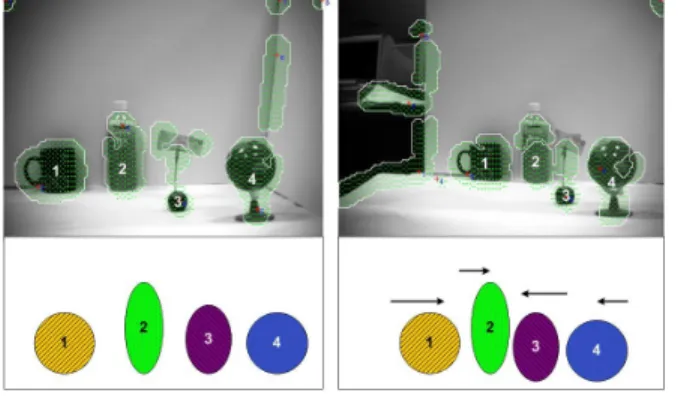
Figure 1.Landmark ranks (in x dimension) under slight viewpoint change.
2.1
Landmark Ranks and Rank Correlation
Coefficient (RCC)
For simplicity, we use an intuitive way to illustrate the idea oflandmark ranks. In fig. 1, two images of a scene taken from different viewpoints are shown. The image on the right is taken when the camera has under-gone a slight viewpoint change to the right. The num-bers show the ranks of the landmarks according to thex coordinate of the landmarks’ position in the image. The metric measurement of the landmarks’ position is con-verted to an ordinal scale [11]. Hence only the ranks of the landmarks’ positions are of concern. The arrows in Fig.1 show clearly how the positions of the four land-marks have changed as the camera shifts to the right. Although the landmarks’ absolute positions change in thexdirection, their ranks remain invariant.
In practice, however, due to viewpoint changes and mismatches, ranks of landmark matches between dif-ferent views of a scene may suffer from some perturba-tions. Nonetheless, the landmark ranks calculated from the reference image remains correlated to some degree to the landmark ranks calculated from a positive test image. This correlation imposes anordinal constraint
on the spatial configuration of the landmarks. In sta-tistics, correlation between different ranks is measured by therank correlation coefficient (RCC)[6], which is a variable within[−1,1]. 1 (or −1) indicates perfect agreement(or disagreement) between the two ranks. 0
indicates complete independence. Many methods have been proposed to calculate RCC, here we use the two most widely used - Spearman’sρand Kendall’sτ[6].
2.2
3D Rank Correlation Coefficient (3D
RCC)
In this paper, we measure the landmark ranks and RCC in three dimensions: two image dimensionsxand y, and the depth dimensionZ. We denote X, Y, Z as axis in the camera coordinate system. It is intuitive and can be mathematically proven that perturbations in the landmark ranks on different dimensions (x, y, Z)
are likely to occur under different types of viewpoint change and in different types of scene configurations. We summarize the characteristics as follows:
* Ranks inx(or y) dimension are likely to be per-turbed by camera translation. The sensitivity de-pends on thein-depthness of the scene:DX= 44ZX (DY = 44ZY)(see Fig. 2). The bigger the DX (DY), the higher the sensitivity. The ranks are however invariant to pure camera rotation around the cameraXorY axis.
* Ranks in Z dimension are likely to be perturbed by camera rotation around theX orY axis. The bigger theDX andDY, the lower the sensitivity. In this case, the ranks are invariant to pure camera translation.
* Camera cyclotorsion (rotation aroundZaxis) may perturb ranks inxandy dimension but does not perturb ranks inZ dimension.
Therefore, RCC in different dimensions compensates one another. One way to obtain a robust tool for recog-nition for scenes of various in-depthness under all kinds of viewpoint changes is to combine the RCC in three dimensions. In this way, a 3D Ordinal Constraint is imposed on the landmarks. Take Spearman’sρfor ex-ample (similar for Kendall’sτ), we define the3D Rank Correlation Coefficeint (3D RCC)as:
ρ3D=wZρZ+wxρx+wyρy (wZ+wx+wy= 1) (1) The weights wZ,wx,wy can be chosen particularly if some prior knowledge of the reference database and the camera view change are known. If not, we can simply average the three(ρ3D= 13(ρZ+ρx+ρy)). If the or-dinal depth information is not available,wZ can be set to zero, and the 3D RCC then degenerates to 2D.
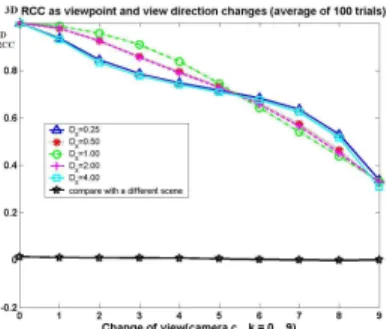
Figure 2 shows 100 3D random points observed un-der typical viewpoint changes in the scene recognition tasks. Figure 3 shows(ρ3D)between the reference view
C0 and the test views Ci, i = 1,2, . . . ,9 in scenes of various in-depthness. The black line shows the 3D RCC between two different scenes under random view-points, which is zero. This shows that 3D RCC can dis-criminate between dissimilar scenes. Furthermore, the
Figure 2. Simulation of 100 3D random points scene under several camera view changes.
invariance of 3D RCC to different scene in-depthness highlights the robustness of the measurement to differ-ent scene configurations, making it a powerful tool for scene recognition.
3
Robust Ordinal Depth Acquisition
-TBL Motion
Since ranks in the depth dimension are used to com-puteρZ in 3D RCC, acquiring ordinal depth in a sim-ple and robust way is a critical issue. In this paper, we recover ordinal depth from the bio-mimic Turn-Back-and-Look (TBL) motionusing standard structure from motion(SFM) technique.
In the face of errors in SFM, Cheong and Xiang [3] showed that there exists generic motion types that ren-der depth recovery more robust and reliable. For lateral movement, although Euclidean reconstruction is diffi-cult, the distortion caused by errors in the motion esti-mates preserves the depth relief, which means that ordi-nal depth is still preserved. The ecological relevance of lateral motion is underlied by the prevalence of lateral motion used by different animals in nature to appreci-ate distances [12]. In the case of bees and wasps, this type of motion is known asTurn-Back-and-Look (TBL) motion. The TBL motion consists of a series of arcs centered about an object of interest, with the direction of translation perpendicular to the line of sight of the insect. TBL is believed to be important for the bees to recognize the scenes on their return trip [10].
We exploit camera TBL motion to recover the or-dinal depth information required for scene recognition purpose. This strategy can also be readily extended to stereo camera systems where the two cameras or eyes are frontally placed. To get reliable ordinal depth infor-mation in this work, all reference and test images in the database consist of two frames taken under camera TBL
Figure 3.3D RCC scores across the camera views for different in-depthness of the scene (average of 100 random trials).
motion. Depth (ZT BL) of each feature point is then re-covered from the optical flow computed from the two frames. The recovered depth may be inaccurate met-rically, however, the ordinal scale depth information is trustworthy and can be used to computeρZin 3D RCC.
4
Scene Recognition Strategy
Our scene recognition strategy(SRS) is a SURF based method combining 3D geometry verification us-ing 3D RCC.
4.1
Constructing the Scene Matrix
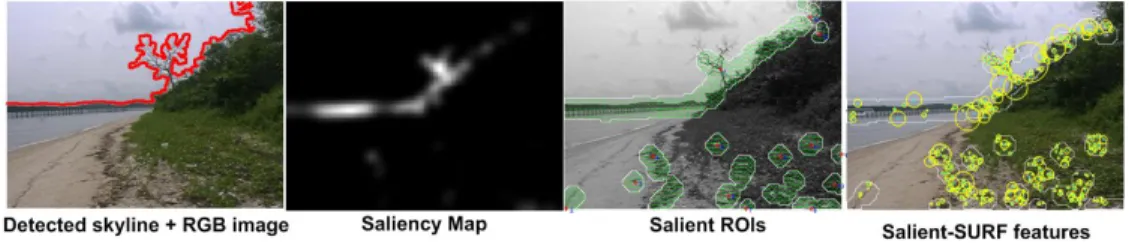
The first step of our SRS is to extract and encode useful regions in the scene for reliable recognition in the later stages. We use a modified version of a com-putational model of human visual saliency [5]. Various image morphological operations are then applied on the saliency map to extract the salient regions which are then encoded using SURF [1] to form ‘salient-SURF’ features (see fig. 4). For improved robustness against illumination changes, the SURF features are detected over the HSV color space. The finalN salient-SURF features are then saved into a compact matrix known as theScene Matrix,sm(c)for thecthcolor space
sm(c) = [locsN×5desN×65ZT BL]N×71, (2)
wherec ∈ {h, s, g} represents the H, S, V color com-ponents. locsis a5D location vector of one SURF fea-ture while desencodes its corresponding 65D SURF descriptor [1]. ZT BL is the depth associated with this feature, obtained through camera TBL motion.
Figure 4.From the original RGB image, we extract the skyline and compute the saliency map. The salient ROIs are then extracted and encoded using SURF features augmented with ordinal depth to form the salient-SURF features.
4.2
Measuring Scene Similarity
Given the reference and the test scenes encoded by their respective scene matrices(sr
m, stm), wheresm rep-resents the scene matrices over the three color spaces, we use the correspondence matching algorithm for SIFT descriptors [8] for efficient matching of the SURF features. To measure the similarity of the reference and the test, we define a similarity measureGc, known as theGlobal Scene Correlation Coefficient:
Gc(srm, s t
m) = (Nmatch/Ntot)×R. (3) whereNmatchandNtotare the number of matches and the total number of features in the test image respec-tively. R = ρ3D+τ3D
2 is the spatial 3D rank correlation
of the matches between the reference and the test im-ages. Equation (3) effectively weighs the 3D RCC by
Nmatch
Ntot , because a large 3D RCC may occur between
2 dissimilar scenes when Nmatch is small. For ideal cases,Gc is close to1for positive scenes and close to
0for negative scenes. In practice, however, the effects of viewpoint changes, mismatches and occlusions often degradeGc.
4.3
Recognition Decision Module
A database of Nref reference scenes will require
Nref pairwise comparisons with the input test scene each of which will use (3) to compute a measure of scene similarity. The results are summarized into a
match statisticmatrixms:
ms= [Nmatch/NtotR Gc]Nref×3 (4)
Thecandidate matchGmax, is the reference scene that yields the largestGc inms. The decision process is as follows:
ifGmax< td, reject the test image;
elseifGmax/G2ndmax< ta, reject the test image;
Table 1. The four databases. (Nref, Npos, Nneg)
refers to the number of reference scenes, positive test scenes, negative test scenes respectively.
Database (Nref, Npos, Nneg) Type IND (18,25,21) Indoor
UBIN (20,63,69) Outdoor coastal SBWR (15,15,16) Outdoor enclosed NS (20,41,52) Outdoor varied
Table 2. Recognition results of the Proposed SRS(SURF + 3D Ordinal Constraint) (%)
Database (ta, td) Pacc Prej Poverall IND (1.1, 0.03) 84.00 90.48 87.24 UBIN (1.3, 0.02) 84.13 91.30 87.72 SBWR (1.2, 0.02) 93.30 100.00 96.65 NS (1.2, 0.01) 92.68 92.31 92.49
elseaccept the test image.
wheretd andta are preset thresholds;G2ndmax is the 2nd largestGcinms.
5
Experimental Results
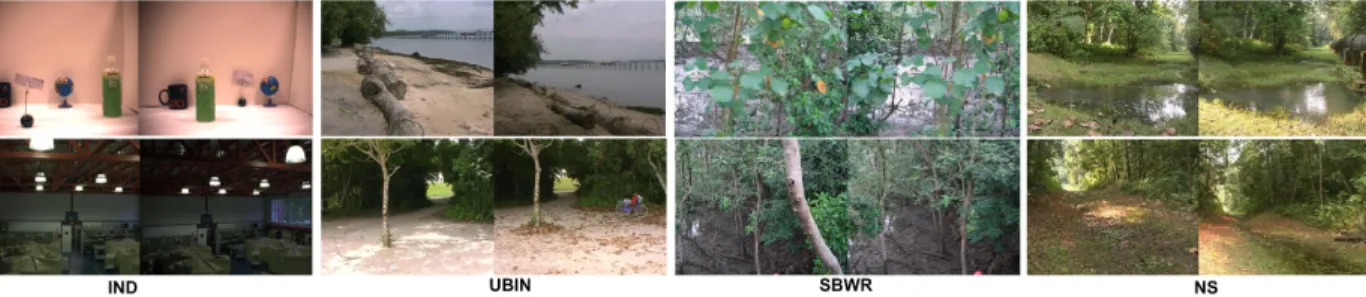
In order to validate the performance of our SRS, four challenging indoor and outdoor databases, with signif-icant image distortions between the test and reference scenes are created (see table 1 and fig. 5).
We evaluate the performance of ourproposed SRS by computing the recognition accuracy in terms of pos-itive acceptance Pacc (%), and negative rejectionPrej (%). Averaging out the results yieldsPoverall(%), the overall recognition accuracy. The results are summa-rized in table 2 (the thresholds shown yield the best overall performance over a range of threshold values).
Figure 5. Various challenging test and reference scenes for the four databases. IND: ambiguous scenes(t) and viewpoint changes(b). UBIN: clear vs hazy overcast skies(t) and shadows vs leaves swept up(b). SBWR: numerous occlusions due to dense vegetation. NS: non-uniform illumination(t) and changes in scene content due to rain and tree fall(b). All the test scenes shown here are successfully recognized.((t)op,(b)ottom).
Table 3. Recognition results of the Simple SRS(SURF Only) (%)
Database (ta, td) Pacc Prej Poverall IND (1.2, 0.03) 76.00 71.43 73.71 UBIN (1.2, 0.01) 69.84 68.12 68.98 SBWR (1.2, 0.02) 80.00 81.25 80.63 NS (1.5, 0.02) 70.73 98.08 84.40
SRS(table 3). Simple SRS uses only the percentage matches Nmatch
Ntot as a similarity measure. One can see
that the recognition accuracy of the proposed SRS is higher and more consistent over the four databases than that of the simple SRS. 3D ordinal constraint thus con-tributes positively in the recognition accuracy.
For further evaluation, we compare the results with that ofepipolar SRS(table 4), which uses SURF match-ing plus RANSAC epipolar constraint to eliminate mis-matches. It can be seen that the proposed SRS outper-forms the epipolar SRS significantly. In addition, the proposed SRS is computationally more efficient than the iterative RANSAC based epipolar SRS. Therefore, 3D ordinal constraint is more effective and efficient than the commonly used epipolar constraint in the scene recognition task.
References
[1] H. Bay, T. Tuytelaars, and L. V. Gool. Surf: Speeded up robust features.ECCV, pages 404–471, May 2006. [2] G. Carneiro and A. D. Jepson. Flexible spatial
config-uration of local image features. PAMI, 29(12):2089– 2104, 2007.
[3] L. F. Cheong and T. Xiang. Characterizing depth distor-tion under different generic modistor-tions. IJCV, 44(3):199– 217, 2001.
Table 4. Recognition results of the Epipolar SRS(SURF + RANSAC based Epipolar Constraint) (%)
Database (ta, td) Pacc Prej Poverall IND (1.2, 0.01) 75.20 71.43 73.32 UBIN (1.2, 0.01) 57.78 68.12 62.95 SBWR (1.2, 0.01) 80.00 81.25 80.63 NS (1.2, 0.01) 80.00 80.77 80.38
[4] R. Hewitt, L. Goncalves, and M. E. Muhich. Enforcing 3-d constraints to improve object and scene recognition.
BMVC, pages 192–201, Sep. 2007.
[5] L. Itti, C. Koch, and E. Niebur. A model of saliency-based visual attention for rapid scene analysis. PAMI, 20(11):1254–1259, 1998.
[6] M. Kendall and J. Gibbons.Rank Correlation Methods, 5th edition. Edward Arnold, 1990.
[7] S. Lazebnik. Local, Semi-local and Global Models for Texture Object and Scene Recognition. PhD thesis, UIUC, 2006.
[8] D. Lowe. Distinctive image features from scale-invariant keypoints.IJCV, 60(2):91–100, 2004. [9] S. Se, D. Lowe, and J. Littler. Vision-based mobile
ro-bot localization and mapping using scale-invariant fea-tures.ICRA, pages 2051–2058, May 2001.
[10] A. Smeulders, M. Worring, S. Santini, A. Gupta, and R. Jain. Content-based image retrival at the end of the early years.PAMI, 22(12):1349–1380, 2000.
[11] S. S. Steven. On the theory of scales of measurements.
Science, 103:677–680, 1946.
[12] R. Voss and J. Zeil. Active vision in insects: an analysis of object-directed zig-zag flights in wasps (odynerus spinipes, eumenidae). J. of Comp. Physio. A, 182(3):377–387, 1998.