Aciom: Application Characteristics-aware Disk and
Network I/O Management on Android Platform
Hyosu Kim, Minsub Lee, Wookhyun Han, Kilho Lee, Insik Shin
∗Dept. of Computer Science KAIST, South Korea
{hskim, minsub, hanwook, khlee}@cps.kaist.ac.kr, [email protected]
ABSTRACT
The last several years have seen a rapid increase in smart phone use. Android offers an open-source software platform on smart phones, that includes a Linux-based kernel, Java applications, and middleware. The Android middleware provides system libraries and services to facilitate the development of performance-sensitive or device-specific functionalities, such as screen display, multime-dia, and web browsing. Android keeps track of which applications make use of which system services for some pre-defined function-alities, and which application is running in the foreground attract-ing the user’s attention. Such information is valuable in capturattract-ing application characteristics and can be useful for resource manage-ment tailored to application requiremanage-ments. However, the Linux-based Android kernel does not utilize such information for I/O re-source management. This paper is the first work, to the best of our knowledge, to attempt to understand application characteris-tics through Android architecture and to incorporate those char-acteristics into disk and network I/O management. Our proposed approach,Aciom(Application Characteristics-aware I/O Manage-ment), requires no modification to applications and characterizes application I/O requests as time-sensitive, bursty, or plain, depend-ing on which system services are involved and which application receives the user’s focus. Aciomthen provides differentiated I/O management services for different types of I/O requests, supporting minimum bandwidth reservations for time-sensitive requests and placing maximum bandwidth limits on bursty requests. We present the design ofAciomand a prototype implementation on Android. Our experimental results show thatAciomis quite effective in han-dling disk and network I/O requests in support of time-sensitive applications in the presence of bursty I/O requests.
∗A corresponding author
Permission to make digital or hard copies of all or part of this work for personal or classroom use is granted without fee provided that copies are not made or distributed for profit or commercial advantage and that copies bear this notice and the full citation on the first page. To copy otherwise, to republish, to post on servers or to redistribute to lists, requires prior specific permission and/or a fee.
EMSOFT’11, October 9–14, 2011, Taipei, Taiwan.
Copyright 2011 ACM 978-1-4503-0714-7/11/10 ...$10.00.
Categories and Subject Descriptors
C.3 [Special-Purpose and Application-Based Systems]: Real-time and embedded systems; D.4.3 [Operating Systems]: File Systems Management—Access Methods; D.4.4 [Operating Sys-tems]: Communications Management—Network Communication
General Terms
Algorithms, Design, Performance
Keywords
Android Platform, Application Characteristics Awareness, I/O Man-agement
1.
INTRODUCTION
The last two decades have seen an explosive spread of mobile phones all over the world. Recently, a rapidly growing portion of mobile subscribers uses smart phones for more advanced comput-ing ability. Smart phone users are projected to overtake feature phone users in the US at the end of this year [5]. Android [2] is introduced to deliver an open-source software platform tailored to mobile devices. Android is reported to be the world’s best-selling smart phone platform [3] and projected to take 49% of the smart phone market in 2012 [4].
The Android platform provides a whole open-source software stack, from operating systems through middleware to applications. Android applications, written in Java, run on their own separate vir-tual machines over a Linux-based kernel. The Android middleware provides access to a set of native libraries for performance opti-mization and third-party libraries such as OpenGL and Webkit. In many mobile devices, including smart phones, the applications run-ning in the foreground usually perform user-interactive tasks. The Android middleware keeps track of which application is running in the foreground and which ones are in the background, and the ker-nel makes use of this information in CPU scheduling and memory management to better support the foreground application’s respon-siveness. However, the Android platform does not yet incorporate such information into I/O management, although I/O management is quite critical to the performance of interactive embedded appli-cations because embedded devices are generally subject to insuffi-cient disk and network capacity.
For example, interactive applications, such as multimedia appli-cations, demand time-predictable handling of their I/O requests. I/O-intensive applications, such as download managers, often make
bursty I/O requests, striving to consume all the spare bandwidth in the system. I/O requests can be of different priorities depending on the applications running in the system. The I/O managers of the existing Linux-based Android kernel are designed to maximize throughput by handling I/O requests in a fair manner, without pay-ing attention to the characteristics of the I/O requests. This could easily lead to cases in which, for example, the I/O requests of a multimedia application experience longer latencies than their re-quirements and the application fails to deliver its intended quality-of-service (i.e., yielding screen delays and pauses).
Many studies [7, 8, 11, 18] have shown that operating systems can make better resource management decisions when the charac-teristics of resource requests are available to the operating systems. For instance, the Redline operating system [18] expects users or system administrators to come up with the resource requirement specifications of interactive applications. For example, the specifi-cation of an interactive multimedia applispecifi-cation, mplayer, can indi-cate its CPU requirement of 5ms out of every 30ms period. Redline then makes use of this specification in determining the scheduling parameters of the application, including its disk request priority. However, such a specification requires manual efforts of expertise upon every different system environment. The mClock hypervisor I/O manager [7] introduces a scheduling algorithm that can accom-modate the different characteristics of disk requests, assuming that each virtual machine is able to determine the specification parame-ters of its disk request requirements. However, this study [7] does not address how to determine such specification parameters appro-priately.
The goal of our paper is to provide differentiated I/O manage-ment services for Android applications according to their character-istics. For example, prioritized or guaranteed I/O management ser-vices are provided for user-interactive applications such that those applications can produce prompt or delay-bounded responses to users. In view of this goal, we developedAciom (Application Characteristics-aware Disk and Network I/O Management) on the Android platform.Aciomtakes advantage of the Android architec-ture to understand the characteristics of applications dynamically. The Android middleware offers various system services to facil-itate application development. For example, multimedia applica-tions can make use of the Android media server system service to play a movie. Such information can be useful to figure out appli-cation characteristics. That is, when the media server service is subject to time-sensitive operations, any application that wants to use this media server service can be considered as time-sensitive as well. As such,Aciomcharacterizes Android applications as time-sensitive, bursty, or plain depending on which system services they use and on whether or not they run in the foreground.Aciomthen provides different disk and network I/O management services for different types of applications. For a time-sensitive application,
Aciomaims to guarantee a certain amount of I/O bandwidth
reser-vation to these applications in order to provide low-latency I/O re-quest handling. For a bursty application, it places a maximum limit on the I/O bandwidth allocation for the application, in order not to impose a negative effect on time-sensitive I/O requests. We devel-oped anAciomprototype on Android, and our experimental results show thatAciomis quite effective in supporting the performance requirement of a time-sensitive application in the presence of bursty I/O requests.
The rest of this paper is organized as follows. Section 2
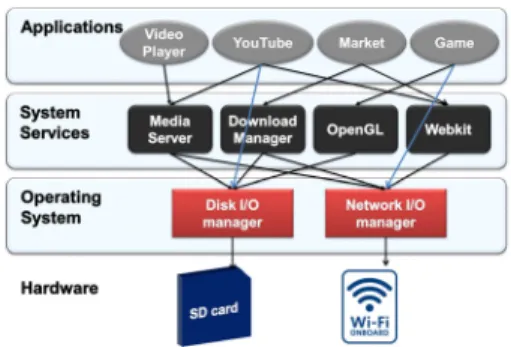
intro-Figure 1: The overall architecture of Android platform
duces the overall architecture of the Android platform, and de-scribes system services that the Android platform provides. Sec-tion 3 presents an overview of our proposed platform (Aciom). In Section 4 and Section 5, we describe the details ofAciom’s differ-entiated I/O service mechanism for disks (Section 4) and networks (Section 5). Section 6 shows the evaluation results, and Section 7 presents related work. Finally, we conclude our paper in Section 8 with ideas for future work.
2.
ANDROID PLATFORM
Android is an open-source, software platform for mobile devices that provides a Linux-based operating system, a set of Java appli-cations for basic mobile device features, and middleware (cf. Fig-ure 1). Each Java application runs within its own instance of the
Dalvik virtual machine, and each instance runs in its own process
with a unique Linux user identification in order to isolate applica-tions within the platform. The middleware offers a set of Java and native libraries to facilitate application development. The Java li-braries, called application framework, offer many kinds of services related to application semantics, such as management of the life-cycle of application components. They also enable the use and re-placement of application components upon request and provide ac-cess to the native libraries through JNI (Java Native Interface). The native libraries are written in C/C++ and expose device-specific and/or performance-sensitive functionalities. We will now discuss the topics necessary to understand our I/O management scheme.
2.1
System Service
The Android middleware offers a set of Java and native libraries, called system services, to support a range of core system functional-ities. As an example, the system services include ActivityManager to manage the lifecycle of application components and
Location-Manager to take care of location (e.g., GPS) updates.
A special process, called service manager, maintains a list of system services available in the platform. Applications make use of system services through the Android IPC mechanism, called
binder. For example, when an application wants to playback a
movie, it first requests permission from the service manager to use the media player service. Once the permission is granted by the vice manager, the application is able to inform the media player ser-vice of the media type and the source location of the movie through the binder. The media player service, instead of the application,
Classification System Service Android
Always bursty Download service Storage service Package manager service
Always Time-sensitive
Media service Audio service Telephony service
Always plain Layout inflater service Power management service
F/B dependent Sqlite service Search service
Figure 2: Android system service characterization with I/O re-quests
then loads the media file from the source location, decodes it ac-cording to its media type, and displays the file.
2.2
Foreground/Background Applications
In many mobile devices such as smart phones, the applications running in the foreground generally perform user-interactive tasks and the applications that do not need interaction with users run in the background. The Android middleware keeps track of which application is running in the foreground and which applications run in the background, and the kernel incorporates this informa-tion into the CPU scheduling and memory management. The ker-nel employs a CFS (completely fair scheduler) algorithm for CPU scheduling, and it gives a higher priority to the foreground appli-cation. The Android memory management performs application-based memory reclamation. When this system finds no free space in the memory, it kills one or more background applications to re-claim the memory from the application(s). As such, Android favors the foreground application in the CPU and memory management, however, it does not yet support the foreground application in disk and network I/O management.
3.
ACIOM OVERVIEW
This section presents an overview of the Aciom(Application Characteristics-aware I/O Manager) system. The goal ofAciomis to provide differentiated I/O management services for Android ap-plications according to their characteristics. For example,Aciom de-livers prioritized or guaranteed I/O management services to user-interactive applications such that those applications can produce prompt or delay-bounded responses to users. Toward this goal, this section first classifies applications according to the characteristics of their I/O requests and discusses the limitations of the current Linux I/O management in support of application characteristics. It then outlines howAciomcan capture application characteristics in Android and how they can be incorporated into differentiated disk and network management services.
Application characterization with I/O requests. Applications can be classified as time-sensitive if they impose timing constraints on their I/O requests, or as time-insensitive otherwise. As an ex-ample, let us consider a multimedia application that plays a live streaming video at 30 FPS (frame-per-second). The kernel should be able to handle the incoming packets of this application with a low latency, say, a latency smaller than 33ms. Time-insensitive
ap-Figure 3: Examples of I/O request pattern
plications can be further characterized as bursty if they often make a burst of I/O requests, or plain if they do not. Bursty applications tend to consume all the bandwidth available in the system and of-ten delay time-sensitive I/O requests. Hence, an I/O management scheme is required that can satisfy the timing constraints imposed by time-sensitive requests, even in the presence of bursty requests. Figure 2 shows how we categorize Android services.
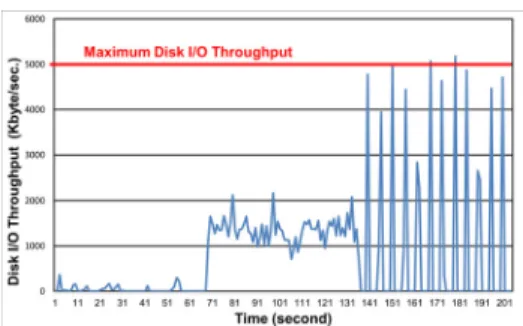
Figure 3 shows three different patterns of application I/O re-quests. The first phase is measured from the web-kit service (plain), the second phase is from the media service (time-sensitive), and the third phase is from the download server (bursty).
There is another types of application characteristic, named F/B dependent (Foreground/Background dependent). From the user’s viewpoint, applications running on mobile devices, such as smart phones, can have different characteristics according to the user at-tention. In other words, some applications can have two differ-ent types of characteristics depending on whether the application is user-interactive or not. For example, let us consider an internal database service, called SQLite service. Such a service can be con-sidered as time-sensitive, if it provides database handling, which usually includes intensive I/O requests, for the foreground applica-tion. Or, it can be classified as bursty if no foreground application makes use of its database I/O requests. In the latter case, it could be considered as harmful to time-sensitive applications.
Limitations of the current Linux platform. The Linux I/O managers do not incorporate the characteristics of applications into policies that determine when and in what order I/O requests are ser-viced. Their default policies are designed to allocate I/O bandwidth in such a way that the system throughput is maximized, oblivious to the applications’ requirements associated with disk and network requests.
This can be detrimental to especially time-sensitive applications. For example, consider a time-sensitive multimedia application ing I/O requests at the same time as a download application is mak-ing a burst of I/O requests. In this case, the Linux I/O managers can handle a batch of requests coming from the download appli-cation ahead of the multimedia appliappli-cation’s requests, imposing longer delays on the latter requests. This could lead to a significant degradation of quality of the multimedia service. The multimedia application can play a movie at a much lower FPS, producing un-acceptable random screen delays and pauses.
As such, Linux does not provide applications with differentiated I/O management services. Therefore, it is inappropriate for embed-ded systems with insufficient resource capacity, and this requires a new application characteristics-aware I/O manager for embedded systems.
Figure 4: The overall architecture ofAciomplatform
Application characteristics available in Android. Commod-ity applications do not provide their own characteristics, and this makes it difficult for operating systems to figure out their perfor-mance requirements. Profiling the behavior of applications can re-veal their resource usage pattern but does not help much to identify whether applications are demanding delay-sensitive I/O requests. However, it is relatively easier to estimate the characteristics of commodity applications in Android.
The Android platform provides a set of system services to appli-cations for performance-sensitive or device-specific functionalities. For example, there is a system service, called download manager, that handles long-running HTTP downloads. A client application can pass a URI to the download manager, asking to download the URI to a particular destination file. The download manager will conduct the download in the background, taking care of the HTTP interactions and retrying downloads over various failures such as disconnection. As such, the client application is not involved in any of the network operations, and the download manager takes care of all the networking processes for the client application. Each system service has its own characteristics on I/O operations. Since each system service is supposed to provide its own pre-defined function-alities, its characteristics can be known in advance. As an example, the download manager can make a burst of network and disk re-quests. When an application makes use of a certain system service, we can then infer the characteristics of the application from the sys-tem service’s characteristics, even though the application does not announce its characteristics explicitly. For example, when a media player application makes use of the media server system service, the media player can be considered as a time-sensitive application. Application characteristics-aware I/O manager.Aciommakes use of two schemes to characterize Android applications. The ap-plications that make use of system services will be characterized as time-sensitive, bursty, or plain depending on which system ser-vices they use. For applications that do not use system serser-vices,
Aciomuses the characteristics of consumer electronics in which
the foreground application usually performs user-interactive tasks. That is,Aciomcharacterizes such applications as time-sensitive if they run in the foreground, or bursty if they are running in the back-ground.
Aciomemploys different I/O management services for different
types of applications. For a time-sensitive application,Aciom
re-serves a certain amount of I/O bandwidth such that the applica-tion’s I/O requests can be handled in time. For a bursty application,
Aciomlimits the bandwidth allocation in order not to interfere with the reserved bandwidth allocations of the time-sensitive applica-tions. If no time-sensitive application is running, thenAciomdoes not place any bandwidth limit on the bursty applications. For a plain application,Aciomdoes not perform any special treatment but takes care of its I/O request in the same way as does the Linux I/O manager.
Aciomaims to allocate as much bandwidth as necessary to
time-sensitive applications so that they can handle their requests prop-erly. However, information is not available on exactly how much bandwidth is required to handle requests that are subject to applica-tion requirements.Aciomestimates the current required bandwidth of a time-sensitive application based on how much bandwidth was requested in previous situations. In fact, such an estimate can be inaccurate when predicting the current or near-future bandwidth re-quirements, in particular when applications start showing different request behaviors. Hence,Aciommaintains reserved extra band-width, called headroom, to give a margin to time-sensitive appli-cations. When time-sensitive applications require more bandwidth than was estimated, they can utilize the headroom to resolve the extra requirement.
Even though theAciomdisk and network managers share the same design principles, they employ different techniques to es-timate the bandwidth requirements of time-sensitive applications, to provide reserved bandwidths to time-sensitive applications, and to limit the bandwidth allocations to bursty applications. This is mainly because the disk and network devices exhibit different char-acteristics. For example, applications generally make disk requests for a large chunk of data in a relatively long interval, while net-work requests are made for a small chunk of data within a shorter request interval. Furthermore, Android applications generally re-ceive packets rather than send them out. This means that network requests will generally be initiated outside of the system, while disk requests will be generated inside the system. Such differences lead
Aciom to employ different management mechanisms. Details of
this are explained in Section 4 for disks and in Section 5 for net-works.
4.
DISK I/O MANAGEMENT
The Linux I/O manager does not incorporate the characteristics of applications into its disk I/O scheduling policy. Its default pol-icy is designed to allocate disk I/O bandwidth in such a way that the system throughput is maximized, sometimes to the detriment of application demands. This section describes the proposed disk I/O manager, which dynamically captures an application’s requiments for disk requests and allows the requests to meet their re-quirements based on the information provided by the Android ar-chitecture.
4.1
Linux Disk I/O Management
The Linux-based Android block device manager uses the
Com-plete Fairness Queuing (CFQ) elevator algorithm for disk I/O
man-agement. The main purpose of CFQ is to ensure a fair allocation of the disk bandwidth among all the applications that initiate disk I/O requests as well as to maximize the system-wide throughput.
To achieve a fair allocation of the disk bandwidth, CFQ uses a two-level queuing approach with 64 internal I/O queues and a
single I/O dispatch queue. When an application issues a disk I/O request, the request is inserted into one of the internal I/O queues. CFQ makes use of a hash function that converts the process iden-tifier of the application into the index of an I/O queue. Therefore, requests coming from the same application are always inserted into the same I/O queue. Requests in an I/O queue are sorted accord-ing to their initial sector numbers. The CFQ elevator then scans the I/O queues in a round-robin fashion, finds the first non-empty queue, and moves a batch of requests from the selected I/O queue to the tail of the dispatch queue. The elevator repeats a sequence of those actions in a work-conserving mode, and this way, the CFQ elevator algorithm guarantees the maximization of the system-wide throughput.
In order to avoid disk request starvation, which occurs when the elevator policy ignores a request for a very long time, each request is assigned a deadline. Every read request is given a default dead-line of 125 ms, while the default deaddead-line for write requests is 250 ms. The elevator keeps scanning the sorted I/O queues sequen-tially, unless a request deadline expires. If so, the elevator moves that expired request to the tail of the dispatch queue.
However, this CFQ policy is not aware of the applications’ re-quirements, which are imposed to disk requests. This can cause time-sensitive requests to wait longer in the I/O queues and/or in the dispatch queue, resulting in a violation of their timing require-ments.
4.2
Aciom Disk I/O Management
The main purpose of theAciomdisk I/O manager is to provide differentiated services to different types of applications.
Time-sensitive requests. A time-sensitive application aims to guarantee a certain amount of disk bandwidth such that its disk I/O requests can be handled in time. Even though the Android architec-ture helps to successfully classify disk requests as time-sensitive, it does not reveal how much bandwidth should be allocated to those time-sensitive requests to avoid any performance loss for their ap-plication. Hence, Aciom tries to figure out directly how much bandwidth each time-sensitive application will require. In order to estimate this requirement,Aciomkeeps track of how often the ap-plication makes time-sensitive disk requests and how large the data size of each request is. LetRikdenote thek-th disk request from a time-sensitive applicationi,Aki denote its arrival time, andSik de-note its data size, respectively. At this point,Aciomfirst computes the projected period (denoted asT¯k
i) as a weighted combination of the previous value and a newly available data, which is the arrival time difference between the two consecutive requests,R(ki −1)and
Rk i, i.e., ¯ Tk i =α·T¯ k−1 i + (1−α)·(Aik−Aki−1),
whereT¯i0is defined as a default period for the time-sensitive appli-cationi,A0i =Ai1−T¯i0, and the parameterαcontrols how much we rely on the history in determining the project period. The value can be chosen in a range[0,1]. LetS¯k
i denote the average data size of a requestRki, which is calculated as follows:
¯ Sk i =β·S¯ k−1 i + (1−β)·(S k i),
whereS¯i0 =Si1andSi1is defined as the first request’s size of an application i. The parameterβworks in a way similar to that of the parametersα, andβ∈[0,1]. Finally, letBidenote how much bandwidth an applicationiwants to consume on average for its disk
operations, and this value can be computed as follows:
Bi= ¯Tik×S¯ik,
when the applicationimakes thek-th disk request.
Now, we have an estimation of the bandwidth requirement (Bi) for a time-sensitive applicationi. We then consider how to allocate the bandwidth ofBito the applicationi. Aciomaims to allocate such bandwidth by taking care of a request of sizeS¯ikwithin every interval of lengthT¯ik. To achieve this,Aciomtakes advantage of a request deadline. It is assigned such that a single request should be served within an interval of lengthT¯ik. LetDki denote the deadline of a requestRk
i, and it is determined as
Dk
i =Dik−1+ ¯Tik,
whereD0i =A1i. Since thek-th request of sizeS¯ikwill be handled before its deadlineDki,Aciomcan provide disk I/O bandwidth of at leastBito the time-sensitive applicationi.
Bursty requests. Bursty applications often seek to consume all the available disk bandwidth in the system and can have a negative influence on time-sensitive disk requests. Hence, Aciomplaces maximum limits on the disk bandwidth allocations to bursty cations such that the reserved bandwidth for time-sensitive appli-cations should be provided independent of bursty requests.
Aciommaintains an additional single internal queue, called a
pre-release queue, for bursty disk requests, in addition to the
exist-ing I/O queues and the dispatch queue of the Linux disk manager. Every bursty disk request is initially placed into the pre-release queue and is assigned an absolute release time. Each bursty re-quest will remain in the pre-release queue until its release time ex-pires. Upon expiry, the request is moved to one of the I/O queues.
Aciom adaptively determines the release times of the bursty
re-quests such that they cannot consume bandwidth greater than their maximum limit. In order to find the maximum possible limit of a bursty application,Aciom first calculates the total remaining band-width that does not violate the total reserved bandband-width for time-sensitive applications. The total remainder bandwidth will be then equally distributed to individual bursty applications. LetRBi(t) denote the remainder bandwidth of a bursty applicationiat timet, and it is calculated as
RBi(t) =
Cmax− j∈T ABj(t) +H(t)
|BA| ,
whereCmax is the maximum disk capacity,T AandBAare the sets of time-sensitive applications and bursty applications, respec-tively,Bi(t)is a projected average bandwidth of a time-sensitive applicationiat timet, andH(t)is the headroom size at timet. For thek-th request of a busty applicationi, letVikdenote the ac-tual size andV¯k
i denote the projected average size. Then,V¯ik is computed as ¯ Vk i =γ·V¯ k−1 i + (1−γ)·(V k i ),
Then, we can compute how many bursty requests can be handled per second. When a bursty applicationimakes itsk-th request, let
Nk
i denote the number of bursty requests to be handled per second at that time. Then,Nikis computed as
Nk
i =RB(t)/V¯ik.
applicationi, which is defined as Lk i =Lki−1+ 1/N k i, whereL0i =A1i −Ti1.
5.
NETWORK I/O MANAGEMENT
The current Linux network management subsystem is separate from applications. Its management scheme is designed to maxi-mize the system throughput, which is sometimes inconsistent with application requirements. In order to bridge from network man-agement to application requirements,Aciomextends the Linux net-work subsystem to make corresponding connections between sock-ets and applications. Even though the existing Linux socket is able to find the corresponding application, its method takes time since it goes through a number of the data structure. We maintain the value in the socket so as to represent which socket corresponds to which process, in order to reduce overhead.
5.1
Linux Network Management
The Linux network subsystem makes use of two queues, the
in-put and outin-put queues, to hold incoming and outgoing packets,
re-spectively. The subsystem takes care of those packets by default in a First-Come-First-Server manner. Linux does not only support FCFS, but also supports some other policies to determine the order in which packets are served, for example, to improve their QoS. However, such policies make use of networking-related parame-ters, such as IP addresses and port number, which do not directly disclose application characteristics. Therefore, the Linux network subsystem may allocate network resources to applications in a way that does not correspond to the user’s anticipation. For example, when a user makes a video call while downloading files in the background, any networking management scheme that provides the video call application with a lower bandwidth than its requirement, will lead to a degraded QoS for the video call.
5.2
ACIOM Network Management
TheAciomnetwork manager primarily aims to handle network
I/O requests according to application characteristics. Similar to the role of theAciom disk manager does, the network manager also tries to secure the required network bandwidth for time-sensitive applications at the expense of limiting the bandwidth allocation for bursty applications. However, theAciomnetwork manager faces several different challenges in achieving this goal, compared to the case of disk management, because there are prominent differences between network and disk I/O requests.
For example, disk I/O requests are synchronous, while network I/O requests are asynchronous, in a sense that disk I/O requests are initiated by the applications inside the system while incoming packets are initiated by applications outside the system. This intro-duces a big difference into the process of I/O management. Disk managers are able to directly throttle disk I/O requests through lo-cal queue management in order to limit disk bandwidth allocations, however, network managers are not capable of simply limiting the network bandwidth allocations for incoming packets by local queue management. In addition, disk I/O requests have a large range of data size, from a single sector size of 512 bytes to any arbitrary large size of up to 2048 KB, while network I/O requests are of a relatively smaller size up to 1024B (i.e., up to the maximum single network frame size). Thus, network I/O management is subject to
having to handle a much larger number of requests in a shorter in-terval, compared to disk I/O management. These problems make it infeasible to directly apply theAciomdisk management techniques to network management.
Unlike theAciomdisk manager, which allocates bandwidth via local queue management, theAciom network manager employs flow control for bandwidth allocation. Aciommakes use of flow control of the TCP protocol; each TCP connection is called a flow. TCP flow control service is designed to resolve speed mismatches between senders and receivers [9]. A fast sender can overflow the network device buffer of a slow receiver, and flow control can be performed to slow down the sender. A TCP packet includes a parameter, called window size, that enforces flow control. The receiver determines the value of window size and sends it to the sender through its ACK packet. The window size gives the sender an idea of how much free buffer space is available at the receiver. A proper control of window size allows the sender to properly control the transmission speed. Note that each individual TCP flow has its own window size parameter, and a change to the window size of a flow does not interfere directly with another flow. Employing the existing TCP flow control as it is, we also note thatAciomdoes not impose any extra data transmission over the network.
However, changing window size to manipulate bandwidth is very difficult to implement in the controller. This is because the con-troller should contain an analytical network model to derive the appropriate window size. There have been considerable studies of the analytical network model [12, 10]. However, most of these are improper because this model is complex when targeting device, be-cause devices consist of complex floating point calculations, and so a controller needs to be implemented as a user-level application.
To resolve this problem, we use a simple proportional controller, called a P controller.
Wout(t+ 1) =Wout(t) +Kp(Bd(t)−Bc(t)
whereWout(t)is the window size at time t in order to control band-width,Bd(t)is the desired bandwidth at timet,Bc(t)is the current bandwidth at timet, andKpis the proportional gain.
The P controller periodically calculates the window size. Since we make the framework at the kernel level, where floating point calculations are limited, a simple P controller can be easily imple-mented with very low cost of overhead.
InAciomnetwork I/O management, the window size of the
time-sensitive application’s flow is never modified in our framework. It always reserves as much bandwidth as possible within the given network bandwidth. Aciom tries to change the window size of bursty application’s. With the P controller, the window size of a bursty application can be calculated as:
Wout(t+ 1) =Wout(t)+ Kp(Cmax−( j∈T A Bj(t) +H(t))− j∈BA Bj(t)) whereCmaxis the maximum network bandwidth.
As mentioned in section 3, network devices usually receive pack-ets within a short time interval. Hence, bandwidth measurement using methods in the disk I/O could incur large overhead in the network I/O. In the network I/O, we use two step phases to mea-sure the bandwidth of each network flow. First, we accumulate the size of the network packet whenever the Linux network stack fin-ishes decoding the packets. Since each Linux socket corresponds
(a) Android platform (b) Aciom platform
Figure 5: The disk I/O bandwidth comparison
to each network flow, the accumulated value is held by the socket. Second, a kernel thread that is activated periodically(In our experi-ment every 500ms) figures out the sum of the time-sensitive appli-cations’ cumulated receive packet size and also that of the bursty applications’. Finally, the kernel thread calculates the window size of bursty applications with the controller.
Compared to the disk I/O management, the network I/O man-agement does not provide straight bandwidth partitioning. Since it is based on the P controller, network management tries to divide bandwidth through given rules.
6.
EXPERIMENTAL EVALUATION
We have built a prototype ofAciombased on the Android 2.2 platform and carried out experiments on the disk and network I/O managements both on Android and onAciom. This section de-scribes our prototype implementation and experiment environments and discusses experimental results. The main purpose of our exper-iments is to examine the following important questions: (1) Why is
Aciomneeded on Android? (2) How effective isAciomin
support-ing the performance requirements of time-sensitive applications, in the presence of bursty applications.
6.1
Prototype Implementation
We implementedAciomby modifying the block device schedul-ing layer and network packet handlschedul-ing layer of a Linux kernel (ver-sion 2.6.35) in Android 2.2. The changes required were small: the overall implementation took roughly 450 lines of C code to modify an existing I/O management layer and implementing a new ker-nel thread to control network flows. Our resulting I/O manager is lightweight, which is important because an embedded device has low computing power and the I/O path has a critical impact on the overall system performance. We constructed our prototype on a
BlazeT M mobile development platform. BlazeT M is equipped with a Texas Instruments’ OMAP4430 dual-core processor, 1GB of RAM, 8GB flash memory storage, and 802.11n Wi-Fi wireless connectivity.
6.2
Disk Management
This subsection presents the experimental environment and re-sults for disk I/O management. We performed disk experiment to first show the need to incorporate application characteristics into the disk I/O management by demonstrating that the Linux-based
Figure 6: The disk I/O latency comparison
Android kernel does not distinguish disk I/O requests coming from different applications, which results in the poor performance of time-sensitive applications in the presence of bursty disk requests. Our disk experiment was carried out to examine whetherAciom can successfully distinguish time-sensitive and bursty disk requests and to determine how well it manages the effect of bursty requests on time-sensitive applications.
6.2.1
Experimental Environment
Our disk experiment was performed with two Android applica-tions: mVideoPlayer and dperf. The mVideoPlayer application is a free video player that can be downloaded from the Android mar-ket [1], and the dperf application is a disk I/O-intensive, custom application that we developed for our experiment. During our ex-periment, mVideoPlayer ran in the foreground and played a movie by using the media server, which is one of the typical time-sensitive Android system services. Specifically, it played the movie, "Toy Story 3" from an MPEG-4 format media file of 316 MB size. The
mVideoPlayer application played the movie at a target of 30 FPS
for 141 seconds with a resolution of 1920 x 1080. On the other hand, dperf ran in the background, making random I/O requests (75% reads) of 128 Kbytes every 75 ms.Aciomautomatically clas-sified the mVideoPlayer as time-sensitive because it made use of the time-sensitive media server, and dperf as bursty because it did not use any system service but ran in the background.
Five parameters were configured for theAciomdisk manage-ment: the maximum disk I/O bandwidth (Cmax), the default pe-riod of the time-intensive application (T¯1), the period weight pa-rameter (α), the size weight parameter (β), and the size of head-room (H(t)).Cmaxwas obtained from the hardware specification
(a) Android platform
(b) Aciom platform
Figure 7: Frames per second of a media server
(10MB/s).T¯1was set at 125ms as a default read request deadline for Linux. Both of the weight parametersαandβwere assigned to 0.95 in order to better account for previous history more.H(t) was also set at0.1×Cmax. We would like to note that optimally configuring the parameters ofα,beta, andH(t)is important for system performance. However, a detailed discussion of how to find these optimal values dynamically is out of the scope of the paper.
6.2.2
Experimental Results
We ran the two applications both on Android 2.2 and on our
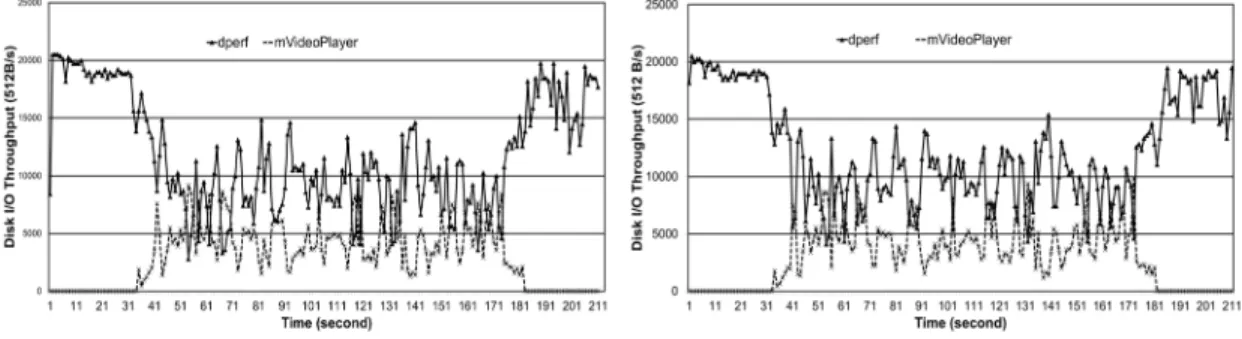
Aciomprototype. Figure 5 compares the performance of Android
andAciomdisk managements in terms of the disk throughput of
the two applications. While dperf ran all the time during the 220 seconds of the experiment, mVideoPlayer ran for only around 150 seconds, from 32 seconds after the beginning of the experiment. The figure shows that dperf consumes the bandwidth of roughly 10 MB within the intervals of [0,32] and [181, 211]. This shows that dperf can consume a bandwidth of 9.6 MB as desired within the two intervals of [0, 32] and [181, 211] both on Android and on
Aciom, while mVideoPlayer makes no disk request within those
intervals. This indicates that when no time-sensitive requests are made,Aciomdoes not place any maximum limit on the disk band-width allocation for bursty disk requests. However, dperf has to compete with mVideoPlayer for disk bandwidth when the latter ap-plication starts making disk requests from 32 second to 181 second. During the interval [32, 181], Android andAciomshow different behavior in allocating disk bandwidth to the two applications. Fig-ure 5 shows that both Android andAciomallocate bandwidth to the two applications in a similar fashion. This shows that even though
Aciommakes use of a headroom reservation to maintain the
band-width margin for time-sensitive applications, it does not decrease the system-wide throughput. In fact, time-sensitive applications require low-latency disk I/O management. That is, even if
mVideo-Player receives a comparable disk bandwidth on Android and on
Aciom, we need to look at the latency of its disk requests to see whether it is receiving proper disk I/O management service.
Figure 6 shows the distribution of the latency of disk I/O requests coming from mVideoPlayer both on Android and onAciom. The figure indicates that a majority of time-sensitive disk requests ex-perienced a much smaller latency onAciomthan on Android. For
(a) Android platform
(b) Aciom platform
Figure 8: Frames per second of a media server
example, 80% of mVideoPlayer’s disk requests were handled in 12 ms onAciom, but required 21 ms on Android. Also,Aciomtook care of 87% of the requests in 20 ms, while Android performed only 75% in 20 ms.
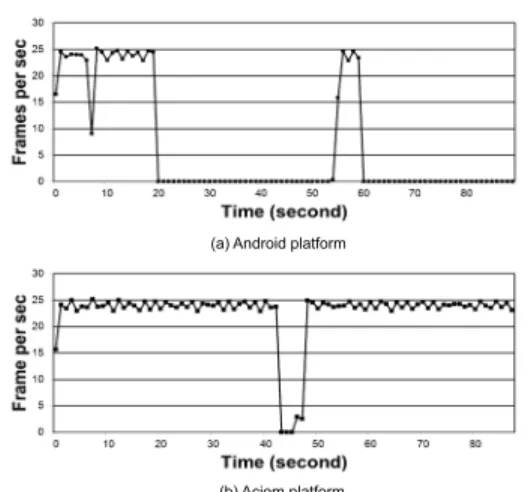
Disk latency is critical to the performance of many time-sensitive applications. Figure 7 shows the performance of mVideoPlayer in terms of how many frames per second (FPS) it displayed. The video clip in the experiment was designed to be displayed at 30 FPS. However, mVideoPlayer could not meet the required FPS many times on Android, experiencing high fluctuations. On the other hand, mVideoPlayer was able to maintain the required 30 FPS much more steadily onAciom.
6.3
Network Management
This subsection describes our experimental environment and re-sults for network I/O management.
6.3.1
Experimental Environment
This experiment includes two applications: YouTubeand iPerf.
YouTube and iPerf are both third-party Android applications that
can be downloaded from the Android market [1]. YouTube plays a video clip via network streaming with RTSP (Real-Time Stream-ing Protocol, and iPerf is a network-intensive application that is designed for performance measurement of network flows. In our network experiment, YouTube played a streaming video at 25 FPS from the YouTube website, making use of the Android media server for downloading, decoding, and displaying of the streaming data.
iPerf received a bunch of network packet from a remote challenger,
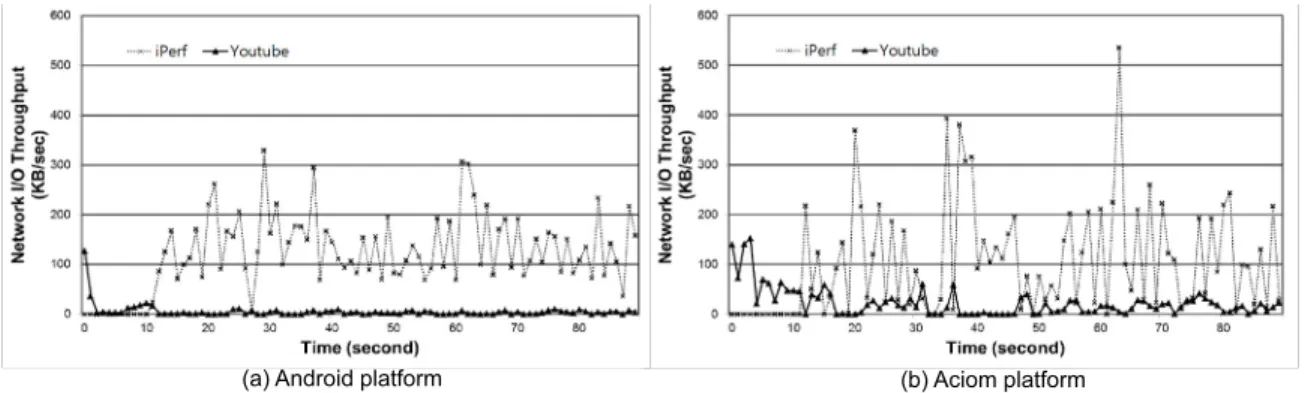
who maintained the network packet handling results for perfor-mance measurement. During the experiment, YouTube ran in the foreground all the time, and iPerf ran in the background and started receiving packets from 10 seconds after the beginning of the exper-iment. This method allowed YouTube to receive some streaming data and to keep them into a buffer.
Four parameters were configured for theAciom network I/O management: the maximum network I/O bandwidth (Cmax) was set at 2.4Mbps, the size of headroom (H(t)) was set at 200Kbps, the proportional gain (Kp) was assigned to 0.5, and the period of the network kernel thread was set at 500ms.
(a) Android platform (b) Aciom platform
Figure 9: The network I/O bandwidth comparison
6.3.2
Experimental Result
Our network experiment was designed to show how effectively
theAciomnetwork manager can take care of network flows for the
purpose of supporting time-sensitive applications, while bursty net-work flows strive to consume all the available netnet-work bandwidth.
Figure 9 shows the network throughput of each flow on Android and onAciom. When iPerf starts to consume network bandwidth from the 10th second, YouTube, as can be seen in Figure 9(a), re-ceived hardly any network bandwidth allocation on Android, on the other hand, it can be seen in Figure 9(b) that YouTube is given some network bandwidth allocation inAciom. This is because the
Aciomnetwork manager favors time-sensitive applications by
lim-iting the bandwidth allocations for bursty applications. It reduces the window size of iPerf ’s TCP flow in order to slow down its sender. Therefore, the total bandwidth consumed by iPerf is 140 Kbps on Android, while it is 121 Kbps onAciom.
We next examined how such bandwidth allocations affect the video quality of YouTube. Figure 8 shows how many frames per second YouTube displayed when running on Android and onAciom. Figure 8(a) shows that YouTube experienced serious problems dur-ing a considerable amount of time in the experiment. It did not pro-ceed at all (i.e., screen pause) for 64 seconds out of the 90 seconds of the experiment. On the other hand, it can be seen in Figure 8(b) that YouTube was able to display the movie in a much more stable manner onAciom. The application mostly displayed the movie at 23∼25FPS and experienced a degradation for only 2∼3 seconds. This indicates thatAciomis quite effective in supporting the perfor-mance requirement of time-sensitive applications through network I/O management.
7.
RELATED WORK
Operating systems often take specifications from time-sensitive applications to determine the quantity of resources those applica-tions will demand. In Rialto [8], applicaapplica-tions shown to make use of system calls to inform the resource manager of their own esti-mate of the quantity of resource required over any period of time. In Redline [18], the resource requirement specifications of applica-tions are assumed to be written by users or system administrators and passed to the resource manager through files. Rialto and Red-line then make use of those specifications to reach scheduling de-cisions. SMART [11] also takes resource requirements from multi-media applications through system calls, and it notifies those
appli-cations as to whether their requests can be satisfied or not. This al-lows multimedia applications to take proper actions upon notifica-tion; they may degrade their quality-of-service accordingly. Those approaches basically assume that the specification of resource re-quirements will be provided explicitly, while our approach does not employ such an assumption and requires no modification to appli-cations at all.
Several real-time scheduling algorithms [15, 6, 17] are proposed to schedule disk I/O requests taking their timing constraints into account. The SCAN-EDF algorithm [15] schedules disk I/O re-quests in an increasing order of their application deadlines, break-ing ties accordbreak-ing to the SCAN algorithm. The WRR-SCAN algo-rithm [17] aims to maximize disk throughput subject to the timing constraints of the disk requests. The algorithm provides disk band-width reservation to each time-sensitive applications according to its timing constraints, and it allocates the remainder of bandwidth to non-real-time applications. The above approaches were found to work well when the system uses a disk as its secondary storage. However, the above approaches do not fit in embedded systems, since most embedded devices use flash memory as its secondary storage.
A few studies [14, 13] have been performed on flash storage-aware I/O buffer scheduling. The CFLRU algorithm [14] takes into consideration a flash memory property that has different costs be-tween read and write: write operations are more expensive. CFLRU uses this property to reduce the total cost. To reduce write opera-tions, the algorithm holds dirty requests in the buffer cache as long as possible until the CFLRU starts to suffer system performance. [13] extends the CFLRU algorithm to improve efficiency by parti-tioning the buffer cache into several regions according to different operation costs. Even though this method considers flash memory properties well, it only aims to improve overall I/O efficiency, and it does not consider the quality of time-sensitive applications.
The mClock I/O manager [7] is introduced for hypervisor disk I/O scheduling. Assuming that each virtual machine (VM) spec-ifies its own disk bandwidth requirement as well as its minimum and maximum requirements, the mClock hypervisor I/O manager aims to allocate disk bandwidth to VMs according to their require-ment specifications. Even though the mClock I/O manager is most closely related to theAciomdisk I/O manager, there are some dif-ference between them. While it is valid for mClock to assume that a time-sensitive VM would not require more bandwidth than its
max-imum requirement, such an assumption does not hold forAciom, and this entails techniques to estimate the required bandwidth of time-sensitive requests and to recover when the required bandwidth is underestimated.
PSM-throttling [16] is proposed in order to reduce network mod-ule energy consumption in mobile devices. These devices generate a network module on/off duty-cycle, which periodically changes the network module’s state between on and off, so that mobile de-vices are able to save energy when the dede-vices are in the off state. These devices employ a zero-fixed window size packet to make senders transmit their packets only when devices are activated. [11] also makes use of zero window size to notify senders that the buffer of the receiver side is full. However, instead of immediately adver-tising a non-zero window when application starts to read data out of the receive buffer, this system waits to advertise the non-zero win-dow size until its winwin-dow has considerably increased, in order to avoid a silly window syndrome. This method configures the buffer occupancy threshold when a non-zero window is advertised (imme-diately following a zero window) as a tunable parameter to adapt to various network conditions.
There have been several studies of the analytical network model [12, 10]. These have aimed to develop an analytical characteriza-tion of the throughput as a funccharacteriza-tion. The parameters of the model are loss rate, RTT(round trip time), and maximum window size. This model considers TCP congestion control in order to establish an accurate model. However,Aciomdoes not employ an analytical network model to calculate proper window size, since the model still has difficulty implementing in the kernel.
8.
CONCLUSION
To the best of our knowledge, this paper presents the first attempt to understand application characteristics through Android architec-ture and to incorporate those characteristics into disk and network I/O management. Our prototype implementation shows that our proposed approach can support time-sensitive applications, allow-ing them to meet their performance requirements even when run-ning with bursty I/O applications.
Our future work will include extending the proposed approach to other aspects of resource management, such as power manage-ment. In addition, in this paper, we consider only application char-acteristics. However, context (i.e., location, time) can also affect an application’s behavior, and this can be important information in resource management. We plan to develop a context-aware sys-tem of resource management in order to better support application performance requirements.
9.
ACKNOWLEDGEMENT
This work was supported in part by the IT R&D Program of MKE/KEIT [2011-KI002090, Development of Technology Base for Trustworthy Computing], Basic Research Laboratory (BRL) Program (2009-0086964), Basic Science Research Program (2011-0005541), and the Personal Plug&Play DigiCar Research Center (NCRC, 2011-0018245) through the National Research Founda-tion of Korea (NRF) funded by the Korea Government (MEST), and KAIST-Microsoft Research Collaboration Center.
10.
REFERENCES
[1] https://market.android.com. [2] http://www.android.com. [3] http://www.canalys.com/pr/2011/r2011013.html. [4] http://www.engadget.com/2011/04/07/gartner-android-grabbing-over-38-percent-of-smartphone-market-i/. [5] http://www.mobileburn.com/news.jsp?id=9125. [6] R.-I. Chang, W.-K. Shih, and R.-C. Chang.Deadline-modification-scan with
maximum-scannable-groups for multimedia real-time disk scheduling. In Proceedings of the IEEE Real-Time Systems
Symposium(RTSS), 1998.
[7] A. Gulati, A. Merchant, and P. J. Varman. mclock: Handling throughput variability for hypervisor io scheduling. In
Proceedings of USENIX Symposium on Operating Systems Design and Implementation (OSDI), 2010.
[8] M. B. Jones, D. L. McCulley, A. Forin, P. J. Leach, D. Rosu, and D. L. Roberts. An overview of the rialto real-time architecture. In Proceedings of ACM SIGOPS European
Workshop, 1996.
[9] J. F. Kurose and K. W. Ross. Computer Networking third
edition. Addison Wesley, 2005.
[10] V. Misra, W.-B. Gong, and D. Towsley. Stochastic differential equation modeling and analysis of tcp-windowsize behavior. In Technical Report
ECE-TR-CCS-99-10-01, Performance, 1999.
[11] J. Nieh and M. S. Lam. The design, implementation and evaluation of smart: a scheduler for multimedia applications. In Proceedings of ACM Symposium on Operating Systems
Principles, 1997.
[12] J. Padhye, V. Firoiu, and D. T. J. Kurose. Modeling tcp throughput: a simple model and its empirical validation. In
Proceedings of the ACM SIGCOMM, 1998.
[13] J. Park, H. Lee, S. Hyun, K. Koh, and H. Bahn. A cost-aware page replacement algorithm for nand flash based mobile embedded systems. In Proceedings of the seventh ACM
international conference on Embedded software (EMSOFT),
2009.
[14] S.-Y. Park, J.-U. K. D. Jung, J.-S. Kim, and J. Lee. Cflru: a replacement algorithm for flash memory. In Proceedings of
the International Conference on Compilers, Architecture and Synthesis for Embedded Systems (CASES), 2006.
[15] A. Reddy, J. Wyllie, and K.B.R.Wijayaratne. Disk
scheduling in a multimedia i/o system. In Proceedings of the
first ACM international conference on Multimedia, 1993.
[16] E. Tan, S. C. Lei Guo, and X. Zhang. Psm-throttling: Minimizing energy consumption for bulk data communications in wlans. In Proceedings of IEEE
International Conference on Network Protocols, 2007.
[17] C.-H. Tsai, E. T.-H. Chu, and T.-Y. Huang. Wrr-scan: a rate-based real-time disk-scheduling algorithm. In
Proceedings of the 4th ACM international conference on Embedded software(EMSOFT), 2004.
[18] T. Yang, T. Liu, E. D. Berger, S. F. Kaplan, and J. E. B. Moss. Redline: First class support for interactivity in commodity operating systems. In Proceedings of USENIX Symposium on