Journal of Fluid Mechanics
http://journals.cambridge.org/FLMAdditional services for
Journal of Fluid Mechanics:
Email alerts: Click here Subscriptions: Click here Commercial reprints: Click here Terms of use : Click here
Vortex/inflectionalwave interactions with weakly threedimensional input
S. N. TIMOSHIN and F. T. SMITH
Journal of Fluid Mechanics / Volume 348 / October 1997, pp 247 294 DOI: 10.1017/S0022112097006447, Published online: 08 September 2000
Link to this article: http://journals.cambridge.org/abstract_S0022112097006447 How to cite this article:
S. N. TIMOSHIN and F. T. SMITH (1997). Vortex/inflectionalwave interactions with weakly threedimensional input. Journal of Fluid Mechanics, 348, pp 247294 doi:10.1017/S0022112097006447
Request Permissions : Click here
c
1997 Cambridge University Press
Vortex/inflectional-wave interactions with
weakly three-dimensional input
By S. N. T I M O S H I N A N D F. T. S M I T H Department of Mathematics, University College London, Gower Street,
London WC1E 6BT, UK
(Received 12 June 1995 and in revised form 23 April 1997)
The subtle impact of the spanwise scaling in nonlinear interactions between oblique instability waves and the induced longitudinal vortex field is considered theoretically for the case of a Rayleigh-unstable boundary-layer flow, at large Reynolds numbers. A classification is given of various flow regimes on the basis of Reynolds-stress mechanisms of mean vorticity generation, and a connection between low-amplitude non-parallel vortex/wave interactions and less-low-amplitude non-equilibrium critical-layer flows is discussed in more detail than in previous studies. Two new regimes of vortex/wave interaction for increased spanwise lengthscales are identified and studied. In the first, with the cross-scale just slightly larger than the boundary-layer thickness, the wave modulation is governed by an amplitude equation with a convolution and an ordinary integral term present due to nonlinear contributions from all three Reynolds-stress components in the cross-momentum balance. In the second regime the cross-scale is larger, and the wave modulation is found to be governed by an integral/partial differential equation. In both cases the main-flow non-parallelism contributes significantly to the coupled wave/vortex development.
1. Introduction
vortex generation considered in conjunction with the effects of cross-scaling and the main-flow non-parallelism.
Apart from a general interest in nonlinear dynamics during the latest stages of transition this study was particularly motivated by the succession of theoretical contributions in Hall & Smith (1991), Brown et al. (1993), Smith, Brown & Brown (1993), Brown & Smith (1996), Allen, Brown & Smith (1996) on VWI in inviscidly unstable flows, by Wuet al.(1996) on packets of Tollmien–Schlichting waves, and Wu (1993), Wu, Lee & Cowley (1993) on weakly nonlinear Rayleigh waves with viscous non-equilibrium critical layers.
Studying the mechanics of a possible equilibration of instabilities in transition, Hall & Smith (1991) suggested a scheme with a strong coupling between a large-scale mean vortex field and low-amplitude short-large-scale inviscid inflectional (Rayleigh) disturbances. The vortex in that paper is driven by nonlinear Reynolds stresses working near the waves’ critical layer, and the development of the vortex downstream must be such as to keep the wave system in saturation, i.e. in a locally neutral state, at each streamwise location. Subsequently Brown et al. (1993) demonstrated the likely start of the saturated VWI from the point of neutral linear stability for a pair of oblique fixed-frequency waves propagating in a two-dimensional inflectional boundary layer. Smith et al. (1993) found that the saturated stage is preceded by a non-saturated transient flow regime in a smaller neighbourhood of the neutral point. The saturated interaction is strongly influenced by the main-flow non-parallelism and the input conditions, so that the development downstream can follow various routes; these include, in addition to an asymptotic approach to saturation, a finite-distance singular breakdown, a decay, or self-sustained oscillations. Effects of non-symmetric input and weak cross-flow create even more complicated patterns including apparently chaotic responses, according to Brown & Smith (1996), Allen
et al. (1996). In all these studies the cross-scale in the flow was assumed to be of
the same order of magnitude as the basic boundary-layer thickness (that is the wave inclination to the free stream is of order one).
& Choi 1989) and fully viscous (Wu et al. 1993) approximations, parametric res-onances and nonlinear triads, Goldstein & Lee (1992), Wu (1992), Mankbadi, Wu & Lee (1993), Khokhlov (1994), Wu (1995), and weakly modulated wave packets, Wu (1993).
With regard to the main topic of this paper the work by Wu et al. (1993) and Wu (1993) on critical-layer interactions promoted by Rayleigh wave pairs and wave packets respectively is directly relevant. Wuet al.(1993) show that a non-equilibrium critical-layer flow with a two-wave interaction reduces to a parallel-flow version of the VWI in Smith et al.(1993) when the wave amplitude is made sufficiently small. The critical-layer structure in this limit splits into a viscous critical layer and a vortex diffusion layer, just as in the VWI theory. The second typical flow regime identified in Wu (1993) is for multi-mode interactions with larger cross-scales. The complex multiple-mode nature of the flow is reflected in the appearance of partial spanwise derivatives in the nonlinear term of the controlling amplitude equation (an example of the cross-flow instability exhibiting similar properties is given in Gajjar 1996). In the low-amplitude limit a VWI-type splitting of the critical layer occurs, and an amplitude equation of a VWI-type emerges again, but with a nonlinear convolution integral different from that in Smith et al. (1993) or Wu et al. (1993). The reason for this difference was uncovered in Timoshin & Smith (1993): it turns out that non-parallel low-amplitude VWI has three distinct regimes, two of them with the cross-scale greater than the typical boundary-layer thickness. The current paper presents a detailed analysis of the two new regimes: the larger-scale interaction corresponding to Wu’s (1993) critical-layer flow, and a new one on the intermediate cross-scale representing properties of both larger-scale and shorter-scale VWI. Both novel regimes are likely to have closer links with applications, for the transition often starts from nearly planar instabilities, the flow being significantly three-dimensional at the subsequent nonlinear stages owing to amplification of secondary modes or, as an alternative examined in this study (see also references above), due to self-induced weakly three-dimensional interactions. Also, an analysis based on the Rayleigh instability of a planar boundary layer is expected to have much broader significance than one might anticipate formally. Indeed, a version of the VWI studied in Smith et al. (1993) happens to be typical for both the nonlinear Tollmien–Schlichting wave development on a pre-induced vortex field (Goldstein & Wundrow 1995) and a nonlinear secondary instability of fully developed (for example G¨ortler) vortices (Blackaby & Hall 1995). The low-amplitude case of Wu’s (1993) theory developed further in this paper proves to be crucial for upper-branch Tollmien–Schlichting wave packets in the Blasius flat-plate boundary layer; see Wu et al. (1996). Further links are found in the nonlinear triad interactions (e.g. Mankbadi et al. 1993); see also Goldstein (1994), Cowley & Wu (1993).
the common point of neutral linear stability for these waves is denoted by xn. The particular source of disturbances is of little concern here; in practical situations it can be for instance a vibrating ribbon, a localized time-periodic injection/suction through the wall, inhomogeneities in the free steam, etc. The important characteristics of the wave perturbations include the frequencyUdL−d1R1/2Ω, the spanwise periodδzand the amplitude (to be introduced in the next section), whereUd is the typical inviscid-flow velocity at the position of the neutral point andR=UdLdνd−1is the Reynolds number, νd being the kinematic viscosity. If, further, (Udu, Udv, Udw), ρd, ρdUd2p, UdL−d1tdenote the velocity components in the directions (x, y, z),the density, the variable part of the pressure and time respectively then the Navier–Stokes equations are written in the form
∂u ∂t +u
∂u ∂x+v
∂u ∂y +w
∂u ∂z =−
∂p ∂x +R
−1∇2u, (1.1)
∂v ∂t +u
∂v ∂x +v
∂v ∂y +w
∂v ∂z =−
∂p ∂y +R
−1∇2v, (1.2)
∂w ∂t +u
∂w ∂x +v
∂w ∂y +w
∂w ∂z =−
∂p ∂z +R
−1∇2w, (1.3)
∂u ∂x+
∂v ∂y +
∂w
∂z = 0, (1.4)
with∇2=∂2/∂x2+∂2/∂y2+∂2/∂z2.
In the following section the scales for the typical regimes of VWI in the physi-cally realistic moderate-to-large range of the spanwise period δz are deduced from a qualitative argument. It is shown that in the theory of Smith et al. (1993) only two out of three nonlinear contributions from the Reynolds stresses in the cross-momentum balance are active. The third contribution represented by the average of the term v∂w/∂y in (1.3) produces, however, a relatively large correction to the induced vortex. This correction is justifiably small if δz is strictly of O(R−1/2)
or less, but even a small increase in the cross-scaling, from O(R−1/2) in Smith
et al. (1993) to O R−23/48, brings about an additional nonlinearity in the
wave-amplitude equations. These are derived in §3. The extra contribution is of the convolution-integral form present in Wu (1993) and it is found to have a strong impact on the solution properties. In particular, the nonlinear oscillatory devel-opment tends to become more stable to the Hall–Smith type of saturation. This is so for symmetric two-wave configurations, whereas asymmetric input leads to a filtering phenomenon with one wave strongly inhibited in favour of the freely developing second wave. Solutions with finite-distance singularities and decaying downstream are also obtained, more in agreement with Smith et al. (1993) but in a somewhat different form. Based on the estimates of §2, the second character-istic case of a weakly three-dimensional disturbance with δz increased further to
O(R−3/8) is considered in §4. This regime provides a VWI analogue of the Wu
(1993) non-equilibrium critical-layer flow and at the same time a non-parallel ver-sion of the more recent theory of Wu et al. (1996). Comparison of the solution properties in the last paper with those obtained in §4 indicates a very complicated dependence of the flow evolution on the specific basic state and on the nature and character of the input perturbation. Further discussion is given in the concluding
2. Qualitative classification of the flows with VWI
The analysis in this section shows how order-of-magnitude estimates for various regimes of the vortex/wave coupling follow from qualitative arguments. We assume, for definiteness, that two oblique waves are induced in a Rayleigh-unstable planar boundary layer and, as they propagate downstream, the waves achieve maximum amplitudes at the neutral station x = xn(the estimates hold also for the case of minimum amplitudes at xn although the effects discussed here require then the wave generator to be located close to xn; see §§3,4). Since the Reynolds number is large, the wave motion near xn has two distinct lengthscales in the main-flow direction: the wavelength of neutral oscillations, of order R−1/2, and a somewhat larger scale, say δx, for wave modulation due to the main-flow non-parallelism. An estimate for δx
will be given later. Another spatial characteristic, the spanwise period of the flow, δz, depends on the particular disturbance source and can be regarded as a free parameter. Thus the relations
x−xn=R−1/2X= (δx)x1, z= (δz)Z , t=R−1/2T (2.1)
give appropriate scaled local variables for the system of oblique Rayleigh waves. The flow regimes considered in the VWI theory are dominated by two physical pro-cesses. First, the nonlinear Reynolds-stress terms in the momentum balances create small three-dimensional mean corrections to the primary two-dimensional velocity field, with a particularly pronounced streamwise vorticity component. Second, the wave evolution becomes affected by the induced mean flow. The two-way interactive balancing is such that the wave modulation reinforces (or inhibits) the vortex produc-tion, and vice versa; however, in an order-of-magnitude analysis it proves convenient to first treat the two processes as unrelated, independent also of the non-parallel effects.
We start with the mean-vortex generation near the waves’ neutral point atxn. Let A(1) denote the typical wave amplitude. In the bulk of the boundary layer, where ¯
y = yR1/2 is O(1), the wave-perturbed velocities and pressure have the following
structure:
u=U0(¯y) + (δx)x1U1(¯y) +. . .+A[Eu(0)+ (δx)Eu(1)+R−1(δz)−2Eu(2)+. . .], (2.2)
v=. . .+A[Ev(0)+ (δx)Ev(1)+R−1(δz)−2Ev(2)+. . .], (2.3)
w =AR−1/2(δz)−1w(0)+. . . , (2.4)
p=. . .+A[Ep(0)+ (δx)Ep(1)+R−1(δz)−2Ep(2)+. . .]. (2.5)
HereU0(¯y) is the basic-state profile atxn. The next term in (2.2) is due to the main-flow non-parallelism. The wave terms are marked with the factor E = exp[i(αX−ΩT)] composed of the fast variables with the real wavenumber α and frequency Ω. The case of a monotonic inflectional profile U0(¯y) is taken for simplicity (as, for instance, in a decelerating boundary layer prior to separation), hence a single critical level, at ¯
y = ¯yc say, exists typically such that U0(¯yc) = Ω/α= c, where c is the disturbance phase speed, andU000(¯yc) = 0,in accordance with Rayleigh’s criterion. If, in addition, δz R−1/2 then the leading-order wave terms u(0), v(0), p(0) are essentially
quasi-two-dimensional and therefore regular at the critical level. The next-order terms
u(1), v(1), p(1) appear in response to the flow non-parallelism and their nature is also
the wave obliqueness. The inviscid balancing in (1.3) then yields
iα(U0−c)w(0)+ ∂p
(0)
∂Z = 0, (2.6)
and hence w(0) and, from (1.4),u(2) are singular at the critical level,
w(0)=O (¯y−y¯c)−1
, u(2) =O (¯y−¯yc)−1
, as y¯→¯yc, (2.7)
whilstv(2)andp(2)remain bounded, cf. Benney (1961). These singularities are smoothed
out in the viscous critical layer where y1 = R1/6(¯y−¯y
c) is of O(1) and the flow functions expand in the form
u=c+R−1/6U00(¯yc)y1+. . .+A[E˜u0+ (δx)E˜u1+R−5/6(δz)−2E˜u2+. . .], (2.8)
v=. . .+A[E˜v0+. . .], w=A[R−2/6(δz)−1Ew0˜ +. . .], (2.9)
p=. . .+A[E˜p0+. . .]. (2.10) The first two terms in (2.8) represent the base-flow profile. The main wave terms ˜
u0,˜v0,˜p0 are independent ofy1 and follow on setting ¯y= ¯ycin the leading wave terms of (2.2), (2.3), (2.5). The y1-dependence of ˜w0,˜u2 is less trivial, for above and below the critical layer they must match with (2.7). Hence ( ˜w0,˜u2) = O(y1−1) as y1 → ±∞,
that is the wave oscillations are strongest inside the critical layer. This is where the cross-flow Reynolds stresses give rise to relatively strong mean flow. With the subscript m denoting the average over the time period we obtain
R2/6∂ 2w
m ∂y2
1
=A2R−2/3
δz)−3(iα˜u2∗w0˜ + ˜w0∗∂w0˜ ∂Z + c.c.
+A2R2/6(δz)−1
˜v0∗ ∂w0˜
∂y1 + c.c.
+. . . , (2.11)
from (1.3). Here the terms in the right-hand side represent the chief contributions from the derivativesu∂w/∂x, w∂w/∂z,v∂w/∂y respectively, and∗and c.c. denote the complex conjugate.
The wave-induced mean flow does not remain confined to the interior of the critical layer, for (2.11) suggests that
wm=A2R−1(δz)−3(I±y1+. . .) +A2(δz)−1J±+. . . asy1→ ±∞, (2.12)
with the y1-independent coefficients I±, J± representing integrated effects of the Reynolds stresses. In generalI+6=I− andJ+6=J−. Note that the cross-shear discon-tinuity (the first term in (2.12)) comes from the time-average hu∂w/∂x+w∂w/∂zi, whereas the velocity jump is due to hv∂w/∂yi. The sketches in figure 1(a) and 1(b) illustrate qualitatively the induced cross-flow velocity near the critical layer.
Physically, the induced cross-velocity jumps act as local sources of streamwise vorticity distributed over the critical-layer surface at y = R−1/2y¯
Buf
fer
CL
y
(a)
wm
Buf
fer
CL
y
(b)
wm
y
(c)
Buf
fer CL
U0+ um
Figure 1.The induced mean flow in the buffer region: (a,b) two contributions to the cross-velocity
wminduced by different groups of the Reynolds stresses; (c) mean correctionsumto the unperturbed streamwise velocity profileU0.
main-order momentum and mass-conservation balancing for the longitudinal and cross-flow components in the buffer:
U0(¯yc) ∂um
∂x +R 1/2v
mU00(¯yc) =R−1 ∂2u
m
∂y2 +. . . , (2.13)
U0(¯yc) ∂wm
∂x =R −1∂2wm
∂y2 +. . . , ∂vm
∂y + ∂wm
∂z +. . .= 0. (2.14)
In consequence the thickness of the buffer layer is evaluated as
and then
wm=O(A2R−5/6(δz)−3(δxv)1/2)I +O(A2(δz)−1)J, (2.16)
um=O(A2R−5/6(δz)−4(δxv)2)I+O(A2(δz)−2(δxv)3/2)J, (2.17) on account of (2.12), where the subscriptsI, J refer to the corresponding jump values. The larger of the two terms in (2.17) provides the estimate for the wave-induced streamwise velocity in the buffer.
Consider now the impact of the induced mean flow on the wave evolution. Figure 1(c) shows qualitatively the effect of the vortex on the flow profile. Since the primary waves are neutral with respect to the basic-state profile U0(¯y) small changes in the mean flow make the waves slightly decaying or growing. An estimate for the growth-rate correction can be obtained from the following argument. Let α,¯β denote the normalized x-, z-wavenumbers of the oblique waves referred to the boundary-layer thickness. The wave stability is determined by the Rayleigh equation
(U−c)
d2ϕ
d¯y2 −(α
2+ ¯β2)ϕ
= d
2U
d¯y2ϕ, (2.18)
where U(¯y) = U0(¯y) +um designates the new perturbed velocity profile, and for a given ¯β the wavenumber α = α0 is real if um ≡ 0. In accordance with (2.15), the mean-velocity correction is centred in a layer of thickness ¯y−y¯c =O((δxv)1/2) near the inflection point ¯yc. Henceα=α0+δα, where the estimate
δα=O um(¯y−¯yc)−2
=O(um(δxv)−1) (2.19)
follows readily from analysis of the Rayleigh problem in the domains ¯y−y¯c=O(1) and ¯y−¯yc=O((δxv)1/2).We conclude that the length of the wave-modulation interval, sayδxw, due to the induced vortex is estimated as
δxw=O(R1/3A−2(δz)4(δxv)−1)I or O(R−1/2A−2(δz)2(δxv)−1/2)J, (2.20)
where the dominant term is whichever is the smaller one.
To summarize so far, we have three typical lengths associated with different pro-cesses: the non-parallel modulation lengthscale δx, the vortex-flow scale δxv, and the vortex-induced modulation lengthscaleδxw. Consider now various regimes of the wave motion starting with low-level input, and then gradually increasing the distur-bance amplitudes. The development of infinitesimal waves depends entirely on the flow non-parallelism, with the ensuing typical lengthδx=O(R−1/4). This can be seen
from the WKB-type wave solution expiQ(x)R1/2−ΩT, expanding the (complex)
phase speed in the neighbourhood of the neutral point x=xn, where Q0(xn) is real. Alternatively the first equality in (2.19) can be used in conjunction with the estimate,
um=O((x−xn)(¯y−¯yc)2),for the non-parallel curvature term in the basic-state bound-ary layer. The non-parallel wave decay prevents the vortex from being generated over larger x-intervals; therefore
δxv =δx=O(R−1/4). (2.21)
For such tiny disturbances the effect of the induced vortex can be neglected. As the input amplitude increases, however, the VWI first comes into operation when
minO(R7/12A−2(δz)4)
I, O(R−3/8A−2(δz)2)J =O(R−1/4), (2.22)
on account of (2.20), (2.21). If, in particular,δz=R−1/2,then the cross-velocity jump
at the critical level, i.e. theJ-term in (2.22), is insignificant and we haveA=O(R−7/12).
The relation (2.22) suggests a new form of VWI, however, when the spanwise scale of the disturbances is just a little larger than the boundary-layer thickness. For theI -and J-terms have the same order of magnitude if
δz=O(R−23/48), A=O(R−13/24). (2.23)
The corresponding flow will be considered in detail in §3 of this paper.
With still largerδzthe VWI is controlled solely by the production inside the critical layer of the cross-shear discontinuity, that is by the J-term in (2.22), so the flow can be treated as a special version of that with the scaling (2.23). There exists, however, a distinct upper limit on the admissible δz-scale. For, from (2.18), (2.19), small changes in the x-wavenumber become comparable with the spanwise wave modulation when
δα is O(¯β2), or if (δz)2=O(δx
wR−1/2). Usingδxw =O(R−1/4) this gives the estimates
δz=O(R−3/8), A=O(R−7/16), (2.24)
for the typical spanwise scale and the wave amplitude, the latter on account of (2.22). An analysis in §4 shows that the amplitude equation for this second new case (2.24) contains partial derivatives with respect to both z- and slow x-variables (as in Wu 1993; Wu et al. 1996), in contrast with the simple mode structure of the VWI with shorter z-modulations in§3 and in many previous studies.
Overall, the spanwise scalings assumed in Smith et al.(1993) and given by (2.23), (2.24) mark the three typical forms of the low-amplitude, nonlinear and non-parallel flow with VWI.
Similar considerations apply to regimes with stronger input disturbances, except that the main-flow non-parallelism becomes insignificant. Indeed, the lengthscale (2.20) decreases with increasing A, hence δxv = O(δxw), with δxw given by (2.20). Qualitatively different flow regimes are obtained then when simultaneously with the streamwise shortening the buffer layer becomes sufficiently thin and merges with the viscous critical layer. This takes place when δxv =O(R−1/3), and then the estimates (2.20) lead, as above, to the classification of the typical cases in accordance with the amplitude dependence on the spanwise scale:
δz=O(R−1/2), A=O(R−1/2), (2.25)
δz=O(R−5/12), A=O(R−5/12). (2.26)
Now we have only two possibilities, both studied in the theory of non-equilibrium critical layers. The first option (2.25), considered in Wu et al.(1993), yields a rather general situation with all the spanwise components of the Reynolds stresses partici-pating in the wave modulation. The case (2.26) is studied in Wu (1993). With even stronger input the perturbed flow becomes inviscid in effect, and hence an alternative system of estimates is called for; see Goldstein & Choi (1989).
The large-scale VWI considered in Hall & Smith (1991) requires the neutrality of the waves to be maintained in a fully non-parallel basic flow by means of a carefully correlated vortex development. Broadly speaking, the non-parallel component must be ‘suppressed’ by the vortex in the buffer. Putting x−xn=O(δxv), ¯y−y¯c=O((δxv)1/2) and δz= R−1/2 we obtain A=O(R−7/12) regardless of the length of the interaction
region, cf. Brown et al. (1993). Similar estimates for saturated regimes with larger
3. Moderately weak input three-dimensionality
In this section the VWI characterized by the scalings (2.1), (2.23) is considered in detail. The order-one fast (X, Z , T) and the slow (x1, z1, t1) variables are introduced by the relations
x−xn=ε24X=ε12x1, z=ε23Z =ε13z1, t=ε24T =ε12t1, (3.1)
where ε = R−1/48 is an appropriate small parameter. The main elements of the
asymptotic splitting of the flow field across the boundary layer were introduced in the previous section. In the subsequent analysis we replace the tentative representations (2.2)–(2.5) and onwards by rigorous asymptotic expansions. The notation below may be regarded as independent of that in §2.
3.1. The main part of the boundary layer
In the core of the flow where the normal coordinate ¯y=yε−24 is ofO(1) the solution of the Navier–Stokes equations expands in the form
u=U0(¯y) +ε12x1U1(¯y) +ε24 12x21U2(¯y) +ε36 16x 3
1U3(¯y) +. . .
+ε26
(
E
" 5 X
K=0
ε2Ku(K)+ε12u(6)+. . .
#
+ c.c.
)
, (3.2)
v=ε24V1(¯y) +ε36V2(¯y) +. . .+ε26
(
E
" 5 X
K=0
ε2Kv(K)+ε12v(6)+. . .
#
+ c.c.
)
, (3.3)
w =ε27
(
E
" 4 X
K=0
ε2Kw(K)+ε10w(5)+. . .
#
+ c.c.
)
, (3.4)
p=p0+ε12x1p1+ε24 12x21p2+ε36 16x 3 1p3+. . .
+ε26
(
E
" 5 X
K=0
ε2Kp(K)+ε12p(6)+. . .
#
+ c.c.
)
. (3.5)
The time-independent terms U0, U1. . . , V0, V1, . . . , p0, p1. . . stem from the Taylor-series expansions of the basic-state two-dimensional steady boundary-layer solution. The wave terms contain the factor E = exp[i(αX−ΩT)] with the real wavenumber
α = α0 +ε2α1 +ε4α2+. . . , and frequency Ω = Ω0 +ε2Ω1+ε4Ω2+. . . . Multiple
harmonicsE2, E3, . . .which also appear in higher approximations in (3.2)–(3.5) do not
contribute to the VWI and, consequently, are not shown.
The appropriate neutral-wave solution for the leading-order disturbance can be written in the form
u(0)=rb−11ϕ0(¯y), v(0)=−iα0rb−11ϕ(¯y), (3.6)
w(0) = i α0b1
∂r
∂Z(U0−c0) −1U0
0ϕ−(U0−c0)ϕ0
, (3.7)
p(0) =rb−1 1
U00ϕ−(U0−c0)ϕ0, c0=Ω0/α0, (3.8) whereϕ(¯y) is the normalized solution of the Rayleigh problem
with U0(¯yc) =c0, U000(¯yc) = 0, b1 =U00(¯yc). The amplitude function r=r(x1, z1, t1, Z) corresponds to the wave pressure at the critical level ¯yc.
The leading-order solution above does not impose any restrictions on the fast Z -dependence in the wave; however, the problem solvability in the next approximation is found to be equivalent to a Z-periodicity, hence ∂2r/∂Z2 = −β2r, with a real β.
This and other properties of the terms under the summation signs in the expansions are discussed in Appendix A.
The wave terms u(6), v(6), p(6) are the first in the expansions to respond to the
main-flow non-parallelism and, through the subsequent match with the inner regions, to the nonlinear effects. Omitting a number of passive inhomogeneous contributions, the normal velocity v(6) is found to be governed by the forced Rayleigh equation
(U0−c0)
∂2v(6) ∂¯y2 −α
2 0v(6)
−U000v(6)=S 1
∂r
∂x1 +S2ix1r+S3i ∂2r ∂z1∂Z +S4
∂r
∂t1, (3.10)
where
S1=b−11c0ϕ00−α20(2U0−c0)ϕ, S3 =α0b−11(U0−c0)ϕ, (3.11)
S2=−α0b−11U100ϕ−U1(ϕ00−α20ϕ), S4=b−11U000ϕ(U0−c0)−1. (3.12) Additional forcing is present in a non-trivial wall condition stemming from the displacement effect of a near-wall viscous Stokes layer, namely
v(6)(¯y= 0) = iα0b−1
1 ϕ0(0)(−iα0c0)−1/2r, (3.13)
where |arg(−iα0c0)|<π; see e.g. Smithet al. (1993). The condition at the outer edge of the boundary layer remains trivial, v(6)→0 as ¯y→ ∞.
Near the inflection point the unperturbed velocity components expand in power series of the form
U0=c0+b1(¯y−y¯c) + 61b3(¯y−y¯c)3+. . . , (3.14)
U1=d0+d1(¯y−¯yc) +21d2(¯y−¯yc)2+. . . . (3.15)
It is easy to show then thatv(6)(¯y) is singular at the critical level, so that
v(6)=Q0+Q1(¯y−y¯
c) ln|¯y−y¯c|+Q±2(¯y−¯yc) +. . . as ¯y→¯yc±, (3.16)
where the coefficient Q1 and the jump in ∂v(6)/∂¯y are given by
Q1 = c0b3
b3 1
∂r ∂x1 −ix1
α0 b2 1
d2− b3d0 b1
r+ b3
b3 1
∂r
∂t1, (3.17)
Q+2 −Q−2 =∆1 ∂r ∂x1 + i∆3
∂2r ∂z1∂Z +∆4
∂r ∂t1
+
n
iα0b−11ϕ0(0)2(−iα0c0)−1/2+ ix1∆2
o
r, (3.18)
with the real constants ∆m, m= 1–4,given by the relations
∆m=−
Z ∞
0 Sm
U0−c0ϕd¯y. (3.19)
3.2. The inner regions
Next we examine how the singularities of the core solution are smoothed out in the inner layers near the inflection point ¯yc. As indicated in§2, the first of the two inner regions to be considered is a thin buffer zone surrounding an even thinner viscous critical layer. In the buffer the appropriateO(1) normal variable isy1 =ε−6(yε−24−y¯c), and the flow functions expand in the form
u=c0+ε6b1y1+ε12d0x1+ε18 16b3y31+d1x1y1
+ε24U0˜ +. . .+ε22E˜u0+ε2˜u1+. . .+ε16lnε˜u8,0+ε16˜u8
+ c.c. , (3.20)
v=ε24V0˜ +ε30V1˜ +ε36V2˜ +. . .
+ε26E˜v0+ε2˜v1+. . .+ε18lnε˜v9,0+ε18˜v9
+ c.c. , (3.21)
w =ε29W0˜ +. . .+ε21Ew0˜ +ε2w1˜ +ε4w2˜ +. . .+ c.c. , (3.22)
p=p0+ε12p1x1+ε24 12p2x21+. . .
+ε26E˜p0+ε2p1+. . .+ε18˜p9+. . .+ c.c. . (3.23)
First we notice that a number of wave terms in the expansions reproduce the outer solution of§3.1 rewritten in terms of y1, for example
˜
u0=− 1
α2 0b1y1
∂2r
∂Z2, ˜v0=−
iα0
b1r, w0˜ =
i
α0b1y1 ∂r
∂Z, ˜p0=r. (3.24)
The crucial point is actually the derivation of the governing equation for ˜v9 in (3.21), as this term must match with (3.16) in the core. On neglecting a purely polynomial part, the equation for ˜v9 can be written in the form
∂2˜v9 ∂y2 1 = Q1 y1 − iα0r b2 1 1 y1 ∂2U0ˆ
∂y2 1
, (3.25)
whereQ1is given by (3.17). The vortex effect on the wave is monitored via theinduced streamwise velocity defined as
ˆ
U0 = ˜U0−b4
4!y 4 1− x1d2 2 y 2 1− x2 1
2U2(¯yc). (3.26)
The match with the core flow above and below the buffer requires that
∂˜v9 ∂y1
y1→+∞
−∂˜v9 ∂y1
y1→−∞
=Q+2 −Q−2. (3.27)
The vortex-flow generation is controlled by the equations
c0∂Uˆ0 ∂x1 +b1
ˆ
V2= ∂
2Uˆ 0 ∂y2
1 , ∂Vˆ2
∂y1 + ∂W˜0
∂Z = 0, (3.28)
c0∂ ˜ W0 ∂x1 +
˜v0∂w˜ ∗ 0 ∂y1 + c.c. = ∂
2W0˜
∂y2 1
, (3.29)
with the outer-edge conditions ˜
W0→0, ∂U0/∂y1ˆ →0, ∂V2/∂y1ˆ →0 as y1→ ±∞. (3.30)
y2
1V100(¯yc)/2, where V1, V2 are as in (3.3). In addition, an analysis in Appendix B indicates that the finite part of ˜W0 and its first derivative are discontinuous at the
critical level, in particular
˜
W0+b−12 ∂ ∂Z
|r|2
ln|y1|= ˜W00±+y1W˜01±+O(y2
1) as y1→ ±0, (3.31)
˜
W00+−W˜00−=J0=−iπ
b2 1
r∗ ∂r ∂Z −r
∂r∗ ∂Z
sgn(α0b1), (3.32)
˜
W+
01−W˜01−=J1=
2π
|α0b1|5/3
2 3
2/3 −2 3 ! ∂ ∂Z ∂r ∂Z 2 ! , (3.33)
whereas ˆU0, ∂U0/∂y1, ∂ˆ 2U0/∂yˆ 2
1 and ˆV0 must be continuous at y1 = 0. The problem
(3.28)–(3.33) was solved using a Fourier transform in x1. On substituting the result into (3.25) and integrating we find that
∂˜v9
∂y1 =Q1ln|y1|+A
±+Φ(y1) at y1>
<0. (3.34)
HereA± are independent ofy1, while the properties of the functionΦ are as follows. The jump at the outer edges of the buffer region is given by
Φ(+∞)−Φ(−∞) =− iα0 2c0b1r
Z x1
−∞ ∂J1 ∂Zdx1+
iπ3/2α0
4c10/2b3 1 r
Z x1
−∞ ∂2 ∂Z
|r|2
ds
(x1−s)1/2. (3.35)
On approach to the critical layer Φ is singular with a continuous finite part:
Φ(y1) =Qiln|y1|+O(1); Φ(y1)−Φ(−y1)→0 as y1 →0, (3.36)
where
Qi=− iα0
4(πc0)1/2b1r
Z x1
−∞ ∂J0 ∂Z
ds
(x1−s)1/2. (3.37)
Matching (3.34)–(3.36) with the critical-layer solution of (B 8), (B 9) and satisfying the outer-edge condition (3.27) we obtain the following two relations:
A+−A−= iπsgn(α0b1)(Q1+Qi), (3.38)
Q+2 −Q−2 =
A+−A−+Φ(+∞)−Φ(−∞). (3.39)
The angle brackets in (3.39) indicate that only terms proportional to cosβZ , sinβZ
are to be retained in the right-hand side.
3.3. Equations of the VWI
For the Z-periodic wave-pressure distribution we write
r=R1(x1, z1, t1) exp(iβZ) +R2(x1, z1, t1) exp(−iβZ), (3.40)
and then the amplitude functions R1, R2 are governed by equations of the form
a∂R1
∂x1 + (cx1+d)R1−iβ∆3 ∂R1 ∂z1 +a1
∂R1 ∂t1
=R2
e0
Z x1
x0 R1R2∗
ds
(x1−s)1/2 +e1
Z x1
x0
R1R2∗ds
a∂R2
∂x1 + (cx1+d)R2+ iβ∆3 ∂R2 ∂z1 +a1
∂R2 ∂t1
=R1
e0
Z x1
x0
R1∗R2 ds
(x1−s)1/2 +e1
Z x1
x0
R1∗R2ds
, (3.42)
as follows from relations (3.38), (3.39) with (3.17), (3.18), (3.32), (3.33), (3.35), (3.37). The constant coefficients present are given by
a=πc0b3b1−3sgn(α0b1) + i∆1, a1 =πb3b−31 sgn(α0b1) + i∆4, (3.43)
c=−∆2−iπsgn(α0b1)α0b3b−31 (d2b1b−13 −d0), d=−α0b−11
ϕ0(0)2(−iα0c0)−1/2, (3.44)
e0=α0β2π3/2c0−1/2b−13, e1= 4πα0β4c0−1b−11|α0b1|−5/3 232/3 −23!. (3.45) We notice that the coefficients of the nonlinear terms are real, whereas the linear differential operators in (3.41), (3.42) contain constants which are complex in general. The nonlinearity enters through two integrals one of which is convolutionary. It is important to note that the entire calculation leading to (3.41), (3.42) holds irrespective of whether the disturbance source is situated at a finite station x0 or the waves are coming from the infinity upstream, hence the lower limit of integration x0 can be either negative infinite or finite. However, for the convergence of the integrals the value ofx0must be taken finite in the case of non-parallel destabilization of the locally
neutral wave (that the inviscid upper-branch neutral wave can be either stabilized or destabilized by the non-parallel effects follows from the argument given in Smith
et al. 1993 and Timoshin 1996). It is also insignificant whether the bearing wave
belongs to the upper neutral branch (as is typical for a decelerating boundary layer) or to an inviscid lower neutral branch as may be the case for certain non-monotonic basic-state profiles. Subtleties may arise however if the bearing neutral frequency has unstable harmonics which are almost inevitably triggered by any local wave generator placed within the VWI region; see Timoshin (1996).
With all three slow-scale derivatives present in the equations, allowance for an extraz1-,t1-modulation of either of the two waves can be made easily. For instance, frequency detuning or a small difference in the wave obliqueness changes the value of the constantdand therefore renders the linear operators in (3.41), (3.42) asymmetric, in the general case. However in the following analysis we set ∂/∂t1 =∂/∂z1 = 0 for simplicity, and focus on the influence of the non-parallelism introduced by the term
cx1; some of the asymmetry effects will be taken into account by allowing different input wave amplitudes.
Let us assume, to begin with, that the input amplitudes are equal, so thatR1=R2. Since the wave pressure r is then real the vortex/wave flow field develops in z -periodic strips with fixed, x1-independent boundaries between neighbouring vortices. The system (3.41), (3.42) then reduces to the single amplitude equation
ρ0(ξ) + ˜cξρ=ρ
˜
e0
Z ξ
ξ0
ρ(s) ds
(ξ−s)1/2 + ˜e1
Z ξ
ξ0 ρ(s)ds
, (3.46)
for the functionρ=ρ−1 0 |R1|
2
=ρ−1 0 |R2|
2
,ρ0being a characteristic value of the square of the amplitude. Here
(ξ, ξ0) =˜λ1/2(x1, x0) + ˜µ˜λ−1/2, (3.47)
˜
˜c= sgn(˜λ), ˜e0 = 2are0|a|−2˜λ −3/4
ρ0, ˜e1= 2are1|a|2˜λ −1
ρ0, (3.49)
and the subscripts r, i refer to the real and imaginary parts respectively. A comple-mentary equation for the phase ofR1, R2 can be solved separately.
The controlling system proves to be simple enough to permit a more or less complete classification of possible solutions. As a representative example we take an initial condition in the form
ρ= 1 at ξ=ξ0= 0. (3.50)
Setting ˜e0= 0 we arrive then at the equation studied in Smithet al.(1993). Following their results we can expect that the particular regime of the VWI will depend primarily on the signs of the coefficients. Since ˜e0,˜e1 must have the same sign, see (3.45), the following four typical cases are obtained.
(i) ˜c = 1, (˜e0,˜e1) < 0. As illustrated in figures 2(a) and 2(b), both non-parallelism and nonlinearity tend to suppress the wave development. As ξ→ ∞the waves decay exponentially hence the induced vortex in the buffer loses support from the Reynolds stresses and therefore develops in a passive inertia–diffusion balance. Analysis of (3.28)–(3.33) suggests that ˜W0 =O(x−11/2),U0ˆ =O(x1) at largex1 in a viscous region of thickness y1 = O(x11/2). We conclude that the vortex persists and even becomes stronger (in terms of its streamwise velocity) downstream of the interaction domain, although the induced three-dimensional flow cannot compete with the non-parallel curvature effect contained in the term x1y2
1=O(x21) in (3.26).
(ii) ˜c = −1, (˜e0,˜e1) > 0. Figures 2(c) and 2(d) show how the non-parallel linear growth adds to the destabilizing nonlinearity to produce solutions terminating at a finite point ξ=ξs with an unbounded amplitude growth of the form
ρ=O
(ξs−ξ)−3/2
if ˜e0 6= 0, (3.51)
ρ=O (ξs−ξ)−2
if ˜e0= 0, (3.52)
from the balance between the derivative and the nonlinear terms in (3.46). Owing to the cumulative growth of both wave and vortex components the next stage in the flow development is associated with non-equilibrium effects in the viscous critical layer caused by a merging of the critical-layer domain with the buffer, cf.§2.
(iii) ˜c = 1, (˜e0,˜e1) > 0. A combination of the properties in cases (i) and (ii) arises when the non-parallel decay of linear waves is linked with nonlinear destabilization, see figures 2(e) and 2(f) and Smith et al.(1993). If the values of ˜e0,˜e1 are sufficiently small then the waves decay far downstream. Somewhat stronger nonlinearity causes a finite-distance breakdown as in (3.51), (3.52). The border between the two families consists of solutions with an asymptotic saturation downstream
ρ= 2(π˜e0)−1ξ1/2+. . . if ˜e1 = 0, (3.53)
ρ= ˜e−11 −˜e0˜e−21 ξ−1/2+. . . if ˜e16= 0, (3.54)
asξ→ ∞. The saturation relies on a balance between the nonlinear and non-parallel terms in (3.46). Solutions in figure 2(f) are for a fixed ˜e0 and varying ˜e1; essentially the same behaviour is observed when ˜e1 is fixed and ˜e0 varies, and when both ˜e0 and ˜
e1 vary.
1.0
0.5
q
˜e0= 0
– 0.2 – 0.6
–1 –1.4
–1.8
(a)
1.0
0.5
q
˜e1= 0
– 0.4 – 0.8
–1.2 –1.6
–2
(b)
1 2
0
ê
1 2
0
ê
1 2
0
ê q
40
20
(d)
˜e0= 1.8
1.4 1
0.6 0.2
˜e1=2
1.6 1.2 0.8 0.4
0.2
1 2
0
ê
40
20
(c)
q
5 10
0
ê
10
5
(e)
q
˜e0= 0.53215
0.53195
10 20
0
ê
2.5
( f )
q
5.0
300
q
˜e0= – 0.01
– 0.015
(g)
˜e0= 0
– 0.02 –0.025
(h)
10
0 20
150
– 0.02 – 0.025
– 0.03 – 0.035
300
q 150
0
ê
10 20
ê
10 20 30
–0.015 – 0.01 –0.005
Figure 2.The square of the wave amplitudeρvs. the scaled coordinateξfor the VWI with equal input disturbances from the numerical solution of (3.46), (3.50). (a) ˜c= 1,˜e1= 0; (b) ˜c= 1,˜e0=−0.2;
(c) ˜c=−1,˜e1= 0; (d) ˜c=−1,˜e0= 0.2.The dots in (a–d) show the non-parallel growth/decay of the
linear waves with ˜e0= ˜e1= 0.(e) ˜c= 1,˜e1= 0: the solid lines correspond to ˜e0varying from 0.53195
to 0.53215 with step ∆˜e0 = 10−5;· · ·, the asymptote (3.53) with ˜e0= 0.532045; (f) ˜c= 1,˜e0 = 0.3
and ˜e1 varies with step ∆˜e1 = 10−10 around the approximate threshold at ˜e1 = 0.45195. . .; – – –
and· · ·illustrate one and two terms in the asymptotic result (3.54) respectively. (g) ˜c=−1,˜e1= 0;
waves meet with a strongly damping nonlinearity. First of all we find that all solutions evolve towards the equilibrium state (3.53) if ˜e1 = 0, see figure 2(g). When ˜e1 6= 0
the role of the convolution integral becomes rather subtle; see figure 2(h). For any non-zero ˜e0 the large-ξ asymptote of the solution is of the form (3.54) which, in the leading approximation, does not contain ˜e0. If, however, we put ˜e0 = 0 then the solution turns into aξ-periodic function for all ˜e1 except ˜e1=−1, whenρ≡1. Thus the first integral in (3.46) determines the asymptotic behaviour of the flow through a background selectivity mechanism. This is discussed in more detail in Appendix C for the case of small negative ˜e0.
The wave saturation in either of the forms (3.53) or (3.54) gives rise to strong vortex flows in the buffer with the behaviour ˜W0 = O(x11/2),U0ˆ =O(x21) when y1 =O(x
1/2 1 )
for largex1. Hence the induced vortex velocity compares in order of magnitude with
the curvature term x1y2
1 in (3.26).
In the case of unequal input waves the controlling equations are (3.41), (3.42) with the initial conditions
R1=R10, R2=R20 at x1=x0 = 0, (3.55)
where the constantsR10, R20 are real without loss of generality. Now that the integrals become complex-valued there seems to be no simple characteristic of the effect of nonlinearity on the VWI; nevertheless we shall continue to use the signs of the products e0ar, e1ar when referring to destabilizing (e0,1ar > 0) and stabilizing (e0,1ar < 0) nonlinearity. The non-parallelism stabilizes/destabilizes the waves in accordance with a positive/negative sign of ˜λin (3.48).
Computations for a number of more or less randomly chosen controlling parameters indicate that a classification along the lines (i)–(iv) above remains applicable here. In particular, the equivalent to case (i) with (e0ar, e1ar)< 0, ˜λ > 0, seems to always lead to ultimate decay of both waves, whereas solutions with (e0ar, e1ar) >0, ˜λ < 0 inevitably terminate in a finite-distance singularity. A possibility of both types of behaviour is observed in case (iii), where (e0ar, e1ar)>0, ˜λ >0, see figure 3(a). Note that the nonlinear effects tend to eliminate the difference between the two waves in these regimes.
The last option (iv) in the case of asymmetric input provides an interesting example of the VWI with a decoupled wave development if ˜λ < 0, (e0ar, e1ar) < 0. For a similar regime, but withe0= 0,Brown & Smith (1996) obtained a number of periodic and quasi-periodic/irregular oscillatory solutions. With the convolution term taken into account the oscillations mostly vanish, see figures 3(b) and 3(c). Instead, the wave with the larger initial amplitude grows exponentially following the trend of a non-parallel amplification in the non-interactive linear regime. Surprisingly, the second wave becomes strongly inhibited even moderately far downstream, despite being linearly unstable. This behaviour was found to be reproducible for a wide range of input amplitudes and coefficients in the equations. The amplitude of the weaker wave performs a few sharp oscillations just before the decoupling settles down, although grid refinement did not reveal any singularities in this part of the solution. Predictions concerning the far-downstream behaviour of the decoupled waves can be made analytically. Suppose that one wave, for example R1, decays sufficiently fast that the right-hand side in (3.42) has no impact on R2 at leading order. Then the second wave grows as
R2 = const×exp
− c
2ax 2 1−
d ax1
with a coefficient determined by integral properties of the solution. Manipulating (3.41) we obtain that
R1R∗2 =−
1 2πe0L0x
−3/2
1 +. . . as x1→ ∞ if e1= 0, (3.57)
R1R2∗=−3e0 4e2 1
L0x−51 /2+. . . as x1→ ∞ if e16= 0, (3.58)
where
L0=
Z ∞
0 R2−1
adR1
dx1
+ (cx1+d)R1
dx1. (3.59)
Comparisons with (3.57), (3.58) are made in figures 3(b) and 3(c).
In a somewhat less spectacular form the wave decoupling is also present in the following example of the VWI with input disturbances generated far upstream of the interaction domain. On setting x0 = −∞ in (3.41), (3.42), the initial conditions become
(R1, R2) = (R10, R20) exp
− c
2ax 2 1−
d ax1
+. . . as x1→ −∞, (3.60)
with constants R10, R20. The terms explicitly shown here provide an exact solution of the linearized equations; we choose (c/a)r >0 so that the waves decay as x1 → ±∞. If in addition (e0ar, e1ar) < 0, then the conditions in the upstream part of the flow field are similar to those for regime (iv) in that the initial linear growth combines with the nonlinear damping. Figure 3(d), curve 1, illustrates a strong nonlinear suppression of equal waves, whereas the main effect of unequal input is evident in the accentuated asymmetry of the wave pattern, especially at higher levels of nonlinearity, cf. curves 4,40. In this case, as in figures 3(b) and 3(c), the VWI acts as a nonlinear filter which allows the initially stronger wave to develop almost freely against the background of the heavily suppressed weaker disturbance.
4. VWI with weakly three-dimensional input
In this section the theory is extended to flows with larger spanwise lengthscales and somewhat higher wave amplitudes, in accord with the estimates (2.24) of §2. The derivation given in §4.1 shows that the wave motion is governed then by a generalization of the integral partial-differential equations encountered in Wu (1993) and Wuet al. (1996). As in those studies, the current flow regime is subject to strong secondary instabilities and phase/amplitude exchange which, combined in our case with the main-flow non-parallelism, renders the ultimate wave development highly dependent on the controlling parameters as well as on the initial conditions, as we show in§4.2.
4.1. Derivation of the amplitude equation.
As in §3 we start with the flow in the core region where ¯y = yR1/2 is of O(1). In
keeping with the estimates (2.1), (2.24) of §2 the scaled variables for the present interaction are introduced by
0 4 8 – 0.085 – 0.09
4 8
|R1|
|R2|
x1
4 2
0 x1 6
15.0
7.5
0
–7.5
–15.0
ln |R1,2|
(a)
(b)
Figure 3(a,b). For caption see facing page.
whereε=R−1/16 is the new small parameter. The expansions for the core flow are of
the form
u=U0(¯y) +ε4x1U1(¯y) +. . .+ε7Eu(0)+ε4u(1)+. . .+ c.c. +. . . , (4.2)
v=ε8V0(¯y) +. . .+ε7Ev(0)+ε4v(1)+. . .+ c.c. +. . . , (4.3)
x1
ln |R1,2|
(c)
(d)
40
20
0
–20
–40
3
0 6 9 12 15
|R1,2|
1.0
0.5
2 3
4
2′ 3′
4′
0 3 6
–3 –6
x1
1
Figure 3.VWI with unequal input disturbances from the numerical solution of (3.41), (3.42), (3.55). (a) The amplitudes vs.x1, a=−1 + 0.5i, c=−0.5, d= 0, R10= 1, R20= 2; the decaying solution
is for ˜e0 = ˜e1 =−0.085; the singular solution is for ˜e0 = ˜e1 =−0.09. (b) The logarithm of the
amplitudes vs.x1, a=−1 + 0.5i, c= 0.5, d= 0, R10= 1, R20= 2,˜e0= 1,˜e1 = 0;· · ·, the function
20|R1R∗2|x 3/2
1 shown for comparison with (3.57). (c) As in (b) but with ˜e0 = ˜e1 = 0.01; · · ·, the
function 1 3|R1R∗2|x
5/2
1 shown for comparison with (3.58). (d) Solution of (3.41), (3.42), (3.60) with
a=−1 + 0.5i, c=−0.5, d= 0; curve 1, equal waves,R10=R20= 1, e0=e1= 10; the other plots are
for nonsymmetric input withR10= 1, R20= 0.5; curves 2,20, e0=e1= 0.1; curves 3,30, e0=e1= 1;
p=. . .+ε7Ep(0)+ε4p(1)+. . .+ c.c. +. . . , (4.5) whereE = exp[i(α0X−ΩT)] with real α0, Ω.
The leading-order wave terms u(0), v(0), w(0), p(0) are again given by (3.6)–(3.9), the
main difference being that now we are not assuming a simple-harmonicZ-dependence in the flow, see below. The normal velocity correctionv(1) is governed by
(U0−c0)
∂2v(1) ∂y¯2 −α
2 0v
(1)
−U000v(1)=S1 ∂r
∂x1 + ix1rS2+ iS3 ∂2r
∂Z2, (4.6)
v(1)(¯y= 0) = iα0b−11ϕ0(0)(−iα0c0)−1/2r, v(1)(¯y→ ∞)→0, (4.7)
with S1, S2, S3 given by (3.11), (3.12). Hence near the critical level as ¯y → ¯yc the formula (3.16) holds, with v(6) replaced byv(1) and the slow-time dependence omitted
for simplicity, the other significant change being also that the jump condition is now written as
Q+2 −Q−2 =∆1 ∂r ∂x1
+ i∆3 ∂ 2r
∂Z2 +r
n
ix1∆2+ iα0b−11
ϕ0(0)2(−iα0c0)−1/2
o
. (4.8)
In the buffer zone we take y1= (¯y−¯yc)ε−2 to be ofO(1). The flow functions expand in the form
u=c0+ε2b1y1+ε4d0x1+ε6 16b3y13+d1x1y1
+ε8U0˜ +. . .+ε7E˜u0+ε2˜u1+ε4lnε˜u2,0+ε4˜u2+. . .
+ c.c. +. . . , (4.9)
v=ε8V0(¯yc) +ε10y1V00(¯yc) +ε12V0˜ +. . .
+ε7E˜v0+ε2˜v1+ε4˜v2+ε6lnε˜v3,0+ε6˜v3+. . .
+ c.c. +. . . , (4.10)
w =ε8W0˜ +. . .+ε7{E[ ˜w0+. . .] + c.c.}+. . . , (4.11)
p=. . .+ε7{E[˜p0+. . .] + c.c.}+. . . . (4.12) The wave and the vortex dynamics in the buffer is also similar to the flow regime in §3. In particular, the main wave terms ˜v0,w0,˜ ˜p0 are given by (3.24). The wave component ˜v3 in (4.10) is coupled with the induced vortex by the relation of the form (3.25). Next, the vortex velocities, i.e. ˜W0in (4.11) and the wave-induced part of ˜U0,V˜0
in (4.9), (4.10), satisfy (3.28), (3.29) but with the jump value (3.33) omitted due to the increased spanwise lengthscale. It can also be verified that the viscous critical layer performs the same functions as in§3. Hence, to obtain the governing formulation for the flow at hand we equate the jump in (4.8) with the corresponding jump supported by the inner layers (as calculated in §3) but withJ1 ≡ 0. All this summarizes in the following equation:
πc0b3 b3
1
sgn(α0b0) + i∆1
∂r ∂x1 −∆3
∂2r ∂Z2 +r
−α0 b1[ϕ
0(0)]2(−iα0c0)1/2
− x1
∆2+ iπα0
b2 1
d2−b3d0 b1
sgn(α0b1)
+ α0π
3/2
2b3 1c
1/2 0
r
Z x1
−∞ ∂ ∂Z
r(s, Z)∂r
∗(s, Z)
∂Z
ds
(x1−s)1/2 = 0, (4.13)
4.2. Properties of the amplitude equation
To simplify the notation, the amplitude equation is now written in the following general form:
a∂r ∂x+b
∂2r
∂z2 + (cx+d)r+e0r
Z x
x0 ∂ ∂z
r∂r ∗
∂z
ds
(x−s)1/2 = 0, (4.14)
where the constant coefficients a, c, d are complex but b, e0 are real; the specific expressions for the coefficients in terms of the basic-state flow field are easily derivable from (4.13). The equation obtained represents a generalization of the earlier Wu’s (1993) limiting form of the non-equilibrium critical-layer flow in that a non-parallel effect is explicitly present at the leading order. Also Wu et al. (1996) show that (4.14) with c = 0 and the coefficients a, d purely imaginary applies to nonlinear wave packets in the upper-branch regime of the Tollmien–Schlichting instability for a flat-plate boundary layer. Until now solutions of (4.14) were only analysed for the special case of the last flow. Here we adopt a more general approach and treat the coefficients in (4.14) as arbitrary complex values (but see below in §4.2.2). The wave pressure r(x, z) is then supposed to be specified at x = x0, with x0 either finite or negative infinite depending on the context, so that (4.14) can be solved for example numerically marching downstream with suitable boundary conditions in the spanwise direction.
4.2.1. Secondary instabilities and correctness of the initial-value problem
Suppose that r=r0 is a constant locally in the vicinity of a certain point x=X0
where the flow is perturbed by a short-scale disturbance of the form
r=r0+A1exp(λx+ iβz) +A2exp(λ∗x−iβz)+. . . , (4.15) with A1,2 being small constant (complex) amplitude factors. Substitution into (4.14)
shows that the growth rateλ satisfies a cubic equation with two roots given by
λ1,2 =β2b|a|−2(ar±iai) +. . . as β→ ∞. (4.16)
These are controlled by the linear operatora∂r/∂x+b∂2r/∂z2and result in Hadamard’s
ill-posedness of the initial-value problem in the case arb >0 or, by contrast, in fast decay of short waves if arb < 0. In this paper we are not concerned with ill-posed formulations; the casearb <0 is assumed subsequently. Even then short-scale pertur-bations can still be unstable due to the third rootλ3 with the limit property
λ3=π(e0/b)2|r0|4+. . . as β→ ∞. (4.17)
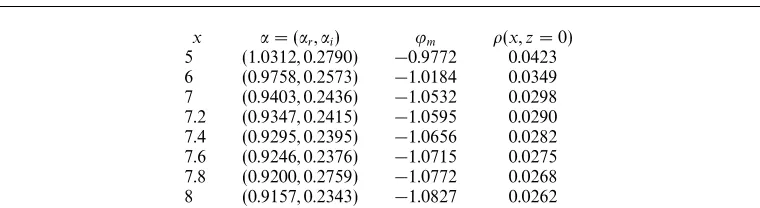
This is from a balance between the integral term and the second z-derivative in the equation, and an equivalent conclusion was drawn in Wu et al. (1996). The typical behaviour of the third root is illustrated in figure 4.
The short-wave instability (4.17) has no immediate impact on the correctness of the formulation, nevertheless the disturbance growth can be sufficiently strong to affect finite-difference computations especially on coarser grids. It can also be shown that the instability vanishes if the entire solution including disturbances is real. Partly because of that the properties of complex-valued and purely real amplitude distributions considered below prove to be significantly different. The final feature to be mentioned here is the importance of the spanwise diffusion term b∂2r/∂z2 in the
wave equation. If b= 0 then the initial-value problem is ill-posed because unstable modes with unbounded growth ratesλofO(β4/3) can be found for largeβ, again due