A HYBRID GENETIC ALGORITHM FOR THE
LONGEST COMMON SUB-SEQUENCE OF
MULTIPLE SEQUENCES: A REVIEW
Aman Rawat
1, Vishal Thakuria
2, Pradeep Gehlot
3, Deepak Garg
41,2,3,4
Dept. of Computer Applications, National Institute of Technology Kurukshetra (India)
ABSTRACT
The k-LCS (longest common sub-sequence)problem is to find the LCS of k sequences. The k-LCS is difficult when the length and the number of sequences are significant. For solving this problem, in this paper, we have reviewed Expansion algorithm, Best next for maximal available symbol algorithm, Genetic algorithm and Ant colony optimization algorithms. By taking good features of above algorithms we have proposed a hybrid method, which is a combination of Genetic algorithm and Hill climbing algorithm. In our review, we compare our method with expansion algorithm, best next for maximal available symbol algorithm, GA and ACO algorithm.We have introduced a local search heuristic, hill climbing, with the GA to solve the above problem.
Keywords: Crossover, Expansion Algorithm,Genetic Algorithm, Hill Climbing, Mutation.
1. INTRODUCTION
Given k number of sequences, we need to find LCS(Longest Common Sub sequence) from the given sequences in k-LCS problem. Suppose we have a set S of input sequences, S={ s1,s2,….,sk }. If P is a sub-sequence of all Si for 1 ≤ i ≤ k , then P is said to be a common sub-sequence (CS) of set S. For example, consider the set S ={s1
characteristics of ant searching for food and uses this to find the common sub-sequence in S [3]. It uses adaptation by relieving on the concentration of pheromone and probabilities to decide next symbol to choose to get superior results. The ACO remembers better solutions that have been recovered, then decides the character that is best common character and then appends it to the CS. Genetic Algorithm (GA) relies on the bio-inspired process such as crossover, selection and mutation to solve the optimization problem. An algorithm was proposed by Chiang et al. for solving the k-LCS problem [2]. The chromosomes are regarded as CS and are evolved in further generations using crossover and mutation operators to find the better common sub-sequence. Based on the fitness function the better results from the chromosomes are retained to form the new generation and are used for evolution in the subsequent generations[12]. As the good part of the result is retained, this helps find a better solution in next generations.
III. RELATED WORK
3.1 Dynamic Programming Based Solution for 2 LCS
Needleman and Wunsch [17] used Dynamic Programming to calculate 2-LCS on a matrix of (m+1)×(n+1) .Let C = c1c2 … ci …cm and D = d1d2 …dj …dn be the two input strings. Let L(i, j) denote the length of string C and
string D, where 0 <=i <=m and 0 <=j <=n. For every entry L(i,j), there will be three cases as stated in the figure 2.1 Based on them, to calculate L(i,j), first L(i-1,j), L(i,j-1) and L(i-1, j-1) needs to be calculated. With each calculation of L(i, j), where 0<=i <=m, 0<=j<=n, we can eventually obtain L(m,n), the LCS length of C and D. So Needleman and Wunsch's algorithm for 2-LCS formula can be represented as follows.
Algorithm: Dynamic Programming Algorithm of 2-LCS Input: Two sequences C and D
Output: The length of LCS (C,D)
{Step 1. calculate L(i,j) based on Equation 2.1} for i = 0 to|C| do
for j = 0 to |D| do if i = 0 or j = 0 then
L(i,j) ← 0
else if C[i] = D[j] then
L(i,j) ← L(i - 1, j - 1) + 1 else
end for end for
{Step 2. Return the length of LCS(C, D)}
LCS(C, D) ← L(|C|, |D|)
2.2 The Expansion Algorithm
Expansion Algorithm(EA) was proposed by Bonizzoni et al. [4] for solving the k-LCS problem.The streams are used to represent the sequence in S and then are used to find the LCS. A stream has non contiguous symbols. Initially, common sub-streams having length more than 2 and a longest common sub-stream T of all sequences in S are found . Further, all sub-strings are expanded to obtain the approximate long common sub-sequence of S. Consider S1 = XXXXYYYXXXXYYX and S2 = XXXYYYYXXXXYYY. After encoding, S1 = X4Y3X4Y2X
and S2 = X 3
Y4X4Y3. One sub-stream ss of S is XYXY. We expand the initial X, and ss now is X2YXY. Then examine if ss is a sub-sequence of both the sequence S1 and S2. The subsequently expanded sub-streams stated
are XY2XY, XYX2Y, XYXY2, X4YXY, X2Y2XY, and so on. Finally, we get ss = X2Y2X4Y2. Then, each symbol is expanded with the maximal value using binary search in a way that the expanded substream is the common sub-sequence of S1 and S2. Finally we get the ss tas X3Y3X4Y2. For k-LCS when the length of input sequence is
n the time complexity is O(kn3 log n), . The EA cannot be used when the input sequence is significantly large, it becomes impractical. A better minimum-spanning-tree-based(MSTG) [14]algorithm was proposed by Tsai and Hsu that can be used to find better common stream.
2.3 The Best Next for Maximal Available Symbols
Best Next for Maximal Available Symbols (BN-MAS) was proposed by Huang et al. [15] for solving the k-LCS problem. In this algorithm, a set S having k sequences over finite letter Σ. The main aim of the algorithm is to list the count of each different character before ai in every sequence, for 1 ≤ i ≤ n, and select the one that has the
most available characters as the common sub-sequence. After that, remove the selected character and the characters that are beyond the selected character from each sequence, and again write the available symbols till there is no such common character in all the sequences . Available characters can be shows as count of each and every characters before the i th character For example, S1 = XYYXVVXZXXYZ, the available characters of
S1[12]( = Z) are two V, three Y , five X and two Z (including symbol Z itself.) So v[Z,1] = [2, 5, 3, 2]. In this
Algo., we first record the v(σ, j) as the available characters of symbol σ in sequence j, and we are only focus about the symbols that are located at the rightmost position. For example, consider four sequences in set S, that are {S1 = XYYXVVXZXXYZ, S2 = VXYZVYVXYXYZ S3 = VXVYVZXZVYXV, S4 =
VYXYVVXZXVXY}.To calculate v(Z ), we have to calculate v(Z, 1) = [2, 5, 3, 2], v(Z, 2) = [3, 3, 3, 3], v(Z, 3) = [3, 2, 1, 2], and v(Z, 4) = [3,2,2,1] initially. Then v(Z ) = min{v(Z,1),v(Z,2),v(Z,3),v(Z,4)}=[2, 2, 1, 1]. We will Repeat it again then the steps, we can get v(V) = [2, 1, 2, 0], v(X) = [2, 3, 2, 1], and v(Y) = [2, 2, 2, 1]. We shows Sum(v[σ]) as the sum of all elements in v[σ]. Then we choose the σ with the maximum Sum(v[σ]) into the
common sub-sequence. In this example, we choose the X into the common sub-sequence. After that, we eliminate the character X and all the characters after X in each sequence, we can get S1’ = XYYXVVXZX, S2’ =
the common subs-equence as XYVXZX. The time complexity of BNMAS is O(σ2kn + σ3n), where σ= |Σ|, k =
|S|, and n is the length of the longest sequence in S. As the sequence length increases gradually this algorithm under-performs.
2.4 ACO for
k
-LCS
Ant Colony Optimization(ACO) algorithm for solving the k-LCS problem was proposed by Shyu and Tsai [21]. The main motive of the algorithm is to discover common characters that are at better positions in the sequences and can help compose a larger common sub-sequence. Each symbol is transformed to one state, and use the ants' pheromone and probabilities as the decision criteria to locate the symbol that must be chosen to form the common sub-sequence. Consider a set S having sequences: S1=VYYVXXVZVVYZ, S2=XVYZXYXVZGYZ,
S3=XVXYXZVZXYVX.
Step 1: Randomly select m sequences (m < |S|) as artificial ants. Suppose m = 1 and the artificial ant is S2. Then each symbol in S2 is transformed into following state: XVYZXYXVZVYZ →(X,1),(V,2),(Y,3),(Z,4), (X, 5),(Y,6),(X,7),(V,8),(Z,9),(V,10),(Y,11),(Z,12).
Step 2: Randomly select a state as the common sub-sequence.Assume we choose (V,2) as the candidate for common sub-sequence, then we find the leftmost V in each sequence, and mark them as the common character V, common sub-sequence (CS) ← V.S1 = VYYVXXVZVVYZ S2 = XVYZXYXVZVYZ S3 = XVXYXZVZXYVX
Step 3: According to the probability function, select the next state p in S2 inside length d, and then find the closest p of V. Suppose d = 3, p may be (Y,3), (Z,4), (X,5). We select (X,5) as p. Then we find the closest X of G in S1 and S3, and mark them. S1 = VYYVXXVZVVYZ, S2 = XVYZXYXVZVYZ, S3 = XVXYXZVZXYVX
Step 4: Repeat Step 3, until the the generation-best result can’t be improved by artificial ants in 100 consecutive generations.
2.5 Genetic Algorithm for
k
-LCS
Genetic Algorithm to solve k-LCS was developed by Chiang et al. [2]. As the part of the algorithm we choose the smallest sequence from set S that contains k sequences. The smallest one is our template sequence. In different words we can say a template pattern of binary string i.e 0 or 1 is randomly generated and if we write all the letters corresponding to 1 in template sequence, the final result is the template sub-sequence.For a template sequence t = BAABCDGFHTBC and a template pattern tp = 010110111011. Then the generated template sub-sequence ts =ABCGFHBC. For k sequences in set S we will randomly generate tp template patterns as our initial populations set. Then we will apply crossover on randomly choosing 2 different template patterns. Then again we will choose a template pattern randomly and mutation operation is applied by choosing a mutation point j and toggling the bit at that point from 0 to 1 or 1 to 0. Finally we use fitness function to determine whether the template pattern is good or not.
We use fitness function given in 2.2 where |S| denotes the input sequences in set S, Pjm is the occurrences of
pattern Pj in the sub-sequences S, Pjvis the sum of letters that Pjis matched to all sequencesin S, and f(Pj) gives
Pjm × Pjv if Pjm = |S| (2.2)[2] f(Pj) = -1× (|S| - Pjm ) × Pjv otherwise.
Genetic Algorithm
Output: The CS of S
{Step 1. Initialize population g}
Produce p template patterns P , choose the last sequence as the template sequence Slast {Step 2. Reproduce the template sub-sequences Subi}
for i = 0 to p do for j = 0 to n do if Pi[j] = 1 then Subi Slast[j] end if
end for end for
{Step 3. Compare template sub-sequences with input sequences} The Fitness function(Pj)
{Step 4. Reproduce new Pj}
Parent1 ← random(P ); Parent2 ← random(P ) Crossover(Parent1 , Parent2)
Parent3←random(P ) Mutation(Parent3)
{Step 5.After repeat Step 2 to Step 4, return the CS} Termination condition: G generations are reached or f(Phighest) is not changed in 10 consecutive generations }. CS S1
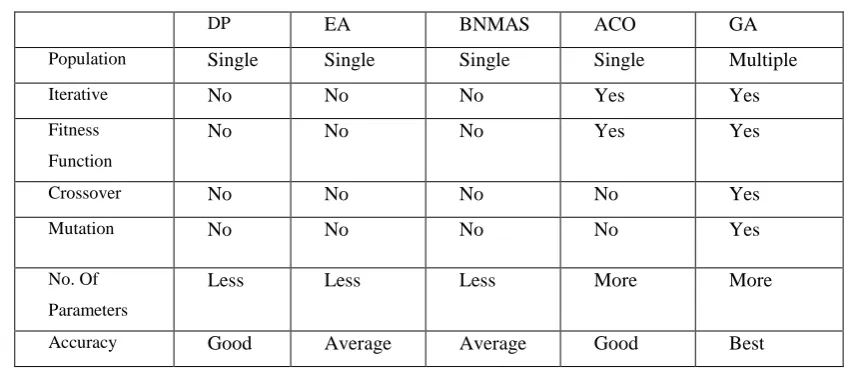
III. COMPARISON TABLE.
Table 1.
Comparison table for different algorithms on k-LCS
DP EA BNMAS ACO GA
Population Single Single Single Single Multiple
Iterative No No No Yes Yes
Fitness
Function
No No No Yes Yes
Crossover No No No No Yes
Mutation No No No No Yes
No. Of
Parameters
Less Less Less More More
VI. PROPOSED ALGORITHM
The Genetic Algorithm comes out to be efficient in terms of the sequence length and accuracy when compared to other heuristics explained above. We hybridize the Genetic Algorithm by combining Hill Climbing in the selection of next chromosome. This will add local optimal search to the GS. The mutation and crossover operation ensures that the search is spread throughout the population space and hill climbing will ensure that we reach the local optima resulting in better quality solution than the GA. By this we extract the goodness of Hill Climbing as well as Genetic Algorithm thus helping in achieving better CS with comparatively less execution time.
VI. HYBRID GENETIC ALGORITHM
Output: The CS of S
{Step 1. Initialize population g}
Produce p template patterns P , choose the last sequence as the template sequence Slast
{Step 2. Reproduce the template sub-sequences Subi} for i = 0 to p do
for j = 0 to n do if Pi[j] = 1 then Subi Slast[j] end if
end for end for
{Step 3. Compare template sub-sequences with input sequences} The Fitness function(Pj)
{Step 4. Reproduce new Pj}
Parent1 ← random(P ); Parent2 ← random(P )
Crossover(Parent1 , Parent2)
Parent1=Hill_Climbing(Parent1) Parent2=Hill_Climbing(Parent2) Parent3←random(P )
Mutation(Parent3)
{Step 5.After repeat Step 2 to Step 4, return the CS} Termination condition: G generations are reached or
f(Phighest) is notchanged in 10 consecutive generations }. CS S1
V. CONCLUSION
hybridization will yield in better solution quality and less execution time. The local search optimization using Hill Climbing gets the best out of Genetic Algorithm when used together. In similar manner other heuristics as well as meta-heuristic algorithms can also be hybridized with Genetic Algorithm to achieve significantly improved results.
VI. FUTURE SCOPE
For the future work, the algorithm will be tested on large k having a significantly long length and to optimize the performance of the algorithm in terms of solution length as well as the execution time. Hybridization with many other heuristics and meta-heuristics will help achieve this. Furthermore implementation of the algorithm using Cuckoo Search and Firefly Algorithm will help compare the solution generation process and that will aid in even better hybridization of the algorithms to get good quality solutions for our problem as well as various other such problems.
REFERENCES
1. Bonizzoni, P., Vedova, G.D. and Mauri, G.: Experimenting an approximation algorithm for the LCS In: Discrete Applied Mathematics,Vol. 110, No. 1, pp. 13–24 (2001).
2. Dorigo, M., Maniezzo, V. and Colorni, A.: Ant system- Optimization by a colony of cooperating agents. In: IEEE Transactions on Systems, Man, and Cybernetics-Part B,Vol. 26, No. 1, pp. 29–41 (1996). 3. Hirschberg, D.S.: A linear space algorithm for computing maximal common subsequence. In:
Communications of the ACM,Vol. 18, No. 6, pp. 341–343, (1975).
4. Hirschberg, D. S.: Algorithms for the longest common subsequence problem. In: Journal of ACM, Vol. 24, pp. 664–675 (1977).
5 . Huang, K.-F, Yang, C.-B. and Tseng, K.-T: An efficient algorithm for multiple sequence Alignment. In: Proc. of the 19th Workshop on Combinatorial Mathematics and Computation Theory, Kaohsiung, Taiwan, pp. 50–59 (2002).
6. Huang, K.-S., Yang, C.-B. and Tseng, K.-T: Fast algorithms for finding the common subsequence of multiple sequences. In: Proceedings of International Computer Symposium, Taipei, Taiwan, pp. 90–95 (2004).
7. Hunt, J.W. and Szymanski, T.G.: A fast algorithm for computing longest common subsequences. In: Communications of the ACM,Vol. 20, No. 5, pp. 350–353 (1977).
8. Lee, R.C.T., Chang, R.C., Tseng, S.S., and Tsai, Y.T.: Introduction to the Design and Analysis of Algorithm - a strategic approach.ISBN 007-124346-1. In: McGraw Hill (2005)
9. Maier, D.: The complexity of some problems on subsequences and supersequences. In: Journal of the ACM, Vol. 25, No. 2, pp. 322–336 (1978).
10. Shyu, S.-J., and Tsai, C.-Y.: Finding the longest common subsequence for multiple biological sequences by ant colony optimization. In: Computers & Operations Research, Vol. 36, pp. 73–91, (2009).
12. Wagner, R.A., and Fischer, M.J.: The stringto-string correction problem. In: Journal of the ACM, Vol. 21, No. 1, pp. 168–173 (1974).
13. Tsai, Y.T., and Hsu, J.T.: An approximation algorithm for multiple longest common subsequence problems. In: Proceeding of the 6thWorld Multiconference on Systemics, Cybernetics and Informatics, SCI, pp. 456-460 (2002).
14. Kuo-Si Huang, C.-B.Y., and Tseng, K.-T.: Fast algorithms for Finding the common subsequence of multiple sequences. In: Proc. of International Computer Symposium, Taipei, Taiwan, Dec. pp.15-17 (2004)
15. Julstrom, B.A., and Hinkemeyer, B.: Starting from scratch: Growing longest common subsequences with evolution In: Proceedings of the 9th In-ternational Conference on Parallel Problem Solving From Nature (PPSN IX), Lecture Notes in Computer Science 4193, Springer Berlin / Hei-delberg, pp. 930-938 (2006.) 16. Needleman, D.B., and Wunsch, C.D.: A general method applicable to the search for similarities in the