A Survey on Target Coverage in Wireless Sensor
Networks
J.Lakshmi Priya
1, K.Subramaniyan
2 1,2ECE, National Engineering College (India)
ABSTRACT
A fundamental challenge in wireless sensor network is to enhance the network lifetime by changing the direction
of the sensor. The coverage constraint is the problem in maximizing network lifetime in Wireless Sensor
Networks. The effective sensing range of sensors is characterized by directionality and sensing angle. The
sensor field is divided into voronoi cells by calculation of sensor. The direction of the sensor is based on the
vertex distance. Thus the sensor covers more targets. The sensor calculates its respective intra-cell coverage
sizes of aligning direction with each vertex and selects the vertex having the maximum coverage as its
preliminary working direction. It improves the overall intercell coverage ratio in the sensor network
environment and also improves the network life time. The main aim of this survey is to improve the network life
time and cover more number of targets by using a followed algorithm. The range has been adjusted in order to
cover more number of targets.
Keywords: Wireless sensor networks, Vertex, Sensing range, Inter cell and Intra cell.
I. INTRODUCTION
In recent years, changing the direction of the sensor design of a Wireless Sensor Network has become a leading area of research. Wireless Sensor Networks is a group of sensors which will communicate among themselves wirelessly. A Sensor is a device that responds and detects some type of input from both the physical or environmental conditions, like pressure, heat, light, etc. The output of the sensor is usually an electrical signal that is transmitted to a controller for further processing. WSN is a wireless network that consists of base stations and numbers of nodes (wireless sensors).coverage becomes one of the important indexes for measuring the WSN Quality of Service. The Directional Sensor Networks (DSN), the coverage is related not only to the location of sensors, but also to the sensing direction and sensing angle of sensors.
The objective of this project is to improve the target coverage and reduces the overlap. This paper proposes an adjustable range of the directional sensors and focuses on the improvement of target coverage of DSN composed of rotatable directional sensors, used the Voronoi diagram characteristics in order to reduce the decision-making complexity of directional sensors in deciding the sensing direction. Distributed Greedy algorithm was used to determine and control the working direction of sensor, so as to improve the overall DSN sensing field coverage.
near to one another therefore because of this problem comes in coverage. Coverage in wireless sensor networks is sometimes outlined as a measure of how well and for how long the sensors are ready to observe the physical area. It is often thought of as a measure of quality of service. Coverage is often measured in several ways depending on the application.
II. SENSOR DEPLOYMENT
There are two types of deployment, namely Static deployment and dynamic deployment.
2.1. Static deployment
A mobile wireless sensor network (MWSN) can simply be defined as a wireless sensor network (WSN) in which the sensor nodes are mobile. ... MWSNs are much more versatile than static sensor networks as they can be deployed in any scenario and cope with rapid topology changes.
Fig 1 Static deployment
2.2
.
Random deployment
The mobile nodes deployment with PPSO is useful in situations while some area need cooperative measuring with multiple nodes, and can be adjusted dynamically according to the requirement of environment.
III. COVERAGE
1. Area coverage 2. Target coverage 3. Barrier coverage
3.1 Target coverage
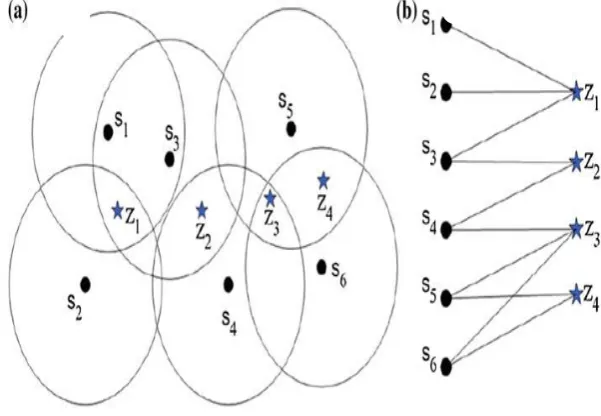
Some sensor applications are only interested in stationary target points, such as buildings, doors, and boxes, whereas other applications aim at tracking mobile targets like intruders. Stationary targets can be located anywhere in the observed area. To cover only the interested targets instead of the whole area, researchers have defined target- based coverage problems. In some studies, researchers name the target coverage approach as point coverage [3]. Unlike the area coverage, this issue puts emphasis on how to cover the maximum number of targets. In target coverage, each target is monitored continuously by at least one sensor.
Fig 3 Target with sensor representation
3.2 Voronoi based target coverage
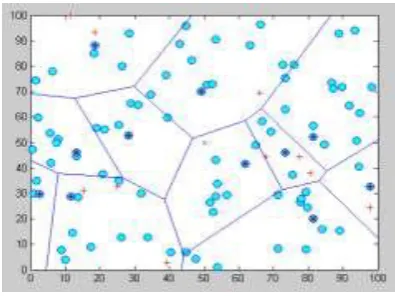
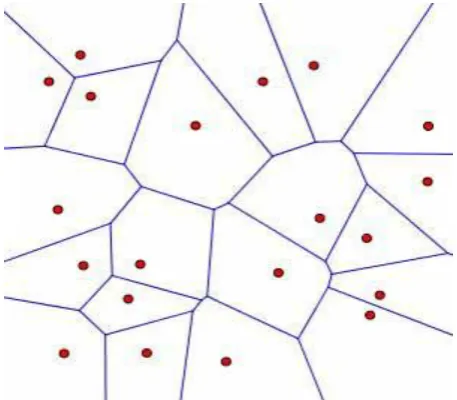
Fig 4 Random deployment of sensor in voronoi
Fig 5 Target covered by the sensor
3.3 SET COVER
Set cover is important in the target coverage. Two types of set cover are present in the target coverage.
3.3.1 Dis joint set cover
3.3.2 Non- disjoints set cover
Non-disjoint set coverproblem where the constructed set covers need not be disjoint. Again, we assume that all sensor nodes have the same amount of initial energy and have the same energy consumption rate in the active state. The lifetime of a single sensor is assumed as one time unit if it is activated all the time. In the context of disjoint set cover problem, each sensor can only be included into one set cover, and all sensors have the same length of the active interval. Therefore, the network lifetime depends on the number of constructed disjoint sensor set covers. However, if we relax the disjoint constraint such that a sensor can be included in more than one set cover and each set cover can be activated for less than one time unit, then the network lifetime may be extended.
3.4 Cell Adjustments
3.4.1 Intra cell Adjustment
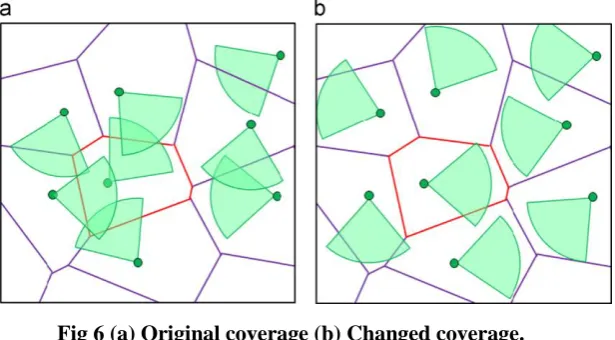
When each sensor completes the construction of its Voronoi cell using distributed/localized algorithm. The vertices of the cell are used as preliminary target working direction candidates [13]. The sensor calculates respective intra-cell coverage sizes of aligning direction with each vertex and selects the vertex having the maximum coverage as its preliminary working direction. In other words, this selection will make the mid split line of the sectorial effective sensing field points to the selected vertex from the position of sensor.
Fig 6 (a) Original coverage (b) Changed coverage.
Except fig 6(a), the overlap area between sectorial sensing field of sensor and irregular convex polygon of Voronoi cell can be divided into multiple triangles according to the intersection between sector boundary and cell edges. The area of intra-cell covered region can be estimated rapidly by summing the areas of all triangles. This is for the purpose of reducing the computation complexity of intra- cell coverage area and there is no significant error between the results of triangular and sectorial calculation methods.
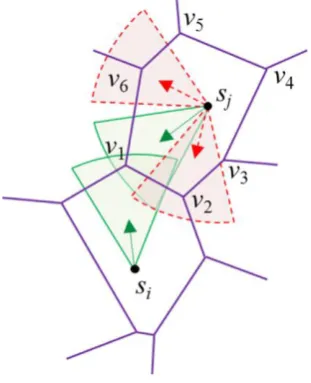
3.4.2 Inter cell adjustment
of two adjacent Voronoi cells, si and sj select v1 as working direction at preliminary stage, there is a large coverage overlap as a result. When this situation occurs, one sensor can be turned to avoid the common vertex. The identification of coverage overlap and the execution of adjustment in direction should be carried out at the Inter-cell Working Direction Adjustment (IDA) stage. As for determining the sensor to be adjusted for direction and the change of direction, the direction of the sensor with smaller intra-cell coverage can be adjusted and it is changed to the cell vertex with this condition largest intra-cell coverage. The working direction faces toward different vertex, so that the probability of coverage overlap is reduced. When the following conditions are tenable, sensor s should have adjustment in direction to change the direction selected at preliminary stage.
Fig 7 Inter - cell working direction adjustment.
IV. SCHEDULING ALGORITHMS FOR TARGET COVERAGE
4.1. Memetic Algorithm
Memetic Algorithm (MA) adopts the Lamarckian theory that the off spring can inherit the knowledge or characteristics that their parents acquire during their lifetime [3]. The MA implements this idea by integrating a local enhancement such as local search and repair operator into the canonical evolutionary algorithm.
Improved memetic algorithm for disjoint set cover is proposed to improve the lifetime of WSN. Local enhancement operators, improver and optimizer, are used in iMA, which is designed specially to improve the lifetime of WSN.
4.2. Learning Automata Algorithm
A learning automaton is considered as an adaptive decision-making unit with the ability for improving its
performance by selecting the best action from a finite set of allowed actions through repeated interactions with a
random environment [5]. The process of action selection is conducted randomly according to a probability
distribution kept over the action-set. Each time an action is selected, it is considered as an input to the random
environment. In response to the taken action, the environment sends a reinforcement signal. Updating the action
probability vector is done based on the reinforcement feedback. A learning automaton aims at finding the
4.3 Min Max Localization Algorithms
Min-Max localization algorithm is one of the most widely applied algorithms application, which has a high accuracy, easy calculation and good scalability. The Min-Max algorithm is similar to three edge localization algorithm. The distance„d‟ from the anchor node to the measured node is calculated by using the transmission distance loss model. Setting the anchor node is the center of the circle, and the radius of the circle is equal to„d‟. In Min-Max localization algorithm, the more square the anchor node contains, the smaller the public square area is, and estimation is more accurate. The process of Min-Max algorithm is not related to the circle itself. Compared to the three edge localization algorithm, it is more convenient for calculation.
4.4 Greedy algorithm
This section elaborates upon the greedy-based algorithm. The Formation process of its cover set can be
Described as follows: each round of the algorithm is composed of a number of stages. A critical target is chosen in each stage [1]. This is followed by the selection of the appropriate adjusted sensor directions that can fulfill the critical target‟s coverage quality requirement. Next, the sensor directions that have been selected are grouped into a set. The process of selecting a critical target and adding the appropriate adjusted sensor directions to the cover set will stop once all the targets‟ coverage quality requirements are satisfied, which will in turn, result in a cover set to be formed.
V. CONCLUSION
There are several algorithms for target coverage, Such as Memetic algorithm, learning automata and min max algorithm. Memetic algorithm is not suitable for more number of sensors. Learning automata is complex to implement in practical. In this survey there are several algorithms are analyzed but the greedy was the best one. Because in the sensor networks power energy and network life time are important constraint. Vertex based greedy algorithm calculates the overall contribution of above three factors. The other three algorithms are only deals with the disjoint set cover. They did not concentrate on non dis- joint set cover. By using non dis- joint set cover single sensor can cover more than one target and also it saves the energy of the sensor and maximizes the network lifetime.
REFERENCES
[1] Jinglan Jia1, Cailin Dong1, Xinggang He1, Deying Li2 and Ying Yu “Sensor scheduling for target coverage in directional sensor networks” International Journal of Distributed Sensor Networks, Vol.
13(6) , 2017.
[2] Chong Han, Lijuan Sun, Jian Guo Chang chao Chen “Rotatable Sensor Scheduling for Multi-demands of Coverage in Directional Sensor Networks”International Conference on computer communication and networks P.no-1 to 8, 2016.
[3] D.Arivudainambi, S.Balaji , D.Rekha “Improved Memetic Algorithm for Energy Efficient Target Coverage in Wireless Sensor Networks” International Conference on networking sensing and control,
[4] Cheng-Long Chuang,, Tzu-Shiang Lin, Min-Sheng Liao, Yung-Chung Wang, “A Hybrid Memetic Framework for Coverage Optimization in Wireless Sensor Networks” IEEE Transaction on
CYBERNETICS , Vol. 45, P.no-2309 to 2322, 2015.
[5] Hosein Mohamadi, Abdul Samad, Bin Haji Ismail, Shaharuddin Salleh “A learning automata-based algorithm for solving coverage problem in directional sensor networks” International conference on Ultra modern telecommunication and control systems,Vol.36, P.no-976 to 980, 2012.
[6] Jing He, Shouling Ji, Yi Pan, Yingshu Li “Reliable and Energy Efficient Target Coverage for Wireless Sensor Networks” TSINGHUA science and technology Volume 16, Number 5, P.no 464 to 474,October
2011.
[7] Dimitrios Zorbas Christos Douligeris “Connected coverage in WSNs based on critical targets” Elsevier Computer networks 2011.
[8] R.Cerullia, R. De Denatoa, A. Raiconia “Exact and heuristic methods to maximize network life time in wireless sensor networks with adjustable sensing ranges” Elsevier December 22, 2010.
[9] Heon-Jong Lee, Yong-hwan Kim, Youn-Hee Han “Centroid -based Movement Assisted Sensor Deployment Schemes in Wireless Sensor Networks” IEEE Conference Publications 2009.
[10] Dhawan, C. T. Vu, A. Zelikovsky, Y. Li, S. K. Prasad “Maximum Lifetime of Sensor Networks with Adjustable Sensing Range” IEEE Conference Publications 2006.
[11] Mihaela Cardei, Jie Wu, and Mingming Lu Int. J. “ Improving Network Lifetime using Sensors with Adjustable Sensing Ranges” Sensor Networks, Vol. 1, Nos. 1/2, 2006.
[12] Mihaela Cardei My T. Thai Yingshu Li Weili Wu “Energy -Efficient Target Coverage in Wireless Sensor Networks” IEEE conference publications 2005.