296 |
P a g e
NEW ITERATIVE METHOD FOR SOLVING HIGHER
ORDER KDV EQUATIONS
Manoj Kumar
1, Anuj Shanker Saxena
21,2
Assistant Professor, National Defence Academy, Khadakwasla, Pune (India)
ABSTRACT
Generalized Korteweg-de Vries equation of fifth order (gfKdV) and seventh order (gsKdV) has various
applications in Sciences and Engineering. In this paper, a New Iterative Method (NIM) is being proposed to
obtain the solution of several forms of the gfKdV and gsKdV equations. We have shown that the NIM solution is
more accurate as comparedto the techniques such as, homotopy perturbation method and adomian
decomposition method. Further, results also demonstrate that NIM solution is more reliable, easy to compute
and computationally fast as compared to other methods.
Keywords: Korteweg-deVries eq.s, New Iterative Method, Adomian Decomposition Method, Homotopy Perturbation Method.
1. INTRODUCTION
The generalized KdV equation of fifth-order (gfKdV) is defined as:
(1)
where and are arbitrary non zero real parameters and the subscripts denote the derivatives of the
corresponding variable. The fifth-order KdVequationplay vital role in various domains such as describing
motion of the long waves in shallow water under gravity,conformal field theory, two-dimensional quantum
gravitationcanonical field theory, nonlinear optics etc.
Generalized KdV equation of seventh-order (gsKdV) is written as:
(2)
where and are arbitrary non zero parameters. This equation plays an important role in
mathematical physics, engineering and applied sciences for investigating travelling solitary wave solutions.
Various numerical techniques have been proposed in the past to solve these equations. Some of the popular
techniques for fifth and seventh order KdV equations are Adomian decomposition method [1], modified
Adomian decomposition method [2], variational iteration method [3], modified variational iteration method,
homotopy perturbation method, modified homotopy perturbation method and homotopy analysis method [4],
Expfunction method [5], homogeneous balance method [6], extended tanh method [7] etc. In addition to these
techniques the seventh order KdVequations are also being solved using the Hirota direct method and the
tanh-coth method [8], homotopy perturbation method [9, 10], variational iteration method [11,12], homotopy analysis
method [13], Adomian decomposition method [14], Cole-Hopf transformation [15] and reconstruction of
297 |
P a g e
In the present paper, we employ New Iterative Method (NIM), developed by DaftardarGejji and Jafari [17], to
solve generalized Korteweg-de Vries equations of fifth and seventh orders [18, 19]. NIM has been used by many
researchers to solve linear and nonlinear equations of integer and fractional orders [20, 21, 22, 23]. Advantage
of NIM is that it gives highly accurate solution with comparatively much lesser number of iterations. Further, it
does not involve additional overhead in computing terms such asadomian polynomials in ADM[24,14,25]
andconstruction of homotopy function in HPM [10, 26].
The organization of this paper is as follows: In section 2, we give the basic introduction of NIM. Solutions of
the generalized KdV equations using NIMderived for several forms of gfKdV and gsKdVare discussed in
section 3. We call these solutions as NIM solutions.NIM solutionsare accurate and the NIM computation
technique is faster as compared to the other commonly used techniques such as HPM[10] and ADM[14]. The
comparisonsbetween the numerical results of the proposed NIM solutions with that ofHPM and ADMare
discussed in section 4. Finally,we conclude by summarizing the advantages of using NIM in solving higher
order KdV equations in section 4.
II NEW ITERATIVE METHOD (NIM)
To illustrate the idea of the NIM, we consider the following general functional equation:
, (3)
where N is a nonlinear operator from a Banach space B → B and is a known function. We are looking for a
solution of (3) having the series form
(4)
The nonlinear operator N can be decomposed as:
(5)
Now using the above eq.s (4) and (5) in (3):
(6)
We define the recurrence relation in the following way:
(7)
Then,
(8)
and
. (9)
The m-term approximate solution of (3) is given by . For understanding the
298 |
P a g e
Solution of higher order KdV equations using NIM
In this section, we discuss solution of higher order KdV equations using NIM. For this we consider two
scenarios each, for fifth order and seventh order Korteweg-deVries (KdV) equations.
2.1 Lax and Sawada-Kotera fifth order equations
Equation (1), as in section 1, is known as Lax fifth order KdV for a = 30, b = 30, c = 10 and d = 1 (Example 1)
and Sawada-Kotera fifth order KdVs for a = 45, b = 15, c = 15 and d = 1 (Example 2). We next derive their
solutions using NIM. In the following discussion we denote .
Example1:The Lax fifth-order KdV equation [10, 6, 29]:
(10)
with the initial condition:
, (11)
has an exact solution:
. (12)
Considering the equivalent integral equation for (10-11):
(13)
On comparing it with equation (3),we have
The NIMrecurrence relation for Lax fifth-order KdV equation (10), using its equivalent form (13) and the
general solution (7) is:
(14)
And, its2-term NIM solution ( i.e. )usinginitial condition(11) is:
. (15)
Example 2: The Sawada-Kotera fifth order KdV eq. [10, 6, 28]
(16)
with the initial condition:
, (17)
has an exact solution:
.
The initial value problem (16-17) is equivalent to
(18)
299 |
P a g e
In view of the recurrence relation (7), we get
(19)
. (20)
Therefore, 3-term NIM solution of (16) (i.e., ) with initial condition (17) is:
(21)
2.2 Lax’s and Sawada-Kotera seventh order KdV equations
In this section, we solve generalized seventh order Korteweg-de Vries (KdV) equations (2) using NIM for
a=140,b = 70,c = 280,d = 70,e = 70,f = 42 and g = 14 (Lax seventh order KdV equation) and for a = 252,b =
63,c = 378,d = 126,e = 63,f = 42 and g = 21 (Sawada-Kotera seventh order KdV equation).
Example3:The Lax seventh order KdV eq. [14, 29]
(22)
with the initial condition:
, (23)
hasan exact solution
. (24)
The eq. (22) along with the initial condition (23) can be written equivalently as
(25)
where
(26)
Now using the recurrence relation (7) in (26):
(27)
300 |
P a g e
Therefore, the 3-term approximate solution obtained by NIM of (22) with initial condition (23) is given by
. (29)
Example4: The Sawada-Kotera seventh order KdV eq. [14, 29]
(30)
with the initial condition:
, (31)
has an exact solution:
. (32)
The eq. (30) along with the initial condition (31) can be written as
(33)
where,
(34)
Using the recurrence relation (7), we get:
(35)
(36)
Therefore, the 3-term approximate NIM solution of (30-31) (i.e., ) is given by:
(37)
III RESULT ANALYSIS
We discuss the numerical results of the NIM solutions for Lax equations and Sawada- Kotera equations of fifth
and seventh orders as derived in section 3. Tables1 and 2 give the numerical comparison between HPM and
301 |
P a g e
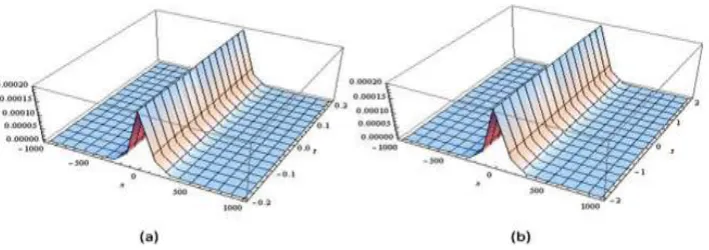
solutions for the seventh order. Graphical representations of NIM solutions and exact solutions for Lax
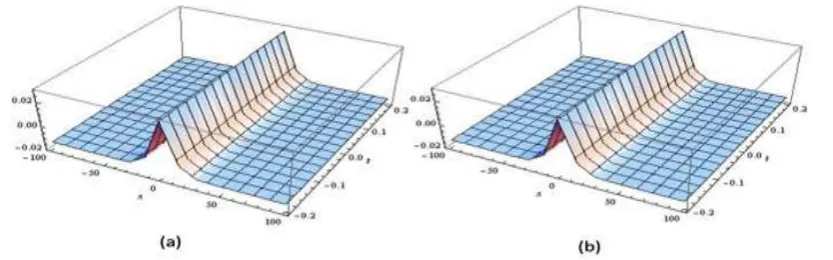
equations of fifth and seventh order are shown in Figures 1 and 3 respectively. Similarly graphical comparison
between NIM solutions and exact solutions of Sawada-Kotera fifth and seventh order equations are shown in
Figures 2and 4 respectively.
x t Exact Solution 10-term HPM Abs Error 2-term NIM Abs Error
0.1 0.1
0.2
0.3
0.4
0.5
3.99999 x 10⁻⁴
3.99999 x 10⁻⁴
3.99999 x 10⁻⁴
3.99999 x 10⁻⁴
3.99999 x 10⁻⁴
9.60 x 10⁻¹²
1.92 x 10⁻¹¹
2.88 x 10⁻¹¹
3.84 x 10⁻¹¹
4.78 x 10⁻¹¹
1.44004x10⁻¹⁵
2.88002 x10⁻¹⁵
4.32000 x10⁻¹⁵
1.44004 x10⁻¹⁵
1.44004 x10⁻¹⁵
0.2 0.1
0.2
0.3
0.4
0.5
3.99998 x 10⁻⁴
3.99998 x 10⁻⁴
3.99998 x 10⁻⁴
3.99998 x 10⁻⁴
3.99998 x 10⁻⁴
9.60 x 10⁻¹¹
1.92 x 10⁻¹¹
2.88 x 10⁻¹¹
3.84 x 10⁻¹¹
4.80 x 10⁻¹¹
2.87991 x10⁻¹⁵
5.75982 x10⁻¹⁵
8.63979 x10⁻¹⁵
1.15198 x10⁻¹⁴
1.15198 x10⁻¹⁴
0.3 0.1
0.2
0.3
0.4
0.5
3.99995 x 10⁻⁴
3.99995 x 10⁻⁴
3.99995 x 10⁻⁴
3.99995 x 10⁻⁴
3.99995 x 10⁻⁴
9.50 x 10⁻¹¹
1.91 x 10⁻¹¹
2.88 x 10⁻¹¹
3.84 x 10⁻¹¹
4.80 x 10⁻¹¹
4.31979 x10⁻¹⁵
8.63963 x10⁻¹⁵
1.29594 x10⁻¹⁴
1.72792 x10⁻¹⁴
1.72792 x10⁻¹⁴
0.4 0.1
0.2
0.3
0.4
0.5
3.99999 x 10⁻⁴
3.99999 x 10⁻⁴
3.99999 x 10⁻⁴
3.99999 x 10⁻⁴
3.99999 x 10⁻⁴
9.50 x 10⁻¹¹
1.91 x 10⁻¹¹
2.87 x 10⁻¹¹
3.87 x 10⁻¹¹
4.79 x 10⁻¹¹
5.75944 x10⁻¹⁵
1.15190 x10⁻¹⁴
1.72786 x10⁻¹⁴
2.30380 x10⁻¹⁴
2.30380 x10⁻¹⁴
0.5 0.1
0.2
0.3
0.4
0.5
3.99985 x 10⁻⁴
3.99985 x 10⁻⁴
3.99985 x 10⁻⁴
3.99985 x 10⁻⁴
3.99985 x 10⁻⁴
9.60 x 10⁻¹¹
1.92 x 10⁻¹¹
2.88 x 10⁻¹¹
3.84 x 10⁻¹¹
4.80 x 10⁻¹¹
7.19905 x10⁻¹⁵
1.43981 x10⁻¹⁴
2.15971 x10⁻¹⁴
2.87961 x10⁻¹⁴
2.87961 x10⁻¹⁴
302 |
P a g e
x t Exact Solution 10-term HPM Abs Error 2-term NIM Abs Error
0.1 0.1
0.2
0.3
0.4
0.5
1.999998 x 10⁻⁴
1.999998 x 10⁻⁴
1.999998 x 10⁻⁴
1.999998 x 10⁻⁴
1.999998 x 10⁻⁴
4.800 x 10⁻¹⁶
9.600 x 10⁻¹⁶
1.440 x 10⁻¹⁵
1.920 x 10⁻¹⁵
2.400 x 10⁻¹⁵
2.71051 x10⁻²⁰
0
8.13152 x10⁻²⁰
2.71051 x10⁻²⁰
2.71051 x10⁻²⁰
0.2 0.1
0.2
0.3
0.4
0.5
1.999992 x 10⁻⁴
1.999992 x 10⁻⁴
1.999992 x 10⁻⁴
1.999992 x 10⁻⁴
1.999992 x 10⁻⁴
9.600 x 10⁻¹⁶
1.920 x 10⁻¹⁵
2.880 x 10⁻¹⁵
3.840 x 10⁻¹⁵
4.800 x 10⁻¹⁵
0
2.71051 x10⁻²⁰
2.71051 x10⁻²⁰
2.71051 x10⁻²⁰
2.71051 x10⁻²⁰
0.3 0.1
0.2
0.3
0.4
0.5
1.999982 x 10⁻⁴
1.999982 x 10⁻⁴
1.999982 x 10⁻⁴
1.999982 x 10⁻⁴
1.999982 x 10⁻⁴
1.440 x 10⁻¹⁵
2.880 x 10⁻¹⁵
4.320 x 10⁻¹⁵
5.760 x 10⁻¹⁵
7.200 x 10⁻¹⁵
2.71051 x10⁻²⁰
5.42101 x10⁻²⁰
0
0
5.42101 x10⁻²⁰
0.4 0.1
0.2
0.3
0.4
0.5
1.999968 x 10⁻⁴
1.999968 x 10⁻⁴
1.999968 x 10⁻⁴
1.999968 x 10⁻⁴
1.999968 x 10⁻⁴
1.920 x 10⁻¹⁵
3.840 x 10⁻¹⁵
5.760 x 10⁻¹⁵
7.680 x 10⁻¹⁵
9.599 x 10⁻¹⁵
2.71051 x10⁻²⁰
8.13152 x10⁻²⁰
2.71051 x10⁻²⁰
2.71051 x10⁻²⁰
5.42101 x10⁻²⁰
0.5 0.1
0.2
0.3
0.4
0.5
1.99950 x 10⁻⁴
1.99950 x 10⁻⁴
1.99950 x 10⁻⁴
1.99950 x 10⁻⁴
1.99950 x 10⁻⁴
2.400 x 10⁻¹⁴
4.800 x 10⁻¹⁴
7.200 x 10⁻¹⁴
9.600 x 10⁻¹⁴
1.200 x 10⁻¹⁴
8.13152 x10⁻²⁰
5.42101 x10⁻²⁰
5.42101 x10⁻²⁰
5.42101 x10⁻²⁰
5.42101 x10⁻²⁰
303 |
P a g e
x t Exact Solution 5-term ADM Abs. Error 3-term NIM Abs Error
0.1 0.1
0.2
0.3
0.4
0.5
1.99980 x 10⁻²
1.99980 x 10⁻²
1.99980 x 10⁻²
1.99980 x 10⁻²
1.99980 x 10⁻²
1.31265 x 10⁻⁸
2.46564 x 10⁻⁸
3.60575 x 10⁻⁸
4.72723 x 10⁻⁸
5.82447 x 10⁻⁸
3.46945 x 10⁻¹⁸
0
0
0
3.46945 x 10⁻¹⁸
0.2 0.1
0.2
0.3
0.4
0.5
1.99920 x 10⁻²
1.99920 x 10⁻²
1.99920 x 10⁻²
1.99920 x 10⁻²
1.99920 x 10⁻²
2.69869 x 10⁻⁸
4.99471 x 10⁻⁸
7.27082 x 10⁻⁸
9.51513 x 10⁻⁸
1.17157 x 10⁻⁷
0
3.46945 x 10⁻¹⁸
6.93889 x 10⁻¹⁸
3.46945 x 10⁻¹⁸
3.46945 x 10⁻¹⁸
0.3 0.1
0.2
0.3
0.4
0.5
1.99820 x 10⁻²
1.99820 x 10⁻²
1.99820 x 10⁻²
1.99820 x 10⁻²
1.99820 x 10⁻²
3.50406 x 10⁻⁸
6.95085 x 10⁻⁸
1.03998 x 10⁻⁸
1.38303 x 10⁻⁸
1.72205 x 10⁻⁸
0
3.46945 x 10⁻¹⁸
3.46945 x 10⁻¹⁸
3.46945 x 10⁻¹⁸
6.93889 x 10⁻¹⁸
0.4 0.1
0.2
0.3
0.4
0.5
1.99680 x 10⁻²
1.99680 x 10⁻²
1.99680 x 10⁻²
1.99680 x 10⁻²
1.99680 x 10⁻²
2.65114 x 10⁻⁸
7.29819 x 10⁻⁸
1.20366 x 10⁻⁷
1.68309 x 10⁻⁷
2.16406 x 10⁻⁷
0
3.46945 x 10⁻¹⁸
0
3.46945 x 10⁻¹⁸
1.04083 x 10⁻¹⁷
0.5 0.1
0.2
0.3
0.4
0.5
1.99550 x 10⁻²
1.99550 x 10⁻²
1.99550 x 10⁻²
1.99550 x 10⁻²
1.99550 x 10⁻²
1.36124 x 10⁻⁸
4.60129 x 10⁻⁸
1.08644 x 10⁻⁷
1.73664 x 10⁻⁷
2.40318 x 10⁻⁷
0
3.46945 x 10⁻¹⁸
6.93889 x 10⁻¹⁸
6.93889 x 10⁻¹⁸
1.04083 x 10⁻¹⁸
x t Exact Solution 5-term ADM Abs. Error 3-term NIM Abs Error
0.1 0.1
0.2
0.3
0.4
0.5
1.99980 x 10⁻²
1.99980 x 10⁻²
1.99980 x 10⁻²
1.99980 x 10⁻²
1.99980 x 10⁻²
1.31265 x 10⁻⁸
2.46564 x 10⁻⁸
3.60575 x 10⁻⁸
4.72723 x 10⁻⁸
5.82447 x 10⁻⁸
3.46945 x 10⁻¹⁸
0
0
0
3.46945 x 10⁻¹⁸
0.2 0.1
0.2
0.3
0.4
0.5
1.99920 x 10⁻²
1.99920 x 10⁻²
1.99920 x 10⁻²
1.99920 x 10⁻²
1.99920 x 10⁻²
2.69869 x 10⁻⁸
4.99471 x 10⁻⁸
7.27082 x 10⁻⁸
9.51513 x 10⁻⁸
1.17157 x 10⁻⁷
0
3.46945 x 10⁻¹⁸
6.93889 x 10⁻¹⁸
3.46945 x 10⁻¹⁸
304 |
P a g e
Table 3. Comparison between 3-term NIM errorand5-term ADM errorfor eq.(22) (x0 = 0.0,k = 0.1) 0.3 0.1
0.2
0.3
0.4
0.5
1.99820 x 10⁻²
1.99820 x 10⁻²
1.99820 x 10⁻²
1.99820 x 10⁻²
1.99820 x 10⁻²
3.50406 x 10⁻⁸
6.95085 x 10⁻⁸
1.03998 x 10⁻⁸
1.38303 x 10⁻⁸
1.72205 x 10⁻⁸
0
3.46945 x 10⁻¹⁸
3.46945 x 10⁻¹⁸
3.46945 x 10⁻¹⁸
6.93889 x 10⁻¹⁸
0.4 0.1
0.2
0.3
0.4
0.5
1.99680 x 10⁻²
1.99680 x 10⁻²
1.99680 x 10⁻²
1.99680 x 10⁻²
1.99680 x 10⁻²
2.65114 x 10⁻⁸
7.29819 x 10⁻⁸
1.20366 x 10⁻⁷
1.68309 x 10⁻⁷
2.16406 x 10⁻⁷
0
3.46945 x 10⁻¹⁸
0
3.46945 x 10⁻¹⁸
1.04083 x 10⁻¹⁷
0.5 0.1
0.2
0.3
0.4
0.5
1.99550 x 10⁻²
1.99550 x 10⁻²
1.99550 x 10⁻²
1.99550 x 10⁻²
1.99550 x 10⁻²
1.36124 x 10⁻⁸
4.60129 x 10⁻⁸
1.08644 x 10⁻⁷
1.73664 x 10⁻⁷
2.40318 x 10⁻⁷
0
3.46945 x 10⁻¹⁸
6.93889 x 10⁻¹⁸
6.93889 x 10⁻¹⁸
305 |
P a g e
x t Exact Solution 5-term ADM Abs. Error 2-term NIM Abs Error
0.1 0.1
0.2
0.3
0.4
0.5
2.66627 x 10⁻²
2.66627 x 10⁻²
2.66627 x 10⁻²
2.66627 x 10⁻²
2.66627 x 10⁻²
6.61289 x 10⁻⁹
1.38091 x 10⁻⁸
2.10236 x 10⁻⁸
2.82628 x 10⁻⁸
3.55331 x 10⁻⁸
1.36515 x 10⁻⁹
2.73030 x 10⁻⁹
4.09545 x 10⁻⁹
5.46061 x 10⁻⁹
6.82576 x 10⁻⁹
0.2 0.1
0.2
0.3
0.4
0.5
2.66507 x 10⁻²
2.66507 x 10⁻²
2.66507 x 10⁻²
2.66507 x 10⁻²
2.66507 x 10⁻²
1.30572 x 10⁻⁸
2.74896 x 10⁻⁸
4.19330 x 10⁻⁸
5.64022 x 10⁻⁸
7.09127 x 10⁻⁸
2.72921 x 10⁻⁹
5.45842 x 10⁻⁹
8.18763 x 10⁻⁹
1.09168 x 10⁻⁸
1.36461 x 10⁻⁸
0.3 0.1
0.2
0.3
0.4
0.5
2.66307 x 10⁻²
2.66307 x 10⁻²
2.66307 x 10⁻²
2.66307 x 10⁻²
2.66307 x 10⁻²
2.20865 x 10⁻⁸
4.37197 x 10⁻⁸
6.52333 x 10⁻⁸
8.66610 x 10⁻⁸
1.08043 x 10⁻⁷
4.09109 x 10⁻⁹
8.18218 x 10⁻⁹
1.22733 x 10⁻⁸
1.63644 x 10⁻⁸
2.04554 x 10⁻⁸
0.4 0.1
0.2
0.3
0.4
0.5
2.66027 x 10⁻²
2.66027 x 10⁻²
2.66027 x 10⁻²
2.66027 x 10⁻²
2.66027 x 10⁻²
3.82381 x 10⁻⁸
6.68601 x 10⁻⁸
9.49483 x 10⁻⁸
1.22581 x 10⁻⁷
1.49860 x 10⁻⁷
5.44979 x 10⁻⁹
1.08994 x 10⁻⁸
1.63491 x 10⁻⁸
2.17988 x 10⁻⁸
2.72485 x 10⁻⁸
0.5 0.1
0.2
0.3
0.4
0.5
2.65668 x 10⁻²
2.65668 x 10⁻²
2.65668 x 10⁻²
2.65668 x 10⁻²
2.65668 x 10⁻²
6.78327 x 10⁻⁸
1.02954 x 10⁻⁷
1.36620 x 10⁻⁷
1.69003 x 10⁻⁷
2.00334 x 10⁻⁷
6.80396 x 10⁻⁹
1.36079 x 10⁻⁸
2.04119 x 10⁻⁸
2.72158 x 10⁻⁸
3.40198 x 10⁻⁸
306 |
P a g e
IV CONCLUSION
In this paper, New Iterative Method has been successfully used for obtaining the analytic solutions for Lax
equations and Sawada-Kotera KdV equations of fifth and seventh orders. NIM solutions are much accurate,as its
numerical solutions are closer to the exact solutions than the solutions derived byHPM and ADM. The same has
also been validated by the graphical comparison of the NIM solutions with the exact solutions. Further, NIM
solutions are computationally efficient as it gives good numerical approximation by considering 2 or 3-terms
only. NIM solutions, as obtained in section 3, are shown to be fast and direct as there is no overhead to compute
additional terms,such as adomian polynomial in ADM and construction of homotopy in HPM.
REFERENCES
[1] D. Kaya and S. M. El-Sayed. On a generalized fifth order kdv equations. Physics Letters A, 310(1):44–51,
2003.
[2] H. O. Bakodah. Modified adomain decomposition method for the generalized fifth order kdv equations.
American Journal of Computational Mathematics, 3(01):53, 2013.
[3] L. Jin. Application of the variational iteration method for solving the fifth order caudrey-doddgibbon
equation. In International Mathematical Forum, volume 5, pages 3259–3265, 2010.
[4] S. Sadigh Behzadi. Numerical solution of sawada-kotera equation by using iterative methods. International
Journal of Industrial Mathematics, 4(3):269–288, 2012.
[5] C.Chun. Solitonsandperiodicsolutionsforthefifth-orderkdvequationwiththeexp-function method. Physics
Letters A, 372(16):2760–2766, 2008.
[6] Y. Lei, Z. Fajiang, and W. Yinghai. The homogeneous balance method, lax pair, hirota transformation and a
general fifth-order kdv equation. Chaos, Solitons & Fractals,13(2):337–340, 2002.
[7] A.-M. Wazwaz. The extended tanh method for new solitons solutions for many forms of the fifth-order kdv
equations. Applied Mathematics and Computation, 184(2):1002–1014, 2007.
[8] A.-M. Wazwaz. The hirotas direct method and the tanh–coth method for multiple-soliton solutions of the
sawada–kotera–ito seventh-order equation. Applied Mathematics and Computation, 199(1):133–138, 2008.
[9] D. Ganji, N. Jamshidi, and Z. Ganji. Hpm and vim methods for finding the exact solutions of the nonlinear
dispersive equations and seventh-order sawada–kotera equation. International Journal of Modern Physics B,
23(01):39–52, 2009.
[10] M. Ghasemi, M. Tavassoli Kajani, and R. Khoshsiar Ghaziani. Numerical solution of fifth order kdv
equations by homotopy perturbation method. Math. Sci. Quarterly J, 2:169–181, 2011.
[11] H. Jafari, A. Yazdani, J. Vahidi, and D. D. Ganji. Application of hes variational iteration method for
solving seventh order sawada-kotera equations. Applied Mathematical Sciences, 2(9-12):471–477, 2008.
[12] A. Soliman. A numerical simulation and explicit solutions of kdv-burgers and laxs seventh order kdv
equations. Chaos, Solitons & Fractals, 29(2):294–302, 2006.
[13] S. Abbasbandy and F. S. Zakaria. Soliton solutions for the fifth-order kdv equation with the homotopy
307 |
P a g e
[14] S. M. El-Sayed and D. Kaya. An application of the ADM to seven-order Sawada–Kotara equations.
Applied mathematics and computation, 157(1):93–101, 2004.
[15] A. H. Salas and C. A. G´omez S. Application of the cole-hopf transformation for finding exact solutions to
several forms of the seventh-order kdvequation. Mathematical Problems in Engineering, 2010, 2010.
[16] M. Saravi, A. Nikkar, and M. Hermann. A new modified approach for solving seven-order sawada-kotara
equations. Journal of mathematics and computer Science, 6(3):230–237, 2013.
[17] V. Daftardar-Gejji and H. Jafari. An iterative method for solving nonlinear functional equations. Journal of
Mathematical Analysis and Applications, 316(2):753–763, 2006.
[18] Y. Ruo-Xia and L. Zhi-Bin. On t/x-dependent conservation laws of the generalized nth-order kdv equation.
Chinese Journal of Physics, 42(4-I), 2004.
[19] G. Whitham. Linear and nonlinear waves. John Wiley&Sons, NewYork, 1974
[20] S. Bhalekar and V. Daftardar-Gejji. New iterative method: application to partial differential equations.
Applied Mathematics and Computation, 203(2):778–783, 2008.
[21] V. Daftardar-Gejji and S. Bhalekar. Solving fractional diffusion-wave equations using a new iterative
method. Fractional Calculus and Applied Analysis, 11(2):193p–202p, 2008.
[22] A. Hemeda and M. Saleh Alluhaibi. New iterative method for solving gas dynamic equation. International
Journal of Applied Mathematical Research, 3(2):190–195, 2014.
[23] H. Kocak and A. Yıldırım. An efficient new iterative method for finding exact solutions of nonlinear
time-fractional partial differential equations. Nonlinear Analysis: Modelling and Control, 16(4):403–414, 2011.
[24] G.Adomian.Solvingfrontierproblemsofphysics: the decomposition method.KluwerBoston, 1994.
[25] D. Kaya. An explicit and numerical solutions of some fifth-order kdv equation by decomposition method.
Applied Mathematics and Computation, 144(2):353–363, 2003.
[26] J.-H. He. Homotopy perturbation technique. Computer methods in applied mechanics and engineering,
178(3):257–262, 1999.
[27] S. Bhalekar and V. Daftardar-Gejji. Convergence of the new iterative method. International Journal of
Differential Equations, 2011, 2011.
[28] E. Parkes and B. Duffy. An automated tanh-function method for finding solitary wave solutions to
non-linear evolution equations. Computer Physics Communications, 98(3):288–300, 1996.
[29] H. Nemati, Z. Eskandari, F. Noori, and M. Ghorbanzadeh. Application of the homotopy perturbation