Copyright1999 by the Genetics Society of America
High Polymorphism at the Human Melanocortin 1 Receptor Locus
Brinda K. Rana,* David Hewett-Emmett,* Li Jin,* Benny H.-J. Chang,*
Naymkhishing Sambuughin,
†Marie Lin,
‡Scott Watkins,
§Michael Bamshad,
§Lynn B. Jorde,
§Michele Ramsay,** Trefor Jenkins,** and Wen-Hsiung Li*
*Human Genetics Center, School of Public Health and Graduate School of Biomedical Sciences, University of Texas, Houston, Texas 77030, †Neurology Research, Phoenix, Arizona 85013,‡Mackay Memorial Hospital, Taipei, Taiwan,§Department of Human Genetics, University
of Utah, Salt Lake City, Utah 84112 and **Department of Human Genetics, South African Institute for Medical Research, Johannesburg, South Africa 2050
Manuscript received July 6, 1998 Accepted for publication December 7, 1998
ABSTRACT
Variation in human skin/hair pigmentation is due to varied amounts of eumelanin (brown/black melanins) and phaeomelanin (red/yellow melanins) produced by the melanocytes. The melanocortin 1 receptor (MC1R) is a regulator of eu- and phaeomelanin production in the melanocytes, and MC1R mutations causing coat color changes are known in many mammals. We have sequenced the MC1R gene in 121 individuals sampled from world populations with an emphasis on Asian populations. We found variation at five nonsynonymous sites (resulting in the variants Arg67Gln, Asp84Glu, Val92Met, Arg151Cys, and Arg163Gln), but at only one synonymous site (A942G). Interestingly, the human consensus protein sequence is observed in all 25 African individuals studied, but at lower frequencies in the other populations examined, especially in East and Southeast Asians. The Arg163Gln variant is absent in the Africans studied, almost absent in Europeans, and at a low frequency (7%) in Indians, but is at an exceptionally high frequency (70%) in East and Southeast Asians. The MC1R gene in common and pygmy chimpanzees, gorilla, orangutan, and baboon was sequenced to study the evolution of MC1R. The ancestral human MC1R sequence is identical to the human consensus protein sequence, while MC1R varies considerably among higher primates. A comparison of the rates of substitution in genes in the melanocortin receptor family indicates that MC1R has evolved the fastest. In addition, the nucleotide diversity at the MC1R locus is shown to be several times higher than the average nucleotide diversity in human populations, possibly due to diversifying selection.
T
HOUGH human hair and skin pigmentation is a hydryl groups, but is otherwise shunted toward eumela-nin synthesis in their absence (Hearing and Kinghighly visible trait and is the primary protection
against the noxious effects of ultraviolet radiation, little 1993). The activity of various enzymes in the eumelanin pathway such as tyrosinase-related protein-1 and -2 and is known about the genetic variation responsible for the
the subsequent polymerization of its intermediates dic-large array of pigmentation observed in human
popula-tate the type of eumelanin synthesized. The melanins, tions. Two classes of melanin, the red/yellow
phaeomel-packaged in melanosomes, are transported through the anins and the black/brown eumelanins, are present in
dendrites and secreted into the neighboring keratino-the epidermal layer of human skin and hair (Thodyet
cytes, which gradually move toward the surface of the
al. 1991). The spectrum of human hair/skin
pigmenta-skin with their melanin packets, contributing to pigmenta-skin tion observed in different geographic regions of the
pigmentation. In hair bulbs, the melanosomes are de-world is the result of varied production, distribution,
posited in the growing hair shaft. Thus, pigmentation and packaging of these two classes of melanin. Which
is a result of the size, shape, and chemical makeup of melanin is produced by the melanocyte depends on the
the melanin in the keratinocytes and hair. activity of the rate-limiting enzyme, tyrosinase, and the
Although the environment, primarily in the form of availability of sulfhydryl groups, cysteine and
glutathi-sun exposure, plays an obvious role in human skin pig-one, at the third enzymatic step of the pathway (Prota
mentation (cf.,Barnicot1977), a genetic component 1980;Hearing andJimenez1987). Melanogenesis
fol-plays a major role in skin color differences as indicated lows the phaeomelanin pathway in the presence of
sulf-by the significant variation in pigmentation of unex-posed skin and the skin of newborns from individuals of different regions of the world. Detailed anthropological
Corresponding author: Wen-Hsiung Li, Department of Ecology and
studies of skin color from European descendants, East
Evolution, University of Chicago, 1101 E. 57th St., Chicago, IL 60637.
E-mail: [email protected] Asians, and those of African descent revealed that color
differences are attributable to differences in the num- al. (1996) andKoppulaet al. (1997) also reported two
of the variants found inValverdeet al.’s (1995) study
ber, size, composition, and distribution of the
melano-somes (Szabo1967;Szaboet al. 1969). To understand of individuals with fair skin (skin types I and II in the Fitzpatrick Clinic Scale; Jimbowet al. 1993). Recently,
the genetic component of skin color variation in
individ-uals from different regions of the world, population Box et al. (1997) reported nine additional variants in
red hair/fair skin individuals. Association of genetic genetic models have been employed. Harrison and
Owen (1964) and Stern (1970) estimated that there variation with phenotype in individuals from an isolated region can be skewed by population genetic phenom-are at least three loci involved in the pigmentation
varia-tion observed in descendants of mixed African and Eu- ena such as founder effects. In contrast, our study was designed to randomly sample individuals from various ropean ancestry alone.
In rodents, the amounts of eumelanin and phaeomel- regions of the world.
In our preliminary study we sampled six Africans, four anin synthesized are controlled primarily by two loci,
extension and agouti. The extension gene is expressed in Chinese, two Indians, and three European descendants (Ranaet al. 1996). The Africans showed a surprising
melanocytes, producing the melanocyte stimulating
hormone receptor (MSHR) or melanocortin-1 receptor lack of variation, while new variants were found in the Chinese studied. For these reasons and for the reason (MC1R). MC1R is a member of the melanocortin
recep-tor subfamily of G-protein-coupled receprecep-tors whose that little data on MC1R variation existed in populations outside of Europe, we examined the African and Chi-action on melanogenesis is mediated through the
activa-tion of adenylyl cyclase to elevate cAMP levels in mel- nese populations further. The distribution of alleles com-mon to east Asia was also investigated by studying Indi-anocytes upon binding of the
proopiomelanocortin-derived peptides,a-MSH and ACTH (Mountjoyet al. ans and individuals from several populations around China that include Southeast Asian, Japanese, Mongo-1992). On the other hand, the agouti protein functions
in a paracrine fashion in the neighborhood of the mela- lian, and Yakut. In addition, we examined an American Indian population to determine if the alleles associating nocyte, acting as an antagonist of MC1R (Luet al. 1994),
and is the primary physiological switch from eumelanin with the Asian population existed before the split be-tween the American Indian and Asian populations. to phaeomelanin synthesis in the mouse (Kobayashiet
al. 1995). Though the human homologue of murine In addition to human MC1R, we have cloned and
sequenced the MC1R gene in gorilla, pygmy chimpan-agouti has been cloned (Kwon et al. 1994; Wilson et
al. 1995), its role in human pigmentation is unclear. zee, common chimpanzee, orangutan, and baboon to study the evolutionary history of MC1R and shed light The human homologue of extension, MC1R, has been
cloned (Chhajlani andWikberg1992; Mountjoy et on the role of selection on genetic variation in human pigmentation.
al. 1992;Gantzet al. 1993) and mapped to chromosome
16q24 (Magenis et al. 1994). MC1R is expressed in
human melanocytes (Mountjoy et al. 1992) and has
SAMPLES AND METHODS
high binding affinity fora-MSH and ACTH (Mountjoy
1994), both of which induce darkening of the skin Human samples:A total of 121 unrelated individuals through melanogenesis. Studies have shown that bind- from different world populations were screened for vari-ing of melanocortin peptides to MC1R on human mela- ation at the human MC1R locus. For samples that were nocytes stimulates melanogenesis (Abdel-Maleket al. collected in our lab, at least 10 ml of whole blood was
1995;Suzukiet al. 1996). collected with informed consent. Genomic DNA was
The MC1R locus might contribute to human pigmen- prepared by proteinase K digestion of the buffy coat tation variation because there is evidence that MC1R followed by NaCl extraction of proteins and ethanol variants are associated with pigmentation variation in precipitation of DNA according to protocol (Milleret other mammalian species. Three dominant darkening
al. 1988).
phenotypes in mouse are due to point mutations in the
coding region of extension that cause the receptor to be European ancestry samples: Genomic DNA was extracted
from whole blood of two American individuals with constitutively active in two cases, and to be
hypersensi-tive toa-MSH in the third case. A recessive yellow pheno- red hair/fair skin, one British individual with light brown hair/skin type III, one American individual type of the mouse is due to a frameshift mutation in
extension rendering the receptor functionless (Robbins with light brown hair/skin type III, one Russian with light brown hair/skin type III, and one American
et al. 1993). MC1R variants have also been associated
with the coat colors of cattle (Klungland et al. 1995; individual with brown hair/skin type IV. Skin was typed according to the Fitzpatrick Clinic Scale.
Joerg et al. 1996), fox (Vage et al. 1997), and horse
(Johanssonet al. 1994). African samples: Two Mbuti Pygmy from northeast Zaire
(GM10493, GM10494A), three Biaka Pygmy from While our study was underway,Valverdeet al. (1995)
four South Africans (Bantu-speaking individuals), Sequence analysis:The Wisconsin Sequence Analysis Package Version 8 was used to estimate the number of one !Kung San from Tsumkwe region (gift from Dr.
M. Ruvolo, Harvard University), two Nigerians (gift synonymous (Ks) and nonsynonymous (Ka)
substitu-tions per site between nucleic acid coding sequences. from Drs. Ralf Krahe and Michael Siciliano, M. D.
Anderson Cancer Center, Houston), one Malian, two The program uses a variant of the method byLi(1993). A parsimony tree indicating amino acid substitutions Kenyans, four Gambians (gift from Dr. John Clegg,
Oxford University), and four Alurs. along the primate lineages was constructed by selecting the tree requiring the least number of substitutions as
Asian samples: A total of 50 Han Chinese individuals from
Taiwan, north China, and south China; 20 individuals described inLi (1997) using primate sequences from this study as well as the MC1R sequences of mouse from from seven regions of India (Andhra Pradesh, Bengal,
Gujarat, Maharashtra, Punjab, Tamil Nadu, and Uttar Coneet al. (1996) and of cow, fox, and chicken obtained
from GenBank (accession numbers U39469, X90844, Pradesh); four Japanese; four Mongolians; and two
and D78272). Southeast Asian individuals (one from Cambodia and
one from Vietnam). Five Yakut individuals from four regions of Iakutia (or the Saha Republic of Russian
RESULTS
Federation).
MC1R variants identified: The entire coding
se-American Indian: Five Karitiana individuals from Brazil.
quence of the MC1R gene was determined in 121
indi-Primate samples:Genomic DNA from baboon (Papio viduals from various regions of the world and compared
cynocephalus; gift from Southwest Foundation) and to published sequences (ChhajlaniandWikberg1992;
orangutan (Pongo pygmaeus; tissue purchased from Em- Mountjoy et al. 1992; Gantz et al. 1993; Cone et al. ory Primate Center) was extracted from whole liver tis- 1996). The human consensus sequence (H) was deter-sue. Gorilla (Gorilla gorilla), common chimpanzee (Pan mined from all available sequences and is different from
troglodytes), and pygmy chimpanzee (P. paniscus) geno- all four published sequences (Figure 1).Chhajlaniand
mic DNA samples were supplied for our study by Dr. Wikberg (1992) reported an arginine at codon 164, Jerry Slightom of the Upjohn Co., Kalamazoo, MI. whereas all samples sequenced in this study have an
PCR amplification and sequencing:The entire coding alanine at this position.Gantzet al. (1993) and
Mount-regions of the human and nonhuman primate MC1R joy et al. (1992) reported a threonine at codon 90, loci were obtained through PCR amplification using whereas this position shows a serine in all of our samples. 200 ng genomic DNA, N-terminal primer (59-ggaagaact Our human consensus sequence differs from that re-gtggggacctggag-39) and C-terminal primer (59-taaggaac ported byConeet al. (1996) at codon 163: arginine vs. tgcccagggtcacac-39) and standard concentrations of Taq glutamine. However, we did find a glutamine variant at DNA polymerase, MgCl, and buffer in a total volume codon 163, which will be discussed later. Thus, as with of 50ml. DNA was amplified for 35 cycles (1 min at 948, this codon 163 variant, differences from the consensus 1 min at 618, 1 min at 728with a 2-sec extension at each in the other reported sequences may represent addi-cycle) in an automated DNA thermal cycler (Perkin tional alleles of human MC1R. However, because nei-Elmer-Cetus, Norwalk, CT). Two microliters of the first ther we nor others (Valverde et al. 1995; Box et al. reaction was reamplifed using a set of nested primers, 1997) have found these variants except that at codon the N-terminal (59-ggaggcctccaacgactccttc-39) and C-ter- 163, it is likely that they are either rare variants or se-minal (59-cagcacacttaaagcgcgt-39), using the above con- quencing errors.
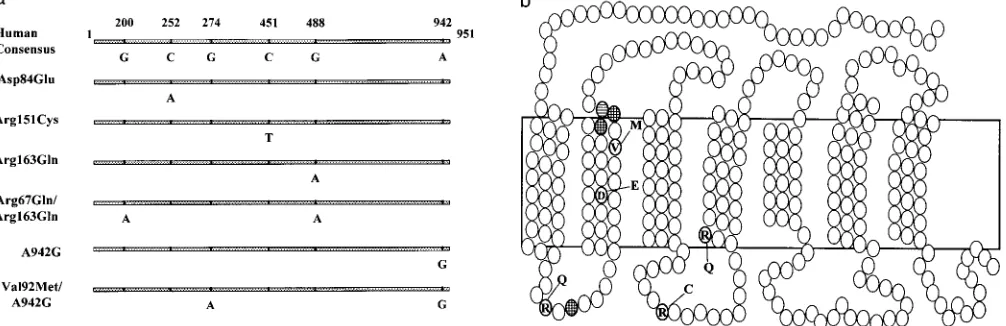
ditions to yield a 1024-nucleotide product containing Six variants of MC1R were found in our samples (Fig-59and 39flanking sequences. ure 2). First, Asp84Glu, caused by a C to A mutation PCR products were electrophoresed through a 1% at nucleotide 252, is a conservative substitution in the agarose gel. An appropriate size band was cut and puri- second transmembrane region of the receptor. Second, fied using the Prep-A-Gene DNA purification kit. Inter- Arg151Cys, caused by a C to T mutation at nucleotide nal primers were end labeled with [g-32P]ATP and both 451, is a change from a positively charged residue to
strands of the template were sequenced according to the an uncharged residue in the second intracellular loop Promega (Madison, WI) fmol DNA sequencing system domain. Third, Arg163Gln is a G to A mutation at nucle-protocol. Indian samples were sequenced using Perkin- otide 488, creating a charged to polar residue change Elmer Applied Biosystems 377 DNA sequencer with the in the fourth transmembrane domain of the receptor. BigDye terminator cycle sequencing protocol. The Arg67Gln/Arg163Gln variant is a combination of
Haplotype determination: PCR products from sub- the Arg163Gln variant described above and a G to A
Figure1.—Consensus sequence (H) of human MC1R. Reported as (*)Thr inMountjoyet al. (1992) andGantzet al. (1993),
(1)Pro inMountjoyet al. (1992), (#)Arg inChhajlaniandWikberg(1992), and (o)Gln inConeet al. (1996).
tide 274, which creates a conservative amino acid change study, nor reported byValverdeet al. (1995) in a study
of 135 British or Irish Caucasians, of which 60 samples in the second transmembrane region of the receptor.
In our samples, Val92Met was always observed with the were fully sequenced for their coding region. However, this variant was observed in the heterozygous state in 942G variant.
Allele frequencies:There are two prominent features one individual of fair skin/blonde hair and another of
red hair byBoxet al. (1997) and may be partly
respon-of the frequencies respon-of variants within populations as
shown in Table 1: (1) The association of the Arg163Gln sible for a phaeomelanin-rich skin phenotype. The Arg67Gln/Arg163Gln variant was found in only two in-variant with the East and Southeast Asian populations
(Chinese, Japanese, Mongolian, Cambodian, Vietnam- dividuals, both in the heterozygous state, in the Chinese population, but not observed in other populations in ese, and Yakut) with an average frequency of 70%, and
(2) the lack of variation in the African samples. Similar this study or previous reports. Because this variant is at low frequency and has only been identified on the to African populations, the human consensus sequence
was the most frequent in the Indian population. In Arg163Gln background, the Arg67Gln mutation may have arisen recently and may be unique to East Asians. addition, Arg163Gln is found in the homozygous state
in all five American Indians studied. This is not sur- In their study of MC1R variants, Valverde et al.
(1995) reported nine alleles associating with red hair/ prising as it is generally accepted that the Americas
were populated by nomadic Siberian populations from fair skin individuals. Val92Met and Asp84Glu were re-ported to be frequent in their red hair/fair skin samples. Northeast Asia. In contrast, this variant has a low
Figure2.—Variants of human MC1R. (a) The numbers indicate the nucleotide positions in the coding region. (b) Residues changed in variants found in this study are indicated by letters. Checkered residues are the locations of dominant darkening mouse mutants. Striped residue indicates the location of a mutant associated with dominant darkening of bovine coat color.
1), whereas the Val92Met variant was found in 23 Chi- stead of valine, the same as human individuals with the Val92Met variant.
nese individuals as well as in a British fair skin/light
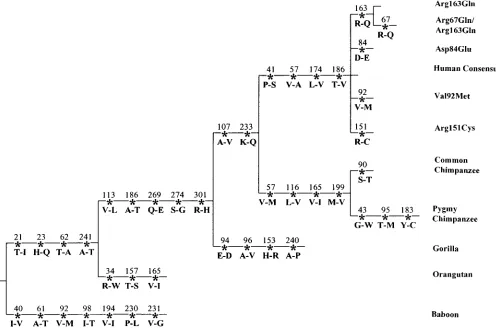
brown hair individual. Another variant, Arg151Cys, was A parsimony tree indicating the amino acid changes along the primate lineages is shown in Figure 4. From observed in only the red hair/fair skin individuals in
this study and, like Asp84Glu, was absent from other this tree, the ancestral human MC1R protein sequence can be inferred to be identical to that of the human populations. This variant was also recently reported by
Boxet al. (1997) in individuals with red hair. consensus sequence. However, at synonymous sites the
ancestral nucleotide MC1R sequence is most likely the
Primate MC1R sequences:To study the evolutionary
history of MC1R and evaluate the significance of these 942G variant because both chimpanzees and gorilla have a G at this site. The parsimony tree also indicates variants, the MC1R homologues in pygmy and common
chimpanzees, gorilla, orangutan, and baboon were se- that the MC1Rs of gorilla, chimpanzees, and human have evolved at a faster rate than those of baboon and quenced (Figure 3). According to the neutral theory of
molecular evolution, functionally less important parts orangutan.
The primate data were also used to examine the possi-of a gene evolve faster than functionally more important
ones. Hence, these sequences as well as the sequences ble effects of selection acting on MC1R. Synonymous sites usually evolve faster than nonsynonymous sites be-for horse, fox, cow, and mouse obtained from GenBank
were aligned and compared. Surprisingly, all amino cause the former have a lower chance of causing delete-rious effects. Thus, if Ksis the number of substitutions
acids at the five polymorphic nonsynonymous sites are
conserved among these different species of mammals, per synonymous site between two coding sequences and
Kais the number of substitutions per nonsynonymous
except that baboon has a methionine at codon 92
in-TABLE 1
Frequencies of variants within populations
Number of Human Val92Met/ Arg67Gln/
Population genes consensus Asp84Glu Asp151Cys A942G Arg163Gln Arg163Gln A942G
African 50 0.58 0.0 0.0 0.0 0.0 0.0 0.42
East and
Southeast Asiana 120 0.06 0.0 0.0 0.23 0.70 0.01 0.0
Indian 40 0.88 0.0 0.0 0.0 0.07 0.0 0.05
Yakut 10 0.30 0.0 0.0 0.10 0.60 0.0 0.0
American Indian 10 0.0 0.0 0.0 0.0 1.00 0.0 0.0
European
Red hair 4 0.25 0.25 0.50 0.0 0.0 0.0 0.0
Others 8 0.88 0.0 0.00 0.13 0.0 0.0 0.0
aIncludes 50 Chinese, four Japanese, four Mongolians, one Cambodian, one Vietnamese. All non-Chinese individuals, except
Figure 3.—Protein se-quence alignment of MC1R. (·) Sites identical to human consensus sequence; (—) gaps/deletions; (*) posi-tions of human variants. Mouse sequence is from Cone et al. (1996), fox
se-quence is from Vageet al.
(1997), cow sequence is from SWISSPROT (P47798), and sheep sequence is from EMBL (Y13965).
site, then the ratio Ka:Ksis usually,1. Indeed, the aver- computed the number of synonymous and
nonsynony-mous substitutions per site in the primate lineage using age ratio for 47 mammalian genes is only z0.20 (Li
1997). The Ka:Ksratios for the MC1R gene were calcu- a total of 49 gene loci. The Ka:Ksratio from these results
is 0.27 and is lower than observed for the MC1R locus. lated for human, pygmy chimpanzee, common
chim-panzee, gorilla, and orangutan and most comparisons These results indicate that MC1R is not subject to strong selective constraints. However, the high ratios might be were found to be at least two times higher than the
average value for mammalian genes (Table 2). Because partly due to advantageous substitutions (i.e., positive Darwinian selection), especially in the pygmy chimpan-it is generally believed that the Ka:Ksratio is higher in
the primates, a better comparison would be to use a zee lineage, where Ka/Ks.1. This possibility is
Figure4.—Parsimony tree indicating amino acid changes along primate lineages. Mouse, cow, and fox sequences were used as outgroups. The T-V change at codon 186 in the common ancestor of humans represents a change of two nucleotides from ACN to GTG. This with the A-T change in the common ancestor of human, chimpanzee, gorilla, and orangutan may represent three changes. An equally parsimonious alternate is a T-A change in both the baboon and orangutan lineages and a T-V change in the human lineage.
Nucleotide diversity within populations:In most genes, was observed. In contrast, 5 nonsynonymous
polymor-phisms were observed out of the 714 nonsynonymous the observed frequency of synonymous changes is higher
than that of nonsynonymous changes within a species. sites (5/71450.007), indicating a twofold higher de-gree of nonsynonymous polymorphism in this gene. Among the 237 synonymous sites in the human MC1R
gene, only 1 synonymous polymorphism (1/23750.004) Eight additional nonsynonymous polymorphisms were
TABLE 2
Ka:Ksratios (above diagonal) andKaandKsvalues (below diagonal) for higher primates MC1R genes
Common Pygmy
Human chimpanzee chimpanzee Gorilla Orangutan
Human — 0.72 1.34 0.53 0.52
Common 0.01760.006 — 0.79 0.67 0.46
chimpanzee 0.02360.012
Pygmy 0.01960.007 0.00760.005 — 1.15 0.65
chimpanzee 0.01460.007 0.00860.009
Gorilla 0.01760.007 0.01760.007 0.01860.008 — 0.33
0.03360.011 0.02660.012 0.02060.007
Orangutan 0.02060.008 0.02060.008 0.02360.008 0.01860.007 —
reported byBoxet al. (1997), who had carefully exam- tem (Coneet al. 1996). MC1R would have more leeway
as it is expressed only in the melanocytes and affects ined synonymous substitutions as well and reported only
one synonymous change, A to G at nucleotide 942 (iden- the type of melanins produced and, as far as it is known, has no other physiological role in which variation would tical to ours). In addition, Valverde et al. (1995)
re-ported 6 other nonsynonymous polymorphisms that be detrimental to the individual.
Biochemical significance of variants: The effect on
were not observed in our study or reported byBoxet al.
(1997). Hence, there are a total of 19 nonsynonymous pigmentation of the five MC1R variants observed in this study cannot be established without further association polymorphisms reported here and by others, but only
1 synonymous polymorphism has been reported so far. studies and functional assays. In addition, the end pig-mentation pattern is most likely the result of a combina-This imbalance of nonsynonymous polymorphisms is
significant at the 2.5% level. However, it is not clear tion of effects of variation in and varied expression of many loci. However, their potential significance can be whetherValverdeet al. (1995) identified synonymous
variants in addition to ours, so this particular analysis predicted from previous studies. The second transmem-brane region is potentially important in ligand binding may be subject to sampling bias slightly lowering
signifi-cance. because two point mutations in this region of the mouse MC1R have given rise to two constitutively active recep-This high level of nonsynonyomous polymorphism
is in sharp contrast to the low level of polymorphism tors (Robbinset al. 1993), resulting in a dominant
dark-ening of the coat. Further,Yanget al. (1997) have shown
generally observed in humans. In a study by Li and
Sadler(1991), the nucleotide diversities of the coding that mutagenesis of an acidic residue in the second trans-membrane domain, specifically Glu94, significantly al-regions of 49 loci encompassing 54,193 bp were
com-pared and the average level of nucleotide diversity per ters binding affinity and potency ofa-MSH. Two of the variants reported here, Asp84Glu and Val92Met, are site (p) was computed from the pooled data. The p
values ranged from a maximum of 0.11% for fourfold located in this region. Not only has Asp at position 84 been conserved among all the mammalian MC1R genes degenerate sites to a minimum of 0.03% for the
nonde-generate sites. This indicated a very low nucleotide di- sequenced to date, it has also been conserved in the other four members of the melanocortin receptor fam-versity in humans. We now compute the nucleotide
di-versity at the MC1R region, according to the equation ily as well as in other G-protein-coupled receptors, such as the b2-adrenergic receptor. The Asp84Glu variant, p 5[n/(n21)]Rxixjdij, where xiis the frequency of the
ith allele, n is the number of sequences in the sample, here and in two more extensive studies of fair skin/ red hair individuals (Valverde et al. 1995, 1996), is
and dij is the number of differences between the i and
j alleles per nucleotide site (seeLi1997). We consider associated with fair skin/red hair individuals. The Val92-Met allele does not seem to be associated with any partic-only our Chinese sample, because the other samples in
our study are small and samples in other studies were ular pigmentation type or geographical region in this study or others (Valverdeet al. 1995, 1996;Coneet al.
not selected randomly. For the fourfold degenerate
sites,p 50.21%, and for the nondegenerate sites,p 5 1996; Box et al. 1997) and has not been conserved
among all species or between the melanocortin family 0.14%. As these are, respectively, two and five times
higher than the corresponding average values for 49 of receptors. However, a-MSH binding assays on the Val92Met receptor expressed in COS-1 cells showed this genes studied byLiandSadler(1991), the MC1R locus
is indeed unusually polymorphic. variant to have an approximately five times lower po-tency in displacing the radiolabeled analogue ofa-MSH as compared to the wild-type receptor (Xuet al. 1996). DISCUSSION
Further studies might show that Val92Met is associated with individuals with phaeomelanin-rich skin because
Rates of evolution of genes of the MC1R:To compare
the rate at which MC1R has evolved with other genes, this variant, as frequent as it is, has not yet been reported in individuals with highly eumelanin-rich skins as in the Kaand Ksvalues were computed for known
melano-cortin receptors using human and rodent (mouse or rat) those of African ancestry.
Boxet al. (1997) were first to identify the Arg151Cys
sequences from GenBank (Table 3). In each of the five
receptors studied, Ka:Ks,1. However, while the synony- variant in the red-hair/fair skin population. It was
identi-fied in both the red-hair/fair skin individuals in our mous rate is within the same range for all the receptors
studied, the differences in nonsynonymous rates be- study, but not in the other populations. Our preliminary studies on the function of this receptor variant showed tween the receptors is greater; e.g., Kais more than three
times greater in MC1R than in MC4R. These results lower response to NDP-MSH, a potent synthetic ana-logue of a-MSH, which is consistent with this variant indicate that MC1R has evolved more rapidly than the
other members of this receptor family. The greater con- associating with phaeomelanin-rich skin.
The Arg163Gln variant may also be associated with straints on the other receptors are likely due to their
sys-TABLE 3
Substitution rates in melanocortin receptor genes
No. of Nonsynonymous Synonymous
Gene codons rate (Ka) rate (Ks) Ka:Ksratio
MC1R 315 0.15560.0802 0.53460.0802 0.290
MC2R 296 0.06160.0140 0.63060.0969 0.096
MC3R 323 0.06560.0147 0.42660.0790 0.153
MC4R 332 0.04060.0111 0.48760.0762 0.081
MC5R 325 0.11360.0205 0.61360.0907 0.185
Rates are numbers of substitutions per site based on pairwise comparisons between rodent and human sequences. Sequences were obtained from GenBank. Accession numbers: mus musculus MC1R, X65635; human ACTHR, X65633; mus sp ACTHR, S78985; human MC3R, L06155; human MC4R, L08603; rattus norvegicus MC4R, U67863; human MC5R, L27080; and mus musculus MC5R, X76295.
tions in this study with phaeomelanin-rich skins to be t(p, y)54Ne{[(12 y)/y]ln(12 y)
the East and Southeast Asians, Yakut, and American 2
[(12 p)/p]ln(12p)}.
Indians and those with eumelanin-rich skins to be the
Indians and Africans, the association of the Arg163Gln We use y5 0.66 (the frequency of Arg163Gln in the variant with the phaeomelanin populations is significant Chinese population) as the current frequency of Arg at the 0.1% level. The arginine at position 163 is con- 163Gln. The last term in the above formula approaches served in the MC1R of higher primates, cow, fox, horse, 21 as p (the initial frequency of the variant) approaches and mouse, although an arginine at this position is not zero. For an effective population size, Ne, in the range
essential for the function of other members of the mela- of 2000 to 5000 and for 20 yr per generation, the mean nocortin receptor family. No mouse mutations have first arrival time is in the range of 71,100 to 175,200 yr. been reported in this region, and site-directed mutagen- Note that the latter value is already much larger than esis studies on the transmembrane regions of MC1R the age of modern humans (z100,000 yr), though the have only targeted residues close to the extracellular Ne value of 5000 is small compared to recent Chinese
segment of transmembrane region four (Frandberget population sizes. Increasing Neproportionally increases
al. 1994; Yang et al. 1997), while amino acid 163 lies the mean first arrival time. As the allele is unlikely to closer to the intracellular loop region of transmem- be older than the origin of modern humans, it is quite brane region four. So it is difficult to speculate on the possible that the allele has increased rapidly in fre-importance of a substitution of an uncharged glutamine quency in East Asians by positive Darwinian selection. for a charged arginine at position 163. Low replacement variation in African samples: We
Age of the Arg163Gln variant:Because the Arg163Gln anticipated finding replacement variation in MC1R
variant is found in American Indians as well as in East among black Africans for two reasons. First, because and Southeast Asian populations, it probably arose con- African individuals are at one extreme of skin color, there might be differences in the MC1R sequence be-siderably earlier than the split between the Asian and
American Indian populations, which is estimated to be tween Africans and other populations. The results of this study show the opposite, in which African individuals between 15,000 and 35,000 years ago (Cavalli-Svorza
et al. 1994a). However, because the allele appears to be possess the human consensus MC1R sequence, which is shared by most populations examined here.
absent or at a very low frequency in both Europeans
and Africans, it is probably not very old, perhaps Second, as African populations have been found to be generally more polymorphic than other populations younger than the divergence among the Asians,
Europe-ans, and Africans. It is therefore intriguing that this (e.g.,Shriver et al. 1997) and are commonly thought
to be most ancient, a higher number of alleles of MC1R allele is present at unusually high frequencies in both
East Asians and American Indians. To see whether an would be expected to have accumulated. However, the 25 African samples from various geographic regions re-allele can reach such a high frequency in a short time
without selective advantage, we calculate the mean first vealed only one synonymous variant but no nonsynony-mous variant. Thus, the African population has the low-arrival time of the Arg163Gln variant using frequency
data from the Chinese population. The mean first arrival est replacement variation. In contrast, individuals from other populations such as European ancestry and Chi-time is the mean number of generations until the
fre-quency of the allele reaches a specific value for the first nese show replacement variation. This may support the vitamin D hypothesis (Cavalli-Sforza et al. 1994b),
time starting from a low initial frequency. For a neutral
pig-Cavalli-Sforza, L. L., P. MenozziandA. Piazza,1994a The History
mentation to the variation observed today. Vitamin D
and Geography of Human Genes, pp. 304–308. Princeton University
is produced through photoconversion of the dietary Press, Princeton, NJ.
precursor, 7-dehydrocholesterol, in the skin capillaries. Cavalli-Sforza, L. L., P. MenozziandA. Piazza,1994b The History and Geography of Human Genes, pp. 266–267. Princeton University
Dark skin reduces the amount of UVR reaching the
Press, Princeton, NJ.
capillaries, which in turn reduces the amount of vitamin Chhajlani, V.,andJ. E. S. Wikberg,1992 Molecular cloning and D formed. In regions of low sunlight, dark skin can be expression of the human melanocyte stimulating hormone
recep-tor cDNA. FEBS Lett. 309: 417–420.
a disadvantage, leading to vitamin D deficiency and the
Cone, R. D., D. Lu, S. Koppula, D. I. Vage, H. Klunglandet al.,
childhood disease of rickets, which in more severe forms 1996 The melanocortin receptors: agonists, antagonists, and can reduce survival and reproduction. For those living the hormonal control of pigmentation. Recent Prog. Horm. Res.
51:287–318.
in the tropics, dark skin can be an advantage as excess
Frandberg, P.-A., R. Muceniece, P. Prusis, G. J. WikberandV.
vitamin D may be toxic. It is possible that African popula- Chhajlani,1994 Evidence for alternate points of attachment tions retained their ancestral sequence to maintain a for a-MSH and its stereoisomer [Nle4, D-Phe7]-a-MSH at the
melanocortin-1 receptor. Biochem. Biophys. Res. Commun. 202:
darker pigmentation for protection against both UVR
1266–1271.
and the toxic effects of vitamin D. As populations
mi-Gantz, I., Y. Konda, T. Tashiro, Y. Shimoto, H. Miwaet al., 1993
grated to regions of lower sun exposure, the selection Molecular cloning of a novel melanocortin receptor. J. Biol. Chem. 268: 8246–8250.
pressure for dark pigmentation was relaxed and
muta-Harrison, G. A.,andJ. J. T. Owen,1964 Studies on the inheritance
tions at MC1R that result in lighter pigmentation might
of human skin colour. Ann. Hum. Genet. 28: 27–37.
be advantageous and increase in frequency. Local selec- Hearing, V. J.,andM. Jimenez,1987 Mammalian tyrosinase: the
critical regulatory control point in melanocyte pigmentation. Int.
tion for specific alleles may explain why there is a higher
J. Biochem. 19: 1141–1147.
variation of MC1R in non-African populations. It may
Hearing, V. J.,andR. A. King,1993 Determination of skin color:
also explain why there are many nonsynonyomous vari- melanocytes and melanization, pp. 3–32 in Pigmentation and
Pig-mentary Disorders, edited byN. Levine.CRC Press, Boca Raton, FL.
ants but only one synonymous variant observed in this
Jimbow, K., W. C. Quevedo Jr., T. B. FitzpatrickandG. Szabo,
and previous studies. It is difficult to infer selection
1993 Biology of Melanocytes, pp. 261–289 in Dermatology In
Gen-independently through a single line of study presented eral Medicine, Ed. 4, edited byT. Fitzpatrick, A. Eisen, K. Wolff, here. Hence, we have taken the approach of integrating I. M. FreedbergandR. F. Austen.McGraw-Hill, New York.
Joerg, H., H. R. Fries, E. MeijernikandG. F. Stranzinger,1996
current knowledge on the physiology of skin
pigmenta-Red coat color in holstein cattle is associated with a deletion in
tion and the biochemistry of MC1R receptors, with our the MSHR gene. Mamm. Genome 7: 317–319.
and existing population studies at MC1R. This and the Johansson, M., L. Marklund, G. K. SandberandL. Andersson,
1994 Cosegregation between the chestnut coat colour in horses
contribution of the results from our evolutionary
analy-and polymorphisms at the melanocyte-stumulation hormone
ses, which include calculation of nucleotide diversity, (MSH) receptor locus. Anim. Genet. 25: 35.
a comparison of rates of substitution at MC1R with Klungland, H., D. I. Vage, L. Gomez-Raya, S. Adalsteinssonand
S. Lien, 1995 The role of melanocyte stimulating hormone
the other melanocortin receptors, and the analysis of
(MSH) receptor in bovine coat color determination. Mamm.
the synonymous and nonsynonymous substitutions, all Genome 6: 636–639.
taken together indicate a role of selection in main- Kobayashi, T., W. D. Vieira, B. Potter, S. Chie, G. Imokawaet al.,
1995 Modulation of melanogenic protein expression during the
taining the large number of variants observed at MC1R.
switch from eu- to pheomelanogenesis. J. Cell Sci. 108: 2301–2309. We are grateful to Dr. Richard B. Clark for his invaluable discussion Koppula, S. V., L. S. Robbins, L. Dongsi, E. Baack, C. R. White Jr. on G-protein-coupled receptors and to Drs. Craig Hanis and Song- et al., 1997 Identification of common polymorphisms in the coding sequence of the human MSH receptor (MC1R) with possi-Kun Shyue for their frequent assistance in collecting blood samples
ble biological effects. Hum. Mutat. 9: 30–36. from which much of this data was obtained. We thank Will Clark for
Kwon, H. Y., S. J. Bultman, C. Loffler, W.-J. Chen, P. J. Furdon
his assistance in cloning MC1R from P. troglodytes and Hongmin Sun,
et al., 1994 Molecular structure and chromosomal mapping of Jay Vivian, and Dr. Claudia Miller for their technical assistance. We
the human homolog of the agouti gene. Proc. Natl. Acad. Sci. thank Drs. Ira Gantz and Ying-Kui Yang for sharing with us their
USA 91: 9760–9764. expertise in the melanocortin receptors without hesitation. This study
Li, W.-H.,1975 The first arrival time and mean age of a deleterious
was supported by National Institutes of Health grants (GM55759 and mutant gene in a finite population. Am. J. Hum. Genet. 27: GM30998) to W.-H. Li., and the Betty Wheless Trotter Professorship. 274–286.
Li, W.-H.,1993 Unbiased estimation of the rates of synonymous and
nonsynonymous substitution. J. Mol. Evol. 36: 96–99.
Li, W.-H.,1997 Molecular Evolution. Sinauer Associates, Sunderland,
LITERATURE CITED MA.
Li, W.-H.,andL. A. Sadler,1991 Low nucleotide diverstiy in man.
Abdel-Malek, Z., V. Swope, I. Suzuki, C. Akcali, M. D. Harriger
Genetics 129: 513–523.
et al., 1995 Mitogenic and melanogenic stimulation of normal
Lu, N., D. Willard, I. R. Patel, S. Kadwell, L. Overtonet al., 1994
human melanocytes by melanotropic peptides. Proc. Natl. Acad.
Agouti protein is an antagonist of the melanocyte stimulating Sci. USA 92: 1789–1793.
hormone receptor. Nature 371: 799–802.
Barnicot, N. A.,1977 Pigmentation and some other morphological
Magenis, R. E., L. Smith, J. H. Nadeau, K. R. Hohnson, K. G.
characters, pp. 207–219 in Human Biology: An Introduction to
Hu-Mountjoyet al., 1994 Mapping of the ACTH, MSH, and neural
man Evolution, Variation, Growth, and Ecology, Ed. 2, edited byG. A.
(MC3 and MC4) melanocortin receptors in the mouse and
hu-Harrison, J. S. Weiner, J. M. Tanner andN. A. Barnicot.
man. Mamm. Genome 5: 503–508. Oxford University Press, Oxford.
Miller, S. A., D. D. DykesandH. F. Polesky,1988 A simple salting
Box, N. F., J. R. Wyeth, L. E. O’Gorman, N. G. MartinandR. A.
out procedure for extracting DNA from human nucleated cells.
Sturm,1997 Characterization of melanocyte stimulating
hor-Nucleic Acids Res. 16: 1215. mone receptor variant alleles in twins with red hair. Hum. Mol.
hor-mone receptor has evolved to become “super-sensitive” to mela- Szabo, G., A. B. Gerald, M. A. Pathak and T. B. Fitzpatrick,
nocortin peptides. Mol. Cell. Endocrinol. 102: R7–R11. 1969 Racial differences in the fate of melanosomes in human
Mountjoy, K. G., L. S. Robbins, M. T. NortrudandR. D. Cone, epidermis. Nature 222: 1081–1082.
1992 The cloning of a family of genes that encode the melano- Thody, A. J., E. M. Higgins, K. Wakamatsu, S. Ito, S. A. Burchil
cortin receptors. Science 257: 1248–1251. et al., 1991 Phaeomelanin as well as eumelanin is present in
Ohta, T.,1995 Synonymous and nonsynonymous substitutions in human epidermis. J. Invest. Dermatol. 97: 340–344.
mammalian genes and the nearly neutral theory. J. Mol. Evol. Vage, D. G., D. Lu, H. Klungland, S. Lien, S. Adalsteinssonet al.,
40:56–63. 1997 A non-epistatic interaction of agouti and extension in the
Prota, G.,1980 Recent advances in the chemistry of melanogenesis fox, Vulpes vulpes. Nat. Genet. 15: 311–315.
in mammals. J. Invest. Dermatol. 75: 122–127. Valverde, P., E. Healy, I. Jackson, J. L. ReesandA. J. Thody,1995
Rana, B. K., D. Hewett-Emmett andW.-H. Li, 1996 Variation Variants of the melanocyte stimulating hormone receptor gene
in the human melanocyte stimulating hormone receptor locus are associated with red hair and fair skin in humans. Nat. Genet. (Abstr.). Pigm. Cell Res 60 (Suppl. 5). 11:328–330.
Robbins, L. S., J. H. Nadeau, K. R. Johnson, M. A. Kelly, L. Roselli- Valverde, P., E. Healy, S. Sikkink, F. Haldane, A. J. Thody et
Rehfusset al., 1993 Pigmentation phenotypes of variant
exten-al., 1996 The Asp84Glu variant of the melanocortin 1 receptor sion locus alleles result from point mutations that alter MSH (MC1R) is associated with melanoma. Hum. Mol. Genet. 5: 1663– receptor function. Cell 72: 827–834.
1666.
Shriver, M. D., L. Jin, R. E. FerrellandR. Deka,1997
Microsatel-Wilson, B. D., M. M. Ollmann, L. Kang, M. Stoffel, G. I. Bellet
lite data support early population expansion in Africa. Genome
al., 1995 Structure and function of ASP, the human homolog Res. 7: 586–591.
of the mouse agouti gene. Hum. Mol. Genet. 4: 223–230.
Stern, C.,1970 Model estimates of the number of gene pairs
in-Xu, X., M. Thornwall, L.-G. LundinandV. Chhajlani,1996
Val9-volved in pigmentation variability of the Negro-American. Hum.
2Met variant of the melanocyte stimulating hormone receptor Hered. 20: 165–168.
gene. Nat. Genet. 14: 384.
Suzuki, I., R. Cone, I. Sungbin, J. NordlundandZ. Abdel-Malek,
Yang, Y.-K., C. Dickinson, C. Haskell-LuevanoandI. Gantz,1997
1996 Binding of melanotropic hormones to the melanocortin
Molecular basis for the interaction of NDP-melanocyte stimulat-receptor MC1R on human melanocytes stimulates proliferation
ing hormone with the human melanocortin-1 receptor (melano-and melanogenesis. Endocrinology 137: 1627–1633.
cytea-MSH receptor). J. Biol. Chem. 272: 23000–23010.
Szabo, G.,1967 Photobiology of melanogenesis: cytological aspects
with reference to differences in racial coloration. Advances in
Communicating editor:N. Takahata