Based Learning Environments. (Under the direction of Dr. James C. Lester.)
Game-based learning environments have been touted as a powerful mechanism for keeping twenty-first century students motivated and engaged in learning tasks. These environments capitalize on important game features such as autonomy, control, and interactivity to main-tain student interest. However, they may introduce new challenges by requiring students to engage in more advanced self-regulatory skills such as a goal-setting and monitoring, com-plex problem solving, and critical thinking. Students without these skills are unlikely to real-ize the benefits of game-based learning and may struggle in systems where they are provided with too much autonomy. Consequently, real-time identification of self-regulated learning (SRL) is a problem of critical importance for providing adaptive scaffolding targeted to an individual student’s needs.
The goal of the research presented in this dissertation is to explore the use of a theo-retically grounded machine learning framework for the real-time stealth assessment of SRL skills. In this framework, prominent psychological theories are used to guide the selection and application of machine learning and data mining techniques. Empirical models are trained on a corpus of data from students interacting with a game-based learning environ-ment, CRYSTAL ISLAND. These models are evaluated to determine if the predictive models are benefited by the theoretically grounded framework and if they are also sufficiently robust to offer real-time trace-based assessment of SRL.
formed by process models of SRL. The models are then empirically learned from a corpus of student interaction data. Finally, the models are evaluated to determine the value of the theo-retically grounded empirical framework. Specifically, the evaluation seeks to quantify use-fulness of the features identified in Phase 2 and the structures devised in Phase 3. Further-more, the models are evaluated to identify how early into the interaction SRL skill can be accurately assessed and how well the models generalize to unseen populations.
© Copyright 2013 by Jennifer Lynne Sabourin
by
Jennifer Lynne Sabourin
A dissertation submitted to the Graduate Faculty of North Carolina State University
in partial fulfillment of the requirements for the degree of
Doctor of Philosophy
Computer Science
Raleigh, North Carolina
2013
APPROVED BY:
_______________________________ ______________________________
Dr. James C. Lester Dr. Kristy E. Boyer
Committee Chair
________________________________ ________________________________
DEDICATION
BIOGRAPHY
Jennifer Lynne Robison was born in Alexandria, Virginia on September 5, 1986 but has spent most of her life living in Cary, North Carolina. She attended William G. Enloe High School in Raleigh, NC. Here, she took her first Computer Science class under the insistence of her parents. Though hesitant, she grew to love it and when she graduated from Enloe in 2004 she chose to pursue Computer Science as her major at North Carolina State University. During her time at N.C. State, Jennifer also minored in Cognitive Science and Psychology. She also interned at SAS Institute starting in 2005. She participated in the University Schol-ars Program, the Computer Science Honors Program, and the STARS Student Leadership Corps. Through these programs she had the opportunity to take graduate level classes and pursue undergraduate research projects under the direction of James Lester and her mentor Scott McQuiggan. These experiences left her confident in her decision to pursue a Ph.D. at N.C. State.
She graduated from her undergraduate program as Valedictorian in 2008 and imme-diately began the graduate program the following semester. She was awarded the NSF Grad-uate Research Fellowship, allowing her great flexibility in guiding her gradGrad-uate career. She remained active with the STARS SLC and helped devise outreach programs and other efforts aimed at broadening participation in computing. She also engaged in many activities focused around improving her teaching skills including the Certificate for Accomplishment in Teach-ing program, a Mentored TeachTeach-ing Assistantship and the PreparTeach-ing the Professoriate pro-gram. She continued to work as an intern at SAS, now in the Education Practice, working on innovative educational technology. She accepted a full-time position with SAS in June 2013 as a Research Scientist and Software Developer.
ACKNOWLEDGMENTS
I would first like to thank my family who has made everything possible. My parents Connie and Russ Robison taught me that I was capable of anything I put my mind to and sometimes even more. My grandparents were always a strong source of support, especially my grandfa-ther Dr. O.W. Robison who was proud to watch his oldest grandchild follow in his academic footsteps. My brothers Chris and Ben have always teased me for being a nerd, and I have yet to prove them wrong. I also have the privilege of having married into a fun, crazy, and large family who have always welcomed me with open arms and encouraged me throughout my graduate career.
I would like to thank my husband, Philippe, who has been with me throughout this whole journey. He has been unfailing in his ability to help me power through when the road was tough and to celebrate the successes big and small. I want to thank all of my friends who have supported me as well, especially Meisha Gourley. She has never doubted me in any-thing and has given me more strength than she knows.
I would also like to thank everyone who has guided me academically. First and fore-most, my advisor Dr. James Lester. His curiosity, enthusiasm and professional character have inspired me greatly throughout this journey. I thank him for all the trust he put in me in choosing my path and all the countless hours he spent reviewing my work and guiding my research. I would like to thank Dr. Scott McQuiggan, who mentored me when I first began my career and continues to mentor me to this day. He provided me with an incredible model of scholarly achievement without which I would not be where I am today. I will always value his friendship, guidance and enthusiastic conversations about all sorts of topics. I would also like to thank Mr. Michael Downey, my first computer science teacher. He ignited my passion for Computer Science and taught me to always fight for myself and never be intimidated by those who didn’t believe in me.
Nietfeld have given me such excellent guidance academically, professional and personally. I am also thankful for the guidance of Jonathan Rowe, who has always selflessly made time to talk through interesting research ideas or discuss professional or personal development, even though he has so little time to give. I am thankful to Lucy Shores for being a great compan-ion throughout this journey and helping to keep me on track to the very end.
I am also thankful for all of the others I have had the opportunity to work with throughout the years. The members of Intellimedia, including Alok Baikadi,Veronica Catete, Stephen Cossa, Kirby Culbertson, Julius Goth, Joe Grafsgaard, Eunyoung Ha, Sarah Hegler, Karoon McDowell, Chris Mitchell, Bradford Mott, Sam Leeman-Munk, Eleni Lobene, Wookhee Min, Marc Russo, Rob Taylor, Andy Smith, and Donnie Wrights, have always been a great source of collaboration and camaraderie. The Faculty and Staff of the Depart-ment of Computer Science, including Barbara Adams, Carol Allen, Suzanne Balik, Sarah Heckman, Linda Honeycutt, Thomas Honeycutt, Purush Iyer, Margery Page, Susan Peaslee, Douglas Reeves, Robert St. Amant, Ken Tate, and David Thuente have always been there for assistance in navigation of the academic waters. I would also like to thank all of the amazing researchers outside of NCSU whose conversations and research have guided me, including Roger Azevedo, Ryan Baker, Gautam Biswas, Cristina Conati, Sidney D’Mello, Joao Dias, Jon Gratch, Jason Harley, John Kinnebrew, Val Shute, and Phil Winne.
TABLE OF CONTENTS
LIST OF TABLES ... viii
LIST OF FIGURES ... ix
CHAPTER 1 Introduction... 1
1.1 Problem ... 2
1.2 Approach ... 3
1.3 Thesis Statement and Hypotheses ... 7
1.4 Contributions ... 8
1.5 Organization ... 9
CHAPTER 2 Background and Related Work ... 11
2.1 Fostering Student Engagement... 11
2.2 Self-Regulated Learning ... 16
2.3 Measuring SRL ... 21
2.4 Modeling and Supporting Student SRL Behaviors ... 24
2.5 Stealth Assessment ... 26
CHAPTER 3 Student Behavior Corpus ... 28
3.1 CRYSTAL ISLAND ... 28
3.2 Corpus Collection ... 29
CHAPTER 4 Prior Findings on Student Engagement and Learning in CRYSTAL ISLAND .... 33
4.1 Affect and Motivation ... 33
4.2 Engagement and Disengagement ... 36
4.3 Inquiry Behaviors ... 38
CHAPTER 5 Identifying Self-Regulated Learning ... 40
5.1 Cognitive/Behavioral Classifications ... 40
5.2 Metacognitive Classifications ... 47
5.3 Motivation Classification ... 52
5.4 Discussion ... 56
CHAPTER 6 Feature Selection and Creation ... 59
6.1 Feature Selection ... 59
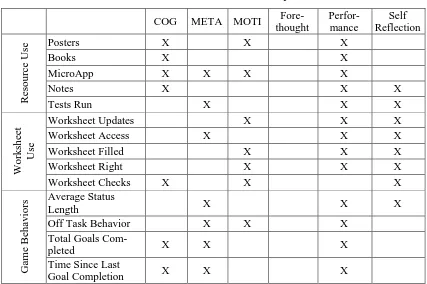
6.3 Discussion ... 74
CHAPTER 7 Predictive Models of Self-Regulated Learning ... 76
7.1 Bayesian Approach ... 76
7.2 Results ... 85
7.3 Discussion ... 100
CHAPTER 8 Generalization ... 101
8.1 Population... 101
8.2 Predictive Models ... 105
8.3 Discussion ... 112
CHAPTER 9 Conclusion ... 114
9.1 Hypotheses Revisited ... 115
9.2 Summary ... 118
9.3 Limitations ... 120
9.4 Future Directions ... 121
9.5 Concluding Remarks ... 122
REFERENCES ... 124
APPENDICES ... 134
Appendix A – SRL Tagging Protocol... 135
Appendix B – Content Test for CRYSTAL ISLAND Study ... 137
Appendix C – Pre-Experiment Materials for CRYSTAL ISLAND Study ... 141
Appendix D – Post-Experiment Materials for CRYSTAL ISLAND Study ... 147
LIST OF TABLES
Table 1. Frequency and proportion of emotion self-reports ... 34
Table 2. Affective states correlated with motivation outcome measures ... 35
Table 3. Class differences on cluster features ... 46
Table 4. Metacognition tagging scheme ... 48
Table 5. IMI subscale differences by motivation class ... 53
Table 6. Classification details ... 57
Table 7. Feature selection for cognition ... 61
Table 8. Feature selection for metacognition ... 62
Table 9. Feature selection for motivation ... 63
Table 10. Differential patterns for cognition ... 68
Table 11. Differential patterns for metacognition ... 69
Table 12. Differential patterns for motivation ... 69
Table 13. Identified patterns of behavior ... 73
Table 14. Personal features to SRL processes ... 80
Table 15. Occurrence features to SRL processes ... 81
Table 16. Created contingency event features to SRL processes ... 84
Table 17. Predictive model performance for cognition ... 89
Table 18. Predictive model performance for metacognition ... 92
Table 19. Predictive model performance for motivation ... 95
Table 20. Secondary corpus classification details ... 102
Table 21. Generalized model performance for cognition ... 106
LIST OF FIGURES
Figure 1. Overview of proposed framework ... 6
Figure 2. Components of self-regulated learning ... 16
Figure 3. Three phases and subprocesses of self-regulated learning ... 18
Figure 4. Posttest score by self-regulated learning score using learner (LC) or program(PC) controlled software ... 21
Figure 5. CRYSTAL ISLAND learning environment ... 28
Figure 6. Self-report device ... 31
Figure 7. Histogram of off-task behavior ... 36
Figure 8. Learning differences by problem-solving cluster ... 45
Figure 9. Testing behavior by problem-solving cluster ... 45
Figure 10. Histogram of metacognitive score ... 49
Figure 11. Learning differences by metacognitive class ... 50
Figure 12. In-game behaviors by SRL classification ... 51
Figure 13. Histogram of IMI Score ... 54
Figure 14. Learning differences by motivation class ... 55
Figure 15. Learning gains by classification ... 57
Figure 16. Targeted behaviors ... 67
Figure 17. Structure of naïve Bayesian network using All Features and Feature Selection .. ... 79
Figure 18. Structure of naïve Bayesian network using Feature Selection + Event Feature Creation ... 79
Figure 19. Structure of static Bayesian network using Feature Selection ... 82
Figure 20. Structure of static Bayesian network using Feature Selection + Event Feature Creation ... 83
Figure 21. Structure of dynamic Bayesian network using Feature Selection ... 86
Figure 22. Structure of dynamic Bayesian network using Feature Selection + Event Crea-tion ... 87
Figure 23. Predictive accuracy of cognition over time ... 90
Figure 24. Predictive accuracy of metacognition over time ... 93
Figure 26. Distributions of accuracy by feature set ... 98
Figure 27. Distributions of accuracy by model type ... 99
Figure 28. Interaction of feature set and model type ... 99
Figure 29. Secondary corpus learning differences by cognition ... 102
Figure 30. Secondary corpus learning differences by metacognition ... 104
Figure 31. Secondary corpus learning differences by motivation ... 104
Figure 32. Generalized model predictive accuracy of cognition over time ... 107
Figure 33. Generalized model predictive accuracy of metacognition over time ... 109
CHAPTER 1
Introduction
One-to-one tutoring has long been considered the gold standard of effective instruction by demonstrating significant improvements in student learning over the typical classroom set-ting (Bloom, 1984). This benefit is suspected to be due to high levels of interactivity as well as highly individualized attention and feedback. While it is not feasible for each student to have his or her own tutor, the intelligent tutoring systems community has been trying to bridge this gap by endowing computers with the same interactive and individualized tutoring capabilities (Vanlehn, 2006; Woolf, 2009). These efforts have led to significant improve-ments in educational software’s effectiveness, and in some cases, intelligent tutoring systems have produced learning gains comparable to human tutors (Vanlehn, 2006). However, as with any educational tool, the software’s ability to produce learning gains for students de-pends heavily on students’ engagement and motivation with the system as well as their abil-ity to use the software effectively.
re-quire these skills (Azevedo, Moos, Greene, Winters, & Cromley, 2008; Easterday et al., 2011; Young, 1996).
The ability to set learning goals, identify successful strategies and evaluate personal success is the hallmark of a self-regulated learner. Students who exhibit self-regulated learn-ing (SRL) skills are able to drive their own learnlearn-ing and are often more successful in learnlearn-ing tasks and academic settings (Zimmerman, 1990). While SRL skills can be taught and often improve with practice (Kostons, van Gog, & Paas, 2012), students who have not yet devel-oped appropriate SRL strategies are more likely to flounder in self-guided learning systems. However, there is evidence that with appropriate scaffolding these environments can be ben-eficial in improving learning and interest as well as aid in development of SRL skills (Aleven, McLaren, Roll, & Koedinger, 2006; Azevedo, Cromley, Winters, Moos, & Greene, 2005). While there is much debate on how to properly scaffold SRL (Davis, 2003; Fiorella & Mayer, 2012; Ifenthaler, 2012; Kauffman, 2004; White & Frederiksen, 1998), there is con-sensus that appropriate scaffolding involves a delicate balance of allowing autonomy but providing support when necessary (Koedinger & Aleven, 2007). To do this successfully, teachers and tutoring systems must be able to accurately identify a student’s SRL skill level which may vary based on the specific learning context (Schraw, 2010).
1.1
Problem
game environment. Consequently, it is the goal of the proposed dissertation to identify stu-dents who are less able to regulate their own learning behaviors in CRYSTAL ISLAND.
However, assessment of SRL presents a substantial challenge. Questionnaires and other static measures may not reliably indicate a student’s ability to regulate their learning in a specific context (Schraw, 2010) and do not capture real-time behaviors (Winne, 2010). Other online measures such as think-aloud protocols or prompting are intrusive and may alter a student’s natural behaviors (Winne & Perry, 2000). Consequently, developing real-time unobtrusive assessments of self-regulated learning in computer-based environments has been recognized as an important and challenging objective (Greene & Azevedo, 2010; Schraw, 2010; Winne, 2010).
1.2
Approach
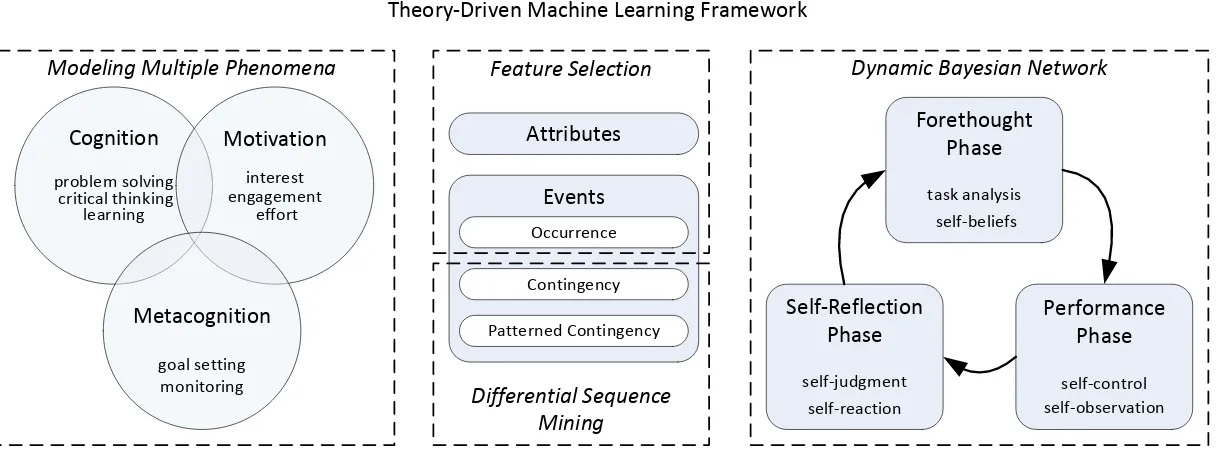
This dissertation focuses on the use of theory-driven machine learning and data mining tech-niques to investigate real-time SRL assessment in the CRYSTAL ISLAND game-based learning environment. In this framework, accepted psychological theories of self-regulated learning are used to select appropriate data mining techniques and develop useful empirically-learned computational models. Here we will describe the psychological theories used to guide the framework and then specifically how these theories informed the computational aspects of the work.
Components of self-regulated learning: According to Zimmerman, “although defini-tions of self-regulated learning involving specific processes often differ on the basis of researchers’ theoretical orientations, a common conceptualization of these students has emerged as metacognitively, motivationally, and behaviorally active participants in their own learning.” (Zimmerman, 1990, p. 4). This provides the distinction of the three primary components of self-regulated learning: cognition/behavior, metacogni-tion, and motivation (Schraw, Crippen, & Hartley, 2006; Zimmerman, 1990). The cognitive/behavioral component involves students having the necessary strategies and skills to be effective learners. The metacognitive component focuses on how students recognize their own knowledge and monitor their learning. Finally, the motivation component describes self-regulated learners’ high self-efficacy, interest, and engage-ment with the learning material.
Cyclical nature of self-regulated learning: Researchers commonly describe self-regulated learning as a cycle of constant reflection on and adaptation of behaviors. Though there are multiple cyclical models (DiBenedetto & Zimmerman, 2013; Winne & Hadwin, 1998; Zimmerman, 2000) most involve at least three phases including planning, performance, and reflection. These phases cycle constantly with planning impacting performance driving reflection, which in turn alters future planning.
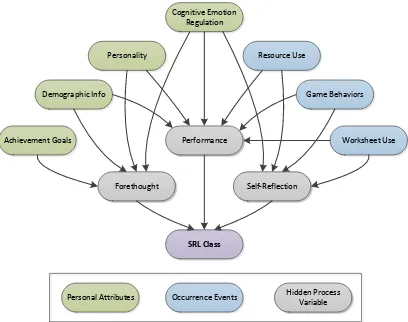
is accepted that an accurate representation of SRL will need to incorporate both at-tribute and event information (Schraw, 2010; Winne, 2010).
Theory-Driven Machine Learning Framework. These three theoretical components are used to guide the machine learning and data mining approaches for modeling self-regulated learning (Figure 1). In each case the theory guides the structure or selection of computational techniques. However, specific measures, patterns, and relationships are empirically learned using the machine learning and data mining techniques. Theory and machine learning are integrated in the following ways:
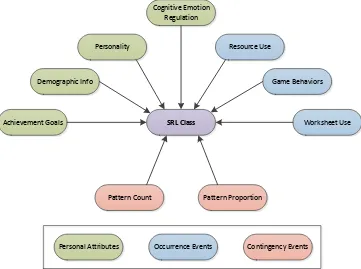
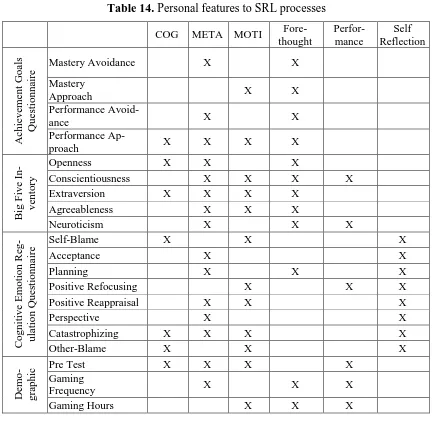
Feature selection: Forward-selection logistic regression is used to identify the attrib-ute and occurrence event level features most predictive of self-regulated learning in CRYSTAL ISLAND. Attribute features are taken from standard validated questionnaires given prior to students’ interactions with the environment. Occurrence level features are taken as the frequency of specific actions within the environment.
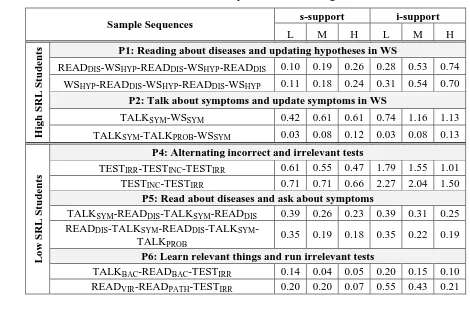
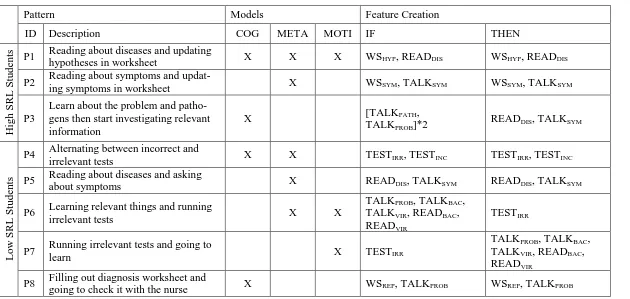
Differential sequence mining: A differential sequence mining approach is used to identify more robust patterns of actions that are demonstrated by students with more advanced self-regulated learning skills. These patterns are then used to create features representing contingency and patterned contingency events.
Dynamic Bayesian networks: Dynamic Bayesian networks are used to represent the cyclical and dynamic nature of self-regulated learning. Specifically, the model seeks to capture the planning, performance, and reflection phases of SRL. The dynamic model further represents the cyclical nature across time.
Attributes
Events
Occurrence
Contingency
Patterned Contingency
Cognition
problem solving critical thinking
learning
Motivation
interest engagement
effort
Metacognition
goal setting monitoring
Stealth Assessment of
Self-Regulated Learning
Theory-Driven Machine Learning Framework
Feature Selection
Differential Sequence Mining
Performance Phase
self-control self-observation
Forethought Phase
task analysis self-beliefs
Self-Reflection Phase
self-judgment self-reaction
Dynamic Bayesian Network Modeling Multiple Phenomena
1.3
Thesis Statement and Hypotheses
This theory-driven machine learning framework incorporates commonly accepted psycholog-ical theories of self-regulated learning and utilizes them to guide empirpsycholog-ical machine learning and data mining approaches for stealth assessment of self-regulated learning in a game-based learning environment. Along these lines, this dissertation investigates the following thesis:
The proposed theory-driven framework can guide the investigation of how machine
learning and data mining techniques can be leveraged for stealth assessment of
self-regulated learning.
To effectively evaluate this thesis, the individual components of the framework should be explored. Specifically, we investigate how the novel applications of existing psy-chological theories and machine learning impact the real-time predictive accuracy of compu-tational models of self-regulated learning. This evaluation centers on the two primary ma-chine learning and data mining techniques utilized: differential sequence mining and dynam-ic Bayesian networks. The following hypotheses explore the usefulness of these techniques for real-time SRL assessment:
Hypothesis 1: Differential sequence mining can identify patterns of student behavior that:
(a) are indicative of self-regulated learning.
(b)improve the predictive accuracy of real-time predictive models of self-regulated learning.
(a) Static Bayesian networks which encode key SRL processes will achieve greater predictive accuracy than naïve Bayesian networks with no such representation.
(b)Dynamic Bayesian networks which encode the cyclic relationship between key processes across time will achieve greater predictive accuracy than static Bayesian networks with no such temporal rep-resentation.
Hypothesis 3: The proposed theory-driven machine learning techniques can be used to assess the
(a) cognitive/behavioral
(b)metacognitive
(c) motivational
aspects of self-regulated learning in real-time.
With the investigation of these hypotheses we hope to show how psychological theory can effectively guide the development of empirically-learned models by improving predictive accuracy and interpretability.
1.4
Contributions
The work reported in this dissertation makes the following contributions:
An empirical account of the relationship between learning and engagement in an open-ended inquiry- and game-based learning environment. (Sabourin, Rowe, Mott, & Lester, 2013; Sabourin, Rowe, Mott, & Lester, 2012a, 2012b; Sabourin & Lester, in press).
An annotation protocol for analyzing student goal setting and monitoring be-havior that is capable of classifying students’ metacognitive self-regulatory skills (Sabourin, Shores, Mott, & Lester, 2012; Sabourin, Shores, Mott, & Lester, in press)
An empirical account of the role of self-regulated learning as it relates to en-gagement and learning outcomes in an inquiry- and game-based learning envi-ronment (Sabourin, Shores, et al., 2012; Sabourin et al., in press).
An empirical investigation of the patterns of behavior and strategies associat-ed with cognitive, metacognitive and motivational components of self-regulated learning in CRYSTAL ISLAND (Sabourin, Mott, & Lester, 2013). A theoretical and empirical framework for real-time unobtrusive assessment
of self-regulated learning in computer-based learning environments.
A suite of predictive models of self-regulated learning incorporating both em-pirical and theoretical knowledge to identify self-regulatory skills at real-time during students’ interaction (Sabourin, Shores, et al., 2012; Sabourin, Mott, & Lester, 2012, 2013).
1.5
Organization
CHAPTER 2
Background and Related Work
This dissertation focuses on examining issues of modeling and assessing self-regulated learn-ing in an intelligent game-based learnlearn-ing environment. This section begins with a brief over-view of efforts to promote student engagement and motivation within intelligent tutoring sys-tems, focusing on two specific approaches to foster student interest, game-based and inquiry-based learning. The following section will describe the role of self-regulated learning in these systems as well as in general academic settings, and will motivate the need to understand and support these processes during learning activities. It will discuss modern approaches to measuring SRL and recent concerns about the limitations of many of these approaches. These concerns highlight the need for real-time unobtrusive assessment of SRL that is afforded by computer-based learning environments. The next section discusses recent advances in this area and describes research on modeling and identifying SRL processes in intelligent tutoring systems. The final section describes the inspiration behind stealth assessment and its applica-tion in other game-based learning environments.
2.1 Fostering Student Engagement
The focus on encouraging student engagement and motivation has been growing rapidly in recent decades in both computer and classroom-based instruction. This attention is driven by empirical findings that students’ feelings of interest and motivation towards an activity, do-main, or learning in general has a powerful influence on how long they will persist with a task and how willing they are to initiate an activity (Baker, D’Mello, Rodrigo, & Graesser, 2010; Kanfer & Ackerman, 1989; Pekrun, Goetz, Titz, & Perry, 2002; Picard et al., 2004).
features and environments (Gee, 2003; Kapp, 2012; Shaffer, 2006). This work draws on em-pirical evidence that games are highly motivating and have natural ties with how people learn (Gee, 2003; Kapp, 2012; McNamara, Jackson, & Graesser, 2009). In recent years games have been devised for a broad range of skills and domains including scientific inquiry (Clarke & Dede, 2009; Rowe, Shores, Mott, & Lester, 2011), mathematics principles (Conati, 2002), negotiation skills (Kim, Hill, Durlach, Lane, Forbell, Core, Marsella et al., 2009), foreign languages (Hallinen, Walker, Wylie, Ogan, & Jones, 2009; Johnson, 2010), policy argumentation (Easterday et al., 2011) and critical reasoning (Millis et al., 2011).
In addition to incorporating engaging game features, many of these systems also in-telligently model student behavior. For example, Prime Climb, a game developed to teach factorization includes models of intelligent hinting behavior as well as student’s affective states (Conati, 2002). Project ARIES integrates natural dialog intelligent tutoring technolo-gies in a game where students must learn critical reasoning skills in order to prevent an alien invasion (Millis et al., 2011). FearNot! is a game aimed at teaching young children strategies to handle bullying and involves robust affective models that drive the characters in the game and adapts the game scenario (Paiva, Dias, Sobral, Aylett, Woods, Hall, & Zoll, 2005). The BiLAT system involves rich interactions with in-game characters and is primarily used in teaching cross-cultural negotiation skills to military personnel (Kim, Hill, Durlach, Lane, Forbell, Core, Marsella et al., 2009). This game incorporates a variety of intelligent models that guide virtual character behavior as well as delivery of hints and explanations.
However, game-based learning has recently fallen under scrutiny for having features that are superfluous to the learning task (Mayer, & Johnson, 2010). A major concern is that the game-play aspects that are designed to encourage interest and motivation may also intro-duce many distractions or “seductive details” that draw student attention away from the learning tasks (Harp & Mayer, 1998; Sabourin, Rowe, Mott, & Lester, 2011). For example, students may become distracted by the characters and objects that are present in the world, or may spend time playing with aspects of the physics engine that underlies the gameplay. There is evidence that while these features may offer positive benefits for engagement, not all students are capable of regulating their behavior in a way that takes advantage of these features without harming their learning outcomes (Sabourin, Rowe, et al., 2011).
Another concern of game-based learning environments is that students interacting with these systems may receive too little direct guidance (Easterday et al., 2011). These envi-ronments often focus on allowing greater student control in order to increase engagement and interest, but, depending on the design of the learning environment, this may be to the detri-ment of learning. According to Fiorella and Mayer, "One of the challenges associated with the design of educational games is that the features intended to motivate students may result in extraneous processing" (Fiorella & Mayer, 2012, p. 1076) Students interacting with these systems are often expected to identify and select their own learning tasks, requiring addition-al resources and skills which students may not yet possess.
for-mulating hypotheses, gathering and analyzing data, and forming conclusions from that data” (Ketelhut, 2007, p. 100).
A variety of approaches to inquiry-based learning have been explored in the intelli-gent tutoring systems community. For example, Woolf et al. have developed the inquiry en-vironment Rashi, which supports inquiry skills in a variety of different domains including biology and geology (Woolf et al., 2005). Students are able to use tools such as the inquiry notebook and hypothesis editor to record their observations, reason about findings and sup-port or reject hypotheses. In this system, students are not taught specific inquiry processes; instead, they are guided through inquiry by a “coach.” This approach allows students to expe-rience inquiry without needing direct instruction.
SimQuest is another inquiry-based system designed for the domain of physics (Veermans et al., 2000). In this system students manipulate simulations in order to conduct experiments and test hypotheses. Veermans et al. have examined mechanisms to support in-quiry in SimQuest, such as encouraging students to reason about the correctness of hypothe-ses and providing details on how experiments can be used to validate them. Results indicate that students whose inquiry is prompted in this way interact with the environment in a more reflective way, by completing more experiments and spending more time on each problem. Though no learning differences were found based on the inquiry scaffolding, it was found that, for students who had the inquiry support, learning was correlated with the number of experiments they conducted, whereas for unscaffolded students, learning was correlated with how many assignments they completed. This presents an interesting dichotomy between the quality versus quantity of interactions.
River City presents inquiry as a scientific mystery in which students are encouraged to gather information about patient symptoms and possible contaminants in an open-ended environment (Ketelhut, 2007). Analysis of student inquiry behaviors in River City has demonstrated that students tend to engage in more inquiry behaviors after repeated interac-tions with the environment. This is particularly true for female students and students with low self-efficacy. This last finding is especially important since low self-efficacy students initially demonstrate fewer inquiry behaviors at the time of the first interaction, but are com-pleting equivalent numbers to the high self-efficacy students by the last interaction.
Many of these investigations of inquiry-based learning environments indicate that this approach may only be effective in particular circumstances. For instance, there is evidence that students need to have a reasonable level of background knowledge in order to learn new material in an inquiry-based setting (Alfieri et al., 2011; Kirschner et al., 2006). For students without sufficient prior knowledge, inquiry environments can require significant cognitive resources resulting in poor learning. Students should also be guided through the steps of in-quiry to avoid floundering (Alfieri et al., 2011; Ketelhut, 2007; Kirschner et al., 2006). How-ever, there is evidence that through initial guidance of appropriate inquiry behaviors students show improved inquiry skills in the future (Ketelhut, 2007). The finding that inquiry-based instruction can improve inquiry skills is important for motivating this as an effective method of teaching (Cuevas, Lee, Hart, & Deaktor, 2005).
2.2 Self-Regulated Learning
Self-regulated learning (SRL) is a term used to describe the behaviors of students who active-ly control their learning goals and outcomes (Schunk & Zimmerman, 2003). Among other things, SRL involves students actively setting goals and making conscious choices to meas-ure and evaluate their progress towards them. Self-regulated learners deliberately reflect on their knowledge and learning strategies and make adjustments based on past success and failure. They are actively engaged in learning tasks and demonstrate persistence in the face of challenges (Zimmerman, 1990).
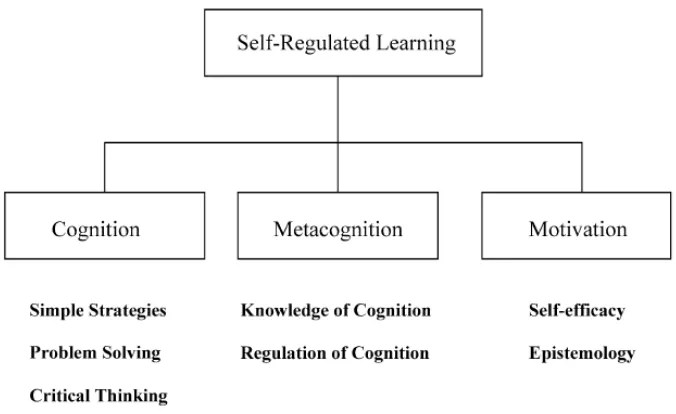
Components of Self-Regulated Learning. While many models of SRL have been proposed, there are three main components (Figure 2) that have been identified as central to SRL pro-cesses: cognition/behavior, metacognition and motivation (Schraw et al., 2006; Winne & Hadwin, 1998; Zimmerman, 1990). The cognitive/behavioral component of SRL involves the skills and behaviors that students demonstrate to support their own learning. This
cludes problem solving strategies such as decomposing large problems into smaller steps, making use of careful observations, and analyzing outcomes. Students also demonstrate criti-cal thinking skills such as analyzing information for credibility, making ties with existing knowledge, and synthesizing information from a variety of sources. Another key behavior is the ability to create positive learning environments by reducing distractions and seeking out sources of appropriate help.
The metacognitive component of SRL involves the regulation of cognitive activities. Self-regulated learners engage in metacognitive behaviors such as setting appropriate learn-ing goals, plannlearn-ing strategies to accomplish them, monitorlearn-ing and evaluatlearn-ing progress and adapting or refining behaviors as necessary. These students are more consciously attuned to their level of knowledge while engaged in a task and are better able to organize thoughts and open questions. They can then use this information to make efficient decisions about the best approaches for learning or completing a task.
Finally, the motivational component of SRL involves students’ beliefs about the value of the task and their own abilities to succeed. Self-regulated learners typically have intrinsic interest in learning tasks, persist in the face of difficulty, and demonstrate high self-efficacy. They tend to have epistemological beliefs that support the idea that they can learn with the appropriate effort and opportunity. These students are ready and willing to learn.
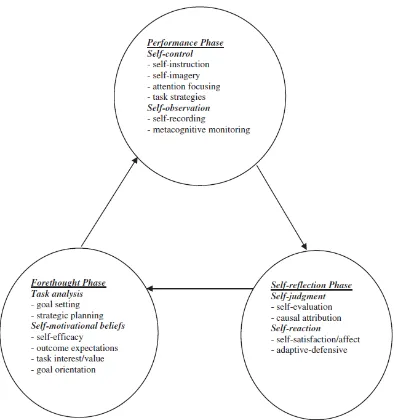
Cyclical Nature of Self-Regulated Learning. Most theories of self-regulated learning de-scribe it as a cyclical process, with each phase impacting the next (DiBenedetto & Zimmerman, 2013; Schraw et al., 2006; Winne & Hadwin, 1998; Zimmerman, 2000). Three phases are commonly described as part of this cycle: planning, performing, and then reflect-ing (Figure 3). Zimmerman (2000) further describes the subprocesses that are part of each
phase. The planning phase is made up of task-analysis and self-motivational beliefs. During task-analysis the student identifies possible outcomes of the learning activity and specifically identifies the outcomes that are most desirable and consequently arrives at a concrete goal. The student can then plan how this goal can be achieved by identifying the most appropriate strategies. During this phase self-motivational beliefs also come into play. A students’ goal orientation and interest in the task can drive what goals they are more likely to focus on. The student’s beliefs about his or her ability will also impact what goals are chosen and how hard the student is willing to work to achieve them.
Students next enter the performance phase where they execute the plans and utilize the strategies identified in the planning phase. Zimmerman (2000) identifies two processes associated with this phase: self-control and self-observation. Self-control involves actively focusing attention on important material and working to avoid distractions. Students also en-gage in practices to make the most of learning such as identifying key points, integrating in-formation, breaking down tasks, and constructing mental models of learned information. The self-observation processes involve students attending to the strategies they use and the result-ing outcomes. To be most effective, self-observations must be timely, accurate, structured, and ideally focused on the positive aspects of performance rather than the negative. Students may record observations externally or just mentally note observations about their perfor-mance. These observations may also lead to experimentation where students recognize they may need to try something new to see if it more effective.
may approach the task moving forward. Students who blame the task will identify new strat-egies as they re-enter the planning phase. Students who blame themselves may defensively alter their goals or may simply have reduced interest and self-efficacy impacting the next planning phase. The student’s beliefs, intentions, and behaviors will continually change as students repeatedly cycle through the three phases of self-regulated learning.
Individual Differences in Self-Regulated Learning. Understanding the processes underly-ing SRL, it is unsurprisunderly-ing that individuals who are better able to regulate their learnunderly-ing in intentional and reflective ways are more likely to achieve academic success (Zimmerman, 1990). However, while it seems all students apply self-regulatory behaviors during learning, the degree of competency is unfortunately broad, even among students of the same age (Schunk & Zimmerman, 2003). Research suggests that low self-regulation during learning activities is simply due to students not having sufficient opportunities to practice and these skills are often not highlighted or required during typical classroom learning (Schunk & Zimmerman, 2003; Schunk & Ertmer, 2000; Zimmerman & Kitsantas, 2002). However, these skills can be improved with practice and with targeted interventions (Kostons et al., 2012; Schunk & Swartz, 1993a, 1993b; Schunk & Zimmerman, 2003).
self-regulated learners performed significantly worse when they were required to guide their own learning (Figure 4). This highlights the role these environments may play in exploring indi-vidual differences in self-regulated learning strategies and skills.
2.3 Measuring SRL
SRL behaviors can vary between individuals and contexts and have significant impacts on learning and performance outcomes. Consequently, the ability to measure and evaluate SRL is important for forming a full picture of the learning process both in traditional classrooms and in intelligent tutoring systems. Additionally, research suggests that SRL scaffolding should be tailored to a student’s existing demonstration of SRL skills (White & Frederiksen, 1998; Young, 1996). Too much or too little scaffolding can harm learning or engagement outcomes (Koedinger & Aleven, 2007). To accomplish this, accurate and meaningful measures of SRL behaviors are critical.
Current Approaches. Measures of SRL typically operate under one of two views of SRL: as an aptitude or as an event (Winne & Perry, 2000). When SRL is measured as an aptitude a single metric represents an individual’s propensity and skill at regulating their learning be-haviors. Measures of this type often include questionnaires where students are asked whether or how often they engage in specific SRL behaviors such as asking for help or finding a quiet place to study. These measures rely on students’ honesty and clear recollection of their typi-cal study behaviors. SRL may also be measured as an aptitude using teacher evaluations or structured interviews. These methods present a holistic view of SRL as a trait of an individu-al learner based on typicindividu-al behaviors and response patterns (Winne & Perry, 2000).
An alternative view is measuring SRL as an event. In this view, SRL is dependent on the specific learning context and measurements reflect individual actions of SRL behaviors. Measures of SRL as an event include external observations of performance, think aloud pro-tocols, and trace methodologies. These methods of measurement seek to examine how indi-viduals respond to specific stimuli and identify both the presence or absence of SRL behav-iors as well as the varieties of skills and responses demonstrated. In this view, SRL is repre-sented by a single action or pattern of actions in a given context and is very specific to the task at hand (Winne, 2010).
While these two views of SRL measurement conceptualize SRL differently, research-ers agree that it is important to consider both aspects in order to get a full picture of SRL (Winne, 2010). While some students are more skilled at regulating their own learning, the successful use of these skills depends highly on the specific learning context (Schraw, 2010). Furthermore, SRL skills may develop and change over time based on independent experienc-es or instruction.
example, asking a student about their current learning goal may cause the student to rethink their current activities and perhaps identify a new goal. Secondly, many measures are inva-sive and interrupt or put additional demands on learning tasks. For example, think aloud pro-tocols require students to verbalize their actions that may cause additional cognitive load and reduce their ability to work on the task at hand. Finally, many measures require subjects to personally recall or qualify their activities. Questionnaires and interviews that ask about typi-cal behaviors depend on individuals’ ability to accurately categorize their past behaviors which may impact the outcome of the measure.
SRL researchers have lamented these challenges of measuring SRL for decades. However, with the increasing availability of computer-based learning environments, new mechanisms for measuring and evaluating SRL have recently come to light. In 2010, a spe-cial issue of Educational Psychologist featured leading SRL researchers discussing the pos-sibilities and challenges of measuring SRL using trace data generated from computer-based learning environments.
Trace-based Assessment of SRL. The rich trace data provided by computer-based learning environments presents novel opportunities for assessing SRL that was previously unavaila-ble. Overall, there are three primary benefits to measuring SRL from trace data:
Rich, dynamic event data. In computer-based learning environments, student actions can be logged at a granularity that is infeasible using other online, real-time measures such as think-aloud protocols. These actions can be analyzed to provide a rich picture of individual SRL events and allow “researchers to capture and model the dynamic nature of these pro-cesses as they are continually deployed and adjusted during learning” (Greene & Azevedo, 2010, p. 205).
assess-ment” has been gaining acceptance because of its ability to capture information about the student without interruption or interference (Shute, 2011).
Contextualization. SRL behaviors are always in response to a specific set of stimuli in a particular context (Winne, 2010). Measuring SRL without accounting for these variables misses out on key components of how students react to learning scenarios. Trace assessment naturally focuses on how students engage in SRL in context; specifically, the context of the computer-based learning environment with which they are presently interacting. Additional-ly, the context also includes the individual learner and the skills, beliefs and aptitudes that they bring to bear on the learning process.
Together, these features allow a richer and more meaningful understanding of SRL processes as they unfold during a learning task. Furthermore, computer-based learning envi-ronments often put users in control of their own learning, necessitating the use of SRL strate-gies. The need for understanding SRL in these environments as well as the measurement benefits provided by these systems has motivated recent examination of these phenomena.
2.4 Modeling and Supporting Student SRL Behaviors
Recent work has examined issues of modeling and supporting SRL in a variety of different computer-based learning environments. For example, in MetaTutor, a hypermedia environ-ment for learning biology, think-aloud protocols have been used to examine which strategies students use, while analysis of students’ navigation through the hypermedia environment helps to identify profiles of self-regulated learners (Azevedo, Johnson, Chauncey, & Burkett, 2010). Further studies have examined the role of prompts encouraging students to set and monitor specific learning goals (Azevedo et al., 2012). The results of these investigations identified the importance of providing timely prompts as well as offering feedback on stu-dents’ responses to the prompt.
Some students may request help too early or frequently without spending time on the prob-lem, while others may avoid help even when it would be beneficial. Aleven et al. developed a model of ideal help seeking behavior to identify students who were not using the feature correctly. Using this model, the system delivered feedback either encouraging students to use or avoid help. While there were no learning differences between students who received feed-back and those who did not, the authors did find that the feedfeed-back improved help-seeking behavior in future interactions with the system.
Similarly, researchers have identified patterns of behavior in the Betty’s Brain system that are indicative of low and high levels of self-regulation (Biswas, Jeong, Roscoe, & Sulcer, 2009). Prompting students to use SRL strategies when these patterns of behavior oc-cur has shown promise in improving student learning. They have also used Hidden Markov Models to identify behavior differences between students who engaged with a version of a system where they received SRL feedback and those who received traditional feedback (Biswas, Jeong, Kinnebrew, Sulcer, & Roscoe, 2010).
While previous work has focused primarily on examining SRL in highly structured problem-solving and learning environments, there has also been work on identifying SRL behaviors in open-ended inquiry environments. For example, work by Shores et al. has ex-amined early prediction of students’ cognitive tool use in order to inform possible interven-tions and scaffolding (Shores, Rowe, & Lester, 2011). This work focused in on a single com-ponent of SRL rather than considering the extremely large scope of phenomena that can be investigated in an open-ended learning scenario.
for assessing SRL it will be important to bridge the gap between these two approaches by both focusing on data-mined behavior patterns as well as run-time modeling.
2.5 Stealth Assessment
Stealth assessment is a form of real-time empirical modeling that has been the subject of in-creasing attention, particularly in the context of open-ended game-based environments (Shute, 2011; Shute & Ventura, 2013). The primary objective of stealth-assessment is to seamlessly measure low-level features of student knowledge, behaviors, or characteristics. The assessment is hidden from the student who is engaged in the learning activity. The sys-tem tracks fine-grained, naturalistic actions of the student that can be integrated in a model of skills or competencies of interest. The resulting assessment can be used to provide formative feedback with the objective of improving the learning or skill acquisition of the student. Stealth assessment is designed to measure important characteristics without interrupting feel-ings of engagement and flow. Since the student is unaware they are being measured they may also demonstrate significantly less anxiety than in traditional assessment measures.
Stealth assessment has been heavily explored in open-ended game-based learning environments. Games are of particular interest for a variety of reasons (Shute, 2011; Shute & Ventura, 2013). First, games are engaging and students may be more willing to interact with them than other learning systems. Second, games often involve “learning by doing” (Shute, 2011, p. 506) which is expected to lead to improved learning outcomes. Third, open-ended learning environments require a wide array of skills and provide opportunities to identify student strengths and weaknesses in these areas. Finally, games offer unique opportunities to provide feedback and improve skills and learning so the student receives additional benefit.
CHAPTER 3
Student Behavior Corpus
This proposal investigates self-regulated learning in the game-based learning environment CRYSTAL ISLAND (Figure 5). This system includes rich game features and storylines aimed at encouraging student interest and motivation. Additionally, it is an inquiry-based system in which students must gather information, form hypotheses and develop and run tests in order to solve the overarching problem. In the following section the details of the CRYSTAL ISLAND environment will be described along with a corpus collection involving over four hundred students interacting with the system.
3.1 C
RYSTALI
SLANDCRYSTAL ISLAND features a science mystery designed to support the North Carolina 8th grade microbiology curriculum. The premise of the mystery is that the student arrives on an island to discover that the research team that has been established there has fallen ill. The camp nurse explains that they have not been able to identify the cause or type of illness and asks
for the student’s help. The student then works to collect clues by talking with virtual charac-ters, running tests on objects in the world, and reading related books and posters. Once the student arrives at the correct source and type of illness and proposes a diagnosis, they have solved the mystery and completed the game.
There are a variety of activities students engage in to learn the material and solve the mystery. Students are encouraged to read books and posters with the related microbiology content. They must converse with characters to understand the symptoms of the ill camp members and to acquire information about what types of things the camp members have been eating. They must gather and run tests on relevant food items to determine what objects might be contaminated. Once a contaminated object has been found they may examine it fur-ther with a microscope to distinguish with what it is contaminated. They are also encouraged to keep track of all their findings and hypothesis by taking notes and recording data in their “diagnosis worksheet.”
3.2 Corpus Collection
Data was collected from students at two North Carolina middle schools interacting with CRYSTAL ISLAND as part of their school day. A primary corpus was collected from the first middle school. This data is used for the analyses of self-regulated learning and models of student behavior presented in subsequent sections of this proposal. A secondary corpus was collected from the second, smaller middle school. This corpus is used as a validation set to ensure that the models and findings from the first corpus extend to novel populations.
His-panic or Latino, 63% were Caucasian, and 10% were of mixed or other races. At the time of the study, the students had not yet completed the microbiology curriculum in their classes.
The second, validation corpus was collected from a study involving 154 eighth grade students from a middle school in same school district as the first study. After cleaning the data, 140 students’ data remained in the validation corpus. Of these, there were 64 male and 76 female students. The average age of the students was 13.6 years (SD = 0.69). Approxi-mately 1% of the participants were American Indian or Alaska Native, 10% were Black or African American, 21% were Hispanic or Latino, 66% were Caucasian, and 1% were mixed or other races.
Measures. A week prior to the interaction, students completed a set of pre-study question-naires including a test of prior knowledge, as well as several measures of personal attributes. Personality was measured using the Big 5 Personality Questionnaire, which describes per-sonality along five dimensions: openness, conscientiousness, extraversion, agreeableness and neuroticism (McCrae & Costa, 1993). Goal orientation, which refers to the extent that a stu-dent values mastery of material and successful performance outcomes when engaged in learning activities, was also measured using the Achievement Goals Questionnaire (Elliot & McGregor, 2001). Finally, students’ emotion regulation strategies were measured with the Cognitive Emotion Regulation Questionnaire (Gernefski & Kraati, 2006), which measures the extent to which each of nine common strategies are used by an individual student. Stu-dents also completed a researcher-generated curriculum test to measure their level of knowledge before interacting with CRYSTAL ISLAND.
value/usefulness. Student engagement and presence in the system was measured using the Presence Questionnaire (Witmer, & Singer, 1998), which includes several subscales such as a sense of immersion and involvement. Students also completed a questionnaire related to their understanding of the CRYSTAL ISLAND mystery, though these measures are outside the scope of this discussion.
Procedure. Having completed the pre-test materials a week prior to the study, the students were seated at a station, which included a laptop, mouse, headphones and a set of explanatory materials. Students listened to an introductory presentation by a researcher that included a brief description of the purpose of the study and details about the game controls. The explan-atory materials at each student station included this same information printed so they could reference it throughout the study.
During the study, students interacted with CRYSTAL ISLAND for 55 minutes or until they completed the mystery. Student’s in-game behaviors were logged in detail by the sys-tem. During their interaction they also received an in-game prompt asking them to report on
their emotional state (Figure 6). This prompt was described to students as being part of an “experimental social network” that was being used on CRYSTAL ISLAND. Students selected from one of seven emotional states: anxious, bored, confused, curious, excited, focused, and frustrated. They were also asked to type a short “status update.”
CHAPTER 4
Prior Findings on Student Engagement and Learning
in C
RYSTALI
SLANDThe primary purpose of the CRYSTAL ISLAND learning environment is to increase microbiol-ogy domain knowledge with additional emphasis on improving inquiry skills and fostering engagement. Consequently, initial work sought to examine how these phenomena are repre-sented in the collected corpus. First, analyses were conducted to ensure that students experi-enced learning gains from interacting with CRYSTAL ISLAND. Using data from both corpora, paired t-tests comparing student’s pretest (M = 6.6, SD = 2.3) and posttest (M = 8.6, SD = 3.4) scores indicated that students’ learning gains from using CRYSTAL ISLAND were statisti-cally significant, t(399) = 12.5, p < 0.0001.
4.1 Affect and Motivation
A repeated measure ANOVA indicated that the states occurred at significantly differ-ent frequencies, F(6, 2394) = 60.4, p < 0.0001. Tukey post-hoc analyses indicated the following
differences in the occurrence of self-reports: focused > curious > (confused = frustrated = excited) > bored > anxious. While it is difficult to compare this pattern of states to other en-vironments because of differences in collection procedures, there are interesting similarities and differences. Students interacting with both traditional and game-based environments tend to spend most of their time in a state of focus or engaged concentration (Baker et al., 2010). However, positive affective states such as delight, curiosity and excitement appear more prevalent in game systems, compared with confusion in traditional tutoring systems (Baker et al., 2010). These trends suggest that there may be affective benefits to game-based learning environments, although more controlled studies (such as (Hallinen et al., 2009)) are neces-sary to further understand the differences.
Additional analyses were conducted to examine the role of affect played on learning and motivational outcomes in CRYSTAL ISLAND. Using student’s self-reported affective states, correlations were conducted to determine the relationship between the occurrences of
Table 1. Frequency and proportion of emotion self-reports
Primary Cor-pus
Secondary
Corpus Total
Emotion Freq Per Freq Per Freq Per
anxious 86 4.6% 41 4.0% 127 4.4%
bored 159 8.5% 84 8.2% 243 8.4%
confused 300 16.1% 167 16.3% 467 16.2%
curious 347 18.6% 203 19.8% 550 19.1%
excited 251 13.5% 126 12.3% 377 13.1%
focused 417 22.4% 252 24.6% 669 23.2%
frustrated 303 16.3% 150 14.7% 453 15.7%
these states and learning outcomes. Results indicated that positive affect was strongly corre-lated with learning gains, r(398) = 0.16, p = 0.001, while negative affect was negatively cor-related with learning gains. Additionally, two negatively valenced emotions appeared to be particularly associated with reduced learning. Both confusion, r(398) = -0.11, p = 0.027 and boredom, r(398) = -0.15, p =0.035 were negatively correlated with learning outcomes.
Further investigation sought to identify whether students’ affective states correspond-ed with feelings of value, interest, and motivation towards the task (Table 2). Correlations were run between the occurrence of student emotion and five subscales of the Intrinsic Moti-vation Inventory (McAuley et al., 1989): Interest/Enjoyment, Perceived Competence, Ef-fort/Importance, Pressure/Tension, and Value/Usefulness. Many affective states had signifi-cant correlations with each of these metrics. Additionally, there is strong evidence (p < 0.001) that positive affect was associated with increased feelings of interest (r=0.49), compe-tence (r=0.35), importance (r=0.33) and value (r=0.35). Understandably, positive affect was also associated with reduced feelings of tension (r = -0.20). Together, these results correlat-ing affective states with learncorrelat-ing and motivation measures corroborate with many findcorrelat-ings in the psychological community. Related research suggests that positive affect can lead to
in-Table 2. Affective states correlated with motivation outcome measures. Bold indicates p < 0.05, highlighted indicates p < 0.01
Interest / Enjoyment
Perceived Competence
Effort / Importance
Pressure / Tension
Value / Usefulness
Anxious 0.07 0.00 0.05 0.01 0.09
Bored -0.43 -0.30 -0.37 0.04 -0.38
Confused -0.15 -0.11 -0.05 0.10 -0.03
Curious 0.16 0.11 0.13 -0.03 0.08
Excited 0.32 0.22 0.19 -0.08 0.22
Focused 0.22 0.15 0.15 -0.16 0.19
creased learning (Bless et al., 1996; Kanfer & Ackerman, 1989; Pekrun et al., 2002), while negative emotions are believed to lead to decreased motivation and effort (Meyer & Turner, 2006; Pekrun et al., 2002; Ramirez & Dockweiler, 1987).
4.2 Engagement and Disengagement
Prior work also examined the occurrence of disengagement in the form of off-task behavior. Specifically, this involved students disengaging from the learning content and focusing in-stead on the game-based features of the environment. This is notably different from disen-gagement in traditional tutoring systems as students are still engaged by the system, though not with the learning task. Analyses conducted with the initial corpus of students indicate that on average, students spent approximate 4.58% (SD = 6.82) of their time off-task (Figure 7). While this is significantly lower than reported by many other environments, it is not
unex-Figure 7. Histogram of off-task behavior 0
10 20 30 40 50 60 70 80
0.00 0.04 0.09 0.13 0.17 0.22 0.26 0.30 0.35 0.39 0.43 0.48 0.52 0.56 0.61 0.65
N
umber
of
Students
% of time off-task
pected given the very different nature of the environment and unique definition of off-task behavior. There was also a wide range between students with approximately a third of stu-dents engaging in no off-task behavior, and at the maximum, one student spent 63.2% of his time off-task.
Further analyses were conducted comparing off-task behavior to student learning. Re-sults resembled findings reported from other investigations of off-task behavior in alternate intelligent tutoring systems (Baker, Corbett, Koedinger, & Wagner, 2004; Cocea, Hershkovitz, & Baker, 2009; Gong, Beck, Heffernan, & Forbes-Summers, 2010). Off-task behavior was found to negatively correlate with students’ normalized learning gains, r(258) = -0.18, p = 0.004. There was no evidence that low prior-knowledge students engaged in more off-task behavior, as the correlation between time off-task and pre-test score was not statisti-cally significant, r(258) = -0.08, p = 0.21. This result contrasted with a previous investigation of off-task behavior using an earlier version of the CRYSTAL ISLAND learning environment (Rowe, McQuiggan, Robison, & Lester, 2009).
The results also highlighted evidence that off-task behavior may have a significant af-fective component. In particular, total time off-task was negatively correlated with curiosity r(258) = -0.12, p = 0.04 and frustration, r(258) = -0.13, p = 0.04. This result was surprising given prior work that demonstrated frustration as a trigger for off-task behavior (Baker et al., 2010). The finding prompted an examination of whether off-task behavior helps alleviate frustration in the CRYSTAL ISLAND environment.
not appear to have this skill the negative impacts of off-task behavior on learning were still observed (Sabourin et al., 2013).
Together these findings indicate a positive relationship between engagement and learning behaviors in the CRYSTAL ISLAND environment. They also indicate differences in student’s abilities to regulate their behavior during interactions. Inspired by these findings, further investigations sought to examine the role of inquiry strategies on learning, engage-ment, and interest.
4.3 Inquiry Behaviors
Prior work examining students’ inquiry behaviors in the game-based learning environment suggested that effective inquiry strategies (e.g., gathering background information prior to formulating and testing hypotheses in a virtual laboratory) were not necessarily associated with improved content learning gains (Sabourin, Rowe, et al., 2012b). However, effective inquiry strategies were associated with improved problem-solving outcomes. Conversely, students who did not use good strategies (e.g., gathering background information after for-mulating and testing hypotheses) were less effective at solving the overall task. These obser-vations led to the hypothesis that individual differences in inquiry strategies may also be as-sociated with differences in affective outcomes. In particular, emotions such as frustration and curiosity were anticipated to correlate with different inquiry behaviors.
CHAPTER 5
Identifying Self-Regulated Learning
In order to build predictive models of the cognitive, metacognitive and behavioral compo-nents of self-regulated learning, it was necessary to first devise measures and classifications for these components. The objective was to select processes and phenomena that were partic-ularly relevant to the CRYSTAL ISLAND environment and were representative of the important processes. We were also interested in exploring different mechanisms for identifying behav-iors and classifying students. For this reason, three different approaches were taken for each of the categories: machine learning, manual annotation, and validated survey measure. It is hoped that by addressing a broad spectrum of behaviors, processes, and techniques the under-lying ideas and methods described will be more easily applied to measuring SRL in other learning environments.
5.1
Cognitive/Behavioral Classifications
strate-gies that were both more effective and tied to learning outcomes. The approach to this task was k-means clustering.
K-Means Clustering. K-means clustering is an unsupervised machine-learning technique that is designed to recognize groups of similar observations from a sample. The primary ob-jective is to create k groupings from a set of observations while minimizing the distance of each observation from the mean of the cluster to which it belongs. Finding the optimal cluster is NP-hard, although iterative refinement algorithms support rapid convergence on possible clusters. In this process, k random means are selected at the start. Each observation is then assigned to a cluster based on the closest mean. The means are then updated to reflect the actual mean of the observations within the cluster. This process is repeated until the means (and assigned observations) no longer change.