ABSTRACT
WOODARD, ETHAN ROBERT. Spectrally Resolved Longitudinal Spatial Coherence Interferometry. (Under the direction of Michael Kudenov).
In this dissertation, an alternative imaging technique is presented which uses longitudinal
spatial coherence interferometry to encode a scene’s spatial information onto the source’s
power spectrum. By spectrally resolving the output using a spectrometer, a channeled
spectrum is measured. Fourier transformation of the channeled spectrum yields a
measurement of the incident scene’s angular spectrum. Theory is presented to exhibit
analogies to conventional Fourier transform spectroscopy of the power spectrum.
Experimental validation of the technique is demonstrated, using a Fabry-Pérot etalon, for
the reconstruction of one-dimensional sinusoidal and randomly generated angular spectra.
This technique is further developed to create an alternative technique for channeled
polarimetry which uses longitudinal spatial coherence interferometry to encode a scene’s
angularly dependent polarization information onto the source’s power spectrum. As before,
a Fourier transformation of the measured channeled spectrum, in combination with
reference beam calibration techniques, yields a reconstruction of the incident scene’s
angular Stokes parameters. Experimental validation of the technique is demonstrated, using
a Fabry-Pérot etalon, for the recovery of one-dimensional linearly polarized scenes and a
step-function scene between two linearly polarized states.
An alternative approach to encode a scene’s angular information onto the power
spectrum is presented, which leverages the dispersive properties of glass materials. By
implementing two glass materials with different dispersion characteristics within a
incident angles adds constructively at a single wavelength. This phenomenon generates a
region of coherence in a spectrally resolved measurement, whose envelope contains the
angular information of the scene. Theory is presented for the spatial-spectral multiplexing
technique, as well as modeling and experimental results from the investigation of various
interferometer schemes. Details of the resolution and operational limitations associated
with the technique are offered.
Finally, a discussion of the future implications of the aforementioned techniques is
presented. The researcher offers insight into several applications in which spectrally
resolved longitudinal spatial coherence interferometry may have future impact. These
techniques include lensless imaging, three- and four-dimensional scene reconstruction, and
propagation of a scene’s spatial and polarization information through multimode optical
© Copyright 2017 Ethan Robert Woodard
Spectrally Resolved Longitudinal Spatial Coherence Interferometry
by
Ethan Robert Woodard
A dissertation submitted to the Graduate Faculty of North Carolina State University
in partial fulfillment of the requirements for the degree of
Doctor of Philosophy
Electrical Engineering
Raleigh, North Carolina
2017
APPROVED BY:
_______________________________ ______________________________
Michael Kudenov Robert Kolbas
Committee Chair
_______________________________ ______________________________
ii
DEDICATION
iii
BIOGRAPHY
Ethan Woodard was born in Columbia, South Carolina to Cliff and Lisa Woodard. After
high school, Ethan attended Presbyterian College for his undergraduate studies and
graduated in 2013 with a B.S. in physics and a B.S. in applied mathematics. He then moved
to Raleigh, North Carolina to attend North Carolina State University in pursuit of an M.S.
in electrical engineering, later transferring to the Ph.D. program under the advisement of
Michael Kudenov. His research interests in the Optical Sensing Lab were related to
iv
ACKNOWLEDGMENTS
First and foremost, I would like to thank Dr. Kudenov for all of his mentoring during my
time at NC State. I also extend thanks to my fellow OSL members who were always willing
to talk things out at the white board. Lastly, I would like to thank my family and friends
v
TABLE OF CONTENTS
LIST OF TABLES………....viii
LIST OF FIGURES……….ix
1.0 Chapter 1: Introduction ... 1
2.0 Chapter 2: Snapshot Spectrally Resolved Longitudinal Spatial Coherence Interferometry ... 7
2.1 Introduction ... 7
2.2 Theory ... 7
2.2.1 Coherence ... 16
2.2.2 Comparison with Conventional Longitudinal Spatial Coherence Interferometry ... 22
2.3 Experimental Setup ... 24
2.3.1 FPE Simulation ... 26
2.3.2 Alignment of Fabry-Pérot Etalon and SLM Carrier Frequency ... 27
2.3.3 Alignment Procedure ... 29
2.4 Experimental Results... 32
2.4.1 Sinusoidal Angular Spectra... 32
2.4.2 Random Angular Spectra ... 36
2.4.3 Error Analysis ... 38
2.4.4 Angular Resolution Analysis ... 40
2.5 Radiometric Analysis ... 42
2.6 Conclusion ... 48
vi
3.1 Introduction ... 49
3.2 Theory ... 51
3.3 Recovery of Angularly Dependent Stokes Parameters ... 58
3.3.1 Reference Beam Calibration ... 58
3.3.2 False Signature Artifact Reduction Technique ... 58
3.4 Experimental Setup ... 60
3.4.1 Alignment Procedure and Methods ... 62
3.5 Experimental Results... 64
3.5.1 First order analysis ... 64
3.5.2 Uniform Stokes Scenes ... 66
3.5.3 Stokes Step Function... 72
3.6 Conclusion ... 74
4.0 Chapter 4: Spatial-spectral Multiplexing using Nonlinear Dispersion ... 76
4.1 Introduction ... 76
4.2 Theory ... 76
4.3 SSM Architectures, Experimental Setups and Results ... 83
4.3.1 Michelson Interferometer ... 84
4.3.2 Mach-Zehnder Interferometer ... 92
4.3.3 Polarization Grating-based Interferometer ... 100
4.3.4 Miscellaneous System Architectures ... 114
4.4 Reconstruction Algorithm for Nonlinear Channeled Spectra ... 120
4.4.1 Simulations of Linear and Nonlinear Optical Path Differences ... 121
vii
4.5 Angular Resolution Analysis ... 143
4.6 Comparison of Angular Resolution of Lens to Fabry-Pérot System ... 153
4.7 Tolerancing and Aberrations ... 155
4.7.1 Tolerancing of Beamsplitter Terminus ... 155
4.7.2 Wavefront Aberrations in Interferometers ... 161
5.0 Chapter 5: Future Work ... 168
5.1 Lensless Imaging ... 168
5.2 Propagation of a Scene’s Spatial and Polarimetric Information through Optical Fibers ………...169
5.3 Reconstruction of three- and four-dimensional object space data ... 171
6.0 Conclusion ... 173
viii
LIST OF TABLES
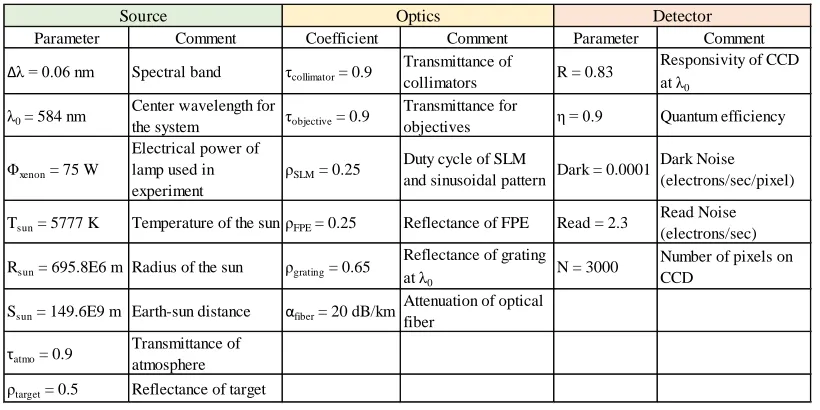
Table 1. Parameters for Radiometric Calculations for the FPE system ... 45
Table 2. RMS Error calculations for reconstruction of normalized Stokes parameters for
uniform, linearly polarized scenes ... 71
Table 3. RMS Error calculations for reconstruction of normalized Stokes parameters for
the step function scene ... 74
Table 4. Glass analysis data for several pairs of potential glass materials for the
PG-interferometer. ... 110
Table 5. Spectral resolutions required to resolve maximum frequencies in channeled
ix
LIST OF FIGURES
Fig. 1. (a) Michelson interferometer configured to measure the spectrum of a source. (b)
Interference pattern, measured on the FPA as a function of OPD; (c) Fourier transform of
the data in (b), yielding the source’s power spectrum. ... 8
Fig. 2. (a) Michelson interferometer configured to measure the angular spectrum of a
uniform source. (b) Spectrally resolved interference pattern, measured on the spectrometer,
as a function of a measurement variable ν that depends on wavenumber σ; (c) Fourier
transform of the data in (b), yielding the source’s angular spectrum. ... 12 Fig. 3. Channeled spectrum simulated for MI with linear ν (red line) relationship,
illustrating low coherence in the detectable region of the spectrum (green shading). ... 16
Fig. 4. FTAS which relays an arbitrary object’s angular spectrum onto an SLM with
transmittance τS. Light is then collimated into the tilted MI, where the spectrally resolved
interference is detected using a spectrometer. ... 18
Fig. 5. Channeled spectrum for wavenumbers spanning 0 mm-1 (λ = ∞ nm) to 2857 mm-1 (λ = 350 nm). The highlighted region signifies wavenumbers spanning 1000 to 2500 mm-1
(λ spanning 1000 to 400 nm). Measurement of (a) the cosine carrier frequency ν0 and (b)
an additional modulation on ν0with a frequency Δν. ... 20
Fig. 6. (a) Visibility peaks simulated for a FZP designed for λ0 = 633 nm and high
coherence at Δz = 2 mm. (b) Simulated spectrally resolved channeled spectrum for
2Δz = 4 mm. ... 23
Fig. 7. (a) Schematic of the experimental configuration for the FPE-based interferometer;
x Fig. 8. (a) Schematic of the spectrometer that was used for our experiments; (b) photo of
the spectrometer on the benchtop. ... 26
Fig. 9. (a) Calculation of FPE reflectance vs. wavelength (solid blue line), for t = 14 μm
and an angle of incidence of 52°, and the coating reflectance (dashed orange line), as
obtained from Thorlabs at an incidence angle of 45° [0]. (b) Fourier transform of the FPE
reflectance spectrum of (a), but for a t = 100 μm cavity. ... 27
Fig. 10. (a) Schematic for FPE alignment configuration, in which the xenon arc lamp source
was replaced with a low pressure neon gas discharge lamp. A camera is also used to directly
observe the light from the SLM and source. (b) Image of the SLM’s carrier fringe
superimposed onto the fringe, observed by residual spectrally narrow band light reflected
off the SLM’s surface. A spatial beat frequency is observed when the FPE’s thickness is
not ideal. (c) Image of an aligned system. In this case, maximum coherence would occur
at a wavelength equal to the neon gas lamp’s filtered emission wavelength at 633 nm. .. 29
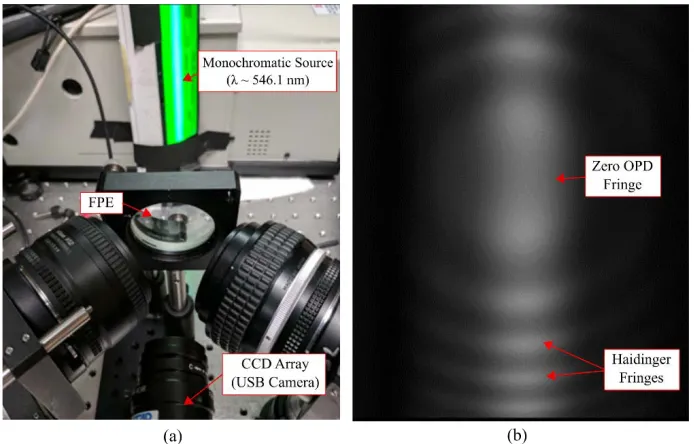
Fig. 11. (a) Setup for aligning the FPE for maximum contrast. A USB camera focused at
infinity is used to image the Haidinger fringes generated by a monochromatic source. (b)
Image of the Haidinger fringes generated by the etalon. ... 30
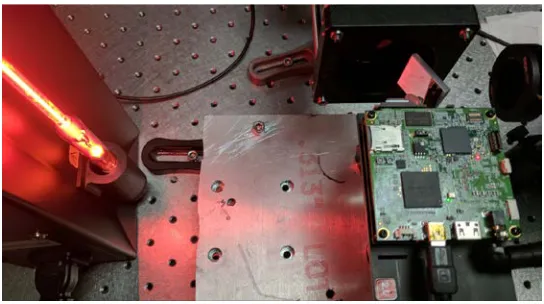
Fig. 12. Image of the illumination setup for collimation and alignment of the SLM carrier
frequency to the Haidinger fringes within the etalon... 31
Fig. 13. (a) Image of the setup for ensuring collimation of the carrier frequency and (b) an
acquired image from the SLM carrier frequency pattern superimposed on Haidinger fringes
xi Fig. 14. Sinusoidal angular spectra that were loaded onto the SLM (solid blue line) and the
associated envelope function (black dashed line) that corresponds to the spatial information
being measured. ... 33
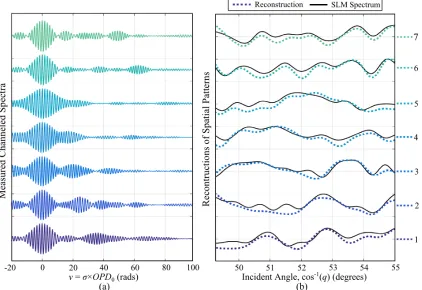
Fig. 15. Measured results. (a) Channeled spectra. The spectra are illustrated from highest
to lowest spatial frequency from top to bottom. (b) The reconstructed results (dotted
colored lines), after Fourier transformation and Mertz phase correction, plotted with the
sinusoidal angular spectra (solid black lines). ... 35
Fig. 16. Random angular spectra that were loaded onto the SLM (solid blue line) and the
associated envelope function (black dashed line) that corresponds to the spatial information
being measured. ... 36
Fig. 17. Measured results for random spectra. (a) Channeled spectra. The spectra were
randomly selected from an experiment containing 100 different random spectra. (b) The
reconstructed results (dotted colored lines), after Fourier transformation and Mertz phase
correction, plotted with the randomly generated angular spectra (solid black lines). ... 38
Fig. 18. (a) RMS error versus spatial frequency factor N for the sinusoidal angular spectra
and (b) (a) RMS error versus spectrum index for the band-limited random angular spectra.
... 39
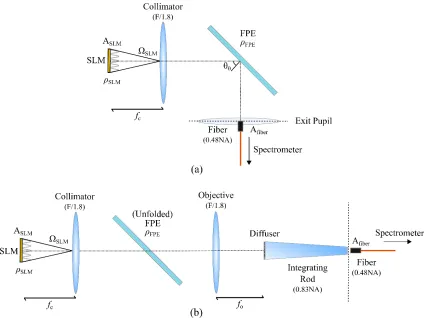
Fig. 19. Schematic used for radiometric and SNR calculations for (b) the optimal system
setup, sampling within the exit pupil of the objective, and (b) the ‘unfolded’ experimental
xii Fig. 20. SNR versus integration time calculated based on the optical power collected at the
aperture of the fiber for the optimal and experimental FTAS systems under (a) laboratory
conditions and (b) a simulated overfilled target under passive solar illumination. ... 46
Fig. 21. SNR versus integration time calculated for the optimal and experimental setups of
the FTAS systems using the grating spectrometer under (a) laboratory conditions and (b) a
simulated overfilled target under passive solar illumination. ... 47
Fig. 22. Model of the CP technique used by Oka and Kato [33], in which high order
retarders are used to generate cosinusoidal carrier frequencies which encode the incident state of polarization onto the source power spectrum as a function of wavenumber, σ. .. 50
Fig. 23. Simple model of the proposed CP technique, in which angularly dependent Stokes
parameters are amplitude modulated onto the source power spectrum using an SLM and
sinusoidal PG. Spectrally resolving the output from a linear CS modulator generates a CS
which contains polarization information of the scene. ... 51
Fig. 24. Schematic of a linear channel spectrum modulator (e.g. titled MI) used to encode
polarization information onto the source’s power spectrum. The SLM provides the
sinusoidal carrier frequency while a polarization grating (PG) of period Λ creates the
sinusoidal envelope used to generate channels within the measured spectrum. ... 52
Fig. 25. Schematic of the intermediate image plane of the optical system in Fig. 24. ... 52
Fig. 26. Simulated channeled spectrum for system in Fig. 24 with PG period Λ = 2240 μm.
Magnified view of the three channels separated in ν space by the phase term, ϕ1, present
xiii Fig. 27. In CP, (a) the S0 component of the source is present near the centerburst, while (b)
the other Stokes parameters are encoded into displaced channels. Since spectral
measurements are a superposition of these components, (c) aliasing will occur when
centerburst modulations are present in the side channels. ... 59
Fig. 28. (a) Schematic and (b) optical table setup of the FPE-based proof of concept system
used for the channeled spectropolarimetry technique. ... 62
Fig. 29. (a) Schematic for FPE alignment configuration, in which the xenon arc lamp source
was replaced with a low pressure neon gas discharge lamp. A camera is also used to directly
observe the light from the SLM and source. (b) Image of the SLM’s carrier fringe
superimposed onto the fringe, observed by residual spectrally narrow band light reflected
off the SLM’s surface. In this aligned system case, maximum coherence would occur at a
wavelength equal to the neon gas lamp’s filtered emission wavelength at 633 nm. (c) Actual
image of the modulated carrier frequency pattern (illuminated by white light) which would
generate channels in the experimental setup. ... 64
Fig. 30. (a) Scaled (×1.7) experimentally acquired CS superimposed on simulated CS for
LPG(0º), LPA(90º). (b) Magnified view of channel C1 in two experimentally acquired CS
for LPG(0º) and LPG(90º). ... 65
Fig. 31. (a) Image of the sinusoidal pattern of period Λ for the PG used in proof of concept
experiments. (b) Image of the analyzers, LPA(0º) and LPA(90º), used to implement the
ART calibration (red arrows denote orientation axis). ... 67
Fig. 32. Processed channeled spectra for a reference, LPG(0º), and sample, LPG(45º), data
xiv measurements for LPA(0º). The yellow spectra are the higher resolution spectrum used in
the ART. ... 68
Fig. 33. Unmodulated spectra used to calculate the weighting factor Γ(ν). ... 69
Fig. 34. Simulation (Sim, solid lines) and experimental (Exp, dashed lines) reconstruction
results for the normalized angularly dependent Stokes parameters, S1/S0 and S2/S0, versus
angle of incidence for linearly polarized scenes: (a) 67.5º, (b) 90º, (c) 135º, and (d) 157.5º.
... 70
Fig. 35. Image of the Stokes step function created by two linear polarizing generators
oriented such that the scene is define as a step between an S1 to S2 polarization state. Model
of the Stokes step function used in numerical simulation of channeled spectra and simulated
reconstructions. ... 72
Fig. 36. Simulation (‘Sim’, solid lines) and experimental (‘Exp’, dashed lines)
reconstruction results for the normalized angularly dependent Stokes parameters, S1/S0
(blue lines) and S2/S0 (red lines), versus angle of incidence for the Stokes step function
scene. State of polarization across the FOV goes from (a) 0º to 135º, (b) 0º to 45º, (c) 45º
to 0º, and from (d) 135º to 0º. ... 73
Fig. 37. Channeled SSM technique using a tilted Michelson interferometer. (a) A tilted MI
accepting multiple angles from the scene. (b) The channeled spectrum created by the MI
and (c) its respective angular spectrum via Fourier transform. ... 77
Fig. 38. Channeled spectrum generated by tilted white-light Michelson interferometer (blue
curve). Region of reduced contrast at visible wavenumbers where the spectrometer
xv Fig. 39. Angular coherence compensation for channeled SSM. (a) A tilted MI compensated
for a single wavelength defined by the intersection of the dispersion curves of the two glass
plates in (b). (c) Simulated channeled spectrum generated by the MI system in (a). ... 80
Fig. 40. Designs for the dual-glass type interferometer systems include the conventional
(a) and modified (b) Michelson interferometer, the conventional (c) and modified (d)
Mach-Zehnder interferometer, and the diffraction-based polarization grating (e)
interferometer. ... 84
Fig. 41. A Michelson interferometer with a plate of glass (or dispersion fluid) in each arm.
One plate has a higher relative dispersion (lower Abbe number) than its counterpart. .... 85
Fig. 42 (a) Dispersion curves for glass windows N-LAK33A and N-SF14. (b) Simulations
of channeled spectra for the ideal case (t1 = t2) and the actual case (t1≠ t2). ... 87
Fig. 43. (a) Schematic of MI system for SSM proof of concept experiment. (b) Optical
table setup for SSM experiment, sampling the (exit) pupil plane of the collimator. ... 88
Fig. 44. Flat field corrected channeled spectra for 3 positions across the defocused image
of the scene slit (i.e. exit pupil). ... 90
Fig. 45. Simulated (blue curve) versus experimental (red curve) channeled spectra for the
proof of concept MI system. ... 91
Fig. 46. Magnified view of the processed experimental data near the centerburst (a) and at
longer wavelengths (b). ... 92
Fig. 47. Two plane-parallel plate model of MMZ interferometer system. ... 94
Fig. 48. (a) Schematic and (b) optical table setup for a proof of concept experiment using
xvi Fig. 49. Illustrations of the three techniques used for aligning the MZ interferometer for
proof of concept experiments... 96
Fig. 50. Channeled spectrum acquired by the OSA spectrometer from interference
generated in the dispersive MZ interferometer. ... 98
Fig. 51. Channeled spectrum acquired by the FTIR spectrometer from interference
generated in the dispersive MZ interferometer. ... 100
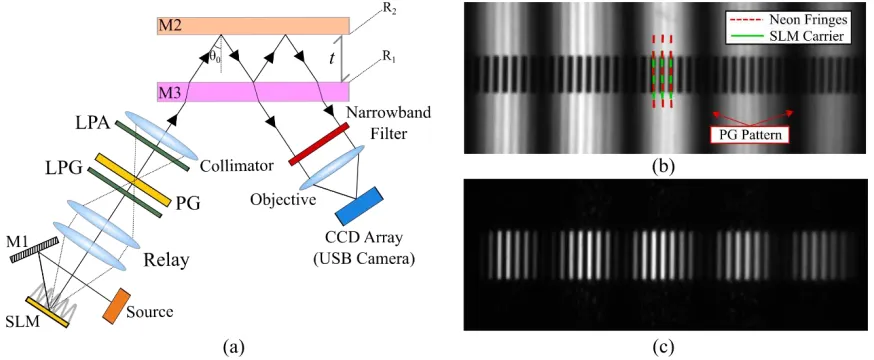
Fig. 52. Design of a PG-based channeled SSM system containing four dispersive materials
and four polarization gratings. ... 101
Fig. 53. Design of PG-based system with two dispersive materials between respective sets
of PGs with period Λ. The rays are shown for an unbalanced system at a wavelength for
which the refractive indices of glasses G1 and G2 are unequal. ... 103
Fig. 54. PG-based system, depicted for a 20 degree angle of incidence at 633 nm. The PG
grating periods are all equal to Λ = 4 microns. All dimensions in mm or degrees. A zoomed
in region of the two exiting rays is displayed in panel (P1)... 106
Fig. 55. Experimental setup for establishing proof of concept results for the SSM technique
and resolution data using a PG-based interferometer. ... 107
Fig. 56. Analysis of spectral content for the LAK8/SF1 glass pair at wavenumbers near the
Fraunhofer spectral lines. Separation of the data cursors is an approximation of the spectral
resolution needed to resolve the frequency content. ... 112
Fig. 57. Simulation of the interference fringes generated at the output of the PG-based
xvii Fig. 58. A compact Mach-Zehnder interferometer with visible white light interference
fringes visible with the preliminary setup for measuring a channeled spectra from the
compact Mach-Zehnder. ... 115
Fig. 59. Dispersion curves for the ordinary and extraordinary rays of CdS. ... 117
Fig. 60. Simulation of the channeled spectrum and phase, ν = σOPD(σ), generated by the
o and e rays of a CdS retarder based on the relationship in the dispersion curves between
no(λ) and ne(λ) ... 118
Fig. 61. (a) Schematic of potential proof of concept SSM system using a birefringent
crystal. (b) Preliminary experiment of birefringent system using a CdS retarder as the
dispersive material. ... 118
Fig. 62. Example of a general situation for a channeled spectrum (blue spectrum) with a
nonlinear OPD dependence (green line) versus a linear OPD dependence (red line). ... 121
Fig. 63. Simulated channeled spectrum (blue) plotted with the linear ν (red) against
wavenumber from σ = 0 m-1 toσ = 2.5 × 10⁶ m-1. Channeled spectrum is simulated with a uniform angular spectrum of 1,000 planes waves in the FOV from -2º to +2º, with an initial
interferometer tilt of 20º. ... 123
Fig. 64. Fourier transform of a double-sided channeled spectrum formed by a linear ν
plotted with respect to 1/δν. Important ranges in frequency bandwidth are represented on
the graph... 125
Fig. 65. Simulated channeled spectrum (blue) plotted with the absolute magnitude of the
xviii Fig. 66. Close up of the quadratic ν channeled spectrum for the spectral range of σ = 0.6 × 10⁶ m- 1 to σ = 1.1 × 10⁶ m- 1. Illustrates the region near local maximum (or
minimum) of the quadratic v phase factor that exhibit fringes of lower frequency and
stationary phase. ... 129
Fig. 67. Normalized channeled spectrum and nonlinear (quadratic) ν over the truncated
spectral range of σ = 1.0 × 10⁶ m- 1 to σ = 2.5 × 10⁶ m- 1. ... 132
Fig. 68. Plot of the original nonlinear phase ν versus the third-order polynomial fitting of
the truncated data. ... 133
Fig. 69. Plot of the truncated nonlinear ν versus the linear approximation of ν from obtained
via the zero crossing and the maximum and minimum values of the nonlinear ν. ... 135
Fig. 70. Plot of the linearly interpolated channeled spectrum after truncation of
wavenumbers to obtain the content between maximum and minimum values of the
nonlinear ν. Channeled spectrum initially contained 100,000 wavenumber samples before
truncation. ... 139
Fig. 71. Reconstructed angular spectrum from direct FFT implementation of the linearly
interpolated channeled spectrum of 100,000 wavenumber samples before truncation. . 139
Fig. 72. Close up of a single side of the reconstructed angular spectrum. Note the jagged
sampling at the peaks of the bandwidth. ... 141
Fig. 73. Reconstructed angular spectrum of linearly interpolated channeled spectrum
(100,000 wavenumbers, 1,000 plane waves over the FOV of θ = -5º to θ = +5º). ... 142
Fig. 74. Angular spectrum reconstructed from a nonlinear channeled spectrum of 500,000
xix Fig. 75. Rotation Fabry-Pérot cavity illuminated by a point source creating two-beam
interference at the observation plane. The optical paths of the two interfering rays are
represented as R1 (black line) and R2 (blue line). ... 146
Fig. 76. Angular resolution, dθi, for an FPE for three different indices of refraction,
n1 = {1.5, 1.6, and 1.7}. ... 148
Fig. 77. PSF of an ideal lens for a single wavelength, λ = 500 nm. ... 150
Fig. 78. PSF of lens plotted for five values of λ in the visible range with λ = 400 nm setting
the lower bound of the angular resolution. ... 152
Fig. 79. Total intensity of PSF (black dashed line) represented as the summation of all the
component wavelengths of the spectrum, unscaled version to show relative magnitude on
left and zoomed-in version to show possible zero-crossings on right. ... 152
Fig. 80. Angular resolution of ideal lens and general FP versus angle of incidence (θ0 = 5°
to θ0 = 45°) for σmax = 2.50 × 10⁶ m-1 for multiple values of OPDmax (top). Zoomed-in
version of the same plot around the angles of incidence for which f = D for the lens
(bottom)... 155
Fig. 81. Dispersion curves of potential glass options (N-LAK8 and N-SF1) based on
Sellmeier equations and known coefficients. Intersection represents design wavelength of
the MI system. ... 157
Fig. 82. Depiction of beamsplitter terminus, with t representing the thickness of the offset.
xx Fig. 83. Simulations of channeled spectra generated by a Michelson interferometer for
equal path lengths (t1 = t2 = 2 mm) with (red curve) and without (blue curve) a beamsplitter
terminus... 159
Fig. 84. Images of the white light interference patterns generated by a Michelson
interferometer for two different sets of dielectric mirrors. ... 160
Fig. 85. Zemax ray trace of MI used with MZDDE and the MATLAB modeling routine.
... 162
Fig. 86. Diagrams of two different scenarios for modeling the effects of wavefront
aberrations in the MI system. (a) Both arms of the MI experience the same added wavefront
error. (b) Same initial wavefront error, but one arm has more wavefront error added. .. 163
Fig. 87. Schematic of the breakdown evaluation of the wavefront error contributed by each
surface of a single arm of the MI system. ... 164
Fig. 88. Schematic of an optical system for spectrally resolved LSCI which replaces the
SLM and collimating lens with geometric phase gratings. ... 169
Fig. 89. Schematic of future application of technique for one-dimensional imaging through
multimode optical fibers. ... 170
Fig. 90. Schematic of the optical model used to develop the SSM reconstruction algorithms
1
1.0 Chapter 1: Introduction
Encoding information onto different dimensions has been investigated in the fields of fiber
optics and communication [1-5], medical imaging [6,7], microscopy [8-10], and remote
sensing [11,12]. Techniques presented in the past have relied on an analog of Hadamard
multiplexing to encode spatial information onto the incident power spectrum; e.g., by use
of filter arrays or masks onto which an object is imaged. In this work, we focus on the
encoding of a scene’s angular spectrum onto a broadband power spectrum by use of
phase-based multiplexing. This is achieved by leveraging longitudinal spatial coherence and the
angular sensitivity of a Fabry-Perot etalon to modulate incident angular information onto
the coherence of the source power spectrum. In this way, each spatial component of the
angular spectrum has a unique frequency in the measured channeled spectrum [13]. The
proposed technique has parallels to Fourier transform spectroscopy [14] in which
interferometric systems are used to modulate the source’s power spectrum onto an angular
spectrum (or spatial axis). Similar to Fourier transform spectroscopy, reconstructing the
angular spectrum can be achieved using a Fourier transform relationship.
In the field of fiber optics and communication a different approach to
spatial-spectral encoding or multiplexing is used to increase the amount of information that can be
transmitted along the fiber. Since fibers have low spatial resolution and complex transfer
functions versus angle, incident spatial information is encoded onto a different space, such
as wavelength [3] or time [4]. In many cases, the spatial-spectral encoding and decoding
2 Armitage et. al. [2] proposed a technique for wavelength multiplexing using dispersive
prisms to encode a one-dimensional object onto the spectrum of a white-light point source.
The prisms served to disperse the white light spectrum across a one-dimensional slit along
the object such that each spatial point was encoded onto a different wavelength before
propagating through a non-imaging light pipe. Meanwhile, Mendlovic et. al. [5] devised a
wavelength multiplexing technique which relied on diffractive structures to create the
spectral spreading across both one- and two-dimensional objects. In this instance, the
diffraction gratings were designed such that each spatial location or pixel across the object
was mapped to a specific wavelength before transmitting through a single-mode fiber. The
decoding process, used to reconstruct the object, also relied on diffractive elements to
convert the individual wavelengths back into their corresponding spatial components.
More recently the research of Barankov and Mertz [7] has demonstrated the use of
spread-spectrum encoding to create high-throughput two-dimensional images of broadband
white-light illuminated sources through single-mode fibers. By using low-finesse Fabry-Perot
etalons as the spread-spectrum encoder, incident ray angles from an extended spatial
distribution are given a unique spectral code across the full spectrum of the source.
Reconstructing the object requires numerical decoding, rather than optical decoding, as
seen in the prism and diffraction grating systems.
Unlike the wavelength multiplexing created using dispersive prisms or diffractive
optical elements, our proposed system relies on interferometric techniques to encode the
angular information onto the power spectrum. In this way, individual components of the
3 frequencies or phases across the entire spectral range of the source. Our technique is more
similar to the work of Barankov and Mertz; however, the basis of our encoding procedure
relies on Dirac delta functions in the spatial domain being related to sinusoids in the
spectral domain, rather than pseudo-random but unique spectral codes used in their
spread-spectral encoder. This allows for a direct Fourier transformation relationship between the
measured channeled spectrum and the reconstruction of the incident angular spectrum.
Longitudinal spatial coherence is used here to refer to coherence between two
points along the optical axis as derived by interpretation of the Van Cittert-Zernike
Theorem [0]. Many researchers have studied the application of longitudinal spatial
coherence to the fields of optical coherence profilometry and tomography [16-20]. Rosen
and Takeda [17] demonstrated the use of longitudinal spatial coherence for surface
profilometry by shifting the degree of spatial coherence with modulations of the source’s
intensity distribution. The researchers used a Michelson interferometer illuminated with
quasi-monochromatic spatially incoherent light to measure the gap between a reference
and test mirror. However, instead of translating one of the mirrors along the longitudinal
axis to determine peaks in coherence, spatial masks, defined by Fresnel zone plates, were
used to modulate the source distribution. The height of the mirrors was thus determined by
a relationship between peaks in spatial coherence and the grating constant or fringe
frequency of the zone plates. Similarly, Wang et. al. [18] continued the preceding work to
demonstrate an interferometric system for tomographic applications. Using a spatial light
4 evident at surface heights which were spatially coherent with Fresnel zone plate-like
sources.
In our interferometric techniques, the concept of longitudinal spatial coherence is
used to maximize the contrast in fringes observed within the measured channeled spectrum.
The spatial frequencies of a source’s angular spectra are coherently matched to the
transmission peaks of monochromatic Haidinger fringes generated within a Fabry-Perot
etalon. When a spectrometer is used to measure the channeled spectrum, maximum
coherence occurs at a wavelength which observes resonance along the longitudinal axis of
the cavity. A channeled spectrum refers to a sinusoidally modulated white-light spectrum
and forms the basis for the measured output of the proposed technique. An example of the
use of a channeled spectrum to recover information is presented by Oka and Kato [11], in
which the state of polarization of a scene is modulated onto the power spectrum of the
source. Using birefringent retarders to create phase retardations along the longitudinal axis
as a function of wavenumber, three quasi-cosinusoidal components are generated which
carry information about the polarization state of the scene. These components appear as
discrete channels along the axis of path difference for the system, and a readily accessible
to demodulate the polarization information of interest. To create discrete channels within
the spectrally resolved measured signal of our system, a cosinusoidal spatial carrier
frequency is used to shift coherence into the detectable region of the spectrum. The carrier
frequency is then amplitude modulated with a spatial envelope to encode angular
information into the channeled spectrum’s coherence. Recovery of the envelope is readily
5 The research of this dissertation as detailed in the following chapters has evolved
several current state-of-the-art techniques in the research fields related to Fourier transform
spectroscopy, longitudinal spatial coherence, and channeled imaging polarimetry. Related
to Fourier transform spectroscopy, this dissertation work has led to the first formal
demonstration of a Fourier transform angular spectrometer (FTAS), which allows for the
recovery of angular spectrum from a spectral measurement, with strong analogies in terms
of resolution and reconstruction algorithms. Conventional longitudinal spatial coherence
interferometry has primarily focused on resolving depth information from two-dimensional
measurements of spatial coherence functions. The work of this dissertation now allows for
acquisition of amplitude and phase information of an optical system’s pupil from
measurements of one-dimensional spatial coherence functions, which leads to the recovery
of a scene’s spatial and polarimetric information. Lastly, with conventional channeled
imaging polarimetry, recovery of spatially dependent polarization information requires a
Fourier transformation of a two-dimensional image. The technique developed in this
research can now recover angularly dependent polarization information directly from
spectrally channeled measurements, with only the polarimetric information of interest
retrieved directly from the measurement domain.
In chapter 2.0, the researcher introduces the technique of snapshot spectrally
resolved longitudinal spatial coherence interferometry by deriving the theory and drawing
parallels to conventional Fourier transform spectroscopy. The experimental setup and
alignment procedure are detailed, and experimental results for the reconstruction of
6 experimental results, and a discussion of the angular resolution and radiometric tradespace
is offered. Chapter 3.0 details the development of the technique for channeled polarimetry,
which allows for the recovery of angularly dependent polarization information from
spectral measurements. Theory and calibration techniques are outlined, followed by the
experimental setup and alignment procedure for the laboratory-based optical system.
Experimental results for the recovery of one-dimensional linearly polarized scenes and a
step-function scene between two linearly polarized states are presented.
In chapter 4.0, the researcher introduces an alternative technique for encoding a
scene’s angular spectrum onto the power spectrum which leverages the nonlinear
dispersion characteristics of glass materials. Theory for the spatial-spectral multiplexing
technique and results from the investigation of several interferometer architectures are
presented. A reconstruction algorithm for nonlinearly sampled experimental measurements
is outlined, followed by discussion of the resolution and operational limitations associated
with the technique.
Finally, in chapter 5.0, the researcher offers insight into the implications of the
spectrally resolved longitudinal spatial coherence interferometry technique for future
applications. The applications for which the technique has the potential to make an impact
include lenless imaging, imaging through multimode optical fibers, and three- and
7
2.0 Chapter 2: Snapshot Spectrally Resolved Longitudinal Spatial Coherence Interferometry
2.1 Introduction
In this chapter, the researcher introduces an alternative imaging technique which encodes
a scene’s angular information onto the source’s power spectrum. Theory for the
interferometric technique for angular-spectral encoding is derived with parallels to Fourier
transform spectroscopy. Details of the experimental design and procedures for validation
of the technique are presented, followed by experimental validation based on the
reconstruction of sinusoidal and random angular spectra.
2.2 Theory
In a conventional Fourier transform spectrometer, or as we will refer to it as a Fourier
Transform Power Spectrometer (FTPS), incident frequency components of the power
spectrum are represented as unique spatial frequencies after two-beam interference. A view
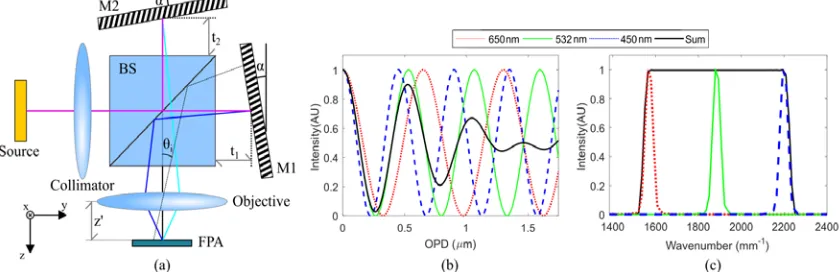
of a typical FTPS is illustrated in Fig. 1 (a), in which a Michelson interferometer (MI), with
tilted mirrors, is used to create a spatially varying optical path difference (OPD) on a focal
plane array (FPA). In this system, light from a source is collimated through a collimator
into a beamsplitter (BS). This redirects the light onto two mirrors, M1 and M2, which are
tilted by an angle α. Light is reflected from these tilted mirrors into an objective lens, which
8
Fig. 1. (a) Michelson interferometer configured to measure the spectrum of a source. (b) Interference pattern, measured on the FPA as a function of OPD; (c) Fourier transform of the data in (b), yielding the source’s power spectrum.
The OPD, as a function of FPA spatial position, can be represented [21] as
( )
4 tan .OPD y = y α (1)
The detected interference pattern, measured by the FPA, can be calculated [22] as
( )
( )
( ) ( ) ( ) ( )
0 0{
0 0( )
0}
0max 0
rect OPD y P cos 2 ,
b OPD y I I OPD y d
OPD τ σ ρ σ σ σ π σ σ
∞
= +
∫
(2)
where b is the measured photogenerated current, ρ represents the detector’s responsivity in
A/W, I is the incident intensity in W, τP is the optics’ power spectrum transmission
function, rect is a uniform rectangular apodization function of width OPDmax [23], and σ0
is the incident wavenumber in units of inverse length. Assuming an ideal 50:50 BS and
mirror reflectivity, the transmittance is
( )
1( ) ( )
, 2
P C O
9 where τC and τO are the transmittances of the collimator and objective lenses, respectively.
A view of the interference pattern is illustrated in Fig. 1 (b) versus OPD for 450 nm, 532
nm, and 650 nm visible light, as well as a continuous superposition given a uniform power
spectrum. Fourier transformation of Eq. (2) with respect to OPD y
( )
yields the detectedpower spectrum as
( )
( ) ( ) ( ) ( )
(
)
(
)
(
)
0 0 0 0 0
0 0
max
1 1
2 2 .
sinc P I B d OPD τ σ ρ σ σ δ σ δ σ σ δ σ σ σ σ σ ∞ + − + + = ∗
∫
(4)where ∗ represents the convolution operator, σ is the Fourier transform variable of OPD in
cycles per unit length, and the constant term from Eq. (2) has been removed for clarity. The
full width spectral resolution of the measured spectrum is then related to the
interferogram’s maximum OPD, such that
max
1OPD ,
σ ∆ =
(5)
where OPDmax is the maximum OPD sampled in Eq. (2). Thus, the Fourier transform of
the interferogram yields the power spectrum I(σ), weighted by the responsivity and
transmission functions. Fig. 1 (c) illustrates the Fourier transformation of the interference
data in Fig. 1 (b), illustrating that the individual spectral components are present within the
recovered source spectrum. An FTPS configured in this way assumes that the source light’s
spatial distribution is uniform (or slowly varying) across the mirrors. If it is not, it creates
10
( )
( )
{
( ) ( )
( ) ( ) ( )
0 0( )
}
0
max 0 0 0 0
rect ,
cos 2
A i P
OPD y
b OPD y d
OPD I I OPD y
τ θ τ σ ρ σ σ σ σ π σ ∞ × = +
∫
(6)where τ θA
( )
i defines the spatial modulation that appears across the mirror’s surface,/ '
i y z
θ = is the viewing angle between a position on the mirror’s surface and its conjugate
position on the FPA, and z' is the distance between the objective lens and FPA. It should be mentioned that spatial modulations across the mirror can be caused by, e.g.,
inhomogeneity in the source, cosine falloff from the collimator and objective lenses, and
angular transmission of antireflection coatings or etalon resonances. Fourier transformation
with this spatial dependence yields
( )
( ) ( ) ( ) ( )
(
)
(
)
(
)
{
( )
}
0 0 0 0 0
0 0
max
1 1
2 2 .
sinc
P
A
I
B d
OPD OPD y
τ σ ρ σ σ δ σ δ σ σ δ σ σ σ σ σ τ ∞ + − + + = ∗ ∗
∫
F (7)where F represents the Fourier transform and the OPD dependence in τA can be calculated
using Eq. (1) given y=θiz'. If τ θA
( )
i does not contain the same spatial frequencies as the modulated power spectrum, then the effect of not having a spatially uniform source wouldappear at spatial frequencies outside of the spectrum after Fourier transformation.
Conversely, if it contains similar spatial frequencies as the data, then crosstalk can occur.
Thus, it is best to ensure no spatial modulation is present or to measure τ θA
( )
i separately11 interferometer is used to measure an arbitrary power spectrum assuming that the scene has
a uniform angular spectrum.
We will now formulate the theory of spectrally resolved longitudinal spatial
coherence interference within the context of the FTPS described above, which we will refer
to as a Fourier Transform Angular Spectrometer (FTAS). What will be demonstrated is
that using a tilted interferometer, with spectrally resolved interferometry, is directly
analogous to the FTPS but for measuring arbitrary angular spectra across one dimension.
A view of our concept interferometer is illustrated below in Fig. 2 (a). It consists of the
same MI, except it applies parallel (non-tilted) mirrors. However, the interferometer itself
is tilted with respect to the incident light’s optical axis. Light from a spatially and spectrally
uniform source is first collimated into the MI, which is tilted with respect to the incident
optical axis (or global y-axis) by an angle θ0. The light is split by a BS into two glass plates,
with refractive indices n1 and n2 and thicknesses t1 and t2, respectively. Light then reflects
off mirrors M1 and M2 before recombining at the BS. Finally, light transmits through a
relay lens, which images the collimator’s pupil into the entrance aperture of a spectrometer
(e.g., a dispersive spectrometer’s entrance slit or fiber, or a Fourier transform
spectrometer’s entrance pupil). Note that a refractive glass has been included between the
12
Fig. 2. (a) Michelson interferometer configured to measure the angular spectrum of a uniform source. (b) Spectrally resolved interference pattern, measured on the spectrometer, as a function of a measurement variable ν that depends on wavenumber σ; (c) Fourier transform of the data in (b), yielding the source’s angular spectrum.
The OPD of the MI interferometer of Fig. 2 (a) may be represented as [25]
( )
2 1( )
1cos( )
1 2 2( )
2cos( )
2 ,OPD σ = n σ t θ − n σ t θ (8)
where θ1 and θ2 are the light’s propagation angles inside the glass plates. Often, a MI is
“field-widened” by optimizing the refractive indices in such a way as to make the
interferometer less sensitive to OPD changes as a function of incidence angle. However, in
the FTAS, the goal is to maximize the change in OPD versus incidence angle to maximize
spatial resolution. To quantify this, the interference pattern can be calculated assuming
n1 = n2 = 1 such that θi + θ0 = θ1 = θ2 and
( )
2(
1 2) ( )
cos 0cos( )
,OPD θ = t −t θ =OPD θ (9)
where θ θ θ= +i 0 and OPD0 is the MI’s optical path difference at normal incidence. The
two beam spectrally resolved interference, calculated for a single incident planewave, can
13
(
,)
( )
{
1 cos 2( ) ( )
cos}
, 2i
A
b vθ = θ + π σv θ (10)
whereA
( )
θ is the incident and offset (in angle) angular spectrum and,( )
0.v σ =σOPD (11)
In this case, the Fourier transform variable of the incident angular spectrum is a
dimensionless quantity ν. Note that for a MI with n1 = n2 = 1, the OPD is constant versus
wavenumber. However, the quantity ν still spans a range of values from ν = 0 at σ = 0 m-1 to some maximum value νmax at σmax. A depiction of a channeled spectrum, which was
simulated with OPD0 = 4.0 μm for wavenumbers spanning σ = 0 cm-1 to 25000 cm-1, is
illustrated in Fig. 2 (b). Fourier transformation of Eq. (10), taken with respect to the
measurement variable ν, yields
( )
( ) ( )
1( )
1( )
cos cos ,
2 2 2
A
B q = θ δ q + δq− θ + δq+ θ
(12)
where q is the transform variable. Eqns. (10) and (12) are expressed for a single incident
plane wave component. For a superposition of plane waves given an arbitraryA
( )
θ , theseexpressions can be represented in integral form. Additionally, the optics’ spectral and
angular transmission functions, the intensity of the incident power spectrum, and the
detector’s responsivity, can be included such that
( ) ( ) ( ) ( )
( )
( )
( )
{
}
/ 2 0 0 0max / 2 0
arccos arccos
rect ,
* 1 cos 2
A P
A q q
v
b I dq
v v q
14 where q0 =cos
( )
θ and νmaxis the maximum value of Eq. (11) for a particular instrumentor channeled spectrum. Defining the Fourier transformation variables as v
( )
σ (unitless)and q (reciprocal space) yields the Fourier transformation of Eq. (13) as
( )
( )
( )
( )
(
)
(
)
(
)
0 0 0 0
/ 2 0 / 2 max 0 1 1 arccos arccos 2 2 , sinc A
A q q q q q q q
B q dq
q g OPD π π τ δ δ δ ν ν − + − + + = ∗ ∗
∫
F (14) where0 0 0 0
,
P
g I
OPD OPD OPD OPD
ν ν τ ν ρ ν
=
(15)
is the source’s power spectrum, optics’ transmittance, and detector responsivity
contributions. Similar to the previous spatial modulation across the FTPS’s mirrors, if
either I, τ, or ρ have angular frequencies that overlap with A
( )
θ , then crosstalk can occurbetween the measured angular spectrum and these power spectrum terms. Ultimately, in a
similar process to Refs. [26,27] for channeled spectropolarimetry, these contributions can
be measured separately and accounted for to remove crosstalk. Finally, the angular
transmittance of the system τ θA
( )
is multiplicative with the incident power spectrum, andbehave similarly to the spectral transmittance term in the FTPS.
Since frequencies of the channeled spectrum components are linear withcos
( )
θ ,15 be located in the reciprocal space at a position equal tocos
( )
θ . A view of this is providedin Fig. 2 (c), which illustrates that the Fourier transformation of a channeled spectrum,
taken with respect to ν, with OPD0 = 4.0 μm and wavenumbers spanning σ = 0 cm-1 to
25000 cm-1. To properly configure the frequency axis, the inverse cosine must be taken of
q. Finally, the interferometer’s angular offset θ0 should be subtracted to properly relate
incident angles to object space angles.
Similar to an FTPS, the angular resolution of the FTAS can be related by the Fourier
transform relationship between the windowing function in Eq. (13) and the Fourier
transform’s output in Eq. (14). From the convolved sinc function, the full width angular
resolution is related to
max
1 .
q ν
∆ = (16)
Relating this to the angular resolution in object space can be achieved by substituting the value of q such that
( )
maxsin 1 .
q θ θ ν
∆ = ∆ = (17)
The angular resolution is equal to
( )
1maxsin .
θ ν θ −
∆ = (18)
For the MI described previously, assuming a system in air
max maxOPD0,
ν =σ (19)
and therefore
( )
1maxOPD0sin .
θ σ θ −
16 Thus, the angular resolution can be increased by increasing OPD0, increasing the
maximum wavenumber observed in the channeled spectrum, or operating the system at
θ = π/2 radians. It should be mentioned that when θ = π/2 radians, this is most analogous
to operating a Young’s Double Pinhole Interferometer (YDPI) viewing linear straight-line
fringes, whereas when θ = 0 radians, the interference pattern is centered on Haidinger
fringes.
2.2.1 Coherence
As mentioned previously, the measurement variable ν ranges from ν = 0 to ν = νmax over
the spectral range σ = 0 m-1to σ = σ
max. For the MI in Fig. 2 (a), the OPD is constant versus
wavenumber, thus ν is linear with respect to wavenumber over the spectral range of the
optical system. In this situation, the region of maximum coherence for which the unique
spectral frequencies of the individual incident angles are in phase occurs at ν = 0 (σ = 0 m -1). This is illustrated by the simulation of a MI channeled spectrum in Fig. 3.
17 The channeled spectrum in Fig. 3 was simulated from σ = 0 mm-1to σ = 2875 mm-1 for a MI with an OPD0 = 200 μm. The angular spectrum is a uniform one-dimensional source
with a field of view (FOV) from θ = 43º to θ = 47º. Maximum coherence occurs at σ = 0 mm-1, however, in the detectable region of the spectrum represented by green shading
(e.g. responsivity of a silicon detector), the measured fringe contrast in the channeled
spectrum is minimal. To remedy this situation by heterodyning coherence to the
measureable region of the spectrum, our technique modulates the incident angular
spectrum with a fixed spatial carrier before directing the light into the interferometerThe
configuration required for this is provided in Fig. 4, in which a digital light projector (DLP)
based spatial light modulator (SLM) is positioned in front of the FTAS. Light from an
arbitrary object’s angular spectrum is first relayed onto an SLM with a 1:1 afocal relay for
simplicity. The SLM’s transmittance is configured to be a chirped sinusoidal angular
spectrum such that
( )
[
0 0]
1 1
cos 2 ,
2 2
S v q
τ θ = + π (21)
where ν0 represents the rate of change in q0. It should be mentioned that for small tilt angles
θ0, the angular spectrum defined by Eq. (21) is highly chirped (as with Haidinger fringes),
and approaches a constant frequency for larger values of θ0 (as with YDPI fringes). Light
transmitted by the SLM is then incident into the rest of the previously described MI through
a collimator lens of focal length f, such that the ratio between object space and the
18
Fig. 4. FTAS which relays an arbitrary object’s angular spectrum onto an SLM with transmittance τS. Light is then collimated into the tilted MI, where the spectrally resolved
interference is detected using a spectrometer.
The SLM’s transmittance can be included directly in Eq. (13) as a part of the angular
transmittance τA as
( )
( ) ( )
,A O S
τ θ =τ θ τ θ (22)
where τO is the angular transmittance of the lenses, BS, and other optics in the system and
are generally of low angular frequency. Given this, assuming τO is constant yields the
detected current as
( ) ( ) ( ) ( )
( )
( )
( )
{
}
/ 2 0 0 0max / 2 0
arccos arccos
rect .
* 1 cos 2
S P
A q q
v
b I dq
v v q
π π τ ν σ τ σ ρ σ π σ − = +
∫
(23)Substituting τS into the integral yields
( )
/ 2( )
0(
)
{
( )
}
0 0 0 0
/ 2
arccos
1 cos 2 1 cos 2 ,
4
A q
b v q v q dq
π π ν π π σ −
= Γ
∫
+ + (24)19
( ) ( ) ( )
max rect . P v I v σ τ σ ρ σ Γ = (25)
Expanding yields
( )
( )
(
)
( )
( )
{
}
{
( )
}
/ 2
0 0 0
0 0
/ 2 0 0 0 0
2 2 cos 2 2 cos 2
arccos .
4 cos 2 cos 2
v q v q
b A q dq
q v v q v v
π π π π σ ν π σ π σ − + + Γ = + − + +
∫
(26)From this result, there exists a sum and difference term which re-localizes the coherence
maximum, with reduced contrast, atv= ±v0. Provided the value of ν0 is selected such that
this secondary coherence exists within the desired spectral passband, the angular spectrum
can be measured and reconstructed. For a given wavenumber of secondary coherence, σm,
the spatial frequency term must be selected such that
0 m 0.
v =σ OPD (27)
To further discuss how ν0 allows access to the information contained within the
incident angular spectrum, a simulation of Eq. (26) was conducted for OPD0 = 200 μm,
wavenumbers spanning σ = 0 mm-1to σ = 2857 mm-1, incidence angles θ spanning 75° to
85°, and a secondary coherence wavenumber σm = 1751 mm-1(λ = 571 nm). For this value
of σm, Eq. (27) yields ν0 = 350. A depiction of the channeled spectrum for these
specifications is illustrated in Fig. 5 (a) for Aarccos
( )
q0 =1. In this figure, thespectrometer’s spectral responsivity ρ σ
( )
is assumed to have non-zero values for20 Thus, the responsivity acts as a windowing filter, only permitting a certain region of the
channeled spectrum to be sampled within the immediate vicinity of ν0.
Fig. 5. Channeled spectrum for wavenumbers spanning 0 mm-1(λ = ∞ nm) to 2857 mm-1
(λ = 350 nm). The highlighted region signifies wavenumbers spanning 1000 to 2500 mm-1
(λ spanning 1000 to 400 nm). Measurement of (a) the cosine carrier frequency ν0 and (b)
an additional modulation on ν0with a frequency Δν.
Simulating now a non-uniform angular spectrum with a single frequency component yields
( )
0(
0)
1 1
arccos cos 2 ,
2 2
A q = + π∆vq (28)
where Δν is the envelope’s rate of change on the carrier defined by frequency ν0 previously.
Substituting Eq. (28) into Eq. (26) for Δν = 100 yields the channeled spectrum depicted in
Fig. 5 (b). The addition of this new frequency component expresses itself as an additional
‘channel’ within the spectrum, centered about both the primary carrier at ν = 0 and the
secondary carriers at ν = ±ν0. Since the spectrometer already behaves as a rectangular
windowing filter for the ν = −ν0 component, the detected channeled spectrum bD only
21
( )
/ 2( )
0{
(
0 0)
0(
( )
0)
}
0/ 2
arccos 2 2 cos 2 cos 2 ,
4
D
b A q v q q v v dq
π
π
ν π π σ
−
Γ
=
∫
+ + − (29)where it is assumed that ρ σ
( )
in Γ has( )
( )
0 1; 1000 2500,
0; 1000 and 2500.
ρ σ σ
ρ σ σ σ
< ≤ ≤ ≤
= > > (30)
Mapping ν = 0 at σm yields the demodulated sampling axis such that
( ) (
m)
0( )
0.v′ σ = σ σ− OPD =v σ −v (31)
Substituting Eq. (31) into Eq. (29) and taking the Fourier transformation with respect to
( )
v′ σ yields
( )
( )
(
) ( )
(
)
(
)
(
)
0 0 0 0 0
/ 2 0 / 2 max 0 1 1
arccos 1 2 cos 2
2 2
. sinc
D
A q v q q q q q q
B q dq
q g OPD π π π δ δ δ ν ν − + + − + + = ∗ ∗
∫
F (32)This makes the Fourier transformation of the demodulated channel per Eq. (29) equal to
the transformation illustrated previously in Eq. (14) with the exception of a larger
magnitude component at q = 0. This is a consequence of the channels’ reduced contrast
22 2.2.2 Comparison with Conventional Longitudinal Spatial Coherence Interferometry
To advance the technique of longitudinal spatial coherence interferometry, we use a
spectrometer to spectrally resolve the output of an interferometer. To demonstrate this
concept, an example taken from Ref. [18] is used, in which the researchers controlled
longitudinal coherence by manipulating the source profile to determine the mirror
displacement in a MI. This was accomplished by using a spatial light modulator to generate
a quasi-monochromatic extended source in the form of a Fresnel zone plate (FZP), given
by intensity distribution
( )
1(
2)
1 cos 2 , where
2
FZP
I r = + πγr +β
(33)
2 0
, and z f γ λ ∆ = (34) 0 4 . z π β λ ∆ = (35)
Here, r is used to define the radius along the circular source, f is the focal length of the
collimating lens, and Δz is the path displacement along the propagation axis between the
two mirrors in a MI. Note that Δz is related to the previously defined OPD0 by OPD0 = 2Δz,
due to the double pass in the MI. From Eq. (33), a spatially incoherent source illuminating
the FZP would produce high coherence peaks at the optical path differences
2 0
2∆ = ±z 0, 2λ γf . Simulating the FZP for λ0 = 633 nm, f = 300 mm, and an optical
23 locations as shown in Fig. 6 (a). In other words, high contrast fringes would be recorded using a CCD for λ0 = 633 nm when the mirrors are displaced by Δz = 2 mm.
Fig. 6. (a) Visibility peaks simulated for a FZP designed for λ0 = 633 nm and high
coherence at Δz = 2 mm. (b) Simulated spectrally resolved channeled spectrum for 2Δz = 4 mm.
To simulate the spectrally resolved output of the MI, we define the variable v(σ) from Eq.
(11) in terms of the FZP parameters such that
( )
(
2)
0 2 0 .
OPD f
ν σ =σ =σ λ γ (36)
In this way, the linear phase term ν(σ) will be coherently matched for λ0 = 633 nm
(σ0 = 1.579E6 m- 1) to the FZP source and thus, the monochromatic Haidinger fringes of
the MI. The channeled spectrum in Fig. 6 (b) generated from σ0 = 0 m- 1to σ0 = 2.5E6 m- 1
using Eq. (24) assumes a uniform power spectrum, with A(θ) being defined by Eq. (33) for Δz = 2 mm. The simulation samples the FZP source angular spectrum across a 3 mm slit
at an incident angle of θ0 = 12º. Evident from Fig. 6 (b) is the region of coherence located
at the designed wavenumber σ0 = 1.579E6 m-1. Noting that the secondary coherence peak
24 Thus, by spectrally resolving the output of the interferometer it is possible to determine the
longitudinal coherence in a snapshot measurement, without modulating the source’s spatial
profile.
2.3 Experimental Setup
Any interferometer that has an angularly dependent interference effect can be used to
modulate the angular spectrum onto its incident power spectrum in this fashion. However,
some interferometers are mechanically easier to interface to than others. Consider the
spatial resolution of the FTAS per Eq. (20). This resolution can be maximized when θ0 = π/2 rad. In this case, we are close to the maximum slope of the cosine given in Eq. (9)
. Additionally, the frequency of the channeled spectrum’s oscillations is also a minimum
when θ0 = π/2 rad for a given OPD0, meaning a spectrometer with a lower spectral
resolution is required to resolve the channeled spectrum.
Initially, we implemented a version of the MI, depicted previously, to perform our
experimental validations [28]. However, due to the aforementioned reasons – primarily the
requirement for high spectral resolution (and thus, signal intensity) – we opted to
implement a Fabry Perot Etalon (FPE) multiple-beam interferometer. The parameters of
the FPE were selected such that it approximated a two-beam interferometer, with most of
the power contained exclusively within the first order. A schematic of the interferometer’s
configuration is depicted in Fig. 7 (a). A Texas Instruments DLP LightCrafter Evaluation
Module is illuminated by a xenon arc lamp through a series of three mirrors (M1 through
25 the angular spectrum under measurement. Reflected light is then collimated by a
collimation lens (50 mm focal length) into a two-mirror (M4 and M5) FPE, which consists
of two 10:90 (R:T) dielectric plate beamsplitters from Thorlabs (BSN16) with reflectance
magnitudes of R1 and R2, respectively. Mirror M4 is placed on a translation stage, which
allows tuning the etalon’s thickness t. An objective lens (50 mm focal length) focuses the
FPE’s reflected light onto a ground glass diffuser and integrating rod, where the spatial
information is homogenized. Homogenization ensures both a uniform spatial and spectral
angular spectrum across the measured beam, which is often inhomogeneous due to
diffraction from the SLM. Finally, the light is measured by a spectrometer at the
homogenized output. A photo of the experimental setup is presented in Fig. 7 (b).
Fig. 7. (a) Schematic of the experimental configuration for the FPE-based interferometer; (b) photo of the setup on the benchtop.
The spectrometer that was implemented for measuring the channeled spectra is illustrated
in Fig. 8 (a). Light from the output fiber illuminates a 20 μm slit, which is then collimated
by a 50 mm focal length Nikon Nikkor F/1.8D lens. Collimated light from the slit