Functional Divergence in the Caspase Gene Family and Altered Functional
Constraints: Statistical Analysis and Prediction
Yufeng Wang and Xun Gu
Department of Zoology and Genetics, Center for Bioinformatics and Biological Statistics, Iowa State University, Ames, Iowa 50011 Manuscript received September 1, 2000
Accepted for publication March 29, 2001
ABSTRACT
In this article, we explore the pattern of type I functional divergence (i.e., altered functional constraints or site-specific rate difference) in the caspase gene family that is important for apoptosis (programmed cell death) and cytokine maturation. By taking advantage of substantial experimental data from caspases, the functional/structural basis of our posterior predictions from sequence analysis was extensively studied. Our results are as follows: (1) Phylogenetic analysis shows that the evolution of major caspase-mediated pathways has been facilitated by gene duplications, (2) type I functional divergence (altered functional constraints) is statistically significant between two major subfamilies, CED-3 and ICE, (3) 4 of 21 predicted amino acid residues (for site-specific rate difference between CED-3 and ICE) have been verified by experimental evidence, and (4) we found that some CED-3 caspases may inherit more ancestral functions, whereas other members may employ some recently derived functions. Our approach can be cost effective in functional genomics to make statistically sound predictions from amino acid sequences.
G
ENE family proliferation provides the raw material -13; Nicholson and Thornberry 1997). Substantial evidence has shown that the CED-3-type caspases are for functional innovation in higher eukaryotes.After gene duplication, the classical model (Ohno essential for most apoptotic pathways (Yuanet al.1993; Kuida et al.1996). In contrast, the major function of 1970) suggests that one gene copy maintains the original
function, while the other copy is free to accumulate the ICE-type caspases is to mediate immune response, although some members may play a role in cell death amino acid changes toward functional divergence. Since
then, many specific models have been proposed (e.g., in some circumstances (YuanandHorvitz1990;Wang et al.1998). X-ray crystallography has also shown a sig-Li1983;Clark1994;Forceet al.1999). However, the
details of functional divergence between duplicate nificant structural difference between these two types of caspases (e.g., Wilson et al. 1994; Rotonda et al. genes remain largely unexplored.Gu(1999) developed
a method to detect amino acid residues that contribute 1996).
In this article, we take advantage of experimental evi-to functional divergence after gene duplication, which
can be considered as candidates for further experimen- dence of caspases to study the functional-structural basis of statistical predictions fromGu’s (1999) method. We tation. Certainly, its effectiveness for functional
geno-mics needs to be verified by using gene families with statistically evaluate the functional divergence between CED-3 and ICE subfamilies and then show that our substantial biological/structural information.
Apoptosis, or programmed cell death, is an ordered predictions are consistent with the observations from structural or functional assay. Our analysis shows the process in which cells commit suicide when they are
not needed or are potentially harmful. The key compo- potential of evolutionary analysis for functional geno-mics.
nent in the apoptotic machinery is a cascade ofcysteine aspartyl proteases (caspases). All caspases, which are ini-tially inactive proenzymes, share the same processing
METHODS scheme to achieve mature forms after cleavage(s) at
specific Asp sites (Kumar 1995; Thornberry and
The data set: We conducted an exhaustive search
Lazebnik 1998). To date, at least 14 members of the
(e.g., the gapped BLAST and PSI-BLAST) in several caspase gene family have been identified in mammals,
major databases to find all available sequences that are which can be further classified into two major
subfami-homologous to theCaenorhabditis elegans CED-3 gene. lies, CED-3 (including caspase-2, -3, -6, -7, -8, -9, -10, and
After synthetic peptides, expressed sequence tags, par--14) and ICE (including caspase-1, -4, -5, -11, -12, and
tial sequences, and redundant sequences were removed, the final data set includes 42 CED-3 homologous se-quences, whose accession numbers are listed in the Fig-Corresponding author:Xun Gu, Department of Zoology and Genetics,
ure 3 legend.
Center for Bioinformatics and Biological Statistics, 332 Science II
Hall, Iowa State University, Ames, IA 50011. E-mail: [email protected] Multiple alignment and phylogenetic analysis: The
multiple alignment of 42 caspase amino acid sequences molecular evolution, each site, no matter whether it is related to functional divergence, has a nonzero proba-was obtained by the program CLUSTALX (Thompson
et al.1997), followed by manual editing according to the bility of becoming any type of amino acid configuration (Figure 1B). Therefore, instead of classifyingad hoctype structure information (Nicholson and Thornberry
1997). A phylogenetic tree was inferred by the neighbor- I amino acid configuration,Gu’s (1999) method is to compute the (posterior) probability of type I functional joining method (SaitouandNei1987) using MEGA2.0
(http://www.megasoftware.net/). PAUP4.0 and PHY- divergence for each amino acid site. Type II functional divergence can be defined in the same manner (results LIP were used to examine whether the inferred
phylog-eny is sensitive to any tree-making method. To evaluate not shown).
Statistical modeling for type I functional divergence: It is the intensity of functional constraints in each caspase,
we calculated the ratio of nonsynonymous to synony- conceptually convenient to use the ancestral gene (be-fore duplication) as a reference. For each duplicate mous rates between human/mouse orthologs usingLi
(1993) and modified Nei and Gojobori (in MEGA2.0) gene cluster, the evolutionary rate at a site may differ from the ancestral gene, which is called theF1site (func-methods.
Type I functional divergence (altered functional con- tional divergence related); otherwise it is calledF0 site (functional divergence unrelated). As shown in Figure
straint) analysis: Types of amino acid configurations:
Con-sider a multiple alignment of a gene family with two 1B, different evolutionary rates between duplicate genes are expected only when a site isF1in at least one cluster homologous genesAandB(Figure 1A). Although
dif-ferent classifications were put forward (e.g., Living- (e.g., sites 3, 4, and 5), a status denoted byS1.The coeffi-cient of type I functional divergence () between two gene
stone and Barton 1996), we adopt the following
schemes: (i) Type 0 represents amino acid configura- clusters is defined as the probability of a site being status S1,i.e., ⫽P(S1). The alternative status isS0, which means tions that are universally conserved through the whole
gene family, implying that these residues may be impor- a site beingF0in both clusters (i.e., the evolutionary rate of each duplicate gene is the same as the ancestral gene, tant for the common function shared by all member
genes, (ii) type I represents amino acid configurations e.g., sites 1 and 2 in Figure 1B). Obviously, P(S0) ⫽ 1⫺ . The null hypothesis is ⫽0, which means that the that are very conserved in geneAbut highly variable in
geneB, or vice versa, implying that these residues may evolutionary rate is virtually the same between duplicate genes (as well as the ancestral gene) at each site. In this have experienced altered functional constraints
re-sulting in site-specific rate difference, (iii) type II repre- case, the model is reduced to the conventional rate variation among sites (e.g.,Gu andZhang 1997). sents amino acid configurations that are very conserved
in both genes but their biochemical properties are very Let A and B be the evolutionary rates of a site in clusters A and B, respectively, which vary among sites. different,e.g., charge positivevs.negative, implying that
these residues may be responsible for functional speci- For a site being F0 in both clusters (status S0) with a probability of 1 ⫺ , we can assume A ⫽ B without fication in the different subfamilies, and (iv) amino acid
configurations at many residues are not so clear-cut that loss of generality. However, for a site beingS1(i.e., being F1in at least one cluster) with a probability of, we have they have to be regarded as unclassified (type U).
Several algorithms were proposed to define these A ⬆ B. To avoid too many parameters, Gu (1999) made the following simplification: UnderS1, although types of amino acid configurations automatically (e.g.,
Casariet al.1995;Lichtargeet al.1996;Landgrafet A ⬎ B at some sites or vice versa at others, over all sitesAandB are statistically independent. Figure 1C al.1999). However, these methods are subject to various
problems,e.g., negligence of phylogenetic tree, unclear outlines the statistical procedure on how to estimate from sequences.
statistical basis, or arbitrary cutoff for classification. To
deal with these problems, a statistical model is needed. Prediction of critical amino acid residues: If ⬎0 significantly, it provides statistical evidence that type I Functional divergence and altered functional constraint:
After gene duplication, two duplicates can undergo sub- functional divergence (site-specific rate difference) may have occurred after gene duplication. If so, it is of inter-stantial functional divergence. It seems that only a small
portion of residues are involved in functional diver- est to predict which residues are responsible, which can be achieved by posterior analysis (Figure 1C). Let gence (Goldingand Dean1998). The trajectories of
differentiation can affect the evolutionary pattern of the P(S1|X) be the posterior probability of a site beingS1when the amino acid configuration (X) is observed. Since the gene family divergence in several ways. According toGu
(1999),type I functional divergence refers to the evolutionary alternative statusS0, with posterior probabilityP(S0|X)⫽ 1⫺P(S1|X), means no altered functional constraint, the process that results in altered functional constraints (or
site-specific rate difference) between two duplicate genes, regardless predicted residues are meaningful only whenP(S1|X)⬎ 0.5 such that the posterior odd ratioR(S1/S0)⫽P(S1|X)/ of the underlying evolutionary mechanisms.Intuitively, type I
amino acid configuration is likely observed at a residue P(S0|X)⬎1. A more stringent cutoff may beP(S1|X)⬎ 0.67 orR(S1/S0)⬎2.
with different evolutionary rates between duplicate
tional distance analysis: The two-cluster analysis de- major (ancient) lineages in CED-3-type caspases, ICE-type caspases diversified recently after the divergence of am-scribed above cannot tell in which gene cluster the
al-tered functional constraint took place after gene dupli- phibians and mammals, and some of them (e.g., cas-pase-4 and -5) arose even after the mammalian radiation. cation. This problem can be solved by a simple method
when at least three homologous gene clusters are avail- Evolutionary innovations of the caspase-mediated apoptosis pathway by gene duplications: To understand the origin able. For any clusteri, leti⫽Pi(F1) be the probability
of a site having a different rate from the ancestral gene, of different caspase-mediated biochemical pathways in apoptosis, we compared the evolutionary relationship and Pi(F0) ⫽ 1 ⫺ i be the probability of having the
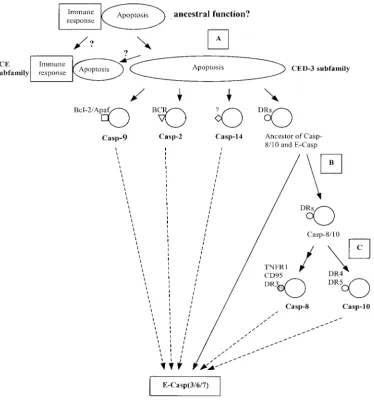
same rate. Consider two clusters i and jin which the of (CED-3-type) caspases with apoptotic pathways (Fig-ure 3). Our major finding is that major evolutionary coefficient of type I functional divergence is denoted
byij⫽Pij(S1)⫽1⫺Pij(S0). If a site beingF1orF0is inde- lineages of caspases may coincide with different caspase-mediated apoptotic pathways triggered by specific death pendent between clusters, we have the relationPij(S0)⫽
Pi(F0)⫻Pj(F0) or 1⫺ ij⫽(1⫺ i)(1⫺ j). Therefore, signals. That is, (i) caspase-9 is a key component in the
mitochondrial initiated pathway, which is initiated by we definetype I functional distance between clustersi and
jasdF(i,j)⫽ ⫺ln(1⫺ ij) andfunctional branch lengthfor the intracellular stimuli, upstream Bcl-2, and Apaf-1
pro-teins (Budihardjoet al. 1999); (ii) caspase-2 initiates cluster i or j as bF(i) ⫽ ⫺ln(1 ⫺ i) and bF(j) ⫽ ⫺ln
(1⫺ j), respectively. Obviously,dF(i,j) is additive,i.e., the apoptosis induced by negative signaling after B cell
Ag receptor (BCR) ligation (Chen et al. 1999); (iii) dF(i,j)⫽ bF(i)⫹ bF(j). (1)
apoptoses mediated by caspase-8 and -10 are similar, both initiated by responding to the death receptors When the coefficient of type I functional divergence
(ij) for each pair of clusters is estimated, the matrix of (DRs), which contain the death effector domain (DED);
and (iv) uniquely, caspase-14 is not processed by any dF(i,j) can be computed easily. Then, a standard
least-squares method is implemented on the basis of Equa- known death stimuli (Van De Craen et al. 1998). In summary, since ancient origins, these caspases may tion 1 for estimating allbF’s. A largebFindicates
substan-tial altered functional constraints in this gene cluster, evolve through different avenues and provide cells with a potential to initiate apoptosis in response to a variety whilebF⫽0 indicates that the evolutionary rate of each
site in this duplicate gene is almost identical to the of intracellular or intercellular stimuli.
Interestingly, although upstream initiator caspases ancestral gene. In other words, a duplicate gene cluster
withbF⫽0 may contain a larger component ofancestral (I-casps,e.g., casp-2, -9, -8/-10) are recruited by different receptors under different physiological or pathological functioncompared to other gene clusters.
stimuli, they all eventually catalyze the same set of down-stream effector caspases (caspase-3, -6, -7), which are RESULTS
the real killers that commit the cell suicide (Figure 3). Our results suggest that (1) gene duplication followed
Evolution of caspase-mediated molecular pathways:
The phylogenetic tree:The evolutionary tree (Figure 2) of by functional divergence is one major mechanism to generate the complexity of the apoptotic network and the caspase gene family was inferred by the
neighbor-joining (NJ) method (SaitouandNei1987). The parsi- (2) such a process is constrained by coordinated regula-tion. Indeed, in the last step, effector caspases as real mony (PAUP4.0) and likelihood (PHYLIP) methods
give virtually the same topology (data not shown). The killers remain unchanged when more initial death sig-nals are continuously recruited at different levels during presence of caspases in vertebrates, arthropods, and
nematodes suggests that the emergence of the caspase the evolution of apoptotic pathways.
Predicting critical residues for type I functional
diver-gene family might be close to or even earlier than the
origin of the animal kingdom. gence (altered functional constraints) between CED-3
and ICE subfamilies:We estimated that the coefficient AlthoughAravindet al.(1999) suggested that caspase
may evolve from an ancient protease supergene family, of functional divergence between ICE and CED-3 sub-families is ⫽ 0.29 ⫾ 0.05 [the ML option in Gu’s the root of the inferred tree (Figure 2) remains unclear.
The evolutionary pattern of caspases can be generally (1999) method], implying that the altered functional constraint between them is statistically significant. Fur-described as follows. On the basin of the tree (see A in
Figure 3), there were at least four duplication events ther, we use the posterior probabilityP(S1|X) to predict critical amino acid residues responsible for type I func-that had occurred during a very short time period,
re-sulting in five major lineages: (i) the ICE subfamily, tional divergence (site-specific rate difference) between CED-3 and ICE subfamilies (Figure 1C). The baseline of consisting of caspase-1, -4, -5, -13, -11, and -12; (ii)
cas-pase-14; (iii) caspase-2; (iv) caspase-9; and (v) the com- the site-specific profile measured byP(S1|X) isⵑ0.2–0.3 (Figure 4A). Thirty-two sites (16% of total sites) have mon ancestor of caspase-8/-10 and caspase-3/-6/-7. In
addition, the effector caspases (E-casp-3/-7/-6) and the P(S1|X)⬎0.5. The fact that most sites have scores⬍50% indicates their similar functional roles between CED-3 ancestor of caspase-8 and -10 were generated before the
Figure2.—The phylogenetic tree of the caspase gene family, inferred by the neighbor-joining method on the basis of the amino acid sequence with Poisson correction. Bootstrap values⬎50% are presented. Initiator caspases (I-casps) are involved in up-stream regulatory events, and ef-fector caspases (E-casps) directly lead to cell disassembly. The accession numbers for protein sequences are (1) casp-3, U13737 (human 3-␣), U13738 (human 3-), U49930 (rat 3-␣), U58656 (rat 3-), Y13086 (mouse), U27463 (hamster), AF083029 (chicken), D89784 (frog); (2) casp-7, U37448 (human), Y13088 (mouse), AF072124 (rat), U47332 (hamster); (3) casp-6, U20536 (human), 25670 (rat), Y13087 (mouse), AF0-82329 (chicken); (4) casp-8, AF102146 (human), AF067841 (mouse); (5) casp-10, U60519 (human 10a), U86214 (human 10/b), AF111345 (human 10/d); (6) casp-9, U60521 (human); (7) casp-2, U13021 (human), U77933 (rat), Y13085 (mouse), U64963 (chicken); (8) casp-14, AF097874 (hu-man), AJ007750 (mouse); (9) casp-1, X65019 (human), AF090119 (horse), L28095 (mouse), U14647 (rat), D89783 (frog ICE-A), D89785 (frog ICE-B); (10) casp-4, Z48810 S78281 (hu-man); (11) casp-5, X94993 (hu(hu-man); (12) casp-13, AF078533 (human); (13) casp-11, Y13089 (mouse); (14) casp-12, Y13090 (mouse); (15) inver-tebrate caspase, P42573 (C. elegans CED-3), Y12261 (Drosophila melano-gaster), U81510 (armyworm, Spodop-tera frugiperda).
Although posterior analysis is widely used in bioinfor- 1. Residue 161(348) (In the literature, this site is numbered as W348, according to the protein sequence of human matics, the cutoff value for residue selection is usually
empirical. We found that when the first 21 highest- caspase-1) is critical for CED-3 caspase substrate specificity by interacting with a unique surface loop in 3-D structure scored residues are removed from the multiple
align-ment, the estimate of is virtually 0. These 21 amino [P(S1|X) ⫽ 0.999] (Rotonda et al. 1996). At this position, all 22 sequences from the CED-3 subfamily acid residues (among 198 residues) corresponding to
the cutoff value P(S1|X) ⬎ 0.61 are then chosen for contain an invariant tryptophan (W), whereas a vari-ety of residues are present in the ICE subfamily (Fig-further analysis. Of course, this procedure is meaningful
only when ⬎0 significantly. ure 5). Crystal structural analysis reveals that W348
is a key determinant for the caspase-3 (CED-3)-type
The functional-structural basis of altered functional
constraints:We mapped these 21 predicted sites onto specificity. First, W348 forms a narrow pocket with the surface loop that is highly conserved in the the 3-D structure of caspases. The resolved X-ray crystal
structures of human caspase-1 and -3 (Wilson et al. CED-3 subfamily; see the boxed region in Figure 5. The steric constriction due to this pocket determines 1994;Rotondaet al.1996) were used to illustrate the
structural features of ICE and CED-3 subfamilies, respec- the preference of caspase-3 to the substrates with small hydrophilic side chains. Second, W348 along tively. From the literature, we found experimental
evi-dence for four predicted residues that are involved in with a group of residues forms a hydrogen bond network, which affects the interaction with the sub-the functional-structural divergence between CED-3
Figure 3.—A schematic of evolution of caspase-mediated pathways. Note that the ances-tral function of caspases (as well as the origin of ICE-type caspases) is uncertain. A–C cor-respond to ancestral nodes in Figure 1. Bcl-2/Apaf, BCR, death receptors (DRs), TNFR1, and CD95 are death signals for spe-cific apoptotic pathways. Cas-pase-3/-6/-7 are effector cas-pases (E-casps), which are the real killer proteins in pro-grammed cell death.
CED-3 caspases seems to be deleted in all ICE-type for two subfamilies. D131 is known as a cleavage site caspases, as shown in the boxed region in Figure 5. in human caspase-1 (ICE type; Thornberry et al. Hence, the relaxed evolutionary constraint observed 1992). All ICE-type caspases preserve an Asp (D) at at this position in the ICE subfamily is likely to be this position, except for mouse caspase-12 (Asn, E). caused by the 3-D structural difference. However, human caspase-3 (CED-3 type) utilizes two 2. Residues 86[P(S1|X)⫽0.75]and 88[P(S1|X)⫽ 0.74] other Asn sites for cleavage (Rotonda et al. 1996) are responsible for 3-D difference with an unknown func- so that the functional role of position 131 in CED-3 tional role.Indeed, in human caspase-1 (ICE), these caspases is no longer important. Therefore, the al-two residues appear to lie in a small loop that is not tered evolutionary constraints at this position can be
found in the CED-3 subfamily. well explained by the different utilization of cleavage
3. Residue 131[P(S1|X)⫽0.866]is proteolytic site specific sites for the precursor processing between CED-3 to the ICE subfamily. All caspases are synthesized as and ICE subfamilies.
inactive proenzymes that need to be processed to
Pattern of type I functional divergence among
CED-the mature forms (Nicholsonet al.1995). However,
spe-Figure4.—(A) The site-specific pro-file for predicting critical amino acid res-idues responsible for the functional di-vergence between CED-3 and the ICE subfamilies, measured by the posterior probability of being functionally diver-gence related at each site [P(S1|X)]. The arrows point to four amino acid residues at which functional divergence between two subfamilies has been verified by ex-perimentation. (B) Four predicted sites that have been verified by experimenta-tion.
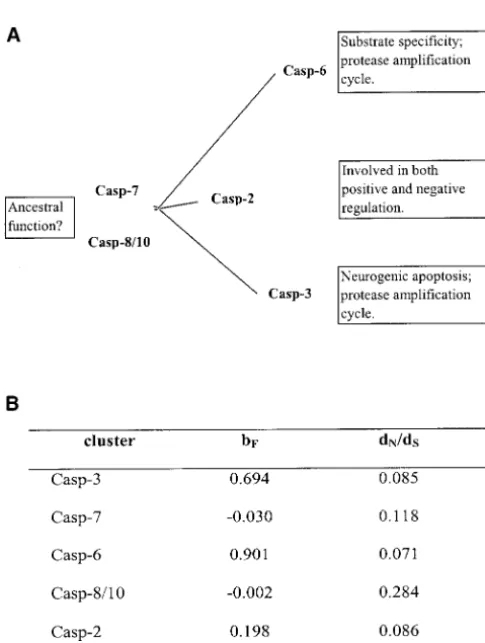
cific group of caspases that mediate the programmed portive experimental evidence is summarized as follows: (i) The nonredundant functional role of caspase-3 in cell death in a well-regulated proteolytic cascade and
employ related but distinct functions. Here we address neurological apoptosis is confirmed by caspase-3 ⫺/⫺ knockout mice (Kuida et al. 1996), (ii) caspase-6 and an interesting problem,i.e., to infer the trend of altered
functional constraint of each cluster. -3 have different substrate specificity, but both partici-pate in the protease amplification cycle by activating We study five gene clusters: caspase-3, -7, -6, -8/-10,
and -2. Due to insufficient data, caspase-9 was excluded, each other, which triggers a series of apoptotic interac-tions (Lazebnik et al.1995; Srinivasula et al. 1996), and caspase-8 and -10 are grouped for their closely
re-lated function (Fernandes-Alnemri et al.1996). The and (iii) caspase-2 has its unique dual-role position in positive and negative regulation in apoptosis by differen-upper diagonal of Table 1 shows pairwise coefficients
of type I functional divergence () between them; all tial expression of two alternative splicing isoforms (2L and⫺2S;Wanget al.1994). This dual-role property is of them are significantly⬎0 (P⬍0.05), with only one
exception;i.e., ⫽0.006 between caspase-7 and cluster- also confirmed by knockout mice: Caspase-2 deficiency causes one defective apoptotic pathway (mediated by 8/-10.
To explore the pattern of type I functional divergence granzyme B and perforin) but accelerates another path-way (cell death of motor neurons;Bergeronet al.1998). in each cluster, we performed functional distance
analy-sis (see methods). The pairwise functional distances In contrast, virtually zero bF values of caspase-7 and -8/-10 indicate that the evolutionary rate of each site in (dF) between clusters are shown in the lower diagonal
of Table 1. The star-like tree presented in Figure 6 shows these genes is almost identical to that of the ancestral gene. In this regard, these caspases may inherit a large the type I functional branch length (bF) of each cluster,
estimated by the least-squares method. The null hypoth- component of ancestral function during caspase gene family evolution.
esis of equal bF value for each cluster was statistically
rejected (P⬍0.05). For each duplicate gene, the average intensity of
func-tional constraints can be approximately measured by the Long functional branch lengths (bF) of caspase-3, -6,
and -2 suggest that these genes may have undergone dN/dSratio between appropriate orthologous sequences (e.g., human-mouse). Interestingly, caspase-3, -6, and extensive altered functional constraints as a result of
Figure5.—Alignment of predicted regions of caspases. Four predicted sites with experimental evidence are highlighted. The sites with asterisks are predicted residues within this region. The boxed region in the C terminus is the critical region for CED-3 substrate specificity: Most CED-3-type caspases form a surface loop, whereas a shallow depression is found in ICE-type caspases.
-8/-10 (zerobF), indicating that type I functional diver- straint after gene duplication may play an important role in evolutionary novelties after gene duplication. gence in caspases may result in a stronger functional
constraint (Figure 6B). Second, the site-specific profile based on posterior
anal-ysis is useful not only for understanding the functional-structural basis of protein family evolution but also for DISCUSSION
designing a cost-effective approach in functional geno-mics,e.g., the strategy for a large-scale mutagenesis. The significance of this functional divergence study
(site-TABLE 1
values anddFvalues from pairwise comparisons in the CED-3 subfamily (ij⫾SE)
dF(i,j)⫾SE Caspase-3 Caspase-7 Caspase-6 Caspase-8/-10 Caspase-2
Caspase-3 0.437⫾0.178 0.844⫾0.113 0.467⫾0.113 0.540⫾0.110 Caspase-7 0.574⫾0.257 0.579⫾0.198 0.006⫾0.022 0.198⫾0.184 Caspase-6 1.858⫾0.724 0.865⫾0.470 0.527⫾0.190 0.627⫾0.125 Caspase-8/10 0.629⫾0.212 0.006⫾0.022 0.749⫾0.401 0.306⫾0.180 Caspase-2 0.777⫾0.239 0.221⫾0.229 0.986⫾0.335 0.365⫾0.259
ij, the coefficient of the functional divergence between clustersiandj;dF(i,j), the distance of the functional divergence between clustersiandj;dF(i,j)⫽ ⫺ln(1⫺ ij), whereiandjare the row and column designation
numbers, respectively, andi⬆j; SE, standard error.
specific rate difference) without evidence could be tion depends on how strong the association is between either lacking experimental data or due to statistical functional divergence and site-specific rate difference. artifacts (e.g., cutoff value). On the other hand, experi- To avoid overinterpretation, we should adopt the poste-mentally verified critical sites that were missed by our rior-based analysis (site-specific profile) in practice only analysis may indicate other types of functional diver- when ⬎ 0 significantly, and the cutoff value should gence (e.g., type II). Clearly, the accuracy of our predic- be weighted by other biological information.
Many other methods are available for functional pre-diction from molecular evolutionary analysis (e.g., see
Golding and Dean 1998 as a review; Pollock et al.
1999; Suzuki and Gojobori 1999; Naylor and
Ger-stein 2000; Dermitzakis and Clark 2001; Gaucher
et al.2001;Gu2001). For example, the method of Su-zukiandGojobori(1999) for detecting positive selec-tion on single sites could make an effective predicselec-tion when natural selection is the major force for functional diversity. However, its application is unfeasible for many ancient gene families (e.g.,WangandGu2000, as synon-ymous distance is saturated). Since all these approaches have their own limitations but complement in some aspects, appropriate combination is strongly recom-mended.
In many models (e.g.,Li1983;Clark1994;Forceet al.1999), ancestral function of a gene family is concep-tual rather than measurable. Functional distance analy-sis provides a quantitative measure for the altered func-tional constraints between the ancestral gene and one duplicate gene. This evolutionary measure has raised an interesting hypothesis that caspase-7 and -8/-10 may represent the function of the common ancestor of the CED-3 subfamily since their respective functional branch lengths are virtually zero. We hope this hypothe-sis can be tested by experimentation.
Similar to any site-specific analysis, our prediction is sensitive to the quality of the multiple alignment. We examined the multiple alignment of the caspase family, particularly in the surrounding regions of the four
veri-Figure6.—(A) A star-like topology of the CED-3 caspases
in terms of type I functional branch lengthbF. Biological evi- fied predicted sites (Figure 5). To the best of our knowl-dence of functional specification for each caspase cluster is edge, the alignment can be considered “nearly opti-shown in the stacked boxes. (B) Functional branch length
mized.” For example, the alignment of position 161 (bF) and the ratio of nonsynonymous to synonymous rates
(W348) is almost indisputable. (dN/dS) for each gene cluster, which were computed by using
ple parallel biochemical pathways during apoptotic execution.
the capability of predicting type I functional divergence
Proc. Natl. Acad. Sci. USA92:9042–9046.
(i.e., altered functional constraints that are site specific) Li, W.-H.,1983 Evolution of duplicate genes and pseudogenes, pp.
14–37 inEvolution of Genes and Proteins, edited byM. Neiand
from sequence evolution. Moreover, our analysis
R. K. Keohn.Sinauer Associates, Sunderland, MA.
showed that a comprehensive approach including
vari-Li, W.-H.,1993 Unbiased estimation of the rates of synonymous and
ous computational methods and multilevel information nonsynonymous substitution. J. Mol. Evol.36:96–99.
Lichtarge, O., H. R. BourneandF. E. Cohen,1996 An
evolution-(from sequence to experimental data) is beneficial for
ary trace method defines binding surfaces common to protein
understanding functional diversity of a large gene family
families. J. Mol. Biol.257:342–358.
in the postgenomics era. Livingstone, C. D.,andG. J. Barton,1996 Identification of
func-tional residues and secondary structure from protein multiple We are grateful to Drs. C.-I Wu and Galvin Naylor for constructive
sequence alignment. Methods Enzymol.266:497–512. comments, which have improved the manuscript significantly. Thanks
Naylor, G. J.,andM. Gerstein,2000 Measuring shifts in function go to Jianying Gu for assistance.This study is supported by National and evolutionary opportunity using variability profiles: a case
Institutes of Health grant RO1 GM62118 to X.G. study of the globins. J. Mol. Evol.51:223–233.
Nicholson, D. W.,andN. A. Thornberry,1997 Caspases: killer proteases. Trends Biochem. Sci.22:299–306.
Nicholson, D. W., A. Ali, N. A. Thornberry, J. P. Vaillancourt, LITERATURE CITED C. K. Dinget al., 1995 Identification and inhibition of the ICE/ CED-3 protease necessary for mammalian apoptosis. Nature376:
Aravind, L., V. M. DixitandE. V. Koonin,1999 The domains of
37–43. death: evolution of the apoptosis machinery. Trends Biochem.
Ohno, S.,1970 Evolution by Gene Duplication.Springer-Verlag, Berlin. Sci.24:47–53.
Pollock, D., W. R. Taylorand N. Goldman, 1999 Coevolving
Bergeron, L., G. I. Perez, G. MacDonald, L. Shi, Y. Sunet al., 1998
protein residues: maximum likelihood identification and rela-Defects in regulation of apoptosis in caspase-2-deficient mice.
tionship to structure. J. Mol. Biol.287:187–198. Genes Dev.12:1304–1314.
Rotonda, J., D. W. Nicholson, K. M. Fazil, M. Gallant, Y. Gateau Budihardjo, I., H. Oliver, M. Lutter, X. LuoandX. Wang,1999
et al., 1996 The three-dimensional structure of apopain/CPP32, Biochemical pathways of caspase activation during apoptosis.
a key mediator of apoptosis. Nat. Struct. Biol.7:619–625. Annu. Rev. Cell. Dev. Biol.15:269–290.
Saitou, N.,andM. Nei,1987 The neighbor-joining method: a new
Casari, G., C. SanderandA. Valancia,1995 A method to predict
method for reconstructing phylogenetic trees. Mol. Biol. Evol. functional residues in proteins. Nat. Struct. Biol.2:171–178.
4:406–425.
Chen, W., H. G. Wang, S. M. Srinivasula, E. S. AlnemriandN. R.
Srinivasula, S. M., T. Fernandes-Alnemri, J. Zangarilli, N. Rob-Cooper,1999 B cell apoptosis triggered by antigen receptor
ertson, R. C. Armstronget al., 1996 The Ced-3/interleukin ligation proceeds via a novel caspase-dependent pathway. J.
Im-1beta converting enzyme-like homolog Mch6 and the lamin-cleav-munol.163:2483–2491.
ing enzyme Mch2alpha are substrates for the apoptotic mediator
Clark, A. G.,1994 Invasion and maintenance of a gene duplication.
CPP32. J. Biol. Chem.271:27099–27106. Proc. Natl. Acad. Sci. USA91:2950–2954.
Suzuki, Y.,andT. Gojobori,1999 A method for detecting positive
Dermitzakis, E. T.,andA. G. Clark,2001 Non-neutral
diversifica-selection at single amino acid sites. Mol. Biol. Evol.16:1315–1328. tion after duplication in mammalian developmental genes. Mol.
Thompson, J. D., T. J. Gibson, F. Plewniak, F. JeanmouginandD. J.
Biol. Evol.18:557–562.
Higgins,1997 The CLUSTAL_X windows interface: flexible
Fernandes-Alnemri, T., R. C. Armstrong, J. Krebs, S. M.
Sriniva-strategies for multiple sequence alignment aided by quality
analy-sula, L. Wanget al., 1996 In vitro activation of CPP32 and
sis tools. Nucleic Acids Res.25:4876–4882. Mch3 by Mch4, a novel human apoptotic cysteine protease
con-Thornberry, N. A., and Y. Lazebnik, 1998 Caspases: enemies taining two FADD-like domains. Proc. Natl. Acad. Sci. USA93:
within. Science281:1312–1316. 7464–7469.
Thornberry, N. A., H. G. Bull, J. R. Calaycay, K. T. Chapman, A. D. Force, A., M. Lynch, F. B. Pickett, A. Amores, Y. L. Yanet al., 1999
Howardet al., 1992 A novel heterodimeric cysteine protease is Preservation of duplicate genes by complementary, degenerative required for interleukin-1 beta processing in monocytes. Nature
mutations. Genetics151:1531–1545. 356:768–774.
Gaucher, E. A., M. M. MiyamotoandS. A. Benner,2001
Function-Van De Craen, M., G. Function-Van Loo, S. Pype, W. Function-Van Criekinge, I.
structure analysis of proteins using covarion-based evolutionary Van Den Brandeet al., 1998 Identification of a new caspase approaches: elongation factors. Proc. Natl. Acad. Sci. USA98: homologue: caspase-14. Cell Death Differ.5:838–846.
548–552. Wang, Y.,andX. Gu,2000 Evolutionary patterns of gene families
Golding, G. B.,andA. M. Dean,1998 The structural basis of molec- generated in the early stage of vertebrates. J. Mol. Evol.51:88–96.
ular adaptation. Mol. Biol. Evol.15:355–369. Wang, L., M. Miura, L. Bergeron, H. ZhuandJ. Yuan,1994 Ich-1,
Gu, X.,1999 Statistical methods for testing functional divergence an Ice/ced-3-related gene, encodes both positive and negative after gene duplication. Mol. Biol. Evol.16:1664–1674. regulators of programmed cell death. Cell78:739–750.
Gu, X.,2001 Maximum likelihood approach for gene family evolu- Wang, S., M. Miura, Y. K. Jung, H. Zhu, E. Liet al., 1998 Murine tion under functional divergence. Mol. Biol. Evol.18:453–464. caspase-11, an ICE-interacting protease, is essential for the
activa-Gu, X., andJ. Zhang,1997 A simple method for estimating the tion of ICE. Cell92:501–509.
parameter of substitution rate variation among sites. Mol. Biol. Wilson, K. P., J. A. Black, J. A. Thomson, E. E. Kim, J. P. Griffith
Evol.14:1106–1113. et al., 1994 Structure and mechanism of interleukin-1 beta
con-Kuida, K., T. S. Zheng, S. Na, C. Kuan, D. Yanget al., 1996 De- verting enzyme. Nature370:270–275.
creased apoptosis in the brain and premature lethality in CPP32- Yuan, J. Y.,andH. R. Horvitz,1990 The Caenorhabditis elegans
deficient mice. Nature384:368–372. genes ced-3 and ced-4 act cell autonomously to cause
pro-Kumar, S.,1995 ICE-like proteases in apoptosis. Trends Biochem. grammed cell death. Dev. Biol.138:33–41.
Sci.20:198–202. Yuan, J., S. Shaham, S. Ledoux, H. M. EllisandH. R. Horvitz,
Landgraf, R., D. FischerandD. Eisenberg,1999 Analysis of here- 1993 The C. elegans cell death gene ced-3 encodes a protein gulin symmetry by weighted evolutionary tracing. Protein Eng. similar to mammalian interleukin-1 beta-converting enzyme. Cell
12:943–951. 75:641–652.
Lazebnik, Y. A., A. Takahashi, R. D. Moir, R. D. Goldman, G. G.