A Firefly Algorithm for Optimal Location and Sizing of
Capacitors on Radial Distribution Systems
Mamatha Rayapuri Assistant Professor, Dept of EEE. ABSTRACT:This paper presents a novel approach
thatdetermines the optimal location and size of capacitors onradial distribution systems to improve voltage profile andreduce the active power loss. Capacitor placement & sizingare done by Loss Sensitivity Factors and Firefly algorithm respectively.An analysis is made on Firefly algorithm considering its dynamic behavior and convergence as important aspects. Algorithm is analyzed using tools from discrete-time dynamic system and this analysis provides qualitative guidelines for general (random) algorithm parameter selection. Simulation experiments are conducted with three parameter sets, three parameter set of fireflies in domain and five benchmark functions. The speed of convergence-robustness tradeoff was discussed. Better results are achieved in small number of fireflies in domain and smaller value of α and γ. Further research is needed to clarify effect of randomness and their effect on convergence. Better parameter sets probably await discovery in the outlined algorithm convergence domain.
KEYWORDS-Capacitor Placement, Radial DistributionSystems, Loss Sensitivity Factors, Firefly algorithm
I. INTRODUCTION
The distribution systems are becoming large and too far which leads to higher system losses and poorvoltage regulation. There is a need to reduce the system losses. By minimizing the losses, the system may getthe longer life span and has greater reliability. Due to high loads in distribution system, power and energy lossesare more. Shunt capacitors are widely used in distribution system. Shunt capacitor results the benefits likeimprovement of power factor, reduction of power loss, improvement of voltage profile.An important method of controlling bus voltage is by placement of shunt capacitor banks at the busesat distribution levels, along lines or at
substations and loads. Essentially capacitors are a means of supplyingVARs at the point of installation [1]. The size and location of shunt capacitors for loss reduction in distributionnetwork considering non-uniform distribution of loads[2]. In this paper the capacitor placement and sizing isdone by the loss sensitivity factor and PSO .pso is used to estimate the level of shunt capacitor to improve thevoltage profile[3].The voltage profile improvement was done by Var compensation using capacitor placementwith the help of Voltage Improvement Factor (VIF)[4].The cuckoo search algorithm is used to the optimalcapacitor size and for the maximum annual savings[5]. The concept of loss sensitivity factors and alphacoefficients can be considered as the new contribution in the area of distribution systems[6]. The conventionalloss sensitivity factors are introduced to identify the optimal location of capacitors in the distribution system andthe amount of injection of reactive power through capacitors[8]. The installation of shunt capacitor at theoptimal position there is a significant decrease in power loss, decrease in total annual cost and increase involtage profile by using firefly algorithm[7][9].
Two important methods are feeder reconfiguration and capacitorplacement where shunt capacitor are widely used in distribution system to reduce the systemlosses[11].The optimum location, size of capacitor banks on feeders with uniformly distributed loads andrandomly distributed variable loads to evaluate the reduction in costs of active and reactive losses[13].Asolution method has been implemented that decomposes the problem into a master problem and a slaveproblem[10]. The paper presents a method of minimizing the loss associated with the reactive component ofbranch currents by placing shunt capacitors[12].
With these various Objectives in mind, OptimalCapacitor Placement aims to determine Capacitorlocation and its size. Optimal Capacitor Placement hasbeen investigated over decades. Early approaches werebased on heuristic techniques. In the 80‟s, morerigorous approaches were suggested as illustrated byGrainger [1-2] and Baran Wu [3-4] formulated theCapacitor Placement as a mixed integer non-linearprogram. In the 90‟s combinatorial algorithms wereintroduced as a means of solving the CapacitorPlacement Problem and neural network techniquebased papers [5] and [6] were investigated. Ng andSalama [7] have proposed a solution approach to thecapacitor placement problem based on fuzzy setstheory. Using this approach, the authors attempted toaccount for uncertainty in the parameters of theproblem. They model these parameters by possibilitydistribution functions. Chin [8] uses a fuzzy dynamicprogramming model to express real power loss, voltagedeviation, and harmonic distortion in fuzzysetnotation. Sundharajan and Pahwa [9] used geneticalgorithm for capacitor placement. SimulatedAnnealing [10], Tabu Search [11], Ant colonyoptimization [12] and Particle Swarm Optimization[23, 26] searches are used for optimal capacitorplacement problems. Salem Arif and AbdelhafidHellal[27] have also used various meta- heuristic techniquesfor reactive power optimization problem.
III. APPROACH
This paper presents a novel approach to determine the best locations for capacitorplacement and the optimal sizing of the capacitor bank in unbalanced radial distributionnetworks. The objective function formulated includes the energy cost, capacitor installationcost and purchase cost, so that the objective function is to be maximized for the net saving.In the proposed method, two algorithms are proposed for the optimal placement and sizingof shunt capacitors in the unbalanced radial distribution networks. The efficacy of theproposed method is tested with the 33-bus and IEEE 37-bus unbalanced test distributionnetworks.
As already stated that before solving the capacitor
placement problem based firefly algorithm is required for finding the node voltages and branch currents at each node of the distribution system as branch currents are required to calculate the real and reactive power losses and the voltages are used in finding the size of capacitors needed to be installed. This algorithm is coded in MATLAB R2010a.It is performing well in terms of speed and accuracy. This problem is converged in 4iterations.
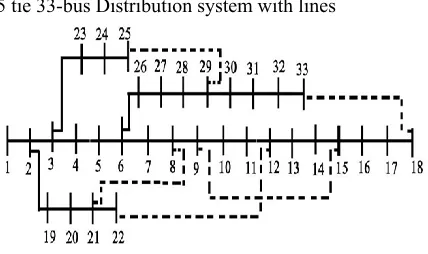
5 tie 33-bus Distribution system with lines
Figure .1 33-bus Distribution systems with 5 tie lines
The algorithm to compute the Firefly algorithm for any size of the system is given below.
1) Run the base case distribution Load Flow and determine the active powerloss.
2) Run the load flow program for the base case where the shunt compensation Qc= 0.0p.u. 3) Run the load flow program with Qc
=k*Qcref;
Where k = 1, 2…., 5 &Qcref = 1.0 p.uQc = Shunt compensation at pthbus in KVAR.
o Compute the „ratio’ of thevoltages
𝑉𝑝𝑘
𝑉𝑝𝑘 −1
=
𝑃𝑡𝑣𝑜𝑙𝑡𝑎𝑔𝑒𝑏𝑢𝑠𝑤𝑖𝑡𝑄𝑐=𝑘𝑄𝑐𝑟𝑒𝑓 𝑃𝑡𝑣𝑜𝑙𝑡𝑎𝑔𝑒𝑏𝑢𝑠𝑤𝑖𝑡𝑄𝑐 = (𝑘 −1)𝑄𝑐𝑟𝑒𝑓 o Calculate:αp = Ratio –1.0
6 Determine the average of the results obtained in step (4)
7 Repeat the process for all buses, except at the Substation bus.
data. After determination of α- coefficients at all the buses of the system, for a given required voltage (Vreq) at a bus „p‟, the value of „k‟ and its Q-
compensation Qc can be determined as 𝑘= (𝑉𝑟𝑒𝑞
𝑉0 -1.0)/𝛼𝑝
𝑄𝑐=𝑘 ∗ 𝑄𝑐𝑟𝑒𝑓
8 Identify the candidate buses for placement of capacitors using α-coefficients.
9 Initialize location of fireflies Iteration =1
10 Run the load flow by placing Qc (i) at candidate buses using fireflies and determine the reduced power loss
11 Generate initial population of fireflies xi ( i=1, 2…, n) 12 Light intensity Ii at xi is determined by f(xi)
13 Define light absorption coefficient γ while (t <MaxGeneration)
for i = 1: n all n fireflies
for j = 1: i all n fireflies
if (Ij> Ii), More firefly i towards j in d-dimension; end if
Attractiveness varies with distance r via exp [-γr] Evaluate new solutions and update light intensity end for j
end for i
Rank the fireflies and find the current best end while
The FA method has been tested on 33-bus system which can be determining the placement of location and sizes in radial distribution systems to improve the voltage profile, compensate the reactive power and reduce the total loss.
The FA properties in this simulation are set as follow: o Number of fireflies: 20
o Maximum iteration: 100 o Alpha (scaling parameter): 0.25
o Minimum value of beta (attractiveness): 0.2 o Gamma (absorption coefficient): 1
IV. CONCLUSION AND FUTURE
SCOPE
The overall goal of this thesis is a Firefly algorithm (FA) has been proposed for direct and quick estimation of required level of shunt capacitive
compensation to improve the voltage profile of the system and reduce the active power loss. Firefly algorithm (FA) is used to determine the optimum locations required for reactive power compensation.The main advantage of this proposed method is that it systematically decides the optimum number of locations and size of capacitors to realize the optimum sizeable reduction in active power loss and significant improvement in voltage profile.Test results on 33 bus systems are presented. The problem is converged in 4 iterations and the method places capacitors at less number of locations with optimum sizes and offers much saving in initial investment and regular maintenance. The purposes of the proposed presented in this paper are to reduce the total loss.Practical implementation of the capacitor placement technique requires further cost-benefit analysis which in turns depends on the costs of capacitor bank and energy saving.The repeated simulation results could be used to develop a Model using any artificial intelligence technique which can accurately predict the location and size of capacitor for any load conditions which gives a great promise for practical implementation of the proposed technique.
REFERENCES