Article
Mapping of the Security Requirements of GDPR and NIS
Najmudin Saqib, Vasileios Germanos , Wen Zeng , Leandros Maglaras *
School of Computer Science and Informatics, De Montfort University, Leicester LE1 9BH, UK * Correspondence: [email protected]
Abstract:Privacy and information insurance have consistently been a priority for the European Union lawmaker. This paper presents whether the NIS prevails in its underlying endeavors to remain the congruity among residents and companies. It distinguishes current difficulties that specific business structures may experience while conforming to the Regulation. The exploration traces certain reasons which could impede the opportune reception of the new lawful ideas inside the system of the organizations. The exploration incorporates what is unique about the NIS; how it overlaps with existing frameworks; and how security requirements in the GDPR influence the NIS Directive. This paper furnishes different point of views of experts with the aim of setting up an entire examination.
Keywords:GDPR, NIS, Cyber Security
1. INTRODUCTION
The 27 member states of the European Union (EU) have their own regulations up to 2016 covering the assortment, compilation and planning on about their citizens’ personal data in relation to the Info-Protection Directive 95/46/EC (DPD). On 27 April 2016, the EU Commission received an additional General Data Protection Regulation (GDPR) that would have a full impact on 25 May 2018, removing all EU member states’ surrounding national data security rules even in the context of the DPD (Commission, 2015). The latest guidance includes numerous basic concepts and aims to easily introduce and recognize relations within the EU. Among the most important news in GDPR was that it was a new guideline to submit another fining framework. This framework states that any corporation that does not meet the new directive could be punished up to 4% of its annual global profit, making this a real challenge. Also, organizations and companies as must be GDPR-compliant quickly as possible (EC 2015) [1].
Apart from the impressive fines, the GDPR contains numerous new and interesting guidelines, regulations and endeavors. The perception of the “one-stop shop” is substantially optimistic, which suggests that the organizations and companies working in the EU should only have a common knowledge insurance regulator rather than one in each EU country. The rule states that a key information protection agency should be selected to hook up where a basic foundation for the practices within the EU is established by the organization or the undertaking (European Commission, 2015) [1].
According to GDPR, both organizations and public authorities, have to appoint their own data protection officer (DPO). The role of DPO is to ensure that the organization handles the personal data of its staff, customers, or any other individuals in compliance with the applicable protection rules. There are several exceptions of the current standard which do not need to be assigned to the DPO (European Commission, 2015).
The new standard within the EU will be information assurance by structure and by default. In view of data reassurance from the leading punctual phases of progress, all items and administrations pointed out or used within the European market must be planned. In addition, in a safe and convenient manner, items and administrations will actually have protective facilities (European Commission, 2015).
Both EU nationals and visitors have the luxury of being ignored by the legitimately-legitimate owner of any details they hold from within the Union. The proprietor of protective information, if no authentic rationale exists
for keeping it, has been privileged to hold their information expelled from any stage or administration (European Commission, 2015).
Individuals have the right to move their own data from one expert company to the next. This is done by smaller organizations, as a result of the fact that the GDPR incorporates different new approaches and deals with the broad spectrum of problems the report can not only imply a start of study. In this paper, the research shall be done pursuant to the specification of questions:
- What was the past law, the principle and the intent behind the reform? What are the past acts?
- What is the GDPR and NIS, and which sections are most checked by local authorities while implementing this new act?
- How does the NIS Directive impact GDPR security requirements?
This paper is organized as follows. Section 2 provides a review of the old Information Security Guideline for EU, and in particular, the substance of Data Protection Directive 95/46/EC4. Section 3 discuss a literature review of GDPR. Section 4 focuses on NIS directives. Section 5 focuses on the interaction between the GDPR and the NIS directive and how NIS directive overlaps with GDPR. Section 6 concludes the paper.
2. Relevant work
This section begins with a clarification of the new broad general data protection regulation (GDPR), and proceeding with the portrayal of cryptography.
2.1. EU-GDPR
The historic background of guidance mandates and information assurance in the EU dated back to the early 70’s after rapid progress on data innovation and an extended debate on security. This follows the expanded handling of individual information on personal computers, when the Hesse province of Germany established the main national data assurance legislation on the plan. The Data Protection Treaty of the Council of Europe came into effect back in 1985 comprising the world’s main constitutionally defined requirements for information security [2].
The Data Protection Directive (DPD) 95/46/EC was discharged in 1995 to coordinate part-sets on how EU staffs are to be secured with regard to individual information preparation and the free development, among EU part-states, of such information [3]. In 2009, the EU Commission promoted a survey of DPD 95/46/EC and identified a number of views which could be strengthened, for example by developing a reasonable EU Internal Market for international organizations, to stick with the various legislation in various EU parts rather than to express them [4].
In January 2012 (European Commission, 2012) the main proposal for the new guideline was released. In different occurrences of the European Union and its part states, the proposal was then discussed and altered [5]. Finally, in April 2016, it became a guideline and came to power on 4 May 2016, when the Council of the European Union and the European Parliament adopted this proposal (European Union, 2016), that it applies for all part States [6].
2.2. Commission Directive 95/45/EC
Because of GDPR, the Commission Directive (CD) 95/45/EC should be revised in order to find out the institutional reasons for cancelling it and adopting the GDPR. In particular, the articles related to the protection of information security and identity insurance policies that are included in CD 95/45/EC of the European Parliament; and of the Council of 24 October 1995, concerning the welfare of citizens in relation to the planning, and the free development of personal information [12]. This was made as an optional act which included the limited terms of only around 3 years with an execution date. The CD received in the mid-1990s to manage ongoing relationship-building in the advanced world. It was the main report at European level to ever deal with insurance enquiries about the protection of personal data in the field of the assortment, preparation, storage and transmission.
It is important to determine the consequences for personal and enterprise information management before attempting to modify the CD’s particular structures, strengths and limitations.The CD was composed when information preparing included techniques that appeared to be inventive during the 1990s - documenting frameworks and PC centralized computers. Maintaining a strategic distance from the dangers identified with such arrangements was generally simple by making commitments for processors and connecting various methods to the specific activities. Its principle design was to blend the current guidelines of the various nations (Member States) to ensure the privilege of enlightening information of the subject and to evacuate the snags with the expectation of complimentary development of individual information on the European market. In any case, consideration must be put on the way that it was not among the destinations of the Commission Directive to make a lawful structure which could address future information preparing and security challenges [13].
The information protection standards established by the 1995 Directive (as a general application) [12] are as follows:
- Reasonable and legal handling of individual information. - Assortment for clear, explicit and accurate purposes
- Adequacy, importance and proportionality for reasons of assortment and handling - Give only what is essential in order to collect or manage your own details.
For the most part, the CD governs the processing and storage of specific records (counting a detailed description of special cases to be handled). The framework of Directive 46/95/EC covers a wide range of transparent and private knowledge organizations, imposes substantive restrictions on information processing by such objects, provides increasing privileges for information topics and requires public notifications and supports for certain activities [14].
Although, regarding the Directive 95/45 in the main section and the distinctive valid setting, it makes it clear that it is not so adequate to handle the ever evolving universe of the collection, movement, correction and reuse of information. However, it certainly indicates the beginning of the feasible road map for defense and knowledge safety. In [15], it is stated that CD 95/45 molds various types of laws, even outside the European Union. Moreover, it will introduce a convincing concrete European pattern of knowledge security.
2.3. ENISA and NIS Directive
ENISA [16] has a common vision of maintaining a high standard of networks and Information System Security (ISS). It is the European Union Agency for network and ISS and is a designated network and information systems professional hub for Member States, the private sector and the people of the EU.
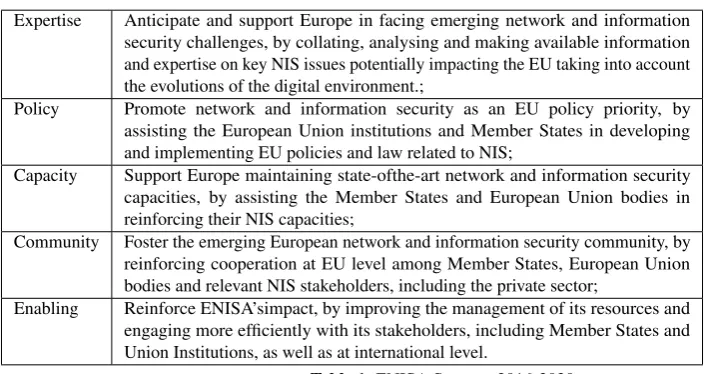
Expertise Anticipate and support Europe in facing emerging network and information security challenges, by collating, analysing and making available information and expertise on key NIS issues potentially impacting the EU taking into account the evolutions of the digital environment.;
Policy Promote network and information security as an EU policy priority, by assisting the European Union institutions and Member States in developing and implementing EU policies and law related to NIS;
Capacity Support Europe maintaining state-ofthe-art network and information security capacities, by assisting the Member States and European Union bodies in reinforcing their NIS capacities;
Community Foster the emerging European network and information security community, by reinforcing cooperation at EU level among Member States, European Union bodies and relevant NIS stakeholders, including the private sector;
Enabling Reinforce ENISA’simpact, by improving the management of its resources and engaging more efficiently with its stakeholders, including Member States and Union Institutions, as well as at international level.
Table 1.ENISA Strategy 2016-2020
The ENISA response mechanism is mainly aimed at preventing and, in situations where these occur, reacting to cyber attacks from a network and in-training networks, and at last handling them effectively and without interruption. Five areas of activity are identified in accordance with its strategy [19] as show in Table1.
3. Network and Information Systems (NIS) Directive
The NIS Directive offers the theoretical framework for necessary measures to be put in place by local stakeholders [20], considering the fact that integration at corporate and legislative level would be jeopardized by its right transposition into national laws. The European Commission has also introduced a Communication on 13.09.2017 to support Member States in the consistent application of the NISD throughout the European Union [20]. The NIS Directive offers essential criteria on establishing operators essential services (OES) and describing Digital Service Providers (DSP) and emerging technology service goods and terminology for maintaining a mutual understanding between Member States and CI stakeholders, for the purposes of developing a cohesive Europe-wide strategy.
3.1. Overview
In order to protect essential services and infrastructure by improving the safety of their networks and knowledge systems, the NIS Directive establishes legal provisions. On 6 July 2016, the European Parliament implemented the NIS Directive. The Directive is to be transposed into national legislation by EU Member States by 9 of May 2018. The UK introduced the Network and Information Systems Legislation 2018 (NIS Regulations) [21], which is applicable from 10 of May 2018. Moreover, in the NIS Directive is incorporated the National Cyber Security Policy 2016-2021 [22], which provides an effective regulatory framework to protect the vital national infrastructure in the UK.
In accordance with the NIS Directive, legal measures are taken to increase the general level of network and safety within the EU by the following [23]:
- Ensure that Member States provide an on-site national network and knowledge systems security framework, comprising the National Cyber-Security strategy, a Computer-Security Incident Response Team (CSIRT) and one Contact Point (SPOC) and the National NIS competent authority (or authorities);
- Member States will also engage in the CSIRT Network for the aim of promoting rapid and productive technical collaboration on common protection events in networks and awareness structures as well as exchanging danger information;
transport, water, telecommunications, and digital infrastructure. Businesses in the areas defined as OESs by Member States will need effective and proportionate security measures to handle their network and information infrastructure threats. Core business suppliers may also be required to notify the relevant authority of accidents. The main DSPs — search engines, cloud computing and online marketplaces — also have to meet the requirements set out in the Directive for health and educational incidents.
The EU referendum took place on 23 June 2016 and the citizens of the UK subsequently decided to leave the EU. The UK remains a full member of the ECU Union until the conclusion of exit negotiations and the rights and obligations of EU membership remain all in effect. In this period, the government continues to agree, introduce and execute EU laws. After the UK has left the EU, the results of the talks on a long-term relationship between the UK and the EU would decide the agreements in regard to EU legislation. It is the intention of the United Kingdom Government that the NIS Directive will still apply in the United Kingdom upon leaving the ECU Union [24].
Between August and September 2017, the UK held a public consultation on its NIS Directive proposals [25]. This consultation covered six key topics:
1. The way essential services are identified;
2. A national implementation management framework; 3. Safety requirements of essential services operators;
4. Incidents reporting requirements for essential services operators; 5. The requirements on digital service providers; and
6. A Penalty regime proposed.
3.2. Oversight and enforcement
The NIS Regulations shall be supervised and implemented by a specified competent authority and shall be held responsible for the application of the NIS national structure in support of its State policy. Although the responsible authorities are governed by the NIS Regulations in their industry, they have an accountability role in enforcing regulations across the United Kingdom, the Department for Digital, Community, Media and Sport (DCMS).The UK Government has decided that, with each competent authority having a detailed understanding of each sector and its related challenges, a multiple competent authority approach is to ensure the most relevant approach for the UK. Therefore, for each industry or area protected by the NIS Regulation, responsible authorities have been appointed.
In respect of all regulatory decisions relating to NIS regulations, the competent authorities shall have the sole authority and responsibility. The national cyber security center (NCSC) will support the competent authorities who shall give the competent authorities technical advice and, as a result, fulfill the SPOC’s and, consequently, the CSIRT duties, other than the health sector during which NHS Digital handles cyber incidents. In the list below, the responsibilities of competent authorities are presented:
- Analysis of the NIS Regulation’s equipment in their area and region;
- Preparation and publishing of guidance to assist OESs or DSP in fulfilling the necessity of the NIS Regulations;
- Establishment of the distinguishing criteria of their sector / region for the OESs;
- Keeping an inventory of all approved OESs, including a sign of the value of each operator - Evaluate compliance with requirements of the Directive for NIS operators;
- Determine the thresholds for reportable incidence in their fields or regions;
- Cooperate with other competent agencies to provide consistent advice and surveillance to OES or DSPs - Receive incident reports;
- Ensure that non-cyber accident protocols are performed on-site and provide guidelines to businesses concerned with non-cyber incidents;
- Evaluate incidents; and
3.3. Monitoring the appliance of the NIS Regulations
The OES or DSPs which meet, or are appointed by the reserve power, the assignment thresholds of this sector are required to comply with the requirements of the NIS regulations [21]. A structured approach to engagement with designated operators would be required for effective monitoring. Competent authorities will consider developing a compliance mechanism to track the implementation of the Regulations. A determination to exchange with the operators in their sector or area shall be made and the character of this mechanism shall be the competent authority concerned.
Such a process must be proactive for competent authorities regulating OES. It indicates that Competent OES authorities will operate in collaboration with industry, provide guidelines, communicate with OES members, and introduce an assessment process, including an audit plan. A proactive monitoring system focused on active control only once an event took place would not serve to satisfy the requirements of the NIS Regulations.The method is confined to ex-post monitoring, i.e. post-incident, for the Office of the Intelligence Commissar (ICO), responsible for regulating DSPs. Therefore, the ICO is encouraged to provide guidance and support for DSPs and to have an effective way of identifying if an event occurred and taking action once it has taken place.
3.4. Identification of Operators of Essential Services and Digital Essential Services
Schedule 2 to the Regulations [21], requirements for determining who contributes to the NIS Regulations have been laid down. The levels for each sector are different: energy, electricity, transportation, safety and digital infrastructure. It is the OES’s duty to identify itself and to alert and communicate with the competent authority, which is responsible. Competent authorities in their industry or area should however be diligent when communicating with prospective OESs.
If the authority determines that the agency is an OES, the NIS Regulations include the power to allow the authority to collect the necessary information in order to assess whether the company satisfies the edge standards and officially designates the institution as an OES. If an agency, which requirements is considered by a competent authority, is not associated with an OES, the authority concerned that, by notification, revoke the designation deemed. Similarly, if an individual does not meet the requirements to be designated as an OES, a qualified body can revoke a designation.
If the OES is not certain whether or not they are bound by the NIS Directive, the appropriate body responsible for providing this confirmation will notify them. If an individual is not beyond the edge of assignment as the OES, then the Competent Authority decides that there may be substantial detrimental consequences of an event involving protection affecting supply by that entity to the critical service, instead the Competent Authority may agree to appoint the entity as an OES according to regulation 7 of the NIS rules [24]. Such marking ability should only be used as an exception to pick OESs. The body must be clearly explained in the reasons for naming an agency, if appropriate, to avoid unnecessary legal challenges, the classification of the company should be accepted beforehand. Responsible Authority may take charge of an inventory of the OES within their industry or area in order to ensure that the UK is able to satisfy the regional reporting requirements and liaise with competent authorities representing an analogous field in specialized administrations. The SPOC is liable for distributing the volume and importance of the annual report to the ecu Commission for other Member States of the OES. Competent Authorities are responsible for handling and updating the inventory of OES in their sector or region on a biennial basis.
Digital Service Providers
coordinate the efforts to reduce overlap by itself and the governed operator and to insure that the operator is not standardized.
A DSP which is a small company or micro company, with less than 50 employees ore10 million a year turnover, is exempt from the requirements of the NIS Regulations. The exemption is meant to reduce the regulatory burden on small businesses for the small and micro-enterprises and only applies to individual companies. A company that is part of a larger group may also be required to include employees headcount / turn / balance sheet data from that group. This often refers in relation to the SME carve-out clause in Article 16(11) of the NIS Directive in Committee Recommendation 2003/361/EC [26]. In a timeline defined by the ICO, DSPs are expected to register with the ICO. This registration is intended to make DSPs easier to identify. DCMS encourages the ICO, as soon as practicable, to place such registration on the spot and to inform potential DSPs and DSPs as appropriate.
3.5. Determination of incidents
Regarding NIS Regulations [22], an incident will be: (i) Any event with an effect on network safety or the IT systems used to provide essential services; (ii) any event where network and knowledge systems are secured, network power and knowledge systems have the power to resist any action affecting the provision of services, genuineness and integrity in a certain degree of confidence, and this has a major impact on the continuity of the critical services they provide.
For the OESs, the competent authority accountable for each sector is liable for the dissemination, for every sector with accident monitoring requirements, of the many impacts to be defined by the NIS. In November 2017, the Competent Authorities received guidance on determining thresholds for incident reporting. Within the scope of the Commission Implementing Regulation 2018/151 of 30 January 2018 [27], the accident notification requirements have been introduced for DPs.
To reach consensus on all requirements of the sectoral Lead Department (or Departments), and subsequently of the NCSC, DCMS urges Competent Authorities to discuss and achieve agreement with it. When deciding the appropriate criteria, the responsible authorities are required to inform the OES and will have to communicate with the industry. Where a field is substantially moved. Cross-border interaction with the Republic of Eire is further facilitated in the case of Northern Ireland. The aim of this agreement is to coordinate the North and South approaches of the border to facilitate the smooth running of NIS systems serving each nation. Therefore, in Northern Ireland, competent authorities should work with other competent authorities within the UK and competent bodies in the Republic of Eire to keep HMG informed and, therefore, SPOC of progress if necessary.
3.6. Enforcement
If a DSP or OES does not agree with the NIS Directive, it is by way of knowledge and administrative correspondence that competent authorities may take various measures to say and execute their judgments. In order to give competent authorities maximum flexibility in the precise process of any enforcement action, a method is often initiated under the NIS Regulations [21]. Competent Organizations should remember in their approach to compliance that simply having an incident is not in itself a breach of the NIS Regulation, which specifies whether or not adequate and proportionate security measures and prosecutions were in place and enforced by the enforcement agencies.
Competent authorities must be as transparent as possible when establishing their enforcement processes or undertaking enforcement action. Transparency is one of the legislative principles of excellent regulation and underlies key provisions of the Code of Regulators and the Strategic Code of Practice of the Scottish Regulators [28]. In order to make OESs and DSPs clear of their approach, it is crucial for the competent authorities to publish their enforcement policies. A step-by-step compliance mechanism in which OES and DSPs are alerted should be enforced by competent authorities.
The competent authorities will take into account the following mandatory factors by considering an enforcement action, including financial penalties, to ensure that this action is acceptable and proportionate:
- Either OES or DSP representation.
- Any measures taken by an OES or a DSP to correct results of failure to comply.
- Whether the OES or DSP has had enough time to implement the regulations and requirements. - Whether the breach is likewise enforceable under a different regulatory framework.
The competent authorities should also notice their responsibilities to comply with the expansion duty, which allows a person carrying on a regulatory position to contribute to the advisability of supporting the economic cycle (the ’development duty’). While carrying out their duties, the value of the practice of regulatory roles while order to promote the economic cycle must be taken into account, in order to ensure that regulatory action is only taken when required and that any intervention is proportionate.
There is a risk that many pieces of legislation may be violated at a time because operators will need to adapt to a wide variety of laws. If an infraction arises that contradicts quite a piece of legislation, the competent authorities will note that and negotiate with others the best solution if practicable but will stay pragmatic, so long as this is reasonable and proportionate, to conduct their own responses to any violation. If the Competent Agency decides that the financial penalty for an OES or the DSP should be discussed with the OES or the DSP the outcome of the investigation.
3.7. Monetary penalties
If necessary, competent authorities shall have the right, in accordance with the wishes of the NIS Regulation, to levy significant financial penalties [21]. Full analysis of penalties is required to establish that the punishment is sufficient and commensurate with the offense for which the penalty is levied, and thus the industries in dispute. In light of the operator’s comments, measures taken to comply with the NIS Regulations, measures taken to address any consequences and other legislation that is breached, the competent authorities shall consider them. The competent authorities will fair and take into consideration factors for each industry or area in a coherent way over the whole of the UK and between sectors. What is a cost-effective and reasonable monetary penalty is different worldwide. A strong, proportionate, transparent and defensible framework for penalties should be implemented by competent Authorities. Standards should be defined and unambiguous during this penalty framework.
3.8. Appeals
The competent authorities are required to provide an impartial and clearly explained route to appeal against regulatory decisions or failure to act in accordance with the Regulators Code, in line with the regulator’s code and, consequently, the Scottish Regulators ’ Strategic Code of Practice [28]. This will be an internal process, but it should not be a matter of individual Regulation Officers who took the decision or action against which the appeal was brought.
The NIS regulations [21] also require competent authorities to determine an independent appeal procedure, if requested, for an appeal against: the appointment of OES that do not meet thresholds; and any monetary sanctions. The aim of this appeal is to complement an established appeals process for the responsible authorities. Responsible authorities will insure that their appeal processes are fair, open and accessible for everyone regulated, be they autonomous or internal.
3.9. Cost recovery
The OES or DSP are often required to pay the reasonable cost of the investigation in order to complete an examination or inspection. The NIS Regulation also includes an impact on the recoupment of reasonable costs from regulators by competent authorities. In performing a relevant function under the NIS Regulations, a competent authority may establish a system to recoup reasonable costs incurred in or on behalf of that authority (see Part 6 of the Regulations) [21]. The Competent Agency shall provide the OES or DSP with a report specifying the work done, the expense and the time period covered by the payment. In 30 days following issuance of the invoice the bill is due by the OES or DSP and can be recovered as a civil debt. If a competent body wishes to recover costs via a hard and fast fee-based regime, a substitute fee regime may need to be determined [21].
impact on the sector (e.g. through consultation with the sector) into account. When additional legislation is necessary to enforce such a policy, the competent authority would comply with its relevant department.
4. The General Data Protection Regulation
The General Data Protection Regulation (ECU) 2016/679 [29] was adopted on 27 April 2016 after years of dialog and preparations on the ECU Parliament and Council with a view to the processing of private data and the free circulation of such data. They began application as of 25 May 2018 and, after the expiry of the two-year transitional period, may revoke Directive 95/46/EC. The GDPR does not need additional laws enforced by Member States in the regulation because they can be controlled and have a direct effect. The GDPR was directed at the reform and harmonization of EU data protection laws. The technological occurrence and the disruptive world demanded major changes in data privacy. For the business, GDPR inevitably means new responsibilities, structural changes and cost of compliance on the one hand, but most significantly, security; the elimination of barriers, and hence the responsibility of data transfers. The EU institutions recognize development through the implementation of the law, incorporate certain facets of the business system and lay the foundation for recent legislation which is compatible with the technologically advanced world.
The reforms in EU data protection law that are most applicable to companies will be covered in this segment. Scientists and clinicians are mainly concerned that the GDPR must conform to the principles mentioned below. Certain amendments are listed or not covered either, as they are governed in the previous Regulation in the same way, or do not make extreme variations in the business process.
4.1. Scope
The relevant rules of the Union extend with favor of GDPR to all or most EU manufacturers / controllers. However, the Regulation seeks to provide data protection for both citizens within and outside the EU. GDPR has an expansionary strategy in accordance with the Directive on “Equipment Usage” by implementing a universal implementation of EU laws and regulations. The latest rules are based on the extraterritorial impact of a law by expanding its implementation scope to non-EU inspectors or processors [14]. By setting up Section 3, GDPR expands the breadth of its operation to non-EU inspectors or processors where the procurement operations are linked to: (i) the provision of products or services for those data subjects within the Union, irrespective of whether payment of the info subject is necessary; or (ii) track their actions as far as the behavior of such data subjects is concerned within the Union.
Many authors give special interpretations to two slightly controversial aspects of this concept in order to explain the terminology used by the EU lawmaker. For instance, this statement: “provides very easy links to a website or email address; the use of language or money commonly used in one or more Member States may also be shown to give an opportunity to purchase goods / services there”. Also, another statement is the following: “comportment tracking” is when users are monitored on the network utilizing formulas using a profiling method to make decisions. The key regulatory moment of EU statutory history, with the two clarifications on processors/controllers outside the EU, guarantees the clarity of one package of regulations (regarding the integrity of data and data protection) under GDPR for non-EU businesses already targeted at EU residents through marketing strategies [29].
In the case that personal information is handled “under the operations” of such an entity that it is listed, regardless of the specific location of processing (EU or not), the GDPR will be applicable; the Regulation applies to companies which have EU “institutions” [30]. The word "government" has been amended by the Court of Justice of the European Union within the 2015 Weltimmo v NAIH case [31]. Many key principles are often drawn from the ruling (which are often used as guidance):
- the legitimate kind of an institution cannot be a determining factor, it may be a local agency, affiliate, office of sales etc.
A meeting of an EU delegate is provided as an external requirement for non-EU controllers and processors subject to EU data protection law. Similarly, to or rather than to the controller or processor shall be the position of the delegate. The new functions of the supervisory authorities are mainly responsible for this regulation. European authorities shall ensure that the GDPR is upheld and that information sharing issues are covered through the right to contact the official in regard to the exploitation of knowledge [29]. In making this specific change, instead of at the place of service of the entity, the legislature transfers the main goal of the law for the relation with the EU citizen.
4.2. Harmonizing data protection rules
One of the reform’s most important objectives was to harmonize the regulation on info-protection for all EU Member States. In this context, consultations have taken place between the organizations about just what shape the law will take. The legislator now selects the form of the regulation, taking account of the previous directive. Second, the compilation of the legal document indicates that existing matters relating to EU data protection legislation harmonization will no longer exist. Furthermore, it is evident that the Commission has followed the idea that regulation is directly applicable by including regulations during a legislative era. While between implementation and the final enforcement of the law, a deadline may be defined, the GDPR will be used explicitly, and no transposition in the countries will be necessary. The EU representative choosing a legal document indicates the plans to establish a data protection and privacy issue for the EU [32].
The new legislation must ensure the security of privacy through Member States in a cohesive way and can enable the free flow of private information between the Member States when it continue to implement the GDPR system [33]. The new legislation must guarantee the protection of privacy in every Member State. Not only at the level of people is this dimension of the transition significant. There is hardly any business that exists on one market in a globalized world and has a global atmosphere that is in accordance with the EU’s values – ‘free flow of commodities, capital, services and people’, as defined in the Treaty on the Functioning of the ECU Level [34]. The EU authorities are aiming to give companies the ability to handle their data in compliance with the relevant rules and principles in any jurisdiction within the framework of the GDPR through the harmonization of regulations. Therefore, both primary and latter roles should place on the data processors / controllers a fair responsibility with respect to the info topics.
4.3. One-stop shop
The so-called ‘one-stop store’ clause is linked to the uniformity of the data protection law. This concept is often used in other fields of legislation to avoid situations where multi-regulators are accountable by an analogous organization in several Member States to govern their similar operation. The standardized decision-making method is given to bring this law into effect. In the light of the GDPR, the EU Member State Data Protection Agency, in the case of a private data controller / processor set up in two or more Member States, where the controller or processor has its primary institution, would be able to supervise its operational operations overall by Member States [35].
4.4. Consent
The criteria for approval are supposed to change the consumer information processing paradigm, because GDPR strengthens the standards under which user information is accessed. GDPR approval is, as in the Directive, a legal basis for data transfers. Though it was included in the previous legislation, the Regulation substantially changes the classification pattern. GDPR makes it harder for firms to obtain a valid consent compared with the Directive. Under the previous rules, controllers were granted conditional and "opt out" approval under special circumstances.The GDPR restricts the principles because companies should obtain the consent of “a statement or transparent positive action” by the subject matter. The consent should be: safe, precise, notified and transparent, in accordance with the provisions of the GDPR. The four components will be discussed in order to clarify the significance of the new definition [39].
4.5. Controllers, joint controllers, processors
The GDPR follows the existing practice by transferring most of the data protection obligations and responsibilities to application controllers. By accordance with the Directive, the GDPR states clearly that joint controllers will exercise their rights against each of the controllers by their shared responsibility for enforcement.
The term “processor” is analogous to the concept of a human, lawful, state, public, entity or other body processing data on behalf of the knowledge controller. However, the GDPR introduces up another new aspect in their responsibility in data infringement reporting [40]. After this processors are required to take note in writing about the service practices of each manager and assign an information compliance officer if necessary. The GDPR is liable for their data infringement reporting responsibilities [41].
4.6. Privacy by design/by default
Two specific principles are acknowledged in the Regulation: ‘Project secrecy’ and ‘Minimum confidentiality’. The EU level privacy information security by design / default was not included in the Directive through comparatively new approaches; nevertheless, certain elements could be described in the directive. In a business context, the GDPR notes, companies become the target of a duty with which data protection of consumers should also be taken into account throughout the whole information collection phase at the very first concept stages of a project. To grasp and evaluate the two definitions even easier, they will be clarified separately [29]:
- Privacy intentionally-through its means, in the initial design phases and throughout the whole process of new products, processes and services involving personal data, organizations’ implementation of acceptable technical and organizational measures considering the privacy law
- Data protection by design - indicates that the default collection should be the most privacy sensitive if one or more of the program or programs require choosing the privacy topic at which point their data might be exchanged with other users.
The senator understood that secrecy can not only be assured by statute. Through incorporating the two new concepts (through default / by design), the EU authorities have accepted the fundamental importance of privacy as an aspect of information preparation and distribution and operating framework for every organization and company.
4.7. Notification of breaches
The law not only requires the organization to share knowledge that an infringement on data concerning privacy was perpetrated by defining the reporting standards under GDPR. In fact, what the Regulation implies is that companies should include data categories, records affected and approximately the number of data subjects affected and therefore details of what hackers or employees are to do [42].
However, privacy infringements are not unique to law internationally, they are enforced in the US, in Australia; in certain Member States, in the UK and Italy; but the GDPR scale backed and assured by the large fines, in particular, expands and enhances the scope of the knowledge violation notice. This criterion provides the principal difficulty in determining the severity of the company’s data leak. The knowledge of a data leak reported to the organization within the first weeks following a serious violation shall be seen in the most common cases. Although the organization recognizes that the tapes or other type of assault have been broken, the time-limit of 72 hours may be inadequate for the organization to accurately predict the effects for individuals. In this case, it will be extremely important for companies before the GDPR begins to develop a system to determine whether a breach is of considerable risk and must be alerted. In this sense it is very essential. For company to grow into the need and related timetable, it will be difficult.
4.8. Demonstrating compliance with the GDPR
The new legislation on data security also includes the following aspects of the GDPR. We are categorized into a separate section because all of them allow organizations to show conformity with the regulations, proposals, and other aspects of GDPR previously discussed.
Codes of conduct
This Directive incorporates the idea of codes of conduct as to how to demonstrate compliance with the info-data protection law. The central aim of the codes of ethics is similar to GDPR - these standards function in order to enhance total conformity with the Regulation and are implemented in organizations. There is however some new aspects which should be listed as they affect companies. For the DPA, more agreements for the publishing of codes of conduct have first been identified. The law calls for the submission to the professional DPA of draft codes of conduct and the adoption or modification, if applicable, of them after release. The DPAs also have the duty to nominate an independent body to track the code’s compliance through the application of the codes. Furthermore, non-EU controllers and processors may use compliance with authorized codes for cross-border data transfers. This regulation creates the opportunity for international business growth as it simplifies cooperation for businesses to extend their market or cooperate with other non-EU partners.
Certification
Certification may be the most contentious and debated data protection reform proposed by the GDPR [29]. GDPR acknowledges the credential as a legal document officially in relation to the Directive. It is one of the methods included within the Law for self-regulation. Certification would act as a strong indicator for customers that other companies have faith where data security is concerned, and the company has taken reasonable steps to insure the data collected is protected. The EU lawmaker supports the usage of third-party systems to show conformity with the data protection regulation as the mechanism is voluntary [43].
An authorized testing organization shall conduct the certification process. This entity will advise the supervisory authority of the judgment with appropriate justification only in the case of both the awarding and withdrawing of the credential from the company.
The certification process is often perceived to be both a liability and a business opportunity [45]. Price, more reporting and logic are certainly related to this. Therefore, as companies continue to develop and cross-border data transfer is a day-to-day issue, this approach can promote international relations with countries which have already developed qualification (such as the USA) which ultimately will result in less expense. The certified certification body will, on the other side, offer additional business incentives for third parties.
Data Protection Officer
In compliance with the GDPR, the hiring of an identity management officer ("DPO") is mandatory for certain private and public organizations [29]. The task of this position will be to control the production activities of the businesses. Specific criteria are defined according to which DPO should be named by organizations:
- The server may be a public authority or - an excessive collection jurisdiction with specific categories of information referred to in Article 9 and private data involving offenders and offenses referred in Article 10 can require regular and institutional supervision of knowledge subjects.
- It is important to note that a previous draft Regulation includes a specific criterion – for businesses with around 250 workers, it was mandatory to name DPO. It was most probable that the EU lawmaker found the test to be focused not on objective tests but on qualitative assessment.
The role of the DPOs is not well-defined in industry based on the terms of the law. In that direction the “DPO guidance” on the implementation of the regulations of the GDPR concerning the need for controllers and suppliers to nominate a DPO are issued along December 2016 by the working group of Article 29 [29]. The title, place and ultimately the duties of the DPO, taking into account its function within the corporate structure, shall be covered in this text.
4.9. Data Protection Impact Assessment
The GDPR allows businesses to conduct an impact assessment (DPIA) for the intent of estimating the potential risks that occur in any new production activity. Although the organization’s basic requirements under the old Directive provide a valid basis for possible high-risk operations, several EU companies are currently needed under the Regulation.
The new technologies are mainly responsible for the implementation of this regulation into the GDPR. Innovation and technology ‘conquer’ consumers and unfortunately people do not always know completely how well their results are handled. The explanations for the new legislation on privacy are complicated. The controllers prevent data errors (subsequent to negligence) and, respectively to heavy penalties, by evaluating the potential risks involved with the transmission operation before actually applying it.
Two similar procedures must be followed for the purposes of the current business impact research. The risk assessment organizations are to decide if there is a possible high danger – must not be mistaken with the overall risk control mechanism [46]. However, the distinction in compliance with Article 35 of the GDPR, the DPIA is dealing with risk management as a whole, including organizations and practices [29]. As for risk management as a whole; the distinction indicates that although a certain danger scenario under the latter may be justified, the risk in the processing of the personal data and the interaction with the personal space cannot be justified.
4.10. New rights for the individuals
All the above laws are intended to guarantee, firstly, individuals’ freedom and, secondly, to promote and make businesses easier to access. With this in mind, the GDPR review would deal with the problems with new rights given to people in the context of the market difficulties. As the work also indicates, such improvements mostly increase the intensity of the freedoms or provide EU citizens with totally new privileges. The details involved are to engage in the data collection and not make them oblivious to their own results. Furthermore, functional rights are granted to people to say that differently so that their own identity is backed by regulation.
The Rights to be forgotten
person may ask for “the right to be lost” if the law does not apply, if the subject may withdraw its acceptance, etc. The law calls for greater flexibility for the client when they address a wider range of erasure demands. In fact, it often constitutes a additional duty to take appropriate and prompt action to inform third parties that any references have been sought by the person.
In [47], it is shown the reason for the organizations implementing this particular procedure in GDPR. The argument was based on the “freedom to forget” concept because the question of processors and controllers’ responsibility for personal data in the search engine was revealed. The Court of Justice has accepted this opinion by creating a general principle, revised and explained in accordance with the developments in the digital world and included in the GDPR. Another key point which academics sometimes overlook but which is articulated as a concern by practitioners is the reality that the company structure requires a process that is often used to execute data ‘erasure’. In fact, companies handling large-scale information should have tools that define the importance of expertise in the context of its use; to be preserved or lost.
“Pseudonymization”
The Regulation introduces a new EU data protection law principle which does not reveal data and does not fully identify data when processing data. “Pseudonomyization” allows companies to distribute such details so that they often interact with both sets of expertise independently without additional information [29]. This technique protects the person’s identity because the details cannot be related to the individual. The utility of the approach is preserved for businesses as it permits the use of data without revealing the identity of the user and reduces risk of breaches of information.
Data portability
The right to data portability is the important right that the GDPR gives to data subjects [29]. The purpose is to give the user an opportunity to collect, reuse and move their personal data from one data manager to another; from one IT setting to another [48]. The key phases in the "Digital Single Market" are often seen together [49]. Organizations should provide the information in a “machine-readable” and accompanying format, and the data subject will send the details to a supervisor or, perhaps under certain situations, to a rival. Since this law offers the controller a reciprocal duty, it is not limitless for the client. The GDPR notes that the organization has no requirement to implement such authentication systems in order to be technologically compliant with the transition of the knowledge.
5. Interaction Between the GDPR and the NIS Directive
The two pieces of legislation are significantly overlapping, often applicable to the same incidents. The EU Network and Information Systems (NIS) Directive [20] will, thanks to the introduction in the UK by 9 May 2018, be enabled by organizations to provide the most essential services and report incidents affecting the technology, data and networks (systems) of the UK. In order to ensure that UK operators are ready to influence the growing number of cyber-threats in essential industries, the NIS Directive needs to take steps to combat threats to IT systems such as energy failures, hardware and environmental dangers as well as cyber-infractions as Wannacry and NotPetya attacks of last year highlighted the chaos. The “Digital Service Providers” (DSP), where the “less strict” regime is definitely introduced to cloud service providers, online marketplaces and search engines, has another aspect to the NIS Directive.
e10 million are automatically excluded from the scope of the government’s decision. Whether these criteria are cumulative, or alternatives remains unclear, unsuccessful.
5.1. Three types of DSP
The Government acknowledged the problem with identifying a DSP when reacting to a general public survey on 29 January 2018 but clarified that three kinds of DSPs will remain in place to enable the Competent Authority and the DSP itself to understand whether DSPs are within the framework or not.
1. Online Marketplaces: identified as a website that intermediaries the distribution of products and services between buyers and sellers. Classified ads websites or shops online are not included.
2. Online search engines: enable users to access the general public on the global web – this does not require site engines operated by other website engines.
3. Cloud Computing Services includes any DSP that allows access to a distributed and dynamic set of physical and virtual tools that exchange, including the delivery of public cloud services of a corresponding character: Infrastructure as a Service (IaaS). According to the consultation response, online gaming, entertainment or VOIP services will probably have been excluded, but Software as a Service (SaaS) providers “do a decisive part of the UK economy and they are right to take responsibility for it”.
Could Service Providers (CSPs) posed the most concerns with the definition of what kind of entities under the Directive should be classed as DSP. A number of topics included a need to include integration, content providers, data centers and managed services in broader areas, such as the extension of Cloud and SaaS definitions, while others felt that the definitions of all DSPs were too narrow to fall within the directive, as many businesses believe web and digital services. This raise concerns that the guidelines are not transparent as to deceptive use “online”, and asks whether new kinds of “Cloud services” will occur in the future, given that new technologies are already evolving which do not fall in well with IaaS, SaaS and Platform as a Service (PaaS) definitions. CSPs are worried that these requirements are not enough. The additional costs which could be included in programs are illustrated by individuals who could come under the concept of DSP. In response to the consultation, the government, however, kept its definition and pointed out that the government has always tried to clearly define who was in scope and who was not and restrict their scope to those companies that are best able to lose services in a single Kingdom economy, which must comply with the Directive.
The NIS inventory contains 14 security principles to ensure compliance with DSPs [50]. In fact, the DSPs will take into account the National Cyber Security Center’s 14 (different) security guidelines introduced [51]. The compliance regulation (Regulation), issued shortly after the government’s reaction to the consultation, further defines the conditions to take into account when taking steps to introduce a safety level. More broadly, the Implementing Regulation establishes the parameters to determine whether an event has a considerable impact and whether an event is considered significant. Incidents which have a ‘significant impact’ to be reported to the ICO within an equal 72-hour span, as needed by the GDPR [29].
The effect of an event is called “substantial” in which, according to the Law (Article 4) [52]:
- For a total of 5 million usage hours (i.e., the number of affected users in the EU over an hour), the service provided by the DSP became inaccessible;
- The accident has resulted in a loss of credibility, reliability or secrecy of data or the services it provides or is obtained through a DSP network or device involving 100 000 users across the EU;
- The accident raised a public safety danger, triggered unrest, or contributed to material damage of more thane1 million to at least one individual within the EU.
- Personal services companies, especially with big business consumers, will need to analyze concern, whether customers object to lack of service or damage caused by the accident, whether disclosing an occurrence alluded to in item 4 above could or might not pre-empt DSP’s role.
NIS Implementing Regulations, what could be deemed to be the technological and operational controls. What does appear possible is that a DSP reporting private infringement under DPD could unintentionally lead to the emphasis on the DSP equivalent which does not comply with the safety elements begun in Article 2 of the Implementing Regulation [29]. The violation is not considered as an event of a “substantial impact” under NIS. NIS failure could end up with penalties of up to 17 million pounds. The Government of the United Kingdom has announced, in relation to the amount of penalties possible under the overall Data Protection Regulation (GDPR), that it would place a combined ceiling on 17 million pounds for contraventions on the 2 bands – and so a penalty band will include all contraventions. The government of the United Kingdom acknowledged and may prohibit voluntary coverage as a risk to “multiple threat”, while reiterating that it will have to act reasonably, adequately and proportionately. The Government of the United Kingdom. Nonetheless, we have to take protection seriously and the government also hopes that the high amount of penalties would promote behavior changes.
5.2. The NIS Directive: for whom and what does it mean?
In May 2018, the EU GDPR in addition to its enforcement, a British Data Protection Act amendment created the standards of GDPR as UK regulations. In turn, by promoting the implementation of the universal and European standards, an EU Network and information system (NIS) Directive was also introduced in UK Law in May 2018, helping in the EU to improve the protection of network and software systems. To organizations offering essential services or those supplying those who provide these services, it is of special importance. Nonetheless, there is nothing to think about conformity with the NIS Directive. Organizations will gain conformity through the introduction of best practices in International Standard on Information Security and the implementation of comprehensive Disaster Recovery and Business Continuity Management Systems. The NIS Directive discusses the challenge of loss of service in IT networks and information structures where GDPR is dealing with the protection of private data. In particular, the protection of essential services involves fines up to 17 million pounds or 4 per cent of worldwide turnover, and individuals who fail to implement effective cyber security measures will be penalized. The measures laid down in the NIS Directive are part of the five-year National Cyber Security Strategy of the United Kingdom Government. These are intended to ensure secure and defensive from cyber-attacks from the critical networks and resources of the UK. In addition to showing a responsive cyber security, operators in power, transport, water, oil, safety and digital infrastructure have to prove that they need comprehensive incident response plans on the spot.
Nevertheless, the NIS Regulation is not restricted to these organizations. It is vital that UK technology companies decide whether or not the NIS Directive applies, as it relates not only to essential services but to important service provider suppliers. This encompasses organizational mess and includes online markets, online search engines and cloud services. The Departments of Education, Entertainment, Media and Sport have made clear that their proposed penalties up to 17 million pounds as a final resort. While this amount is highly significant, operators should prove that sufficient risk analyses are required, effective precautions have been introduced, solid incident response measures have been established and the system is widely employed, the sanctions will not be enforced. Therefore, the key is to show that the NIS Directive is at the heart of the cyber defense strategy of an organization. The following steps must be addressed: recruitment of staff through penetration testing, control of accidents, stability readiness and continuing resilience. All who are already in the path of GDPR implementation will be required to comply with the requirements of the NIS Directive, but it is important to understand what further steps must be taken. Thanks to the management of this process, professional support is crucial and cost-effective. SRM has helped many organizations become ready for ISO27001 certification [53] and can support the continuity of business and disaster recovery. SRM consulting teams can manage the method without dalliance or budget with experience and expertise across a wide range of organizations, and a sound understanding of what the NIS Directive is all about.
5.3. NIS Directive Impact and GDPR Security Requirements
Firstly, there are different rules that activate expertise under the Directive and subsequently the GDPR. The GDPR shall apply, with few exceptions, to a person or entity that processes or monitors the personal data of the European Union residents related to the provision of products or services. The NIS Directive is much closer for service providers and digital service providers employing 50 or more. Therefore, only in comparison to these operators, the similarity exists. Secondly, the Directive is fully focused on network security, where the objective of the GDPR is to preserve personal data. Therefore, the GDPR includes regulators, while the Directive allows operators to safeguard their networks properly, to ensure the delivery of the services. Although these priorities frequently intersect, the safeguards will also vary in some cases. Encryption, for example, will help protect personal data under the GDPR by shielding the network from misuse in compliance with terms of the Directive.
It is the same for the notice of a breach. The GDPR includes safeguards, without unreasonable pause or, if possible, not less than 72 hours after they have become informed of a violation, to alert the relevant authority. It is doubtful that the breach of private data will contribute to a danger of people’s rights and liberty. Thus, it is only when personal data have been at stake where GDPR needs disclosure of an infringement. On the contrary, the Directive requires notification for violations if the provision of the service is seriously disrupted. There are no provisions for jeopardizing specific information since it is not protected by the GDPR. The Directive also penalizes operators who do not carry out adequate security procedures or who do not alert the competent authorities of a case.
Finally, operators shall only notify the competent authorities in accordance with the Directive. But the GDPR includes controls to alert subjects of details, i.e. Persons — where the abuse of their rights and freedoms faces a “high risk”. In addition to regulatory measures, the GDPR gives certain people a specific right of protest. Only administrative fines are provided for in the Directive.
The order stipulates that it will adhere to the GDPR ‘without discrimination’, but what occurs by contradicting commitments remains unclear. In cases where the operator has violated the provisions of the two laws, the directive is likely to result in additional liability. Could GDPR, therefore, act as a compliance aid under the directive? There will undoubtedly be many issues with the introduction of these new laws over the next few years.
5.4. GDPR and NISD at a glance
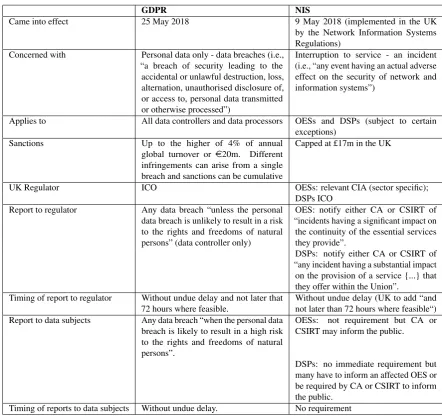
Debbie Heywood, in [52], dentifies the most GDPR-NISD in relation to infringement reporting requirements and differences. On 9 May 2018, Network Information Systems Regulations 2018 implemented the NISD (Network Information Systems Directive) in UK legislation. Although the GDPR is broadly available, NISD only affects certain companies. The GDPR focuses on cyber security, while the NISD is more concerned with the network and system security and service interruption. Organizations collected by NISD will also have to adhere to GDPR for all personal data. In Table2are identified the main differences between the two legislative sets.
6. Conclusion
The European Union lawmaker had always made data and identity protection a required policy. The legislation was slowly drawn up to satisfy the general Data Protection Regulation. The GDPR also encourages legal business approaches to allow it to create a safe market to insert the basic rights protection. This study proposed research on whether the NIS Directive retains the coherence of citizens and companies in its underlying efforts. However, it distinguishes between the present problems faced in compliance with the legislation by specific business structures. There are factors behind this discovery that may hinder the timely acceptance of new legal ideas within the organizations’ structure. The report examines what is new about NIS Directive, how the existing framework overlaps with it, and how the GDPR security needs affect the NIS Directive, and the plan presents analysts and specialists with a different perspective in order to complete a review.
Funding:This research received no external funding.
GDPR NIS
Came into effect 25 May 2018 9 May 2018 (implemented in the UK
by the Network Information Systems Regulations)
Concerned with Personal data only - data breaches (i.e., “a breach of security leading to the accidental or unlawful destruction, loss, alternation, unauthorised disclosure of, or access to, personal data transmitted or otherwise processed”)
Interruption to service - an incident (i.e., “any event having an actual adverse effect on the security of network and information systems”)
Applies to All data controllers and data processors OESs and DSPs (subject to certain exceptions)
Sanctions Up to the higher of 4% of annual
global turnover or e20m. Different infringements can arise from a single breach and sanctions can be cumulative
Capped at £17m in the UK
UK Regulator ICO OESs: relevant CIA (sector specific);
DSPs ICO Report to regulator Any data breach “unless the personal
data breach is unlikely to result in a risk to the rights and freedoms of natural persons” (data controller only)
OES: notify either CA or CSIRT of “incidents having a significant impact on the continuity of the essential services they provide”.
DSPs: notify either CA or CSIRT of “any incident having a substantial impact on the provision of a service {...} that they offer within the Union”.
Timing of report to regulator Without undue delay and not later that 72 hours where feasible.
Without undue delay (UK to add “and not later than 72 hours where feasible“) Report to data subjects Any data breach “when the personal data
breach is likely to result in a high risk to the rights and freedoms of natural persons”.
OESs: not requirement but CA or CSIRT may inform the public.
DSPs: no immediate requirement but many have to inform an affected OES or be required by CA or CSIRT to inform the public.
Timing of reports to data subjects Without undue delay. No requirement Table 2.Differences between GDPR and NIS Directive
References
1. Blackmer, W.S. GDPR: Getting Ready for the New EU General Data Protection Regulation. Information Law Group. InfoLawGroup LLP. Archived from the original on 14 May 2018. Retrieved 22 June 20162016.
2. P. De Hert, V.P., The Data Protection Regime Applying to the Inter-Agency Cooperation and Future Architecture of the EU Criminal Justice and Law Enforcement Area; 2014. doi:10.2139/ssrn.2542122.
3. European Union, Directive 95/46/EC of the European Parliament and of the Council on the Protection of Individuals with Regard to the Processing of Personal Data and on the Free Movement of Such Data.https://www.refworld.org/ docid/3ddcc1c74.html., 1995.
4. Review of the European Data Protection Directive. https://www.rand.org/pubs/technical_reports/TR710.html., 2009. 5. Regulation of the European Parliament and of the Council on the protection of individuals with regard to the processing of personal data and on the free movement of such data (General Data Protection Regulation). https://www.europarl.europa.eu/registre/docs_autres_institutions/commission_europeenne/com/2012/ 0011/COM_COM(2012)0011_EN.pdf., 2012.
6. Data protection in the EU.https://ec.europa.eu/info/law/law-topic/data-protection/data-protection-eu_en., 2016. 7. Article 17: Right to Erasure (‘right to be forgotten’).https://gdpr-info.eu/art-17-gdpr/., 2016.
9. Article 20: GDPR Right to Data Portability. https://gdpr-info.eu/art-20-gdpr/., 2016.
10. Article 34: GDPR Communication of a Personal Data Breach to the Data Subject. https://gdpr-info.eu/art-34-gdpr/., 2016.
11. Article 25: EU GDPR “Data protection by design and by default”. https://www.privacy-regulation.eu/en/article-25-data-protection-by-design-and-by-default-GDPR.htm., 2016.
12. Commission Directive 95/45/EC.https://eur-lex.europa.eu/legal-content/en/ALL/?uri=CELEX:31995L0045., 1995. 13. de Hert, P.; Papakonstantinou, V. The Council of Europe Data Protection Convention reform: Analysis of the new
text and critical comment on its global ambition. Computer Law & Security Review2014,30, 633 – 642.
14. Cedric Burton, Laura De Boel, C.K.A.P.S.C.; Hoffman, S.G. The Final European Union General Data Protection Regulation. https://www.wsgr.com/images/content/1/5/v2/15414/BloombergBNA-0116.pdf, 2016.
15. Schwartz, P.M. The EU-US privacy collision: a turn to institutions and procedures. Harv. L. Rev.2012,126, 1966. 16. Enisa: European Union Agency for Cybersecurity.https://www.enisa.europa.eu/., 2004.
17. Greenleaf, G. Renewing Convention 108: The CoE’s’ GDPR Lite’Initiatives. 142 Privacy Laws & Business International Report, SSRN.2016,17-3, 14–17.
18. Regulation (EU) No 526/2013 of the European Parliament and of the Council of 21 May 2013 concerning the European Union Agency for Network and Information Security (ENISA) and repealing Regulation (EC) No 460/2004 Text with EEA relevance.https://eur-lex.europa.eu/legal-content/EN/ALL/?uri=celex:32013R0526., 2013. 19. Enisa Strategy 2016-2020. https://www.enisa.europa.eu/publications/corporate/enisa-strategy., 2020.
20. Making the most of NIS – towards the effective implementation of Directive (EU) 2016/1148 concerning measures for a high common level of security of network and information systems across the Union COM/2017/047.https: //eur-lex.europa.eu/legal-content/EN/TXT/?uri=CELEX%3A52017DC0476., 2017.
21. The Network and Information Systems Regulations 2018. http://www.legislation.gov.uk/uksi/2018/506/made., 2018. 22. National Cyber Security Strategy 2016-2021.https://www.enisa.europa.eu/topics/national-cyber-security-strategies/
ncss-map/national_cyber_security_strategy_2016.pdf., 2016.
23. NIS Guidance Collection. https://www.ncsc.gov.uk/staticjson/ncsc-content/files/NIS%20Guidance%20Collection% 201.0.pdf., 2018.
24. Review of the Directive on Security of Network and Information Systems. https://www.europarl.europa.eu/legislative-train/theme-a-europe-fit-for-the-digital-age/file-review-of-the-nis-directive., 2020.
25. Consultation on the Security of Network and Information Systems Directive. https://www.gemserv.com/consultation-security-network-information-systems-nis-directive/., 2017.
26. Committee Recommendation 2003/361/EC.https://eur-lex.europa.eu/LexUriServ/LexUriServ.do?uri=OJ:L:2003: 124:0036:0041:EN:PDF., 2003.
27. Commission Implementing Regulation (EU) 2018/151.https://eur-lex.europa.eu/legal-content/EN/TXT/?toc=OJ% 3AL%3A2018%3A026%3ATOC&uri=uriserv%3AOJ.L_.2018.026.01.0048.01.ENG., 2018.
28. Scottish regulators’ strategic code of practice. https://www.gov.scot/publications/scottish-regulators-strategic-code-of-practice/., 2015.
29. The General Data Protection Regulation.https://gdpr-info.eu/., 2016.
30. Power, L. Weltimmo - The lesser-known decision of the Court of Justice of the European Union. https://www.fieldfisher.com/en/services/privacy-security-and-information/privacy-security-and-information-law-blog/weltimmo-the-lesser-known-decision-of-the-court-of-justice-of-the-european-union., 2015. 31. C-230/14 - Weltimmo. http://curia.europa.eu/juris/liste.jsf?num=C-230/14., 2015.
32. Hert, P.D.; Papakonstantinou, V. The new general data protection regulation : Still a sound system for the protection of individuals. Computer Law & Security Review2016,32, 179–194.
33. Irion, K.; Luchetta, G. Online personal data processing and EU data protection reform. CEPS Task Force Report of the CEPS Digital Forum, 2013.
34. Consolidated Version of the Treaty on the Functioning of the European Union.https://eur-lex.europa.eu/legal-content/ EN/TXT/PDF/?uri=CELEX:12012E/TXT&from=EN., 2012.
35. Voss, W.G. Looking at European Union Data Protection Law Reform Through a Different Prism: The Proposed EU General Data Protection Regulation Two Years Later.Journal of Internet Law2009,17.
36. Is GDPR Good or Bad News for Business? https://www.welivesecurity.com/2017/02/09/gdpr-good-bad-news-business/., 2017.