Article
Patient and Provider Dilemmas of type 2 Diabetes Self-Management: a Qualitative Study in
Socioeconomically Disadvantaged Communities in Stockholm
Juliet Aweko 1*, Jeroen De Man 2, Pilvikki Absetz 3, Claes-Göran Östenson 4, Stefan Swartling
Peterson 5, Helle Mölsted Alvesson 1, and Meena Daivadanam 1, 6
1. Department of Public Health Sciences, Karolinska Institutet, Stockholm, Sweden;e-mail: Juliet.aweko@ki,se, [email protected]
2. Department of Public Health, Institute of Tropical Medicine, Antwerp, Belgium; e-mail: [email protected] 3. Institute of Public Health and Clinical Nutrition, University of Eastern Finland, Joensuu, Finlande-mail: [email protected]
4. Department of Molecular Medicine and Surgery, Karolinska University Hospital, Stockholm, Sweden; e-mail: [email protected]
5. Department of Women's and Children's Health, International Maternal and Child Health, Uppsala University, Uppsala, Sweden; e-mail: [email protected]
6. Department of Food, Nutrition and Dietetics, Uppsala University, Uppsala; e-mail: [email protected]
* Corresponding author: Juliet Aweko, Department of Public Health sciences, Karolinska Institutet,
Widerströmska Huset, Tomtebödavägen 18A, SE-171 76 Stockholm, Sweden; e-mail: [email protected]; Tel.: +46-723-95-0205
Abstract:
Keywords: Self-management, type 2 diabetes, immigrants, health systems, chronic diseases, qualitative study, lifestyle change, thematic analysis, socioeconomically disadvantaged, Stockholm, Sweden
1. Introduction
Self-management is the core strategy for managing Type 2 diabetes (T2D) and is aimed at glycemic control and preventing diabetes-associated complications [1, 2]. Strategies recommended for successful self-management aim at patient empowerment and these include; diabetes self-management education [3-6] and support from health professionals, family and peers [7-9]. These strategies are suggested to be effective in promoting peoples’ ability to make decisions regarding management of their illness. Although such strategies exist, self-management remains a challenge from both the patient and provider perspective. Self-management is to a large degree the responsibility of the patient, who is expected to monitor and manage several aspects of the disease including diet, physical activity, blood glucose, regular check-ups with health-care professionals [10] and adherence to treatment on a daily basis [3, 11-13]. People with T2D are also expected to stay motivated [14, 15], and develop skills such as decision-making, problem-solving, and translating knowledge into practical routines that enhance glycemic control [16]. This often involves changing behavior which is difficult [17]. The main challenges that influence people’s decisions to self-manage are related to changing diet and physical activity behavior [13, 15, 18] and limited understanding of individuals’ perceptions, attitudes and beliefs about T2D and its management [19, 20]. Mosnier et al, in their study on patients’ attitudes and perceptions of diabetes, found that people with T2D who perceived their disease as not serious were often less likely to engage in self-management than those who took their condition seriously [21]. Other factors suggested to hinder patients’ engagement in self-management include: limited support from health care professionals in terms of knowledge and guidance on making specific self-management plans, lack of understanding of treatment regimens and frustration associated with lack of glycemic control and continued disease progression despite adherence to recommendations [22]. These challenges are more pronounced among vulnerable populations including migrants who face additional problems related to cultural and linguistic barriers during clinical encounters [23-25]. Healthcare providers on the other hand are expected to ensure that patients adhere to the lifestyle advice recommended. This includes providing care that is tailored to the needs of the patient.
of diabetes, little effort has been directed towards understanding how people with diabetes perceive and experience self-management. Available studies have mainly focused on understanding patients’ attitudes, beliefs and perceptions regarding diabetes diagnosis, coping strategies [1, 20, 36] [25, 37] and social support [9] among people from specific ethnic groups, mostly from African and Middle Eastern backgrounds. These studies highlight linguistic and cultural barriers in interaction between patients and health professionals, [20, 25] and recommend culturally sensitive approaches and support for self-management. Studies comparing provider and patients views and experiences of self-management in primary healthcare settings are particularly scarce in socio-economically disadvantaged communities [38]. Available studies are mostly quantitative [39-41] and only focus on perceptions of T2D in the general population. Only a few have specifically studied perceptions of diabetes care among socioeconomically disadvantaged populations
[40, 41]
. These suggest differences in patient and provider views of diabetes, which have documented consequences for diabetes self-management [40, 41] that may be further exacerbated in vulnerable populations. This study sought to understand how self-management is perceived among persons with T2D born outside Europe and healthcare providers in socioeconomically disadvantaged communities in Stockholm.2. Materials and Methods
Data for this study was collected from July 2015 to October 2016, as part of the formative studies of a four-year collaborative research project (SMART2D) funded by EU Horizon 2020 [42].
Setting
The study was conducted in five socioeconomically disadvantaged communities together with their public primary healthcare centers located in three districts with a high proportion of immigrants ( >/= 36%) in Stockholm County [43]. The population in the study setting is diverse, comprising a mix of nationalities from more than 100 countries, the majority originating from the Middle East (mostly Syria and Iraq) and Africa (mainly Somalia and Eritrea) [31], some newly arrived and others having lived in the areas for decades . Education levels vary among the residents in these communities, but income levels are low, unemployment levels are high and housing is generally poor compared to other parts of Stockholm County [26, 30]. The means of the Care Need Index (CNI) – a measure of social deprivation, for deciles is also higher in these communities than in the affluent neighborhoods in the County [44]
.
Diabetes care is delivered in primary healthcare centers by teams of health professionals, mainly doctors and nurses, with referral to secondary and tertiary care, i.e. dieticians, podiatrists, ophthalmologists and endocrinologists where needed [45, 46]. National guidelines for diabetes prevention and care exist and optimal diabetes care includes regular eye examinations, foot care, monitoring of glycemic control, blood pressure and cholesterol checks, all of which are essential in minimizing and preventing diabetes-related complications [47]. Registered patients with T2D receive subsidized care from a healthcare center of their choice with two annual follow-up visits [46] as in other parts of the county. One follow-up visit is with a doctor for structured individual tests including HbA1c, cholesterol and blood pressure and the other is with a diabetes nurse for lifestyle education [46]. Swedish national guidelines for diabetes prevention and care emphasize that health care should reach the socioeconomically disadvantaged populations, and that self-care programs should be culturally adapted to cater for the different cultural needs of the targeted population[47].This study applied a qualitative design with individual and group interviews to explore patient and provider perceptions and experiences of T2D self-management. Three types of participants were included: Patients; healthcare providers and healthcare center managers. The selection of the patients study sample aimed to include participants living within the same neighborhoods with different nationalities, duration of diabetes, length of stay in Sweden, employment status, age and educational background, as a means of addressing diversity [48, 49].
Participant selection
By means of purposive sampling, patients were sequentially selected in two steps from a database of T2D-screened patients in the five healthcare centers. Selection of the study centers was based on their being located in socioeconomically disadvantaged communities and their involvement in a screening program. Two of the healthcare centers had, at the time, an ongoing T2D screening program run by the 4D project, jointly managed by Karolinska Institutet and the Stockholm County Council [50].
Initially, we identified participants from these two healthcare centers who had been diagnosed with T2D in the last six months and had lived in Sweden for at least five years. The participants were identified from patient lists and each was contacted by a diabetes nurse and asked if they were interested in participating in the study. Interested participants were then scheduled for an interview by the research team. In a second step, after preliminary analysis, additional participants who had lived with a diabetes diagnosis for more than five years were also included from the three other healthcare centers in order to get variation in the perceptions of self-management.
Doctors and nurses specialized in T2D, who had daily or weekly contact with T2D patients, were purposively selected at the five health centers. In addition, four health center managers of the respective centers were interviewed to further understand the structure of diabetes care including composition of providers and patient journeys from the community to the health center and referral to tertiary care.One of the managers was responsible for two of the healthcare centers and thereby presented views from both centers.
In total, twelve patients, seven providers and four managers were interviewed (See tables 1 and 2). The patient participants were born in four different countries from the Middle East, South American and east and western African region while all health providers and managers except three (born in Africa and South America and Middle East) were born in Sweden. The median length of stay in Sweden was 22 years and the level of education varied between primary school and university. Half of them were unemployed (See table 1). The healthcare providers and managers had an average work experience of 10 years (See table 2).
Characteristics Women Men
Number of participants
6 6
Duration of diabetes
<5 3 2
≥5 3 4
Length of stay in Sweden (in years)
5-15 3 1
≥15 3 5
Employment status
Employed 3 3
Unemployed 3 3
Education level
Primary school 2 2
High school 2 2
University 2 2
Age group
35-59 2 4
>60 4 2
Table 2: Characteristics of healthcare providers
Characteristics Women Men
Number of participants 8 2
Profession
Doctors 1 1
Nurses 5 -
Healthcare managers 3 1
Years of experience
Data collection
An interview guide with open-ended questions was developed to explore participants’ perceptions regarding four topic areas: 1) Perceptions of diabetes diagnosis; 2) Diabetes care, patient and provider interactions; 3) Experiences of diabetes self-management; and 4) Support for self-management. The initial interview guide was developed from a generic topic guide informed by literature on diabetes care from three field-site partners of the SMART2D project [42] and then further adapted to the context in Sweden based on literature on diabetes care. The guide was pretested with three patients (not included in the study) and minor revisions were made for purposes of comprehension (Appendix 1). Additional questions and probes were added during the interviews in order to gain a deeper insight of participants’ perceptions of self-management.
The patients were free to choose the language they felt comfortable using during the interviews as well as the time and venue. The majority preferred to be interviewed in basic Swedish with the exception of one participant for whom an interpreter was used to translate from Swedish to Persian. The interviews were conducted by the first author (JA) and a research assistant in the SMART2D project. They took place in quiet spaces within libraries, participant homes, cafés and secluded spaces or rooms within the healthcare centers. Field notes were also taken during the interviews to aid understanding of the interview data and four member checks were conducted to seek clarification and affirm the meaning of responses [51]. The interviews lasted between 55 and 90 minutes. Based on preliminary analysis of the first nine interviews, three additional interviews were conducted in October 2016 to follow up on emerging concepts such as ‚using numbers to communicate diabetes‛.
6-10 2 1
Providers were interviewed at the health centers in their working teams and these included groups of 2-3 participants per session. The managers were also interviewed in a group during a managers’ meeting at the county council and this included three participants. One of the managers, who wasn’t present at the meeting, was individually interviewed. JA and a co-author (HMA) together moderated the interviews using a modified version of the interview guide previously used to interview participants with T2D (See appendix 1).
Data analysis
All the interviews were recorded and transcribed verbatim in Swedish. The data was analyzed using Braun & Clarke’s thematic analysis [52, 53] and was in three steps. Transcripts were entered into Nvivo software version 11 and an initial coding list based on preliminary analysis of first three interviews was developed by JA and HMA. The codes were translated from Swedish to English and revised multiple times until a final list of codes was agreed upon and used to code the remainder of the interview data. Secondly, codes on self-management were compared and contrasted between the three categories of participants to identify themes and sub-themes that were assessed and refined by JA, HMA and MD. Finally, responses from the patients and providers/managers were labeled as different types of dilemmas.
Ethical approval and participation consent
The study was granted formal ethical approval by the Regional Ethics Review Board in Stockholm (Ref. 2015/712-31/1). Permission to conduct the study was obtained from the heads of the participating primary healthcare centers. All participants gave their individual written informed consent prior to participation in the interviews.
3. Results
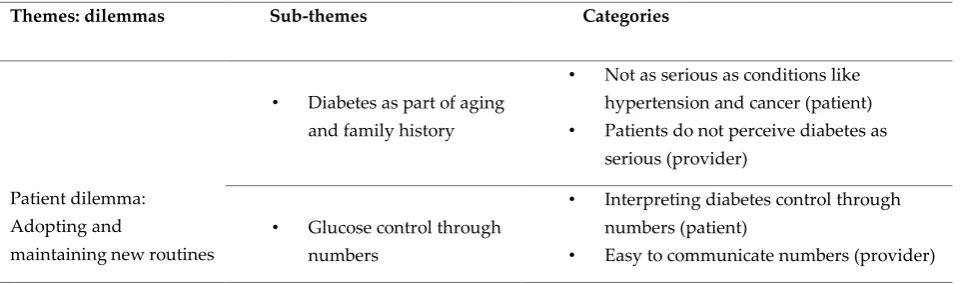
Two main themes were identified characterized by inherent dilemmas representing confusions and conflicts that patients and providers experience in their daily life or practice respectively:Adopting and maintaining new routines through practical and appropriate lifestyle choices from the patient perspective andbalancing expectations and pre-conceptions of self-management from the provider perspective. Providers and managers shared some views on self-management and when this was the case, the views are presented together in the text as healthcare providers’ perspective. The dilemmas are informed by four sub-themes presented in Table 3
Table 3: Results from participant interviews
Themes: dilemmas Sub-themes Categories
Patient dilemma: Adopting and
maintaining new routines
• Diabetes as part of aging and family history
• Not as serious as conditions like hypertension and cancer (patient) • Patients do not perceive diabetes as
serious (provider)
• Glucose control through numbers
• Interpreting diabetes control through numbers (patient)
through practical and appropriate lifestyle choices
Provider dilemma: Balancing expectations and pre-conceptions of self-management
• Tailoring of information and advice to fit daily life
• Insufficient information (patient) • Adopting selective recommendations
(patient)
• Ignoring impossible recommendations (patient)
• Cultural differences as a barrier to interaction (provider)
• Balancing opposing roles of
self-management responsibility (provider)
• Frustrations associated with sustaining change
• Realizing chronicity (patient)
• Stress and anxiety of monitoring glucose levels (patient)
• Belief in education to promote behavior change (provider)
• Coping with ‘difficult’ patients (provider)
• Differing views of self-management support
• Expecting support from family (patient) • Low expectation of support from friends
and peers
Diabetes as part of aging and family history
All of the patients in the study acknowledged that T2D is a part of the aging process dependent on their perceived genetic profile. The participants thought that it was normal to get T2D as one becomes older, as the majority of them had reportedly observed close relatives suffering from the disease. The patients also acknowledged that T2D was chronic but did not perceive it as fatal and reported that although one could have it for life, it was not as serious as having cancer or high blood pressure.
“…no, diabetes is sugar and a little sugar in the body is ok. Dad also had it, it is common to have diabetes.” (Male with T2D)
Providers echoed that many of their patients did not perceive themselves as ill and did not take their condition seriously enough. As a result, they felt that their patients were not keen on changing their dietary and physical activity behavior as per their recommendations.
“…They do not know they are sick. They say that they have a little diabetes, a little sugar that the body gets used to…” (Health provider)
Glucose control through numbers
Self-monitoring of blood glucose was a more common practice among younger patients than among older patients.
All the patients reported that it was easy to interpret diabetes control through numbers. The
‚numbers‛ referred to are readings from a blood glucose test that participants conducted at home or at the healthcare center. Participants used these numbers to interpret their sugar levels as high or low, which also gave them a reason to take action. For example, many participants reported perceiving a high blood sugar value as a signal to immediately exercise in order to bring the numbers back to normal. The ability to change the numbers by walking or running also gave them a sense of control over their blood glucose.
“Today I took the blood sugar test. I had about 7.6 that is ok. I panic when I get more than about 8 or 9.”(Female with T2D)
“... If you tell the patient that their blood sugar is high, you see no reaction, but if you give the numbers, you get a different reaction. And if you say then that it has improved, and then justify it with the numbers, then they get motivated.” (Health provider)
Tailoring of information and advice to fit daily life
All patients received self-management advice from a healthcare provider during their visits to the primary healthcare center, and they were informed about the need to change diet and physical activity habits and to stop alcohol and tobacco use. However, they found it challenging to fit the diet and physical activity recommendations into their day-to-day life. Some participants described that they adopted specific practices that were easy to follow. These included: reducing their intake of sweet foods like pastries, candy and sugar in tea, adding more fruit and vegetables to their daily meals or performing simple exercises like walking after meals. The older patients who had had T2D for a longer time only took medication to control their blood glucose and largely ignored the lifestyle
recommendations. They felt that the diet and physical activity recommendations were impossible to perform since they had several concomitant conditions (including heart disease).
“I am on medication for heart disease and high blood pressure. Diabetes is just one of the conditions that I am being treated for. At the health center they tell me what to eat and that I should walk at least one hour but I don´t like it. I am always tired and I have back pain so I cannot do much.” (Female with T2D)
The patients further pointed out that the lifestyle information they received from healthcare providers was not explicit as to what diet and physical activity practices were suitable for them or how to do them.
“…they told me, you must reduce your food, and exercise a lot…They just say you have to do that and that and that, but don’t tell you how. I need a plan with information on what to eat.” (Male with T2D)
A predominant concern was the uncertainty surrounding which foods were suitable for consumption.
All healthcare providers had the expectation that patients should take responsibility for
self-management. However, a majority of them were faced with a dilemma of deciding how much of the responsibility should be left to the patients. They tried multiple strategies for dealing with the patients. Some perceived their own role as giving patients instructions on what to do to manage their diabetes. Others mentioned that most of the patients do not follow the lifestyle advice recommended to them and attributed the above to the patients not taking their disease seriously. A majority thought that self-management tasks were too difficult for the patients who were already dealing with several other socioeconomic concerns including; family responsibilities, unemployment and poor
accommodation situations. They felt that it was their responsibility to support these patients.
“It is the patient’s responsibility, but a difficult one too. I often tell new patients that it is your responsibility but as a physician, you cannot just leave the responsibility to the patient. You cannot just say that it is his
responsibility, you have to help them.” (Healthcare provider)
The providers above mentioned that they were balancing roles in order to support the patients, i.e. they reported switching roles between ‚expert‛ and ‚facilitator‛ depending on the patient’s
and the illiterate. They did this by learning about the cultural food habits of these patients and listening to different patients’ opinions about treatment alternatives. Such cultural experiences were reported useful in the provision of appropriate lifestyle advice.
“…what I have discovered is, I have patients that have different food habits. So first I have to learn the culture and what they eat, and then I have to be able to give advice. There are Somalis, so you have to be able to learn their food. For example, I did not know that they eat a banana every meal.” (Healthcare provider)
Other healthcare providers found it difficult to adjust their roles, citing barriers such as a heavy workload and limited time for patients. Another challenge reported from the managers was the high staff turn-over in the health centers and lack of adequate resources to provide specialized care to the patients.
Frustrations associated with sustaining change
All the patients acknowledged that managing T2D was a lifelong responsibility and felt that their lives were restricted. This was mainly attributed to the strict dietary practices they felt they had to follow. Most patients felt trapped by the disease and all its requirements. They expressed that they had no freedom to eat whatever they wanted - including their favorite foods - like they did before they were diagnosedand this had affected their social lives. Some patients expressed that they no longer wanted to go to social gatherings because it was frustrating for them to watch others eat everything while they had to be restrictive in what they ate.
“…It is frustrating when you are out at barbecues with friends. Then they eat more while you eat just a little. No, I want to eat normally. I want to eat like them…‛ (Male with T2D)
The patients also expressed that sustaining dietary and physical activity routines was difficult as most of them had busy schedules, either working or taking care of their families, which they had to
prioritize over their diabetes. These difficulties were mainly expressed by women. They further reported that the difficulties were felt more during festive seasons, holidays and trips abroad as they had limited food choices and found it difficult to maintain the new routines
Other participants voiced feelings of frustration at not seeing substantial change in their blood glucose values even after persistently carrying out the new routines. In addition, participants who had lived longer with T2D (≥5 years) perceived self-monitoring of blood glucose as stressful and causing anxiety. For these participants, blood glucose was monitored only during medical consultations.
“…No, I no longer test my sugar at home, I used to get stressed and worried every time I tested my sugar. So I decided I will only do that when I go to the health center.” (Male with T2D)
“…sometimes we call and call and do not reach the patient. Maybe they have moved or are abroad for about 10 months. I don’t know what they do in their home countries. Some come back but with high glucose values. Others don’t come, so we also give up.”(Healthcare manager)
The providers felt the need to empower their patients to change behavior through education. However, they viewed diversity in culture pertaining to food, physical activity and treatment
perceptions as a barrier to interaction. The patients had various cultural beliefs and perceptions of care that the providers found challenging to address.
“What is problematic then is that, the perception of food, treatment and physical activity is perhaps different from what we are used to.”(Healthcare manger)
Additionally, it was reported that many persons in the study areas were mobile and often moved to better neighborhoods when their incomes improved or relocated to their home countries. This was experienced as a barrier to continuity of care.
Differing views of self-management support
For most patients, support for self-management was mainly expressed as a need for assistance with practical daily diet and physical activity tasks, mostly from close family members. Patients recognized family members (mainly spouses and children) as their core support in performing daily
self-management tasks. These tasks included preparing meals for them based on lifestyle
recommendations from their providers, accompanying them to clinic visits and encouraging them to exercise. Irrespective of which country they came from, men tended to rely more on support from family, particularly spouses, while women were more involved in deciding, and preparing their own meals.
“They try to help me with everything. My wife is trying to help me with the cooking and such.My wife watches what I eat. She makes a lot of salad, fish, chicken and little rice and no sugar. (Male with T2D)
In some instances, women received support and encouragement from older children for physical activity. Additionally, family members and relatives who were already managing T2D themselves were considered supportive in encouraging participants to change behavior. A few participants expressed frustration about family members who continuously instructed them on what to eat and avoid during meal times.
The patients also recognized that friends, work colleagues and peers could be helpful in motivating them to be physically active through conducting joint physical activities. However, there was an overall low expectation of help from this group due to lack of time and different work schedules, which did not allow them to meet regularly. Some men in particular were not keen about involving friends and peers in the management of their diabetes. They mentioned that, in their culture, illness was a private problem shared only with close family and healthcare providers. Others felt that no one else understood the experience of living with diabetes better than they themselves, leaving them with the responsibility of managing their own diabetes.
In comparison, several women were engaged in some form of network involving activities for only women e.g., water aerobics. They further expressed interest in peer group activities pertaining to physical activity exclusive to women as such activities gave them the opportunity to interact with fellow women.
“… A separate group is better because women have this thing, if it is a walk, men go fast but women are not as fast as men and during walking we can discuss and talk about some things… When women are alone, I do not know, but it’s better that way (Female with T2D).
Healthcare providers recognized the value of family support during self-management and
acknowledged that most of their patients were accompanied to consultations by family members often spouses and, or children. However, providers could not see the role of family members in the
consultation rooms and in the facility care process. The presence of relatives in the room was often perceived as an inconvenience. The providers were uncertain about how to address relatives and at the same time maintain patient privacy. They also added that there was hardly any engagement with the patients beyond the patient-provider interactions during the short consultations and that very few patients participated in other clinic-led activities, such as outdoor walking activities.
4. Discussion
We identified two overarching themes characterized by inherent dilemmas in T2D self-management that patients and providers experienced in their daily life or practice respectively, which are important to consider while providing health care that meets the needs of population. These will be discussed in terms of four main aspects that influence self-management listed below.
Diabetes perceptions
Irrespective of country of birth, patients in the present study perceived their disease as chronic but not fatal. Similar perceptions of T2D have been well-documented [20, 36, 54-56] according to these studies, that some patients either do not understand the seriousness of the disease [55, 56] or view the diagnosis from a religious and cultural perspective as fated by a higher power[36, 54]. In some of the studies, patients from African and Middle Eastern descent were found to perceive T2D as not serious and they attributed the disease to fate or supernatural factors like God or Allah [36, 54]. Such views have been shown to have consequences in patients’ uptake of lifestyle advice [57], often causing frustration for providers.
Provider perceptions in the present study reflected the frustrations inherent in their belief that patients do not understand the seriousness of the disease. Similar findings have been seen in previous studies [3, 13]. Since patients did not perceive themselves as ill, providers felt that patients did not give due seriousness to their condition and hence did not take adequate measures to control their disease. In contrast to providers’ view, a possible reason for patients’ lack of seriousness could be attributed to unfamiliarity with the signs and symptoms of T2D and thus a tendency to normalize these symptoms. Normalizing signs and symptoms of disease can be due to inadequate acknowledgement of the seriousness of disease, leading to lack of urgency to change behavior [21, 54, 58].
Providers and patients found it easy to communicate diabetes control status using numbers from blood glucose test readings. Patients understood the current status of their glycemic control and what they needed to do to achieve glycemic control. The numbers gave patients a more concrete understanding of what action to take at which time point. Our findings are in support of Andersen & Whyte’s view that numerical values such as glucometer measurements are perceived as true indicators of health, and contribute to a formative process that motivates or provokes an individual to do something about their risk or condition [59].
Numeracy skills, i.e. ‚the ability to understand and use numbers in daily life‛, are used by diabetes patients to assist with self-management tasks such as understanding glucose measurements, calculating medication doses (especially insulin) and interpreting dietary recommendations and nutrition labels [60]. High performance on a numeracy test developed and tested for diabetes has been found to have a significant correlation with higher diabetes knowledge and higher perceived self-efficacy [60, 61] but the association between numeracy skills and glycemic control has not been consistently demonstrated [62-64] [65]. In populations which face language barriers, numbers can become the single most important criterion for understanding disease status. From a medical viewpoint, reducing T2D to numbers without understanding what they mean could have adverse implications for care in the long term, since the numbers could denote short-term or long-term glycemic control depending on the test (e.g. fasting blood glucose and glycated hemoglobin, HbA1c).
From new routines to sustainable change
Patients found it difficult to implement self-management and struggled to adapt to the recommended lifestyle changes. Their main challenge was identifying suitable lifestyle practices and the practicalities of sustaining new routines, especially in relation to social occasions and holidays. A major dilemma was uncertainty about what foods were appropriate for consumption and in what proportions. This dilemma was also acknowledged by the providers, although they did not seem to consider this as a priority, being more concerned with providing clinical treatment. Moreover, providers perceived their responsibility to be restricted to providing instructions on self-management. These findings are consistent with those of another study in a similar setting in Sweden [20, 54], where participants with a Somali background reportedly found it difficult to follow dietary advice and perceived it as culturally inappropriate.
Self-management support
The present study, like earlier studies [3, 9, 66] reveals that the engagement of close family in self-management is perceived by patients to be very important since it assists them with daily self-management tasks. Need for support in daily self-management tasks, specifically deciding what food to prepare and how to prepare it was mostly reported by men than women. Similar views were voiced by the providers, although they expressed a dilemma in dealing with patients together with their relatives in the same consultation room and at the same time maintaining privacy. Gender differences in perceptions of family support have also been documented in other studies [3, 67, 68]. Men have been seen to, often depend on their spouses for support in self-management tasks while women tend to utilize their extensive network for support in stressful situations [3, 68]. Such differences could be influenced by the traditional or cultural backgrounds of the participants.
Support from close family members could enhance autonomous self-management among participants as a result of collective performance of self-management tasks, such as attending consultation visits together and offering emotional encouragement [14, 66]. Research suggests that support for self-management education and awareness-raising is a means to achieve behavior change [17]. The focus of self-management education has shifted to building the ‘how’ and the necessary skills to go with it, together with empowering and motivating individuals [17]. Some providers in the present study took the initiative to balance their expert and facilitator roles during consultations, i.e. listening to participants’ opinions about their treatment and giving patients advice according to their needs. This is a shift towards patient empowerment and a patient-centered approach to chronic disease management, which advocates collaboration between providers and patients in order to help patients achieve their own health goals [5]. However, providers’ efforts are often inadequate as they are not sufficiently equipped to handle the different cultural and social needs of their patients. Cultural incompetence among providers has been highlighted as a challenge and as a result, general practitioners reportedly ignore cultural differences during meetings with immigrant patients because they were uncertain of how to deal with the different cultural needs of the patients [25]. Moreover providers were seen to face a dilemma with respect to patients’ role in self-management; they expect the patient to take lead in the management of their diseases, but also think patients are incapable of managing their disease and thus they have to intervene [66].
Having high level of education may have an influence on patients’ engagement in self-management. However, in the present study, despite the variation in the level of education among participants with T2D, there was no significant difference in their perceptions or experiences of diabetes self-management. A possible reason could be that, the participants live in the same geographical location and share similar problems and limited resources including employment.
Methodological considerations
approach that focuses on the common characteristics of the population and less on the differences in ethnicity, culture, sex age, language, religion etc., and suggests reciprocity and accommodation as means to address diversity [48, 49]. A strength in the present study, is the consideration of the common characteristics of, living in the same geographical location and being an immigrant among the population and using the above characteristics as a basis for selection of the patient sample. In that way, the views, and experiences of different groups of people within the population are represented in the sample selected. For the same reason, the findings of this study are transferrable to other socioeconomically disadvantaged settings in high income countries with a high proportion of immigrants.
Another strength of the study was the interdisciplinary composition of the study team. It included doctors, a nutritionist, a medical anthropologist, a behavioral scientist and an endocrinologist, all with diverse public health skills and experience, which brought different perspectives to the study. The study sample was purposively selected. Participants with T2D included only those with access to the health facility for care and it is likely that hard-to-reach groups within this population were not included. The information power [35] of the study sample was considered sufficient as the aim of the study was specific and focused on self-management. In addition, triangulation of data sources and data collection methods made it possible to validate the core findings.
5. Conclusion
This study highlights dilemmas representing struggles and confusions that patients experience while adjusting to lifestyle recommendations and providers’ care practice. As patients struggled to adapt lifestyle recommendations to their everyday life, healthcare providers, sought to support the patients in this struggle, mainly through education, but felt that they are not adequately equipped to deal with the different cultural and social aspects of self-management. Understanding such dilemmas is
important as they influence the interaction and collaboration between patients and providers and in turn impact the uptake and utilization of self-management advice and services by patients. Thus they should be taken into consideration when designing self-management interventions in primary health care centers particularly in socioeconomically disadvantaged settings. Additionally, intercultural approaches should be further studies in dealing with diversity in the selection of study participants and implementing self-management interventions in socioeconomically disadvantaged settings with a high proportion of immigrants.
Supplementary Materials: The interview guides are publicly available and upploaded.
Author Contributions: JA, HMA, MD, SSP and CGO conceptualized and designed the study. JA developed the interview guide while HMA reviewed the guide. JA conducted the individual interviews and moderated the group interviews together with HMA. Preliminary analysis was carried out by JA while HMA and MD assessed and refined the analysis. PA, JDM, SSP and CGO reviewed the analysis and interpretation of data. JA compiled the first draft of the manuscript and coordinated the writing with MD and HMA. CGO, PA, JDM and SSP reviewed and edited the manuscript. All authors participated in development of the manuscript and approved the final manuscript.
Alliance for Chronic Diseases: Prevention and treatment of type 2 diabetes‛. The SMART2D consortium includes the following six partner institutions: Karolinska Institutet, Sweden; Institute of Tropical Medicine, Belgium; Collaborative Care Systems, Finland; Makerere University, School of Public Health, Uganda; University of Western Cape, School of Public Health, South Africa; and Uppsala University, Sweden. The content of this article is solely the responsibility of the authors and does not reflect the views of the EU. The study was also partly funded by the Karolinska Institutet Doctoral (KID) grant.
Acknowledgments: We would like to thank the study participants who agreed to take part in this study and research assistant Irma Nordin, who also helped collect data and the SMART2D consortium for the support.
Conflicts of Interest: The authors declare no conflict of interest.
References