1
Cell Sheets: From Delivery Tool to a Model of Guided Regeneration
Author list:
Peter P. Nimiritsky1,2 #, Roman Yu. Eremichev1 #,
Natalia A. Alexandrushkina1,2 #, MD Anastasia Yu. Efimenko1,2, MD, PhD Vsevelod A. Tkachuk1-3, DSc
Pavel I. Makarevich* 1,2, MD, PhD
Author affiliations
1 – Institute for Regenerative Medicine, Medical research and education center, Lomonosov Moscow State University, Moscow, Russia
2 – Faculty of Medicine, Medical research and education center, Lomonosov Moscow State University, Moscow, Russia
3 – Laboratory of Molecular Endocrinology, National medical research center of cardiology, Moscow, Russia
Abstract
Regeneration is a fundamental perpetual tissue process much attributed to functions of adult stem cell. In last decades delivery of adult stem cells to restore tissue structure is widely adopted in regenerative medicine. However, delivery of stem cells can not complete the task of human body regeneration effectively as far as cells need a basis to form a tissue. Certain improvement can be achieved when cells are organized to cells sheets (CS) – primitive tissue-engineered structures comprising of viable cells and ECM proteins. This led us to an assumption that after damage an intermediate feeder is structure formed as a ground for future tissue resulting in gradients of stimuli required to attract other cells (vascular, neural, epithelial, parenchyma etc.) in an organized manner.
This feeder acquires increasing heterogeneity and becomes a guiding feeder that provides basic level of organization to increase complexity of structure up to normal tissue. We also highlight potential role of adult mesenchymal stromal cells (MSC) as the main source of guiding feeder and support it by our recent knowledge of their biological function.
Finally, we assume that CS known to be a feasible delivery tool in therapeutics resemble guiding feeder and show our own data indicating properties of MSC-based CS. Furthermore, this concept shifts our understanding of therapeutic mechanism underlying a widely known delivery method for regenerative medicine.
1. Introduction: regeneration as a tissue process of guided organization
Living organisms possess an amazing ability to temporarily avoid perpetual increase of entropy stipulated by the Second law of thermodynamics and, thus, unavoidable destruction (which eventually occurs). This depends on another ability of living systems to utilize energy of the outer world and reduce internal entropy to keep their form/structure (e.g. to maintain chemical bonds and electrostatic interactions) which applies to all levels of organization - from single cell to tissue to whole organism [1].
Obviously, living organisms do not violate the Second law of thermodynamics, but manage to keep a balance between energy-dependent synthesis and spontaneous destruction constantly "re-creating" structures instead of those “destroyed by entropy”. This leads us to a rather mechanistic conclusion that a living system exists in homeostasis due to permanent renewal triggered by a fundamental law of nature [2, 3].
This law also underlies recovery from a much more intense and less fundamental factor - namely damage. Successful regeneration after destruction of tissue down to molecular level requires “recreation” of native structure [4]. This can be achieved by moving down the path from chaos of initial stages immediately after damage to formation and progressive complication of connections between synthesized elements eventually increasing order in the system and, thus, reducing entropy [5, 6].
Accumulated data suggests that regenerative potential of adult stem cell and outcome of its activation is defined by a combination of intrinsic abilities and conditions of environment that control, direct and support finely balanced stages of progenitor maturation and stem cell renewal [7]. Indeed, since Raymond Schofield’s seminal paper [8] cell biology has adopted the concept of stem cell as a “non-autonomous” unit depending on its environment (namely, the “niche”). Critical role of environment has also been supported by investigation focused on molecular and cellular processes that drive tissue development and postnatal regeneration in primitive animals that show marvelous abilities to rebuild body parts or even the whole organism (e.g. planarians or starfish). Even in these creatures “isolated” adult stem cells lack ability to drive full-scale regeneration and require certain volume of tissue with intact interactions between elements [9].
This hypothesis article suggests a view on human body regeneration pinpointing the following points:
1. Early stages of regeneration result in formation of a stromal cell feeder that serves a basis for future increase of complexity during tissue formation; 2. Increase of complexity in the feeder results in tissue-like interactions
between cells and heterogeneous structure and gradients of stimuli that play a potential guiding role for other cell types (guiding feeder);
3. Adult mesenchymal stromal cells (MSC) are the most prominent candidate cell type as a main producer of guiding feeder.
2. Guiding feeder: stromal cells as organizers of regeneration
2.1 Tissue as an ecosystem and sequential recovery of its hierarchy during regeneration
To form the basis of our concept we address classical principles that we need to keep in mind. First of all, proper function of an organ/tissue depends on 2 crucial factors:
1. Correct structure with normal topography of various cell types in their specific locations (compliance to an evolutionary-developed morphological “blueprint”). Physical stability of structure is supported by connections between elements: direct cell-to-cell contacts, interaction of cells with extracellular matrix (ECM) etc.
2. Integration of elements in a regulatory network tightly bound to the structure. Indeed, all cells in the tissue are and exchanging signals: soluble proteins, metabolites and electrochemical stimuli. Most of these signals distribute through the tissue and form gradients that result in different local microenvironments.
Crucial role of both listed features is a long-standing concept in physiology known as “unity of function and structure” [10]. Briefly speaking, to work effectively the tissue must have normal topography and undisturbed regulatory interactions between cells.
Furthermore, as the more specialized the cell becomes the more demanding it turns requiring accurate location and a definitive set of signals to maintain its correct function. Indeed, correct regulation and functional environment are extremely important for cells with finely tuned functions - e.g. adult stem/progenitor cells or parenchyma.
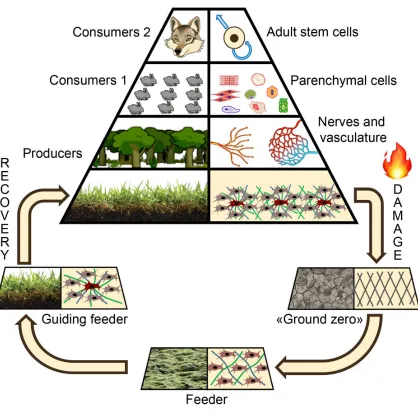
The metaphor above is useful not only for explanation of how normal tissue is organized, but to describe tissue repair either. Severe damage to tissue results in loss of structure, and disruption of hierarchy with regulatory framework that has existed. In ecology this is similar to destruction of the ecosystem - e.g. a forest fire with complete burnout of vast areas to ashes and loss of all inhabitants of the ecosystem (Fig.1).
Below, we summarize the most important points and show allusion between the regenerating tissue and the forest ecological niche. After a fire the site of catastrophe can not be immediately re-populated by the species from the top of food chain, but will undergo slow restoration of structure and hierarchy from the bottom starting with the most adaptive and viable species. When they generate a necessary trophic substrate then more demanding species can enter this system and populate it. Gradually the species diversity and biological capacity of entire ecosystem increases and both - structure and hierarchy is restored.
Extrapolated to the tissue this example illustrates the crucial role of early stages in tissue regeneration when a community of cells is formed to restore basic elements of microenvironment. Putative sequence of events generally corresponds in early stages generally corresponds to well-known reparative regeneration reaction:
1. Immediately after damage involved area is cleansed by inflammatory response. However, this phase leaves a “ground zero” with completely disrupted structure of the tissue down to the molecular level.
2. After cease of acute phase of inflammation stromal cells with a major fraction of MSC migrate to the damaged area and actively attenuating intensity of residual inflammation and proliferate.
3. When stromal cells are activated by local conditions after injury they produce basic elements of any tissue: ECM and trophic paracrine factors that attract and maintain the function of other cells. At this stage the ground is made for future restoration of tissue and stromal cells serve as a feeder.
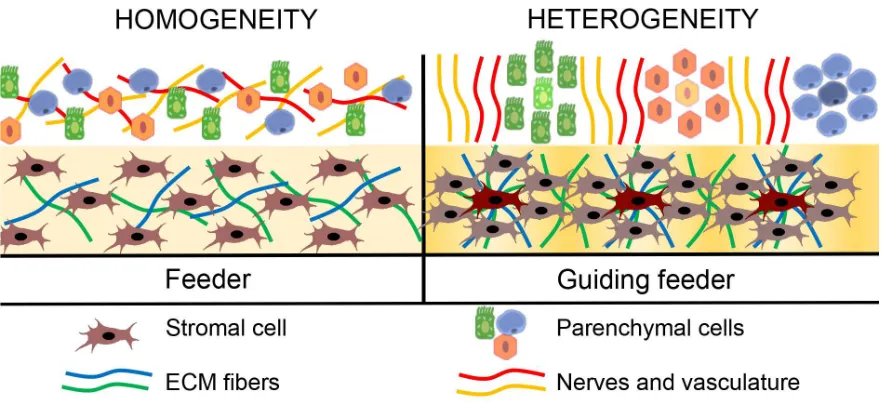
undergoes a stage of maturation and believe it to be a tissue-like structure and apply the term “guiding”. Both concepts arise from events occurring between the phase of basic tissue elements recovery and restoration of structure specialization:
4. ECM and paracrine factors produced by the feeder inevitably result in strengthening of intercellular interactions between the stromal cells. Eventually they self-organize and form areas of heterogeneity with differential production of structural factors and soluble proteins resulting in a gradient of stimuli. At this point the system is no longer just a sum of stromal cells, but has heterogeneous structure and forms hierarchy between elements.
5. As structural heterogeneity in feeder increases it results in signal gradient formation and, thus, specific areas of the feeder attract specific cell types. Some of them provide vascular nutrition and neural trophic rebuilding middle part of the “pyramid” (Fig. 1-2) making ground for the most specialized elements - stem/progenitor cells and parenchyma that stand on ttop of hierarchy. Frankly speaking, heterogeneity of feeder tissue serves a “guiding light” for further restoration of structure so we suggest the term guiding feeder for this system.
thus, fail to organize other cell types. Right panel: guiding feeder forms a distinct pattern of factors (ECM, secreted stimuli etc.) and hierarchy of elements eventually guiding other cell types to specific locations.
2.2 Mesenchymal stromal cells as main structural elements of the guiding feeder
Among numerous cell types of human body (with over 250 types identified) we find MSC to be a prominent candidate the main cellular source of suggested guidance feeder. This assumption results from our understanding of their function in development, mature tissue maintenance and regeneration.
MSC are active participants of tissue formation since ontogenetic development [12]. Early stages of development are driven by embryonic stem cells’ (ESCs) ability for self-organization yet later they rely on other cells that carry out “mapping” tissue microstructure by gradients of morphogenetic factors [13]. One of prominent examples in a very complex organ is crucial role of radial glia in development of central nervous system. Indeed, ablation of radial glia leads to severe brain malformations [14]. Furthermore, radial glia shares common characteristics with adult MSC (e.g. vimentin-positive intermediate filaments) and known to operate via active secretion of potent morphogens similarly to MSC. Thus, once certain cell type acts as structure organizer since development it may potentially retain this function in postnatal period for renewal and regeneration of tissue.
are involved in maintaining of structure and cellular homeostasis of healthy tissue [17].
However, after damage MSC show prominent abilities that are prerequisites for their potential role of a main cellular source for the guiding feeder described above.
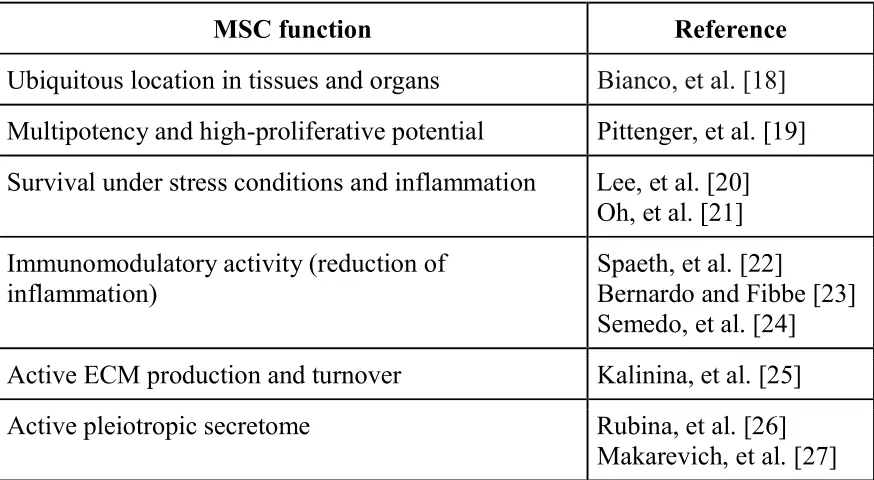
Table 1. MSC biological properties that support its role as a cellular source of guiding feeder
MSC function Reference
Ubiquitous location in tissues and organs Bianco, et al. [18] Multipotency and high-proliferative potential Pittenger, et al. [19] Survival under stress conditions and inflammation Lee, et al. [20]
Oh, et al. [21] Immunomodulatory activity (reduction of
inflammation)
Spaeth, et al. [22]
Bernardo and Fibbe [23] Semedo, et al. [24] Active ECM production and turnover Kalinina, et al. [25] Active pleiotropic secretome Rubina, et al. [26]
Makarevich, et al. [27]
the growth of blood vessels and nerves. Thus, we see that MSC possess all features required to produce the feeder.
However, the main part - the “guiding” function of the feeder seems completely elusive from our recent knowledge and depends on a complex and heterogeneous structure making it marginally unexplorable in vivo. However, in our numerous works focused on developing new stem cell delivery methods [27, 29, 30] we stumbled upon widely disregarded spontaneous heterogeneity in CS from MSC which hinted their use as a potential ex vivo model of suggested guiding feeder. Below we provide a brief overview to support choice of model object and provide our preliminary data.
3.Potential ex vivo model of guiding feeder 3.1 Cell sheet technology: basics and application
Cell Sheets (CS) are scaffold-free tissue-engineering constructs consisting of cells and ECM accumulated in cultural conditions. Formation of CS varies in time (3-14 days) and depends on cells proliferation, ECM and paracrine factors production resulting in a multilayered construct that readily detaches from the dish by different methods (treatment with EDTA solution [30], thermo-responsive coating [31] etc.).
urinary bladder, heart, blood vessels, esophagus, cornea etc [36]. Nevertheless, despite the practical significance of CS technology, the mechanisms underlying cell self-organization, ECM deposition and formation of intercellular contacts have not been studied.
3.2 Using cell sheets as a model object to study guiding feeder properties
MSC of different sources readily form CS and we lately have focused on experimental proof of their efficacy in numerous disorders ranging from wound healing to myocardial ischemia [29, 37, 38]. However, concept of MSC as a source of guiding feeder drew our attention to the fact that MSC-derived CS show vivid spontaneous heterogeneity despite being initially seeded from a relatively homogeneous cell population. Furthermore, this heterogeneity is formed after a certain period of time and brings up the “missing” link - formation of focal stimuli which we stress as a crucial factor of tissue organization and regeneration after damage. In this final part we focus on our preliminary data that reveal distinctive similar features of MSC-derived CS and putative guiding feeder described above. For details of experimental procedures please address supplementary Materials and methods online.
3.2.1 Spontaneous formation of morphological heterogeneity
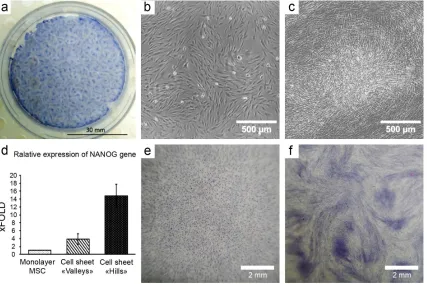
During culture MSC form CS and then spontaneously show heterogeneity of cell density corresponding to putative stage of guiding feeder maturation. Two distinct compartments are formed: 1) compact multi-layered aggregates 300-500 microns wide with increased density of cells (“hills”) surrounded by 2) areas with cell density similar to confluent MSC culture (“valleys”). Both of them are visible macroscopically in a dish (Figure 3, a) and can be discerned one from another under magnification (Figure 3, b and c).
coordinated contracting and movement of cells and their groups relative to each other (Supplementary video 1).
Figure 3. Self-organization of MSC in vitro results in formation of heterogeneous environment in cell sheets
a. Heterogeneous distribution of MSC in mature CS; hematoxylin staining;
b. Self-organization of MSC in CS results in formation of hills; hematoxylin staining;
c. Self-organization of MSC in CS results in formation of hills (snapshots from Supplementary video 1); microphotography, phase contrast.;
d. MSC subpopulations were picked by laser microdissection. MSC in the “hills” show increased expression of stemness-associated factor (NANOG); real-time qPCR (n=3); data expressed as mean ± standard deviation are shown.
Spontaneous formation of feeder heterogeneity (“hills and valleys”) may have functional outcome. Namely may provide more or less favorable conditions for different MSC subpopulations or shift MSC differentiation status due to environment changes. Using laser microdissection we compared relative expression of stemness-related gene NANOG in MSC from different microenvironments. We compared monolayer culture to separately studied “valleys” and “hills” laser-dissected from a CS imitating mature guiding feeder. We found that “hills” showed significantly increased expression of NANOG than monolayer or “valleys” of same CS (Figure 3, d). It suggested that guiding feeder (or CS) heterogeneity results in either sorting of different cells to different compartments of the construct or local shift of stemness - in particular, higher NANOG expression. In any case, this set of data is an evidence that structural heterogeneity is accompanied by changes of MSC status in situ which resembles primitive hierarchy and putatively related to focal gradients of stimuli in the guiding feeder.
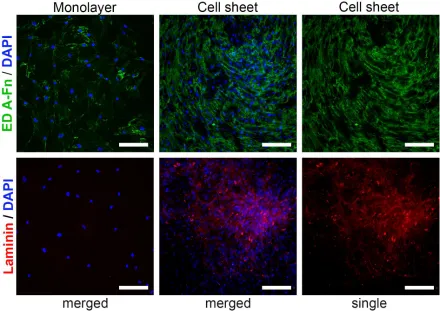
3.2.3 Cell distribution heterogeneity correlates with heterogeneity of ECM distribution
Figure 4. Heterogeneity of ECM deposition in CS compared to monolayer. During formation of cell sheet MSC organise EDA-Fibronectin in regular network of fibres (upper row); laminin shows a distinct pattern of deposition primarily in “hills”, but not in “valleys” creating foci of heterogeneity in CS. Immunofluorescent microscopy, nuclei are stained by DAPI.
4. Conclusions
Presented concept of guiding feeder is a subject for discussion; however, it drives us to shift the focus from “cell-censtristic” approach in regenerative medicine to “tissue-centristic” view on human body regeneration after damage. To conclude, we shall summarize the main points of the hypothesis we promote by this article:
1. Regeneration as a process is characterized by increase of heterogeneity and complexity of intercellular communications that define tissue topography and organization to ensure function;
3. Initial stages of regeneration are potentially stem cell-independent, but they lay ground of a feeder enriched with ECM and secreted factors;
4. Self-organization of feeder tissue results in formation of focal stimuli - the distinctive feature of guiding feeder - becoming the basis of further successful regeneration
5. Mesenchymal stromal cells (MSC) are a putative source of the guiding feeder tissue and its components due to their ubiquitous location and biological properties
References
1. Lehninger, A. L.; Nelson, D. L.; Cox, M. M., Principles of biochemistry. 2nd ed.; Worth Publishers: New York, NY, 1993; p xli, 1013, 77 p.
2. Koshland, D. E., Jr., Special essay. The seven pillars of life. Science 2002,
295, (5563), 2215-6.
3. Zotin, A. I.; Zotina, R. S., Thermodynamic aspects of developmental biology. J Theor Biol 1967, 17, (1), 57-75.
4. Agata, K.; Saito, Y.; Nakajima, E., Unifying principles of regeneration I: Epimorphosis versus morphallaxis. Dev Growth Differ 2007, 49, (2), 73-8. 5. Rinkevich, B.; Rinkevich, Y., The "Stars and Stripes" Metaphor for Animal
Regeneration-Elucidating Two Fundamental Strategies along a Continuum. Cells 2012, 2, (1), 1-18.
6. Sena, G.; Birnbaum, K. D., Built to rebuild: in search of organizing
principles in plant regeneration. Curr Opin Genet Dev 2010, 20, (4), 460-5. 7. Morrison, S. J.; Spradling, A. C., Stem cells and niches: mechanisms that
promote stem cell maintenance throughout life. Cell 2008, 132, (4), 598-611.
8. Schofield, R., The relationship between the spleen colony-forming cell and the haemopoietic stem cell. Blood Cells 1978, 4, (1-2), 7-25.
9. Tanaka, E. M.; Reddien, P. W., The cellular basis for animal regeneration. Dev Cell 2011, 21, (1), 172-85.
10. Saladin, K., Anatomy and physiology: The unity of form and function. 2007.
Ohio: McGraw-Hill 2010.
11. McCusker, C. D.; Gardiner, D. M., Positional Information Is Reprogrammed in Blastema Cells of the Regenerating Limb of the Axolotl (Ambystoma mexicanum). PLoS ONE 2013, 8, (9).
12. Gilbert, S. F.; Barresi, M., DEVELOPMENTAL BIOLOGY, 2016.
13. Li, N.; Xie, T.; Sun, Y., Towards organogenesis and morphogenesis in vitro: harnessing engineered microenvironment and autonomous behaviors of pluripotent stem cells. Integrative Biology 2018, 10, (10), 574-586. 14. Barry, D. S.; Pakan, J. M.; McDermott, K. W., Radial glial cells: key
organisers in CNS development. The international journal of biochemistry & cell biology 2014, 46, 76-79.
15. Kosinski, C.; Li, V. S.; Chan, A. S.; Zhang, J.; Ho, C.; Tsui, W. Y.; Chan, T. L.; Mifflin, R. C.; Powell, D. W.; Yuen, S. T., Gene expression patterns of human colon tops and basal crypts and BMP antagonists as intestinal stem cell niche factors. Proceedings of the National Academy of Sciences 2007,
104, (39), 15418-15423.
16. Kfoury, Y.; Scadden, D. T., Mesenchymal cell contributions to the stem cell niche. Cell stem cell 2015, 16, (3), 239-253.
17. Klimczak, A.; Kozlowska, U., Mesenchymal stromal cells and tissue-specific progenitor cells: their role in tissue homeostasis. Stem cells international 2016, 2016.
18. Bianco, P.; Cao, X.; Frenette, P. S.; Mao, J. J.; Robey, P. G.; Simmons, P. J.; Wang, C.-Y., The meaning, the sense and the significance: translating the science of mesenchymal stem cells into medicine. Nature medicine 2013,
19, (1), 35.
19. Pittenger, M. F.; Mackay, A. M.; Beck, S. C.; Jaiswal, R. K.; Douglas, R.; Mosca, J. D.; Moorman, M. A.; Simonetti, D. W.; Craig, S.; Marshak, D. R., Multilineage potential of adult human mesenchymal stem cells. science
1999, 284, (5411), 143-147.
20. Lee, S.; Choi, E.; Cha, M.-J.; Hwang, K.-C., Cell adhesion and long-term survival of transplanted mesenchymal stem cells: a prerequisite for cell therapy. Oxidative medicine and cellular longevity 2015, 2015.
mesenchymal stem cells to burn injury sites and their therapeutic effects in a living mouse model. Journal of Controlled Release 2018, 279, 79-88.
22. Spaeth, E.; Klopp, A.; Dembinski, J.; Andreeff, M.; Marini, F., Inflammation and tumor microenvironments: defining the migratory itinerary of mesenchymal stem cells. Gene therapy 2008, 15, (10), 730. 23. Bernardo, M. E.; Fibbe, W. E., Mesenchymal stromal cells: sensors and
switchers of inflammation. Cell stem cell 2013, 13, (4), 392-402.
24. Semedo, P.; Palasio, C. G.; Oliveira, C. D.; Feitoza, C. Q.; Gonçalves, G. M.; Cenedeze, M. A.; Wang, P. M.; Teixeira, V. P.; Reis, M. A.; Pacheco-Silva, A., Early modulation of inflammation by mesenchymal stem cell after acute kidney injury. International immunopharmacology 2009, 9, (6), 677-682.
25. Kalinina, N.; Kharlampieva, D.; Loguinova, M.; Butenko, I.; Pobeguts, O.; Efimenko, A.; Ageeva, L.; Sharonov, G.; Ischenko, D.; Alekseev, D., Characterization of secretomes provides evidence for adipose-derived mesenchymal stromal cells subtypes. Stem cell research & therapy 2015, 6, (1), 221.
26. Rubina, K.; Kalinina, N.; Efimenko, A.; Lopatina, T.; Melikhova, V.;
Tsokolaeva, Z.; Sysoeva, V.; Tkachuk, V.; Parfyonova, Y., Adipose stromal cells stimulate angiogenesis via promoting progenitor cell differentiation, secretion of angiogenic factors, and enhancing vessel maturation. Tissue
Engineering Part A 2009, 15, (8), 2039-2050.
27. Makarevich, P. I.; Boldyreva, M. A.; Gluhanyuk, E. V.; Efimenko, A. Y.; Dergilev, K. V.; Shevchenko, E. K.; Sharonov, G. V.; Gallinger, J. O.; Rodina, P. A.; Sarkisyan, S. S., Enhanced angiogenesis in ischemic skeletal muscle after transplantation of cell sheets from baculovirus-transduced adipose-derived stromal cells expressing VEGF165. Stem cell research & therapy 2015, 6, (1), 204.
29. Dergilev, K.; Tsokolaeva, Z.; Makarevich, P.; Beloglazova, I.; Zubkova, E.; Boldyreva, M.; Ratner, E.; Dyikanov, D.; Menshikov, M.; Ovchinnikov, A.; Ageev, F.; Parfyonova, Y., C-Kit Cardiac Progenitor Cell Based Cell Sheet Improves Vascularization and Attenuates Cardiac Remodeling following Myocardial Infarction in Rats. Biomed Res Int 2018, 2018, 3536854. 30. Dergilev, K. V.; Makarevich, P. I.; Tsokolaeva, Z. I.; Boldyreva, M. A.;
Beloglazova, I. B.; Zubkova, E. S.; Menshikov, M. Y.; Parfyonova, Y. V., Comparison of cardiac stem cell sheets detached by Versene solution and from thermoresponsive dishes reveals similar properties of constructs. Tissue Cell 2017, 49, (1), 64-71.
31. Okano, T.; Yamada, N.; Sakai, H.; Sakurai, Y., A novel recovery system for cultured cells using plasma-treated polystyrene dishes grafted with poly(N-isopropylacrylamide). J Biomed Mater Res 1993, 27, (10), 1243-51.
32. Aguado, B. A.; Mulyasasmita, W.; Su, J.; Lampe, K. J.; Heilshorn, S. C., Improving viability of stem cells during syringe needle flow through the design of hydrogel cell carriers. Tissue Eng Part A 2012, 18, (7-8), 806-15. 33. Kushida, A.; Yamato, M.; Isoi, Y.; Kikuchi, A.; Okano, T., A noninvasive
transfer system for polarized renal tubule epithelial cell sheets using temperature-responsive culture dishes. Eur Cell Mater 2005, 10, 23-30; discussion 23-30.
34. Chen, L.; Xing, Q.; Zhai, Q.; Tahtinen, M.; Zhou, F.; Chen, L.; Xu, Y.; Qi, S.; Zhao, F., Pre-vascularization Enhances Therapeutic Effects of Human Mesenchymal Stem Cell Sheets in Full Thickness Skin Wound Repair. Theranostics 2017, 7, (1), 117-131.
35. Roh, J. L.; Lee, J.; Kim, E. H.; Shin, D., Plasticity of oral mucosal cell sheets for accelerated and scarless skin wound healing. Oral Oncol 2017,
75, 81-88.
37. Hsu, M. N.; Liao, H. T.; Li, K. C.; Chen, H. H.; Yen, T. C.; Makarevich, P.; Parfyonova, Y.; Hu, Y. C., Adipose-derived stem cell sheets functionalized by hybrid baculovirus for prolonged GDNF expression and improved nerve regeneration. Biomaterials 2017, 140, 189-200.
38. Makarevich, P. I.; Boldyreva, M. A.; Gluhanyuk, E. V.; Efimenko, A. Y.; Dergilev, K. V.; Shevchenko, E. K.; Sharonov, G. V.; Gallinger, J. O.; Rodina, P. A.; Sarkisyan, S. S.; Hu, Y. C.; Parfyonova, Y. V., Enhanced angiogenesis in ischemic skeletal muscle after transplantation of cell sheets from baculovirus-transduced adipose-derived stromal cells expressing VEGF165. Stem Cell Res Ther 2015, 6, 204.